Search Results: "ema"

1 September 2007

Erich Schubert: Postfix under siege

Many people will have seen their postfix reporting new errors these days, like if is overloaded:
postfix/master[7287]: warning: service "smtp" (25) has reached its process limit "100": new clients may experience noticeable delays
This is not really because your system is overloaded. To me, it looks more like a (deliberate?) malfunction of some spammers software. When you rejected it's spam mail a few times, it starts opening up lots of connections to your system, but never sends any data. They just sit there and time out.The solution is simple: limit the number of connections per client. Make sure the 'anvil' service is enabled (default at least on Debian) and then add
smtpd_client_connection_count_limit = 10
to your postfix configuration.You should now begin to see messages such as
postfix/smtpd[21680]: warning: Connection concurrency limit exceeded: 11 from unknown[210.210.247.52] for service smtp
A corean cable IP. Yeah, I don't think this would have been legitimate mail traffic anyway.Feel free to pick the limit value even lower than 10 on really busy systems (or if these 'attacks' become stronger) - most people should never need more than 2 parallel connections (note: you can send multiple emails over one connection, there isn't much to be gained by using more than one connection).

Junichi Uekawa: Has info-lookup-symbol keybinding changed?

Has info-lookup-symbol keybinding changed? Apparently, it has. Personally, 'C-h S' is much harder to type for me than 'C-h C-i'. I've added this configuration to .emacs to work around the problem. (define-key help-map "\C-i" 'info-lookup-symbol)

31 August 2007

Simon Richter: Carbon emissions

Russell thinks that trading emission "rights" individually would decrease emissions. The global emission market has shown quite the opposite happening, countries that have no industry and did not contribute to the problem now sell their rights to industrial countries, with the net effect being as if all these countries suddenly became industrialized over night. I don't think anything different would happen at an individual level. The fundamental problem is this: emission rights trading happens only when buying rights is cheaper than actually reducing your emissions. When this is relatively cheap, you remove any incentive to develop better processes in individual companies; if it is more expensive, most industries will remain at the status quo (no emission trading) while those where it still makes sense fiscally now have an alternative, which diminishes the market for technology companies specializing in filtering technology and process optimization (i.e. it becomes even more expensive to behave environmentally conscious). At the same time, the cost of buying these rights from individuals will be passed on to the consumer, the only way to get this money back will be to sell off their emission rights. From a macroeconomic perspective, no money ever changes hands, but you have effectively transferred the individual emission rights over to the industry. Looking at individuals, you are penalizing those that behave environmentally conscious and neither use their "rights" nor sell them. So, emission rights trading is a really bad idea.

Ross Burton: Evolution Lovers and Haters

Evolution (the email client, not the theory) really seems to bring out extreme emotions in its users.
RP: pgc: I'm with you, I hate evolution
dodji: yay
dodji: evo haters fanclub
chris: I also hate Evo, but everyone here loves it and wants to have its babies
ross: I've had evo's babies
chris: ross: I bet there were random duplicates
Poor Evolution. NP: Directions LP, Acroplane

Biella Coleman: OA for Books vs Journals

Peter Suber provides a nice summary of the debatesaround Open Access for books vs. journals. The debate started when Karl Fogel posted a comment on my blog asking about the licensing terms for the recently released Decoding Liberation. Tonight Karl, Scott, and Samir will meet for the first time at my house. I imagine the conversation will continue to be lively!

Russell Coker: Interesting Ideas from George Monbiot

Here is a transcript of a lecture by George Monbiot about climate change and what we need to do. The latest scientific evidence suggests that we need to cut emissions to zero by 2030 to avoid significant increases in the sea level over the next century, George describes some options that will form part of a solution to this problem. Below are my comments on what I consider the most interesting (the ideas that I hadn’t heard of before), I recommend reading the full article for the rest.
  1. Have a carbon ration for each citizen. Wealthy people who want to use more resources could buy carbon rations from poorer people on an open market. That way people who use less than their ration still have an incentive to save more because the extra savings are worth money! As everyone would then have a financial incentive to reduce emissions there would be a lot of new development of methods and technologies for eliminating or compensating for carbon emissions, capitalism works!

  2. Build battery powered cars with interchangeable batteries. The idea is that you rent a battery from a fuel company, and whenever it runs low you go to a service station and swap it for a fully charged battery (for a small fee). If doing this the service station could use cheap night-time electricity to charge the batteries, and the batteries that are charged could be used to put electricity back into the grid at times of peak demand. A common idea is to have Prius+ type vehicles charge from the grid when not being used and then sell electricity back to the grid at peak times. Implementing such a system for millions of homes is technically challenging and expensive. But having a much smaller number of service stations sell larger quantities of electricity back to the grid is easier to manage.

  3. Reduce air travel by 90%. I wonder how much of this can be achieved by using high-speed trains for all national travel systems and for most travel within the EU. I have often travelled between Amsterdam and London by train, it’s much more civilised than flying.

  4. Classic quote from George on John Howard: “if Howard believes a slight reduction in consumption is a recessionary measure he ought to see what a total reduction of land area would be as a result of the melting of the west Antarctic ice sheet. The two things are just completely out of proportion..”

George Monbiot also has recently released a new book Heat: How to Stop the Planet from Burning.

Erinn Clark: My new furniture

Pink. Victorian. Vulvacious.

I have the most emasculating living room ever.

30 August 2007

Chris Lamb: Strawman

We have a somewhat esoteric heating arrangement at my parent’s house. We burn bales of bean straw inside a large combustion chamber (similar to these) which is located in an out-house to the main building. A number of water-filled pipes run through the chamber which is then pumped around the house. Environmentally, it’s really good. Most of the straw would have been burnt anyway (the rest cut into the soil) and the combustion is fan-assisted to minimise incomplete combustion. Very little ash is produced from burning such a bale. Anyway, the delivery and storage of approximately 700 straw bales has become a yearly tradition in our house. As a guide, the trailer in the picture below is holding 160. It’s pretty tough going: even individually these things weigh a considerable amount, and they require removing from the trailer and then stacking in a 3 metre pile inside another shed! You quickly adopt the rules of moving a bale as little as possible vertically (carry them on your back if you’re young enough!), and never, ever, moving a bale twice. There’s also a large amount of dust, and a geek’s delicate palms quickly tire of the string holding the bales together. Anyway, this happened today on a couple of hours notice. The other two males in the house decided to be elsewhere *cough*, leaving it up to me and my poor mum. If anyone was expecting email/code/chat/info today.. sorry.

Biella Coleman: Collective Communications Campus

Collective Communications Campus is a very handy new blog covering news and information on NYC area communication, journalism, and media graduate departments, programs, lectures, and classes.

29 August 2007

David Welton: "Playing fetch" with DocBook

A while ago I wrote about the idea of "playing fetch" - meaning chasing after programming "sticks" that are basically makework. I am starting to get the feeling that the documentation system that I chose for Hecl is one such stick. I've been trying to document that lcdui commands that Wolfgang created last year. They're really cool, and give you access to pretty much everything you can do from Java, but cranking out these docs is sure time-consuming. Here's an example:
<refentry id="lcdui_date">
  <refnamediv>
<refname>lcdui.date</refname>
<refpurpose>Date/Time widget for lcdui forms</refpurpose>
  </refnamediv>
  <refsynopsisdiv>
<cmdsynopsis>
  <command>lcdui.date</command>
  <arg choice="opt">
    -date
    <replaceable>date/time in seconds</replaceable>
  </arg>
  <arg choice="opt">
    -label
    <replaceable>label</replaceable>
  </arg>
Once you finally slog through and create the documentation, it's very flexible, because you have not created just formatting instructions, but actually described each piece of the text. But... look at how often things get repeated. Aside from the repetitive XML tags, lcdui.date is more or less there three times. Ugh. Emacs + psgml mode helps some, but I still get the feeling I got suckered into doing something that should only be attempted by Big Corporations or at least large, well established projects that can afford to send people off to spend lots of time producing this kind of documentation.

John Goerzen: Desktop Linux: Gnome

I had been intending to write an entire series of posts about our corporate switch to Linux on the Desktop. To date, I wrote only one introducing the project and our reasons for switching from Windows. That was back in April.

Today I'd like to start talking about it all some more.

We have standardized on Gnome for our desktops. Given the Windows background of our user base, it was pretty much a given that we would have to use either Gnome or KDE. Something like fvwm or a non-integrated environment just wouldn't be a good option.

We evaluated both Gnome and KDE. The very "clean" appearance of Gnome was a nice thing for us. KDE seemed to be to "chatty", talked about entering in audiocd:/ when it shouldn't have needed to, and generally violated the KISS and principle of least surprise too often. That said, I continue to run KDE for my personal desktop because Gnome just doesn't have the flexibility that KDE does. It is too bad that Gnome has gone on this remove functionality kick, and KDE hasn't gotten the KISS religion yet.

Anyway, Gnome worked well for the most part. We have set some defaults in gconf for things like panel icons. We also set a few mandatory defaults. I fixed a couple of bugs in the vfs system related to nfs4 support, which manifested themselves as icons for files newly saved to the desktop never showing up.

We wanted to present a customized menu to people based on what their job function is. That is, we are using a single system image, so all apps will be installed on all machines. But we didn't want people to have to see a ton of software that they don't use. That was easily enough accomplished for custom apps by creating desktop files with mode 0640 and setting the group to the set of people that should see the program on their menu. We removed a few stock programs (such as the terminal) from the menu as well, using dpkg-statoverride. That was also quite easily done. However, I will say that the entire Gnome XDG menu thing is woefully under-documented.

We use Firefox for the standard web browser. It is integrated well enough with Gnome and we have no problems there, aside from sites that are IE-only. We solve that with a Windows terminal server, which I'll discuss later.

Our network printing was already based on Cups. The individual machines are set up as Cups clients only, which works fine. We did find, however, that gnome-cups-manager automatically installs a tray monitor for cups. This monitor puts little printer icons on the tray when printers are in use. Unfortunately, it figures out which printers are in use by polling the server, and it is turned on by default out of the box, with no good way to disable it short of dpkg-statoverriding it to 0000. You can imagine that hundreds of users times dozens of printers times numerous polls per minute created quite the load on the server. This was a really braindead design and the people that wrote it should have known better. It is also quite useless to have icons coming on for all the printers on the network, which on some networks could be thousands, and not even on the same continent as the user.

Printing is generally a bit iffy in Gnome. They seem to be transitioning between about 3 different printing toolkits, all of which have different print dialog boxes with different supported features and different ways of selecting printers. One chief annoyance is that the print box in evince (the document/PDF viewer) does not let people access printer-specific features such as hole punching and stapling. So we installed gtklp and xpdf for people. The people that print heavy PDFs are huge fans of gtklp these days; it's a nicer solution than we had in Windows. Nobody really likes evince. We also have had some trouble with evince generating PostScript output that some printers can't grok. It sounds like all this should be much better in newer versions of Gnome, which if true, would be welcome news.

The Gnome screenshot tool makes it easy to save off a screenshot to a file, or to drag it into an email, but it is difficult to print it (you have to save it first). That was a common complaint around here, so I wrote a little wrapper around xwd and gtklp for printing screenshots. People really like that because gtklp gives them lots of options about orientation and size of the image if they want it, or a simple "Print" button to click if they don't care. We set a gconf default to bind this to Ctrl-PrintScr and it works well. KDE's screenshot tool is much more capable, and if we were using KDE, we wouldn't have had any problem with screenshots.

The bottom line on Gnome is that we, and are users, are happy with it after we've made these customizations. But we have had to do more customization that we should have. I still think that Gnome has been better for our users than KDE, but I do wonder how long we'll be able to survive with our "no KDE libraries" policy, as people want ksnapshot, kolour, etc.

MJ Ray: Announcement

"BOWN. Walter Sydney (Wally). Passed away on Monday, August 20th, 2007, aged 74 years. He will be greatly missed by all of his family and friends. The funeral service will be held on Thursday, August 30th, 12.30pm, Weston-super-Mare Crematorium. Family flowers only, donations if desired for Weston Hospicecare, c/o The Elms Funeral Directors, 50 Baker Street, Weston-super-Mare. Telephone 01934 616006."
(From the Weston & Somerset Mercury, 23rd August 2007 issue) So I'm not blogging much just now. I think usual service should resume Friday 31 August.

28 August 2007

Biella Coleman: Open Sourcing Books

Thanks mostly to David Berry and Karl Fogel, there is a debate unfolding in the comment section of my post on whether it makes sense to open source books and in what ways the model of free software is transferable (or not) to book publishing. It is worth reading if you are interested in this debate as the back and forth volley is pretty illuminating. Somewhat independent of the content, Karl Fogel wrote something that I love, mostly because I often try to remind people of this, although I have not said is as eloquently and tersely as Karl:
I do not understand how you can have libre freedom without free as in beer freedom. While the latter does not necessarily imply the former, the former always implies the latter. If everyone can share X freely with others, than the cost will always be driven down to zero (hence X will have both freedoms); if people cannot so share, then X is, by definition, not libre free.
Much more there, so check it out.

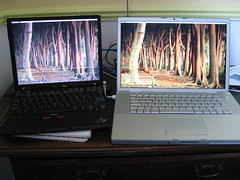
Kai Hendry: MBP versus X40

Thinkpad X40 vs MBP I’ve spent a bit of the bank holiday weekend by probably violating the warranty of a new 15” Macbook Pro (MBP) from work. I also was at the Debian bbq 2007 in Cambridge and met some friendly faces. :) More MBP & X40 porn So now I can boot into MacOSX and run Ubuntu or boot straight into Ubuntu from rEFIt. There are a couple of problems. There are some things I quite like about the MBP compared to the X40: Currently I remain not totally convinced about the Apple MBP. I’ll keep my Debian X40 my personal machine and the MBP for work. Now I can compile Webkit on Apple OSX (Debian can too) and see what’s happening in Ubuntu.

Biella Coleman: Conversing about Open Access

Karl Fogel’s recent comment asking why Samir Chopra and Scott Dexter did not publish Decoding Liberation with some sort of open licenses, especially since they are such unabashed advocates of open licensing, spurred a flurry of further comments from the authors on my blog as well as some more thought out blog posts and commentary. I don’t have too much to add except perhaps to state the obvious: the economics of book publishing and software are quite distinct creatures. When it comes to software, one can pull in revenue from support and services, while this is pretty much impossible for most books. Software also has a much shorter shelf life, which is why making it open access, fast, is key. Books however have a longer shelf life, which is why I am personally not opposed to some sort of limited copyright for books (around 5 years, give or take a couple) so that publishers can recoup their costs (and in academic publishing, no one is making a bundle of money, that is sure) but then it should be made free to the world, never to die that awful death of “out of print” (in so far as it can be thrown on the web, legally). Journal publishing is another matter and I firmly believe that articles should spread far and wide and quick because of their shorter shelf life, which tends to be shorter mostly because there are just so many articles… As Alex Golub has informed us, my own professional association has really failed not only in providing more open access journals, they are not even allowing the members of the organization any say in the matter. But thankfully other disciplines and academics are taking open access and the possibilities afforded by new media a little more seriously and here is an edited volume by CT Watch Quarterly The Coming Revolution in Scholarly Communications & Cyberinfrastructure that provides an important node in what is an important conversation.

27 August 2007

Russell Coker: Writing a CV for a Contract Position

There is a lot of career advice related to writing CVs in books and floating around the net. Unfortunately almost all of it is tailored to permanent positions. Some advice that I have seen includes researching the company you are applying for and emphasising your experience in related fields. This probably makes some sense if you have targetted a major company to be your employer for the rest of your life. But if you are after contract work (which incidentally tends to pay better than permanent positions) then it’s not going to work. About half the time when applying for contract work you won’t know the name of the company that is receiving your CV until after they have decided whether to grant you an interview. Contractors therefore need to write their CVs to have broad appeal (emphasising common technologies such as C programming and skills such as debugging), and to appeal to a recruiting agent. Some people recommend writing your CV in MS-Word to support agencies and potential employers who are not competent enough to open other file formats (such as PDF and HTML). I strongly disagree with this advice, most contract positions are advertised by multiple recruiting agencies and it would be best for you to be represented by the most competent agency. Therefore having an agency staffed by incompetent people not represent you because they can’t figure out how to read a HTML or PDF file is a good thing! The same applies for employers, while applying for the best paying contracts will often result in some strange and unpleasant working conditions having a manager who can’t open a PDF or HTML file is likely to result in something that is unusually bad - run away! Recruiting agents will often give specific requirements for a CV. Sometimes these requirements are a little odd (such as demanding that references to C programming be removed from a CV when applying for a Unix sys-admin job), but being merely a little odd is no reason to boycot the agency. To solve this I wrote my CV in M4 macros to generate HTML code. When I wanted to apply for a position I would just type make to compile the M4 source into five or more different CVs. Sometimes a recruiting agent would request two versions when applying for one position, it’s a strange request but when five versions were compiled in one pass it was easy to satisfy it. If I liked PDF I could have written M4 macros that generate TeX and have the make process convert TeX to PS and then PS to PDF. Unfortunately I can’t share any macros because the code was not of particularly high quality (which is a little ironic) and because it’s tightly tied in to my CV. The best piece of advice that I can give to anyone trying this is to get columns sorted out as the first issue. If you want to have some lists of programming languages, lists of OSs, and lists of hardware, etc in your CV then it usually works best to have two columns in the page. If the largest list is removed then the other lists need to be shuffled around to get the column lengths to match. Doing this in HTML required some ugly M4 macros. There probably is a better way of doing this in TeX (but I’m really not good at TeX and can’t give advice about it). James has some interesting advice about writing CVs. I think that his most useful points are:
  1. Use file names based on your name so that agents can find your CV in the directory full of CVs

  2. Include complete contact details. One thing he doesn’t mention is that you should buy a mobile phone for the purpose of getting a job even if you don’t want one for any other reason. A 5% difference in pay for a year’s work would cover the cost of many mobile phones and the difference between a good job and a bad one is likely to be more than 5%. If you are afraid of brain cancer then don’t worry, if you only spend a few minutes a month talking to recruiting agents then you are at no risk.

  3. Don’t start a sentence in the career history section with the word worked - everything in that section will be related to where you worked in the past. It seems obvious in retrospect but I realised that I have made this mistake on my CV.

26 August 2007

Russell Coker: Never IRC as Root

Ben Fowler blogs about the issues related to running IRC as root. Google searches for (irc client exploit) and (irc client “buffer overflow”) give a number of interesting web pages. Many of the exploits require the user to perform an action that’s slightly unusual, but why take a chance? The advice to not run as root while generally sensible (run everything with minimum privileges as much as possible) is IMHO not very useful in recent times (and probably was never very useful). Generally when a user is worried about system compromise they are not worried about attackers having direct hardware access, the ability to corrupt system files, etc. They are worried that the attacker might read their email and access other personal files. Therefore the instruction should be “don’t run IRC as root or as any account that has access to data which is important to you“. It’s not difficult to start an X-term that runs “exec su - ircuser irc” or “ssh -t ircuser@localhost irc“. Note that the -t option is required for ssh to make it allocate a pty even when receiving a command to run. Note also that in the case of su you need the exec option so that if the irc client is compromised and tries to perform a ioctl(0, TIOCSTI… based attack then it won’t succeed. In any of these methods make sure that X access is not granted. Until we get Security Enhanced X working in a viable manner any process that can display an X window on your screen can own you totally. There are of course relatively safe ways of doing X, I have previously documented how to configure the Xephyr X server (replacement for Xnest) to allow a process with a different security context to safely display a graphical window on your desktop. Generally I recommend not using a graphical X client on an untrusted network (IE anything other than an Intranet IRC server). I prefer to do my IRC in an account that’s not even on a machine that I care about and have it run screen so I can disconnect and re-connect from anywhere in the world. When I first got SE Linux in Debian to be useful (when I could boot and run all programs without problem) I logged on to some IRC channels related to Debian with the security context of root:user_r:user_t. I admit that my actions in this regard could possibly be described as trolling, but I wanted to demonstrate what SE Linux can do. Unfortunately of the many people who told me off for logging in to IRC as root, none of them wanted to hear an explanation of why user_r is safe in this regard. I expect that most of them were running their IRC client in the same Unix account that was used for their email etc (and probably most of them had GPG keys accessible from such an account). Sigh, it’s so easy to run IRC as a different user - in fact it’s probably the easiest of all network client programs to run in such a manner. There’s no reason not to.

Christian Perrier: Back...and mail read

Less than one full day to read 8000+ mails. Not that bad. Among these were like 2000 spams that hadn't been detected by my spamassassin+CRM114 setup on my mail server, but properly identified by CRM114 on my laptop. Interesting thread in debian-devel after I reported bugs about the use of "Homepage: " in packages descriptions and Christoph Berg objected to it. Apparently, this could lead to the support of a "Homepage:" field in debian/control which is Good. New samba upstream release (3.0.25c) on its way. Steve Langasek did a release of the package while I was away, Peter Eisentraut did some bug triaging and No l K the prepared the release toay, searching for the bugs that are fixed. No real problem building the new version, except for the Python bindings which are nearly unmaintained (we are seriously considering to stop providing python-samba so please speak up *and* come helping if interested). The D-I l10n-sync script was hosed for 2 weeks because of a broken Swedish translation file (I hate poEdit for this, see #420685). I really should begin seeking for a backup for D-I l10n handling as Dennis Stampfer is now apparently completely MIA. Nothing really important apart from all this. Probably time now to begin preparing a possible trip to India for FOSS.in which I really would like to participate to, if I can find a way to fund the travel. Also time to think deeper about the proposed Extremadura i18n meeting which hasn't met a huge success, probably because we really want it to be focused on *one* goal this time (DDTP/Pootle).

Biella Coleman: The problem with presentism

A few days ago, Joe Reagle was telling me about the rise of (sometimes very arcane) policies and bureaucratic imperatives that now characterize Wikipedia. A few days later I stumbled across a few interesting posts on the topic, posts (especially Nick Carr’s) seeping with almost celebratory gloom and doom:
‘But, given human nature, is it really so “incredible” that Wikipedia has evolved as it has? Although writers like Yochai Benkler have presented Wikipedia as an example of how widescale, volunteer-based “social production” on the Internet can exist outside hierarchical management structures, the reality is very different. As Wikipedia has grown, it has developed a bureaucracy that is remarkable not only for the intricacies of its hierarchy but for the breadth and complexity of its rules. The reason Deletionism has triumphed so decisively over Inclusionism is pretty simple: It’s because Deletionism provides a path toward ever more elaborate schemes of rule-making - with no end - and that’s the path that people prefer, at least when they become members of a large group. The development of Wikipedia’s organization provides a benign case study in the political malignancy of crowds.”
It is without question that a problem has arisen in Wikipedia, a problem composed of a thick web and net of rules that can be helpful as guidelines but often are often confusing and clearly work to ensnarl new users. But can we so quickly put blame on so-called human nature? Or is it not a problem of human organization, which as the anthropological and sociological record shows, can take many forms? And is it not just that: a problem begging for a solution instead of an opportunity to declare the fundamental nature of wikipedia (and that of human nature?). Not only may history prove him wrong, other large scale collaborative projects at least prove that solutions can be found to deal with problems of growth and scale. It is as if Carr just wants to see a project like Wikipedia fail, which somehow, this morning hit a raw nerve. What I find exciting about large scale projects of (at times unwieldy) collaboration are not just the explicit outputs of the projects (an encyclopedia or operating system) but the social worlds they create. And there is no inevitable path they *must* follow. These groups have a choice to react to and respond to these sort of problems and enact solutions that will hopefully solve them and allow these projects to change. Debian, a slightly older project than Wikipedia, has gone through many growing pains and there was even a period when the the whole process of integrating new Debian developers was shut down and if my memory serves me correctly, for 2 years! At the time, it could have been possible to say: “This signals the end of Debian” but eventually a solution was found, the New Maintainer process, which while not perfect (what is?) allowed the project to grow and produce a great operating system for years to come. Debian today faces new problems and is working to find solutions. I hope that Wikipedia can and will do the same. And instead of declaring its death, why not wait and see, and offer something a little more constructive and illuminating, than destructive?

Russell Coker: Solar Hot Water - Not Expensive

The Australian has a new Environment writer named Matthew Warren who has a history of doing PR work for the coal industry. This has the potential for insightful articles based on knowledge of what the industry is doing or for PR work for the coal industry masquerading as journalism. Unfortunately it seems like the latter is what we are getting. Matthew’s latest effort is an article claiming a $6.5 billion cost to home-owners because of an “effective ban” on electric hot water systems that Labor might impose. Unfortunately he doesn’t clearly state what an effective ban is, but does note that apartments are exempt. The specific claim that is used as the basis for the article is that solar hot-water systems cost $2,800 more than electric systems, and that after the solar hot-water rebate ($1,000) the additional cost would be $650,000,000 per annum, and that a period of 10 years would be required to replace all hot-water systems thus giving a cost of $6,500,000,000. So I presume that he expects that there would be 650,000,000/1,800 hot water systems installed per year which would be about 361,111. According to the Australian Bureau of Statistics there were 6,744,800 households in Australia in 2003. Matthew’s article states that about 40% of homes can have gas hot-water systems fitted that comply with the proposed new regulations, given that and the exemption for apartment buildings let’s assume for the sake of discussion that 50% of homes would require a solar hot-water system. Assuming that each household has a separate hot-water system that means that for these claims to hole we need an average expected lifetime for a hot water system of 6,744,800/2/361,111 = about 9.3 years. If the currently installed hot-water systems are expected to be replaced in 9.3 years then we can expect that hot water systems tend to survive for an average of about 18.6 years. I wonder if that number is correct (some google searching didn’t turn up an answer). One of the disadvantages of old-fashioned media is that they tend not to include calculations or cite sources adequately so we can’t easily verify or disprove their claims, I wonder if this is deliberate… Matthew admits that using a solar hot water system can be expected to save households $300 per annum in electricity expenses, I presume that this is based on current energy prices and that the savings can therefore be expected to increase as energy prices increase (we have a lack of water which is increasing the cost of producing electricity from coal). Let’s assume for the sake of discussion that the typical home-owner has a mortgage, the Commonwealth Bank is currently advertising mortgages with a rate of just over 8%, the way things work is that there are various criteria for getting a discount rate which most borrowers can meet so the result will be slightly below 8%. If a solar hot water system costs $1,800 extra to install and the money comes from a mortgage then every year it will cost the home owner about 8% of $1,800 which is about $144 (a saving of $156 per annum). If the solar hot water system saves the home owner $300 per annum then at any interest rate below 300/1800 (16.66%) they will make money. If there was no government subsidy and the entire $2,800 extra was paid by the home owner then at 8% interest it will cost $224 per annum (a saving of $76 per annum) and the interest rate would need to increase to 300/2800 = 10.7% to make it break even. So for solar hot water to not save the home-owner money we need to have a significant increase in interest rates (which incidentally would bankrupt many home owners), AND to have electricity prices remain the same (which would require even more of our tax money to be spent on supporting the coal industry). Finally Matthew complains that the solar hot-water rebate could cost the government $4 billion over the course of the scheme (the next 10 years). This sounds like a lot of money until you think about the 9 billion dollars a year that the government spends on subsidies for the coal, oil, and gas industries! On the current course the government would spend 90 billion dollars of our tax money subsidising polluting industries that cause climate change, but Matthew opposes spending 4 billion subsidising technology that prevents pollution and reduces climate change.

Next.

Previous.