Search Results: "will"

24 April 2012

Michal Čihař: phpMyAdmins projects in GSoC 2012

There already has been official announcement for this years GSoC at phpMyAdmin and it's time to share my bits. First of all more details about chosen projects are available on our wiki (missing bits will get updated soon). This year I'll be mentoring again three students. As usual, it was quite tough job to choose students and I hope we've chosen really good ones. Anyway we'll see this later during there summer :-). As we're currently on a (long) way to phpMyAdmin 4.0, basically all projects are somehow about cleanup and refactoring of quite historical code which lives in some dark places of phpMyAdmin. The only big difference is automated testing project, which is purely about writing new test cases and making tests cover more functionality. Anyway I'm looking forward to see first improvements from my students - Alex Marin, Yasitha Pandithawatta and Chanaka Indrajith.

Filed under: English Phpmyadmin 0 comments Flattr this!

Jonathan McDowell: The future is here again

Back in 2004 when Simon and I went full time with Black Cat one of the first things I did was sort out an ADSL offering, including native IPv6. We were one of the first UK ISPs to offer this (possibly the first; I know A&A had been doing tunneled IPv6 for a lot longer, but I'm not sure exactly when they enabled IPv6 on the PPP session. Also Bogons were fairly quick to enable it as well). By the middle of 2004 I was fully IPv6 enabled; my colo box had a native connection, my entire home network (a /64 for the wired, a /64 for the wireless) was configured, BCN had multiple native IPv6 connections to other ISPs (such as peering over LoNAP). By and large it just worked; I remember at one point looking at a traffic graph link from someone in Australia and them indicating surprise that I'd come in over v6. I hadn't noticed anything different than normal, which is exactly how it should be. When we sold BCN in 2007 unfortunately one of the casualties was the v6 support. The ISP that took over the ADSL wasn't setup to be able to continue the v6 support, nor were RapidSwitch, who took over most of the hosting (I note with sadness that RapidSwitch still don't seem to be offering v6, though they keep saying it's a work in progress). So I stopped having any v6 for some time, refusing to slum it with a tunnel. This changed at the start of last year, when I sought out new hosting for the. I ended up selecting Bytemark, partly because I knew of their commitment to v6. I'd chosen Sonic as my US access ISP, again partly because they offered an IPv6 tunnel service (while not as nice as native v6 over the DSL I felt that a tunnel provided by the DSL ISP was acceptable for access). However a combination of not having a machine that was always on at home, and a dynamic IP on my connection, meant that I never got round to configuring anything permanent up. Recently I got around to buying a little low powered box to be always-on and this week I finally looked at configuring it up as the tunnel endpoint, planning to do some sort of screen scraping of the web interface to automatically update the tunnel broker information for the rare occurrences when my IP changes. The first nice surprise was that Sonic are now doing static IPs for free (previously you could only have a block of 8 for $20/month extra). That makes things a lot easier. So tonight I configured up the little server as the tunnel endpoint, installing radvd and some basic v6 firewalling. As expected my laptop sees the RAs, automatically configures everything up and my ssh sessions start to go over IPv6 instead. Looks like my phone also does the same. I'm not entirely sure what the NAT on the ADSL router is doing and if inbound connections will fail if there's nothing outbound holding the translation entry active, but I'm sure I can work around that if it turns out to be a problem. I care more about access than hosting anything on the end of my DSL anyway. This means I'm finally almost back to where I was nearly 8 years ago, just in time for World IPv6 Launch day.

23 April 2012

Christian Perrier: Boston marathon 2012

I just read reports about Boston marathon 2012. Incredibly though race this year as the heat raised up to 32-35 C (around 90 F?) for the last runners and 26 C at 10:00 at marathon start. The outcome is indeed impressive: the 2012 winner won with a "not so good" time of 2h12 while last year saw an unofficial world best time of 2h03'02" (there can't be any world record in Boston because of the race being one-way, thus prone to too favourable wind, plus a negative slope between start and finish). Even though this year is less likely to see great records (because this is an olympic year and the best runners won't run another marathon before the Olympics), we still had times around 2h05 in Paris, Rotterdam....and this year's best time in London with 2h04'44" (Dubai time is 2h04'23" but I do not count this one as a mass marathon). So, 2h12 in Boston just says how hard this race was. But, still, that's my dream marathon, even more than NYC marathon. And I'll do it, I promise....though I now have to run below 3h30 to qualify....unless I'm still running marathons when I reach 55, where the qualificaiton mark will be only 3h40 (which is exactly my PB as of now). Will I still be able to run in 3h40 in 4 years? Or will I succeed in running in less than 3h30 in the meantime? We'll see..:-) Until then....my first marathon for this year will be on June 9th, in Caen, as planned. Target: less than 3h40, despite the quite hard profile (and possible windy conditions as the first half of the race is along the famous Normandy beaches code named Sword, Gold and Juno, between Courseulles sur Mer and Ouistreham). So, until then, I'll forget about my nice races in forests and plains, and concentrate on interval trainings, boring sequences of 400m or 1000m runs, etc, etc. That will be the first time I'm doing this but everybody keeps telling me I need to do that if I want to lower my PB (and every marathoner wants to!).

Russell Coker: Links April 2012

Karen Tse gave an interesting TED talk about how to stop police torture as an investigative tool [1]. Mostly it s about training and empowering public defenders. Phil Plait gave an interesting TED talk about how to defend the Earth from asteroids [2]. Julian Baggini wrote an interesting article for the Financial Times about the persecution of Atheists in the US [3]. Charlie Todd of Improv Everywhere gave an amusing TED talk about Improv events that he has run [4]. He is most famous for organising people to wear blue shirts and khaki pants in Best Buy, but he s done lots of other funny things. Paul Zak gave an interesting TED talk about trust, morality, and oxytocin [5]. One of the many interesting fact that he shared is that oxytocin levels can significantly increase when using social networking sites. So people who use Facebook etc are likely to be more trustworthy as well as more trusting. The Occupy the Judge Rotenberg Center movement aims to stop the torture of Autistic children in the US [6], Anonymous is involved in that too. Paul Lewis gave an insightful TED talk about the use of crowdsourced data in news reporting [7]. A lot of the analysis of citizen journalism is based on comparing bloggers with full-time paid journalists, but Paul describes how professional full-time journalistic work can be greatly assisted by random people filming and photographing things that seem noteworthy. Make sure your next phone has the best possible camera phone cameras will never be great but the quality of the camera you have with you is what matters. Sam Harris published an interesting interview with Tim Prowse who is a Baptist minister who faked belief for two years after becoming an atheist [8A]. He also references The Clergy Project a support group for atheists who are current or former members of the clergy [8B]. Cracked has an insightful article about 6 things that rich people need to stop saying [9]. How do the 1% not understand these things? Barack Obama and Nichelle Nichols (who played Lt Uhura in the original Star Treck) give the Vulcan Salute in the White-House [10]. Gabriel Arana wrote an insightful article about his experiences with the ex-gay movement [11]. The therapist who hurt him so much is still doing the same to other victims. S#!T Ignorant People Say To Autistics is an interesting youtube video about ignorant and annoying people [12]. Strangely I ve received little of that myself, I wonder whether women on the Autism Spectrum get a lot more of that than men. At GManCaseFile an ex-FBI agent has written an informative post about how the TSA is failing [13]. The Nieder Family has an interesting article about how patents are being used to prevent the creation of assisted communication (AAC) devices for children [14]. Apparently the company that has the patents wants all AAC devices to be really expensive and profitable for them. This is yet another example of patents doing harm not good. Renew Economy has an informative article by Giles Parkinson about the affect that solar power generation will have on power prices [15]. In short as solar systems produce power when it s most needed (during the day and at the hottest time of the day for warm climates) it will dramatically reduce the auction price for wholesale power. That will hurt the business of the power companies and also allow lower prices on the retail market. Related posts:
  1. Links March 2012 Washington s Blog has an informative summary of recent articles about...
  2. Links February 2012 Sociological Images has an interesting article about the attempts to...
  3. Links April 2010 Sam Harris gave an interesting TED talk about whether there...

Julien Danjou: OpenStack Swift eventual consistency analysis & bottlenecks

Swift is the software behind the OpenStack Object Storage service. This service provides a simple storage service for applications using RESTful interfaces, providing maximum data availability and storage capacity. I explain here how some parts of the storage and replication in Swift works, and show some of its current limitations. If you don't know Swift and want to read a more "shallow" overview first, you can read John Dickinson's Swift Tech Overview. How Swift storage works If we refer to the CAP theorem, Swift chose availability and partition tolerance and dropped consistency. That means that you'll always get your data, they will be dispersed on many places, but you could get an old version of them (or no data at all) in some odd cases (like some server overload or failure). This compromise is made to allow maximum availability and scalability of the storage platform. But there are mechanisms built into Swift to minimize the potential data inconsistency window: they are responsible for data replication and consistency. The official Swift documentation explains the internal storage in a certain way, but I'm going to write my own explanation here about this. Consistent hashing Swift uses the principle of consistent hashing. It builds what it calls a ring. A ring represents the space of all possible computed hash values divided in equivalent parts. Each part of this space is called a partition. The following schema (stolen from the Riak project) shows the principle nicely: Consistent hashing ring In a simple world, if you wanted to store some objects and distribute them on 4 nodes, you would split your hash space in 4. You would have 4 partitions, and computing hash(object) modulo 4 would tell you where to store your object: on node 0, 1, 2 or 3. But since you want to be able to extend your storage cluster to more nodes without breaking the whole hash mapping and moving everything around, you need to build a lot more partitions. Let's say we're going to build 210 partitions. Since we have 4 nodes, each node will have 210 4 = 256 partitions. If we ever want to add a 5th node, it's easy: we just have to re-balance the partitions and move 1 4 of the partitions from each node to this 5th node. That means all our nodes will end up with 210 5 204 partitions. We can also define a weight for each node, in order for some nodes to get more partitions than others. With 210 partitions, we can have up to 210 nodes in our cluster. Yeepee. For reference, Gregory Holt, one of the Swift authors, also wrote an explanation post about the ring. Concretely, when building one Swift ring, you'll have to say how much partitions you want, and this is what this value is really about. Data duplication Now, to assure availability and partitioning (as seen in the CAP theorem) we also want to store replicas of our objects. By default, Swift stores 3 copies of every objects, but that's configurable. In that case, we need to store each partition defined above not only on 1 node, but on 2 others. So Swift adds another concept: zones. A zone is an isolated space that does not depends on other zone, so in case of an outage on a zone, the other zones are still available. Concretely, a zone is likely to be a disk, a server, or a whole cabinet, depending on the size of your cluster. It's up to you to chose anyway. Consequently, each partitions has not to be mapped to 1 host only anymore, but to N hosts. Each node will therefore store this number of partitions:
number of partition stored on one node = number of replicas   total number of partitions   number of node
Examples:
We split the ring in 210 = 1024 partitions. We have 3 nodes. We want 3 replicas of data.
Each node will store a copy of the full partition space: 3 210 3 = 210 = 1024 partitions.
We split the ring in 211 = 2048 partitions. We have 5 nodes. We want 3 replicas of data.
Each node will store 211 3 5 1129 partitions.
We split the ring in 211 = 2048 partitions. We have 6 nodes. We want 3 replicas of data.
Each node will store 211 3 6 = 1024 partitions.
Three rings to rule them all In Swift, there is 3 categories of thing to store: account, container and objects. An account is what you'd expect it to be, a user account. An account contains containers (the equivalent of Amazon S3's buckets). Each container can contains user-defined key and values (just like a hash table or a dictionary): values are what Swift call objects. Swift wants you to build 3 different and independent rings to store its 3 kind of things (accounts, containers and objects). Internally, the two first categories are stored as SQLite databases, whereas the last one is stored using regular files. Note that this 3 rings can be stored and managed on 3 completely different set of servers. Swift storage schema Data replication Now that we have our storage theory in place (accounts, containers and objects distributed into partitions, themselves stored into multiple zones), let's go the replication practice. When you put something in one of the 3 rings (being an account, a container or an object) it is uploaded into all the zones responsible for the ring partition the object belongs to. This upload into the different zones is the responsibility of the swift-proxy daemon. Swift proxy schema But if one of the zone is failing, you can't upload all your copies in all zones at the upload time. So you need a mechanism to be sure the failing zone will catch up to a correct state at some point. That's the role of the swift- container,account,object -replicator processes. This processes are running on each node part of a zone and replicates their contents to nodes of the other zones. When they run, they walk through all the contents from all the partitions on the whole file system and for each partition, issue a special REPLICATE HTTP request to all the other zones responsible for that same partition. The other zone responds with information about the local state of the partition. That allows the replicator process to decide if the remote zone has an up-to-date version of the partition. In case of account and containers, it doesn't check at the partition level, but check each account/container contained inside each partition. If something is not up-to-date, it will be pushed using rsync by the replicator process. This is why you'll read that the replication updates are "push based" in Swift documentation.
# Pseudo code describing replication process for accounts
# The principle is exactly the same for containers
for account in accounts:
    # Determine the partition used to store this account
    partition = hash(account) % number_of_partitions
    # The number of zone is the number of replicas configured
    for zone in partition.get_zones_storing_this_partition():
        # Send a HTTP REPLICATE command to the remote swift-account-server process
        version_of_account = zone.send_HTTP_REPLICATE_for(account):
        if version_of_account < account.version()
            account.sync_to(zone)
This replication process is O(number of account number of replicas). The more your number of account will increase and the more you will want replicas for your data, the more the replication time for your accounts will grow. The same rule applies for containers.
# Pseudo code describing replication process for objects
for partition in partitions_storing_objects:
    # The number of zone is the number of replicas configured
    for zone in partition.get_zones_storing_this_partition():
        # Send a HTTP REPLICATE command to the remote swift-object-server process
        verion_of_partition = zone.send_HTTP_REPLICATE_for(partition):
        if version_of_partition < partition.version()
            # Use rsync to synchronize the whole partition
            # and all its objects
            partition.rsync_to(zone)
This replication process is O(number of objects partitions number of replicas). The more your number of objects partitions will increase, and the more you will want replicas for your data, the more the replication time for your objects will grow. I think this is something important to know when deciding how to build your Swift architecture. Choose the right number the number of replicas, partitions and nodes. Replication process bottlenecks Copycat File accesses The problem, as you might have guessed, is that to replicate, it walks through every damn things, things being accounts, containers, or object's partition hash files. This means it need to open and read (part of) a every file your node stores to check that data need or not to be replicated! For accounts & containers replication, this is done every 30 seconds by default, but it will likely take more than 30 seconds as soon as you hit around 12 000 containers on a node (see measurements below). Therefore you'll end up checking consistency of accounts & containers on each all node all the time, using obviously a lot of CPU time. For reference, Alex Yang also did an analysis of that same problem. TCP connections Worst, the HTTP connections used to send the REPLICATE commands are not pooled: a new TCP connection is established each time something has to be checked against the same thing stored on a remote zone. This is why you'll see in the Swift's Deployment Guide this lines listed under "general system tuning":
# disable TIME_WAIT.. wait..
net.ipv4.tcp_tw_recycle=1
net.ipv4.tcp_tw_reuse=1
# double amount of allowed conntrack
net.ipv4.netfilter.ip_conntrack_max = 262144
In my humble opinion, this is more an ugly hack than a tuning. If you don't activate this and if you have a lot of containers on your node, you'll end up soon with thousands of connections in TIME_WAIT state, and you indeed risk to overload the IP conntrack module. Container deletion We also should talk about container deletion. When a user deletes a container from its account, the container is marked as deleted. And that's it. It's not deleted. Therefore the SQLite database file representing the container will continue to be checked for synchronization, over and over. The only way to have a container permanently deleted is to mark an account as deleted. This way the swift-account-reaper will delete all its containers and, finally, the account. Measurement On a pretty big server, I measured the replications to be done at a speed of around 350 account,container,object-partitions /second, which can be a real problem if you chose to build a lots of partition and you have a low number_of_node number_of_replicas ratio. For example, the default parameters runs the container replication every 30 seconds. To check replication status of 12 000 containers stored on one node at the speed of 350 containers/seconds, you'll need around 34 seconds to do so. In the end, you'll never stop checking replication of your containers, and the more you'll have containers, the more your inconsistency window will increase. Conclusion Until some of the code is fixed (the HTTP connection pooling probably being the "easiest" one), I warmly recommend to chose correctly the different Swift parameters for your setup. The replication process optimization consists in having the minimum amount of partitions per node, which can be done by: For very large setups, some code to speed up accounts and containers synchronization, and remove deleted containers will be required, but this does not exist yet, as far as I know.

22 April 2012

Joey Hess: moving my email archives and packages to git-annex

I've recently been moving some important data into git-annex, and finding it simplifies things while also increasing my flexability. email archives I've kept my email archives in git for years. This works ok, just choose the right file format (compressed mbox) and number of files (one archive per mailbox per month or so) and git can handle this well enough, as email is not really large. But, email is not really small either. Keeping my email repository checked out on my netbook consumes 2 gigabytes of its 30 gigabyte SSD, half of which is duplication in .git. Also, I have only kept it at 2 gigabytes through careful selection of what classes of mail I archive. That made sense when archival disk was more expensive, but what makes sense these days is to archive everything. For a while I've wanted to have a "raw" archive, that includes all email I receive. (Even spam.) This protects against various disasters in mail filtering or reading. Setting that up was my impetus for switching my mail archives to git-annex today. The new system I've settled on is to first copy all incoming mail into a "raw" maildir folder. Then mailfilter sorts it into the folders I sync (with offlineimap) and read. Each day, the "raw" folder is moved into a mbox archive, and that's added to the git annex. Each month, the mail I've read is moved into a monthly archives, and added to the git annex. A simple script does the work. I counted the number of copies that existed of my mail when it was stored in git, and found 7 copies spread amoung just 3 drives. I decided to slim that back, and configured git-annex to require only 5 copies. But those 5 copies will spread amoung more drives, including several offline archival drives, so it will be more robust overall. My netbook will have an incomplete checkout of my mail, omitting the "raw" archive. If I need to peek inside a spam folder for a lost mail, I can quickly pull it down; if I need to free up space I can quickly drop older archives. This is the flexability that git-annex fans love. :) By the way, this also makes it easier to permanantly delete mail, when you really need to (ie, for contractual reasons). Before, I'd have to do a painful git-filter-branch if I needed to get rid of eg, mail for old jobs. Now I can git annex drop --force. Pro Tip: If you're doing this kind of migration to git-annex, you can save bandwidth by not re-transferring files to machines that already have a copy. I ran this command on my netbook to inject the archives it had in the old repository into the new repository, verifying checksums as it goes:
cd ~/mail/archive; find -type l -exec git annex reinject ~/mail.old/archive/    \;
Note on mairix compatability: I use mairix to index and search my mail. But it refuses to follow git-annex's symlinks to the content. So I have to point it at .git/annex/objects/. I also configured annex.backend to SHA256E, which keeps the extensions on my compressed mailbox files, which is necessary for mairix to realize they're compressed. debian packages I'd evolved a complex and fragile chain of personal apt repositories to hold Debian packages I've released. I recently got rid of the mess, which looked like this: dput local mini-dinstall repo dput&rarr;mini-dinstallrepo on my server &rarr;dput Debian The point of all that was that I could "upload" a package locally while offline and batch transfer it later. And I had a local and a public apt repository of just the packages I've uploaded. But these days, packages uploaded to Debian are available nearly immediately, so there's not much reason to do that. My old system also had a problem: It only kept the most recent single copy of each package. Again, disk is cheap, so I'd rather have archives of everything I have uploaded. Again I switched to git-annex. My new system is simplicity itself. I release a package by checking it into a "toupload" directory in my git annex repository on my netbook. Items in that directory are dput to Debian and moved to "released". I have various other clones of that repository, which I git annex move packages to periodically to free up SSD space. In the rare cases when I build a package on a server, I check it into the clone on the server, and again rely on git-annex to copy it around. Now, does anyone know a good way to download a copy of every package you're ever released from archive.debian.org? (Ideally as a list of urls I can feed to git annex addurl.) conclusion My email and Debian packages were the last large files I was not storing in git-annex. Even backups of my backups end up checked into git-annex and archived away. Now that I'm using git-annex in every place I can, my goal with it is to make it as easy as possible for as many of you to use it as possible, too. I have some inotify tricks up my sleeve that seem promising. Kickstarter may be involved. Watch this space!

Julian Andres Klode: Reference Counting and Tail Calls

One thing I thought about today is reference counting in combination with tail calls. Imagine a function like this:
function f(x)   return g(x+1);  
Now consider that x is a reference counted object and that x + 1 creates a new object. The call to g(x + 1) shall be in tail call position. In most reference counted languages, the reference to an argument is owned by the caller. That is, f() owns the reference to x + 1. In that case, the call to g() would no longer be in a tail call position, as we still have to decrease the reference count after g() exits. An alternative would be that the callee owns the reference. This however, will most likely create far more reference count changes than a caller-owns language (increase reference count in caller, decrease reference count in callee). For example, the following function requires an increment before the call to g().
function f1(x)   return g(x);  
Does anyone have any ideas on how to solve the problem of tail calls while avoiding the callee-owns scenario? Something that does not require a (non-reference-counting) garbage collector would be preferably.
Filed under: General

Lars Wirzenius: Obnam 1.0 planning

Obnam is my backup program. See http://liw.fi/obnam/ for details. Debian is hopefully going to be freezing the current testing version in June, in preparation for a release late this year. I'd like Obnam 1.0 to be included. In preparation for that I reviewed the currently open bugs and tagged the ones that I think are blockers. See list of 1.0 blocker bugs. Did I miss anything? Is anything there that isn't really a blocker? Other than that, the roadmap for 1.0 has the following things that aren't done yet: Performance is one of those things that's always going to be a problem. I'm hoping to optimize the sftp performance a big, but apart from that, I don't consider it to be a blocker for 1.0. The verification test I'm confident I will pass, but it needs to actually be performed. (See the roadmap for details of the test.) Anyone else have opinions of what needs to be done for Obnam 1.0? PS. There's a mailing list for Obnam now.

Russell Coker: Neighborhood Watch

While writing my previous post I heard a huge noise at the front of my house. I found one man being restrained in a seated position on the ground at my front door, the man who was holding him down was accusing him of theft and asking me to call the police, and a woman was hanging around and crying. When calling the police I discovered that Optus (the Telco that provides the virtual service which Virgin Mobile uses) doesn t accept 112 as an emergency number! This combined with the fact that CyanogenMod 7 on my phone doesn t accept 000 as an emergency number meant that I had to unlock my phone before calling the police. Unlocking your phone late at night when there s a situation that needs police attention isn t as easy as you would hope. As an aside there are usually no penalties for testing the emergency service on your phone, people who install PABX systems and other significant telephony devices test emergency services calls as a matter of routine, so testing emergency calls from your phone is a really good idea. If anyone knows how to configure CyanogenMod 7 to support 000 as an emergency call then please let me know! Anyway the man who was held down claimed that a friend of his had given him a bag containing tools that he had lugged from some place not particularly near my house. The man who was holding him down said that he witnessed the other man stealing the tools from his neighbor not far from my house. The woman was apparently the girlfriend of the man who was accused of burglary. The end result was that the police arrested the man who was accused of burglary and his girlfriend. He didn t have any obvious injuries and the police said that the man who detained him did them a favor, so it seems unlikely that there will be any assault charges filed. Presumably the man who detained the burglar is explaining it all at the police station now, I hope the police gave him a chance to put on pants and shoes first. The man who made the burglary accusation said that his house was robbed last night which is why he was more observant than usual tonight. This makes me glad of my policy of rejecting every job offer which involves moving to the US. In Australia hand guns are really hard to get so there s no way that a house burglary will involve a gun and there s also no way that someone who wants to help the police will have a gun. So while it was unpleasant to have this happen at my front door it didn t involve any risk to me. It could have ended up with someone other than me getting a beating but the probability of serious injury or death for them was quite low. As everyone knew that no-one had a gun and no-one wanted to be charged with assault it made sense for everyone to avoid excessive force. From what I saw no excessive force was used. The police arrived fairly quickly and EVERYONE was glad to see them. All up it took a bit more than 30 minutes from the first noise to the police departing after arresting both suspects and filling out a bunch of paperwork. I was impressed by that! Related posts:
  1. CyanogenMod and the Galaxy S Thanks to some advice from Philipp Kern I have now...

Russell Coker: Autism as an Excuse

A Polish geek going by the handle of mmemuar has recently written a blog post claiming that people use Autism as an excuse for bad behavior [1]. He gets enough things wrong in one short post to make it worth debunking it. It seems that Google s translation of Polish isn t as good as some other languages, but unless Google mistranslated about a dozen sections such that they had the exact opposite meaning then mmemuar s post has a lot of wrong ideas. Does Anyone use Autism as an Excuse? I ve read a lot of blog posts written by people on the Autism Spectrum, read many forum discussions, and talked to more than a few people in person. So far I haven t yet encountered any evidence of people using an Autism Spectrum Disorder (ASD) diagnosis as an excuse. There are probably about 70,000,000 people who meet the diagnostic criteria (most of whom have not been diagnosed due to not having access to anyone who is qualified to do an assessment). The number of people who have been diagnosed is large enough that I couldn t claim that none of them have ever used it as an excuse. The number of self-diagnosed people is also large enough that there has to be some people who wouldn t get diagnosed if professionally assessed. But I don t see any evidence that using an ASD as an excuse is at all common. I imagine that some people would take someone merely mentioning the fact that they have an ASD diagnosis in a public place (EG a mailing list or a blog post) as some sort of an excuse. One problem with such an interpretation is that for every way in which people on the Autism Spectrum annoy other people it s the ones who aren t diagnosed (or who reject a diagnosis) that will do it the most. Being diagnosed with an ASD is correlated with annoying other people less. Another problem is that keeping quiet about such things when they get raised for discussion so often takes a psychological toll. When someone is diagnosed as an adult a fairly common reaction is to study Psychology and Sociology (usually through web sites such as Sociological Images which I highly recommend [2]) and try to get a better understanding of other people. Any time you assume that everyone else thinks like you then you will get things wrong, when someone gets an ASD diagnosis they will probably take more care to avoid making such mistakes. Is Autism Obvious? Mmemuar says if you were full of autistic, which is very easy to overheat the brain from excess signals at the input, it would be very obvious to all . There are some people who are utterly incapable of acting like an NT. But the majority of people on the Autism Spectrum have some ability to pass as NT, it just takes a lot of effort. So if someone is spending all their effort to walk, talk, and make eye contact in a way that most people expect then they will have little spare effort for other things. This can result in them having little patience for other people. The solution to this is to not require people to look average. Even apart from Autism there are people who fidget, don t make eye contact in the way you expect, and do other things a little differently. Being tolerant of such things won t hurt you and will generally make things easier for everyone. TheAnMish gave a good Youtube presentation about the way that she has to act normal [3]. Note that while her video represents her own personal experiences (which differ slightly from those of other Aspies particularly male Aspies) they are regarded as representative enough for her video to be shown by Tony Attwood (a world renowned expert on Asperger Syndrome) at a conference about women on the Autism Spectrum. As an aside I disagree with her use of the word normal without scare-quotes. Learning about Psychology through Sci-Fi In the end of the blog post and in some of the comments there is discussion about learning to understand people through reading sci-fi books. The first problem with this is that fiction books generally have a range of characters that is determined by the author s understanding of people, if you read multiple books by an author then you will usually notice the same character types. The second problem is that characters in fiction books are simplified to fit into a reasonable sized book, in real life people have lots of really boring reasons for doing what they do, in fiction only stuff that is interesting ends up in print. But the biggest problem is that fiction books just aren t a good way of learning about people. Whatever lessons might be in a fiction book will probably be missed by a reader who is concentrating on the plot. You can learn things about people by reading an analysis of literature by a Psychologist or a Sociologist, but apart from that you probably won t be able to learn things if you don t already know them. As an aside, my experience of reading sci-fi books suggests that some of the popular sci-fi authors have such a poor understanding of people that it impairs their ability to write believable fiction about human characters. If I was going to try and learn about people by reading fiction I d choose something that s been popular for a long time. If a book has been popular for more than 100 years and sold well in different times, cultures, and languages then it probably has something to say about the human condition. Catching up on Youth Mmemuar says absolutely nothing prevents you to the age of twenty he began to catch up on some of youth . Actually one significant thing is that the human brain develops in particular stages, the older you get the more difficult it becomes to learn things. So even if it was just a matter of learning things someone who was behind at age 20 would have some significant difficulty in catching up. But some things just can t be learned, for example someone who has extreme discomfort in making eye contact can t just learn to be happy with it. Also there are some things which people would have learned if it was possible. For example people who have Prosopagnosia (an inability to recognise faces) suffer extreme bullying in school, if they could just learn to recognise people then they surely would do so, so if they complete school without learning then it s probably going to be impossible for them. Prosopagnosia is one of many conditions which can contribute to social difficulties and therefore contribute to an ASD diagnosis. Can Aspies get Married? Some people think that people on the Autism Spectrum can t get married. In fact this belief is so widely held that some people who seem very obviously Autistic are convinced that they are NT simply because they are married! The fact that there are more than few books offering advice to people who have married someone who is on the Autism Spectrum is clear proof that such claims are bogus. The Relevance to Geek Communities People who meet the diagnostic criteria for Asperger Syndrome will almost certainly be Geeks due to the Restricted, repetitive patterns of behavior, interests, or activities section of the diagnostic criteria (the proposed revision for the DSM-V is the best reference I know for this [4]) as the modern use of the term Geek applies to anyone who has an extreme interest in something. The more Geeky a community is the greater the incidence of people who could be diagnosed with an ASD. Spreading ideas such as those of mmemuar will lead to people not being assessed for an ASD. I would have been assessed earlier if it wasn t for hearing an influential member of the Linux community say some things which were similar in concept (although not as deliberate). Having people not be assessed is bad for the individuals in question and bad for the community. Related posts:
  1. Autism Awareness and the Free Software Community It s Autism Awareness Month April is Autism Awareness month, there...
  2. Autism vs Asperger Syndrome Diagnostic Changes for Autism Spectrum Disorders Currently Asperger Syndrome (AS)...
  3. Communication Shutdown and Autism The AEIOU Foundation The AEIOU Foundation [1] is a support...

Christian Perrier: Bug #670000

Julien Cristau reported Debian bug #670000 on Sunday April 22th, against libgtkada. This bug is indeed part of a MBF for packages that are "marked as Multi-Arch: same, but contain files in arch-independent paths with arch-specific contents" (doh, these multi-arch things are sometimes giving me headaches!) Bug #660000 was reported as of February 15th: 2 months and 7 days for 10,000 bugs. As expected, QA work and release preparation do trigger an increase in bug report rate and we're now again quite close from the "10,000 bugs in two months mark". I forgot to report that bug #666666 has been reported in the meantime. This time by one of the top bug reporters in Debian, namely Lucas Nussbaum, during one of his archive-wide package rebuilds, against psimedia. Next step will be bug #680000, targeted in June 2012. With this rate, bug #700000 should be reported around mid-November 2012 and Kartik Mistry would win the Bug #700000 prediction contest". In the meantime, Launchpad will have reached bug #1000000 (the highest bug number is currently #986849....which will be no longer true by the time you read this). The rate in LP is currently about 20,000 bugs per month. I wonder how many of these are closed as I feel like this is humanly impossible to process that many bug reports.

Steve Kemp: Work on my bathroom continues

Work on my bathroom continues. I had expected it to be complete on Friday but it lookse like the new completion date will be Tuesday or Wednesday. It will be very nice to have a working shower, and a toilet I don't need to "flush" with a bucket. The only interesting thing I've been doing is planning on a kernel to support long-term for some poor unfortunate souls who cannot use Debian-based kernels. I know building, supporting, and maintaining a kernel will be a pain. But at the moment it looks like a valid thing to be suggesting. Otherwise life goes on. I've been hit by the DIY bug, largely as the result of seeing all the bathroom work going on, and figuring I was going to live with dust/mess anyway - so I've erected some more book-shelves, and ordered a pair of ceiling fans. The only other thing to report is that I've started deleting emails. (shock!) I look after a few machines for myself, friends and so on. Each one will send me automated emails at times. I've got them going back years - but no longer:

#
#  Prune old mailboxes.
#
for maildir in .Automated.backups .machines.spotlight .machines.skx; do
   nrecent --keep=150 $HOME/Maildir/$ maildir /cur
done
Another new use for my nrecent tool. (Note: Only delete files from ./cur, to avoid deleting messages I've not read. Maildir is your friend!) ObQuote: "I'm sorry I'm sweating on you... " - Knocked Up.

Iustin Pop: Running: Z rich city run rain, rain, rain

This year was the 10th anniversary of the Z rich marathon, so they had a new category: 10km city run (at least, I think it was a new category). So I went along, thinking 10k would be a nice Sunday run. But oh, even the famed Swiss organisational skills fail some time. And when they fail, they fail hard. First, if you have 3 events all going on at the same time (marathon, team run, city run), please, please mark the road appropriately. The finish line was marked only marathon and team run, so I didn't even knew when I finished, I only realised well, that must have been it when I reached the place where I gave back the transponder chip. This marking issue was on-going for the last ~500-600 metres, as I thought I was lost when running along a road marked (again) only with marathon and team run and almost exited the road to look for my actual trail. Of course, if I had remembered that the finish is common to all three categories, all would have been good, but don't ask me to remember such stuff at the end of a race. Second, clothes storage. They had clothes storage organised nicely, in railroad freight cars, 500 people per car. This went well, except that they underestimated the number of people registering, so the last car had well over 700 bags, which created a huge bottleneck for this single car, which of course was where I also had the clothes (as I registered late). So I run for ~1 hour and then spend 30 minutes getting my clothes back. This wouldn't have been an issue, if the weather would have been fine. But it started raining seriously 500 meters into the race, and by the time I finished I was already fully drenched, just in a t-shirt (thanks fully with long pants) and waiting in the rain for 30 minutes was painful. I think also unhealthy, due to the abrupt switch from running to just standing in the rain. I haven't been so cold in a long while. By the time I got home my hands were shaking so hard I couldn't unzip my jacket (and I couldn't stop shaking, which is not a good sign). So yeah, I learned a few things. Try not to use the clothes storage if you can (it was the first time I used it), especially if you can pick up the stuff they give you a day early (and I could have gone to the race directly dressed) and I hope the organisers learned to provide better conditions just in case it rains. Which in Z rich happens, well, quite often. People were joking in the line: "1 hour running, 1 hour picking the clothes, 1 week sick". I hope I won't get sick (a hot tea after a hot bath can do wonders), but still, at least my voice will sound like after whole-night partying. OK, rant over. What about the race? It's nice (except the very dark overcast & rain, as said), through the centre of the city; as a friend says: Running on Bahnhofstrasse is cool . Otherwise, 10k seem to go quite quick nowadays . Having ~1,600 people all in red t-shirts was funny, especially if you're trying to look for friends. It was a very diverse crowd, you could see more varied people than in the other races (where more running-focused people seem to come); here there were all kind of people, children, teenagers, adults and so on, no per-category start or such. As to myself, I still am bothered by some small injuries, so I can't enjoy the nice result I got: 47m26.4s, for a 4m.44s/km! Yay! Of course, the reason I run so fast was because I was cold and needed to run to heat up. Also, again a flat race. I should start getting friends with hills. And due to the fact that it was a more diverse crowd, for the first time I didn't class (in my age category) around the ~66% down the list, but around ~44% only (~13 minutes slower than the winner). Yay!

Stefano Zacchiroli: deferred bits from the DPL for March 2012

Posted a week ago, already deferred back then, this report is even more deferred now! But as there are people interest in knowing what the "DPL job" is about even among non debian-devel-announce subscribers, here is a blog-conveyed reproduction, for the records.
Dear project members,
here is my monthly DPL activity report, this time for last March. It is delayed by a couple of weeks because, myself being both incumbent and candidate DPL, I preferred not to use d-d-a during the voting period unless really needed. Apologies for the delay (or the unneeded paranoia, you name it). As a side effect of the delay, the results of the DPL election are now known. I'd like to thank all the people who took part in the elections: voters, people who asked questions on -vote, the secretary, and obviously Gergely and Wouter, without whom the campaign wouldn't have allowed to discuss relevant aspects of Debian "politics". Thanks for your trust. I'll do my best to match your expectations. ... and just to remind you what you've just asked for, here goes the BigMonthlyBlurb! Highlight: long-term hardware replacement planning The highlight for this month is long term planning of hardware replacement. It's something I've been discussing with DSA for quite a while and on which DSA has worked hard during the recent sprint. As a result, we now have a quite ambitious 5-year hardware replacement plan that will guarantee that all machines in production are under warranty at any given time (with the nice side effect of generally better performances, as they go hand in hand with newer hardware). The current estimated cost per year is 29'000 USD. That does not yet include buildds and porter-boxes, so it is expected to increase a bit to cover all our hardware needs. But we expect it not increase too much, as we tend to get explicit hardware donations to cover arch-specific needs. Given the current state of Debian finances and donation trends, the plan looks sustainable for at least 2-3 years. But this assessment still needs to be refined as soon as, together with the auditors, we'll manage to obtain the history of past Debian transactions, in particular from SPI. We've been waiting for this for about 5 months now, but I'm positive it could become a reality in the next weeks. In the meantime, it is surely safe to start with the plan for the next 1-1.5 years, so I'll give green light to DSA for the first acquisitions as soon as they're ready for it. When implemented, this plan will increase our ability to rely on hardware. But it also means we will need to become a bit more organized about fund-raising. The discussion started with the sprint report has some insights about how to do that. As part of this, we'll also need to share resources (e.g. contact databases, people, etc.) among the yearly DebConf fund-raising initiatives and the initiatives mentioned in the aforementioned discussion. Ongoing discussions Summer of Code Debian has been accepted as an organization for the Google Summer of Code. At the time these bits go out, the student application deadline has also elapsed. In March I've contributed a few project ideas and chased potential mentors for them, when I thought the project could be important for Debian and the prospective student. I'm happy that one (a dak building block needed for the implementation of PPAs and more) has found both mentors and students. We'll see if any of the corresponding student proposal is retained and how it goes. Communication I've given an interview, about Debian and Free Software in general, to La Repubblica, one of the major newspapers in Italy. The interview is available online, but only in Italian. If some kind (and Italian-speaking) soul would like to translate it into English, I'll be happy to publish the translation as well. (update 22/04/2012: Matteo Cortese has contributed an English translation of the interview, which I'll make available shortly) Legal stuff In order to transfer ownership of the Debian trademark in Japan to SPI, I've contacted the current owners (all Japanese Debian Developers or contributors) to do the needed paperwork. I've been blessed by the help of Kenshi Muto that has taken the matter in his hands. He is now navigating through Japanese trademark procedures, a subject neither myself nor SPI lawyers were familiar with. Thanks also to Jonathan McDowell who has done the needed paperwork, SPI-side. Sprints Plenty of sprints and sprint reports in March!: Debian Med, DSA, DAM/FrontDesk. Everything should also be available from the wiki sprint page where you can find info to organize your team sprint. Assets miscellanea Cheers.
PS the boring day-to-day activity log for March is available at master:/srv/leader/news/bits-from-the-DPL.txt.201203

21 April 2012

Vasudev Kamath: Update: Issue in Kannada Dictionary Bot

Just a short update for those who are wondering what is Kannada Dictionary bot, it is a small Jabber chat bot written in Python which pulls out meaning for given English or Kannada word from Kannada Wiktionary. More about the usage of this bot can be found in my previous post Recently I've been getting many queries from users that they are not able to access the bot from their GTalk account. Of course no one contacted me directly they were pinging my friend Omshivaprakash and in turn he was pinging and telling that some one contacted him and told bot is not online. But I have monit service monitoring bot 24x7 additionally I could see it online all the time, even when shiv is telling me its offline!. Finally figured out the reason when I went to Jabber So here is the reason
As you ve probably noticed, the jabber.org service has been experiencing connectivity problems with gmail.com and other Google Talk domains (e.g., you might not be able to see if your contacts there are online). The folks at Google are working on a solution and we will post again once they have fixed the problem.
Now folks please have patience till a solution comes up and once its in place you should be able to use the bot without any issue.

20 April 2012

Dominique Dumont: A success story for Config::Model

Hello Here s a mail telling how the Config::Model Perl module was used to refactor existing configuration tools in Perl. Some punctuation and blank lines were added to improve the flow of this text. The full name and mail address of gkr is withheld on his request.
I took over a perl script that was responsible to pull data from several sources and push it after validation and re-packaging including some meta data into one of our production systems. The script was never intended to be used for more then a few month. But as things go, we were still using it after a few years. Only now for a lot more sources. Since all the configuration of sources and meta data were contained as a single hash in this script, it became very unwieldy. Although the configuration seldom changed, once it got added it was not an option to keep it like this especially as we decided to prepare a Debian package for faster installation and version tracking. So I had to re-work it and was looking for some library that was allowing me to define how the configuration has to look like, providing sensible hard coded and computed defaults for some of the values. This was when I found Config::Model on Cpan. It was, after some digging into the documentation, quite simple to define a rough first version of the complete config, including global default values as ini file and very simple to read in and write out. A more advanced version was not working because the Config::Model in Debian squeeze did not provide needed features. Switching to yaml as configuration file format not only increased readability but also worked with the standard Squeeze package. Consistency is checked automatically inside the model so broken configurations are more unlikely in the future. Of course I had some work re-factoring the original source but Config::Model allowed an easy addition of a value-checked and documented configuration file. To access the Config::Model::Instance I added small wrapper packages that allowed an easy access of the config elements by name to make the source easier to understand. The re-factoring needed for creating a Debian package for the Script which is now a set of modules and a small executable was simple once I had Config::Model working, since I was able to add new configuration items effortlessly and remove a lot of hard coded parameters. I don t use the cli tool yet for configuration editing but that s going to be the next step.
Many thanks to gkr for this feedback. Let s hope he will continue to give feedback on his usage of Config::Model. All the best
Tagged: config-model, configuration, debian, Perl

Michal &#268;iha&#345;: Weblate gets experimental support for Android resources

I did sort of commit to at least trying to add support for Android string resource to Weblate on Stack Overflow, now while waiting for bugs to fix in 1.0 release it was right time to look at it. It turned out to be few lines of code but it took me some time to figure them out as translate-toolkit internals are not really god documented. Anyway I've hacked something what works for Weblate (and one random project I've tried) so it might be actually useful. You can find the code for it in pull request, let's see if it will get upstream. To use that, you need patched translate-toolkit (see above) and latest Git checkout from Weblate. As the changes on Weblate side were quite minor and not intrusive, I've decided to put this into 1.0 release, even if I originally did not plan to do so.

Filed under: English Weblate 0 comments Flattr this!

Keith Packard: fireworks

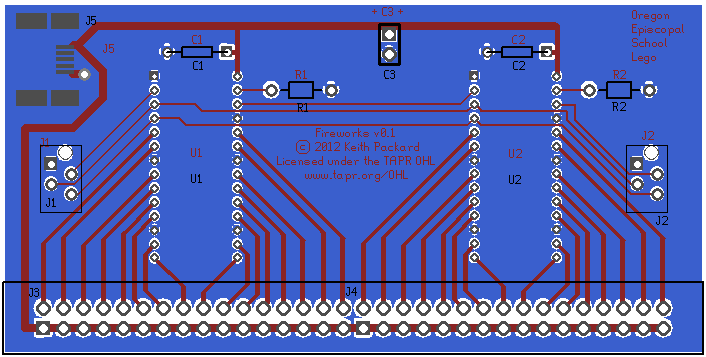
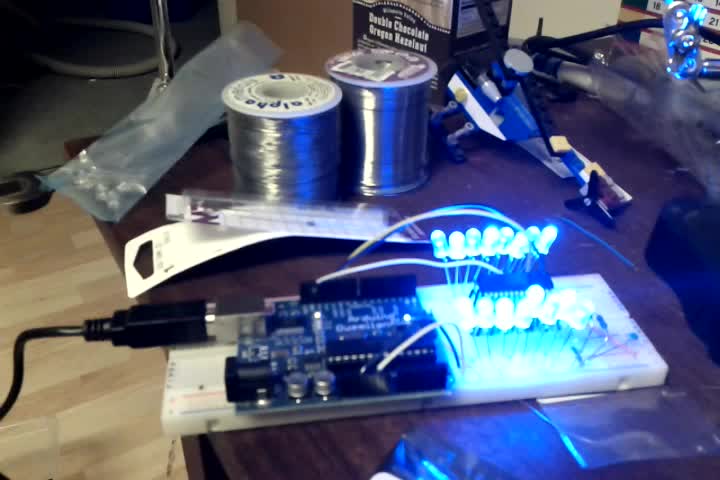
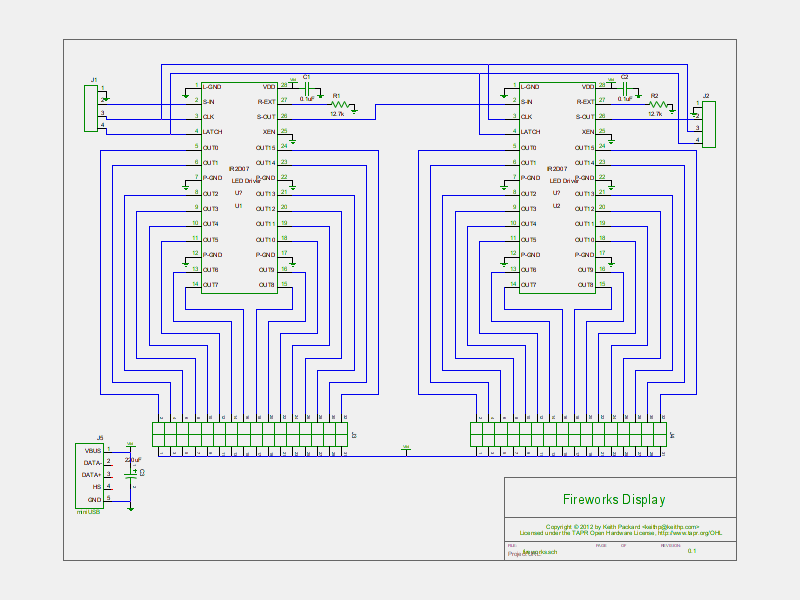
LED Fireworks. Or, parent helpers go overboard My friend, Mike Ward, and I help out at our kids school by teaching 5th and 6th graders programming in conjunction with a Lego class. For several years, I was teaching Logo on ancient Apple II machines. The teacher had a great curriculum and the kids learned a lot, but this year we decided to switch things around and try them out on Arduinos. This spring, the kids are building a Lego display centered around a birthday party theme for the star elephant at the Oregon Zoo (Packy), who turned 50 last weekend. In a moment of fun, I suggested that perhaps we should have some fireworks, along with the presents and birthday cake. How hard could it be to wire up a couple of LEDs to an Arduino to make something that looked like fireworks? Selecting parts. Mike and I sat down to order some parts from Digikey. We found these nice, cheap, LED drivers from Sharp. Then we found a selection of LEDs from Cree along with current-programming resistors (12.7k ) to drive the LEDs at 20mA, and some bypass caps (0.1 F) to keep the parts happy. The LED drivers are simple shift registers, with separate clock and data. They have both input and output pins, so you can daisy chain them and drive as many as you like from a single pair of CPU pins. We figured 160 LEDs would be plenty, so we ordered 10 chips. The LED drivers came in a through-hole, DIP package; it seemed like we d be able to just stuff them into a breadboard and quickly wire things up. Prototyping the design The LED driver chips turn out to use a much finer pitch package than the usual 0.1 spacing. There s no way we could stuff them into a breadboard and quickly wire things up. Obviously, a bit more care while ordering would have uncovered this, but my experience with through-hole parts is limited to parts from the mid 1970s I soldered extension wires onto one chip to test the circuit, and managed to get one chip talking to an Arduino. Here s a short movie of that in action: You can see the LED driver chip sitting on a set of extension leads plugged into the breadboard. It s hooked to the SPI port on the Arduino board, with the clock set as fast as it will go. If you watch the video, you can see that the LEDs actually vary in brightness. They re actually being pulse-width modulated. Clocked at 2MHz, there s enough bandwidth in the SPI bus to drive 160 LEDs with 127 discrete pulse widths at nearly 100Hz (100 * 127 * 160 = 2032000). Is bread boarding practical? With the chip propped up on its extension wires, and the LEDs plugged in, the whole setup was not surprisingly fragile. Getting five of these chips wired up and running for the length of the Lego show (one day at school and two days at the zoo) seemed unlikely. So, we decided to build some custom circuit boards. Using the GEDA tools to make circuit boards My business partner, Bdale Garbee, and I build rocketry electronics through Altus Metrum. He s the hardware guy and I spend my weekends writing firmware for various micro-controllers. Of course, I use free software tools for the firmware, and Bdale uses the free gEDA tools for the hardware. I ve gotten vaguely familiar with those by helping Bdale review circuit diagrams and PC board layout over the years. So I figured I d be able to learn a bit more about them and come up with some designs. I decided to stick two LED drivers on each board. As the chips can drive each LED with up to 50mA of current, each board could potentially consume 1.6A at 5V. Sticking a linear regulator on each board capable of supplying that much current would have required a hefty heat sink. Instead, I decided to stick a mini USB connector on the board and use some cheap USB power supplies. Of course, there wasn t a pre-packaged schematic symbol or footprint for the LED driver, so I first had to construct those. But, with symbols for all of the parts I used available, I drew this circuit: Wiring up 32 LEDs It s really easy to draw wires showing 32 LEDs hooked up to each board. Actually selecting connectors that can be easily hooked up took a bit more time. The idea of crimping individual two-pin connectors for 160 LEDs didn t seem like fun, plus individual connectors were going to cost a small fortune (the best option I found would have cost about $0.40 per LED). Bdale suggested using ribbon cable with a crimp-on connector crimp a connector across the whole cable and then split out two-wire sets for each LED. I d still have to individually solder each LED to the wire, but on the board end, all I d have to do is crimp the connector on to the cable. Designing the circuit boards The gEDA tools separate schematic design and PCB layout into two separate tools; the schematic program, gschem, exports a netlist and set of components which the schematic program, PCB, can import. This sounded a bit clunky to me, as you have to re-export and re-import the schematic data into the PCB each time you make changes, but it seems to work reasonably well in practice. The first time the schematic data is imported to the PCB tool, all of the component footprints are simply stacked on top of one another. With those moved to sensible locations, the tool will show rats for each netlist. Having drawn the schematic with symbols that strongly resembled the actual components, it was pretty easy to work through the rats one at a time by painting copper on the board. I d noticed that all of the signals could easily be routed on one side of the board, so I flooded the back side with a ground plane to keep things quiet. The final circuit board design looks like this: Circuit boards. All Altus Metrum products are manufactured by Advanced Circuits, and we ve been quite happy with them. They offer a cheap and fast prototyping service through their barebonespcb.com site. These boards are two layers with no silk screen or solder mask. I uploaded my design and in a couple of days I got back some shiny circuit boards: The footprint I designed for the LED drivers turned out to have a very small gap between the pads for each pin and the ground plane. This lead to a couple of shorted pins in the five boards, which were pretty easy to diagnose as the LED driven by that pin would be stuck on. Here s another picture with the ribbon cable connected and an LED lit up: Mounting the LEDs I started by writing a small nickle program to simulate the trajectory of a ballistic fireworks shell followed by an explosion at apogee and subsequent ballistic tracks for the resulting pieces. I made the initial conditions of the launch somewhat random, and Mike and I sat and watched that draw things until we saw a couple that looked good . The output from that was a series of X/Y locations spaced uniformly in time. Mike used those to drill holes in a piece of acrylic from TAP plastics. He glued the LEDs into that with some white glue (so that we have a chance of getting them back out): A custom maple box? I spent last weekend visiting my father for his birthday. Meanwhile, Mike was busy back home building a case for the project. I got home and found that he had fabricated a solid maple case. It s beautiful, and holds all of the LEDs, boards, wires and a couple of 4-outlet USB power supplies. Here s a picture of the joint he made in the box corners: The finished product Here s the inside of the box: And here s a movie of the whole thing in action. It s missing 8 white LEDs; I hadn t ordered enough from Digikey. Downloading schematics and PCB artwork The hardware design is licensed under the TAPR Open Hardware License. It s all stored in git (of course):
git://keithp.com/git/hw/fireworks
All of the symbols I created are also available through git:
git://keithp.com/git/hw/keithp
Things I d do differently One of the frustrating things about moving atoms around instead of just bits is that once you ve got a physical artifact, it s really expensive to change it. There are a couple of minor things I would change if I were going to build more of these: Things that worked well There were a couple of things that went better than I had expected:

19 April 2012

James Morrison: Issues with Appengine

I like App Engine, my wedding website runs on App Engine as well as a couple recent commercial projects. However, there are some annoyances that make a lot of the useful things I learned at Google not applicable.

  1. Chunked responses
    App Engine doesn't have a way of doing chunked responses.
    1.5. Processing after sending the responseMy annoyance here is that I can't send an early response and wait for some resource. Say I want to do 5 url fetches that I cache for a short period of time. If I want to reply in 250ms, I want to use any of the results I've gotten and reply to the user. Then once the rest of the fetches come in, I want to put them in the cache, so they will come back quickly the next time.
  2. Counters
    App Engine has crappy support for counters. You can shard your counters into the datastore: https://developers.google.com/appengine/articles/sharding_counters#counter_python or you can use taskqueues: http://blog.appenginefan.com/2009/10/non-sharded-counters-part-2-using-task.html . Now, how do you graph these counters over time, well, that is left as an exercise for the reader. Google has special datastores for stores and retrieving counters.
  3. Backends
    Backends in appengine are versioned separately from frontends. This sounds like a good idea, but to run the devserver with backends, the backends need to be in the same source tree. Thus backends share the same url space. Backends also share the same app.yaml, so again the url space is shared. Thus, if you make a change that you want to coordinate between the frontend and the backend, you need to change the application version in app.yaml, then rename all the backends in backends.yaml. If backends are supposed to be in the same source tree as frontends, then they should be prefixed with the application version. If backends should be versioned separately from frontends, then they shouldn't share url handlers from app.yaml.
    3.5 Uploading backends is slow
    Each backend is uploaded through appcfg.py separately. So if you are crazy and have one backend per backend level, then you need to upload 4 copies of the source code each time the backends get updated.
  4. Logging
    I want structured logs. Instead what you have to do is use the python logging module to write out human readable logs, then parse them out into the structure you want.
    http://code.google.com/p/google-app-engine-samples/source/browse/trunk/logparser/logparser.py

As a preemptive counter, 1.5 could be dealt with using backends and a background thread, except backends don't scale to the number of queries, so my use case above isn't fixed.

Petter Reinholdtsen: RAND terms - non-reasonable and discriminatory

Here in Norway, the Ministry of Government Administration, Reform and Church Affairs is behind a directory of standards that are recommended or mandatory for use by the government. When the directory was created, the people behind it made an effort to ensure that everyone would be able to implement the standards and compete on equal terms to supply software and solutions to the government. Free software and non-free software could compete on the same level. But recently, some standards with RAND (Reasonable And Non-Discriminatory) terms have made their way into the directory. And while this might not sound too bad, the fact is that standard specifications with RAND terms often block free software from implementing them. The reasonable part of RAND mean that the cost per user/unit is low,and the non-discriminatory part mean that everyone willing to pay will get a license. Both sound great in theory. In practice, to get such license one need to be able to count users, and be able to pay a small amount of money per unit or user. By definition, users of free software do not need to register their use. So counting users or units is not possible for free software projects. And given that people will use the software without handing any money to the author, it is not really economically possible for a free software author to pay a small amount of money to license the rights to implement a standard when the income available is zero. The result in these situations is that free software are locked out from implementing standards with RAND terms. Because of this, when I see someone claiming the terms of a standard is reasonable and non-discriminatory, all I can think of is how this really is non-reasonable and discriminatory. Because free software developers are working in a global market, it does not really help to know that software patents are not supposed to be enforceable in Norway. The patent regimes in other countries affect us even here. I really hope the people behind the standard directory will pay more attention to these issues in the future. You can find more on the issues with RAND, FRAND and RAND-Z terms from Simon Phipps (RAND: Not So Reasonable?). Update 2012-04-21: Just came across a blog post from Glyn Moody over at Computer World UK warning about the same issue, and urging people to speak out to the UK government. I can only urge Norwegian users to do the same for the hearing taking place at the moment (respond before 2012-04-27). It proposes to require video conferencing standards including specifications with RAND terms.

Next.

Previous.