Search Results: "tg"

14 October 2013

Clint Adams: The Windy City is full of meat

As you know, I am not big on reviews, so you should disregard the remainder of this entry. I recently found myself in what is called a theatre complex , watching an adaptation of Moli re's Les Femmes savantes by Freyda Thomas, who is apparently famous for playing Alenis Grem on Deep Space Nine. Called The Learned Ladies, this translation to English manages to approximate some of the rhyme of the original, thereby making it unquestionably better than DS9. Also noteworthy is the all-female cast, cobbled together from two all-female theater groups. Elizabeth Neptune plays Chrysale, occasionally channeling the spirit of Jackie Gleason or bringing adorable ardor to such epic lines as Tea! I won't say anything about her eyes, but I will say something about her slippers. Sara Montgomery, as B lise, is delightfully crazy in her singing, dancing, costume changes, and other antics, which serve to transform this otherwise-completely-serious play into a comedy. I definitely won't say anything about her shoes. Madeleine Maby begins playing Philaminte well before the show starts. Spoiler alert: she sits on the stage, pretending to look through a telescope and make notes from before the house opens until right before the start of the first scene. I still feel exhausted by the thought of having to do that myself. L' pine is portrayed by Alyssa Lott, who also plays three minor roles. Her mastery of physical comedy is not wasted on this production. Marta Kuersten plays Clitandre opposite Sarah Brill's Henriette. While Marta's performance was quite good, she looks much better as a woman. I will not be saying this about everyone. Katie Honaker delivers visceral smarm and sleaze as Trissotin. Even her hairstyle is somehow evocative of contempt. Susan Finch plays Vadius and Le notaire. Susan was definitely most convincing as a man. Despite mutterings to the contrary, some suspension of disbelief was necessary for the other male roles, but not for Vadius, oh no. Finishing out the list we have Janna Emig as Martine, Francesca Day as Armande, and Kathryn Alexander as Ariste, with good performances, particularly in the second half. Even though it didn't have Coppertop from Strangers With Candy and a boy-band song-and-dance cover of To Be with You by Mr. Big, I recommend this play.

13 October 2013

Robert Collins: key transition time

I ve transitioned to a new key announcement here or below. If you ve signed my key in the past please consider signing my new key to get it integrated into the web of trust. Thanks!
-----BEGIN PGP SIGNED MESSAGE-----
Hash: SHA1,SHA256
Sun, 2013-10-13
Time for me to migrate to a new key (shockingly late - sorry!).
My old key is set to expire early next year. Please use my new key effective
immediately. If you have signed my old key then please sign my key - this
message is signed by both keys (and the new key is signed by my old key).
old key:
pub 1024D/FBD3EB8E 2002-07-20
Key fingerprint = 9222 8732 859D 25CC 2560 B617 867B F9A9 FBD3 EB8E
new key:
pub 4096R/AAC0E286 2013-10-13
Key fingerprint = 8244 0CEA B440 83C7 9431 D2CC 298E 9A19 AAC0 E286
The new key is up on the keyservers, so you can just pull it from there.
- -Rob
-----BEGIN PGP SIGNATURE-----
Version: GnuPG v2.0.19 (GNU/Linux)
iEYEARECAAYFAlJZ8FEACgkQhnv5qfvT644WxACfWBoKdVW+YDrMR1H9IY6iJUk8
ZC8AoIMRc55CTXsyn3S7GWCfOR1QONVhiQEcBAEBCAAGBQJSWfBRAAoJEInv1Yjp
ddbfbvgIAKDsvPLQil/94l7A3Y4h4CME95qVT+m9C+/mR642u8gERJ1NhpqGzR8z
fNo8X3TChWyFOaH/rYV+bOyaytC95k13omjR9HmLJPi/l4lnDiy/vopMuJaDrqF4
4IS7DTQsb8dAkCVMb7vgSaAbh+tGmnHphLNnuJngJ2McOs6gCrg3Rb89DzVywFtC
Hu9t6Sv9b0UAgfc66ftqpK71FSo9bLQ4vGrDPsAhJpXb83kOQHLXuwUuWs9vtJ62
Mikb0kzAjlQYPwNx6UNpQaILZ1MYLa3JXjataAsTqcKtbxcyKgLQOrZy55ZYoZO5
+qdZ1+wiD3+usr/GFDUX9KiM/f6N+Xo=
=EVi2
-----END PGP SIGNATURE-----

11 October 2013

Michal Čihař: Hackweek is over

10th hackweek is over and I think it has been again great chance to hack on something. This year we even had better food supplies so interruptions from hacking were even less frequent. As you've might have already noticed, I was working on Weblate whole week and I think it worked pretty well and I've implemented all what I wanted. First of all, Weblate now supports login using lot of third party services (like GitHub, Facebook, Google, ...). This was achieved by using python-social-auth for that. It is quite new module for this, so hopefully it's API will stay stable enough to be usable in the long term. It was surprisingly easy to implement, though I've spent quite a lot of tweaking of the login and registration process to make it work according to my expectations. After doing this quite big change, I thought it's about time to restructure the documentation and document new features in it. I think it now covers all important things, but if you can't find something or some parts are hard to understand, just let me know, I'll fix it. Another quite big feature (though it won't be much visible in upcoming 1.8 release) is source string tracking. This is prerequisite for many features people have requested in Weblate's issue tracker, but these will have to wait for next releases. If you want to see some feature earlier, you can support it by money on Bountysource :-). Weblate can now also search in all strings, which might become handy if grepping over dozen of Git repositories is not your favorite game. And last but not least, I've implemented simple Captcha protection for new registrations as the demo server is full of bots who register there and do nothing afterward. Basically I think this makes Weblate 1.8 feature complete and I'd like to stabilize it in upcoming weeks to release. Right now it is deployed on the demo server, where you can play with it and discover bugs :-). Also it's now time to work on Weblate translations!

Filed under: English SUSE Weblate 0 comments Flattr this!

9 October 2013

John Goerzen: Two Kittens

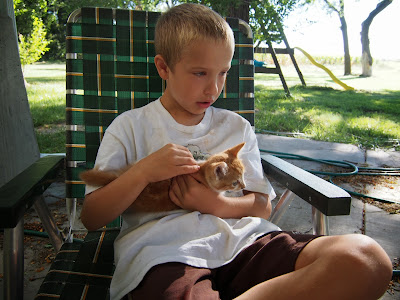
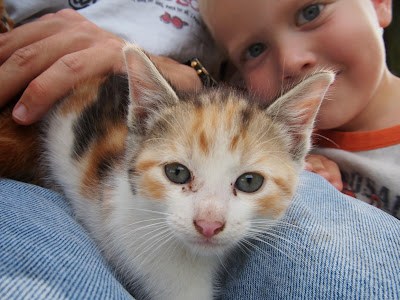
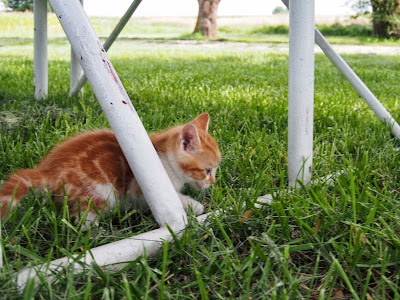
Almost every time he got off the bus for the past month and a half, Jacob started his afternoon in the same way. Before toys, before his trains and his toy bus, before anything indoors, he went for our cats. Here he is, cradling his favorite, Tigger: Laura and I both grew up around cats. We had been talking about kittens, and shortly after we got engaged, one of my relatives offered us some free kittens. We went to his place one evening and selected two of them one calico and one tiger-colored. Since what is now my place will soon be our place, they came to live with me. Our cats were one of the first things we did to prepare for our lives together. Oliver wanted to name them some rather impractical sentence-long names ( The Cat Who Always Likes To Run ), so Laura and I suggested some names from one of their favorite books: Tigger and Roo. They both liked the names, but Oliver thought they should be called Tigger the Digger and Roo the Runner . Never mind that they were just 6 weeks old at the time, and not really old enough to either dig or run. Here s Oliver with Roo, the day after the kittens arrived here. I have always had outside cats, both because I m allergic to cats so I need them to be outside, and because they sometimes literally quiver with joy of being outdoors. Tigger and Roo often chased insects, wrestled with each other, ran up (and slowly came back down) trees, and just loved the outside. Sometimes, I have taken my laptop and wireless headset and work from the back porch. The kittens climb up my jeans, inspect the laptop, and once Roo even fell asleep on my lap at one of those times. Jacob has been particularly attached to Tigger, calling him my very best friend. When Jacob picks him up after school, Tigger often purrs while cradled in Jacob s arms, and Jacob comments that Tigger loves me. Oh dad, he knows I am his friend! The kittens have been growing, and becoming more and more comfortable with their home in the country. Whenever I go outside, it isn t long before there are two energetic kittens near my feet, running back and forth, sometimes being very difficult to avoid stepping on. I call and I see little heads looking at me, from up in a tree, or peeking out from the grain elevator door, or from under the grill. They stare for just a second, and then start running, sometimes comically crashing into something in their haste. Yesterday when I went to give them food, I called and no cats came. I was concerned, and walked around the yard, but at some point either they come or they don t. Yesterday afternoon, just after the bus dropped off Jacob, I discovered Tigger on the ground, motionless. Once Jacob was in the house, I went to investigate, and found Tigger was dead. As I was moving his body, I saw Roo was dead, too. Both apparently from some sort of sudden physical injury a bit mysterious, because neither of them were at a place where they had ever gone before. While all this was happening, I had to also think about how I was going to tell the boys about this. I tried to minimize what he could see, Jacob had caught an unavoidable glimpse of Tigger as we were walking back from the bus, but didn t know exactly what had happened. He waited in the house, and when I came back, asked me if Tigger was dead. I said he was. Jacob started crying, saying, Oh Dad, I am so sad , and reached up for a hug. I picked him up and held him, then sat down on the couch and let him curl up on my lap. I could quite honestly let him know he wasn t alone, telling him I am sad, too. Oliver arrived not long after, and he too was sad, though not as much as Jacob. Both boys pretty soon wanted to see them. I decided this was important for them for closure, and to understand, so while they waited in the house, I went back out to arrange the kittens to hide their faces, the part that looks most unnatural after they die. The boys and I walked out to where I put them, then I carried both of them the last few feet. We stood a little ways back close enough to see who was there, far enough to not get too much detail and they were both sniffling. I tried to put voice to the occasion, saying, Goodbye, Tigger and Roo. We love you. Oliver asked if they could hear us. I said No, but I told them what I felt like anyway. Jacob, through tears, said, Dad, maybe they are in heaven now. We went back inside. Jacob said, Oh dad, I am so sad. This is the saddest day of my life. My heart is breaking. Hearing a 7-year-old say that isn t exactly easy for a dad. Pretty soon he was thinking of sort of comfort activities to do, saying I think I would feel better if we did So they decided to watch a favorite TV program. Jacob asked if Laura knew yet, and when I said no, he got his take-charge voice and said, Dad, you will start the TV show for us. While we are watching, you will send Laura an email to tell her about Tigger and Roo. OK? What could I say, it wasn t a bad idea. Pretty soon both boys were talking and laughing. It was Big Truck Night last night, at a town about half an hour away. It s an annual event we were already planning to attend, where all sorts of Big Trucks firetrucks, school bus, combine, bucket truck, cement truck, etc show up and are open for kids to climb in and explore. It s always a highlight for them. They played and sang happily as we drove, excitedly opened and closed the big door on the school bus and yelled All Aboard! from the top of the combine. We ate dinner, and drove back home. When we got home, Jacob mentioned the cats again, in a sort of matter-of-fact way, and also wanted to make sure he knew Laura had got the message. A person never wakes up expecting to have to dump a bowl of un-eaten cat food, or to give an impromptu cat funeral for little boys. As it was happening, I wished they hadn t been around right then. But in retrospect, I am glad they were. They had been part of life for those kittens, and it is only right that they could be included in being part of death. They got visual closure this way, and will never wonder if the cats are coming back someday. They had a chance to say goodbye. Here is how I remember the kittens.

5 October 2013

Rémi Vanicat: Key-transition

A recent discussion on debian-project remind me I have to do this:
-----BEGIN PGP SIGNED MESSAGE-----
Hash: SHA1,SHA256
Hello,
I am transitioning GPG keys from an old 1024-bit DSA key to a new
4096-bit RSA key.  The old key will continue to be valid for some
time, but I prefer all new correspondance to be encrypted in the new
key, and will be making all signatures going forward with the new key.
This transition document is signed with both keys to validate the
transition.
If you have signed my old key, I would appreciate signatures on my new
key as well, provided that your signing policy permits that without
reauthenticating me.
The old key, which I am transitional away from, is:
   pub   1024D/9057B5D3 2002-02-07
         Key fingerprint = 7AA1 9755 336C 6D0B 8757  E393 B0E1 98D7 9057 B5D3
The new key, to which I am transitioning, is:
   pub   4096R/31ED8AEF 2009-05-08
         Key fingerprint = DE8F 92CD 16FA 1E5B A16E  E95E D265 C085 31ED 8AEF
To fetch the full new key from a public key server using GnuPG, run:
  gpg --keyserver keys.gnupg.net --recv-key D265C08531ED8AEF
If you have already validated my old key, you can then validate that
the new key is signed by my old key:
  gpg --check-sigs D265C08531ED8AEF
If you then want to sign my new key, a simple and safe way to do that
is by using caff (shipped in Debian as part of the "signing-party"
package) as follows:
  caff D265C08531ED8AEF
Please contact me via e-mail at <vanicat@debian.org> if you have any
questions about this document or this transition.
  Remi vanicat
  vanicat@debian.org
  remi.vanicat@gmail.com
  remi.vanicat@ens-lyon.org
-----BEGIN PGP SIGNATURE-----
Version: GnuPG v1.4.14 (GNU/Linux)
iD8DBQFST8iPsOGY15BXtdMRAggfAJ4z5wEpUy8Bcicv9KTGOjsUAZF2xACfYKv9
GWXh8iT1N2Qqjhwtpvx9B3aJAhUDBQFST8iP0mXAhTHtiu8BCPldEADYM9e/22yu
En8lcZ5UUI/eQ5jFgZaxTZ90ShS0vPD/Mgn6xyKoeigA0Bk4ltTjDXA7vEWXLjOK
gbGv3SvffPJIsR1WJmhYtVyNquJXXjyElEBsbxvCJ/awYdU9BFXPqtLlLVCObvSc
bE9xlJhoLdk3bDqSSTO3nqoDa0qgPnJvwKNYIMBrNavGyIW3QT0BRUCKyBssqh+u
P4x8VhpHiR2Ee4LHfRVeJk+5ncvSXYluAohOXka5AnV2GgFQoVYfFqxn2Gh3BMWC
sqf/NUPnFOCSRw++oNP3mBv3jn/jZuo8BcVOECKL+/dO6/3otgO6a/5tUspfnAJA
m/UxBdc2vs7LkZ0wUipIHg10x4154f+hZfx4WuCJ05X0dqcKeh4eJ0zFBvxMyh+A
o2TfifT9WJlyb+Hah/w1MFAXI8cAj5RvwdVgTzcodXpggtpBpdLDvv3G1KYFm/TG
Zev480N6bGrBb3JKgUtAMuTls8+FngYtYg9YKBiajEDM3MVC+H4MiOzVNKV++y/n
YW3z59Oc04ZMi9hV+uR3kwq8D7aUJmc0QFeOGmq7W9LOjvVO+lTf87l3jh2ahxx/
FgiinSZr1YzE+9OtNj8CTsmAmApIxsTJUCR6h554z+lyrTwc0pdeUwzSWqV84k7G
V6HBmTiw9IGs22+W15pRzq/mCVYdrYT7zQ==
=c5fJ
-----END PGP SIGNATURE-----
Here is the link to the .txt version for easier checking of signature.

23 September 2013

Daniel Pocock: PostBooks packages available

A common theme that comes up in free software evangelism is the question of how to tap into the huge expenditure that small to medium-sized businesses make for off-the-shelf licensed software. It is well known that many small companies are paying over the odds compared to the site-license rates given to big business, so why is it that small businesses are not rushing to adopt free and open source solutions? The answer is not likely to be found by fighting a battle on pricing (even though it is a battle that free software is inherently well prepared for). Rather, the most compelling strategy involves helping businesses find better ways to solve their own problems. A problem that every business encounters in every industry is the maintenance of proper financial records. Up until now, packaged solutions like GnuCash and HomeBank, available in many Linux distributions, have only catered for the smallest businesses and household accounting. At the other end of the spectrum, solutions like Compiere/Adempiere and OpenERP require a level of effort to install and maintain that makes them unsuitable for small users and businesses that don't need their full range of features. OpenERP briefly appeared as a Debian package but subsequently dropped out due to difficulties supporting the package. There is another choice, PostBooks. PostBooks has recently been packaged for Debian and this experience leads me to believe it will be supportable in Fedora and other distributions too. PostBooks, which started off as a commercial product, was re-licensed as an open source solution in 2007. In March 2013, PostBooks was project of the month on Sourceforge. Of particular note,
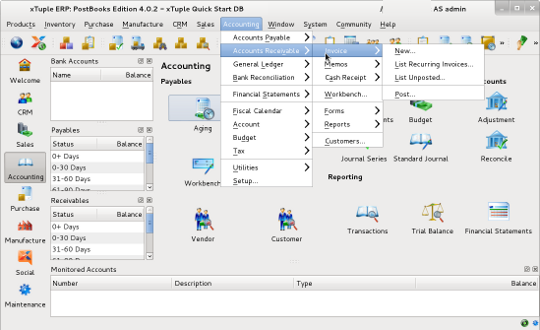
  • PostBooks has a Qt-based GUI where users of equivalent commercial solutions are likely to feel comfortable very quickly
  • PostBooks does not depend on any dedicated server processes other than a PostgreSQL database
  • Using the quickstart database, it can be set up in less than half a day, making it suitable for many consultants and freelancers who may otherwise use a product having a setup wizard (such as QuickBooks).
  • However, with features like inventory, invoicing, a sophisticated data import GUI (known as CSVImp), a true SQL backend, multi-currency and multiple concurrent users, it scales beyond the use cases that Quickbooks and Sage Accounting are capable of servicing.
  • The company behind PostBooks, xTuple, is well established and offers related services such as training and an annual user conference (which takes place in just a few weeks). Many business users are likely to find this style of support very reassuring and familiar, even if they don't plan to immediately take advantage of these things.
Limitations Two particular limitations caught my attention early when evaluating PostBooks: The developers have acknowledged these limitations and offered to complete these solutions with a crowd-funding campaign dubbed Feature Mob 2.

While everybody likes a free lunch, I personally feel that developers are perfectly entitled to request payment for their work. Having already taken a great leap of faith in open-sourcing a product that had previously been developed in-house, companies like xTuple need to look at new ways to generate revenue. Having looked at some of the prices of equivalent solutions, I felt quite comfortable pledging a similar amount based on four things:
  • it is based on the Kickstarter model, they only keep the money if their funding target is reached and feature implementation goes ahead
  • they are releasing the work as open source
  • the desire to have the option of using a highly capable free software solution that will be around well into the future
  • the probability that this is one piece of software that is likely to create more commercial opportunities for free software developers
Next steps People trying the packages and people who potentially want to package PostBooks for other distributions are very welcome to come and ask questions in the xTuple Debian maintainers packaging list or using the xTuple web forums. Please also feel free to report bugs through the Debian bug tracker.

17 September 2013

Stefano Zacchiroli: sources.debian.net - advanced search and other news

all your ctag (and checksum) are belong to us A few months after the initial announcement, here are some news about the sources.d.n service. I've been late in blogging this, but most of it has been implemented by myself and Matthieu Caneill during DebConf13, which has been a great DebConf, totally exceeding my expectations (and they were already fairly high!). First, you might have noticed some user-visible changes: On the other hand, under the hood: As you usual, your bug reports (and patches!) are more than welcome, just check BUGS before reporting to avoid duplicates.
That's all!

Craig Small: jqGrid in TurboGears2 Admin Screens

I wanted to use the jqGrid for my admin pages as I liked that look and it matches some of the other screens outside the admin controller. The admin controller, or rather the CrudRestController out of tgext.crud, has a way of exporting results in json format. So surely its a matter of changing the TableBase to use jqGrid in the admin controller and we re done? Well, no. First you need to adjust the jsonReader options so that it lines up to the field names that the controller sends and this was one of the first (or last snags). The json output looks like:
 
  "value_list":  
    "total": 20,
    "items_per_page": 7,
    "page": 1,
    "entries": [(lots of entries)...]
   
 
Now this is a little odd because of the top-level dictionary that is being used here. Most of the examples have everything that is inside the value_list being returned. In fact adjusting the controller to return only those items in the value_list values works. To look inside this structure we need to adjust the jsonReader options. jqGrid documentation uses the format toptier>subtier for the XML reader so that was the intial attempt. It was also an intial fail, it doesn t work and you get your very familiar empty grid. The trick is close to this format, but slightly different for json. You change the options to toptier.subtier . In other words change the greater than symbol to a full stop for json access. The jqGridWidget now has the following options (amongst others):
options =  
  'datatype': 'json',
  'jsonReader':  
    'repeatitems': False,
    'root': 'value_list.entries',
    'total': 'value_list.total',
    'page': 'value_list.page',
   
 
There might be a way of saying all entries sit under value_list inside jqGrid, but I couldn t find it. Those options given above do give a working jqGrid on the admin screens.

13 September 2013

Daniel Pocock: Calendar and Contact data with free software in the Smartphone era

Since the rise of smartphones, first Blackberry, then iPhone and now Android, the world at large has had a convenient option to fall back on for management of contact and calendar data. The data itself seems somewhat trivial: many of us software developers have worked with a plethora of obscenely more obscure schemas. It is unlikely that most people would ever have to perform an operation on their address book that requires a statistical toolkit like the R project or any of the other advanced tools we now have for data processing. In terms of data, addresses and phone numbers can appear quite boring. So why hasn't the free software community mastered it and cloud providers are currently running rampant hoovering up the data of billions of users? Ruling out LDAP One problem that people have faced is the existence of different standards. LDAP has quite a high profile and appears to be supported by default in many desktop applications. For this reason, it tends to grab people's attention but after a close look, many people find it is not the right solution. LDAP tends to work well for organisations where the data is centrally managed and in situations where fine-grained access control is not required. LDAP servers often need a capable UNIX administer to manage effectively. To top it off, LDAP itself does not provide an effective solution for two-way synchronization of data with remote and mobile users. The emergence of SyncML, CalDAV, GroupDAV and CardDAV Addressing this final problem (two-way mobile/portable device sync) has brought on the development of further standards. Initially, SyncML (now known as Open Mobile Alliance Data Synchronization and Device Management) grabbed significant attention, partly because it had been included in some of the first generation of smartphones from once-prominent vendors like Nokia. Open source server solutions for SyncML did not gain traction though. The most prominent is Funambol, however, it is not packaged in any major Linux distribution and it requires some basic Java knowledge to maintain it effectively. Like LDAP it appears to be most comfortable in enterprise use cases and doesn't appeal to the people who run a private mail and web server. SyncML has further suffered with the lack of support in more recent generations of smartphones. WebDAV was formalised in 1999 and there are now various derivative standards such as CalDAV and CardDAV which use WebDAV as a foundation. However, standards didn't arrive at this place directly: CalDAV only appeared as RFC 4791 in 2007 and CardDAV as RFC 6352 in 2011. In the meantime, some vendors experiemented with an alternative called GroupDAV. GroupDAV is largely obsolete now and GroupDAV v2 is a subset of CalDAV and CardDAV. Finally gaining traction The good news is, CardDAV and CalDAV are gaining traction, in no small part due to support from Apple and the highly proprietary iPhone. Some free software enthusiasts may find that surprising. It appears to be a strategic move from Apple, using open standards to compete with the dominance of Microsoft Exchange in large corporate networks. Both protocols are supported natively in iPhones and Mac OS X. More exciting, Apple releases their Contacts Server and Calendar Server as open source software, making it easier to look under the hood and observe any deviations from the standards. Apple's adoption of CardDAV and CalDAV has been accompanied by a similar effort in free software, however, support is more patchy. The Mozilla Lightning calendar plug-in for Thunderbird (known as the iceowl-extension plugin for icedove on Debian) has supported CalDAV for some time. In contrast, Thunderbird's address book lacks native support for CardDAV and has other limitations (discussed in detail below). Limited CardDAV support in Thunderbird can be achieved using the third-party SOGo Connector, which is not just for ScalableOGo server. The Evolution PIM appears to support both CardDAV and CalDAV relatively smoothly and appears to be more functional and easier to get started with. Free software servers are also emerging. DAViCal, despite the name, supports both CardDAV and CalDAV. It is a good solution for people who have an existing mail server and don't want to transition to an all-in-one groupware suite. Packages available in Debian make it easy to deploy and get started. It is a PHP solution, using a PostgreSQL database underneath. For people who do want a groupware suite, CardDAV and CalDAV are supported in products like ScalableOGo and Zimbra. For people who don't want a server at all and just want to sync between a desktop and a mobile device, there are options like Calypso. Mobile support: the missing link A number of people have blogged about using the Android apps CardDAV-Sync and CalDAV-Sync to complete the picture. I've tested these myself and verified that they work. However, there is one vital thing missing: the source code. Nobody knows what is inside these apps except the developer. That makes it impossible for other developers to troubleshoot them and improve them and it also makes it impossible to be certain that they do not leak information. An alternative is the aCal app for Android. Despite the name, aCal can synchronize the address book as well as the calendar. However, in my tests against DAViCal, I found that the addressbook can only be synced once and that on subsequent syncs, it fails to discover any new server-side contacts. aCal source code is available on gitorious.

aCal appears to be a compelling solution for Android users, hopefully the contact sync will be fixed soon. It only syncs once after installation and then fails to detect any new contacts. Thunderbird's limitations It has already been mentioned that the Thunderbird address book can be synchronized to a CardDAV server by adding the SOGo Connector plugin. However, this is not a perfect solution. The plugin itself is fine: the SOGo web site describes the connector (as opposed to the SOGo Integrator plugin) as a portable solution: in other words, it is vendor neutral, compatible with any standards-compliant server. The first limitation is that it is necessary to duplicate the setup process for both the calendar sync and the address book sync. This is just a question of convenience.
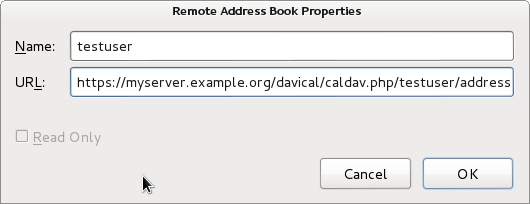
The SOGo Connector plugin configuration window is very trivial. I recommend using read-only mode to avoid the problems with multiple email addresses or telephone numbers. More serious limitations exist in the address book itself: if the CardDAV server has more than 2 email addresses, they will not appear in the Thunderbird address book. Changing an email address on the client side will result in loss of those additional email addresses on the server-side. The Mozilla team initially committed to rewrite the address book from the ground up but it is not clear whether that work is still in progress. DAViCal confusion I had been using DAViCal for quite some time as a CalDAV server before I recently decided to try and use it for CardDAV as well. As a calendar server, it had been working fine. I have a small number of users with some private calendars and also some shared calendars. When I installed the SOGo Connector plugin and went to setup the client-side configuration, it asked me for the server URL. Having used CalDAV already, I simply tried copying the existing CalDAV URL, which is of the form https://myserver.example.org/davical/caldav.php/daniel/home The URL was accepted and I could create address book entries on the client side. No errors appeared. I then tried setting up the same URL as an address book in Evolution. This time, I found I was able to create contacts and sync them to the server and access them from another copy of Evolution. It appeared DAViCal was working fine and I felt that Thunderbird or the SOGo Connector was somehow broken, because the Evolution clients were syncing but Thunderbird was not. The lack of any errors from the Thunderbird GUI further undermined my confidence in the SOGo Connector. Nonetheless, I decided to dig a little deeper, looking through the DAViCal source code. This brought me to the realisation that each URL could be flagged as either a calendar resource or an address book resource. This had not been obvious to me before. Evolution had effectively been storing the contact entries into a calendar URL and DAViCal had been happily accepting them. SOGo Connector, querying the URL, appears to have received both calendar and contact records from DAViCal and given up.
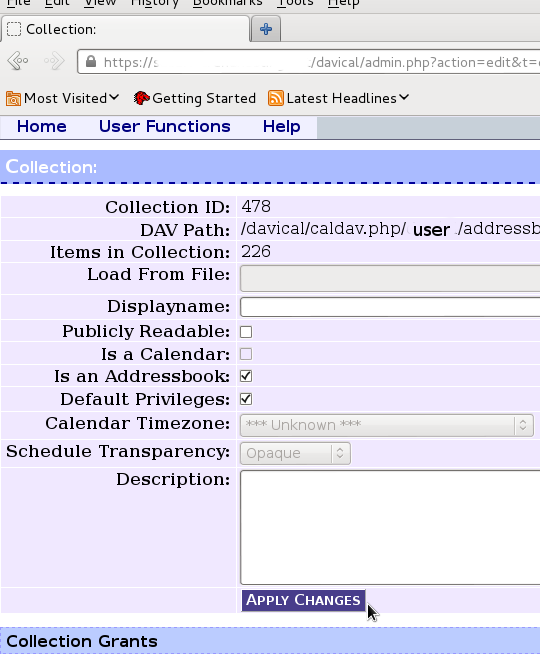
Here is where I configured the extra resource for an address book store under my user account in DAViCal In the DAViCal web management console, I created an extra resource for my user ID and set the appropriate checkbox to mark the resource as an address book. Then I put this resource URL into all the clients and found that they were all able to sync with each other. DAViCal's maintainer has explained that this is a limitation in the CardDAV/CalDAV protocols: technically, it is valid for the client to store the wrong type of objects in each URL. Clients need to be more resilient when they stumble across objects they don't expect in a particular resource. Conclusion A complete free software based contact-management solution can be easily deployed using any of the servers mentioned above, particularly if Evolution is the preferred client software. Using Thunderbird as a client, it can also work, but attention is needed to avoid data loss on sync. Thunderbird could also be used in a read-only mode to access address books maintained with Evolution. Mobile support is still patchy on Android. The closed source solution (CardDAV-Sync and CalDAV-Sync) appears to work and a promising open source close, aCal, appears to be "nearly there". Some people would obviously prefer to use a standalone contact/calendar server, while others may prefer an all-in-one groupware suite. Both approaches appear to be feasible, but the standalone contact/calendar server appears to offer a more compelling way to start quickly and have minimal administrative overhead, particularly due to the fact that DAViCal is available in a supported package.
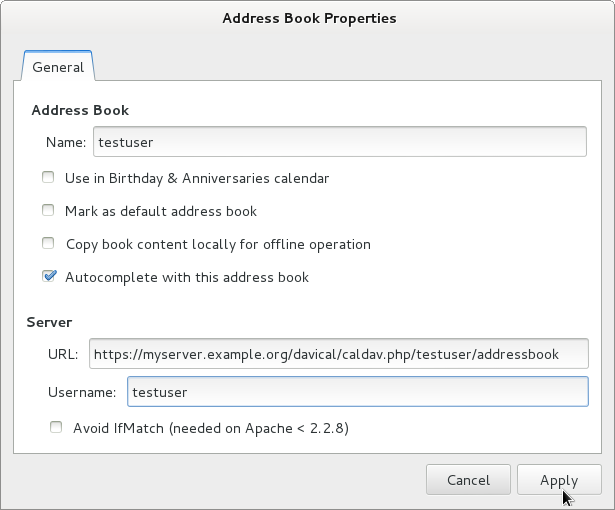
This is the contact server configuration window in Evolution. It offers slightly more options than SOGo Connector in Thunderbird and appears to be a more finished solution overall.

10 September 2013

Steve Kemp: node.js is kicking me

Today I started hacking on a re-implementation of my BlogSpam service - which tests that incoming comments are SPAM/HAM - in node.js (blogspam.js) The current API uses XML::RPC and a perl server, along with a list of plugins, to do the work. Having had some fun and success with the HTTP+JSON mstore toy I figured I'd have a stab at making BlogSpam more modern: In theory this is easy, I've hacked up a couple of plugins, and a Perl client to make a submission. But sadly the async-stuff is causing me .. pain. This is my current status:
shelob ~/git/blogspam.js $ node blogspam.js
Loaded plugin: ./plugins/10-example.js
Loaded plugin: ./plugins/20-ip.js
Loaded plugin: ./plugins/80-sfs.js
Loaded plugin: ./plugins/99-last.js
Received submission:  "body":"This is my body ..","ip":"109.194.111.184","name":"Steve Kemp" 
	plugin 10-example.js said next :next
	plugin 20-ip.js said next :next
	plugin 99-last.js said spam SPAM: Listed in StopForumSpam.com
So we've loaded plugins, and each has been called. But the end result was "SPAM: Listed .." and yet the caller didn't get that result. Instead the caller go this:
shelob ~/git/blogspam.js $ ./client.pl
200 OK 99-last.js
The specific issue is that I iterate over every loaded-plugin, and wait for them to complete. Because they complete asynchronously the plugin which should be last, and just return "OK" , has executed befure the 80-sfs.js plugin. (Which makes an outgoing HTTP request). I've looked at async, I've looked at promises, but right now I can't get anything working. Meh. Surprise me with a pull request ;)

5 September 2013

Daniel Pocock: Will Baby Boomers strangle Australia's Internet?

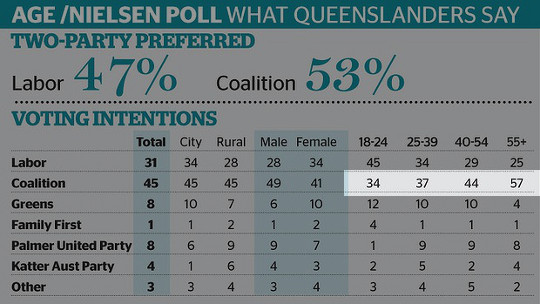
When Labor's Communications Minister Stephen Conroy won the title Internet villain of the year most educated people realised it wasn't something to celebrate. So it might be surprising for some that the title could potentially be returning to Australia so soon... Australia's main opposition party, the deceptively named Liberals (who actually lurk at the Marine Le Pen grade of conservatism) have just announced plans to resurrect the plan by implanting filtering technology in all modems, routers and smartphones. Whether they do or don't, there are serious concerns that they have described Australia's still-under-construction national broadband network as a wasteful project (which is potentially true) but failed to provide any credible alternative: who really thinks the conservative's proposed 25MBps will be a serious technology when they finish deploying it in 2019?. It is interesting to look at the bigger picture to see where this stupidity comes from. A political poll released early this week gives us half the story: Big bad baby boomers It is obvious that older voters prefer the conservative "coalition" parties, 57% of over-55s in particular. It is a huge jump from the 44% of voters in the age group below them. What this table doesn't tell us is that Australia's population is top-heavy with Baby Boomers. In other words, there are actually quite a lot of those over-55-year-old voters. In fact, it is estimated that close to 1 in 3 Australians will be in this category within the next 10 years. People who want the world to be the way it was in the 60s: many have already paid off a mortgage on a home in the suburbs with no access to things like public transport. They grew up under the white Australia policy and are frustrated at the presence of educated hard working foreigners from countries like India and China. Retired, no longer working, expecting the state to provide roads to their poorly located McMansions and free health care but little concern for broadband or anything that smells new. As they are no longer working, many have no commercial demand for broadband but will happily vote for a policy to censor it even if they don't use it themselves, simply because they want to see a Government that is blocking change. Sadly, they are shooting themselves in the foot: younger generations of Australians need to work and pay tax if there is to be any hope of keeping the dream alive for older Australians. However, with the conservatives cutting education to fund an over-dramatised response to immigration that costs billions of dollars every year, cutting corners and dumbing-down essential technology like the Internet, it seems that working-age Australians will struggle to compete in the global marketplace.

31 August 2013

Chris Lamb: Decrypting the Caesar cipher using shell

In cryptography, a Caesar cipher, also known as Caesar's cipher, the shift cipher, Caesar's code or Caesar shift, is one of the simplest and most widely known encryption techniques. It is a type of substitution cipher in which each letter in the plaintext is replaced by a letter some fixed number of positions down the alphabet. [...]
#!/bin/sh
IN="MJHVIZN ZPIO YJHPN"
for I in $(seq 25); do
    echo $I $IN   tr $(printf %$ I s   tr ' ' '.')\A-Z A-ZA-Z
done
This outputs:
1 NKIWJAO AQJP ZKIQO
2 OLJXKBP BRKQ ALJRP
3 PMKYLCQ CSLR BMKSQ
4 QNLZMDR DTMS CNLTR
5 ROMANES EUNT DOMUS
6 SPNBOFT FVOU EPNVT
7 TQOCPGU GWPV FQOWU
8 URPDQHV HXQW GRPXV
9 VSQERIW IYRX HSQYW
10 WTRFSJX JZSY ITRZX
11 XUSGTKY KATZ JUSAY
12 YVTHULZ LBUA KVTBZ
13 ZWUIVMA MCVB LWUCA
14 AXVJWNB NDWC MXVDB
15 BYWKXOC OEXD NYWEC
16 CZXLYPD PFYE OZXFD
17 DAYMZQE QGZF PAYGE
18 EBZNARF RHAG QBZHF
19 FCAOBSG SIBH RCAIG
20 GDBPCTH TJCI SDBJH
21 HECQDUI UKDJ TECKI
22 IFDREVJ VLEK UFDLJ
23 JGESFWK WMFL VGEMK
24 KHFTGXL XNGM WHFNL
25 LIGUHYM YOHN XIGOM
The only line which makes sense is 5 ROMANES EUNT DOMUS, giving us our solution.

24 August 2013

Marko Lalic: PTS rewrite: Django Memory Usage


Rewriting the PTS in a fairly large Web framework such as Django is sure to cause larger memory consumption by even the more simple tasks, when compared to a couple of (loosely related) perl scripts. If anything, simply due to the fact that the entire Django machinery needs to be loaded.

However, just how large the memory consumption difference between the two can be seen in the example of the command to dispatch received package emails to users. In the new version, the command is implemented as a Django management command, whereas before it was a perl script dispatch.pl relying on the common.pl script for some additional functions.

The reason this command's memory usage is important is an incident with the current test deployment of the new PTS found at http://pts.debian.net. All package mails that the old PTS receives are also forwarded to the new instance in order to expose the new implementation to real-world mail traffic. At a certain point, over a hundred mails were received instantly causing over a hundred dispatch processes to be launched. This led to the system running out of memory and the kernel had to run the OOM Killer which brought down PostgreSQL server thereby causing the site to become unavailable.

For now, such a problem seems to have been prevented from reoccurring by setting up exim to queue messages when a certain system average load is exceeded, however it is interesting to check how large the memory consumption difference between the old and new dispatch really is.

Measurement setupIn order to measure the memory use, two messages of different sizes were used: 1KB and 1MB.

For the new PTS two cases were considered, when the database used is sqlite3 and PostgreSQL. In both cases, it was simply initialized by syncdb, meaning it contained only the default keywords found in the initial fixture and no registered users and subscriptions. The DEBUG setting was set to False.

For testing the old PTS's dispatch.pl, the database was also initialized empty.

This way, the tests should show the actual difference between the two implementations.

Since the main concern here is the maximum memory usage of the dispatch script, a simple bash script was written which takes a PID of a running process and outputs the maximum memory usage as reported by ps once the process is terminated. The script used is shown below.

#!/usr/bin/env bash

pid=$1

while ps $pid >/dev/null
do
ps -o vsz= $ pid
sleep 0.1
done sort -n tail -n1

Old PTS Measurements
The maximum memory usage of the old PTS was:
  1. 37.8 MB for the 1 KB message
  2. 38.2 MB for the 1 MB message

New PTS Measurements

sqlite3
The maximum memory usage of the new PTS using sqlite3 was:
  1. 91.77 MB for the 1 KB message
  2. 92.59 MB for the 1 MB message

PostgreSQL

The maximum memory usage of the new PTS using PostgreSQL was:
  1. 148 MB for the 1 KB message
  2. 160 MB for the 1 MB message

Comparison and DiscussionWhen comparing the memory used by the old dispatch.pl implementation and the new PTS running sqlite3, the difference does not seem to be too large and is to be expected, since, as mentioned, the whole Django framework is loaded when executing a management command.

However, the huge difference between the two versions of the new PTS: the one using sqlite3 and the one using PostgreSQL is very surprising indeed.

Another interesting measurement is the difference between running a bare Django management command: one including only a sleep statement (in order to allow enough time to measure its memory usage) on PostgreSQL and sqlite3. In both cases, the memory usage was only about 1 MB less than what the respective maximum memory usage when processing the 1 KB message.

All this considered, the logical conclusion seems to be that either psycopg2 package and/or the Django postgresql_psycopg2 database engine use a lot more memory than the corresponding sqlite3 alternatives.

Could anyone shed some more light as to what causes this stark difference between using sqlite3 and Postgres in Django? Anything that could be done to mitigate it?

23 August 2013

Thorsten Glaser: FrOSCon 2013, or, why is there no MirBSD exhibit?

FrOSCon is approaching, and all MirBSD developers will attend but why s there no MirBSD exhibit? The answer to that is a bit complex. First let s state that of course we will participate in the event as well as the Open Source world. We ll also be geocaching around the campus with other interested (mostly OSS) people (including those we won for this sport) and helping out other OSS projects we ve become attached to. MirOS BSD, the operating system, is a niche system. The conference on the other hand got younger and more mainstream. This means that almost all conference visitors do not belong to the target group of MirOS BSD which somewhat is an ancient solution : the most classical BSD around (NetBSD loses because they have rc.d and PAM and lack sendmail(8), sorry guys, your attempt at being not reformable doesn t count) and running on restricted hardware (such as my 486SLC with 12 MiB RAM) and exots (SPARCstation). It s viable even as developer workstation (if your hardware is supported otherwise just virtualise it) but its strength lies with SPARC support and embedded x86 . And being run as virtual machine: we re reportedly more stable and more performant than OpenBSD. MirBSD is not cut off from modern development and occasionally takes a questionable but justified choice (such as using 16-bit Unicode internally) or a weird-looking but beneficial one (such as OPTU encoding saving us locale(1) hassles) or even acts as technological pioneer (64-bit time_t on ILP32 platforms) or, at least, is faster than OpenBSD (newer GNU toolchain, things like that), but usually more conservatively, and yes, this is by design, not by lack of manpower, most of the time. The MirPorts Framework, while technically superiour in enough places, is something that just cannot happen without manpower. I (tg@) am still using it exclusively, continuing to update ports I use and occasionally creating new ones (mupdf is in the works!), but it s not something I d recommend someone (other than an Mac OSX user) to use on a n n-MirBSD system (Interix is not exactly thriving either, and the Interix support was only begun; other OSes are not widely tested). The MirBSD Korn Shell is probably the one thing I will be remembered for. But I have absolutely no idea how one would present it on a booth at such an exhibition. A talk is much more likely. So no on that front too. jupp, the editor which sucks less, is probably something that does deserve mainstream interest (especially considering Natureshadow is using it while teaching computing to kids) but probably more in a workshop setting. And booth space is precious enough in the FH so I think that d be unfair. All the other subprojects and side projects Benny and I have, such as mir c , josef stalin, FreeWRT, Lunix Ewe, Shellsnippets, the fonts, etc. are interesting but share few, if any, common ground. Again, this does not match the vast majority of visitors. While we probably should push a number of these more, but a booth isn t it here, either. MirOS Linux ( MirLinux ) and MirOS Windows are, despite otherwise-saying rumours called W*k*p*d*a, only premature ideas that will not really be worked on (though MirLinux concepts are found in mir c and stalin). As you can see, despite all developers having full-time dayjobs, The MirOS Project is far from being obsolete. We hope that our website visitors understand our reasons to not have an exhibition booth of our own (even if the SPARCstation makes for a way cool one, it s too heavy to lift all the time), and would like to point out that there are several other booths (commercial ones, as well as OSS ones such as AllBSD, Debian and (talking to) others) and other itineries we participate in. This year both Benny and I have been roped into helping out the conference itself, too (not exactly unvoluntarily though). The best way to talk to us is IRC during regular European geek hours (i.e. until way too late into the night which Americans should benefit from), semi-synchronously, or mailing lists. We sort of expect you to not be afraid to RTFM and look up acronyms you don t understand; The MirOS Project is not unfriendly but definitely not suited for your proverbial Aunt Tilly, newbies, desktop users, and people who aren t at least somewhat capable of using written English (this is by design).

11 August 2013

Steve Kemp: Lumail now uses GMime

A hectic day and now we use GMime for all MIME-fu. This has allowed me to decode headers correctly, setup MIME parts properly in outgoing mails with attachments, and cleanup the code-base. The next release of Lumail will contain basically just this change, as it is pretty drastic. But first I need to work out how to make binaries for Squeeze compiled against the back-ported version of gmime-2.6.x. (Previously we used libmimetic. Which was awesome in its way, but caused me some pain with RFC 2047 header-decoding.)

9 August 2013

Hideki Yamane: bring two small server to DebConf13

Now I'm on the way to DebConf13. And this time, our DebConf sponsor "Plat'Home" asked me to bring their Compact ARM Server named "OpenBlocks".

So, if you're interested in it, please let me know. You can play with it with root access, and I would answer to your question about it (as I can as possible).

3 August 2013

Daniel Leidert: Setting up a network buildd with pbuilder, ccache, inoticoming and NFS

I recently bought an N54L HP microserver, which shall act as a build-daemon (buildd) for Debian packaging. The idea of my workflow is the following:
  1. do the maintenance tasks locally, usually using svn-buildpackage, quilt etc.pp
  2. build a source package locally
  3. upload the source to an incoming directory on the server
  4. watch this incoming directory and start a build process as soon as a package is uploaded
  5. put the result into an accessible directory
  6. support different vendors (debian, ubuntu)
  7. support different releases (experimental, unstable, stable, oldstable)
  8. support different architectures (amd64, i386)
  9. speed up the build process
Setting up the building environmentMy first idea was to use sbuild as described in several places. However I went with pbuilder for a long time having a setup I personally like. So I decided to stay with it. I reduce the time and work to update the configure files by using
  • one central file /etc/pbuilderrc.inc defining all the common/shared settings and
  • small configure files defining vendor, release, architecture and mirrors
Here are the relevant parts of my central configure snippet:

[..]
EXTRAPACKAGES="apt-utils debconf debconf-utils libfile-fcntllock-perl"
[..]
BASETGZ="/var/cache/pbuilder/base.$DISTRIBUTION.$ARCHITECTURE.tgz"
APTCACHE="/var/cache/pbuilder/aptcache/$DISTRIBUTION/$ARCHITECTURE/"
BUILDRESULT="/var/cache/pbuilder/result/$DISTRIBUTION/$ARCHITECTURE/"
[..]
case "$VENDOR" in
ubuntu)
MIRRORSITE="http://archive.ubuntu.com/ubuntu"
COMPONENTS="main restricted universe multiverse"
OTHERMIRROR="\
deb http://de.archive.ubuntu.com/ubuntu $DISTRIBUTION main restricted universe multiverse \
deb http://archive.ubuntu.com/ubuntu $DISTRIBUTION-updates main restricted universe multiverse \
deb http://security.ubuntu.com/ubuntu $DISTRIBUTION-security main restricted universe multiverse \
"
;;
*)
MIRRORSITE="http://ftp.debian.org/debian"
COMPONENTS="main contrib non-free"
OTHERMIRROR="\
deb http://ftp.de.debian.org/debian $DISTRIBUTION main contrib non-free \
"
;;
esac
[..]
DEBBUILDOPTS="-us -uc -j2"
AUTO_DEBSIGN=no
USE_PDEBUILD_INTERNAL=yes
[..]
You get the main idea, right? Create own files and directories for each architecture, release and vendor. Further I only want to pull build related packages into the build environment, not into the server environment. So I enabled USE_PDEBUILD_INTERNAL. I don't want to sign anything on the buildd itself and use both cores. That's what DEBBUILDOPTS and AUTO_DEBSIGN are used for. Further I saw some warnings reported during build processes. I therefor install the packages mentioned in EXTRAPACKAGES to every build enviroment. The following are the configure files for the unstable amd64 (default) and the stable i386 build environments:

VENDOR="debian"
DISTRIBUTION="sid"
ARCHITECTURE="amd64"

. /etc/pbuilderrc.inc

VENDOR="debian"
DISTRIBUTION="wheezy"
ARCHITECTURE="i386"

. /etc/pbuilderrc.inc

OTHERMIRROR+="\
deb http://security.debian.org $DISTRIBUTION/updates main contrib non-free \
"
Now to not having to update all of these environments manually there is a small parallelized script /usr/local/sbin/update-pbuilder-chroots:

#!/bin/sh

t=$(tempfile -p .upc. -s .list) exit 1

cat > $t << EOF
/etc/pbuilderrc.amd64.sid
/etc/pbuilderrc.i386.sid
/etc/pbuilderrc.amd64.wheezy
/etc/pbuilderrc.i386.wheezy
/etc/pbuilderrc.amd64.squeeze
/etc/pbuilderrc.i386.squeeze
EOF

parallel /usr/sbin/pbuilder update --override-config --configfile :::: $t tee -a /var/log/pbuilder.log

rm -f $t

exit 0
The script will make sure, that every change to the configuration file(s) will be considered (--override-config) and is run once a week via cron. The default build environment is updated on a daily base without this restriction:

@reboot root rm -rf /var/cache/pbuilder/build/*/ >> /dev/null 2>&1
@daily root test -x /usr/sbin/pbuilder && /usr/sbin/pbuilder update --configfile /etc/pbuilderrc.amd64.sid tee -a /var/log/pbuilder.log >> /dev/null 2>&1
@weekly root test -x /usr/local/sbin/update-pbuilder-chroots && /usr/local/sbin/update-pbuilder-chroots >> /dev/null 2>&1
Speeding up the build processSometimes it is necessary to recompile a package. The tool to speed up this process is ccache, which can be easily integrated into pbuilder by setting CCACHEDIR in /etc/pbuilderrc.inc. It acts like a cache for compiled files and avoids recompilation in several buildd runs.

CCACHEDIR=/var/cache/pbuilder/ccache
It is also possible to use a TMPFS for BUILDPLACE to speed up the build process itself. In this case APTCACHEHARDLINK must be disabled. Well, yeah, I don't do this.Watch an incoming directory and start the build processNot much to say about this except that the user nobody is used to run the pbuilder command. Therefor it is necessary to mention this in /etc/sudoers to allow him to do this via sudo command:

Defaults env_keep = "DH_OPTIONS DH_VERBOSE DEB_BUILD_OPTIONS DH_OPTIONS MAKEFLAGS CC CXX CPP F77 F90"
[..]
nobody ALL=NOPASSWD:/usr/sbin/pbuilder
The first line is only necessary, if a pbuilder command is started with one of these environmental variables set. This can be useful when e.g. debugging a build failure with a future gcc version that is not yet the default or when debugging a clang build issue or when creating non-stripped binary packages for creating a backtrace (BTW: When there is a common repository of all debugging symbols created?).Now to start the build process, I created an incoming directory with mods 777 at /var/cache/pbuilder/incoming/ and use inoticoming to watch it. This is started during boot via cron. The following shows the entry for the default unstable amd64 build environment:

@reboot root /usr/bin/inoticoming --logfile /var/log/inoticoming.log --pid-file /var/run/inoticoming.pid /var/cache/pbuilder/incoming --chdir /var/cache/pbuilder/incoming --suffix .dsc --stderr-to-log --stdout-to-log /bin/su -c '/usr/bin/sudo /usr/sbin/pbuilder build --autocleanaptcache ' nobody \;
Done. That's how the basic buildd works.Getting the resultsThe pbuilder BUILDRESULT directory with mods 777 is shared via NFS mount to the workstation. After successfully building the package, debsign and dput can be used as usual.Setting up the workstationI use svn-buildpackage for most of my packages. Because pbuilder won't download source tarballs on demand by default (maybe via hook?), the tarball must always be included building the source package, which then gets uploaded via dput to the buildd. This is considered in the command listed in svn-builder in ~/.svn-buildpackage.conf (note, below shows my personal layout):

svn-builder=debuild --post-dpkg-buildpackage-hook=\"dput -f buildd /usr/local/src/packages/$PACKAGE/%p_%v_source.changes\" --no-lintian -d -sa -us -uc -S
svn-override=origDir=/usr/local/src/packages/$PACKAGE
svn-override=buildArea=/usr/local/src/packages/$PACKAGE
[..]
The host buildd has been added to ~/.dput.cf:

[buildd]
fqdn = mybuildd
login = mylogin
method = scp
incoming = /var/cache/pbuilder/incoming
allow_unsigned_uploads = 1
run_lintian = 0
Done. Now the svn-buildpackage command will create a source package including the source tarball and upload it to the buildd, where the package building starts right after the upload.ConclusionsThis is the main setup which works nicely for the default build environment so far. On the TODO list is to extend this setup so I can easily deal with all the architectures and releases (point 6..8 at the beginning).

31 July 2013

Vincent Fourmond: Importing lots of files into git-annex

If, like me, you find git-annex very appealing, but have been moving files without it for a while, here is a little script that may help you through the transition. I've just converted my MP3 library to git-annex, but, now I must convert all my copies of the library on various computers to track one (or more) of them. The trick is to teach git-annex about the already existing files, as re-downloading a 20GB library through a 80 KB/s upload DSL line doesn't sound that funny. Here is how I did it.First, convert one repository to using git-annex. Then, switch to another computer, move away the directory containing the files to a backup directory, and git clone the first repository. Then, from the directory created, run:
~ ./import path/to/old/backup/copy

Where import is the following script:
#! /bin/bash
src="$1"
IFS=$'\n' 
for f in $(find -type l); do 
    if stat -L "$f" >/dev/null 2>/dev/null; then
        echo "File $f ok"
    else
        tg=$(readlink "$f"   sed 's/.*git/.git/' )
        dir=$(dirname "$tg")
        if [ -r "$src/$f" ]; then
            mkdir -p "$dir"
            cp -avl "$src/$f" "$tg"
        fi
    fi
done

Once this is done, you'll need to run
~ git annex fsck

Of course, there is no warranty !! It saved me lots of download time, but it could irretrievably damage your data, put your dog in danger or set fire to your house, so use with care !

28 July 2013

Paul Tagliamonte: The stupidest bug I ever hit in Django-land

Given a model:
class PASPPoint(models.Model): point = models.PointField() when = DateTimeField() user = models.ForeignKey(User) objects = models.GeoManager()
The following Query:
counts = PASPPoint.objects.filter( user=user, when__year= 2013 , when__month= 4 , ).extra( day : date_trunc( day , when) ).values( day ).order_by().annotate(count=Count( id ))
will error out with a SyntaxError. It didn t hit me until some PostgreSQL debugging that this was because when is a SQL-ish word. D oh. Changing when to timestamp fixed the problem.

Next.

Previous.