Search Results: "sten"

9 January 2021

Thorsten Alteholz: My Debian Activities in December 2020

FTP master This month I only accepted 8 packages and like last month rejected 0. Despite the holidays 293 packages got accepted. Debian LTS This was my seventy-eighth month that I did some work for the Debian LTS initiative, started by Raphael Hertzog at Freexian. This month my all in all workload has been 26h. During that time I did LTS uploads of: Unfortunately package slirp has the same version in Stretch and Buster. So I first had to upload slirp/1:1.0.17-11 to unstable, in order to be allowed to fix the CVE in Buster and to finally upload a new version to Stretch. Meanwhile the fix for Buster has been approved by the Release Team and I am waiting for the next point release now. I also prepared a debdiff for influxdb, which will result in DSA-4823-1 in January. As there appeared new CVEs for openjpeg2, I did not do an upload yet. This is planned for January now. Last but not least I did some days of frontdesk duties. Debian ELTS This month was the thirtieth ELTS month. During my allocated time I uploaded: As well as for LTS, I did not finish work on all CVEs of openjpeg2, so the upload is postponed to January. Last but not least I did some days of frontdesk duties. Unfortunately I also had to give back some hours. Other stuff This month I uploaded new upstream versions of: I fixed one or two bugs in: I improved packaging of: Some packages just needed a source upload: and there have been even some new packages: With these uploads I finished the libosmocom- and libctl-transitions. The Debian Med Advent Calendar was again really successful this year. There was no new record, but with 109, the second most number of bugs has been closed.
year number of bugs closed
2011 63
2012 28
2013 73
2014 5
2015 150
2016 95
2017 105
2018 81
2019 104
2020 109
Well done everybody who participated. It is really nice to see that Andreas is no longer a lone wolf.

6 January 2021

Urvika Gola: Dog tails and tales from 2020

There is no denying in the fact that 2020 was a challenging year for everybody, including animals. In India, animals such as dogs who mostly filled their bellies at street food stalls, were starving as there were no street eateries operating during a long long lockdown. I was in my home town, New Delhi, working from home like most of us. During the month of July 2020, a dog near the place I live (we fondly called her Brownie) delivered 7 pups in wilderness. I would never forget my first sight of them, inside a dirty, garbage filled land there were the cutest, cleanest, tiniest ball of fur! All of them were toppled as the land s surface was uneven.. The first instinct was to put them all together on a flat surface. After the search mission completed, this was the sight..
Brownie and her litter put together in the same land where she gave birth.
The next day, I sought help from a animal-lover person to build a temporary shed for the puppies! We came and changed sheets, cleaned the surroundings and put fresh water for Brownie until
..it started raining heavily one night and we were worried if the shed would sustain the heavy rainfall.
Next morning the first thing was to check on the pups, luckily, the pups were fine however, the entire area and their bed was damp. Without any second thought, the pups were moved from there to a safe house shelter as it was predicted that the rains will continue for a few more weeks due to monsoon. Soon, 2 months went by, from observing the pups crawl over, their eyes open and to their first bark, despite the struggles, it was an beautiful experience.
Brownie weaned off the pups and thus, they were ready for adoption! However, my biggest fear was, will anyone come forward to adopt them??

With such thoughts parallelly running in my mind, I started to post about adoption for these 7 pups.
To my biggest surprise, one by one, 5 amazing humans came forward and decided to give these pups a better life than what they would get on the streets of India. I wouldn t be able to express in words how grateful I will to be all the five dog parents who decided to adopt an Indian Street Puppy/Indies/Desi Puppy, opening up the space in their hearts and homes for the pups!

One of the 5 adopted pups is adopted by a person who hails from USA, but currently working in India. It s so heartwarming to see, that in India, despite so much awareness created against breeders and their methods, people still prefer to go for foreign bred puppy and disregard Indian/Desi Dogs.. On the other hand, there are foreigners who value the life of a Indian/Desi Dog : )

The 5 Adopted Pups who now have a permanent loving family!

The adorable, Robin !
Don and his new big brother!
The naughty and handsome, Swayze !
First Pup who got adopted Pluto
Playful and Beautiful, Bella !
If this isn t perfect, I don t know what is! God had planned loving families for them and they found it..
However, Its been almost six months now, that we haven t found a permanent home for 2 of the 7 pups, but they have the perfect foster family taking care of them right now.

UP FOR ADOPTION Delhi/NCR
Meet Momo and Beesa,
2 out of the 7 pups, who are still waiting for a forever home, currently living with a loving foster family.

Vaccinations, Deworming is done.
Female pups, 6 months old.

Now as winters are here, Along with one of my friend, who is also fostering the two pups, arranged gunny sack bags for our street, stray dogs. Two NGOs namely, Lotus Indie Foundation and We Exist Foundation who work Animal Welfare in India, were providing dog beds to ground volunteers like us. We are fortunate that they selected us and helped us to make winters less harsh for the stray dogs. However, the cold is such, I also purchased dog coats as well and put in on a few furries. After hours of running behind dogs and convincing them to wear coats, we managed to put it on a few.
Brownie, the mom dog!
This is a puppy!
She did not let us put coat on her
Another topic that needs more sensitivity is Sterilization/Neutering of dogs, that s a viable method cited by the Government to control dog population and end suffering of puppies who die under the wheels of cars. However, the implementation of this is worrisome, as it s not as robust. In a span of 6 months, I managed to get 5 dog sterilized in my area, number is not big but I feel it s a good start as an individual  When I see them now, healthier, happier, running around, with no fear of getting attacked by dogs, I can t express the content I feel. For 2 of the dogs (Brownie and her friend) I got it done personally from a private vet. For the other 3, I got it done via Municipal Corporations who do it for free for dogs, you d have to call them and they come with dog catchers and a van and drop them back in the same area, but volunteers like us have to be very vigilant and active during the whole process to follow up with them.
Dogs getting dropped off after sterilization.
My 2020 ended with this, I am not sure why I am I even writing this in my blog where mostly I focused on my technical work and experiences, but this pandemic was challenging was everybody and what we planned couldn t happen, but because of 2020, because of the pandemic, I was on WFH in my city and I was able to help a few dogs in my area have a healthy life ahead!

What I learned during this entire adventure was, there are a lot of sweet, sensitive, caring people that we are just yet to meet. Along the way, we will also meet insensitive and discouraging people, who are unwilling to change or listen, ignore them and continue your good.

Have 1 person by your side, it s so much stronger than 10 against you. Silver lining! Hope you all had some positive experiences despite the adversity faced by every single one of us.

5 January 2021

Steve Kemp: Brexit has come

Nothing too much has happened recently, largely as a result of the pandemic killing a lot of daily interests and habits. However as a result of Brexit I'm having to do some paperwork, apparently I now need to register for permanent residency under the terms of the withdrawal agreement, and that will supersede the permanent residency I previously obtained. Of course as a UK citizen I've now lost the previously-available freedom of movement. I can continue to reside here in Helsinki, Finland, indefinitely, but I cannot now move to any other random EU country. It has crossed my mind, more than a few times, that I should attempt to achieve Finnish citizenship. As a legal resident of Finland the process is pretty simple, I just need two things: Of course the latter requirement is hard, I can understand a lot of spoken and written Finnish, but writing myself, and speaking a lot is currently beyond me. I need to sit down and make the required effort to increase my fluency. There is the alternative option of learning Swedish, which is a hack a lot of immigrants use: Finland has two official languages, and so the banks, the medical world, the tax-office, etc, are obliged to provide service in both. However daily life, ordering food at restaurants, talking to parents in the local neighborhood? Finnish, or English are the only real options. So if I went this route I'd end up in a weird situation where I had to learn a language to pass a test, but then would continue to need to learn more Finnish to live my life. That seems crazy, unless I were desperate for a second citizenship which I don't think I am. Learning Finnish has not yet been a priority, largely because I work in English in the IT-world, and of course when I first moved here I was working (remotely) for a UK company, and didn't have the time to attend lessons (because they were scheduled during daytime, on the basis that many immigrants are unemployed). Later we had a child, which meant that early-evening classes weren't a realistic option either. (Of course I learned a lot of the obvious things immediately upon moving, things like numbers, names for food, days of the week were essential. Without those I couldn't have bought stuff in shops and would have starved!) On the topic of languages a lot of people talk about how easy it is for children to pick up new languages, and while that is broadly true it is also worth remembering just how many years of correction and repetition they have to endure as part of the process. For example we have a child, as noted already, he is spoken to by everybody in Finnish. I speak to him in English, and he hears his mother and myself speaking English. But basically he's 100% Finnish with the exception of: If he speaks Finnish to me I pretend to not understand him, even when I do, just for consistency. As a result of that I've heard him tell strangers "Daddy doesn't speak Finnish" (in Finnish) when we've been stopped and asked for directions. He also translates what some other children have said into English for my benefit which is adorable Anyway he's four, and he's pretty amazing at speaking to everybody in the correct language - he's outgrown the phase where he'd mix different languages in the same sentence ("more leip ", "saisinko milk") - when I took him to the UK he surprised and impressed me by being able to understand a lot of the heavy/thick accents he'd never heard before. (I'll still need to train him on Rab C. Nesbitt when he's a wee bit older, but so far no worries.) So children learn languages, easily and happily? Yes and no. I've spent nearly two years correcting his English and he still makes the same mistake with gender. It's not a big deal, at all, but it's a reminder that while children learn this stuff, they still don't do it as easily as people imagine. I'm trying to learn and if I'd been corrected for two years over the same basic point you'd rightly think I was "slow", but actually that's just how it works. Learning languages requires a hell of a lot of practice, a lot of effort, and a lot of feedback/corrections. Specifically Finnish doesn't have gendered pronouns, the same word is used for "he" and "she". This leads to a lot of Finnish people, adults and children, getting the pronouns wrong in English. In the case of our child he'll say "Mommy is sleeping, when he wake up?" In the case of adults I've heard people say "My girlfriend is a doctor, he works in a hospital", or "My dad is an accountant, she works for a big firm". As I say I've spent around two years making this correction to the child, and he's still nowhere near getting it right. Kinda adorable actually:

4 January 2021

Iustin Pop: Year 2020 review

Year 2020. What a year! Sure, already around early January there were rumours/noise about Covid-19, but who would have thought where it will end up! Thankfully, none of my close or extended family was directly (medically) affected by Covid, so I/we had a privileged year compared to so many other people. I thought how to write a mini-summary, but prose is too difficult, so let s just go month-by-month. Please note that my memory is fuzzy after 9 months cooked up in the apartment, so things could 1 month compared to what I wrote.

Timeline

January Ski weekend. Skiing is awesome! Cancelling a US work trip since there will be more opportunities soon (har har!).

February Ski vacation. Yep, skiing is awesome. Can t wait for next season (har har!). Discussions about Covid start in the office, but more is this scary or just interesting? (yes, this was before casualties). Then things start escalating, work-from-home at least partially, etc. etc. Definitely not just intersting anymore. In Garmin-speak, I got ~700+ intensity minutes in February (correlates with activity time, but depends on intensity of the effort whether 1:1 or 2 intensity minutes for one wall-clock minute).

March Sometimes during the month, my workplace introduces mandatory WFH. I remember being the last person in our team in the office, on the last day we were allowed to work, and cleaning my desk/etc., thinking all this, and we ll be back in 3 weeks or so . Har har! I buy a webcam, just in case WFH gets extended. And start to increase my sports - getting double the intensity minutes (1500+).

April Switzerland enters the first, hard, lockdown. Or was it late March? Not entirely sure, but in my mind March was the opening, and April was the first main course. It is challenging, having to juggle family and work and stressed schedule, but also interesting. Looking back, I think I liked April the most, as people were actually careful at that time. I continue upgrading my home office - new sound system, so that I don t have to plug in/plug out cables. 1700+ intensity minutes this month.

May Continued WFH, somewhat routine now. My then internet provider started sucking hard, so I upgrade with good results. I m still happy, half a year later (quite happy, even). Still going strong otherwise, but waiting for summer vacation, whatever it will be. A tiny bit more effort, so 1800 intensity minutes in May.

June Switzerland relaxes the lock down, but not my company, so as the rest of the family goes out and about, I start feeling alone in the apartment. And somewhat angry at it, which impacts my sports (counter-intuitively), so I only get 1500 intensity minutes. I go and buy a coffee machine a real one, that takes beans and grinds them, so I get to enjoy the smell of freshly-ground coffee and the fun of learning about coffee beans, etc. But it occupies the time. On the work/job front, I think at this time I finally got a workstation for home, instead of a laptop (which was ultra-portable too), so together with the coffee machine, it feels like a normal work environment. Well, modulo all the people. At least I m not crying anymore every time I open a new tab in Chrome

July Situation is slowly going better, but no, not my company. Still mandatory WFH, with (if I recall correctly) one day per week allowed, and no meeting other people. I get angrier, but manage to channel my energy into sports, almost doubly my efforts in July - 2937 intensity minutes, not quite reaching the 3000 magic number. I buy more stuff to clean and take care of my bicycles, which I don t really use. So shopping therapy too.

August The month starts with a one week family vacation, but I take a bike too, so I manage to put in some effort (it was quite nice riding TBH). A bit of changes in the personal life (nothing unexpected), which complicates things a bit, but at this moment I really thought Switzerland is going to continue to decrease in infections/R-factor/etc. so things will get back to normal, right? My company expands a bit the work-from-office part, so I m optimistic. Sports wise, still going strong, 2500 intensity minutes, preparing for the single race this year.

September The personal life changes from August start to stabilise, so things become again routine, and I finally get to do a race. Life was good for an extended weekend (well, modulo race angst, but that s part of the fun), and I feel justified to take it slow the week after the race. And the week after that too. I end up the month with close, but not quite, 1900 intensity minutes.

October October starts with school holidays and a one week family vacation, but I feel demotivated. Everything is closing down again (well, modulo schools), and I actually have difficulty getting re-adjusted to no longer being alone in the apartment during the work hours. I only get ~1000 intensity minutes in October, mainly thanks to good late autumn weather and outside rides. And I start playing way more computer games. I also sell my PS4, hoping to get a PS5 next month.

November November continues to suck. I think my vacation in October was actually detrimental - it broke my rhythm, I don t really do sport anymore, not consistently at least, so I only get 700+ intensity minutes. And I keep playing computer games, even if I missed the PS5 ordering window; so I switch to PC gaming. My home office feels very crowded, so as kind of anti-shopping therapy, I sell tons of smallish stuff; can t believe how much crap I kept around while not really using it. I also manage to update/refresh all my Debian packages, since next freeze approaches. Better than for previous releases, so it feels good.

December December comes, end of the year, the much awaited vacation - which we decide to cancel due to the situation in whole of Switzerland (and neighbouring countries). I basically only play computer games, and get grand total of 345 activity minutes this month. And since my weight is inversely correlated to my training, I m basically back at my February weight, having lost all the gains I made during the year. I mean, having gained back all the fat I lost. Err, you know what I mean; I m back close to my high-watermark, which is not good.

Conclusion I was somehow hoping that the end of the year will allow me to reset and restart, but somehow - a few days into January - it doesn t really feel so. My sleep schedule is totally ruined, my motivation is so-so, and I think the way I crashed in October was much harder/worse than I realised at the time, but in a way expected for this crazy year. I have some projects for 2021 - or at least, I m trying to make up a project list - in order to get a bit more structure in my continued stuck inside the house part, which is especially terrible when on-call. I don t know how the next 3-6 months will evolve, but I m thankful that so far, we are all healthy. Actually, me personally I ve been healthier physically than in other years, due to less contact with other people. On the other side, thinking of all the health-care workers, or even service workers, my IT job is comfy and all I am is a spoiled person (I could write many posts on specifically this topic). I really need to up my willpower and lower my spoil level. Hints are welcome :( Wish everybody has a better year in 2021.

John Goerzen: More Topics on Store-And-Forward (Possibly Airgapped) ZFS and Non-ZFS Backups with NNCP

Note: this is another article in my series on asynchronous communication in Linux with UUCP and NNCP. In my previous post, I introduced a way to use ZFS backups over NNCP. In this post, I ll expand on that and also explore non-ZFS backups. Use of nncp-file instead of nncp-exec The previous example used nncp-exec (like UUCP s uux), which lets you pipe stdin in, then queues up a request to run a given command with that input on a remote. I discussed that NNCP doesn t guarantee order of execution, but that for the ZFS use case, that was fine since zfs receive would just fail (causing NNCP to try again later). At present, nncp-exec stores the data piped to it in RAM before generating the outbound packet (the author plans to fix this shortly). That made it unusable for some of my backups, so I set it up another way: with nncp-file, the tool to transfer files to a remote machine. A cron job then picks them up and processes them. On the machine being backed up, we have to find a way to encode the dataset to be received. I chose to do that as part of the filename, so the updated simplesnap-queue could look like this:
#!/bin/bash
set -e
set -o pipefail
DEST=" echo $1   sed 's,^tank/simplesnap/,,' "
FILE="bakfsfmt2- date "+%s.%N".$$ _ echo "$DEST"   sed 's,/,@,g' "
echo "Processing $DEST to $FILE" >&2
# stdin piped to this
zstd -8 - \
    gpg --compress-algo none --cipher-algo AES256 -e -r 012345...  \
    su nncp -c "/usr/local/nncp/bin/nncp-file -nice B -noprogress - 'backupsvr:$FILE'" >&2
echo "Queued $DEST to $FILE" >&2
I ve added compression and encryption here as well; more on that below. On the backup server, we would define a different incoming directory for each node in nncp.hjson. For instance:
host1:  
...
   incoming: "/var/local/nncp-bakcups-incoming/host1"
 
host2:  
...
   incoming: "/var/local/nncp-backups-incoming/host2"
 
I ll present the scanning script in a bit. Offsite Backup Rotation Most of the time, you don t want just a single drive to store the backups. You d like to have a set. At minimum, one wouldn t be plugged in so lightning wouldn t ruin all your backups. But maybe you d store a second drive at some other location you have access to (friend s house, bank box, etc.) There are several ways you could solve this: The third option can be helped with NNCP, too. One way is to create separate NNCP installations for each of the drives that you store data on. Then, whenever one is plugged in, the appropriate NNCP config will be loaded and appropriate packets received and processed. The neighbor machine the spooler would just store up packets for the offsite drive until it comes back onsite (or, perhaps, your airgapped USB transport would do this). Then when it s back onsite, all the queued up ZFS sends get replayed and the backups replicated. Now, how might you handle this with NNCP? The simple way would be to have each system generating backups send them to two destinations. For instance:
zstd -8 -   gpg --compress-algo none --cipher-algo AES256 -e -r 07D5794CD900FAF1D30B03AC3D13151E5039C9D5 \
    tee >(su nncp -c "/usr/local/nncp/bin/nncp-file -nice B+5 -noprogress - 'backupdisk1:$FILE'") \
        >(su nncp -c "/usr/local/nncp/bin/nncp-file -nice B+5 -noprogress - 'backupdisk2:$FILE'") \
   > /dev/null
You could probably also more safely use pee(1) (from moreutils) to do this. This has an unfortunate result of doubling the network traffic from every machine being backed up. So an alternative option would be to queue the packets to the spooling machine, and run a distribution script from it; something like this, in part:
INCOMINGDIR="/var/local/nncp-bakfs-incoming"
LOCKFILE="$INCOMINGDIR/.lock"
printf -v EVAL_SAFE_LOCKFILE '%q' "$LOCKFILE"
if dotlockfile -r 0 -l -p "$ LOCKFILE "; then
  logit "Lock obtained at $ LOCKFILE  with dotlockfile"
  trap 'ECODE=$?; dotlockfile -u '"$ EVAL_SAFE_LOCKFILE "'; exit $ECODE' EXIT INT TERM
else
  logit "Could not obtain lock at $LOCKFILE; $0 likely already running."
  exit 0
fi
logit "Scanning queue directory..."
cd "$INCOMINGDIR"
for HOST in *; do
   cd "$INCOMINGDIR/$HOST"
   for FILE in bakfsfmt2-*; do
           if [ -f "$FILE" ]; then
                   for BAKFS in backupdisk1 backupdisk2; do
                           runcommand nncp-file -nice B+5 -noprogress "$FILE" "$BAKFS:$HOST/$FILE"
                   done
                   runcommand rm "$FILE"
           else
                   logit "$HOST: Skipping $FILE since it doesn't exist"
           fi
   done
done
logit "Scan complete."
Security Considerations You ll notice that in my example above, the encryption happens as the root user, but nncp is called under su. This means that even if there is a vulnerability in NNCP, the data would still be protected by GPG. I ll also note here that many sites run ssh as root unnecessarily; the same principles should apply there. (ssh has had vulnerabilities in the past as well). I could have used gpg s built-in compression, but zstd is faster and better, so we can get good performance by using fast compression and piping that to an algorithm that can use hardware acceleration for encryption. I strongly encourage considering transport, whether ssh or NNCP or UUCP, to be untrusted. Don t run it as root if you can avoid it. In my example, the nncp user, which all NNCP commands are run as, has no access to the backup data at all. So even if NNCP were compromised, my backup data wouldn t be. For even more security, I could also sign the backup stream with gpg and validate that on the receiving end. I should note, however, that this conversation assumes that a network- or USB-facing ssh or NNCP is more likely to have an exploitable vulnerability than is gpg (which here is just processing a stream). This is probably a safe assumption in general. If you believe gpg is more likely to have an exploitable vulnerability than ssh or NNCP, then obviously you wouldn t take this particular approach. On the zfs side, the use of -F with zfs receive is avoided; this could lead to a compromised backed-up machine generating a malicious rollback on the destination. Backup zpools should be imported with -R or -N to ensure that a malicious mountpoint property couldn t be used to cause an attack. I choose to use zfs receive -u -o readonly=on which is compatible with both unmounted backup datasets and zpools imported with -R (or both). To access the data in a backup dataset, you would normally clone it and access it there. The processing script So, put this all together and look at an example of a processing script that would run from cron as root and process the incoming ZFS data.
#!/bin/bash
set -e
set -o pipefail
# Log a message
logit ()  
   logger -p info -t " basename "$0" [$$]" "$1"
 
# Log an error message
logerror ()  
   logger -p err -t " basename "$0" [$$]" "$1"
 
# Log stdin with the given code.  Used normally to log stderr.
logstdin ()  
   logger -p info -t " basename "$0" [$$/$1]"
 
# Run command, logging stderr and exit code
runcommand ()  
   logit "Running $*"
   if "$@" 2> >(logstdin "$1") ; then
      logit "$1 exited successfully"
      return 0
   else
       RETVAL="$?"
       logerror "$1 exited with error $RETVAL"
       return "$RETVAL"
   fi
 
STORE=backups/simplesnap
INCOMINGDIR=/backups/nncp/incoming
if ! [ -d "$INCOMINGDIR" ]; then
        logerror "$INCOMINGDIR doesn't exist"
        exit 0
fi
LOCKFILE="/backups/nncp/.nncp-backups-zfs-scan.lock"
printf -v EVAL_SAFE_LOCKFILE '%q' "$LOCKFILE"
if dotlockfile -r 0 -l -p "$ LOCKFILE "; then
  logit "Lock obtained at $ LOCKFILE  with dotlockfile"
  trap 'ECODE=$?; dotlockfile -u '"$ EVAL_SAFE_LOCKFILE "'; exit $ECODE' EXIT INT TERM
else
  logit "Could not obtain lock at $LOCKFILE; $0 likely already running."
  exit 0
fi
EXITCODE=0
cd "$INCOMINGDIR"
logit "Scanning queue directory..."
for HOST in *; do
    HOSTPATH="$INCOMINGDIR/$HOST"
    # files like backupsfmt2-134.13134_dest
    for FILE in "$HOSTPATH"/backupsfmt2-[0-9]*_?*; do
        if [ ! -f "$FILE" ]; then
            logit "Skipping non-existent $FILE"
            continue
        fi
        # Now, $DEST will be HOST/DEST.  Strip off the @ also.
        DEST=" echo "$FILE"   sed -e 's/^.*backupsfmt2[^_]*_//' -e 's,@,/,g' "
        if [ -z "$DEST" ]; then
            logerror "Malformed dest in $FILE"
            continue
        fi
        HOST2=" echo "$DEST"   sed 's,/.*,,g' "
        if [ -z "$HOST2" ]; then
            logerror "Malformed DEST $DEST in $FILE"
            continue
        fi
        if [ ! "$HOST" = "$HOST2" ]; then
            logerror "$DIR: $HOST doesn't match $HOST2"
            continue
        fi
        logit "Processing $FILE to $STORE/$DEST"
            if runcommand gpg -q -d < "$FILE"   runcommand zstdcat   runcommand zfs receive -u -o readonly=on "$STORE/$DEST"; then
                logit "Successfully processed $FILE to $STORE/$DEST"
                runcommand rm "$FILE"
        else
                logerror "FAILED to process $FILE to $STORE/$DEST"
                EXITCODE=15
        fi
Applying These Ideas to Non-ZFS Backups ZFS backups made our job easier in a lot of ways: Some of these benefits you just won't get without ZFS (or something similar like btrfs), but let's see how we could apply these ideas to non-ZFS backups. I will explore the implementation of them in a future post. When I say "non ZFS", I am being a bit vague as to whether the source, the destination, or both systems are running a non-ZFS filesystem. In general I'll assume that neither are ZFS. The first and most obvious answer is to just tar up the whole system and send that every day. This is, of course, only suitable for small datasets on a fast network. These tarballs could be unpacked on the destination and stored more efficiently via any number of methods (hardlink trees, a block-level deduplicator like borg or rdedup, or even just simply compressed tarballs). To make the network trip more efficient, something like rdiff or xdelta could be used. A signature file could be stored on the machine being backed up (generated via tee/pee at stream time), and the next run could simply send an rdiff delta over NNCP. This would be quite network-efficient, but still would require reading every byte of every file on every backup, and would also require quite a bit of temporary space on the receiving end (to apply the delta to the previous tarball and generate a new one). Alternatively, a program that generates incremental backup files such as rdup could be used. These could be transmitted over NNCP to the backup server, and unpacked there. While perhaps less efficient on the network -- every file with at least one modified byte would be retransmitted in its entirety -- it avoids the need to read every byte of unmodified files or to have enormous temporary space. I should note here that GNU tar claims to have an incremental mode, but it has a potential data loss bug. There are also some tools with algorithms that may apply well in this use care: syrep and fssync being the two most prominent examples, though rdedup (mentioned above) and the nascent asuran project may also be combinable with other tools to achieve this effect. I should, of course, conclude this section by mentioning btrfs. Every time I've tried it, I've run into serious bugs, and its status page indicates that only some of them have been resolved. I would not consider using it for something as important as backups. However, if you are comfortable with it, it is likely to be able to run in more constrained environments than ZFS and could probably be processed in much the same way as zfs streams.

31 December 2020

Chris Lamb: Free software activities in December 2020

Here is my monthly update covering what I have been doing in the free software world during December 2020 (previous month):

Reproducible Builds One of the original promises of open source software is that distributed peer review and transparency of process results in enhanced end-user security. However, whilst anyone may inspect the source code of free and open source software for malicious flaws, almost all software today is distributed as pre-compiled binaries. This allows nefarious third-parties to compromise systems by injecting malicious code into ostensibly secure software during the various compilation and distribution processes. The motivation behind the Reproducible Builds effort is to ensure no flaws have been introduced during this compilation process by promising identical results are always generated from a given source, thus allowing multiple third-parties to come to a consensus on whether a build was compromised. This month, I: I also made the following changes to diffoscope, our in-depth and content-aware diff utility that can locate and diagnose reproducibility issues, including releasing version 163:

Debian Uploads I also sponsored an upload of adminer (4.7.8-2) on behalf of Alexandre Rossi and performed two QA uploads of sendfile (2.1b.20080616-7 and 2.1b.20080616-8) to make the build the build reproducible (#776938) and to fix a number of other unrelated issues. Debian LTS This month I have worked 18 hours on Debian Long Term Support (LTS) and 12 hours on its sister Extended LTS project. You can find out more about the Debian LTS project via the following video:

28 December 2020

Guido G nther: phosh overview

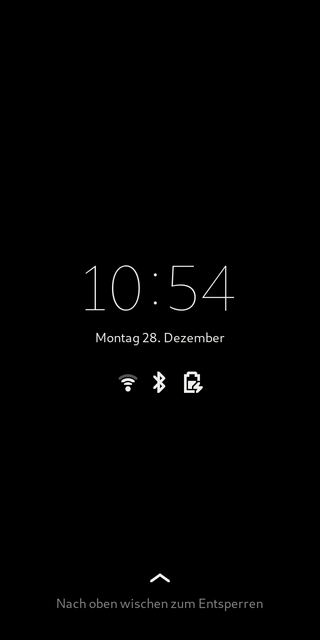
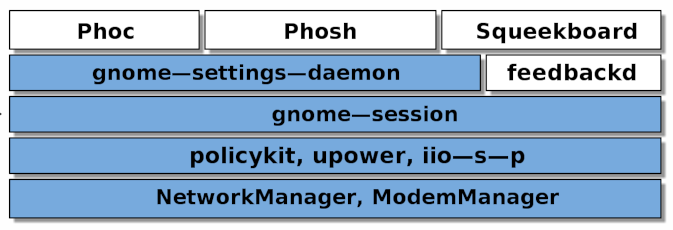
phosh is graphical shell for mobile, touch based devices like smart phones. It's the default graphical shell on Purism's Librem 5 (and that's where it came to life) but projects like postmarketOS, Mobian and Debian have picked it up putting it into use on other devices as well and contributing patches. This post is meant as a short overview how things are tied together so further posts can provide more details. A PHone SHell As mobile shell phosh provides the interface components commonly found on mobile devices to phosh's overview 2 phosh's lockscreen phosh's overview 1 It uses GObject object system and GTK to build up the user interface components. Mobile specific patterns are brought in via libhandy. Since phosh is meant to blend into GNOME as seamlessly as possible it uses the common interfaces present there via D-Bus like org.gnome.Screensaver or org.gnome.keyring.SystemPrompter and retrieves user configuration like keybindings via GSettings from preexisting schema. The components of a running graphical session roughly look like this: phosh session The blue boxes are the very same found on GNOME desktop sessions while the white ones are currently only found on phones. feedbackd is explained quickly: It's used for providing haptic or visual user feedback and makes your phone rumble and blink when applications (or the shell) want to notify the user about certain events like incoming phone calls or new messages. What about phoc and squeekboard? phoc and squeekboard Although some stacks combine the graphical shell with the display server (the component responsible for drawing applications and handling user input) this isn't the case for phosh. phosh relies on a Wayland compositor to be present for that. Keeping shell and compositor apart has some advantages like being able to restart the shell without affecting other applications but also adds the need for some additional communication between compositor and shell. This additional communication is implemented via Wayland protocols. The Wayland compositor used with phosh is called phoc for PHone Compositor. One of these additional protocols is wlr-layer-shell. It allows the shell to reserve space on the screen that is not used by other applications and allows it to draw things like the top and bottom bar or lock screen. Other protocols used by phosh (and hence implemented by phoc) are wlr-output-management to get information on and control properties of monitors or wlr-foreign-toplevel-management to get information about other windows on the display. The later is used to allow to switch between running applications. However these (and other) Wayland protocols are not implemented in phoc from scratch. phoc leverages the wlroots library for that. The library also handles many other compositor parts like interacting with the video and input hardware. The details on how phoc actually puts things up on the screen deserves a separate post. For the moment it's sufficient to note that phosh requires a Wayland compositor like phoc. We've not talked about entering text without a physical keyboard yet - phosh itself does not handle that either. squeekboard is the on screen keyboard for text (and emoji) input. It again uses Wayland protocols to talk to the Wayland compositor and it's (like phosh) a component that wants exclusive access to some areas of the screen (where the keyboard is drawn) and hence leverages the layer-shell protocol. Very roughly speaking it turns touch input in that area into text and sends that back to the compositor that then passes it back to the application that currently gets the text input. squeekboard's main author dcz has some more details here. The session So how does the graphical session in the picture above come into existence? As this is meant to be close to a regular GNOME session it's done via gnome-session that is invoked somewhat like:
phoc -E 'gnome-session --session=phosh'
So the compositor phoc is started up, launches gnome-session which then looks at phosh.session for the session's components. These are phosh, squeekboard and gnome-settings-daemon. These then either connect to already running services via D-Bus (e.g. NetworkManager, ModemManager, ...) or spawn them via D-Bus activation when required (e.g. feedbackd). Calling conventions So when talking about phosh it's good to keep several things apart: On top of that people sometimes refer to 'Phosh' as the software collection consisting of the above plus more components from GNOME (Settings, Contacs, Clocks, Weather, Evince, ...) and components that currently aren't part of GNOME but adapt to small screen sizes, use the same technologies and are needed to make a phone fun to use e.g. Geary for email, Calls for making phone calls and Chats for SMS handling. Since just overloading the term Phosh is confusing GNOME/Phosh Mobile Environment or Phosh Mobile Environment have been used to describe the above collection of software and I've contacted GNOME on how to name this properly, to not infringe on the GNOME trademark but also give proper credit and hopefully being able to move things upstream that can live upstream. That's it for a start. phosh's development documentation can be browsed here but is also available in the source code. Besides the projects mentioned above credits go to Purism for allowing me and others to work on the above and other parts related to moving Free Software on mobile Linux forward.

20 December 2020

Sven Hoexter: Mock a Serial pty Device with socat

Another note to myself before I forget about this nifty usage of socat again. I was looking for something to mock a serial device, similar to a microcontroller which usually ends up as /dev/ttyACM0 and might output some text. What I found is a very helpful post on stackoverflow showing an example utilizing socat.
$ socat -d -d pty,rawer pty,rawer
2020/12/20 21:37:53 socat[29130] N PTY is /dev/pts/8
2020/12/20 21:37:53 socat[29130] N PTY is /dev/pts/11
2020/12/20 21:37:53 socat[29130] N starting data transfer loop with FDs [5,5] and [7,7]
Write whatever you need to the second pty, here /dev/pts/11, e.g.
$ i=0; while :; do echo "foo: $ i " > /dev/pts/11; let i++; sleep 5; done
Now you can listen with whatever you like, e.g. some tool you work on, on the fist pty, here /dev/pts/8. For demonstration purpose just use cat:
$ cat /dev/pts/8
foo: 0
foo: 1
socat is an awesome tool, looking through the manpage you need some knowledge about sockets, but it's incredibly vesatile.

Russ Allbery: Review: Can't Even

Review: Can't Even, by Anne Helen Petersen
Publisher: Houghton Mifflin
Copyright: 2020
ISBN: 0-358-31659-6
Format: Kindle
Pages: 230
Like many other people, I first became aware of Anne Helen Petersen's journalism when her Buzzfeed article "How Millennials Became the Burnout Generation" went viral. Can't Even is the much-awaited (at least by me) book-length expansion of that thesis: The United States is, as a society, burning out, and that burnout is falling on millennials the hardest. We're not recognizing the symptoms because we think burnout looks like something dramatic and flashy. But for most people burnout looks less like a nervous breakdown and more like constant background anxiety and lack of energy.
Laura, who lives in Chicago and works as a special ed teacher, never wants to see her friends, or date, or cook she's so tired, she just wants to melt into the couch. "But then I can't focus on what I'm watching, and end up unfocused again, and not completely relaxing," she explained. "Here I am telling you I don't even relax right! I feel bad about feeling bad! But by the time I have leisure time, I just want to be alone!"
Petersen explores this idea across childhood, education, work, family, and parenting, but the core of her thesis is the precise opposite of the pervasive myth that millennials are entitled and lazy (a persistent generational critique that Petersen points out was also leveled at their Baby Boomer parents in the 1960s and 1970s). Millennials aren't slackers; they're workaholics from childhood, for whom everything has become a hustle and a second (or third or fourth) job. The struggle with "adulting" is a symptom of the burnout on the other side of exhaustion, the mental failures that happen when you've forced yourself to keep going on empty so many times that it's left lingering damage. Petersen is a synthesizing writer who draws together the threads of other books rather than going deep on a novel concept, so if you've been reading about work, psychology, stress, and productivity, many of the ideas here will be familiar. But she's been reading the same authors that I've been reading (Tressie McMillan Cottom, Emily Guendelsberger, Brigid Schulte, and even Cal Newport), and this was the book that helped me pull those analyses together into a coherent picture. That picture starts with the shift of risk in the 1970s and 1980s from previously stable corporations with long-lasting jobs and retirement pensions onto individual employees. The corresponding rise in precarity and therefore fear led to a concerted effort to re-establish a feeling of control. Baby Boomers doubled down on personal responsibility and personal capability, replacing unstructured childhood for their kids with planned activities and academic achievement. That generation, in turn, internalized the need for constant improvement, constant grading, and constant achievement, accepting an implied bargain that if they worked very hard, got good grades, got into good schools, and got a good degree, it would pay off in a good life and financial security. They were betrayed. The payoff never happened; many millennials graduated into the Great Recession and the worst economy since World War II. In response, millennials doubled down on the only path to success they were taught. They took on more debt, got more education, moved back in with their parents to cut expenses, and tried even harder.
Even after watching our parents get shut out, fall from, or simply struggle anxiously to maintain the American Dream, we didn't reject it. We tried to work harder, and better, more efficiently, with more credentials, to achieve it.
Once one has this framework in mind, it's startling how pervasive the "just try harder" message is and how deeply we've internalized it. It is at the center of the time management literature: Getting Things Done focuses almost entirely on individual efficiency. Later time management work has become more aware of the importance of pruning the to-do list and doing fewer things, but addresses that through techniques for individual prioritization. Cal Newport is more aware than most that constant busyness and multitasking interacts poorly with the human brain, and has taken a few tentative steps towards treating the problem as systemic rather than individual, but his focus is still primarily on individual choices. Even when tackling a problem that is clearly societal, such as the monetization of fear and outrage on social media, the solutions are all individual: recognize that those platforms are bad for you, make an individual determination that your attention is being exploited, and quit social media through your personal force of will. And this isn't just productivity systems. Most of public discussion of environmentalism in the United States is about personal energy consumption, your individual carbon footprint, household recycling, and whether you personally should eat meat. Discussions of monopoly and monopsony become debates over whether you personally should buy from Amazon. Concerns about personal privacy turn into advocacy for using an ad blocker or shaming people for using Google products. Articles about the growth of right-wing extremism become exhortations to take responsibility for the right-wing extremist in your life and argue them out of their beliefs over the dinner table. Every major systemic issue facing society becomes yet another personal obligation, another place we are failing as individuals, something else that requires trying harder, learning more, caring more, doing more. This advice is well-meaning (mostly; sometimes it is an intentional and cynical diversion), and can even be effective with specific problems. But it's also a trap. If you're feeling miserable, you just haven't found the right combination of time-block scheduling, kanban, and bullet journaling yet. If you're upset at corporate greed and the destruction of the environment, the change starts with you and your household. The solution is in your personal hands; you just have try a little harder, work a little harder, make better decisions, and spend money more ethically (generally by buying more expensive products). And therefore, when we're already burned out, every topic becomes another failure, increasing our already excessive guilt and anxiety. Believing that we're in control, even when we're not, does have psychological value. That's part of what makes it such a beguiling trap. While drafting this review, I listened to Ezra Klein's interview with Robert Sapolsky on poverty and stress, and one of the points he made is that, when mildly or moderately bad things happen, believing you have control is empowering. It lets you recast the setback as a larger disaster that you were able to prevent and avoid a sense of futility. But when something major goes wrong, believing you have control is actively harmful to your mental health. The tragedy is now also a personal failure, leading to guilt and internal recrimination on top of the effects of the tragedy itself. This is why often the most comforting thing we can say to someone else after a personal disaster is "there's nothing you could have done." Believing we can improve our lives if we just try a little harder does work, until it doesn't. And because it does work for smaller things, it's hard to abandon; in the short term, believing we're at the mercy of forces outside our control feels even worse. So we double down on self-improvement, giving ourselves even more things to attempt to do and thus burning out even more. Petersen is having none of this, and her anger is both satisfying and clarifying.
In writing that article, and this book, I haven't cured anyone's burnout, including my own. But one thing did become incredibly clear. This isn't a personal problem. It's a societal one and it will not be cured by productivity apps, or a bullet journal, or face mask skin treatments, or overnight fucking oats. We gravitate toward those personal cures because they seem tenable, and promise that our lives can be recentered, and regrounded, with just a bit more discipline, a new app, a better email organization strategy, or a new approach to meal planning. But these are all merely Band-Aids on an open wound. They might temporarily stop the bleeding, but when they fall off, and we fail at our new-found discipline, we just feel worse.
Structurally, Can't Even is half summaries of other books and essays put into this overall structure and half short profiles and quotes from millennials that illustrate her point. This is Petersen's typical journalistic style if you're familiar with her other work. It gains a lot from the voices of individuals, but it can also feel like argument from anecdote. If there's a epistemic flaw in this book, it's that Petersen defends her arguments more with examples than with scientific study. I've read enough of the other books she cites, many of which do go into the underlying studies and statistics, to know that her argument is well-grounded, but I think Can't Even works better as a roadmap and synthesis than as a primary source of convincing data. The other flaw that I'll mention is that although Petersen tries very hard to incorporate poorer and non-white millennials, I don't think the effort was successful, and I'm not sure it was possible within the structure of this book. She frequently makes a statement that's accurate and insightful for millennials from white, middle-class families, acknowledges that it doesn't entirely apply to, for example, racial minorities, and then moves on without truly reconciling those two perspectives. I think this is a deep structural problem: One's experience of American life is very different depending on race and class, and the phenomenon that Petersen is speaking to is to an extent specific to those social classes who had a more comfortable and relaxing life and are losing it. One way to see the story of the modern economy is that white people are becoming as precarious as everyone else already was, and are reacting by making the lives of non-white people yet more miserable. Petersen is accurately pointing to significant changes in relationships with employers, productivity, family, and the ideology of individualism, but experiencing that as a change is more applicable to white people than non-white people. That means there are, in a way, two books here: one about the slow collapse of the white middle class into constant burnout, and a different book about the much longer-standing burnout of being non-white in the United States and our systemic failure to address the causes of it. Petersen tries to gesture at the second book, but she's not the person to write it and those two books cannot comfortably live between the same covers. The gestures therefore feel awkward and forced, and while the discomfort itself serves some purpose, it lacks the insight that Petersen brings to the rest of the book. Those critiques aside, I found Can't Even immensely clarifying. It's the first book that explained to me in a way I understood what's so demoralizing and harmful about Instagram and its allure of cosplaying as a successful person. It helped me understand how productivity and individual political choices fit into a system that emphasizes individual action as an excuse to not address collective problems. And it also gave me a strange form of hope, because if something can't go on forever, it will, at some point, stop.
Millennials have been denigrated and mischaracterized, blamed for struggling in situations that set us up to fail. But if we have the endurance and aptitude and wherewithal to work ourselves this deeply into the ground, we also have the strength to fight. We have little savings and less stability. Our anger is barely contained. We're a pile of ashes smoldering, a bad memory of our best selves. Underestimate us at your peril: We have so little left to lose.
Nothing will change without individual people making different decisions and taking different actions than they are today. But we have gone much too far down the path of individual, atomized actions that may produce feelings of personal virtue but that are a path to ineffectiveness and burnout when faced with systemic problems. We need to make different choices, yes, but choices towards solidarity and movement politics rather than personal optimization. There is a backlash coming. If we let it ground itself in personal grievance, it could turn ugly and take a racist and nationalist direction. But that's not, by in large, what millennials have done, and that makes me optimistic. If we embrace the energy of that backlash and help shape it to be more inclusive, just, and fair, we can rediscover the effectiveness of collective solutions for collective problems. Rating: 8 out of 10

18 December 2020

Rapha&#235;l Hertzog: Freexian s report about Debian Long Term Support, November 2020

A Debian LTS logo Like each month, here comes a report about the work of paid contributors to Debian LTS. Individual reports In November, 239.25 work hours have been dispatched among 13 paid contributors. Their reports are available: Evolution of the situation In November we held the last LTS team meeting for 2020 on IRC, with the next one coming up at the end of January.
We announced a new formalized initiative for Funding Debian projects with money from Freexian s LTS service.
Finally, we would like to remark once again that we are constantly looking for new contributors. Please contact Holger if you are interested! We re also glad to welcome two new sponsors, Moxa, a device manufacturer, and a French research lab (Institut des Sciences Cognitives Marc Jeannerod). The security tracker currently lists 37 packages with a known CVE and the dla-needed.txt file has 40 packages needing an update. Thanks to our sponsors Sponsors that joined recently are in bold.

One comment Liked this article? Click here. My blog is Flattr-enabled.

17 December 2020

Elana Hashman: Easy risotto

I have a secret: risotto doesn't have to involve standing over a pot, stirring for 30 minutes. There is a better way. I've made risotto using the "stir 5ever" method and frankly this one is half the work and just as good. I took inspiration from Kenji Lopez-Alt, who describes how you can make risotto with only a few minutes of stirring at the end! Yes, this is a secret too good to keep to myself. The linked recipe is too rich for a weeknight dinner, at least for my tastes, so I've included my typical modifications below, which omits the heavy cream. I usually make mushroom risotto, because all the ingredients are long-lived pantry ingredients, which means I can make this on a whim without having to grocery shop! Mushroom risotto Serves 3 as a main course. Active time: 25m. Total time: 45m. Ingredients: Recipe:
  1. Leave mushrooms to rehydrate in 1 cup of hot water for at least 10 minutes.
  2. Set a wide saucepan (about 3.5qts) or skillet on medium heat.
  3. Mix stock and wine for a total of 4 cups. You can used homemade stock (the best), boxed, or reconstitute from bouillon (my usual). If you use bouillon, I find you get the best flavour if you use a mix, so I tend to use half "no-chicken" and half "organic chicken" of the Better than Bouillon brand. Let this cool if you used boiling water; you don't want it to be too hot.
  4. Mix the rice and stock in a large bowl, agitating it to release the starch. Reserve stock and set the rice in a strainer to drain.
  5. Small dice an onion. Add olive oil and butter to the pan, and then add the onion. Cook the onion until it's translucent, but don't brown it.
  6. Increase the heat to high and add the rice to the pan to toast until it becomes a little bit brown, stirring occasionally, about 3-4 minutes. Set a timer so it doesn't burn
  7. Meanwhile, drain the mushrooms, making sure you reserve the broth. Chop mushrooms and mince the garlic. Once the rice is toasted, add mushrooms and garlic and stir.
  8. Stir the reserved stock. Add all of the mushroom liquid and all but 1 cup of the starchy stock to the pan. Bring to a boil.
  9. Once it has reached a boil, cover, reduce to the lowest heat, and allow the rice to simmer undisturbed for 10 minutes. In the meantime, you can grate the cheese.
  10. After 10 minutes, stir the rice once, shake the pan to ensure it is level, and return to the heat for 10 more minutes. Sit back, relax, and bask in the very little stirring you are doing.
  11. At this point, the rice should be nearly cooked. Give it a stir, and add the remaining cup of broth. Stir until fully incorporated, turn the heat up to high, and cook until the risotto reaches your preferred consistency. I like mine rather thick.
  12. Once the rice is fully cooked, turn off the heat and stir in the grated cheese a bit at a time, reserving some for garnish. Taste, and season with salt and pepper.
  13. Garnish with the grated cheese, and perhaps some herbs. Serve and enjoy!
Variations No mushrooms: Okay, okay, you hate mushrooms! Sorry! You can leave them out. Don't bother with the mushrooms, and add broth to make up for the lost liquid. Mushroom lover: Alternatively, if you love mushrooms and you have fresh ones available, use &frac13 to a pound (150-225g) chopped fresh mushrooms instead of dried. Add them at the same time you add the onions to ensure all the liquid cooks off. Milanese, with stuff: One of my favourite variations on this dish is a version with shrimp, asparagus, and saffron. Leave the mushrooms out, increase the wine to or even 1 cup (seafood likes a little extra acidity), ensure you have a total of 5 cups of broth, and add a few strands of saffron. Chop asparagus and shrimp, season with salt and pepper, saut them with some butter or olive oil in a separate pan so they don't overcook, and fold them in at the very end, after you've added the cheese. I MUST SUFFER: This was too easy? Want to stir more??? Fine, have it your $*!#ing way. I'm sure you can be creative and come up with something on your own...

16 December 2020

Jonathan McDowell: DeskPi Pro + 8GB Pi 4

DeskPi Pro Raspberry Pi case Despite having worked on a number of ARM platforms I ve never actually had an ARM based development box at home. I have a Raspberry Pi B Classic (the original 256MB rev 0002 variant) a coworker gave me some years ago, but it s not what you d choose for a build machine and generally gets used as a self contained TFTP/console server for hooking up to devices under test. Mostly I ve been able to do kernel development with the cross compilers already built as part of Debian, and either use pre-built images or Debian directly when I need userland pieces. At a previous job I had a Marvell MACCHIATObin available to me, which works out as a nice platform - quad core A72 @ 2GHz with 16GB RAM, proper SATA and a PCIe slot. However they re still a bit pricey for a casual home machine. I really like the look of the HoneyComb LX2 - 16 A72 cores, up to 64GB RAM - but it s even more expensive. So when I saw the existence of the 8GB Raspberry Pi 4 I was interested. Firstly, the Pi 4 is a proper 64 bit device (my existing Pi B is ARMv6 which means it needs to run Raspbian instead of native Debian armhf), capable of running an upstream kernel and unmodified Debian userspace. Secondly the Pi 4 has a USB 3 controller sitting on a PCIe bus rather than just the limited SoC USB 2 controller. It s not SATA, but it s still a fairly decent method of attaching some storage that s faster/more reliable than an SD card. Finally 8GB RAM is starting to get to a decent amount - for a headless build box 4GB is probably generally enough, but I wanted some headroom. The Pi comes as a bare board, so I needed a case. Ideally I wanted something self contained that could take the Pi, provide a USB/SATA adaptor and take the drive too. I came across the pre-order for the DeskPi Pro, decided it was the sort of thing I was after, and ordered one towards the end of September. It finally arrived at the start of December, at which point I got round to ordering a Pi 4 from CPC. Total cost ~ 120 for the case + Pi.

The Bad First, let s get the bad parts out of the way. Broken USB port (right) I managed to break a USB port on the Desk Pi. It has a pair of forward facing ports, I plugged my wireless keyboard dongle into it and when trying to remove it the solid spacer bit in the socket broke off. I ve never had this happen to me before and I ve been using USB devices for 20 years, so I m putting the blame on a shoddy socket. The first drive I tried was an old Crucial M500 mSATA device. I have an adaptor that makes it look like a normal 2.5 drive so I used that. Unfortunately it resulted in a boot loop; the Pi would boot its initial firmware, try to talk to the drive and then reboot before even loading Linux. The DeskPi Pro comes with an m2 adaptor and I had a spare m2 drive, so I tried that and it all worked fine. This might just be power issues, but it was an unfortunate experience especially after the USB port had broken off. (Given I ended up using an M.2 drive another case option would have been the Argon ONE M.2, which is a bit more compact.)
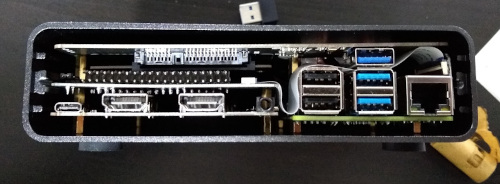
The Annoying DeskPi Pro without rear bezel The case is a little snug; I was worried I was going to damage things as I slid it in. Additionally the construction process is a little involved. There s a good set of instructions, but there are a lot of pieces and screws involved. This includes a couple of FFC cables to join things up. I think this is because they ve attempted to make a compact case rather than allowing a little extra room, and it does have the advantage that once assembled it feels robust without anything loose in it. DeskPi Pro with rear bezel and USB3 dongle I hate the need for an external USB3 dongle to bridge from the Pi to the USB/SATA adaptor. All the cases I ve seen with an internal drive bay have to do this, because the USB3 isn t brought out internally by the Pi, but it just looks ugly to me. It s hidden at the back, but meh. Fan control is via a USB/serial device, which is fine, but it attaches to the USB C power port which defaults to being a USB peripheral. Raspbian based kernels support device tree overlays which allows easy reconfiguration to host mode, but for a Debian based system I ended up rolling my own dtb file. I changed


#include "bcm283x-rpi-usb-peripheral.dtsi"
to
#include "bcm283x-rpi-usb-host.dtsi"
in arch/arm/boot/dts/bcm2711-rpi-4-b.dts and then I did:
cpp -nostdinc -I include -I arch -undef -x assembler-with-cpp \
    arch/arm/boot/dts/bcm2711-rpi-4-b.dts > rpi4.preprocessed
dtc -I dts -O dtb rpi4.preprocessed -o bcm2711-rpi-4-b.dtb
and the resulting bcm2711-rpi-4-b.dtb file replaced the one in /boot/firmware. This isn t a necessary step if you don t want to use the cooling fan in the case, or the front USB ports, and it s not really anyone s fault, but it was an annoying extra step to have to figure out. The DeskPi came with a microSD card that was supposed to have RaspiOS already on it. It didn t, it was blank. In my case that was fine, because I wanted to use Debian, but it was a minor niggle.

The Good I used Gunnar s pre-built Pi Debian image and it Just Worked; I dd d it to the microSD as instructed and the Pi 4 came up with working wifi, video and USB enabling me to get it configured for my network. I did an apt upgrade and got updated to the Buster 10.7 release, as well as the latest 5.9 backport kernel, and everything came back without effort after a reboot. It s lovely to be able to run Debian on this device without having to futz around with self-compiled kernels. The DeskPi makes a lot of effort to route things externally. The SD slot is brought out to the front, making it easy to fiddle with the card contents without having to open the case to replace it. All the important ports are brought out to the back either through orientation of the Pi, or extenders in the case. That means the built in Pi USB ports, the HDMI sockets (conveniently converted to full size internally), an audio jack and a USB-C power port. The aforementioned USB3 dongle for the bridge to the drive is the only external thing that s annoying. Thermally things seem good too. I haven t done a full torture test yet, but with the fan off the system is sitting at about 40 C while fairly idle. Some loops in bash that push load up to above 2 get the temperature up to 46 C or so, and turning the fan on brings it down to 40 C again. It s audible, but quieter than my laptop and not annoying. I liked the way the case came with everything I needed other than the Pi 4 and a suitable disk drive. There was an included PSU (a proper USB-C PD device, UK plug), the heatsink/fan is there, the USB/SATA converter is there and even an SD card is provided (though that s just because I had a pre-order). Speaking of the SD, I only needed it for initial setup. Recent Pi 4 bootloaders are capable of booting directly from USB mass storage devices. So I upgraded using the RPi EEPROM Recovery image (which just needs extracted to the SD FAT partition, no need for anything complicated - boot with it and the screen goes all green and you know it s ok), then created a FAT partition at the start of the drive for the kernel / bootloader config and a regular EXT4 partition for root. Copies everything over, updated paths, took out the SD and it all just works happily.

Summary My main complaint is the broken USB port, which feels like the result of a cheap connector. For a front facing port expected to see more use than the rear ports I think there s a reasonable expectation of robustness. However I m an early adopter and maybe future runs will be better. Other than that I m pretty happy. The case is exactly the sort of thing I wanted; I was looking for something that would turn the Pi into a box that can sit on my desk on the network and that I don t have to worry about knocking wires out of or lots of cables hooking bits up. Everything being included made it very convenient to get up and running. I still haven t poked the Pi that hard, but first impressions are looking good for it being a trouble free ARM64 dev box in the corner, until I can justify a HoneyComb.

13 December 2020

Russ Allbery: Review: Because Internet

Review: Because Internet, by Gretchen McCulloch
Publisher: Riverhead Books
Copyright: 2019
ISBN: 0-7352-1095-0
Format: Kindle
Pages: 276
If you're familiar with linguistics as a field of scientific study (as opposed to the tool-based fields of grammar or writing advice), you'll be familiar with the dichotomy between written and spoken language. We may spend more time thinking about written language since it is central to most types of education and carries much of the intellectual and social weight of society. Linguists, however, see spoken language as more fundamental, since speech is wired into our brains and universal in human societies. Written language is a recent and somewhat artificial invention. One also learns from linguistics that spoken language does not follow many of the rules of written language that we painstakingly memorized in school. In casual speech, people split infinitives, speak in partial and run-on sentences, ignore nit-picking pronoun case rules, and rarely notice or care about the difference between less and fewer. Spoken language does have rules, but they're more subtle and nuanced than the grammar rules we learn in school. (I think the real fun of linguistics is separating the rules that native speakers follow effortlessly from the artificial rules used as education markers.) This is, in part, because nearly all spoken language is informal, whereas nearly all written language is formal. Enter the Internet, and enter this book. For the first time in human history we have both an explosion of informal writing and easy availability of that writing to linguists for study. Informal writing is not entirely new, of course. We've had personal letters for nearly as long as we've had writing, not to mention private notes, diaries, and other writing intended for tiny audiences. But consider who wrote private letters and, on top of that historical filter, whose private letters were preserved for linguistic research. Until relatively recently, only the upper classes were literate and had access to the infrastructure to write and send letters. Someone's letters or private notes were unlikely to be preserved unless they were someone famous and important, and thus often well-educated and more likely to take a more formal tone in writing. If you compare this to the Internet-driven blizzard of work and personal email, SMS conversations, chatrooms, and social media posts, the difference is obvious in both volume and level of informality. We're all on the Internet, we all read and write with a frequency that would be staggering to the average person from even fifty years ago, and while one may take a bit of additional care with a tricky email to one's manager, the SMS message to one's friend is as informal of a use of language as a conversation over coffee. Gretchen McCulloch is a professional linguist and Because Internet is about exactly this phenomenon: the new conventions of informal writing, how it has changed and evolved, and the new subtleties and shortcuts we've invented to make written communication easier. That goes beyond words and grammar to encompass punctuation, emoji and emoticons, memes and reaction gifs, and even the subtleties of timing, whitespace, and the construction of virtual places via our choices in how and where we write. This topic is my catnip, so it's not surprising I love this book. I've been heavily involved with online communities that communicate in writing since 1993 (making me, in McCulloch's classification, an Old Internet Person; each wave of introduction to the Internet has its own conventions that can be in conflict with later waves). I've now spent more than half my life carrying out most of my social activity and most of my closest friendships primarily in writing, so I found a lot of satisfaction in a linguistic study that takes that seriously rather than treating it as a curiosity. But, even better, I was amazed at how much I didn't know, in part because I am from a specific wave. I have a deep intuition for the Usenet conventions, but not as good of an understanding of the ones from AIM and LiveJournal one wave later (the Full Internet People). And I had a lot to learn about the conventions of the Instagram and Snapchat cluster (the Post Internet People, who have never known life without the Internet). One of the things that struck me while reading this book is how most of the language innovations that McCulloch describes are addressing the old complaint that written communication is inferior to face-to-face conversation because it lacks emotional nuance. My knee-jerk reply is that, no, written communication is full of emotional nuance and the complainer is just bad at reading it, but that's somewhat unfair. A better statement of the problem is that there is not a standardized language for emotional nuance in written communication, in part because it's so new in human history. Most humans are extremely good at reading facial expressions and body language for emotional cues, and those physical expressions are largely subconscious, reliable, and similar among different people (particularly within a culture; one can get in trouble with body language variations across cultures). This is not true of writing. With friends I've talked to over chat for twenty-five years, I can read volumes about their emotional state in a couple of short lines of text. But with strangers, despite decades of Internet communications, I will still misread cues and misinterpret simple intentions. The other standard response to this complaint is that it is possible to put extensive emotional nuance into formal writing. Just get better at writing! This is true, but unhelpful. There's a reason why we give book contracts to people who are very good at investing formal writing with emotional nuance. It's difficult, time-consuming, and requires a great deal of practice. That may be appropriate for formal, paid writing, but it won't do for informal writing, which by definition needs to be as effortless as possible. It's therefore unsurprising that once millions of people were using the Internet regularly for informal writing, they started adding new mechanisms, shortcuts, and conventions for emotional nuance. The standardization is growing, but conventions still vary widely between waves of Internet users. One of the most fascinating parts of this book for me was McCulloch's explanation of why periods (and, to a lesser extent, capital letters) in short chat messages are perceived by younger users as harsh or passive-aggressive. I still have the formal writing mindset of treating proper capitalization and punctuation as a point of pride, but McCulloch makes an excellent argument for letting go of my biases and understanding how and why language is changing. The realization I had while reading this is that many of the changes that look like sloppiness or laziness to someone trained in formal writing have the effect of giving language greater dynamic range. If one always uses periods uniformly, the period becomes meaningless except as a sentence boundary (which is redundant with newlines in most short informal chat messages). If one normally doesn't use it, and then suddenly starts using it, the period can carry semantic weight. It can convey a snippy tone of voice, a note of annoyance, or other subtle shades of meaning. I still use periods in most of my Slack messages because habits are hard to break, but I'm remembering to leave them off some of the time and paying more attention to what emotional weight they're carrying when present. Because Internet is therefore the rare book that meets the bar of changing my day-to-day behavior. "lol" is another excellent example that McCulloch spends some time on. It started life as LOL, an abbreviation for "laughing out loud," and that's still how it's stuck in my head. But, as McCulloch explains, it no longer means that to newer waves of Internet users. It now carries a far more complicated and nuanced meaning that has very little to do with physical laughter and that doesn't easily translate to a single word or sentence. I went from being mildly irritated by and mildly superior towards the ubiquitous "lol" to realizing that it's a fascinating new word that carries primarily emotional nuance and that I don't understand well enough to read or use properly (yet). One more example of the type of analysis McCulloch brings to this book: emoji. The tendency when talking about emoji is to treat them as rebuses (pictures that stand in for a word, or at least a specific concept). They are sometimes used that way, but McCulloch argues that they more often function in the same role that gestures play in informal speech, including the gestures that have no simple name and no independent meaning outside of the context of the words being said at the same time. This seems obvious in retrospect, but before reading Because Internet I had never thought about what a gesture is, what function it plays in speech, and how that could be translated into informal written communication. If you're as interested in this area as I am, this is great stuff. I'd seen several mentions of this book go past on Twitter and kept holding off because I had lots of things to read and was worried it would only cover the superficial things I already knew as a long-time Internet user who has listened to a few lectures on linguistics. That was not the case at all. I learned so much from this book and had a delightful time reading it. If you're also interested in these topics, recommended. Rating: 9 out of 10

11 December 2020

Evgeni Golov: systemd + SELinux =

Okay, getting a title that will ensure clicks for this post was easy. Now comes the hard part: content! When you deploy The Foreman, you want a secure setup by default. That's why we ship (and enable) a SELinux policy which allows you to run the involved daemons in confined mode. We have recently switched our default Ruby application server from Passenger (running via mod_passenger inside Apache httpd) to Puma (running standalone and Apache just being a reverse proxy). While doing so, we initially deployed Puma listening on localhost:3000 and while localhost is pretty safe, a local user could still turn out evil and talk directly to Puma, pretending to be authenticated by Apache (think Kerberos or X.509 cert auth). Obviously, this is not optimal, so the next task was to switch Puma to listen on an UNIX socket and only allow Apache to talk to said socket. This doesn't sound overly complicated, and indeed it wasn't. The most time/thought was spent on doing that in a way that doesn't break existing setups and still allows binding to a TCP socket for setups where users explicitly want that. We also made a change to the SELinux policy to properly label the newly created socket and allow httpd to access it. The whole change was carefully tested on CentOS 7 and worked like a charm. So we merged it, and it broke. Only on CentOS 8, but broken is broken, right? This is the start of my Thanksgiving story "learn how to debug SELinux issues" ;) From the logs of our integration test I knew the issue was Apache not being able to talk to that new socket (we archive sos reports as part of the tests, and those clearly had it in the auditd logs). But I also knew we did prepare our policy for that change, so either our preparation was not sufficient or the policy wasn't properly loaded. The same sos report also contained the output of semanage fcontext --list which stated that all regular files called /run/foreman.sock would get the foreman_var_run_t type assigned. Wait a moment, all regular files?! A socket is not a regular file! Let's quickly make that truly all files. That clearly changed the semanage fcontext --list output, but the socket was still created as var_run_t?! It was time to actually boot a CentOS 8 VM and try more things out. Interestingly, you actually can't add a rule for /run/something, as /run is an alias (equivalency in SELinux speak) for /var/run:
# semanage fcontext --add -t foreman_var_run_t /run/foreman.sock
ValueError: File spec /run/foreman.sock conflicts with equivalency rule '/run /var/run'; Try adding '/var/run/foreman.sock' instead
I have no idea how the list output in the report got that /run rule, but okay, let's match /var/run/foreman.sock. Did that solve the issue? Of course not! And you knew it, as I didn't get to the juciest part of the headline yet: systemd! We use systemd to create the socket, as it is both convenient and useful (no more clients connecting before Rails has finished booting). But why is it wrongly labeling our freshly created socket?! A quick check with touch shows that the policy is correct now, the touched file gets the right type assigned. So it must be something with systemd A bit of poking (and good guesswork based on prior experience with a similar issue in Puppet: PUP-2169 and PUP-10548) led to the realization that a systemctl daemon-reexec after adding the file context rule "fixes" the issue. Moving the poking to Google, you quickly end up at systemd issue #9997 which is fixed in v245, but that's in no EL release yet. And indeed, the issue seems fixed on my Fedora 33 with systemd 246, but I still need it to work on CentOS 7 and 8 Well, maybe that reexec isn't that bad after all? At least the socket is now properly labeled and httpd can connect to it on CentOS 8. Btw, no idea why the connection worked on CentOS 7, as there the socket was also wrongly labeled, but SELinux didn't deny httpd to open it. Big shout out to lzap and ewoud for helping me with this beast!

10 December 2020

Jonathan Carter: CentOS Stream, or Debian?

It s the end of CentOS as we know it Earlier this week, the CentOS project announced the shift to CentOS stream. In a nutshell, this means that they will discontinue being a close clone of RHEL along with security updates, and instead it will serve as a development branch of RHEL. As you can probably imagine (or gleam from the comments in that post I referenced), a lot of people are unhappy about this. One particular quote got my attention this morning while catching up on this week s edition of Linux Weekly News, under the distributions quotes section:

I have been doing this for 17 years and CentOS is basically my life s work. This was (for me personally) a heart wrenching decision. However, i see no other decision as a possibility. If there was, it would have been made.Johnny Hughes
I feel really sorry for this person and can empathize, I ve been in similar situations in my life before where I ve poured all my love and energy into something and then due to some corporate or organisational decisions (and usually poor ones), the project got discontinued and all that work that went into it vanishes into the ether. Also, 17 years is really long to be contributing to any one project so I can imagine that this must have been especially gutting.

Throw me a freakin bone here I m also somewhat skeptical of how successful CentOS Stream will really be in any form of a community project. It seems that Red Hat is expecting that volunteers should contribute to their product development for free, and then when these contributors actually want to use that resulting product, they re expected to pay a corporate subscription fee to do so. This seems like a very lop-sided relationship to me, and I m not sure it will be sustainable in the long term. In Red Hat s announcement of CentOS Stream, they kind of throw the community a bone by saying In the first half of 2021, we plan to introduce low- or no-cost programs for a variety of use cases - it seems likely that this will just be for experimental purposes similar to the Windows Insider program and won t be of much use for production users at all. Red Hat does point out that their Universal Base Image (UBI) is free to use and that users could just use that on any system in a container, but this doesn t add much comfort to the individuals and organisations who have contributed huge amounts of time and effort to CentOS over the years who rely on a stable, general-purpose Linux system that can be installed on bare metal.

Way forward for CentOS users Where to from here? I suppose CentOS users could start coughing up for RHEL subscriptions. For many CentOS use cases that won t make much sense. They could move to another distribution, or fork/restart CentOS. The latter is already happening. One of the original founders of the CentOS project, Gregory Kurtzer, is now working on Rocky Linux, which aims to be a new free system built from the RHEL sources. Some people from Red Hat and Canonical are often a bit surprised or skeptical when I point out to them that binary licenses are also important. This whole saga is yet another data point, but it proves that yet again. If Red Hat had from the beginning released RHEL with free sources and unobfuscated patches, then none of this would ve been necessary in the first place. And while I wish Rocky Linux all the success it aims to achieve, I do not think that working for free on a system that ultimately supports Red Hat s selfish eco-system is really productive or helpful. The fact is, Debian is already a free enterprise-scale system already used by huge organisations like Google and many others, which has stable releases, LTS support and ELTS offerings from external organisations if someone really needs it. And while RHEL clones have come and gone through the years, Debian s mission and contract to its users is something that stays consistent and I believe Debian and its ideals will be around for as long as people need Unixy operating systems to run anywhere (i.e. a very long time). While we sometimes fall short of some of our technical goals in Debian, and while we don t always agree on everything, we do tend to make great long-term progress, and usually in the right direction. We ve proved that our method of building a system together is sustainable, that we can do so reliably and timely and that we can collectively support it. From there on it can only get even better when we join forces and work together, because when either individuals or organisations contribute to Debian, they can use the end result for both private or commercial purposes without having to pay any fee or be encumbered by legal gotchas. Don t get caught by greedy corporate motivations that will result in you losing years of your life s work for absolutely no good reason. Make your time and effort count and either contribute to Debian or give your employees time to do so on company time. Many already do and reap the rewards of this, and don t look back. While Debian is a very container and virtualization friendly system, we ve managed to remain a good general-purpose operating system that manages to span use cases so vast that I d have to use a blog post longer than this one just to cover them. And while learning a whole new set of package build chain, package manager and new organisational culture and so on can be uhm, really rocky at the start, I d say that it s a good investment with Debian and unlikely to be time that you ll ever felt was wasted. As Debian project leader, I m personally available to help answer any questions that someone might have if they are interested in coming over to Debian. Feel free to mail leader_AT_debian.org (replace _AT_ with @) or find me on the oftc IRC network with the nick highvoltage. I believe that together, we can make Debian the de facto free enterprise system, and that it would be to the benefit of all its corporate users, instead of tilting all the benefit to just one or two corporations who certainly don t have your best interests in mind.

5 December 2020

Thorsten Alteholz: My Debian Activities in November 2020

FTP master Unfortunately a day only has 24h. As the freeze is approaching, I had to concentrate a bit more on keeping my packages in shape. So this month I only accepted nine packages. The good news, I rejected no package. The overall number of packages that got accepted was 328. Debian LTS This was my seventy-seventh month that I did some work for the Debian LTS initiative, started by Raphael Hertzog at Freexian. This month my all in all workload has been 22.75h. During that time I did LTS uploads of: I also started to work on x11vnc and slirp. Last but not least I did some days of frontdesk duties. Debian ELTS This month was the twenty ninth ELTS month. During my allocated time I uploaded: Unfortunately I also had to give back some hours. Last but not least I did some days of frontdesk duties. Other stuff This month I uploaded new upstream versions of: I fixed one or two bugs in: I improved packaging of: and there have been even some new packages: As it is again this time of the year, I would also like to draw some attention to the Debian Med Advent Calendar. Like the past years, the Debian Med team starts a bug squashing event from the December 1st to 24th. Every bug that is closed will be registered in the calendar. So instead of taking something from the calendar, this special one will be filled and at Christmas hopefully every Debian Med related bug is closed. Don t hesitate, start to squash :-). The announcement on the mailing list can be found here.

Joachim Breitner: Named goals in Coq

TL;DR: Some mildly tricky tricks allow you to select subgoals by name, like in Isabelle. This leads to more readable proofs, and proofs that are more robust against changes.

The need for case names Consider the following Coq proof, right out of the respected Software Foundations book, Chapter Inductively Defined Propositions (and slightly simplified):
Lemma star_app: forall T (s1 s2 : list T) (re : reg_exp T),
  s1 =~ Star re ->
  s2 =~ Star re ->
  s1 ++ s2 =~ Star re.
Proof.
  intros T s1 s2 re H1.
  remember (Star re) as re'.
   generalize dependent s2.
  induction H1.
  - (* MEmpty *) discriminate.
  - (* MChar *) discriminate.
  - (* MApp *) discriminate.
  - (* MUnionL *) discriminate.
  - (* MUnionR *) discriminate.
  - (* MStar0 *)
    injection Heqre' as Heqre''. intros s H. apply H.
  - (* MStarApp *)
    injection Heqre' as Heqre''.
    intros s3 H1. rewrite <- app_assoc.
    apply MStarApp.
    + apply H1_.
    + apply IHexp_match2.
      * rewrite Heqre''. reflexivity.
      * apply H1.
Qed.
This is a very typical example for a proof by induction over an inductively defined relation (in this case, the relations s =~ re which indicates that the string s matches the regular expression re): After some preparation, the invocation of a tactic like induction (could also be inversion or others) creates a number of new goals, one of for each rule of the relation. Then the modern(!) Coq user uses proof bullets to focus the goals, one after another, in order, to solve them. We can see from this example that proof bullets (which were a big improvement) are not quite satisfactory, and the author of this proof felt the need to annotate each subproof with the case it corresponds to. But these are mere comments! This is unsatisfactory, as there is nothing keeping them correct as my proof changes. And anyone who came to Coq from Isabelle is just flabbergasted that the state of art in Coq is still at that level So, wouldn t it be great if
  • I could focus goals by their name (e.g. MEmpty)
  • Focus them in any order (so that refactoring of my data types do not break my proofs)
  • This even worked when simultaneously inducting over or inverting multiple relations?

Simulating named goals in Coq Well, with a few tricks we can! It just takes three simple steps:
  1. I load a small file full of hacks (explained below):
    Require Import NamedCases.
  2. This allows me to prefix the type of the constructors of the inductive relations (i.e. the rules of the relation) with case <name>, , as follows:
    Reserved Notation "s =~ re" (at level 80).
    Inductive exp_match  T  : list T -> reg_exp T -> Prop :=
        MEmpty:
        case empty,
        [] =~ EmptyStr
        MChar:
        case char,
        forall x,
        [x] =~ (Char x)
        MApp:
        case app,
        forall s1 re1 s2 re2
        (H1 : s1 =~ re1)
        (H2 : s2 =~ re2),
        (s1 ++ s2) =~ (App re1 re2)
        MUnionL:
        case union_l,
        forall s1 re1 re2
        (H1 : s1 =~ re1),
        s1 =~ (Union re1 re2)
        MUnionR:
        case union_r,
        forall re1 s2 re2
        (H2 : s2 =~ re2),
        s2 =~ (Union re1 re2)
        MStar0:
        case star0,
        forall re,
        [] =~ (Star re)
        MStarApp:
        case star_app,
        forall s1 s2 re
        (H1 : s1 =~ re)
        (H2 : s2 =~ (Star re)),
        (s1 ++ s2) =~ (Star re)
      where "s =~ re" := (exp_match s re).
    This is the definition from the Software Foundations book; only the case <name>, lines are added.
  3. Now I can change the proof: After the induction tactic I use ; name_cases to name the cases, and then I can use the relatively new named goal focusing feature ([name]: , which I suggested two years ago, and was implemented by Th o Zimmermann) to focus a specific case:
    Lemma star_app2: forall T (s1 s2 : list T) (re : reg_exp T),
      s1 =~ Star re ->
      s2 =~ Star re ->
      s1 ++ s2 =~ Star re.
    Proof.
      intros T s1 s2 re H1.
      remember (Star re) as re'.
       generalize dependent s2.
      induction H1; name_cases.
      [empty]:  
         discriminate.
       
      [char]:  
         discriminate.
       
      [app]:  
         discriminate.
       
      [unionL]:  
         discriminate.
       
      [unionR]:  
        discriminate.
       
      [star0]:  
        injection Heqre' as Heqre''. intros s H. apply H.
       
      [starApp]:  
        injection Heqre' as Heqre''.
        intros s3 H1. rewrite <- app_assoc.
        apply MStarApp; clear_names.
        + apply H1_.
        + apply IHexp_match2.
          * rewrite Heqre''. reflexivity.
          * apply H1.
        
    Qed.
    The comments have turned into actual names!
Goal focusing is now just much more reliable. For example, let me try to discharge the boring cases by using ; try discriminate after the induction. This means there are suddenly only two goals left. With bullets, the first bullet would now suddenly focus a different goal, and my proof script would likely fail somewhere. With named goals, I get a helpful error message No such goal: empty and I can t even enter the first subproof. So let me delete these goals and, just to show off, focus the remaining goals in the wrong order:
Lemma star_app: forall T (s1 s2 : list T) (re : reg_exp T),
  s1 =~ Star re ->
  s2 =~ Star re ->
  s1 ++ s2 =~ Star re.
Proof.
  intros T s1 s2 re H1.
  remember (Star re) as re'.
   generalize dependent s2.
  induction H1; name_cases; try discriminate.
  [starApp]:  
    injection Heqre' as Heqre''.
    intros s3 H1. rewrite <- app_assoc.
    apply MStarApp; clear_names.
    + apply H1_.
    + apply IHexp_match2.
      * rewrite Heqre''. reflexivity.
      * apply H1.
    
  [star0]:  
    injection Heqre' as Heqre''. intros s H. apply H.
   
Qed.
I did not explain the clear_names tactic yet that I had to use after apply MStarApp. What I am showing here is a hack, and it shows these case names are extra hypothesis (of a trivially true type CaseName), and this tactic gets rid of it.

Even better than Isabelle The above even works when there are multiple inductions/inversions involved. To give an example, let s introduce another inductive predicate, and begin proving a lemma that one can do by induction on one and inversion on the other predicate.
Inductive Palindrome  T  : list T -> Prop :=
  EmptyPalin:
  case emptyP,
  Palindrome []
  SingletonPalin:
  case singletonP,
  forall x,
  Palindrome [x]
  GrowPalin:
  case growP,
  forall l x,
  Palindrome l -> Palindrome ([x] ++ l ++ [x])
.
Lemma palindrome_star_of_two:
  forall T (s : list T) x y,
  Palindrome s -> s =~ Star (App (Char x) (Char y)) ->
  s = [] \/ x = y.
Proof.
  intros T s x y HPalin HRe.
  induction HPalin; inversion HRe; name_cases.
At this point we have four open goals. Can you tell why there are four, and which ones they are? Luckily, Show Existentials will tell us their names (and Coq 8.13 will just show them in the proof state window). These names not only help us focus the goal in a reliable way; they even assist us in understanding what goal we have to deal with. For example, the last goal arose from the GrowP rule and the StarApp rule. Neat!
  [emptyP_star0]:  
    left. reflexivity.
   
  [emptyP_starApp]:  
     left. reflexivity.
   
  [singletonP_starApp]:  
    inversion HRe; clear HRe.
    inversion H5; clear H5.
    inversion H10; clear H10.
    inversion H11; clear H11.
    subst.
    inversion H3.
   
 [growP_starApp]:  
    admit. (* I did not complete the proof *)
  

Under the hood (the hack) The above actually works, but it works with a hack, and I wish that Coq s induction tactic would just do the right thing here. I hope eventually this will be the case, and this section will just be curiosity but until, it may actually be helpful.
  1. The trick1 is to leave markers in the proof state. We use a dedicate type CaseName, and a hypothesis name : CaseName indicates that this goal arose from the that case.
    Inductive CaseName := CaseNameI.
    With this, we can write StarApp: forall (starApp : CaseName), to name this case.
  2. For a little bit of polish, we can introduce notation for that:
    Notation "'case' x , t" := (forall  x : CaseName , t) (at level 200).
    This allows us to use the syntax you saw above.
  3. To easily discharge these CaseName assumptions when using the introduction forms, I wrote these tactics:
    Ltac clear_names := try exact CaseNameI.
    Ltac named_constructor  := constructor; [ exact CaseNameI   idtac .. ].
    Ltac named_econstructor := econstructor; [ exact CaseNameI   idtac .. ].
  4. Finally I wrote the tactic name_cases. What it does is relatively simple:
    For each subgoal: Take all hypotheses of type CaseName, concatenate their names, change the name of the current goal to that, and clear these hypotheses
    Unfortunately, my grasp of Coq tactic programming is rather rudimentary, and the only way I manged to solve this is a horrible monster of Ltac2, including hand-rolled imperative implementations of string concatenation and a little nested Ltac1 tactic within. You have been warned:
    From Ltac2 Require Import Ltac2.
    From Ltac2 Require Option.
    Set Default Proof Mode "Classic".
    Ltac name_cases := ltac2:(
      (* Horribly manual string manipulations. Does this mean I should
         go to the Ocaml level?
      *)
      let strcpy s1 s2 o :=
        let rec go := fun n =>
          match Int.lt n (String.length s2) with
            true => String.set s1 (Int.add o n) (String.get s2 n); go (Int.add n 1)
            false => ()
          end
        in go 0
      in
      let concat := fun s1 s2 =>
        let l := Int.add (Int.add (String.length s1) (String.length s2)) 1 in
        let s := String.make l (Char.of_int 95) in
        strcpy s s1 0;
        strcpy s s2 (Int.add (String.length s1) 1);
        s
      in
      Control.enter (let rec go () :=
        lazy_match! goal with
          [ h1 : CaseName, h2 : CaseName  - _ ] =>
          (* Multiple case names? Combine them (and recurse) *)
          let h := concat (Ident.to_string h1) (Ident.to_string h2) in
          Std.clear [h1; h2];
          let h := Option.get (Ident.of_string h) in
          assert ($h := CaseNameI);
          go ()
          [ _ : CaseName  - _ ] =>
          (* A single case name? Set current goal name accordingly. *)
          ltac1:(
            (* How to do this in ltac2? *)
            lazymatch goal with
              [ H : CaseName  - _ ] => refine ?[H]; clear H
            end
          )
          [  - _ ] =>
          Control.backtrack_tactic_failure "Did not find any CaseName hypotheses"
        end
      in go)
    ).
    If someone feels like re-implementing this in a way that is more presentable, I ll be happy to update this code (and learn something along the way
That s all it takes!

Conclusion With some mild hackery, we can get named cases in Coq, which I find indispensable in managing larger, evolving proofs. I wonder why this style is not more common, and available out of the box, but maybe it is just not known well enough? Maybe this blog post can help a bit here.

  1. I have vague recollections of seeing at least parts of this trick on some blog some years ago, and I do not claim originality here.

4 December 2020

Russell Coker: ZFS 2.0.0 Released

Version 2.0 of ZFS has been released, it s now known as OpenZFS and has a unified release for Linux and BSD which is nice. One new feature is persistent L2ARC (which means that when you use SSD or NVMe to cache hard drives that cache will remain after a reboot) is an obvious feature that was needed for a long time. The Zstd compression invented by Facebook is the best way of compressing things nowadays, it s generally faster while giving better compression than all other compression algorithms and it s nice to have that in the filesystem. The PAM module for encrypted home directories is interesting, I haven t had a need for directory level encryption as block device encryption has worked well for my needs. But there are good use cases for directory encryption. I just did a quick test of OpenZFS on a VM, the one thing it doesn t do is let me remove a block device accidentally added to a zpool. If you have a zpool with a RAID-Z array and mistakenly add a new disk as a separate device instead of replacing a part of the RAID-Z then you can t remove it. There are patches to allow such removal but they didn t appear to get in to the OpenZFS 2.0.0 release. For my use ZFS on Linux 0.8.5 has been working fairly well and apart from the inability to remove a mistakenly added device I haven t had any problems with it. So I have no immediate plans to upgrade existing servers. But if I was about to install a new ZFS server I d definitely use the latest version. People keep asking about license issues. I m pretty sure that Oracle lawyers have known about sites like zfsonlinux.org for years, the fact that they have decided not to do anything about it seems like clear evidence that it s OK for me to keep using that code.

Russell Coker: KDE Icons Disappearing in Debian/Unstable

One of my workstations is running Debian/Unstable with KDE and SDDM on an AMD Radeon R7 260X video card. Recently it stopped displaying things correctly after a reboot, all the icons failed to display as well as many of the Qt controls. When I ran a KDE application from the command line I got the error QSGTextureAtlas: texture atlas allocation failed, code=501 . Googling that error gave a blog post about a very similar issue in 2017 [1]. From that blog post I learned that I could stop the problem by setting MESA_EXTENSION_OVERRIDE= -GL_EXT_bgra -GL_EXT_texture_format_BGRA8888 in the environment. In a quick test I found that the environment variable setting worked, making the KDE apps display correctly and not report an error about a texture atlas. I created a file ~/.config/plasma-workspace/env/bgra.sh with the following contents:
export MESA_EXTENSION_OVERRIDE="-GL_EXT_bgra -GL_EXT_texture_format_BGRA8888"
Then after the next login things worked as desired! Now the issue is, where is the bug? GL, X, and the internals of KDE are things I don t track much. I welcome suggestions from readers of my blog as to what the culprit might be and where to file a Debian bug or a URL to a Debian bug report if someone has already filed one. Update When I run the game warzone2100 with this setting it crashes with the below output. So this Mesa extension override isn t always a good thing, just solves one corner case of a bug.
$ warzone2100 
/usr/bin/gdb: warning: Couldn't determine a path for the index cache directory.
27      ../sysdeps/unix/sysv/linux/wait4.c: No such file or directory.
No frame at level 0x7ffc3392ab50.
Saved dump file to '/home/etbe/.local/share/warzone2100-3.3.0//logs/warzone2100.gdmp-VuGo2s'
If you create a bugreport regarding this crash, please include this file.
Segmentation fault (core dumped)
Update 2 Carsten provided the REAL solution to this, run apt remove libqt5quick5-gles which will automatically install libqt5quick5 which makes things work. Another workstation I run that tracks Testing had libqt5quick5 installed which was why it didn t have the problem. The system in question had most of KDE removed due to package dependency issues when tracking Unstable and when I reinstalled it I guess the wrong one was installed.

30 November 2020

Chris Lamb: Free software activities in November 2020

Here is my monthly update covering what I have been doing in the free software world during November 2020 (previous month):

Reproducible Builds One of the original promises of open source software is that distributed peer review and transparency of process results in enhanced end-user security. However, whilst anyone may inspect the source code of free and open source software for malicious flaws, almost all software today is distributed as pre-compiled binaries. This allows nefarious third-parties to compromise systems by injecting malicious code into ostensibly secure software during the various compilation and distribution processes. The motivation behind the Reproducible Builds effort is to ensure no flaws have been introduced during this compilation process by promising identical results are always generated from a given source, thus allowing multiple third-parties to come to a consensus on whether a build was compromised. The project is proud to be a member project of the Software Freedom Conservancy. Conservancy acts as a corporate umbrella allowing projects to operate as non-profit initiatives without managing their own corporate structure. If you like the work of the Conservancy or the Reproducible Builds project, please consider becoming an official supporter.
This month, I:
I also made the following changes to diffoscope:

Debian I performed the following uploads to the Debian Linux distribution this month: I also filed a release-critical bug against the minidlna package which could not be successfully purged from the system without reporting a cannot remove '/var/log/minidlna' error. (#975372)

Debian LTS This month I have worked 18 hours on Debian Long Term Support (LTS) and 12 hours on its sister Extended LTS project, including: You can find out more about the Debian LTS project via the following video:

Next.

Previous.