Search Results: "reg"

27 December 2023

David Bremner: Added a derived backend for org export

See web-stacker for the background. yantar92 on #org-mode pointed out that a derived backend would be a cleaner solution. I had initially thought it was too complicated, but I have to agree the example in the org-mode documentation does pretty much what I need. This new approach has the big advantage that the generation of URLs happens at export time, so it's not possible for the displayed program code and the version encoded in the URL to get out of sync.
;; derived backend to customize src block handling
(defun my-beamer-src-block (src-block contents info)
  "Transcode a SRC-BLOCK element from Org to beamer
         CONTENTS is nil.  INFO is a plist used as a communication
         channel."
  (let ((attr (org-export-read-attribute :attr_latex src-block :stacker)))
    (concat
     (when (or (not attr) (string= attr "both"))
       (org-export-with-backend 'beamer src-block contents info))
     (when attr
       (let* ((body  (org-element-property :value src-block))
              (table '(? ?\n ?: ?/ ?? ?# ?[ ?] ?@ ?! ?$ ?& ??
                         ?( ?) ?* ?+ ?, ?= ?%))
              (slug (org-link-encode body table))
              (simplified (replace-regexp-in-string "[%]20" "+" slug nil 'literal)))
         (format "\n\\stackerlink %s " simplified))))))
(defun my-beamer-export-to-latex
    (&optional async subtreep visible-only body-only ext-plist)
  "Export current buffer as a (my)Beamer presentation (tex).
    See org-beamer-export-to-latex for full docs"
  (interactive)
  (let ((file (org-export-output-file-name ".tex" subtreep)))
    (org-export-to-file 'my-beamer file
      async subtreep visible-only body-only ext-plist)))
(defun my-beamer-export-to-pdf
    (&optional async subtreep visible-only body-only ext-plist)
  "Export current buffer as a (my)Beamer presentation (PDF).
  See org-beamer-export-to-pdf for full docs."
  (interactive)
  (let ((file (org-export-output-file-name ".tex" subtreep)))
    (org-export-to-file 'my-beamer file
      async subtreep visible-only body-only ext-plist
      #'org-latex-compile)))
(with-eval-after-load "ox-beamer"
  (org-export-define-derived-backend 'my-beamer 'beamer
    :translate-alist '((src-block . my-beamer-src-block))
    :menu-entry '(?l 1 ((?m "my beamer .tex" my-beamer-export-to-latex)
                        (?M "my beamer .pdf" my-beamer-export-to-pdf)))))
An example of using this in an org-document would as below. The first source code block generates only a link in the output while the last adds a generated link to the normal highlighted source code.
* Stuff
** Frame
#+attr_latex: :stacker t
#+NAME: last
#+BEGIN_SRC stacker :eval no
  (f)
#+END_SRC
#+name: smol-example
#+BEGIN_SRC stacker :noweb yes
  (defvar x 1)
  (deffun (f)
    (let ([y 2])
      (deffun (h)
        (+ x y))
      (h)))
  <<last>>
#+END_SRC
** Another Frame 
#+ATTR_LATEX: :stacker both
#+begin_src smol :noweb yes
  <<smol-example>>
#+end_src

Bits from Debian: Statement about the EU Cyber Resilience Act

Debian Public Statement about the EU Cyber Resilience Act and the Product Liability Directive The European Union is currently preparing a regulation "on horizontal cybersecurity requirements for products with digital elements" known as the Cyber Resilience Act (CRA). It is currently in the final "trilogue" phase of the legislative process. The act includes a set of essential cybersecurity and vulnerability handling requirements for manufacturers. It will require products to be accompanied by information and instructions to the user. Manufacturers will need to perform risk assessments and produce technical documentation and, for critical components, have third-party audits conducted. Discovered security issues will have to be reported to European authorities within 25 hours (1). The CRA will be followed up by the Product Liability Directive (PLD) which will introduce compulsory liability for software. While a lot of these regulations seem reasonable, the Debian project believes that there are grave problems for Free Software projects attached to them. Therefore, the Debian project issues the following statement:
  1. Free Software has always been a gift, freely given to society, to take and to use as seen fit, for whatever purpose. Free Software has proven to be an asset in our digital age and the proposed EU Cyber Resilience Act is going to be detrimental to it. a. As the Debian Social Contract states, our goal is "make the best system we can, so that free works will be widely distributed and used." Imposing requirements such as those proposed in the act makes it legally perilous for others to redistribute our work and endangers our commitment to "provide an integrated system of high-quality materials with no legal restrictions that would prevent such uses of the system". (2) b. Knowing whether software is commercial or not isn't feasible, neither in Debian nor in most free software projects - we don't track people's employment status or history, nor do we check who finances upstream projects (the original projects that we integrate in our operating system). c. If upstream projects stop making available their code for fear of being in the scope of CRA and its financial consequences, system security will actually get worse rather than better. d. Having to get legal advice before giving a gift to society will discourage many developers, especially those without a company or other organisation supporting them.
  2. Debian is well known for its security track record through practices of responsible disclosure and coordination with upstream developers and other Free Software projects. We aim to live up to the commitment made in the Debian Social Contract: "We will not hide problems." (3) a.The Free Software community has developed a fine-tuned, tried-and-tested system of responsible disclosure in case of security issues which will be overturned by the mandatory reporting to European authorities within 24 hours (Art. 11 CRA). b. Debian spends a lot of volunteering time on security issues, provides quick security updates and works closely together with upstream projects and in coordination with other vendors. To protect its users, Debian regularly participates in limited embargos to coordinate fixes to security issues so that all other major Linux distributions can also have a complete fix when the vulnerability is disclosed. c. Security issue tracking and remediation is intentionally decentralized and distributed. The reporting of security issues to ENISA and the intended propagation to other authorities and national administrations would collect all software vulnerabilities in one place. This greatly increases the risk of leaking information about vulnerabilities to threat actors, representing a threat for all the users around the world, including European citizens. d. Activists use Debian (e.g. through derivatives such as Tails), among other reasons, to protect themselves from authoritarian governments; handing threat actors exploits they can use for oppression is against what Debian stands for. e. Developers and companies will downplay security issues because a "security" issue now comes with legal implications. Less clarity on what is truly a security issue will hurt users by leaving them vulnerable.
  3. While proprietary software is developed behind closed doors, Free Software development is done in the open, transparent for everyone. To retain parity with proprietary software the open development process needs to be entirely exempt from CRA requirements, just as the development of software in private is. A "making available on the market" can only be considered after development is finished and the software is released.
  4. Even if only "commercial activities" are in the scope of CRA, the Free Software community - and as a consequence, everybody - will lose a lot of small projects. CRA will force many small enterprises and most probably all self employed developers out of business because they simply cannot fulfill the requirements imposed by CRA. Debian and other Linux distributions depend on their work. If accepted as it is, CRA will undermine not only an established community but also a thriving market. CRA needs an exemption for small businesses and, at the very least, solo-entrepreneurs.

Information about the voting process: Debian uses the Condorcet method for voting. Simplistically, plain Condorcets method can be stated like so : "Consider all possible two-way races between candidates. The Condorcet winner, if there is one, is the one candidate who can beat each other candidate in a two-way race with that candidate." The problem is that in complex elections, there may well be a circular relationship in which A beats B, B beats C, and C beats A. Most of the variations on Condorcet use various means of resolving the tie. Debian's variation is spelled out in the constitution, specifically, A.5(3) Sources: (1) CRA proposals and links & PLD proposals and links (2) Debian Social Contract No. 2, 3, and 4 (3) Debian Constitution

David Bremner: Generating links to a web IDE from org-beamer

The Emacs part is superceded by a cleaner approach I the upcoming term I want to use KC Lu's web based stacker tool. The key point is that it takes (small) programs encoded as part of the url. Yesterday I spent some time integrating it into my existing org-beamer workflow. In my init.el I have
(defun org-babel-execute:stacker (body params)
  (let* ((table '(? ?\n ?: ?/ ?? ?# ?[ ?] ?@ ?! ?$ ?& ??
                    ?( ?) ?* ?+ ?, ?= ?%))
         (slug (org-link-encode body table))
         (simplified (replace-regexp-in-string "[%]20" "+" slug nil 'literal)))
    (format "\\stackerlink %s " simplified)))
This means that when I "execute" the block below with C-c C-c, it updates the link, which is then embedded in the slides.
#+begin_src stacker :results value latex :exports both
  (deffun (f x)
    (let ([y 2])
      (+ x y)))
  (f 7)
#+end_src
#+RESULTS:
#+begin_export latex
\stackerlink %28deffun+%28f+x%29%0A++%28let+%28%5By+2%5D%29%0A++++%28%2B+x+y%29%29%29%0A%28f+7%29 
#+end_export
The \stackerlink macro is probably fancier than needed. One could just use \href from hyperref.sty, but I wanted to match the appearence of other links in my documents (buttons in the margins). This is based on a now lost answer from stackoverflow.com; I think it wasn't this one, but you get the main idea: use \hyper@normalise.
\makeatletter
% define \stacker@base appropriately
\DeclareRobustCommand* \stackerlink \hyper@normalise\stackerlink@ 
\def\stackerlink@#1 %
  \begin tikzpicture [overlay]%
    \coordinate (here) at (0,0);%
    \draw (current page.south west  - here)%
    node[xshift=2ex,yshift=3.5ex,fill=magenta,inner sep=1pt]%
     \hyper@linkurl \tiny\textcolor white stacker \stacker@base?program=#1 ; %
  \end tikzpicture 
\makeatother

Russ Allbery: Review: A Study in Scarlet

Review: A Study in Scarlet, by Arthur Conan Doyle
Series: Sherlock Holmes #1
Publisher: AmazonClassics
Copyright: 1887
Printing: February 2018
ISBN: 1-5039-5525-7
Format: Kindle
Pages: 159
A Study in Scarlet is the short mystery novel (probably a novella, although I didn't count words) that introduced the world to Sherlock Holmes. I'm going to invoke the 100-year-rule and discuss the plot of this book rather freely on the grounds that even someone who (like me prior to a few days ago) has not yet read it is probably not that invested in avoiding all spoilers. If you do want to remain entirely unspoiled, exercise caution before reading on. I had somehow managed to avoid ever reading anything by Arthur Conan Doyle, not even a short story. I therefore couldn't be sure that some of the assertions I was making in my review of A Study in Honor were correct. Since A Study in Scarlet would be quick to read, I decided on a whim to do a bit of research and grab a free copy of the first Holmes novel. Holmes is such a part of English-speaking culture that I thought I had a pretty good idea of what to expect. This was largely true, but cultural osmosis had somehow not prepared me for the surprise Mormons. A Study in Scarlet establishes the basic parameters of a Holmes story: Dr. James Watson as narrator, the apartment he shares with Holmes at 221B Baker Street, the Baker Street Irregulars, Holmes's competition with police detectives, and his penchant for making leaps of logical deduction from subtle clues. The story opens with Watson meeting Holmes, agreeing to split the rent of a flat, and being baffled by the apparent randomness of Holmes's fields of study before Holmes reveals he's a consulting detective. The first case is a murder: a man is found dead in an abandoned house, without a mark on him although there are blood splatters on the walls and the word "RACHE" written in blood. Since my only prior exposure to Holmes was from cultural references and a few TV adaptations, there were a few things that surprised me. One is that Holmes is voluble and animated rather than aloof. Doyle is clearly going for passionate eccentric rather than calculating mastermind. Another is that he is intentionally and unabashedly ignorant on any topic not related to solving mysteries.
My surprise reached a climax, however, when I found incidentally that he was ignorant of the Copernican Theory and of the composition of the Solar System. That any civilized human being in this nineteenth century should not be aware that the earth travelled round the sun appeared to be to me such an extraordinary fact that I could hardly realize it. "You appear to be astonished," he said, smiling at my expression of surprise. "Now that I do know it I shall do my best to forget it." "To forget it!" "You see," he explained, "I consider that a man's brain originally is like a little empty attic, and you have to stock it with such furniture as you chose. A fool takes in all the lumber of every sort that he comes across, so that the knowledge which might be useful to him gets crowded out, or at best is jumbled up with a lot of other things so that he has a difficulty in laying his hands upon it. Now the skilful workman is very careful indeed as to what he takes into his brain-attic. He will have nothing but the tools which may help him in doing his work, but of these he has a large assortment, and all in the most perfect order. It is a mistake to think that that little room has elastic walls and can distend to any extent. Depend upon it there comes a time when for every addition of knowledge you forget something that you knew before. It is of the highest importance, therefore, not to have useless facts elbowing out the useful ones."
This is directly contrary to my expectation that the best way to make leaps of deduction is to know something about a huge range of topics so that one can draw unexpected connections, particularly given the puzzle-box construction and odd details so beloved in classic mysteries. I'm now curious if Doyle stuck with this conception, and if there were any later mysteries that involved astronomy. Speaking of classic mysteries, A Study in Scarlet isn't quite one, although one can see the shape of the genre to come. Doyle does not "play fair" by the rules that have not yet been invented. Holmes at most points knows considerably more than the reader, including bits of evidence that are not described until Holmes describes them and research that Holmes does off-camera and only reveals when he wants to be dramatic. This is not the sort of story where the reader is encouraged to try to figure out the mystery before the detective. Rather, what Doyle seems to be aiming for, and what Watson attempts (unsuccessfully) as the reader surrogate, is slightly different: once Holmes makes one of his grand assertions, the reader is encouraged to guess what Holmes might have done to arrive at that conclusion. Doyle seems to want the reader to guess technique rather than outcome, while providing only vague clues in general descriptions of Holmes's behavior at a crime scene. The structure of this story is quite odd. The first part is roughly what you would expect: first-person narration from Watson, supposedly taken from his journals but not at all in the style of a journal and explicitly written for an audience. Part one concludes with Holmes capturing and dramatically announcing the name of the killer, who the reader has never heard of before. Part two then opens with... a western?
In the central portion of the great North American Continent there lies an arid and repulsive desert, which for many a long year served as a barrier against the advance of civilization. From the Sierra Nevada to Nebraska, and from the Yellowstone River in the north to the Colorado upon the south, is a region of desolation and silence. Nor is Nature always in one mood throughout the grim district. It comprises snow-capped and lofty mountains, and dark and gloomy valleys. There are swift-flowing rivers which dash through jagged ca ons; and there are enormous plains, which in winter are white with snow, and in summer are grey with the saline alkali dust. They all preserve, however, the common characteristics of barrenness, inhospitality, and misery.
First, I have issues with the geography. That region contains some of the most beautiful areas on earth, and while a lot of that region is arid, describing it primarily as a repulsive desert is a bit much. Doyle's boundaries and distances are also confusing: the Yellowstone is a northeast-flowing river with its source in Wyoming, so the area between it and the Colorado does not extend to the Sierra Nevadas (or even to Utah), and it's not entirely clear to me that he realizes Nevada exists. This is probably what it's like for people who live anywhere else in the world when US authors write about their country. But second, there's no Holmes, no Watson, and not even the pretense of a transition from the detective novel that we were just reading. Doyle just launches into a random western with an omniscient narrator. It features a lean, grizzled man and an adorable child that he adopts and raises into a beautiful free spirit, who then falls in love with a wild gold-rush adventurer. This was written about 15 years before the first critically recognized western novel, so I can't blame Doyle for all the cliches here, but to a modern reader all of these characters are straight from central casting. Well, except for the villains, who are the Mormons. By that, I don't mean that the villains are Mormon. I mean Brigham Young is the on-page villain, plotting against the hero to force his adopted daughter into a Mormon harem (to use the word that Doyle uses repeatedly) and ruling Salt Lake City with an iron hand, border guards with passwords (?!), and secret police. This part of the book was wild. I was laughing out-loud at the sheer malevolent absurdity of the thirty-day countdown to marriage, which I doubt was the intended effect. We do eventually learn that this is the backstory of the murder, but we don't return to Watson and Holmes for multiple chapters. Which leads me to the other thing that surprised me: Doyle lays out this backstory, but then never has his characters comment directly on the morality of it, only the spectacle. Holmes cares only for the intellectual challenge (and for who gets credit), and Doyle sets things up so that the reader need not concern themselves with aftermath, punishment, or anything of that sort. I probably shouldn't have been surprised this does fit with the Holmes stereotype but I'm used to modern fiction where there is usually at least some effort to pass judgment on the events of the story. Doyle draws very clear villains, but is utterly silent on whether the murder is justified. Given its status in the history of literature, I'm not sorry to have read this book, but I didn't particularly enjoy it. It is very much of its time: everyone's moral character is linked directly to their physical appearance, and Doyle uses the occasional racial stereotype without a second thought. Prevailing writing styles have changed, so the prose feels long-winded and breathless. The rivalry between Holmes and the police detectives is tedious and annoying. I also find it hard to read novels from before the general absorption of techniques of emotional realism and interiority into all genres. The characters in A Study in Scarlet felt more like cartoon characters than fully-realized human beings. I have no strong opinion about the objective merits of this book in the context of its time other than to note that the sudden inserted western felt very weird. My understanding is that this is not considered one of the better Holmes stories, and Holmes gets some deeper characterization later on. Maybe I'll try another of Doyle's works someday, but for now my curiosity has been sated. Followed by The Sign of the Four. Rating: 4 out of 10

26 December 2023

Russ Allbery: Review: A Study in Honor

Review: A Study in Honor, by Claire O'Dell
Series: Janet Watson Chronicles #1
Publisher: Harper Voyager
Copyright: July 2018
ISBN: 0-06-269932-6
Format: Kindle
Pages: 295
A Study in Honor is a near-future science fiction novel by Claire O'Dell, a pen name for Beth Bernobich. You will see some assertions, including by the Lambda Literary Award judges, that it is a mystery novel. There is a mystery, but... well, more on that in a moment. Janet Watson was an Army surgeon in the Second US Civil War when New Confederacy troops overran the lines in Alton, Illinois. Watson lost her left arm to enemy fire. As this book opens, she is returning to Washington, D.C. with a medical discharge, PTSD, and a field replacement artificial arm scavenged from a dead soldier. It works, sort of, mostly, despite being mismatched to her arm and old in both technology and previous wear. It does not work well enough for her to resume her career as a surgeon. Watson's plan is to request a better artificial arm from the VA (the United States Department of Veterans Affairs, which among other things is responsible for the medical care of wounded veterans). That plan meets a wall of unyielding and uninterested bureaucracy. She has a pension, but it's barely enough for cheap lodging. A lifeline comes in the form of a chance encounter with a former assistant in the Army, who has a difficult friend looking to split the cost of an apartment. The name of that friend is Sara Holmes. At this point, you know what to expect. This is clearly one of the many respinnings of Arthur Conan Doyle. This time, the setting is in the future and Watson and Holmes are both black women, but the other elements of the setup are familiar: the immediate deduction that Watson came from the front, the shared rooms (2809 Q Street this time, sacrificing homage for the accuracy of a real address), Holmes's tendency to play an instrument (this time the piano), and even the title of this book, which is an obvious echo of the title of the first Holmes novel, A Study in Scarlet. Except that's not what you'll get. There are a lot of parallels and references here, but this is not a Holmes-style detective novel. First, it's only arguably a detective novel at all. There is a mystery, which starts with a patient Watson sees in her fallback job as a medical tech in the VA hospital and escalates to a physical attack, but that doesn't start until a third of the way into the book. It certainly is not solved through minute clues and leaps of deduction; instead, that part of the plot has the shape of a thriller rather than a classic mystery. There is a good argument that the thriller is the modern mystery novel, so I don't want to overstate my case, but I think someone who came to this book wanting a Doyle-style mystery would be disappointed. Second, the mystery is not the heart of this book. Watson is. She, like Doyle's Watson, is the first-person narrator, but she is far more present in the book. I have no idea how accurate O'Dell's portrayal of Watson's PTSD is, but it was certainly compelling and engrossing reading. Her fight for basic dignity and her rage at the surface respect and underlying disinterested hostility of the bureaucratic war machinery is what kept me turning the pages. The mystery plot is an outgrowth of that and felt more like a case study than the motivating thread of the plot. And third, Sara Holmes... well, I hesitate to say definitively that she's not Sherlock Holmes. There have been so many versions of Holmes over the years, even apart from the degree to which a black woman would necessarily not be like Doyle's character. But she did not remind me of Sherlock Holmes. She reminded me of a cross between James Bond and a high fae. This sounds like a criticism. It very much is not. I found this high elf spy character far more interesting than I have ever found Sherlock Holmes. But here again, if you came into this book hoping for a Holmes-style master detective, I fear you may be wrong-footed. The James Bond parts will be obvious when you get there and aren't the most interesting (and thankfully the misogyny is entirely absent). The part I found more fascinating is the way O'Dell sets Holmes apart by making her fae rather than insufferable. She projects effortless elegance, appears and disappears on a mysterious schedule of her own, thinks nothing of reading her roommate's diary, leaves meticulously arranged gifts, and even bargains with Watson for answers to precisely three questions. The reader does learn some mundane explanations for some of this behavior, but to be honest I found them somewhat of a letdown. Sara Holmes is at her best as a character when she tacks her own mysterious path through a rather grim world of exhausted war, penny-pinching bureaucracy, and despair, pursuing an unexplained agenda of her own while showing odd but unmistakable signs of friendship and care. This is not a romance, at least in this book. It is instead a slowly-developing friendship between two extremely different people, one that I thoroughly enjoyed. I do have a couple of caveats about this book. The first is that the future US in which it is set is almost pure Twitter doomcasting. Trump's election sparked a long slide into fascism, and when that was arrested by the election of a progressive candidate backed by a fragile coalition, Midwestern red states seceded to form the New Confederacy and start a second civil war that has dragged on for nearly eight years. It's a very specific mainstream liberal dystopian scenario that I've seen so many times it felt like a cliche even though I don't remember seeing it in a book before. This type of future projection of current fears is of course not new for science fiction; Cold War nuclear war novels are probably innumerable. But I had questions, such as how a sparsely-populated, largely non-industrial, and entirely landlocked set of breakaway states could maintain a war footing for eight years. Despite some hand-waving about covert support, those questions are not really answered here. The second problem is that the ending of this book kind of falls apart. The climax of the mystery investigation is unsatisfyingly straightforward, and the resulting revelation is a hoary cliche. Maybe I'm just complaining about the banality of evil, but if I'd been engrossed in this book for the thriller plot, I think I would have been annoyed. I wasn't, though; I was here for the characters, for Watson's PTSD and dogged determination, for Sara's strangeness, and particularly for the growing improbable friendship between two women with extremely different life experiences, emotions, and outlooks. That part was great, regardless of the ending. Do not pick this book up because you want a satisfying deductive mystery with bumbling police and a blizzard of apparently inconsequential clues. That is not at all what's happening here. But this was great on its own terms, and I will be reading the sequel shortly. Recommended, although if you are very online expect to do a bit of eye-rolling at the setting. Followed by The Hound of Justice, but the sequel is not required. This book reaches a satisfying conclusion of its own. Rating: 8 out of 10

25 December 2023

Sergio Talens-Oliag: GitLab CI/CD Tips: Automatic Versioning Using semantic-release

This post describes how I m using semantic-release on gitlab-ci to manage versioning automatically for different kinds of projects following a simple workflow (a develop branch where changes are added or merged to test new versions, a temporary release/#.#.# to generate the release candidate versions and a main branch where the final versions are published).

What is semantic-releaseIt is a Node.js application designed to manage project versioning information on Git Repositories using a Continuous integration system (in this post we will use gitlab-ci)

How does it workBy default semantic-release uses semver for versioning (release versions use the format MAJOR.MINOR.PATCH) and commit messages are parsed to determine the next version number to publish. If after analyzing the commits the version number has to be changed, the command updates the files we tell it to (i.e. the package.json file for nodejs projects and possibly a CHANGELOG.md file), creates a new commit with the changed files, creates a tag with the new version and pushes the changes to the repository. When running on a CI/CD system we usually generate the artifacts related to a release (a package, a container image, etc.) from the tag, as it includes the right version number and usually has passed all the required tests (it is a good idea to run the tests again in any case, as someone could create a tag manually or we could run extra jobs when building the final assets if they fail it is not a big issue anyway, numbers are cheap and infinite, so we can skip releases if needed).

Commit messages and versioningThe commit messages must follow a known format, the default module used to analyze them uses the angular git commit guidelines, but I prefer the conventional commits one, mainly because it s a lot easier to use when you want to update the MAJOR version. The commit message format used must be:
<type>(optional scope): <description>
[optional body]
[optional footer(s)]
The system supports three types of branches: release, maintenance and pre-release, but for now I m not using maintenance ones. The branches I use and their types are:
  • main as release branch (final versions are published from there)
  • develop as pre release branch (used to publish development and testing versions with the format #.#.#-SNAPSHOT.#)
  • release/#.#.# as pre release branches (they are created from develop to publish release candidate versions with the format #.#.#-rc.# and once they are merged with main they are deleted)
On the release branch (main) the version number is updated as follows:
  1. The MAJOR number is incremented if a commit with a BREAKING CHANGE: footer or an exclamation (!) after the type/scope is found in the list of commits found since the last version change (it looks for tags on the same branch).
  2. The MINOR number is incremented if the MAJOR number is not going to be changed and there is a commit with type feat in the commits found since the last version change.
  3. The PATCH number is incremented if neither the MAJOR nor the MINOR numbers are going to be changed and there is a commit with type fix in the the commits found since the last version change.
On the pre release branches (develop and release/#.#.#) the version and pre release numbers are always calculated from the last published version available on the branch (i. e. if we published version 1.3.2 on main we need to have the commit with that tag on the develop or release/#.#.# branch to get right what will be the next version). The version number is updated as follows:
  1. The MAJOR number is incremented if a commit with a BREAKING CHANGE: footer or an exclamation (!) after the type/scope is found in the list of commits found since the last released version.In our example it was 1.3.2 and the version is updated to 2.0.0-SNAPSHOT.1 or 2.0.0-rc.1 depending on the branch.
  2. The MINOR number is incremented if the MAJOR number is not going to be changed and there is a commit with type feat in the commits found since the last released version.In our example the release was 1.3.2 and the version is updated to 1.4.0-SNAPSHOT.1 or 1.4.0-rc.1 depending on the branch.
  3. The PATCH number is incremented if neither the MAJOR nor the MINOR numbers are going to be changed and there is a commit with type fix in the the commits found since the last version change.In our example the release was 1.3.2 and the version is updated to 1.3.3-SNAPSHOT.1 or 1.3.3-rc.1 depending on the branch.
  4. The pre release number is incremented if the MAJOR, MINOR and PATCH numbers are not going to be changed but there is a commit that would otherwise update the version (i.e. a fix on 1.3.3-SNAPSHOT.1 will set the version to 1.3.3-SNAPSHOT.2, a fix or feat on 1.4.0-rc.1 will set the version to 1.4.0-rc.2 an so on).

How do we manage its configurationAlthough the system is designed to work with nodejs projects, it can be used with multiple programming languages and project types. For nodejs projects the usual place to put the configuration is the project s package.json, but I prefer to use the .releaserc file instead. As I use a common set of CI templates, instead of using a .releaserc on each project I generate it on the fly on the jobs that need it, replacing values related to the project type and the current branch on a template using the tmpl command (lately I use a branch of my own fork while I wait for some feedback from upstream, as you will see on the Dockerfile).

Container used to run itAs we run the command on a gitlab-ci job we use the image built from the following Dockerfile:
Dockerfile
# Semantic release image
FROM golang:alpine AS tmpl-builder
#RUN go install github.com/krakozaure/tmpl@v0.4.0
RUN go install github.com/sto/tmpl@v0.4.0-sto.2
FROM node:lts-alpine
COPY --from=tmpl-builder /go/bin/tmpl /usr/local/bin/tmpl
RUN apk update &&\
  apk upgrade &&\
  apk add curl git jq openssh-keygen yq zip &&\
  npm install --location=global\
    conventional-changelog-conventionalcommits@6.1.0\
    @qiwi/multi-semantic-release@7.0.0\
    semantic-release@21.0.7\
    @semantic-release/changelog@6.0.3\
    semantic-release-export-data@1.0.1\
    @semantic-release/git@10.0.1\
    @semantic-release/gitlab@9.5.1\
    @semantic-release/release-notes-generator@11.0.4\
    semantic-release-replace-plugin@1.2.7\
    semver@7.5.4\
  &&\
  rm -rf /var/cache/apk/*
CMD ["/bin/sh"]

How and when is it executedThe job that runs semantic-release is executed when new commits are added to the develop, release/#.#.# or main branches (basically when something is merged or pushed) and after all tests have passed (we don t want to create a new version that does not compile or passes at least the unit tests). The job is something like the following:
semantic_release:
  image: $SEMANTIC_RELEASE_IMAGE
  rules:
    - if: '$CI_COMMIT_BRANCH =~ /^(develop main release\/\d+.\d+.\d+)$/'
      when: always
  stage: release
  before_script:
    - echo "Loading scripts.sh"
    - . $ASSETS_DIR/scripts.sh
  script:
    - sr_gen_releaserc_json
    - git_push_setup
    - semantic-release
Where the SEMANTIC_RELEASE_IMAGE variable contains the URI of the image built using the Dockerfile above and the sr_gen_releaserc_json and git_push_setup are functions defined on the $ASSETS_DIR/scripts.sh file:
  • The sr_gen_releaserc_json function generates the .releaserc.json file using the tmpl command.
  • The git_push_setup function configures git to allow pushing changes to the repository with the semantic-release command, optionally signing them with a SSH key.

The sr_gen_releaserc_json functionThe code for the sr_gen_releaserc_json function is the following:
sr_gen_releaserc_json()
 
  # Use nodejs as default project_type
  project_type="$ PROJECT_TYPE:-nodejs "
  # REGEX to match the rc_branch name
  rc_branch_regex='^release\/[0-9]\+\.[0-9]\+\.[0-9]\+$'
  # PATHS on the local ASSETS_DIR
  assets_dir="$ CI_PROJECT_DIR /$ ASSETS_DIR "
  sr_local_plugin="$ assets_dir /local-plugin.cjs"
  releaserc_tmpl="$ assets_dir /releaserc.json.tmpl"
  pipeline_runtime_values_yaml="/tmp/releaserc_values.yaml"
  pipeline_values_yaml="$ assets_dir /values_$ project_type _project.yaml"
  # Destination PATH
  releaserc_json=".releaserc.json"
  # Create an empty pipeline_values_yaml if missing
  test -f "$pipeline_values_yaml"   : >"$pipeline_values_yaml"
  # Create the pipeline_runtime_values_yaml file
  echo "branch: $ CI_COMMIT_BRANCH " >"$pipeline_runtime_values_yaml"
  echo "gitlab_url: $ CI_SERVER_URL " >"$pipeline_runtime_values_yaml"
  # Add the rc_branch name if we are on an rc_branch
  if [ "$(echo "$CI_COMMIT_BRANCH"   sed -ne "/$rc_branch_regex/ p ")" ]; then
    echo "rc_branch: $ CI_COMMIT_BRANCH " >>"$pipeline_runtime_values_yaml"
  elif [ "$(echo "$CI_MERGE_REQUEST_SOURCE_BRANCH_NAME"  
      sed -ne "/$rc_branch_regex/ p ")" ]; then
    echo "rc_branch: $ CI_MERGE_REQUEST_SOURCE_BRANCH_NAME " \
      >>"$pipeline_runtime_values_yaml"
  fi
  echo "sr_local_plugin: $ sr_local_plugin " >>"$pipeline_runtime_values_yaml"
  # Create the releaserc_json file
  tmpl -f "$pipeline_runtime_values_yaml" -f "$pipeline_values_yaml" \
    "$releaserc_tmpl"   jq . >"$releaserc_json"
  # Remove the pipeline_runtime_values_yaml file
  rm -f "$pipeline_runtime_values_yaml"
  # Print the releaserc_json file
  print_file_collapsed "$releaserc_json"
  # --*-- BEG: NOTE --*--
  # Rename the package.json to ignore it when calling semantic release.
  # The idea is that the local-plugin renames it back on the first step of the
  # semantic-release process.
  # --*-- END: NOTE --*--
  if [ -f "package.json" ]; then
    echo "Renaming 'package.json' to 'package.json_disabled'"
    mv "package.json" "package.json_disabled"
  fi
 
Almost all the variables used on the function are defined by gitlab except the ASSETS_DIR and PROJECT_TYPE; in the complete pipelines the ASSETS_DIR is defined on a common file included by all the pipelines and the project type is defined on the .gitlab-ci.yml file of each project. If you review the code you will see that the file processed by the tmpl command is named releaserc.json.tmpl, its contents are shown here:
 
  "plugins": [
     - if .sr_local_plugin  
    "  .sr_local_plugin  ",
     - end  
    [
      "@semantic-release/commit-analyzer",
       
        "preset": "conventionalcommits",
        "releaseRules": [
            "breaking": true, "release": "major"  ,
            "revert": true, "release": "patch"  ,
            "type": "feat", "release": "minor"  ,
            "type": "fix", "release": "patch"  ,
            "type": "perf", "release": "patch"  
        ]
       
    ],
     - if .replacements  
    [
      "semantic-release-replace-plugin",
        "replacements":   .replacements   toJson    
    ],
     - end  
    "@semantic-release/release-notes-generator",
     - if eq .branch "main"  
    [
      "@semantic-release/changelog",
        "changelogFile": "CHANGELOG.md", "changelogTitle": "# Changelog"  
    ],
     - end  
    [
      "@semantic-release/git",
       
        "assets":   if .assets   .assets   toJson   else  []  end  ,
        "message": "ci(release): v$ nextRelease.version \n\n$ nextRelease.notes "
       
    ],
    [
      "@semantic-release/gitlab",
        "gitlabUrl": "  .gitlab_url  ", "successComment": false  
    ]
  ],
  "branches": [
      "name": "develop", "prerelease": "SNAPSHOT"  ,
     - if .rc_branch  
      "name": "  .rc_branch  ", "prerelease": "rc"  ,
     - end  
    "main"
  ]
 
The values used to process the template are defined on a file built on the fly (releaserc_values.yaml) that includes the following keys and values:
  • branch: the name of the current branch
  • gitlab_url: the URL of the gitlab server (the value is taken from the CI_SERVER_URL variable)
  • rc_branch: the name of the current rc branch; we only set the value if we are processing one because semantic-release only allows one branch to match the rc prefix and if we use a wildcard (i.e. release/*) but the users keep more than one release/#.#.# branch open at the same time the calls to semantic-release will fail for sure.
  • sr_local_plugin: the path to the local plugin we use (shown later)
The template also uses a values_$ project_type _project.yaml file that includes settings specific to the project type, the one for nodejs is as follows:
replacements:
  - files:
      - "package.json"
    from: "\"version\": \".*\""
    to: "\"version\": \"$ nextRelease.version \""
assets:
  - "CHANGELOG.md"
  - "package.json"
The replacements section is used to update the version field on the relevant files of the project (in our case the package.json file) and the assets section includes the files that will be committed to the repository when the release is published (looking at the template you can see that the CHANGELOG.md is only updated for the main branch, we do it this way because if we update the file on other branches it creates a merge nightmare and we are only interested on it for released versions anyway). The local plugin adds code to rename the package.json_disabled file to package.json if present and prints the last and next versions on the logs with a format that can be easily parsed using sed:
local-plugin.cjs
// Minimal plugin to:
// - rename the package.json_disabled file to package.json if present
// - log the semantic-release last & next versions
function verifyConditions(pluginConfig, context)  
  var fs = require('fs');
  if (fs.existsSync('package.json_disabled'))  
    fs.renameSync('package.json_disabled', 'package.json');
    context.logger.log( verifyConditions: renamed 'package.json_disabled' to 'package.json' );
   
 
function analyzeCommits(pluginConfig, context)  
  if (context.lastRelease && context.lastRelease.version)  
    context.logger.log( analyzeCommits: LAST_VERSION=$ context.lastRelease.version  );
   
 
function verifyRelease(pluginConfig, context)  
  if (context.nextRelease && context.nextRelease.version)  
    context.logger.log( verifyRelease: NEXT_VERSION=$ context.nextRelease.version  );
   
 
module.exports =  
  verifyConditions,
  analyzeCommits,
  verifyRelease
 

The git_push_setup functionThe code for the git_push_setup function is the following:
git_push_setup()
 
  # Update global credentials to allow git clone & push for all the group repos
  git config --global credential.helper store
  cat >"$HOME/.git-credentials" <<EOF
https://fake-user:$ GITLAB_REPOSITORY_TOKEN @gitlab.com
EOF
  # Define user name, mail and signing key for semantic-release
  user_name="$SR_USER_NAME"
  user_email="$SR_USER_EMAIL"
  ssh_signing_key="$SSH_SIGNING_KEY"
  # Export git user variables
  export GIT_AUTHOR_NAME="$user_name"
  export GIT_AUTHOR_EMAIL="$user_email"
  export GIT_COMMITTER_NAME="$user_name"
  export GIT_COMMITTER_EMAIL="$user_email"
  # Sign commits with ssh if there is a SSH_SIGNING_KEY variable
  if [ "$ssh_signing_key" ]; then
    echo "Configuring GIT to sign commits with SSH"
    ssh_keyfile="/tmp/.ssh-id"
    : >"$ssh_keyfile"
    chmod 0400 "$ssh_keyfile"
    echo "$ssh_signing_key"   tr -d '\r' >"$ssh_keyfile"
    git config gpg.format ssh
    git config user.signingkey "$ssh_keyfile"
    git config commit.gpgsign true
  fi
 
The function assumes that the GITLAB_REPOSITORY_TOKEN variable (set on the CI/CD variables section of the project or group we want) contains a token with read_repository and write_repository permissions on all the projects we are going to use this function. The SR_USER_NAME and SR_USER_EMAIL variables can be defined on a common file or the CI/CD variables section of the project or group we want to work with and the script assumes that the optional SSH_SIGNING_KEY is exported as a CI/CD default value of type variable (that is why the keyfile is created on the fly) and git is configured to use it if the variable is not empty.
Warning: Keep in mind that the variables GITLAB_REPOSITORY_TOKEN and SSH_SIGNING_KEY contain secrets, so probably is a good idea to make them protected (if you do that you have to make the develop, main and release/* branches protected too).
Warning: The semantic-release user has to be able to push to all the projects on those protected branches, it is a good idea to create a dedicated user and add it as a MAINTAINER for the projects we want (the MAINTAINERS need to be able to push to the branches), or, if you are using a Gitlab with a Premium license you can use the api to allow the semantic-release user to push to the protected branches without allowing it for any other user.

The semantic-release commandOnce we have the .releaserc file and the git configuration ready we run the semantic-release command. If the branch we are working with has one or more commits that will increment the version, the tool does the following (note that the steps are described are the ones executed if we use the configuration we have generated):
  1. It detects the commits that will increment the version and calculates the next version number.
  2. Generates the release notes for the version.
  3. Applies the replacements defined on the configuration (in our example updates the version field on the package.json file).
  4. Updates the CHANGELOG.md file adding the release notes if we are going to publish the file (when we are on the main branch).
  5. Creates a commit if all or some of the files listed on the assets key have changed and uses the commit message we have defined, replacing the variables for their current values.
  6. Creates a tag with the new version number and the release notes.
  7. As we are using the gitlab plugin after tagging it also creates a release on the project with the tag name and the release notes.

Notes about the git workflows and merges between branchesIt is very important to remember that semantic-release looks at the commits of a given branch when calculating the next version to publish, that has two important implications:
  1. On pre release branches we need to have the commit that includes the tag with the released version, if we don t have it the next version is not calculated correctly.
  2. It is a bad idea to squash commits when merging a branch to another one, if we do that we will lose the information semantic-release needs to calculate the next version and even if we use the right prefix for the squashed commit (fix, feat, ) we miss all the messages that would otherwise go to the CHANGELOG.md file.
To make sure that we have the right commits on the pre release branches we should merge the main branch changes into the develop one after each release tag is created; in my pipelines the fist job that processes a release tag creates a branch from the tag and an MR to merge it to develop. The important thing about that MR is that is must not be squashed, if we do that the tag commit will probably be lost, so we need to be careful. To merge the changes directly we can run the following code:
# Set the SR_TAG variable to the tag you want to process
SR_TAG="v1.3.2"
# Fetch all the changes
git fetch --all --prune
# Switch to the main branch
git switch main
# Pull all the changes
git pull
# Switch to the development branch
git switch develop
# Pull all the changes
git pull
# Create followup branch from tag
git switch -c "followup/$SR_TAG" "$SR_TAG"
# Change files manually & commit the changed files
git commit -a --untracked-files=no -m "ci(followup): $SR_TAG to develop"
# Switch to the development branch
git switch develop
# Merge the followup branch into the development one using the --no-ff option
git merge --no-ff "followup/$SR_TAG"
# Remove the followup branch
git branch -d "followup/$SR_TAG"
# Push the changes
git push
If we can t push directly to develop we can create a MR pushing the followup branch after committing the changes, but we have to make sure that we don t squash the commits when merging or it will not work as we want.

Russ Allbery: Review: The Blackwing War

Review: The Blackwing War, by K.B. Spangler
Series: Deep Witches #1
Publisher: A Girl and Her Fed Books
Copyright: March 2021
ISBN: blackwing-war
Format: Kindle
Pages: 284
The Blackwing War is the first book of a projected space opera series. I previously reviewed Stoneskin, which was intended as a prelude to this series. In theory you can start here, but I would read Stoneskin first. Tembi is a Witch, which means she can ask the Deep to do things for her. At the start of the book, those things mostly involve disarming bombs. The galaxy is in the middle of a genocidal war between the well-equipped and all-but-officially supported Sagittarius Armed Forces, also known as the Blackwings, and the Sabenta resistance movement. To settle the galaxy, humans fiddled with their genes to adapt themselves to otherwise-hostile planets. The Blackwings take exception, in the tradition of racist humans throughout history, and think it's time to purify human bloodlines again. Both sides are using bombs. The Deep is the brilliant idea of this series. It seems to exist everywhere simultaneously, it's alive, it adores teleporting things, and it's basically a giant cosmic puppy. Humans are nearly incomprehensible to the Deep, and it's nearly incomprehensible to humans, but it somehow picks out specific humans who can (sort of) understand it and whom it gets attached to and somehow makes immortal. These are the Witches, and they have turned the Deep into the logistical backbone of human civilization. Essentially all commerce and travel is now done through Deep teleportation, requested by a Witch and coordinated by Lancaster, the Witches' governing council. The exception is war. Lancaster is strictly neutral; it does not take sides, even in the face of an ongoing genocide, and it refuses to transport military ships, any type of weapons, or even war refugees. Domino, Lancaster's cynically manipulative leader, is determined to protect its special privileges and position at all costs. Tembi is one of the quasi-leaders of a resistance against that position, but even they are reluctant to ask the Deep to take sides in a war. To them, the Deep is a living magical creature that they are exploiting, and which also tends to be a bundle of nerves. Using it as a weapon feels like a step too far. That's how the situation lies at the start of this book when, after a successful bomb defusing, the Deep whisks Tembi away to watch an unknown weapon blow up a moon. A lot of this book consists of Tembi unraveling a couple of mysteries, starting with the apparent experimental bomb and then expanding to include the apparent drugging and disappearance of her former classmate. The low-grade war gets worse throughout, leaving Tembi torn between the justifications for Lancaster's neutrality and her strong sense of basic morality. The moments when Tembi gets angry enough or impatient enough to take action are the best parts, but a lot of this book is quite grim. Do not expect all to be resolved in a happy ending. There is some catharsis, but The Blackwing War is also clearly setup for a longer series. Tembi is a great character and the Deep is even better. I thoroughly enjoyed reading about both of them, and Tembi's relationship with the Deep is a delight. Usually I get frustrated by baffling incomprehensibility as a plot devices, but Spangler pulls it off as well as I've seen it done. But unfortunately, this book is firmly in the "gets worse before it will get better" part of the overall story arc, and the sequels have not yet appeared. The Blackwing War ends on a cliffhanger that portends huge changes for the characters and the setting, and if I had the next book to rush into, I wouldn't mind the grimness as much. As is, it was a somewhat depressing reading experience despite its charms, and despite a somewhat optimistic ending (that I doubt will truly resolve anything). I think the world-building elements were a touch predictable, and I wish Spangler wouldn't have her characters keep trying to justify Domino's creepy, abusive, and manipulative actions. But the characters are so much fun, and the idea of the Deep as a character is such a delight, that I am hooked on this series regardless. Recommended, although I will (hopefully) be able to recommend it more heartily once at least one sequel has been published. Content warnings: genocide, racism, violent death. Rating: 7 out of 10

22 December 2023

Joachim Breitner: The Haskell Interlude Podcast

It was pointed out to me that I have not blogged about this, so better now than never: Since 2021 I am together with four other hosts producing a regular podcast about Haskell, the Haskell Interlude. Roughly every two weeks two of us interview someone from the Haskell Community, and we chat for approximately an hour about how they came to Haskell, what they are doing with it, why they are doing it and what else is on their mind. Sometimes we talk to very famous people, like Simon Peyton Jones, and sometimes to people who maybe should be famous, but aren t quite yet. For most episodes we also have a transcript, so you can read the interviews instead, if you prefer, and you should find the podcast on most podcast apps as well. I do not know how reliable these statistics are, but supposedly we regularly have around 1300 listeners. We don t get much feedback, however, so if you like the show, or dislike it, or have feedback, let us know (for example on the Haskell Disourse, which has a thread for each episode). At the time of writing, we released 40 episodes. For the benefit of my (likely hypothetical) fans, or those who want to train an AI voice model for nefarious purposes, here is the list of episodes co-hosted by me: Can t decide where to start? The one with Ryan Trinkle might be my favorite. Thanks to the Haskell Foundation and its sponsors for supporting this podcast (hosting, editing, transscription).

20 December 2023

Ulrike Uhlig: How volunteer work in F/LOSS exacerbates pre-existing lines of oppression, and what that has to do with low diversity

This is a post I wrote in June 2022, but did not publish back then. After first publishing it in December 2023, a perfectionist insecure part of me unpublished it again. After receiving positive feedback, i slightly amended and republish it now. In this post, I talk about unpaid work in F/LOSS, taking on the example of hackathons, and why, in my opinion, the expectation of volunteer work is hurting diversity. Disclaimer: I don t have all the answers, only some ideas and questions.

Previous findings In 2006, the Flosspols survey searched to explain the role of gender in free/libre/open source software (F/LOSS) communities because an earlier [study] revealed a significant discrepancy in the proportion of men to women. It showed that just about 1.5% of F/LOSS community members were female at that time, compared with 28% in proprietary software (which is also a low number). Their key findings were, to name just a few:
  • that F/LOSS rewards the producing code rather than the producing software. It thereby puts most emphasis on a particular skill set. Other activities such as interface design or documentation are understood as less technical and therefore less prestigious.
  • The reliance on long hours of intensive computing in writing successful code means that men, who in general assume that time outside of waged labour is theirs , are freer to participate than women, who normally still assume a disproportionate amount of domestic responsibilities. Female F/LOSS participants, however, seem to be able to allocate a disproportionate larger share of their leisure time for their F/LOSS activities. This gives an indication that women who are not able to spend as much time on voluntary activities have difficulties to integrate into the community.
We also know from the 2016 Debian survey, published in 2021, that a majority of Debian contributors are employed, rather than being contractors, and rather than being students. Also, 95.5% of respondents to that study were men between the ages of 30 and 49, highly educated, with the largest groups coming from Germany, France, USA, and the UK. The study found that only 20% of the respondents were being paid to work on Debian. Half of these 20% estimate that the amount of work on Debian they are being paid for corresponds to less than 20% of the work they do there. On the other side, there are 14% of those who are being paid for Debian work who declared that 80-100% of the work they do in Debian is remunerated.

So, if a majority of people is not paid, why do they work on F/LOSS? Or: What are the incentives of free software? In 2021, Louis-Philippe V ronneau aka Pollo, who is not only a Debian Developer but also an economist, published his thesis What are the incentive structures of free software (The actual thesis was written in French). One very interesting finding Pollo pointed out is this one:
Indeed, while we have proven that there is a strong and significative correlation between the income and the participation in a free/libre software project, it is not possible for us to pronounce ourselves about the causality of this link.
In the French original text:
En effet, si nous avons prouv qu il existe une corr lation forte et significative entre le salaire et la participation un projet libre, il ne nous est pas possible de nous prononcer sur la causalit de ce lien.
Said differently, it is certain that there is a relationship between income and F/LOSS contribution, but it s unclear whether working on free/libre software ultimately helps finding a well paid job, or if having a well paid job is the cause enabling work on free/libre software. I would like to scratch this question a bit further, mostly relying on my own observations, experiences, and discussions with F/LOSS contributors.

Volunteer work is unpaid work We often hear of hackathons, hack weeks, or hackfests. I ve been at some such events myself, Tails organized one, the IETF regularly organizes hackathons, and last week (June 2022!) I saw an invitation for a hack week with the Torproject. This type of event generally last several days. While the people who organize these events are being paid by the organizations they work for, participants on the other hand are generally joining on a volunteer basis. Who can we expect to show up at this type of event under these circumstances as participants? To answer this question, I collected some ideas:
  • people who have an employer sponsoring their work
  • people who have a funder/grant sponsoring their work
  • people who have a high income and can take time off easily (in that regard, remember the Gender Pay Gap, women often earn less for the same work than men)
  • people who rely on family wealth (living off an inheritance, living on rights payments from a famous grandparent - I m not making these situations up, there are actual people in such financially favorable situations )
  • people who don t need much money because they don t have to pay rent or pay low rent (besides house owners that category includes people who live in squats or have social welfare paying for their rent, people who live with parents or caretakers)
  • people who don t need to do care work (for children, elderly family members, pets. Remember that most care work is still done by women.)
  • students who have financial support or are in a situation in which they do not yet need to generate a lot of income
  • people who otherwise have free time at their disposal
So, who, in your opinion, fits these unwritten requirements? Looking at this list, it s pretty clear to me why we d mostly find white men from the Global North, generally with higher education in hackathons and F/LOSS development. ( Great, they re a culture fit! ) Yes, there will also always be some people of marginalized groups who will attend such events because they expect to network, to find an internship, to find a better job in the future, or to add their participation to their curriculum. To me, this rings a bunch of alarm bells.

Low diversity in F/LOSS projects a mirror of the distribution of wealth I believe that the lack of diversity in F/LOSS is first of all a mirror of the distribution of wealth on a larger level. And by wealth I m referring to financial wealth as much as to social wealth in the sense of Bourdieu: Families of highly educated parents socially reproducing privilege by allowing their kids to attend better schools, supporting and guiding them in their choices of study and work, providing them with relations to internships acting as springboards into well paid jobs and so on. That said, we should ask ourselves as well:

Do F/LOSS projects exacerbate existing lines of oppression by relying on unpaid work? Let s look again at the causality question of Pollo s research (in my words):
It is unclear whether working on free/libre software ultimately helps finding a well paid job, or if having a well paid job is the cause enabling work on free/libre software.
Maybe we need to imagine this cause-effect relationship over time: as a student, without children and lots of free time, hopefully some money from the state or the family, people can spend time on F/LOSS, collect experience, earn recognition - and later find a well-paid job and make unpaid F/LOSS contributions into a hobby, cementing their status in the community, while at the same time generating a sense of well-being from working on the common good. This is a quite common scenario. As the Flosspols study revealed however, boys often get their own computer at the age of 14, while girls get one only at the age of 20. (These numbers might be slightly different now, and possibly many people don t own an actual laptop or desktop computer anymore, instead they own mobile devices which are not exactly inciting them to look behind the surface, take apart, learn, appropriate technology.) In any case, the above scenario does not allow for people who join F/LOSS later in life, eg. changing careers, to find their place. I believe that F/LOSS projects cannot expect to have more women, people of color, people from working class backgrounds, people from outside of Germany, France, USA, UK, Australia, and Canada on board as long as volunteer work is the status quo and waged labour an earned privilege.

Wait, are you criticizing all these wonderful people who sacrifice their free time to work towards common good? No, that s definitely not my intention, I m glad that F/LOSS exists, and the F/LOSS ecosystem has always represented a small utopia to me that is worth cherishing and nurturing. However, I think we still need to talk more about the lack of diversity, and investigate it further.

Some types of work are never being paid Besides free work at hacking events, let me also underline that a lot of work in F/LOSS is not considered payable work (yes, that s an oxymoron!). Which F/LOSS project for example, has ever paid translators a decent fee? Which project has ever considered that doing the social glue work, often done by women in the projects, is work that should be paid for? Which F/LOSS projects pay the people who do their Debian packaging rather than relying on yet another already well-paid white man who can afford doing this work for free all the while holding up how great the F/LOSS ecosystem is? And how many people on opensourcedesign jobs are looking to get their logo or website done for free? (Isn t that heart icon appealing to your altruistic empathy?) In my experience even F/LOSS projects which are trying to do the right thing by paying everyone the same amount of money per hour run into issues when it turns out that not all hours are equal and that some types of work do not qualify for remuneration at all or that the rules for the clocking of work are not universally applied in the same way by everyone.

Not every interaction should have a monetary value, but Some of you want to keep working without being paid, because that feels a bit like communism within capitalism, it makes you feel good to contribute to the greater good while not having the system determine your value over money. I hear you. I ve been there (and sometimes still am). But as long as we live in this system, even though we didn t choose to and maybe even despise it - communism is not about working for free, it s about getting paid equally and adequately. We may not think about it while under the age of 40 or 45, but working without adequate financial compensation, even half of the time, will ultimately result in not being able to care for oneself when sick, when old. And while this may not be an issue for people who inherit wealth, or have an otherwise safe economical background, eg. an academic salary, it is a huge problem and barrier for many people coming out of the working or service classes. (Oh and please, don t repeat the neoliberal lie that everyone can achieve whatever they aim for, if they just tried hard enough. French research shows that (in France) one has only 30% chance to become a class defector , and change social class upwards. But I managed to get out and move up, so everyone can! - well, if you believe that I m afraid you might be experiencing survivor bias.)

Not all bodies are equally able We should also be aware that not all of us can work with the same amount of energy either. There is yet another category of people who are excluded by the expectation of volunteer work, either because the waged labour they do already eats all of their energy, or because their bodies are not disposed to do that much work, for example because of mental health issues - such as depression-, or because of physical disabilities.

When organizing events relying on volunteer work please think about these things. Yes, you can tell people that they should ask their employer to pay them for attending a hackathon - but, as I ve hopefully shown, that would not do it for many people, especially newcomers. Instead, you could propose a fund to make it possible that people who would not normally attend can attend. DebConf is a good example for having done this for many years.

Conclusively I would like to urge free software projects that have a budget and directly pay some people from it to map where they rely on volunteer work and how this hurts diversity in their project. How do you or your project exacerbate pre-existing lines of oppression by granting or not granting monetary value to certain types of work? What is it that you take for granted? As always, I m curious about your feedback!

Worth a read These ideas are far from being new. Ashe Dryden s well-researched post The ethics of unpaid labor and the OSS community dates back to 2013 and is as important as it was ten years ago.

19 December 2023

Fran ois Marier: Filtering your own spam using SpamAssassin

I know that people rave about GMail's spam filtering, but it didn't work for me: I was seeing too many false positives. I personally prefer to see some false negatives (i.e. letting some spam through), but to reduce false positives as much as possible (and ideally have a way to tune this). Here's the local SpamAssassin setup I have put together over many years. In addition to the parts I describe here, I also turn off greylisting on my email provider (KolabNow) because I don't want to have to wait for up to 10 minutes for a "2FA" email to go through. This setup assumes that you download all of your emails to your local machine. I use fetchmail for this, though similar tools should work too.

Three tiers of emails The main reason my setup works for me, despite my receiving hundreds of spam messages every day, is that I split incoming emails into three tiers via procmail:
  1. not spam: delivered to inbox
  2. likely spam: quarantined in a soft_spam/ folder
  3. definitely spam: silently deleted
I only ever have to review the likely spam tier for false positives, which is on the order of 10-30 spam emails a day. I never even see the the hundreds that are silently deleted due to a very high score. This is implemented based on a threshold in my .procmailrc:
# Use spamassassin to check for spam
:0fw: .spamassassin.lock
  /usr/bin/spamassassin
# Throw away messages with a score of > 12.0
:0
* ^X-Spam-Level: \*\*\*\*\*\*\*\*\*\*\*\*
/dev/null
:0:
* ^X-Spam-Status: Yes
$HOME/Mail/soft_spam/
# Deliver all other messages
:0:
$ DEFAULT 
I also use the following ~/.muttrc configuration to easily report false negatives/positives and examine my likely spam folder via a shortcut in mutt:
unignore X-Spam-Level
unignore X-Spam-Status
macro index S "c=soft_spam/\n" "Switch to soft_spam"
# Tell mutt about SpamAssassin headers so that I can sort by spam score
spam "X-Spam-Status: (Yes No), (hits score)=(-?[0-9]+\.[0-9])" "%3"
folder-hook =soft_spam 'push ol'
folder-hook =spam 'push ou'
# <Esc>d = de-register as non-spam, register as spam, move to spam folder.
macro index \ed "<enter-command>unset wait_key\n<pipe-entry>spamassassin -r\n<enter-command>set wait_key\n<save-message>=spam\n" "report the message as spam"
# <Esc>u = unregister as spam, register as non-spam, move to inbox folder.
macro index \eu "<enter-command>unset wait_key\n<pipe-entry>spamassassin -k\n<enter-command>set wait_key\n<save-message>=inbox\n" "correct the false positive (this is not spam)"

Custom SpamAssassin rules In addition to the default ruleset that comes with SpamAssassin, I've also accrued a number of custom rules over the years. The first set comes from the (now defunct) SpamAssassin Rules Emporium. The second set is the one that backs bugs.debian.org and lists.debian.org. Note this second one includes archived copies of some of the SARE rules and so I only use some of the rules in the common/ directory. Finally, I wrote a few custom rules of my own based on specific kinds of emails I have seen slip through the cracks. I haven't written any of those in a long time and I suspect some of my rules are now obsolete. You may want to do your own testing before you copy these outright. In addition to rules to match more spam, I've also written a ruleset to remove false positives in French emails coming from many of the above custom rules. I also wrote a rule to get a bonus to any email that comes with a patch:
describe FM_PATCH   Includes a patch
body FM_PATCH   /\bdiff -pruN\b/
score FM_PATCH  -1.0
since it's not very common in spam emails :)

SpamAssassin settings When it comes to my system-wide SpamAssassin configuration in /etc/spamassassin/, I enable the following plugins:
loadplugin Mail::SpamAssassin::Plugin::AntiVirus
loadplugin Mail::SpamAssassin::Plugin::AskDNS
loadplugin Mail::SpamAssassin::Plugin::ASN
loadplugin Mail::SpamAssassin::Plugin::AutoLearnThreshold
loadplugin Mail::SpamAssassin::Plugin::Bayes
loadplugin Mail::SpamAssassin::Plugin::BodyEval
loadplugin Mail::SpamAssassin::Plugin::Check
loadplugin Mail::SpamAssassin::Plugin::DKIM
loadplugin Mail::SpamAssassin::Plugin::DNSEval
loadplugin Mail::SpamAssassin::Plugin::FreeMail
loadplugin Mail::SpamAssassin::Plugin::FromNameSpoof
loadplugin Mail::SpamAssassin::Plugin::HashBL
loadplugin Mail::SpamAssassin::Plugin::HeaderEval
loadplugin Mail::SpamAssassin::Plugin::HTMLEval
loadplugin Mail::SpamAssassin::Plugin::HTTPSMismatch
loadplugin Mail::SpamAssassin::Plugin::ImageInfo
loadplugin Mail::SpamAssassin::Plugin::MIMEEval
loadplugin Mail::SpamAssassin::Plugin::MIMEHeader
loadplugin Mail::SpamAssassin::Plugin::OLEVBMacro
loadplugin Mail::SpamAssassin::Plugin::PDFInfo
loadplugin Mail::SpamAssassin::Plugin::Phishing
loadplugin Mail::SpamAssassin::Plugin::Pyzor
loadplugin Mail::SpamAssassin::Plugin::Razor2
loadplugin Mail::SpamAssassin::Plugin::RelayEval
loadplugin Mail::SpamAssassin::Plugin::ReplaceTags
loadplugin Mail::SpamAssassin::Plugin::Rule2XSBody
loadplugin Mail::SpamAssassin::Plugin::SpamCop
loadplugin Mail::SpamAssassin::Plugin::TextCat
loadplugin Mail::SpamAssassin::Plugin::TxRep
loadplugin Mail::SpamAssassin::Plugin::URIDetail
loadplugin Mail::SpamAssassin::Plugin::URIEval
loadplugin Mail::SpamAssassin::Plugin::VBounce
loadplugin Mail::SpamAssassin::Plugin::WelcomeListSubject
loadplugin Mail::SpamAssassin::Plugin::WLBLEval
Some of these require extra helper packages or Perl libraries to be installed. See the comments in the relevant *.pre files. My ~/.spamassassin/user_prefs file contains the following configuration:
required_hits   5
ok_locales en fr
# Bayes options
score BAYES_00 -4.0
score BAYES_40 -0.5
score BAYES_60 1.0
score BAYES_80 2.7
score BAYES_95 4.0
score BAYES_99 6.0
bayes_auto_learn 1
bayes_ignore_header X-Miltered
bayes_ignore_header X-MIME-Autoconverted
bayes_ignore_header X-Evolution
bayes_ignore_header X-Virus-Scanned
bayes_ignore_header X-Forwarded-For
bayes_ignore_header X-Forwarded-By
bayes_ignore_header X-Scanned-By
bayes_ignore_header X-Spam-Level
bayes_ignore_header X-Spam-Status
as well as manual score reductions due to false positives, and manual score increases to help push certain types of spam emails over the 12.0 definitely spam threshold. Finally, I have the FuzzyOCR package installed since it has occasionally flagged some spam that other tools had missed. It is a little resource intensive though and so you may want to avoid this one if you are filtering spam for other people. As always, feel free to leave a comment if you do something else that works well and that's not included in my setup. This is a work-in-progress.

Dirk Eddelbuettel: tinythemes 0.0.1 at CRAN: New Package

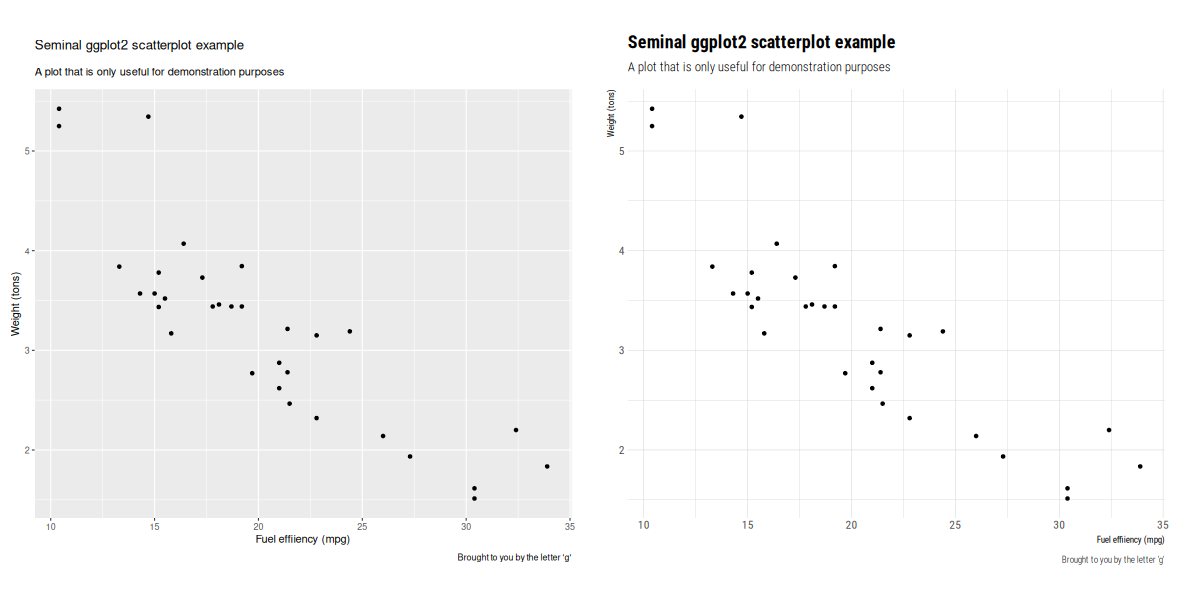
Delighted to announce a new package that arrived on CRAN today: tinythemes. It repackages the theme_ipsum_rc() function by Bob Rudis from his hrbrthemes package in a zero (added) dependency way. A simple example is (also available as a demo inside the packages in the next update) contrasts the default style (on left) with the one added by this package (on the right): The GitHub repo also shows this little example: total dependencies of hrbrthemes over what ggplot2 installs:
> db <- tools::CRAN_package_db()
> deps <- tools::package_dependencies(c("ggplot2", "hrbrthemes"), recursive=TRUE, db=db
> Filter(\(x) x != "ggplot2", setdiff(deps[[2]], deps[[1]]))
 [1] "extrafont"         "knitr"             "rmarkdown"         "htmltools"        
 [5] "tools"             "gdtools"           "extrafontdb"       "Rttf2pt1"         
 [9] "Rcpp"              "systemfonts"       "gfonts"            "curl"             
[13] "fontquiver"        "base64enc"         "digest"            "ellipsis"         
[17] "fastmap"           "evaluate"          "highr"             "xfun"             
[21] "yaml"              "bslib"             "fontawesome"       "jquerylib"        
[25] "jsonlite"          "stringr"           "tinytex"           "cachem"           
[29] "memoise"           "mime"              "sass"              "fontBitstreamVera"
[33] "fontLiberation"    "shiny"             "crul"              "crayon"           
[37] "stringi"           "cpp11"             "urltools"          "httpcode"         
[41] "fs"                "rappdirs"          "httpuv"            "xtable"           
[45] "sourcetools"       "later"             "promises"          "commonmark"       
[49] "triebeard"        
>
Comments and suggestions are welcome at the GitHub repo. If you like this or other open-source work I do, you can sponsor me at GitHub.

This post by Dirk Eddelbuettel originated on his Thinking inside the box blog. Please report excessive re-aggregation in third-party for-profit settings.

17 December 2023

Dirk Eddelbuettel: littler 0.3.19 on CRAN: Several Updates

max-heap image The twentieth release of littler as a CRAN package landed a few minutes ago, following in the now seventeen year history (!!) as a package started by Jeff in 2006, and joined by me a few weeks later. littler is the first command-line interface for R as it predates Rscript. It allows for piping as well for shebang scripting via #!, uses command-line arguments more consistently and still starts faster. It also always loaded the methods package which Rscript only began to do in recent years. littler lives on Linux and Unix, has its difficulties on macOS due to yet-another-braindeadedness there (who ever thought case-insensitive filesystems as a default were a good idea?) and simply does not exist on Windows (yet the build system could be extended see RInside for an existence proof, and volunteers are welcome!). See the FAQ vignette on how to add it to your PATH. A few examples are highlighted at the Github repo:, as well as in the examples vignette. This release contains a fair number of small changes and improvements to some of the example scripts is run daily. The full change description follows.

Changes in littler version 0.3.19 (2023-12-17)
  • Changes in examples scripts
    • The help or usage text display for r2u.r, ttt.r, check.r has been improved, expanded or corrected, respectively
    • installDeps.r has a new argument for dependency selection
    • An initial 'single test file' runner tttf.r has been added
    • r2u.r has two new options for setting / varying the Debian build version of package that is built, and one for BioConductor builds, one for a 'dry run' build, and a new --compile option
    • installRSPM.r, installPPM.r, installP3M.r have been updates to reflect the name changes
    • installRub.r now understands 'package@universe' too
    • tt.r flips the default of the --effects switch

My CRANberries service provides a comparison to the previous release. Full details for the littler release are provided as usual at the ChangeLog page, and also on the package docs website. The code is available via the GitHub repo, from tarballs and now of course also from its CRAN page and via install.packages("littler"). Binary packages are available directly in Debian as well as (in a day or two) Ubuntu binaries at CRAN thanks to the tireless Michael Rutter. Comments and suggestions are welcome at the GitHub repo. If you like this or other open-source work I do, you can sponsor me at GitHub.

This post by Dirk Eddelbuettel originated on his Thinking inside the box blog. Please report excessive re-aggregation in third-party for-profit settings.

14 December 2023

Russell Coker: Fat Finger Shell

I ve been trying out the Fat Finger Shell which is a terminal emulator for Linux on touch screen devices where the keyboard is overlayed with the terminal output. This means that instead of having a tiny keyboard and a tiny terminal output you have the full screen for both. There is a YouTube video showing how the Fat Finger Shell works [1]. Here is a link to the Github page [2], which hasn t changed much in the last 11 years. Currently the shell is hard-coded to a 80*24 terminal and a 640*480 screen which doesn t match any modern hardware. Some parts of this are easy to change but then there s the comment I ran once XGetGeometry and I am harcoded (bad) values for x, y, etc.. which is followed by some magic numbers that are not easy to change which are hacked into the source of xvt. The configuration of this is almost great. It has a plain text file where each line has 4 numbers representing the X and Y coordinates of opposite corners of a rectangle and additional information on what the key is, which is relatively easy to edit. But then it has an image which has to match that, the obvious improvement would be to not have an image but to just display rectangles for each pair of corner coordinates and display the glyph of the character in question inside it. I think there is a real need for a terminal like this for use on devices like the PinePhonePro, it won t be to everyone s taste but the people who like it will really like it. The features that such a shell needs for modern use are being based on Wayland, supporting a variety of screen resolutions and particularly the commonly used ones like 720*1440 and 1920*1080 (with terminal resolution matching the combination of screen resolution and font), and having code derived from a newer terminal emulator. As a final note it would be good for such a terminal to also take input from a regular keyboard so when you plug your Linux phone into a dock you don t need to close your existing terminal sessions. There is a Debian RFP/ITP bug for this [3] which I think should be closed due to nothing happening for 11 years and the fact that so much work is required to make this usable. The current Fat Finger Shell code is a good demonstration of the concept, but I don t think it makes sense to move on with this code base. One of the many possible ways of addressing this with modern graphics technology might be to have a semi transparent window overlaying the screen and generating virtual keyboard events for whichever window happens to be below it so instead of being limited to one terminal program by the choice of input method have that input work for any terminal that the user may choose as well as any other text based program (email, IM, etc).

Dirk Eddelbuettel: RProtoBuf 0.4.21 on CRAN: Updated Upstream Support!

An exciting new release 0.4.21 of RProtoBuf arrived on CRAN earlier today. RProtoBuf provides R with bindings for the Google Protocol Buffers ( ProtoBuf ) data encoding and serialization library used and released by Google, and deployed very widely in numerous projects as a language and operating-system agnostic protocol. ProtoBuf development, following what seemed like a multi-year lull, all of a sudden picked up again with a vengeance a little while ago. And the library releases we rely on for convenience and provided by the Linux distributions are lagging. So last summer we received an excellent, and focussed, pull request #93 offering to update the package to the newer ProtoBuf 22.0 and beyond. (Aside: When a library ditches its numbering scheme you know changes are for real . My Ubuntu 23.10 box is still at 3.21 in a different counting scheme .) But it wasn t until last weekend the issue ticket #95 by Sebastian ran into the same issue, but recognized it and contained a container recipe! So now all of a sudden we were able to build under a newer ProtoBuf which made accepting the PR #93 much easier! We added this as an additional continuous unit test, and made a few other smaller updates to documentation and style. The following section from the NEWS.Rd file has full details.

Changes in RProtoBuf version 0.4.21 (2022-12-13)
  • Package now builds with ProtoBuf >= 22.x thanks to Matteo Gianella (#93 addressing #92).
  • An Alpine 3.19-based workflow was added to test this in continuous integration thanks to a suggestion by Sebastian Meyer.
  • A large number of old-style .Call were updated (#96).
  • Several packaging, dcoumentation and testing items were updated.

Thanks to my CRANberries, there is a diff to the previous release. The RProtoBuf page has copies of the (older) package vignette, the quick overview vignette, and the pre-print of our JSS paper. Questions, comments etc should go to the GitHub issue tracker off the GitHub repo. If you like this or other open-source work I do, you can sponsor me at GitHub.

This post by Dirk Eddelbuettel originated on his Thinking inside the box blog. Please report excessive re-aggregation in third-party for-profit settings.

13 December 2023

Melissa Wen: 15 Tips for Debugging Issues in the AMD Display Kernel Driver

A self-help guide for examining and debugging the AMD display driver within the Linux kernel/DRM subsystem. It s based on my experience as an external developer working on the driver, and are shared with the goal of helping others navigate the driver code. Acknowledgments: These tips were gathered thanks to the countless help received from AMD developers during the driver development process. The list below was obtained by examining open source code, reviewing public documentation, playing with tools, asking in public forums and also with the help of my former GSoC mentor, Rodrigo Siqueira.

Pre-Debugging Steps: Before diving into an issue, it s crucial to perform two essential steps: 1) Check the latest changes: Ensure you re working with the latest AMD driver modifications located in the amd-staging-drm-next branch maintained by Alex Deucher. You may also find bug fixes for newer kernel versions on branches that have the name pattern drm-fixes-<date>. 2) Examine the issue tracker: Confirm that your issue isn t already documented and addressed in the AMD display driver issue tracker. If you find a similar issue, you can team up with others and speed up the debugging process.

Understanding the issue: Do you really need to change this? Where should you start looking for changes? 3) Is the issue in the AMD kernel driver or in the userspace?: Identifying the source of the issue is essential regardless of the GPU vendor. Sometimes this can be challenging so here are some helpful tips:
  • Record the screen: Capture the screen using a recording app while experiencing the issue. If the bug appears in the capture, it s likely a userspace issue, not the kernel display driver.
  • Analyze the dmesg log: Look for error messages related to the display driver in the dmesg log. If the error message appears before the message [drm] Display Core v... , it s not likely a display driver issue. If this message doesn t appear in your log, the display driver wasn t fully loaded and you will see a notification that something went wrong here.
4) AMD Display Manager vs. AMD Display Core: The AMD display driver consists of two components:
  • Display Manager (DM): This component interacts directly with the Linux DRM infrastructure. Occasionally, issues can arise from misinterpretations of DRM properties or features. If the issue doesn t occur on other platforms with the same AMD hardware - for example, only happens on Linux but not on Windows - it s more likely related to the AMD DM code.
  • Display Core (DC): This is the platform-agnostic part responsible for setting and programming hardware features. Modifications to the DC usually require validation on other platforms, like Windows, to avoid regressions.
5) Identify the DC HW family: Each AMD GPU has variations in its hardware architecture. Features and helpers differ between families, so determining the relevant code for your specific hardware is crucial.
  • Find GPU product information in Linux/AMD GPU documentation
  • Check the dmesg log for the Display Core version (since this commit in Linux kernel 6.3v). For example:
    • [drm] Display Core v3.2.241 initialized on DCN 2.1
    • [drm] Display Core v3.2.237 initialized on DCN 3.0.1

Investigating the relevant driver code: Keep from letting unrelated driver code to affect your investigation. 6) Narrow the code inspection down to one DC HW family: the relevant code resides in a directory named after the DC number. For example, the DCN 3.0.1 driver code is located at drivers/gpu/drm/amd/display/dc/dcn301. We all know that the AMD s shared code is huge and you can use these boundaries to rule out codes unrelated to your issue. 7) Newer families may inherit code from older ones: you can find dcn301 using code from dcn30, dcn20, dcn10 files. It s crucial to verify which hooks and helpers your driver utilizes to investigate the right portion. You can leverage ftrace for supplemental validation. To give an example, it was useful when I was updating DCN3 color mapping to correctly use their new post-blending color capabilities, such as: Additionally, you can use two different HW families to compare behaviours. If you see the issue in one but not in the other, you can compare the code and understand what has changed and if the implementation from a previous family doesn t fit well the new HW resources or design. You can also count on the help of the community on the Linux AMD issue tracker to validate your code on other hardware and/or systems. This approach helped me debug a 2-year-old issue where the cursor gamma adjustment was incorrect in DCN3 hardware, but working correctly for DCN2 family. I solved the issue in two steps, thanks for community feedback and validation: 8) Check the hardware capability screening in the driver: You can currently find a list of display hardware capabilities in the drivers/gpu/drm/amd/display/dc/dcn*/dcn*_resource.c file. More precisely in the dcn*_resource_construct() function. Using DCN301 for illustration, here is the list of its hardware caps:
	/*************************************************
	 *  Resource + asic cap harcoding                *
	 *************************************************/
	pool->base.underlay_pipe_index = NO_UNDERLAY_PIPE;
	pool->base.pipe_count = pool->base.res_cap->num_timing_generator;
	pool->base.mpcc_count = pool->base.res_cap->num_timing_generator;
	dc->caps.max_downscale_ratio = 600;
	dc->caps.i2c_speed_in_khz = 100;
	dc->caps.i2c_speed_in_khz_hdcp = 5; /*1.4 w/a enabled by default*/
	dc->caps.max_cursor_size = 256;
	dc->caps.min_horizontal_blanking_period = 80;
	dc->caps.dmdata_alloc_size = 2048;
	dc->caps.max_slave_planes = 2;
	dc->caps.max_slave_yuv_planes = 2;
	dc->caps.max_slave_rgb_planes = 2;
	dc->caps.is_apu = true;
	dc->caps.post_blend_color_processing = true;
	dc->caps.force_dp_tps4_for_cp2520 = true;
	dc->caps.extended_aux_timeout_support = true;
	dc->caps.dmcub_support = true;
	/* Color pipeline capabilities */
	dc->caps.color.dpp.dcn_arch = 1;
	dc->caps.color.dpp.input_lut_shared = 0;
	dc->caps.color.dpp.icsc = 1;
	dc->caps.color.dpp.dgam_ram = 0; // must use gamma_corr
	dc->caps.color.dpp.dgam_rom_caps.srgb = 1;
	dc->caps.color.dpp.dgam_rom_caps.bt2020 = 1;
	dc->caps.color.dpp.dgam_rom_caps.gamma2_2 = 1;
	dc->caps.color.dpp.dgam_rom_caps.pq = 1;
	dc->caps.color.dpp.dgam_rom_caps.hlg = 1;
	dc->caps.color.dpp.post_csc = 1;
	dc->caps.color.dpp.gamma_corr = 1;
	dc->caps.color.dpp.dgam_rom_for_yuv = 0;
	dc->caps.color.dpp.hw_3d_lut = 1;
	dc->caps.color.dpp.ogam_ram = 1;
	// no OGAM ROM on DCN301
	dc->caps.color.dpp.ogam_rom_caps.srgb = 0;
	dc->caps.color.dpp.ogam_rom_caps.bt2020 = 0;
	dc->caps.color.dpp.ogam_rom_caps.gamma2_2 = 0;
	dc->caps.color.dpp.ogam_rom_caps.pq = 0;
	dc->caps.color.dpp.ogam_rom_caps.hlg = 0;
	dc->caps.color.dpp.ocsc = 0;
	dc->caps.color.mpc.gamut_remap = 1;
	dc->caps.color.mpc.num_3dluts = pool->base.res_cap->num_mpc_3dlut; //2
	dc->caps.color.mpc.ogam_ram = 1;
	dc->caps.color.mpc.ogam_rom_caps.srgb = 0;
	dc->caps.color.mpc.ogam_rom_caps.bt2020 = 0;
	dc->caps.color.mpc.ogam_rom_caps.gamma2_2 = 0;
	dc->caps.color.mpc.ogam_rom_caps.pq = 0;
	dc->caps.color.mpc.ogam_rom_caps.hlg = 0;
	dc->caps.color.mpc.ocsc = 1;
	dc->caps.dp_hdmi21_pcon_support = true;
	/* read VBIOS LTTPR caps */
	if (ctx->dc_bios->funcs->get_lttpr_caps)  
		enum bp_result bp_query_result;
		uint8_t is_vbios_lttpr_enable = 0;
		bp_query_result = ctx->dc_bios->funcs->get_lttpr_caps(ctx->dc_bios, &is_vbios_lttpr_enable);
		dc->caps.vbios_lttpr_enable = (bp_query_result == BP_RESULT_OK) && !!is_vbios_lttpr_enable;
	 
	if (ctx->dc_bios->funcs->get_lttpr_interop)  
		enum bp_result bp_query_result;
		uint8_t is_vbios_interop_enabled = 0;
		bp_query_result = ctx->dc_bios->funcs->get_lttpr_interop(ctx->dc_bios, &is_vbios_interop_enabled);
		dc->caps.vbios_lttpr_aware = (bp_query_result == BP_RESULT_OK) && !!is_vbios_interop_enabled;
	 
Keep in mind that the documentation of color capabilities are available at the Linux kernel Documentation.

Understanding the development history: What has brought us to the current state? 9) Pinpoint relevant commits: Use git log and git blame to identify commits targeting the code section you re interested in. 10) Track regressions: If you re examining the amd-staging-drm-next branch, check for regressions between DC release versions. These are defined by DC_VER in the drivers/gpu/drm/amd/display/dc/dc.h file. Alternatively, find a commit with this format drm/amd/display: 3.2.221 that determines a display release. It s useful for bisecting. This information helps you understand how outdated your branch is and identify potential regressions. You can consider each DC_VER takes around one week to be bumped. Finally, check testing log of each release in the report provided on the amd-gfx mailing list, such as this one Tested-by: Daniel Wheeler:

Reducing the inspection area: Focus on what really matters. 11) Identify involved HW blocks: This helps isolate the issue. You can find more information about DCN HW blocks in the DCN Overview documentation. In summary:
  • Plane issues are closer to HUBP and DPP.
  • Blending/Stream issues are closer to MPC, OPP and OPTC. They are related to DRM CRTC subjects.
This information was useful when debugging a hardware rotation issue where the cursor plane got clipped off in the middle of the screen. Finally, the issue was addressed by two patches: 12) Issues around bandwidth (glitches) and clocks: May be affected by calculations done in these HW blocks and HW specific values. The recalculation equations are found in the DML folder. DML stands for Display Mode Library. It s in charge of all required configuration parameters supported by the hardware for multiple scenarios. See more in the AMD DC Overview kernel docs. It s a math library that optimally configures hardware to find the best balance between power efficiency and performance in a given scenario. Finding some clk variables that affect device behavior may be a sign of it. It s hard for a external developer to debug this part, since it involves information from HW specs and firmware programming that we don t have access. The best option is to provide all relevant debugging information you have and ask AMD developers to check the values from your suspicions.
  • Do a trick: If you suspect the power setup is degrading performance, try setting the amount of power supplied to the GPU to the maximum and see if it affects the system behavior with this command: sudo bash -c "echo high > /sys/class/drm/card0/device/power_dpm_force_performance_level"
I learned it when debugging glitches with hardware cursor rotation on Steam Deck. My first attempt was changing the clock calculation. In the end, Rodrigo Siqueira proposed the right solution targeting bandwidth in two steps:

Checking implicit programming and hardware limitations: Bring implicit programming to the level of consciousness and recognize hardware limitations. 13) Implicit update types: Check if the selected type for atomic update may affect your issue. The update type depends on the mode settings, since programming some modes demands more time for hardware processing. More details in the source code:
/* Surface update type is used by dc_update_surfaces_and_stream
 * The update type is determined at the very beginning of the function based
 * on parameters passed in and decides how much programming (or updating) is
 * going to be done during the call.
 *
 * UPDATE_TYPE_FAST is used for really fast updates that do not require much
 * logical calculations or hardware register programming. This update MUST be
 * ISR safe on windows. Currently fast update will only be used to flip surface
 * address.
 *
 * UPDATE_TYPE_MED is used for slower updates which require significant hw
 * re-programming however do not affect bandwidth consumption or clock
 * requirements. At present, this is the level at which front end updates
 * that do not require us to run bw_calcs happen. These are in/out transfer func
 * updates, viewport offset changes, recout size changes and pixel
depth changes.
 * This update can be done at ISR, but we want to minimize how often
this happens.
 *
 * UPDATE_TYPE_FULL is slow. Really slow. This requires us to recalculate our
 * bandwidth and clocks, possibly rearrange some pipes and reprogram
anything front
 * end related. Any time viewport dimensions, recout dimensions,
scaling ratios or
 * gamma need to be adjusted or pipe needs to be turned on (or
disconnected) we do
 * a full update. This cannot be done at ISR level and should be a rare event.
 * Unless someone is stress testing mpo enter/exit, playing with
colour or adjusting
 * underscan we don't expect to see this call at all.
 */
enum surface_update_type  
UPDATE_TYPE_FAST, /* super fast, safe to execute in isr */
UPDATE_TYPE_MED,  /* ISR safe, most of programming needed, no bw/clk change*/
UPDATE_TYPE_FULL, /* may need to shuffle resources */
 ;

Using tools: Observe the current state, validate your findings, continue improvements. 14) Use AMD tools to check hardware state and driver programming: help on understanding your driver settings and checking the behavior when changing those settings.
  • DC Visual confirmation: Check multiple planes and pipe split policy.
  • DTN logs: Check display hardware state, including rotation, size, format, underflow, blocks in use, color block values, etc.
  • UMR: Check ASIC info, register values, KMS state - links and elements (framebuffers, planes, CRTCs, connectors). Source: UMR project documentation
15) Use generic DRM/KMS tools:
  • IGT test tools: Use generic KMS tests or develop your own to isolate the issue in the kernel space. Compare results across different GPU vendors to understand their implementations and find potential solutions. Here AMD also has specific IGT tests for its GPUs that is expect to work without failures on any AMD GPU. You can check results of HW-specific tests using different display hardware families or you can compare expected differences between the generic workflow and AMD workflow.
  • drm_info: This tool summarizes the current state of a display driver (capabilities, properties and formats) per element of the DRM/KMS workflow. Output can be helpful when reporting bugs.

Don t give up! Debugging issues in the AMD display driver can be challenging, but by following these tips and leveraging available resources, you can significantly improve your chances of success. Worth mentioning: This blog post builds upon my talk, I m not an AMD expert, but presented at the 2022 XDC. It shares guidelines that helped me debug AMD display issues as an external developer of the driver. Open Source Display Driver: The Linux kernel/AMD display driver is open source, allowing you to actively contribute by addressing issues listed in the official tracker. Tackling existing issues or resolving your own can be a rewarding learning experience and a valuable contribution to the community. Additionally, the tracker serves as a valuable resource for finding similar bugs, troubleshooting tips, and suggestions from AMD developers. Finally, it s a platform for seeking help when needed. Remember, contributing to the open source community through issue resolution and collaboration is mutually beneficial for everyone involved.

11 December 2023

Jonathan Dowland: Talks: why?

I'd planned to write some private mail on the subject of preparing and delivering conference talks. However, each time I try to write that mail, I've managed to somehow contrive to lose it. So I thought I'd try as a blog post instead, to break the curse. The first aspect I wanted to write about is the pre-planning phase, or, the bit where you decide to give a talk in the first place. But first a bit about me. I don't talk all that regularly. I think I'm averaging one talk a year. I don't consider myself to be a natural talk-giver: I don't particularly enjoy it and I still get quite nervous. So the first question is: why do it? One motivation is that you want to attend a particular conference, and presenting at it makes it much easier to get institutional support for doing so (i.e., travel and accommodation covered). At the moment, I've written some talk proposals for FOSDEM because I want to attend, and it increases my chances if I'm delivering a talk. Another reason, pertinent to academia, is you wish to have a paper published. Last year I attended a conference in Portland that I had a paper accepted to. A condition of the paper being accepted is you attend and do a presentation about it. Obviously, the presentation itself is a useful form of dissemination for your work, but the paper has the potential to reach more people. You may wish to promote what you're talking about: academic work, but perhaps a piece of open source software that would benefit from wider awareness, more adoption, more bug reports, testing, and patches. You may wish to support the venue. There are a some of small-scale conferences that I enjoy participating in which don't receive a lot of submissions and so I tend to send one or more in order to help make sure there are enough possible talks to keep the whole thing viable. Finally, you may wish to promote yourself: certainly, some Software Engineers I've met seem to spend as much time on talks and travelling as writing software. It's a good way to see a lot of the world, and might be a good way to get your name known and increase your employment prospects. I feel lucky I haven't had to rely on this.

Jonathan Dowland: Tex Shura

So yeah, I bought the Shura.
Tex Shura keyboard, ISO-UK layout
It's been about a year since I got the Tex Shinobi keyboard. I ended up taking to the office and using it there. The MX Silent Red switches are a good fit for a shared space, and I have a bit more desk space so the extra large footprint is not a problem. Back at home, I have a reasonably large desk, but I've got a Synth jammed at the back-centre, leaving a slightly tight budget for keyboard depth. The Shura is nice and compact and fits in perfectly. So what should I say about it? Build quality is excellent. I went with MX Reds (non-silent this time) which feel a lot better to me than the silent variant. I do worry about waking the kids up if I type after they've gone to bed, but it hasn't actually been a problem (and the switches activate quite early in travel so you can "tip-toe" type silently, and slowly). I like these keyboards (and I've otherwise avoided the Mech keyboard money pit) because they have the integrated trackpoint, which I rely on. Just as with the Shinobi, the Trackpoint is of an excellent quality, pretty much indistinguishable from that on the official Lenovo trackpoint keyboards. Since the Shura is a a "60%" or "65%" or "70%" or something, thus forgoing the Function keys and such, I rely on "layers": switching the function of all the regular keys whilst "Fn" is pressed. You can reprogram the Tex keyboards using a profile output by their web-based configurator which I've used to mildly customize the layout: swapped left-hand "Win" with "Fn" (FN1), mapped FN1 to the right-hand "Win". That's it so far, the defaults are otherwise sufficient for me. I've also used the DIP switches to enable mouse wheel emulation with the trackpoint (in common with the Lenovos). In September, Justin from TeX left an intriguing comment on my last blog post:
Thanks for your promotion !! We will try to design a new keyboard ( a little ergo keyboard ) should be release end of this year !!

9 December 2023

Simon Josefsson: Classic McEliece goes to IETF and OpenSSH

My earlier work on Streamlined NTRU Prime has been progressing along. The IETF document on sntrup761 in SSH has passed several process points. GnuPG s libgcrypt has added support for sntrup761. The libssh support for sntrup761 is working, but the merge request is stuck mostly due to lack of time to debug why the regression test suite sporadically errors out in non-sntrup761 related parts with the patch. The foundation for lattice-based post-quantum algorithms has some uncertainty around it, and I have felt that there is more to the post-quantum story than adding sntrup761 to implementations. Classic McEliece has been mentioned to me a couple of times, and I took some time to learn it and did a cut n paste job of the proposed ISO standard and published draft-josefsson-mceliece in the IETF to make the algorithm easily available to the IETF community. A high-quality implementation of Classic McEliece has been published as libmceliece and I ve been supporting the work of Jan Moj to package libmceliece for Debian, alas it has been stuck in the ftp-master NEW queue for manual review for over two months. The pre-dependencies librandombytes and libcpucycles are available in Debian already. All that text writing and packaging work set the scene to write some code. When I added support for sntrup761 in libssh, I became familiar with the OpenSSH code base, so it was natural to return to OpenSSH to experiment with a new SSH KEX for Classic McEliece. DJB suggested to pick mceliece6688128 and combine it with the existing X25519+sntrup761 or with plain X25519. While a three-algorithm hybrid between X25519, sntrup761 and mceliece6688128 would be a simple drop-in for those that don t want to lose the benefits offered by sntrup761, I decided to start the journey on a pure combination of X25519 with mceliece6688128. The key combiner in sntrup761x25519 is a simple SHA512 call and the only good I can say about that is that it is simple to describe and implement, and doesn t raise too many questions since it is already deployed. After procrastinating coding for months, once I sat down to work it only took a couple of hours until I had a successful Classic McEliece SSH connection. I suppose my brain had sorted everything in background before I started. To reproduce it, please try the following in a Debian testing environment (I use podman to get a clean environment).
# podman run -it --rm debian:testing-slim
apt update
apt dist-upgrade -y
apt install -y wget python3 librandombytes-dev libcpucycles-dev gcc make git autoconf libz-dev libssl-dev
cd ~
wget -q -O- https://lib.mceliece.org/libmceliece-20230612.tar.gz   tar xfz -
cd libmceliece-20230612/
./configure
make install
ldconfig
cd ..
git clone https://gitlab.com/jas/openssh-portable
cd openssh-portable
git checkout jas/mceliece
autoreconf
./configure # verify 'libmceliece support: yes'
make # CC="cc -DDEBUG_KEX=1 -DDEBUG_KEXDH=1 -DDEBUG_KEXECDH=1"
You should now have a working SSH client and server that supports Classic McEliece! Verify support by running ./ssh -Q kex and it should mention mceliece6688128x25519-sha512@openssh.com. To have it print plenty of debug outputs, you may remove the # character on the final line, but don t use such a build in production. You can test it as follows:
./ssh-keygen -A # writes to /usr/local/etc/ssh_host_...
# setup public-key based login by running the following:
./ssh-keygen -t rsa -f ~/.ssh/id_rsa -P ""
cat ~/.ssh/id_rsa.pub > ~/.ssh/authorized_keys
adduser --system sshd
mkdir /var/empty
while true; do $PWD/sshd -p 2222 -f /dev/null; done &
./ssh -v -p 2222 localhost -oKexAlgorithms=mceliece6688128x25519-sha512@openssh.com date
On the client you should see output like this:
OpenSSH_9.5p1, OpenSSL 3.0.11 19 Sep 2023
...
debug1: SSH2_MSG_KEXINIT sent
debug1: SSH2_MSG_KEXINIT received
debug1: kex: algorithm: mceliece6688128x25519-sha512@openssh.com
debug1: kex: host key algorithm: ssh-ed25519
debug1: kex: server->client cipher: chacha20-poly1305@openssh.com MAC: <implicit> compression: none
debug1: kex: client->server cipher: chacha20-poly1305@openssh.com MAC: <implicit> compression: none
debug1: expecting SSH2_MSG_KEX_ECDH_REPLY
debug1: SSH2_MSG_KEX_ECDH_REPLY received
debug1: Server host key: ssh-ed25519 SHA256:YognhWY7+399J+/V8eAQWmM3UFDLT0dkmoj3pIJ0zXs
...
debug1: Host '[localhost]:2222' is known and matches the ED25519 host key.
debug1: Found key in /root/.ssh/known_hosts:1
debug1: rekey out after 134217728 blocks
debug1: SSH2_MSG_NEWKEYS sent
debug1: expecting SSH2_MSG_NEWKEYS
debug1: SSH2_MSG_NEWKEYS received
debug1: rekey in after 134217728 blocks
...
debug1: Sending command: date
debug1: pledge: fork
debug1: permanently_set_uid: 0/0
Environment:
  USER=root
  LOGNAME=root
  HOME=/root
  PATH=/usr/bin:/bin:/usr/sbin:/sbin:/usr/local/bin
  MAIL=/var/mail/root
  SHELL=/bin/bash
  SSH_CLIENT=::1 46894 2222
  SSH_CONNECTION=::1 46894 ::1 2222
debug1: client_input_channel_req: channel 0 rtype exit-status reply 0
debug1: client_input_channel_req: channel 0 rtype eow@openssh.com reply 0
Sat Dec  9 22:22:40 UTC 2023
debug1: channel 0: free: client-session, nchannels 1
Transferred: sent 1048044, received 3500 bytes, in 0.0 seconds
Bytes per second: sent 23388935.4, received 78108.6
debug1: Exit status 0
Notice the kex: algorithm: mceliece6688128x25519-sha512@openssh.com output. How about network bandwidth usage? Below is a comparison of a complete SSH client connection such as the one above that log in and print date and logs out. Plain X25519 is around 7kb, X25519 with sntrup761 is around 9kb, and mceliece6688128 with X25519 is around 1MB. Yes, Classic McEliece has large keys, but for many environments, 1MB of data for the session establishment will barely be noticeable.
./ssh -v -p 2222 localhost -oKexAlgorithms=curve25519-sha256 date 2>&1   grep ^Transferred
Transferred: sent 3028, received 3612 bytes, in 0.0 seconds
./ssh -v -p 2222 localhost -oKexAlgorithms=sntrup761x25519-sha512@openssh.com date 2>&1   grep ^Transferred
Transferred: sent 4212, received 4596 bytes, in 0.0 seconds
./ssh -v -p 2222 localhost -oKexAlgorithms=mceliece6688128x25519-sha512@openssh.com date 2>&1   grep ^Transferred
Transferred: sent 1048044, received 3764 bytes, in 0.0 seconds
So how about session establishment time?
date; i=0; while test $i -le 100; do ./ssh -v -p 2222 localhost -oKexAlgorithms=curve25519-sha256 date > /dev/null 2>&1; i= expr $i + 1 ; done; date
Sat Dec  9 22:39:19 UTC 2023
Sat Dec  9 22:39:25 UTC 2023
# 6 seconds
date; i=0; while test $i -le 100; do ./ssh -v -p 2222 localhost -oKexAlgorithms=sntrup761x25519-sha512@openssh.com date > /dev/null 2>&1; i= expr $i + 1 ; done; date
Sat Dec  9 22:39:29 UTC 2023
Sat Dec  9 22:39:38 UTC 2023
# 9 seconds
date; i=0; while test $i -le 100; do ./ssh -v -p 2222 localhost -oKexAlgorithms=mceliece6688128x25519-sha512@openssh.com date > /dev/null 2>&1; i= expr $i + 1 ; done; date
Sat Dec  9 22:39:55 UTC 2023
Sat Dec  9 22:40:07 UTC 2023
# 12 seconds
I never noticed adding sntrup761, so I m pretty sure I wouldn t notice this increase either. This is all running on my laptop that runs Trisquel so take it with a grain of salt but at least the magnitude is clear. Future work items include: Happy post-quantum SSH ing! Update: Changing the mceliece6688128_keypair call to mceliece6688128f_keypair (i.e., using the fully compatible f-variant) results in McEliece being just as fast as sntrup761 on my machine. Update 2023-12-26: An initial IETF document draft-josefsson-ssh-mceliece-00 published.

Dirk Eddelbuettel: RcppInt64 0.0.4 on CRAN: Minor Bugfix

The new-ish package RcppInt64 (announced earlier this fall in this post, with two small updates following) arrived on CRAN minutes ago as relase 0.0.4. RcppInt64 collects some of the previous conversions between 64-bit integer values in R and C++, and regroups them in a single package. It offers two interfaces: both a more standard as<>() converter from R values along with its companions wrap() to return to R, as well as more dedicated functions from and to . This release addresses an issues Sebastian reported a few hours and which is reported by newer, pickier compilers: We need to include <cstdint> so that int64_t is declared. CRAN was at its usual best processing this efficiently including tests of the by now two reverse dependencies. Twenty two minutes total, all automated: The brief NEWS entry follows:

Changes in version 0.0.4 (2023-12-09)
  • The cstdint header is now included (closes #1).

Courtesy of my CRANberries, there is a diffstat report relative to previous release. If you like this or other open-source work I do, you can sponsor me at GitHub.

This post by Dirk Eddelbuettel originated on his Thinking inside the box blog. Please report excessive re-aggregation in third-party for-profit settings.

6 December 2023

Reproducible Builds: Reproducible Builds in November 2023

Welcome to the November 2023 report from the Reproducible Builds project! In these reports we outline the most important things that we have been up to over the past month. As a rather rapid recap, whilst anyone may inspect the source code of free software for malicious flaws, almost all software is distributed to end users as pre-compiled binaries (more).

Reproducible Builds Summit 2023 Between October 31st and November 2nd, we held our seventh Reproducible Builds Summit in Hamburg, Germany! Amazingly, the agenda and all notes from all sessions are all online many thanks to everyone who wrote notes from the sessions. As a followup on one idea, started at the summit, Alexander Couzens and Holger Levsen started work on a cache (or tailored front-end) for the snapshot.debian.org service. The general idea is that, when rebuilding Debian, you do not actually need the whole ~140TB of data from snapshot.debian.org; rather, only a very small subset of the packages are ever used for for building. It turns out, for amd64, arm64, armhf, i386, ppc64el, riscv64 and s390 for Debian trixie, unstable and experimental, this is only around 500GB ie. less than 1%. Although the new service not yet ready for usage, it has already provided a promising outlook in this regard. More information is available on https://rebuilder-snapshot.debian.net and we hope that this service becomes usable in the coming weeks. The adjacent picture shows a sticky note authored by Jan-Benedict Glaw at the summit in Hamburg, confirming Holger Levsen s theory that rebuilding all Debian packages needs a very small subset of packages, the text states that 69,200 packages (in Debian sid) list 24,850 packages in their .buildinfo files, in 8,0200 variations. This little piece of paper was the beginning of rebuilder-snapshot and is a direct outcome of the summit! The Reproducible Builds team would like to thank our event sponsors who include Mullvad VPN, openSUSE, Debian, Software Freedom Conservancy, Allotropia and Aspiration Tech.

Beyond Trusting FOSS presentation at SeaGL On November 4th, Vagrant Cascadian presented Beyond Trusting FOSS at SeaGL in Seattle, WA in the United States. Founded in 2013, SeaGL is a free, grassroots technical summit dedicated to spreading awareness and knowledge about free source software, hardware and culture. The summary of Vagrant s talk mentions that it will:
[ ] introduce the concepts of Reproducible Builds, including best practices for developing and releasing software, the tools available to help diagnose issues, and touch on progress towards solving decades-old deeply pervasive fundamental security issues Learn how to verify and demonstrate trust, rather than simply hoping everything is OK!
Germane to the contents of the talk, the slides for Vagrant s talk can be built reproducibly, resulting in a PDF with a SHA1 of cfde2f8a0b7e6ec9b85377eeac0661d728b70f34 when built on Debian bookworm and c21fab273232c550ce822c4b0d9988e6c49aa2c3 on Debian sid at the time of writing.

Human Factors in Software Supply Chain Security Marcel Fourn , Dominik Wermke, Sascha Fahl and Yasemin Acar have published an article in a Special Issue of the IEEE s Security & Privacy magazine. Entitled A Viewpoint on Human Factors in Software Supply Chain Security: A Research Agenda, the paper justifies the need for reproducible builds to reach developers and end-users specifically, and furthermore points out some under-researched topics that we have seen mentioned in interviews. An author pre-print of the article is available in PDF form.

Community updates On our mailing list this month:

openSUSE updates Bernhard M. Wiedemann has created a wiki page outlining an proposal to create a general-purpose Linux distribution which consists of 100% bit-reproducible packages albeit minus the embedded signature within RPM files. It would be based on openSUSE Tumbleweed or, if available, its Slowroll-variant. In addition, Bernhard posted another monthly update for his work elsewhere in openSUSE.

Ubuntu Launchpad now supports .buildinfo files Back in 2017, Steve Langasek filed a bug against Ubuntu s Launchpad code hosting platform to report that .changes files (artifacts of building Ubuntu and Debian packages) reference .buildinfo files that aren t actually exposed by Launchpad itself. This was causing issues when attempting to process .changes files with tools such as Lintian. However, it was noticed last month that, in early August of this year, Simon Quigley had resolved this issue, and .buildinfo files are now available from the Launchpad system.

PHP reproducibility updates There have been two updates from the PHP programming language this month. Firstly, the widely-deployed PHPUnit framework for the PHP programming language have recently released version 10.5.0, which introduces the inclusion of a composer.lock file, ensuring total reproducibility of the shipped binary file. Further details and the discussion that went into their particular implementation can be found on the associated GitHub pull request. In addition, the presentation Leveraging Nix in the PHP ecosystem has been given in late October at the PHP International Conference in Munich by Pol Dellaiera. While the video replay is not yet available, the (reproducible) presentation slides and speaker notes are available.

diffoscope changes diffoscope is our in-depth and content-aware diff utility that can locate and diagnose reproducibility issues. This month, Chris Lamb made a number of changes, including:
  • Improving DOS/MBR extraction by adding support for 7z. [ ]
  • Adding a missing RequiredToolNotFound import. [ ]
  • As a UI/UX improvement, try and avoid printing an extended traceback if diffoscope runs out of memory. [ ]
  • Mark diffoscope as stable on PyPI.org. [ ]
  • Uploading version 252 to Debian unstable. [ ]

Website updates A huge number of notes were added to our website that were taken at our recent Reproducible Builds Summit held between October 31st and November 2nd in Hamburg, Germany. In particular, a big thanks to Arnout Engelen, Bernhard M. Wiedemann, Daan De Meyer, Evangelos Ribeiro Tzaras, Holger Levsen and Orhun Parmaks z. In addition to this, a number of other changes were made, including:

Upstream patches The Reproducible Builds project detects, dissects and attempts to fix as many currently-unreproducible packages as possible. We endeavour to send all of our patches upstream where appropriate. This month, we wrote a large number of such patches, including:

Reproducibility testing framework The Reproducible Builds project operates a comprehensive testing framework (available at tests.reproducible-builds.org) in order to check packages and other artifacts for reproducibility. In October, a number of changes were made by Holger Levsen:
  • Debian-related changes:
    • Track packages marked as Priority: important in a new package set. [ ][ ]
    • Stop scheduling packages that fail to build from source in bookworm [ ] and bullseye. [ ].
    • Add old releases dashboard link in web navigation. [ ]
    • Permit re-run of the pool_buildinfos script to be re-run for a specific year. [ ]
    • Grant jbglaw access to the osuosl4 node [ ][ ] along with lynxis [ ].
    • Increase RAM on the amd64 Ionos builders from 48 GiB to 64 GiB; thanks IONOS! [ ]
    • Move buster to archived suites. [ ][ ]
    • Reduce the number of arm64 architecture workers from 24 to 16 in order to improve stability [ ], reduce the workers for amd64 from 32 to 28 and, for i386, reduce from 12 down to 8 [ ].
    • Show the entire build history of each Debian package. [ ]
    • Stop scheduling already tested package/version combinations in Debian bookworm. [ ]
  • Snapshot service for rebuilders
    • Add an HTTP-based API endpoint. [ ][ ]
    • Add a Gunicorn instance to serve the HTTP API. [ ]
    • Add an NGINX config [ ][ ][ ][ ]
  • System-health:
    • Detect failures due to HTTP 503 Service Unavailable errors. [ ]
    • Detect failures to update package sets. [ ]
    • Detect unmet dependencies. (This usually occurs with builds of Debian live-build.) [ ]
  • Misc-related changes:
    • do install systemd-ommd on jenkins. [ ]
    • fix harmless typo in squid.conf for codethink04. [ ]
    • fixup: reproducible Debian: add gunicorn service to serve /api for rebuilder-snapshot.d.o. [ ]
    • Increase codethink04 s Squid cache_dir size setting to 16 GiB. [ ]
    • Don t install systemd-oomd as it unfortunately kills sshd [ ]
    • Use debootstrap from backports when commisioning nodes. [ ]
    • Add the live_build_debian_stretch_gnome, debsums-tests_buster and debsums-tests_buster jobs to the zombie list. [ ][ ]
    • Run jekyll build with the --watch argument when building the Reproducible Builds website. [ ]
    • Misc node maintenance. [ ][ ][ ]
Other changes were made as well, however, including Mattia Rizzolo fixing rc.local s Bash syntax so it can actually run [ ], commenting away some file cleanup code that is (potentially) deleting too much [ ] and fixing the html_brekages page for Debian package builds [ ]. Finally, diagnosed and submitted a patch to add a AddEncoding gzip .gz line to the tests.reproducible-builds.org Apache configuration so that Gzip files aren t re-compressed as Gzip which some clients can t deal with (as well as being a waste of time). [ ]

If you are interested in contributing to the Reproducible Builds project, please visit our Contribute page on our website. However, you can get in touch with us via:

Next.

Previous.