Search Results: "pm"

28 April 2022

Raphaël Hertzog: Freexian s report about Debian Long Term Support, March 2022

A Debian LTS logo
Every month we review the work funded by Freexian s Debian LTS offering. Please find the report for March below. Debian project funding Learn more about the rationale behind this initiative in this article. Debian LTS contributors In March, 11 contributors were paid to work on Debian LTS, their reports are available below. If you re interested in participating in the LTS or ELTS teams, we welcome participation from the Debian community. Simply get in touch with Jeremiah or Rapha l if you are if you are interested in participating. Evolution of the situation In March we released 42 DLAs. The security tracker currently lists 81 packages with a known CVE and the dla-needed.txt file has 52 packages needing an update. We re glad to welcome a few new sponsors such as lectricit de France (Gold sponsor), Telecats BV and Soliton Systems. Thanks to our sponsors Sponsors that joined recently are in bold.

27 April 2022

Antoine Beaupr : building Debian packages under qemu with sbuild

I've been using sbuild for a while to build my Debian packages, mainly because it's what is used by the Debian autobuilders, but also because it's pretty powerful and efficient. Configuring it just right, however, can be a challenge. In my quick Debian development guide, I had a few pointers on how to configure sbuild with the normal schroot setup, but today I finished a qemu based configuration.

Why I want to use qemu mainly because it provides better isolation than a chroot. I sponsor packages sometimes and while I typically audit the source code before building, it still feels like the extra protection shouldn't hurt. I also like the idea of unifying my existing virtual machine setup with my build setup. My current VM is kind of all over the place: libvirt, vagrant, GNOME Boxes, etc?). I've been slowly converging over libvirt however, and most solutions I use right now rely on qemu under the hood, certainly not chroots... I could also have decided to go with containers like LXC, LXD, Docker (with conbuilder, whalebuilder, docker-buildpackage), systemd-nspawn (with debspawn), unshare (with schroot --chroot-mode=unshare), or whatever: I didn't feel those offer the level of isolation that is provided by qemu. The main downside of this approach is that it is (obviously) slower than native builds. But on modern hardware, that cost should be minimal.

How Basically, you need this:
sudo mkdir -p /srv/sbuild/qemu/
sudo apt install sbuild-qemu
sudo sbuild-qemu-create -o /srv/sbuild/qemu/unstable.img unstable https://deb.debian.org/debian
Then to make this used by default, add this to ~/.sbuildrc:
# run autopkgtest inside the schroot
$run_autopkgtest = 1;
# tell sbuild to use autopkgtest as a chroot
$chroot_mode = 'autopkgtest';
# tell autopkgtest to use qemu
$autopkgtest_virt_server = 'qemu';
# tell autopkgtest-virt-qemu the path to the image
# use --debug there to show what autopkgtest is doing
$autopkgtest_virt_server_options = [ '--', '/srv/sbuild/qemu/%r-%a.img' ];
# tell plain autopkgtest to use qemu, and the right image
$autopkgtest_opts = [ '--', 'qemu', '/srv/sbuild/qemu/%r-%a.img' ];
# no need to cleanup the chroot after build, we run in a completely clean VM
$purge_build_deps = 'never';
# no need for sudo
$autopkgtest_root_args = '';
Note that the above will use the default autopkgtest (1GB, one core) and qemu (128MB, one core) configuration, which might be a little low on resources. You probably want to be explicit about this, with something like this:
# extra parameters to pass to qemu
# --enable-kvm is not necessary, detected on the fly by autopkgtest
my @_qemu_options = ['--ram-size=4096', '--cpus=2'];
# tell autopkgtest-virt-qemu the path to the image
# use --debug there to show what autopkgtest is doing
$autopkgtest_virt_server_options = [ @_qemu_options, '--', '/srv/sbuild/qemu/%r-%a.img' ];
$autopkgtest_opts = [ '--', 'qemu', @qemu_options, '/srv/sbuild/qemu/%r-%a.img'];
This configuration will:
  1. create a virtual machine image in /srv/sbuild/qemu for unstable
  2. tell sbuild to use that image to create a temporary VM to build the packages
  3. tell sbuild to run autopkgtest (which should really be default)
  4. tell autopkgtest to use qemu for builds and for tests
Note that the VM created by sbuild-qemu-create have an unlocked root account with an empty password.

Other useful tasks
  • enter the VM to make test, changes will be discarded (thanks Nick Brown for the sbuild-qemu-boot tip!):
     sbuild-qemu-boot /srv/sbuild/qemu/unstable-amd64.img
    
    That program is shipped only with bookworm and later, an equivalent command is:
     qemu-system-x86_64 -snapshot -enable-kvm -object rng-random,filename=/dev/urandom,id=rng0 -device virtio-rng-pci,rng=rng0,id=rng-device0 -m 2048 -nographic /srv/sbuild/qemu/unstable-amd64.img
    
    The key argument here is -snapshot.
  • enter the VM to make permanent changes, which will not be discarded:
     sudo sbuild-qemu-boot --readwrite /srv/sbuild/qemu/unstable-amd64.img
    
    Equivalent command:
     sudo qemu-system-x86_64 -enable-kvm -object rng-random,filename=/dev/urandom,id=rng0 -device virtio-rng-pci,rng=rng0,id=rng-device0 -m 2048 -nographic /srv/sbuild/qemu/unstable-amd64.img
    
  • update the VM (thanks lavamind):
     sudo sbuild-qemu-update /srv/sbuild/qemu/unstable-amd64.img
    
  • build in a specific VM regardless of the suite specified in the changelog (e.g. UNRELEASED, bookworm-backports, bookworm-security, etc):
     sbuild --autopkgtest-virt-server-opts="-- qemu /var/lib/sbuild/qemu/bookworm-amd64.img"
    
    Note that you'd also need to pass --autopkgtest-opts if you want autopkgtest to run in the correct VM as well:
     sbuild --autopkgtest-opts="-- qemu /var/lib/sbuild/qemu/unstable.img" --autopkgtest-virt-server-opts="-- qemu /var/lib/sbuild/qemu/bookworm-amd64.img"
    
    You might also need parameters like --ram-size if you customized it above.
And yes, this is all quite complicated and could be streamlined a little, but that's what you get when you have years of legacy and just want to get stuff done. It seems to me autopkgtest-virt-qemu should have a magic flag starts a shell for you, but it doesn't look like that's a thing. When that program starts, it just says ok and sits there. Maybe because the authors consider the above to be simple enough (see also bug #911977 for a discussion of this problem).

Live access to a running test When autopkgtest starts a VM, it uses this funky qemu commandline:
qemu-system-x86_64 -m 4096 -smp 2 -nographic -net nic,model=virtio -net user,hostfwd=tcp:127.0.0.1:10022-:22 -object rng-random,filename=/dev/urandom,id=rng0 -device virtio-rng-pci,rng=rng0,id=rng-device0 -monitor unix:/tmp/autopkgtest-qemu.w1mlh54b/monitor,server,nowait -serial unix:/tmp/autopkgtest-qemu.w1mlh54b/ttyS0,server,nowait -serial unix:/tmp/autopkgtest-qemu.w1mlh54b/ttyS1,server,nowait -virtfs local,id=autopkgtest,path=/tmp/autopkgtest-qemu.w1mlh54b/shared,security_model=none,mount_tag=autopkgtest -drive index=0,file=/tmp/autopkgtest-qemu.w1mlh54b/overlay.img,cache=unsafe,if=virtio,discard=unmap,format=qcow2 -enable-kvm -cpu kvm64,+vmx,+lahf_lm
... which is a typical qemu commandline, I'm sorry to say. That gives us a VM with those settings (paths are relative to a temporary directory, /tmp/autopkgtest-qemu.w1mlh54b/ in the above example):
  • the shared/ directory is, well, shared with the VM
  • port 10022 is forward to the VM's port 22, presumably for SSH, but not SSH server is started by default
  • the ttyS1 and ttyS2 UNIX sockets are mapped to the first two serial ports (use nc -U to talk with those)
  • the monitor UNIX socket is a qemu control socket (see the QEMU monitor documentation, also nc -U)
In other words, it's possible to access the VM with:
nc -U /tmp/autopkgtest-qemu.w1mlh54b/ttyS2
The nc socket interface is ... not great, but it works well enough. And you can probably fire up an SSHd to get a better shell if you feel like it.

Nitty-gritty details no one cares about

Fixing hang in sbuild cleanup I'm having a hard time making heads or tails of this, but please bear with me. In sbuild + schroot, there's this notion that we don't really need to cleanup after ourselves inside the schroot, as the schroot will just be delted anyways. This behavior seems to be handled by the internal "Session Purged" parameter. At least in lib/Sbuild/Build.pm, we can see this:
my $is_cloned_session = (defined ($session->get('Session Purged')) &&
             $session->get('Session Purged') == 1) ? 1 : 0;
[...]
if ($is_cloned_session)  
$self->log("Not cleaning session: cloned chroot in use\n");
  else  
if ($purge_build_deps)  
    # Removing dependencies
    $resolver->uninstall_deps();
  else  
    $self->log("Not removing build depends: as requested\n");
 
 
The schroot builder defines that parameter as:
    $self->set('Session Purged', $info-> 'Session Purged' );
... which is ... a little confusing to me. $info is:
my $info = $self->get('Chroots')->get_info($schroot_session);
... so I presume that depends on whether the schroot was correctly cleaned up? I stopped digging there... ChrootUnshare.pm is way more explicit:
$self->set('Session Purged', 1);
I wonder if we should do something like this with the autopkgtest backend. I guess people might technically use it with something else than qemu, but qemu is the typical use case of the autopkgtest backend, in my experience. Or at least certainly with things that cleanup after themselves. Right? For some reason, before I added this line to my configuration:
$purge_build_deps = 'never';
... the "Cleanup" step would just completely hang. It was quite bizarre.

Disgression on the diversity of VM-like things There are a lot of different virtualization solutions one can use (e.g. Xen, KVM, Docker or Virtualbox). I have also found libguestfs to be useful to operate on virtual images in various ways. Libvirt and Vagrant are also useful wrappers on top of the above systems. There are particularly a lot of different tools which use Docker, Virtual machines or some sort of isolation stronger than chroot to build packages. Here are some of the alternatives I am aware of: Take, for example, Whalebuilder, which uses Docker to build packages instead of pbuilder or sbuild. Docker provides more isolation than a simple chroot: in whalebuilder, packages are built without network access and inside a virtualized environment. Keep in mind there are limitations to Docker's security and that pbuilder and sbuild do build under a different user which will limit the security issues with building untrusted packages. On the upside, some of things are being fixed: whalebuilder is now an official Debian package (whalebuilder) and has added the feature of passing custom arguments to dpkg-buildpackage. None of those solutions (except the autopkgtest/qemu backend) are implemented as a sbuild plugin, which would greatly reduce their complexity. I was previously using Qemu directly to run virtual machines, and had to create VMs by hand with various tools. This didn't work so well so I switched to using Vagrant as a de-facto standard to build development environment machines, but I'm returning to Qemu because it uses a similar backend as KVM and can be used to host longer-running virtual machines through libvirt. The great thing now is that autopkgtest has good support for qemu and sbuild has bridged the gap and can use it as a build backend. I originally had found those bugs in that setup, but all of them are now fixed:
  • #911977: sbuild: how do we correctly guess the VM name in autopkgtest?
  • #911979: sbuild: fails on chown in autopkgtest-qemu backend
  • #911963: autopkgtest qemu build fails with proxy_cmd: parameter not set
  • #911981: autopkgtest: qemu server warns about missing CPU features
So we have unification! It's possible to run your virtual machines and Debian builds using a single VM image backend storage, which is no small feat, in my humble opinion. See the sbuild-qemu blog post for the annoucement Now I just need to figure out how to merge Vagrant, GNOME Boxes, and libvirt together, which should be a matter of placing images in the right place... right? See also hosting.

pbuilder vs sbuild I was previously using pbuilder and switched in 2017 to sbuild. AskUbuntu.com has a good comparative between pbuilder and sbuild that shows they are pretty similar. The big advantage of sbuild is that it is the tool in use on the buildds and it's written in Perl instead of shell. My concerns about switching were POLA (I'm used to pbuilder), the fact that pbuilder runs as a separate user (works with sbuild as well now, if the _apt user is present), and setting up COW semantics in sbuild (can't just plug cowbuilder there, need to configure overlayfs or aufs, which was non-trivial in Debian jessie). Ubuntu folks, again, have more documentation there. Debian also has extensive documentation, especially about how to configure overlays. I was ultimately convinced by stapelberg's post on the topic which shows how much simpler sbuild really is...

Who Thanks lavamind for the introduction to the sbuild-qemu package.

Russ Allbery: Review: Sorceress of Darshiva

Review: Sorceress of Darshiva, by David Eddings
Series: The Malloreon #4
Publisher: Del Rey
Copyright: December 1989
Printing: November 1990
ISBN: 0-345-36935-1
Format: Mass market
Pages: 371
This is the fourth book of the Malloreon, the sequel series to the Belgariad. Eddings as usual helpfully summarizes the plot of previous books (the one thing about his writing that I wish more authors would copy), this time by having various important people around the world briefed on current events. That said, you don't want to start reading here (although you might wish you could). This is such a weird book. One could argue that not much happens in the Belgariad other than map exploration and collecting a party, but the party collection involves meddling in local problems to extract each new party member. It's a bit of a random sequence of events, but things clearly happen. The Malloreon starts off with a similar structure, including an explicit task to create a new party of adventurers to save the world, but most of the party is already gathered at the start of the series since they carry over from the previous series. There is a ton of map exploration, but it's within the territory of the bad guys from the previous series. Rather than local meddling and acquiring new characters, the story is therefore chasing Zandramas (the big bad of the series) and books of prophecy. This could still be an effective plot trigger but for another decision of Eddings that becomes obvious in Demon Lord of Karanda (the third book): the second continent of this world, unlike the Kingdoms of Hats world-building of the Belgariad, is mostly uniform. There are large cities, tons of commercial activity, and a fairly effective and well-run empire, with only a little local variation. In some ways it's a welcome break from Eddings's previous characterization by stereotype, but there isn't much in the way of local happenings for the characters to get entangled in. Even more oddly, this continental empire, which the previous series set up as the mysterious and evil adversaries of the west akin to Sauron's domain in Lord of the Rings, is not mysterious to some of the party at all. Silk, the Drasnian spy who is a major character in both series, has apparently been running a vast trading empire in Mallorea. Not only has he been there before, he has houses and factors and local employees in every major city and keeps being distracted from the plot by his cutthroat capitalist business shenanigans. It's as if the characters ventured into the heart of the evil empire and found themselves in the entirely normal city next door, complete with restaurant recommendations from one of their traveling companions. I think this is an intentional subversion of the normal fantasy plot by Eddings, and I kind of like it. We have met the evil empire, and they're more normal than most of the good guys, and both unaware and entirely uninterested in being the evil empire. But in terms of dramatic plot structure, it is such an odd choice. Combined with the heroes being so absurdly powerful that they have no reason to take most dangers seriously (and indeed do not), it makes this book remarkably anticlimactic and weirdly lacking in drama. And yet I kind of enjoyed reading it? It's oddly quiet and comfortable reading. Nothing bad happens, nor seems very likely to happen. The primary plot tension is Belgarath trying to figure out the plot of the series by tracking down prophecies in which the plot is written down with all of the dramatic tension of an irritated rare book collector. In the middle of the plot, the characters take a detour to investigate an alchemist who is apparently immortal, featuring a university on Melcena that could have come straight out of a Discworld novel, because investigating people who spontaneously discover magic is of arguably equal importance to saving the world. Given how much the plot is both on rails and clearly willing to wait for the protagonists to catch up, it's hard to argue with them. It felt like a side quest in a video game. I continue to find the way that Eddings uses prophecy in this series to be highly amusing, although there aren't nearly enough moments of the prophecy giving Garion stage direction. The basic concept of two competing prophecies that are active characters in the world attempting to create their own sequence of events is one that would support a better series than this one. It's a shame that Zandramas, the main villain, is rather uninteresting despite being female in a highly sexist society, highly competent, a different type of shapeshifter (I won't say more to avoid spoilers for earlier books), and the anchor of the other prophecy. It's good material, but Eddings uses it very poorly, on top of making the weird decision to have her talk like an extra in a Shakespeare play. This book was astonishingly pointless. I think the only significant plot advancement besides map movement is picking up a new party member (who was rather predictable), and the plot is so completely on rails that the characters are commenting about the brand of railroad ties that Eddings used. Ce'Nedra continues to be spectacularly irritating. It's not, by any stretch of the imagination, a good book, and yet for some reason I enjoyed it more than the other books of the series so far. Chalk one up for brain candy when one is in the right mood, I guess. Followed by The Seeress of Kell, the epic (?) conclusion. Rating: 6 out of 10

Russell Coker: PIN for Login

Windows 10 added a new PIN login method, which is an optional login method instead of an Internet based password through Microsoft or a Domain password through Active Directory. Here is a web page explaining some of the technology (don t watch the YouTube video) [1]. There are three issues here, whether a PIN is any good in concept, whether the specifics of how it works are any good, and whether we can copy any useful ideas for Linux. Is a PIN Any Good? A PIN in concept is a shorter password. I think that less secure methods of screen unlocking (fingerprint, face unlock, and a PIN) can be reasonably used in less hostile environments. For example if you go to the bathroom or to get a drink in a relatively secure environment like a typical home or office you don t need to enter a long password afterwards. Having a short password that works for short time periods of screen locking and a long password for longer times could be a viable option. It could also be an option to allow short passwords when the device is in a certain area (determined by GPS or Wifi connection). Android devices have in the past had options to disable passwords when at home. Is the Windows 10 PIN Any Good? The Windows 10 PIN is based on TPM security which can provide real benefits, but this is more of a failure of Windows local passwords in not using the TPM than a benefit for the PIN. When you login to a Windows 10 system you will be given a choice of PIN or the configured password (local password or AD password). As a general rule providing a user a choice of ways to login is bad for security as an attacker can use whichever option is least secure. The configuration options for Windows 10 allow either group policy in AD or the registry to determine whether PIN login is allowed but doesn t have any control over when the PIN can be used which seems like a major limitation to me. The claim that the PIN is more secure than a password would only make sense if it was a viable option to disable the local password or AD domain password and only use the PIN. That s unreasonably difficult for home users and usually impossible for people on machines with corporate management. Ideas For Linux I think it would be good to have separate options for short term and long term screen locks. This could be implemented by having a screen locking program use two different PAM configurations for unlocking after short term and long term lock periods. Having local passwords based on the TPM might be useful. But if you have the root filesystem encrypted via the TPM using systemd-cryptoenroll it probably doesn t gain you a lot. One benefit of the TPM is limiting the number of incorrect attempts at guessing the password in hardware, the default is allowing 32 wrong attempts and then one every 10 minutes. Trying to do that in software would allow 32 guesses and then a hardware reset which could average at something like 32 guesses per minute instead of 32 guesses per 320 minutes. Maybe something like fail2ban could help with this (a similar algorithm but for password authentication guesses instead of network access). Having a local login method to use when there is no Internet access and network authentication can t work could be useful. But if the local login method is easier then an attacker could disrupt Internet access to force a less secure login method. Is there a good federated authentication system for Linux? Something to provide comparable functionality to AD but with distributed operation as a possibility?

26 April 2022

Reproducible Builds: Supporter spotlight: Google Open Source Security Team (GOSST)

The Reproducible Builds project relies on several projects, supporters and sponsors for financial support, but they are also valued as ambassadors who spread the word about our project and the work that we do. This is the fourth instalment in a series featuring the projects, companies and individuals who support the Reproducible Builds project. If you are a supporter of the Reproducible Builds project (of whatever size) and would like to be featured here, please let get in touch with us at contact@reproducible-builds.org. We started this series by featuring the Civil Infrastructure Platform project and followed this up with a post about the Ford Foundation as well as a recent one about ARDC. However, today, we ll be talking with Meder Kydyraliev of the Google Open Source Security Team (GOSST).
Chris Lamb: Hi Meder, thanks for taking the time to talk to us today. So, for someone who has not heard of the Google Open Source Security Team (GOSST) before, could you tell us what your team is about? Meder: Of course. The Google Open Source Security Team (or GOSST ) was created in 2020 to work with the open source community at large, with the goal of making the open source software that everyone relies on more secure.
Chris: What kinds of activities is the GOSST involved in? Meder: The range of initiatives that the team is involved in recognizes the diversity of the ecosystem and unique challenges that projects face on their security journey. For example, our sponsorship of sos.dev ensures that developers are rewarded for security improvements to open source projects, whilst the long term work on improving Linux kernel security tackles specific kernel-related vulnerability classes. Many of the projects GOSST is involved with aim to make it easier for developers to improve security through automated assessment (Scorecards and Allstar) and vulnerability discovery tools (OSS-Fuzz, ClusterFuzzLite, FuzzIntrospector), in addition to contributing to infrastructure to make adopting certain best practices easier. Two great examples of best practice efforts are Sigstore for artifact signing and OSV for automated vulnerability management.
Chris: The usage of open source software has exploded in the last decade, but supply-chain hygiene and best practices has seemingly not kept up. How does GOSST see this issue and what approaches is it taking to ensure that past and future systems are resilient? Meder: Every open source ecosystem is a complex environment and that awareness informs our approaches in this space. There are, of course, no silver bullets , and long-lasting and material supply-chain improvements requires infrastructure and tools that will make lives of open source developers easier, all whilst improving the state of the wider software supply chain. As part of a broader effort, we created the Supply-chain Levels for Software Artifacts framework that has been used internally at Google to protect production workloads. This framework describes the best practices for source code and binary artifact integrity, and we are engaging with the community on its refinement and adoption. Here, package managers (such as PyPI, Maven Central, Debian, etc.) are an essential link in the software supply chain due to their near-universal adoption; users do not download and compile their own software anymore. GOSST is starting to work with package managers to explore ways to collaborate together on improving the state of the supply chain and helping package maintainers and application developers do better all with the understanding that many open source projects are developed in spare time as a hobby! Solutions like this, which are the result of collaboration between GOSST and GitHub, are very encouraging as they demonstrate a way to materially strengthen software supply chain security with readily available tools, while also improving development workflows. For GOSST, the problem of supply chain security also covers vulnerability management and solutions to make it easier for everyone to discover known vulnerabilities in open source packages in a scalable and automated way. This has been difficult in the past due to lack of consistently high-quality data in an easily-consumable format. To address this, we re working on infrastructure (OSV.dev) to make vulnerability data more easily accessible as well as a widely adopted and automation friendly data format.
Chris: How does the Reproducible Builds effort help GOSST achieve its goals? Meder: Build reproducibility has a lot of attributes that are attractive as part of generally good build hygiene . As an example, hermeticity, one of requirements to meet SLSA level 4, makes it much easier to reason about the dependencies of a piece of software. This is an enormous benefit during vulnerability or supply chain incident response. On a higher level, however, we always think about reproducibility from the viewpoint of a user and the threats that reproducibility protects them from. Here, a lot of progress has been made, of course, but a lot of work remains to make reproducibility part of everyone s software consumption practices.
Chris: So if someone wanted to know more about GOSST or follow the team s work, where might they go to look? Meder: We post regular updates on Google s Security Blog and on the Linux hardening mailing list. We also welcome community participation in the projects we work on! See any of the projects linked above or OpenSSF s GitHub projects page for a list of efforts you can contribute to directly if you want to get involved in strengthening the open source ecosystem.
Chris: Thanks for taking the time to talk to us today. Meder: No problem. :)


For more information about the Reproducible Builds project, please see our website at reproducible-builds.org. If you are interested in ensuring the ongoing security of the software that underpins our civilisation and wish to sponsor the Reproducible Builds project, please reach out to the project by emailing contact@reproducible-builds.org.

22 April 2022

Andrej Shadura: To England by train (part 1)

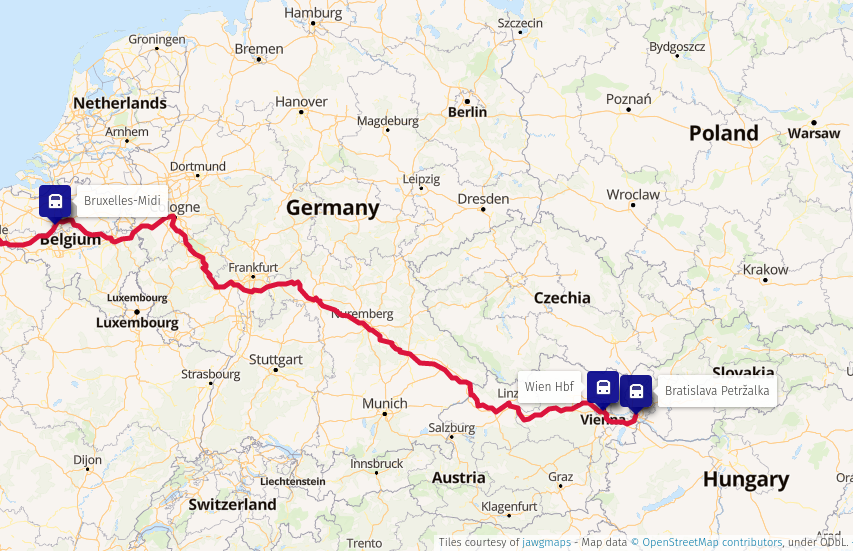
This post was written in August 2021. Just as I was going to publish it, I received an email from BB stating that due to a railway strike in Germany my night train would be cancelled. Since the rest of the trip has already been booked well in advance, I had to take a plane to Charleroi and a bus to Brussels to catch my Eurostar. Ultimately, I ended up publishing it in April 2022, just as I m about to leave for a fully train-powered trip to the UK once again. Before the pandemic started, I planned to use the last months of my then-expiring UK visa and go to England by train. I ve completed two train long journeys by that time already, to Brussels and to Belarus and Ukraine, but this would be something quite different, as I wanted to have multiple stops on my way, use night trains where it made sense, and to go through the Channel Tunnel. The Channel Tunnel fascinated me since my childhood; I first read about it in the Soviet Science and Life magazine ( ) when I was seven. I ve never had the chance to use it though, since to board any train going though it I d first need to get to France, Belgium or the Netherlands, making it significantly more expensive than the cheap 30 Ryanair flights to Stansted. As the coronavirus spread across the world, all of my travel plans along with plans for a sabbatical had to be cancelled. During 2020, I only managed to go on two weekend trips to Prague and Budapest, followed by a two-weeks holiday on Crete (we returned just a couple of weeks before the infection numbers rose and lockdowns started). I do realise that a lot of people couldn t even have this much because the situation in their countries was much worse we were lucky to have had at least some travel. Fast forward to August 2021, I m fully vaccinated, I once again have a UK visa for five years, and the UK finally recognises the EU vaccination passports yay! I can finally go to Devon to see my mother and sister again. By train, of course. Compared to my original plan, this journey will be different: about the same or even more expensive than I originally planned, but shorter and with fewer stops on the way. My original plan would be to take multiple trains from Bratislava to France or Belgium and complete this segment of the trip in about three days, enjoying my stay in a couple of cities on the way. Instead, I m taking a direct NightJet from Vienna to Brussels, not stopping anywhere on the way.
Map: train route from Bratislava to BrusselsTrain route from Bratislava to Brussels
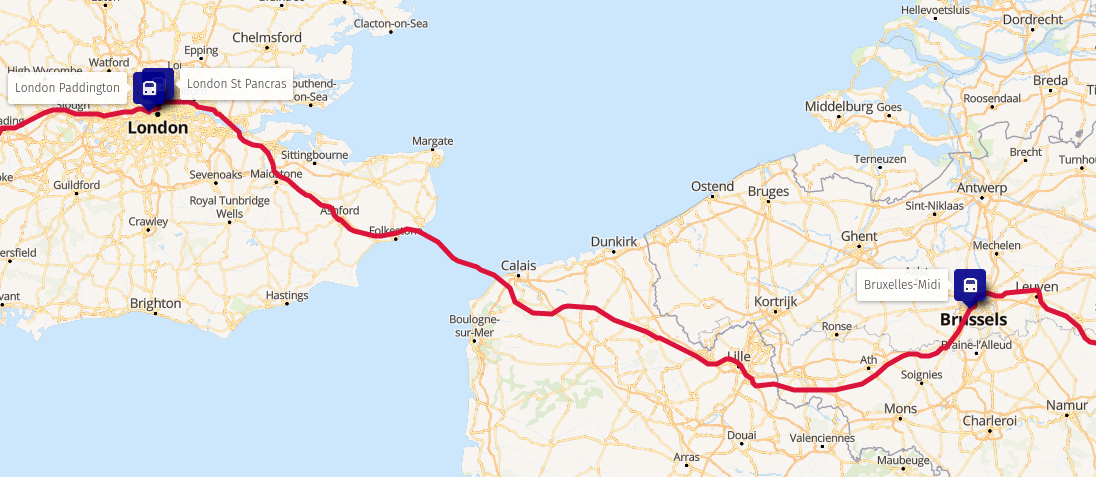
Since I was booking my trip just two weeks ahead, the price of the ticket is not that I hoped for, but much higher: 109 for the ticket itself and 60 for the berth (advance bookings could be about twice as cheap). Next, to London! Eurostar is still on a very much reduced schedule, running one train only from Amsterdam through Brussels and Lille to London each day. This means, of course, higher ticket prices (I paid about 100 for the ticket) and longer waiting time in Brussels my sleeper arrives about 10 am, but the Eurostar train is scheduled to depart at 3 pm.
Map: train route from Brussels to LondonTrain route from Brussels to London
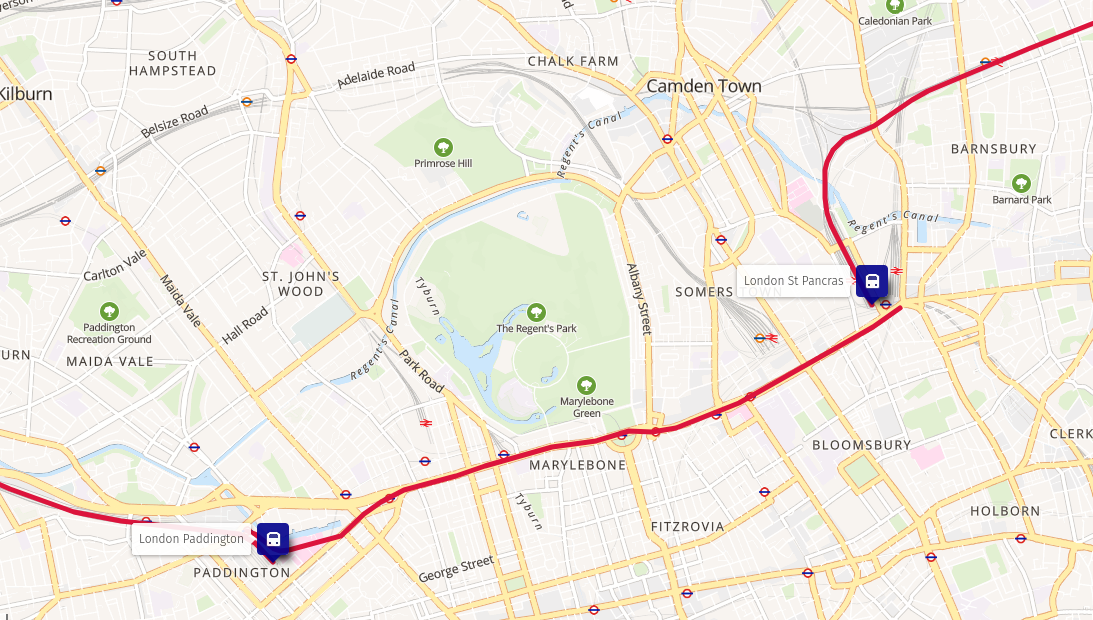
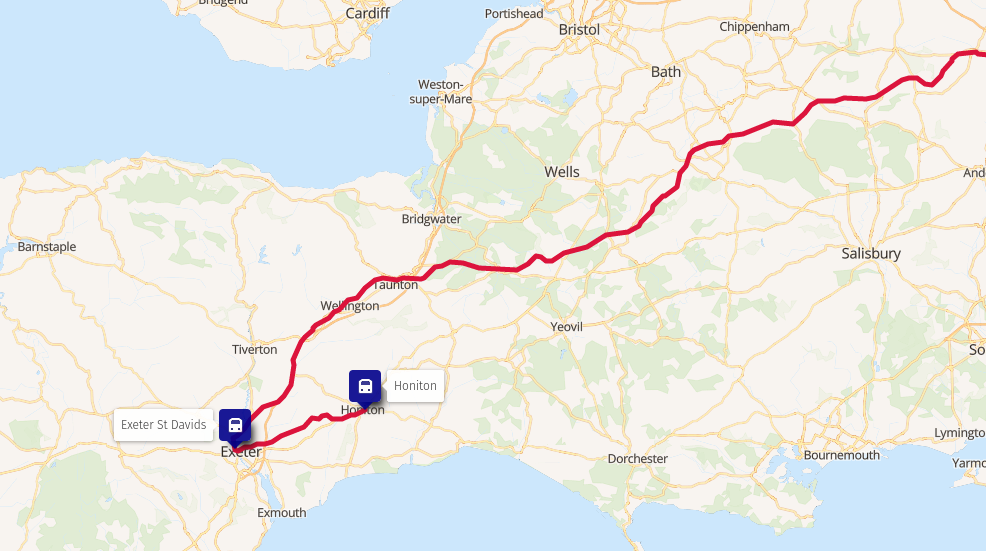
The train makes a stop in Lille, which I initially suspected to be risky as at the time when I booked my tickets, as at the time France was on the amber plus list for the UK, requiring a quarantine upon arrival. However, Eurostar announced that they will assign travellers from Lille to a different carriage to avoid other passengers having to go to quarantine, but recently France was taken off the amber plus list. The train fare system in the UK is something I don t quite understand, as sometimes split tickets are cheaper, sometimes they re expensive, sometimes prices for the same service at different times can be vastly different, off-peak tickets don t say what exactly off-peak means (very few people in the UK are asked were able to tell me when exactly off-peak hours are). Curiously, transfers between train stations using London Underground services can be included into railway tickets, but some last mile connection like Exeter to Honiton cannot (but this used to be possible). Both GWR.com and TrainLine refused to sell me a single ticket from London to Honiton through Exeter, insisting I split the ticket at Exeter St Davids or take the slower South Western train to Honiton via Salisbury and Yeovil. I ended up buying a 57 ticket from Paddington to Exeter St Davids with the first segment being the London Underground from St Pancras, and a separate 7.70 ticket to Honiton.
Map: arrival at St Pancras, the underground, departure from PaddingtonChange of trains in London
Map: arrival at Exeter St Davids, change to a South Western train, arrival at HonitonChange of trains in Exeter
Date Station Arrival Departure Train
12.8 Bratislava-Petr alka 18:15 REX 7756
Wien Hbf 19:15 19:53 NJ 50490
13.8 Bruxelles-Midi 9:55 15:06 EST 9145
London St Pancras 16:03 16:34 TfL
London Paddington 16:49 17:04 GWR 59231
Exeter St Davids 19:19 19:25 SWR 52706
Honiton 19:54
Unfortunately, due to the price of the tickets, I m taking a 15 Ryanair flight back Update after the journey Since I flew to Charleroi instead of comfortably sleeping in a night train, I had to put up with inconveniences of airports, including cumbersome connections to the nearby cities. The only reasonable way of getting from Charleroi to Brussels is an overcrowded bus which takes almost an hour to arrive. I used to take this bus when I tried to save money on my way to FOSDEM, and I must admit it s not something I missed. Boarding the Eurostar train went fine, my vaccination passport and Covid test wasn t really checked, just glanced at. The waiting room was a bit of a disappointment, with bars closed and vending machines broken. Since it was underground, I couldn t even see the trains until the very last moment when we were finally allowed on the platform. The train itself, while comfortable, disappointed me with the bistro carriage: standing only, instant coffee, poor selection of food and drinks. I m glad I bought some food at Carrefour at the Midi station! When I arrived in Exeter, I soon found out why the system refused to sell me a through ticket: 6 minutes is not enough to change trains at Exeter St Davids! Or, it might have been if I took the right footbridge but I took the one which led into a very talkative (and slow!) lift. I ended up running to the train just as it closed the doors and departed, leaving me tin Exeter for an hour until. I used this chance and walked to Exeter Central, and had a pint in a conveniently located pub around the corner. P.S. The maps in this and other posts were created using uMap; the map data come from OpenStreetMap. The train route visualisation was generated with help of the Raildar.fr OSRM instance.

19 April 2022

Bits from Debian: ITP Prizren Platinum Sponsor of DebConf22

itplogo We are very pleased to announce that ITP - Innovation and Training Park Prizren has committed to supporting DebConf22 as a Platinum sponsor. Also, ITP Prizren will host the Conference for all 15 days! The ITP Prizren intends to be a changing and boosting element in the area of ICT, agro-food and creatives industries, through the creation and management of a favourable environment and efficient services for SMEs, exploiting different kinds of innovations that can contribute to Kosovo to improve its level of development in industry and research, bringing benefits to the economy and society of the country as a whole. ITP Prizren is a focal point in the Balkan region for innovation, business and skills development, and a source of innovative and successful ideas. With this commitment as Platinum Sponsor, ITP Prizren is contributing to make possible our annual conference, and directly supporting the progress of Debian and Free Software, helping to strengthen the community that continues to collaborate on Debian projects throughout the rest of the year. Thank you very much ITP Prizren, for your support of DebConf22! Become a sponsor too! DebConf22 will take place from July 17th to 24th, 2022 at the Innovation and Training Park (ITP) in Prizren, Kosovo, and will be preceded by DebCamp, from July 10th to 16th. And DebConf22 is still accepting sponsors! Interested companies and organizations may contact the DebConf team through sponsors@debconf.org, and visit the DebConf22 website at https://debconf22.debconf.org/sponsors/become-a-sponsor. DebConf22 banner open registration

14 April 2022

Reproducible Builds: Supporter spotlight: Amateur Radio Digital Communications (ARDC)

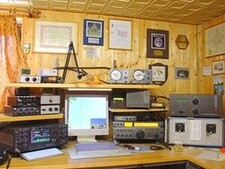
The Reproducible Builds project relies on several projects, supporters and sponsors for financial support, but they are also valued as ambassadors who spread the word about the project and the work that we do. This is the third instalment in a series featuring the projects, companies and individuals who support the Reproducible Builds project. If you are a supporter of the Reproducible Builds project (of whatever size) and would like to be featured here, please let get in touch with us at contact@reproducible-builds.org. We started this series by featuring the Civil Infrastructure Platform project and followed this up with a post about the Ford Foundation. Today, however, we ll be talking with Dan Romanchik, Communications Manager at Amateur Radio Digital Communications (ARDC).
Chris Lamb: Hey Dan, it s nice to meet you! So, for someone who has not heard of Amateur Radio Digital Communications (ARDC) before, could you tell us what your foundation is about? Dan: Sure! ARDC s mission is to support, promote, and enhance experimentation, education, development, open access, and innovation in amateur radio, digital communication, and information and communication science and technology. We fulfill that mission in two ways:
  1. We administer an allocation of IP addresses that we call 44Net. These IP addresses (in the 44.0.0.0/8 IP range) can only be used for amateur radio applications and experimentation.
  2. We make grants to organizations whose work aligns with our mission. This includes amateur radio clubs as well as other amateur radio-related organizations and activities. Additionally, we support scholarship programs for people who either have an amateur radio license or are pursuing careers in technology, STEM education and open-source software development projects that fit our mission, such as Reproducible Builds.
Chris: How might you relate the importance of amateur radio and similar technologies to someone who is non-technical? Dan: Amateur radio is important in a number of ways. First of all, amateur radio is a public service. In fact, the legal name for amateur radio is the Amateur Radio Service, and one of the primary reasons that amateur radio exists is to provide emergency and public service communications. All over the world, amateur radio operators are prepared to step up and provide emergency communications when disaster strikes or to provide communications for events such as marathons or bicycle tours. Second, amateur radio is important because it helps advance the state of the art. By experimenting with different circuits and communications techniques, amateurs have made significant contributions to communications science and technology. Third, amateur radio plays a big part in technical education. It enables students to experiment with wireless technologies and electronics in ways that aren t possible without a license. Amateur radio has historically been a gateway for young people interested in pursuing a career in engineering or science, such as network or electrical engineering. Fourth and this point is a little less obvious than the first three amateur radio is a way to enhance international goodwill and community. Radio knows no boundaries, of course, and amateurs are therefore ambassadors for their country, reaching out to all around the world. Beyond amateur radio, ARDC also supports and promotes research and innovation in the broader field of digital communication and information and communication science and technology. Information and communication technology plays a big part in our lives, be it for business, education, or personal communications. For example, think of the impact that cell phones have had on our culture. The challenge is that much of this work is proprietary and owned by large corporations. By focusing on open source work in this area, we help open the door to innovation outside of the corporate landscape, which is important to overall technological resiliency.
Chris: Could you briefly outline the history of ARDC? Dan: Nearly forty years ago, a group of visionary hams saw the future possibilities of what was to become the internet and requested an address allocation from the Internet Assigned Numbers Authority (IANA). That allocation included more than sixteen million IPv4 addresses, 44.0.0.0 through 44.255.255.255. These addresses have been used exclusively for amateur radio applications and experimentation with digital communications techniques ever since. In 2011, the informal group of hams administering these addresses incorporated as a nonprofit corporation, Amateur Radio Digital Communications (ARDC). ARDC is recognized by IANA, ARIN and the other Internet Registries as the sole owner of these addresses, which are also known as AMPRNet or 44Net. Over the years, ARDC has assigned addresses to thousands of hams on a long-term loan (essentially acting as a zero-cost lease), allowing them to experiment with digital communications technology. Using these IP addresses, hams have carried out some very interesting and worthwhile research projects and developed practical applications, including TCP/IP connectivity via radio links, digital voice, telemetry and repeater linking. Even so, the amateur radio community never used much more than half the available addresses, and today, less than one third of the address space is assigned and in use. This is one of the reasons that ARDC, in 2019, decided to sell one quarter of the address space (or approximately 4 million IP addresses) and establish an endowment with the proceeds. This endowment now funds ARDC s a suite of grants, including scholarships, research projects, and of course amateur radio projects. Initially, ARDC was restricted to awarding grants to organizations in the United States, but is now able to provide funds to organizations around the world.

Chris: How does the Reproducible Builds effort help ARDC achieve its goals? Dan: Our aspirational goals include: We think that the Reproducible Builds efforts in helping to ensure the safety and security of open source software closely align with those goals.
Chris: Are there any specific success stories that ARDC is particularly proud of? Dan: We are really proud of our grant to the Hoopa Valley Tribe in California. With a population of nearly 2,100, their reservation is the largest in California. Like everywhere else, the COVID-19 pandemic hit the reservation hard, and the lack of broadband internet access meant that 130 children on the reservation were unable to attend school remotely. The ARDC grant allowed the tribe to address the immediate broadband needs in the Hoopa Valley, as well as encourage the use of amateur radio and other two-way communications on the reservation. The first nation was able to deploy a network that provides broadband access to approximately 90% of the residents in the valley. And, in addition to bringing remote education to those 130 children, the Hoopa now use the network for remote medical monitoring and consultation, adult education, and other applications. Other successes include our grants to:

Chris: ARDC supports a number of other existing projects and initiatives, not all of them in the open source world. How much do you feel being a part of the broader free culture movement helps you achieve your aims? Dan: In general, we find it challenging that most digital communications technology is proprietary and closed-source. It s part of our mission to fund open source alternatives. Without them, we are solely reliant, as a society, on corporate interests for our digital communication needs. It makes us vulnerable and it puts us at risk of increased surveillance. Thus, ARDC supports open source software wherever possible, and our grantees must make a commitment to share their work under an open source license or otherwise make it as freely available as possible.
Chris: Thanks so much for taking the time to talk to us today. Now, if someone wanted to know more about ARDC or to get involved, where might they go to look? To learn more about ARDC in general, please visit our website at https://www.ampr.org. To learn more about 44Net, go to https://wiki.ampr.org/wiki/Main_Page. And, finally, to learn more about our grants program, go to https://www.ampr.org/apply/

For more about the Reproducible Builds project, please see our website at reproducible-builds.org. If you are interested in ensuring the ongoing security of the software that underpins our civilisation and wish to sponsor the Reproducible Builds project, please reach out to the project by emailing contact@reproducible-builds.org.

13 April 2022

Antoine Beaupr : Tuning my wifi radios

After listening to an episode of the 2.5 admins podcast, I realized there was some sort of low-hanging fruit I could pick to better tune my WiFi at home. You see, I'm kind of a fraud in WiFi: I only started a WiFi mesh in Montreal (now defunct), I don't really know how any of that stuff works. So I was surprised to hear one of the podcast host say "it's all about airtime" and "you want to reduce the power on your access points" (APs). It seemed like sound advice: better bandwidth means less time on air, means less collisions, less latency, and less power also means less collisions. Worth a try, right?

Frequency So the first thing I looked at was WifiAnalyzer to see if I had any optimisation I could do there. Normally, I try to avoid having nearby APs on the same frequency to avoid collisions, but who knows, maybe I had messed that up. And turns out I did! Both APs were on "auto" for 5GHz, which typically means "do nothing or worse". 5GHz is really interesting, because, in theory, there are LOTS of channels to pick from, it goes up to 196!! And both my APs were on 36, what gives? So the first thing I did was to set it to channel 100, as there was that long gap in WifiAnalyzer where no other AP was. But that just broke 5GHz on the AP. The OpenWRT GUI (luci) would just say "wireless not associated" and the ESSID wouldn't show up in a scan anymore. At first, I thought this was a problem with OpenWRT or my hardware, but I could reproduce the problem with both my APs: a TP-Link Archer A7 v5 and a Turris Omnia (see also my review). As it turns out, that's because that range of the WiFi band interferes with trivial things like satellites and radar, which make the actually very useful radar maps look like useless christmas trees. So those channels require DFS to operate. DFS works by first listening on the frequency for a certain amount of time (1-2 minute, but could be as high as 10) to see if there's something else transmitting at all. So typically, that means they just don't operate at all in those bands, especially if you're near any major city which generally means you are near a weather radar that will transmit on that band. In the system logs, if you have such a problem, you might see this:
Apr  9 22:17:39 octavia hostapd: wlan0: DFS-CAC-START freq=5500 chan=100 sec_chan=1, width=0, seg0=102, seg1=0, cac_time=60s
Apr  9 22:17:39 octavia hostapd: DFS start_dfs_cac() failed, -1
... and/or this:
Sat Apr  9 18:05:03 2022 daemon.notice hostapd: Channel 100 (primary) not allowed for AP mode, flags: 0x10095b NO-IR RADAR
Sat Apr  9 18:05:03 2022 daemon.warn hostapd: wlan0: IEEE 802.11 Configured channel (100) not found from the channel list of current mode (2) IEEE 802.11a
Sat Apr  9 18:05:03 2022 daemon.warn hostapd: wlan0: IEEE 802.11 Hardware does not support configured channel
Here, it clearly says RADAR (in all caps too, which means it's really important). NO-IR is also important, I'm not sure what it means but it could be that you're not allowed to transmit in that band because of other local regulations. There might be a way to workaround those by changing the "region" in the Luci GUI, but I didn't mess with that, because I figured that other devices will have that already configured. So using a forbidden channel might make it more difficult for clients to connect (although it's possible this is enforced only on the AP side). In any case, 5GHz is promising, but in reality, you only get from channel 36 (5.170GHz) to 48 (5.250GHz), inclusively. Fast counters will notice that is exactly 80MHz, which means that if an AP is configured for that hungry, all-powerful 80MHz, it will effectively take up all 5GHz channels at once. This, in other words, is as bad as 2.4GHz, where you also have only two 40MHz channels. (Really, what did you expect: this is an unregulated frequency controlled by commercial interests...) So the first thing I did was to switch to 40MHz. This gives me two distinct channels in 5GHz at no noticeable bandwidth cost. (In fact, I couldn't find hard data on what the bandwidth ends up being on those frequencies, but I could still get 400Mbps which is fine for my use case.)

Power The next thing I did was to fiddle with power. By default, both radios were configured to transmit as much power as they needed to reach clients, which means that if a client gets farther away, it would boost its transmit power which, in turns, would mean the client would still connect to instead of failing and properly roaming to the other AP. The higher power also means more interference with neighbors and other APs, although that matters less if they are on different channels. On 5GHz, power was about 20dBm (100 mW) -- and more on the Turris! -- when I first looked, so I tried to lower it drastically to 5dBm (3mW) just for kicks. That didn't work so well, so I bumped it back up to 14 dBm (25 mW) and that seems to work well: clients hit about -80dBm when they get far enough from the AP, which gets close to the noise floor (and where the neighbor APs are), which is exactly what I want. On 2.4GHz, I lowered it down even further, to 10 dBm (10mW) since it's better at going through wells, I figured it would need less power. And anyways, I rather people use the 5GHz APs, so maybe that will act as an encouragement to switch. I was still able to connect correctly to the APs at that power as well.

Other tweaks I disabled the "Allow legacy 802.11b rates" setting in the 5GHz configuration. According to this discussion:
Checking the "Allow b rates" affects what the AP will transmit. In particular it will send most overhead packets including beacons, probe responses, and authentication / authorization as the slow, noisy, 1 Mb DSSS signal. That is bad for you and your neighbors. Do not check that box. The default really should be unchecked.
This, in particular, "will make the AP unusable to distant clients, which again is a good thing for public wifi in general". So I just unchecked that box and I feel happier now. I didn't make tests to see the effect separately however, so this is mostly just a guess.

10 April 2022

Dirk Eddelbuettel: RcppRedis 0.2.1: Maintenance

A month after the major release 0.2.0 bringing pub/sub and other goodies to our RcppRedis package, a new version 0.2.1 arrived on CRAN yesterday. RcppRedis is one of several packages connecting R to the fabulous Redis in-memory datastructure store (and much more). RcppRedis does not pretend to be feature complete, but it may do some things faster than the other interfaces, and also offers an optional coupling with MessagePack binary (de)serialization via RcppMsgPack. The package has carried production loads for several years now. This release updated the rredis suggestion by adding an Additional_repositories entry as Bryan decided to retire the rredis package. You can still install it via install.packages("rredis") by setting the addtional repo, for example repos=c("https://ghrr.github.io/drat", getOption("repos")) as documented in package and at our ghrr drat repo. The detailed changes list follows.

Changes in version 0.2.1 (2022-04-09)
  • The rredis package can be installed via the repo listed in Additional_repositories; the pubsub.R test file makes rredis optional and conditional; all demos now note that the optional rredis package is installable via the drat listed in Additional_repositories.
  • The fallback-compilation of hiredis has been forced to override compilation flags because CRAN knows better than upstream.
  • The GLOBEX pub/sub example has small updates.

Courtesy of CRANberries, there is also a diffstat report for this release. More information is on the RcppRedis page. If you like this or other open-source work I do, you can now sponsor me at GitHub.

This post by Dirk Eddelbuettel originated on his Thinking inside the box blog. Please report excessive re-aggregation in third-party for-profit settings.

8 April 2022

Reproducible Builds: Reproducible Builds in March 2022

Welcome to the March 2022 report from the Reproducible Builds project! In our monthly reports we outline the most important things that we have been up to over the past month.
The in-toto project was accepted as an incubating project within the Cloud Native Computing Foundation (CNCF). in-toto is a framework that protects the software supply chain by collecting and verifying relevant data. It does so by enabling libraries to collect information about software supply chain actions and then allowing software users and/or project managers to publish policies about software supply chain practices that can be verified before deploying or installing software. CNCF foundations hosts a number of critical components of the global technology infrastructure under the auspices of the Linux Foundation. (View full announcement.)
Herv Boutemy posted to our mailing list with an announcement that the Java Reproducible Central has hit the milestone of 500 fully reproduced builds of upstream projects . Indeed, at the time of writing, according to the nightly rebuild results, 530 releases were found to be fully reproducible, with 100% reproducible artifacts.
GitBOM is relatively new project to enable build tools trace every source file that is incorporated into build artifacts. As an experiment and/or proof-of-concept, the GitBOM developers are rebuilding Debian to generate side-channel build metadata for versions of Debian that have already been released. This only works because Debian is (partial) reproducible, so one can be sure that that, if the case where build artifacts are identical, any metadata generated during these instrumented builds applies to the binaries that were built and released in the past. More information on their approach is available in README file in the bomsh repository.
Ludovic Courtes has published an academic paper discussing how the performance requirements of high-performance computing are not (as usually assumed) at odds with reproducible builds. The received wisdom is that vendor-specific libraries and platform-specific CPU extensions have resulted in a culture of local recompilation to ensure the best performance, rendering the property of reproducibility unobtainable or even meaningless. In his paper, Ludovic explains how Guix has:
[ ] implemented what we call package multi-versioning for C/C++ software that lacks function multi-versioning and run-time dispatch [ ]. It is another way to ensure that users do not have to trade reproducibility for performance. (full PDF)

Kit Martin posted to the FOSSA blog a post titled The Three Pillars of Reproducible Builds. Inspired by the shock of infiltrated or intentionally broken NPM packages, supply chain attacks, long-unnoticed backdoors , the post goes on to outline the high-level steps that lead to a reproducible build:
It is one thing to talk about reproducible builds and how they strengthen software supply chain security, but it s quite another to effectively configure a reproducible build. Concrete steps for specific languages are a far larger topic than can be covered in a single blog post, but today we ll be talking about some guiding principles when designing reproducible builds. [ ]
The article was discussed on Hacker News.
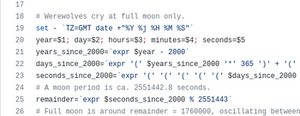
Finally, Bernhard M. Wiedemann noticed that the GNU Helloworld project varies depending on whether it is being built during a full moon! (Reddit announcement, openSUSE bug report)

Events There will be an in-person Debian Reunion in Hamburg, Germany later this year, taking place from 23 30 May. Although this is a Debian event, there will be some folks from the broader Reproducible Builds community and, of course, everyone is welcome. Please see the event page on the Debian wiki for more information. Bernhard M. Wiedemann posted to our mailing list about a meetup for Reproducible Builds folks at the openSUSE conference in Nuremberg, Germany. It was also recently announced that DebConf22 will take place this year as an in-person conference in Prizren, Kosovo. The pre-conference meeting (or Debcamp ) will take place from 10 16 July, and the main talks, workshops, etc. will take place from 17 24 July.

Misc news Holger Levsen updated the Reproducible Builds website to improve the documentation for the SOURCE_DATE_EPOCH environment variable, both by expanding parts of the existing text [ ][ ] as well as clarifying meaning by removing text in other places [ ]. In addition, Chris Lamb added a Twitter Card to our website s metadata too [ ][ ][ ]. On our mailing list this month:

Distribution work In Debian this month:
  • Johannes Schauer Marin Rodrigues posted to the debian-devel list mentioning that he exploited the property of reproducibility within Debian to demonstrate that automatically converting a large number of packages to a new internal source version did not change the resulting packages. The proposed change could therefore be applied without causing breakage:
So now we have 364 source packages for which we have a patch and for which we can show that this patch does not change the build output. Do you agree that with those two properties, the advantages of the 3.0 (quilt) format are sufficient such that the change shall be implemented at least for those 364? [ ]
In openSUSE, Bernhard M. Wiedemann posted his usual monthly reproducible builds status report.

Tooling diffoscope is our in-depth and content-aware diff utility. Not only can it locate and diagnose reproducibility issues, it can provide human-readable diffs from many kinds of binary formats. This month, Chris Lamb prepared and uploaded versions 207, 208 and 209 to Debian unstable, as well as made the following changes to the code itself:
  • Update minimum version of Black to prevent test failure on Ubuntu jammy. [ ]
  • Updated the R test fixture for the 4.2.x series of the R programming language. [ ]
Brent Spillner also worked on adding graceful handling for UNIX sockets and named pipes to diffoscope. [ ][ ][ ]. Vagrant Cascadian also updated the diffoscope package in GNU Guix. [ ][ ] reprotest is the Reproducible Build s project end-user tool to build the same source code twice in widely different environments and checking whether the binaries produced by the builds have any differences. This month, Santiago Ruano Rinc n added a new --append-build-command option [ ], which was subsequently uploaded to Debian unstable by Holger Levsen.

Upstream patches The Reproducible Builds project detects, dissects and attempts to fix as many currently-unreproducible packages as possible. We endeavour to send all of our patches upstream where appropriate. This month, we wrote a large number of such patches, including:

Testing framework The Reproducible Builds project runs a significant testing framework at tests.reproducible-builds.org, to check packages and other artifacts for reproducibility. This month, the following changes were made:
  • Holger Levsen:
    • Replace a local copy of the dsa-check-running-kernel script with a packaged version. [ ]
    • Don t hide the status of offline hosts in the Jenkins shell monitor. [ ]
    • Detect undefined service problems in the node health check. [ ]
    • Update the sources.lst file for our mail server as its still running Debian buster. [ ]
    • Add our mail server to our node inventory so it is included in the Jenkins maintenance processes. [ ]
    • Remove the debsecan package everywhere; it got installed accidentally via the Recommends relation. [ ]
    • Document the usage of the osuosl174 host. [ ]
Regular node maintenance was also performed by Holger Levsen [ ], Vagrant Cascadian [ ][ ][ ] and Mattia Rizzolo.
If you are interested in contributing to the Reproducible Builds project, please visit our Contribute page on our website. However, you can get in touch with us via:

5 April 2022

Matthew Garrett: Bearer tokens are just awful

As I mentioned last time, bearer tokens are not super compatible with a model in which every access is verified to ensure it's coming from a trusted device. Let's talk about that in a bit more detail.

First off, what is a bearer token? In its simplest form, it's simply an opaque blob that you give to a user after an authentication or authorisation challenge, and then they show it to you to prove that they should be allowed access to a resource. In theory you could just hand someone a randomly generated blob, but then you'd need to keep track of which blobs you've issued and when they should be expired and who they correspond to, so frequently this is actually done using JWTs which contain some base64 encoded JSON that describes the user and group membership and so on and then have a signature associated with them so whenever the user presents one you can just validate the signature and then assume that the contents of the JSON are trustworthy.

One thing to note here is that the crypto is purely between whoever issued the token and whoever validates the token - as far as the server is concerned, any client who can just show it the token is just fine as long as the signature is verified. There's no way to verify the client's state, so one of the core ideas of Zero Trust (that we verify that the client is in a trustworthy state on every access) is already violated.

Can we make things not terrible? Sure! We may not be able to validate the client state on every access, but we can validate the client state when we issue the token in the first place. When the user hits a login page, we do state validation according to whatever policy we want to enforce, and if the client violates that policy we refuse to issue a token to it. If the token has a sufficiently short lifetime then an attacker is only going to have a short period of time to use that token before it expires and then (with luck) they won't be able to get a new one because the state validation will fail.

Except! This is fine for cases where we control the issuance flow. What if we have a scenario where a third party authenticates the client (by verifying that they have a valid token issued by their ID provider) and then uses that to issue their own token that's much longer lived? Well, now the client has a long-lived token sitting on it. And if anyone copies that token to another device, they can now pretend to be that client.

This is, sadly, depressingly common. A lot of services will verify the user, and then issue an oauth token that'll expire some time around the heat death of the universe. If a client system is compromised and an attacker just copies that token to another system, they can continue to pretend to be the legitimate user until someone notices (which, depending on whether or not the service in question has any sort of audit logs, and whether you're paying any attention to them, may be once screenshots of your data show up on Twitter).

This is a problem! There's no way to fit a hosted service that behaves this way into a Zero Trust model - the best you can say is that a token was issued to a device that was, around that time, apparently trustworthy, and now it's some time later and you have literally no idea whether the device is still trustworthy or if the token is still even on that device.

But wait, there's more! Even if you're nowhere near doing any sort of Zero Trust stuff, imagine the case of a user having a bunch of tokens from multiple services on their laptop, and then they leave their laptop unlocked in a cafe while they head to the toilet and whoops it's not there any more, better assume that someone has access to all the data on there. How many services has our opportunistic new laptop owner gained access to as a result? How do we revoke all of the tokens that are sitting there on the local disk? Do you even have a policy for dealing with that?

There isn't a simple answer to all of these problems. Replacing bearer tokens with some sort of asymmetric cryptographic challenge to the client would at least let us tie the tokens to a TPM or other secure enclave, and then we wouldn't have to worry about them being copied elsewhere. But that wouldn't help us if the client is compromised and the attacker simply keeps using the compromised client. The entire model of simply proving knowledge of a secret being sufficient to gain access to a resource is inherently incompatible with a desire for fine-grained trust verification on every access, but I don't see anything changing until we have a standard for third party services to be able to perform that trust verification against a customer's policy.

Still, at least this means I can just run weird Android IoT apps through mitmproxy, pull the bearer token out of the request headers and then start poking the remote API with curl. It may all be broken, but it's also got me a bunch of bug bounty credit, so, it;s impossible to say if its bad or not,

(Addendum: this suggestion that we solve the hardware binding problem by simply passing all the network traffic through some sort of local enclave that could see tokens being set and would then sequester them and reinject them into later requests is OBVIOUSLY HORRIFYING and is also probably going to be at least three startup pitches by the end of next week)

comment count unavailable comments

31 March 2022

Matthew Garrett: ZTA doesn't solve all problems, but partial implementations solve fewer

Traditional network access controls work by assuming that something is trustworthy based on some other factor - for example, if a computer is on your office network, it's trustworthy because only trustworthy people should be able to gain physical access to plug something in. If you restrict access to your services to requests coming from trusted networks, then you can assert that it's coming from a trusted device.

Of course, this isn't necessarily true. A machine on your office network may be compromised. An attacker may obtain valid VPN credentials. Someone could leave a hostile device plugged in under a desk in a meeting room. Trust is being placed in devices that may not be trustworthy.

A Zero Trust Architecture (ZTA) is one where a device is granted no inherent trust. Instead, each access to a service is validated against some policy - if the policy is satisfied, the access is permitted. A typical implementation involves granting each device some sort of cryptographic identity (typically a TLS client certificate) and placing the protected services behind a proxy. The proxy verifies the device identity, queries another service to obtain the current device state (we'll come back to that in a moment), compares the state against a policy and either pass the request through to the service or reject it. Different services can have different policies (eg, you probably want a lax policy around whatever's hosting the documentation for how to fix your system if it's being refused access to something for being in the wrong state), and if you want you can also tie it to proof of user identity in some way.

From a user perspective, this is entirely transparent. The proxy is made available on the public internet, DNS for the services points to the proxy, and every time your users try to access the service they hit the proxy instead and (if everything's ok) gain access to it no matter which network they're on. There's no need to connect to a VPN first, and there's no worries about accidentally leaking information over the public internet instead of over a secure link.

It's also notable that traditional solutions tend to be all-or-nothing. If I have some services that are more sensitive than others, the only way I can really enforce this is by having multiple different VPNs and only granting access to sensitive services from specific VPNs. This obviously risks combinatorial explosion once I have more than a couple of policies, and it's a terrible user experience.

Overall, ZTA approaches provide more security and an improved user experience. So why are we still using VPNs? Primarily because this is all extremely difficult. Let's take a look at an extremely recent scenario. A device used by customer support technicians was compromised. The vendor in question has a solution that can tie authentication decisions to whether or not a device has a cryptographic identity. If this was in use, and if the cryptographic identity was tied to the device hardware (eg, by being generated in a TPM), the attacker would not simply be able to obtain the user credentials and log in from their own device. This is good - if the attacker wanted to maintain access to the service, they needed to stay on the device in question. This increases the probability of the monitoring tooling on the compromised device noticing them.

Unfortunately, the attacker simply disabled the monitoring tooling on the compromised device. If device state was being verified on each access then this would be noticed before too long - the last data received from the device would be flagged as too old, and the requests would no longer satisfy any reasonable access control policy. Instead, the device was assumed to be trustworthy simply because it could demonstrate its identity. There's an important point here: just because a device belongs to you doesn't mean it's a trustworthy device.

So, if ZTA approaches are so powerful and user-friendly, why aren't we all using one? There's a few problems, but the single biggest is that there's no standardised way to verify device state in any meaningful way. Remote Attestation can both prove device identity and the device boot state, but the only product on the market that does much with this is Microsoft's Device Health Attestation. DHA doesn't solve the broader problem of also reporting runtime state - it may be able to verify that endpoint monitoring was launched, but it doesn't make assertions about whether it's still running. Right now, people are left trying to scrape this information from whatever tooling they're running. The absence of any standardised approach to this problem means anyone who wants to deploy a strong ZTA has to integrate with whatever tooling they're already running, and that then increases the cost of migrating to any other tooling later.

But even device identity is hard! Knowing whether a machine should be given a certificate or not depends on knowing whether or not you own it, and inventory control is a surprisingly difficult problem in a lot of environments. It's not even just a matter of whether a machine should be given a certificate in the first place - if a machine is reported as lost or stolen, its trust should be revoked. Your inventory system needs to tie into your device state store in order to ensure that your proxies drop access.

And, worse, all of this depends on you being able to put stuff behind a proxy in the first place! If you're using third-party hosted services, that's a problem. In the absence of a proxy, trust decisions are probably made at login time. It's possible to tie user auth decisions to device identity and state (eg, a self-hosted SAML endpoint could do that before passing through to the actual ID provider), but that's still going to end up providing a bearer token of some sort that can potentially be exfiltrated, and will continue to be trusted even if the device state becomes invalid.

ZTA doesn't solve all problems, and there isn't a clear path to it doing so without significantly greater industry support. But a complete ZTA solution is significantly more powerful than a partial one. Verifying device identity is a step on the path to ZTA, but in the absence of device state verification it's only a step.

comment count unavailable comments

27 March 2022

Andrew Cater: Imminent release for the media images for Debian 10.12 and 11.3 20220327 0010

OK - so it wasn't quite all done in one day - and since today is TZ change day in the UK, it might actually run into the TZ bump but I suspect that it will all be done very soon now. Very few glitches - everybody cheerful with what's been done.I did spot someone in IRC who had been reading the release notes - which is always much appreciated. Lots of security fixes overall in the last couple of months but just a fairly normal time, I think.Thanks to the team behind all of this: the ftpmasters, the press team and everyone else involved in making Debian more secure. This is the last blog for this one - there will be another point release along in about three months or so.

24 March 2022

Ingo Juergensmann: New Server NVMe Issues

My current server is somewhat aged. I bought it new in July 2014 with a 6-core Xeon E5-2630L, 32 GB RAM and 4x 3.5 hot-swappable drives. Gladly I had the opportunity to extend the memory to 128 GB RAM at no additional cost by using memory from my ex-employer. It also has 4x 2 TB WD Red HDDs with 5400 rpm hooked up to the SATA backplane, but unfortunately only two of them are SATA-3 with 6 Gbit/s. The new server is a used/refurbished Supermicro server with 2x 14-core Xeon E5-2683 and 256 GB RAM and 4x 3.5 hot-swappable drives. It also came with a Hardware-RAID SAS/SATA 8-port controller with BBU. I also ordered two slim drive kits (MCP-220-81504-0N & MCP-220-81506-0N) to be able to use 2x 3.5 slots for rotational HDDs as a cheap storage. Right now I added 2x 128 GB Supermicro SATA DOMs, 4x WD Red 4 TB SSDs and a Sonnet Fusion 4 4 Silent and 4x 1 TB Seagate Firecuda 520 NVMe disks. And here the issue starts: The NVMe should be capable of 4-5 GB/s, but they are connected to a PCIe 3.0 x16 port via the Sonnet Fusion 4 4, which itself features a PCIe bridge, so bifurbacation is not necessary. When doing some tests with bonnie++ I get around 1 GB/s transfer rates out of a RAID10 setup with all 4 NVMes. In fact, regardless of the RAID level there are only transfer rates of about 1 1.2 GB/s with bonnie++. (All software RAIDs with mdadm.) But also when constructing a RAID each NVMe gives around 300-600 MB/s in sync speed except for one exception: RAID1. Regardless of how many NVMe disks in a RAID1 setup the sync speed is up to 2.5 GB/s for each of the NVMe disks. So the lower transfer rates with bonnie++ or other RAID levels shouldn t be limited by bus speed nor by CPU speed. Alas, atop shows upto 100% CPU usage for all tests. I even tested In my understanding RAID10 should perform similar to RAID1 in terms of syncing and better and while bonnie++ tests (up to 2x write and 4x read speed compared to a single disk). For the bonnie++ tests I even made some tests that are available here. You can find the test parameters listed in the hostname column: Baldur is the hostname, then followed by the layout (near-2, far-2, offset-2), chunk size and concurrency of bonnie++. In the end there was no big impact of the chunk size of the RAID. So, now I m wondering what the reason for the slow performance of those 4x NVMe disks is? Bus speed of the PCIe 3.0 x16 shouldn t be the cause, because I assume that the software RAID will need to transfer the blocks in RAID1 as well as in RAID10 over the bus. Same goes for the CPU: the amount of CPU work should be roughly the same for RAID1 and for RAID10. RAID10 should even have an advantage because the blocks only need to be synced to 2 disks in a stripe set. Bonnie++ tests are a different topic for sure. But when testing reading with dd from the md-devices I only get around 1-1.5 GB/s as well. Even when using LVM RAID instead of LVM on top of md RAID. All NVMe disks are already set to 4k and IO scheduler is set to mq-deadline. Is there anything I could do to improve the performance of the NVMe disks? On the other head, pure transfer rates are not that important to a server that runs a dozen of VMs. Here the improved IOPS performance over rotation disks is a clear performance gain. But I m still curious if I could get maybe 2 GB/s out of a RAID10 setup with the NVMe disks. Then again having two independent RAID1 setups for MariaDB and for PostgreSQL databases might be a better choice over a single RAID10 setup?

23 March 2022

Matthew Garrett: AMD's Pluton implementation seems to be controllable

I've been digging through the firmware for an AMD laptop with a Ryzen 6000 that incorporates Pluton for the past couple of weeks, and I've got some rough conclusions. Note that these are extremely preliminary and may not be accurate, but I'm going to try to encourage others to look into this in more detail. For those of you at home, I'm using an image from here, specifically version 309. The installer is happy to run under Wine, and if you tell it to "Extract" rather than "Install" it'll leave a file sitting in C:\\DRIVERS\ASUS_GA402RK_309_BIOS_Update_20220322235241 which seems to have an additional 2K of header on it. Strip that and you should have something approximating a flash image.

Looking for UTF16 strings in this reveals something interesting:

Pluton (HSP) X86 Firmware Support
Enable/Disable X86 firmware HSP related code path, including AGESA HSP module, SBIOS HSP related drivers.
Auto - Depends on PcdAmdHspCoreEnable build value
NOTE: PSP directory entry 0xB BIT36 have the highest priority.
NOTE: This option will NOT put HSP hardware in disable state, to disable HSP hardware, you need setup PSP directory entry 0xB, BIT36 to 1.
// EntryValue[36] = 0: Enable, HSP core is enabled.
// EntryValue[36] = 1: Disable, HSP core is disabled then PSP will gate the HSP clock, no further PSP to HSP commands. System will boot without HSP.

"HSP" here means "Hardware Security Processor" - a generic term that refers to Pluton in this case. This is a configuration setting that determines whether Pluton is "enabled" or not - my interpretation of this is that it doesn't directly influence Pluton, but disables all mechanisms that would allow the OS to communicate with it. In this scenario, Pluton has its firmware loaded and could conceivably be functional if the OS knew how to speak to it directly, but the firmware will never speak to it itself. I took a quick look at the Windows drivers for Pluton and it looks like they won't do anything unless the firmware wants to expose Pluton, so this should mean that Windows will do nothing.

So what about the reference to "PSP directory entry 0xB BIT36 have the highest priority"? The PSP is the AMD Platform Security Processor - it's an ARM core on the CPU package that boots before the x86. The PSP firmware lives in the same flash image as the x86 firmware, so the PSP looks for a header that points it towards the firmware it should execute. This gives a pointer to a "directory" - a list of different object types and where they're located in flash (there's a description of this for slightly older AMDs here). Type 0xb is treated slightly specially. Where most types contain the address of where the actual object is, type 0xb contains a 64-bit value that's interpreted as enabling or disabling various features - something AMD calls "soft fusing" (Intel have something similar that involves setting bits in the Firmware Interface Table). The PSP looks at the bits that are set here and alters its behaviour. If bit 36 is set, the PSP tells Pluton to turn itself off and will no longer send any commands to it.

So, we have two mechanisms to disable Pluton - the PSP can tell it to turn itself off, or the x86 firmware can simply never speak to it or admit that it exists. Both of these imply that Pluton has started executing before it's shut down, so it's reasonable to wonder whether it can still do stuff. In the image I'm looking at, there's a blob starting at 0x0069b610 that appears to be firmware for Pluton - it contains chunks that appear to be the reference TPM2 implementation, and it broadly decompiles as valid ARM code. It should be viable to figure out whether it can do anything in the face of being "disabled" via either of the above mechanisms.

Unfortunately for me, the system I'm looking at does set bit 36 in the 0xb entry - as a result, Pluton is disabled before x86 code starts running and I can't investigate further in any straightforward way. The implication that the user-controllable mechanism for disabling Pluton merely disables x86 communication with it rather than turning it off entirely is a little concerning, although (assuming Pluton is behaving as a TPM rather than having an enhanced set of capabilities) skipping any firmware communication means the OS has no way to know what happened before it started running even if it has a mechanism to communicate with Pluton without firmware assistance. In that scenario it'd be viable to write a bootloader shim that just faked up the firmware measurements before handing control to the OS.

The bit 36 disabling mechanism seems more solid? Again, it should be possible to analyse the Pluton firmware to determine whether it actually pays attention to a disable command being sent. But even if it chooses to ignore that, if the PSP is in a position to just cut the clock to Pluton, it's not going to be able to do a lot. At that point we're trusting AMD rather than trusting Microsoft, but given that you're also trusting AMD to execute the code you're giving them to execute, it's hard to avoid placing trust in them.

Overall: I'm reasonably confident that systems that ship with Pluton disabled via setting bit 36 in the soft fuses are going to disable it sufficiently hard that the OS can't do anything about it. Systems that give the user an option to enable or disable it are a little less clear in that respect, and it's possible (but not yet demonstrated) that an OS could communicate with Pluton anyway. However, if that's true, and if the firmware never communicates with Pluton itself, the user could install a stub loader in UEFI that mimicks the firmware behaviour and leaves the OS thinking everything was good when it absolutely is not.

So, assuming that Pluton in its current form on AMD has no capabilities outside those we know about, the disabling mechanisms are probably good enough. It's tough to make a firm statement on this before I have access to a system that doesn't just disable it immediately, so stay tuned for updates.

comment count unavailable comments

22 March 2022

Ulrike Uhlig: Workshops about anger, saying NO, and mapping one s capacities and desires

For the second year in a row, I proposed some workshops at the feminist hackers assembly at the remote C3. I m sharing them here because I believe they might be useful to others.

Anger workshop Based on my readings about the subject and a mediation training, I created a first workshop about dealing with one s own anger for the feminist hackers assembly in 2020. Many women who attended said they recognized themselves in what I was talking about. I created the exercises in the workshop with the goal of getting participants to share and self-reflect in small groups. I m not giving out solutions, instead proposals on how to deal with anger come from the participants themselves. (I added the last two content pages to the file after the workshop.) This is why this workshop is always different, depending on the group and what they want to share. The first time I did this workshop was a huge success and so I created an improved version for the assembly of 2021. Angry womxn* workshop

The act of saying NO We often say yes, despite wanting to say no, out of a sense of duty, or because we learned that we should always be nice and helpful, and that our own needs are best served last. Many people don t really know how to say no. Sarah Cooper, a former Google employee herself, makes fun of this in her fabulous book How to Be Successful Without Hurting Men s Feelings (highly recommended read!): A drawing of a woman who says: How I say yes: I'd love to. How I say no: sure. That s why a discussion space about saying NO did not seem out of place at the feminist hackers assembly :) I based my workshop on the original, created by the Institute of War and Peace Reporting and distributed through their holistic security training manual. I like this workshop because sharing happens in a small groups and has an immediately felt effect. Several people reported that the exercises allowed them to identify the exact moment when they had said yes to something despite really having wanted to say no. The exercises from the workshop can easily be done with a friend or trusted person, and they can even be done alone by writing them down, although the effect in writing might be less pronounced. The act of saying NO workshop

Mapping capacities and desires Based on discussions with a friend, whose company uses SWOT analysis (strengths weaknesses opportunities threats) to regularly check in with their employees, and to allow employees to check in with themselves, I created a similar tool for myself which I thought would be nice to share with others. It s a very simple self-reflection that can help map out what works well, what doesn t work so well and where one wants to go in the future. I find it important to not use this tool narrow-mindedly only regarding work skills and expertise. Instead, I think it s useful to also include soft skills, hobbies, non-work capacities and whatever else comes to mind in order to create a truer map. Fun fact: During the assembly, a bunch of participants reported that they found it hard to distinguish between things they don t like doing and things they don t know how to do. Mapping capacities and desires

Known issues One important feedback point I got is that people felt the time for the exercises in all three workshops could have been longer. In case you want to try out these workshops, you might want to take this into account.

21 March 2022

Gunnar Wolf: Long, long, long live Emacs after 39 years

Reading Planet Debian (see, Sam, we are still having a conversation over there? ), I read Anarcat s 20+ years of Emacs. And.. Well, should I brag contribute to the discussion? Of course, why not? Emacs is the first computer program I can name that I ever learnt to use to do something minimally useful. 39 years ago.
From the Space Cadet keyboard that (obviously ) influenced Emacs early design
The Emacs editor was born, according to Wikipedia, in 1976, same year as myself. I am clearly not among its first users. It was already a well-established citizen when I first learnt it; I am fortunate to be the son of a Physics researcher at UNAM, My father used to take me to his institute after he noticed how I was attracted to computers; we would usually spend some hours there between 7 and 11PM on Friday nights. His institute had a computer room where they had very sweet gear: Some 10 Heathkit terminals quite similar to this one: The terminals were connected (via individual switches) to both a PDP-11 and a Foonly F2 computers. The room also had a beautiful thermal printer, a beautiful Tektronix vectorial graphics output terminal, and some other stuff. The main user for my father was to typeset some books; he had recently (1979) published Integral Transforms in Science and Engineering (that must be my first mention in scientific literature), and I remember he was working on the proceedings of a conference he held in Oaxtepec (the account he used in the system was oax, not his usual kbw, which he lent me). He was also working on Manual de Lenguaje y Tipograf a Cient fica en Castellano, where you can see some examples of TeX; due to a hardware crash, the book has the rare privilege of being a direct copy of the output of the thermal printer: It was not possible to produce a higher resolution copy for several years But it is fun and interesting to see what we were able to produce with in-house tools back in 1985! So, what could he teach me so I could use the computers while he worked? TeX, of course. No, no LaTeX (that was published in 1984). LaTeX is a set of macros developed initially by Leslie Lamport, used to make TeX easier; TeX was developed by Donald Knuth, and if I have this information correct, it was Knuth himself who installed and demonstrated TeX in the Foonly computer, during a visit to UNAM. Now, after 39 years hammering at Emacs buffers Have I grown extra fingers? Nope. I cannot even write decent elisp code, and can barely read it. I do use org-mode (a lot!) and love it; I have written basically five books, many articles and lots of presentations and minor documents with it. But I don t read my mail or handle my git from Emacs. I could say, I m a relatively newbie after almost four decades. Four decades When we got a PC in 1986, my father got the people at the Institute to get him memacs (micro-emacs). There was probably a ten year period I barely used any emacs, but always recognized it. My fingers hve memorized a dozen or so movement commands, and a similar number of file management commands. And yes, Emacs and TeX are still the main tools I use day to day.

19 March 2022

Russell Coker: More About the Librem 5

I concluded my previous post about the Purism Librem 5 [1] with the phone working as a Debian/GNOME system with SSH access over the LAN. Before I published that post I managed to render it unbootable, making a new computer unbootable on the first day of owning it isn t uncommon for me. In this case I tried to get SE Linux running on it and changing the kernel commandline parameter security=apparmor to security=selinux caused it to fail the checksum on kernel parameters and halt the boot. That seems to require a fresh install, it seems possible that I could setup my Librem5 to boot a recovery image from a SD card in such situations but that doesn t seem to be well documented and I didn t have any important data to lose. If I do figure out how to recover data by booting from a micro SD card I ll document it. Here s the documentation for reflashing the phone [2], you have to use the --variant luks option for the flashing tool to have an encrypted root filesystem (should default to on to match the default shipping configuration). There is an option --skip-cleanup to allow you to use the same image multiple times, but that probably isn t useful. The image that is available for download today has the latest kernel update that I installed yesterday so it seems that they quickly update the image which makes it convenient to get the latest (dpkg is slow on low power ARM systems). Overall the flash tool is nicely written, does the download and install and instructs you how to get the phone in flashing mode. It is a minor annoyance that the battery has to be removed as part of the flashing process, I will probably end up flashing my phone more often than I want to take the back off the case. A mitigating factor is that the back is well designed and doesn t appear prone to having it s plastic tabs breaking off when removed (as has happened to several other phones I ve owned). The camera doesn t seem to work well at this time, all photos have an unusually low brightness. The audio recording also doesn t work well, speaking clearly into the phone results in quiet recordings. I updated the Debian Wiki page on Mobile devices [3] to include a link to a page about the Librem5 [4] and to also have a section about applications known to work well on mobile devices. Hopefully other people will make some additions to that as most programs in Debian don t work well on mobile devices so we need a list of known good applications as well as applications that can be easily changed to work well. One thing I ve started looking at is the code for the Geary MUA (the default MUA for the Librem5 and the only one in Debian I know to be suitable for a phone). It needs the Thunderbird style autoconfig and it needs the ability to select which IMAP folders to scan as a common practice is to have some large IMAP folders that aren t used on mobile devices. I believe that Android runs each app in a separate UID to prevent them from messing with each other. The configuration on a standard Linux system and on PureOS is to have all apps running with the same permissions, I think this needs to be improved both for phones and for regular Linux systems which will probably benefit more than phones do. I ll write another blog post about this.

9 March 2022

Dirk Eddelbuettel: RcppRedis 0.2.0: Major Updates

A new major release of RcppRedis arrived on CRAN today. RcppRedis is one of several packages connecting R to the fabulous Redis in-memory datastructure store (and much more). RcppRedis does not pretend to be feature complete, but it may do some things faster than the other interfaces, and also offers an optional coupling with MessagePack binary (de)serialization via RcppMsgPack. The package has carried production loads for several years now. This release integrates support for pub/sub, a popular messaging pattern in which one or more clients can subscribe to one or more channels . Whenever a client instances publishes, the Redis server immediately updates all clients listening on the given channel. This pattern is fairly common to transmit data to listeners. A there is a bit more to explain about this, I also added a brand-new vignette describing pub/sub with RcppRedis, along with another introductory vignette about Redis itself. We blogged about this exciting new feature and its particular use for market monitoring in R4 #36 recently too. The pub/sub feature was available in package rredis by Bryan Lewis and has now been ported over by Bryan in a truly elegant yet compact implementation. We placed the code for the pub/sub examples, both for a single symbol (SP 500) as well as for a set of (futures) symbols, into a new examples/ subdirectory. Other changes in this release are the removal of the build-dependency on Boost (or, rather, my BH package), an update to the included hiredis library (used if no system-wide version is found), and an updated to the UCRT build for R. That last one is a bit of a sore spot and nobody at CRAN deemed it necessary to tell me they were waiting for me to make this change; communication with the CRAN team can still be challenging (and I am being generous here). Anyway, the package is now on CRAN so all is well now, at long last. The detailed changes list follows.

Changes in version 0.2.0 (2022-03-08)
  • Two simple C++11 features remove needs for BH and lexical_cast() (Dirk in #45 addressing #44).
  • Redis pub/sub is now supported (Dirk in #43, Bryan in #46).
  • Bryan Lewis is now a coauthor.
  • Added pub/sub examples for single and multiple Globex symbols.
  • The included hiredis sources have been updated to release 1.0.2.
  • Two vignettes have been added to introduce Redis and to described a live market-monitoring application included in directory pubsub/.
  • The UCRT build was updated per a suggestion by Tomas.

Courtesy of CRANberries, there is also a diffstat report for this release. More information is on the RcppRedis page. If you like this or other open-source work I do, you can now sponsor me at GitHub.

This post by Dirk Eddelbuettel originated on his Thinking inside the box blog. Please report excessive re-aggregation in third-party for-profit settings.

Next.

Previous.