Search Results: "pini"

16 April 2010

Wouter Verhelst: DPL vote

The DPL vote is over. I did not win, apparently. Let me start off by thanking the other candidates for running, and congratulating Stefano for winning. My own results aren't too bad; I beat 'none of the above' by a comfortable margin of almost 10 to 1, and ended up defeating Charles Plessy by a slightly smaller margin. My margin to NOTA was far better than during the previous DPL election that I participated in, though I did end up defeating more than half of the other candidates back then, which I didn't this time around. All in all, not enough to win, but enough to conclude that I might have a chance some other time. Margarita and Stefano were just better candidates this time around. My own vote was:
[ 2 ] Stefano Zacchiroli
[ 1 ] Wouter Verhelst
[ 4 ] Charles Plessy
[ 2 ] Margarita Manterola
[ 3 ] NOTA
If you run, you have to be serious about running, and support yourself. So I did. After that, I wasn't sure that Stefano would do a better job than Margarita (or vice versa), so I put them at the same spot. Finally, I became convinced during campaigning that Charles has a lot to learn still about what lives in the Debian community, and I am of the opinion that feeling the community is a vital requirement for a DPL; so that ruled him out. So why did I not win? Obviously because there were better candidates in the election, but the real question is: why is that the case? What did I do, or what did other candidates do, that meant they fared better than I? One possibility was given on IRC:
< svuorela> ol: and "I'm running because no other runs" is also
not a good way to get votes ...
Which is fair enough; but I did run with the intention of winning, and I did try to make that clear. I'm hoping that worked out okay, which would imply that there could be other reasons. I'd like to know about those. So if you voted, and did not place me on the top spot, I'd very much appreciate learning about your motivations for doing so especially so if you were one of the 39 people who would rather have redone the vote than see me win. Comments on this blog post are welcome, or by private e-mail if you'd rather not see them made public.

15 April 2010

MJ Ray: Debian Project Leader Election Campaign Round-up

I ve been AWOL for most of the debian project leader election campaigns this year, but I still want to vote, so I ve been dredging the emails on the last day. Maybe someone still has to vote and reads this, or maybe it ll help someone to interpret the result. What I ve done this year is to make a quick tally of platform points and campaign answers that I liked and disliked for each candidate, then total them up to get an order. If anyone gets a negative (more dislikes than likes), then I ll rank them below NOTA. Platforms: Margarita Manterola, Stefano Zacchiroli, Wouter Verhelst, Charles Plessy. Some of the questions: Make of that what you will. It surprised me which way the scores came out, but there was one answer with such a massive problem (in my opinion) that I ranked its giver equal with the next candidate down anyway. If you re a debian developer (DD), have you voted yet?

14 April 2010

Andrew Pollock: [opinion] Queensland and daylight saving: the epic battle continues

I see that Queensland is making noises about daylight saving again. I personally quite like daylight saving. I think it works great in California. I remember when it was trialed in Queensland, and I enjoyed it when I lived in Canberra. I can't remember who told me why the farmers object to it so much, (no, it's not that they're worried about their curtains fading), but it was an interesting explanation: Farmers work the land, from sunrise to sunset, not the clock. The pub, however still closes at the same time. If they're now knocking off work an hour later, but the pub still closes at the same time, that's an hour less drinking. No idea how accurate that explanation is, but it makes for a good story. Anyway, the point of this post is to say that I think the idea of carving the state into two timezones is insane. It should be all or nothing.

3 April 2010

Russell Coker: Too Stupid to be a Bishop

A Stupid Bisop breaks the Godwin Rule The Sydney Morning Herald reports that Catholic Bishop Anthony Fisher has just claimed that GODLESSNESS and secularism led to Nazism, Stalinism, mass murder and abortion [1]. This is a violation of the rule part of Godwin s Law. We might not expect clerics to have enough general knowledge of society to know this rule, but it does seem reasonable to expect them to have enough empathy to understand why inappropriate Hitler analogies will just offend people and don t advance their cause. But anyone in a position of leadership in a global organisation who is going to talk to the media should have enough intelligence to check historical references. The Wikipedia article about Positive Christianity is worth reading, it includes references to Christian based race-hate in Nazi Germany as well as modern references [2]. There is also an interesting Wikipedia page about the Religious aspects of Nazism [3], there seems to be room for a lot of debate on the matter of how religion fit in to the Nazi regime but it seems quite clear that it was not an atheist regime. The Wikipedia page about the Rechskonkordat (the agreement between the Nazi Germany and the Catholic Church) is also worth reading [4]. Also I m sure that the Chilean Dictator Augusto Pinochet wasn t the only Catholic despot. Community Services and Moral Authority Cardinal Pell was quoted in the same SMH article as saying we find no community services sponsored by the atheists , of course if he was to investigate who is contributing to the religious based community service organisations he would find plenty of atheists. I know I m not the only atheist who donates to The Salvation Army [5] on occasion. I wonder how many religious people would be happy to donate to an explicitly atheist organisation, I suspect that the prevalence of religious charities is due to the fact that a religious charity can get money from both religious people and atheists while a charity that advocated atheism in any way would be limited to atheist donors. If I was to establish a community service charity I would seriously consider adding some religious element to help with fund raising it s just a matter of doing what s necessary to achieve the main goal. Even if it wasn t for violating Godwin s law and a total lack of any knowledge of history Anthony would still have failed. We all know the position of the Catholic Church on the sexual abuse of children. The Catholic policies are implemented in the same way in every country and as far as we can tell have been done so for all time. I believe that makes them unqualified to offer moral advice of any kind. Criticising the Secular World Peter Craven has written an article for The Age criticising the secular world [6]. He makes the extraordinary claim the molesting clergy are like the brutal policemen and negligent doctors and corrupt politicians: they come with the territory because pennies have two sides . The difference of course is that police, doctors, and politicians tend to get punished for doing the wrong thing even when they do things that are far less serious. But the molesting clergy seem to be protected by all levels of the church hierarchy. Peter makes some claims about the secular world as if there is a Borg collective of atheists and claims that there is an incomprehension of Christian values . I believe that the attitudes of atheists and the secular justice system correspond quite well with what most Christians would regard as Christian values the problem is that the actions of the church leaders tend not to match that. It s All About Money I would like to know why Christians almost never change church and never cease donating. Religious organisations are much like corporations, they seek new members and new revenue sources. If a significant number of Catholics were to pledge to not donate any money to their church for a year after every child sex abuse scandal then Catholic policies might change. Also if Catholics were to start changing to Christian denominations that do the right thing in regard to moral issues then the Catholic church would either change or eventually become irrelevant. If you keep paying people who do bad things then you are supporting them! I suggest that any church member who cares about the moral issues of the day should vote with their checkbook. If their church fails to do the right thing then inside the donation envelope they should put a note saying due to the immoral actions of the church I will donate to other charities . I am not aware of any church that would expel members for such a protest, but I know that some smaller parishes have cash-flow problems and would rapidly escalate the issue through the management chain if even a few members were to protest in such a manner.

30 March 2010

David Welton: Where Tcl and Tk Went Wrong

I've been pondering this subject for a while, and I think I'm finally ready to write about it.
Tcl was, for many years, my go-to language of choice. It's still near and dear to me in many ways, and I even worked on a portion of a book about it ( http://journal.dedasys.com/2009/09/15/tcl-and-the-tk-toolkit-2nd-edition ). However, examining what "went wrong" is quite interesting, if one attempts, as much as possible, a dispassionate, analytical approach that aims to gain knowledge, rather than assign blame or paper over real defects with a rose-colored vision of things. It has made me consider, and learn, about a variety of aspects of the software industry, such as economics and marketing, that I had not previously been interested in. Indeed, my thesis is that Tcl and Tk's problems primarily stem from economic and marketing (human) factors, rather than any serious defects with the technology itself. Before we go further, I want to say that Tcl is not "dying". It is still a very widely used language, with a lot of code in production, and, importantly, a healthy, diverse, and highly talented core team that is dedicated to maintaining and improving the code. That said, since its "heyday" in the late 90ies, it has not ... "thrived", I guess we can say. I would also like to state that "hindsight is 20-20" - it's easy to criticize after the fact, and not nearly so easy to do the right thing in the right moment. This was one reason why I was reticent to write this article. Let me repeat that I am writing it not out of malice or frustration (I went through a "frustrated" phase, but that's in the past), but because at this point I think it's a genuinely interesting "case history" of a the rise and gentle decline of a widely used software system, and that there is a lot to be learned. At the height of its popularity, Tcl was up there with Perl, which was the scripting language in those days. Perl, Tcl, and Python were often mentioned together. Ruby existed, but was virtually unknown outside of Japan. PHP was on the rise, but still hadn't really come into its own. Lua hadn't really carved out a niche for itself yet, either. Tcl is no longer one of the popular languages, these days, so to say it hasn't had problems is to bury one's head in the sand: it has fallen in terms of popularity. To examine what went wrong, we should probably start off with what went right: These features led to Tcl being widely used, from Cisco routers to advanced television graphics generation programs to the AOLserver web server, which was busy serving out large quantities of dynamic web pages when many of us were still fiddling around with comparatively slow and clunky CGI programs in Perl. Note also that there have been a lot of cool things to have gone into Tcl in the mean time. It has a lot of impressive features; many more than most people realize, and has had a lot of them for a while. Check out http://www.tcl.tk to learn more about the "good stuff". But that's not the point of this article... There was a healthy, active community of developers producing lots of interesting add-ons for the language, and working on the language itself. This culminated in its adoption by Sun Microsystems, which hired the language's creator, Dr. John Ousterhout, and a team of people, who added a lot of great features to the language. Quoting from Ousterhout's history of Tcl page:

The additional resources provided by Sun allowed us to make major improvements to Tcl and Tk. Scott Stanton and Ray Johnson ported Tcl and Tk to Windows and the Macintosh, so that Tcl became an outstanding cross-platform development environment; Windows quickly came to be the most common platform. Jacob Levy and Scott Stanton overhauled the I/O system and added socket support, so that Tcl could easily be used for a variety of network applications. Brian Lewis built a bytecode compiler for Tcl scripts, which provided speedups of as much as a factor of 10x. Jacob Levy implemented Safe-Tcl, a powerful security model that allows untrusted scripts to be evaluated safely. Jacob Levy and Laurent Demailly built a Tcl plugin, so that Tcl scripts can be evaluated in a Web browser, and we created Jacl and TclBlend, which allow Tcl and Java to work closely together. We added many other smaller improvements, such as dynamic loading, namespaces, time and date support, binary I/O, additional file manipulation commands, and an improved font mechanism. Unfortunately, after several years, Sun decided that they wanted to promote one and only one language. And that language was Java. So Ousterhout and many people from his team decamped to a startup that Ousterhout founded, called Scriptics, where the Tcl and Tk innovations continued:

In 1998, Scriptics made several patch releases for Tcl 8.0 to fix bugs and add small new features, such as a better support for the [incr Tcl] extension. In April 1999, Scriptics made its first major open source release, Tcl/Tk 8.1. This release added Unicode support (for internationalization), thread safety (for multi-threaded server applications), and an all-new regular expression package by Henry Spencer that included many new features as well as Unicode support.
However, as many a company based around open source was to find later, it's a tough space to be in. Scriptics changed its name to Ajuba, and was eventually sold (at a healthy profit, apparently, making it a relative dot com success story, all in all) to Interwoven, for the "B2B" technology that Ajuba had developed. Interwoven was not interested in Tcl, particularly, so, to create a system for the ongoing development and governance of the language, the "Tcl Core Team" was created. This was something of a blow to Tcl, but certainly not fatal: Perl, Python, Ruby, PHP, Lua have all had some paid corporate support, but it has by no means been constant, or included large teams. At the same time in the late 90ies, open source was really starting to take off in general. Programmers were making all kinds of progress, and had begun to make Linux into what is today the world's most widely used server platform, and laying the groundwork for the KDE and Gnome desktops. While these may still not be widely used, they are for the most part very polished systems, and leaps and bounds better than what passed for the 'Unix desktop' experience in the 90ies. One of the key bits of work that was added to Tk was to make it look pretty good on Microsoft Windows systems. This was in an time when the "enterprisey" folks were turning away from Unix in the form of AIX, Solaris, HPUX, et al. and taking up NT as the platform of choice, so it was in some ways sensible to make Tk work well there, and in any case as a cross platform GUI toolkit, it ought to work well there in any case. And, on the Unix side, Tk emulated the expensive, professional Motif look and feel that serious Unix programmers used. What could go wrong? As Gnome and KDE continued to mature, though, what would become one of Tk's major (in my opinion) marketing blunders took root. I have it on good authority, from someone who was there in the office, that the Scriptics guys working on Tcl and Tk viewed Gnome and KDE (and the Gtk and Qt toolkits) as not really worth their while. To be fair, since Tk has always been under a liberal BSD style license, the Qt toolkit has always been "off limits". Still, though, the attitude was that Tk was a standalone system, and since it ran on pretty much any Unix system, it didn't need to bother with Gnome or KDE. Gradually, though, as more and more people used Gnome and KDE exclusively on Linux, the Tk look and feel began to look more and more antiquated, a relic from the 1990ies when Motif (which has since pretty much disappeared) was king. Tk applications started to really stand out by not looking at all like the rest of the operating system. And, while Linux may not be responsible for a vast portion of the world's desktops, it is widely used by developers, who were turned off by the increasingly creaky look of the Tk applications they saw. Tk is and was actually a fairly flexible system, and it would have been possible to tweak the look and feel to make it look a bit better on Linux, without even doing any major work. Maybe not perfect, but certainly better looking. Nothing happened, though. Another problem was that Tk and Tcl made it so easy to create GUIs that anyone could, and did, despite, in many cases, a complete lack of design skills. You can't particularly blame the tools for how they're used, but there was certainly a cultural problem: if you read most of the early Tcl and Tk books, and even many of the modern ones, there are hundreds of pages dedicated to exactly how to use Tk, but few to none explaining even basic user interface concepts, or even admonitions to the user to seek out that knowledge prior to attempting a serious GUI program. The end result is that a lot of Tk programs, besides just looking "old fashioned" had fairly poor user interfaces because they were made by programmers who did not have a UI/design culture. Contrast that with Gnome and KDE, which have made a point of focusing on how to make a good GUI for their systems, complete with guidelines about how applications should behave. It may have taken them some time to get things right, but they have done a lot to try and instill a culture of creating high quality, well-integrated GUI's that are consistent with the system where they run. Lately, there has been a lot of work to update the Tk look and feel, and it has finally started to bear fruit. However, in terms of marketing, the damage has already been done: the image of "old, crufty Tk" has been firmly planted in countless developers' minds, and no amount of facts are going to displace it in the near future. Another problem Tcl faced, as it grew, was the tug-of-war between those wishing to see it small, light, and easy to distribute embedded within some other program, and those wishing it to become a "full-fledged" programming language, with lots of tools for solving every day programs. Unfortunately, that tug of war seems to have left it somewhere in the middle. Lua is probably more popular these days as an embedded language, because it is very small, and very fast, and doesn't have as much "baggage" as Tcl. Meaning, of course, that it doesn't do as much as Tcl either, but for a system where one merely wishes to embed a scripting language, without much 'extra stuff', Tcl's extra functionality is perhaps a burden rather than a bonus. On the other hand, while Perl was happily chugging along with their CPAN system for distributing code, giving users easy access to a huge array of add-on functionality, and Python was building up a "batteries included" distribution, that included a lot of very useful software straight out of the box. Tcl, on the other hand, chose to keep the core distribution smallish, and only lately has got some semblance of a packaging and distribution system, that is, however, run by ActiveState, and is (at least according to a cursory glance at the Tcl'ers wiki), not even fully open source. The lack of a good distribution mechanism, and, in the meantime, eschewing a larger, batteries-included main distribution left Tcl users with a language that, out of the box, did significantly less than the competition. Technically, a Python style "big" distribution would not have been all that difficult, so once again, I think this is a marketing problem: a failure of the Tcl Core Team to observe the "market", assess what users needed, and act on it in a timely manner. Somewhat related to the large Tcl vs small Tcl issue was one particular extension, or extensions to the language that was noticeably absent: a system for writing "object oriented" code. Tcl, at heart, will never be an OO language through and through, like Ruby or Smalltalk, but that doesn't mean that an OO system for it is not a useful way of organizing larger Tcl systems. Indeed, Tcl's syntax is flexible enough that it's possible to write an OO system in Tcl itself, or, optimizing for speed, utilizing the extensive C API in order to create new commands. Over the years, a number of such systems have arisen, the most well-known being "Incr Tcl" (a play on the incr command, which is akin to += 1 in languages like C). However, none of these extensions was ever included with the standard Tcl distribution or somehow "blessed" as the official OO system for Tcl. This meant that a newcomer to Tcl wishing to organize their code according to OO principles had to pick a system to use from several competing options. And of course, newcomers are the least able to judge a complex feature like that in a language, making it a doubly stressful choice. Furthermore, even experienced Tcl programmers who wanted to share their code could not utilize an OO system if they wanted their code to work with just standard Tcl. Also, if their code had a dependancy on some OO system, it would require the user to download not only the extension in question, but the OO system it was built on, which, naturally, might conflict with whatever OO system the user had already selected! As of Tcl 8.6, thanks to the work of Donal Fellows, Tcl is finally integrating the building blocks of an OO system in the core itself, but this effort is probably something like 10 years too late. Some other more or less minor things that have taken too long to get integrated in the Tcl or Tk distributions include the PNG format (still not there in a production release of Tcl), a readline-based command line (Tkcon is nice, but not a replacement for simply being able to type "tclsh" and get a nice, functional shell like Python, Ruby and most other languages have. This could easily lead to a bad first experience for someone trying out Tcl). Tcl also took too long to integrate a first-class hash type (accessed with the 'dict' command), which only appeared in 8.5. Its "arrays" aren't bad, but don't quite have the full power of a hash table as dict implements them. Once again, the code to do these things was/is out there, it has just been a matter of integrating it into Tcl and Tk, which has been a slow process. One actual technical problem that Tcl faces is the concept that all values must be representable as a string. This is more or less ok for things like lists, hash tables or numbers, but is problematic when the user wishes to represent a value that simply isn't a string. A basic example is a file handle, which at the C API level is a FILE*. How does Tcl get around this? It keeps an internal hash table with a Tcl-script accessible string, such as "file5" that points to a FILE * value that is used internally by file commands. This works pretty well, but there is a big "but": since you can compose a string like "file5" at any time, that must be able to access the actual file pointer, you can't do any sort of "garbage collection" to determine when to clean things up automatically. Other languages have explicit references to resources, so the program "knows" when a resource is no longer referenced by the rest of the program, and can clean it up. Therefore, the programmer must explicity free any resources referenced this way. This explanation is simplifying things somewhat, but it is something I view as a technical problem with Tcl. If you've been following along, you've noticed a lot of "these days" and "recently". That's because Tcl is still very actively developed, with a lot of new ideas going into it. However, if you look at the release dates, it seems that after Ajuba was sold off, and Ousterhout pretty much abandoned an active role in the language for good, placing it in the hands of the Tcl Core Team, there was a lull in the momentum, with Tcl 8.5 taking 5 years to be released. This is actually, in my opinion, an interesting phenomenon in languages: you risk hitting some kind of local maximum when your language is popular enough to have a lot of users who will be angry if things are changed or accidentally broken in the course of big upheavals. So you have to slow down, go carefully, and not rock the boat too much. On the other hand, there is an opportunity cost in that newer languages with less to lose can race ahead of you, adding all kinds of cool and handy new things, or simply fix and remove "broken" features. Erlang is another system that has, in my opinion, suffered from this problem to some degree, but this article is long enough already! Once again, though, not really a technical issue, but a problem with how the code was managed (and not an easy one to solve, at that). A Tcl failure that I was personally involved with was the web infrastructure. What went on to become Apache Rivet was one of the first open source Apache/Tcl projects, and was actually quite a nice system: it was significantly faster than PHP, and of course made use of Tcl, which at the time had a large library of existing code, and could be easily repurposed for projects outside the web (or the other way around: non-web code could be brought in to a web-based project). One thing I ought to have done differently with the Apache Rivet project was listen to the wise advice of Damon Courtney, my "partner in crime" on the project, who wanted to see Apache Rivet have a fairly "fat" distribution with lots of useful goodies. Rails and Django, these days, have shown that that's a sensible approach, rather than relying on lots of little extensions that the user has to go around and collect. The code was out there, I should have helped make Rivet do more "out of the box". A problem that is and it isn't: the syntax. Tcl's syntax is amazingly flexible. Since everything is a command, you can write new commands in Tcl itself - and that goes for control structures, too! For instance, Tcl has a "while" command, but no "do ... while". It's very easy to implement that in Tcl itself. You simply can't do that in most "everyday" languages. However, this comes at something of a "cost". The syntax, for your average programmer who doesn't want to go too far out of their comfort zone, is perhaps a little bit further afield from the C family of languages than they would prefer. Still though, a "human" problem, rather than a technical one. Perhaps, sadly, the message is that you'd better not "scare" people when introducing a new language, by showing people something that doesn't look at least a little bit familiar. Conclusions? First and foremost, that, gradually, Tcl and Tk continue to be improved. However, if one visits developer forums, there are also a lot of negatives associated with the Tcl and Tk "brands", and I am not sure if it will be possible to rectify that. So what can we learn from the rise and subsequent "stagnation" of Tcl?

Russell Coker: Why Comments?

Russ Albery has described why he doesn t support comments on his blog [1]. I respect his opinion and I m not going to try and convince him to do otherwise. But I think it s worth describing why I want comments on my blog and feel that they are worth having for many (possibly most) other blogs. Types of Blog The first thing to consider is the type of post on the blog. Some blogs are not well suited to comments. I have considered turning off comments on my documents blog [2] because it gets a small number of readers and is designed as reference material rather than something you might add to a public Planet feed or read every week as it has a small number of posts that are updated. So conversations in the blog comments are unlikely to happen. One thing that has made me keep comments open on my documents blog is the fact that I am using blog posts as the main reference pages for some of my projects and some people are using the comments facility for bug reports. I may make this the main bug reporting facility I will delete the comments when I release a version of the software with the bugs fixed. One particular corner case is a blog which has comments as a large part of it s purpose. Some blogs have a regular open thread where anyone can comment about any topic, blogs which do such things have the owners act more like editors than writers. One example of this is the Making Light blog by Teresa and Patrick Nielsen Hayden [3] who are both professional editors. The next issue is the content of the post. If I was to create a separate blog for authoritative posts about SE Linux then there wouldn t be much point in allowing comments, there are very few people who could correct me when I make a mistake and they would probably be just as happy to use email. When I write about issues where there is no provably correct answer (such as in this post) the input of random people on the net is more useful. Another content issue is that of posts of a personal nature. Some people allow comments on most blog posts apart from when they announce some personal matter. I question the wisdom of blogging about any topic for which you would find comments intolerable, but if you are going to do so then turning off comments makes sense. Finally there is the scale of the blog. If you don t get enough readers to have a discussion in the comments then there is less benefit in having the facility turned on the ratio of effort required to deal with spam to the benefit in comments isn t good enough. In his FAQ about commenting [4] Russ claims that controlling spam can take a tremendous amount of time or involve weird hoop-jumping required for commenters . I have found the Block Spam by Math [5] Wordpress plugin to be very effective in dealing with the spam, so for this blog it s a clear benefit to allow comments. Since using that plugin my spam problem has decreased enough that I now allow comments on posts which are less than 1 year old previously comments were closed after 90 days. The plugin is a little annoying but I changed the code to give an error message that describes the situation and prevents a comment from being lost so the readers don t seem too unhappy. The Purpose of Comments Russ considers the purpose of comments to be meaningfully addressed to the original post author or show intent to participate in a discussion . That s a reasonable opinion, but I believe that in most cases it s best if comments are not addressed to the author of the post and are instead directed towards the general readers. I believe that participating in a discussion and helping random people who arrive as the result of a Google search are the main reasons for commenting. For my blog an average post will get viewed about 500 times a year and the popular posts get viewed more than 200 times per month, so when over the course of a year more than 1000 people read the comments on a post (which is probably common for one of my posts) then 99.9% of readers are not me and commentators might want to direct their comments accordingly. Of course a comment can be addressed at the blog author so the unknown audience can enjoy watching the discussion. For some of my technical posts I don t have time to respond to all comments. If I have developed a solution to a technical problem that is good enough I may not feel inclined to invest some extra work in developing an ideal solution. So when a reader suggests a better option I sometimes don t test that out and therefore can t respond to the comment. But the comment is still valuable to the 1000+ other people who read the comment section. So a commentator should not assume that I will always entirely read a comment on a technical matter. Comment threads can end up being a little like mailing lists. I don t think that general discussions really work well in comment threads and don t aim for such things. But if a conversation starts then I think you might as well continue as long as it s generally interesting. Generally for most blogs I think that providing background information, supporting evidence, and occasionally evidence of errors is a major part of the purpose of blog comments. But entertainment is always welcome. I would be happy to see some poems in the comments section of technical posts, sometimes a Limerick or haiku could really help make a technical point. Political blog posts can be a difficult area. Generally the people who feel inclined to write political blog posts or comment on them are not going to be convinced to entirely change course, but as there are many people who can t seem to understand this fact a significant portion of the comments on political blog posts consist of different ways of saying you re wrong . The solution to this is to moderate the comments aggressively, too many political blogs have comments sections that are all heat and no light. I m happy for people to go off on tangents when commenting on my political posts or to suggest a compromise between my position and their preferred option. But my tolerance of comments that simply disagree is quite small. Generally I think that blogs which directly advocate a certain political position should have the comments moderated accordingly, people will read a site in the expectation of certain content and I believe that the comments should also meet that expectation to some degree. Comments on political posts can provide insights into different points of view and help discover compromise positions if moderated well. How to provide Feedback Russ advocates commenting to the blog author via email it is now the only option he accepts. My observation is that the number of people who are prepared to comment via email (which generally involves giving away their identity) is vastly smaller than those who use Blog comment facilities. This means that you will miss some good comments. One of the most valuable commentators on my blog uses the name Anonymous and has not felt inclined to ever identify themself to me, I wouldn t want to miss the input of that person and some of the other people who have useful things to say but who don t want to identify themself. I have previously written about how not all opinions are equal and anonymous comments are given a lower weight [6]. That post inspired at least one blogger to configure their blog to refuse anonymous comments, it was not my intent to inspire such reactions (although they are logical actions based on a different opinion of the facts I presented). I believe that someone who is anonymous can gain authority by repeatedly producing quality work. Another option is for people to write their own blog posts referencing the post in question. I don t believe that my core reader base desires short posts so I won t write a blog post unless I have something significant to say. I expect that many other people believe that the majority of their blog comments would not meet the level of quality that their readers expect from their posts (posts are expected to be more detailed and better researched than comments). As an aside forcing people to comment via blog posts will tend to increase your Technorati rating. :-# A final option is for people to use services such as Twitter to provide short comments on posts. While Twitter is well designed for publishing short notes the problem with this is that it s a different medium. There are many people who like reading and discussing blog posts but who don t like Twitter and thus using a different service excludes them from the conversation. For my blog I prefer comments for short responses and blog posts for the longer ones. If you write a blog post that references one of my posts then please enter a comment to inform me and the readers of my blog. Email is not preferred but anyone who wants to send me some is welcome to do so. If this post inspires you to change your blog comment policy then please let me know. I would like to know whether I inspire people to allow or deny blog comments.

28 March 2010

Clint Adams: DPL Campaign Questions 009

Serafeim Zanikolas:
With respect to attracting new contributors, please ponder the idea of a formal one-on-one mentoring scheme (as opposed to one-off interactions via d-mentors).
I see nothing particularly objectionable about this. A long time ago people were talking about replacing NM with a saner mentoring process, and I am certain that mentoring occurs unofficially. I see no reason that you could not set up a formal one-on-one mentoring infrastructure with or without the Project's blessing. Charles Plessy:
So my question to other candidates is simple: what is your opinion and program about membership?
I think that we have enough inequality in the project as it is. That is why I consider DM to be a bad thing, even though it has practical benefits. I think that NM is probably fundamentally broken, and I get a bit nervous when people are talking about increasing the amount of NM indoctrination or bureaucracy. I would be in favor of exploring the replacement of NM with some kind of mentorship-type process, though I would worry it would not scale. I would be in favor of exploring the replacement of NM with something like Lars's proposal a while back, though I would worry that it would encourage popularity contests and cliques and cabals. Raphael Hertzog:
1/ Do you believe that it's a good move to standardize our packaging tools? (example: debhelper is almost standard, quilt is gaining status of the standard patch system thanks to the new source format) 3/ Do you have any preference on the tools that we should try to standardize on (which source format/patch system, dh7/CDBS/yada/etc., VCS helper, etc.)? 4/ Organizing changes that have an impact on (a large part of all) the archive is very difficult: How can we change our processes so that doing/organizing such changes is less of a burden? 5/ I have the feeling that Debian is innovating less than it used to do. We are more often followers rather than leaders. Do you share that feeling? What shall we do to make that change?
1/ I think that we should standardize on dpkg-dev. If there are features which absolutely every package needs, it would seem the logical place to add them. 3/ Right now I wish everyone were using git, but I do not believe in forcing them. Of the available source formats, I like 3.0 (quilt) with no additional patch system, and no package helpers at all. I am not quite sure what a VCS helper is so I have no known preference to express. 4/ I am not sure whether or not what you are talking about should, in fact, be less of a burden, and why it should or should not, so I do not have a valid opinion on how to change the process. 5/ I do share that feeling. I think that sometimes we get bullied by Ubuntu when there are things we would do for our own benefit which would make their lives difficult. I think that people are generally resistant to change, even when it would be of little cost to them and great benefit to someone else. These problems are social and might be correctable with a better spirit of teamwork and cooperation. However, I do not think we should be innovating just for innovation's sake or to be known as the most innovative kid on the block. We should be making my favorite operating system.

Russell Coker: Autism vs Asperger Syndrome

Diagnostic Changes for Autism Spectrum Disorders Currently Asperger Syndrome (AS) is one of a group of conditions that are grouped into the category Autism Spectrum Disorders (ASD). The American Psychiatric Association plans to merge Asperger s Disorder into Autism Spectrum Disorder [1] in version 5 of their Diagnostic and Statistical Manual (DSM). Apparently a primary reason for the change is the difficulty in assessing people into the various categories (AS, Autism, and PDD-NOS) and some variation in diagnosis between regions. Professor Simon Baron-Cohen (a leading researcher on Autism and Asperger Syndrome) wrote an insightful article about this for the New York Times [2]. He suggests that while genetic research about the causes of Autism Spectrum Disorders (ASDs) is in progress there should be no change. If it turns out that AS and Autism have the same genetic cause then that would be good evidence to combine them into a single diagnostic category. If however they turn out to have different genetic causes then they would need different categories and he suggests that changes should be delayed until this issue is resolved. Simon also raises the issue of the status of people who have already been diagnosed, this is one of the social issues relating to a change in diagnostic criteria. Social Issues related to Diagnosis Unlike some disorders listed in the DSM, many (possibly most) people with AS really care about such things. I think that a common reaction to being diagnosed with Aspergers is to make the study of ASDs a Special Interest , which therefore makes it impossible to ignore what the psychologists are doing in this regard. The biggest problem with changing the diagnostic criteria in this regard is that AS has a good reputation. Some people even think that it s generally a good thing and seem to imagine that every child who is diagnosed with it will end up working for Google! This means that parents will be less likely to reject a diagnosis and therefore will be more likely to try and create a good environment for their child and seek appropriate therapies (such as social skills training and occupational therapy). I expect that a child who is diagnosed as Autistic but who doesn t obviously conform to the worst stereotypes will likely have their parents reject the diagnosis which will lead to a bad result for everyone concerned. The contrary view in this issue is that people who are on the spectrum but who insist that they aren t Autistic are prejudiced and they should embrace the Autism Spectrum label as a measure of solidarity [3], while that s a reasonable point it s not going to happen in the short term. Also there is the issue of adult diagnosis of AS, there are lots of adults who could benefit from being diagnosed and obstacles to such diagnosis (such as associating it with a label that is not well accepted such as Autism) are not going to do any good for anyone. Is Asperger Syndrome really that similar to Autism? Roy Richard Grinker (Professor of Anthropology) wrote a positive article for the New York Times about the diagnostic changes [4]. He seems to think that because in some cases it is difficult to distinguish the difference between Autism and AS they should be in a single diagnostic criteria. Based on that logic you could say that no-one should be diagnosed with an ASD because there is never a clear dividing line between the Neuro-Typical and those who are on the spectrum! Some people are clearly on the spectrum, some clearly aren t, and some are near the border. Roy cites his daughter and Temple Grandin as examples of Autistic people who have greater ability to relate to animals than someone who is Neuro-Typical (NT). I don t have any particular skills in terms of relating to animals. Animals have smaller brains than humans and have thoughts that are less complex and more related to short-term issues, this makes them easier to predict in some situations. I do have significantly better skills in figuring out how to operate machines than most NTs, and this doesn t appear to be uncommon among Aspies. I ve read some of the material that Temple Grandin has written and watched the video of her TED talk, and I get a strong impression that she isn t like me. Even the Aspies who are the least successful in terms of their career (IE quite unlike Temple Grandin) often seem to be like me, I can understand the way they think and recognise that the problems they face are similar to mine but merely more severe. It seems to me that there are significant personality differences between people who have an affinity for animals and those who have an affinity for machines, maths, and engineering. I wouldn t be surprised if it was discovered that Autism and AS had different genetic causes, and this might mean that someone could have both sets of genes. It is obvious that the dividing line between Autism and AS is not that clear. It also seems that part of the diagnosis as implemented by psychologists may be based on the ability to act like an NT and succeed by objective criteria IE earn a good salary in the case of adults. One thing that Roy does get right is that he notes that among people diagnosed with AS and Autism there are both high and low functioning individuals. One thing that Roy gets wrong is the implication that Autistic people can become Aspies. An adult who is assessed without background information on their childhood may get a different diagnosis. If someone was reassessed as an adult with the full facts about their childhood available then (barring DSM changes) the same diagnosis should be returned. Conclusion It appears that this DSM change is going through regardless of the opinion of the people who are affected. While there is a logical basis for giving more weight to researchers than to the research subjects (who are bound to be more biased) it seems that there are some things you can t properly understand unless you live them. When a good portion of the research subjects feel compelled to share their experiences with anyone who will listen it is disappointing that so few of the researchers appear to be listening.

Clint Adams: DPL Campaign Questions 007

Bernd Zeimetz:
From the other candidates I'd like to know their opinion and plans (if there are any) about license/copyright requirements in Debian.
I believe that intellectual property laws are wrong and should be abolished, so I am not particularly in favor of giving copyrights any more respect than necessary. However, I do not think that Debian is the place to undermine copyright, and that we should attempt to maintain standards which not only protect people from legal liability, but are also in the best interests of our developers and users. I do not know what level of nitpicking best serves our developers and users. A GR seems like an interesting way of determining at part of that. Anthony Towns:
What's your estimate of the current number of Debian users?
I do not have one. While I do acknowledge that the number of users does affect us in terms of potential contributor base, and scaling issues (including bug reporting), I do not think that the exact number is important at all to what we do. Also I would hope that whichever DPL is elected chooses to focus on practical matters rather than academic exercises. Kurt Roeckx:
I think that one of issues we have is that there is alot of work to be done by some teams, some of them even regularaly mail that they need more members, but they seem to have a hard time keeping the numbers up, burning the other team members out. What are your ideas to make sure those teams keep running?
Note that I do not think it appropriate either for core teams to choose their own members or to reserve the privilege of demanding that a new person be able to work with them in a certain way. An ideal team member should be able to work with anyone. If the existing delegates are unable to work with new people, perhaps they are not ideal team members. Charles Plessy:
During the discussions that started after the GR, I suggested that the GR proposer should have more control about the options put to the vote. In particular, it would be useful if he can refuse an option that would disequilibrate the voting system. That would make him responsible for the success of the GR: discarding a popular option is taking the risk that the whole GR is refused and the option is accepted as a separate GR, which is the kind of public failure that I expect that people will avoid.
I do not think GR proposers should have any special control over general resolutions beyond what is Constitutionally granted at present. In fact, I would prefer if people did not try to propose multiple options or strategically craft ballots for any purpose. To me, the only honest method is to propose the outcome one genuinely wants to win, and let our strange and special brand of parliamentary procedure take care of the rest. As for the supermajority issue, I am not a huge fan of political word games. Debian distributes non-free software. We have a non-free section within our normal infrastructure, and while it is segregated and does not receive quite the same love that main does, it is still very much part of what we work on and distribute from our official infrastructure. So there is no amount of word lawyering, cognitive dissonance, or NM indoctrination that can make me believe that it is an honest statement to say that non-free is not part of Debian. Likewise I do not believe in redefining success or the meanings of Foundation Documents. I do not think that we should allow ourselves to pass any kind of magical resolution that contravenes the DFSG or Social Contract without actually modifying them. That seems utterly absurd to me, and I have seen what has become of the United States government.

Russ Allbery: Why no comments

When I first converted my journal from Movable Type, I converted all the comments with it and planned on adding comment support, as a long-term goal. But I've increasingly found that not having comment support is nice, and recently after reading several different takes on this topic, I've decided to take this off my long-term to-do list. A point made by both people involved with sites with strong commenting communities (Making Light and John Scalzi's Whatever) and others who have turned off comments is that maintaining a good comment community in the face of significant interest is a lot of work. One of my goals right now is to do less work that isn't directly interesting so that I can reserve my energy for things that I consider more core. I've now added a link to my explanation for why there are no comments to all of my journal posts and indices. A few more thoughts in addition to the ones there: I've been reading a lot of comments recently, mostly from following the debate in the US about health care reform, and I've been struck at how rarely comments are meaningfully addressed to the original post author or show intent to participate in a discussion. On political topics, most comments appear instead to be taking advantage of the comment platform to post one's own opinion in public, sometimes with the additional gratification of forcing that opinion to show up in the space of someone who obviously disagrees. I'm not interested in participating in or enabling that. If you want to make a controversial statement or take a political stance, own your own words and take that stance in your own space. I also suspect that one of the reasons why this happens so much in comments is that comments are considerably more anonymous than journals. Even if one's journal isn't openly connected with one's real name and life, like mine is, there is some persistance and history to most journals. I'm a strong believer in anonymous speech for a variety of different reasons, but one of those reasons is not to permit drive-by content-free attacks on other people. And that's the standard behavior in both political blogs and comment pages on newspaper sites. The anonymous speech I have the most respect for is the type that creates and builds reputation for an anonymous nom de plume, presenting a consistent public image and taking responsibility for one's previous beliefs. This isn't what happens in comment threads. Finally, I consider all of my web site, including my journal, to be to some extent permanent. I mostly do not take down pages, and I wouldn't want to take down comment threads. But for the most part comments, particularly on controversial topics, don't fit into that model. There's nothing wrong with that, but it makes me want to redirect them to a more appropriate forum. If I felt like there was some lack in the world of places where people could anonymously publish controversial opinions, I might feel more obligation to provide one in my journal, but I don't. It's also not something that I'm good at; other people are doing a much better job. So I'm going to stay out of hosting that type of on-line discussion and leave it to people with more interest and time. I welcome e-mail replies to journal posts, and have had several good discussions in those e-mail exchanges. That's what works best for me.

27 March 2010

Wouter Verhelst: Annoyed by Marc Wickmayer

In just under a month, Belgium will face Estonia in a Fed Cup World Group Playoff tie. The winning team will participate in the world group next year, which, in theory, opens the possibility of winning. So this is an important encounter. When team captain Sabine Appelmans announced the Belgian selection, it was described by the Belgian press as the 'dream team' Clijsters, Henin, Wickmayer and Flipkens, aka the four best Belgian female Tennis professionals. That, combined with the possibility of a World Group promotion, seems to excite much of the country, to the extent that 10000 tickets have been sold in no time. Yes, I'll be there too. But one man seems unhappy. Marc Wickmayer, father of Yanina, will say to everyone who wants to hear it, that 'Appelmans needs to choose'; that he's 'tired of the hypocrisy', and so on. His arguments: Clijsters and Henin have not been part of the Fed Cup selection in two years, and his daughter should not be the fourth wheel on the wagon after having been much of the reason why Belgium is playing these playoffs. Sigh. Let's check some facts, shall we? Curiously, Yanina herself does not share her father's opinion. She's been quoted several times as being excited to have Clijstes and Henin on the team, since 'the team is much better with them'. Indeed. Her relationship with her father, is often described as being 'very close'; apparently that doesn't mean they are of the same opinion on everything. Maybe it is time for the two of them to have a little chat on the whole Fed Cup thing, before this gets out of hand. I'd hate for Appelmans to have to make the wrong choices to appease people...

26 March 2010

Benjamin Drung: How to get units consistent across all applications?

We have a units policy in Ubuntu, which we have to implement in lucid+1 (Ubuntu 10.10). Correcting all applications to conform to this policy is not an easy task. The first attempt to patch glib, which provides the g_format_size_for_display() function, failed. We need a library that can handle input and output formatted sizes. Take transmission as example: I want to set the bandwidth limit in the same unit as it displays me the limit. We have to introduce a set of new functions. Should I create a new library (named libbyteunits or similar) or add a bunch of new functions to glib (as replacement for g_format_size_for_display)? Is glib the right place for ten or more functions handling units? Pros for a separate library: Cons: I like to hear as many opinions as possible. Please let me also know, if you are glib developer, a g_format_size_for_display() using developer, a developer, or a user.

22 March 2010

Russell Coker: Links March 2010

Blaise Aguera y Arcas gave an exciting demonstration of new augmented reality mapping software from Microsoft that combines video (including live video) with static mapping data and pictures [1]. This is a significant advance over current mapping systems such as Google Earth but it s not released yet either. It will be interesting to see whether Google or Microsoft gets this released first. The New York Review of Books has an insightful atricle by Garry Kasparov about human/computer chess [2]. It s surprising the degree to which a combination of human and computer chess playing can give a good result. Amateur human chess players plus regular PCs can beat grandmasters with computers or high-end computers with human help. It s apparently the quality of human-computer interaction that determines the quality of play. But the article contains a lot more, I recommend reading it. Daniel Kahneman gave an interesting TED talk about the difference between experiential and memory happyness [3]. As the concept of the moment is so short (about 3 seconds) apparently most people try to optimise their actions for the best memories of being happy. But to do so requires some different strategies. For example a two week vacation gives a memory that s not much different from a one week vacation. Therefore it seems that you would be better off staying in a five star hotel for a week than a four star hotel for two weeks, and eat dinner at a Michelin Star restaurant at least once per holiday even if it means eating at McDonalds on other occasions due to lack of funds. Temple Grandin gave an interesting TED talk The World Needs all Kinds of Minds [4] which mostly focussed on teaching children who are on the Autism spectrum. She is concerned that autistic children won t end up where they belong in Silicon Valley . Anupam Mishra gave an interesting TED talk about how the people of India s Golden desert built structures to harvest and store water [5]. Some of their ideas should be copied in Australia, due to mismanagement and stupidity Australians are failing to survive in much more hospitable places. Michael Tieman wrote an insightful and well researched article about the OSI s rejection of the IIPA s attacks on Open Source [6]. This is worth reading by anyone who wants to make a business or social case for free software. Mark Shuttleworth wrote an interesting post about the new visual style for Ubuntu and Canonical [7]. Apparently this includes the creation of a new font set which will be available for free use. Divorced Before Puberty an informative New York Times article by Nicholas Kristof about the links between treatment of women and terrorism [8]. The New York Times has an interesting article on Human Flesh Searches on the Internet in China [9]. It s basically crowds targetting people to find private information and harass them (similar to what some griefers are known for doing on the English-language part of the Internet). But they seem more interested in vigilante justice than lulz. The New York Times has an informative article about the Cult of Scientology (Co$) [10]. Among other interesting news it suggests that the number of cult victims in the US has dropped from 55,000 to 25,000 in the 2001-2008 time period. Senator Xenophon has called for an inquiry into the crimes committed by the cult and a review of it s tax-exempt status [11]. As always Xenu.net is the authoritative source for information on the Cult of Scientology AKA the Church of Scientology. The New York Times has an interesting article about formally studying the skills related to school teaching [12]. It largely focuses on Doug Lemov s Taxonomy of Effective Teaching describes 49 techniques that improve school results and some other related research. The article also mentions that increasing teacher salaries is not going to help much due to the large number of teachers, it s only professions that employ small numbers of people that can potentially have their overall skills improved by increasing salaries. Andy Wingo wrote an interesting article about Julius Caesar [13] based on the book The Assassination of Julius Caesar: A People s History of Ancient Rome by Michael Parenti. It seems that Caesar was more of a populist than a despot. Interesting article in The Register about the Large Hadron Collider (LHC) [14]. Apparently one 3.5TeV proton beam has as much energy as a British aircraft carrier running at 8 knots.

Christian Perrier: Amazing week in Khon Kaen for Thailand MiniDebconf

I'm now on my way back from The first miniDebCamp and miniDebconf that happened from March 13th to March 19th in Khon Kaen, Thailand. This even was organized locally by a team of very motivated Thai Debian enthusiasts and contributors, such as Theppitak Karoonboonyanan (*the* Thai DD), Neutron Soutmun, Kitt Tientanopajai, and all those whose name I'm not remembering as of now (I hope they won't mind). The even had kinda the structure of DebConfs, with a few days of "Debcamp" to begin. See the full schedule. We were hosted in Khon Kaen University (KKU), one one the most famous universities in Thailand, a small "town in town" in a city with a few hundred thousand inhabitants (dunno exactly). Lodging was done in a hotel located inside the university. Interestingly, the hotel was also hosting youg students participating to "Summer Camps" (apparently training systems to get good school results) gving to all this a very young atmosphere. The hacking lab and talks location was a 30-seat room in the university library, and meals were brought in there very efficiently, with the very specific way that Thai people have to transport each and every kind of meal (in small plastic bags closed by rubber). I arrived only in the 3rd day because I had commitments at home that made it impossible to me to come for the first day. During these days, people have been very busy hacking and participating to the Bug Squashing Party. During that BSP, about 50 bugs have been touched, without about 15 or so closed. Other non Thai attendees were Andrew Lee from TW, Paul Wise from AU, Daiki Ueno and Yukiharu Yabuki from JP. Organizers were expecting some attendees from neighbouring countries such as Laos, Vietnam or Cambodia. Unfortunately, none of them could come, including Anousak Soupavanh, leader of Lao free software localization efforts, who I was very impatient to meet. Transport difficulties, or visa problems, do not make things easy in that part of the world. On Wednesday we had a "DayTrip" as it is common for such event. We went abotu 50 km away from Khon Kaen, to visit a nice place, close to a dam lake, and climbed a hill surrounded by a big temple and a giant Buddha statue. Then we had a wonderful lunch in a fish restaurant in the very specific Thai way to share stuff: everything is on the table and you pick your food here and there, at you rconvenience. Of course, local advice before trying apparently innocent food is always worth it because the fire might be hidden anywhere (for instance in that soja plate which I tried and that set my mouth as a burning hell for 20 minutes). The journey ended by a visit of a great temple in Khon Kaen and, very noticeably by a dinner in a very popular barbecue restaurant in "all you can eat" style for...100Bath (so, about 2.5 euros). Maybe only vegetarian people had more trouble enjoying the meal as it was mostly made of various meat (and sea food). The talk days were very intense, at least in my opinion. Probably because I ended up giving four talks, some of them completely improvised (about IP-over-DNS, which I was using at the hotel and about which many wanted to learn a little bit more, and GPG keysigning processes). It turned out that the GPG talk was well received and, discussing with Paul later on, we agreed that such a talk, mostly meant to explain the DOs and DON'Ts For good GPG keys signing, could be a good idea even for Debconfs. There were also a few talks about local initiatives and efforts to develop (and not only promote) free software. We have no recordings of these talks as we were infortunately missing some video recording installation (maybe next time, Thep) just like the miniConf that was happening in Panama at about the same time was having. Due to local regulation on the university network, we had some limitations with Internet access (some firewalling that for instance was preventing SIP to work properly, which made a video-conference with a japanese user group fail, unfurtunately). The event ended in a round table discussion about ideas to organize something bigger in the future. The local community in Thailand has apparently the energy, maybe ressources and local support to be able to organize a slightly bigger event as first try (somethign like an Asian DebConf or something similar, targeting mostly Asian contributors and about 50-100 people. Thailand seems to be a good target to host such event, with many things being relatively inexpensive (and not only beer!). And they even think about possibly hosting a Debconf at some time in the future (actually, Martin Krafft should also be credited for bringing this idea). That isn't as crazy as it seems and, provided that potential organizers start involving themselves in the current Debconfs, everything seems to be possible. After all, if we look back to 2005, only one person (hello, Safir) was seriously thinking that Debconf could really happen in Bosnia and Herzegovina, right? After this week (followed by 2.5 days of sightseeing in Bangkok for me, plus a small meeting today with local Thai Linux corporate users and IT company owners), I feel like the mood in Asia about Debian development is high and full of potential. The miniconf last year in Taiwan was already a good success, by establishing a good connection between people.....we need to keep that alive and, hopefully, there will be other miniconfs in this part of the world. And, well, if I can be there, I'll be there.
21 March 2010

Russell Coker: Citing Wikipedia

A meme that has been going around is that you can t cite Wikipedia. You can t Cite Wikipedia Academically Now it s well known and generally agreed that you can t cite Wikipedia for a scientific paper or other serious academic work. This makes sense firstly because Wikipedia changes, both in the short term (including vandalism) and in the long term (due to changes in technology, new archaeological discoveries, current events, etc). But you can link to a particular version of a Wikipedia page, you can just click on the history tab at the top of the screen and then click on the date of the version for which you want a direct permanent link. The real reason for not linking to Wikipedia articles in academic publications is that you want to reference the original research not a report on it, which really makes sense. Of course the down-side is that you might reference some data that is in the middle of a 100 page report, in which case you might have to mention the page number as well. Also often the summary of the data you desire simply isn t available anywhere else, someone might for example take some facts from 10 different pages of a government document and summarise them neatly in a single paragraph on Wikipedia. This isn t a huge obstacle but just takes more time to create your own summary with references. When Wikipedia is Suitable The real issue however is how serious the document you are writing is and how much time you are prepared to spend on it. If I m writing a message to a mailing list or a comment on a blog post then I probably won t bother reading all the primary sources of Wikipedia pages, it would just waste too much of my time. Wikipedia is adequate for the vast majority of mailing list discussions. If I m discussing several choices for software with some colleagues we will probably start by reading the Wikipedia pages, if one option doesn t appear to have the necessary features (according to Wikipedia) then we may ask the vendor if those features are really missing and if so whether they will be added in the next version but we may decide that we don t really need the features in question and modify our deployment plans. Many business decisions are made with incomplete data, time is money and there often isn t time to do everything you want to do. Using Wikipedia as a primary source for business decisions is a way of trading off a little accuracy for a huge time saving. This is significantly better than the old fashioned approach of comparing products by reading their brochures companies LIE in their advertising! When writing blog posts the choice of whether to use Wikipedia as a reference depends on the point that you are trying to make and how serious the post is. If the post isn t really serious or contentious or if the Wikipedia reference is for some facts that are not likely to be disputed then Wikipedia will probably do. For some posts a reference to a primary source will be better. A blog post that references data that is behind a pay-wall (such as a significant portion of academic papers and news articles) is practically of less use than a post that cites Wikipedia. In most cases Wikipedia references free primary sources on the Internet (although it does sometimes refer to dead tree products and data that is behind a pay-wall). In the minority of cases where the primary references for a Wikipedia page are not available for free on the Internet there will be people searching for freely available references to replace the non-free ones. So if you refer to a Wikipedia page with non-free references a future reader might find that someone has added free references to it. The Annoying People One thing that often happens is that an Internet discussion contains no references for anything it s all just unsupported assertions. Then if anyone cites Wikipedia someone jumps in with you can t cite Wikipedia . If you want to criticise Wikipedia references then please first start by criticising people who state opinions as fact and people who provide numbers without telling anyone where they came from! The Guinness Book of Records (now known as Guinness World Records ) was devised as a reference to cite in debates in pubs [1]. It seems that most of the people who dismiss references to Wikipedia on the net would prefer that Internet debates have lower requirements for references than a pub debate. When Wikipedia is cited in an online discussion it is usually a matter of one mouse click to check the references for the data in question. If Wikipedia happens to be wrong then anyone who cares can correct it. Saying the Wikipedia page you cited had some transcription errors in copying data from primary sources and some of the other data was not attributed, I ve corrected the numbers and noted that it contains original research would be a very effective rebuttal to an argument that relies on data in Wikipedia. Saying you can t cite Wikipedia means little, particularly if you happen to be strongly advocating an opposing position while not providing any references. If one person cites an academic paper and someone else cites Wikipedia then it seems reasonable to assume that the academic paper is the better reference. But when it s a choice between Wikipedia and no reference then surely Wikipedia should win! Also references to non-free data are not much good for supporting an argument, that s really just unverified claims as far as most people can determine therefore the issue becomes how much the person citing the non-free reference can be trusted to correctly understand and summarise the non-free data. Also it has to be considered that not all primary sources are equal. Opinion pieces should be considered to have a fairly low value and while they are authoritative for representing the opinion of the person who wrote them they often prove little else unless they happen to cite good references which brings them to the same level as Wikipedia. The main benefit for linking to opinion pieces is that it saves time typing and gives a better product for the readers it s sometimes easier to find someone else expressing an opinion well than to express it yourself. So please, don t criticise me for citing Wikipedia unless others in the discussion are citing better references. If most people are not citing any references or only citing opinion pieces then a Wikipedia page may be the best reference that is being provided!

12 March 2010

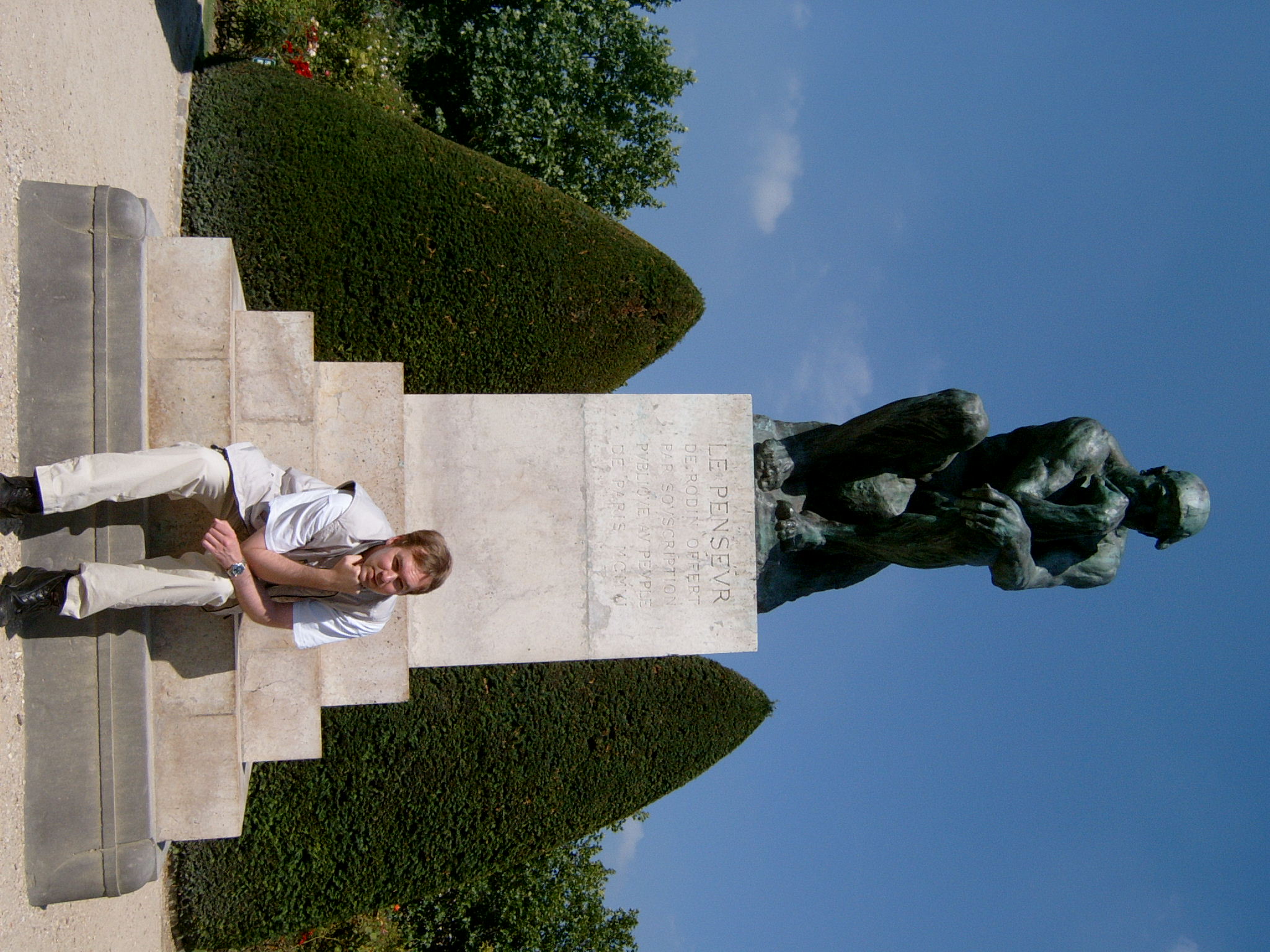
Russell Coker: CAL Self-Serving and Useless

Me Thinking about Copyright in front of Le Pensevr Brendan Scott linked to a couple of articles about CAL (the Copyright Agency Limited) [1]. I have previously written about CAL and the way that they charge organisations for the work of others without their consent [2]. My personal dispute with CAL is that they may be charging people to use my work, I have not given them permission to act on my behalf and will never do so. If they ever bill anyone for my work then it will be an act of piracy. The fact that the government through some bad legislation permitted them to do such things doesn t prevent it from being piracy you can t disagree with this claim without supporting the past actions of China and other countries that have refrained from preventing factories from mass-producing unauthorised copies of software. The first article concerns the fact that last year CAL paid more than $9,400,000 in salary to it s employees (including $350,000 to it s CEO) while it only paid $9,100,000 directly to the authors [3]. It also spent another $300,000 to send it s executives to a junket in Barbados. It did give $76,000,000 to publishers on the assumption that a proportion of this money will be returned to authors of course said publishers could have used the money to have holidays in Barbados. CAL doesn t bother to check who ends up with shares of the $76,000,000 so it s anyone s guess where it ends up. The second article is by James Bradley who is an author and director of CAL [4]. He claims that much of the $76,000,000 was distributed to authors, although I m not sure how he would have any idea of how much it was which is presumably why he used the word much instead of some other word with a clearer meaning such as most . He also notes that CAL invested $1,000,000 in projects specifically designed to promote the development and dissemination of Australian writing , which sounds nice until you consider the fact that none of the authors (apart from presumably the few who sit on the CAL board) had any say in the matter. Can I take a chunk of the $9,400,000 that is paid to CAL employees and invest it in something? If not then why not? If they can invest money that was owed to other people then why can t I invest their salaries? James also says The issue of how well CAL serves rights-holders and authors and artists in particular is a vital one which is remarkably silly. He is entirely ignoring the fact that some rights holders don t want to be served by CAL at all. The fact that CAL can arbitrarily take money for other people s work is an infringement on their rights. He further demonstrates his ignorance by saying Without CAL and the licences we administer, users educational institutions, government agencies and corporate organisations, to name just a few would be required to seek permission every time they reproduced copyright material or run the risk of legal action for copyright infringement of course any educational institution can use Creative Commons licensed work [5]. I ve previously written about the CK12 project to develop CC licensed text books for free use [6]. There s no reason why the same thing can t be done for university text books. In the discussion following Claudine Chionh s LUV talk titled Humanities computing, Drupal and What I did on my holidays [7] it was suggested that it should be possible to gain credit towards a post-graduate degree based on work done to share information this could mean setting up a Drupal site and populating the database or it could mean contributing to CC licensed text books. Let s face it, a good CC text book will be read by many more people than the typical conference proceedings! James says that CAL is used Instead of having to track down individual rights-holders every time they want to reproduce copyright material . The correct solution to this problem would be to change the copyright law such that if a reasonable attempt to discover the rights-holder fails then work is deemed to be in the public domain. The solution to the problem of tracking down rights-holders is not to deny them their rights entirely and grant CAL the right to sub-license their work! He also makes the ridiculous claim Whereas in the age of the physical book schools and universities could have bought fewer books and made up the difference by using photocopies, it is now possible for an organisation to buy a single set of digital materials and reproduce them ad infinitum which implies that CAL is the only thing saving the profits of authors from unrestricted digital copying. Of course as CAL seems to have no active enforcement mechanisms and they apparently charge a per-student fee they really have no impact on the issue of a single licensed copy being potentially used a million times extra use apparently won t provide benefits to the author and use in excess of the licensing scheme won t be penalised. He asks the rhetorical question After all, why go to the expense of creating a textbook (or some form of digital course materials) if you are going to sell only a half-dozen copies to state education departments . The answer is obvious to anyone who has real-world experience with multiple licensing schemes you can sell one single copy and make a profit if the price is high enough. The smart thing for the education departments to do would be to pool their resources and pay text book companies for writing CC licensed texts (or releasing previously published texts under the CC). The average author of a text book would probably be very happy to earn $100,000 for their work, the editorial process probably involves a similar amount of work. So if the government was to offer $300,000 for the entire rights to a text book then I m sure that there would be more than a few publishers tendering for the contract. According to the CIA World Fact Book there are 2,871,482 people in Australia aged 0-14 [8], that means about 205,000 per year level. CAL charges $16 for each primary and secondary student so the government is paying about $3,280,000 every year per year level. Even in year 12 the number of text books used is probably not more than 10, so it seems to me that if all the money paid to CAL by schools in a single year was instead used to fund Creative Commons licensed text books then the majority of the school system would be covered! The universities have a much wider range of text books but they also have higher CAL fees of $40 per student. After cutting off the waste of taxpayer money on CAL fees for schools that money could be invested in the production of CC licensed university text books.

9 March 2010

John Goerzen: Review: The Future of Faith by Harvey Cox

I know I ve been on something of a religion streak on the blog of late, and this will be the last such post for awhile. I first hear of Harvey Cox s book The Future of Faith during an excellent hour-long interview with NPR s Diane Rehm. It was intriguing enough that I bought the Kindle edition of the book and read it. The title of the book is both very accurate and rather misleading. A lot of the book and, to me, the most fascinating parts of it focus on the history of faith. Cox s repeated point is that we are only now regaining a notion of faith that the earliest Christians had, and it is a notion that happens to be compatible with modern science and incompatible with fundamentalism and intolerance in all its stripes. Throughout this post, it should be understood that quotes or passages are from the book. Cox is so quotable that a good chunk of this review will be showing you some of his quotes, with a bit of discussion around them. I very much enjoyed this book, and highly recommend it. Faith vs. Belief
It is true that for many people faith and belief are just two words for the same thing. But they are not the same and it is important to clarify the difference. Faith is about deep-seated confidence. In everyday speech we usually apply it to people we trust or the values we treasure a matter of what the Hebrews spoke of as the heart. Belief, on the other hand, is more like opinion. We often use the term to express a degree of uncertainty We can believe something to be true without it making much difference to us, but we place our faith only in something that is vital for the way we live.
This is an important distinction, and if you stop and think about it, Cox is arguing with a common notion about faith almost from page 1. Faith isn t about intellectual assent to a set of propositions. It s about what we hold dear, what we think works for us in life. Creeds
Creeds are clusters of beliefs. But Christianity is not a history of creeds. It is the story of a people of faith who sometimes cobbled together creeds out of beliefs. It is also the history of equally faithful people who questioned, altered, and discarded those same creeds But both the doctrinal canons and the architectural constructions are means to an end. Making either the defining element warps the underlying reality of faith.
Cox here reinforces the point that Christianity isn t about believing certain statements, and it isn t even about a literal (or not) reading of the Bible. It s what C. S. Lewis talked about as the inward transformation in onesself. Creeds, such as the Nicene Creed, are rather irrelevant to him. Cox separates the history of Christianity into three periods: the age of faith, stretching from the time of Jesus only a few centuries until Constantine; the age of belief, stretching from Constantine until the 20th century; and the age of the spirit, now dawning. During the age of faith, their sharing in the living Spirit of Christ united Christians with each other, and faith meant hope and assurance in the dawning of a new era of freedom, healing, and compassion that Jesus had demonstrated. Cox makes the point that doctrinal questions just weren t all that important back then, and though differences existed, they weren t considered to be fundamental to the religion. Confidence in Christ was their primary orientation, and hope for his [earthly] Kingdom their motivating drive. Further, he argues that the age of the spirit is a return to this earlier age, albeit with modern twists.
Christianity is growing faster than it ever has before, but mainly outside the West and in movements that accent spiritual experience, discipleship, and hope; pay scant attention to creeds; and flourish without hierarchies. We are now witnessing the beginning of a post-Constantinian era.
Cox describes a person that described himself as a practicing Christian, not always a believing one. He suggests that the belief/non-believer statement is a disservice to Christianity and to other religions. He then quoted a Catholic bishop as saying: The line between belief and unbelief runs through the middle of each one of us, including myself, a bishop of the church. In other words, The experience of the divine is displacing theories about it. Faith and Belief in Bible reading
Creation myths such as the first chapters of Genesis were not primarily composed to answer the how or when questions. They are not scientific accounts, even though their poetical language, when read literally (which is always a mistake), may sound that way. Rather, they grapple with the linked mysteries of both why there is a universe and what our place in it is They are more like lyrical cantatas, symphonies of symbols through which humans have tried to make sense of their place in the world This is where the distinction between faith and belief is vital. These stories are literally not to be believed. They are, rather, artifacts human beings have crafted to try to wring some meaning from the mystery. They are not themselves the mystery.
I liken this to Michael Crichton s novel Jurassic Park. If you were to read it 1000 years in the future, it might not have been conveniently shelved above the word fiction. Would a reader in the future know that it was not meant to be a literal description of facts? I think sometimes we make this mistake when we read the Bible. Note, though, that although we all understand that Jurassic Park wasn t meant to be a literal description of facts, it seems to have been valued by quite a large part of society. And it didn t even address big mysteries. Cox argues against ridding ourselves of the creation myths, suggesting that they are an important reminder that we are similar to humans who grappled with the same big questions centuries ago as we do today.
The ill-advised transmuting of symbols into a curious kind of facts has created an immense obstacle to faith for many thoughtful people. Instead of helping them confront the great mystery, it has effectively prevented them from doing so the objective knowledge science rightly insists on is not the only kind of knowledge human beings need Faith, although it is evoked by the mystery that surrounds us, is not the mystery itself.
Constantine and the Age of Belief
One of the most devastating blunders made by the church, especially as the Age of Belief began, was to insist that the Spirit is present only in believers.
Cox spends a lot of time covering the very interesting topic of how and why the church moved to the Age of Belief. His central thesis is that money, power, and prestige were primarily responsible, and that an unrighteous collusion between bishops and Constantine, each using Christianity for their own purposes, finally made it happen. This is very interesting stuff, but this post is too long already, so I will not spend a lot of time on it. I found the Council of Nicea to be particularly interesting, considering that the Nicean Creed came about partially by exile or execution of those Christians that disagreed with it. Cox also points out that there never was a single early Christianity ; there were many, and the idea of heresy was unknown.
The time is ripe to retrieve the term Way for Christianity and followers of the Way for Christians. It is at once more accurate, more original, and more contemporary than believers.
To the future Cox describes attending a meeting of the church in Hong Kong in 2003, and uses it as a metaphor for the future of faith:
Their idea of interfaith dialogue was to work with their fellow Asians of whatever religion to advance the Kingdom that Jesus had inspired them, as Christians, to strive for, regardless of what the others called it. They were neither fundamentalist nor modernist. They seemed more attuned to the element of mystery at the core of Christianity and to its vision of justice. They were also clearly impatient with many of the disputes that preoccupy the different wings of the American churches.
Conclusion I found this book to be both enlightening and informative. I highly recommend it, even if you disagree with some of Cox s conclusions. It is a fascinating view into how the world s largest religion evolved over the years, and a candid look at the mistakes it has made in that time.

5 March 2010

David Welton: Books vs "e-books" ?

I've been thinking about something for a while, and to be honest, still haven't reached any firm conclusions: what to think about self-published "e-books"? I'm curious to hear your opinions. For instance: These are all: electronic, in that they aren't distributed as real, paper books, have no ISBN number, and are generally only available via the author's web site (you won't find them on Amazon.com). They aren't simply on-line, PDF versions of real books. They're certainly a departure from the traditional model of having a publisher, editor, and real, physical books that could be purchased from book stores. They don't appear to have been through any kind of formal editing or quality control process. The prices seem to differ quite a bit; the first one is $19, the second one is $12, and the last one is $30.77. For the authors, the appeal is obvious: they get to keep all of the money, and don't have to fool around with a lot of "process". Consumers, on the other hand, have to consider different aspects: with a "real book", the bureacracy and process exist to guarantee some minimum standards of quality. If you buy an O'Reilly book, you know that it's probably like many of the other books they sell: perhaps it won't stand the test of time like something written by Knuth, but it'll be a pretty good guide to the technology it describes, most likely be someone who is indeed an expert in that area. If I buy some random PDF on the internet, it may come from someone who really knows their stuff, or it may be junk. On the other hand, were this market to grow, theoretically prices could come down. Since the people who are authoring the book don't have to fool around with editing, printing, and so on, and get to keep all the money themselves, they could in theory keep their prices significantly lower than someone creating a more 'traditional' book with a lot of overhead. That is, of course, if the book is one where there is competition in its niche. Right now a lot of these books that pop up on my radar are written by domain experts. However, what's to prevent a lot of people from jumping in and attempting to make a quick buck with a flashy looking web site? Buying books based only on reputation? That might lead to people who are really good authors, but perhaps not well known as "doers" (they didn't invent the technology in question) being left out in the cold. Also, there is something of an unknown quantity about "pdf books". For instance, after raking in a bunch of cash with theirs, 37signals put it on their web site, completely for free. That had to leave the guy who bought it the day before it went free feeling like a bit of a chump. At least with a 'real book', even if the contents are posted on the internet, you have a physical object that belongs to you. I wonder how bad piracy is, and how bad it might be were these to become more popular? Another thing worth noting is that, via services like Lulu.com, it *is* possible to print these out. In any case, I think things are likely to change with time, as we aren't dealing with a static situation, but rather one where a changing landscape maylead to different outcomes, as the key variables... vary. I am honestly unsure of what to make of this development. How do you see the market for "home brewed" pdf ebooks evolving?

28 February 2010

Russ Allbery: Review: Coders at Work

Review: Coders at Work, by Peter Seibel
Publisher: Apress
Copyright: 2009
ISBN: 1-4302-1948-3
Format: Trade paperback
Pages: 601
Coders at Work is a collection of edited interviews by Peter Seibel (probably best known previously for his book Practical Common Lisp) of an eclectic and excellent collection of fifteen programmers. It opens with an interview with Jamie Zawinski (one of the original Netscape developers) and closes with Donald Knuth. In between, the interview subjects range in programmer generations from Fran Allen (who started at IBM in 1957) and Bernie Cosell (one of the original ARPANET developers) to Brad Fitzpatrick (LiveJournal founder and original developer). Techniques and preferences also range widely, including two people involved in JavaScript development and standardization (Brendan Eich and Douglas Crockford), a functional programming language designer and developer (Simon Peyton Jones), language designers and standardizers such as Guy Steele, and people like Dan Ingalls who have a different experimental approach to programming than the normal application development focus. All of the interviewees are asked roughly the same basic questions, but each discussion goes in different directions. Seibel does an excellent job letting the interview subjects shape the discussion. Two things immediately stood out for me about this book. First, it's huge, and that's not padding. There are just over 600 pages of content here, much of it fascinating. The discussions Seibel has are broad-ranging, covering topics from the best way to learn programming to history and anecdotes of the field. There's some discussion of technique, but primarily at the level of basic approaches and mindset. One typical question is how each programmer organizes their approach to reading code that isn't familiar with them. Each interviewee is also asked for book recommendations, for their debugging techniques, for their opinions on proving code correct, and how they design code. The participants are so different in their backgrounds and approaches that these conversations go in fifteen different directions. This is one of the most compelling and engrossing non-fiction books I've read. Second, the selection of interview subjects, while full of well-known names in the field, is not the usual suspects. While I'm interested in the opinions of people like Larry Wall and Guido van Rossum, I've already heard quite a lot about how they think about programming. That's material that Coders at Work doesn't need to cover, and it doesn't. Many of the interview subjects here are people I'd heard of only vaguely or not at all prior to this book, often because they work in an area of programming that I'm not yet personally familiar with. Those who I had heard of, such as L. Peter Deutsch, I often knew in only one context (Ghostscript in that case) and was unfamiliar with the rest of their work. This gives the book a great exploratory feel and a lot of originality. There is so much good material here that it's hard to give a capsule review. This is a book I'm highly likely to re-read, taking more detailed notes. There's entertaining snarking from Jamie Zawinski and Brendan Eich, fascinating history of the field (including in gender balance) from Fran Allen, and an intriguing interview with Joe Armstrong (creator of Erlang), who seems to have a far different attitude towards languages and libraries than the other interviewees. Every interview is full of gems, bits of insight that I now want to research or play with. A couple of examples come to mind, just to provide a feel of the sort of insights I took out of the book. In the interview with Joshua Bloch, who does a lot of work on library APIs, he mentions that empathy is one of the most important skills for designing an API. You have to be able to put yourself in the shoes of the programmer who's going to use the API and understand how it will feel to them. This came up in the context of a discussion about different types of programmers, and how programmers can be good at different things; the one who can do low-level deep optimization may not have that sense of empathy. Another example: Bernie Cosell talked about how he did debugging, and how he got a reputation for being a fantastic debugger who was able to fix just about anything. He confessed that he often reached a portion of the code that he didn't understand, that seemed too complex and tricky for what it was attempting to accomplish, and rather than trace through it and try to understand it, he just rewrote it. And after rewriting, the bug was often gone. It wasn't really debugging, but at the same time it's close to the more recent concept of refactoring. Several of the interview subjects commented on a subjective feeling of complexity and how when it gets too high that's a warning sign that code may need to be rethought and rewritten. A third example: I was fascinated by the number of interviewees who said that they used printf, assert, and eyeballs to debug rather than using any more advanced debugging tools. The former Lisp developers would often bemoan the primitiveness of tools like gdb, but many of them found that print statements and thinking hard about the code were usually all that's needed. (There was also a lot of discussion about test suites and test-driven development.) The general consensus was that concurrency problems were the hardest to debug; they made up a disproportional number of the responses to Seibel's question about the hardest bug the programmer ever had to track down. I could go on giving similar examples at great length, but apart from the specific bits of wisdom, the strongest impact this book made on me was emotional. Coders at Work is full of people who love programming and love software, and that enthusiasm, both in general and for specific tools and ideas, comes through very clearly. I found it inspiring. I realized while reading this book, and I suspect I'm not alone among programmers in this, that I largely stopped learning how to program a few years back and have been reusing skills that I already have. Reading Coders at Work gave me a strong push towards finding ways to start learning, experimenting, and trying new techniques again. It also filled me with enthusiasm for the process of programming, which immediately helped my productivity on my own coding projects. This is obviously a book whose primary target audience is practicing programmers, and while it doesn't go too far into language theory, I was relying on remembered terms and structure from my master's degree for a few of the interviews. I think it's approachable for anyone who has a working background in programming and a few languages or a CS degree, but it might be a stretch for someone new to the field. But even someone without any programming knowledge at all would get a lot out of the anecdotes and snapshots of the history of software development. Coders at Work is also full of jumping-off points for some additional research on Google or additional reading in other recommended books. I only have one complaint, which I have to mention in passing: for such a large book full of interesting ideas and book recommendations, the index is wholly inadequate. I tried looking up five or six things in it, including the source of some of the book recommendations that are collected in an appendix, and I struck out every time. It's very hard to find something again in 600 pages, and more attention paid to the index would have been greatly appreciated. But, despite that, for people within the target audience, I cannot recommend this book too highly. Not only was it full of useful information, at the level of programming above the code details that's often the hardest to talk about, but it's consistently entertaining and emotionally invigorating and inspiring. It made the rounds of tech blogs when it was first released, to nearly universal approval, and I can only echo that. If you're a practicing programmer, I don't think you'll regret spending a few weeks reading and thinking about this book. Rating: 10 out of 10

26 February 2010

Martin F. Krafft: ACTA leak: no surprises about transparency blockers

The most common criticism of the Anti-Counterfeiting Trade Agreement (ACTA) is the lack of transparency. Before the nations disclose the terms of the agreement under negotiation, we are unable to gain an idea of the big picture, let alone voice our opinions and push for changes. Our politicians don t want us to know. We rely on leaked documents for our information. This is backwards in a world where a state should represent its people. This smells foul to me. There are undoubtedly some good reasons for the treaty, and if we can contain worldwide, large-scale trade of counterfeited goods and medicine, then that would be a net benefit to us all. However, we must not allow certain governments to succomb to the pressure of (commercially-motivated) lobbyists, to extend that pressure onto other nations using trade as a means of pressure, and to slash our freedom as if it were an inconvenient obstacle in their way. Only if the terms under negotiation become publicly available, and the public is given a voice, then we can help our governments in entering an agreement that is in the interest of its people, rather than a threat to us. It is hardly surprising that total capitalist nation USA are the strongest opponents of transparency, because the public might delay or even prevent the treaty. I was also not surprised to see South Korea and Germany in the list of supporters of secrecy either. It is interesting to see that the leaders of Singapore, Belgium, Portugal, and Denmark also seem to believe that these negotiations should be withheld from the public. Does anyone know about Switzerland? I tip my hat to New Zealand, Canada, Australia, Netherlands, Sweden, Finland, Ireland, Hungary, Poland, Estonia, and Austria for their support of transparency.

Next.

Previous.
