Search Results: "otto"

9 February 2009

Julian Andres Klode: debimg core example


The following example demonstrates the features of debimg core, and how it can be used to fetch a some packages. As you will see when you run this example, debimg uses SHA1 filenames for the downloaded files. This may be changed in a future version. There is also an improved version of this example, which creates a repository, but the needed module (debimg.core.repository) is not public yet, because its far from being finished. I expect to complete repository code on Wednesday.
#!/usr/bin/python
# Copyright (C) 2009 Julian Andres Klode.
#
# Released under the terms of the GNU General Publice License, version 3
# or (at your option) any later version.
#
"""Example to demonstrate the power of debimg's pool
This example creates a directory example.debimg, with two subdirectories:
- pool: This holds debimg's file pool (see debimg.core.files.Pool)
"""
from debimg.core.resolver import Resolver
from debimg.core.files import Pool
def main():
    """Called when the script is executed."""
    # Create a pool, which manages the access to the files.
    pool = Pool('example.debimg/pool')
    # Create a resolver using your local apt configuration.
    pkgs = Resolver()
    # Add all packages with priority required to the resolver
    pkgs.add_priority('required')
    # Add the packages from the resolver to the pool
    for group in pkgs.groups():
        for package in group:
            pool.add_package(package)
    pool.fetch() # Fetch all the packages from the mirror
    for file in sorted(pool._files, key=lambda k: k.uri):
        print file # Print information about every file, sorted by URI.
if __name__ == '__main__':
    main()
Posted in Debian, debimg

2 February 2009

Muammar El Khatib: Debian Lenny might be released this month

I'd like to join those who also feel the happiness of knowing that a new Debian release is getting closer :-) It has been a long wait, but the result will be a good one.

I am anxious to see the official announce and to have a bunch of new versions of packages in unstable, so that my system will be more funny than it is :-D


Benjamin Mako Hill: Mottos

I recently ate a bag of potato chips made by FoodShouldTasteGood, Inc.. Their motto (as printed on that bag under their name) was, "It's our name. It's our brand. It's our motto." Now, either the antecedents for those three it's are different -- which seems implausible -- or their motto is lying in its final sentence. It's all very complicated. Seth Schoen reminded me of a somewhat similar issue with the United States' national anthem, The Star Spangled Banner. The final stanza includes the line, "And this be our motto 'In God is our trust.'" This is not and has never been the U.S. motto. In fact, the U.S. had no motto at all until 1956 when "In God We Trust" -- which is very similar, but not quite the same -- became official. It seems that nobody is quite sure where "In God We Trust" came from but there is some speculation that it originated in the anthem itself. Presumably, it became the motto because lawmakers thought it sounded good in the song and not because the U.S. government failed while trying to "correct" the embarrassing incorrect line in its anthem.

29 January 2009

Bdale Garbee: Facial Dignity

People keep asking me about the beard thing... Here's my take on what happened and why. Just before I left for LCA 2009, my wife offered to send along one of the limited edition prints of her award-winning waterfall photograph. She knew from prior years that the LCA organizers often host an auction or raffle to raise money for some worthy charity at the conference banquet. Since the photo was taken at Milford Sound on the way to last year's LCA in Melbourne, there was a connection between the photo and LCA. We had no idea what this year's charity might be, nor did we anticipate that her photo would become the centerpiece of the evening's fund-raising activities. The charity selected this year was an organization that is trying to save the Tasmanian Devil from extinction. Professor Hamish McCallum, the chief scientist with the program, gave a talk after dinner and before the auction began. The native population is suffering from a fatal facial tumor disease that results in horrible lesions, and is likely to kill off all the Devils within a decade or three. My family and I all have a strong love of nature, and Karen and I had the pleasure of touring Tasmania after LCA 2003 in Perth, so this seemed like a great charity to raise money for with her photo. As often happens at LCA, the auction and related fund-raising activities got complicated. This year, the photo alone was bid up to $2500 (which was very cool!), before people started offering things for higher bids. For years, going maybe as far back as Perth, I've been cajoled about shaving my beard if the bidding hit some level, and have always said no. This year, someone offered $5000 if I would shave my beard, and again I said no. Much later, after more cajoling and many counter offers, when the bids and various matching offers had us approaching $20,000 in total donation to the charity, I relented and announced that if we hit a total of $25,000 going to the charity I would consent to a shave. The resulting frenzy, including the suggestion that if it went high enough Linus should do the shaving, and the formation of a bidding consortium that kept raising more money and bidding against itself, was completely unexpected! Others have tried to capture details of the insanity, but the bottom line is that by the end of the evening, the total had blown way past anything we could have imagined, and by the end of the conference the total going to the charity was on the order of $40,000! Why did I agree to let Linus shave my beard? To be honest, I'm not entirely certain. I only had one beer that evening, so I can't blame intoxication. The fact that it would yield a worthy charity something over 10 times what my wife's photo alone had drawn as a maximum bid seemed significant to me. In hindsight, I also think I was at least a little bit curious to see what my face looked like after having a beard since sometime around September of 1982! In any case, I made the offer, insane amounts of money were raised, and on the last day of the conference, over the lunch hour, Linus took trimmers in hand and removed my beard in front of an audience. The reactions have been completely overwhelming. A local TV station and a local newspaper in Hobart were both there and ran stories. The ripple of mentions in the blogosphere was and is just astounding. There's even a silly Shaving Bdale game created overnight by the "Mad Scientists" at Secret Lab! And from all over the globe, people I do and don't know have been sending emails and finding me on IRC to plead with me to grow my beard again! Right after the shave, my good friend Keith Packard said "Bdale, grow it back!". Before I left Hobart, my wife emailed saying she and the kids hoped I wasn't waiting until I got home to start. Joey Hess blogged a hairy tale about how I'd scarred the minds of young Debian developers. The leader of Debian-RS sent word by email that the group all hoped I would re-grow my beard. And on and on and on... I'm really not used to being the center of so much attention! Being suddenly without beard felt weird in lots of silly little ways. I was hyper-sensitive to drafts. The feel of cold beverages hitting my upper lip was downright strange. And I kept wanting to scratch what wasn't there! After making faces at myself in the mirror for a while, I decided I really wasn't happy, and do prefer being bearded. So I haven't shaved since Saturday morning in Hobart, and am pretty scruffy looking. My wife said today that I'm "already starting to look like Bdale again". At the current growth rate, I have high hopes of having at least some facial dignity back by the time I speak at FOSDEM. And no, I won't be shaving my beard off again any time soon...

26 January 2009

Andrew Pollock: [life] Too much deja vu

Seriously, every time Sarah has surgery, it all goes pear shaped. The bottom (last time it was towards the top) of Sarah's incision from her recent wire removal surgery was looking a bit red, swollen and hard on Friday, so she went in to the clinic at got them to take a look at it. They decided that a knot in the sutures was trying to work its way out, and causing inflammation or something, so just like last time, they decided to reopen the incision a bit. They did that, and cut the knot out, and rather than packing with gauze, they just taped the small opening closed with some steristrips and covered it with gauze and sent her on her way. Somewhat fortunately (for me) Sarah went into the clinic during the day while I was at work, so I missed participating in the fun and games. They didn't use any local anaesthetic, but Sarah said it didn't hurt too much. That night, though, she was in a reasonable amount of pain, again, similar to last time, except it was a band across her upper abdomen, below her breasts, instead of chest pain. Mindful of the staph infection disaster from last time, we trotted off to the ER on Saturday afternoon, hoping to nip this in the bud. They did some blood work, which came back clear, and gave her some IV pain medication, which didn't seem to do much, and were generally scratching their heads as to the cause of the pain. Fortunately, one of the surgeons involved with Sarah's wire removal from 2.5 weeks previously happened to be on call, so he got called in. He had a bit of a poke around the opening with a long cotton bud, and declared that it was possibly infected, because there was a bit of cloudy fluid discharged when he poked it in. Oh, and the cotton bud disappeared a good centimetre or more under the skin further up the incision, which indicated an abscess was forming. So, for the second time, I got to watch my wife being cut open with a scalpel. I think the local anaesthetic injections were the most painful part for her. He opened the incision up a bit further, and packed it with some Betadine-soaked gauze, and we got sent home with the same instructions as last time this happened: I had to repack the wound with saline-soaked gauze two to three times a day and let it heal from the bottom up. She was also prescribed some antibiotics. She's got about a 2cm incision just below her breasts. It looks a lot deeper than the hole from last year's incision. So we got home about 6pm last night, and went to bed around 11pm. Sarah lasted a couple of hours before she woke up in even more pain than before. She called up the hospital and had the same surgeon paged, and he advised her to come in to the ER again. So at I think about 2am, we headed back. They took some more blood, did a CT scan, which came back clear, and decided to admit her. They're giving her IV antibiotics and pain medication. Initially she didn't want to have any more IV pain medication because it didn't seem to be working, and it tends to make her nauseous. She wasn't keen on dealing with throwing up with the amount of pain she was having. It hurt to move as it was. With a mixture of IV anti-nausea drugs and the IV pain medication, the pain has finally come under control though. She did have one bought of vomiting this evening, which didn't seem to cause her too much discomfort, and she's getting in and out of bed more comfortably. They're going to keep her in overnight. She has a post-operative followup tomorrow in the clinic, so I expect they'll keep her in the hospital until at least then, depending on how things go. Her cardiologist, intimately familiar with last year's debacle, dropped in this afternoon. He's wondering, given how this has happened twice now, if Sarah has some sort of allergy to the type of absorbable suture they've used. Apparently there are different types of sutures, so if she ever has any other surgery, we'll have to get them to try a different type It'll be interesting to see how she goes tonight, as the pain seems to get worse overnight. She hasn't had any IV pain medication since about 1pm, and she wanted to see how she goes without it, because if she gets discharged tomorrow, she'll have to rely on oral stuff anyway. I think it definitely gets harder for her to manage her pain when the pain is causing her to lose sleep. She can only deal with having a couple of night's worth of bad sleep before it all gets too much. So I'm really hoping she gets a good night's sleep tonight. Not that hospitals are renowned for that...

22 January 2009

Joerg Jaspert: Bugs, Bugs, Bugs and a nice speed improvement

This all started when a DSA (Debian SysAdmin (those with root rights on all .debian.org machines)) wanted to upgrade the kernel running on our ftp-master host. It was shortly before dinstall, but hey, there it went, and the machine rebooted into a 2.6.28. Besides murphy taking his share making the machine fsck its huge filesystem that is all fine. What wasn t fine was the result we found. An odd one. Suddenly one tool we run during our dinstall run decided to blow up. Well, it did nt break, it just went dead-slow. Usual runtime had been about 5 minutes before, now we had over an hour - and only about 20% of the work was done. YUCK. Thats sure not going to work. Reboot in a 2.6.27 kernel did not show this problem, going back to .28 had it again. Which meant we had yet another reboot to get a working system. At which point investigation of the problem started. Turns out that pythons popen2.popen2 function is closing all available filehandles before it forks. Thats all fine and also what you usually want. Problem is (and all the glory to have found the cause goes to Peter weasel Palfrader) that the .28 kernel included a patch titled rlimit: permit setting RLIMITNOFILE to RLIMINFINITY (0c2d64fb6cae9aae480f6a46cfe79f8d7d48b59f) that allows, as the title implies, to set the limit for number of files to infinity. More citation from weasels mail: Closer investigation showed that the broken default ulimit did not apply to system processes (like stuff started from init). In the end I could establish that all processes that passed through pam_limit at one point had the bad resource limit. Apparently the pam library in Debian etch (4.0) initializes the limits to some default values when it doesn t have any settings in limit.conf to override them. Turns out that for nofiles this is RLIMINFINITY. Commenting out case RLIMITNOFILE in pam_limit.c:267 of our pam package version 0.79-5 fixes that - tho I m not sure what side effects that has. Debian lenny (the upcoming 5.0 version) doesn t have this issue as it uses a different pam (version). So, whatever the fix might be for etch, if any, there is no way we Ftpmaster can force DSA to live with a 2.6.27 kernel forever on our host. As the problem occurs when using popen2 - lets get rid of it. Luckily popen2 was used in dak by people that either did not know the gzip module python has, or it has been there since before that exists. Don t know, but that made removing popen2 a not too hard deal, done by our newest addition to the Ftpteam, Mike O Connor, stew (Thanks!). A pretty nice side effect is a huge improvement to the speed of the tool Prior, using popen2, it took around 5 minutes to do its job. Now using the gzip module we are down to some 44 seconds. Yes, below one minute, but well, must have some effect if you stop forking a thousand times and all that thousand times close all (1024) available filehandles But that alone isn t enough. There was a second tool also using popen2 (thankfully only once instead of a million times). Fixing that tool got its runtime from 2 minutes down to 0.7 seconds. Yes, less than one second, getting the same result out. Thats the gain you get from not going like get a tempfile, zcat foo > tempfile, filehandle=open(file), dowork including reading its content but foo=gzipfile.readitscontents, dowork(foo) . I like it. And am now sure that avoid popen2 at nearly all costs, if you can is a good motto. :)

19 January 2009

Stefano Zacchiroli: debcheckout hacking

New features for debcheckout, ... now with TopGit support! Today I've spent some time hacking on debcheckout, which for weird reasons happens to be at the bottom of a stack of chained things that I need to do in the forthcoming days. Also, I had neglected debcheckout for a while, and the other devscripts folks where ready to shout at me because of that :-) . Well, it has been fun, and beside having fixed all the outstanding bugs, debcheckout has grown some cute new features: Enjoy! (ah, of course all this is not uploaded yet, but you can grab a preview from devscripts' VCS or, better, doing debcheckout devscripts which is soooo bootstrapy. SCNR.)

Stefano Zacchiroli: ocaml batteries included debian packages

preview of OCaml batteries included Debian packages OCaml batteries included is a wonderful community-driven initiative to standardize the OCaml development platform. It is similar to initiatives sharing the same motto, like Haskell batteries included and Python batteries included (which then has become the legacy Python distribution), but I have always felt that OCaml was more desperately needing a similar initiative. David Teller and the OCaml batteries included team have been the first actually doing something to address the frustration of many otherwise enthusiastic OCaml developers. A couple of days ago, their efforts have given birth to a first milestone: the release of the first alpha version of batteries included. To help out, I've released as quickly as possible the Debian packages of OCaml batteries included. You can find them in experimental (actually in NEW, at the time of writing), and from my people.d.o space. I've only built the packages for amd64, if you need some other architecture you can build on it by yourself, but I recommend not trying to rebuild the -doc package (which takes 10 minutes on my laptop to build). You can reuse the -doc package I've built, which is arch: all, to rebuild only the -dev part unpack the source package and do fakeroot debian/rules binary-arch.

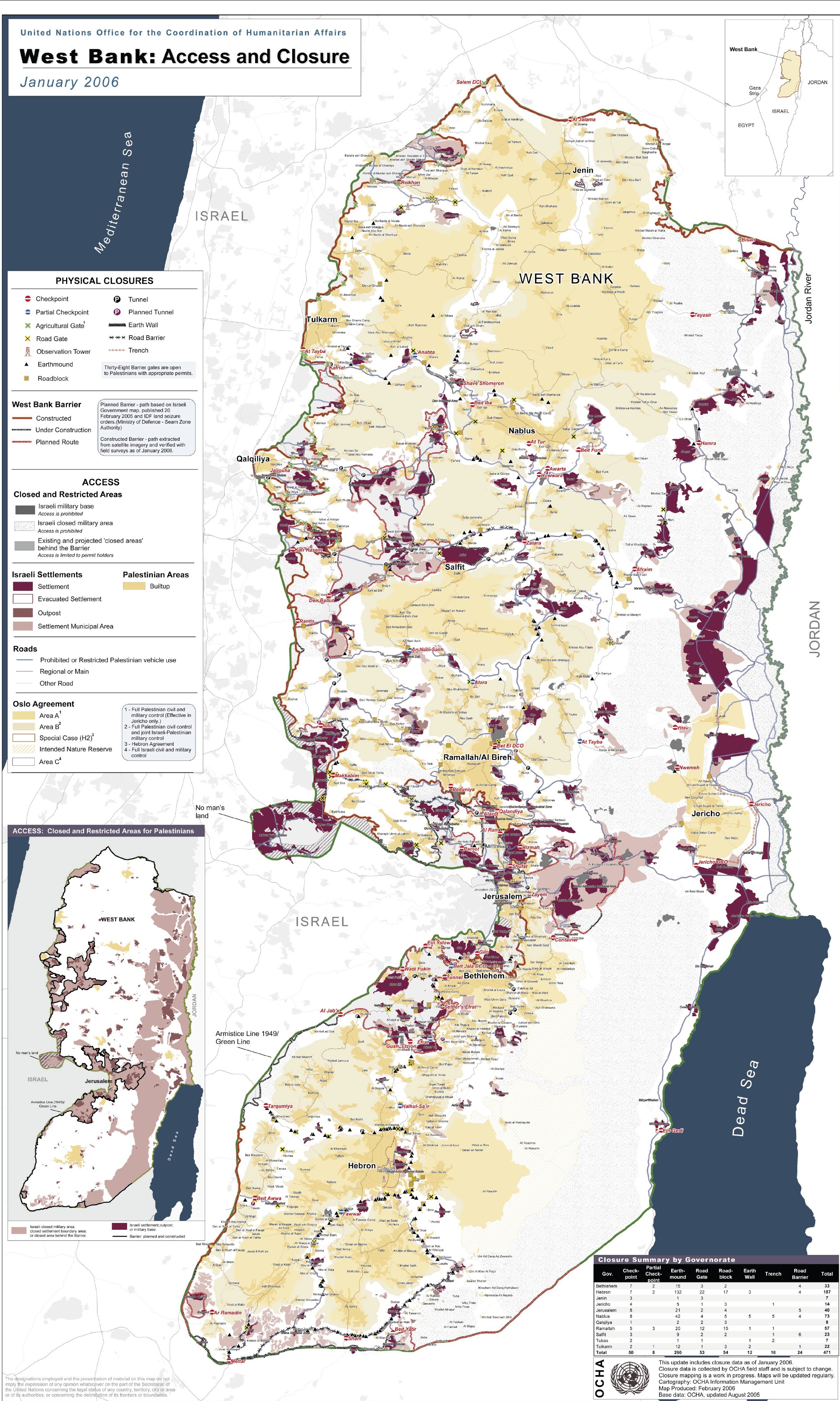
Gunnar Wolf: About the recent events and possible outcomes in Israel and Palestine

Several friends, from different groups and backgrounds and with different points of view regarding the current war in Israel (and regarding the Arab-Israeli conflict in general) have asked me for an explanation on what is happening there, what is (my view of) the real conflict, its causes... and any possible answers. And yet I am quite far from being an authority, I do want to write something about it. Be prepared, as this post is quite long.
And yet, after writing frankly a lot more than what I expected... It is by far not enough. I have still much more to add, but I have to say "stop" at some point. So, here you have it: My points of view, as well as some explanation on why are we standing where we currently are.
I am writing this based just on my personal experiencie and, of course, my personal point of view. Furthermore, I wrote a good part of this text while riding a bus, with no network access, so I am offering very few references - In any case, it will allow me to make much more progress. References always take as much time as the text itself! About me Why am I writing this? Why do people ask for my opinion? I must start by explaining who I am, so the rest of this makes sense. I am a Mexican Jew. That means, I was born in a Jewish (albeit secular) family, and grew up in an environment with general Jewish culture. My direct family (say, my parents and brother, and to a lesser degree my closest cousins) are not at all religious, I'd even venture to say most of us are complete atheists. Yet, besides the cultural belonging (which is a mixture of a Eastern European culture with lots of Idish words and dishes and general humor), my family has a strong national identification - In other words, I grew up in a fully Zionist environment, which traces back to Poland.
My grandmother was member of Hashomer Hatzair in Poland, since the early years of its existence, late 1910s and early 1920s. What is it? To make it short, a Zionist Socialist, Kibbutzian youth movement. It has many similarities (and somewhat stems indirectly from) the Scouts many of you will be familiar with, but -obviously- has a way lengthier agenda. And, yes, nowadays I feel it is somewhat out of reach with the current state of the world - It was founded in 1913, and only slightly adjusted its principles since then.
I will talk more about Hashomer later on.
My grandmother arrived in the late 1920s to Mexico, for familiar and economic reasons, but still dreamt about living in Israel for a long time. As they grew up, first my uncle joined Hashomer in Mexico in the late 1940s, when it still pursued a very much Soviet-style ideals for Israel (one of the core points that changed during the 1950s); both my father and my mother joined in the late 1950s (in fact, that's where they met). My cousins and myself were very active in the 1980s and 1990s.
The Iszaevich family has something very unusual, I'd say, engraved in our genes. We live very deeply our ideologies. That's the only explanation I can find to the way we all have led our lives. I won't go into the other family members' details, but just into mine: I was fully convinced of all we taught to our younger members and what we discussed among ourselves. I am among the very few people who really learnt Hebrew at my school, and that was only because I really cared - I know some people that just after 12 years of pseudo-learning could maybe utter a few phrases.
After finishing high school I went with my Hashomer group, together with people my age from other similar-minded Mexican Zionist youth groups, to live and learn for a year in Israel, on what is usually known as shnat hajshar - A year to get ready. To get ready to what? But of course, to come and give back go the younger groups of the movement, and finally go back to Israel and settle there definitively. I came back to Mexico, and after one year I did the only thing that was logical: I became an Israeli and went to live to a kibutz - Zikim, a beautiful place just between Ashkelon and Gaza, very near the sea shore. It was a beautiful period in my life, and I really enjoyed it - But it didn't last for very long - I quickly grew to hate the Israeli society at large. A society full of rage, of hatred. Not just between Arabs and Israelis, as many would think from the outside, but between religious and seculars. And between immigrants and locals. And between leftists and rightists (in several dimensions, as it is one of the countries where you can most easily be a economic leftist while being a political rightist - a complex society it is). A society full of disrespect and intolerance. A very hypocritical society. And one of the things that most shocked me: I wanted to live in a society of proud of its existence, that's what I had learnt Israel was - But Israelis aspire and dream of being anything else (and mostly US-Americans) in a way that made me sick, more than anything I had previously seen in Mexico.
I loved the life at the Kibutz, and I loved being an agricultor, doing hard work every day and literally getting the fruit of it. However, I cannot live isolated to a 300-people universe - At least once a week you have to go to the city if you don't want to become insane. And I could not stand the sick Israeli society.
Anyway, to make things short: After six months as an Israeli, I came back to Mexico. I went through a long period of finding myself, as I could not uphold anymore my Hashomer ideology (if I am not going to live by it, how can I continue teaching it?). Many people do anyway, but for the first months, where my Hashomer work was basically all of my life, I felt really uncomfortable. So, in short, I severed all of my relations to the Jewish community, and even denied for a long time my Jewishness until I found a (I think) better balance.
Today I am at peace. But anyway, I wanted to talk about myself in the critical period that marked me in this regard: The 1990s. Enough, lets get down to business. Zionism 1870-1920 Many people argue that the Jews invaded the Palestinians homeland - And yes, nowadays I cannot counter this. But we cannot judge what happened then based on what we see now.
Modern Zionism started around the 1870s. The Jewish history is full of pogroms and persecution, in different countries all over Europe - And a group of young people decided the only solution was to build a place to call their own. And yes, this was full of idealism and in no small part the foolishness of youth. For several centuries and up to 1920, all of current Middle East were provinces of the Ottoman Empire. Before Zionism began, the population of today-Israel was very sparse, not more than 400,000 people - up to 5% of them Jewish, around 10% Christian Arabs, and the remainder, Muslim Arabs. Of course, the low population was mostly because the country was mostly hostile - A desert in the South, mostly swamps in the North, and some minor towns mostly in the hills. It was a mostly forgotten province, away from the central Turkish rule, and there had been no frictions with the local population. It was a nice place to go, thinking -again- as a fool youngster, or as an idealist. They said, lets take a folk without a land to a land without a folk.
The number of accomplishing Zionists (this is, people who actually went to Israel instead of just talking about doing so) was not high during the first decades. But towards the 1890s, it gained critical mass. The political Zionist movement was born, with Theodor Herzl as a leader, and they started pushing -politically- for different governments to concede a territory to Jews. They went to the Turks, and didn't really get much echo. Went to other colonial powers of the time, and got unfeasible promises with no real backing (i.e. Birobidjan in Eastern Russia, Uganda in Africa)... And, as it happens in strongly ideologized movements, the movement started splitting into different groups with slightly different positions.
And no, I am not talking about the People Front for the Liberation of Judea and the People Judean Liberation Front, but I very well could. Sometimes the differences are as ridiculous as that. But hey, I take that most of my readers are acquinted with the Free Software issues, right? Think BSD vs. GPL vs. OpenSource. To give a broad idea - Only in Mexico City, with a very small Jewish community (~30,000 people), in the mid-1990s we had over 10 such movements, with 50-150 youngsters attending each. And even though some were local, and even though some very important ideologies are not represented in this country, they are all different enough to exist as separate entities. British Mandate The Ottoman empire was divided after the first World War. Its possesions in Europe became independent states, while in Asia (and Africa, if you take the semi-independent Egypt and part of Sudan into account) they were taken over as colonies or protectorates by France and the UK - Evidently, attempting to secure a long-term dominion over the area. In some aspects, they failed. In some aspects, they were (and still are) tremendously successful. The division of people by setting arbitrary boundaries has led to countries sustainable only by force and a harsh rule (such as Iraq, Lebanon and Syria), or doomed to poverty (and thus submission) due to lack of natural resources (as Jordan). Focusing on Israel/Palestine, the UK entered the area by making mutually incompatible promises to arabs and Jews - i.e. the Hussein-McMahon letters and the Balfour declaration, both ambiguous enough to lead to... Well, today. The UK rule was disastrous to the region, both in giving (and taking away) power from all sorts of puppet regimes, and swiftly going away as soon as things started looking too complicated. Yes, typical colonialism.
So, while up to the 1920s there was no real animosity between Arabs and Jews (as i.e. the Faisal-Weizmann agreement shows), during the next decades the seeds of hatred started growing, from both sides.
Many people still quote the 1947 partition plan as the direct antecedent towards Israel's real existence - That was not the first partition plan that existed. Ten years earlier, the Peel commision suggested a similar partition involving forceful population transfer. And many people see the separation of Transjordan (now Jordan) from Palestine in 1922 as a first partition. It is understandable that both partition plans (much more the 1947 than the 1937 one) were accepted by Zionists: Going from having nothing to having something (and against all odds in the environment they lived) is acceptable.
From the Zionist side, two main groups rejected the partitions: The right-wing and religious groups, insisting that the whole of the Mandate should become Israel, and the left-wing groups, which advocated for a single, bi-national state, with equal rights for all of its population. Go over and read this last link, as it was quite interesting (to me at least) to see how this solution has kept existing and regarded by (relatively) many people, and has many interesting links. 1948 onwards: Where did the refugees come from? The November 1947 partition didn't exactly translate to a planned, smooth Israeli independence - It led to six months of revolts (basically, a civil war). By mid May, the UK government and troops abandoned the territory, and one day later, Israel declared its independence. And, of course, all neighbouring countries (and Iraq) sent their troops to invade Israel. The war lasted for over six months (cease-fire was signed in January 1949). There was an intense Arab campaign indicating the armies would enter Israel and devastate it, leaving no stone in place, indicating Arab population to temporarily leave the Jewish-destined areas. The war, they said, would not take more than a couple of months, and they would be able to go back home.
Only that... When the war ended, the results were far from what the Arab governments expected. Not only Israel continued to exist, but it conquered important territories.
Of course, the Israelis were not innocent from said exodus: During the 1947-1948 civil war, and the independence war, some of the existing so-called self-defense forces (some of them were really defensive, while some were quite aggressive, even terrorist) attacked Arab villages in strategic or predominantly Jewish areas to prompt them to leave - yes, what we today call ethnic cleansing.
I had (in my head) the number of 650,000 Arabs (from a total of slightly over a million) fleeing to neighbouring countries. Wikipedia states that it is somewhere between 367,000 and 950,000. A similar number of Jews were expelled from Arab countries, many of which arrived to settle at Israel (and many others went elsewhere - For instance, a good part of the Mexican Jewish community is from Syrian origins - Many of them fleed in those years). Israel didn't accept back the (relatively few) Arabs that requested to resettle, as they were seen as hostile population - but neither did the countries that "temporarily" accepted the Palestinians accepted them as citizens. The Palestinian refugee camps today, mainly in in Lebanon, Syria, and the occupied territories held by Israel have terrible living conditions, and its population -despite living there for over 60 years- have no civil rights at all. Note that I'm omitting Jordan here, although it has several camps as well, as their situation is way better.
The Arab population that didn't leave did receive full Israeli citizenship. No, their living standards are not up to level with the average Israeli. The country and the society do have a sensible degree of racism and segregation. But the situation is nowhere as terrible as it is in the camps.
The areas which were originally to become Palestinian and were not conquered by Israel -this is, current-day West Bank and Gaza- bacame respectively Jordan and Egyptian territory. While Jordan did fully extend its soverignty covering the West Bank, Egypt didn't - Gaza is, since 1949, occupied military territory. Gaza, among the most densely populated areas in the world, has had their inhabitants under military rule ever since. When Israel returned the Sinai after signing the peace treaty with President Sadat, Egypt didn't accept Gaza back - And that's where today's greatest problem is born.
Now, Israel conquered those territories in 1967, along with the very sparsely populated Sinai and Golan. For the first ten years, the territories were basically only administered (yes, under a military rule). In 1977, with the first right-wing Israeli government, an extensive settlement policy began (and led partly to today's seemingly unsolvable situation). In 1980-1982, Israel withdrew from the Sinai. In 1981, Israel claimed full soverignty over the whole of Jerusalem and the Golan. In 1993, the "Oslo Agreement" was signed between Israel and the PLO, and it seemed we were heading towards a bright future. I lived in Israel between 1994 and 1996 - Yes, the most hope-filled period in the country's life.
Since 1996, I have tried to keep up to date with the country's evolution. All in all, even if I won't live there again, it is a country I learnt to love, a society I have long studied (even if in the end I did include many references, I wrote most of this text just off the top of my head, with the data I remember - so it might have several big errata). And yes, I keep the political stand I had 12 years ago: The only solution is to dialogue, to treat the current enemies -and not only their governments- with respect, recognizing their dignity and right to life, to self-determination. Only then we will change the status quo. How not to fight hatred Since 1993, the dream of peaceful coexistence seems to have faded. What we saw during the past three weeks, along to what we saw in Lebanon in 2006, is plainly a gross mistake if the goal is to achieve good, lasting peace.
Try to imagine how could life in Gaza be, even in the total absence of Israeli attacks. Just to set some numbers first: The Gaza strip hosts almost 1.5 million people on 360 km . When I lived in Israel, I was constantly surprised at how small a country it is - Israel tops at 550Km North to South, 150Km east to West (it is amazing, almost wherever you stand, except in the middle of the Negev, you can see the country's borders. Yes, I recognize as the border the so-called Green Line); over half of the territory is a desert, and it hosts seven million inhabitants. And it is hard to imagine how that country can be economically viable.
I do not find it feasible to imagine Gaza and the West Bank integrating a single country, and not only because they are separated by ~40Km, but because they are so sociologically different. People in the West Bank, yes, live opressed under military rule and subject to a much more constant, more visible apartheid-like state (as the territory is truly sprinkled with Jewish outposts which many Israelis refuse to recognize as their own, but still, which have incredibly higher living standards). The best land has been taken away from them, yes, but they have some space between cities to have some farming, to communicate, to... Breathe. Besides, West Bank inhabitants -even those in refugee camps- have much better living standards than anybody in Gaza. It is still an overpopulated area, but not nearly as much as Gaza.
Gazan population have been driven towards extremism. And yes, there was a civil war between Palestinian factions, as the world views between both populations are completely different - However hostile a Jenin inhabitant can be towards Israel, he does not lead the life -if it can so be called- you see at Khan Yunis.
But back to Gaza... What Israel is doing (and not only during this military operation terror campaign is wrong, from any rational point of view. Israel wants Hamas to become weaker? Then don't drive the population into supporting them!
Palestinians started giving over 50% of their support to Fatah (ex-PLO), and under 20% to Hamas. That was less than 15 years ago. However, Fatah has shown to be corrupt and inefficient at building infrastructure and improving life conditions, ineffective at negotiating a permanent agreement which secures dignity and sustainability to their people. Hamas stands as a religious, righteous organization. There are no serious corruption charges against any Hamas leaders. Hamas is clearly still at war - They didn't subscribe any peace agreement so far, and their stated #1 goal is to build a Muslim State in the whole of Israel. And the Hamas movement -like Hizbollah in Lebanon- has built quite a bit of infrastructure in the areas they control - Mainly housing. Yes, housing where they mix their own offices, many will accuse, getting human shields for free. But still, they are benefactors to a dehumanized, pauperized population.
I find it obvious that, if living conditions were at a basic level in the region, support of Hamas would decrease. Even more, of course, if they improved due to Israeli support. Israel controls this territory, so it is responsible for the well-being of its population, like it or not. And Gaza is simply too small and low on resources to survive by itself.
I was a bit surprised to find mention -although very brief- of a three state solution - And yes, this is close to what I would expect as a viable outcome. It is clear that Israel will not ever grant full citizenship to the Palestinians, as they would -euphemistically speaking- challenge the Jewish character of the State. Dropping the euphemism, Israel relies on apartheid in order not to become an Arab majority country. I might have some numbers wrong, but AFAIK, there are ~7 million Israelis, 20% of which are Arab citizens (which means, 1.4 million Arabs and probably 5 million Jews, with many other minor denominations for the difference), and ~4 million Palestinians live in the territories. Today, the country is already predominantly Arab, or at least is close to being so. So, Israel should permanently, formally disengage from all of the occupied territories. And in order to ensure violence stops, start a comprehensive, unconditional, long-term aid program. Start with giving them autonomy to regain their sea, as the Gaza port has long been closed. Allow the airport to operate again. Instead of bombing tunnels in the Egypt-Gaza borders, allow Gaza to trade with Egypt - Perhaps even to integrate territorialy, if the conditions are met. Treat their people with respect, and help them ease the terrible situation they have lived for so many decades - and then, undoubtely, terror will stop.
The West Bank? Possibly it could become a Palestinian state by itself. Possibly, it could integrate back to Jordan. That would be up to Jordans and Palestinians to decide. Of course, Jordan has already a large segment of its population defining itself as Palestinians, which counts both for and against. So, I won't venture into this supposition.
But anyway - Back to what prompted me to write this text -yes, a very or maybe even too long text - I hope somebody even takes the time to read it!- is to explain what is my point of view on the current situation, and why.
Today, a cease-fire was announced, after 23 days of murder and destruction. I sadly do not hold very high hopes for it to be lasting, much the less to be enough, to lead to what they call a de-escalation of the conflict. The most I can currently do is to voice my opinion, and hope that mine is just one more voice pointing to a sane solution, to a permanent, dignifying way out, for all people involved. Every people has the right for survival and for safety. We cannot deny this to any others. And certainly, we cannot expect anybody not to fight for their right to live.

Axel Beckert: How I use my virtual desktops

Many months ago I stumbled upon this German written meme about how users use their virtual desktops. I use virtual desktops since my very early Unix times (tvtwm on Sun Sparc SLC/ELC/IPX with greyscale screens running SunOS 4.x), so in the meanwhile I use them nearly everywhere the same way. Short Summary 3x5, no overlapping windows, either tiling or fullscreen, keyboard navigation, xterms, yeahconsole, FVWM, panel for systray. Window Manager of Choice My window manager of choice is FVWM since more than a decade. I tried others like Sawfish, Metacity and Compiz, but I couldn t get them behave like the FVWM I got used to, so I always came back. Since I hate overlapping windows, I use FVWM a lot like a tiling window manager. FVWM has this nice function to maximize windows so that they occupy as much space as available, but do not overlap other windows. This function was also often missing when I tried other window managers. I though do not want to use real tiling window managers since I have a few sticky windows around (e.g. the panner with the virtual desktops and xosview) and they shouldn t be overlapped either. Virtual Desktops Switching between virtual desktops is done with the keyboard only with Ctrl-Shift as modifier and the cursor keys. The cursor keys are usually pressed with thumb, ring and small finger of the right hand. Which hand presses Ctrl and Shift depend on the situation and keyboard layout, but it s usually either ring and small finger of the left hand, or pointer and middle finger of the right hand. So I m able to switch the virtual desktop with only one hand. I have always three rows of virtual desktops and usually four or five columns. The top row is usually occupied with xterms. It s my work space. The top left workspace usually contains at least one xterms with a shell and one with mutt, my favourite e-mail client since nearly a decade. At home the second left virtual desktop in the top row usually contains a full-screen Liferea (my preferred feed reader) while at work it contains the GNU Emacs main window besides two xterms. Emacs and the emacs server are automatically started at login. This also means that I switch the virtual desktops when I switch between mutt and Emacs for typing the content of an e-mail. Did this already during my studies. (At home mutt runs inside a screen, so there I just switch the virtual terminal with Ctrl-A Ctrl-A instead of the virtual desktop. Not that big difference ;-) The other virtual desktops of the the top row get filled with xterms as needed. Usually one virtual desktop per task. The middle row is for web browsers. One full screen browser (usually Conkeror or Opera) per virtual desktop, often opened with many tabs (tabs in Opera, buffers in Conkeror) related to the task I m accomplishing in the xterms in the virtual deskop directly above. The third row usually contains root shells for maintenance tasks, either permanently open ones on machines I need an administrate often (e.g. daily updates of Debian testing or Debian unstable machines), or for temporary mass administration (Linux workstations on the job, all Xen DomUs of one Xen server, etc.) using pconsole. yeahconsole Additionally I have a sticky yeahconsole running, an xterm which slides down from the top like the console in Quake. (It s the only overlapping thing I use. :-) My yeahconsole can be activated on every virtual desktop by pressing Ctrl-Alt-Z (with QWERTY layout, Ctrl-Alt-Y with QWERTZ layout). It s the terminal for those one-line jobs then and when, e.g. calling ccal, translate, wget or clive. Changes over time Of course the desktop usage changes from time to time: At work I have more than one monitor, so in the meanwhile the second row with the web browsers moved to the second screen with independent virtual desktops (multiple X servers, no Xinerama). The second row on the main screen at work is now used the same way as the third row with a slight preference for the permanently open shells while the third row is more used for mass administration with pconsole. At home I used XMMS respective Audacious for a long time (my FVWM panner and xosview are exactly as wide as WinAmp2/XMMS/Audacious, guess why:-) which usually was sticky the same way as the panner and xosview are. But when I started using last.fm recently, I moved to Rhythmbox (after testing some other music players like e.g. Amarok) which I use in fullscreen as I do with web browsers and the feed reader. So it occupies a complete virtual desktop, usually the second one in the middle row below the feed reader because I don t need a corresponding web browser for the feed reader. (Just found out that there is a last.fm player for text-mode, so maybe that will change again. :-) Another thing which changed my virtual desktop usage was the switch from a classical tabbed web browser (Galeon, Kazehakase, Opera) to the buffer oriented Conkeror. With a tabbed web browser I have either no overview over all open tabs (one row tab bar or truncated tab menu) or they occupy too much space of the browser window. That was another reason for more than one browser window and therefore more than one virtual desktop with fullscreen web browser windows. With Conkeror tabs are optional (and not even enabled by default), Conkeror uses buffer like Emacs and if you want to switch to another buffer, you press C-x b and then start typing parts of the buffer s name (e.g. parts of the URL or the web page title) to narrow down the list of buffers until only one is left or until you have spotted the wanted buffer in the list and choose it with the cursor keys. So the need for more than one browser window is gone. For a long time I didn t need any task/menu/start/whatever bar on my desktop. But since neither NetworkManager nor wicd have a comand-line interface (yet) and bluetooth seems also easier handled from the system tray my laptops also use either gnome-panel (big screen, long sessions with FVWM) or lxpanel (formerly used trayer; use it on small screen, short sessions with ratpoison or matchbox) on my laptops. It s sticky and always visible. (No overlapping, remember? ;-) The panel is usually at the bottom on the screen as by default with Windows or KDE, not at top as with GNOME and MacOS. Only on the OpenMoko, I have the panel at the top to be close to what I m used from Nokia mobile phones. Things I tried but didn t survive in my setup: Systems without Virtual Desktops Anyway, there are systems where I don t use virtual desktops at all. On systems with a screen resolution so small that there s not enough space for two non-overlapping, fixed font 80x25 xterms on the screen (e.g. on my MicroClient with 8 touch screen, the 7 EeePC or the OpenMoko) I do not use virtual desktops at all. On such systems I use all applications in fullscreen, so switching between applications is like switching virtual desktops anyway. My window managers of choice for such systems are ratpoison for systems with keyboard and matchbox for system without keyboard. With ratpoison you treat windows like terminals in GNU screen, so there are no new keybindings to learn if you re already used to screen (which I use nearly daily since more than a decade).

15 January 2009

Amaya Rodrigo: Basko by holgi


Basko by holgi
Originally uploaded by Amayita.

Russell Coker: Old PDA vs New Mobile Phone for PDA use

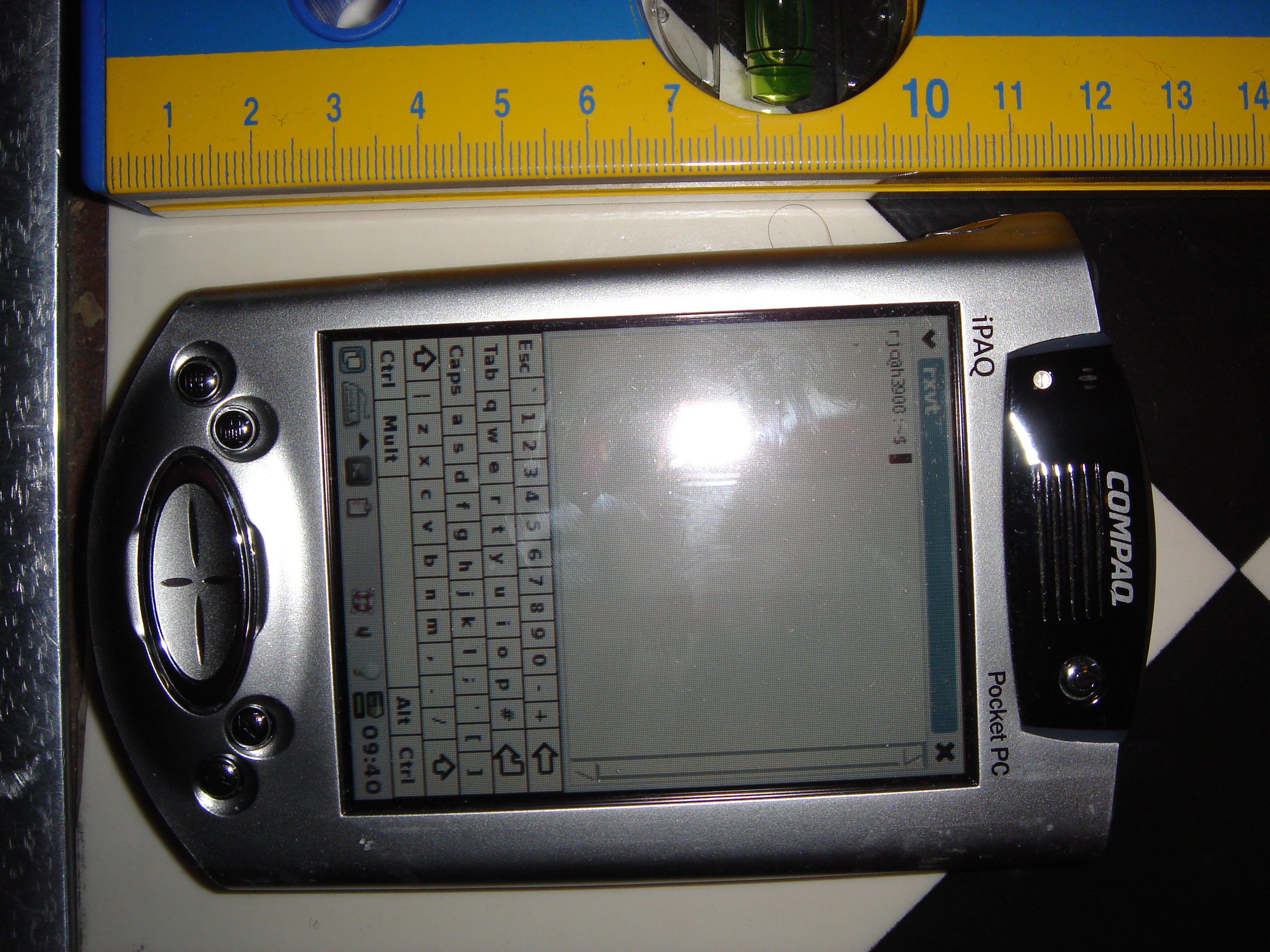
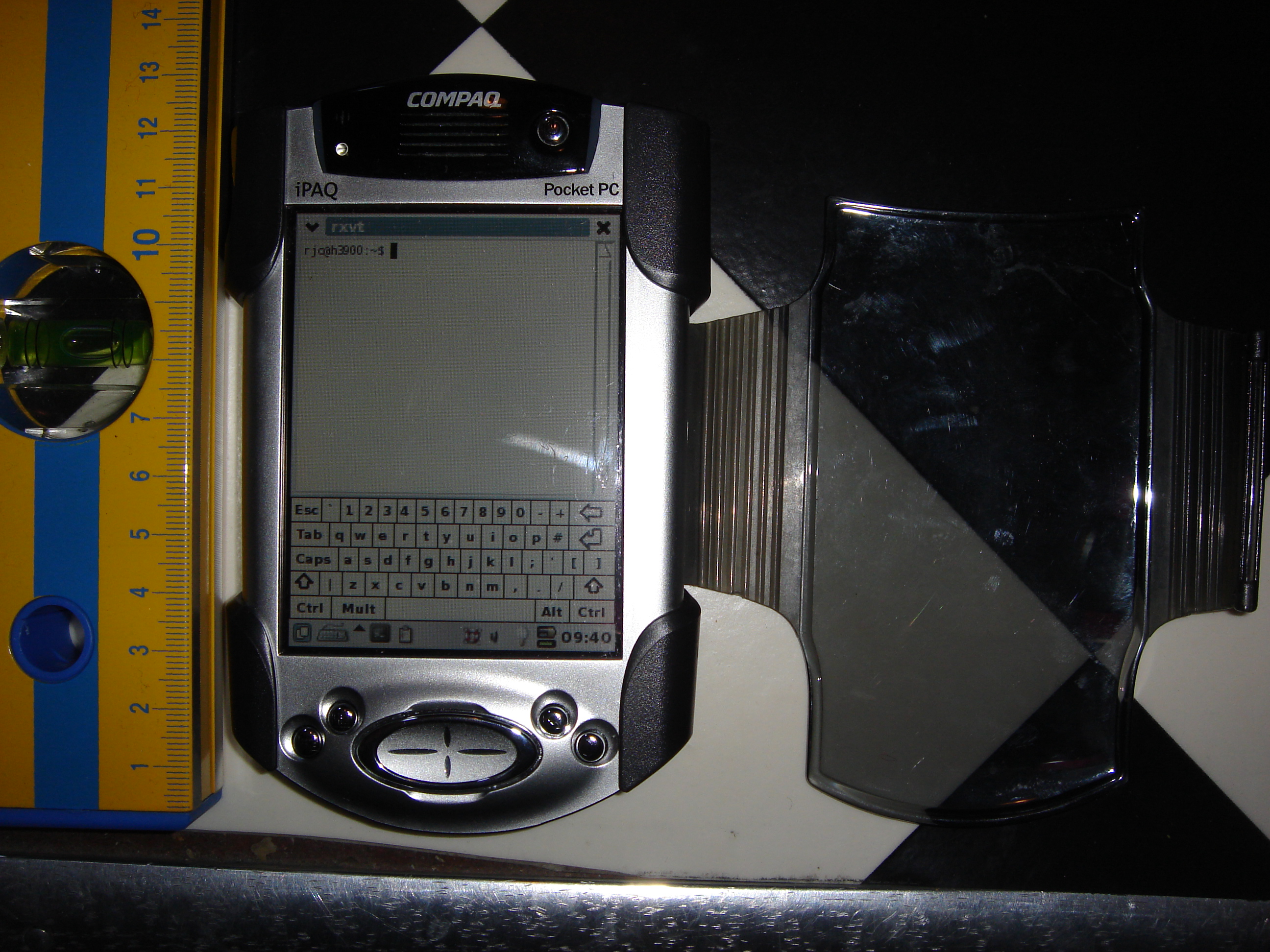
Since about 2002 I have been using a iPaQ [1] for taking notes while on the move. I have a pair of H3950 iPaQs that were given to me for the purpose of some software development work. As modern mobile phones have telephony as a small part of their feature set I think it s worth comparing a 2002 iPaQ with a 2009 mobile phone in terms of the note taking functionality. I have just got myself an LG U990 Viewty mobile phone [2]. It has a screen resolution of 240*320 which is the highest resolution that is remotely common for a mobile phone - and the same resolution as my 2002 model iPaQ. The LG KC910 Renoir has a resolution of 240*400 and seems to be the only phone that my carrier provides which has a higher resolution. The iPhone [3] has a resolution of 480*320. So it seems that the most expensive modern mobile phone that is available in Australia has a screen resolution that is only twice that of a 2002 PDA. I believe that in Japan you could buy a PDA with a higher resolution than 240*320 in 2002. My iPaQ is running Linux, so I can do whatever I want with it. I have a bar at the bottom of the screen with icons to launch, I configure it with the programs that I need most often and they are always one click away. While with my mobile phone I always have two large icons for paid services from my telco and I can t add icons for the things that I want. My iPaQ has a virtual keyboard that can be displayed in portrait or landscape mode. The above pictures show it in the portrait mode which allows the greatest area of screen space for text. The landscape mode is good for entering long lines of text even though the total number of words that can be displayed on screen is smaller. The size of my iPaQ is 134mm in height, between 77 and 84mm in width (it tapers) and 15.9mm thick without it s protective sleeve. The protective sleeve (shown in the second picture) adds about another 5mm to the width and thickness. My iPaQ is 1.76* the volume of my Viewty phone and at 184g vs 112g is 1.64* the mass. With it s sleeve on it is about 2.4* the volume. It s larger but with the sleeve it s a lot more solid, a touch-screen is very fragile so putting a touch-screen device in your back pocket without a sleeve is not a viable option. So I now own a mobile phone that has more storage, RAM, and CPU power than my iPaQ, but is less useful for the basic task of writing small documents and seems to have no facility for drawing diagrams. Most recent mobile phones have the ability to record voice (my Viewty can store 34 hours on it s internal storage and supports mini-SD cards for extra storage). But my Viewty lacks the ability to pause voice recording so if I wanted a series of notes during a meeting I would get a series of short voice recordings rather than a single file with many items. The todo list is also fairly poor in the Viewty, so even disregarding the poor keyboard on the touch-screen it would compare badly to the iPaQ. So it seems that an iPaQ that is almost seven years old when running Linux and the GPE Palmtop Environment [4] with with default configuration handily beats one of the latest and greatest mobile phones for all areas of common functionality. If the Viewty had it s source code available I would be tempted to contribute some patches (even if it was not free software). Finally, before someone suggests an Android [5], Greenphone [6] or other phone that s relatively open and programmable, I wanted a phone that had a good camera (by phone standards) and came essentially for free on an affordable contract. Maybe in two years time (when my current contract ends) there will be such a phone on offer. Mobile phones aren t THAT important to me, so while I would like to encourage the development of open telephony platforms it s a much lower priority than about a dozen free software projects. I expect that in the future something like an Android will become a great mobile phone with great PDA functionality. But for the moment I ll use an iPaQ and a Viewty.

Kapil Paranjape: Securing Synchronisation with unison (Mostly Wrong)

There are a number of documents about how to permit ssh access to run rsync or unison for remote synchronisation by an appropriate configuration of the authorized_keys file. Of these the best two are probably those by St phane Kattoor and Christian 'Greek0' Aichinger. Joey Hess also explains some of the pitfalls. The problem is the familiar one: to limit the file-system hierarchy accessible. The humble chroot is a natural way to implement such restrictions which is probably what led "Greek0" to suggest the use of dchroot. This is indeed a fine solution ... except, how does one implement it if one is not root on the server machine? WARNING: The rest of this entry is wrong as was pointed out by Joey Hess. See the update at the bottom. The package fakechroot by Piotr Roszatycki provides a way out. The problem I had was as follows: A recent enough version of fakechroot (version 2.8 worked) allows one to do make use of environment variables as follows:
LD_PRELOAD=libfakechroot.so
LD_LIBRARY_PATH=/usr/lib/fakechroot:/usr/lib64/fakechroot:/usr/lib32/fakechroot:/usr/lib:/lib
FAKECHROOT=true
FAKECHROOT_VERSION=2.8
FAKECHROOT_EXCLUDE_PATH=/bin:/lib:/usr
export LD_LIBRARY_PATH LD_PRELOAD
export FAKECHROOT_EXCLUDE_PATH FAKECHROOT FAKECHROOT_VERSION

After this setup one can run
HOME=/ chroot $HOME/some/dir /usr/bin/unison -server

and the unison server1 will only be able to view /bin, /lib, /usr and $HOME/some/dir; the latter will be mapped to /. (One needs to set the $HOME variable to something sensible for unison to function.) One should not be tempted to create subdirectories of $HOME/some/dir containing only the "relevant" portions of the system directories for unison. The reason is that those files will be created as me and so could be overwritten by unison. The creation of a suitable entry in authorized_keys to use this is an easy exercise! UPDATE: As Joey Hess has noted:
Taking a program, be it fakechroot or unison, that was never designed with security in mind, and trying to use it as a security barrier, is an open invitation to pain.
I had thought about the problem of uploading static-linked binaries and had imagined that it had been overcome. However, the basic facts in this case are:

  1. For those trying this out at $HOME with some terminal command like /bin/sh instead of /usr/bin/unison a suggestion is to add /dev to the FAKEROOT_EXCLUDE_PATH variable so that you have access to your terminal. Be aware that giving remote access to /dev may have unintended consequences!

4 January 2009

Neil Williams: Installing Emdebian Grip with D-I

A few experiments have led to a partial route to pre-seeding Emdebian Grip from a standard Debian Lenny ISO. A few issues arise:


Overall, it is possible to install Emdebian Grip - with a little help - using Debian Installer. A few more changes should make it possible to select a standard Emdebian Grip installation without X and an Emdebian Grip XFCE desktop.

Remaining issues include:


A bespoke config package can be arranged for this purpose - it won't be compliant with Debian Policy, at least as far as the status of Policy for Lenny.

Lots more to do but Lenny is still in-progress so there's time to get a usable installation before FOSDEM.

1 January 2009

Amaya Rodrigo: Mooch @ MAD


Mooch @ MAD
Originally uploaded by Amayita.

31 December 2008

Muammar El Khatib: Happy New Year

I just wanted to wish you all a Happy New Year :-)

29 December 2008

Adrian von Bidder: Milk

A blog entry I wanted to write quite some time now... Depicted on the right is a liter carton of organic whole milk of one of the two big retailers here in Switzerland. At the bottom is the red area again, enlarged. For those who don't read french, italian or german: it's an indication of the ingredients ( Ingredients: whole milk ), and a warning for people with allergies ( Contains milk .) No doubt information like this is an essential contribution to lowering health costs by making people chose healthier foods and being aware of what they eat.

28 December 2008

Aigars Mahinovs: How to survive a coffee cup - guide for laptop (and cat) owners

Yesterday my cat spilled a full cup of hot coffee on my 2k$+ laptop. Today, there is no trace of the incident and the laptop is working perfectly again. This is partially thanks to luck, partially to Dell laptop engineering and partially to my instinctive actions within first 10 seconds of the incident. I will recap it here so that if you happen to have a mishap of such kind you would know what to do to save your laptop. The first thing I did is pick up the laptop (so that extra coffee from the table would not go into the vents at the bottom of the laptop) keeping the corner that was soaked with coffee downwards. With one hand I held the notebook and pressed and held the Power button to turn the laptop off as soon as possible. With the other hand I removed the power cord and tried to remove the battery as well. It took a couple seconds, but when that was done and the laptop was placed on a towel on the floor the time sensitive part was over. After that was the clean-up. Coffee from the table and floor (so that other things don t get soaked), coffee form the outside of the laptop (with a damp cloth), After that I disassembled my laptop down to removing the motherboard and checking it for damage. Where ever I found traces of coffee, I cleaned them up with cotton swabs and spirit (clean water would also work, but would require more drying time). After I cleaned and dried every part off with a fan, I put the laptop back together. It took around 2 hours (more like 4 because I had to ask my girlfriend to pick up a new screwdriver on her way home as I lost mine). Everything was working, except the keyboard. Bits of coffee got inside the keyboard and were shortening the wires so some lines of buttons were not working and some were activating other keys when pressed. On an advice from a fried, I took out the keyboard and washed it. I simply put the keyboard under a stream on running water and made sure that the water got into every possible and impossible opening. After 5 minutes of washing I got the hairdryer and proceeded to dry the keyboard. After an hour I put it in, but it still did not work, so I left it on a heating radiator overnight. After around 18 hours of drying the keyboard started working again. Oh and it was cleaner than it ever was :D Summary: Do not panic! Get water out of you laptop, get it turned off, disconnect power and remove the battery. If you manage to do all that in 10 seconds or less, you might have a chance of seeing your laptop boot up again.

24 December 2008

Joachim Breitner: 19 month of laptop battery data

In June 2007, I bought a new 9-cell-battery for my ThinkPad notebook. Since then, I recorded, via a cron job, every five minutes these bits of information:I had planned to make some detailed analysis of this, but I haven t gotten around to do more than this graph (warning, large), of which the following iis a cut out. Since I now got a new laptop (with a new battery), I ll share my records.
I find it interesting that the last-full-state sometimes jumps up, closer to the design state. This could be re-calibration. Or the battery, after a while, re-scales iits output to appear less degraded. This might be checked by comparing the speed of discharge and charge at various points in time.If you want to do some analysis of your own, you can download the raw data (44354 data points). It has been anonymised by starting the time counter at zero, and shortening any gap of more than four hours to four hours. If you want to do some analysis in Haskell, you can take some code from my anonymizer script to parse the data. If you happen to find something interesting, appropriate crediting is appreciated.

Joachim Breitner: 19 months of laptop battery data

In June 2007, I bought a new 9-cell-battery for my ThinkPad notebook. Since then, I recorded, via a cron job, every five minutes these bits of information:I had planned to make some detailed analysis of this, but I haven t gotten around to do more than this graph (warning, large), of which the following is a cut out. Since I now got a new laptop (with a new battery), I ll share my records.
I find it interesting that the last-full-state sometimes jumps up, closer to the design state. This could be re-calibration. Or the battery, after a while, re-scales iits output to appear less degraded. This might be checked by comparing the speed of discharge and charge at various points in time.If you want to do some analysis of your own, you can download the raw data (44354 data points). It has been anonymised by starting the time counter at zero, and shortening any gap of more than four hours to four hours. If you want to do some analysis in Haskell, you can take some code from my anonymizer script to parse the data. If you happen to find something interesting, appropriate crediting is appreciated.

Next.

Previous.