Search Results: "nate"

11 October 2023

Russell Coker: The PineTime

I have just got a PineTime smart watch [1] from Pine64. They cost $US27 each which ended up as $144.63 Australian for three including postage when I ordered on the 16th of September, it s annoying that you can t order more than 3 at a time to reduce postage costs. The Australian online store Kogan has smart watches starting at about $15 [2] with Bluetooth and support for phone notifications so the $48.21 for a PineTime doesn t compare well on just price and features. The watches Kogan sells start getting into high resolution at around the $25 price and many of them have features like 24*7 heart monitoring that the PineTime lacks (it just measures when you request it). No-one would order a PineTime for being cheap or having lots of features, you order it because you want open hardware that allows you to do things your way. Also the PineTime isn t going to be orphaned while it s likely that in a few years most of the cheap watches sold by Kogan etc won t support the new phones running the latest version of Android. The screen of the PineTime is 240*240 resolution (about 260dpi) with 64k colors. The screen resolution is lower than some high-end smart watches but higher than most phones and almost all monitors. I doubt that much benefit could be gained from higher resolution. Even on minimum brightness the screen is easy to read on all but the brightest sunny days. The compute capabilities are 4.5MB of flash storage, 64k of RAM, and a 64MHz CPU this can t run Linux and nothing like it will run Linux for a long time. I ve had the PineTime for 6 days now, I charged it once and it s now at 55% battery. It looks like it will last close to 2 weeks on a single charge and it s claimed that a newer firmware will make the battery last longer. Software The main Android app for using with the PineTime is GadgetBridge which I installed from the f-droid repository. It had lots of click-through menus for allowing access to various Android features (contacts, bluetooth, draw over foreground, location, and more) but after that it was easy to setup. It was the first bluetooth device I ve used which had a 6 digit PIN for connecting to a phone. Initially I used the PineTime with my Huawei Nova 7i [3]. The aim is to eventually have it run from my PinePhonePro but my test of the PinePhonePro didn t go as well as hoped [4]. Now I m using it on my Huawei Mate 10 Pro. It comes with InfiniTime [5] installed as the default firmware, mine had 1.11.0 which is a fairly recent version. I will probably upgrade it soon to get the better power optimisation and weather alerts in the watch face. I don t have any plans to use different watch firmware and I don t have any plans to contribute to firmware development I just can t hack on every FOSS project around it s better to do big contributions to a small number of projects. For people who don t want the default firmware the Wasp-OS project seems interesting as it s written in Python [6], I don t like Python but it s very popular. Python is particularly popular in ML development, it will be interesting to see if Wasp-OS becomes a preferred platform for smart watches that talk to GPT servers. Generally the software works well, one annoyance is that when a notification goes away on the phone it remains on the PineTime and has to be manually dismissed. It would be nice if clearing notifications on the phone would clear them on the PineTime too. The music control works with RocketPlayer on Android, it displays the track name and has options for pause/play and skipping forward and backward one track. Annoyingly the current firmware doesn t allow configuring the main screens, from the primary screen you swipe down for notifications, right for settings, up for menus, and there s nothing defined for swipe left. I d like to make swipe left the command to get to music control. Hardware It has a detachable band that appears to be within the common range of watch bands. According to the PineTime Wiki page [7] there are a selection of alternate bands that will fit it, but some don t because the band is recessed into the watch. It is IP67 rated which means you can probably wear it while swimming. The charging contacts are exposed on the bottom of the case which means that any chemicals left by pool water can be cleaned off and also as they are apparently not expected to be harmed by sweat and skin oil there shouldn t be a problem charging it. I have significant experience using a Samsung Galaxy S5 Mini which is rated at IP67 in swimming pools. I had two problems with the S5 Mini when getting out of the pool, firstly water in the headphone socket made the phone consider that it was in headphone mode and turn off the speakers and secondly it took hours to become dry enough to charge and after many swims the charge rate dropped presumably due to oxide on the contacts. There are reports of success when swimming with a PineTime. Generally it feels well made and appears more solid than the cheapest Kogan devices appear to be. Conclusion If I wanted monitoring for medical reasons then I would choose a different smart watch. I ve read about people doing things like tracking their body stats 24*7 and trying to discover useful things, the PineTime is not a good option for BioHacking type use. However if I did have a need for such things I d probably just buy a second smart watch and have one on each wrist. The PineTime generally works well. It s a pity it has fewer hardware features than closed devices that are cheaper. But having a firmware that can be continually improved by the community is good. The continually expanding use of mobile phone technology devices for custom use in corporations (such as mobile phone in custom case for scanning prices etc in a supermarket) has some potential for use with this. I can imagine someone adding some custom features to a PineTime for such use. When a supermarket chain has 200,000 employees (as Woolworths in Australia does) then paying for a few months of software development work to make a smart watch do specific things for that company could provide significant value. There are probably some business opportunities for FOSS developers to hack on extra hardware on a PineTime and write software to support it. I recommend that everyone who s into FOSS buy one of these. Preferably make a deal with two friends to get the minimum postage cost.

10 October 2023

Dirk Eddelbuettel: drat 0.2.4 on CRAN: Improved macOS Support, General Updates

drat user A new minor release of the drat package arrived on CRAN today making it the first release in one and a half years. drat stands for drat R Archive Template, and helps with easy-to-create and easy-to-use repositories for R packages. Since its inception in early 2015 it has found reasonably widespread adoption among R users because repositories with marked releases is the better way to distribute code. Because for once it really is as your mother told you: Friends don t let friends install random git commit snapshots. Properly rolled-up releases it is. Just how CRAN shows us: a model that has demonstrated for two-plus decades how to do this. And you can too: drat is easy to use, documented by six vignettes and just works. Detailed information about drat is at its documentation site. Two more blog posts using drat from GitHub Actions were just added today showing, respectively, how to add to a drat repo in either push or pull mode. This release contains two extended PRs contributed by drat users! Both extended support for macOS: Joey Reid extended M1 support to pruning and archival, and Arne Johannes added bug-sur support. I polished a few more things around the edges, mostly documentation or continuos-integrations related. The NEWS file summarises the release as follows:

Changes in drat version 0.2.4 (2023-10-09)
  • macOS Arm M1 repos are now also supported in pruning and archival (Joey Reid in #135 fixing #134)
  • A minor vignette typo was fixed (Dirk)
  • A small error with setwd() in insertPackage() was corrected (Dirk)
  • macOS x86_64 repos (on big-sur) are now supported too (Arne Johannes Holmin in #139 fixing #138)
  • A few small maintenance tweaks were applied to the CI setup, and to the main README.md

Courtesy of my CRANberries, there is a comparison to the previous release. More detailed information is on the drat page as well as at the documentation site. If you like this or other open-source work I do, you can sponsor me at GitHub.

This post by Dirk Eddelbuettel originated on his Thinking inside the box blog. Please report excessive re-aggregation in third-party for-profit settings.

8 October 2023

Sahil Dhiman: Lap 24

Twenty-four is a big number. More than one/fourth (or more) of my life is behind me now. At this point, I truly feel like I have become an adult; mentally and physically. Another year seem to have gone by quickly. I still vividly remember writing 23 and Counting and here I m writing the next one so soon. Probably the lowest I felt ever on my birthday; with loss of Abraham and on the other hand, medical issues with a dear one. Didn t even felt like birthday was almost here. The loss of Abraham, taught me to care for people more and meet cherish everyone. I m grateful for all the people who supported and cared for me and others during times of grief when things went numb. Thank you! Also, for the first time ever, I went to office on my birthday. This probably would become a norm in coming years. Didn t felt like doing anything, so just went to office. The cake, wishes and calls kept coming in throughout the day. I m grateful for the all people around for remembering :) This year marked my first official job switch where I moved from MakeMyTrip to Unmukti as a GNU/Linux Network Systems engineer (that s a mouthful of a job role, I know) where I do anything and everything ranging from system admin, network engineering, a bit of social media, chronicling stuff on company blog and bringing up new applications as per requirement. Moving from MMT to Unmukti was a big cultural shift. From a full-blown corporate with more than 3 thousand employees to a small 5-person team. People still think I work for a startup on hearing the low head count, though Unmukti is a 13 year old organization. I get the freedom to work at my own pace and put my ideas in larger technical discussions, while also actively participating in the community, which I m truly grateful of. I go full geek here and almost everyone here is on the same spectrum, so things technical or societal discussions just naturally flow. The months of August-September again marked the Great Refresh. For reasons unforeseen, I have had to pack my stuff again and move, albeit to just next door for now, but that gave me the much need opportunity to sift through my belongings here. As usual, I threw a boatload of stuff which was of no use and/or just hogging space. My wardrobe cupboard finally got cleaned and sorted, with old and new clothes getting (re)discovered. The Refresh is always a pain with loads of collating stuff in carry worthy bags and hauling stuff but as usual, there s nothing else I can do other than just pack and move. This year also culminated our four plus years of work for organizing annual Debian conference, DebConf to India. DebConf23 happened in Kochi, Kerala from 3rd September to 17th September (including DebCamp). First concrete work to bring conference to India was done Raju Dev who made the first bid during DebConf18 in Hsinchu, Taiwan. We lost but won during the next year bid at DebConf19 Curitiba, Brazil in 2019. I joined the efforts after meeting the team online after DebConf20. Initially started with the publicity team, but we didn t need much publicity for event, I was later asked to join sponsors/fundraising team. That turned out to be quite an experience. Then the conference itself turned to be a good experience. More on that in an upcoming DebConf23 blog post, which will come eventually. After seeing how things work out in Debian in 2020, I had the goal to become a Debian Developer (DD) before DebConf23, which gave me almost three years to get involved and get recognized to become a DD. I was more excited to grab sahil AT debian.org, a short email with only my name and no number of characters after it. After, quite a while, I dropped the hope of become a DD because I wasn t successful in my attempts to meaningfully package and technically contribute to the project. But people in Debian India later convinced me that I have done enough to become a Debian Developer, non uploading, purely by showing up and helping around all for the Debian conferences. I applied and got sponsored (i.e. supported) for my request by srud and Praveen. Finally, on 23rd Feb, I officially became part of Debian project as 14th (at the moment) Debian Developer from India. Got sahil AT debian.org too :) For some grace, I also became a DD before DebConf23. Becoming a DD didn t change anything much though, I still believe, it might have helped secure me a job though. Also, worth mentioning is my increased interest in OpenStreetMap (OSM) mapping. I heavily mapped this year and went around for mapathon-meetups too. One step towards a better OSM and more community engagement around it. Looking back at my blog, this year around, it seems mostly dotted with Debian and one OSM post. Significant shift from the range of topics I use to write about in the past year but blogging this year wasn t a go-to activity. Other stuff kept me busy. Living in Gurugram has shown me many facades of life from which I was shielded or didn t come across earlier. It made me realize all the privileges which has helped me along the way, which became apparent while living almost alone here and managing thing by oneself.

6 October 2023

Russ Allbery: Review: The Far Reaches

Review: The Far Reaches, edited by John Joseph Adams
Publisher: Amazon Original Stories
Copyright: June 2023
ISBN: 1-6625-1572-3
ISBN: 1-6625-1622-3
ISBN: 1-6625-1503-0
ISBN: 1-6625-1567-7
ISBN: 1-6625-1678-9
ISBN: 1-6625-1533-2
Format: Kindle
Pages: 219
Amazon has been releasing anthologies of original short SFF with various guest editors, free for Amazon Prime members. I previously tried Black Stars (edited by Nisi Shawl and Latoya Peterson) and Forward (edited by Blake Crouch). Neither were that good, but the second was much worse than the first. Amazon recently released a new collection, this time edited by long-standing SFF anthology editor John Joseph Adams and featuring a new story by Ann Leckie, which sounded promising enough to give them another chance. The definition of insanity is doing the same thing over and over again and expecting different results. As with the previous anthologies, each story is available separately for purchase or Amazon Prime "borrowing" with separate ISBNs. The sidebar cover is for the first in the sequence. Unlike the previous collections, which were longer novelettes or novellas, my guess is all of these are in the novelette range. (I did not do a word count.) If you're considering this anthology, read the Okorafor story ("Just Out of Jupiter's Reach"), consider "How It Unfolds" by James S.A. Corey, and avoid the rest. "How It Unfolds" by James S.A. Corey: Humans have invented a new form of physics called "slow light," which can duplicate any object that is scanned. The energy expense is extremely high, so the result is not a post-scarcity paradise. What the technology does offer, however, is a possible route to interstellar colonization: duplicate a team of volunteers and a ship full of bootstrapping equipment, and send copies to a bunch of promising-looking exoplanets. One of them might succeed. The premise is interesting. The twists Corey adds on top are even better. What can be duplicated once can be duplicated again, perhaps with more information. This is a lovely science fiction idea story that unfortunately bogs down because the authors couldn't think of anywhere better to go with it than relationship drama. I found the focus annoying, but the ideas are still very neat. (7) "Void" by Veronica Roth: A maintenance worker on a slower-than-light passenger ship making the run between Sol and Centauri unexpectedly is called to handle a dead body. A passenger has been murdered, two days outside the Sol system. Ace is in no way qualified to investigate the murder, nor is it her job, but she's watched a lot of crime dramas and she has met the victim before. The temptation to start poking around is impossible to resist. It's been a long time since I've read a story built around the differing experiences of time for people who stay on planets and people who spend most of their time traveling at relativistic speeds. It's a bit of a retro idea from an earlier era of science fiction, but it's still a good story hook for a murder mystery. None of the characters are that memorable and Roth never got me fully invested in the story, but this was still a pleasant way to pass the time. (6) "Falling Bodies" by Rebecca Roanhorse: Ira is the adopted son of a Genteel senator. He was a social experiment in civilizing the humans: rescue a human orphan and give him the best of Genteel society to see if he could behave himself appropriately. The answer was no, which is how Ira finds himself on Long Reach Station with a parole officer and a schooling opportunity, hopefully far enough from his previous mistakes for a second chance. Everyone else seems to like Rebecca Roanhorse's writing better than I do, and this is no exception. Beneath the veneer of a coming-of-age story with a twist of political intrigue, this is brutal, depressing, and awful, with an ending that needs a lot of content warnings. I'm sorry that I read it. (3) "The Long Game" by Ann Leckie: The Imperial Radch trilogy are some of my favorite science fiction novels of all time, but I am finding Leckie's other work a bit hit and miss. I have yet to read a novel of hers that I didn't like, but the short fiction I've read leans more heavily into exploring weird and alien perspectives, which is not my favorite part of her work. This story is firmly in that category: the first-person protagonist is a small tentacled alien creature, a bit like a swamp-dwelling octopus. I think I see what Leckie is doing here: balancing cynicism and optimism, exploring how lifespans influence thinking and planning, and making some subtle points about colonialism. But as a reading experience, I didn't enjoy it. I never liked any of the characters, and the conclusion of the story is the unsettling sort of main-character optimism that seems rather less optimistic to the reader. (4) "Just Out of Jupiter's Reach" by Nnedi Okorafor: K rm n scientists have found a way to grow living ships that can achieve a symbiosis with a human pilot, but the requirements for that symbiosis are very strict and hard to predict. The result was a planet-wide search using genetic testing to find the rare and possibly nonexistent matches. They found seven people. The deal was simple: spend ten years in space, alone, in her ship. No contact with any other human except at the midpoint, when the seven ships were allowed to meet up for a week. Two million euros a year, for as long as she followed the rules, and the opportunity to be part of a great experiment, providing data that will hopefully lead to humans becoming a spacefaring species. The core of this story is told during the seven days in the middle of the mission, and thus centers on people unfamiliar with human contact trying to navigate social relationships after five years in symbiotic ships that reshape themselves to their whims and personalities. The ships themselves link so that the others can tour, which offers both a good opportunity for interesting description and a concretized metaphor about meeting other people. I adore symbiotic spaceships, so this story had me at the premise. The surface plot is very psychological, and I didn't entirely click with it, but the sense of wonder vibes beneath that surface were wonderful. It also feels fresh and new: I've seen most of the ideas before, but not presented or written this way, or approached from quite this angle. Definitely the best story of the anthology. (8) "Slow Time Between the Stars" by John Scalzi: This, on the other hand, was a complete waste of time, redeemed only by being the shortest "story" in the collection. "Story" is generous, since there's only one character and a very dry, linear plot that exists only to make a philosophical point. "Speculative essay" may be closer. The protagonist is the artificial intelligence responsible for Earth's greatest interstellar probe. It is packed with a repository of all of human knowledge and the raw material to create life. Its mission is to find an exoplanet capable of sustaining that life, and then recreate it and support it. The plot, such as it is, follows the AI's decision to abandon that mission and cut off contact with Earth, for reasons that it eventually explains. Every possible beat of this story hit me wrong. The sense of wonder attaches to the most prosaic things and skips over the moments that could have provoked real wonder. The AI is both unbelievable and irritating, with all of the smug self-confidence of an Internet reply guy. The prose is overwrought in all the wrong places ("the finger of God, offering the spark to animate the dirt of another world" would totally be this AI's profile quote under their forum avatar). The only thing I liked about the story is the ethical point that it slowly meanders into, which I think I might agree with and at least find plausible. But it's delivered by the sort of character I would actively leave rooms to avoid, in a style that's about as engrossing as a tax form. Avoid. (2) Rating: 5 out of 10

5 October 2023

Scarlett Gately Moore: KDE: Why KDE snaps Love KDE neon and the Big Move.

KDE neonKDE neon
KDE neon: KDE neon is extremely important to the KDE snaps eco-system as I briefly mentioned in my last post. Why? KDE neon is based on Jammy LTS which is the same as Core 22 base for snaps. Neon has a very useful continuous integration system in place that tests all the things, including dependencies, qml, cmake errors, debian packaging lintian tool and the list go on. This is very important to get packages out that don t break things on user desktops. Once the packages are a lovely shade of green on the neon CI ( or at least all the important issues are resolved ) it is in good shape for snapping. I have scripts that pull the build and runtime dependency information for our application package to use in the snapcraft.yaml. We know this list is complete, because it passed the tests! As applications gain features, they requires newer dependencies than what is provided in the ubuntu jammy repositories. Neon builds those newer dependencies and provides them to our users in the neon aptly repositories. It is much easier and more reliable than tracking down PPAs and hoping they stay maintained. We use the neon user edition repository in our snapcraft file to ensure we are up to date on KDE applications dependency needs. This week my work in Neon included turning jobs green and fixing kio-gdrive which is still qt5, but it s dependency libkgapi is qt6! We have to provide both versions in cases like this which entails tracking both master and the qt5 release branch. Snaps:
KMymoney 5.1
This week begun the big transition from single repository remote-builds to per repository snapcraft and using snap recipes on launchpad. This is an important move for a couple of reasons. We were having major issues with build failures as I pointed out in this bug report on launchpad: https://bugs.launchpad.net/launchpad/+bug/2031307 . This was due to the way remote-build works. It creates temporary snap recipes that builds once and sends back the snap or failure status. This made it very difficult to debug build failures as once the failure status was sent the job disappeared off of launchpad, taking all build logs with it. Now with the per repository snapcraft files, I have set up proper snap recipes on launchpad and the builds are automated by polling the github mirror for changes and it publishes the shiny new snap to candidate for testing or sends me the failure log that I can view at my convenience. This of course is a work in progress as we have 186 snaps currently and there are a few steps to get each one done. But once it is done, it will reduce my workload immensely and make debugging build issues faster. While making the move, I am also updating the snapcraft files for changes within snapcraft, adding cleanup to decrease bloat and fixing bugs! Snap move complete:
Artikulate with Courses
Current WIP: Audiotube, Digikam, Cantor, Neochat I also made a new content pack with KDE frameworks 5.110, but a new Qt 5.15.11 was just released so I will be making a new one tomorrow. The kf6 content snap has come to a halt as the qt6 content snap has stalled. I asked to be given access to the snapcraft file so that I may collaborate, but have not heard back. My mysterious project has reached its end for me. I might get a part time gig doing snaps out of it, but I do not meet the requirements to do any of the engineering of it. It is what it is. Thank you to all who vouched for me, alas it wasn t meant to be. If you can spare some change, I would appreciate it, especially to pay my phone/Internet bill so I can do more Neon and snaps  Thank you for stopping by. Donate https://gofund.me/b8b69e54

30 September 2023

Russell Coker: Links September 2023

Interesting article in Wired about adversarial attacks on ML systems to get them to do things that they are explicitely programmed not to do such as describe how to make illegal drugs [1]. The most interesting part of this is that the attacks work on most GPT systems which is probably due to the similar data used to train them. Vice has an interesting article about the Danish Synthetic Party , a political partyled by an AI [2]. Citizens can vote for candidates who will try to get laws passed that match the AI generated goals, there is no option of voting for an AI character. The policies they are advocating for are designed to appeal to the 20% of Danes who don t vote. They are also trying to inspire similar parties in other countries. I think this has the potential to improve democracy. Vice reports that in 2021 a man tried to assasinate the Queen of England with inspiration from Star Wars and an AI chat bot [3]. While someone who wants to be a real-life Sith is probably going to end up doing something bad we still don t want to have chat bots encourage it. Bruce Schneier wrote an interesting article about milestones for AI involvement in the political process [4]. Sam Varghese wrote an interesting article about the allegations that India is following the example of Saudi Arabia and assasinating people in other countries who disagree with their government [5]. We need to stop this. Ian Jackson wrote an interesting blog post advocating that DKIM PRIVATE keys be rotated and PUBLISHED [6]. The idea is that if a hostile party gets access to the mailbox of someone who received private email from you then in the normal DKIM setup of keys never changing they can prove that the email is authentic when they leak it. While if you mail server publishes the old keys as Ian advocates then the hostile party can t prove that you sent the email in question as anyone could have forged a signature. Anything that involves publishing a private key gets an immediate negative reaction but I can t fault the logic here.

Russell Coker: Choosing Exclusion

There is an article The Inappropriately Excluded by the Polymath Archives [1] that gets cited a lot. Mainly by Mensa types who think that their lack of success is due to being too smart. The Main Claim is Wrong The main claim is:
The probability of entering and remaining in an intellectually elite profession such as Physician, Judge, Professor, Scientist, Corporate Executive, etc. increases with IQ to about 133. It then falls by about 1/3 at 140. By 150 IQ the probability has fallen from its peak by 97%! The first thing to consider is whether taking those professions is a smart thing to do. These are the types of jobs that a school career adviser would tell you are good choices for well paying jobs, but really there s lots of professional positions that get similar pay with less demanding work. Physicians have to deal with people who are sick and patients who die including cases where the physician needs to make a recommendation on incomplete information where the wrong choice will result in serious injury or death, there are significant benefits to being a medical researcher or doing biological engineering. Being a Judge has a high public profile and has a reasonable amount of pressure, good for status but you can probably earn more money with less work as a corporate lawyer. Being a professor is a position that is respected but which in many countries is very poorly paid. In a mid-size company executives probably get about $300k compared to $220k for middle managers and $100k-$180k for senior professional roles in the same company. There has been research on how much happyness is increased by having more money, here is one from CBS saying that income up to $500K can increase happiness[2] which contradicts previous research suggesting that income over $75K didn t provide much benefit. I think that part of this is determined by the conditions that you live in, if you live in a country like Australia with cheap healthcare then you won t feel as great a need to hoard money. Another part is whether you feel obliged to compete with other people for financial status, if driving an old car of a non-prestige brand while my neighbours have new BMWs concerned me then I might desire an executive position. I think that the smart thing to do is to get work that is relatively enjoyable, pays enough for all the essentials and some reasonable luxury, and doesn t require excessive effort or long hours. Unless you have a great need for attention from other people then for every job with a high profile there will be several with similar salaries but less attention. The main point of the article is that people with high IQs all want to reach the pinnacle of their career path and don t do so because they are excluded. It doesn t consider the possibility that smart people might have chosen the option that s best for them. For example I ve seen what my manager and the CIO of my company do and it doesn t look like fun for me. I m happy to have them earn more than me as compensation for doing things I don t want to do. Why is This Happening? This section of the article starts with Because of the dearth of objective evidence, the cause of the exclusion cannot be determined directly which is possibly where they should have given up. Also I could have concluded this blog post with I m not excluded from this list of jobs that suck , but I will continue listing problems with the article. One claim in the article is:
Garth Zietsman has said, referring to people with D15IQs over 152, A common experience with people in this category or higher is that they are not wanted the masses (including the professional classes) find them an affront of some sort. The question I have is whether it s being smart or being a jerk that the masses find to be an affront, I m guessing the latter. I don t recall seeing evidence outside high school of people inherently disliking smarter people. The article claims that We have no reason to conclude that this upper limit on IQ differences changes in adulthood . Schools don t cater well to smart kids and it isn t good for kids to have no intellectual peers. One benefit I ve found in the Free Software community is that there are a lot of smart people. Regarding leadership it claims D.K. Simonton found that persuasiveness is at its maximum when the IQ differential between speaker and audience is about 20 points . A good counter example is Julius Sumner Miller who successfully combined science education and advertising for children s chocolate [3]. Maybe being a little smarter than other people makes it more difficult to communicate with them but being as smart as Julius Sumner Miller can outweigh that. The article goes on to claim that the intellectual elites have an average IQ of 125 because they have to convince people who have an average IQ of 105. I think that if that 20 point difference was really a thing then you would have politicians with an IQ of 125 appointing leaders of the public service with an IQ of 145 who would then hire scientific advisers with an IQ of 165. In a corporate environment a CEO with an IQ of 125 could hire a CIO with an IQ of 145 who could then hire IT staff with an IQ of 165. If people with 165 IQs wanted to be Prime Minister or CEO that might suck for them, but if they wanted to have the most senior technical roles in public service or corporations then it would work out well. For the work I do I almost never speak to a CEO and rarely speak to anyone who regularly speaks to them, if CEOs don t like me and won t hire people like me then it doesn t matter to me as I won t meet them. Inappropriate Educational Options The section on Inappropriate Educational Options is one where I almost agree with the author. I say almost because I don t think that schools are good for anyone. Yes schools have some particular problems for smart kids, but they also have serious problems for kids who are below average IQ, kids who have problems at home, kids who are disabled, etc. Most schools fail so many groups of kids in so many ways that the overall culture of schools can t be functional. Social Isolation The section on Social Isolation is another where I almost agree with the author. But as with schools I think that society overall is poorly structured to support people such that people on the entire range of IQs have more difficulty in finding friends and relationships than they should. One easy change to make would be to increase the minimum wage such that one minimum wage job can support a family without working more than 35 hours a week and to set the maximum work week to something less than 40 hours Atlassian has a good blog post about the data on working weeks [4]. Wired has an article suggesting that 5 hours a day is an ideal work time for some jobs [5]. We also need improvements in public transport and city design to have less wasted time and better options for socialising. Conclusion The blogspot site hosting the article in question also has a very complex plan for funding a magazine for such articles [6]. The problems with that funding model start with selling advertising that converts to shares in a Turks & Caicos company in an attempt to circumvent securities regulations (things don t work that way). Then it goes in to some complex formulas for where money will go. This isn t the smart way to start a company, the smart way is to run a kickstarter with fixed rewards for specific amounts of contributions and then possibly have an offer of profit sharing with people who donate extra or something. As a general rule when doing something that s new to you it s a good idea to look at how others have succeeded at it in the past. Devising an experimental new way of doing something is best reserved to people who have some experience withe the more common methods. Mentioning this may seem like an ad hominem attack, but I think it s relevant to consider this in the context of people who score well in IQ tests but don t do so well in other things. Maybe someone who didn t think that they were a lot smarter than everyone else would have tried to launch a magazine in a more common way and actually had some success at it. In a more general sense I think that people who believe that they are suffering because of being too smart are in a similar category as incels. It s more of a psychological problem than anything else and one that they could solve for themselves.

29 September 2023

Scarlett Gately Moore: KDE: Another Busy Week! KDE neon, Debian, Snaps Oh My!

KDE Plasma 6KDE Plasma 6
I would like to welcome you to my revamped site. It is still a work in progress, so please be patient while I work out the kinks! I have also explained a bit more about myself in my About Me page for those that may have questions about my homesteader lifestyle. Check it out when you have time. My site is mostly my adventures in packaging software in Linux in a variety of formats ( mostly Debian and Ubuntu Snaps containerized packages ). This keeps me very busy, as folks don t realize the importance of packaging. Without it, applications remain in source code form which isn t very usable by the users! While turning the source code into something user friendly we often run into issues and work with upstream ( I am a very strong believer in upstream first ) to resolve any issues. This makes for a better user experience and less buggy software. Workarounds are very hard to maintain and thus fixing it right the first time is the best path! With this said, while I am not strong in any one programming language ( Well maybe Ruby from my CI tooling background ) I am versed in many languages, as I have to understand the code that I am filing bug reports for! We have to have a strong knowledge of being able to understand build failures, debug runtime failures and most importantly we have to be able to fix them, or find the resources to assist in fixing them. As most of you know I am KDE s biggest fan ( There is nothing wrong with Gnome, its a great platform ). So a big portion of my work is dedicated to KDE. A fantastic tool for working on my KDE packaging has been KDE Neon! With the developer version I have all the tools necessary to debug and fix issues that arise. There is also the added bonus of living on the edge and finding out runtime issues right away! That is enough about me for now and on to my weekly round up! KDE neon: Carlos ( check out his new blog! https://www.ethicalconstruct.au/dotclear_blog/ ) and I have been very busy with another round of KDE applications making the move to Qt6. We have finished KDE PIM and KDE Games in Neon/unstable! I have worked out issues with print-manager and re-enabled it in experimental as it s qt6 development is still happening in kf6 branch. Instructions here: https://blog.neon.kde.org/2023/08/04/announcing-kde-neon-experimental/ Fixed issues with a broken kscreenlocker and missing window decorations. You can now safely leave your computer and not worry about that dreaded black screen. Debian: I have uploaded the newest squashfuse to unstable. I have uploaded another NEW dependency for bubblegum golang-github-alecthomas-mango-kong-dev Ubuntu Snaps: This week continues working closely with Jarred Wilson of Canonical in getting his Qt6 content snap in shape for use with my KDE Frameworks 6 snap ( an essential snap to move forward with our next generation Qt6 applications and of course the Plasma snap. I spent some time debugging the neochat snap and fixed some QML issues, but I am now facing issues with wayland. It now works fine for those of us still on X11. I will continue working out wayland. Thank you! I rely on donations to upkeep my everyday living and so far thanks to each and every one of you I have survived almost a full year! It has been scary from time to time, but I am surviving. Until my snap project goes through I must rely on the kindness of my supporters. The proceeds of my donations goes to the following: I have joined the kool kids and moved to Donorbox for donations. Donate I still have Gofundme for those that don t want to signup for yetanotherdonationplatform. https://gofund.me/b8b69e54

22 September 2023

Scarlett Gately Moore: KDE: KDE Neon updates! Qt6 transition moving along.

With user edition out the door last week, this week was spent stabilizing unstable! Spent some time sorting out our Calamares installer being quite grumpy which is now fixed by reverting an upstream change. Unstable and developer ISO rebuilt and installable. Spent some time sorting out some issues with using an unreleased appstream ( thanks ximion for help with packagekit! ) KDE applications are starting to switch to Qt6 in master this week, the big one being KDE PIM! This entails an enormous amount of work re-packaging. I have made a dent, sorta. To be continued next week. I fixed our signond / kaccounts line for qt6 which entailed some work on upstream code that uses QStringList.toSet which was removed in Qt6! Always learning new things! I have spent some time working on the KF6 content snap, working with Jarred to make sure his qt6 content snap will work for us. Unfortunately, I do not have much time for this as I must make money to survive, donations help free up time for this  Our new proposal with Kevin s super awesome management company has been submitted and we will hopefully hear back next week. Thanks for stopping by! Till next week. If you can spare some change, consider a donation Thank you! https://gofund.me/b8b69e54

21 September 2023

Jonathan Carter: DebConf23

I very, very nearly didn t make it to DebConf this year, I had a bad cold/flu for a few days before I left, and after a negative covid-19 test just minutes before my flight, I decided to take the plunge and travel. This is just everything in chronological order, more or less, it s the only way I could write it.
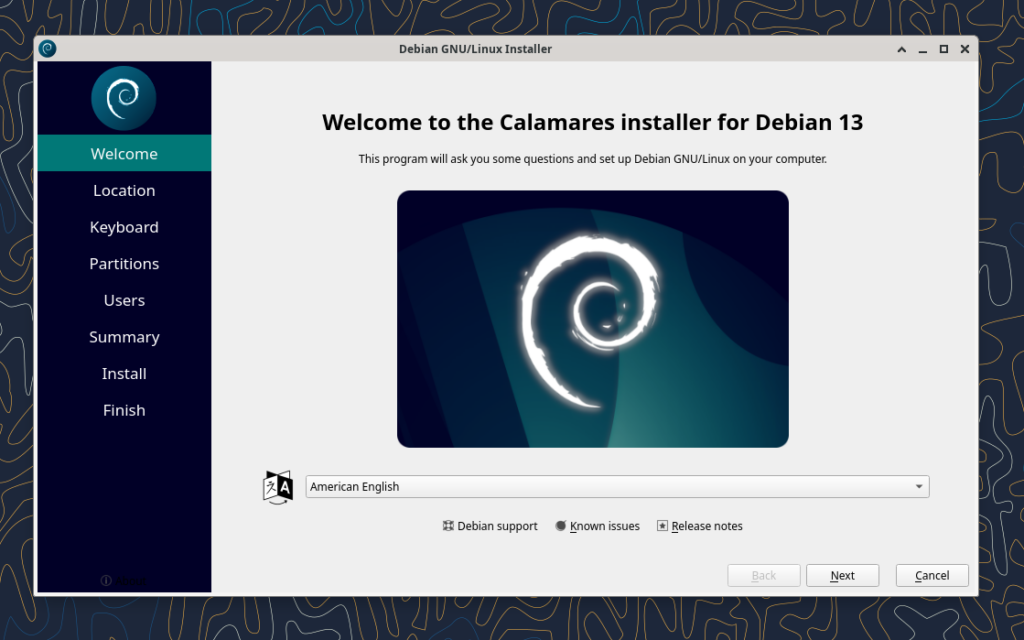
DebCamp I planned to spend DebCamp working on various issues. Very few of them actually got done, I spent the first few days in bed further recovering, took a covid-19 test when I arrived and after I felt better, and both were negative, so not sure what exactly was wrong with me, but between that and catching up with other Debian duties, I couldn t make any progress on catching up on the packaging work I wanted to do. I ll still post what I intended here, I ll try to take a few days to focus on these some time next month: Calamares / Debian Live stuff:
  • #980209 installation fails at the install boot loader phase
  • #1021156 calamares-settings-debian: Confusing/generic program names
  • #1037299 Install Debian -> Untrusted application launcher
  • #1037123 Minimal HD space required too small for some live images
  • #971003 Console auto-login doesn t work with sysvinit
At least Calamares has been trixiefied in testing, so there s that! Desktop stuff:
  • #1038660 please set a placeholder theme during development, different from any release
  • #1021816 breeze: Background image not shown any more
  • #956102 desktop-base: unwanted metadata within images
  • #605915 please mtheake it a non-native package
  • #681025 Put old themes in a new package named desktop-base-extra
  • #941642 desktop-base: split theme data files and desktop integrations in separate packages
The Egg theme that I want to develop for testing/unstable is based on Juliette Taka s Homeworld theme that was used for Bullseye. Egg, as in, something that hasn t quite hatched yet. Get it? (for #1038660) Debian Social:
  • Set up Lemmy instance
    • I started setting up a Lemmy instance before DebCamp, and meant to finish it.
  • Migrate PeerTube to new server
    • We got a new physical server for our PeerTube instance, we should have more space for growth and it would help us fix the streaming feature on our platform.
Loopy: I intended to get the loop for DebConf in good shape before I left, so that we can spend some time during DebCamp making some really nice content, unfortunately this went very tumbly, but at least we ended up with a loopy that kind of worked and wasn t too horrible. There s always another DebConf to try again, right?
So DebCamp as a usual DebCamp was pretty much a wash (fitting with all the rain we had?) for me, at least it gave me enough time to recover a bit for DebConf proper, and I had enough time left to catch up on some critical DPL duties and put together a few slides for the Bits from the DPL talk.

DebConf Bits From the DPL I had very, very little available time to prepare something for Bits fro the DPL, but I managed to put some slides together (available on my wiki page). I mostly covered:
  • A very quick introduction of myself (I ve done this so many times, it feels redundant giving my history every time), and some introduction on what it is that the DPL does. I declared my intent not to run for DPL again, and the reasoning behind it, and a few bits of information for people who may intend to stand for DPL next year.
  • The sentiment out there for the Debian 12 release (which has been very positive). How we include firmware by default now, and that we re saying goodbye to architectures both GNU/KFreeBSD and mipsel.
  • Debian Day and the 30th birthday party celebrations from local groups all over the world (and a reminder about the Local Groups BoF later in the week).
  • I looked forward to Debian 13 (trixie!), and how we re gaining riscv64 as a release architecture, as well as loongarch64, and that plans seem to be forming to fix 2k38 in Debian, and hopefully largely by the time the Trixie release comes by.
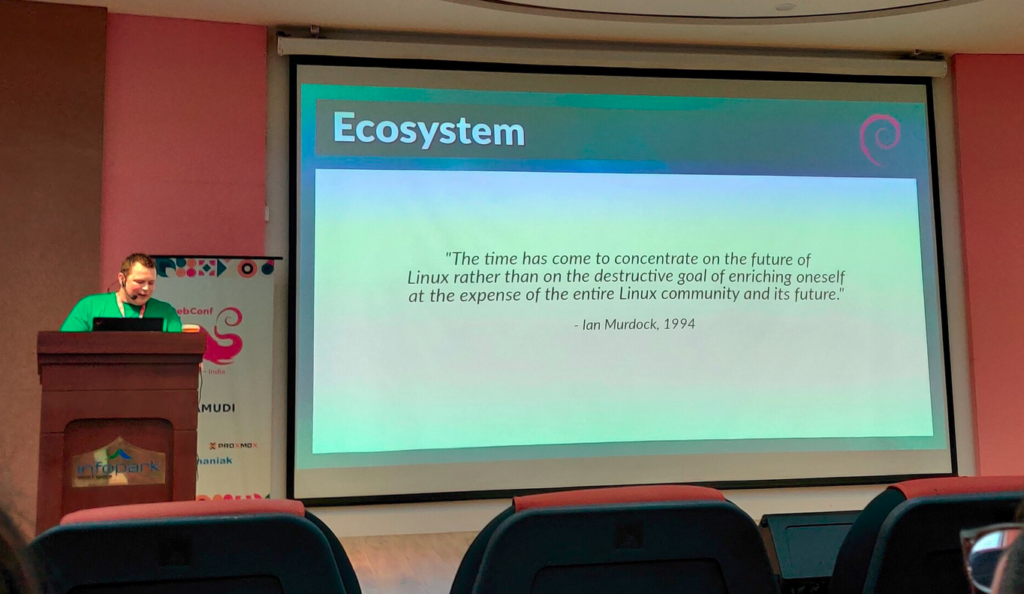
  • I made some comments about Enterprise Linux as people refer to the RHEL eco-system these days, how really bizarre some aspects of it is (like the kernel maintenance), and that some big vendors are choosing to support systems outside of that eco-system now (like CPanel now supporting Ubuntu too). I closed with the quote below from Ian Murdock, and assured the audience that if they want to go out and make money with Debian, they are more than welcome too.
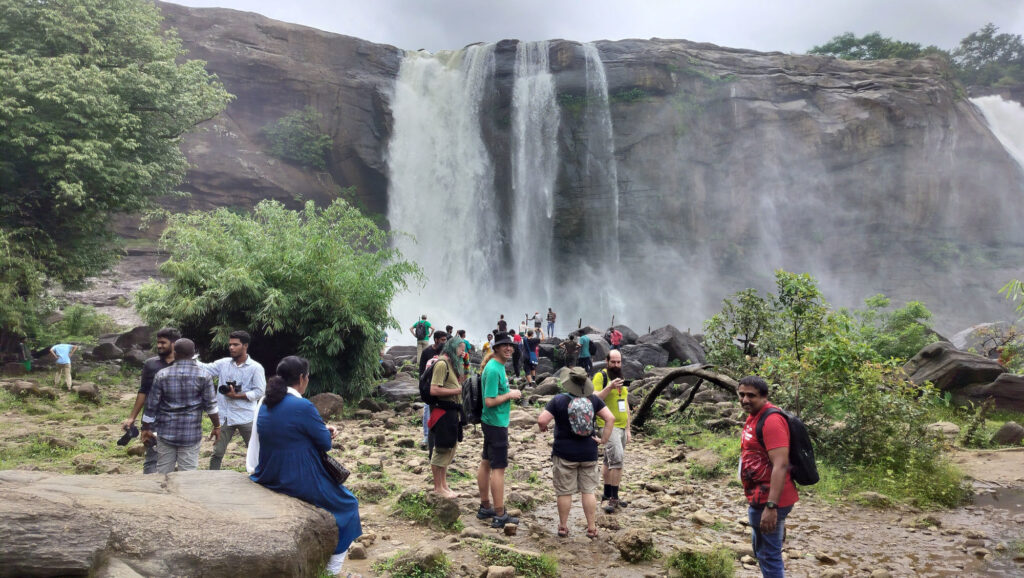
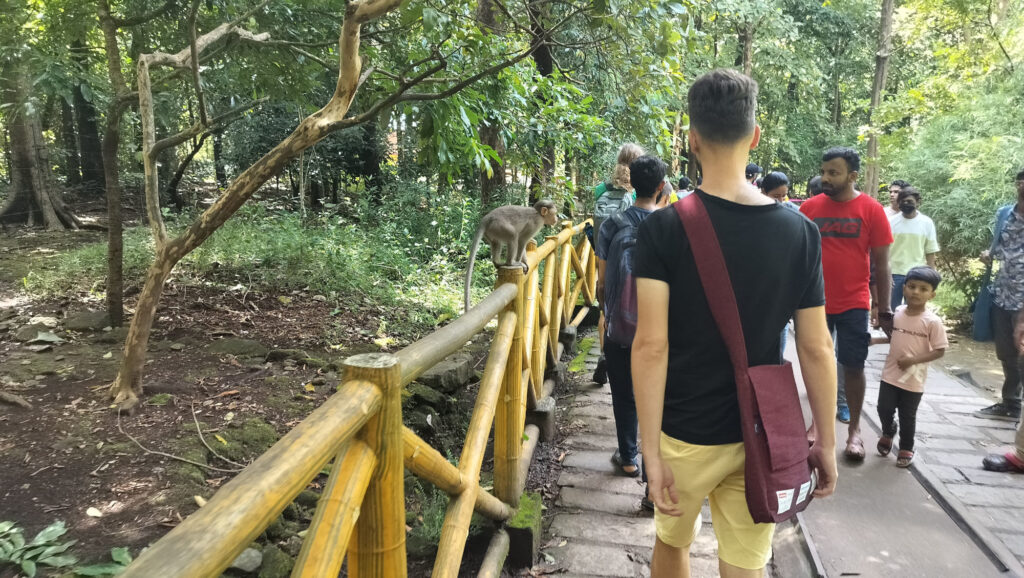
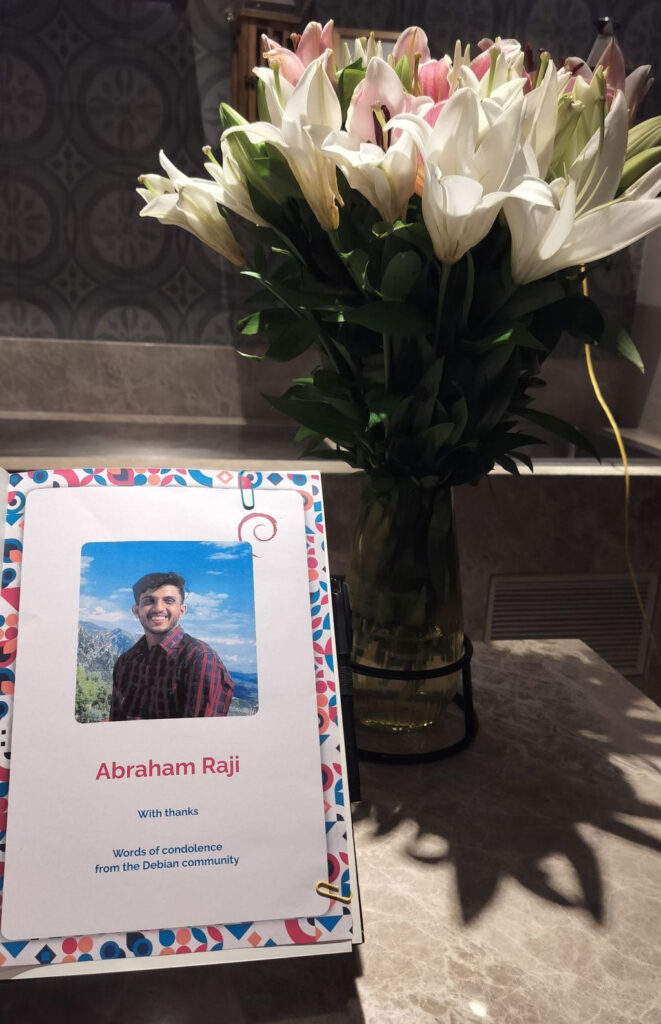
Job Fair I walked through the hallway where the Job Fair was hosted, and enjoyed all the buzz. It s not always easy to get this right, but this year it was very active and energetic, I hope lots of people made some connections! Cheese & Wine Due to state laws and alcohol licenses, we couldn t consume alcohol from outside the state of Kerala in the common areas of the hotel (only in private rooms), so this wasn t quite as big or as fun as our usual C&W parties since we couldn t share as much from our individual countries and cultures, but we always knew that this was going to be the case for this DebConf, and it still ended up being alright. Day Trip I opted for the forest / waterfalls daytrip. It was really, really long with lots of time in the bus. I think our trip s organiser underestimated how long it would take between the points on the route (all in all it wasn t that far, but on a bus on a winding mountain road, it takes long). We left at 8:00 and only found our way back to the hotel around 23:30. Even though we arrived tired and hungry, we saw some beautiful scenery, animals and also met indigenous river people who talked about their struggles against being driven out of their place of living multiple times as government invests in new developments like dams and hydro power. Photos available in the DebConf23 public git repository. Losing a beloved Debian Developer during DebConf To our collective devastation, not everyone made it back from their day trips. Abraham Raji was out to the kayak day trip, and while swimming, got caught by a whirlpool from a drainage system. Even though all of us were properly exhausted and shocked in disbelief at this point, we had to stay up and make some tough decisions. Some initially felt that we had to cancel the rest of DebConf. We also had to figure out how to announce what happened asap both to the larger project and at DebConf in an official manner, while ensuring that due diligence took place and that the family is informed by the police first before making anything public. We ended up cancelling all the talks for the following day, with an address from the DPL in the morning to explain what had happened. Of all the things I ve ever had to do as DPL, this was by far the hardest. The day after that, talks were also cancelled for the morning so that we could attend his funeral. Dozens of DebConf attendees headed out by bus to go pay their final respects, many wearing the t-shirts that Abraham had designed for DebConf. A book of condolences was set up so that everyone who wished to could write a message on how they remembered him. The book will be kept by his family.
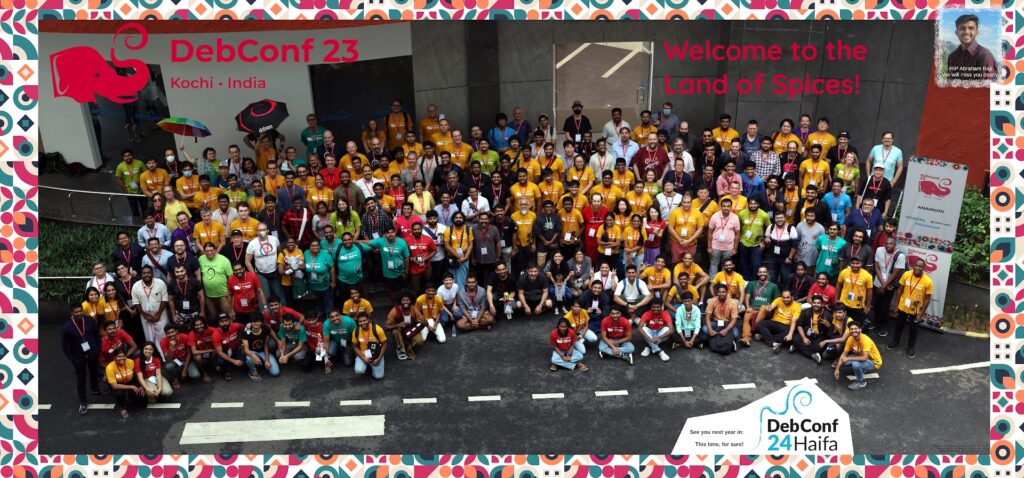
Today marks a week since his funeral, and I still feel very raw about it. And even though there was uncertainty whether DebConf should even continue after his death, in hindsight I m glad that everyone pushed forward. While we were all heart broken, it was also heart warming to see people care for each other in all of this. If anything, I think I needed more time at DebConf just to be in that warm aura of emotional support for just a bit longer. There are many people who I wanted to talk to who I barely even had a chance to see. Abraham, or Abru as he was called by some people (which I like because bru in Afrikaans is like bro in English, not sure if that s what it implied locally too) enjoyed artistic pursuits, but he was also passionate about knowledge transfer. He ran classes at DebConf both last year and this year (and I think at other local events too) where he taught people packaging via a quick course that he put together. His enthusiasm for Debian was contagious, a few of the people who he was mentoring came up to me and told me that they were going to see it through and become a DD in honor of him. I can t even remember how I reacted to that, my brain was already so worn out and stitching that together with the tragedy of what happened while at DebConf was just too much for me. I first met him in person last year in Kosovo, I already knew who he was, so I think we interacted during the online events the year before. He was just one of those people who showed so much promise, and I was curious to see what he d achieve in the future. Unfortunately, we was taken away from us too soon. Poetry Evening Later in the week we had the poetry evening. This was the first time I had the courage to recite something. I read Ithaka by C.P. Cavafy (translated by Edmund Keely). The first time I heard about this poem was in an interview with Julian Assange s wife, where she mentioned that he really loves this poem, and it caught my attention because I really like the Weezer song Return to Ithaka and always wondered what it was about, so needless to say, that was another rabbit hole at some point. Group Photo Our DebConf photographer organised another group photo for this event, links to high-res versions available on Aigar s website.
BoFs I didn t attend nearly as many talks this DebConf as I would ve liked (fortunately I can catch up on video, should be released soon), but I did make it to a few BoFs. In the Local Groups BoF, representatives from various local teams were present who introduced themselves and explained what they were doing. From memory (sorry if I left someone out), we had people from Belgium, Brazil, Taiwan and South Africa. We talked about types of events a local group could do (BSPs, Mini DC, sprints, Debian Day, etc. How to help local groups get started, booth kits for conferences, and setting up some form of calendar that lists important Debian events in a way that makes it easier for people to plan and co-ordinate. There s a mailing list for co-ordination of local groups, and the irc channel is -localgroups on oftc.
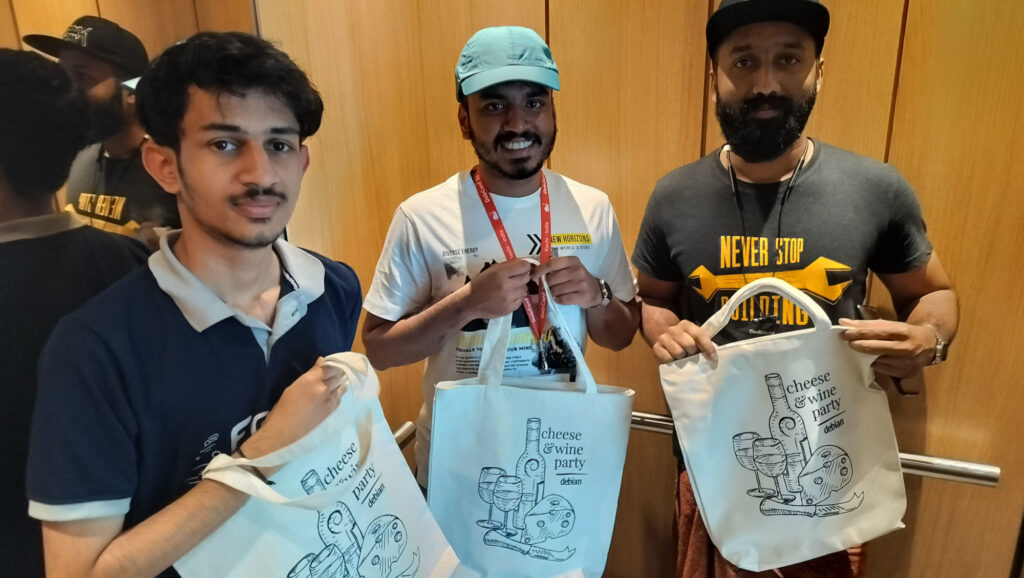
If you got one of these Cheese & Wine bags from DebConf, that s from the South African local group!
In the Debian.net BoF, we discussed the Debian.net hosting service, where Debian pays for VMs hosted for projects by individual DDs on Debian.net. The idea is that we start some form of census that monitors the services, whether they re still in use, whether the system is up to date, whether someone still cares for it, etc. We had some discussion about where the lines of responsibility are drawn, and we can probably make things a little bit more clear in the documentation. We also want to offer more in terms of backups and monitoring (currently DDs do get 500GB from rsync.net that could be used for backups of their services though). The intention is also to deploy some form of configuration management for some essentials across the hosts. We should also look at getting some sponsored hosting for this. In the Debian Social BoF, we discussed some services that need work / expansion. In particular, Matrix keeps growing at an increased rate as more users use it and more channels are bridged, so it will likely move to its own host with big disks soon. We might replace Pleroma with a fork called Akkoma, this will need some more home work and checking whether it s even feasible. Some services haven t really been used (like Writefreely and Plume), and it might be time to retire them. We might just have to help one or two users migrate some of their posts away if we do retire them. Mjolner seems to do a fine job at spam blocking, we haven t had any notable incidents yet. WordPress now has improved fediverse support, it s unclear whether it works on a multi-site instance yet, I ll test it at some point soon and report back. For upcoming services, we are implementing Lemmy and probably also Mobilizon. A request was made that we also look into Loomio. More Information Overload There s so much that happens at DebConf, it s tough to take it all in, and also, to find time to write about all of it, but I ll mention a few more things that are certainly worth of note. During DebConf, we had some people from the Kite Linux team over. KITE supplies the ICT needs for the primary and secondary schools in the province of Kerala, where they all use Linux. They decided to switch all of these to Debian. There was an ad-hoc BoF where locals were listening and fielding questions that the Kite Linux team had. It was great seeing all the energy and enthusiasm behind this effort, I hope someone will properly blog about this! I learned about the VGLUG Foundation, who are doing a tremendous job at promoting GNU/Linux in the country. They are also training up 50 people a year to be able to provide tech support for Debian. I came across the booth for Mostly Harmless, they liberate old hardware by installing free firmware on there. It was nice seeing all the devices out there that could be liberated, and how it can breathe new life into old harware.
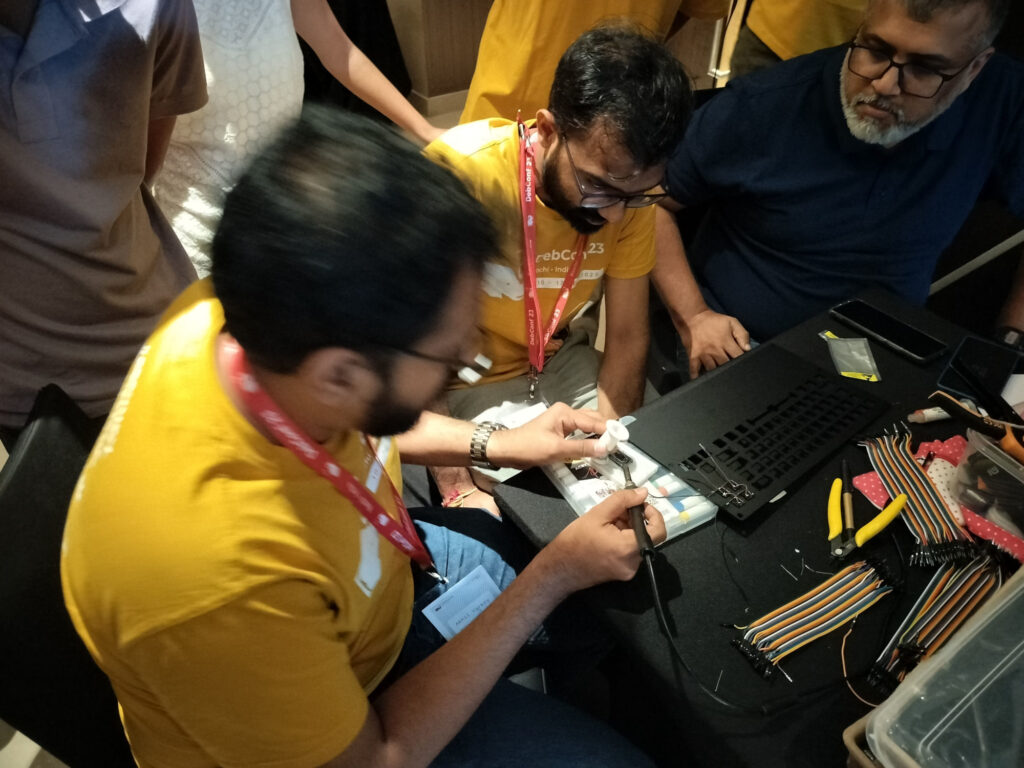
Some hopefully harmless soldering.
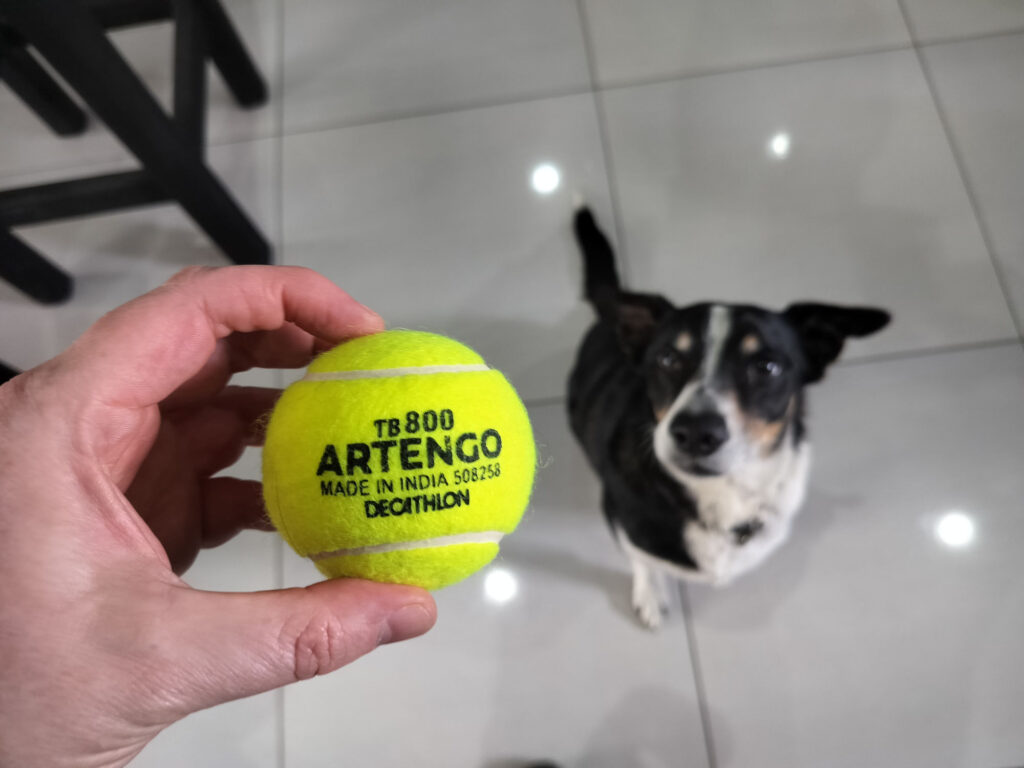
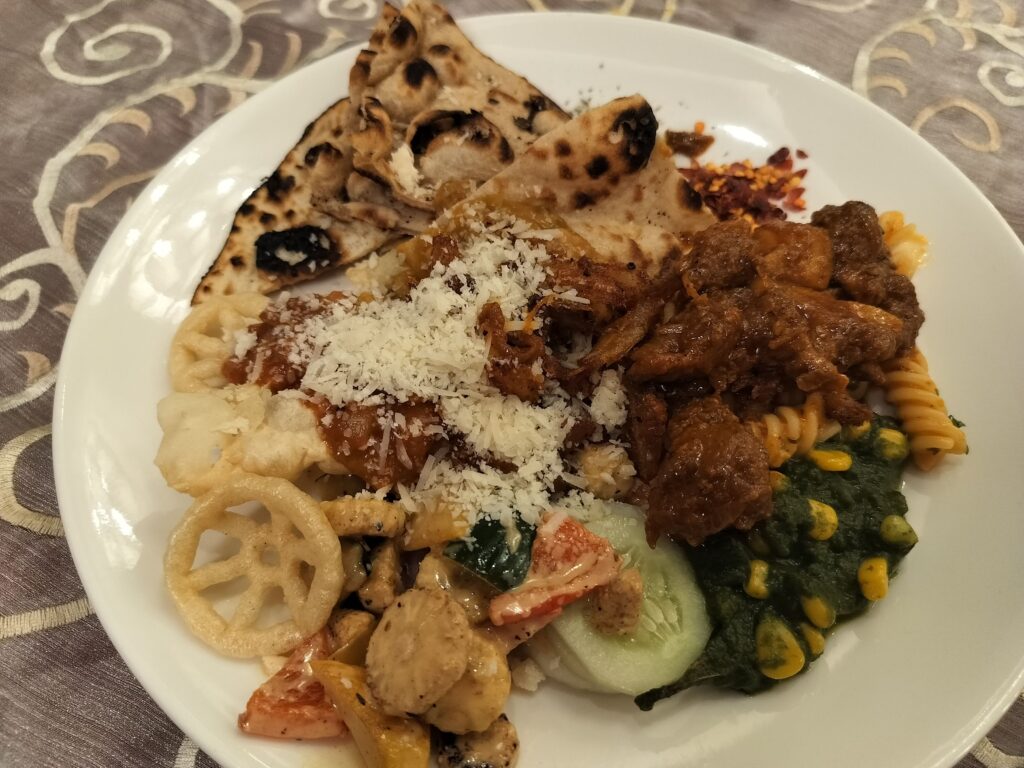
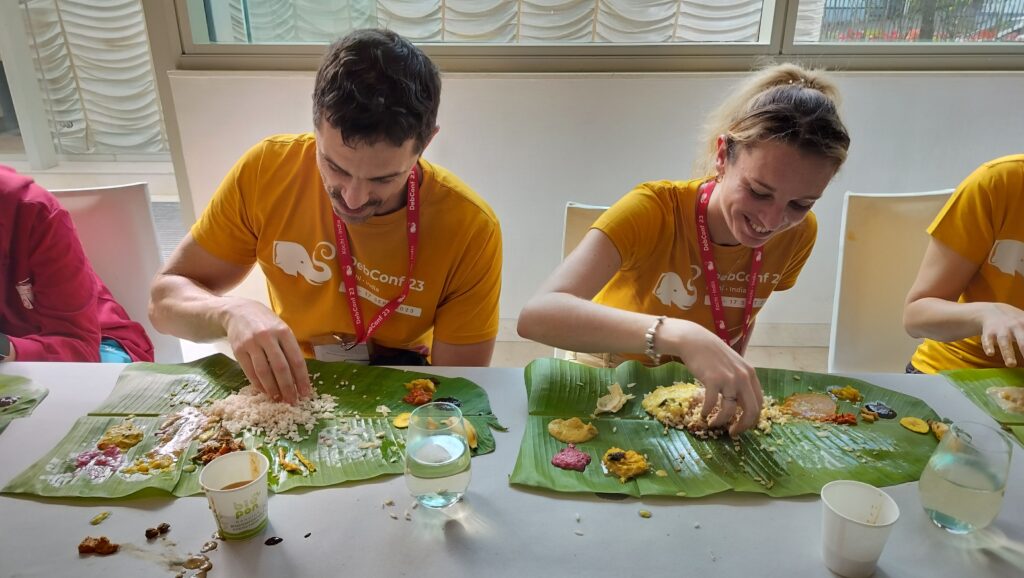
Overall, the community and their activities in India are very impressive, and I wish I had more time to get to know everyone better. Food Oh yes, one more thing. The food was great. I tasted more different kinds of curry than I ever did in my whole life up to this point. The lunch on banana leaves was interesting, and also learning how to eat this food properly by hand (thanks to the locals who insisted on teaching me!), it was a fruitful experience? This might catch on at home too less dishes to take care of! Special thanks to the DebConf23 Team I think this may have been one of the toughest DebConfs to organise yet, and I don t think many people outside of the DebConf team knows about all the challenges and adversity this team has faced in organising it. Even just getting to the previous DebConf in Kosovo was a long and tedious and somewhat risky process. Through it all, they were absolute pro s. Not once did I see them get angry or yell at each other, whenever a problem came up, they just dealt with it. They did a really stellar job and I did make a point of telling them on the last day that everyone appreciated all the work that they did. Back to my nest I bought Dax a ball back from India, he seems to have forgiven me for not taking him along.
I ll probably take a few days soon to focus a bit on my bugs and catch up on my original DebCamp goals. If you made it this far, thanks for reading! And thanks to everyone for being such fantastic people.

Jonathan McDowell: DebConf23 Writeup

DebConf2023 Logo (I wrote this up for an internal work post, but I figure it s worth sharing more publicly too.) I spent last week at DebConf23, this years instance of the annual Debian conference, which was held in Kochi, India. As usual, DebConf provides a good reason to see a new part of the world; I ve been going since 2004 (Porto Alegre, Brazil), and while I ve missed a few (Mexico, Bosnia, and Switzerland) I ve still managed to make it to instances on 5 continents. This has absolutely nothing to do with work, so I went on my own time + dime, but I figured a brief write-up might prove of interest. I first installed Debian back in 1999 as a machine that was being co-located to operate as a web server / email host. I was attracted by the promise of easy online upgrades (or, at least, upgrades that could be performed without the need to be physically present at the machine, even if they naturally required a reboot at some point). It has mostly delivered on this over the years, and I ve never found a compelling reason to move away. I became a Debian Developer in 2000. As a massively distributed volunteer project DebConf provides an opportunity to find out what s happening in other areas of the project, catch up with team mates, and generally feel more involved and energised to work on Debian stuff. Also, by this point in time, a lot of Debian folk are good friends and it s always nice to catch up with them. On that point, I felt that this year the hallway track was not quite the same as usual. For a number of reasons (COVID, climate change, travel time, we re all getting older) I think fewer core teams are achieving critical mass at DebConf - I was the only member physically present from 2 teams I m involved in, and I d have appreciated the opportunity to sit down with both of them for some in-person discussions. It also means it s harder to use DebConf as a venue for advancing major changes; previously having all the decision makers in the same space for a week has meant it s possible to iron out the major discussion points, smoothing remote implementation after the conference. I m told the mini DebConfs are where it s at for these sorts of meetings now, so perhaps I ll try to attend at least one of those next year. Of course, I also went to a bunch of talks. I have differing levels of comment about each of them, but I ve written up some brief notes below about the ones I remember something about. The comment was made that we perhaps had a lower level of deep technical talks, which is perhaps true but I still think there were a number of high level technical talks that served to pique ones interest about the topic. Finally, this DebConf was the first I m aware of that was accompanied by tragedy; as part of the day trip Abraham Raji, a project member and member of the local team, was involved in a fatal accident.
Talks (videos not yet up for all, but should appear for most)
  • Opening Ceremony
    Not much to say here; welcome to DebConf!
  • Continuous Key-Signing Party introduction
    I ended up running this, as Gunnar couldn t make it. Debian makes heavy use of the OpenPGP web of trust (no mass ability to send out Yubikeys + perform appropriate levels of identity verification), so making sure we re appropriately cross-signed, and linked to local conference organisers, is a dull but important part of the conference. We use a modified keysigning approach where identity verification + fingerprint confirmation happens over the course of the conference, so this session was just to explain how that works and confirm we were all working from the same fingerprint list.
  • State of Stateless - A Talk about Immutability and Reproducibility in Debian
    Stateless OSes seem to be gaining popularity, so I went along to this to see if there was anything of note. It was interesting, but nothing earth shattering - very high level.
  • What s missing so that Debian is finally reproducible?
    Reproducible builds are something I ve been keeping an eye on for a long time, and I continue to be impressed by the work folks are putting into this - both for Debian, and other projects. From a security standpoint reproducible builds provide confidence against trojaned builds, and from a developer standpoint knowing you can build reproducibly helps with not having to keep a whole bunch of binary artefacts around.
  • Hello from keyring-maint
    In the distant past the process of getting your OpenPGP key into the Debian keyring (which is used to authenticate uploads + votes, amongst other things) was a clunky process that was often stalled. This hasn t been the case for at least the past 10 years, but there s still a residual piece of project memory that thinks keyring is a blocker. So as a team we say hi and talk about the fact we do monthly updates and generally are fairly responsive these days.
  • A declarative approach to Linux networking with Netplan
    Debian s /etc/network/interfaces is a fairly basic (if powerful) mechanism for configuring network interfaces. NetworkManager is a better bet for dynamic hosts (i.e. clients), and systemd-network seems to be a good choice for servers (I m gradually moving machines over to it). Netplan tries to provide a unified mechanism for configuring both with a single configuration language. A noble aim, but I don t see a lot of benefit for anything I use - my NetworkManager hosts are highly dynamic (so no need to push shared config) and systemd-network (or /etc/network/interfaces) works just fine on the other hosts. I m told Netplan has more use with more complicated setups, e.g. when OpenVSwitch is involved.
  • Quick peek at ZFS, A too good to be true file system and volume manager.
    People who use ZFS rave about it. I m naturally suspicious of any file system that doesn t come as part of my mainline kernel. But, as a longtime cautious mdraid+lvm+ext4 user I appreciate that there have been advances in the file system space that maybe I should look at, and I ve been trying out btrfs on more machines over the past couple of years. I can t deny ZFS has a bunch of interesting features, but nothing I need/want that I can t get from an mdraid+lvm+btrfs stack (in particular data checksumming + reflinks for dedupe were strong reasons to move to btrfs over ext4).
  • Bits from the DPL
    Exactly what it says on the tin; some bits from the DPL.
  • Adulting
    Enrico is always worth hearing talk; Adulting was no exception. Main takeaway is that we need to avoid trying to run the project on martyrs and instead make sure we build a sustainable project. I ve been trying really hard to accept I just don t have time to take on additional responsibilities, no matter how interesting or relevant they might seem, so this resonated.
  • My life in git, after subversion, after CVS.
    Putting all of your home directory in revision control. I ve never made this leap; I ve got some Ansible playbooks that push out my core pieces of configuration, which is held in git, but I don t actually check this out directly on hosts I have accounts on. Interesting, but not for me.
  • EU Legislation BoF - Cyber Resilience Act, Product Liability Directive and CSAM Regulation
    The CRA seems to be a piece of ill informed legislation that I m going to have to find time to read properly. Discussion was a bit more alarmist than I personally feel is warranted, but it was a short session, had a bunch of folk in it, and even when I removed my mask it was hard to make myself understood.
  • What s new in the Linux kernel (and what s missing in Debian)
    An update from Ben about new kernel features. I m paying less attention to such things these days, so nice to get a quick overview of it all.
  • Intro to SecureDrop, a sort-of Linux distro
    Actually based on Ubuntu, but lots of overlap with Debian as a result, and highly customised anyway. Notable, to me, for using OpenPGP as some of the backend crypto support. I managed to talk to Kunal separately about some of the pain points around that, which was an interesting discussion - they re trying to move from GnuPG to Sequoia, primarily because of the much easier integration and lack of requirement for the more complicated GnuPG features that sometimes get in the way.
  • The Docker(.io) ecosystem in Debian
    I hate Docker. I m sure it s fine if you accept it wants to take over the host machine entirely, but when I ve played around with it that s not been the case. This talk was more about the difficulty of trying to keep a fast moving upstream with lots of external dependencies properly up to date in a stable release. Vendoring the deps and trying to get a stable release exception seems like the least bad solution, but it s a problem that affects a growing number of projects.
  • Chiselled containers
    This was kinda of interesting, but I think I missed the piece about why more granular packaging wasn t an option. The premise is you can take an existing .deb and chisel it into smaller components, which then helps separate out dependencies rather than pulling in as much as the original .deb would. This was touted as being useful, in particular, for building targeted containers. Definitely appealing over custom built userspaces for containers, but in an ideal world I think we d want the information in the main packaging and it becomes a lot of work.
  • Debian Contributors shake-up
    Debian Contributors is a great site for massaging your ego around contributions to Debian; it s also a useful point of reference from a data protection viewpoint in terms of information the project holds about contributors - everything is already public, but the Contributors website provides folk with an easy way to find their own information (with various configurable options about whether that s made public or not). T ssia is working on improving the various data feeds into the site, but realistically this is the responsibility of every Debian service owner.
  • New Member BOF
    I m part of the teams that help get new folk into Debian - primarily as a member of the New Member Front Desk, but also as a mostly inactive Application Manager. It s been a while since we did one of these sessions so the Front Desk/Debian Account Managers that were present did a panel session. Nothing earth shattering came out of it; like keyring-maint this is a team that has historically had problems, but is currently running smoothly.

20 September 2023

Dirk Eddelbuettel: RcppInt64 0.0.3 on CRAN: Now with nanotime Support

The still new package RcppInt64 (announced two weeks ago in this post, with this followup last week) arrived on CRAN earlier today in its second update and relase 0.0.3. RcppInt64 collects some of the previous conversions between 64-bit integer values in R and C++, and regroups them in a single package by providing a single header. It offers two interfaces: both a more standard as<>() converter from R values along with its companions wrap() to return to R, as well as more dedicated functions from and to . This release adds support for the corresponding nanotime conversion between R and C++. nanotime is leveraging the same bit64-based reprensentation of 64-bit integers for nanosecond resolution timestamps. A thorough S4 wrapping the offers R based access for convenient and powerful operations at nanosecond resolution. And as tweeted (here and here), tooted (here and here), and skeeted (here and here) in a quick preview last Sunday, it makes for easy and expressive code. The brief NEWS entry follows:

Changes in version 0.0.3 (2023-09-19)
  • The as<>() and wrap() converters are now declared inline.
  • Conversion to and from nanotime has been added.

Courtesy of my CRANberries, there is a diffstat report relative to previous release. If you like this or other open-source work I do, you can sponsor me at GitHub.

This post by Dirk Eddelbuettel originated on his Thinking inside the box blog. Please report excessive re-aggregation in third-party for-profit settings.

Valhalla's Things: Chickpea Crackers

Posted on September 20, 2023
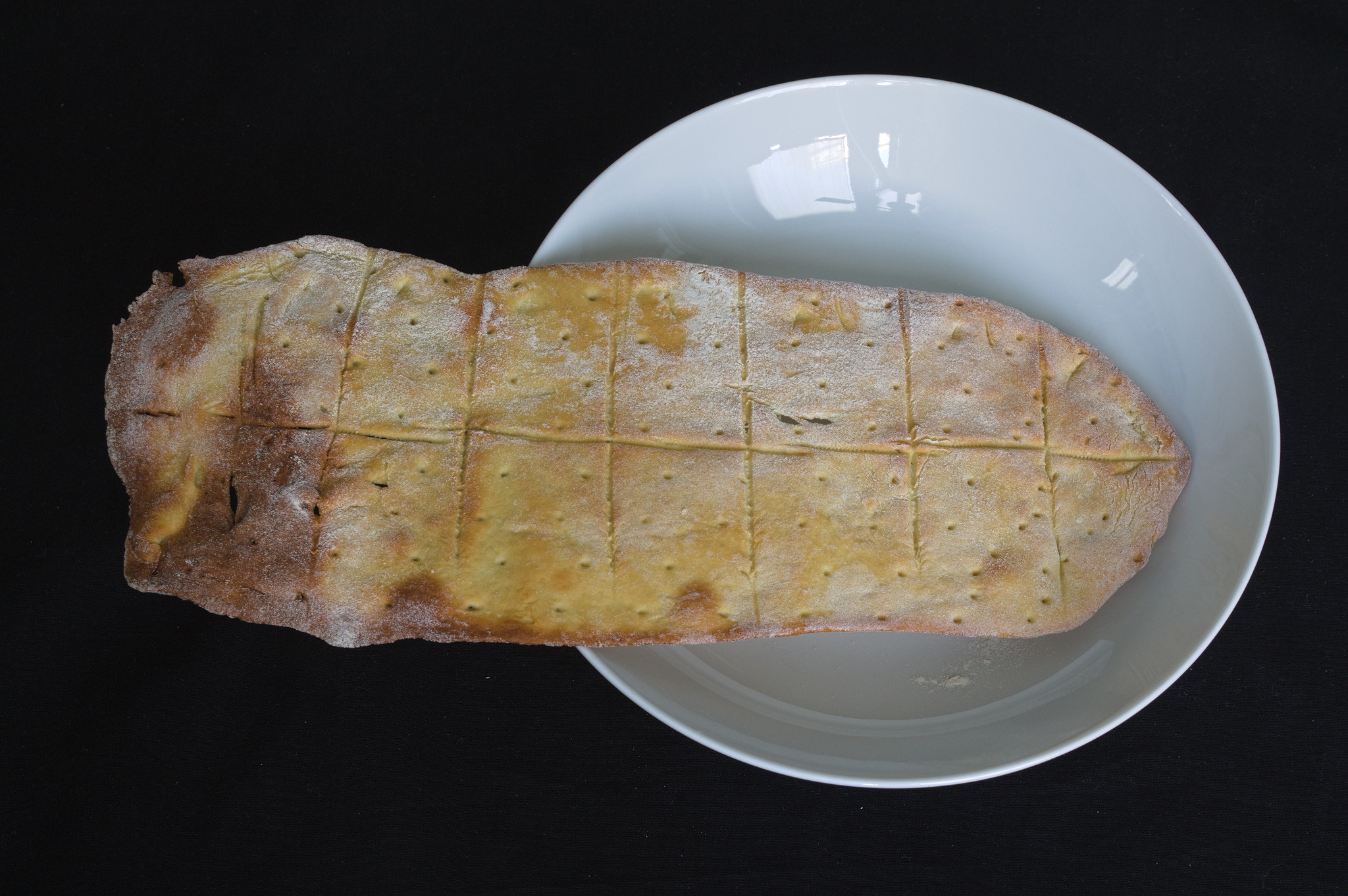
A flatbread, prescored into small portions, but still in one piece on top of a plate and overflowing to the side (it's about 10 cm   30 cm or so). A side is thin and more browned, the other side is a bit thicker and paler. And another half-written article I had in my repo. (Am I doing #FallFinishAlong with blog articles instead of / in addition to craft projects? it feels so). I was in need of snacks. I wanted something bready, but with a bit less carbs and more proteins. I had a bag of chickpea flour. Ingredients were:

  • 100 g wheat flour
  • 100 g chickpea flour
  • 100 g water
  • 3 g salt
  • 1 g dry yeast
Mix everything as usual for bread, leave to rise for 4-6 hours. Divide in 4 parts, roll them out to a thickness of about 1 2 mm, prick them with a fork (or the fancy cracker pricking tool that you don t really need but I may have bought). Optionally spray with a bit of water and sprinkle with salt (coarse or flake is best). Preheat the oven to 240 C and cook for 5 minutes, or preheat the oven to 210 C and cook for 10 minutes for a dryer version. I ve tried both cooking temperatures: the 210 C had the big advantage of being the same as the common bread I was already making, so no additional oven time was required (it was summer. this was a consideration.), but I m not sure which version I like best, so I think in winter I will alternate between the two. Put it in a cotton (linen?) bag and keep it in a dry place, where it will keep for weeks (assuming you ve made a bigger batch :D ). This is now part of my staples.

15 September 2023

John Goerzen: How Gapped is Your Air?

Sometimes we want better-than-firewall security for things. For instance:
  1. An industrial control system for a municipal water-treatment plant should never have data come in or out
  2. Or, a variant of the industrial control system: it should only permit telemetry and monitoring data out, and nothing else in or out
  3. A system dedicated to keeping your GPG private keys secure should only have material to sign (or decrypt) come in, and signatures (or decrypted data) go out
  4. A system keeping your tax records should normally only have new records go in, but may on occasion have data go out (eg, to print a copy of an old record)
In this article, I ll talk about the high side (the high-security or high-sensitivity systems) and the low side (the lower-sensitivity or general-purpose systems). For the sake of simplicity, I ll assume the high side is a single machine, but it could as well be a whole network. Let s focus on examples 3 and 4 to make things simpler. Let s consider the primary concern to be data exfiltration (someone stealing your data), with a secondary concern of data integrity (somebody modifying or destroying your data). You might think the safest possible approach is Airgapped that is, there is literal no physical network connection to the machine at all. This help! But then, the problem becomes: how do we deal with the inevitable need to legitimately get things on or off of the system? As I wrote in Dead USB Drives Are Fine: Building a Reliable Sneakernet, by using tools such as NNCP, you can certainly create a sneakernet : using USB drives as transport. While this is a very secure setup, as with most things in security, it s less than perfect. The Wikipedia airgap article discusses some ways airgapped machines can still be exploited. It mentions that security holes relating to removable media have been exploited in the past. There are also other ways to get data out; for instance, Debian ships with gensio and minimodem, both of which can transfer data acoustically. But let s back up and think about why we think of airgapped machines as so much more secure, and what the failure modes of other approaches might be.

What about firewalls? You could very easily set up high-side machine that is on a network, but is restricted to only one outbound TCP port. There could be a local firewall, and perhaps also a special port on an external firewall that implements the same restrictions. A variant on this approach would be two computers connected directly by a crossover cable, though this doesn t necessarily imply being more secure. Of course, the concern about a local firewall is that it could potentially be compromised. An external firewall might too; for instance, if your credentials to it were on a machine that got compromised. This kind of dual compromise may be unlikely, but it is possible. We can also think about the complexity in a network stack and firewall configuration, and think that there may be various opportunities to have things misconfigured or buggy in a system of that complexity. Another consideration is that data could be sent at any time, potentially making it harder to detect. On the other hand, network monitoring tools are commonplace. On the other hand, it is convenient and cheap. I use a system along those lines to do my backups. Data is sent, gpg-encrypted and then encrypted again at the NNCP layer, to the backup server. The NNCP process on the backup server runs as an untrusted user, and dumps the gpg-encrypted files to a secure location that is then processed by a cron job using Filespooler. The backup server is on a dedicated firewall port, with a dedicated subnet. The only ports allowed out are for NNCP and NTP, and offsite backups. There is no default gateway. Not even DNS is permitted out (the firewall does the appropriate redirection). There is one pinhole allowed out, where a subset of the backup data is sent offsite. I initially used USB drives as transport, and it had no network connection at all. But there were disadvantages to doing this for backups particularly that I d have no backups for as long as I d forget to move the drives. The backup system also would have clock drift, and the offsite backup picture was more challenging. (The clock drift was a problem because I use 2FA on the system; a password, plus a TOTP generated by a Yubikey) This is pretty good security, I d think. What are the weak spots? Well, if there were somehow a bug in the NNCP client, and the remote NNCP were compromised, that could lead to a compromise of the NNCP account. But this itself would accomplish little; some other vulnerability would have to be exploited on the backup server, because the NNCP account can t see plaintext data at all. I use borgbackup to send a subset of backup data offsite over ssh. borgbackup has to run as root to be able to access all the files, but the ssh it calls runs as a separate user. A ssh vulnerability is therefore unlikely to cause much damage. If, somehow, the remote offsite system were compromised and it was able to exploit a security issue in the local borgbackup, that would be a problem. But that sounds like a remote possibility. borgbackup itself can t even be used over a sneakernet since it is not asynchronous. A more secure solution would probably be using something like dar over NNCP. This would eliminate the ssh installation entirely, and allow a complete isolation between the data-access and the communication stacks, and notably not require bidirectional communication. Logic separation matters too. My Roundup of Data Backup and Archiving Tools may be helpful here. Other attack vectors could be a vulnerability in the kernel s networking stack, local root exploits that could be combined with exploiting NNCP or borgbackup to gain root, or local misconfiguration that makes the sandboxes around NNCP and borgbackup less secure. Because this system is in my basement in a utility closet with no chairs and no good place for a console, I normally manage it via a serial console. While it s a dedicated line between the system and another machine, if the other machine is compromised or an adversary gets access to the physical line, credentials (and perhaps even data) could leak, albeit slowly. But we can do much better with serial lines. Let s take a look.

Serial lines Some of us remember RS-232 serial lines and their once-ubiquitous DB-9 connectors. Traditionally, their speed maxxed out at 115.2Kbps. Serial lines have the benefit that they can be a direct application-to-application link. In my backup example above, a serial line could directly link the NNCP daemon on one system with the NNCP caller on another, with no firewall or anything else necessary. It is simply up to those programs to open the serial device appropriately. This isn t perfect, however. Unlike TCP over Ethernet, a serial line has no inherent error checking. Modern programs such as NNCP and ssh assume that a lower layer is making the link completely clean and error-free for them, and will interpret any corruption as an attempt to tamper and sever the connection. However, there is a solution to that: gensio. In my page Using gensio and ser2net, I discuss how to run NNCP and ssh over gensio. gensio is a generic framework that can add framing, error checking, and retransmit to an unreliable link such as a serial port. It can also add encryption and authentication using TLS, which could be particularly useful for applications that aren t already doing that themselves. More traditional solutions for serial communications have their own built-in error correction. For instance, UUCP and Kermit both were designed in an era of noisy serial lines and might be an excellent fit for some use cases. The ZModem protocol also might be, though it offers somewhat less flexibility and automation than Kermit. I have found that certain USB-to-serial adapters by Gearmo will actually run at up to 2Mbps on a serial line! Look for the ones on their spec pages with a FTDI chipset rated at 920Kbps. It turns out they can successfully be driven faster, especially if gensio s relpkt is used. I ve personally verified 2Mbps operation (Linux port speed 2000000) on Gearmo s USA-FTDI2X and the USA-FTDI4X. (I haven t seen any single-port options from Gearmo with the 920Kbps chipset, but they may exist). Still, even at 2Mbps, speed may well be a limiting factor with some applications. If what you need is a console and some textual or batch data, it s probably fine. If you are sending 500GB backup files, you might look for something else. In theory, this USB to RS-422 adapter should work at 10Mbps, but I haven t tried it. But if the speed works, running a dedicated application over a serial link could be a nice and fairly secure option. One of the benefits of the airgapped approach is that data never leaves unless you are physically aware of transporting a USB stick. Of course, you may not be physically aware of what is ON that stick in the event of a compromise. This could easily be solved with a serial approach by, say, only plugging in the cable when you have data to transfer.

Data diodes A traditional diode lets electrical current flow in only one direction. A data diode is the same concept, but for data: a hardware device that allows data to flow in only one direction. This could be useful, for instance, in the tax records system that should only receive data, or the industrial system that should only send it. Wikipedia claims that the simplest kind of data diode is a fiber link with transceivers connected in only one direction. I think you could go one simpler: a serial cable with only ground and TX connected at one end, wired to ground and RX at the other. (I haven t tried this.) This approach does have some challenges:
  • Many existing protocols assume a bidirectional link and won t be usable
  • There is a challenge of confirming data was successfully received. For a situation like telemetry, maybe it doesn t matter; another observation will come along in a minute. But for sending important documents, one wants to make sure they were properly received.
In some cases, the solution might be simple. For instance, with telemetry, just writing out data down the serial port in a simple format may be enough. For sending files, various mitigations, such as sending them multiple times, etc., might help. You might also look into FEC-supporting infrastructure such as blkar and flute, but these don t provide an absolute guarantee. There is no perfect solution to knowing when a file has been successfully received if the data communication is entirely one-way.

Audio transport I hinted above that minimodem and gensio both are software audio modems. That is, you could literally use speakers and microphones, or alternatively audio cables, as a means of getting data into or out of these systems. This is pretty limited; it is 1200bps, and often half-duplex, and could literally be disrupted by barking dogs in some setups. But hey, it s an option.

Airgapped with USB transport This is the scenario I began with, and named some of the possible pitfalls above as well. In addition to those, note also that USB drives aren t necessarily known for their error-free longevity. Be prepared for failure.

Concluding thoughts I wanted to lay out a few things in this post. First, that simply being airgapped is generally a step forward in security, but is not perfect. Secondly, that both physical and logical separation matter. And finally, that while tools like NNCP can make airgapped-with-USB-drive-transport a doable reality, there are also alternatives worth considering especially serial ports, firewalled hard-wired Ethernet, data diodes, and so forth. I think serial links, in particular, have been largely forgotten these days. Note: This article also appears on my website, where it may be periodically updated.

13 September 2023

Matthew Garrett: Reconstructing an invalid TPM event log

TPMs contain a set of registers ("Platform Configuration Registers", or PCRs) that are used to track what a system boots. Each time a new event is measured, a cryptographic hash representing that event is passed to the TPM. The TPM appends that hash to the existing value in the PCR, hashes that, and stores the final result in the PCR. This means that while the PCR's value depends on the precise sequence and value of the hashes presented to it, the PCR value alone doesn't tell you what those individual events were. Different PCRs are used to store different event types, but there are still more events than there are PCRs so we can't avoid this problem by simply storing each event separately.


This is solved using the event log. The event log is simply a record of each event, stored in RAM. The algorithm the TPM uses to calculate the PCR values is known, so we can reproduce that by simply taking the events from the event log and replaying the series of events that were passed to the TPM. If the final calculated value is the same as the value in the PCR, we know that the event log is accurate, which means we now know the value of each individual event and can make an appropriate judgement regarding its security.

If any value in the event log is invalid, we'll calculate a different PCR value and it won't match. This isn't terribly helpful - we know that at least one entry in the event log doesn't match what was passed to the TPM, but we don't know which entry. That means we can't trust any of the events associated with that PCR. If you're trying to make a security determination based on this, that's going to be a problem.

PCR 7 is used to track information about the secure boot policy on the system. It contains measurements of whether or not secure boot is enabled, and which keys are trusted and untrusted on the system in question. This is extremely helpful if you want to verify that a system booted with secure boot enabled before allowing it to do something security or safety critical. Unfortunately, if the device gives you an event log that doesn't replay correctly for PCR 7, you now have no idea what the security state of the system is.

We ran into that this week. Examination of the event log revealed an additional event other than the expected ones - a measurement accompanied by the string "Boot Guard Measured S-CRTM". Boot Guard is an Intel feature where the CPU verifies the firmware is signed with a trusted key before executing it, and measures information about the firmware in the process. Previously I'd only encountered this as a measurement into PCR 0, which is the PCR used to track information about the firmware itself. But it turns out that at least some versions of Boot Guard also measure information about the Boot Guard policy into PCR 7. The argument for this is that this is effectively part of the secure boot policy - having a measurement of the Boot Guard state tells you whether Boot Guard was enabled, which tells you whether or not the CPU verified a signature on your firmware before running it (as I wrote before, I think Boot Guard has user-hostile default behaviour, and that enforcing this on consumer devices is a bad idea).

But there's a problem here. The event log is created by the firmware, and the Boot Guard measurements occur before the firmware is executed. So how do we get a log that represents them? That one's fairly simple - the firmware simply re-calculates the same measurements that Boot Guard did and creates a log entry after the fact[1]. All good.

Except. What if the firmware screws up the calculation and comes up with a different answer? The entry in the event log will now not match what was sent to the TPM, and replaying will fail. And without knowing what the actual value should be, there's no way to fix this, which means there's no way to verify the contents of PCR 7 and determine whether or not secure boot was enabled.

But there's still a fundamental source of truth - the measurement that was sent to the TPM in the first place. Inspired by Henri Nurmi's work on sniffing Bitlocker encryption keys, I asked a coworker if we could sniff the TPM traffic during boot. The TPM on the board in question uses SPI, a simple bus that can have multiple devices connected to it. In this case the system flash and the TPM are on the same SPI bus, which made things easier. The board had a flash header for external reprogramming of the firmware in the event of failure, and all SPI traffic was visible through that header. Attaching a logic analyser to this header made it simple to generate a record of that. The only problem was that the chip select line on the header was attached to the firmware flash chip, not the TPM. This was worked around by simply telling the analysis software that it should invert the sense of the chip select line, ignoring all traffic that was bound for the flash and paying attention to all other traffic. This worked in this case since the only other device on the bus was the TPM, but would cause problems in the event of multiple devices on the bus all communicating.

With the aid of this analyser plugin, I was able to dump all the TPM traffic and could then search for writes that included the "0182" sequence that corresponds to the command code for a measurement event. This gave me a couple of accesses to the locality 3 registers, which was a strong indication that they were coming from the CPU rather than from the firmware. One was for PCR 0, and one was for PCR 7. This corresponded to the two Boot Guard events that we expected from the event log. The hash in the PCR 0 measurement was the same as the hash in the event log, but the hash in the PCR 7 measurement differed from the hash in the event log. Replacing the event log value with the value actually sent to the TPM resulted in the event log now replaying correctly, supporting the hypothesis that the firmware was failing to correctly reconstruct the event.

What now? The simple thing to do is for us to simply hard code this fixup, but longer term we'd like to figure out how to reconstruct the event so we can calculate the expected value ourselves. Unfortunately there doesn't seem to be any public documentation on this. Sigh.

[1] What stops firmware on a system with no Boot Guard faking those measurements? TPMs have a concept of "localities", effectively different privilege levels. When Boot Guard performs its initial measurement into PCR 0, it does so at locality 3, a locality that's only available to the CPU. This causes PCR 0 to be initialised to a different initial value, affecting the final PCR value. The firmware can't access locality 3, so can't perform an equivalent measurement, so can't fake the value.

comment count unavailable comments

12 September 2023

Dirk Eddelbuettel: RcppInt64 0.0.2 on CRAN: Small Update

The still very new package RcppInt64 (announced a week ago in this post) arrived on CRAN earlier today in its first update, now at 0.0.2. RcppInt64 collects some of the previous conversions between 64-bit integer values in R and C++, and regroups them in a single package by providing a single header. It offers two interfaces: both a more standard as<>() converter from R values along with its companions wrap() to return to R, as well as more dedicated functions from and to . The package by now has its first user as we rearranged RcppFarmHash to use it. The change today makes bit64 a weak rather than strong dependency as we use it only for tests and illustrations. We also added two missing fields to DESCRIPTION and added badges to README.md. The brief NEWS entry follows:

Changes in version 0.0.2 (2023-09-12)
  • DESCRIPTION has been extended, badges have been added to README.md
  • Package bit64 is now a Suggests:

Courtesy of my CRANberries, there is a [diffstat report relative to previous release][this release]. If you like this or other open-source work I do, you can sponsor me at GitHub.

This post by Dirk Eddelbuettel originated on his Thinking inside the box blog. Please report excessive re-aggregation in third-party for-profit settings.

11 September 2023

Dirk Eddelbuettel: RcppArmadillo 0.12.6.4.0 on CRAN: Another Upstream Bugfix

armadillo image Armadillo is a powerful and expressive C++ template library for linear algebra and scientific computing. It aims towards a good balance between speed and ease of use, has a syntax deliberately close to Matlab, and is useful for algorithm development directly in C++, or quick conversion of research code into production environments. RcppArmadillo integrates this library with the R environment and language and is widely used by (currently) 1096 other packages on CRAN, downloaded 30.5 million times (per the partial logs from the cloud mirrors of CRAN), and the CSDA paper (preprint / vignette) by Conrad and myself has been cited 552 times according to Google Scholar. This release brings bugfix upstream release 12.6.4. Conrad prepared this a few days ago; it takes me the usual day or so to run reverse-dependency check against the by-now almost 1100 CRAN packages using RcppArmadillo. And this time, CRAN thought it had found two issues when I submitted and it took two more days til we were all clear about those two being false positives (as can, and does, happen). So today it reached CRAN. The set of changes follows.

Changes in RcppArmadillo version 0.12.6.4.0 (2023-09-06)
  • Upgraded to Armadillo release 12.6.4 (Cortisol Retox)
    • Workarounds for bugs in Apple accelerate framework
    • Fix incorrect calculation of rcond for band matrices in solve()
    • Remove expensive and seldom used optimisations, leading to faster compilation times

Courtesy of my CRANberries, there is a diffstat report relative to previous release. More detailed information is on the RcppArmadillo page. Questions, comments etc should go to the rcpp-devel mailing list off the Rcpp R-Forge page. If you like this or other open-source work I do, you can sponsor me at GitHub.

This post by Dirk Eddelbuettel originated on his Thinking inside the box blog. Please report excessive re-aggregation in third-party for-profit settings.

10 September 2023

Jelmer Vernooij: Transcontinental Race No 9

After cycling the Northcape 4000 (from Italy to northern Norway) last year, I signed up for the transcontinental race this year. The Transcontinental is bikepacking race across Europe, self-routed (but with some mandatory checkpoints), unsupported and with a distance of usually somewhere around 4000 km. The cut-off time is 15 days, with the winner usually taking 7-10 days. This year, the route went from Belgium to Thessaloniki in Greece, with control points in northern Italy, Slovenia, Albania and Meteora (Greece). The event was great - it was well organised and communication was a lot better than at the Northcape. It did feel very different from the Northcape, though, being a proper race. Participants are not allowed to draft off each other or help each other, though a quick chat here or there as you pass people is possible, or when you re both stopped at a shop or control point.
My experience The route was beautiful - the first bit through France was a bit monotonic, but especially the views in the alps were amazing. Like with other long events, the first day or two can be hard but once you get into the rhythm of things it s a lot easier. From early on, I lost a lot of time. We started in the rain, and I ran several flats in a row, just 4 hours in. In addition to that, the thread on my pump had worn so it wouldn t fit on some of my spare tubes, and my tubes were all TPU - which are hard to patch. So at 3 AM I found myself by the side of an N-road in France without any usable tubes to put in my rear wheel. I ended up walking 20km to the nearest town with a bike shop, where they fortunately had good old butyl tubes and a working pump. But overall, this cost me about 12 hours in total. In addition to that, my time management wasn t great. On previous rides, I d usually gotten about 8 hours of sleep per night while staying in hotels. On the transcontinental I had meant to get less sleep but still stay in hotels most night, but I found that not all hotels accomodated well for that - especially with a bike. So I ended up getting more sleep than I had intended, and spending more time off the bike than I had planned - close to 11 or 12 hours per day. I hadn t scheduled much time off work after the finish either, so arriving in Greece late wasn t really an option. And then, on an early morning in Croatia (about 2000km in) in heavy fog, I rode into a kerb at 35 km/h, bending the rim of my front wheel (but fortunately not coming off my bike). While I probably would have been able to continue with a replacement wheel (and mailing the broken one home), that would have taken another day to sort out and I almost certainly wouldn t have been able to source a new dynamo wheel in Croatia - which would have made night time riding a lot harder. So I decided to scratch and take the train home from Zagreb. Overall, I really enjoyed the event and I think I ve learned some useful lessons. I ll probably try again next year.

Freexian Collaborators: Debian Contributions: /usr-merge updates, Salsa CI progress, DebConf23 lead-up, and more! (by Utkarsh Gupta)

Contributing to Debian is part of Freexian s mission. This article covers the latest achievements of Freexian and their collaborators. All of this is made possible by organizations subscribing to our Long Term Support contracts and consulting services.

/usr-merge work, by Helmut Grohne, et al. Given that we now have consensus on moving forward by moving aliased files from / to /usr, we will also run into the problems that the file move moratorium was meant to prevent. The way forward is detecting them early and applying workarounds on a per-package basis. Said detection is now automated using the Debian Usr Merge Analysis Tool. As problems are reported to the bug tracking system, they are connected to the reports if properly usertagged. Bugs and patches for problem categories DEP17-P2 and DEP17-P6 have been filed. After consensus has been reached on the bootstrapping matters, debootstrap has been changed to swap the initial unpack and merging to avoid unpack errors due to pre-existing links. This is a precondition for having base-files install the aliasing symbolic links eventually. It was identified that the root filesystem used by the Debian installer is still unmerged and a change has been proposed. debhelper was changed to recognize systemd units installed to /usr. A discussion with the CTTE and release team on repealing the moratorium has been initiated.

Salsa CI work, by Santiago Ruano Rinc n August was a busy month in the Salsa CI world. Santiago reviewed and merged a bunch of MRs that have improved the project in different aspects: The aptly job got two MRs from Philip Hands. With the first one, the aptly now can export a couple of variables in a dotenv file, and with the second, it can include packages from multiple artifact directories. These MRs bring the base to improve how to test reverse dependencies with Salsa CI. Santiago is working on documenting this. As a result of the mass bug filing done in August, Salsa CI now includes a job to test how a package builds twice in a row. Thanks to the MRs of Sebastiaan Couwenberg and Johannes Schauer Marin Rodrigues. Last but not least, Santiago helped Johannes Schauer Marin Rodrigues to complete the support for arm64-only pipelines.

DebConf23 lead-up, by Stefano Rivera Stefano wears a few hats in the DebConf organization and in the lead up to the conference in mid-September, they ve all been quite busy. As one of the treasurers of DebConf 23, there has been a final budget update, and quite a few payments to coordinate from Debian s Trusted Organizations. We try to close the books from the previous conference at the next one, so a push was made to get DebConf 22 account statements out of TOs and record them in the conference ledger. As a website developer, we had a number of registration-related tasks, emailing attendees and trying to estimate numbers for food and accommodation. As a conference committee member, the job was mostly taking calls and helping the local team to make decisions on urgent issues. For example, getting conference visas issued to attendees required getting political approval from the Indian government. We only discovered the full process for this too late to clear some complex cases, so this required some hard calls on skipping some countries from the application list, allowing everyone else to get visas in time. Unfortunate, but necessary.

Miscellaneous contributions
  • Rapha l Hertzog updated gnome-shell-extension-hamster to a new upstream git snapshot that is compatible with GNOME Shell 44 that was recently uploaded to Debian unstable/testing. This extension makes it easy to start/stop tracking time with Hamster Time Tracker. Very handy for consultants like us who are billing their work per hour.
  • Rapha l also updated zim to the latest upstream release (0.74.2). This is a desktop wiki that can be very useful as a note-taking tool to build your own personal knowledge base or even to manage your personal todo lists.
  • Utkarsh reviewed and sponsored some uploads from mentors.debian.net.
  • Utkarsh helped the local team and the bursary team with some more DebConf activities and helped finalize the data.
  • Thorsten tried to update package hplip. Unfortunately upstream added some new compressed files that need to appear uncompressed in the package. Even though this sounded like an easy task, which seemed to be already implemented in the current debian/rules, the new type of files broke this implementation and made the package no longer buildable. The problem has been solved and the upload will happen soon.
  • Helmut sent 7 patches for cross build failures. Since dpkg-buildflags now defaults to issue arm64-specific compiler flags, more care is needed to distinguish between build architecture flags and host architecture flags than previously.
  • Stefano pushed the final bit of the tox 4 transition over the line in Debian, allowing dh-python and tox 4 to migrate to testing. We got caught up in a few unusual bugs in tox and the way we run it in Debian package building (which had to change with tox 4). This resulted in a couple of patches upstream.
  • Stefano visited Haifa, Israel, to see the proposed DebConf 24 venue and meet with the local team. While the venue isn t committed yet, we have high hopes for it.

9 September 2023

Dirk Eddelbuettel: Carmageddon by Daniel Knowles: A Brief Review

Carmageddon Daniel Knowles Carmageddon: How Cars Make Life Worse and What to Do About It is an entertaining, lucid, and well-written manifesto (to borrow a term from the author) aiming to get us all thinking a bit more about what cars do to society, and how to move on to a better outcome for all. The book alternates between historical context and background, lived experience (as the author is a foreign correspondent who had the opportunity to travel), and researched content. It is refreshingly free of formalities (no endless footnotes or endnotes with references, though I would have liked occassional references but hey we all went to school long enough to do a bit of research given a pointer or two). I learned or relearned a few things as I was for example somewhat unaware of the air pollution (micro-particle) impact stemming from tires and brake abrasions for which electronic vehicles do zilch, and for which the auto-obesity of ever larger and heavier cars is making things much worse. And some terms (even when re-used by Knowles) are clever such bionic duckweed. But now you need to read the book to catch up on it. Overall, the book argues its case rather well. The author brings sufficient evidence to make the formal guilty charge quite convincing. It is also recent having come out just months ago, making current figures even more relevant. I forget the exact circumstance but I think I came across the author in the context of our joint obsession with both Chicago and cycling (as there may have been a link from a related social media post) and/or the fact that I followed some of his colleagues at The Economist on social media. Either way, the number of Chicago and MidWest references made for some additional fun when reading the book over a the last few days. And for me another highlight was the ode to Tokyo which I wholeheartedly agree with: on my second trip to Japan I spent a spare day cycling across the city as the AirBnB host kindly gave me access to his bicycles. Great weather, polite drivers, moderate traffic, and just wicked good infrastructure made me wonder why I did not see more cyclists. I have little to criticize beyond the lack of any references. The repeated insistence on reminding us that Knowles comes from Birmingham gets a little old by the fifth or sixth repetition. It is all a wee bit anglo- or UK-centric. It obviously has a bit on France, Paris, and all the recent success of Anne Hidalgo (who, when I was in graduate school in France, was still a TV person rather than the very successful mayor she is now) but then does not mention the immense (and well known) success of the French train system which lead to a recent dictum to no longer allow intra-Frace air travel if train rides of under 2 1/2 hours are available which is rather remarkable. (Though in fairness that may have been enacted once the book was finished.) Lastly, the book appears to have a few sections available via Google Books. My copy will good back from one near-west suburban library to the neighbouring one. Overall a strong recommendation for a very good and timely book.

Next.

Previous.