I rebuilt (the top-50 popcon) Debian and Ubuntu packages, on amd64 and arm64, and compared the results a couple of months ago. Since then the Reproduce.Debian.net effort has been launched. Unlike my small experiment, that effort is a full-scale rebuild with more architectures. Their goal is to reproduce what is published in the Debian archive.
One differences between these two approaches are the build inputs: The Reproduce Debian effort use the same build inputs which were used to build the published packages. I m using the latest version of published packages for the rebuild.
What does that difference imply? I believe reproduce.debian.net will be able to reproduce more of the packages in the archive. If you build a C program using one version of GCC you will get some binary output; and if you use a later GCC version you are likely to end up with a different binary output. This is a good thing: we want GCC to evolve and produce better output over time. However it means in order to reproduce the binaries we publish and use, we need to rebuild them using whatever build dependencies were used to prepare those binaries. The conclusion is that we need to use the old GCC to rebuild the program, and this appears to be the Reproduce.Debian.Net approach.
It would be a huge success if the Reproduce.Debian.net effort were to reach 100% reproducibility, and this seems to be within reach.
However I argue that we need go further than that. Being able to rebuild the packages reproducible using older binary packages only begs the question: can we rebuild those older packages? I fear attempting to do so ultimately leads to a need to rebuild 20+ year old packages, with a non-negligible amount of them being illegal to distribute or are unable to build anymore due to bit-rot. We won t solve the Trusting Trust concern if our rebuild effort assumes some initial binary blob that we can no longer build from source code.
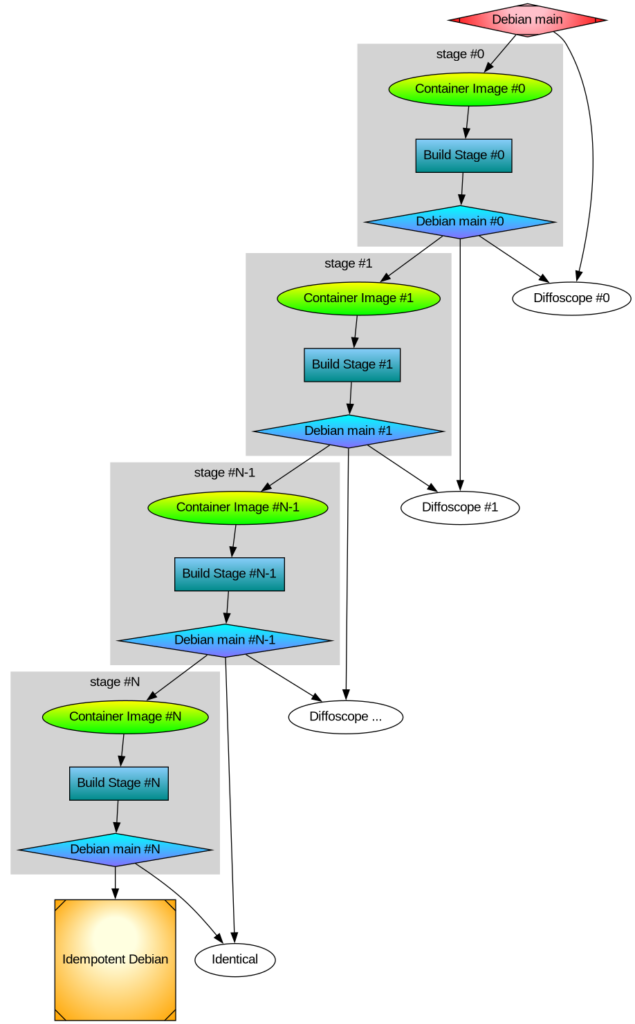
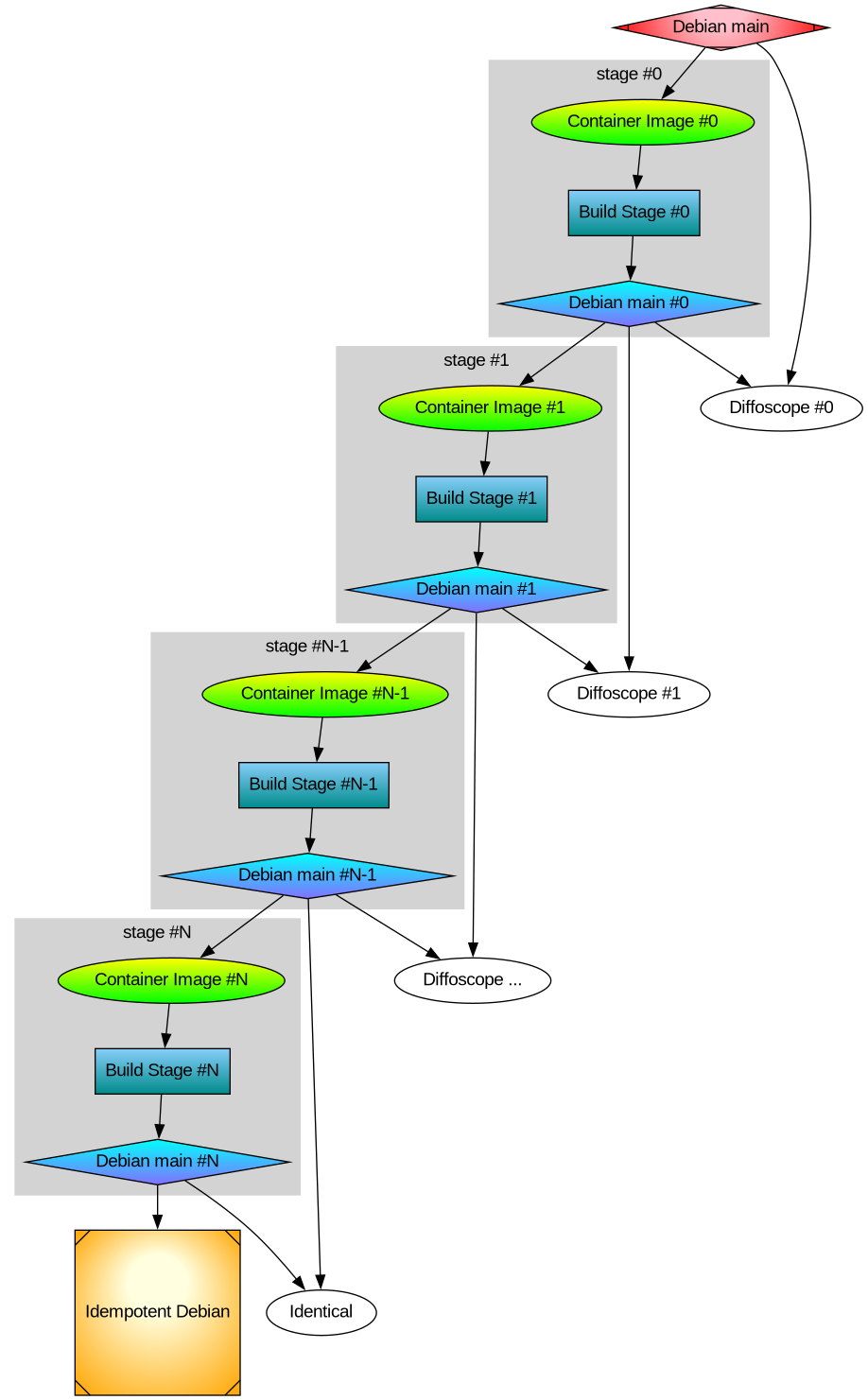
I ve made an illustration of the effort I m thinking of, to reach something that is stronger than reproducible rebuilds. I am calling this concept a Idempotent Rebuild, which is an old concept that I believe is the same as John Gilmore has described many years ago.
The illustration shows how the Debian main archive is used as input to rebuild another stage #0 archive. This stage #0 archive can be compared with diffoscope to the main archive, and all differences are things that would be nice to resolve. The packages in the stage #0 archive is used to prepare a new container image with build tools, and the stage #0 archive is used as input to rebuild another version of itself, called the stage #1 archive. The differences between stage #0 and stage #1 are also useful to analyse and resolve. This process can be repeated many times. I believe it would be a useful property if this process terminated at some point, where the stage #N archive was identical to the stage #N-1 archive. If this would happen, I label the output archive as an Idempotent Rebuild of the distribution.
How big is N today? The simplest assumption is that it is infinity. Any build timestamp embedded into binary packages will change on every iteration. This will cause the process to never terminate. Fixing embedded timestamps is something that the Reproduce.Debian.Net effort will also run into, and will have to resolve.
What other causes for differences could there be? It is easy to see that generally if some output is not deterministic, such as the sort order of assembler object code in binaries, then the output will be different. Trivial instances of this problem will be caught by the reproduce.debian.net effort as well.
Could there be higher order chains that lead to infinite N? It is easy to imagine the existence of these, but I don t know how they would look like in practice.
An ideal would be if we could get down to N=1. Is that technically possible? Compare building GCC, it performs an initial stage 0 build using the system compiler to produce a stage 1 intermediate, which is used to build itself again to stage 2. Stage 1 and 2 is compared, and on success (identical binaries), the compilation succeeds. Here N=2. But this is performed using some unknown system compiler that is normally different from the GCC version being built. When rebuilding a binary distribution, you start with the same source versions. So it seems N=1 could be possible.
I m unhappy to not be able to report any further technical progress now. The next step in this effort is to publish the stage #0 build artifacts in a repository, so they can be used to build stage #1. I already showed that stage #0 was around ~30% reproducible compared to the official binaries, but I didn t save the artifacts in a reusable repository. Since the official binaries were not built using the latest versions, it is to be expected that the reproducibility number is low. But what happens at stage #1? The percentage should go up: we are now compare the rebuilds with an earlier rebuild, using the same build inputs. I m eager to see this materialize, and hope to eventually make progress on this. However to build stage #1 I believe I need to rebuild a much larger number packages in stage #0, it could be roughly similar to the build-essentials-depends package set.
I believe the ultimate end goal of Idempotent Rebuilds is to be able to re-bootstrap a binary distribution like Debian from some other bootstrappable environment like Guix. In parallel to working on a achieving the 100% Idempotent Rebuild of Debian, we can setup a Guix environment that build Debian packages using Guix binaries. These builds ought to eventually converge to the same Debian binary packages, or there is something deeply problematic happening. This approach to re-bootstrap a binary distribution like Debian seems simpler than rebuilding all binaries going back to the beginning of time for that distribution.
What do you think?
PS. I fear that Debian main may have already went into a state where it is not able to rebuild itself at all anymore: the presence and assumption of non-free firmware and non-Debian signed binaries may have already corrupted the ability for Debian main to rebuild itself. To be able to complete the idempotent and bootstrapped rebuild of Debian, this needs to be worked out.
Ghostdrift is a science fiction adventure and the fourth (and
possibly final) book of the Finder Chronicles. You should definitely read
this series in order and not start here, even though the plot of this book
would stand alone.
Following The Scavenger Door, in which
he made enemies even more dramatically than he had in the previous books,
Fergus Ferguson has retired to the beach on Coralla to become a tea master
and take care of his cat. It's a relaxing, idyllic life and a much-needed
total reset. Also, he's bored. The arrival of his alien friend Qai, in
some kind of trouble and searching for him, is a complex balance between
relief and disappointment.
Bas Belos is one of the most notorious pirates of the Barrens. He has
someone he wants Fergus to find: his twin sister, who disappeared ten
years ago. Fergus has an unmatched reputation for finding things, so Belos
kidnapped Qai's partner to coerce her into finding Fergus. It's not an
auspicious beginning to a relationship, and Qai was ready to fight once
they got her partner back, but Belos makes Fergus an offer of payment
that, startlingly, is enough for him to take the job mostly voluntarily.
Ghostdrift feels a bit like a return to Finder. Fergus is once again alone among strangers, on an
assignment that he's mostly not discussing with others, piecing together
clues and navigating tricky social dynamics. I missed his friends,
particularly Ignatio, and while there are a few moments with AI ships,
they play less of a role.
But Fergus is so very good at what he does, and Palmer is so very good at
writing it. This continues to be competence porn at its best. Belos's crew
thinks Fergus is a pirate recruited from a prison colony, and he quietly
sets out to win their trust with a careful balance of self-deprecation and
unflappable skill, helped considerably by the hidden gift he acquired in
Finder. The character development is subtle, but this feels like a
Fergus who understands friendship and other people at a deeper and more
satisfying level than the Fergus we first met three books ago.
Palmer has a real talent for supporting characters and Ghostdrift
is no exception. Belos's crew are criminals and murderers, and Palmer does
remind the reader of that occasionally, but they're also humans with
complex goals and relationships. Belos has earned their loyalty by being
loyal and competent in a rough world where those attributes are rare. The
morality of this story reminds me of infiltrating a gang: the existence of
the gang is not a good thing, and the things they do are often
indefensible, but they are an understandable reaction to a corrupt social
system. The cops (in this case, the Alliance) are nearly as bad, as we've
learned over the past couple of books, and considerably more insufferable.
Fergus balances the ethical complexity in a way that I found satisfyingly
nuanced, while quietly insisting on his own moral lines.
There is a deep science fiction plot here, possibly the most complex of
the series so far. The disappearance of Belos's sister is the tip of an
iceberg that leads to novel astrophysics, dangerous aliens, mysterious
ruins, and an extended period on a remote and wreck-strewn planet. I
groaned a bit when the characters ended up on the planet, since treks
across primitive alien terrain with jury-rigged technology are one of my
least favorite science fiction tropes, but I need not have worried. Palmer
knows what she's doing; the pace of the plot does slow a bit at first, but
it quickly picks up again, adding enough new setting and plot
complications that I never had a chance to be bored by alien plants. It
helps that we get another batch of excellent supporting characters for
Fergus to observe and win over.
This series is such great science fiction. Each book becomes my new
favorite, and Ghostdrift is no exception. The skeleton of its plot
is a satisfying science fiction mystery with multiple competing factions,
hints of fascinating galactic politics, complicated technological puzzles,
and a sense of wonder that reminds me of reading Larry Niven's Known Space
series. But the characters are so much better and more memorable than
classic SF; compared to Fergus, Niven's Louis
Wu barely exists and is readily forgotten as soon as the story is over.
Fergus starts as a quiet problem-solver, but so much character depth
unfolds over the course of this series. The ending of this book was
delightfully consistent with everything we've learned about Fergus, but
also the sort of ending that it's hard to imagine the Fergus from
Finder knowing how to want.
Ghostdrift, like each of the books in this series, reaches a
satisfying stand-alone conclusion, but there is no reason within the story
for this to be the last of the series. The author's acknowledgments,
however, says that this the end. I admit to being disappointed, since I
want to read more about Fergus and there are numerous loose ends that
could be explored. More importantly, though, I hope Palmer will write more
novels in any universe of her choosing so that I can buy and read them.
This is fantastic stuff. This review comes too late for the Hugo
nominating deadline, but I hope Palmer gets a Best Series nomination for
the Finder Chronicles as a whole. She deserves it.
Rating: 9 out of 10
Version 0.0.21 of RcppSpdlog arrived
on CRAN today and has been
uploaded to Debian. RcppSpdlog
bundles spdlog, a
wonderful header-only C++ logging library with all the bells and
whistles you would want that was written by Gabi Melman, and also includes fmt by Victor Zverovich. You can learn
more at the nice package
documention site.
This release updates the code to the version 1.15.2 of spdlog which was released
this weekend as well.
The NEWS entry for this release follows.
Changes in
RcppSpdlog version 0.0.21 (2025-03-30)
Upgraded to upstream release spdlog 1.15.2 (including fmt
11.1.4)
A new release 0.1.8 of RcppZiggurat
is now on the CRAN network for
R, following up on the 0.1.7
release last week which was the first release in four and a half
years.
The RcppZiggurat
package updates the code for the Ziggurat
generator by Marsaglia and
others which provides very fast draws from a Normal (or Exponential)
distribution. The package provides a simple C++ wrapper class for the
generator improving on the very basic macros, and permits comparison
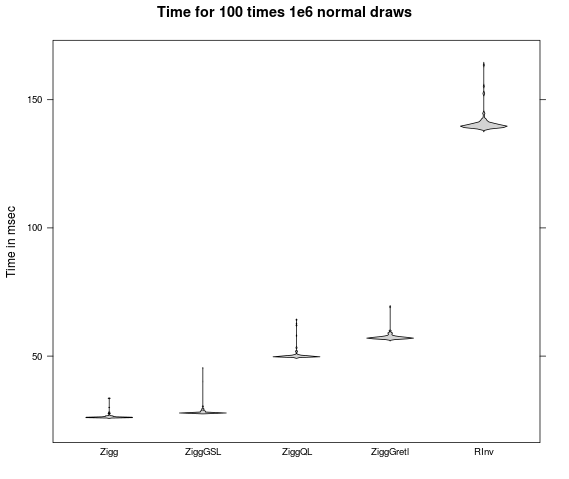
among several existing Ziggurat implementations. This can be seen in the
figure where Ziggurat from this package dominates accessing the
implementations from the GSL, QuantLib and Gretl all of which are still
way faster than the default Normal generator in R (which is of course of
higher code complexity).
This release switches the vignette to the standard trick of premaking
it as a pdf and including it in a short Sweave document that imports it
via pdfpages; this minimizes build-time dependencies on
other TeXLive components. It also incorporates a change contributed by
Tomas to rely on the system build of the GSL on Windows as well if
Rtools 42 or later is found. No other changes.
The NEWS file entry below lists all changes.
Changes in version 0.1.8
(2025-03-30)
The vignette is now premade and rendered as Rnw via pdfpage to
minimize the need for TeXLive package at build / install time
(Dirk)
Windows builds now use the GNU GSL when Rtools is 42 or later
(Tomas Kalibera in #25)
Here s my 66th monthly but brief update about the activities I ve done in the F/L/OSS world.
Debian
This was my 75th month of actively contributing to Debian.
I became a DM in late March 2019 and a DD on Christmas 19! \o/
There s a bunch of things I do, both, technical and non-technical. Here s what I did:
Updating Rails to v7.2.2.1 for Trixie.
Updating Redmine to v6.0.4 for Trixie.
Kickstarting the bursary team for DC25.
Mentoring for newcomers.
Moderation of -project mailing list.
Ubuntu
This was my 50th month of actively contributing to Ubuntu.
Now that I joined Canonical to work on Ubuntu full-time, there s a bunch of things I do! \o/
I mostly worked on different things, I guess.
I was too lazy to maintain a list of things I worked on so there s
no concrete list atm. Maybe I ll get back to this section later or
will start to list stuff from the fall, as I was doing before. :D
Debian (E)LTS
Debian Long Term Support (LTS) is a project to extend the lifetime of all Debian stable releases to (at least) 5 years. Debian LTS is not handled by the Debian security team, but by a separate group of volunteers and companies interested in making it a success.
And Debian Extended LTS (ELTS) is its sister project, extending support to the stretch and jessie release (+2 years after LTS support).
This was my 66th month as a Debian LTS and 53rd month as a Debian ELTS paid contributor.
I worked for 15.00 hours for LTS and 7.50 hours for ELTS.
I did the following things:
Cascade Failure is a far-future science fiction adventure with a
small helping of cyberpunk vibes. It is the first of a (so far) two-book
series, and was the author's first novel.
The Ambit is an old and small Guild ship, not much to look at, but
it holds a couple of surprises. One is its captain, Eoan, who is an AI
with a deep and insatiable curiosity that has driven them and their ship
farther and farther out into the Spiral. The other is its surprisingly
competent crew: a battle-scarred veteran named Saint who handles the
fighting, and a talented engineer named Nash who does literally everything
else. The novel opens with them taking on supplies at Aron Outpost. A
supposed Guild deserter named Jalsen wanders into the ship looking for
work.
An AI ship with a found-family crew is normally my catnip, so I wanted to
love this book. Alas, I did not.
There were parts I liked. Nash is great: snarky, competent, and direct.
Eoan is a bit distant and slightly more simplistic of a character than I
was expecting, but I appreciated the way Sagas put them firmly in charge
of the ship and departed from the conventional AI character presentation.
Once the plot starts in earnest (more on that in a moment), we meet Anke,
the computer hacker, whose charming anxiety reaction is a complete
inability to stop talking and who adds some needed depth to the character
interactions. There's plenty of action, a plot that makes at least some
sense, and a few moments that almost achieved the emotional payoff the
author was attempting.
Unfortunately, most of the story focuses on Saint and Jal, and both of
them are irritatingly dense cliches.
The moment Jal wanders onto the Ambit in the first chapter, the
reader is informed that Jal, Saint, and Eoan have a history. The crew of
the Ambit spent a year looking for Jal and aren't letting go of him now
that they've found him. Jal, on the other hand, clearly blames Saint for
something and is not inclined to trust him. Okay, fine, a bit generic of a
setup but the writing moved right along and I was curious enough.
It then takes a full 180 pages before the reader finds out what the hell
is going on with Saint and Jal. Predictably, it's a stupid
misunderstanding that could have been cleared up with one conversation in
the second chapter.
Cascade Failure does not contain a romance (and to the extent that
it hints at one, it's a sapphic romance), but I swear Saint and Jal are
both the male protagonist from a certain type of stereotypical
heterosexual romance novel. They're both the brooding man with the past,
who is too hurt to trust anyone and assumes the worst because he's unable
to use his words or ask an open question and then listen to the answer.
The first half of this book is them being sullen at each other at great
length while both of them feel miserable. Jal keeps doing weird and
suspicious things to resolve a problem that would have been far more
easily resolved by the rest of the crew if he would offer any explanation
at all. It's not even suspenseful; we've read about this character enough
times to know that he'll turn out to have a heart of gold and everything
will be a misunderstanding. I found it tedious. Maybe people who like slow
burn romances with this character type will have a less negative reaction.
The real plot starts at about the time Saint and Jal finally get their
shit sorted out. It turns out to have almost nothing to do with either of
them. The environmental control systems of worlds are suddenly failing
(hence the book title), and Anke, the late-arriving computer programmer
and terraforming specialist, has a rather wild theory about what's
happening. This leads to a lot of action, some decent twists, and a plot
that felt very cyberpunk to me, although unfortunately it culminates in an
absurdly-cliched action climax.
This book is an action movie that desperately wants to make you feel all
the feels, and it worked about as well as that typically works in action
movies for me. Jaded cynicism and an inability to communicate are not the
ways to get me to have an emotional reaction to a book, and Jal (once he
finally starts talking) is so ridiculously earnest that it's like reading
the adventures of a Labrador puppy. There was enough going on that it kept
me reading, but not enough for the story to feel satisfying. I needed a
twist, some depth, way more Nash and Anke and way less of the men,
something.
Everyone is going to compare this book to Firefly, but
Firefly had better banter, created more complex character
interactions due to the larger and more varied crew, and played the
cynical mercenary for laughs instead of straight, all of which suited me
better. This is not a bad book, particularly once it gets past the halfway
point, but it's not that memorable either, at least for me. If you're
looking for a space adventure with heavy action hero and military SF vibes
that wants to be about Big Feelings but gets there in mostly obvious ways,
you could do worse. If you're looking for a found-family starship crew
story more like Becky Chambers, I think you'll find this one a bit too
shallow and obvious.
Not really recommended, although there's nothing that wrong with it and
I'm sure other people's experience will differ.
Followed by Gravity Lost, which I'm unlikely to read.
Rating: 6 out of 10
A second maintenance release of our still young-ish package tinythemes arrived
on CRAN today. tinythemes
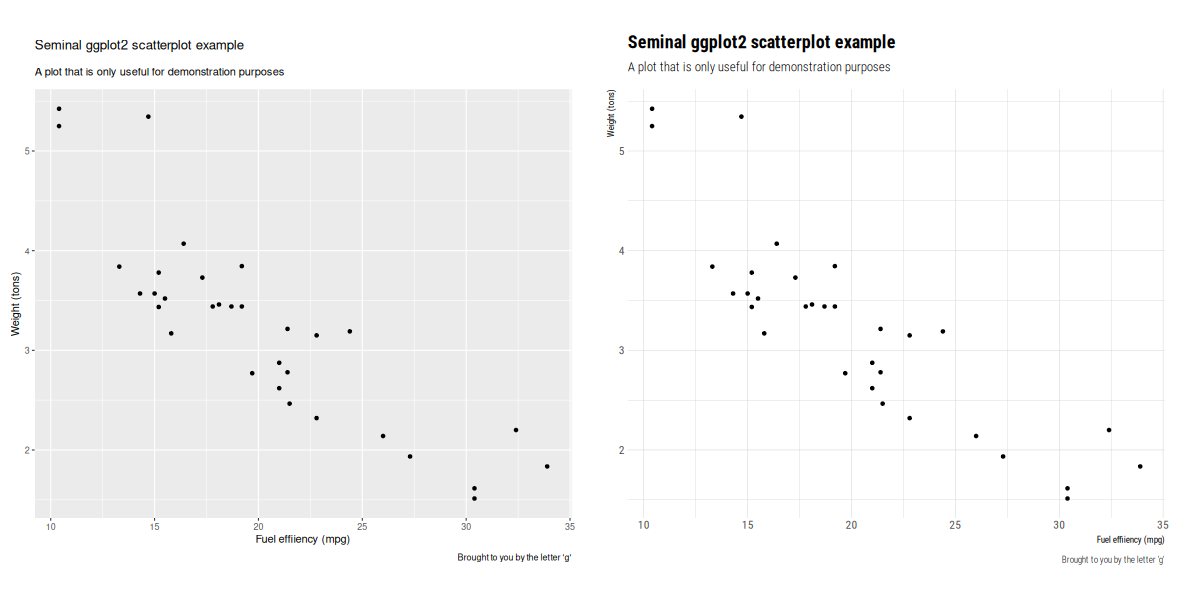
provides the theme_ipsum_rc() function from hrbrthemes by Bob Rudis in a zero (added) dependency way. A
simple example is (also available as a demo inside the package)
contrasts the default style (on the left) with the one added by this
package (on the right):
This version responds solely to things CRAN now nags about. As these are
all package quality improvement we generally oblige happily (and
generally fix in the respective package repo when we notice). I am
currently on a quest to get most/all of my nags down so new releases are
sometimes the way to go even when not under a deadline gun (as with
other releases this week).
The full set of changes since the last release (a little over a year
ago) follows.
Changes in
tinythemes version 0.0.3 (2025-03-29)
Updated a badge URL in README.md
Updated manual pages with proper anchor links
Rewrote one example without pipe to not require minimum R
version
Courtesy of my CRANberries, there
is a diffstat
report relative to previous release. More detailed information is on
the repo where
comments and suggestions are welcome.
Following
the
1.2.0beta1 release two weeks ago, a final 1.2.0 release of theora
was wrapped up today. This new release is tagged in
the Xiph gitlab theora
instance and you can fetch it from
the Theora home page as soon as
someone with access find time to update the web pages. In the mean time
(automatically removed after 14 days) the release tarball is also
available as a git build artifact from
CI
build of the release tag.
The list of changes since The 1.2.0beta release from the CHANGES
file in the tarball look like this:
libtheora 1.2.0 (2025 March 29)
Bumped minor SONAME versions as oc_comment_unpack() implementation
changed.
Added example wrapper script encoder_example_ffmpeg (#1601 #2336).
Improve comment handling on platforms where malloc(0) return NULL
(#2304).
Added pragma in example code to quiet clang op precedenca warnings.
Adjusted encoder_example help text.
Adjusted README, CHANGES, pkg-config and spec files to better reflect
current release (#2331 #2328).
Corrected english typos in source and build system.
Switched http links to https in doc and comments where relevant.
Did not touch RFC drafts.
As usual, if you use Bitcoin and want to show your support of my
activities, please send Bitcoin donations to my address
15oWEoG9dUPovwmUL9KWAnYRtNJEkP1u1b.
Rust, and resistance to it in some parts of the Linux community, has been in my feed recently. One undercurrent seems to be the notion that Rust is woke (and should therefore be rejected as part of culture wars).
I m going to argue that Rust, the language, is woke. So the opponents are right, in that sense. Of course, as ever, dissing something for being woke is nasty and fascist-adjacent.
Community
The obvious way that Rust may seem woke is that it has the trappings, and many of the attitudes and outcomes, of a modern, nice, FLOSS community. Rust certainly does better than toxic environments like the Linux kernel, or Debian. This is reflected in a higher proportion of contributors from various kinds of minoritised groups. But Rust is not outstanding in this respect. It certainly has its problems. Many other projects do as well or better.
And this is well-trodden ground. I have something more interesting to say:
Technological values - particularly, compared to C/C++
Rust is woke technology that embodies a woke understanding of what it means to be a programming language.
Ostensible values
Let s start with Rust s strapline:
A language empowering everyone to build reliable and efficient software.
Surprisingly, this motto is not mere marketing puff. For Rustaceans, it is a key goal which strongly influences day-to-day decisions (big and small).
Empowering everyone is a key aspect of this, which aligns with my own personal values. In the Rust community, we care about empowerment. We are trying to help liberate our users. And we want to empower everyone because everyone is entitled to technological autonomy. (For a programming language, empowering individuals means empowering their communities, of course.)
This is all very airy-fairy, but it has concrete consequences:
Attitude to the programmer s mistakes
In Rust we consider it a key part of our job to help the programmer avoid mistakes; to limit the consequences of mistakes; and to guide programmers in useful directions.
If you write a bug in your Rust program, Rust doesn t blame you. Rust asks how could the compiler have spotted that bug .
This is in sharp contrast to C (and C++). C nowadays is an insanely hostile programming environment. A C compiler relentlessly scours your program for any place where you may have violated C s almost incomprehensible rules, so that it can compile your apparently-correct program into a buggy executable. And then the bug is considered your fault.
These aren t just attitudes implicitly embodied in the software. They are concrete opinions expressed by compiler authors, and also by language proponents. In other words:
Rust sees programmers writing bugs as a systemic problem, which must be addressed by improvements to the environment and the system. The toxic parts of the C and C++ community see bugs as moral failings by individual programmers.
Sound familiar?
The ideology of the hardcore programmer
Programming has long suffered from the myth of the rockstar . Silicon Valley techbro culture loves this notion.
In reality, though, modern information systems are far too complicated for a single person. Developing systems is a team sport. Nontechnical, and technical-adjacent, skills are vital: clear but friendly communication; obtaining and incorporating the insights of every member of your team; willingness to be challenged. Community building. Collaboration. Governance.
The hardcore C community embraces the rockstar myth: they imagine that a few super-programmers (or super-reviewers) are able to spot bugs, just by being so brilliant. Of course this doesn t actually work at all, as we can see from the atrocious bugfest that is the Linux kernel.
These rockstars want us to believe that there is a steep hierarchy in programmming; that they are at the top of this hierarchy; and that being nice isn t important.
Sound familiar?
Memory safety as a power struggle
Much of the modern crisis of software reliability arises from memory-unsafe programming languages, mostly C and C++.
Addressing this is a big job, requiring many changes. This threatens powerful interests; notably, corporations who want to keep shipping junk. (See also, conniptions over the EU Product Liability Directive.)
The harms of this serious problem mostly fall on society at large, but the convenience of carrying on as before benefits existing powerful interests.
Sound familiar?
Memory safety via Rust as a power struggle
Addressing this problem via Rust is a direct threat to the power of established C programmers such as gatekeepers in the Linux kernel. Supplanting C means they will have to learn new things, and jostle for status against better Rustaceans, or be replaced. More broadly, Rust shows that it is practical to write fast, reliable, software, and that this does not need (mythical) rockstars .
So established C programmer experts are existing vested interests, whose power is undermined by (this approach to) tackling this serious problem.
Sound familiar?
NotesThis is not a RIIR manifesto
I m not saying we should rewrite all the world s C in Rust. We should not try to do that.
Rust is often a good choice for new code, or when a rewrite or substantial overhaul is needed anyway. But we re going to need other techniques to deal with all of our existing C. CHERI is a very promising approach. Sandboxing, emulation and automatic translation are other possibilities. The problem is a big one and we need a toolkit, not a magic bullet.
But as for Linux: it is a scandal that substantial new drivers and subsystems are still being written in C. We could have been using Rust for new code throughout Linux years ago, and avoided very many bugs. Those bugs are doing real harm. This is not OK.
Disclosure
I first learned C from K&R I in 1989. I spent the first three decades of my life as a working programmer writing lots and lots of C. I ve written C++ too. I used to consider myself an expert C programmer, but nowadays my C is a bit rusty and out of date. Why is my C rusty? Because I found Rust, and immediately liked and adopted it (despite its many faults).
I like Rust because I care that the software I write actually works: I care that my code doesn t do harm in the world.
On the meaning of woke
The original meaning of woke is something much more specific, to do with racism. For the avoidance of doubt, I don t think Rust is particularly antiracist.
I m using woke (like Rust s opponents are) in the much broader, and now much more prevalent, culture wars sense.
Pithy conclusion
If you re a senior developer who knows only C/C++, doesn t want their authority challenged, and doesn t want to have to learn how to write better software, you should hate Rust.
Also you should be fired.
Edited 2025-03-28 17:10 UTC to fix minor problems and add a new note about the meaning of the word "woke".
Armadillo is a powerful
and expressive C++ template library for linear algebra and scientific
computing. It aims towards a good balance between speed and ease of use,
has a syntax deliberately close to Matlab, and is useful for algorithm
development directly in C++, or quick conversion of research code into
production environments. RcppArmadillo
integrates this library with the R environment and language and is
widely used by (currently) 1236 other packages on CRAN, downloaded 39 million times
(per the partial logs from the cloud mirrors of CRAN), and the CSDA paper (preprint
/ vignette) by Conrad and myself has been cited 620 times according
to Google Scholar.
This release brings a small upstream bug fix to the two
FFTW3-interfacing functions, something not likely to hit many CRAN packages.
The changes since the last and fairly recent CRAN release are summarised
below.
Changes in
RcppArmadillo version 14.4.1-1 (2025-03-27)
Upgraded to Armadillo release 14.4.1 (Filtered Espresso)
Fix for fft() and ifft() when using FFTW3
in multi-threaded contexts (such as OpenMP)
As I write this in March 2025, there is a lot of confusion about Signal messenger due to the recent news of people using Signal in government, and subsequent leaks.
The short version is: there was no problem with Signal here. People were using it because they understood it to be secure, not the other way around.
Both the government and the Electronic Frontier Foundation recommend people use Signal. This is an unusual alliance, and in the case of the government, was prompted because it understood other countries had a persistent attack against American telephone companies and SMS traffic.
So let s dive in. I ll cover some basics of what security is, what happened in this situation, and why Signal is a good idea.
This post isn t for programmers that work with cryptography every day. Rather, I hope it can make some of these concepts accessible to everyone else.
What makes communications secure?
When most people are talking about secure communications, they mean some combination of these properties:
Privacy - nobody except the intended recipient can decode a message.
Authentication - guarantees that the person you are chatting with really is the intended recipient.
Ephemerality - preventing a record of the communication from being stored. That is, making it more like a conversation around the table than a written email.
Anonymity - keeping your set of contacts to yourself and even obfuscating the fact that communications are occurring.
If you think about it, most people care the most about the first two. In fact, authentication is a key part of privacy. There is an attack known as man in the middle in which somebody pretends to be the intended recipient. The interceptor reads the messages, and then passes them on to the real intended recipient. So we can t really have privacy without authentication.
I ll have more to say about these later. For now, let s discuss attack scenarios.
What compromises security?
There are a number of ways that security can be compromised. Let s think through some of them:
Communications infrastructure snooping
Let s say you used no encryption at all, and connected to public WiFi in a coffee shop to send your message. Who all could potentially see it?
The owner of the coffee shop s WiFi
The coffee shop s Internet provider
The recipient s Internet provider
Any Internet providers along the network between the sender and the recipient
Any government or institution that can compel any of the above to hand over copies of the traffic
Any hackers that compromise any of the above systems
Back in the early days of the Internet, most traffic had no encryption. People were careful about putting their credit cards into webpages and emails because they knew it was easy to intercept them. We have been on a decades-long evolution towards more pervasive encryption, which is a good thing.
Text messages (SMS) follow a similar path to the above scenario, and are unencrypted. We know that all of the above are ways people s texts can be compromised; for instance, governments can issue search warrants to obtain copies of texts, and China is believed to have a persistent hack into western telcos. SMS fails all four of our attributes of secure communication above (privacy, authentication, ephemerality, and anonymity).
Also, think about what information is collected from SMS and by who. Texts you send could be retained in your phone, the recipient s phone, your phone company, their phone company, and so forth. They might also live in cloud backups of your devices. You only have control over your own phone s retention.
So defenses against this involve things like:
Strong end-to-end encryption, so no intermediate party even the people that make the app can snoop on it.
Using strong authentication of your peers
Taking steps to prevent even app developers from being able to see your contact list or communication history
You may see some other apps saying they use strong encryption or use the Signal protocol. But while they may do that for some or all of your message content, they may still upload your contact list, history, location, etc. to a central location where it is still vulnerable to these kinds of attacks.
When you think about anonymity, think about it like this: if you send a letter to a friend every week, every postal carrier that transports it even if they never open it or attempt to peak inside will be able to read the envelope and know that you communicate on a certain schedule with that friend. The same can be said of SMS, email, or most encrypted chat operators. Signal s design prevents it from retaining even this information, though nation-states or ISPs might still be able to notice patterns (every time you send something via Signal, your contact receives something from Signal a few milliseconds later). It is very difficult to provide perfect anonymity from well-funded adversaries, even if you can provide very good privacy.
Device compromise
Let s say you use an app with strong end-to-end encryption. This takes away some of the easiest ways someone could get to your messages. But it doesn t take away all of them.
What if somebody stole your phone? Perhaps the phone has a password, but if an attacker pulled out the storage unit, could they access your messages without a password? Or maybe they somehow trick or compel you into revealing your password. Now what?
An even simpler attack doesn t require them to steal your device at all. All they need is a few minutes with it to steal your SIM card. Now they can receive any texts sent to your number - whether from your bank or your friend. Yikes, right?
Signal stores your data in an encrypted form on your device. It can protect it in various ways. One of the most important protections is ephemerality - it can automatically delete your old texts. A text that is securely erased can never fall into the wrong hands if the device is compromised later.
An actively-compromised phone, though, could still give up secrets. For instance, what if a malicious keyboard app sent every keypress to an adversary? Signal is only as secure as the phone it runs on but still, it protects against a wide variety of attacks.
Untrustworthy communication partner
Perhaps you are sending sensitive information to a contact, but that person doesn t want to keep it in confidence. There is very little you can do about that technologically; with pretty much any tool out there, nothing stops them from taking a picture of your messages and handing the picture off.
Environmental compromise
Perhaps your device is secure, but a hidden camera still captures what s on your screen. You can take some steps against things like this, of course.
Human error
Sometimes humans make mistakes. For instance, the reason a reporter got copies of messages recently was because a participant in a group chat accidentally added him (presumably that participant meant to add someone else and just selected the wrong name). Phishing attacks can trick people into revealing passwords or other sensitive data. Humans are, quite often, the weakest link in the chain.
Protecting yourself
So how can you protect yourself against these attacks? Let s consider:
Use a secure app like Signal that uses strong end-to-end encryption where even the provider can t access your messages
Keep your software and phone up-to-date
Be careful about phishing attacks and who you add to chat rooms
Be aware of your surroundings; don t send sensitive messages where people might be looking over your shoulder with their eyes or cameras
There are other methods besides Signal. For instance, you could install GnuPG (GPG) on a laptop that has no WiFi card or any other way to connect it to the Internet. You could always type your messages on that laptop, encrypt them, copy the encrypted text to a floppy disk (or USB device), take that USB drive to your Internet computer, and send the encrypted message by email or something. It would be exceptionally difficult to break the privacy of messages in that case (though anonymity would be mostly lost). Even if someone got the password to your secure laptop, it wouldn t do them any good unless they physically broke into your house or something. In some ways, it is probably safer than Signal. (For more on this, see my article How gapped is your air?)
But, that approach is hard to use. Many people aren t familiar with GnuPG. You don t have the convenience of sending a quick text message from anywhere. Security that is hard to use most often simply isn t used. That is, you and your friends will probably just revert back to using insecure SMS instead of this GnuPG approach because SMS is so much easier.
Signal strikes a unique balance of providing very good security while also being practical, easy, and useful. For most people, it is the most secure option available.
Signal is also open source; you don t have to trust that it is as secure as it says, because you can inspect it for yourself. Also, while it s not federated, I previously addressed that.
Government use
If you are a government, particularly one that is highly consequential to the world, you can imagine that you are a huge target. Other nations are likely spending billions of dollars to compromise your communications. Signal itself might be secure, but if some other government can add spyware to your phones, or conduct a successful phishing attack, you can still have your communications compromised.
I have no direct knowledge, but I think it is generally understood that the US government maintains communications networks that are entirely separate from the Internet and can only be accessed from secure physical locations and secure rooms. These can be even more secure than the average person using Signal because they can protect against things like environmental compromise, human error, and so forth. The scandal in March of 2025 happened because government employees were using Signal rather than official government tools for sensitive information, had taken advantage of Signal s ephemerality (laws require records to be kept), and through apparent human error had directly shared this information with a reporter. Presumably a reporter would have lacked access to the restricted communications networks in the first place, so that wouldn t have been possible.
This doesn t mean that Signal is bad. It just means that somebody that can spend billions of dollars on security can be more secure than you. Signal is still a great tool for people, and in many cases defeats even those that can spend lots of dollars trying to defeat it.
And remember - to use those restricted networks, you have to go to specific rooms in specific buildings. They are still not as convenient as what you carry around in your pocket.
Conclusion
Signal is practical security. Do you want phone companies reading your messages? How about Facebook or X? Have those companies demonstrated that they are completely trustworthy throughout their entire history?
I say no. So, go install Signal. It s the best, most practical tool we have.
This post is also available on my website, where it may be periodically updated.
A new version 0.1.5 of the tint package
arrived at CRAN today.
tint provides a style not unlike Tufte for use in html
and pdf documents created from markdown. The github repo shows
several examples in its README, more as usual in the package
documentation.
This is the first release in one and a half years and contains only
routine maintenance. As CRAN
now bags about missing anchors in the common \code \link
use, I added these today. Otherwise the usual mix of updates to
continuous integration, to badges and URLs and other small packaging
details but nothing user-facing.
Changes in tint
version 0.1.5 (2025-03-27)
Standard package maintenance for continuous integration, URL
updates, and packaging conventions
Evolution of the situation
In February, we have released 38 DLAs.
Notable security updates:
pam-u2f, prepared by Patrick Winnertz, fixed an authentication bypass vulnerability
openjdk-17, prepared by Emilio Pozuelo Monfort, fixed an authorization bypass/information disclosure vulnerability
firefox-esr, prepared by Emilio Pozuelo Monfort, fixed several vulnerabilities
thunderbird, prepared by Emilio Pozuelo Monfort, fixed several vulnerabilities
postgresql-13, prepared by Christoph Berg, fixed an SQL injection vulnerability
freerdp2, prepared by Tobias Frost, fixed several vulnerabilities
openssh, prepared by Colin Watson, fixed a machine-in-the-middle vulnerability
LTS contributors Emilio Pozuelo Monfort and Santiago Ruano Rinc n coordinated the administrative aspects of LTS updates of postgresql-13 and pam-u2f, which were prepared by the respective maintainers, to whom we are most grateful.
As has become the custom of the LTS team, work is under way on a number of package updates targeting Debian 12 (codename bookworm ) with fixes for a variety of vulnerabilities. In February, Guilhem Moulin prepared an upload of sssd, while several other updates are still in progress. Bastien Roucari s prepared an upload of krb5 for unstable as well.
Given the importance of the Debian Security Tracker to the work of the LTS Team, we regularly contribute improvements to it. LTS contributor Emilio Pozuelo Monfort reviewed and merged a change to improve performance, and then dealt with unexpected issues that arose as a result. He also made improvements in the processing of CVEs which are not applicable to Debian.
Looking to the future (the release of Debian 13, codename trixie , and beyond), LTS contributor Santiago Ruano Rinc n has initiated a conversation among the broader community involved in the development of Debian. The purpose of the discussion is to explore ways to improve the long term supportability of packages in Debian, specifically by focusing effort on ensuring that each Debian release contains the best supported upstream version of packages with a history of security issues.
Thanks to our sponsors
Sponsors that joined recently are in bold.
We are pleased to announce that Viridien
has committed to sponsor DebConf25 as a
Platinum Sponsor.
Viridien is an advanced technology, digital
and Earth data company that pushes the boundaries of science for a more
prosperous and sustainable future.
Viridien has been using Debian-based systems to power most of its HPC
infrastructure and its cloud platform since 2009 and currently employs two
active Debian Project Members.
As a Platinum Sponsor, Viridien is contributing to the Debian annual
Developers' conference, directly supporting the progress of Debian and Free
Software. Viridien contributes to strengthen the community that collaborates
on the Debian project from all around the world throughout all of the year.
Thank you very much, Viridien, for your support of DebConf25!
Become a sponsor too!
DebConf25 will take place from 14 to 20
July 2025 in Brest, France, and will be preceded by DebCamp, from 7 to 13
July 2025.
DebConf25 is accepting sponsors! Interested companies and organizations may
contact the DebConf team through
sponsors@debconf.org, and visit the DebConf25
website at
https://debconf25.debconf.org/sponsors /become-a-sponsor/.
A new minor release 0.2.5 of our RcppRedis
package arrived on CRAN today.
RcppRedis
is one of several packages connecting R to the fabulous Redis in-memory datastructure store (and
much more). RcppRedis
does not pretend to be feature complete, but it may do some things
faster than the other interfaces, and also offers an optional coupling
with MessagePack binary
(de)serialization via RcppMsgPack. The
package has been deployed in production as a risk / monitoring tool on
a trading floor for several years. It also supports pub/sub
dissemination of streaming market data as per this
earlier example.
Given the changes around Redis, it is
worth stressing that the package works just as well with valkey and uses only hiredis which remains proper
open source.
This update is again somewhat mechanical as a few maintenance things
bubbled up in since the last release in the summer of 2023. As with
other packages, continuous integration was updated a few times as were
URLs and badges, and we update the use of our RApiSerialize.
And, just as we did today and yesterday with littler,
RQuantLib
and RDieHarder,
this addresses a nag from CRAN
about implicit bash dependency in configure.ac
(which we fixed in January as for the other packages but are under
deadline now). Last but not least the newly-added extension of
forbidden symbols in static libraries revealed that yes indeed I had
forgotten to set -DNDEBUG when building the embedded hiredis in fallback mode and
I now also converted its four uses of sprintf to
snprintf so we are clean there too.
The detailed changes list follows.
Changes in version 0.2.5
(2025-03-26)
The continuous integration setup was updated several
times
Badges and URLs in README.md have been updated
An updated interface from RApiSerialize
is now used, and a versioned dependency on version 0.1.4 or later has
been added
The DESCRIPTION file now uses Authors@R
Two possible bashisms have been converted in
configure.ac
The (fallback if needed) build of libhiredis.a now
sets -DNDEBUG, four uses of sprintf converted
to snprintf
An new version 0.2.7 of the random-number generator tester RDieHarder
(based on the DieHarder
suite developed / maintained by Robert Brown with contributions by David
Bauer and myself along with other contributors) is now on CRAN.
This release contains only internal maintenance changes: continuous
integration was updated as was a badge URL, and a bashism issue in
configure.ac was addressed (months ago) but as CRAN now sends NOTEs it triggered
this update (just like littler
and RQuantLib
yesterday).
Thanks to CRANberries, you
can also look at the most recent diff
to the previous release.
If you like this or other open-source work I do, you can now sponsor me at
GitHub.
A third release of the crc32c package
is now on CRAN. The package
bring the Google library
crc32c to R and offers
cyclical checksums with parity in hardware-accelerated form on (recent
enough) intel cpus as well as on arm64.
This release is one hundred percent maintenance. Brian Ripley reached
out as he already tests the (still very much unreleased)
cmake 4.0.0 release, currently at rc5. And that version is
now picky about minimumcmake version statements
in CMakeLists.txt. As we copied the upstream one here, with its setting
of the jurassic 3.1 version, our build conked out. A simple switch to
3.5..4.0, declaring a from .. to scheme with a minimally
supported version (here 3.5, released in 2016) up to a tested version
works. No other changes, really, besides an earlier helping hand from Jeroen concerning cross-compilation
support he needed or encountered (and that happened right after the
0.0.2 release).
The NEWS entry for this (as well the initial release) follows.
Changes in version 0.0.3
(2025-03-25)
Support cross-compilation by setting CC and CXX in Makevars.in
(Jeroen Ooms in #1)
Support pre-release 4.0.0 of cmake by moving the
minimum stated version from 3.1 to 3.5 per CRAN request, also sent PR
upstream
My CRANberries
service provides a comparison to the
previous release. The code is available via the GitHub repo, and of
course also from its
CRAN page and via install.packages("crc32c"). Comments
and suggestions are welcome at the GitHub repo.
The twentysecond release of littler as a
CRAN package
landed on CRAN just now, following in the now nineteen year history (!!)
as a (initially non-CRAN) package started by Jeff in 2006, and joined
by me a few weeks later.
littler
is the first command-line interface for R as it predates
Rscript. It allows for piping as well for shebang
scripting via #!, uses command-line arguments more
consistently and still starts
faster. It also always loaded the methods package which
Rscript only began to do in recent years.
littler
lives on Linux and Unix, has its difficulties on macOS due to
some-braindeadedness there (who ever thought case-insensitive
filesystems as a default were a good idea?) and simply does not exist on
Windows (yet the build system could be extended see RInside for
an existence proof, and volunteers are welcome!). See the FAQ
vignette on how to add it to your PATH. A few examples
are highlighted at the Github repo:, as well
as in the examples
vignette.
This release, the first is almost exactly one year, brings
enhancements to six scripts as well as three new ones. The new ones
crup.r offers CRan UPloads from the command-line,
deadliners.r lists CRAN package by CRAN deadline, and
wb.r uploads to win-builder (replacing an older shell
script of mine). Among the updated ones, kitten.r now
creates more complete DESCRIPTION files in the packages it makes, and
several scripts support additional options. A number of changes were
made to packaging as well, some of which were contributed by Jon and Michael which is of course
always greatly appreciated. The trigger for the release was, just like
for RQuantLib
earlier today, a CRAN nag
on bashisms half of which actually false here it was in a comment
only. Oh well.
The full change description follows.
Changes in littler
version 0.3.21 (2025-03-24)
Changes in examples scripts
Usage text for ciw.r is improved, new options were
added (Dirk)
The noble release is supported by r2u.r
(Dirk)
The installRub.r script has additional options
(Dirk)
The ttlt.r script has a new
load_package argument (Dirk)
A new script deadliners.r showing CRAN packages
'under deadline' has been added, and then refined (Dirk)
The kitten.r script can now use whoami and argument githubuser on the
different *kitten helpers it calls (Dirk)
A new script wb.r can upload to win-builder
(Dirk)
A new script crup.r can upload a CRAN submission
(Dirk)
In rcc.r, the return from rcmdcheck is now explicitly printed (Dirk)
In r2u.r the dry-run option is passed
to the build command (Dirk)
Changes in package
Regular updates to badges, continuous integration, DESCRIPTION
and configure.ac (Dirk)
Errant osVersion return value are handled more
robustly (Michael Chirico in #121)
The current run-time path is available via variable
LITTLER_SCRIPT_PATH (Jon Clayden in #122)
The cleanup script remove macOS debug symbols (Jon Clayden in #123)
My CRANberries
service provides a comparison to the
previous release. Full details for the littler
release are provided as usual at the ChangeLog
page, and also on the package docs website.
The code is available via the GitHub repo, from
tarballs and now of course also from its CRAN page and
via install.packages("littler"). Binary packages are
available directly in Debian as
well as (in a day or two) Ubuntu binaries at
CRAN thanks to the tireless Michael Rutter. Comments and suggestions
are welcome at the GitHub repo.
A new minor release 0.4.25 of RQuantLib
arrived on CRAN this morning,
and has just now been uploaded to Debian too.
QuantLib is a rather
comprehensice free/open-source library for quantitative
finance. RQuantLib
connects (some parts of) it to the R environment and language, and has
been part of CRAN for nearly
twenty-two years (!!) as it was one of the first packages I uploaded to
CRAN.
This release of RQuantLib
is tickled by a request to remove bashisms in shell scripts, or, as in
my case here, configure.ac where I used the non-portable
form of string comparison. That has of course been there for umpteen
years and not bitten anyone as the default shell for most is in fact
bash but the change has the right idea. And is of course
now mandatory affecting quite a few packages is I
tooted yesterday. It also contains an improvement to the macOS 14
build kindly contributed by Jeroen.
Changes in RQuantLib version 0.4.25 (2025-03-24)
Support macOS 14 with a new compiler flag (Jeroen in #190)
Correct two bashisms in configure.ac
One more note, though: This may however be the last release I make
with Windows support. CRAN now
also checks for forbidden symbols (such as assert or
(s)printf or ) in static libraries, and this release
tickled one such warning from the Windows side (which only uses static
libraries). I have no desire to get involved in also maintaing QuantLib
(no R here) for Windows and may simply turn the package back to
OS_type: unix to avoid the hassle. To avoid that, it would
be fabulous if someone relying on RQuantLib on Windows could step up and
lend a hand looking after that library build.
Courtesy of my CRANberries, there
is also a diffstat
report for the this release. As always, more detailed information is
on the RQuantLib
page. Questions, comments etc should go to the rquantlib-devel mailing list.
Issue tickets can be filed at the GitHub repo.
If you like this or other open-source work I do, you can now sponsor me at
GitHub.
I am told, by friends who have spent time at Google, about the reason Google Reader finally disappeared. Apparently it had become a 20% Project for those who still cared about it internally, and there was some major change happening to one of it upstream dependencies that was either going to cause a significant amount of work rearchitecting Reader to cope, or create additional ongoing maintenance burden. It was no longer viable to support it as a side project, so it had to go. This was a consequence of an internal culture at Google where service owners are able to make changes that can break downstream users, and the downstream users are the ones who have to adapt.
My experience at Meta goes the other way. If you own a service or other dependency and you want to make a change that will break things for the users, it s on you to do the migration, or at the very least provide significant assistance to those who own the code. You don t just get to drop your new release and expect others to clean up; doing that tends to lead to changes being reverted. The culture flows the other way; if you break it, you fix it (nothing is someone else s problem).
There are pluses and minuses to both approaches. Users having to drive the changes to things they own stops them from blocking progress. Service/code owners having to drive the changes avoids the situation where a wildly used component drops a new release that causes a lot of high priority work for folk in order to adapt.
I started thinking about this in the context of Debian a while back, and a few incidents since have resulted in my feeling that we re closer to the Google model than the Meta model. Anyone can upload a new version of their package to unstable, and that might end up breaking all the users of it. It s not quite as extreme as rolling out a new service, because it s unstable that gets affected (the clue is in the name, I really wish more people would realise that), but it can still result in release critical bugs for lots other Debian contributors.
A good example of this are toolchain changes. Major updates to GCC and friends regularly result in FTBFS issues in lots of packages. Now in this instance the maintainer is usually diligent about a heads up before the default changes, but it s still a whole bunch of work for other maintainers to adapt (see the list of FTBFS bugs for GCC 15 for instance - these are important, but not serious yet). Worse is when a dependency changes and hasn t managed to catch everyone who might be affected, so by the time it s discovered it s release critical, because at least one package no longer builds in unstable.
Commercial organisations try to avoid this with a decent CI/CD setup that either vendors all dependencies, or tracks changes to them and tries rebuilds before allowing things to land. This is one of the instances where a monorepo can really shine; if everything you need is in there, it s easier to track the interconnections between different components. Debian doesn t have a CI/CD system that runs for every upload, allowing us to track exact causes of regressions. Instead we have Lucas, who does a tremendous job of running archive wide rebuilds to make sure we can still build everything. Unfortunately that means I am often unfairly grumpy at him; my heart sinks when I see a bug come in with his name attached, because it often means one of my packages has a new RC bug where I m going to have to figure out what changed elsewhere to cause it. However he s just (very usefully) surfacing an issue someone else created, rather than actually being the cause of the problem.
I don t know if I have a point to this post. I think it s probably that I wish folk in Free Software would try and be mindful of the incompatible changes they might introducing, and the toil they create for other volunteer developers, often not directly visible to the person making the change. The approach done by the Debian toolchain maintainers strikes me as a good balance; they do a bunch of work up front to try and flag all the places that might need to make changes, far enough in advance of the breaking change actually landing. However they don t then allow a tardy developer to block progress.
 Version 0.0.21 of
 A new release 0.1.8 of



 A second maintenance release of our still young-ish package


 Like each month, have a look at the work funded by


 The twentysecond release of
 I am told, by friends who have spent time at Google, about the reason