Search Results: "ema"

23 November 2023

Freexian Collaborators: Debian Contributions: Preparing for Python 3.12, /usr-merge updates, invalid PEP-440 versions, and more! (by Utkarsh Gupta)

Contributing to Debian is part of Freexian s mission. This article covers the latest achievements of Freexian and their collaborators. All of this is made possible by organizations subscribing to our Long Term Support contracts and consulting services.

urllib3 s old security patch by Stefano Rivera Stefano ran into a test-suite failure in a new Debian package (python-truststore), caused by Debian s patch to urllib3 from a decade ago, making it enable TLS verification by default (remember those days!). Some analysis confirmed that this patch isn t useful any more, and could be removed. While working on the package, Stefano investigated the scope of the urllib3 2.x transition. It looks ready to start, not many packages are affected.

Preparing for Python 3.12 in dh-python by Stefano Rivera We are preparing to start the Python 3.12 transition in Debian. Two of the upstream changes that are going to cause a lot of packages to break could be worked-around in dh-python, so we did:
  • Distutils is no longer shipped in the Python stdlib. Packages need to Build-Depend on python3-setuptools to get a (compatibility shim) distutils. Until that happens, dh-python will Depend on setuptools.
  • A failure to find any tests to execute will now make the unittest runner exit 5, like pytest does. This was our change, to test-suites that have failed to be automatically discovered. It will cause many packages to fail to build, so until they explicitly skip running test suites, dh-python will ignore these failures.

/usr-merge by Helmut Grohne It has become clear that the planned changes to debhelper and systemd.pc cause more rc-bugs. Helmut researched these systematically and filed another stack of patches. At the time of this writing, the uploads would still cause about 40 rc-bugs. A new opt-in helper dh_movetousr has been developed and added to debhelper in trixie and unstable.

debian-printing, by Thorsten Alteholz This month Thorsten adopted two packages, namely rlpr and lprng, and moved them to the debian-printing team. As part of this Thorsten could close eight bugs in the BTS. Thorsten also uploaded a new upstream version of cups, which also meant that eleven bugs could be closed. As package hannah-foo2zjs still depended on the deprecated policykit-1 package, Thorsten changed the dependency list accordingly and could close one RC bug by the following upload.

Invalid PEP-440 Versions in Python Packages by Stefano Rivera Stefano investigated how many packages in Debian (typically Debian-native packages) recorded versions in their packaging metadata (egg-info directories) that weren t valid PEP-440 Python versions. pip is starting to enforce that all versions on the system are valid.

Miscellaneous contributions
  • distro-info-data updates in Debian, due to the new Ubuntu release, by Stefano.
  • DebConf 23 bookkeeping continues, but is winding down. Stefano still spends a little time on it.
  • Utkarsh continues to monitor and help with reimbursements.
  • Helmut continues to maintain architecture bootstrap and accidentally broke pam briefly
  • Anton uploaded boost1.83 and started to prepare a transition to make boost1.83 as a default boost version.
  • Rejuntada Debian UY 2023, a MiniDebConf that will be held in Montevideo, from 9 to 11 November, mainly organized by Santiago.

22 November 2023

Scarlett Gately Moore: A Season to be Thankful, Thank You!

Here in the US, we celebrate Thanksgiving tomorrow. I am thankful to be a part of such an amazing community. I have raised enough to manage another month and I can continue my job search in less dire circumstances. I am truly grateful to each and every one of you. While my focus will remain on my job hunt, I will be back next week at reduced hours to maintain my work. I have to alter my priorities to keep my hours reduced enough to focus on my job search so I will be contributing as follows: Again, thank you all ever so much for your support. Though, this didn t end up being my year, I am confident I will find my place in this career path in the near future. I could still use some funds to make land and car payment or at least partial. We purchased from friends so they won t take away my wheels or home, I just feel bad I haven t been able to make payments in awhile. Thanks for your consideration. https://gofund.me/f9f0fb53

21 November 2023

Mike Hommey: How I (kind of) killed Mercurial at Mozilla

Did you hear the news? Firefox development is moving from Mercurial to Git. While the decision is far from being mine, and I was barely involved in the small incremental changes that ultimately led to this decision, I feel I have to take at least some responsibility. And if you are one of those who would rather use Mercurial than Git, you may direct all your ire at me. But let's take a step back and review the past 25 years leading to this decision. You'll forgive me for skipping some details and any possible inaccuracies. This is already a long post, while I could have been more thorough, even I think that would have been too much. This is also not an official Mozilla position, only my personal perception and recollection as someone who was involved at times, but mostly an observer from a distance. From CVS to DVCS From its release in 1998, the Mozilla source code was kept in a CVS repository. If you're too young to know what CVS is, let's just say it's an old school version control system, with its set of problems. Back then, it was mostly ubiquitous in the Open Source world, as far as I remember. In the early 2000s, the Subversion version control system gained some traction, solving some of the problems that came with CVS. Incidentally, Subversion was created by Jim Blandy, who now works at Mozilla on completely unrelated matters. In the same period, the Linux kernel development moved from CVS to Bitkeeper, which was more suitable to the distributed nature of the Linux community. BitKeeper had its own problem, though: it was the opposite of Open Source, but for most pragmatic people, it wasn't a real concern because free access was provided. Until it became a problem: someone at OSDL developed an alternative client to BitKeeper, and licenses of BitKeeper were rescinded for OSDL members, including Linus Torvalds (they were even prohibited from purchasing one). Following this fiasco, in April 2005, two weeks from each other, both Git and Mercurial were born. The former was created by Linus Torvalds himself, while the latter was developed by Olivia Mackall, who was a Linux kernel developer back then. And because they both came out of the same community for the same needs, and the same shared experience with BitKeeper, they both were similar distributed version control systems. Interestingly enough, several other DVCSes existed: In this landscape, the major difference Git was making at the time was that it was blazing fast. Almost incredibly so, at least on Linux systems. That was less true on other platforms (especially Windows). It was a game-changer for handling large codebases in a smooth manner. Anyways, two years later, in 2007, Mozilla decided to move its source code not to Bzr, not to Git, not to Subversion (which, yes, was a contender), but to Mercurial. The decision "process" was laid down in two rather colorful blog posts. My memory is a bit fuzzy, but I don't recall that it was a particularly controversial choice. All of those DVCSes were still young, and there was no definite "winner" yet (GitHub hadn't even been founded). It made the most sense for Mozilla back then, mainly because the Git experience on Windows still wasn't there, and that mattered a lot for Mozilla, with its diverse platform support. As a contributor, I didn't think much of it, although to be fair, at the time, I was mostly consuming the source tarballs. Personal preferences Digging through my archives, I've unearthed a forgotten chapter: I did end up setting up both a Mercurial and a Git mirror of the Firefox source repository on alioth.debian.org. Alioth.debian.org was a FusionForge-based collaboration system for Debian developers, similar to SourceForge. It was the ancestor of salsa.debian.org. I used those mirrors for the Debian packaging of Firefox (cough cough Iceweasel). The Git mirror was created with hg-fast-export, and the Mercurial mirror was only a necessary step in the process. By that time, I had converted my Subversion repositories to Git, and switched off SVK. Incidentally, I started contributing to Git around that time as well. I apparently did this not too long after Mozilla switched to Mercurial. As a Linux user, I think I just wanted the speed that Mercurial was not providing. Not that Mercurial was that slow, but the difference between a couple seconds and a couple hundred milliseconds was a significant enough difference in user experience for me to prefer Git (and Firefox was not the only thing I was using version control for) Other people had also similarly created their own mirror, or with other tools. But none of them were "compatible": their commit hashes were different. Hg-git, used by the latter, was putting extra information in commit messages that would make the conversion differ, and hg-fast-export would just not be consistent with itself! My mirror is long gone, and those have not been updated in more than a decade. I did end up using Mercurial, when I got commit access to the Firefox source repository in April 2010. I still kept using Git for my Debian activities, but I now was also using Mercurial to push to the Mozilla servers. I joined Mozilla as a contractor a few months after that, and kept using Mercurial for a while, but as a, by then, long time Git user, it never really clicked for me. It turns out, the sentiment was shared by several at Mozilla. Git incursion In the early 2010s, GitHub was becoming ubiquitous, and the Git mindshare was getting large. Multiple projects at Mozilla were already entirely hosted on GitHub. As for the Firefox source code base, Mozilla back then was kind of a Wild West, and engineers being engineers, multiple people had been using Git, with their own inconvenient workflows involving a local Mercurial clone. The most popular set of scripts was moz-git-tools, to incorporate changes in a local Git repository into the local Mercurial copy, to then send to Mozilla servers. In terms of the number of people doing that, though, I don't think it was a lot of people, probably a few handfuls. On my end, I was still keeping up with Mercurial. I think at that time several engineers had their own unofficial Git mirrors on GitHub, and later on Ehsan Akhgari provided another mirror, with a twist: it also contained the full CVS history, which the canonical Mercurial repository didn't have. This was particularly interesting for engineers who needed to do some code archeology and couldn't get past the 2007 cutoff of the Mercurial repository. I think that mirror ultimately became the official-looking, but really unofficial, mozilla-central repository on GitHub. On a side note, a Mercurial repository containing the CVS history was also later set up, but that didn't lead to something officially supported on the Mercurial side. Some time around 2011~2012, I started to more seriously consider using Git for work myself, but wasn't satisfied with the workflows others had set up for themselves. I really didn't like the idea of wasting extra disk space keeping a Mercurial clone around while using a Git mirror. I wrote a Python script that would use Mercurial as a library to access a remote repository and produce a git-fast-import stream. That would allow the creation of a git repository without a local Mercurial clone. It worked quite well, but it was not able to incrementally update. Other, more complete tools existed already, some of which I mentioned above. But as time was passing and the size and depth of the Mercurial repository was growing, these tools were showing their limits and were too slow for my taste, especially for the initial clone. Boot to Git In the same time frame, Mozilla ventured in the Mobile OS sphere with Boot to Gecko, later known as Firefox OS. What does that have to do with version control? The needs of third party collaborators in the mobile space led to the creation of what is now the gecko-dev repository on GitHub. As I remember it, it was challenging to create, but once it was there, Git users could just clone it and have a working, up-to-date local copy of the Firefox source code and its history... which they could already have, but this was the first officially supported way of doing so. Coincidentally, Ehsan's unofficial mirror was having trouble (to the point of GitHub closing the repository) and was ultimately shut down in December 2013. You'll often find comments on the interwebs about how GitHub has become unreliable since the Microsoft acquisition. I can't really comment on that, but if you think GitHub is unreliable now, rest assured that it was worse in its beginning. And its sustainability as a platform also wasn't a given, being a rather new player. So on top of having this official mirror on GitHub, Mozilla also ventured in setting up its own Git server for greater control and reliability. But the canonical repository was still the Mercurial one, and while Git users now had a supported mirror to pull from, they still had to somehow interact with Mercurial repositories, most notably for the Try server. Git slowly creeping in Firefox build tooling Still in the same time frame, tooling around building Firefox was improving drastically. For obvious reasons, when version control integration was needed in the tooling, Mercurial support was always a no-brainer. The first explicit acknowledgement of a Git repository for the Firefox source code, other than the addition of the .gitignore file, was bug 774109. It added a script to install the prerequisites to build Firefox on macOS (still called OSX back then), and that would print a message inviting people to obtain a copy of the source code with either Mercurial or Git. That was a precursor to current bootstrap.py, from September 2012. Following that, as far as I can tell, the first real incursion of Git in the Firefox source tree tooling happened in bug 965120. A few days earlier, bug 952379 had added a mach clang-format command that would apply clang-format-diff to the output from hg diff. Obviously, running hg diff on a Git working tree didn't work, and bug 965120 was filed, and support for Git was added there. That was in January 2014. A year later, when the initial implementation of mach artifact was added (which ultimately led to artifact builds), Git users were an immediate thought. But while they were considered, it was not to support them, but to avoid actively breaking their workflows. Git support for mach artifact was eventually added 14 months later, in March 2016. From gecko-dev to git-cinnabar Let's step back a little here, back to the end of 2014. My user experience with Mercurial had reached a level of dissatisfaction that was enough for me to decide to take that script from a couple years prior and make it work for incremental updates. That meant finding a way to store enough information locally to be able to reconstruct whatever the incremental updates would be relying on (guess why other tools hid a local Mercurial clone under hood). I got something working rather quickly, and after talking to a few people about this side project at the Mozilla Portland All Hands and seeing their excitement, I published a git-remote-hg initial prototype on the last day of the All Hands. Within weeks, the prototype gained the ability to directly push to Mercurial repositories, and a couple months later, was renamed to git-cinnabar. At that point, as a Git user, instead of cloning the gecko-dev repository from GitHub and switching to a local Mercurial repository whenever you needed to push to a Mercurial repository (i.e. the aforementioned Try server, or, at the time, for reviews), you could just clone and push directly from/to Mercurial, all within Git. And it was fast too. You could get a full clone of mozilla-central in less than half an hour, when at the time, other similar tools would take more than 10 hours (needless to say, it's even worse now). Another couple months later (we're now at the end of April 2015), git-cinnabar became able to start off a local clone of the gecko-dev repository, rather than clone from scratch, which could be time consuming. But because git-cinnabar and the tool that was updating gecko-dev weren't producing the same commits, this setup was cumbersome and not really recommended. For instance, if you pushed something to mozilla-central with git-cinnabar from a gecko-dev clone, it would come back with a different commit hash in gecko-dev, and you'd have to deal with the divergence. Eventually, in April 2020, the scripts updating gecko-dev were switched to git-cinnabar, making the use of gecko-dev alongside git-cinnabar a more viable option. Ironically(?), the switch occurred to ease collaboration with KaiOS (you know, the mobile OS born from the ashes of Firefox OS). Well, okay, in all honesty, when the need of syncing in both directions between Git and Mercurial (we only had ever synced from Mercurial to Git) came up, I nudged Mozilla in the direction of git-cinnabar, which, in my (biased but still honest) opinion, was the more reliable option for two-way synchronization (we did have regular conversion problems with hg-git, nothing of the sort has happened since the switch). One Firefox repository to rule them all For reasons I don't know, Mozilla decided to use separate Mercurial repositories as "branches". With the switch to the rapid release process in 2011, that meant one repository for nightly (mozilla-central), one for aurora, one for beta, and one for release. And with the addition of Extended Support Releases in 2012, we now add a new ESR repository every year. Boot to Gecko also had its own branches, and so did Fennec (Firefox for Mobile, before Android). There are a lot of them. And then there are also integration branches, where developer's work lands before being merged in mozilla-central (or backed out if it breaks things), always leaving mozilla-central in a (hopefully) good state. Only one of them remains in use today, though. I can only suppose that the way Mercurial branches work was not deemed practical. It is worth noting, though, that Mercurial branches are used in some cases, to branch off a dot-release when the next major release process has already started, so it's not a matter of not knowing the feature exists or some such. In 2016, Gregory Szorc set up a new repository that would contain them all (or at least most of them), which eventually became what is now the mozilla-unified repository. This would e.g. simplify switching between branches when necessary. 7 years later, for some reason, the other "branches" still exist, but most developers are expected to be using mozilla-unified. Mozilla's CI also switched to using mozilla-unified as base repository. Honestly, I'm not sure why the separate repositories are still the main entry point for pushes, rather than going directly to mozilla-unified, but it probably comes down to switching being work, and not being a top priority. Also, it probably doesn't help that working with multiple heads in Mercurial, even (especially?) with bookmarks, can be a source of confusion. To give an example, if you aren't careful, and do a plain clone of the mozilla-unified repository, you may not end up on the latest mozilla-central changeset, but rather, e.g. one from beta, or some other branch, depending which one was last updated. Hosting is simple, right? Put your repository on a server, install hgweb or gitweb, and that's it? Maybe that works for... Mercurial itself, but that repository "only" has slightly over 50k changesets and less than 4k files. Mozilla-central has more than an order of magnitude more changesets (close to 700k) and two orders of magnitude more files (more than 700k if you count the deleted or moved files, 350k if you count the currently existing ones). And remember, there are a lot of "duplicates" of this repository. And I didn't even mention user repositories and project branches. Sure, it's a self-inflicted pain, and you'd think it could probably(?) be mitigated with shared repositories. But consider the simple case of two repositories: mozilla-central and autoland. You make autoland use mozilla-central as a shared repository. Now, you push something new to autoland, it's stored in the autoland datastore. Eventually, you merge to mozilla-central. Congratulations, it's now in both datastores, and you'd need to clean-up autoland if you wanted to avoid the duplication. Now, you'd think mozilla-unified would solve these issues, and it would... to some extent. Because that wouldn't cover user repositories and project branches briefly mentioned above, which in GitHub parlance would be considered as Forks. So you'd want a mega global datastore shared by all repositories, and repositories would need to only expose what they really contain. Does Mercurial support that? I don't think so (okay, I'll give you that: even if it doesn't, it could, but that's extra work). And since we're talking about a transition to Git, does Git support that? You may have read about how you can link to a commit from a fork and make-pretend that it comes from the main repository on GitHub? At least, it shows a warning, now. That's essentially the architectural reason why. So the actual answer is that Git doesn't support it out of the box, but GitHub has some backend magic to handle it somehow (and hopefully, other things like Gitea, Girocco, Gitlab, etc. have something similar). Now, to come back to the size of the repository. A repository is not a static file. It's a server with which you negotiate what you have against what it has that you want. Then the server bundles what you asked for based on what you said you have. Or in the opposite direction, you negotiate what you have that it doesn't, you send it, and the server incorporates what you sent it. Fortunately the latter is less frequent and requires authentication. But the former is more frequent and CPU intensive. Especially when pulling a large number of changesets, which, incidentally, cloning is. "But there is a solution for clones" you might say, which is true. That's clonebundles, which offload the CPU intensive part of cloning to a single job scheduled regularly. Guess who implemented it? Mozilla. But that only covers the cloning part. We actually had laid the ground to support offloading large incremental updates and split clones, but that never materialized. Even with all that, that still leaves you with a server that can display file contents, diffs, blames, provide zip archives of a revision, and more, all of which are CPU intensive in their own way. And these endpoints are regularly abused, and cause extra load to your servers, yes plural, because of course a single server won't handle the load for the number of users of your big repositories. And because your endpoints are abused, you have to close some of them. And I'm not mentioning the Try repository with its tens of thousands of heads, which brings its own sets of problems (and it would have even more heads if we didn't fake-merge them once in a while). Of course, all the above applies to Git (and it only gained support for something akin to clonebundles last year). So, when the Firefox OS project was stopped, there wasn't much motivation to continue supporting our own Git server, Mercurial still being the official point of entry, and git.mozilla.org was shut down in 2016. The growing difficulty of maintaining the status quo Slowly, but steadily in more recent years, as new tooling was added that needed some input from the source code manager, support for Git was more and more consistently added. But at the same time, as people left for other endeavors and weren't necessarily replaced, or more recently with layoffs, resources allocated to such tooling have been spread thin. Meanwhile, the repository growth didn't take a break, and the Try repository was becoming an increasing pain, with push times quite often exceeding 10 minutes. The ongoing work to move Try pushes to Lando will hide the problem under the rug, but the underlying problem will still exist (although the last version of Mercurial seems to have improved things). On the flip side, more and more people have been relying on Git for Firefox development, to my own surprise, as I didn't really push for that to happen. It just happened organically, by ways of git-cinnabar existing, providing a compelling experience to those who prefer Git, and, I guess, word of mouth. I was genuinely surprised when I recently heard the use of Git among moz-phab users had surpassed a third. I did, however, occasionally orient people who struggled with Mercurial and said they were more familiar with Git, towards git-cinnabar. I suspect there's a somewhat large number of people who never realized Git was a viable option. But that, on its own, can come with its own challenges: if you use git-cinnabar without being backed by gecko-dev, you'll have a hard time sharing your branches on GitHub, because you can't push to a fork of gecko-dev without pushing your entire local repository, as they have different commit histories. And switching to gecko-dev when you weren't already using it requires some extra work to rebase all your local branches from the old commit history to the new one. Clone times with git-cinnabar have also started to go a little out of hand in the past few years, but this was mitigated in a similar manner as with the Mercurial cloning problem: with static files that are refreshed regularly. Ironically, that made cloning with git-cinnabar faster than cloning with Mercurial. But generating those static files is increasingly time-consuming. As of writing, generating those for mozilla-unified takes close to 7 hours. I was predicting clone times over 10 hours "in 5 years" in a post from 4 years ago, I wasn't too far off. With exponential growth, it could still happen, although to be fair, CPUs have improved since. I will explore the performance aspect in a subsequent blog post, alongside the upcoming release of git-cinnabar 0.7.0-b1. I don't even want to check how long it now takes with hg-git or git-remote-hg (they were already taking more than a day when git-cinnabar was taking a couple hours). I suppose it's about time that I clarify that git-cinnabar has always been a side-project. It hasn't been part of my duties at Mozilla, and the extent to which Mozilla supports git-cinnabar is in the form of taskcluster workers on the community instance for both git-cinnabar CI and generating those clone bundles. Consequently, that makes the above git-cinnabar specific issues a Me problem, rather than a Mozilla problem. Taking the leap I can't talk for the people who made the proposal to move to Git, nor for the people who put a green light on it. But I can at least give my perspective. Developers have regularly asked why Mozilla was still using Mercurial, but I think it was the first time that a formal proposal was laid out. And it came from the Engineering Workflow team, responsible for issue tracking, code reviews, source control, build and more. It's easy to say "Mozilla should have chosen Git in the first place", but back in 2007, GitHub wasn't there, Bitbucket wasn't there, and all the available options were rather new (especially compared to the then 21 years-old CVS). I think Mozilla made the right choice, all things considered. Had they waited a couple years, the story might have been different. You might say that Mozilla stayed with Mercurial for so long because of the sunk cost fallacy. I don't think that's true either. But after the biggest Mercurial repository hosting service turned off Mercurial support, and the main contributor to Mercurial going their own way, it's hard to ignore that the landscape has evolved. And the problems that we regularly encounter with the Mercurial servers are not going to get any better as the repository continues to grow. As far as I know, all the Mercurial repositories bigger than Mozilla's are... not using Mercurial. Google has its own closed-source server, and Facebook has another of its own, and it's not really public either. With resources spread thin, I don't expect Mozilla to be able to continue supporting a Mercurial server indefinitely (although I guess Octobus could be contracted to give a hand, but is that sustainable?). Mozilla, being a champion of Open Source, also doesn't live in a silo. At some point, you have to meet your contributors where they are. And the Open Source world is now majoritarily using Git. I'm sure the vast majority of new hires at Mozilla in the past, say, 5 years, know Git and have had to learn Mercurial (although they arguably didn't need to). Even within Mozilla, with thousands(!) of repositories on GitHub, Firefox is now actually the exception rather than the norm. I should even actually say Desktop Firefox, because even Mobile Firefox lives on GitHub (although Fenix is moving back in together with Desktop Firefox, and the timing is such that that will probably happen before Firefox moves to Git). Heck, even Microsoft moved to Git! With a significant developer base already using Git thanks to git-cinnabar, and all the constraints and problems I mentioned previously, it actually seems natural that a transition (finally) happens. However, had git-cinnabar or something similarly viable not existed, I don't think Mozilla would be in a position to take this decision. On one hand, it probably wouldn't be in the current situation of having to support both Git and Mercurial in the tooling around Firefox, nor the resource constraints related to that. But on the other hand, it would be farther from supporting Git and being able to make the switch in order to address all the other problems. But... GitHub? I hope I made a compelling case that hosting is not as simple as it can seem, at the scale of the Firefox repository. It's also not Mozilla's main focus. Mozilla has enough on its plate with the migration of existing infrastructure that does rely on Mercurial to understandably not want to figure out the hosting part, especially with limited resources, and with the mixed experience hosting both Mercurial and git has been so far. After all, GitHub couldn't even display things like the contributors' graph on gecko-dev until recently, and hosting is literally their job! They still drop the ball on large blames (thankfully we have searchfox for those). Where does that leave us? Gitlab? For those criticizing GitHub for being proprietary, that's probably not open enough. Cloud Source Repositories? "But GitHub is Microsoft" is a complaint I've read a lot after the announcement. Do you think Google hosting would have appealed to these people? Bitbucket? I'm kind of surprised it wasn't in the list of providers that were considered, but I'm also kind of glad it wasn't (and I'll leave it at that). I think the only relatively big hosting provider that could have made the people criticizing the choice of GitHub happy is Codeberg, but I hadn't even heard of it before it was mentioned in response to Mozilla's announcement. But really, with literal thousands of Mozilla repositories already on GitHub, with literal tens of millions repositories on the platform overall, the pragmatic in me can't deny that it's an attractive option (and I can't stress enough that I wasn't remotely close to the room where the discussion about what choice to make happened). "But it's a slippery slope". I can see that being a real concern. LLVM also moved its repository to GitHub (from a (I think) self-hosted Subversion server), and ended up moving off Bugzilla and Phabricator to GitHub issues and PRs four years later. As an occasional contributor to LLVM, I hate this move. I hate the GitHub review UI with a passion. At least, right now, GitHub PRs are not a viable option for Mozilla, for their lack of support for security related PRs, and the more general shortcomings in the review UI. That doesn't mean things won't change in the future, but let's not get too far ahead of ourselves. The move to Git has just been announced, and the migration has not even begun yet. Just because Mozilla is moving the Firefox repository to GitHub doesn't mean it's locked in forever or that all the eggs are going to be thrown into one basket. If bridges need to be crossed in the future, we'll see then. So, what's next? The official announcement said we're not expecting the migration to really begin until six months from now. I'll swim against the current here, and say this: the earlier you can switch to git, the earlier you'll find out what works and what doesn't work for you, whether you already know Git or not. While there is not one unique workflow, here's what I would recommend anyone who wants to take the leap off Mercurial right now: As there is no one-size-fits-all workflow, I won't tell you how to organize yourself from there. I'll just say this: if you know the Mercurial sha1s of your previous local work, you can create branches for them with:
$ git branch <branch_name> $(git cinnabar hg2git <hg_sha1>)
At this point, you should have everything available on the Git side, and you can remove the .hg directory. Or move it into some empty directory somewhere else, just in case. But don't leave it here, it will only confuse the tooling. Artifact builds WILL be confused, though, and you'll have to ./mach configure before being able to do anything. You may also hit bug 1865299 if your working tree is older than this post. If you have any problem or question, you can ping me on #git-cinnabar or #git on Matrix. I'll put the instructions above somewhere on wiki.mozilla.org, and we can collaboratively iterate on them. Now, what the announcement didn't say is that the Git repository WILL NOT be gecko-dev, doesn't exist yet, and WON'T BE COMPATIBLE (trust me, it'll be for the better). Why did I make you do all the above, you ask? Because that won't be a problem. I'll have you covered, I promise. The upcoming release of git-cinnabar 0.7.0-b1 will have a way to smoothly switch between gecko-dev and the future repository (incidentally, that will also allow to switch from a pure git-cinnabar clone to a gecko-dev one, for the git-cinnabar users who have kept reading this far). What about git-cinnabar? With Mercurial going the way of the dodo at Mozilla, my own need for git-cinnabar will vanish. Legitimately, this begs the question whether it will still be maintained. I can't answer for sure. I don't have a crystal ball. However, the needs of the transition itself will motivate me to finish some long-standing things (like finalizing the support for pushing merges, which is currently behind an experimental flag) or implement some missing features (support for creating Mercurial branches). Git-cinnabar started as a Python script, it grew a sidekick implemented in C, which then incorporated some Rust, which then cannibalized the Python script and took its place. It is now close to 90% Rust, and 10% C (if you don't count the code from Git that is statically linked to it), and has sort of become my Rust playground (it's also, I must admit, a mess, because of its history, but it's getting better). So the day to day use with Mercurial is not my sole motivation to keep developing it. If it were, it would stay stagnant, because all the features I need are there, and the speed is not all that bad, although I know it could be better. Arguably, though, git-cinnabar has been relatively stagnant feature-wise, because all the features I need are there. So, no, I don't expect git-cinnabar to die along Mercurial use at Mozilla, but I can't really promise anything either. Final words That was a long post. But there was a lot of ground to cover. And I still skipped over a bunch of things. I hope I didn't bore you to death. If I did and you're still reading... what's wrong with you? ;) So this is the end of Mercurial at Mozilla. So long, and thanks for all the fish. But this is also the beginning of a transition that is not easy, and that will not be without hiccups, I'm sure. So fasten your seatbelts (plural), and welcome the change. To circle back to the clickbait title, did I really kill Mercurial at Mozilla? Of course not. But it's like I stumbled upon a few sparks and tossed a can of gasoline on them. I didn't start the fire, but I sure made it into a proper bonfire... and now it has turned into a wildfire. And who knows? 15 years from now, someone else might be looking back at how Mozilla picked Git at the wrong time, and that, had we waited a little longer, we would have picked some yet to come new horse. But hey, that's the tech cycle for you.

Russ Allbery: Review: Thud!

Review: Thud!, by Terry Pratchett
Series: Discworld #34
Publisher: Harper
Copyright: October 2005
Printing: November 2014
ISBN: 0-06-233498-0
Format: Mass market
Pages: 434
Thud! is the 34th Discworld novel and the seventh Watch novel. It is partly a sequel to The Fifth Elephant, partly a sequel to Night Watch, and references many of the previous Watch novels. This is not a good place to start. Dwarfs and trolls have a long history of conflict, as one might expect between a race of creatures who specialize in mining and a race of creatures whose vital organs are sometimes the targets of that mining. The first battle of Koom Valley was the place where that enmity was made concrete and given a symbol. Now that there are large dwarf and troll populations in Ankh-Morpork, the upcoming anniversary of that battle is the excuse for rising tensions. Worse, Grag Hamcrusher, a revered deep-down dwarf and a dwarf supremacist, is giving incendiary speeches about killing all trolls and appears to be tunneling under the city. Then whispers run through the city's dwarfs that Hamcrusher has been murdered by a troll. Vimes has no patience for racial tensions, or for the inspection of the Watch by one of Vetinari's excessively competent clerks, or the political pressure to add a vampire to the Watch over his prejudiced objections. He was already grumpy before the murder and is in absolutely no mood to be told by deep-down dwarfs who barely believe that humans exist that the murder of a dwarf underground is no affair of his. Meanwhile, The Battle of Koom Valley by Methodia Rascal has been stolen from the Ankh-Morpork Royal Art Museum, an impressive feat given that the painting is ten feet high and fifty feet long. It was painted in impressive detail by a madman who thought he was a chicken, and has been the spark for endless theories about clues to some great treasure or hidden knowledge, culminating in the conspiratorial book Koom Valley Codex. But the museum prides itself on allowing people to inspect and photograph the painting to their heart's content and was working on a new room to display it. It's not clear why someone would want to steal it, but Colon and Nobby are on the case. This was a good time to read this novel. Sadly, the same could be said of pretty much every year since it was written. "Thud" in the title is a reference to Hamcrusher's murder, which was supposedly done by a troll club that was found nearby, but it's also a reference to a board game that we first saw in passing in Going Postal. We find out a lot more about Thud in this book. It's an asymmetric two-player board game that simulates a stylized battle between dwarf and troll forces, with one player playing the trolls and the other playing the dwarfs. The obvious comparison is to chess, but a better comparison would be to the old Steve Jackson Games board game Ogre, which also featured asymmetric combat mechanics. (I'm sure there are many others.) This board game will become quite central to the plot of Thud! in ways that I thought were ingenious. I thought this was one of Pratchett's best-plotted books to date. There are a lot of things happening, involving essentially every member of the Watch that we've met in previous books, and they all matter and I was never confused by how they fit together. This book is full of little callbacks and apparently small things that become important later in a way that I found delightful to read, down to the children's book that Vimes reads to his son and that turns into the best scene of the book. At this point in my Discworld read-through, I can see why the Watch books are considered the best sub-series. It feels like Pratchett kicks the quality of writing up a notch when he has Vimes as a protagonist. In several books now, Pratchett has created a villain by taking some human characteristic and turning it into an external force that acts on humans. (See, for instance the Gonne in Men at Arms, or the hiver in A Hat Full of Sky.) I normally do not like this plot technique, both because I think it lets humans off the hook in a way that cheapens the story and because this type of belief has a long and bad reputation in religions where it is used to dodge personal responsibility and dehumanize one's enemies. When another of those villains turned up in this book, I was dubious. But I think Pratchett pulls off this type of villain as well here as I've seen it done. He lifts up a facet of humanity to let the reader get a better view, but somehow makes it explicit that this is concretized metaphor. This force is something people create and feed and choose and therefore are responsible for. The one sour note that I do have to complain about is that Pratchett resorts to some cheap and annoying "men are from Mars, women are from Venus" nonsense, mostly around Nobby's subplot but in a few other places (Sybil, some of Angua's internal monologue) as well. It's relatively minor, and I might let it pass without grumbling in other books, but usually Pratchett is better on gender than this. I expected better and it got under my skin. Otherwise, though, this was a quietly excellent book. It doesn't have the emotional gut punch of Night Watch, but the plotting is superb and the pacing is a significant improvement over The Fifth Elephant. The parody is of The Da Vinci Code, which is both more interesting than Pratchett's typical movie parodies and delightfully subtle. We get more of Sybil being a bad-ass, which I am always here for. There's even some lovely world-building in the form of dwarven Devices. I love how Pratchett has built Vimes up into one of the most deceptively heroic figures on Discworld, but also shows all of the support infrastructure that ensures Vimes maintain his principles. On the surface, Thud! has a lot in common with Vimes's insistently moral stance in Jingo, but here it is more obvious how Vimes's morality happens in part because his wife, his friends, and his boss create the conditions for it to thrive. Highly recommended to anyone who has gotten this far. Rating: 9 out of 10

16 November 2023

Dimitri John Ledkov: Ubuntu 23.10 significantly reduces the installed kernel footprint


Photo by Pixabay
Ubuntu systems typically have up to 3 kernels installed, before they are auto-removed by apt on classic installs. Historically the installation was optimized for metered download size only. However, kernel size growth and usage no longer warrant such optimizations. During the 23.10 Mantic Minatour cycle, I led a coordinated effort across multiple teams to implement lots of optimizations that together achieved unprecedented install footprint improvements.

Given a typical install of 3 generic kernel ABIs in the default configuration on a regular-sized VM (2 CPU cores 8GB of RAM) the following metrics are achieved in Ubuntu 23.10 versus Ubuntu 22.04 LTS:

  • 2x less disk space used (1,417MB vs 2,940MB, including initrd)

  • 3x less peak RAM usage for the initrd boot (68MB vs 204MB)

  • 0.5x increase in download size (949MB vs 600MB)

  • 2.5x faster initrd generation (4.5s vs 11.3s)

  • approximately the same total time (103s vs 98s, hardware dependent)


For minimal cloud images that do not install either linux-firmware or modules extra the numbers are:

  • 1.3x less disk space used (548MB vs 742MB)

  • 2.2x less peak RAM usage for initrd boot (27MB vs 62MB)

  • 0.4x increase in download size (207MB vs 146MB)


Hopefully, the compromise of download size, relative to the disk space & initrd savings is a win for the majority of platforms and use cases. For users on extremely expensive and metered connections, the likely best saving is to receive air-gapped updates or skip updates.

This was achieved by precompressing kernel modules & firmware files with the maximum level of Zstd compression at package build time; making actual .deb files uncompressed; assembling the initrd using split cpio archives - uncompressed for the pre-compressed files, whilst compressing only the userspace portions of the initrd; enabling in-kernel module decompression support with matching kmod; fixing bugs in all of the above, and landing all of these things in time for the feature freeze. Whilst leveraging the experience and some of the design choices implementations we have already been shipping on Ubuntu Core. Some of these changes are backported to Jammy, but only enough to support smooth upgrades to Mantic and later. Complete gains are only possible to experience on Mantic and later.

The discovered bugs in kernel module loading code likely affect systems that use LoadPin LSM with kernel space module uncompression as used on ChromeOS systems. Hopefully, Kees Cook or other ChromeOS developers pick up the kernel fixes from the stable trees. Or you know, just use Ubuntu kernels as they do get fixes and features like these first.

The team that designed and delivered these changes is large: Benjamin Drung, Andrea Righi, Juerg Haefliger, Julian Andres Klode, Steve Langasek, Michael Hudson-Doyle, Robert Kratky, Adrien Nader, Tim Gardner, Roxana Nicolescu - and myself Dimitri John Ledkov ensuring the most optimal solution is implemented, everything lands on time, and even implementing portions of the final solution.

Hi, It's me, I am a Staff Engineer at Canonical and we are hiring https://canonical.com/careers.

Lots of additional technical details and benchmarks on a huge range of diverse hardware and architectures, and bikeshedding all the things below:

For questions and comments please post to Kernel section on Ubuntu Discourse.


Martin-&#201;ric Racine: dhcpcd almost ready to replace ISC dhclient in Debian

A lot of time has passed since my previous post on my work to make dhcpcd the drop-in replacement for the deprecated ISC dhclient a.k.a. isc-dhcp-client. Current status:

13 November 2023

Freexian Collaborators: Monthly report about Debian Long Term Support, October 2023 (by Roberto C. S nchez)

Like each month, have a look at the work funded by Freexian s Debian LTS offering.

Debian LTS contributors In October, 18 contributors have been paid to work on Debian LTS, their reports are available:
  • Adrian Bunk did 8.0h (out of 7.75h assigned and 10.0h from previous period), thus carrying over 9.75h to the next month.
  • Anton Gladky did 9.5h (out of 9.5h assigned and 5.5h from previous period), thus carrying over 5.5h to the next month.
  • Bastien Roucari s did 16.0h (out of 16.75h assigned and 1.0h from previous period), thus carrying over 1.75h to the next month.
  • Ben Hutchings did 8.0h (out of 17.75h assigned), thus carrying over 9.75h to the next month.
  • Chris Lamb did 17.0h (out of 17.75h assigned), thus carrying over 0.75h to the next month.
  • Emilio Pozuelo Monfort did 17.5h (out of 17.75h assigned), thus carrying over 0.25h to the next month.
  • Guilhem Moulin did 9.75h (out of 17.75h assigned), thus carrying over 8.0h to the next month.
  • Helmut Grohne did 1.5h (out of 10.0h assigned), thus carrying over 8.5h to the next month.
  • Lee Garrett did 10.75h (out of 17.75h assigned), thus carrying over 7.0h to the next month.
  • Markus Koschany did 30.0h (out of 30.0h assigned).
  • Ola Lundqvist did 4.0h (out of 0h assigned and 19.5h from previous period), thus carrying over 15.5h to the next month.
  • Roberto C. S nchez did 12.0h (out of 5.0h assigned and 7.0h from previous period).
  • Santiago Ruano Rinc n did 13.625h (out of 7.75h assigned and 8.25h from previous period), thus carrying over 2.375h to the next month.
  • Sean Whitton did 13.0h (out of 6.0h assigned and 7.0h from previous period).
  • Sylvain Beucler did 7.5h (out of 11.25h assigned and 6.5h from previous period), thus carrying over 10.25h to the next month.
  • Thorsten Alteholz did 14.0h (out of 14.0h assigned).
  • Tobias Frost did 16.0h (out of 9.25h assigned and 6.75h from previous period).
  • Utkarsh Gupta did 0.0h (out of 0.75h assigned and 17.0h from previous period), thus carrying over 17.75h to the next month.

Evolution of the situation In October, we have released 49 DLAs. Of particular note in the month of October, LTS contributor Chris Lamb issued DLA 3627-1 pertaining to Redis, the popular key-value database similar to Memcached, which was vulnerable to an authentication bypass vulnerability. Fixing this vulnerability involved dealing with a race condition that could allow another process an opportunity to establish an otherwise unauthorized connection. LTS contributor Markus Koschany was involved in the mitigation of CVE-2023-44487, which is a protocol-level vulnerability in the HTTP/2 protocol. The impacts within Debian involved multiple packages, across multiple releases, with multiple advisories being released (both DSA for stable and old-stable, and DLA for LTS). Markus reviewed patches and security updates prepared by other Debian developers, investigated reported regressions, provided patches for the aforementioned regressions, and issued several security updates as part of this. Additionally, as MariaDB 10.3 (the version originally included with Debian buster) passed end-of-life earlier this year, LTS contributor Emilio Pozuelo Monfort has begun investigating the feasibility of backporting MariaDB 10.11. The work is in early stages, with much testing and analysis remaining before a final decision can be made, as this only one of several available potential courses of action concerning MariaDB. Finally, LTS contributor Lee Garrett has invested considerable effort into the development the Functional Test Framework here. While so far only an initial version has been published, it already has several features which we intend to begin leveraging for testing of LTS packages. In particular, the FTF supports provisioning multiple VMs for the purposes of performing functional tests of network-facing services (e.g., file services, authentication, etc.). These tests are in addition to the various unit-level tests which are executed during package build time. Development work will continue on FTF and as it matures and begins to see wider use within LTS we expect to improve the quality of the updates we publish.

Thanks to our sponsors Sponsors that joined recently are in bold.

12 November 2023

Petter Reinholdtsen: New and improved sqlcipher in Debian for accessing Signal database

For a while now I wanted to have direct access to the Signal database of messages and channels of my Desktop edition of Signal. I prefer the enforced end to end encryption of Signal these days for my communication with friends and family, to increase the level of safety and privacy as well as raising the cost of the mass surveillance government and non-government entities practice these days. In August I came across a nice recipe on how to use sqlcipher to extract statistics from the Signal database explaining how to do this. Unfortunately this did not work with the version of sqlcipher in Debian. The sqlcipher package is a "fork" of the sqlite package with added support for encrypted databases. Sadly the current Debian maintainer announced more than three years ago that he did not have time to maintain sqlcipher, so it seemed unlikely to be upgraded by the maintainer. I was reluctant to take on the job myself, as I have very limited experience maintaining shared libraries in Debian. After waiting and hoping for a few months, I gave up the last week, and set out to update the package. In the process I orphaned it to make it more obvious for the next person looking at it that the package need proper maintenance. The version in Debian was around five years old, and quite a lot of changes had taken place upstream into the Debian maintenance git repository. After spending a few days importing the new upstream versions, realising that upstream did not care much for SONAME versioning as I saw library symbols being both added and removed with minor version number changes to the project, I concluded that I had to do a SONAME bump of the library package to avoid surprising the reverse dependencies. I even added a simple autopkgtest script to ensure the package work as intended. Dug deep into the hole of learning shared library maintenance, I set out a few days ago to upload the new version to Debian experimental to see what the quality assurance framework in Debian had to say about the result. The feedback told me the pacakge was not too shabby, and yesterday I uploaded the latest version to Debian unstable. It should enter testing today or tomorrow, perhaps delayed by a small library transition. Armed with a new version of sqlcipher, I can now have a look at the SQL database in ~/.config/Signal/sql/db.sqlite. First, one need to fetch the encryption key from the Signal configuration using this simple JSON extraction command:
/usr/bin/jq -r '."key"' ~/.config/Signal/config.json
Assuming the result from that command is 'secretkey', which is a hexadecimal number representing the key used to encrypt the database. Next, one can now connect to the database and inject the encryption key for access via SQL to fetch information from the database. Here is an example dumping the database structure:
% sqlcipher ~/.config/Signal/sql/db.sqlite
sqlite> PRAGMA key = "x'secretkey'";
sqlite> .schema
CREATE TABLE sqlite_stat1(tbl,idx,stat);
CREATE TABLE conversations(
      id STRING PRIMARY KEY ASC,
      json TEXT,
      active_at INTEGER,
      type STRING,
      members TEXT,
      name TEXT,
      profileName TEXT
    , profileFamilyName TEXT, profileFullName TEXT, e164 TEXT, serviceId TEXT, groupId TEXT, profileLastFetchedAt INTEGER);
CREATE TABLE identityKeys(
      id STRING PRIMARY KEY ASC,
      json TEXT
    );
CREATE TABLE items(
      id STRING PRIMARY KEY ASC,
      json TEXT
    );
CREATE TABLE sessions(
      id TEXT PRIMARY KEY,
      conversationId TEXT,
      json TEXT
    , ourServiceId STRING, serviceId STRING);
CREATE TABLE attachment_downloads(
    id STRING primary key,
    timestamp INTEGER,
    pending INTEGER,
    json TEXT
  );
CREATE TABLE sticker_packs(
    id TEXT PRIMARY KEY,
    key TEXT NOT NULL,
    author STRING,
    coverStickerId INTEGER,
    createdAt INTEGER,
    downloadAttempts INTEGER,
    installedAt INTEGER,
    lastUsed INTEGER,
    status STRING,
    stickerCount INTEGER,
    title STRING
  , attemptedStatus STRING, position INTEGER DEFAULT 0 NOT NULL, storageID STRING, storageVersion INTEGER, storageUnknownFields BLOB, storageNeedsSync
      INTEGER DEFAULT 0 NOT NULL);
CREATE TABLE stickers(
    id INTEGER NOT NULL,
    packId TEXT NOT NULL,
    emoji STRING,
    height INTEGER,
    isCoverOnly INTEGER,
    lastUsed INTEGER,
    path STRING,
    width INTEGER,
    PRIMARY KEY (id, packId),
    CONSTRAINT stickers_fk
      FOREIGN KEY (packId)
      REFERENCES sticker_packs(id)
      ON DELETE CASCADE
  );
CREATE TABLE sticker_references(
    messageId STRING,
    packId TEXT,
    CONSTRAINT sticker_references_fk
      FOREIGN KEY(packId)
      REFERENCES sticker_packs(id)
      ON DELETE CASCADE
  );
CREATE TABLE emojis(
    shortName TEXT PRIMARY KEY,
    lastUsage INTEGER
  );
CREATE TABLE messages(
        rowid INTEGER PRIMARY KEY ASC,
        id STRING UNIQUE,
        json TEXT,
        readStatus INTEGER,
        expires_at INTEGER,
        sent_at INTEGER,
        schemaVersion INTEGER,
        conversationId STRING,
        received_at INTEGER,
        source STRING,
        hasAttachments INTEGER,
        hasFileAttachments INTEGER,
        hasVisualMediaAttachments INTEGER,
        expireTimer INTEGER,
        expirationStartTimestamp INTEGER,
        type STRING,
        body TEXT,
        messageTimer INTEGER,
        messageTimerStart INTEGER,
        messageTimerExpiresAt INTEGER,
        isErased INTEGER,
        isViewOnce INTEGER,
        sourceServiceId TEXT, serverGuid STRING NULL, sourceDevice INTEGER, storyId STRING, isStory INTEGER
        GENERATED ALWAYS AS (type IS 'story'), isChangeCreatedByUs INTEGER NOT NULL DEFAULT 0, isTimerChangeFromSync INTEGER
        GENERATED ALWAYS AS (
          json_extract(json, '$.expirationTimerUpdate.fromSync') IS 1
        ), seenStatus NUMBER default 0, storyDistributionListId STRING, expiresAt INT
        GENERATED ALWAYS
        AS (ifnull(
          expirationStartTimestamp + (expireTimer * 1000),
          9007199254740991
        )), shouldAffectActivity INTEGER
        GENERATED ALWAYS AS (
          type IS NULL
          OR
          type NOT IN (
            'change-number-notification',
            'contact-removed-notification',
            'conversation-merge',
            'group-v1-migration',
            'keychange',
            'message-history-unsynced',
            'profile-change',
            'story',
            'universal-timer-notification',
            'verified-change'
          )
        ), shouldAffectPreview INTEGER
        GENERATED ALWAYS AS (
          type IS NULL
          OR
          type NOT IN (
            'change-number-notification',
            'contact-removed-notification',
            'conversation-merge',
            'group-v1-migration',
            'keychange',
            'message-history-unsynced',
            'profile-change',
            'story',
            'universal-timer-notification',
            'verified-change'
          )
        ), isUserInitiatedMessage INTEGER
        GENERATED ALWAYS AS (
          type IS NULL
          OR
          type NOT IN (
            'change-number-notification',
            'contact-removed-notification',
            'conversation-merge',
            'group-v1-migration',
            'group-v2-change',
            'keychange',
            'message-history-unsynced',
            'profile-change',
            'story',
            'universal-timer-notification',
            'verified-change'
          )
        ), mentionsMe INTEGER NOT NULL DEFAULT 0, isGroupLeaveEvent INTEGER
        GENERATED ALWAYS AS (
          type IS 'group-v2-change' AND
          json_array_length(json_extract(json, '$.groupV2Change.details')) IS 1 AND
          json_extract(json, '$.groupV2Change.details[0].type') IS 'member-remove' AND
          json_extract(json, '$.groupV2Change.from') IS NOT NULL AND
          json_extract(json, '$.groupV2Change.from') IS json_extract(json, '$.groupV2Change.details[0].aci')
        ), isGroupLeaveEventFromOther INTEGER
        GENERATED ALWAYS AS (
          isGroupLeaveEvent IS 1
          AND
          isChangeCreatedByUs IS 0
        ), callId TEXT
        GENERATED ALWAYS AS (
          json_extract(json, '$.callId')
        ));
CREATE TABLE sqlite_stat4(tbl,idx,neq,nlt,ndlt,sample);
CREATE TABLE jobs(
        id TEXT PRIMARY KEY,
        queueType TEXT STRING NOT NULL,
        timestamp INTEGER NOT NULL,
        data STRING TEXT
      );
CREATE TABLE reactions(
        conversationId STRING,
        emoji STRING,
        fromId STRING,
        messageReceivedAt INTEGER,
        targetAuthorAci STRING,
        targetTimestamp INTEGER,
        unread INTEGER
      , messageId STRING);
CREATE TABLE senderKeys(
        id TEXT PRIMARY KEY NOT NULL,
        senderId TEXT NOT NULL,
        distributionId TEXT NOT NULL,
        data BLOB NOT NULL,
        lastUpdatedDate NUMBER NOT NULL
      );
CREATE TABLE unprocessed(
        id STRING PRIMARY KEY ASC,
        timestamp INTEGER,
        version INTEGER,
        attempts INTEGER,
        envelope TEXT,
        decrypted TEXT,
        source TEXT,
        serverTimestamp INTEGER,
        sourceServiceId STRING
      , serverGuid STRING NULL, sourceDevice INTEGER, receivedAtCounter INTEGER, urgent INTEGER, story INTEGER);
CREATE TABLE sendLogPayloads(
        id INTEGER PRIMARY KEY ASC,
        timestamp INTEGER NOT NULL,
        contentHint INTEGER NOT NULL,
        proto BLOB NOT NULL
      , urgent INTEGER, hasPniSignatureMessage INTEGER DEFAULT 0 NOT NULL);
CREATE TABLE sendLogRecipients(
        payloadId INTEGER NOT NULL,
        recipientServiceId STRING NOT NULL,
        deviceId INTEGER NOT NULL,
        PRIMARY KEY (payloadId, recipientServiceId, deviceId),
        CONSTRAINT sendLogRecipientsForeignKey
          FOREIGN KEY (payloadId)
          REFERENCES sendLogPayloads(id)
          ON DELETE CASCADE
      );
CREATE TABLE sendLogMessageIds(
        payloadId INTEGER NOT NULL,
        messageId STRING NOT NULL,
        PRIMARY KEY (payloadId, messageId),
        CONSTRAINT sendLogMessageIdsForeignKey
          FOREIGN KEY (payloadId)
          REFERENCES sendLogPayloads(id)
          ON DELETE CASCADE
      );
CREATE TABLE preKeys(
        id STRING PRIMARY KEY ASC,
        json TEXT
      , ourServiceId NUMBER
        GENERATED ALWAYS AS (json_extract(json, '$.ourServiceId')));
CREATE TABLE signedPreKeys(
        id STRING PRIMARY KEY ASC,
        json TEXT
      , ourServiceId NUMBER
        GENERATED ALWAYS AS (json_extract(json, '$.ourServiceId')));
CREATE TABLE badges(
        id TEXT PRIMARY KEY,
        category TEXT NOT NULL,
        name TEXT NOT NULL,
        descriptionTemplate TEXT NOT NULL
      );
CREATE TABLE badgeImageFiles(
        badgeId TEXT REFERENCES badges(id)
          ON DELETE CASCADE
          ON UPDATE CASCADE,
        'order' INTEGER NOT NULL,
        url TEXT NOT NULL,
        localPath TEXT,
        theme TEXT NOT NULL
      );
CREATE TABLE storyReads (
        authorId STRING NOT NULL,
        conversationId STRING NOT NULL,
        storyId STRING NOT NULL,
        storyReadDate NUMBER NOT NULL,
        PRIMARY KEY (authorId, storyId)
      );
CREATE TABLE storyDistributions(
        id STRING PRIMARY KEY NOT NULL,
        name TEXT,
        senderKeyInfoJson STRING
      , deletedAtTimestamp INTEGER, allowsReplies INTEGER, isBlockList INTEGER, storageID STRING, storageVersion INTEGER, storageUnknownFields BLOB, storageNeedsSync INTEGER);
CREATE TABLE storyDistributionMembers(
        listId STRING NOT NULL REFERENCES storyDistributions(id)
          ON DELETE CASCADE
          ON UPDATE CASCADE,
        serviceId STRING NOT NULL,
        PRIMARY KEY (listId, serviceId)
      );
CREATE TABLE uninstalled_sticker_packs (
        id STRING NOT NULL PRIMARY KEY,
        uninstalledAt NUMBER NOT NULL,
        storageID STRING,
        storageVersion NUMBER,
        storageUnknownFields BLOB,
        storageNeedsSync INTEGER NOT NULL
      );
CREATE TABLE groupCallRingCancellations(
        ringId INTEGER PRIMARY KEY,
        createdAt INTEGER NOT NULL
      );
CREATE TABLE IF NOT EXISTS 'messages_fts_data'(id INTEGER PRIMARY KEY, block BLOB);
CREATE TABLE IF NOT EXISTS 'messages_fts_idx'(segid, term, pgno, PRIMARY KEY(segid, term)) WITHOUT ROWID;
CREATE TABLE IF NOT EXISTS 'messages_fts_content'(id INTEGER PRIMARY KEY, c0);
CREATE TABLE IF NOT EXISTS 'messages_fts_docsize'(id INTEGER PRIMARY KEY, sz BLOB);
CREATE TABLE IF NOT EXISTS 'messages_fts_config'(k PRIMARY KEY, v) WITHOUT ROWID;
CREATE TABLE edited_messages(
        messageId STRING REFERENCES messages(id)
          ON DELETE CASCADE,
        sentAt INTEGER,
        readStatus INTEGER
      , conversationId STRING);
CREATE TABLE mentions (
        messageId REFERENCES messages(id) ON DELETE CASCADE,
        mentionAci STRING,
        start INTEGER,
        length INTEGER
      );
CREATE TABLE kyberPreKeys(
        id STRING PRIMARY KEY NOT NULL,
        json TEXT NOT NULL, ourServiceId NUMBER
        GENERATED ALWAYS AS (json_extract(json, '$.ourServiceId')));
CREATE TABLE callsHistory (
        callId TEXT PRIMARY KEY,
        peerId TEXT NOT NULL, -- conversation id (legacy)   uuid   groupId   roomId
        ringerId TEXT DEFAULT NULL, -- ringer uuid
        mode TEXT NOT NULL, -- enum "Direct"   "Group"
        type TEXT NOT NULL, -- enum "Audio"   "Video"   "Group"
        direction TEXT NOT NULL, -- enum "Incoming"   "Outgoing
        -- Direct: enum "Pending"   "Missed"   "Accepted"   "Deleted"
        -- Group: enum "GenericGroupCall"   "OutgoingRing"   "Ringing"   "Joined"   "Missed"   "Declined"   "Accepted"   "Deleted"
        status TEXT NOT NULL,
        timestamp INTEGER NOT NULL,
        UNIQUE (callId, peerId) ON CONFLICT FAIL
      );
[ dropped all indexes to save space in this blog post ]
CREATE TRIGGER messages_on_view_once_update AFTER UPDATE ON messages
      WHEN
        new.body IS NOT NULL AND new.isViewOnce = 1
      BEGIN
        DELETE FROM messages_fts WHERE rowid = old.rowid;
      END;
CREATE TRIGGER messages_on_insert AFTER INSERT ON messages
      WHEN new.isViewOnce IS NOT 1 AND new.storyId IS NULL
      BEGIN
        INSERT INTO messages_fts
          (rowid, body)
        VALUES
          (new.rowid, new.body);
      END;
CREATE TRIGGER messages_on_delete AFTER DELETE ON messages BEGIN
        DELETE FROM messages_fts WHERE rowid = old.rowid;
        DELETE FROM sendLogPayloads WHERE id IN (
          SELECT payloadId FROM sendLogMessageIds
          WHERE messageId = old.id
        );
        DELETE FROM reactions WHERE rowid IN (
          SELECT rowid FROM reactions
          WHERE messageId = old.id
        );
        DELETE FROM storyReads WHERE storyId = old.storyId;
      END;
CREATE VIRTUAL TABLE messages_fts USING fts5(
        body,
        tokenize = 'signal_tokenizer'
      );
CREATE TRIGGER messages_on_update AFTER UPDATE ON messages
      WHEN
        (new.body IS NULL OR old.body IS NOT new.body) AND
         new.isViewOnce IS NOT 1 AND new.storyId IS NULL
      BEGIN
        DELETE FROM messages_fts WHERE rowid = old.rowid;
        INSERT INTO messages_fts
          (rowid, body)
        VALUES
          (new.rowid, new.body);
      END;
CREATE TRIGGER messages_on_insert_insert_mentions AFTER INSERT ON messages
      BEGIN
        INSERT INTO mentions (messageId, mentionAci, start, length)
        
    SELECT messages.id, bodyRanges.value ->> 'mentionAci' as mentionAci,
      bodyRanges.value ->> 'start' as start,
      bodyRanges.value ->> 'length' as length
    FROM messages, json_each(messages.json ->> 'bodyRanges') as bodyRanges
    WHERE bodyRanges.value ->> 'mentionAci' IS NOT NULL
  
        AND messages.id = new.id;
      END;
CREATE TRIGGER messages_on_update_update_mentions AFTER UPDATE ON messages
      BEGIN
        DELETE FROM mentions WHERE messageId = new.id;
        INSERT INTO mentions (messageId, mentionAci, start, length)
        
    SELECT messages.id, bodyRanges.value ->> 'mentionAci' as mentionAci,
      bodyRanges.value ->> 'start' as start,
      bodyRanges.value ->> 'length' as length
    FROM messages, json_each(messages.json ->> 'bodyRanges') as bodyRanges
    WHERE bodyRanges.value ->> 'mentionAci' IS NOT NULL
  
        AND messages.id = new.id;
      END;
sqlite>
Finally I have the tool needed to inspect and process Signal messages that I need, without using the vendor provided client. Now on to transforming it to a more useful format. As usual, if you use Bitcoin and want to show your support of my activities, please send Bitcoin donations to my address 15oWEoG9dUPovwmUL9KWAnYRtNJEkP1u1b.

11 November 2023

Gunnar Wolf: There once was a miniDebConf in Uruguay...

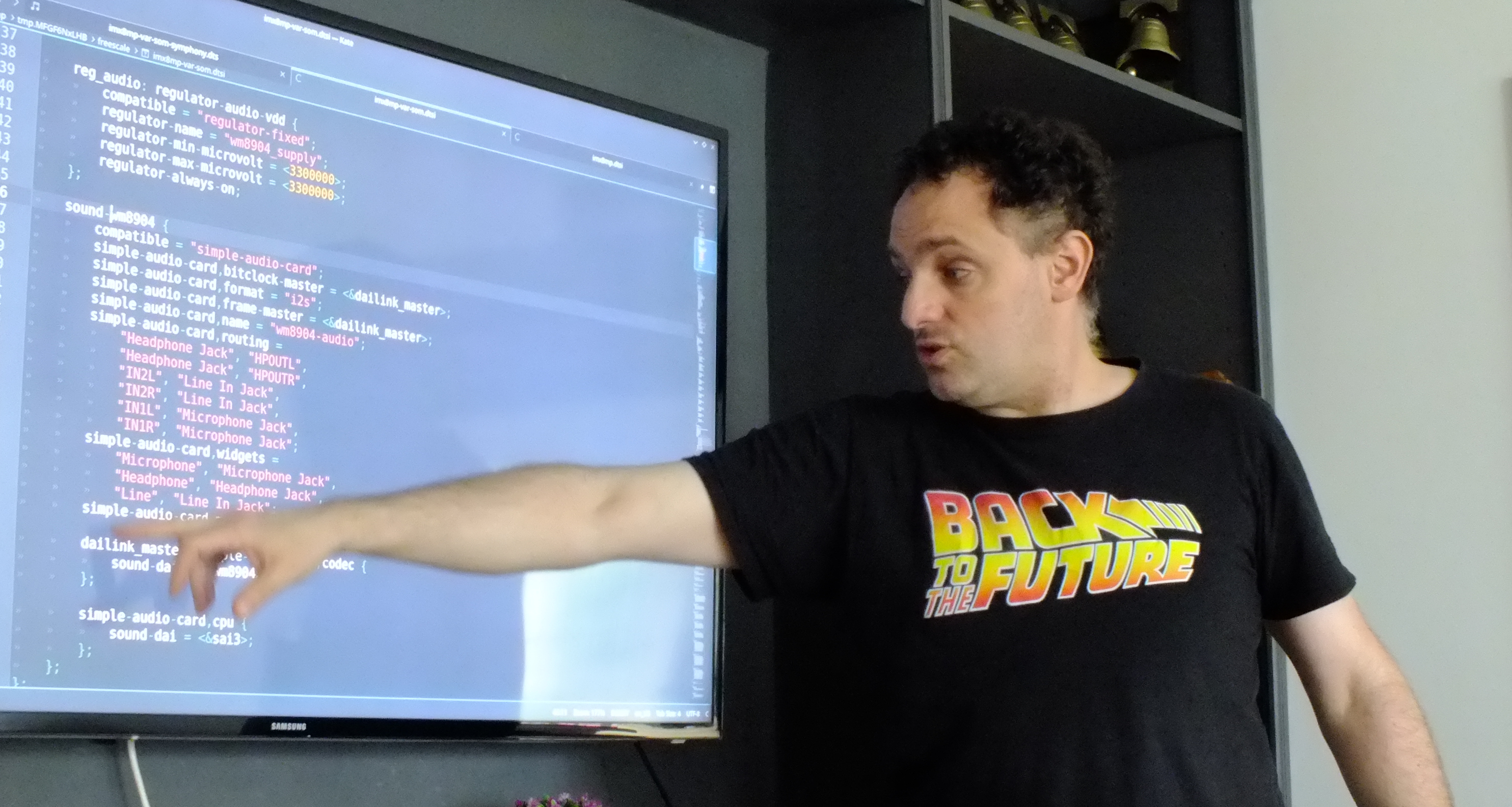
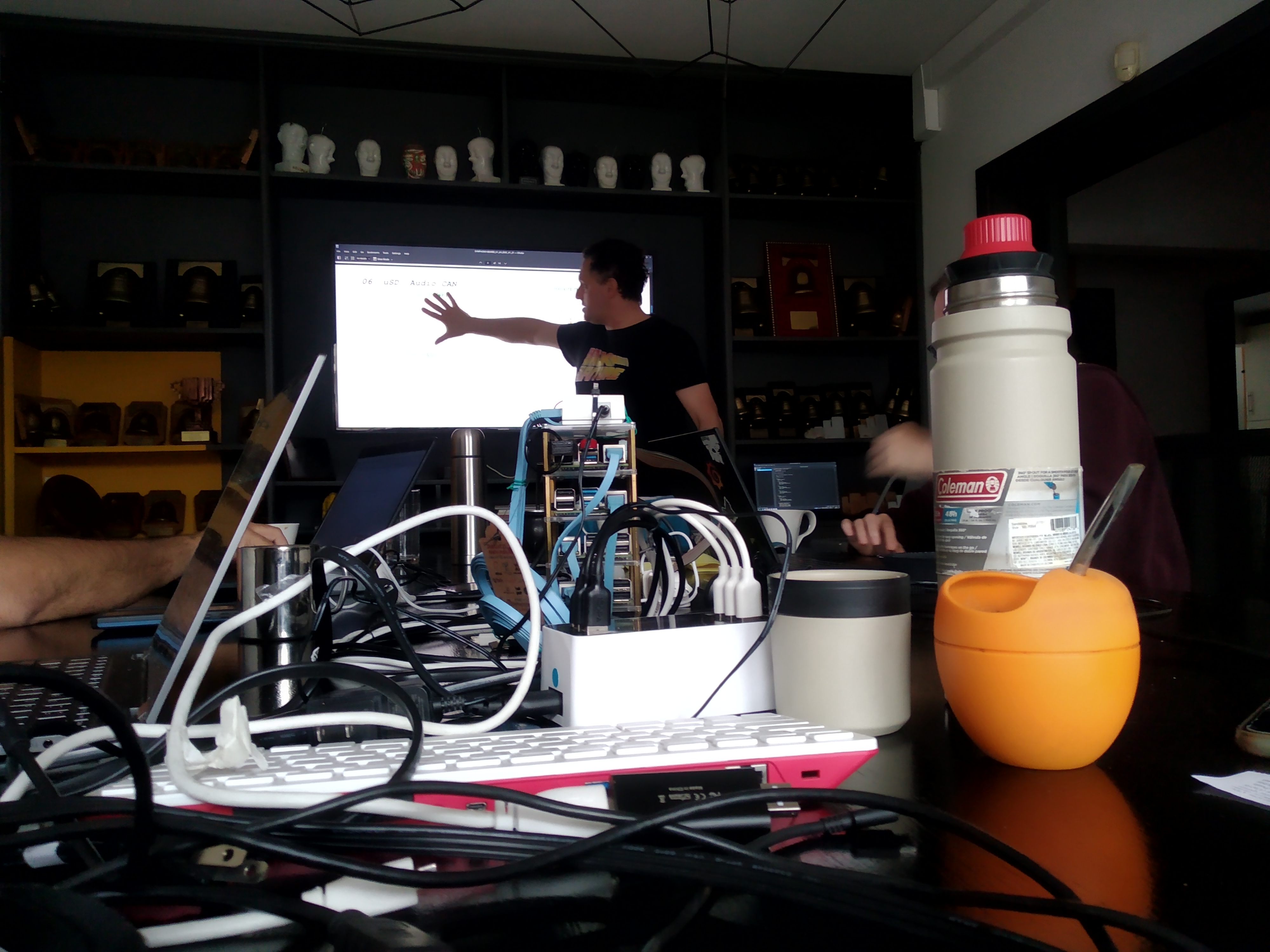
Meeting Debian people for having a good time together, for some good hacking, for learning, for teaching Is always fun and welcome. It brings energy, life and joy. And this year, due to the six-months-long relocation my family and me decided to have to Argentina, I was unable to attend the real deal, DebConf23 at India. And while I know DebConf is an experience like no other, this year I took part in two miniDebConfs. One I have already shared in this same blog: I was in MiniDebConf Tamil Nadu in India, followed by some days of pre-DebConf preparation and scouting in Kochi proper, where I got to interact with the absolutely great and loving team that prepared DebConf. The other one is still ongoing (but close to finishing). Some months ago, I talked with Santiago Ruano, jokin as we were Spanish-speaking DDs announcing to the debian-private mailing list we d be relocating to around R o de la Plata. And things worked out normally: He has been for several months in Uruguay already, so he decided to rent a house for some days, and invite Debian people to do what we do best. I left Paran Tuesday night (and missed my online class at UNAM! Well, you cannot have everything, right?). I arrived early on Wednesday, and around noon came to the house of the keysigning (well, the place is properly called Casa Key , it s a publicity agency that is also rented as a guesthouse in a very nice area of Montevideo, close to Nuevo Pocitos beach). In case you don t know it, Montevideo is on the Northern (or Eastern) shore of R o de la Plata, the widest river in the world (up to 300Km wide, with current and non-salty water). But most important for some Debian contributors: You can even come here by boat! That first evening, we received Ilu, who was in Uruguay by chance for other issues (and we were very happy about it!) and a young and enthusiastic Uruguayan, Felipe, interested in getting involved in Debian. We spent the evening talking about life, the universe and everything Which was a bit tiring, as I had to interface between Spanish and English, talking with two friends that didn t share a common language On Thursday morning, I went out for an early walk at the beach. And lets say, if only just for the narrative, that I found a lost penguin emerging from R o de la Plata! For those that don t know (who d be most of you, as he has not been seen at Debian events for 15 years), that s Lisandro Dami n Nicanor P rez Meyer (or just lisandro), long-time maintainer of the Qt ecosystem, and one of our embedded world extraordinaires. So, after we got him dry and fed him fresh river fishes, he gave us a great impromptu talk about understanding and finding our way around the Device Tree Source files for development boards and similar machines, mostly in the ARM world. From Argentina, we also had Emanuel (eamanu) crossing all the way from La Rioja. I spent most of our first workday getting my laptop in shape to be useful as the driver for my online class on Thursday (which is no small feat people that know the particularities of my much loved ARM-based laptop will understand), and running a set of tests again on my Raspberry Pi labortory, which I had not updated in several months. I am happy to say we are also finally also building Raspberry images for Trixie (Debian 13, Testing)! Sadly, I managed to burn my USB-to-serial-console (UART) adaptor, and could neither test those, nor the oldstable ones we are still building (and will probably soon be dropped, if not for anything else, to save disk space). We enjoyed a lot of socialization time. An important highlight of the conference for me was that we reconnected with a long-lost DD, Eduardo Tr pani, and got him interested in getting involved in the project again! This second day, another local Uruguayan, Mauricio, joined us together with his girlfriend, Alicia, and Felipe came again to hang out with us. Sadly, we didn t get photographic evidence of them (nor the permission to post it). The nice house Santiago got for us was very well equipped for a miniDebConf. There were a couple of rounds of pool played by those that enjoyed it (I was very happy just to stand around, take some photos and enjoy the atmosphere and the conversation). Today (Saturday) is the last full-house day of miniDebConf; tomorrow we will be leaving the house by noon. It was also a very productive day! We had a long, important conversation about an important discussion that we are about to present on debian-vote@lists.debian.org. It has been a great couple of days! Sadly, it s coming to an end But this at least gives me the opportunity (and moral obligation!) to write a long blog post. And to thank Santiago for organizing this, and Debian, for sponsoring our trip, stay, foods and healthy enjoyment!

Reproducible Builds: Reproducible Builds in October 2023

Welcome to the October 2023 report from the Reproducible Builds project. In these reports we outline the most important things that we have been up to over the past month. As a quick recap, whilst anyone may inspect the source code of free software for malicious flaws, almost all software is distributed to end users as pre-compiled binaries.

Reproducible Builds Summit 2023 Between October 31st and November 2nd, we held our seventh Reproducible Builds Summit in Hamburg, Germany! Our summits are a unique gathering that brings together attendees from diverse projects, united by a shared vision of advancing the Reproducible Builds effort, and this instance was no different. During this enriching event, participants had the opportunity to engage in discussions, establish connections and exchange ideas to drive progress in this vital field. A number of concrete outcomes from the summit will documented in the report for November 2023 and elsewhere. Amazingly the agenda and all notes from all sessions are already online. The Reproducible Builds team would like to thank our event sponsors who include Mullvad VPN, openSUSE, Debian, Software Freedom Conservancy, Allotropia and Aspiration Tech.

Reflections on Reflections on Trusting Trust Russ Cox posted a fascinating article on his blog prompted by the fortieth anniversary of Ken Thompson s award-winning paper, Reflections on Trusting Trust:
[ ] In March 2023, Ken gave the closing keynote [and] during the Q&A session, someone jokingly asked about the Turing award lecture, specifically can you tell us right now whether you have a backdoor into every copy of gcc and Linux still today?
Although Ken reveals (or at least claims!) that he has no such backdoor, he does admit that he has the actual code which Russ requests and subsequently dissects in great but accessible detail.

Ecosystem factors of reproducible builds Rahul Bajaj, Eduardo Fernandes, Bram Adams and Ahmed E. Hassan from the Maintenance, Construction and Intelligence of Software (MCIS) laboratory within the School of Computing, Queen s University in Ontario, Canada have published a paper on the Time to fix, causes and correlation with external ecosystem factors of unreproducible builds. The authors compare various response times within the Debian and Arch Linux distributions including, for example:
Arch Linux packages become reproducible a median of 30 days quicker when compared to Debian packages, while Debian packages remain reproducible for a median of 68 days longer once fixed.
A full PDF of their paper is available online, as are many other interesting papers on MCIS publication page.

NixOS installation image reproducible On the NixOS Discourse instance, Arnout Engelen (raboof) announced that NixOS have created an independent, bit-for-bit identical rebuilding of the nixos-minimal image that is used to install NixOS. In their post, Arnout details what exactly can be reproduced, and even includes some of the history of this endeavour:
You may remember a 2021 announcement that the minimal ISO was 100% reproducible. While back then we successfully tested that all packages that were needed to build the ISO were individually reproducible, actually rebuilding the ISO still introduced differences. This was due to some remaining problems in the hydra cache and the way the ISO was created. By the time we fixed those, regressions had popped up (notably an upstream problem in Python 3.10), and it isn t until this week that we were back to having everything reproducible and being able to validate the complete chain.
Congratulations to NixOS team for reaching this important milestone! Discussion about this announcement can be found underneath the post itself, as well as on Hacker News.

CPython source tarballs now reproducible Seth Larson published a blog post investigating the reproducibility of the CPython source tarballs. Using diffoscope, reprotest and other tools, Seth documents his work that led to a pull request to make these files reproducible which was merged by ukasz Langa.

New arm64 hardware from Codethink Long-time sponsor of the project, Codethink, have generously replaced our old Moonshot-Slides , which they have generously hosted since 2016 with new KVM-based arm64 hardware. Holger Levsen integrated these new nodes to the Reproducible Builds continuous integration framework.

Community updates On our mailing list during October 2023 there were a number of threads, including:
  • Vagrant Cascadian continued a thread about the implementation details of a snapshot archive server required for reproducing previous builds. [ ]
  • Akihiro Suda shared an update on BuildKit, a toolkit for building Docker container images. Akihiro links to a interesting talk they recently gave at DockerCon titled Reproducible builds with BuildKit for software supply-chain security.
  • Alex Zakharov started a thread discussing and proposing fixes for various tools that create ext4 filesystem images. [ ]
Elsewhere, Pol Dellaiera made a number of improvements to our website, including fixing typos and links [ ][ ], adding a NixOS Flake file [ ] and sorting our publications page by date [ ]. Vagrant Cascadian presented Reproducible Builds All The Way Down at the Open Source Firmware Conference.

Distribution work distro-info is a Debian-oriented tool that can provide information about Debian (and Ubuntu) distributions such as their codenames (eg. bookworm) and so on. This month, Benjamin Drung uploaded a new version of distro-info that added support for the SOURCE_DATE_EPOCH environment variable in order to close bug #1034422. In addition, 8 reviews of packages were added, 74 were updated and 56 were removed this month, all adding to our knowledge about identified issues. Bernhard M. Wiedemann published another monthly report about reproducibility within openSUSE.

Software development The Reproducible Builds project detects, dissects and attempts to fix as many currently-unreproducible packages as possible. We endeavour to send all of our patches upstream where appropriate. This month, we wrote a large number of such patches, including: In addition, Chris Lamb fixed an issue in diffoscope, where if the equivalent of file -i returns text/plain, fallback to comparing as a text file. This was originally filed as Debian bug #1053668) by Niels Thykier. [ ] This was then uploaded to Debian (and elsewhere) as version 251.

Reproducibility testing framework The Reproducible Builds project operates a comprehensive testing framework (available at tests.reproducible-builds.org) in order to check packages and other artifacts for reproducibility. In October, a number of changes were made by Holger Levsen:
  • Debian-related changes:
    • Refine the handling of package blacklisting, such as sending blacklisting notifications to the #debian-reproducible-changes IRC channel. [ ][ ][ ]
    • Install systemd-oomd on all Debian bookworm nodes (re. Debian bug #1052257). [ ]
    • Detect more cases of failures to delete schroots. [ ]
    • Document various bugs in bookworm which are (currently) being manually worked around. [ ]
  • Node-related changes:
    • Integrate the new arm64 machines from Codethink. [ ][ ][ ][ ][ ][ ]
    • Improve various node cleanup routines. [ ][ ][ ][ ]
    • General node maintenance. [ ][ ][ ][ ]
  • Monitoring-related changes:
    • Remove unused Munin monitoring plugins. [ ]
    • Complain less visibly about too many installed kernels. [ ]
  • Misc:
    • Enhance the firewall handling on Jenkins nodes. [ ][ ][ ][ ]
    • Install the fish shell everywhere. [ ]
In addition, Vagrant Cascadian added some packages and configuration for snapshot experiments. [ ]

If you are interested in contributing to the Reproducible Builds project, please visit our Contribute page on our website. However, you can get in touch with us via:

7 November 2023

Melissa Wen: AMD Driver-specific Properties for Color Management on Linux (Part 2)

TL;DR: This blog post explores the color capabilities of AMD hardware and how they are exposed to userspace through driver-specific properties. It discusses the different color blocks in the AMD Display Core Next (DCN) pipeline and their capabilities, such as predefined transfer functions, 1D and 3D lookup tables (LUTs), and color transformation matrices (CTMs). It also highlights the differences in AMD HW blocks for pre and post-blending adjustments, and how these differences are reflected in the available driver-specific properties. Overall, this blog post provides a comprehensive overview of the color capabilities of AMD hardware and how they can be controlled by userspace applications through driver-specific properties. This information is valuable for anyone who wants to develop applications that can take advantage of the AMD color management pipeline. Get a closer look at each hardware block s capabilities, unlock a wealth of knowledge about AMD display hardware, and enhance your understanding of graphics and visual computing. Stay tuned for future developments as we embark on a quest for GPU color capabilities in the ever-evolving realm of rainbow treasures.
Operating Systems can use the power of GPUs to ensure consistent color reproduction across graphics devices. We can use GPU-accelerated color management to manage the diversity of color profiles, do color transformations to convert between High-Dynamic-Range (HDR) and Standard-Dynamic-Range (SDR) content and color enhacements for wide color gamut (WCG). However, to make use of GPU display capabilities, we need an interface between userspace and the kernel display drivers that is currently absent in the Linux/DRM KMS API. In the previous blog post I presented how we are expanding the Linux/DRM color management API to expose specific properties of AMD hardware. Now, I ll guide you to the color features for the Linux/AMD display driver. We embark on a journey through DRM/KMS, AMD Display Manager, and AMD Display Core and delve into the color blocks to uncover the secrets of color manipulation within AMD hardware. Here we ll talk less about the color tools and more about where to find them in the hardware. We resort to driver-specific properties to reach AMD hardware blocks with color capabilities. These blocks display features like predefined transfer functions, color transformation matrices, and 1-dimensional (1D LUT) and 3-dimensional lookup tables (3D LUT). Here, we will understand how these color features are strategically placed into color blocks both before and after blending in Display Pipe and Plane (DPP) and Multiple Pipe/Plane Combined (MPC) blocks. That said, welcome back to the second part of our thrilling journey through AMD s color management realm!

AMD Display Driver in the Linux/DRM Subsystem: The Journey In my 2022 XDC talk I m not an AMD expert, but , I briefly explained the organizational structure of the Linux/AMD display driver where the driver code is bifurcated into a Linux-specific section and a shared-code portion. To reveal AMD s color secrets through the Linux kernel DRM API, our journey led us through these layers of the Linux/AMD display driver s software stack. It includes traversing the DRM/KMS framework, the AMD Display Manager (DM), and the AMD Display Core (DC) [1]. The DRM/KMS framework provides the atomic API for color management through KMS properties represented by struct drm_property. We extended the color management interface exposed to userspace by leveraging existing resources and connecting them with driver-specific functions for managing modeset properties. On the AMD DC layer, the interface with hardware color blocks is established. The AMD DC layer contains OS-agnostic components that are shared across different platforms, making it an invaluable resource. This layer already implements hardware programming and resource management, simplifying the external developer s task. While examining the DC code, we gain insights into the color pipeline and capabilities, even without direct access to specifications. Additionally, AMD developers provide essential support by answering queries and reviewing our work upstream. The primary challenge involved identifying and understanding relevant AMD DC code to configure each color block in the color pipeline. However, the ultimate goal was to bridge the DC color capabilities with the DRM API. For this, we changed the AMD DM, the OS-dependent layer connecting the DC interface to the DRM/KMS framework. We defined and managed driver-specific color properties, facilitated the transport of user space data to the DC, and translated DRM features and settings to the DC interface. Considerations were also made for differences in the color pipeline based on hardware capabilities.
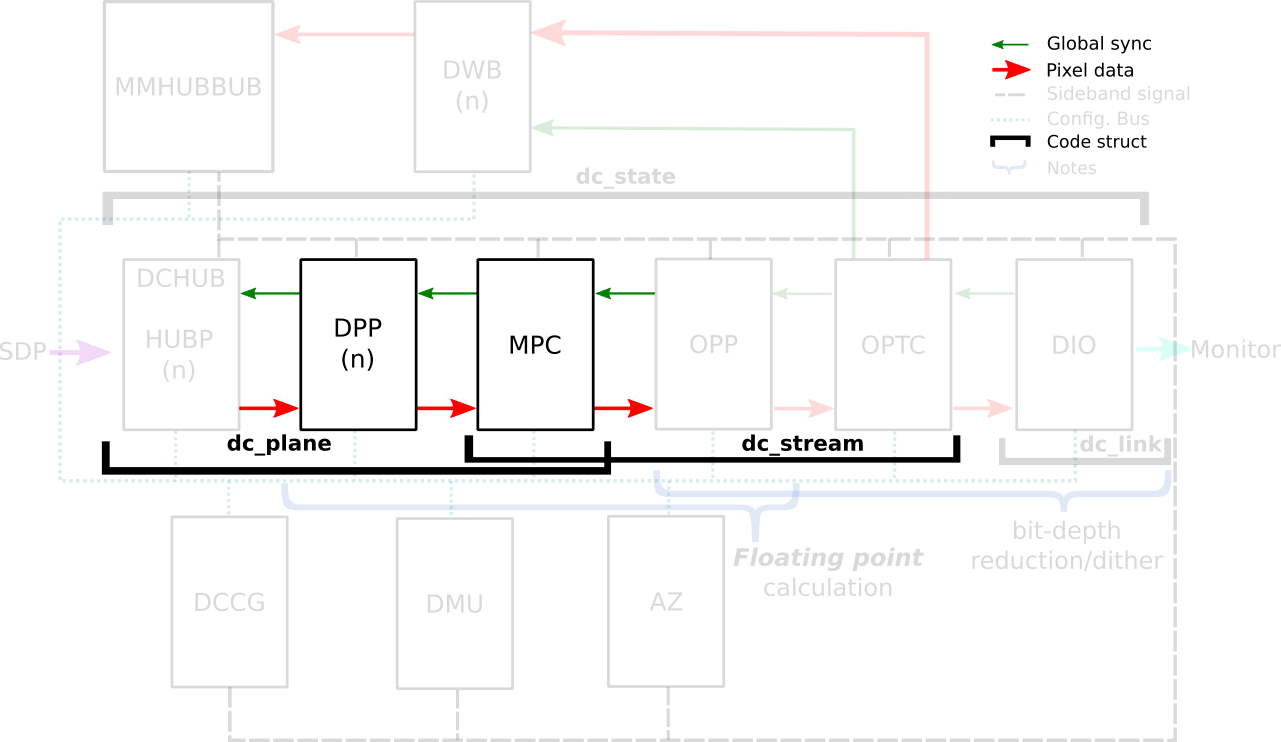
Exploring Color Capabilities of the AMD display hardware Now, let s dive into the exciting realm of AMD color capabilities, where a abundance of techniques and tools await to make your colors look extraordinary across diverse devices. First, we need to know a little about the color transformation and calibration tools and techniques that you can find in different blocks of the AMD hardware. I borrowed some images from [2] [3] [4] to help you understand the information.

Predefined Transfer Functions (Named Fixed Curves): Transfer functions serve as the bridge between the digital and visual worlds, defining the mathematical relationship between digital color values and linear scene/display values and ensuring consistent color reproduction across different devices and media. You can learn more about curves in the chapter GPU Gems 3 - The Importance of Being Linear by Larry Gritz and Eugene d Eon. ITU-R 2100 introduces three main types of transfer functions:
  • OETF: the opto-electronic transfer function, which converts linear scene light into the video signal, typically within a camera.
  • EOTF: electro-optical transfer function, which converts the video signal into the linear light output of the display.
  • OOTF: opto-optical transfer function, which has the role of applying the rendering intent .
AMD s display driver supports the following pre-defined transfer functions (aka named fixed curves):
  • Linear/Unity: linear/identity relationship between pixel value and luminance value;
  • Gamma 2.2, Gamma 2.4, Gamma 2.6: pure power functions;
  • sRGB: 2.4: The piece-wise transfer function from IEC 61966-2-1:1999;
  • BT.709: has a linear segment in the bottom part and then a power function with a 0.45 (~1/2.22) gamma for the rest of the range; standardized by ITU-R BT.709-6;
  • PQ (Perceptual Quantizer): used for HDR display, allows luminance range capability of 0 to 10,000 nits; standardized by SMPTE ST 2084.
These capabilities vary depending on the hardware block, with some utilizing hardcoded curves and others relying on AMD s color module to construct curves from standardized coefficients. It also supports user/custom curves built from a lookup table.

1D LUTs (1-dimensional Lookup Table): A 1D LUT is a versatile tool, defining a one-dimensional color transformation based on a single parameter. It s very well explained by Jeremy Selan at GPU Gems 2 - Chapter 24 Using Lookup Tables to Accelerate Color Transformations It enables adjustments to color, brightness, and contrast, making it ideal for fine-tuning. In the Linux AMD display driver, the atomic API offers a 1D LUT with 4096 entries and 8-bit depth, while legacy gamma uses a size of 256.

3D LUTs (3-dimensional Lookup Table): These tables work in three dimensions red, green, and blue. They re perfect for complex color transformations and adjustments between color channels. It s also more complex to manage and require more computational resources. Jeremy also explains 3D LUT at GPU Gems 2 - Chapter 24 Using Lookup Tables to Accelerate Color Transformations

CTM (Color Transformation Matrices): Color transformation matrices facilitate the transition between different color spaces, playing a crucial role in color space conversion.

HDR Multiplier: HDR multiplier is a factor applied to the color values of an image to increase their overall brightness.

AMD Color Capabilities in the Hardware Pipeline First, let s take a closer look at the AMD Display Core Next hardware pipeline in the Linux kernel documentation for AMDGPU driver - Display Core Next In the AMD Display Core Next hardware pipeline, we encounter two hardware blocks with color capabilities: the Display Pipe and Plane (DPP) and the Multiple Pipe/Plane Combined (MPC). The DPP handles color adjustments per plane before blending, while the MPC engages in post-blending color adjustments. In short, we expect DPP color capabilities to match up with DRM plane properties, and MPC color capabilities to play nice with DRM CRTC properties. Note: here s the catch there are some DRM CRTC color transformations that don t have a corresponding AMD MPC color block, and vice versa. It s like a puzzle, and we re here to solve it!

AMD Color Blocks and Capabilities We can finally talk about the color capabilities of each AMD color block. As it varies based on the generation of hardware, let s take the DCN3+ family as reference. What s possible to do before and after blending depends on hardware capabilities describe in the kernel driver by struct dpp_color_caps and struct mpc_color_caps. The AMD Steam Deck hardware provides a tangible example of these capabilities. Therefore, we take SteamDeck/DCN301 driver as an example and look at the Color pipeline capabilities described in the file: driver/gpu/drm/amd/display/dcn301/dcn301_resources.c
/* Color pipeline capabilities */
dc->caps.color.dpp.dcn_arch = 1; // If it is a Display Core Next (DCN): yes. Zero means DCE.
dc->caps.color.dpp.input_lut_shared = 0;
dc->caps.color.dpp.icsc = 1; // Intput Color Space Conversion  (CSC) matrix.
dc->caps.color.dpp.dgam_ram = 0; // The old degamma block for degamma curve (hardcoded and LUT).  Gamma correction  is the new one.
dc->caps.color.dpp.dgam_rom_caps.srgb = 1; // sRGB hardcoded curve support
dc->caps.color.dpp.dgam_rom_caps.bt2020 = 1; // BT2020 hardcoded curve support (seems not actually in use)
dc->caps.color.dpp.dgam_rom_caps.gamma2_2 = 1; // Gamma 2.2 hardcoded curve support
dc->caps.color.dpp.dgam_rom_caps.pq = 1; // PQ hardcoded curve support
dc->caps.color.dpp.dgam_rom_caps.hlg = 1; // HLG hardcoded curve support
dc->caps.color.dpp.post_csc = 1; // CSC matrix
dc->caps.color.dpp.gamma_corr = 1; // New  Gamma Correction  block for degamma user LUT;
dc->caps.color.dpp.dgam_rom_for_yuv = 0;
dc->caps.color.dpp.hw_3d_lut = 1; // 3D LUT support. If so, it's always preceded by a shaper curve. 
dc->caps.color.dpp.ogam_ram = 1; //  Blend Gamma  block for custom curve just after blending
// no OGAM ROM on DCN301
dc->caps.color.dpp.ogam_rom_caps.srgb = 0;
dc->caps.color.dpp.ogam_rom_caps.bt2020 = 0;
dc->caps.color.dpp.ogam_rom_caps.gamma2_2 = 0;
dc->caps.color.dpp.ogam_rom_caps.pq = 0;
dc->caps.color.dpp.ogam_rom_caps.hlg = 0;
dc->caps.color.dpp.ocsc = 0;
dc->caps.color.mpc.gamut_remap = 1; // Post-blending CTM (pre-blending CTM is always supported)
dc->caps.color.mpc.num_3dluts = pool->base.res_cap->num_mpc_3dlut; // Post-blending 3D LUT (preceded by shaper curve)
dc->caps.color.mpc.ogam_ram = 1; // Post-blending regamma.
// No pre-defined TF supported for regamma.
dc->caps.color.mpc.ogam_rom_caps.srgb = 0;
dc->caps.color.mpc.ogam_rom_caps.bt2020 = 0;
dc->caps.color.mpc.ogam_rom_caps.gamma2_2 = 0;
dc->caps.color.mpc.ogam_rom_caps.pq = 0;
dc->caps.color.mpc.ogam_rom_caps.hlg = 0;
dc->caps.color.mpc.ocsc = 1; // Output CSC matrix.
I included some inline comments in each element of the color caps to quickly describe them, but you can find the same information in the Linux kernel documentation. See more in struct dpp_color_caps, struct mpc_color_caps and struct rom_curve_caps. Now, using this guideline, we go through color capabilities of DPP and MPC blocks and talk more about mapping driver-specific properties to corresponding color blocks.

DPP Color Pipeline: Before Blending (Per Plane) Let s explore the capabilities of DPP blocks and what you can achieve with a color block. The very first thing to pay attention is the display architecture of the display hardware: previously AMD uses a display architecture called DCE
  • Display and Compositing Engine, but newer hardware follows DCN - Display Core Next.
The architectute is described by: dc->caps.color.dpp.dcn_arch

AMD Plane Degamma: TF and 1D LUT Described by: dc->caps.color.dpp.dgam_ram, dc->caps.color.dpp.dgam_rom_caps,dc->caps.color.dpp.gamma_corr AMD Plane Degamma data is mapped to the initial stage of the DPP pipeline. It is utilized to transition from scanout/encoded values to linear values for arithmetic operations. Plane Degamma supports both pre-defined transfer functions and 1D LUTs, depending on the hardware generation. DCN2 and older families handle both types of curve in the Degamma RAM block (dc->caps.color.dpp.dgam_ram); DCN3+ separate hardcoded curves and 1D LUT into two block: Degamma ROM (dc->caps.color.dpp.dgam_rom_caps) and Gamma correction block (dc->caps.color.dpp.gamma_corr), respectively. Pre-defined transfer functions:
  • they are hardcoded curves (read-only memory - ROM);
  • supported curves: sRGB EOTF, BT.709 inverse OETF, PQ EOTF and HLG OETF, Gamma 2.2, Gamma 2.4 and Gamma 2.6 EOTF.
The 1D LUT currently accepts 4096 entries of 8-bit. The data is interpreted as an array of struct drm_color_lut elements. Setting TF = Identity/Default and LUT as NULL means bypass. References:

AMD Plane 3x4 CTM (Color Transformation Matrix) AMD Plane CTM data goes to the DPP Gamut Remap block, supporting a 3x4 fixed point (s31.32) matrix for color space conversions. The data is interpreted as a struct drm_color_ctm_3x4. Setting NULL means bypass. References:

AMD Plane Shaper: TF + 1D LUT Described by: dc->caps.color.dpp.hw_3d_lut The Shaper block fine-tunes color adjustments before applying the 3D LUT, optimizing the use of the limited entries in each dimension of the 3D LUT. On AMD hardware, a 3D LUT always means a preceding shaper 1D LUT used for delinearizing and/or normalizing the color space before applying a 3D LUT, so this entry on DPP color caps dc->caps.color.dpp.hw_3d_lut means support for both shaper 1D LUT and 3D LUT. Pre-defined transfer function enables delinearizing content with or without shaper LUT, where AMD color module calculates the resulted shaper curve. Shaper curves go from linear values to encoded values. If we are already in a non-linear space and/or don t need to normalize values, we can set a Identity TF for shaper that works similar to bypass and is also the default TF value. Pre-defined transfer functions:
  • there is no DPP Shaper ROM. Curves are calculated by AMD color modules. Check calculate_curve() function in the file amd/display/modules/color/color_gamma.c.
  • supported curves: Identity, sRGB inverse EOTF, BT.709 OETF, PQ inverse EOTF, HLG OETF, and Gamma 2.2, Gamma 2.4, Gamma 2.6 inverse EOTF.
The 1D LUT currently accepts 4096 entries of 8-bit. The data is interpreted as an array of struct drm_color_lut elements. When setting Plane Shaper TF (!= Identity) and LUT at the same time, the color module will combine the pre-defined TF and the custom LUT values into the LUT that s actually programmed. Setting TF = Identity/Default and LUT as NULL works as bypass. References:

AMD Plane 3D LUT Described by: dc->caps.color.dpp.hw_3d_lut The 3D LUT in the DPP block facilitates complex color transformations and adjustments. 3D LUT is a three-dimensional array where each element is an RGB triplet. As mentioned before, the dc->caps.color.dpp.hw_3d_lut describe if DPP 3D LUT is supported. The AMD driver-specific property advertise the size of a single dimension via LUT3D_SIZE property. Plane 3D LUT is a blog property where the data is interpreted as an array of struct drm_color_lut elements and the number of entries is LUT3D_SIZE cubic. The array contains samples from the approximated function. Values between samples are estimated by tetrahedral interpolation The array is accessed with three indices, one for each input dimension (color channel), blue being the outermost dimension, red the innermost. This distribution is better visualized when examining the code in [RFC PATCH 5/5] drm/amd/display: Fill 3D LUT from userspace by Alex Hung:
+	for (nib = 0; nib < 17; nib++)  
+		for (nig = 0; nig < 17; nig++)  
+			for (nir = 0; nir < 17; nir++)  
+				ind_lut = 3 * (nib + 17*nig + 289*nir);
+
+				rgb_area[ind].red = rgb_lib[ind_lut + 0];
+				rgb_area[ind].green = rgb_lib[ind_lut + 1];
+				rgb_area[ind].blue = rgb_lib[ind_lut + 2];
+				ind++;
+			 
+		 
+	 
In our driver-specific approach we opted to advertise it s behavior to the userspace instead of implicitly dealing with it in the kernel driver. AMD s hardware supports 3D LUTs with 17-size or 9-size (4913 and 729 entries respectively), and you can choose between 10-bit or 12-bit. In the current driver-specific work we focus on enabling only 17-size 12-bit 3D LUT, as in [PATCH v3 25/32] drm/amd/display: add plane 3D LUT support:
+		/* Stride and bit depth are not programmable by API yet.
+		 * Therefore, only supports 17x17x17 3D LUT (12-bit).
+		 */
+		lut->lut_3d.use_tetrahedral_9 = false;
+		lut->lut_3d.use_12bits = true;
+		lut->state.bits.initialized = 1;
+		__drm_3dlut_to_dc_3dlut(drm_lut, drm_lut3d_size, &lut->lut_3d,
+					lut->lut_3d.use_tetrahedral_9,
+					MAX_COLOR_3DLUT_BITDEPTH);
A refined control of 3D LUT parameters should go through a follow-up version or generic API. Setting 3D LUT to NULL means bypass. References:

AMD Plane Blend/Out Gamma: TF + 1D LUT Described by: dc->caps.color.dpp.ogam_ram The Blend/Out Gamma block applies the final touch-up before blending, allowing users to linearize content after 3D LUT and just before the blending. It supports both 1D LUT and pre-defined TF. We can see Shaper and Blend LUTs as 1D LUTs that are sandwich the 3D LUT. So, if we don t need 3D LUT transformations, we may want to only use Degamma block to linearize and skip Shaper, 3D LUT and Blend. Pre-defined transfer function:
  • there is no DPP Blend ROM. Curves are calculated by AMD color modules;
  • supported curves: Identity, sRGB EOTF, BT.709 inverse OETF, PQ EOTF, HLG inverse OETF, and Gamma 2.2, Gamma 2.4, Gamma 2.6 EOTF.
The 1D LUT currently accepts 4096 entries of 8-bit. The data is interpreted as an array of struct drm_color_lut elements. If plane_blend_tf_property != Identity TF, AMD color module will combine the user LUT values with pre-defined TF into the LUT parameters to be programmed. Setting TF = Identity/Default and LUT to NULL means bypass. References:

MPC Color Pipeline: After Blending (Per CRTC)

DRM CRTC Degamma 1D LUT The degamma lookup table (LUT) for converting framebuffer pixel data before apply the color conversion matrix. The data is interpreted as an array of struct drm_color_lut elements. Setting NULL means bypass. Not really supported. The driver is currently reusing the DPP degamma LUT block (dc->caps.color.dpp.dgam_ram and dc->caps.color.dpp.gamma_corr) for supporting DRM CRTC Degamma LUT, as explaning by [PATCH v3 20/32] drm/amd/display: reject atomic commit if setting both plane and CRTC degamma.

DRM CRTC 3x3 CTM Described by: dc->caps.color.mpc.gamut_remap It sets the current transformation matrix (CTM) apply to pixel data after the lookup through the degamma LUT and before the lookup through the gamma LUT. The data is interpreted as a struct drm_color_ctm. Setting NULL means bypass.

DRM CRTC Gamma 1D LUT + AMD CRTC Gamma TF Described by: dc->caps.color.mpc.ogam_ram After all that, you might still want to convert the content to wire encoding. No worries, in addition to DRM CRTC 1D LUT, we ve got a AMD CRTC gamma transfer function (TF) to make it happen. Possible TF values are defined by enum amdgpu_transfer_function. Pre-defined transfer functions:
  • there is no MPC Gamma ROM. Curves are calculated by AMD color modules.
  • supported curves: Identity, sRGB inverse EOTF, BT.709 OETF, PQ inverse EOTF, HLG OETF, and Gamma 2.2, Gamma 2.4, Gamma 2.6 inverse EOTF.
The 1D LUT currently accepts 4096 entries of 8-bit. The data is interpreted as an array of struct drm_color_lut elements. When setting CRTC Gamma TF (!= Identity) and LUT at the same time, the color module will combine the pre-defined TF and the custom LUT values into the LUT that s actually programmed. Setting TF = Identity/Default and LUT to NULL means bypass. References:

Others

AMD CRTC Shaper and 3D LUT We have previously worked on exposing CRTC shaper and CRTC 3D LUT, but they were removed from the AMD driver-specific color series because they lack userspace case. CRTC shaper and 3D LUT works similar to plane shaper and 3D LUT but after blending (MPC block). The difference here is that setting (not bypass) Shaper and Gamma blocks together are not expected, since both blocks are used to delinearize the input space. In summary, we either set Shaper + 3D LUT or Gamma.

Input and Output Color Space Conversion There are two other color capabilities of AMD display hardware that were integrated to DRM by previous works and worth a brief explanation here. The DC Input CSC sets pre-defined coefficients from the values of DRM plane color_range and color_encoding properties. It is used for color space conversion of the input content. On the other hand, we have de DC Output CSC (OCSC) sets pre-defined coefficients from DRM connector colorspace properties. It is uses for color space conversion of the composed image to the one supported by the sink. References:

The search for rainbow treasures is not over yet If you want to understand a little more about this work, be sure to watch Joshua and I presented two talks at XDC 2023 about AMD/Steam Deck colors on Gamescope: In the time between the first and second part of this blog post, Uma Shashank and Chaitanya Kumar Borah published the plane color pipeline for Intel and Harry Wentland implemented a generic API for DRM based on VKMS support. We discussed these two proposals and the next steps for Color on Linux during the Color Management workshop at XDC 2023 and I briefly shared workshop results in the 2023 XDC lightning talk session. The search for rainbow treasures is not over yet! We plan to meet again next year in the 2024 Display Hackfest in Coru a-Spain (Igalia s HQ) to keep up the pace and continue advancing today s display needs on Linux. Finally, a HUGE thank you to everyone who worked with me on exploring AMD s color capabilities and making them available in userspace.

5 November 2023

Vincent Bernat: Non-interactive SSH password authentication

SSH offers several forms of authentication, such as passwords and public keys. The latter are considered more secure. However, password authentication remains prevalent, particularly with network equipment.1 A classic solution to avoid typing a password for each connection is sshpass, or its more correct variant passh. Here is a wrapper for Zsh, getting the password from pass, a simple password manager:2
pssh()  
  passh -p <(pass show network/ssh/password   head -1) ssh "$@"
 
compdef pssh=ssh
This approach is a bit brittle as it requires to parse the output of the ssh command to look for a password prompt. Moreover, if no password is required, the password manager is still invoked. Since OpenSSH 8.4, we can use SSH_ASKPASS and SSH_ASKPASS_REQUIRE instead:
ssh()  
  set -o localoptions -o localtraps
  local passname=network/ssh/password
  local helper=$(mktemp)
  trap "command rm -f $helper" EXIT INT
  > $helper <<EOF
#!$SHELL
pass show $passname   head -1
EOF
  chmod u+x $helper
  SSH_ASKPASS=$helper SSH_ASKPASS_REQUIRE=force command ssh "$@"
 
If the password is incorrect, we can display a prompt on the second tentative:
ssh()  
  set -o localoptions -o localtraps
  local passname=network/ssh/password
  local helper=$(mktemp)
  trap "command rm -f $helper" EXIT INT
  > $helper <<EOF
#!$SHELL
if [ -k $helper ]; then
   
    oldtty=\$(stty -g)
    trap 'stty \$oldtty < /dev/tty 2> /dev/null' EXIT INT TERM HUP
    stty -echo
    print "\rpassword: "
    read password
    printf "\n"
    > /dev/tty < /dev/tty
  printf "%s" "\$password"
else
  pass show $passname   head -1
  chmod +t $helper
fi
EOF
  chmod u+x $helper
  SSH_ASKPASS=$helper SSH_ASKPASS_REQUIRE=force command ssh "$@"
 
A possible improvement is to use a different password entry depending on the remote host:3
ssh()  
  # Grab login information
  local -A details
  details=($ =$ (M)$ :-"$ (@f)$(command ssh -G "$@" 2>/dev/null) " :#(host hostname user) * )
  local remote=$ details[host]:-details[hostname] 
  local login=$ details[user] @$ remote 
  # Get password name
  local passname
  case "$login" in
    admin@*.example.net)  passname=company1/ssh/admin ;;
    bernat@*.example.net) passname=company1/ssh/bernat ;;
    backup@*.example.net) passname=company1/ssh/backup ;;
  esac
  # No password name? Just use regular SSH
  [[ -z $passname ]] &&  
    command ssh "$@"
    return $?
   
  # Invoke SSH with the helper for SSH_ASKPASS
  # [ ]
 
It is also possible to make scp invoke our custom ssh function:
scp()  
  set -o localoptions -o localtraps
  local helper=$(mktemp)
  trap "command rm -f $helper" EXIT INT
  > $helper <<EOF 
#!$SHELL
source $ (%):-%x 
ssh "\$@"
EOF
  command scp -S $helper "$@"
 
For the complete code, have a look at my zshrc. As an alternative, you can put the ssh() function body into its own script file and replace command ssh with /usr/bin/ssh to avoid an unwanted recursive call. In this case, the scp() function is not needed anymore.

  1. First, some vendors make it difficult to associate an SSH key with a user. Then, many vendors do not support certificate-based authentication, making it difficult to scale. Finally, interactions between public-key authentication and finer-grained authorization methods like TACACS+ and Radius are still uncharted territory.
  2. The clear-text password never appears on the command line, in the environment, or on the disk, making it difficult for a third party without elevated privileges to capture it. On Linux, Zsh provides the password through a file descriptor.
  3. To decipher the fourth line, you may get help from print -l and the zshexpn(1) manual page. details is an associative array defined from an array alternating keys and values.

Petter Reinholdtsen: Test framework for DocBook processors / formatters

All the books I have published so far has been using DocBook somewhere in the process. For the first book, the source format was DocBook, while for every later book it was an intermediate format used as the stepping stone to be able to present the same manuscript in several formats, on paper, as ebook in ePub format, as a HTML page and as a PDF file either for paper production or for Internet consumption. This is made possible with a wide variety of free software tools with DocBook support in Debian. The source format of later books have been docx via rst, Markdown, Filemaker and Asciidoc, and for all of these I was able to generate a suitable DocBook file for further processing using pandoc, a2x and asciidoctor, as well as rendering using xmlto, dbtoepub, dblatex, docbook-xsl and fop. Most of the books I have published are translated books, with English as the source language. The use of po4a to handle translations using the gettext PO format has been a blessing, but publishing translated books had triggered the need to ensure the DocBook tools handle relevant languages correctly. For every new language I have published, I had to submit patches dblatex, dbtoepub and docbook-xsl fixing incorrect language and country specific issues in the framework themselves. Typically this has been missing keywords like 'figure' or sort ordering of index entries. After a while it became tiresome to only discover issues like this by accident, and I decided to write a DocBook "test framework" exercising various features of DocBook and allowing me to see all features exercised for a given language. It consist of a set of DocBook files, a version 4 book, a version 5 book, a v4 book set, a v4 selection of problematic tables, one v4 testing sidefloat and finally one v4 testing a book of articles. The DocBook files are accompanied with a set of build rules for building PDF using dblatex and docbook-xsl/fop, HTML using xmlto or docbook-xsl and epub using dbtoepub. The result is a set of files visualizing footnotes, indexes, table of content list, figures, formulas and other DocBook features, allowing for a quick review on the completeness of the given locale settings. To build with a different language setting, all one need to do is edit the lang= value in the .xml file to pick a different ISO 639 code value and run 'make'. The test framework source code is available from Codeberg, and a generated set of presentations of the various examples is available as Codeberg static web pages at https://pere.codeberg.page/docbook-example/. Using this test framework I have been able to discover and report several bugs and missing features in various tools, and got a lot of them fixed. For example I got Northern Sami keywords added to both docbook-xsl and dblatex, fixed several typos in Norwegian bokm l and Norwegian Nynorsk, support for non-ascii title IDs added to pandoc, Norwegian index sorting support fixed in xindy and initial Norwegian Bokm l support added to dblatex. Some issues still remains, though. Default index sorting rules are still broken in several tools, so the Norwegian letters , and are more often than not sorted properly in the book index. The test framework recently received some more polish, as part of publishing my latest book. This book contained a lot of fairly complex tables, which exposed bugs in some of the tools. This made me add a new test file with various tables, as well as spend some time to brush up the build rules. My goal is for the test framework to exercise all DocBook features to make it easier to see which features work with different processors, and hopefully get them all to support the full set of DocBook features. Feel free to send patches to extend the test set, and test it with your favorite DocBook processor. Please visit these two URLs to learn more: If you want to learn more on Docbook and translations, I recommend having a look at the the DocBook web site, the DoCookBook site and my earlier blog post on how the Skolelinux project process and translate documentation, a talk I gave earlier this year on how to translate and publish books using free software (Norwegian only). As usual, if you use Bitcoin and want to show your support of my activities, please send Bitcoin donations to my address 15oWEoG9dUPovwmUL9KWAnYRtNJEkP1u1b.

1 November 2023

Joachim Breitner: Joining the Lean FRO

Tomorrow is going to be a new first day in a new job for me: I am joining the Lean FRO, and I m excited.

What is Lean? Lean is the new kid on the block of theorem provers. It s a pure functional programming language (like Haskell, with and on which I have worked a lot), but it s dependently typed (which Haskell may be evolving to be as well, but rather slowly and carefully). It has a refreshing syntax, built on top of a rather good (I have been told, not an expert here) macro system. As a dependently typed programming language, it is also a theorem prover, or proof assistant, and there exists already a lively community of mathematicians who started to formalize mathematics in a coherent library, creatively called mathlib.

What is a FRO? A Focused Research Organization has the organizational form of a small start up (small team, little overhead, a few years of runway), but its goals and measure for success are not commercial, as funding is provided by donors (in the case of the Lean FRO, the Simons Foundation International, the Alfred P. Sloan Foundation, and Richard Merkin). This allows us to build something that we believe is a contribution for the greater good, even though it s not (or not yet) commercially interesting enough and does not fit other forms of funding (such as research grants) well. This is a very comfortable situation to be in.

Why am I excited? To me, working on Lean seems to be the perfect mix: I have been working on language implementation for about a decade now, and always with a preference for functional languages. Add to that my interest in theorem proving, where I have used Isabelle and Coq so far, and played with Agda and others. So technically, clearly up my alley. Furthermore, the language isn t too old, and plenty of interesting things are simply still to do, rather than tried before. The ecosystem is still evolving, so there is a good chance to have some impact. On the other hand, the language isn t too young either. It is no longer an open question whether we will have users: we have them already, they hang out on zulip, so if I improve something, there is likely someone going to be happy about it, which is great. And the community seems to be welcoming and full of nice people. Finally, this library of mathematics that these users are building is itself an amazing artifact: Lots of math in a consistent, machine-readable, maintained, documented, checked form! With a little bit of optimism I can imagine this changing how math research and education will be done in the future. It could be for math what Wikipedia is for encyclopedic knowledge and OpenStreetMap for maps and the thought of facilitating that excites me. With this new job I find that when I am telling friends and colleagues about it, I do not hesitate or hedge when asked why I am doing this. This is a good sign.

What will I be doing? We ll see what main tasks I ll get to tackle initially, but knowing myself, I expect I ll get broadly involved. To get up to speed I started playing around with a few things already, and for example created Loogle, a Mathlib search engine inspired by Haskell s Hoogle, including a Zulip bot integration. This seems to be useful and quite well received, so I ll continue maintaining that. Expect more about this and other contributions here in the future.

31 October 2023

Iustin Pop: Raspberry PI OS: upgrading and cross-grading

One of the downsides of running Raspberry PI OS is the fact that - not having the resources of pure Debian - upgrades are not recommended, and cross-grades (migrating between armhf and arm64) is not even mentioned. Is this really true? It is, after all a Debian-based system, so it should in theory be doable. Let s try!

Upgrading The recently announced release based on Debian Bookworm here says:
We have always said that for a major version upgrade, you should re-image your SD card and start again with a clean image. In the past, we have suggested procedures for updating an existing image to the new version, but always with the caveat that we do not recommend it, and you do this at your own risk. This time, because the changes to the underlying architecture are so significant, we are not suggesting any procedure for upgrading a Bullseye image to Bookworm; any attempt to do this will almost certainly end up with a non-booting desktop and data loss. The only way to get Bookworm is either to create an SD card using Raspberry Pi Imager, or to download and flash a Bookworm image from here with your tool of choice.
Which means, it s time to actually try it turns out it s actually trivial, if you use RPIs as headless servers. I had only three issues:
  • if using an initrd, the new initrd-building scripts/hooks are looking for some binaries in /usr/bin, and not in /bin; solution: install manually the usrmerge package, and then re-run dpkg --configure -a;
  • also if using an initrd, the scripts are looking for the kernel config file in /boot/config-$(uname -r), and the raspberry pi kernel package doesn t provide this; workaround: modprobe configs && zcat /proc/config.gz > /boot/config-$(uname -r);
  • and finally, on normal RPI systems, that don t use manual configurations of interfaces in /etc/network/interface, migrating from the previous dhcpcd to NetworkManager will break network connectivity, and require you to log in locally and fix things.
I expect most people to hit only the 3rd, and almost no-one to use initrd on raspberry pi. But, overall, aside from these two issues and a couple of cosmetic ones (login.defs being rewritten from scratch and showing a baffling diff, for example), it was easy. Is it worth doing? Definitely. Had no data loss, and no non-booting system.

Cross-grading (32 bit to 64 bit userland) This one is actually painful. Internet searches go from it s possible, I think to it s definitely not worth trying . Examples: Aside from these, there are a gazillion other posts about switching the kernel to 64 bit. And that s worth doing on its own, but it s only half the way. So, armed with two different systems - a RPI4 4GB and a RPI Zero W2 - I tried to do this. And while it can be done, it takes many hours - first system was about 6 hours, second the same, and a third RPI4 probably took ~3 hours only since I knew the problematic issues. So, what are the steps? Basically:
  • install devscripts, since you will need dget
  • enable new architecture in dpkg: dpkg --add-architecture arm64
  • switch over apt sources to include the 64 bit repos, which are different than the 32 bit ones (Raspberry PI OS did a migration here; normally a single repository has all architectures, of course)
  • downgrade all custom rpi packages/libraries to the standard bookworm/bullseye version, since dpkg won t usually allow a single library package to have different versions (I think it s possible to override, but I didn t bother)
  • install libc for the arm64 arch (this takes some effort, it s actually a set of 3-4 packages)
  • once the above is done, install whiptail:amd64 and rejoice at running a 64-bit binary!
  • then painfully go through sets of packages and migrate the set to arm64:
    • sometimes this work via apt, sometimes you ll need to use dget and dpkg -i
    • make sure you download both the armhf and arm64 versions before doing dpkg -i, since you ll need to rollback some installs
  • at one point, you ll be able to switch over dpkg and apt to arm64, at which point the default architecture flips over; from here, if you ve done it at the right moment, it becomes very easy; you ll probably need an apt install --fix-broken, though, at first
  • and then, finish by replacing all packages with arm64 versions
  • and then, dpkg --remove-architecture armhf, reboot, and profit!
But it s tears and blood to get to that point

Pain point 1: RPI custom versions of packages Since the 32bit armhf architecture is a bit weird - having many variations - it turns out that raspberry pi OS has many packages that are very slightly tweaked to disable a compilation flag or work around build/test failures, or whatnot. Since we talk here about 64-bit capable processors, almost none of these are needed, but they do make life harder since the 64 bit version doesn t have those overrides. So what is needed would be to say downgrade all armhf packages to the version in debian upstream repo , but I couldn t find the right apt pinning incantation to do that. So what I did was to remove the 32bit repos, then use apt-show-versions to see which packages have versions that are no longer in any repo, then downgrade them. There s a further, minor, complication that there were about 3-4 packages with same version but different hash (!), which simply needed apt install --reinstall, I think.

Pain point 2: architecture independent packages There is one very big issue with dpkg in all this story, and the one that makes things very problematic: while you can have a library package installed multiple times for different architectures, as the files live in different paths, a non-library package can only be installed once (usually). For binary packages (arch:any), that is fine. But architecture-independent packages (arch:all) are problematic since usually they depend on a binary package, but they always depend on the default architecture version! Hrmm, and I just realise I don t have logs from this, so I m only ~80% confident. But basically:
  • vim-solarized (arch:all) depends on vim (arch:any)
  • if you replace vim armhf with vim arm64, this will break vim-solarized, until the default architecture becomes arm64
So you need to keep track of which packages apt will de-install, for later re-installation. It is possible that Multi-Arch: foreign solves this, per the debian wiki which says:
Note that even though Architecture: all and Multi-Arch: foreign may look like similar concepts, they are not. The former means that the same binary package can be installed on different architectures. Yet, after installation such packages are treated as if they were native architecture (by definition the architecture of the dpkg package) packages. Thus Architecture: all packages cannot satisfy dependencies from other architectures without being marked Multi-Arch foreign.
It also has warnings about how to properly use this. But, in general, not many packages have it, so it is a problem.

Pain point 3: remove + install vs overwrite It seems that depending on how the solver computes a solution, when migrating a package from 32 to 64 bit, it can choose either to:
  • overwrite in place the package (akin to dpkg -i)
  • remove + install later
The former is OK, the later is not. Or, actually, it might be that apt never can do this, for example (edited for brevity):
# apt install systemd:arm64 --no-install-recommends
The following packages will be REMOVED:
  systemd
The following NEW packages will be installed:
  systemd:arm64
0 upgraded, 1 newly installed, 1 to remove and 35 not upgraded.
Do you want to continue? [Y/n] y
dpkg: systemd: dependency problems, but removing anyway as you requested:
 systemd-sysv depends on systemd.
Removing systemd (247.3-7+deb11u2) ...
systemd is the active init system, please switch to another before removing systemd.
dpkg: error processing package systemd (--remove):
 installed systemd package pre-removal script subprocess returned error exit status 1
dpkg: too many errors, stopping
Errors were encountered while processing:
 systemd
Processing was halted because there were too many errors.
But at the same time, overwrite in place is all good - via dpkg -i from /var/cache/apt/archives. In this case it manifested via a prerm script, in other cases is manifests via dependencies that are no longer satisfied for packages that can t be removed, etc. etc. So you will have to resort to dpkg -i a lot.

Pain point 4: lib- packages that are not lib During the whole process, it is very tempting to just go ahead and install the corresponding arm64 package for all armhf lib package, in one go, since these can coexist. Well, this simple plan is complicated by the fact that some packages are named libfoo-bar, but are actual holding (e.g.) the bar binary for the libfoo package. Examples:
  • libmagic-mgc contains /usr/lib/file/magic.mgc, which conflicts between the 32 and 64 bit versions; of course, it s the exact same file, so this should be an arch:all package, but
  • libpam-modules-bin and liblockfile-bin actually contain binaries (per the -bin suffix)
It s possible to work around all this, but it changes a 1 minute:
# apt install $(dpkg -i   grep ^ii   awk ' print $2 ' grep :amrhf sed -e 's/:armhf/:arm64')
into a 10-20 minutes fight with packages (like most other steps).

Is it worth doing? Compared to the simple bullseye bookworm upgrade, I m not sure about this. The result? Yes, definitely, the system feels - weirdly - much more responsive, logged in over SSH. I guess the arm64 base architecture has some more efficient ops than the lowest denominator armhf , so to say (e.g. there was in the 32 bit version some rpi-custom package with string ops), and thus migrating to 64 bit makes more things faster , but this is subjective so it might be actually not true. But from the point of view of the effort? Unless you like to play with dpkg and apt, and understand how these work and break, I d rather say, migrate to ansible and automate the deployment. It s doable, sure, and by the third system, I got this nailed down pretty well, but it was a lot of time spent. The good aspect is that I did 3 migrations:
  • rpi zero w2: bullseye 32 bit to 64 bit, then bullseye to bookworm
  • rpi 4: bullseye to bookworm, then bookworm 32bit to 64 bit
  • same, again, for a more important system
And all three worked well and no data loss. But I m really glad I have this behind me, I probably wouldn t do a fourth system, even if forced And now, waiting for the RPI 5 to be available See you!

Bits from Debian: Call for bids for DebConf24

Due to the current state of affairs in Israel, who were to host DebConf24, the DebConf committee has decided to renew calls for bids to host DebConf24 at another venue and location. The DebConf committee would like to express our sincere appreciation for the DebConf Israeli team, and the work they've done over several years. However, given the uncertainty about the situation, we regret that it will most likely not be possible to hold DebConf in Israel. As we ask for submissions for new host locations we ask that you please review and understand the details and requirements for a bid submission to host the Debian Developer Conference. Please review the template for a DebConf bid for guidelines on how to sumbit a proper bid. To submit a bid, please create the appropriate page(s) under DebConf Wiki Bids, and add it to the "Bids" section in the main DebConf 24 page. There isn't very much time to make a decision. We need bids by the end of November in order to make a decision by the end of the year. After your submission is completed please send us a notification at debconf-team@lists.debian.org to let us know that your bid submission is ready for review. We also suggest hanging out in our IRC chat room #debconf-team. Given this short deadline, we understand that bids won't be as complete as they would usually be. Do the best you can in the time available. Bids will be evaluated according to The Priority List. You can get in contact with the DebConf team by email to debconf-team@lists.debian.org, or via the #debconf-team IRC channel on OFTC or via our Matrix Channel. Thank you, The Debian Debconf Committee
27 October 2023

Scarlett Gately Moore: KDE: KDEneon Plasma Release, Unstable BOOM, Snaps, and Debian

Yang the cat birdYang the cat bird
While Yang our cat tries to lure in unsuspecting birds on the bird feeder, I have been busy working on many things. First things first though, a big thank you to all that donated to my Internet bill. I was able to continue my work without interruption. KDE neon: A busy week in KDE neon as https://kde.org/announcements/plasma/5/5.27.9/ was released! We have it ready to update in User edition or if you would like to download the new ISO you can find it here: https://neon.kde.org/download I highly advise the User Edition as Unstable is volatile right now with Qt6 transition and ABI breakage. Which leads me to the next busy work for the week. Plasma 6 exploded breaking unstable desktops all over, including mine! A library changed and it was not backward compatible, so we had to rebuild the Qt6 $world to get Plasma and PIM functional again. I am happy to report it is all fixed now, but I cannot stress enough, if you don t want to chance broken things, please use the User Edition! I also continued the orange -> green build effort in making sure all our runtime dependencies are up to date. This fixes odd UI bugs and developers have all the build dependencies needed to build their applications. KDE Snaps: Several more 23.08.2 snaps have arrived in the snap store including the new to snaps Kamoso!
KDE snap KamosoKDE snap Kamoso
I have an auto-connect request to the snap-store policy folks, but until it is approved please snap connect kamoso:camera :camera I have a pile of new MR s in for non release service applications and some fixes for issues found while testing. While this new workflow does take a bit longer waiting for approvals I like it much better as I am developing closer relationships with the application developers. I have made significant progress on the Kf6 ( Qt6 based ) content snap. I am about 90% complete. While this doesn t mean much for users yet, it will when KDE applications release their qt6 ports starting the next major release cycle. I will be ready! The last bit for snap work is I have almost completed my akonadi service snap. This will connect to all KDE PIM snaps so they share data. Akonadi is the background database that ties all the PIM applications together. Debian: This week I have worked on updates for several golang packages including charmbracelet/lipgloss charmbracelet/bubbles, and muesli-termenv. unfortunately I am stuck golang-github-aymanbagabas-go-osc52. The work is done in salsa but the maintainer has not uploaded. I have shot an email to the maintainer. I have also begun mentoring my first potential future DD! I reviewed his python-scienceplots and python-art which should land in Debian soon. Thanks for stopping by! As usual, if you can please spare some change, consider a donation. All proceeds go to surviving another day to work on cool things to land on your desktop! https://gofund.me/b8b69e54 <noscript><a href="https://liberapay.com/sgmoore/donate"><img alt="Donate using Liberapay" src="https://liberapay.com/assets/widgets/donate.svg" /></a></noscript> Donate

23 October 2023

Russ Allbery: Review: Going Postal

Review: Going Postal, by Terry Pratchett
Series: Discworld #33
Publisher: Harper
Copyright: October 2004
Printing: November 2014
ISBN: 0-06-233497-2
Format: Mass market
Pages: 471
Going Postal is the 33rd Discworld novel. You could probably start here if you wanted to; there are relatively few references to previous books, and the primary connection (to Feet of Clay) is fully re-explained. I suspect that's why Going Postal garnered another round of award nominations. There are arguable spoilers for Feet of Clay, however. Moist von Lipwig is a con artist. Under a wide variety of names, he's swindled and forged his way around the Disc, always confident that he can run away from or talk his way out of any trouble. As Going Postal begins, however, it appears his luck has run out. He's about to be hanged. Much to his surprise, he wakes up after his carefully performed hanging in Lord Vetinari's office, where he's offered a choice. He can either take over the Ankh-Morpork post office, or he can die. Moist, of course, immediately agrees to run the post office, and then leaves town at the earliest opportunity, only to be carried back into Vetinari's office by a relentlessly persistent golem named Mr. Pump. He apparently has a parole officer. The clacks, Discworld's telegraph system first seen in The Fifth Elephant, has taken over most communications. The city is now dotted with towers, and the Grand Trunk can take them at unprecedented speed to even far-distant cities like Genua. The post office, meanwhile, is essentially defunct, as Moist quickly discovers. There are two remaining employees, the highly eccentric Junior Postman Groat who is still Junior because no postmaster has lasted long enough to promote him, and the disturbingly intense Apprentice Postman Stanley, who collects pins. Other than them, the contents of the massive post office headquarters are a disturbing mail sorting machine designed by Bloody Stupid Johnson that is not picky about which dimension or timeline the sorted mail comes from, and undelivered mail. A lot of undelivered mail. Enough undelivered mail that there may be magical consequences. All Moist has to do is get the postal system running again. Somehow. And not die in mysterious accidents like the previous five postmasters. Going Postal is a con artist story, but it's also a startup and capitalism story. Vetinari is, as always, solving a specific problem in his inimitable indirect way. The clacks were created by engineers obsessed with machinery and encodings and maintenance, but it's been acquired by... well, let's say private equity, because that's who they are, although Discworld doesn't have that term. They immediately did what private equity always did: cut out everything that didn't extract profit, without regard for either the service or the employees. Since the clacks are an effective monopoly and the new owners are ruthless about eliminating any possible competition, there isn't much to stop them. Vetinari's chosen tool is Moist. There are some parts of this setup that I love and one part that I'm grumbly about. A lot of the fun of this book is seeing Moist pulled into the mission of resurrecting the post office despite himself. He starts out trying to wriggle out of his assigned task, but, after a few early successes and a supernatural encounter with the mail, he can't help but start to care. Reformed con men often make good protagonists because one can enjoy the charisma without disliking the ethics. Pratchett adds the delightfully sharp-witted and cynical Adora Belle Dearheart as a partial reader stand-in, which makes the process of Moist becoming worthy of his protagonist role even more fun. I think that a properly functioning postal service is one of the truly monumental achievements of human society and doesn't get nearly enough celebration (or support, or pay, or good working conditions). Give me a story about reviving a postal service by someone who appreciates the tradition and social role as much as Pratchett clearly does and I'm there. The only frustration is that Going Postal is focused more on an immediate plot, so we don't get to see the larger infrastructure recovery that is clearly needed. (Maybe in later books?) That leads to my grumble, though. Going Postal and specifically the takeover of the clacks is obviously inspired by corporate structures in the later Industrial Revolution, but this book was written in 2004, so it's also a book about private equity and startups. When Vetinari puts a con man in charge of the post office, he runs it like a startup: do lots of splashy things to draw attention, promise big and then promise even bigger, stumble across a revenue source that may or may not be sustainable, hire like mad, and hope it all works out. This makes for a great story in the same way that watching trapeze artists or tightrope walkers is entertaining. You know it's going to work because that's the sort of book you're reading, so you can enjoy the audacity and wonder how Moist will manage to stay ahead of his promises. But it is still a con game applied to a public service, and the part of me that loves the concept of the postal service couldn't stop feeling like this is part of the problem. The dilemma that Vetinari is solving is a bit too realistic, down to the requirement that the post office be self-funding and not depend on city funds and, well, this is repugnant to me. Public services aren't businesses. Societies spend money to build things that they need to maintain society, and postal service is just as much one of those things as roads are. The ability of anyone to send a letter to anyone else, no matter how rural the address is, provides infrastructure on which a lot of important societal structure is built. Pratchett made me care a great deal about Ankh-Morpork's post office (not hard to do), and now I want to see it rebuilt properly, on firm foundations, without splashy promises and without a requirement that it pay for itself. Which I realize is not the point of Discworld at all, but the concept of running a postal service like a startup hits maybe a bit too close to home. Apart from that grumble, this is a great book if you're in the mood for a reformed con man story. I thought the gold suit was a bit over the top, but I otherwise thought Moist's slow conversion to truly caring about his job was deeply satisfying. The descriptions of the clacks are full of askew Discworld parodies of computer networking and encoding that I enjoyed more than I thought I would. This is also the book that introduced the now-famous (among Pratchett fans at least) GNU instruction for the clacks, and I think that scene is the most emotionally moving bit of Pratchett outside of Night Watch. Going Postal is one of the better books in the Discworld series to this point (and I'm sadly getting near the end). If you have less strongly held opinions about management and funding models for public services, or at least are better at putting them aside when reading fantasy novels, you're likely to like it even more than I did. Recommended. Followed by Thud!. The thematic sequel is Making Money. Rating: 8 out of 10

22 October 2023

Aigars Mahinovs: Figuring out finances part 3

So now that I have something that looks very much like a budgeting setup going, I am going to .. delete it! Why? Well, at the end of the last part of this, the Firefly III instance was running on a tiny Debian server in a Docker container right next to another Docker container that is running the main user of this server - a Home Assistant instance that has been managing my home for several years already. So why change that? See, there is one bit of knowledge that is very crucial to your Home Assistant experience, which is not really emphasised enough in the Home Assistant documentation. In fact back when I was getting into the Home Assistant both the main documentation and basically all the guides around were just coming off the hype of Docker disrupting everything and that is a big reason why everyone suggested to install and use Home Assistant as a Docker container on top of any kind of stable OS. In fact I used to run it for years on my TerraMaster NAS, just so that I don't have a separate home server running 24/7 at home and just have everything inside the very compact NAS case. So here is the thing you NEED to know - Home Assistant Container is DEMO version of Home Assistant! If you want to have a full Home Assistant experience and use the knowledge of the huge community around the HA space, you have to use the Home Assistant OS. Ideally on dedicated hardware. Ideally on HA Green box, but any tiny PC would also work great. Raspberry Pi 4+ is common, but quite weak as the network size grows and especially the SD card for storage gets old very fast. Get a real small x86 PC with at least 4Gb RAM and a NVME SSD (eMMC is fine too). You want to have an Ethernet port and a few free USB ports. I would also suggest immediately getting HA SkyConnect adapter that can do Zigbee networking and will do Matter soon (tm). I am making do with a SonOff Zigbee gateway, but it is quite hacky to get working and your whole Zigbee communication breaks down if the WiFi goes down - suboptimal. So I took a backup of the Home Assistant instance using it's build-in tools. I took an export of my fully configured Firefly III instance and proceeded to wipe the drive of the NUC. That was not a smart idea. :D On the Home Assitant side I was really frustrated by the documentation that was really focused on users that are (likely) using Windows and are using an SD card in something like Raspberry Pi to get Home Assistant OS running. It recommended downloading Etcher to write the image to the boot medium. That is a really weird piece of software that managed to actually crash consistently when I was trying to run it from Debian Live or Ubuntu Live on my NUC. It took me way too long to give up and try something much simpler - dd. xzcat haos_generic-x86-64-11.0.img.xz dd of=/dev/mmcblk0 bs=1M That just worked, prefectly and really fast. If you want to use a GUI in a live environment, then just using the gnome-disk-utility ("Disks" in Gnome menu) and using the "Restore Disk Image ..." on a partition would work just as well. It even supports decompressing the XZ images directly while writing. But that image is small, will it not have a ton of unused disk space behind the fixed install partition? Yes, it will ... until first boot. The HA OS takes over the empty space after its install partition on the first boot-up and just grows its main partition to take up all the remaining space. Smart. After first boot is completed, the first boot wizard can be accessed via your web browser and one of the prominent buttons there is restoring from backup. So you just give it the backup file and wait. Sadly the restore does not actually give any kind of progress, so your only way to figure out when it is done is opening the same web adress in another browser tab and refresh periodically - after restoring from backup it just boots into the same config at it had before - all the settings, all the devices, all the history is preserved. Even authentification tokens are preserved so if yu had a Home Assitant Mobile installed on your phone (both for remote access and to send location info and phone state, like charging, to HA to trigger automations) then it will just suddenly start working again without further actions needed from your side. That is an almost perfect backup/restore experience. The first thing you get for using the OS version of HA is easy automatic update that also automatically takes a backup before upgrade, so if anything breaks you can roll back with one click. There is also a command-line tool that allows to upgrade, but also downgrade ha-core and other modules. I had to use it today as HA version 23.10.4 actually broke support for the Sonoff bridge that I am using to control Zigbee devices, which are like 90% of all smart devices in my home. Really helpful stuff, but not a must have. What is a must have and that you can (really) only get with Home Assistant Operating System are Addons. Some addons are just normal servers you can run alongside HA on the same HA OS server, like MariaDB or Plex or a file server. That is not the most important bit, but even there the software comes pre-configured to use in a home server configuration and has a very simple config UI to pre-configure key settings, like users, passwords and database accesses for MariaDB - you can litereally in a few clicks and few strings make serveral users each with its own access to its own database. Couple more clicks and the DB is running and will be kept restarted in case of failures. But the real gems in the Home Assistant Addon Store are modules that extend Home Assitant core functionality in way that would be really hard or near impossible to configure in Home Assitant Container manually, especially because no documentation has ever existed for such manual config - everyone just tells you to install the addon from HA Addon store or from HACS. Or you can read the addon metadata in various repos and figure out what containers it actually runs with what settings and configs and what hooks it puts into the HA Core to make them cooperate. And then do it all over again when a new version breaks everything 6 months later when you have already forgotten everything. In the Addons that show up immediately after installation are addons to install the new Matter server, a MariaDB and MQTT server (that other addons can use for data storage and message exchange), Z-Wave support and ESPHome integration and very handy File manager that includes editors to edit Home Assitant configs directly in brower and SSH/Terminal addon that boht allows SSH connection and also a web based terminal that gives access to the OS itself and also to a comand line interface, for example, to do package downgrades if needed or see detailed logs. And also there is where you can get the features that are the focus this year for HA developers - voice enablers. However that is only a beginning. Like in Debian you can add additional repositories to expand your list of available addons. Unlike Debian most of the amazing software that is available for Home Assistant is outside the main, official addon store. For now I have added the most popular addon repository - HACS (Home Assistant Community Store) and repository maintained by Alexbelgium. The first includes things like NodeRED (a workflow based automation programming UI), Tailscale/Wirescale for VPN servers, motionEye for CCTV control, Plex for home streaming. HACS also includes a lot of HA UI enhacement modules, like themes, custom UI control panels like Mushroom or mini-graph-card and integrations that provide more advanced functions, but also require more knowledge to use, like Local Tuya - that is harder to set up, but allows fully local control of (normally) cloud-based devices. And it has AppDaemon - basically a Python based automation framework where you put in Python scrips that get run in a special environment where they get fed events from Home Assistant and can trigger back events that can control everything HA can and also do anything Python can do. This I will need to explore later. And the repository by Alex includes the thing that is actually the focus of this blog post (I know :D) - Firefly III addon and Firefly Importer addon that you can then add to your Home Assistant OS with a few clicks. It also has all kinds of addons for NAS management, photo/video server, book servers and Portainer that lets us setup and run any Docker container inside the HA OS structure. HA OS will detect this and warn you about unsupported processes running on your HA OS instance (nice security feature!), but you can just dismiss that. This will be very helpful very soon. This whole environment of OS and containers and apps really made me think - what was missing in Debian that made the talented developers behind all of that to spend the immense time and effor to setup a completely new OS and app infrastructure and develop a completel paraller developer community for Home Assistant apps, interfaces and configurations. Is there anything that can still be done to make HA community and the general open source and Debian community closer together? HA devs are not doing anything wrong: they are using the best open source can provide, they bring it to people whould could not install and use it otherwise, they are contributing fixes and improvements as well. But there must be some way to do this better, together. So I installed MariaDB, create a user and database for Firefly. I installed Firefly III and configured it to use the MariaDB with the web config UI. When I went into the Firefly III web UI I was confronted with the normal wizard to setup a new instance. And no reference to any backup restore. Hmm, ok. Maybe that goes via the Importer? So I make an access token again, configured the Importer to use that, configured the Nordlinger bank connection settings. Then I tried to import the export that I downloaded from Firefly III before. The importer did not auto-recognose the format. Turns out it is just a list of transactions ... It can only be barely useful if you first manually create all the asset accounts with the same names as before and even then you'll again have to deal with resolving the problem of transfers showing up twice. And all of your categories (that have not been used yet) are gone, your automation rules and bills are gone, your budgets and piggy banks are gone. Boooo. It will be easier for me to recreate my account data from bank exports again than to resolve data in that transaction export. Turns out that Firefly III documenation explicitly recommends making a mysqldump of your own and not rely on anything in the app itself for backup purposes. Kind of sad this was not mentioned in the export page that sure looked a lot like a backup :D After doing all that work all over again I needed to make something new not to feel like I wasted days of work for no real gain. So I started solving a problem I had for a while already - how do I add cash transations to the system when I am out of the house with just my phone in the hand? So far my workaround has been just sending myself messages in WhatsApp with the amount and description of any cash expenses. Two solutions are possible: app and bot. There are actually multiple Android-based phone apps that work with Firefly III API to do full financial management from the phone. However, after trying it out, that is not what I will be using most of the time. First of all this requires your Firefly III instance to be accessible from the Internet. Either via direct API access using some port forwarding and secured with HTTPS and good access tokens, or via a VPN server redirect that is installed on both HA and your phone. Tailscale was really easy to get working. But the power has its drawbacks - adding a new cash transaction requires opening the app, choosing new transaction view, entering descriptio, amount, choosing "Cash" as source account and optionally choosing destination expense account, choosing category and budget and then submitting the form to the server. Sadly none of that really works if you have no Internet or bad Internet at the place where you are using cash. And it's just too many steps. Annoying. An easier alternative is setting up a Telegram bot - it is running in a custom Docker container right next to your Firefly (via Portainer) and you talk to it via a custom Telegram chat channel that you create very easily and quickly. And then you can just tell it "Coffee 5" and it will create a transaction from the (default) cash account in 5 amount with description "Coffee". This part also works if you are offline at the moment - the bot will receive the message once you get back online. You can use Telegram bot menu system to edit the transaction to add categories or expense accounts, but this part only work if you are online. And the Firefly instance does not have to be online at all. Really nifty. So next week I will need to write up all the regular payments as bills in Firefly (again) and then I can start writing a Python script to predict my (financial) future!

Ian Jackson: DigiSpark (ATTiny85) - Arduino, C, Rust, build systems

Recently I completed a small project, including an embedded microcontroller. For me, using the popular Arduino IDE, and C, was a mistake. The experience with Rust was better, but still very exciting, and not in a good way. Here follows the rant. Introduction In a recent project (I ll write about the purpose, and the hardware in another post) I chose to use a DigiSpark board. This is a small board with a USB-A tongue (but not a proper plug), and an ATTiny85 microcontroller, This chip has 8 pins and is quite small really, but it was plenty for my application. By choosing something popular, I hoped for convenient hardware, and an uncomplicated experience. Convenient hardware, I got. Arduino IDE The usual way to program these boards is via an IDE. I thought I d go with the flow and try that. I knew these were closely related to actual Arduinos and saw that the IDE package arduino was in Debian. But it turns out that the Debian package s version doesn t support the DigiSpark. (AFAICT from the list it offered me, I m not sure it supports any ATTiny85 board.) Also, disturbingly, its board manager seemed to be offering to install board support, suggesting it would download stuff from the internet and run it. That wouldn t be acceptable for my main laptop. I didn t expect to be doing much programming or debugging, and the project didn t have significant security requirements: the chip, in my circuit, has only a very narrow ability do anything to the real world, and no network connection of any kind. So I thought it would be tolerable to do the project on my low-security video laptop . That s the machine where I m prepared to say yes to installing random software off the internet. So I went to the upstream Arduino site and downloaded a tarball containing the Arduino IDE. After unpacking that in /opt it ran and produced a pointy-clicky IDE, as expected. I had already found a 3rd-party tutorial saying I needed to add a magic URL (from the DigiSpark s vendor) in the preferences. That indeed allowed it to download a whole pile of stuff. Compilers, bootloader clients, god knows what. However, my tiny test program didn t make it to the board. Half-buried in a too-small window was an error message about the board s bootloader ( Micronucleus ) being too new. The boards I had came pre-flashed with micronucleus 2.2. Which is hardly new, But even so the official Arduino IDE (or maybe the DigiSpark s board package?) still contains an old version. So now we have all the downsides of curl bash-ware, but we re lacking the it s up to date and it just works upsides. Further digging found some random forum posts which suggested simply downloading a newer micronucleus and manually stuffing it into the right place: one overwrites a specific file, in the middle the heaps of stuff that the Arduino IDE s board support downloader squirrels away in your home directory. (In my case, the home directory of the untrusted shared user on the video laptop,) So, whatever . I did that. And it worked! Having demo d my ability to run code on the board, I set about writing my program. Writing C again The programming language offered via the Arduino IDE is C. It s been a little while since I started a new thing in C. After having spent so much of the last several years writing Rust. C s primitiveness quickly started to grate, and the program couldn t easily be as DRY as I wanted (Don t Repeat Yourself, see Wilson et al, 2012, 4, p.6). But, I carried on; after all, this was going to be quite a small job. Soon enough I had a program that looked right and compiled. Before testing it in circuit, I wanted to do some QA. So I wrote a simulator harness that #included my Arduino source file, and provided imitations of the few Arduino library calls my program used. As an side advantage, I could build and run the simulation on my main machine, in my normal development environment (Emacs, make, etc.). The simulator runs confirmed the correct behaviour. (Perhaps there would have been some more faithful simulation tool, but the Arduino IDE didn t seem to offer it, and I wasn t inclined to go further down that kind of path.) So I got the video laptop out, and used the Arduino IDE to flash the program. It didn t run properly. It hung almost immediately. Some very ad-hoc debugging via led-blinking (like printf debugging, only much worse) convinced me that my problem was as follows: Arduino C has 16-bit ints. My test harness was on my 64-bit Linux machine. C was autoconverting things (when building for the micrcocontroller). The way the Arduino IDE ran the compiler didn t pass the warning options necessary to spot narrowing implicit conversions. Those warnings aren t the default in C in general because C compilers hate us all for compatibility reasons. I don t know why those warnings are not the default in the Arduino IDE, but my guess is that they didn t want to bother poor novice programmers with messages from the compiler explaining how their program is quite possibly wrong. After all, users don t like error messages so we shouldn t report errors. And novice programmers are especially fazed by error messages so it s better to just let them struggle themselves with the arcane mysteries of undefined behaviour in C? The Arduino IDE does offer a dropdown for compiler warnings . The default is None. Setting it to All didn t produce anything about my integer overflow bugs. And, the output was very hard to find anyway because the log window has a constant stream of strange messages from javax.jmdns, with hex DNS packet dumps. WTF. Other things that were vexing about the Arduino IDE: it has fairly fixed notions (which don t seem to be documented) about how your files and directories ought to be laid out, and magical machinery for finding things you put nearby its sketch (as it calls them) and sticking them in its ear, causing lossage. It has a tendency to become confused if you edit files under its feet (e.g. with git checkout). It wasn t really very suited to a workflow where principal development occurs elsewhere. And, important settings such as the project s clock speed, or even the target board, or the compiler warning settings to use weren t stored in the project directory along with the actual code. I didn t look too hard, but I presume they must be in a dotfile somewhere. This is madness. Apparently there is an Arduino CLI too. But I was already quite exasperated, and I didn t like the idea of going so far off the beaten path, when the whole point of using all this was to stay with popular tooling and share fate with others. (How do these others cope? I have no idea.) As for the integer overflow bug: I didn t seriously consider trying to figure out how to control in detail the C compiler options passed by the Arduino IDE. (Perhaps this is possible, but not really documented?) I did consider trying to run a cross-compiler myself from the command line, with appropriate warning options, but that would have involved providing (or stubbing, again) the Arduino/DigiSpark libraries (and bugs could easily lurk at that interface). Instead, I thought, if only I had written the thing in Rust . But that wasn t possible, was it? Does Rust even support this board? Rust on the DigiSpark I did a cursory web search and found a very useful blog post by Dylan Garrett. This encouraged me to think it might be a workable strategy. I looked at the instructions there. It seemed like I could run them via the privsep arrangement I use to protect myself when developing using upstream cargo packages from crates.io. I got surprisingly far surprisingly quickly. It did, rather startlingly, cause my rustup to download a random recent Nightly Rust, but I have six of those already for other Reasons. Very quickly I got the trinket LED blink example, referenced by Dylan s blog post, to compile. Manually copying the file to the video laptop allowed me to run the previously-downloaded micronucleus executable and successfully run the blink example on my board! I thought a more principled approach to the bootloader client might allow a more convenient workflow. I found the upstream Micronucleus git releases and tags, and had a look over its source code, release dates, etc. It seemed plausible, so I compiled v2.6 from source. That was a success: now I could build and install a Rust program onto my board, from the command line, on my main machine. No more pratting about with the video laptop. I had got further, more quickly, with Rust, than with the Arduino IDE, and the outcome and workflow was superior. So, basking in my success, I copied the directory containing the example into my own project, renamed it, and adjusted the path references. That didn t work. Now it didn t build. Even after I copied about .cargo/config.toml and rust-toolchain.toml it didn t build, producing a variety of exciting messages, depending what precisely I tried. I don t have detailed logs of my flailing: the instructions say to build it by cd ing to the subdirectory, and, given that what I was trying to do was to not follow those instructions, it didn t seem sensible to try to prepare a proper repro so I could file a ticket. I wasn t optimistic about investigating it more deeply myself: I have some experience of fighting cargo, and it s not usually fun. Looking at some of the build control files, things seemed quite complicated. Additionally, not all of the crates are on crates.io. I have no idea why not. So, I would need to supply local copies of them anyway. I decided to just git subtree add the avr-hal git tree. (That seemed better than the approach taken by the avr-hal project s cargo template, since that template involve a cargo dependency on a foreign git repository. Perhaps it would be possible to turn them into path dependencies, but given that I had evidence of file-location-sensitive behaviour, which I didn t feel like I wanted to spend time investigating, using that seems like it would possibly have invited more trouble. Also, I don t like package templates very much. They re a form of clone-and-hack: you end up stuck with whatever bugs or oddities exist in the version of the template which was current when you started.) Since I couldn t get things to build outside avr-hal, I edited the example, within avr-hal, to refer to my (one) program.rs file outside avr-hal, with a #[path] instruction. That s not pretty, but it worked. I also had to write a nasty shell script to work around the lack of good support in my nailing-cargo privsep tool for builds where cargo must be invoked in a deep subdirectory, and/or Cargo.lock isn t where it expects, and/or the target directory containing build products is in a weird place. It also has to filter the output from cargo to adjust the pathnames in the error messages. Otherwise, running both cd A; cargo build and cd B; cargo build from a Makefile produces confusing sets of error messages, some of which contain filenames relative to A and some relative to B, making it impossible for my Emacs to reliably find the right file. RIIR (Rewrite It In Rust) Having got my build tooling sorted out I could go back to my actual program. I translated the main program, and the simulator, from C to Rust, more or less line-by-line. I made the Rust version of the simulator produce the same output format as the C one. That let me check that the two programs had the same (simulated) behaviour. Which they did (after fixing a few glitches in the simulator log formatting). Emboldened, I flashed the Rust version of my program to the DigiSpark. It worked right away! RIIR had caused the bug to vanish. Of course, to rewrite the program in Rust, and get it to compile, it was necessary to be careful about the types of all the various integers, so that s not so surprising. Indeed, it was the point. I was then able to refactor the program to be a bit more natural and DRY, and improve some internal interfaces. Rust s greater power, compared to C, made those cleanups easier, so making them worthwhile. However, when doing real-world testing I found a weird problem: my timings were off. Measured, the real program was too fast by a factor of slightly more than 2. A bit of searching (and searching my memory) revealed the cause: I was using a board template for an Adafruit Trinket. The Trinket has a clock speed of 8MHz. But the DigiSpark runs at 16.5MHz. (This is discussed in a ticket against one of the C/C++ libraries supporting the ATTiny85 chip.) The Arduino IDE had offered me a choice of clock speeds. I have no idea how that dropdown menu took effect; I suspect it was adding prelude code to adjust the clock prescaler. But my attempts to mess with the CPU clock prescaler register by hand at the start of my Rust program didn t bear fruit. So instead, I adopted a bodge: since my code has (for code structure reasons, amongst others) only one place where it dealt with the underlying hardware s notion of time, I simply changed my delay function to adjust the passed-in delay values, compensating for the wrong clock speed. There was probably a more principled way. For example I could have (re)based my work on either of the two unmerged open MRs which added proper support for the DigiSpark board, rather than abusing the Adafruit Trinket definition. But, having a nearly-working setup, and an explanation for the behaviour, I preferred the narrower fix to reopening any cans of worms. An offer of help As will be obvious from this posting, I m not an expert in dev tools for embedded systems. Far from it. This area seems like quite a deep swamp, and I m probably not the person to help drain it. (Frankly, much of the improvement work ought to be done, and paid for, by hardware vendors.) But, as a full Member of the Debian Project, I have considerable gatekeeping authority there. I also have much experience of software packaging, build systems, and release management. If anyone wants to try to improve the situation with embedded tooling in Debian, and is willing to do the actual packaging work. I would be happy to advise, and to review and sponsor your contributions. An obvious candidate: it seems to me that micronucleus could easily be in Debian. Possibly a DigiSpark board definition could be provided to go with the arduino package. Unfortunately, IMO Debian s Rust packaging tooling and workflows are very poor, and the first of my suggestions for improvement wasn t well received. So if you need help with improving Rust packages in Debian, please talk to the Debian Rust Team yourself. Conclusions Embedded programming is still rather a mess and probably always will be. Embedded build systems can be bizarre. Documentation is scant. You re often expected to download board support packages full of mystery binaries, from the board vendor (or others). Dev tooling is maddening, especially if aimed at novice programmers. You want version control? Hermetic tracking of your project s build and install configuration? Actually to be told by the compiler when you write obvious bugs? You re way off the beaten track. As ever, Free Software is under-resourced and the maintainers are often busy, or (reasonably) have other things to do with their lives. All is not lost Rust can be a significantly better bet than C for embedded software: The Rust compiler will catch a good proportion of programming errors, and an experienced Rust programmer can arrange (by suitable internal architecture) to catch nearly all of them. When writing for a chip in the middle of some circuit, where debugging involves staring an LED or a multimeter, that s precisely what you want. Rust embedded dev tooling was, in this case, considerably better. Still quite chaotic and strange, and less mature, perhaps. But: significantly fewer mystery downloads, and significantly less crazy deviations from the language s normal build system. Overall, less bad software supply chain integrity. The ATTiny85 chip, and the DigiSpark board, served my hardware needs very well. (More about the hardware aspects of this project in a future posting.)

comment count unavailable comments

Next.

Previous.