Search Results: "don"

10 December 2024

Stephan Lachnit: Creating a bootable USB stick that can still be used as normal storage

As someone who daily drives rolling release operating systems, having a bootable USB stick with a live install of Debian is essential. It has saved reverting broken packages and making my device bootable again at least a couple of times. However, creating a bootable USB stick usually uses the entire storage of the USB stick, which seems unnecessary given that USB sticks easily have 64GiB or more these days while live ISOs still don t use more than 8GiB. In this how-to, I will explain how to create a bootable USB stick, that also holds a FAT32 partition, which allows the USB stick used as usual.

Creating the partition partble The first step is to create the partition table on the new drive. There are several tools to do this, I recommend the ArchWiki page on this topic for details. For best compatibility, MBR should be used instead of the more modern GPT. For simplicity I just went with the GParted since it has an easy GUI, but feel free to use any other tool. The layout should look like this:
Type    Partition   Suggested size
 
EFI     /dev/sda1             8GiB
FAT32   /dev/sda2        remainder
Notes:
  • The disk names are just an example and have to be adjusted for your system.
  • Don t set disk labels, they don t appear on the new install anyway and some UEFIs might not like it on your boot partition.
  • If you used GParted, create the EFI partition as FAT32 and set the esp flag.

Mounting the ISO and USB stick The next step is to download your ISO and mount it. I personally use a Debian Live ISO for this. To mount the ISO, use the loop mounting option:
mkdir -p /tmp/mnt/iso
sudo mount -o loop /path/to/image.iso /tmp/mnt/iso
Similarily, mount your USB stick:
mkdir -p /tmp/mnt/usb
sudo mount /dev/sda1 /tmp/mnt/usb

Copy the ISO contents To copy the contents from the ISO to the USB stick, use this command:
sudo cp -r -L /tmp/mnt/iso/. /tmp/mnt/usb
The -L option is required to deference the symbolic links present in the ISO, since FAT32 does not support symbolic links. Note that you might get warning about cyclic symbolic links. Nothing can be done to fix those, except hoping that they won t cause a problem. For me this never was a problem though.

Finishing touches Umnount the ISO and USB stick:
sudo umount /tmp/mnt/usb
sudo umount /tmp/mnt/iso
Now the USB stick should be bootable and have a usable data partition that can be used on essentially every operating system. I recommend testing that the stick is bootable to make sure it actually works in case of an emergency.

9 December 2024

Gunnar Wolf: Some tips for those who still administer Drupal7-based sites

A bit of history: Drupal at my workplace (and in Debian) My main day-to-day responsibility in my workplace is, and has been for 20 years, to take care of the network infrastructure for UNAM s Economics Research Institute. One of the most visible parts of this responsibility is to ensure we have a working Web presence, and that it caters for the needs of our academic community. I joined the Institute in January 2005. Back then, our designer pushed static versions of our webpage, completely built in her computer. This was standard practice at the time, and lasted through some redesigns, but I soon started advocating for the adoption of a Content Management System. After evaluating some alternatives, I recommended adopting Drupal. It took us quite a bit to do the change: even though I clearly recall starting work toward adopting it as early as 2006, according to the Internet Archive, we switched to a Drupal-backed site around June 2010. We started using it somewhere in the version 6 s lifecycle. As for my Debian work, by late 2012 I started getting involved in the maintenance of the drupal7 package, and by April 2013 I became its primary maintainer. I kept the drupal7 package up to date in Debian until 2018; the supported build methods for Drupal 8 are not compatible with Debian (mainly, bundling third-party libraries and updating them without coordination with the rest of the ecosystem), so towards the end of 2016, I announced I would not package Drupal 8 for Debian. By March 2016, we migrated our main page to Drupal 7. By then, we already had several other sites for our academics projects, but my narrative follows our main Web site. I did manage to migrate several Drupal 6 (D6) sites to Drupal 7 (D7); it was quite involved process, never transparent to the user, and we did have the backlash of long downtimes (or partial downtimes, with sites half-available only) with many of our users. For our main site, we took the opportunity to do a complete redesign and deployed a fully new site. You might note that March 2016 is after the release of D8 (November 2015). I don t recall many of the specifics for this decision, but if I m not mistaken, building the new site was a several months long process not only for the technical work of setting it up, but for the legwork of getting all of the needed information from the different areas that need to be represented in the Institute. Not only that: Drupal sites often include tens of contributed themes and modules; the technological shift the project underwent between its 7 and 8 releases was too deep, and modules took a long time (if at all many themes and modules were outright dumped) to become available for the new release. Naturally, the Drupal Foundation wanted to evolve and deprecate the old codebase. But the pain to migrate from D7 to D8 is too big, and many sites have remained under version 7 Eight years after D8 s release, almost 40% of Drupal installs are for version 7, and a similar proportion runs a currently-supported release (10 or 11). And while the Drupal Foundation made a great job at providing very-long-term support for D7, I understand the burden is becoming too much, so close to a year ago (and after pushing several times the D7, they finally announced support will finish this upcoming January 5.

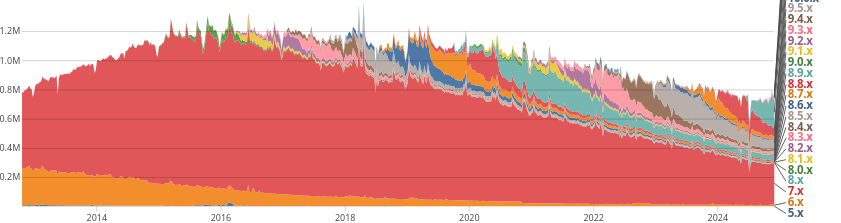
Drupal 7 must go! I found the following usage graphs quite interesting: the usage statistics for all Drupal versions follows a very positive slope, peaking around 2014 during the best years of D7, and somewhat stagnating afterwards, staying since 2015 at the 25000 28000 sites mark (I m very tempted to copy the graphs, but builtwith s terms of use are very clear in not allowing it). There is a sharp drop in the last year I attribute it to the people that are leaving D7 for other technologies after its end-of-life announcement. This becomes clearer looking only at D7 s usage statistics: D7 peaks at 15000 installs in 2016 stays there for close to 5 years, and has a sharp drop to under 7500 sites in the span of one year. D8 has a more regular rise, peak and fall peaking at ~8500 between 2020 and 2021, and down to close to 2500 for some months already; D9 has a very brief peak of almost 9000 sites in 2023 and is now close to half of it. Currently, the Drupal king appears to be D10, still on a positive slope and with over 9000 sites. Drupal 11 is still just a blip in builtwith s radar, with 3 registered sites as of September 2024 :- After writing this last paragraph, I came across the statistics found in the Drupal webpage; the methodology for acquiring its data is completely different: while builtwith s methodology is their trade secret, you can read more about how Drupal s data is gathered (and agree or disagree with it , but at least you have a page detailing 12 years so far of reported data, producing the following graph (which can be shared under the CC BY-SA license ): Drupal usage statistics by version 2013 2024 This graph is disgregated into minor versions, and I don t want to come up with yet another graph for it but it supports (most of) the narrative I presented above although I do miss the recent drop builtwith reported in D7 s numbers!

And what about Backdrop? During the D8 release cycle, a group of Drupal developers were not happy with the depth of the architectural changes that were being adopted, particularly the transition to the Symfony PHP component framework, and forked the D7 codebase to create the Backdrop CMS, a modern version of Drupal, without dropping the known and tested architecture it had. The Backdrop developers keep working closely together with the Drupal community, and although its usage numbers are way smaller than Drupal s, seems to be sustainable and lively. Of course, as I presented their numbers in the previous section, you can see Backdrop s numbers in builtwith are way, way lower. I have found it to be a very warm and welcoming community, eager to receive new members. And, thanks to its contributed D2B Migrate module, I found it is quite easy to migrate a live site from Drupal 7 to Backdrop.

Migration by playbook! So Well, I m an academic. And (if it s not obvious to you after reading so far ), one of the things I must do in my job is to write. So I decided to write an article to invite my colleagues to consider Backdrop for their D7 sites in Cuadernos T cnicos Universitarios de la DGTIC, a young journal in our university for showcasing technical academical work. And now that my article got accepted and published, I m happy to share it with you of course, if you can read Spanish But anyway Given I have several sites to migrate, and that I m trying to get my colleagues to follow suite, I decided to automatize the migration by writing an Ansible playbook to do the heavy lifting. Of course, the playbook s users will probably need to tweak it a bit to their personal needs. I m also far from an Ansible expert, so I m sure there is ample room fo improvement in my style. But it works. Quite well, I must add.

But with this size of database I did stumble across a big pebble, though. I am working on the migration of one of my users sites, and found that its database is huge. I checked the mysqldump output, and it got me close to 3GB of data. And given the D2B_migrate is meant to work via a Web interface (my playbook works around it by using a client I wrote with Perl s WWW::Mechanize), I repeatedly stumbled with PHP s maximum POST size, maximum upload size, maximum memory size I asked for help in Backdrop s Zulip chat site, and my attention was taken off fixing PHP to something more obvious: Why is the database so large? So I took a quick look at the database (or rather: my first look was at the database server s filesystem usage). MariaDB stores each table as a separate file on disk, so I looked for the nine largest tables:
# ls -lhS head
total 3.8G
-rw-rw---- 1 mysql mysql 2.4G Dec 10 12:09 accesslog.ibd
-rw-rw---- 1 mysql mysql 224M Dec  2 16:43 search_index.ibd
-rw-rw---- 1 mysql mysql 220M Dec 10 12:09 watchdog.ibd
-rw-rw---- 1 mysql mysql 148M Dec  6 14:45 cache_field.ibd
-rw-rw---- 1 mysql mysql  92M Dec  9 05:08 aggregator_item.ibd
-rw-rw---- 1 mysql mysql  80M Dec 10 12:15 cache_path.ibd
-rw-rw---- 1 mysql mysql  72M Dec  2 16:39 search_dataset.ibd
-rw-rw---- 1 mysql mysql  68M Dec  2 13:16 field_revision_field_idea_principal_articulo.ibd
-rw-rw---- 1 mysql mysql  60M Dec  9 13:19 cache_menu.ibd
A single table, the access log, is over 2.4GB long. The three following tables are, cache tables. I can perfectly live without their data in our new site! But I don t want to touch the slightest bit of this site until I m satisfied with the migration process, so I found a way to exclude those tables in a non-destructive way: given D2B_migrate works with a mysqldump output, and given that mysqldump locks each table before starting to modify it and unlocks it after its job is done, I can just do the following:
$ perl -e '$output = 1; while (<>)   $output=0 if /^LOCK TABLES  (accesslog search_index watchdog cache_field cache_path) /; $output=1 if /^UNLOCK TABLES/; print if $output ' < /tmp/d7_backup.sql  > /tmp/d7_backup.eviscerated.sql; ls -hl /tmp/d7_backup.sql /tmp/d7_backup.eviscerated.sql
-rw-rw-r-- 1 gwolf gwolf 216M Dec 10 12:22 /tmp/d7_backup.eviscerated.sql
-rw------- 1 gwolf gwolf 2.1G Dec  6 18:14 /tmp/d7_backup.sql
Five seconds later, I m done! The database is now a tenth of its size, and D2B_migrate is happy to take it. And I m a big step closer to finishing my reliance on (this bit of) legacy code for my highly-visible sites

Paul Wise: FLOSS Activities November 2024

Focus This month I didn't have any particular focus. I just worked on issues in my info bubble.

Changes

Issues

Review

Communication
  • Respond to queries from Debian users and contributors on IRC

Sponsors The SWH work was sponsored. All other work was done on a volunteer basis.

8 December 2024

Paulo Henrique de Lima Santana: Bits from MiniDebConf Toulouse 2024

Intro I always find it amazing the opportunities I have thanks to my contributions to the Debian Project. I am happy to receive this recognition through the help I receive with travel to attend events in other countries. This year, two MiniDebConfs were scheduled for the second half of the year in Europe: the traditional edition in Cambridge in UK and a new edition in Toulouse in France. After weighing the difficulties and advantages that I would have to attend one of them, I decided to choose Toulouse, mainly because it was cheaper and because it was in November, giving me more time to plan the trip. I contacted the current DPL Andreas Tille explaining my desire to attend the event and he kindly approved my request for Debian to pay for the tickets. Thanks again to Andreas! MiniDebConf Toulouse 2024 was held in November 16th and 17th (Saturday and Sunday) and took place in one of the rooms of a traditional Free Software event in the city named Capitole du Libre. Before MiniDebConf, the team organized a MiniDebCamp in November 14th and 15th at a coworking space. The whole experience promised to be incredible, and it was! From visiting a city in France for the first time, to attending a local Free Software event, and sharing four days with people from the Debian community from various countries.

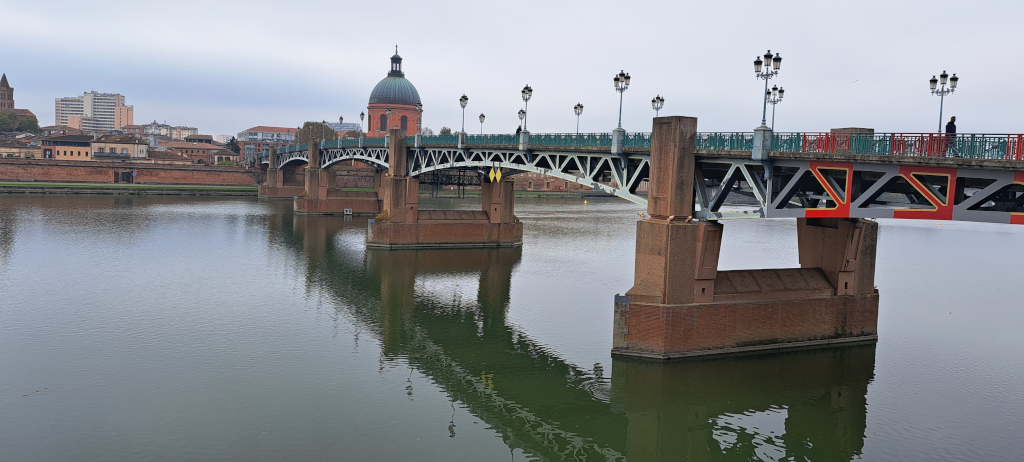
Travel and the city My plan was to leave Belo Horizonte on Monday, pass through S o Paulo, and arrive in Toulouse on Tuesday night. I was going to spend the whole of Wednesday walking around the city and then participate in the MiniDebCamp on Thursday. But the flight that was supposed to leave S o Paulo in the early hours of Monday to Tuesday was cancelled due to a problem with the airplane and I had spent all Tuesday waiting. I was rebooked on another flight that left in the evening and arrived in Toulouse on Wednesday afternoon. Even though I was very tired from the trip, I still took advantage of the end of the day to walk around the city. But it was a shame to have lost an entire day of sightseeing. On Thursday I left early in the morning to walk around a little more before going to the MiniDebCamp venue. I walked around a lot and saw several tourist attractions. The city is really very beautiful, as they say, especially the houses and buildings made of pink bricks. I was impressed by the narrow and winding streets; at one point it seemed like I was walking through a maze. I arrived to a corner and there would be 5 streets crossing in different directions. The riverbank that runs through the city is very beautiful and people spend their evenings there just hanging out. There was a lot of history around there. I stayed in an airbnb 25 minutes walking from the coworking space and only 10 minutes from the event venue. It was a very spacious apartment that was much cheaper than a hotel. MiniDebConf Toulouse 2024

MiniDebConf Toulouse 2024

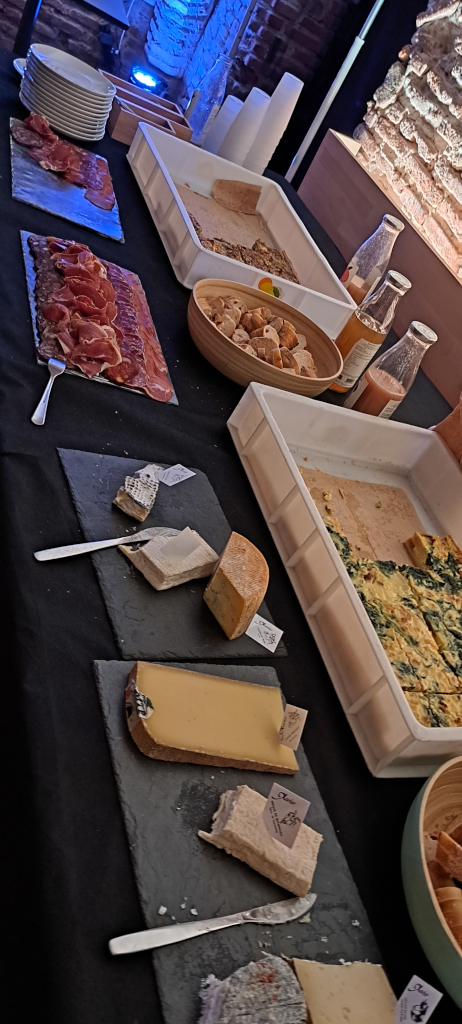
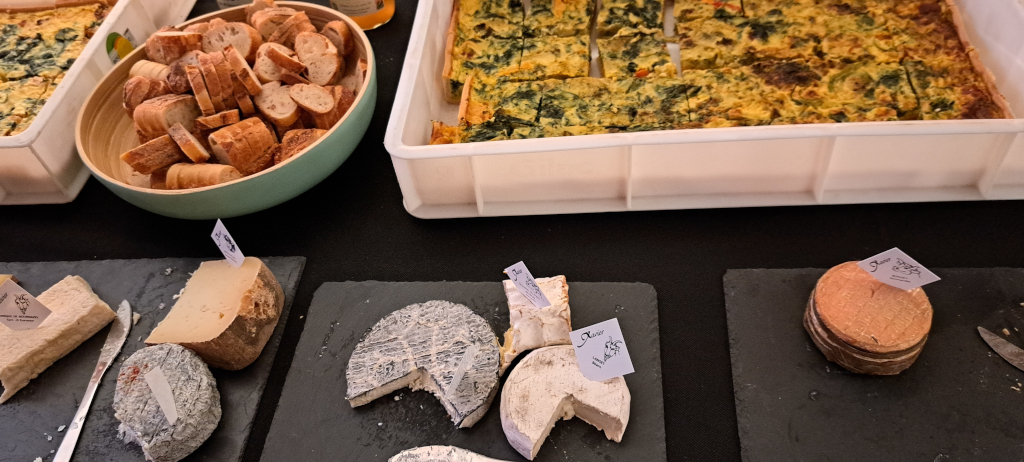
MiniDebCamp I arrived at the coworking space where the MiniDebCamp was being held and met up with several friends. I also met some new people, talked about the translation work we do in Brazil, and other topics. We already knew that the organization would pay for lunch for everyone during the two days of MiniDebCamp, and at a certain point they told us that we could go to the room (which was downstairs from the coworking space) to have lunch. They set up a table with quiches, breads, charcuterie and LOTS of cheese :-) There were several types of cheese and they were all very good. I just found it a little strange because I m not used to having cheese for lunch, but the experience was amazing anyway :-) MiniDebConf Toulouse 2024

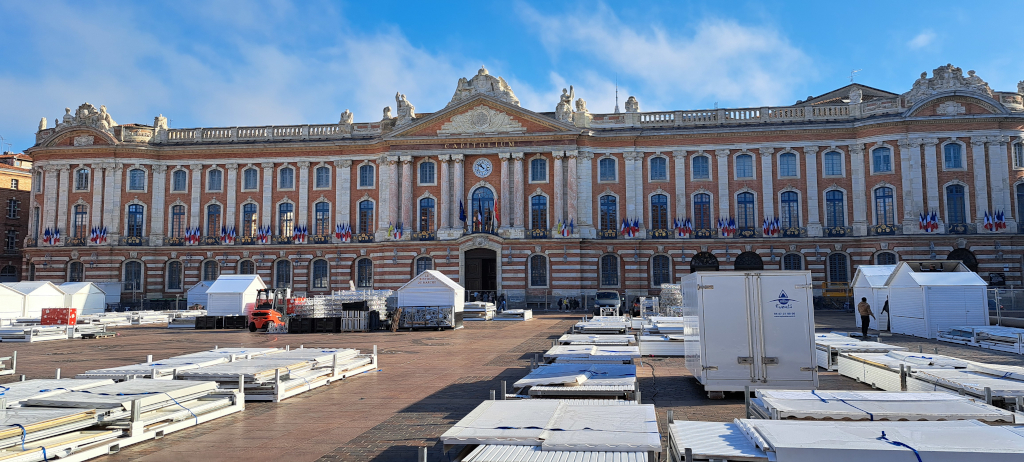
MiniDebConf Toulouse 2024 In the evening, we went as a group to dinner at a restaurant in front of the Capitolium, the city s main tourist attraction. On the second day, in the morning, I walked around the city a bit more, then went to the coworking space and had another incredible cheese table for lunch.

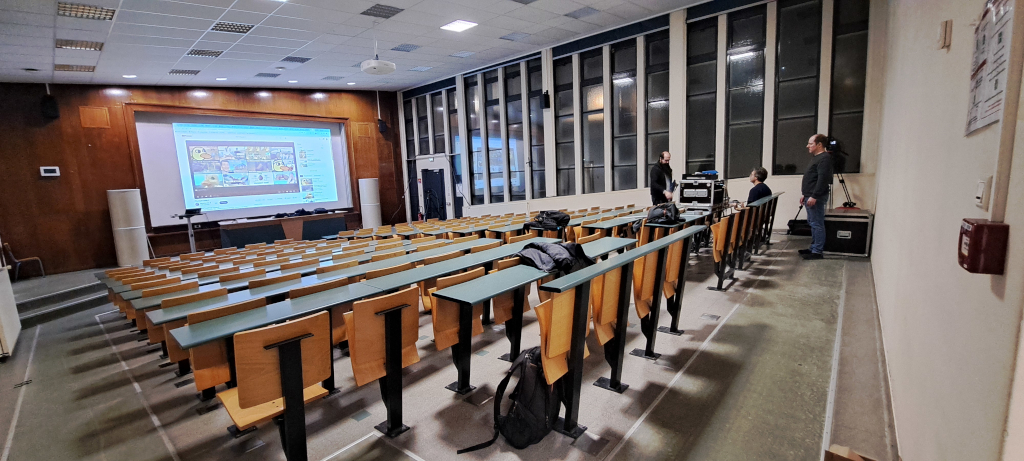
Video Team One of my ideas for going to Toulouse was to be able to help the video team in setting up the equipment for broadcasting and recording the talks. I wanted to follow this work from the beginning and learn some details, something I can t do before the DebConfs because I always arrive after the people have already set up the infrastructure. And later reproduce this work in the MiniDebConfs in Brazil, such as the one in Macei that is already scheduled for May 1-4, 2025. As I had agreed with the people from the video team that I would help set up the equipment, on Friday night we went to the University and stayed in the room working. I asked several questions about what they were doing, about the equipment, and I was able to clear up several doubts. Over the next two days I was handling one of the cameras during the talks. And on Sunday night I helped put everything away. Thanks to olasd, tumbleweed and ivodd for their guidance and patience. MiniDebConf Toulouse 2024

The event in general There was also a meeting with some members of the publicity team who were there with the DPL. We went to a cafeteria and talked mainly about areas that could be improved in the team. The talks at MiniDebConf were very good and the recordings are also available here. I ended up not watching any of the talks from the general schedule at Capitole du Libre because they were in French. It s always great to see free software events abroad to learn how they are done there and to bring some of those experiences to our events in Brazil. I hope that MiniDebConf in Toulouse will continue to take place every year, or that the French community will hold the next edition in another city and I will be able to join again :-) If everything goes well, in July next year I will return to France to join DebConf25 in Brest. MiniDebConf Toulouse 2024 More photos

Russ Allbery: Review: Why Buildings Fall Down

Review: Why Buildings Fall Down, by Matthys Levy & Mario Salvadori
Illustrator: Kevin Woest
Publisher: W.W. Norton
Copyright: 1992
Printing: 1994
ISBN: 0-393-31152-X
Format: Trade paperback
Pages: 314
Why Buildings Fall Down is a non-fiction survey of the causes of structure collapses, along with some related topics. It is a sequel of sorts to Why Buildings Stand Up by Mario Salvadori, which I have not read. Salvadori was, at the time of writing, Professor Emeritus of Architecture at Columbia University (he died in 1997). Levy is an award-winning architectural engineer, and both authors were principals at the structural engineering firm Weidlinger Associates. There is a revised and updated 2002 edition, but this review is of the original 1992 edition. This is one of those reviews that comes with a small snapshot of how my brain works. I got fascinated by the analysis of the collapse of Champlain Towers South in Surfside, Florida in 2021, thanks largely to a random YouTube series on the tiny channel of a structural engineer. Somewhere in there (I don't remember where, possibly from that channel, possibly not) I saw a recommendation for this book and grabbed a used copy in 2022 with the intent of reading it while my interest was piqued. The book arrived, I didn't read it right away, I got distracted by other things, and it migrated to my shelves and sat there until I picked it up on an "I haven't read nonfiction in a while" whim. Two years is a pretty short time frame for a book to sit on my shelf waiting for me to notice it again. The number of books that have been doing that for several decades is, uh, not small. Why Buildings Fall Down is a non-technical survey of structure failures. These are mostly buildings, but also include dams, bridges, and other structures. It's divided into 18 fairly short chapters, and the discussion of each disaster is brisk and to the point. Most of the structures discussed are relatively recent, but the authors talk about the Meidum Pyramid, the Parthenon (in the chapter on intentional destruction by humans), and the Pavia Civic Tower (in the chapter about building death from old age). If you are someone who has already been down the structural failure rabbit hole, you will find chapters on the expected disasters like the Tacoma Narrows Bridge collapse and the Hyatt Regency walkway collapse, but there are a lot of incidents here, including a short but interesting discussion of the Leaning Tower of Pisa in the chapter on problems caused by soil properties. What you're going to get, in other words, is a tour of ways in which structures can fail, which is precisely what was promised by the title. This wasn't quite what I was expecting, but now I'm not sure why I was expecting something different. There is no real unifying theme here; sometimes the failure was an oversight, sometimes it was a bad design, sometimes it was a last-minute change, and sometimes it was something unanticipated. There are a lot of factors involved in structure design and any of them can fail. The closest there is to a common pattern is a lack of redundancy and sufficient safety factors, but that lack of redundancy was generally not deliberate and therefore this is not a guide to preventing a collapse. The result is a book that feels a bit like a grab-bag of structural trivia that is individually interesting but only occasionally memorable. The writing style I suspect will be a matter of taste, but once I got used to it, I rather enjoyed it. In a co-written book, it's hard to separate the voices of the authors, but Salvadori wrote most of the chapter on the law in the first person and he's clearly a character. (That chapter is largely the story of two trials he testified in, which, from his account, involved him verbally fencing with lawyers who attempted to claim his degrees from the University of Rome didn't count as real degrees.) If this translates to his speaking style, I suspect he was a popular lecturer at Columbia. The explanations of the structural failures are concise and relatively clear, although even with Kevin Woest's diagrams, it's hard to capture the stresses and movement in a written description. (I've found from watching YouTube videos that animations, or even annotations drawn while someone is talking, help a lot.) The framing discussion, well, sometimes that is bombastic in a way that I found amusing:
But we, children of a different era, do not want our lives to be enclosed, to be shielded from the mystery. We are eager to participate in it, to gather with our brothers and sisters in a community of thought that will lift us above the mundane. We need to be together in sorrow and in joy. Thus we rarely build monolithic monuments. Instead, we build domes.
It helps that passages like this are always short and thus don't wear out their welcome. My favorite line in the whole book is a throwaway sentence in a discussion of building failures due to explosions:
With a similar approach, it can be estimated that the chance of an explosion like that at Forty-fifth Street was at most one in thirty million, and probably much less. But this is why life is dangerous and always ends in death.
Going hard, structural engineering book! It's often appealing to learn about things from their failures because the failures are inherently more dramatic and thus more interesting, but if you were hoping for an introduction to structural engineering, this is probably not the book you want. There is an excellent and surprisingly engaging appendix that covers the basics of structural analysis in 45 pages, but you would probably be better off with Why Buildings Stand Up or another architecture or structural engineering textbook (or maybe a video course). The problem with learning by failure case study is that all the case studies tend to blend together, despite the authors' engaging prose, and nearly every collapse introduces a new structural element with new properties and new failure modes and only the briefest of explanations. This book might make you a slightly more informed consumer of the news, but for most readers I suspect it will be a collection of forgettable trivia told in an occasionally entertaining style. I think the book I wanted to read was something that went deeper into the process of forensic engineering, not just the outcomes. It's interesting to know what the cause of a failure was, but I'm more interested in how one goes about investigating a failure. What is the process, how do you organize the investigation, and how does the legal system around engineering failures work? There are tidbits and asides here, but this book is primarily focused on the structural analysis and elides most of the work done to arrive at those conclusions. That said, I was entertained. Why Buildings Fall Down is a bit dated the opening chapter on airplanes hitting buildings reads much differently now than when it was written in 1992, and I'm sure it was updated in the 2002 edition but it succeeds in being clear without being soulless or sounding like a textbook. I appreciate an occasional rant about nuclear weapons in a book about architecture. I'm not sure I really recommend this, but I had a good time with it. Also, I'm now looking for opportunities to say "this is why life is dangerous and always ends in death," so there is that. Rating: 6 out of 10

7 December 2024

Dominique Dumont: New cme command to update Debian Standards-Version field

Hi While updating my Debian package, I often have to update a field from debian/control file. This field is named Standards-Version and it declares which version of Debian policy the package complies to. When updating this field, one must follow the upgrading checklist. That being said, I maintain a lot of similar package and I often have to update this Standards-Version field. This field can be updated manually with cme fix dpkg (see Managing Debian packages with cme). But this command may make other changes and does not commit the result. So I ve created a new update-standards-version cme script that: For instance:
$ cme run update-standards-version 
Reading package lists... Done
Building dependency tree... Done
Reading state information... Done
Connecting to api.ftp-master.debian.org to check 31 package versions. Please wait...
Got info from api.ftp-master.debian.org for 31 packages.
Warning in 'source Standards-Version': Current standards version is '4.7.0'. Please read https://www.debian.org/doc/debian-policy/upgrading-checklist.html for the changes that may be needed on your package
to upgrade it from standard version '4.6.2' to '4.7.0'.
Offending value: '4.6.2'
Changes applied to dpkg-control configuration:
- source Standards-Version: '4.6.2' -> '4.7.0'
[master 552862c1] control: declare compliance with Debian policy 4.7.0
 1 file changed, 1 insertion(+), 1 deletion(-)
Here s the generated commit. Note that the generated log mentions the new policy version:
$ git show
commit 552862c1f24479b1c0c8c35a6289557f65e8ff3b (HEAD -> master)
Author: Dominique Dumont <dod[at]debian.org>
Date:   Sat Dec 7 19:06:14 2024 +0100
    control: declare compliance with Debian policy 4.7.0
diff --git a/debian/control b/debian/control
index cdb41dc0..e888012e 100644
--- a/debian/control
+++ b/debian/control
@@ -48,7 +48,7 @@ Build-Depends-Indep: dh-sequence-bash-completion,
                      libtext-levenshtein-damerau-perl,
                      libyaml-tiny-perl,
                      po-debconf
-Standards-Version: 4.6.2
+Standards-Version: 4.7.0
 Vcs-Browser: https://salsa.debian.org/perl-team/modules/packages/libconfig-model-perl
 Vcs-Git: https://salsa.debian.org/perl-team/modules/packages/libconfig-model-perl.git
 Homepage: https://github.com/dod38fr/config-model/wiki
Notes: I hope this will be useful to all my fellow Debian developers to reduce the boring parts of packaging activities. All the best

Russ Allbery: Review: Dark Minds

Review: Dark Minds, by Michelle Diener
Series: Class 5 #3
Publisher: Eclipse
Copyright: 2016
ISBN: 0-6454658-5-2
Format: Kindle
Pages: 328
Dark Minds is the third book in the self-published Class 5 science-fiction romance series. It is a sequel to Dark Deeds and should not be read out of order, but as with the other books of the series, it follows new protagonists. Imogen, like another Earth woman before her, was kidnapped by a Class 5 for experimentation by the Tecran. She was subsequently transferred to a research facility and has been held in cages and secret military bases for over three months. As the story opens, she had been imprisoned in a Tecran transport for a couple of weeks when the transport is taken by the Krik who kill all of the Tecran crew. Next stop: another Class 5. That same Class 5 is where the Krik are taking Camlar Kalor and his team. Cam is a Grih investigator from the United Council, sent to look into reports of a second Earth woman rescued from a Garmman ship. (The series reader will recognize this as the plot of Dark Deeds.) Now he's trapped with the crews of a bunch of other random ships in the cargo hold of a Class 5 with Krik instead of Tecran roaming the halls, apparently at the behest of the ship's banned AI, and a mysterious third Earth woman already appears to be befriending it. Imogen is the woman Fiona saw signs of in Dark Deeds. She's had a rougher time than the protagonists of the previous two books in this series, and she's been dropped into a less stable situation. The Class 5 she's brought to at the start of the story is far more suspicious (with quite a lot of cause) and somewhat more hostile than the AIs we've encountered previously. The rest of the story formula is roughly the same, though: hunky Grih officer with a personality completely indistinguishable from the hunky Grih officers in the previous two books, an AI with a sketchy concept of morality that desperately needs an ally, the Grih obsession with singing, the eventual discovery of useful armor and weaponry that Imogen can use to surprise people, and more political maneuvering over the Sentient Beings Agreement. This entry in the series mostly abandons the Grih shock and horror at how badly the Earth women have been treated. This makes sense, given how dangerous Earth women have proven over the course of this series, and I like that Diener is changing the political dynamics as the story develops. I do sometimes miss that appalled anger of Dark Horse, but Dark Minds focuses more on the politics and corridor fighting of a tense multi-sided stand-off. I found the action more gripping in Dark Minds than in Dark Deeds, and I liked Imogen more as a character than Fiona. She doesn't have the delightfully calm competence of Rose from Dark Horse, but she's a bit more hardened, a bit more canny, and is better at taking control of situations. I also like that Diener avoids simplistically pairing Earth women off with Class 5s. The series plot is progressing faster than I had expected, and that gives this book a somewhat different shape than the previous ones. Cam is probably the least interesting of the men in this series so far and appears to exist solely to take up the man-shaped hole in the plot. This is not a great series for gender roles; thankfully, the romance is a small part of the plot and largely ignorable. The story is about the women and the AIs, and all of the women and most of the AIs of the previous books make an appearance. It's clear they're forming an alliance whether the Grih like it or not, and that part of the story was very satisfying. Up to this book, this series had been all feel-good happy endings. I will risk the small spoiler and warn that this is not true to the same degree here, so you may not want to read this one if you want something entirely fluffy, light, and positive (inasmuch as a series involving off-screen experimentation on humans can be fluffy, light, and positive). That caught me by surprise in a way I didn't entirely like, and I wish Diener had stuck with the entirely positive tone. Other than that, though, this was fun, light, readable entertainment. It's not going to win any literary awards, it's formulaic, the male protagonist comes from central casting, and the emphasis by paragraph break is still a bit grating in places, but I will probably pick up the next book when I'm in the mood for something light. Dark Minds is an improvement over book two, which bodes well for the rest of the series. Followed by Dark Matters. Rating: 7 out of 10

Louis-Philippe V ronneau: lintian.debian.org: Episode IV A New Hope

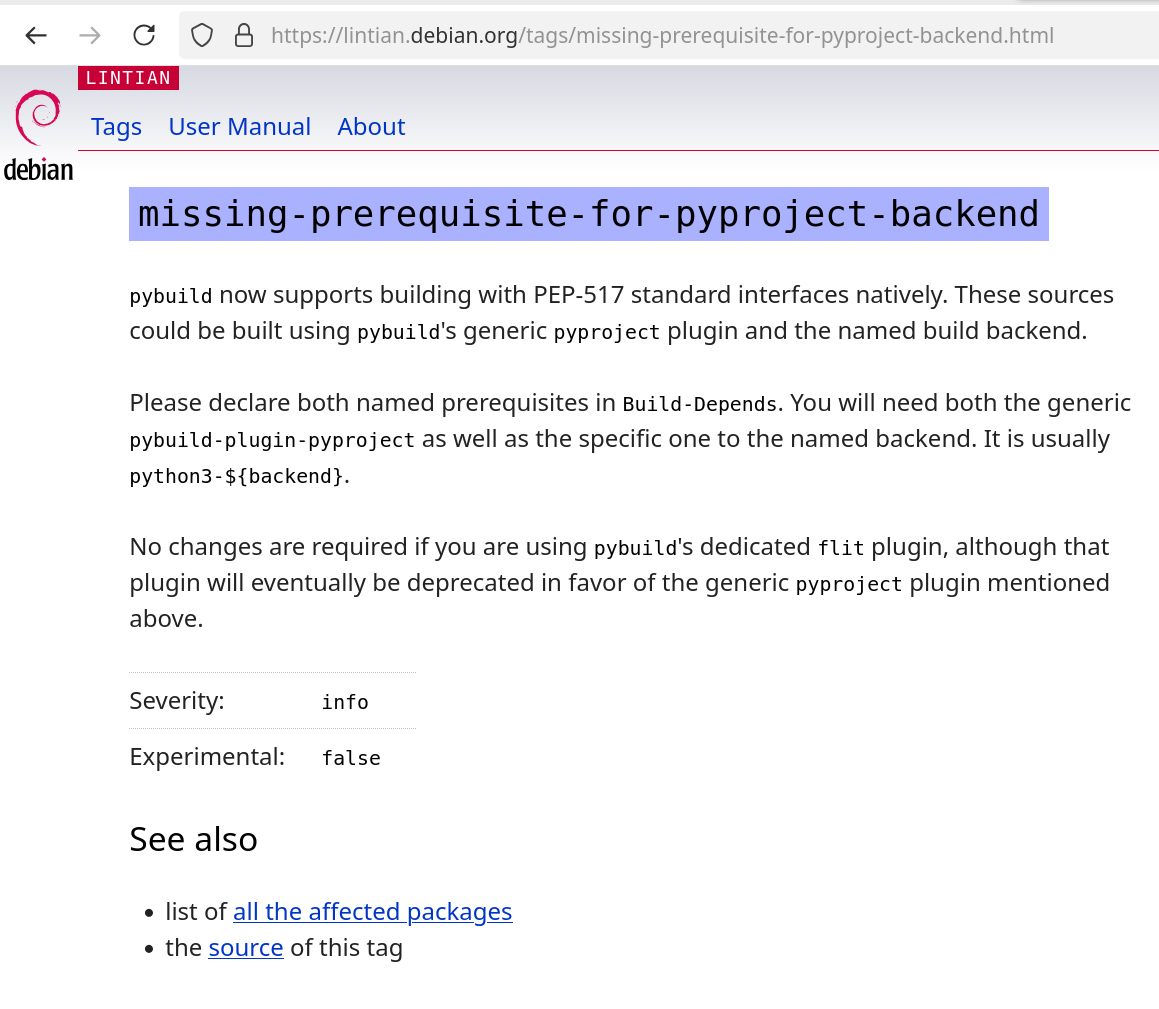
After weeks dare I say months of work, it is finally done. lintian.debian.org is back online! Screenshot of the new lintian.debian.org website Many, many thanks to everyone who worked hard to make this possible: All in all, I did very little (mostly coordinating these fine folks) and they should get the credit for this very useful service being back.

6 December 2024

B lint R czey: Firebuild 0.8.3 is out with 100+ fixes and experimental macOS support!

The new Firebuild release contains plenty of small fixes and a few notable improvements.

Experimental macOS support The most frequently asked question from people getting to know Firebuild was if it worked on their Mac and the answer sadly used to be that well, it did, but only in a Linux VM. This was far from what they were looking for. Linux and macOS have common UNIX roots, but porting Firebuild to macOS included bigger challenges, like ensuring that dyld(1), macOS s dynamic loader initializes the preloaded interceptor library early enough to catch all interesting calls, and avoid using anything that uses malloc() or thread local variables which are not yet set up then. Preloading libraries on Linux is really easy, running LD_PRELOAD=my_lib.so ls just works if the library exports the symbols to be interposed, while macOS employs multiple lines of defense to prevent applications from using unknown libraries. Firebuild s guide for making DYLD_INSERT_LIBRARIES honored on Macs can be helpful with other projects as well that rely on injecting libraries. Since GitHub s Arm64 macOS runners don t allow intercepting binaries with arm64e ABI yet, Firebuild s Apple Silicon tests are run at Bitrise, who are proud to be first to provide the latest Xcode stacks and were also quick to make the needed changes to their infrastructure to support Firebuild (thanks!  ). Firebuild on macOS can already accelerate simple projects and rebuild itself with Xcode. Since Xcode introduces a lot of nondeterminism to the build, Firebuild can t shine in acceleration with Xcode yet, but can provide nice reports to show which part of the build is the most time consuming and how each sub-command is called. If you would like to try Firebuild on macOS please compile it from the GitHub repository for now. Precompiled binaries will be distributed on the Mac App Store and via CI providers. Contact us to get notified when those channels become available.

Dealing with the Epochalypse Glibc s API provides many functions with time parameters and some of those functions are intercepted by Firebuild. Time parameters used to be passed as 32-bit values on 32-bit systems, preventing them to accurately represent timestamps after year 2038, which is known as the Y2038 problem or the Epochalypse. To deal with the problem glibc 2.34 started providing new function symbol variants with 64-bit time parameters, e.g clock_gettime64() in addition to clock_gettime(). The new 64-bit variants are used when compiling consumers of the API with _TIME_BITS=64 defined. Processes intercepted by Firebuild may have been compiled with or without _TIME_BITS=64, thus libfirebuild now provides both variants on affected systems running glibc >= 34 to work safely with binaries using 64-bit and 32-bit time representation. Many Linux distributions already stopped supporting 32-bit architectures, but Debian and Ubuntu still supports armhf, for example, where the Y2038 problem still applies. Both Debian and Ubuntu performed a transition rebuilding every library (and their reverse dependencies) with -D_FILE_OFFSET_BITS=64 set where the libraries exported symbols that changed when switching to 64-bit time representation (thanks to Steve Langasek for driving this!) . Thanks to the transition most programs are ready for 2038, but interposer libraries are trickier to fix and if you maintain one it might be a good idea to check if it works well both 32-bit and 64-bit libraries. Faketime, for example is not fixed yet, see #1064555.

Select passed through environment variables with regular expressions Firebuild filters out most of the environment variables set when starting a build to make the build more reproducible and achieve higher cache hit rate. Extra environment variables to pass through can be specified on the command line one by one, but with many similarly named variables this may become hard to maintain. With regular expressions this just became easier:
firebuild -o 'env_vars.pass_through += "MY_VARS_.*"' my_build_command
If you are not interested in acceleration just would like to explore what the build does by generating a report you can simply pass all variables:
firebuild -r -o 'env_vars.pass_through += ".*"' my_build_command

Other highlights from the 0.8.3 release
  • Fixed and nicer report in Chrome and other WebKit based browsers
  • Support GLibc 2.39 by intercepting pidfd_spawn() and pidfd_spawnp()
  • Even faster Rust build acceleration
For all the changes please check out the release page on GitHub!  (This post is also published on The Firebuild blog.)

5 December 2024

Reproducible Builds: Reproducible Builds in November 2024

Welcome to the November 2024 report from the Reproducible Builds project! Our monthly reports outline what we ve been up to over the past month and highlight items of news from elsewhere in the world of software supply-chain security where relevant. As ever, if you are interested in contributing to the Reproducible Builds project, please visit our Contribute page on our website. Table of contents:
  1. Reproducible Builds mourns the passing of Lunar
  2. Introducing reproduce.debian.net
  3. New landing page design
  4. SBOMs for Python packages
  5. Debian updates
  6. Reproducible builds by default in Maven 4
  7. PyPI now supports digital attestations
  8. Dependency Challenges in OSS Package Registries
  9. Zig programming language demonstrated reproducible
  10. Website updates
  11. Upstream patches
  12. Misc development news
  13. Reproducibility testing framework

Reproducible Builds mourns the passing of Lunar The Reproducible Builds community sadly announced it has lost its founding member, Lunar. J r my Bobbio aka Lunar passed away on Friday November 8th in palliative care in Rennes, France. Lunar was instrumental in starting the Reproducible Builds project in 2013 as a loose initiative within the Debian project. He was the author of our earliest status reports and many of our key tools in use today are based on his design. Lunar s creativity, insight and kindness were often noted. You can view our full tribute elsewhere on our website. He will be greatly missed.

Introducing reproduce.debian.net In happier news, this month saw the introduction of reproduce.debian.net. Announced at the recent Debian MiniDebConf in Toulouse, reproduce.debian.net is an instance of rebuilderd operated by the Reproducible Builds project. rebuilderd is our server designed monitor the official package repositories of Linux distributions and attempts to reproduce the observed results there. In November, reproduce.debian.net began rebuilding Debian unstable on the amd64 architecture, but throughout the MiniDebConf, it had attempted to rebuild 66% of the official archive. From this, it could be determined that it is currently possible to bit-for-bit reproduce and corroborate approximately 78% of the actual binaries distributed by Debian that is, using the .buildinfo files hosted by Debian itself. reproduce.debian.net also contains instructions how to setup one s own rebuilderd instance, and we very much invite everyone with a machine to spare to setup their own version and to share the results. Whilst rebuilderd is still in development, it has been used to reproduce Arch Linux since 2019. We are especially looking for installations targeting Debian architectures other than i386 and amd64.

New landing page design As part of a very productive partnership with the Sovereign Tech Fund and Neighbourhoodie, we are pleased to unveil our new homepage/landing page. We are very happy with our collaboration with both STF and Neighbourhoodie (including many changes not directly related to the website), and look forward to working with them in the future.

SBOMs for Python packages The Python Software Foundation has announced a new cross-functional project for SBOMs and Python packages . Seth Michael Larson writes that the project is specifically looking to solve these issues :
  • Enable Python users that require SBOM documents (likely due to regulations like CRA or SSDF) to self-serve using existing SBOM generation tools.
  • Solve the phantom dependency problem, where non-Python software is bundled in Python packages but not recorded in any metadata. This makes the job of software composition analysis (SCA) tools difficult or impossible.
  • Make the adoption work by relevant projects such as build backends, auditwheel-esque tools, as minimal as possible. Empower users who are interested in having better SBOM data for the Python projects they are using to be able to contribute engineering time towards that goal.
A GitHub repository for the initiative is available, and there are a number of queries, comments and remarks on Seth s Discourse forum post.

Debian updates There was significant development within Debian this month. Firstly, at the recent MiniDebConf in Toulouse, France, Holger Levsen gave a Debian-specific talk on rebuilding packages distributed from ftp.debian.org that is to say, how to reproduce the results from the official Debian build servers: Holger described the talk as follows:
For more than ten years, the Reproducible Builds project has worked towards reproducible builds of many projects, and for ten years now we have build Debian packages twice with maximal variations applied to see if they can be build reproducible still. Since about a month, we ve also been rebuilding trying to exactly match the builds being distributed via ftp.debian.org. This talk will describe the setup and the lessons learned so far, and why the results currently are what they are (spoiler: they are less than 30% reproducible), and what we can do to fix that.
The Debian Project Leader, Andreas Tille, was present at the talk and remarked later in his Bits from the DPL update that:
It might be unfair to single out a specific talk from Toulouse, but I d like to highlight the one on reproducible builds. Beyond its technical focus, the talk also addressed the recent loss of Lunar, whom we mourn deeply. It served as a tribute to Lunar s contributions and legacy. Personally, I ve encountered packages maintained by Lunar and bugs he had filed. I believe that taking over his packages and addressing the bugs he reported is a meaningful way to honor his memory and acknowledge the value of his work.
Holger s slides and video in .webm format are available.
Next, rebuilderd is the server to monitor package repositories of Linux distributions and attempt to reproduce the observed results. This month, version 0.21.0 released, most notably with improved support for binNMUs by Jochen Sprickerhof and updating the rebuilderd-debian.sh integration to the latest debrebuild version by Holger Levsen. There has also been significant work to get the rebuilderd package into the Debian archive, in particular, both rust-rebuilderd-common version 0.20.0-1 and rust-rust-lzma version 0.6.0-1 were packaged by kpcyrd and uploaded by Holger Levsen. Related to this, Holger Levsen submitted three additional issues against rebuilderd as well:
  • rebuildctl should be more verbose when encountering issues. [ ]
  • Please add an option to used randomised queues. [ ]
  • Scheduling and re-scheduling multiple packages at once. [ ]
and lastly, Jochen Sprickerhof submitted one an issue requested that rebuilderd downloads the source package in addition to the .buildinfo file [ ] and kpcyrd also submitted and fixed an issue surrounding dependencies and clarifying the license [ ]
Separate to this, back in 2018, Chris Lamb filed a bug report against the sphinx-gallery package as it generates unreproducible content in various ways. This month, however, Dmitry Shachnev finally closed the bug, listing the multiple sub-issues that were part of the problem and how they were resolved.
Elsewhere, Roland Clobus posted to our mailing list this month, asking for input on a bug in Debian s ca-certificates-java package. The issue is that the Java key management tools embed timestamps in its output, and this output ends up in the /etc/ssl/certs/java/cacerts file on the generated ISO images. A discussion resulted from Roland s post suggesting some short- and medium-term solutions to the problem.
Holger Levsen uploaded some packages with reproducibility-related changes:
Lastly, 12 reviews of Debian packages were added, 5 were updated and 21 were removed this month adding to our knowledge about identified issues in Debian.

Reproducible builds by default in Maven 4 On our mailing list this month, Herv Boutemy reported the latest release of Maven (4.0.0-beta-5) has reproducible builds enabled by default. In his mailing list post, Herv mentions that this story started during our Reproducible Builds summit in Hamburg , where he created the upstream issue that builds on a multi-year effort to have Maven builds configured for reproducibility.

PyPI now supports digital attestations Elsewhere in the Python ecosystem and as reported on LWN and elsewhere, the Python Package Index (PyPI) has announced that it has finalised support for PEP 740 ( Index support for digital attestations ). Trail of Bits, who performed much of the development work, has an in-depth blog post about the work and its adoption, as well as what is left undone:
One thing is notably missing from all of this work: downstream verification. [ ] This isn t an acceptable end state (cryptographic attestations have defensive properties only insofar as they re actually verified), so we re looking into ways to bring verification to individual installing clients. In particular, we re currently working on a plugin architecture for pip that will enable users to load verification logic directly into their pip install flows.
There was an in-depth discussion on LWN s announcement page, as well as on Hacker News.

Dependency Challenges in OSS Package Registries At BENEVOL, the Belgium-Netherlands Software Evolution workshop in Namur, Belgium, Tom Mens and Alexandre Decan presented their paper, An Overview and Catalogue of Dependency Challenges in Open Source Software Package Registries . The abstract of their paper is as follows:
While open-source software has enabled significant levels of reuse to speed up software development, it has also given rise to the dreadful dependency hell that all software practitioners face on a regular basis. This article provides a catalogue of dependency-related challenges that come with relying on OSS packages or libraries. The catalogue is based on the scientific literature on empirical research that has been conducted to understand, quantify and overcome these challenges. [ ]
A PDF of the paper is available online.

Zig programming language demonstrated reproducible Motiejus Jak ty posted an interesting and practical blog post on his successful attempt to reproduce the Zig programming language without using the pre-compiled binaries checked into the repository, and despite the circular dependency inherent in its bootstrapping process. As a summary, Motiejus concludes that:
I can now confidently say (and you can also check, you don t need to trust me) that there is nothing hiding in zig1.wasm [the checked-in binary] that hasn t been checked-in as a source file.
The full post is full of practical details, and includes a few open questions.

Website updates Notwithstanding the significant change to the landing page (screenshot above), there were an enormous number of changes made to our website this month. This included:
  • Alex Feyerke and Mariano Gim nez:
    • Dramatically overhaul the website s landing page with new benefit cards tailored to the expected visitors to our website and a reworking of the visual hierarchy and design. [ ][ ][ ][ ][ ][ ][ ][ ][ ][ ]
  • Bernhard M. Wiedemann:
    • Update the System images page to document the e2fsprogs approach. [ ]
  • Chris Lamb:
  • FC (Fay) Stegerman:
    • Replace more inline markdown with HTML on the Success stories page. [ ]
    • Add some links, fix some other links and correct some spelling errors on the Tools page. [ ]
  • Holger Levsen:
    • Add a historical presentation ( Reproducible builds everywhere eg. in Debian, OpenWrt and LEDE ) from October 2016. [ ]
    • Add jochensp and Oejet to the list of known contributors. [ ][ ]
  • Julia Kr ger:
  • Ninette Adhikari & hulkoba:
    • Add/rework the list of success stories into a new page that clearly shows milestones in Reproducible Builds. [ ][ ][ ][ ][ ][ ]
  • Philip Rinn:
    • Import 47 historical weekly reports. [ ]
  • hulkoba:
    • Add alt text to almost all images (!). [ ][ ]
    • Fix a number of links on the Talks . [ ][ ]
    • Avoid so-called ghost buttons by not using <button> elements as links, as the affordance of a <button> implies an action with (potentially) a side effect. [ ][ ]
    • Center the sponsor logos on the homepage. [ ]
    • Move publications and generate them instead from a data.yml file with an improved layout. [ ][ ]
    • Make a large number of small but impactful stylisting changes. [ ][ ][ ][ ]
    • Expand the Tools to include a number of missing tools, fix some styling issues and fix a number of stale/broken links. [ ][ ][ ][ ][ ][ ]

Upstream patches The Reproducible Builds project detects, dissects and attempts to fix as many currently-unreproducible packages as possible. We endeavour to send all of our patches upstream where appropriate. This month, we wrote a large number of such patches, including:

Misc development news

Reproducibility testing framework The Reproducible Builds project operates a comprehensive testing framework running primarily at tests.reproducible-builds.org in order to check packages and other artifacts for reproducibility. In November, a number of changes were made by Holger Levsen, including:
  • reproduce.debian.net-related changes:
    • Create and introduce a new reproduce.debian.net service and subdomain [ ]
    • Make a large number of documentation changes relevant to rebuilderd. [ ][ ][ ][ ][ ]
    • Explain a temporary workaround for a specific issue in rebuilderd. [ ]
    • Setup another rebuilderd instance on the o4 node and update installation documentation to match. [ ][ ]
    • Make a number of helpful/cosmetic changes to the interface, such as clarifying terms and adding links. [ ][ ][ ][ ][ ]
    • Deploy configuration to the /opt and /var directories. [ ][ ]
    • Add an infancy (or alpha ) disclaimer. [ ][ ]
    • Add more notes to the temporary rebuilderd documentation. [ ]
    • Commit an nginx configuration file for reproduce.debian.net s Stats page. [ ]
    • Commit a rebuilder-worker.conf configuration for the o5 node. [ ]
  • Debian-related changes:
    • Grant jspricke and jochensp access to the o5 node. [ ][ ]
    • Build the qemu package with the nocheck build flag. [ ]
  • Misc changes:
    • Adapt the update_jdn.sh script for new Debian trixie systems. [ ]
    • Stop installing the PostgreSQL database engine on the o4 and o5 nodes. [ ]
    • Prevent accidental reboots of the o4 node because of a long-running job owned by josch. [ ][ ]
In addition, Mattia Rizzolo addressed a number of issues with reproduce.debian.net [ ][ ][ ][ ]. And lastly, both Holger Levsen [ ][ ][ ][ ] and Vagrant Cascadian [ ][ ][ ][ ] performed node maintenance.
If you are interested in contributing to the Reproducible Builds project, please visit our Contribute page on our website. However, you can get in touch with us via:

4 December 2024

Scarlett Gately Moore: Hacked and tis the season for surgeries

I am still here. Sadly while I battle this insane infection from my broken arm I got back in July, the hackers got my blog. I am slowly building it back up. Further bad news is I have more surgeries, first one tomorrow. Furthering my current struggles I cannot start my job search due to hospitalization and recovery. Please consider a donation. https://gofund.me/6e99345d On the open source work front, I am still working on stuff, mostly snaps ( Apps 24.08.3 released ) Thank you everyone that voted me into the Ubuntu Community Council! I am trying to stay positive, but it seems I can t catch a break. I will have my computer in the hospital and will work on what I can. Have a blessed day and see you soon. Scarlett

Sven Hoexter: Looking at x509 Certificate Chains

Sometimes you've to look at the content of x509 certificate chains. Usually one finds them pem encoded and concatenated in a text file. Since the openssl x509 subcommand only decodes the first certificate it will find in a file, I did something like this:
csplit -z -f 'cert' fullchain.pem '/-----BEGIN CERTIFICATE-----/' ' * '
for x in cert*; do openssl x509 -in $x -noout -text; done
Apparently that's the "wrong" way and the more appropriate way is using the openssl crl2pkcs7 subcommand albeit we do not try to parse a revocation list here.
  openssl crl2pkcs7 -nocrl -certfile fullchain.pem   \
  openssl pkcs7 -print_certs -noout
Learned that one in a webinar presented by Victor Dukhovni. If you're new to the topic worth watching.

Enrico Zini: How to right click

I climbed on top of a mountain with a beautiful view, and when I started readying my new laptop for a work call (as one does on top of mountains), I realised that I couldn't right click and it kind of spoiled the mood. Clicking on the bottom right corner of my touchpad left-clicked. Clicking with two fingers left-clicked. Alt-clicking, Super-clicking, Control-clicking, left clicked. Here's there are two ways to simulate mouse buttons with touchpads in Wayland: Skippable digression:
I'm not sure why Gnome insists in following Macs for defaults, which is what people with non-Mac hardware are less likely to be used to. In my experience, Macs are as arbitrarily awkward to use as anything else, but they managed to build a community where if you don't understand how it works you get told you're stupid. All other systems (including Gnome) have communities where instead you get told (as is generally the case) that the system design is stupid, which at least gives you some amount of validation in your suffering. Oh well.
How to configure right click Surprisingly, this is not available in Gnome Shell settings. It can be found in gnome-tweaks: under "Keyboard & Mouse", "Mouse Click Emulation", one can choose between "Fingers" or "Area". I tried both and went for "Area": I use right-drag a lot to resize windows, and I couldn't find a way, at least with this touchpad, to make it work consistently in "Fingers" mode.

2 December 2024

Bits from Debian: Bits from the DPL

This is bits from DPL for November. MiniDebConf Toulouse I had the pleasure of attending the MiniDebConf in Toulouse, which featured a range of engaging talks, complementing those from the recent MiniDebConf in Cambridge. Both events were preceded by a DebCamp, which provided a valuable opportunity for focused work and collaboration. DebCamp During these events, I participated in numerous technical discussions on topics such as maintaining long-neglected packages, team-based maintenance, FTP master policies, Debusine, and strategies for separating maintainer script dependencies from runtime dependencies, among others. I was also fortunate that members of the Publicity Team attended the MiniDebCamp, giving us the opportunity to meet in person and collaborate face-to-face. Independent of the ongoing lengthy discussion on the Debian Devel mailing list, I encountered the perspective that unifying Git workflows might be more critical than ensuring all packages are managed in Git. While I'm uncertain whether these two questions--adopting Git as a universal development tool and agreeing on a common workflow for its use--can be fully separated, I believe it's worth raising this topic for further consideration. Attracting newcomers In my own talk, I regret not leaving enough time for questions--my apologies for this. However, I want to revisit the sole question raised, which essentially asked: Is the documentation for newcomers sufficient to attract new contributors? My immediate response was that this question is best directed to new contributors themselves, as they are in the best position to identify gaps and suggest improvements that could make the documentation more helpful. That said, I'm personally convinced that our challenges extend beyond just documentation. I don't get the impression that newcomers are lining up to join Debian only to be deterred by inadequate documentation. The issue might be more about fostering interest and engagement in the first place. My personal impression is that we sometimes fail to convey that Debian is not just a product to download for free but also a technical challenge that warmly invites participation. Everyone who respects our Code of Conduct will find that Debian is a highly diverse community, where joining the project offers not only opportunities for technical contributions but also meaningful social interactions that can make the effort and time truly rewarding. In several of my previous talks (you can find them on my talks page just search for "team," and don't be deterred if you see "Debian Med" in the title; it's simply an example), I emphasized that the interaction between a mentor and a mentee often plays a far more significant role than the documentation the mentee has to read. The key to success has always been finding a way to spark the mentee's interest in a specific topic that resonates with their own passions. Bug of the Day In my presentation, I provided a brief overview of the Bug of the Day initiative, which was launched with the aim of demonstrating how to fix bugs as an entry point for learning about packaging. While the current level of interest from newcomers seems limited, the initiative has brought several additional benefits. I must admit that I'm learning quite a bit about Debian myself. I often compare it to exploring a house's cellar with a flashlight you uncover everything from hidden marvels to things you might prefer to discard. I've also come across traces of incredibly diligent people who have invested their spare time polishing these hidden treasures (what we call NMUs). The janitor, a service in Salsa that automatically updates packages, fits perfectly into this cellar metaphor, symbolizing the ongoing care and maintenance that keep everything in order. I hadn't realized the immense amount of silent work being done behind the scenes--thank you all so much for your invaluable QA efforts. Reproducible builds It might be unfair to single out a specific talk from Toulouse, but I'd like to highlight the one on reproducible builds. Beyond its technical focus, the talk also addressed the recent loss of Lunar, whom we mourn deeply. It served as a tribute to Lunar's contributions and legacy. Personally, I've encountered packages maintained by Lunar and bugs he had filed. I believe that taking over his packages and addressing the bugs he reported is a meaningful way to honor his memory and acknowledge the value of his work. Advent calendar bug squashing I d like to promote an idea originally introduced by Thorsten Alteholz, who in 2011 proposed a Bug Squashing Advent Calendar for the Debian Med team. (For those unfamiliar with the concept of an Advent Calendar, you can find an explanation on Wikipedia.) While the original version included a fun graphical element which we ve had to set aside due to time constraints (volunteers, anyone?) we ve kept the tradition alive by tackling one bug per day from December 1st to 24th each year. This initiative helps clean up issues that have accumulated over the year. Regardless of whether you celebrate the concept of Advent, I warmly recommend this approach as a form of continuous bug-squashing party for every team. Not only does it contribute to the release readiness of your team s packages, but it s also an enjoyable and bonding activity for team members. Best wishes for a cheerful and productive December
Andreas.

Charles: Hello World

Or how it took more than a year for me to set up this website - As the computer science tradition demands, we must start with a Hello World. Though I have to say this hello world took quite a long time to reach the internet. I ve been thinking about setting up this website for way over a year, but there are always too many things to decide - what Static Site Generator will I use? Where should I get a domain from? Which registrar would be better now? What if I want to set up a mail server, is it good enough? Oh, and what about the theme, which one to choose? Can I get one simple enough to not fetch javascript or css from external sources? This was taking so long that even my friends were saying Please, just share your screen and let s do it now! . Well, rejoice friends, now it s done!

1 December 2024

Guido G nther: Free Software Activities November 2024

Another short status update of what happened on my side last month. The larger blocks are the Phosh 0.43 release, the initial file chooser portal, phosh-osk-stub now handling digit, number, phone and PIN input purpose via special layouts as well as Phoc mostly catching up with wlroots 0.18 and the current development version targeting 0.19. phosh phoc phosh-mobile-settings libphosh-rs phosh-osk-stub phosh-tour pfs xdg-desktop-portal-phosh meta-phosh Debian Calls libcall-ui git-buildpackage wlroots python-dbusmock xdg-spec ashpd govarnam varnam-schemes Reviews This is not code by me but reviews I did on other peoples code. The list is incomplete, but I hope to improve on this in the upcoming months. Thanks for the contributions! Help Development If you want to support my work see donations. This includes a list of hardware we want to improve support for. Thanks a lot to all current and past donors. Comments? Join the Fediverse thread

Colin Watson: Free software activity in November 2024

Most of my Debian contributions this month were sponsored by Freexian. You can also support my work directly via Liberapay. Conferences I attended MiniDebConf Toulouse 2024, and the MiniDebCamp before it. Most of my time was spent with the Freexian folks working on debusine; Stefano gave a talk about its current status with a live demo (frantically fixed up over the previous couple of days, as is traditional) and with me and others helping to answer questions at the end. I also caught up with some people I haven t seen in ages, ate a variety of delicious cheeses, and generally had a good time. Many thanks to the organizers and sponsors! After the conference, Freexian collaborators spent a day and a half doing some planning for next year, and then went for an afternoon visiting the Cit de l espace. Rust team I upgraded these packages to new upstream versions, as part of upgrading pydantic and rpds-py: Python team Last month, I mentioned that we still need to work out what to do about the multipart vs. python-multipart name conflict in Debian (#1085728). We eventually managed to come up with an agreed plan; Sandro has uploaded a renamed binary package to experimental, and I ve begun work on converting reverse-dependencies (asgi-csrf, fastapi, python-curies, and starlette done so far). There s a bit more still to do, but I expect we can finish it soon. I fixed problems related to adding Python 3.13 support in: I fixed some packaging problems that resulted in failures any time we add a new Python version to Debian: I fixed other build/autopkgtest failures in: I packaged python-quart-trio, needed for a new upstream version of python-urllib3, and contributed a small packaging tweak upstream. I backported a twisted fix that caused problems in other packages, including breaking debusine s tests. I disentangled some upstream version confusion in python-catalogue, and upgraded to the current upstream version. I upgraded these packages to new upstream versions: Other small fixes I contributed Incus support to needrestart upstream. In response to Helmut s Cross building talk at MiniDebConf Toulouse, I fixed libfilter-perl to support cross-building (5b4c2e10, f9788c27). I applied a patch to move aliased files from / to /usr in iprutils (#1087733). I adjusted debconf to use the new /usr/lib/apt/apt-extracttemplates path (#1087523). I upgraded putty to 0.82.

Russ Allbery: Review: Unexploded Remnants

Review: Unexploded Remnants, by Elaine Gallagher
Publisher: Tordotcom
Copyright: 2024
ISBN: 1-250-32522-6
Format: Kindle
Pages: 111
Unexploded Remnants is a science fiction adventure novella. The protagonist and world background would support an episodic series, but as of this writing it stands alone. It is Elaine Gallagher's first professional publication. Alice is the last survivor of Earth: an explorer, information trader, and occasional associate of the Archive. She scouts interesting places, looks for inconsistencies in the stories the galactic civilizations tell themselves, and pokes around ruins for treasure. As this story opens, she finds a supposedly broken computer core in the Alta Sidoie bazaar that is definitely not what the trader thinks it is. Very shortly thereafter, she's being hunted by a clan of dangerous Delosi while trying to decide what to do with a possibly malevolent AI with frightening intrusion abilities. This is one of those stories where all the individual pieces sounded great, but the way they were assembled didn't click for me. Unusually, I'm not entirely sure why. Often it's the characters, but I liked Alice well enough. The Lewis Carroll allusions were there but not overdone, her computer agent Bugs is a little too much of a Warner Brothers cartoon but still interesting, and the world building has plenty of interesting hooks. I certainly can't complain about the pacing: the plot moves briskly along to a somewhat predictable but still adequate conclusion. The writing is smooth and competent, and the world is memorable enough that I'm still thinking about it. And yet, I never connected with this story. I think it may be because both Alice and the tight third-person narrator tend towards breezy confidence and matter-of-fact descriptions. Alice does, at times, get scared or angry, but I never felt those emotions. They were just events that were described to me. There wasn't an emotional hook, a place where the character grabbed me, and so it felt like everything was happening at an odd remove. The advantage of this approach is that there are no overwrought emotional meltdowns or brooding angstful protagonists, just an adventure story about a competent and thoughtful character, but I think I wanted a bit more emotional involvement than I got. The world background is the best part and feels like it could be part of a larger series. The Milky Way is connected by an old, vast, and only partly understood network of teleportation portals, which had cut off Earth for unknown reasons and then just as mysteriously reactivated when Alice, then Andrew, drunkenly poked at a standing stone while muttering an old prayer in Gaelic. The Archive spent a year sorting out her intellectual diseases (capitalism was particularly alarming) and giving her a fresh start with a new body. Humanity subsequently destroyed itself in a paroxysm of reactionary violence, leaving Alice a free agent, one of a kind in a galaxy of dizzying variety and forgotten history. Gallagher makes great use of the weirdness of the portal network to create a Star Wars style of universe: the focus is more on the diversity of the planets and alien species than on a coherent unifying structure. The settings of this book are not prone to Planet of the Hats problems. They instead have the contrasts that one would get if one dropped portals near current or former Earth population centers and then took a random walk through them (or, in other words, what playing GeoGuessr on a world map feels like). I liked this effect, but I have to admit that it also added to that sense of sliding off the surface of the story. The place descriptions were great bits of atmosphere, but I never cared about them. There isn't enough emotional coherence to make them memorable. One of the more notable quirks of this story is the description of ideologies and prejudices as viral memes that can be cataloged, cured, and deployed like weapons. This is a theme of the world-building as well: this society, or at least the Archive-affiliated parts of it, classifies some patterns of thought as potentially dangerous but treatable contagious diseases. I'm not going to object too much to this as a bit of background and characterization in a fairly short novella stuffed with a lot of other world-building and plot, but there's was something about treating ethical systems like diseases that bugged me in much the same way that medicalization of neurodiversity bugs me. I think some people will find that sense of moral clarity relaxing and others will find it vaguely irritating, and I seem to have ended up in the second group. Overall, I would classify this as an interesting not-quite-success. It felt like a side story in a larger universe, like a story that would work better if I already knew Alice from other novels and had an established emotional connection with her. As is, I would not really recommend it, but there are enough good pieces here that I would be interested to see what Gallagher does next. Rating: 6 out of 10

30 November 2024

Enrico Zini: New laptop setup

My new laptop Framework (Framework Laptop 13 DIY Edition (AMD Ryzen 7040 Series)) arrived, all the hardware works out of the box on Debian Stable, and I'm very happy indeed. This post has the notes of all the provisioning steps, so that I can replicate them again if needed. Installing Debian 12 Debian 12's installer just worked, with Secure Boot enabled no less, which was nice. The only glitch is an argument with the guided partitioner, which was uncooperative: I have been hit before by a /boot partition too small, and I wanted 1G of EFI and 1G of boot, while the partitioner decided that 512Mb were good enough. Frustratingly, there was no way of changing that, nor I found how to get more than 1G of swap, as I wanted enough swap to fit RAM for hybernation. I let it install the way it pleased, then I booted into grml for a round of gparted. The tricky part of that was resizing the root btrfs filesystem, which is in an LV, which is in a VG, which is in a PV, which is in LUKS. Here's a cheatsheet. Shrink partitions: note that I used an increasing size because I don't trust that each tool has a way of representing sizes that aligns to the byte. I'd be happy to find out that they do, but didn't want to find out the hard way that they didn't. Resize with gparted: Move and resize partitions at will. Shrinking first means it all takes a reasonable time, and you won't have to wait almost an hour for a terabyte-sized empty partition to be carefully moved around. Don't ask me why I know. Regrow partitions: Setup gnome When I get a new laptop I have a tradition of trying to make it work with Gnome and Wayland, which normally ended up in frustration and a swift move to X11 and Xfce: I have a lot of long-time muscle memory involved in how I use a computer, and it needs to fit like prosthetics. I can learn to do a thing or two in a different way, but any papercut that makes me break flow and I cannot fix will soon become a dealbreaker. This applies to Gnome as present in Debian Stable. General Gnome settings tips I can list all available settings with:
gsettings list-recursively
which is handy for grepping things like hotkeys. I can manually set a value with:
gsettings set <schema> <key> <value>
and I can reset it to its default with:
gsettings reset <schema> <key>
Some applications like Gnome Terminal use "relocatable schemas", and in those cases you also need to specify a path, which can be discovered using dconf-editor:
gsettings set <schema>:<path> <key> <value>
Install appindicators First thing first: app install gnome-shell-extension-appindicator, log out and in again: the Gnome Extension manager won't see the extension as available until you restart the whole session. I have no idea why that is so, and I have no idea why a notification area is not present in Gnome by default, but at least now I can get one. Fix font sizes across monitors My laptop screen and monitor have significantly different DPIs, so:
gsettings set org.gnome.mutter experimental-features "['scale-monitor-framebuffer']"
And in Settings/Displays, set a reasonable scaling factor for each display. Disable Alt/Super as hotkey for the Overlay Seeing all my screen reorganize and reshuffle every time I accidentally press Alt leaves me disoriented and seasick:
gsettings set org.gnome.mutter overlay-key ''
Focus-follows-mouse and Raise-or-lower My desktop is like my desktop: messy and cluttered. I have lots of overlapping window and I switch between them by moving the focus with the mouse, and when the visible part is not enough I have a handy hotkey mapped to raise-or-lower to bring forward what I need and send back what I don't need anymore. Thankfully Gnome can be configured that way, with some work: This almost worked, but sometimes it didn't do what I wanted, like I expected to find a window to the front but another window disappeared instead. I eventually figured that by default Gnome delays focus changes by a perceivable amount, which is evidently too slow for the way I move around windows. The amount cannot be shortened, but it can be removed with:
gsettings set org.gnome.shell.overrides focus-change-on-pointer-rest false
Mouse and keyboard shortcuts Gnome has lots of preconfigured sounds, shortcuts, animations and other distractions that I do not need. They also either interfere with key combinations I want to use in terminals, or cause accidental window moves or resizes that make me break flow, or otherwise provide sensory overstimulation that really does not work for me. It was a lot of work, and these are the steps I used to get rid of most of them. Disable Super+N combinations that accidentally launch a questionable choice of programs:
for i in  seq 1 9 ; do gsettings set org.gnome.shell.keybindings switch-to-application-$i '[]'; done
Gnome-Shell settings: gnome-tweak-tool settings: Gnome Terminal settings: Thankfully 10 years ago I took notes on how to customize Gnome Terminal, and they're still mostly valid: Other hotkeys that got in my way and had to disable the hard way:
for n in  seq 1 12 ; do gsettings set org.gnome.mutter.wayland.keybindings switch-to-session-$n '[]'; done
gsettings set org.gnome.desktop.wm.keybindings move-to-workspace-down '[]'
gsettings set org.gnome.desktop.wm.keybindings move-to-workspace-up '[]'
gsettings set org.gnome.desktop.wm.keybindings panel-main-menu '[]'
gsettings set org.gnome.desktop.interface menubar-accel '[]'
Note that even after removing F10 from being bound to menubar-accel, and after having to gsetting binding to F10 as is:
$ gsettings list-recursively grep F10
org.gnome.Terminal.Legacy.Keybindings switch-to-tab-10 '<Alt>F10'
I still cannot quit Midnight Commander using F10 in a terminal, as that moves the focus in the window title bar. This looks like a Gnome bug, and a very frustrating one for me. Appearance Gnome-Shell settings: gnome-tweak-tool settings: Gnome Terminal settings: Other decluttering and tweaks Gnome Shell Settings: Set a delay between screen blank and lock: when the screen goes blank, it is important for me to be able to say "nope, don't blank yet!", and maybe switch on caffeine mode during a presentation without needing to type my password in front of cameras. No UI for this, but at least gsettings has it:
gsettings set org.gnome.desktop.screensaver lock-delay 30
Extensions I enabled the Applications Menu extension, since it's impossible to find less famous applications in the Overview without knowing in advance how they're named in the desktop. This stole a precious hotkey, which I had to disable in gsettings:
gsettings set org.gnome.shell.extensions.apps-menu apps-menu-toggle-menu '[]'
I also enabled: I didn't go and look for Gnome Shell extentions outside what is packaged in Debian, as I'm very wary about running JavaScript code randomly downloaded from the internet with full access over my data and desktop interaction. I also took care of checking that the Gnome Shell Extensions web page complains about the lacking "GNOME Shell integration" browser extension, because the web browser shouldn't be allowed to download random JavaScript from the internet and run it with full local access. Yuck. Run program dialog The default run program dialog is almost, but not quite, totally useless to me, as it does not provide completion, not even just for executable names in path, and so it ends up being faster to open a new terminal window and type in there. It's possible, in Gnome Shell settings, to bind a custom command to a key. The resulting keybinding will now show up in gsettings, though it can be located in a more circuitous way by grepping first, and then looking up the resulting path in dconf-editor:
gsettings list-recursively grep custom-key
org.gnome.settings-daemon.plugins.media-keys custom-keybindings ['/org/gnome/settings-daemon/plugins/media-keys/custom-keybindings/custom0/']
I tried out several run dialogs present in Debian, with sad results, possibly due to most of them not being tested on wayland: Both gmrun and xfrun4 seem like workable options, with xfrun4 being customizable with convenient shortcut prefixes, so xfrun4 it is. TODO I'll try to update these notes as I investigate. Conclusion so far I now have something that seems to work for me. A few papercuts to figure out still, but they seem manageable. It all feels a lot harder than it should be: for something intended to be minimal, Gnome defaults feel horribly cluttered and noisy to me, continuosly getting in the way of getting things done until tamed into being out of the way unless called for. It felt like a device that boots into flashy demo mode, which needs to be switched off before actual use. Thankfully it can be switched off, and now I have notes to do it again if needed. gsettings oddly feels to me like a better UI than the interactive settings managers: it's more comprehensive, more discoverable, more scriptable, and more stable across releases. Most of the Q&A I found on the internet with guidance given on the UI was obsolete, while when given with gsettings command lines it kept being relevant. I also have the feeling that these notes would be easier to understand and follow if given as gsettings invocations instead of descriptions of UI navigation paths. At some point I'll upgrade to Trixie and reevaluate things, and these notes will be a useful checklist for that. Fingers crossed that this time I'll manage to stay on Wayland. If not, I know that Xfce is still there for me, and I can trust it to be both helpful and good at not getting in the way of my work.

Aurelien Jarno: UEFI Unified Kernel Image for Debian Installer on riscv64

On the riscv64 port, the default boot method is UEFI, with U-Boot typically used as the firmware. This approach aligns more closely with other architectures, which avoid developping riscv64 specific code. For advanced users, booting using U-Boot and extlinux is possible, thanks to the kernel being built with CONFIG_EFI_STUB=y. The same applies to the Debian Installer, which is provided as ISO images in various sizes and formats like on other architectures. These images can be put on a USB drive or an SD-card and booted directly from U-Boot in UEFI mode. Some users prefer to use the netboot "image", which in practice consists of a Linux kernel, an initrd, plus a set of Device Tree Blob (DTB) files. However, booting this in UEFI mode is not straightforward, unless you use a TFTP server, which is also not trivial. Less known to users, there is also a corresponding mini.iso image, which contains all the above plus a bootloader. This offers a simpler alternative for installation, but depending on your (vendor) U-Boot version this still requires to go through a media. Systemd version 257-rc2 comes with a great new feature, the ability to include multiple DTB files in a single UKI (Unified Kernel Image) file, with systemd-stub automatically loading the appropriate one for the current hardware. A UKI file combines a UEFI boot stub program, a Linux kernel image, an optional initrd, and further resources in a single UEFI PE file. This finally solves the DTB problem in the UEFI world for distributions, as a single image can work on multiple boards. Building upon this, debian-installer on riscv64 now also creates a UEFI UKI mini.efi image, which contains systemd-stub, a Linux kernel, an initrd, plus a set of Device Tree Blob (DTB) files. Using this image also ensures that the system is booted in UEFI mode. Booting it with debian-installer is as simple as:
load mmc 0:1 mini.efo $kernel_addr_r # (can also be done using tftpboot, wget, etc.)
bootefi $kernel_addr_r
Additional parameters can be passed to the image using the U-Boot bootargs environment variable. For instance, to boot in rescue mode:
setenv bootargs "rescue/enable=true"

Next.

Previous.