Search Results: "daniel"

23 February 2013

Daniel Pocock: Checking authors.txt before migrating to github

Ensuring that contributors are correctly recognised for their work is a cornerstone of the free and open source software community. Here I present a convenient script to help. When projects migrate to git (and usually Github these days), there is usually quite a lot of enthusiasm to get up and running and the authors.txt file is not looked at closely, or not at all. Github does a great job of summarising the free software contributions of each member. To do this, it needs to cross-reference their commits with their email addresses. This possibility is not unique to Github though: as git is a distributed version control system, it is quite possible that other services will seek to mirror and report on code contributions in the future. authors.txt can be tedious For a large project with a long history, there may be more than 100 committers, many of them designated by SVN user IDs that are unique to the project and not easily mapped to the user email address. If the project is hosted on Google Code SVN, then Google often makes dummy gmail.com accounts for the committers - and many people don't even use those accounts for anything else, not even as an email account. Including these accounts in a git repository is a bad idea if it is not the person's preferred email address. If they don't have that address associated with their Github account, then their commits won't be easily attributed to them at all. Often, building an accurate authors.txt can be tedious, but here are some steps to simplify it:
  • Use a script like svn-authors-extract to quickly build a template file by scanning the SVN repository.
  • Scan email list history - if necessary, download the email archive as a mailbox, and use regular expressions to extract all email addresses
  • Find out if the SVN server keeps a list of email addresses with the SVN user IDs somewhere
  • Use searches in Google, LinkedIn and various other places to try and find out where the person is now
  • Finally, use the script below to test the results
Testing the results against Github automatically How do you know which email addresses are already matched to a Github account and which need further research? I've written a convenient script to help It creates a dummy repository with one commit per committer. Upload this dummy repository as a new project on Github, view the commit log page, and all the matched user IDs will be highlighted, so the missing ones will stand out and you can quickly focus your search for missing email addresses. I've tested this with the authors.txt file I'm building for the Sipdroid/Lumicall projects. This project comes from Google Code SVN and almost all the identities are obscured by gmail.com addresses that may or may not be the real/preferred email addresses. I created a dummy project on Github called sipdroid-users and pushed the dummy commits there so I can see how many of the contributors are correctly mapped to a Github account. A full copy of the script is below, you can also find it in the sync2git repository:
#!/bin/bash
set -e
if [ $# -lt 2 ];
then
  echo "$0 <authors file> <dest repo for push>"
  exit 1
fi
AUTHORS_FILE=" pwd /$1"
DEST_REPO="$2"
if [ ! -e "$ AUTHORS_FILE " ];
then
  echo "can't find $ AUTHORS_FILE , aborting"
  exit 1
fi
TMP_REPO= mktemp -d 
TARGET_FILE="testing.txt"
cd "$ TMP_REPO "
git init .
cat "$ AUTHORS_FILE "   while read ;
do
  full_info= echo "$ REPLY "   cut -f2 -d'='   cut -b2- 
  an=" echo "$ full_info "   sed -e "s/ <.*\$//\" "
  am=" echo "$ full_info "   sed -e "s/^.*</</\" "
  cn="$an"
  cm="$am"
  echo "$REPLY" >> "$ TARGET_FILE "
  git add "$ TARGET_FILE "
  export GIT_AUTHOR_NAME="$an"
  export GIT_AUTHOR_EMAIL="$am"
  export GIT_COMMITTER_NAME="$cn"
  export GIT_COMMITTER_EMAIL="$cm"
  git commit -m "Test adding $ REPLY "
done
git remote add origin "$ DEST_REPO "
git push -u origin master

21 February 2013

Daniel Pocock: US military may need Lumicall

In a remarkable report in Wired Magazine, it has been revealed that US stealth bombers have to communicate with their British allies using conventional radio. What that means in practice is that it would be child's play for the enemy to use basic techniques like triangulation to locate these otherwise invisible aircraft. While the thought of an ineffective multi-billion-dollar stealth bomber program seems preposterous, some may argue that the military has bigger problems maintaining discretion when even the CIA director is busted having an affair via Gmail. After all, it costs nothing to download GnuPG So what could the Americans and British do to put the stealth back into stealth bomber? Maybe it is time that pilots were issued with smartphones running Lumicall - with the built-in encryption features, could it make all their worries go away? At the very least, this issue demonstrates in a remarkable manner the reasons to stick with open standards like XMPP and SIP for building interoperable communications systems. If they missed our talk on Free, open, secure and convenient communications at FOSDEM, that may also be an interesting place to start searching for answers, as the idea of federated real-time communications is just as valuable in the air as it is for business or private purposes on the ground. The video is available now for those who missed it, and my earlier FOSDEM wrap-up provides more food for thought about the relevance of private communications for maintaining individual freedom (with or without the help of airborne supremecy). FOSDEM video: <video controls="controls" preload="none">
<source src="http://video.fosdem.org/2013/maintracks/Janson/Free,_open,_secure_and_convenient_communications.webm" type="video/webm; codecs="vp8, vorbis""></source></video> <object data="http://releases.flowplayer.org/swf/flowplayer-3.2.15.swf" type="application/x-shockwave-flash"> <param name="movie" value="http://releases.flowplayer.org/swf/flowplayer-3.2.15.swf"><param name="allowfullscreen" value="true"><param name="flashvars" value="config= 'clip': 'url': 'http://video.fosdem.org/2013/maintracks/Janson/Free,_open,_secure_and_convenient_communications.webm', 'autoPlay':false, 'autoBuffering':false ">Video tag not supported. Download the video here. </object>

20 February 2013

Daniel Pocock: Automatically mirroring SVN repositories to git and github

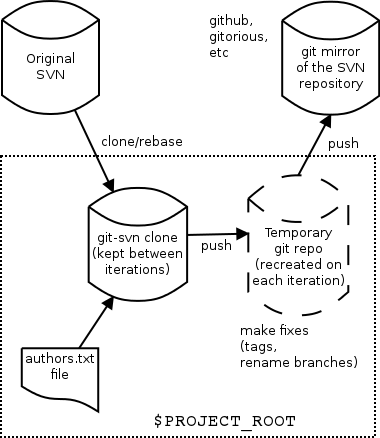
Updated 21 February 2013: the scripts below have now been adapted to run conveniently from cron and mirror multiple repositories. You can find full scripts and documentation on github There are a number of scripts around, including an earlier blog post of my own, for making a once-off conversion of an SVN repository to a Git repository. However, what if the project team is not yet ready for a full move to git? You may want to start benefiting from git (e.g. using the project as a submodule of another git project, or using Travis-CI.org for automated builds) while development officially continues to take place in SVN. If you don't need to make commits into git just now, you can set up a mirror and refresh it periodically from SVN. This process can be used with various SVN repositories, including Sourceforge and Google Code SVN repositories. Process overview
  • An authors.txt file is created manually before the first run.
  • A git-svn clone of the SVN repository is created. This clone needs to be retained between replication runs.
  • On each run, a temporary git repository is created. The svn-clone is rebased and pushed to the fresh git repository.
  • Fixes (e.g. branch renames and tagging) are made in the temporary git repository.
  • The final results are then pushed from the temporary repository to the real git mirror that is being maintained.
  • Finally, the temporary git repository is deleted, but the svn-clone is kept.
Here is a diagram of the workflow: Config file Here is a sample config file for the script, it mirrors the rather complicated reSIProcate repository with 10,000 commits:
PROJECT_ROOT=/home/daniel/svn-mirror/resiprocate
AUTHORS_FILE=$ PROJECT_ROOT /authors.txt
SVN_REPO=https://svn.resiprocate.org/rep/resiprocate
SVN_LAYOUT="--trunk=main --branches=branches --tags=tags"
GIT_REPO=git@github.com:resiprocate/resiprocate.git
Of particular note here:
  • The $PROJECT_ROOT is where the svn-clone and the temporary repositories will be created
  • $GIT_REPO is the final destination repository. For testing, it could just be a local directory initialised with git init --bare .
  • In this repository, our trunk is actually called main, hence we have the layout argument --trunk=main. Many projects would just use --trunk=trunk
The script The script itself is below. I'd suggest running it manually a few times first and observing how it behaves, disk space requirements, etc.
#!/bin/bash
set -e
if [ ! $# -eq 1 ];
then
  echo "Usage:"
  echo "$0 <config-file>"
  exit 1
fi
CONFIG_FILE="$1"
. "$ CONFIG_FILE "   exit 1
SVN_CLONE="$ PROJECT_ROOT /svn-clone"
GIT_BARE="$ PROJECT_ROOT /git-bare-tmp"
if [ ! -d "$ PROJECT_ROOT " ];
then
  mkdir -p "$ PROJECT_ROOT "
fi
cd "$ PROJECT_ROOT "
if [ ! -d "$ SVN_CLONE " ];
then
  git svn clone \
    "$ SVN_REPO " \
    -A "$ AUTHORS_FILE " \
    $ SVN_LAYOUT  \
    "$ SVN_CLONE "
  cd "$ SVN_CLONE "
else
  cd "$ SVN_CLONE "
  git remote rm bare   echo "failed to delete remote:bare, proceeding anyway"
  git svn rebase \
    --fetch-all \
    -A "$ AUTHORS_FILE "
fi
git remote add bare "$ GIT_BARE "
git config remote.bare.push 'refs/remotes/*:refs/heads/*'
if [ -d "$ GIT_BARE " ];
then
  rm -rf "$ GIT_BARE "
fi
mkdir -p "$ GIT_BARE "
cd "$ GIT_BARE "
git init --bare .
git symbolic-ref HEAD refs/heads/trunk
cd "$ SVN_CLONE "
git push bare
cd "$ GIT_BARE "
git branch -m trunk master
git for-each-ref --format='%(refname)' refs/heads/tags   \
   cut -d / -f 4   \
   while read ref;
   do
      git tag "$ref" "refs/heads/tags/$ref"
      git branch -D "tags/$ref"
   done
git remote add origin "$ GIT_REPO "
git config branch.master.remote origin
git config branch.master.merge refs/heads/master
git push --tags origin master
git push --all
rm -rf "$ GIT_BARE "
</config-file>
AttachmentSize
svn-mirror.png32.65 KB

Daniel Pocock: Automatically mirroring SVN repositories to git and github

Updated 21 February 2013: the scripts below have now been adapted to run conveniently from cron and mirror multiple repositories. You can find full scripts and documentation on github There are a number of scripts around, including an earlier blog post of my own, for making a once-off conversion of an SVN repository to a Git repository. However, what if the project team is not yet ready for a full move to git? You may want to start benefiting from git (e.g. using the project as a submodule of another git project, or using Travis-CI.org for automated builds) while development officially continues to take place in SVN. If you don't need to make commits into git just now, you can set up a mirror and refresh it periodically from SVN. This process can be used with various SVN repositories, including Sourceforge and Google Code SVN repositories. Process overview
  • An authors.txt file is created manually before the first run - see my other blog entry for convenient scripts to help generate authors.txt
  • A git-svn clone of the SVN repository is created. This clone needs to be retained between replication runs.
  • On each run, a temporary git repository is created. The svn-clone is rebased and pushed to the fresh git repository.
  • Fixes (e.g. branch renames and tagging) are made in the temporary git repository.
  • The final results are then pushed from the temporary repository to the real git mirror that is being maintained.
  • Finally, the temporary git repository is deleted, but the svn-clone is kept.
Here is a diagram of the workflow: Config file Here is a sample config file for the script, it mirrors the rather complicated reSIProcate repository with 10,000 commits:
PROJECT_ROOT=/home/daniel/svn-mirror/resiprocate
AUTHORS_FILE=$ PROJECT_ROOT /authors.txt
SVN_REPO=https://svn.resiprocate.org/rep/resiprocate
SVN_LAYOUT="--trunk=main --branches=branches --tags=tags"
GIT_REPO=git@github.com:resiprocate/resiprocate.git
Of particular note here:
  • The $PROJECT_ROOT is where the svn-clone and the temporary repositories will be created
  • $GIT_REPO is the final destination repository. For testing, it could just be a local directory initialised with git init --bare .
  • In this repository, our trunk is actually called main, hence we have the layout argument --trunk=main. Many projects would just use --trunk=trunk
The script The script itself is below. I'd suggest running it manually a few times first and observing how it behaves, disk space requirements, etc.
#!/bin/bash
set -e
if [ ! $# -eq 1 ];
then
  echo "Usage:"
  echo "$0 <config-file>"
  exit 1
fi
CONFIG_FILE="$1"
. "$ CONFIG_FILE "   exit 1
SVN_CLONE="$ PROJECT_ROOT /svn-clone"
GIT_BARE="$ PROJECT_ROOT /git-bare-tmp"
if [ ! -d "$ PROJECT_ROOT " ];
then
  mkdir -p "$ PROJECT_ROOT "
fi
cd "$ PROJECT_ROOT "
if [ ! -d "$ SVN_CLONE " ];
then
  git svn clone \
    "$ SVN_REPO " \
    -A "$ AUTHORS_FILE " \
    $ SVN_LAYOUT  \
    "$ SVN_CLONE "
  cd "$ SVN_CLONE "
else
  cd "$ SVN_CLONE "
  git remote rm bare   echo "failed to delete remote:bare, proceeding anyway"
  git svn rebase \
    --fetch-all \
    -A "$ AUTHORS_FILE "
fi
git remote add bare "$ GIT_BARE "
git config remote.bare.push 'refs/remotes/*:refs/heads/*'
if [ -d "$ GIT_BARE " ];
then
  rm -rf "$ GIT_BARE "
fi
mkdir -p "$ GIT_BARE "
cd "$ GIT_BARE "
git init --bare .
git symbolic-ref HEAD refs/heads/trunk
cd "$ SVN_CLONE "
git push bare
cd "$ GIT_BARE "
git branch -m trunk master
git for-each-ref --format='%(refname)' refs/heads/tags   \
   cut -d / -f 4   \
   while read ref;
   do
      git tag "$ref" "refs/heads/tags/$ref"
      git branch -D "tags/$ref"
   done
git remote add origin "$ GIT_REPO "
git config branch.master.remote origin
git config branch.master.merge refs/heads/master
git push --tags origin master
git push --all
rm -rf "$ GIT_BARE "
</config-file>
AttachmentSize
svn-mirror.png32.65 KB

19 February 2013

Daniel Pocock: dynalogin 1.0.0 released

dynalogin 1.0.0 has finally been released. It is available now from the dynalogin web site Packages for Debian GNU/Linux are already in the experimental catalog. It will be made available in Debian unstable and backports as soon as the freeze is lifted for the wheezy release. dynalogin is a distributed solution for one-time-password/token based two-factor authentication on Linux/UNIX based operating systems. It supports PAM (pam_dynalogin) and also has native client code for C/C++ and PHP applications. It is free, open source software, so users can ascertain for themselves that it is genuinely secure and reliable for their needs. dynalogin is licensed under GPL terms. dynalogin works with various soft-tokens, including the dynalogin token for Android and the Google Authenticator for various mobile devices. HOTP and TOTP-based hardware tokens can also be used. Many thanks to Simon Josefsson and the OATH toolkit project which provides the underlying authentication algorithms for dynalogin dynalogin can be integrated with the SimpleID OpenID provider to provide a turn-key solution for web-based single-sign-on, intranets and extranets. All the necessary components are conveniently packaged in Debian and Ubuntu.

Mike Hommey: Ten years

Ten years ago, this very day, my first Debian package entered the Debian unstable repository. It was an addon for Mozilla Composer, Daniel Glazman s Cascades. On the same day, my second Debian package entered the Debian unstable repository as well. It was an addon for Mozilla Browser, Checky. A few days later, my third Debian package entered Debian unstable. It was an addon for Mozilla Browser, Diggler. Do you see a pattern? They are now abandoned software, although I made Checky and Diggler live a little longer (and I m actually considering reviving Diggler) but they had their importance in my journey, and are part of the reason why I am where I am now. My journey on the web started with NCSA Mosaic on VAX/VMS, then continued with Netscape Navigator, Netscape Communicator and Mozilla Suite on Linux. That s where I was ten years ago, sailing between Galeon (a browser using the Mozilla engine) and Mozilla Suite, and filing some layout bugs. Ten years ago, there was a new kid on the block. It used to be called Phoenix, it had just changed its name to Firebird. Eventually, it changed again for Firefox. You may have heard about it. Because Firebird was so much nicer than the browser in the Mozilla Suite, I started using its Debian package, and wanted my packaged addons to work with it. So I contacted Eric Dorland, Phoenix/Firebird package maintainer at the time, and got the addons working. I then ended up fixing a bunch of packaging issues. This is how I got involved in Firefox packaging for Debian, and what eventually led me to work for Mozilla.

16 February 2013

Daniel Pocock: Adapting the Swisscom Piccolo (Motorola 7640-47) Router for bridging and other ISPs

Background The Piccolo is actually quite a powerful router. Unfortunately, Swisscom has crippled it, removing fundamental configuration options from the web management interface, and even worse, breaking some of the (undocumented) command line configuration options. At a bare minimum, the router can be turned into a bridge/modem, enabling more powerful functionality to be implemented using a wifi router with OpenWRT or a similar solution. Documentation for the Motorola generic version of this device provides some helpful clues about the configuration and may be a useful resource for anybody adapting it. The undocumented telnet interface The username and password for the web interface also allow telnet access to administer the router. The telnet interface actually has quite a lot of features, many more than the web interface. The normal username is admin. If the admin password is not known it can be reset to 1234 using the factory reset button on the back of the router.
$ telnet 192.168.1.1
Trying 192.168.1.1...
Connected to 192.168.1.1.
Escape character is '^]'.
login: admin
Password: (default 1234)
Terminal shell v1.0
Copyright (C) 2011 Motorola, Inc. All rights reserved.
Motorola Netopia Model 7640-47 Annex A VDSL2 IAD
Running Netopia SOC OS version 9.0.10 (build h2d8)
ADSL/VDSL capable
(admin completed login: Admin account with read/write access.)
Removing the Swisscom backdoor The first step for any Piccolo owner is to remove the backdoor from Swisscom. Swisscom links the routers to a management platform that allows them to change configuration remotely, or even push out firmware updates. Allowing an external party such as your ISP to push updates to your router is a major risk. Just imagine if Swisscom decides to update firmware while you are making an online purchase or checking in to a flight - your router reboots itself and your transaction is hosed. Let's have a look at the default configuration of the router, notice these cwmp settings:
Centro_piccolo> show conf
.
.
.
set management cwmp enable on
set management cwmp acs-url "https://rms.bluewin.ch/cwmpWeb/WGCPEMgt"
set management cwmp acs-username "bluewincustomer"
set management cwmp acs-password "***************"
.
.
.
If you didn't already know that was there, you might be quite unpleasantly surprised right now. Removing it is easy:
Centro_piccolo> conf
Config Mode v1.3
Centro_piccolo (top)>> management
Centro_piccolo (management)>> cwmp enable
Centro_piccolo (management cwmp enable)>> set
      enable (on) [ off   on ]: off
Centro_piccolo (management cwmp enable)>> up
Centro_piccolo (management cwmp)>> up
Centro_piccolo (management)>> up
Centro_piccolo (top)>> save
Configuration data saved.
Centro_piccolo (top)>> exit
Notice that after you make a change, you must type the save command to persist the change. Disable the Piccolo's DHCP server If using a more powerful router (e.g. a TP-Link or Buffalo running OpenWRT) then the DHCP server in the Piccolo is not needed. Furthermore, if bridging from a provider that uses the DHCP (as opposed to PPPoE) mechanism to give you your real-world IP address, then the Piccolo's DHCP server will answer the DHCP requests from your other router, and it will never get the proper IP address from the ISP. This scenario must be avoided by disabling the DHCP server in the Piccolo.
Centro_piccolo (top)>> conn name LAN
Centro_piccolo (conn name "LAN")>> dhcp-server-enable
Centro_piccolo (conn name "LAN" dhcp-server-enable)>> set off
Centro_piccolo (conn name "LAN" dhcp-server-enable)>> save
Now, when you want to administer the Piccolo, you need to manually configure an IP address (e.g. 192.168.1.2/24) on the PC that is connecting to the Piccolo. Putting the router into bridge mode When I purchased the router, I was using it with Swisscom. Their own network operates ethernet over ATM and the router obtains an IP address using DHCP. I subsequently changed my ISP to Init7, an independent ISP. Init7, like most third-party ISPs in Switzerland, uses PPPoE rather than the bridged mode. For either mode of operation, the router can bridge the DHCP or PPPoE packets to a more flexible router, such as a TP Link WR-1043ND running OpenWRT or even a Linux server. In the normal configuration, I discovered two bridges in the router:
Centro_piccolo> show bridge interfaces
Bridge interfaces:
bridge name     bridge id               STP enabled     interfaces
br1             8000.0024c94dfcf0       no              eth0.16
                                                        eth1.16
br2             8000.0024c94dfcf1       no              ptm0
                                                        atm1
Clearly, bridging is possible. The Motorola/Netopia manuals refer to various bridge configuration options that just don't seem to exist on this unit. Nonetheless, it is possible to join those two bridges into one:
Centro_piccolo> conf
Config Mode v1.3
Centro_piccolo (top)>> link name LAN
Centro_piccolo (link name "LAN")>> port-vlan
Centro_piccolo (link name "LAN" port-vlan)>> ports
Centro_piccolo (link name "LAN" port-vlan ports)>> set
        ports ("lan-1 lan-2") [ lan-1, lan-2, ptm, vc-1 ]: "lan-1 lan-2 ptm vc-1"
Centro_piccolo (link name "LAN" port-vlan ports)>> up
Centro_piccolo (link name "LAN" port-vlan)>> up
Centro_piccolo (link name "LAN")>> up
Centro_piccolo (link)>> name WAN
Centro_piccolo (link name "WAN")>> port
Centro_piccolo (link name "WAN" port-vlan)>> view
      port-vlan
        ports "ptm vc-1"
        priority 0
Centro_piccolo (link name "WAN" port-vlan)>> ports
Centro_piccolo (link name "WAN" port-vlan ports)>> set
        ports ("ptm vc-1") [ lan-1, lan-2, ptm, vc-1 ]: ""
Centro_piccolo (link name "WAN" port-vlan ports)>> view
        ports ""
Centro_piccolo (link name "WAN" port-vlan ports)>> up
Centro_piccolo (link name "WAN" port-vlan)>> up
Centro_piccolo (link name "WAN")>> up
Centro_piccolo (link)>> save
Configuration data saved.
Centro_piccolo (conn name "WAN" link-oid)>> exit
and now let's check the results:
Centro_piccolo> show bridge interfaces
 Bridge interfaces:
bridge name     bridge id               STP enabled     interfaces
br1             8000.0024c94dfcf0       no              eth0.16
                                                        eth1.16
                                                        ptm0
                                                        atm1
Any WAN connection parameters (PPPoE or DHCP) should now be ignored by the router, and it should just be bridging PPPoE or DHCP traffic from the ISP to the other router. The Piccolo is now behaving like a modem/bridge.

4 February 2013

Rapha&#235;l Hertzog: My Free Software Activities in January 2013

This is my monthly summary of my free software related activities. If you re among the people who made a donation to support my work (84.25 , thanks everybody!), then you can learn how I spent your money. Otherwise it s just an interesting status update on my various projects. Debian Packaging In one of my customer projects, I had to use libwebsockets and since it was not packaged for Debian, I filed a Request For Package (RFP #697671). I discovered a fork of this library on github and decided to mail the original author and the author of the fork to learn a bit more about the reason of the fork. It turns out that they miscommunicated and that the original author was interested by most of the improvements. The fork still exists but the important fixes and most of the improvements have been merged (and he released a version 1.0 after that!). Furthermore the original author setup a bug tracker to better organize the project and so that the author of the fork can submit patches and be sure that they won t be forgotten (as it happened in the past). I spend quite some time discussing with both parties but at the end I m pleased to see that good progress has been made (although nobody stepped up to maintain this package in Debian). I packaged zim 0.59 (an important bugfix release) and wordpress 3.5.1 (with several security fixes). I updated the dpkg-dev squeeze backports to version 1.16.9~bpo60+1 on request of Daniel Schepler. This backport led me to file #698133 on kgb-client because the bot literally spammed the #debian-dpkg IRC channel for multiple hours by resending old commit notices that got merged in the squeeze-backports branch. BTW, they need help to get this issue fixed. I updated python-django-registration to fix a compatibility issue with python3-sphinx (see #697721 for details). Misc Debian Stuff Serious bug with salt. I filed a grave bug on salt (#697747 ) and prepared the upload to fix the issue on request of the maintainer. In the mean time, the maintainer orphaned the package. Franklin G. Mendoza already announced its willingness to take over but this package deserves multiple maintainers since this is a good piece of software that is getting more and more popular. net-retriever and alternate keyrings. I filed a wishlist bug (#698618) on net-retriever to request a way for derivatives to use another keyring package (i.e. not debian-archive-keyring-udeb) without having to fork net-retriever. Linux 3.7 on armel/armhf. I helped the kernel maintainers to fix the 3.7 kernel on armel/armhf by reporting on IRC the results of successive failing kernel rebuilds on those architectures (this kernel version is only in experimental). Carl9170 firmware. I also pinged the kernels maintainers about a missing firmware for the carl9170 driver (already reported in #635840) and Ben Hutchings took care of re-activating its inclusion in upstream s linux-firmware.git and then uploaded firmware-free 3.2 to Debian. Thanks Ben! New QA team member. And to finish with the miscellaneous stuff, I helped Holger Levsen to be added to the qa group so that he could integrate his awesome work on automated QA checks with Jenkins. Debian France Preparation for Solutions Linux. The people organizing the village of associations in the Solutions Linux conference have asked all organizations to apply for a booth if they wanted one. Last year Carl Chenet took care of organizing this and this time we had to find someone else. I made multiple call for volunteers (on the mailing list, on my blog) without much success but I finally managed to convince Tanguy Ortolo to take care of this. Thank you Tanguy! Get in touch with treasurer who disappeared. During the transition with the former Debian France officers, it has been said that Aur lien G r me another former treasurer of Debian France had entirely disappeared together with some papers that he never gave to his successor. I didn t want to give up on this without at least trying to get in touch by myself so after multiple tries (over IRC, phone, and snail mail), and some weeks without answers, he got back to me, explaining that he s currently in a foreign country and that he will take care of that next time that he comes in France. \o/ New website in preparation. Replacing the single-page website webpage with a more comprehensive website is an important goal. Alexandre Delano provided a basic ikiwiki setup inspired by dsa.debian.org. I cleaned it and integrated it in a git repository on our machine. There s thus a new test website on http://france.debian.net/test/. Tanguy Ortolo and Fernando Lagrange immeditaly made some small improvements but since then nobody stepped up to further complete the website. I ll try to do this in February and put the new website in production. Paypal and handling of members. We installed a paypal plugin in galette so that members can renew their membership online. I asked Christian Bayle to try it out and we found some issues that I reported upstream and that got fixed. But this is only the first step, we want to go much further and automate all the membership handling, from membership renewal mail reminders up to integration in the accounting system. To this end, I filed some new tickets in the Galette tracker and completed some that were already opened: #490, #368 and #394. We requested a quote for those tickets and Debian France is going to fund the work on those tickets so that we have a 100% free software solution for our needs. Thanks See you next month for a new summary of my activities.

No comment Liked this article? Click here. My blog is Flattr-enabled.

1 February 2013

Daniel Kahn Gillmor: proprietary software activation fail

i have a colleague who is forced by work situations to use Windows. Somehow, I'm the idiot^W^W^W^W^Wfriendly guy who gets tapped to fix it when things break. Well, this time, the power supply broke. As in, dead, no lights, no fan, no nothing. No problem, though, the disk is still good, and i've got a spare machine lying around; and the spare is actually superior hardware to the old machine so it'll be an upgrade in addition to a fix. Nice! So i transplant the disk and fire up the new chassis. But WinXP fails to boot with a lovely "0x0000007b" BSOD. The internet tells me that this might mean it can't find its own disk. OK, pop into the new chassis' BIOS, tell it to run the SATA ports in "legacy IDE" mode, and try again. Now we get a "0x0000007e" BSOD. Some digging on the 'net makes me think it's now complaining now about the graphics driver. Hmm. Well, i figure i can probably work around that by installing new drivers from Safe Mode. So i reboot into Safe Mode. Success! It boots to the login screen in Safe Mode. And, mirabile dictu, i happen to know the Administrator password. I put it in, and get a message that this Windows installation isn't "activated" yet -- presumably because the hardware has changed out from under it. And by the way, i'm not allowed to log in via safe mode until it's activated. So please reboot to "normal" Windows and activate it first. Except, of course, the whole reason i'm booting into safe mode was because normal Windows gives a BSOD. Grrrr. Who thought up this particular lovely catch-22? OK, change tactics. Scavenging the scrap bin turns up a machine with a failed mainboard, but a power supply with all the right leads. It's rated for about 80W less than the old machine's failed supply, but i figure if i rip out the DVD-burner and the floppy drive maybe it will hold. Oh, and the replacement power supply doesn't physically fit the old chassis, but it hangs halfway out the back and sort of rattles around a bit. I sacrifice the rest of the scrap machine, rip out its power supply, stuff the power supply into the old chassis, swap the original disk back in, and ... it boots successfully, finally. That was the shorter version of the story :P So now my colleague has a horrible mess of a frankencomputer which is more likely to fail again in the future, instead of a nice shiny upgrade. Why? Because Microsoft's need to control the flow of software takes priority over the needs of their users. This is what you get when you let Marketing and BizDev drive your technical decisions. Do i still need to explain why i prefer free software? Tags: griping, windows

29 January 2013

Daniel Kahn Gillmor: visualizing MIME structure

Better debugging tools can help us understand what's going on with MIME messages. A python scrap i wrote a couple years ago named printmimestructure has been very useful to me, so i thought i'd share it. It reads a message from stdin, and prints a visualisation of its structure, like this:
0 dkg@alice:~$ printmimestructure < 'Maildir/cur/1269025522.M338697P12023.monkey,S=6459,W=6963:2,Sa' 
 multipart/signed 6546 bytes
  text/plain inline 895 bytes
  application/pgp-signature inline [signature.asc] 836 bytes
0 dkg@alice:~$ 
You can fetch it with git if you like:
git clone git://lair.fifthhorseman.net/~dkg/printmimestructure
It feels silly to treat this ~30 line script as its own project, but i don't know of another simple tool that does this. If you know of one, or of something similar, i'd love to hear about it in the comments (or by sending me e-mail if you prefer). If it's useful for others, I'd be happy to contribute printmimestructure to a project of like-minded tools. Does such a project exist? Or if people think it would be handy to have in debian, i can also package it up, though that feels like it might be overkill. and oh yeah, as always: bug reports, suggestions, complaints, and patches are welcome :)Tags: debugging, mime, python

25 January 2013

Johannes Schauer: Bootstrappable Debian - New Milestone

This post is about the port bootstrap build ordering tool (naming suggestions welcome) which was started as a Debian Google Summer of Code project in 2012 and continued to be developed afterwards. Sources are available through gitorious. In the end of November 2012, I managed to put down an approximation algorithm to the feedback arc set problem which allowed to break the dependency graph into a directed acyclic graph with only few removed build dependencies. I wrote about this effort on our mailinglist but didnt mention it here because it was still too much of a proof-of-concept. Later, in January 2013, I mentioned the result of this algorithm in an email wookey and me wrote to debian-devel mailinglist. Many things happened since November 2012:
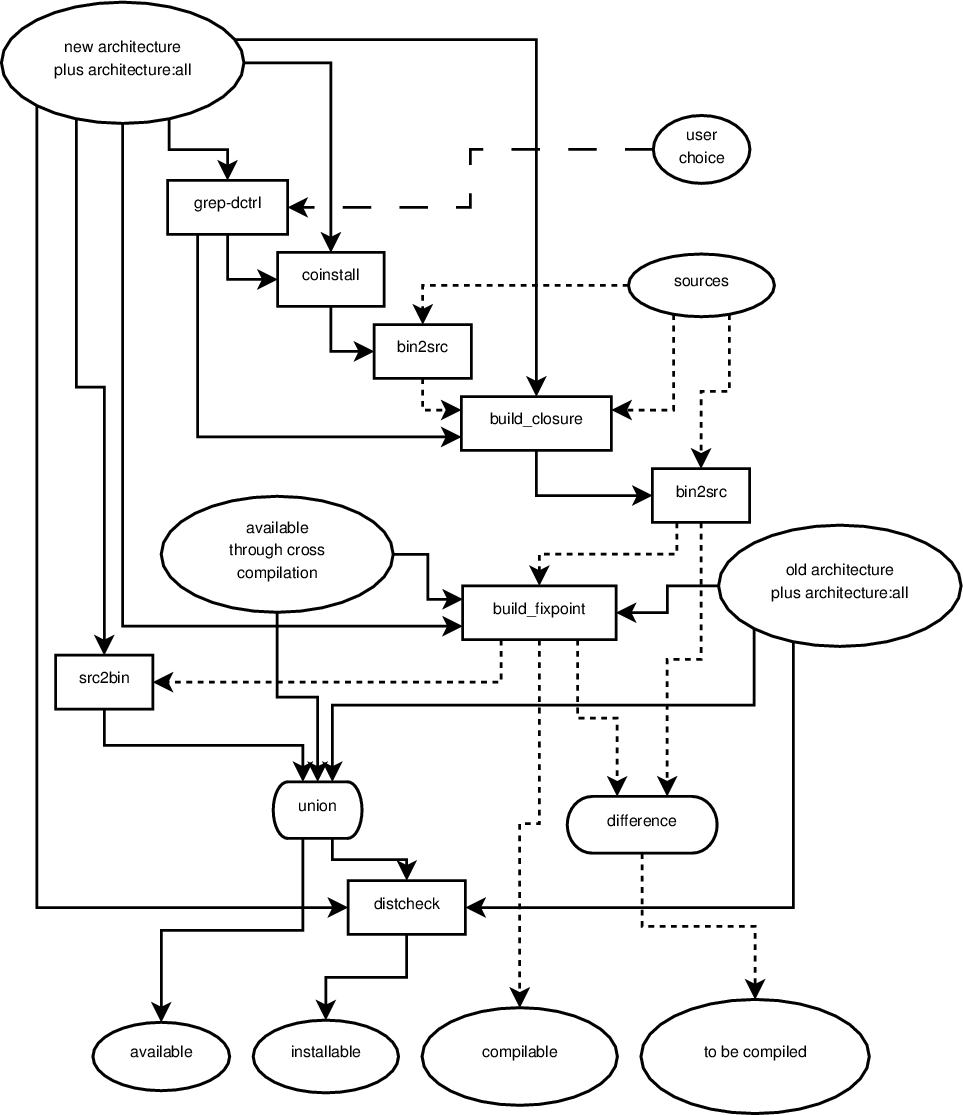
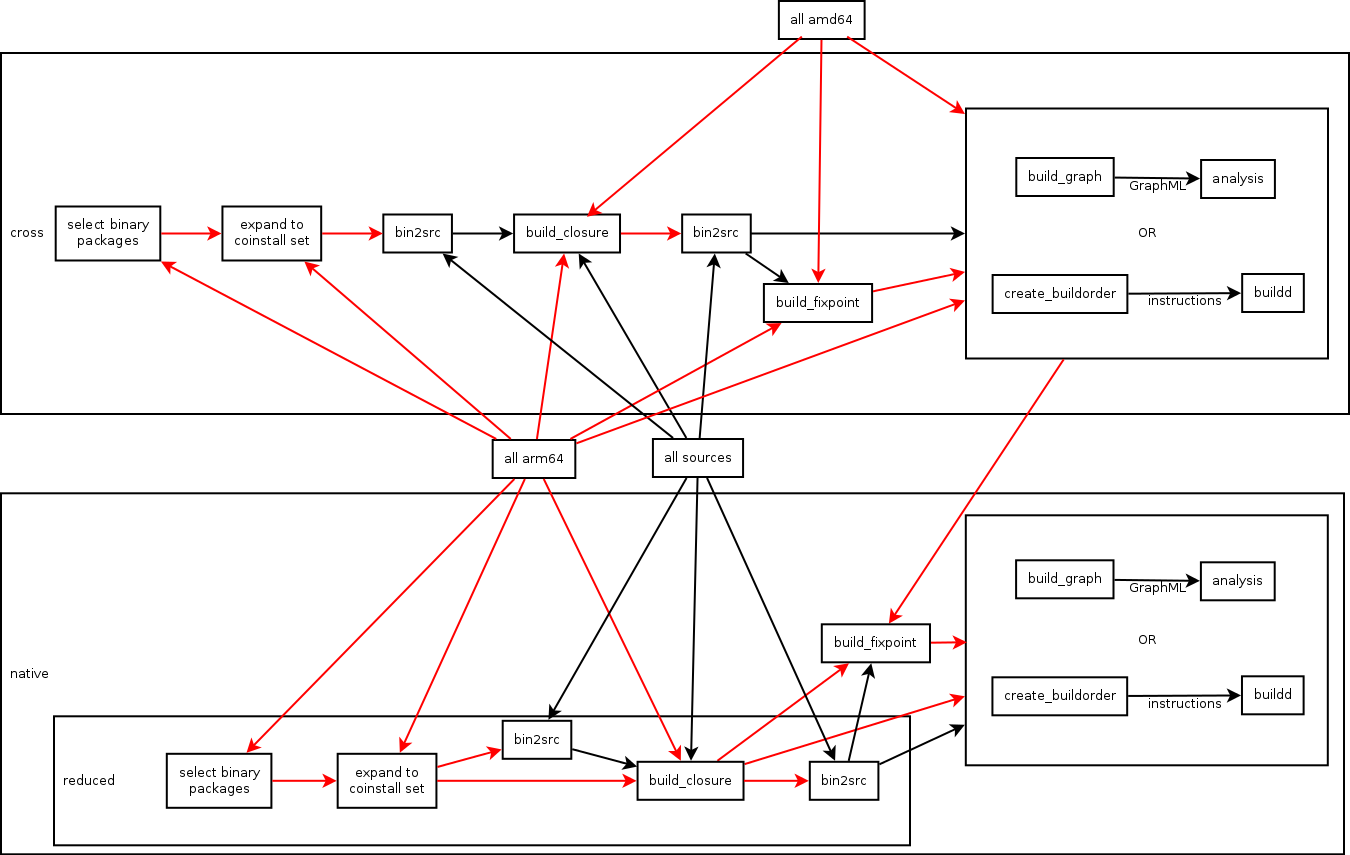
Processing pipeline instead of monolithic tools The tools I developed so far tried to accomplish everything by themselves, reusing functionality implemented in a central library. Therefor, if one wanted to try out even trivial new things, it mostly meant to hack some OCaml code. Pietro Abate suggested to instead develop smaller tools which could work independently of each other, would only execute one algorithm each and could easily be connected together in different ways to achieve different effects. This switch is now done and all functionality from the old tools is moved into a new toolset. The exchange format between the tools is either plain text files in deb822 control format (Packages/Sources files) or a dependency graph. The dependency graph is currently marshalled by OCaml but future versions should work with just passing a GraphML (an XML graph format) representation around. This new way of doing things seems close to the UNIX philosophy (each program does one thing well, data is stored as text, every program is a filter). For example the deb822 control output can easily be manipulated using grep-dctrl(1) and there exist many tools which can read, analyze and manipulate GraphML. It is a big improvement over the old, monolithic tools which did not allow to manipulate any intermediate result by external, existing tools. Currently, a shell script (native.sh) will execute all tools in a meaningful order, connecting them together correctly. The same tools will be used for a future cross.sh but they will be connected differently. I wrote about a first proposal of what the individual tools should do and how they should be connected in this email from which I also linked a confusing overview of the pipeline. This overview has recently been improved to be even more confusing and the current version of the lower half (the native part) now looks like this: native reduced Solid arrows represent a flow of binary packages, dottend arrows represent a flow of source packages, ovals represent a set of packages, boxes with rounded corners represent set operations, rectangular boxes represent filters. There is only one input to a filter, which is the arrow connected to the top of the box. Outgoing arrows from the bottom represent the filtered input. Ingoing arrows to either side are arguments to the filter and control how the filter behaves depending on the algorithm. I will explain this better once the pipeline proved to be less in flux. The pipeline is currently executed like this by native.sh.

Two new ways to break dependency cycles have been discovered So far, we knew of three ways to formally break dependency cycles:
  • remove build dependencies through build profiles
  • find out that the build dependency is only used to build arch:all packages and therefor put it into Build-Depends-Indep
  • cross compile some source packages
Two new methods can be added to the above:

Dependency graph definition changed Back in September when I was visiting irill, Pietro found a flaw in how the dependency graph used to be generated. He supplied a new definition of the dependency graph which does away with the problem he found. After fixing some small issues with his code, I changed all the existing algorithms to use the new graph definition. The old graph is as of today removed from the repository. Thanks to Pietro for supplying the new graph definition - I must still admit that my OCaml foo is not strong enough to have come up with his code.

Added complexity for profile built source packages As mentioned in the introduction, wookey and me addressed the debian-devel list with a proposal on necessary changes for an automated bootstrapping of Debian. During the discussiong, two important things came up which are to be considered by the dependency graph algorithms:
  • profile built source packages may not create all binary packages
  • profile built source packages may need additional build dependencies
Both things make it necessary to alter the dependency graph during the generation of a feedback arc set and feedback vertex set beyond the simple removal of edges. Luckily, the developed approximation algorithms can be extended to support such changes in the graph.

Different feedback arc set algorithms The initially developed feedback arc set algorithm is well suited to discover build dependency edges which should be dropped. It performs far worse when creating the final build order because it only considers edges by itself and not how many edges of a source package can be dropped by profile building it. The adjusted algorithm for generating a build order is more of a feedback vertex set algorithm because instead of greedily finding the edge with most cycles through it, it greedily finds the source package which would break most cycles if it was profile built.

Generating a build order with less profile built source packages After implementing all the features above I now feel more confident to publish the current status of the tools to a wider audience. The following test shows a run of the aforementioned ./native.sh shell script. Its final output is a list of source packages which have to be profile built and a build order. Using the resulting build order, starting from a minimal build system (essential:yes, build-essential and debhelper), all source packages will be compiled which are needed to compile all binary packages in the system. The result will therefor be a list of source and binary packages which fulfill the following property:
  • all binary packages can be built from the available source packages
  • all source packages can be built with the available binary packages
I called this a "reduceded distribution" in earlier posts. The interesting property of this specific selection is, that it contains the biggest problem set of Debian when bootstrapping it: a 900 to 1000 nodes big strongly connected component. Here is a visualization of the problem: hideous mess Source packages do not yet come with build profiles and the cross build situation can not yet be analyzed, so the following assumptions were made: The last point is about 14 build dependencies which were decided to be broken by the feedback arc set algorithm but for which other data sources did not indicate that they are actually breakable. Those 14 are dynamically generated by native.sh. If above assumptions should not be too far from the actual situation, then not more than 73 source packages have to be modified to bootstrap a reduced distribution. This reduced distribution even includes dependency-wise "big" packages like webkit, metacity, iceweasel, network-manager, tracker, gnome-panel, evolution-data-server, kde-runtime, libav and nautilus. By changing one line in native.sh one could easily develop a build order which generates gnome-desktop or really any given (meta-)package selection. All of native.sh takes only 80 seconds to execute on my system (Core i5, 2.5 GHz, singlethreaded). Here is the final build order which creates 2044 binary packages from 613 source packages.
  1. nspr, libio-pty-perl, libmcrypt, unzip, libdbi-perl, cdparanoia, libelf, c-ares, liblocale-gettext-perl, libibverbs, numactl, ilmbase, tbb, check, libogg, libatomic-ops, libnl($), orc($), libaio, tcl8.4, kmod, libgsm, lame, opencore-amr, tcl8.5, exuberant-ctags, mhash, libtext-iconv-perl, libutempter, pciutils, gperf, hspell, recode, tcp-wrappers, fdupes, chrpath, libbsd, zip, procps, wireless-tools, cpufrequtils, ed, libjpeg8, hesiod, pax, less, dietlibc, netkit-telnet, psmisc, docbook-to-man, libhtml-parser-perl, libonig, opensp($), libterm-size-perl, linux86, libxmltok, db-defaults, java-common, sharutils, libgpg-error, hardening-wrapper, cvsps, p11-kit, libyaml, diffstat, m4
  2. openexr, enca, help2man, speex, libvorbis, libid3tag, patch, openjade1.3, openjade, expat, fakeroot, libgcrypt11($), ustr, sysvinit, netcat, libirman, html2text, libmad, pth, clucene-core, libdaemon($), texinfo, popt, net-tools, tar, libsigsegv, gmp, patchutils($), dirac, cunit, bridge-utils, expect, libgc, nettle, elfutils, jade, bison
  3. sed, indent, findutils, fastjar, cpio, chicken, bzip2, aspell, realpath, dctrl-tools, rsync, ctdb, pkg-config($), libarchive, gpgme1.0, exempi, pump, re2c, klibc, gzip, gawk, flex-old, original-awk, mawk, libtasn1-3($), flex($), libtool
  4. libcap2, mksh, readline6, libcdio, libpipeline, libcroco, schroedinger, desktop-file-utils, eina, fribidi, libusb, binfmt-support, silgraphite2.0, atk1.0($), perl, gnutls26($), netcat-openbsd, ossp-uuid, gsl, libnfnetlink, sg3-utils, jbigkit, lua5.1, unixodbc, sqlite, wayland, radvd, open-iscsi, libpcap, linux-atm, gdbm, id3lib3.8.3, vo-aacenc, vo-amrwbenc, fam, faad2, hunspell, dpkg, tslib, libart-lgpl, libidl, dh-exec, giflib, openslp-dfsg, ppl($), xutils-dev, blcr, bc, time, libdatrie, libpthread-stubs, guile-1.8, libev, attr, libsigc++-2.0, pixman, libpng, libssh2, sqlite3, acpica-unix, acl, a52dec
  5. json-c, cloog-ppl, libverto, glibmm2.4, rtmpdump, libdbd-sqlite3-perl, nss, freetds, slang2, libpciaccess, iptables, e2fsprogs, libnetfilter-conntrack, bash, libthai, python2.6($), libice($), libpaper, libfontenc($), libxau, libxdmcp($), openldap($), cyrus-sasl2($), openssl, python2.7($)
  6. psutils, libevent, stunnel4, libnet-ssleay-perl, libffi, readline5, file, libvoikko, gamin, libieee1284, build-essential, libcap-ng($), lcms($), keyutils, libxml2, libxml++2.6, gcc-4.6($), binutils, dbus($), libsm($), libxslt, doxygen($)
  7. liblqr, rarian, xmlto, policykit-1($), libxml-parser-perl, tdb, devscripts, eet, libasyncns, libusbx, icu, linux, libmng, shadow, xmlstarlet, tidy, gavl, flac, dbus-glib($), libxcb, apr, krb5, alsa-lib
  8. usbutils, enchant, neon27, uw-imap, libsndfile, yasm, xcb-util, gconf($), shared-mime-info($), audiofile, ijs($), jbig2dec, libx11($)
  9. esound, freetype, libxkbfile, xvidcore, xcb-util-image, udev($), libxfixes, libxext($), libxt, libxrender
  10. tk8.4, startup-notification, libatasmart, fontconfig, libxp, libdmx, libvdpau, libdrm, libxres, directfb, libxv, libxxf86dga, libxxf86vm, pcsc-lite, libxss, libxcomposite, libxcursor, libxdamage, libxi($), libxinerama, libxrandr, libxmu($), libxpm, libxfont($)
  11. xfonts-utils, libxvmc, xauth, libxtst($), libxaw($)
  12. pmake, corosync, x11-xserver-utils, x11-xkb-utils, coreutils, xft, nas, cairo
  13. libedit, cairomm, tk8.5, openais, pango1.0($)
  14. ocaml, blt, ruby1.8, firebird2.5, heimdal, lvm2($)
  15. cvs($), python-stdlib-extensions, parted, llvm-2.9, ruby1.9.1, findlib, qt4-x11($)
  16. xen, mesa, audit($), avahi($)
  17. x11-utils, xorg-server, freeglut, libva
  18. jasper, tiff3, python3.2($)
  19. openjpeg, qt-assistant-compat, v4l-utils, qca2, jinja2, markupsafe, lcms2, sip4, imlib2, netpbm-free, cracklib2, cups($), postgresql-9.1
  20. py3cairo, pycairo, pam, libgnomecups, gobject-introspection($)
  21. gdk-pixbuf, libgnomeprint, gnome-menus, gsettings-desktop-schemas, pangomm, consolekit, vala-0.16($), colord($), atkmm1.6
  22. libgee, gtk+3.0($), gtk+2.0($)
  23. gtkmm2.4, poppler($), openssh, libglade2, libiodbc2, gcr($), libwmf, systemd($), gcj-4.7, java-atk-wrapper($)
  24. torque, ecj($), vala-0.14, gnome-keyring($), gcc-defaults, gnome-vfs($)
  25. libidn, libgnome-keyring($), openmpi
  26. mpi-defaults, dnsmasq, wget, lynx-cur, ghostscript, curl
  27. fftw3, gnupg, libquvi, xmlrpc-c, raptor, liboauth, groff, fftw, boost1.49, apt
  28. boost-defaults, libsamplerate, cmake, python-apt
  29. qjson, qtzeitgeist, libssh, qimageblitz, pkg-kde-tools, libical, dwarves-dfsg, automoc, attica, yajl, source-highlight, pygobject, pygobject-2, mysql-5.5($)
  30. libdbd-mysql-perl, polkit-qt-1, libdbusmenu-qt, raptor2, dbus-python, apr-util
  31. rasqal, serf, subversion($), apache2
  32. git, redland
  33. xz-utils, util-linux, rpm, man-db, make-dfsg, libvisual, cryptsetup, libgd2, gstreamer0.10
  34. mscgen, texlive-bin
  35. dvipng, luatex
  36. libconfig, transfig, augeas, blas, libcaca, autogen, libdbi, linuxdoc-tools, gdb, gpm
  37. ncurses, python-numpy($), rrdtool, w3m, iproute, gcc-4.7, libtheora($), gcc-4.4
  38. libraw1394, base-passwd, lm-sensors, netcf, eglibc, gst-plugins-base0.10
  39. libiec61883, qtwebkit, libvirt, libdc1394-22, net-snmp, jack-audio-connection-kit($), bluez
  40. redhat-cluster, gvfs($), pulseaudio($)
  41. phonon, libsdl1.2, openjdk-6($)
  42. phonon-backend-gstreamer($), gettext, libbluray, db, swi-prolog, qdbm, swig2.0($)
  43. highlight, libselinux, talloc, libhdate, libftdi, libplist, python-qt4, libprelude, libsemanage, php5
  44. samba, usbmuxd, libvpx, lirc, bsdmainutils, libiptcdata, libgtop2, libgsf, telepathy-glib, libwnck3, libnotify, libunique3, gnome-desktop3, gmime, glib2.0, json-glib, libgnomecanvas, libcanberra, orbit2, udisks, d-conf, libgusb
  45. libgnomeprintui, libimobiledevice, nautilus($), libbonobo, librsvg
  46. evas, wxwidgets2.8, upower, gnome-disk-utility, libgnome
  47. ecore, libbonoboui
  48. libgnomeui
  49. graphviz
  50. exiv2, libexif, lapack, soprano, libnl3, dbus-c++
  51. atlas, libffado, graphicsmagick, libgphoto2, network-manager
  52. pygtk, jackd2, sane-backends, djvulibre
  53. libav($), gpac($), ntrack, python-imaging, imagemagick, dia
  54. x264($), matplotlib, iceweasel
  55. strigi, opencv, libproxy($), ffms2
  56. kde4libs, frei0r, glib-networking
  57. kde-baseapps, kate, libsoup2.4
  58. geoclue, kde-runtime, totem-pl-parser, libgweather, librest, libgdata
  59. webkit
  60. zenity, gnome-online-accounts
  61. metacity, evolution-data-server
  62. gnome-panel
  63. tracker
The final recompilation of profile built source packages is omitted. Source packages marked with a ($) are selected to be profile built. All source packages listed in the same line can be built in parallel as they do not depend upon each other. This order looks convincing as it first compiles a multitude of source packages which have no or only few build dependencies lacking. Later steps allow fewer source packages to be compiled in parallel. The amount of needed build dependencies is highest in the source packages that are built last.

17 January 2013

Tollef Fog Heen: Gitano git hosting with ACLs and other shininess

gitano is not entirely unlike the non-web, server side of github. It allows you to create and manage users and their SSH keys, groups and repositories from the command line. Repositories have ACLs associated with them. Those can be complex ("allow user X to push to master in the doc/ subtree) or trivial ("admin can do anything"). Gitano is written by Daniel Silverstone, and I'd like to thank him both for writing it and for holding my hand as I went stumbling through my initial gitano setup. Getting started with Gitano can be a bit tricky, as it's not yet packaged and fairly undocumented. Until it is packaged, it's install from source time. You need luxio, lace, supple, clod, gall and gitano itself. luxio needs a make install LOCAL=1, the others will be installed to /usr/local with just make install. Once that is installed, create a user to hold the instance. I've named mine git, but you're free to name it whatever you would like. As that user, run gitano-setup and answer the prompts. I'll use git.example.com as the host name and john as the user I'm setting this up for. To create users, run ssh git@git.example.com user add john john@example.com John Doe, then add their SSH key with ssh git@git.example.com as john sshkey add workstation < /tmp/john_id_rsa.pub. To create a repository, run ssh git@git.example.com repo create myrepo. Out of the box, this only allows the owner (typically "admin", unless overridden) to do anything with it. To change ACLs, you'll want to grab the refs/gitano/admin branch. This lives outside of the space git usually use for branches, so you can't just check it out. The easiest way to check it out is to use git-admin-clone. Run it as git-admin-clone git@git.example.com:myrepo ~/myrepo-admin and then edit in ~/myrepo-admin. Use git to add, commit and push as normal from there. To change ACLs for a given repo, you'll want to edit the rules/main.lace file. A real-world example can be found in the NetSurf repository and the lace syntax might be useful. A lace file consists of four types of lines: Rules are processed one by one, from the top and terminate whenever a matching allow or deny is found. Conditions can either be matches to an update, such as ref refs/heads/master to match updates to the master branch. To create groupings, you can use the anyof or allof verbs in a definition. Allows and denials are checked against all the definitions listed and if all of them match, the appropriate action is taken. Pay some attention to what conditions you group together, since a basic operation (is_basic_op, aka op_read and op_write) happens before git is even involved and you don't have a tree at that point, so rules like:
define is_master ref refs/heads/master
allow "Devs can push" op_is_basic is_master
simply won't work. You'll want to use a group and check on that for basic operations and then have a separate rule to restrict refs.

Russ Allbery: A few last thoughts on Aaron Swartz

Daniel Kahn Gillmor has a very good blog post. You should read it. It includes a thoughtful rebuttal to some of my earlier thoughts about activism. I think I'm developing a richer understanding of where I see boundaries here, but after my last post, I also realized that by focusing on the specific details of what should have been a minor alleged crime, I'm derailing. Swartz did so much else. I made a note to come back to the more theoretical discussion in six months; now isn't the time. Now is the time to celebrate open content and all of the things Swartz achieved. (But thank you very much to the multiple people who have pointed out flaws in my reasoning and attempted approach.) Hopefully, it's also an opportunity to keep the pressure on for a saner and less abusive judicial system that doesn't threaten people with ridiculous and disproportional punishment in order to terrify them into unwarranted plea bargains. The petition I mentioned has reached nearly 40,000 signatures and passed the threshold (at the time it was posted) for forcing a White House response. Probably more importantly, it also seems to be creating the feedback cycle that I was hoping to see: the popularity of the petition is causing this story to stay in the news cycle and continue to be written about, which in turn drives more signatures to the petition. I'm not particularly hopeful that the Obama administration cares about the vast and deep problems with our criminal justice system, but I'm somewhat more hopeful that they, like most politicians, hate news cycles that they don't control. The longer this goes on, the stronger the incentive to find some way to make it go away, which could lead to real disciplinary action. A key committee in the US House of Representatives is starting a formal investigation. One of my local representatives has proposed modifying the US federal law on computer fraud and abuse to remove violations of terms of service from the definition of the crime. (I don't have much hope that this will pass when proposed by the minority party in a fairly hostile House, but the mere act of proposing it keeps the news focus on.) Glenn Greenwald has a (typically long-winded) round-up of news in the Guardian. Note that both Greenwald and Declan McCullagh link directly to the petition in articles in mainstream news outlets. One thing that slacktivism can do is perpetuate a news cycle until it gets more uncomfortable for people in power. It's still nowhere near as effective as the types of activism that Swartz was so good at, but in this specific case I think one gets a reasonable return on one's five-minute investment of effort. I'm going to stop talking about this now, since other people are a lot better at this sort of post than I am. But one last link: the medical community has a related open content problem, and theirs is also killing people. Possibly people you know. If all of this has inspired you, as it has me, to care even more about open content, be watching the push for open access to clinical trial data. More background is in Ben Goldacre's TED talk.

15 January 2013

Daniel Kahn Gillmor: in memory of Aaron Swartz

I was upset to learn about Aaron Swartz's death last week. I continue to be upset about his loss, and about our loss. He didn't just show promise of great things to come in the future -- he had already done more work for the public good than many of us will ever do. I'd only met him IRL a couple times, but (like many others) i had encountered him on the 'net in many places. He was a good person, someone i didn't need to always agree with to respect. I read Russ Allbery's posts about Aaron and "slacktivism" with much appreciation. I had been ambivalent about signing the whitehouse.gov petition asking for the removal of the prosecutor for overreach, because I generally distrust the effectiveness of online petitions (and offline petitions, for that matter). But Russ's analysis convinced me to go ahead and sign it. The petition is concrete, clear (despite wanting a grammatical proofread), and actionable. For people willing to go beyond petition signing to civil disobedience, The Aaron Swartz Memorial JSTOR Liberator is an option. It makes it straightforward to potentially violate the onerous JSTOR terms of service by re-publishing a public-domain article from JSTOR to archive.org, where it will be accessible to anyone directly. As someone who builds and maintains information/communications infrastructure, i have very mixed feelings about most online civil disobedience, since it often takes the form of a Distributed Denial of Service (DDoS) attack of some sort. DDoS attacks of public services are notoriously difficult to defend against without having huge resources to throw at the problem, so encouraging participation in a DDoS often feels a little bit like handing out cans of gasoline when you know that everyone is living in a house of straw. However, the JSTOR Liberator is not a DDoS at all -- it's simply a facilitation of people breaking the JSTOR Terms of Service (ToS), some of the same terms that Aaron was facing charges for violating. So it is a well-targeted way to demonstrate that the prosecutions were overreaching. I wanted to take issue with one of Russ' statements, though. In his second post about the situation, Russ wrote:
Social activism and political disobedience are important and often valuable things, but performing your social activism using other people's stuff is just rude. I think it can be a forgivable rudeness; people can get caught up in the moment and not realize what they're doing. But it's still rude, and it's still not the way to go about civil disobedience.
While i generally agree with Russ' thoughtful consideration of consent, I have to take issue with this elevation of some sort of hyper-extended property right over the moral agency that drives civil disobedience. To use someone else's property for the sake of a just cause without damaging the property or depriving the owner of its use is not "forgivable rudeness" -- it's forgivable, laudable even, because it is just. And the person using the property doesn't need to be "caught up in the moment and not realize what they're doing" for it to be acceptable. Civil disobedience often involves putting some level of inconvenience or discomfort on other people, including innocent people. It might be the friends and family of the activist who have to deal with the jail time; it might be the drivers stuck in a traffic jam caused by a demonstration; it might be the people forced to shop elsewhere because the store's doors are barricaded by protestors. All of these people could be troubled by the civil disobedience more than MIT's network users and admins were troubled by Aaron's protest, and that doesn't make the protests described worse or "not the way to go about civil disobedience." The trouble highlights a more significant injustice, and in its troubling way does what it can to help right it. Aaron was a troublemaker, and a good one. He will be missed. Tags: aaronsw

9 January 2013

Daniel Kahn Gillmor: universally accessible storage for the wary user

A friend wrote me a simple question today. My response turned out to be longer than i expected, but i hope it's useful (and maybe other people will have better suggestions) so i thought i'd share it here too: Angela Starita wrote:
I'd like to save my work in a location where I can access it from any computer. I'm wary of using the mechanisms provided by Google and Apple. Can you suggest another service?
Here's my reply: I think you're right to be wary of the big cloud providers, who have a tendency to inspect your data to profile you, to participate in arbitrary surveillance regimes, and to try to sell your eyeballs to advertisers. Caveat: You have to trust the client machine too But it's also worth remembering that the network service provider is not the only source of risk. If you really mean "accessing your data from any computer", that means the computer you're using to access the data can do whatever it wants with it. That is, you need to trust both the operator of these "cloud" services, *and* the administrator/operating system of the client computer you're using to access your data. For example, if you log into any "secure" account from a terminal in a web caf , that leaves you vulnerable to the admins of the web caf (and, in the rather-common case of sloppily-administered web terminals, vulnerable to the previous user(s) of the terminal as well). Option 0: Portable physical storage One way to have your data so that you can access it from "any computer" is to not rely on the network at all, but rather to carry a high-capacity MicroSD card (and USB adapter) around with you (you'll probably want to format the card with a widely-understood filesystem like FAT32 instead of NTFS or HFS+ or ext4, which are only understood by some of the major operating systems, but not all). Here is some example hardware: Almost every computer these days has either a microSD slot or a USB port, while some computers are not connected to the network. This also means that you don't have to rely on someone else to manage servers that keep your data available all the time. Note that going the microSD route doesn't remove the caveat about needing to trust the client workstation you're using, and it has another consideration: You'd be responsible for your own backup in the case of hardware failure. You're responsible for your own backup in the case of online storage too, of course -- but the better online companies are probably better equipped than most of us to deal with hardware failure. OTOH, they're also susceptible to some data loss scenarios that we aren't as individual humans (e.g. the company might go bankrupt, or get bought by a competitor who wants to terminate the service, or have a malicious employee who decides to take revenge). Backup of a MicroSD card isn't particularly hard, though: just get a USB stick that's the same size, and regularly duplicate the contents of the MicroSD card to the USB stick. One last consideration is storage size -- MicroSD cards are currently limited to 32GB or 64GB. If you have significantly more data than that, this approach might not be possible, or you might need to switch to a USB hard disk, which would limit your ability to use the data on computers that don't have a USB port (such as some smartphones). Option 1: Proprietary service providers If you don't think this portable physical storage option is the right choice for you, here are a couple proprietary service providers who offer some flavor of "cloud" storage while claiming to not look at the contents of your data: I'm not particularly happy with either of those, though, in part because the local client software they want you to run is proprietary, so there's no way to verify that they are actually unable to access the contents of your data. But i'd be a lot happier with either wuala or spideroak than i would be with google drive, dropbox, or iCloud. Option 2: What i really want I'm much more excited about the network-accessible, free-software, privacy-sensitive network-based storage tool known as git-annex assistant. The project is spearheaded by Joey Hess, who is one of the most skilled and thoughtful software developers i know of. "assistant" (and git-annex, from which it derives) has the advantage of being pretty agnostic about the backend service (many plugins for many different cloud providers) and allows you to encrypt your data locally before sending it to the remote provider. This also means you can put your encrypted data in more than one provider, so that if one of the providers fails for some reason, you can be relatively sure that you have another copy available. But "assistant" won't be ready for Windows or Android for several months (builds are available for Linux and Mac OS X now), so i don't know if it meets the criterion for "accessible from any computer". And, of course, even with the encryption capabilities, the old caveat about needing to trust the local client machine still applies.

25 December 2012

Russ Allbery: Kindle haul

Happy winder holiday of choice to all and sundry! Enough new Kindle books have accumulated that it seems time for another post so that I can remember what I bought. Elizabeth Bear Garret Investigates (sff)
eluki bes shahar Hellflower (sff)
Elizabeth Cleghorn Gaskell Cranford (mainstream)
John Scalzi Subterranean Scalzi Super Bundle (sff) Cranford was free since it was written in the 1800s. I picked it up because of Jo Walton's review on Tor.com. The eluki bes shahar novel is from Daniel Moran's e-book site FS&, an impulse buy from browsing through his catalog while picking up the Long Run bundle for my mother. The Scalzi super-bundle is a collection of five separately-published novellas and chapbooks plus one non-fiction essay, only one of which I already owned (The God Engines), which seemed like a fairly good deal. In a separate note, the problem with watching interesting lectures on YouTube (apart from the fact that it's very easy to lose a day doing so) is that I usually end up wanting to buy the book on the topic and then read that. That happened to me today: I finally got around to watching Philip Ball's lecture on the chemistry of painting, and now Bright Earth is in my non-fiction want list. And there are three more hour-long TVO programs linked off of related material that look interesting. I fear the day may disappear.... Well, I will be rescued at least partly by being called to help decorate Christmas cookies. This is the beginning of by far my favorite two weeks of the year, although not for the reasons that people might suspect. Other than food (yum) my family doesn't do Christmas: no decorations, no huge family get-togethers, and we all give each other the freedom from guilt and stress of having to find presents. But I get two weeks of mandatory vacation from work, as does, importantly, everyone else. Which means there's nothing going on to suck me in from vacation and a very pleasant sense of resting and resetting for the new year. It's quiet, I can sit and read, I can focus on one thing at a time, and I can reorganize and order my life and revisit priorities and to-do lists with a lovely sense of perspective. Any other mandatory or at least widespread holiday would work as well, so it's unrelated to the season. (I find the commercialism somewhat distracting rather than a positive part of the experience.) But this is the one that we get, and it happens to coincide nicely with the meaningless but psychologically significant change of the year number. And it's delightful every year.

21 December 2012

Daniel Kahn Gillmor: libasound2-plugins is a resource hog!

I run mpd on debian on "igor", an NSLU2 -- a very low-power ~266MHz armel machine, with no FPU and a scanty 32MiB of RAM. This serves nicely to feed my stereo with music that is controllable from anywhere on my LAN. When playing music and talking to a single mpd client, the machine is about 50% idle. However, during a recent upgrade, something wanted to pull in pulseaudio, which in turn wanted to pull in libasound2-plugins, and i distractedly (foolishly) let it. With that package installed, after an mpd restart, the CPU was completely thrashed (100% utilization) and music only played in stutters of 1 second interrupted by a couple seconds of silence. igor was unusable for its intended purpose. Getting rid of pulseaudio was my first attempt to fix the stuttering, but the problem remained even after pulse was all gone and mpd was restarted. Then i did a little search of which packages had been freshly installed in the recent run:
grep ' install .* <none> ' /var/log/dpkg.log
and used that to pick out the offending package. After purging libasound2-plugins and restarting mpd, the igor is back in action. Lesson learned: on low-overhead machines, don't allow apt to install recommends!
echo 'APT::Install-Recommends "0";' >> /etc/apt/apt.conf
And it should go without saying, but sometimes i get sloppy: i need to pay closer attention during an "apt-get dist-upgrade" Tags: alsa, apt, low-power, mpd

17 December 2012

Lars Wirzenius: Obnam 1.3 (backup software) and other releases

I've just pushed out the release files for Obnam version 1.3, my backup application, as well as Larch, my B-tree library, and cliapp, my Python framework for command line applications. They are available via my home page (http://liw.fi/). Since Debian is frozen, I am not uploading packages to Debian, but .deb files are available from my personal apt repository for the intrepid. (I will be uploading to Debian again after the freeze. I am afraid I'm too lazy to upload to experimental, or do backports. Help is welcome!) From the Obnam NEWS file: Bug fixes for Obnam: NEWS for Larch: NEWS for cliapp:
Next.

Previous.