Search Results: "cas"

5 April 2024

Bits from Debian: apt install dpl-candidate: Andreas Tille

The Debian Project Developers will shortly vote for a new Debian Project Leader known as the DPL. The Project Leader is the official representative of The Debian Project tasked with managing the overall project, its vision, direction, and finances. The DPL is also responsible for the selection of Delegates, defining areas of responsibility within the project, the coordination of Developers, and making decisions required for the project. Our outgoing and present DPL Jonathan Carter served 4 terms, from 2020 through 2024. Jonathan shared his last Bits from the DPL post to Debian recently and his hopes for the future of Debian. Recently, we sat with the two present candidates for the DPL position asking questions to find out who they really are in a series of interviews about their platforms, visions for Debian, lives, and even their favorite text editors. The interviews were conducted by disaster2life (Yashraj Moghe) and made available from video and audio transcriptions: Voting for the position starts on April 6, 2024. Editors' note: This is our official return to Debian interviews, readers should stay tuned for more upcoming interviews with Developers and other important figures in Debian as part of our "Meet your Debian Developer" series. We used the following tools and services: Turboscribe.ai for the transcription from the audio and video files, IRC: Oftc.net for communication, Jitsi meet for interviews, and Open Broadcaster Software (OBS) for editing and video. While we encountered many technical difficulties in the return to this process, we are still able and proud to present the transcripts of the interviews edited only in a few areas for readability. 2024 Debian Project Leader Candidate: Andrea Tille Andreas' Interview Who are you? Tell us a little about yourself. [Andreas]:
How am I? Well, I'm, as I wrote in my platform, I'm a proud grandfather doing a lot of free software stuff, doing a lot of sports, have some goals in mind which I like to do and hopefully for the best of Debian.
And How are you today? [Andreas]:
How I'm doing today? Well, actually I have some headaches but it's fine for the interview. So, usually I feel very good. Spring was coming here and today it's raining and I plan to do a bicycle tour tomorrow and hope that I do not get really sick but yeah, for the interview it's fine.
What do you do in Debian? Could you mention your story here? [Andreas]:
Yeah, well, I started with Debian kind of an accident because I wanted to have some package salvaged which is called WordNet. It's a monolingual dictionary and I did not really plan to do more than maybe 10 packages or so. I had some kind of training with xTeddy which is totally unimportant, a cute teddy you can put on your desktop. So, and then well, more or less I thought how can I make Debian attractive for my employer which is a medical institute and so on. It could make sense to package bioinformatics and medicine software and it somehow evolved in a direction I did neither expect it nor wanted to do, that I'm currently the most busy uploader in Debian, created several teams around it. DebianMate is very well known from me. I created the Blends team to create teams and techniques around what we are doing which was Debian TIS, Debian Edu, Debian Science and so on and I also created the packaging team for R, for the statistics package R which is technically based and not topic based. All these blends are covering a certain topic and R is just needed by lots of these blends. So, yeah, and to cope with all this I have written a script which is routing an update to manage all these uploads more or less automatically. So, I think I had one day where I uploaded 21 new packages but it's just automatically generated, right? So, it's on one day more than I ever planned to do.
What is the first thing you think of when you think of Debian? Editors' note: The question was misunderstood as the worst thing you think of when you think of Debian [Andreas]:
The worst thing I think about Debian, it's complicated. I think today on Debian board I was asked about the technical progress I want to make and in my opinion we need to standardize things inside Debian. For instance, bringing all the packages to salsa, follow some common standards, some common workflow which is extremely helpful. As I said, if I'm that productive with my own packages we can adopt this in general, at least in most cases I think. I made a lot of good experience by the support of well-formed teams. Well-formed teams are those teams where people support each other, help each other. For instance, how to say, I'm a physicist by profession so I'm not an IT expert. I can tell apart what works and what not but I'm not an expert in those packages. I do and the amount of packages is so high that I do not even understand all the techniques they are covering like Go, Rust and something like this. And I also don't speak Java and I had a problem once in the middle of the night and I've sent the email to the list and was a Java problem and I woke up in the morning and it was solved. This is what I call a team. I don't call a team some common repository that is used by random people for different packages also but it's working together, don't hesitate to solve other people's problems and permit people to get active. This is what I call a team and this is also something I observed in, it's hard to give a percentage, in a lot of other teams but we have other people who do not even understand the concept of the team. Why is working together make some advantage and this is also a tough thing. I [would] like to tackle in my term if I get elected to form solid teams using the common workflow. This is one thing. The other thing is that we have a lot of good people in our infrastructure like FTP masters, DSA and so on. I have the feeling they have a lot of work and are working more or less on their limits, and I like to talk to them [to ask] what kind of change we could do to move that limits or move their personal health to the better side.
The DPL term lasts for a year, What would you do during that you couldn't do now? [Andreas]:
Yeah, well this is basically what I said are my main issues. I need to admit I have no really clear imagination what kind of tasks will come to me as a DPL because all these financial issues and law issues possible and issues [that] people who are not really friendly to Debian might create. I'm afraid these things might occupy a lot of time and I can't say much about this because I simply don't know.
What are three key terms about you and your candidacy? [Andreas]:
As I said, I like to work on standards, I d like to make Debian try [to get it right so] that people don't get overworked, this third key point is be inviting to newcomers, to everybody who wants to come. Yeah, I also mentioned in my term this diversity issue, geographical and from gender point of view. This may be the three points I consider most important.
Preferred text editor? [Andreas]:
Yeah, my preferred one? Ah, well, I have no preferred text editor. I'm using the Midnight Commander very frequently which has an internal editor which is convenient for small text. For other things, I usually use VI but I also use Emacs from time to time. So, no, I have not preferred text editor. Whatever works nicely for me.
What is the importance of the community in the Debian Project? How would like to see it evolving over the next few years? [Andreas]:
Yeah, I think the community is extremely important. So, I was on a lot of DebConfs. I think it's not really 20 but 17 or 18 DebCons and I really enjoyed these events every year because I met so many friends and met so many interesting people that it's really enriching my life and those who I never met in person but have read interesting things and yeah, Debian community makes really a part of my life.
And how do you think it should evolve specifically? [Andreas]:
Yeah, for instance, last year in Kochi, it became even clearer to me that the geographical diversity is a really strong point. Just discussing with some women from India who is afraid about not coming next year to Busan because there's a problem with Shanghai and so on. I'm not really sure how we can solve this but I think this is a problem at least I wish to tackle and yeah, this is an interesting point, the geographical diversity and I'm running the so-called mentoring of the month. This is a small project to attract newcomers for the Debian Med team which has the focus on medical packages and I learned that we had always men applying for this and so I said, okay, I dropped the constraint of medical packages. Any topic is fine, I teach you packaging but it must be someone who does not consider himself a man. I got only two applicants, no, actually, I got one applicant and one response which was kind of strange if I'm hunting for women or so. I did not understand but I got one response and interestingly, it was for me one of the least expected counters. It was from Iran and I met a very nice woman, very open, very skilled and gifted and did a good job or have even lose contact today and maybe we need more actively approach groups that are underrepresented. I don't know if what's a good means which I did but at least I tried and so I try to think about these kind of things.
What part of Debian has made you smile? What part of the project has kept you going all through the years? [Andreas]:
Well, the card game which is called Mao on the DebConf made me smile all the time. I admit I joined only two or three times even if I really love this kind of games but I was occupied by other stuff so this made me really smile. I also think the first online DebConf in 2020 made me smile because we had this kind of short video sequences and I tried to make a funny video sequence about every DebConf I attended before. This is really funny moments but yeah, it's not only smile but yeah. One thing maybe it's totally unconnected to Debian but I learned personally something in Debian that we have a do-ocracy and you can do things which you think that are right if not going in between someone else, right? So respect everybody else but otherwise you can do so. And in 2020 I also started to take trees which are growing widely in my garden and plant them into the woods because in our woods a lot of trees are dying and so I just do something because I can. I have the resource to do something, take the small tree and bring it into the woods because it does not harm anybody. I asked the forester if it is okay, yes, yes, okay. So everybody can do so but I think the idea to do something like this came also because of the free software idea. You have the resources, you have the computer, you can do something and you do something productive, right? And when thinking about this I think it was also my Debian work. Meanwhile I have planted more than 3,000 trees so it's not a small number but yeah, I enjoy this.
What part of Debian would you have some criticisms for? [Andreas]:
Yeah, it's basically the same as I said before. We need more standards to work together. I do not want to repeat this but this is what I think, yeah.
What field in Free Software generally do you think requires the most work to be put into it? What do you think is Debian's part in the field? [Andreas]:
It's also in general, the thing is the fact that I'm maintaining packages which are usually as modern software is maintained in Git, which is fine but we have some software which is at Sourceport, we have software laying around somewhere, we have software where Debian somehow became Upstream because nobody is caring anymore and free software is very different in several things, ways and well, I in principle like freedom of choice which is the basic of all our work. Sometimes this freedom goes in the way of productivity because everybody is free to re-implement. You asked me for the most favorite editor. In principle one really good working editor would be great to have and would work and we have maybe 500 in Debian or so, I don't know. I could imagine if people would concentrate and say five instead of 500 editors, we could get more productive, right? But I know this will not happen, right? But I think this is one thing which goes in the way of making things smooth and productive and we could have more manpower to replace one person who's [having] children, doing some other stuff and can't continue working on something and maybe this is a problem I will not solve, definitely not, but which I see.
What do you think is Debian's part in the field? [Andreas]:
Yeah, well, okay, we can bring together different Upstreams, so we are building some packages and have some general overview about similar things and can say, oh, you are doing this and some other person is doing more or less the same, do you want to join each other or so, but this is kind of a channel we have to our Upstreams which is probably not very successful. It starts with code copies of some libraries which are changed a little bit, which is fine license-wise, but not so helpful for different things and so I've tried to convince those Upstreams to forward their patches to the original one, but for this and I think we could do some kind of, yeah, [find] someone who brings Upstream together or to make them stop their forking stuff, but it costs a lot of energy and we probably don't have this and it's also not realistic that we can really help with this problem.
Do you have any questions for me? [Andreas]:
I enjoyed the interview, I enjoyed seeing you again after half a year or so. Yeah, actually I've seen you in the eating room or cheese and wine party or so, I do not remember we had to really talk together, but yeah, people around, yeah, for sure. Yeah.

Bits from Debian: apt install dpl-candidate: Sruthi Chandran

The Debian Project Developers will shortly vote for a new Debian Project Leader known as the DPL. The DPL is the official representative of representative of The Debian Project tasked with managing the overall project, its vision, direction, and finances. The DPL is also responsible for the selection of Delegates, defining areas of responsibility within the project, the coordination of Developers, and making decisions required for the project. Our outgoing and present DPL Jonathan Carter served 4 terms, from 2020 through 2024. Jonathan shared his last Bits from the DPL post to Debian recently and his hopes for the future of Debian. Recently, we sat with the two present candidates for the DPL position asking questions to find out who they really are in a series of interviews about their platforms, visions for Debian, lives, and even their favorite text editors. The interviews were conducted by disaster2life (Yashraj Moghe) and made available from video and audio transcriptions: Voting for the position starts on April 6, 2024. Editors' note: This is our official return to Debian interviews, readers should stay tuned for more upcoming interviews with Developers and other important figures in Debian as part of our "Meet your Debian Developer" series. We used the following tools and services: Turboscribe.ai for the transcription from the audio and video files, IRC: Oftc.net for communication, Jitsi meet for interviews, and Open Broadcaster Software (OBS) for editing and video. While we encountered many technical difficulties in the return to this process, we are still able and proud to present the transcripts of the interviews edited only in a few areas for readability. 2024 Debian Project Leader Candidate: Sruthi Chandran Sruthi's interview Hi Sruthi, so for the first question, who are you and could you tell us a little bit about yourself? [Sruthi]:
I usually talk about me whenever I am talking about answering the question who am I, I usually say like I am a librarian turned free software enthusiast and a Debian Developer. So I had no technical background and I learned, I was introduced to free software through my husband and then I learned Debian packaging, and eventually I became a Debian Developer. So I always give my example to people who say I am not technically inclined, I don't have technical background so I can't contribute to free software. So yeah, that's what I refer to myself.
For the next question, could you tell me what do you do in Debian, and could you mention your story up until here today? [Sruthi]:
Okay, so let me start from my initial days in Debian. I started contributing to Debian, my first contribution was a Tibetan font. We went to a Tibetan place and they were saying they didn't have a font in Linux. So that's how I started contributing. Then I moved on to Ruby packages, then I have some JavaScript and Go packages, all dependencies of GitLab. So I was involved with maintaining GitLab for some time, now I'm not very active there. But yeah, so GitLab was the main package I was contributing to since I contributed since 2016 to maybe like 2020 or something. Later I have come [over to] packaging. Now I am part of some of the teams, delegated teams, like community team and outreach team, as well as the Debconf committee. And the biggest, I think, my activity in Debian, I would say is organizing Debconf 2023. So it was a great experience and yeah, so that's my story in Debian.
So what are three key terms about you and your candidacy? [Sruthi]:
Okay, let me first think about it. For candidacy, I can start with diversity is one point I started expressing from the first time I contested for DPL. But to be honest, that's the main point I want to bring.
[Yashraj]:
So for diversity, if you could break down your thoughts on diversity and make them, [about] your three points including diversity.
[Sruthi]:
So in addition to, eventually when starting it was just diversity. Now I have like a bit more ideas, like community, like I want to be a leader for the Debian community. More than, I don't know, maybe people may not agree, but I would say I want to be a leader of Debian community rather than a Debian operating system. I connect to community more and third point I would say.
The term of a DPL lasts for an year. So what do you think during, what would you try to do during that, that you can't do from your position now? [Sruthi]:
Okay. So I, like, I am very happy with the structure of Debian and how things work in Debian. Like you can do almost a lot of things, like almost all things without being a DPL. Whatever change you want to bring about or whatever you want to do, you can do without being a DPL. Anyone, like every DD has the same rights. Only things I feel [the] DPL has hold on are mainly the budget or the funding part, which like, that's where they do the decision making part. And then comes like, and one advantage of DPL driving some idea is that somehow people tend to listen to that with more, like, tend to give more attention to what DPL is saying rather than a normal DD. So I wanted to, like, I have answered some of the questions on how to, how I plan to do the financial budgeting part, how I want to handle, like, and the other thing is using the extra attention that I get as a DPL, I would like to obviously start with the diversity aspect in Debian. And yeah, like, I, what I want to do is not, like, be a leader and say, like, take Debian to one direction where I want to go, but I would rather take suggestions and inputs from the whole community and go about with that. So yes, that's what I would say.
And taking a less serious question now, what is your preferred text editor? [Sruthi]:
Vim.
[Yashraj]:
Vim, wholeheartedly team Vim?
[Sruthi]:
Yes.
[Yashraj]:
Great. Well, this was made in Vim, all the text for this.
[Sruthi]:
So, like, since you mentioned extra data, I'll give my example, like, it's just a fun note, when I started contributing to Debian, as I mentioned, I didn't have any knowledge about free software, like Debian, and I was not used to even using Linux. So, and I didn't have experience with these text editors. So, when I started contributing, I used to do the editing part using gedit. So, that's how I started. Eventually, I moved to Nano, and once I reached Vim, I didn't move on.
Team Vim. Next question. What, what do you think is the importance of the Debian project in the world today? And where would you like to see it in 10 years, like 10 years into the future? [Sruthi]:
Okay. So, Debian, as we all know, is referred to as the universal operating system without, like, it is said for a reason. We have hundreds and hundreds of operating systems, like Linux, distributions based on Debian. So, I believe Debian, like even now, Debian has good influence on the, at least on the Linux or Linux ecosystem. So, what we implement in Debian has, like, is going to affect quite a lot of, like, a very good percentage of people using Linux. So, yes. So, I think Debian is one of the leading Linux distributions. And I think in 10 years, we should be able to reach a position, like, where we are not, like, even now, like, even these many years after having Linux, we face a lot of problems in newer and newer hardware coming up and installing on them is a big problem. Like, firmwares and all those things are getting more and more complicated. Like, it should be getting simpler, but it's getting more and more complicated. So, I, one thing I would imagine, like, I don't know if we will ever reach there, but I would imagine that eventually with the Debian, we should be able to have some, at least a few of the hardware developers or hardware producers have Debian pre-installed and those kind of things. Like, not, like, become, I'm not saying it's all, it's also available right now. What I'm saying is that it becomes prominent enough to be opted as, like, default distro.
What part of Debian has made you And what part of the project has kept you going all through these years? [Sruthi]:
Okay. So, I started to contribute in 2016, and I was part of the team doing GitLab packaging, and we did have a lot of training workshops and those kind of things within India. And I was, like, I had interacted with some of the Indian DDs, but I never got, like, even through chat or mail. I didn't have a lot of interaction with the rest of the world, DDs. And the 2019 Debconf changed my whole perspective about Debian. Before that, I wasn't, like, even, I was interested in free software. I was doing the technical stuff and all. But after DebConf, my whole idea has been, like, my focus changed to the community. Debian community is a very welcoming, very interesting community to be with. And so, I believe that, like, 2019 DebConf was a for me. And that kept, from 2019, my focus has been to how to support, like, how, I moved to the community part of Debian from there. Then in 2020 I became part of the community team, and, like, I started being part of other teams. So, these, I would say, the Debian community is the one, like, aspect of Debian that keeps me whole, keeps me held on to the Debian ecosystem as a whole.
Continuing to speak about Debian, what do you think, what is the first thing that comes to your mind when you think of Debian, like, the word, the community, what's the first thing? [Sruthi]:
I think I may sound like a broken record or something.
[Yashraj]:
No, no.
[Sruthi]:
Again, I would say the Debian community, like, it's the people who makes Debian, that makes Debian special. Like, apart from that, if I say, I would say I'm very, like, one part of Debian that makes me very happy is the, how the governing system of Debian works, the Debian constitution and all those things, like, it's a very unique thing for Debian. And, and it's like, when people say you can't work without a proper, like, establishment or even somebody deciding everything for you, it's difficult. When people say, like, we have been, Debian has been proving it for quite a long time now, that it's possible. So, so that's one thing I believe, like, that's one unique point. And I am very proud about that.
What areas do you think Debian is failing in, how can it (that standing) be improved? [Sruthi]:
So, I think where Debian is failing now is getting new people into Debian. Like, I don't remember, like, exactly the answer. But I remember hearing someone mention, like, the average age of a Debian Developer is, like, above 40 or 45 or something, like, exact age, I don't remember. But it's like, Debian is getting old. Like, the people in Debian are getting old and we are not getting enough of new people into Debian. And that's very important to have people, like, new people coming up. Otherwise, eventually, like, after a few years, nobody, like, we won't have enough people to take the project forward. So, yeah, I believe that is where we need to work on. We are doing some efforts, like, being part of GSOC or outreachy and having maybe other events, like, local events. Like, we used to have a lot of Debian packaging workshops in India. And those kind of, I think, in Brazil and all, they all have, like, local communities are doing. But we are not very successful in retaining the people who maybe come and try out things. But we are not very good at retaining the people, like, retaining people who come. So, we need to work on those things. Right now, I don't have a solid answer for that. But one thing, like, I was thinking about is, like, having a Debian specific outreach project, wherein the focus will be about the Debian, like, starting will be more on, like, usually what happens in GSOC and outreach is that people come, have the, do the contributions, and they go back. Like, they don't have that connection with the Debian, like, Debian community or Debian project. So, what I envision with these, the Debian outreach, the Debian specific outreach is that we have some part of the internship, like, even before starting the internship, we have some sessions and, like, with the people in Debian having, like, getting them introduced to the Debian philosophy and Debian community and Debian, how Debian works. And those things, we focus on that. And then we move on to the technical internship parts. So, I believe this could do some good in having, like, when you have people you can connect to, you tend to stay back in a project mode. When you feel something more than, like, right now, we have so many technical stuff to do, like, the choice for a college student is endless. So, if they want, if they stay back for something, like, maybe for Debian, I would say, we need to have them connected to the Debian project before we go into technical parts. Like, technical parts, like, there are other things as well, where they can go and do the technical part, but, like, they can come here, like, yeah. So, that's what I was saying. Focused outreach projects is one thing. That's just one. That's not enough. We need more of, like, more ideas to have more new people come up. And I'm very happy with, like, the DebConf thing. We tend to get more and more people from the places where we have a DebConf. Brazil is an example. After the Debconf, they have quite a good improvement on Debian contributors. And I think in India also, it did give a good result. Like, we have more people contributing and staying back and those things. So, yeah. So, these were the things I would say, like, we can do to improve.
For the final question, what field in free software do you, what field in free software generally do you think requires the most work to be put into it? What do you think is Debian's part in that field? [Sruthi]:
Okay. Like, right now, what comes to my mind is the free software licenses parts. Like, we have a lot of free software licenses, and there are non-free software licenses. But currently, I feel free software is having a big problem in enforcing these licenses. Like, there are, there may be big corporations or like some people who take up the whole, the code and may not follow the whole, for example, the GPL licenses. Like, we don't know how much of those, how much of the free softwares are used in the bigger things. Yeah, I agree. There are a lot of corporations who are afraid to touch free software. But there would be good amount of free software, free work that converts into property, things violating the free software licenses and those things. And we do not have the kind of like, we have SFLC, SFC, etc. But still, we do not have the ability to go behind and trace and implement the licenses. So, enforce those licenses and bring people who are violating the licenses forward and those kind of things is challenging because one thing is it takes time, like, and most importantly, money is required for the legal stuff. And not always people who like people who make small software, or maybe big, but they may not have the kind of time and money to have these things enforced. So, that's a big challenge free software is facing, especially in our current scenario. I feel we are having those, like, we need to find ways how we can get it sorted. I don't have an answer right now what to do. But this is a challenge I felt like and Debian's part in that. Yeah, as I said, I don't have a solution for that. But the Debian, so DFSG and Debian sticking on to the free software licenses is a good support, I think.
So, that was the final question, Do you have anything else you want to mention for anyone watching this? [Sruthi]:
Not really, like, I am happy, like, I think I was able to answer the questions. And yeah, I would say who is watching. I won't say like, I'm the best DPL candidate, you can't have a better one or something. I stand for a reason. And if you believe in that, or the Debian community and Debian diversity, and those kinds of things, if you believe it, I hope you would be interested, like, you would want to vote for me. That's it. Like, I'm not, I'll make it very clear. I'm not doing a technical leadership part here. So, those, I can't convince people who want technical leadership to vote for me. But I would say people who connect with me, I hope they vote for me.

4 April 2024

John Goerzen: The xz Issue Isn t About Open Source

You ve probably heard of the recent backdoor in xz. There have been a lot of takes on this, most of them boiling down to some version of:
The problem here is with Open Source Software.
I want to say not only is that view so myopic that it pushes towards the incorrect, but also it blinds us to more serious problems. Now, I don t pretend that there are no problems in the FLOSS community. There have been various pieces written about what this issue says about the FLOSS community (usually without actionable solutions). I m not here to say those pieces are wrong. Just that there s a bigger picture. So with this xz issue, it may well be a state actor (aka spy ) that added this malicious code to xz. We also know that proprietary software and systems can be vulnerable. For instance, a Twitter whistleblower revealed that Twitter employed Indian and Chinese spies, some knowingly. A recent report pointed to security lapses at Microsoft, including preventable lapses in security. According to the Wikipedia article on the SolarWinds attack, it was facilitated by various kinds of carelessness, including passwords being posted to Github and weak default passwords. They directly distributed malware-infested updates, encouraged customers to disable anti-malware tools when installing SolarWinds products, and so forth. It would be naive indeed to assume that there aren t black hat actors among the legions of programmers employed by companies that outsource work to low-cost countries some of which have challenges with bribery. So, given all this, we can t really say the problem is Open Source. Maybe it s more broad:
The problem here is with software.
Maybe that inches us closer, but is it really accurate? We have all heard of Boeing s recent issues, which seem to have some element of root causes in corporate carelessness, cost-cutting, and outsourcing. That sounds rather similar to the SolarWinds issue, doesn t it?
Well then, the problem is capitalism.
Maybe it has a role to play, but isn t it a little too easy to just say capitalism and throw up our hands helplessly, just as some do with FLOSS as at the start of this article? After all, capitalism also brought us plenty of products of very high quality over the years. When we can point to successful, non-careless products and I own some of them (for instance, my Framework laptop). We clearly haven t reached the root cause yet. And besides, what would you replace it with? All the major alternatives that have been tried have even stronger downsides. Maybe you replace it with better regulated capitalism , but that s still capitalism.
Then the problem must be with consumers.
As this argument would go, it s consumers buying patterns that drive problems. Buyers individual and corporate seek flashy features and low cost, prizing those over quality and security. No doubt this is true in a lot of cases. Maybe greed or status-conscious societies foster it: Temu promises people to shop like a billionaire , and unloads on them cheap junk, which all but guarantees that shipments from Temu containing products made with forced labor are entering the United States on a regular basis . But consumers are also people, and some fraction of them are quite capable of writing fantastic software, and in fact, do so. So what we need is some way to seize control. Some way to do what is right, despite the pressures of consumers or corporations. Ah yes, dear reader, you have been slogging through all these paragraphs and now realize I have been leading you to this:
Then the solution is Open Source.
Indeed. Faults and all, FLOSS is the most successful movement I know where people are bringing us back to the commons: working and volunteering for the common good, unleashing a thousand creative variants on a theme, iterating in every direction imaginable. We have FLOSS being vital parts of everything from $30 Raspberry Pis to space missions. It is bringing education and communication to impoverished parts of the world. It lets everyone write and release software. And, unlike the SolarWinds and Twitter issues, it exposes both clever solutions and security flaws to the world. If an authentication process in Windows got slower, we would all shrug and mutter Microsoft under our breath. Because, really, what else can we do? We have no agency with Windows. If an authentication process in Linux gets slower, anybody that s interested anybody at all can dive in and ask why and trace it down to root causes. Some look at this and say FLOSS is responsible for this mess. I look at it and say, this would be so much worse if it wasn t FLOSS and experience backs me up on this. FLOSS doesn t prevent security issues itself. What it does do is give capabilities to us all. The ability to investigate. Ability to fix. Yes, even the ability to break and its cousin, the power to learn. And, most rewarding, the ability to contribute.

3 April 2024

Joey Hess: reflections on distrusting xz

Was the ssh backdoor the only goal that "Jia Tan" was pursuing with their multi-year operation against xz? I doubt it, and if not, then every fix so far has been incomplete, because everything is still running code written by that entity. If we assume that they had a multilayered plan, that their every action was calculated and malicious, then we have to think about the full threat surface of using xz. This quickly gets into nightmare scenarios of the "trusting trust" variety. What if xz contains a hidden buffer overflow or other vulnerability, that can be exploited by the xz file it's decompressing? This would let the attacker target other packages, as needed. Let's say they want to target gcc. Well, gcc contains a lot of documentation, which includes png images. So they spend a while getting accepted as a documentation contributor on that project, and get added to it a png file that is specially constructed, it has additional binary data appended that exploits the buffer overflow. And instructs xz to modify the source code that comes later when decompressing gcc.tar.xz. More likely, they wouldn't bother with an actual trusting trust attack on gcc, which would be a lot of work to get right. One problem with the ssh backdoor is that well, not all servers on the internet run ssh. (Or systemd.) So webservers seem a likely target of this kind of second stage attack. Apache's docs include png files, nginx does not, but there's always scope to add improved documentation to a project. When would such a vulnerability have been introduced? In February, "Jia Tan" wrote a new decoder for xz. This added 1000+ lines of new C code across several commits. So much code and in just the right place to insert something like this. And why take on such a significant project just two months before inserting the ssh backdoor? "Jia Tan" was already fully accepted as maintainer, and doing lots of other work, it doesn't seem to me that they needed to start this rewrite as part of their cover. They were working closely with xz's author Lasse Collin in this, by indications exchanging patches offlist as they developed it. So Lasse Collin's commits in this time period are also worth scrutiny, because they could have been influenced by "Jia Tan". One that caught my eye comes immediately afterwards: "prepares the code for alternative C versions and inline assembly" Multiple versions and assembly mean even more places to hide such a security hole. I stress that I have not found such a security hole, I'm only considering what the worst case possibilities are. I think we need to fully consider them in order to decide how to fully wrap up this mess. Whether such stealthy security holes have been introduced into xz by "Jia Tan" or not, there are definitely indications that the ssh backdoor was not the end of what they had planned. For one thing, the "test file" based system they introduced was extensible. They could have been planning to add more test files later, that backdoored xz in further ways. And then there's the matter of the disabling of the Landlock sandbox. This was not necessary for the ssh backdoor, because the sandbox is only used by the xz command, not by liblzma. So why did they potentially tip their hand by adding that rogue "." that disables the sandbox? A sandbox would not prevent the kind of attack I discuss above, where xz is just modifying code that it decompresses. Disabling the sandbox suggests that they were going to make xz run arbitrary code, that perhaps wrote to files it shouldn't be touching, to install a backdoor in the system. Both deb and rpm use xz compression, and with the sandbox disabled, whether they link with liblzma or run the xz command, a backdoored xz can write to any file on the system while dpkg or rpm is running and noone is likely to notice, because that's the kind of thing a package manager does. My impression is that all of this was well planned and they were in it for the long haul. They had no reason to stop with backdooring ssh, except for the risk of additional exposure. But they decided to take that risk, with the sandbox disabling. So they planned to do more, and every commit by "Jia Tan", and really every commit that they could have influenced needs to be distrusted. This is why I've suggested to Debian that they revert to an earlier version of xz. That would be my advice to anyone distributing xz. I do have a xz-unscathed fork which I've carefully constructed to avoid all "Jia Tan" involved commits. It feels good to not need to worry about dpkg and tar. I only plan to maintain this fork minimally, eg security fixes. Hopefully Lasse Collin will consider these possibilities and address them in his response to the attack.

2 April 2024

Sven Hoexter: PKIX: pathLen Constrain on Root Certificates

I recently came a cross a x509 P(rivate)KI Root Certificate which had a pathLen constrain set on the (self signed) Root Certificate. Since that is not commonly seen I looked a bit around to get a better understanding about how the pathLen basic constrain should be used. Primary source is RFC 5280 section 4.2.1.9
The pathLenConstraint field is meaningful only if the cA boolean is asserted and the key usage extension, if present, asserts the keyCertSign bit (Section 4.2.1.3). In this case, it gives the maximum number of non-self-issued intermediate certificates that may follow this certificate in a valid certification path
Since the Root is always self-issued it doesn't count towards the limit, and since it's the last certificate (or the first depending on how you count) in a chain, it's pretty much pointless to configure a pathLen constrain directly on a Root Certificate. Another relevant resource are the Baseline Requirements of the CA/Browser Forum (currently v2.0.2). Section 7.1.2.1.4 "Root CA Basic Constraints" describes it as NOT RECOMMENDED for a Root CA. Last but not least there is the awesome x509 Limbo project which has a section for validating pathLen constrains. Since the RFC 5280 based assumption is that self signed certs do not count, they do not check a case with such a constrain on the Root itself, and what the implementations do about it. So the assumption right now is that they properly ignore it. Summary: It's pointless to set the pathLen constrain on the Root Certificate, so just don't do it.

1 April 2024

Ben Hutchings: FOSS activity in March 2024

Ben Hutchings: FOSS activity in March 2024

24 March 2024

Niels Thykier: debputy v0.1.21

Earlier today, I have just released debputy version 0.1.21 to Debian unstable. In the blog post, I will highlight some of the new features.
Package boilerplate reduction with automatic relationship substvar Last month, I started a discussion on rethinking how we do relationship substvars such as the $ misc:Depends . These generally ends up being boilerplate runes in the form of Depends: $ misc:Depends , $ shlibs:Depends where you as the packager has to remember exactly which runes apply to your package. My proposed solution was to automatically apply these substvars and this feature has now been implemented in debputy. It is also combined with the feature where essential packages should use Pre-Depends by default for dpkg-shlibdeps related dependencies. I am quite excited about this feature, because I noticed with libcleri that we are now down to 3-5 fields for defining a simple library package. Especially since most C library packages are trivial enough that debputy can auto-derive them to be Multi-Arch: same. As an example, the libcleric1 package is down to 3 fields (Package, Architecture, Description) with Section and Priority being inherited from the Source stanza. I have submitted a MR to show case the boilerplate reduction at https://salsa.debian.org/siridb-team/libcleri/-/merge_requests/3. The removal of libcleric1 (= $ binary:Version ) in that MR relies on another existing feature where debputy can auto-derive a dependency between an arch:any -dev package and the library package based on the .so symlink for the shared library. The arch:any restriction comes from the fact that arch:all and arch:any packages are not built together, so debputy cannot reliably see across the package boundaries during the build (and therefore refuses to do so at all). Packages that have already migrated to debputy can use debputy migrate-from-dh to detect any unnecessary relationship substitution variables in case you want to clean up. The removal of Multi-Arch: same and intra-source dependencies must be done manually and so only be done so when you have validated that it is safe and sane to do. I was willing to do it for the show-case MR, but I am less confident that would bother with these for existing packages in general. Note: I summarized the discussion of the automatic relationship substvar feature earlier this month in https://lists.debian.org/debian-devel/2024/03/msg00030.html for those who want more details. PS: The automatic relationship substvars feature will also appear in debhelper as a part of compat 14.
Language Server (LSP) and Linting I have long been frustrated by our poor editor support for Debian packaging files. To this end, I started working on a Language Server (LSP) feature in debputy that would cover some of our standard Debian packaging files. This release includes the first version of said language server, which covers the following files:
  • debian/control
  • debian/copyright (the machine readable variant)
  • debian/changelog (mostly just spelling)
  • debian/rules
  • debian/debputy.manifest (syntax checks only; use debputy check-manifest for the full validation for now)
Most of the effort has been spent on the Deb822 based files such as debian/control, which comes with diagnostics, quickfixes, spellchecking (but only for relevant fields!), and completion suggestions. Since not everyone has a LSP capable editor and because sometimes you just want diagnostics without having to open each file in an editor, there is also a batch version for the diagnostics via debputy lint. Please see debputy(1) for how debputy lint compares with lintian if you are curious about which tool to use at what time. To help you getting started, there is a now debputy lsp editor-config command that can provide you with the relevant editor config glue. At the moment, emacs (via eglot) and vim with vim-youcompleteme are supported. For those that followed the previous blog posts on writing the language server, I would like to point out that the command line for running the language server has changed to debputy lsp server and you no longer have to tell which format it is. I have decided to make the language server a "polyglot" server for now, which I will hopefully not regret... Time will tell. :) Anyhow, to get started, you will want:
$ apt satisfy 'dh-debputy (>= 0.1.21~), python3-pygls'
# Optionally, for spellchecking
$ apt install python3-hunspell hunspell-en-us
# For emacs integration
$ apt install elpa-dpkg-dev-el markdown-mode-el
# For vim integration via vim-youcompleteme
$ apt install vim-youcompleteme
Specifically for emacs, I also learned two things after the upload. First, you can auto-activate eglot via eglot-ensure. This badly feature interacts with imenu on debian/changelog for reasons I do not understand (causing a several second start up delay until something times out), but it works fine for the other formats. Oddly enough, opening a changelog file and then activating eglot does not trigger this issue at all. In the next version, editor config for emacs will auto-activate eglot on all files except debian/changelog. The second thing is that if you install elpa-markdown-mode, emacs will accept and process markdown in the hover documentation provided by the language server. Accordingly, the editor config for emacs will also mention this package from the next version on. Finally, on a related note, Jelmer and I have been looking at moving some of this logic into a new package called debpkg-metadata. The point being to support easier reuse of linting and LSP related metadata - like pulling a list of known fields for debian/control or sharing logic between lintian-brush and debputy.
Minimal integration mode for Rules-Requires-Root One of the original motivators for starting debputy was to be able to get rid of fakeroot in our build process. While this is possible, debputy currently does not support most of the complex packaging features such as maintscripts and debconf. Unfortunately, the kind of packages that need fakeroot for static ownership tend to also require very complex packaging features. To bridge this gap, the new version of debputy supports a very minimal integration with dh via the dh-sequence-zz-debputy-rrr. This integration mode keeps the vast majority of debhelper sequence in place meaning most dh add-ons will continue to work with dh-sequence-zz-debputy-rrr. The sequence only replaces the following commands:
  • dh_fixperms
  • dh_gencontrol
  • dh_md5sums
  • dh_builddeb
The installations feature of the manifest will be disabled in this integration mode to avoid feature interactions with debhelper tools that expect debian/<pkg> to contain the materialized package. On a related note, the debputy migrate-from-dh command now supports a --migration-target option, so you can choose the desired level of integration without doing code changes. The command will attempt to auto-detect the desired integration from existing package features such as a build-dependency on a relevant dh sequence, so you do not have to remember this new option every time once the migration has started. :)

Jacob Adams: Regular Reboots

Uptime is often considered a measure of system reliability, an indication that the running software is stable and can be counted on. However, this hides the insidious build-up of state throughout the system as it runs, the slow drift from the expected to the strange. As Nolan Lawson highlights in an excellent post entitled Programmers are bad at managing state, state is the most challenging part of programming. It s why did you try turning it off and on again is a classic tech support response to any problem. In addition to the problem of state, installing regular updates periodically requires a reboot, even if the rest of the process is automated through a tool like unattended-upgrades. For my personal homelab, I manage a handful of different machines running various services. I used to just schedule a day to update and reboot all of them, but that got very tedious very quickly. I then moved the reboot to a cronjob, and then recently to a systemd timer and service. I figure that laying out my path to better management of this might help others, and will almost certainly lead to someone telling me a better way to do this. UPDATE: Turns out there s another option for better systemd cron integration. See systemd-cron below.

Stage One: Reboot Cron The first, and easiest approach, is a simple cron job. Just adding the following line to /var/spool/cron/crontabs/root1 is enough to get your machine to reboot once a month2 on the 6th at 8:00 AM3:
0 8 6 * * reboot
I had this configured for many years and it works well. But you have no indication as to whether it succeeds except for checking your uptime regularly yourself.

Stage Two: Reboot systemd Timer The next evolution of this approach for me was to use a systemd timer. I created a regular-reboot.timer with the following contents:
[Unit]
Description=Reboot on a Regular Basis
[Timer]
Unit=regular-reboot.service
OnBootSec=1month
[Install]
WantedBy=timers.target
This timer will trigger the regular-reboot.service systemd unit when the system reaches one month of uptime. I ve seen some guides to creating timer units recommend adding a Wants=regular-reboot.service to the [Unit] section, but this has the consequence of running that service every time it starts the timer. In this case that will just reboot your system on startup which is not what you want. Care needs to be taken to use the OnBootSec directive instead of OnCalendar or any of the other time specifications, as your system could reboot, discover its still within the expected window and reboot again. With OnBootSec your system will not have that problem. Technically, this same problem could have occurred with the cronjob approach, but in practice it never did, as the systems took long enough to come back up that they were no longer within the expected window for the job. I then added the regular-reboot.service:
[Unit]
Description=Reboot on a Regular Basis
Wants=regular-reboot.timer
[Service]
Type=oneshot
ExecStart=shutdown -r 02:45
You ll note that this service is actually scheduling a specific reboot time via the shutdown command instead of just immediately rebooting. This is a bit of a hack needed because I can t control when the timer runs exactly when using OnBootSec. This way different systems have different reboot times so that everything doesn t just reboot and fail all at once. Were something to fail to come back up I would have some time to fix it, as each machine has a few hours between scheduled reboots. One you have both files in place, you ll simply need to reload configuration and then enable and start the timer unit:
systemctl daemon-reload
systemctl enable --now regular-reboot.timer
You can then check when it will fire next:
# systemctl status regular-reboot.timer
  regular-reboot.timer - Reboot on a Regular Basis
     Loaded: loaded (/etc/systemd/system/regular-reboot.timer; enabled; preset: enabled)
     Active: active (waiting) since Wed 2024-03-13 01:54:52 EDT; 1 week 4 days ago
    Trigger: Fri 2024-04-12 12:24:42 EDT; 2 weeks 4 days left
   Triggers:   regular-reboot.service
Mar 13 01:54:52 dorfl systemd[1]: Started regular-reboot.timer - Reboot on a Regular Basis.

Sidenote: Replacing all Cron Jobs with systemd Timers More generally, I ve now replaced all cronjobs on my personal systems with systemd timer units, mostly because I can now actually track failures via prometheus-node-exporter. There are plenty of ways to hack in cron support to the node exporter, but just moving to systemd units provides both support for tracking failure and logging, both of which make system administration much easier when things inevitably go wrong.

systemd-cron An alternative to converting everything by hand, if you happen to have a lot of cronjobs is systemd-cron. It will make each crontab and /etc/cron.* directory into automatic service and timer units. Thanks to Alexandre Detiste for letting me know about this project. I have few enough cron jobs that I ve already converted, but for anyone looking at a large number of jobs to convert you ll want to check it out!

Stage Three: Monitor that it s working The final step here is confirm that these units actually work, beyond just firing regularly. I now have the following rule in my prometheus-alertmanager rules:
  - alert: UptimeTooHigh
    expr: (time() - node_boot_time_seconds job="node" ) / 86400 > 35
    annotations:
      summary: "Instance  Has Been Up Too Long!"
      description: "Instance  Has Been Up Too Long!"
This will trigger an alert anytime that I have a machine up for more than 35 days. This actually helped me track down one machine that I had forgotten to set up this new unit on4.

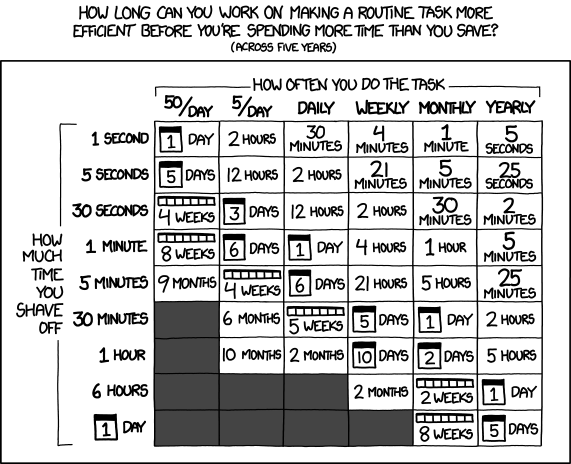
Not everything needs to scale Is It Worth The Time One of the most common fallacies programmers fall into is that we will jump to automating a solution before we stop and figure out how much time it would even save. In taking a slow improvement route to solve this problem for myself, I ve managed not to invest too much time5 in worrying about this but also achieved a meaningful improvement beyond my first approach of doing it all by hand.
  1. You could also add a line to /etc/crontab or drop a script into /etc/cron.monthly depending on your system.
  2. Why once a month? Mostly to avoid regular disruptions, but still be reasonably timely on updates.
  3. If you re looking to understand the cron time format I recommend crontab guru.
  4. In the long term I really should set up something like ansible to automatically push fleetwide changes like this but with fewer machines than fingers this seems like overkill.
  5. Of course by now writing about it, I ve probably doubled the amount of time I ve spent thinking about this topic but oh well

23 March 2024

Dirk Eddelbuettel: littler 0.3.20 on CRAN: Moar Features!

max-heap image The twentyfirst release of littler as a CRAN package landed on CRAN just now, following in the now eighteen year history (!!) as a package started by Jeff in 2006, and joined by me a few weeks later. littler is the first command-line interface for R as it predates Rscript. It allows for piping as well for shebang scripting via #!, uses command-line arguments more consistently and still starts faster. It also always loaded the methods package which Rscript only began to do in recent years. littler lives on Linux and Unix, has its difficulties on macOS due to yet-another-braindeadedness there (who ever thought case-insensitive filesystems as a default were a good idea?) and simply does not exist on Windows (yet the build system could be extended see RInside for an existence proof, and volunteers are welcome!). See the FAQ vignette on how to add it to your PATH. A few examples are highlighted at the Github repo:, as well as in the examples vignette. This release contains another fair number of small changes and improvements to some of the scripts I use daily to build or test packages, adds a new front-end ciw.r for the recently-released ciw package offering a CRAN Incoming Watcher , a new helper installDeps2.r (extending installDeps.r), a new doi-to-bib converter, allows a different temporary directory setup I find helpful, deals with one corner deployment use, and more. The full change description follows.

Changes in littler version 0.3.20 (2024-03-23)
  • Changes in examples scripts
    • New (dependency-free) helper installDeps2.r to install dependencies
    • Scripts rcc.r, tt.r, tttf.r, tttlr.r use env argument -S to set -t to r
    • tt.r can now fill in inst/tinytest if it is present
    • New script ciw.r wrapping new package ciw
    • tttf.t can now use devtools and its loadall
    • New script doi2bib.r to call the DOI converter REST service (following a skeet by Richard McElreath)
  • Changes in package
    • The CI setup uses checkout@v4 and the r-ci-setup action
    • The Suggests: is a little tighter as we do not list all packages optionally used in the the examples (as R does not check for it either)
    • The package load messag can account for the rare build of R under different architecture (Berwin Turlach in #117 closing #116)
    • In non-vanilla mode, the temporary directory initialization in re-run allowing for a non-standard temp dir via config settings

My CRANberries service provides a comparison to the previous release. Full details for the littler release are provided as usual at the ChangeLog page, and also on the package docs website. The code is available via the GitHub repo, from tarballs and now of course also from its CRAN page and via install.packages("littler"). Binary packages are available directly in Debian as well as (in a day or two) Ubuntu binaries at CRAN thanks to the tireless Michael Rutter. Comments and suggestions are welcome at the GitHub repo. If you like this or other open-source work I do, you can sponsor me at GitHub.

This post by Dirk Eddelbuettel originated on his Thinking inside the box blog. Please report excessive re-aggregation in third-party for-profit settings.

21 March 2024

Ian Jackson: How to use Rust on Debian (and Ubuntu, etc.)

tl;dr: Don t just apt install rustc cargo. Either do that and make sure to use only Rust libraries from your distro (with the tiresome config runes below); or, just use rustup. Don t do the obvious thing; it s never what you want Debian ships a Rust compiler, and a large number of Rust libraries. But if you just do things the obvious default way, with apt install rustc cargo, you will end up using Debian s compiler but upstream libraries, directly and uncurated from crates.io. This is not what you want. There are about two reasonable things to do, depending on your preferences. Q. Download and run whatever code from the internet? The key question is this: Are you comfortable downloading code, directly from hundreds of upstream Rust package maintainers, and running it ? That s what cargo does. It s one of the main things it s for. Debian s cargo behaves, in this respect, just like upstream s. Let me say that again: Debian s cargo promiscuously downloads code from crates.io just like upstream cargo. So if you use Debian s cargo in the most obvious way, you are still downloading and running all those random libraries. The only thing you re avoiding downloading is the Rust compiler itself, which is precisely the part that is most carefully maintained, and of least concern. Debian s cargo can even download from crates.io when you re building official Debian source packages written in Rust: if you run dpkg-buildpackage, the downloading is suppressed; but a plain cargo build will try to obtain and use dependencies from the upstream ecosystem. ( Happily , if you do this, it s quite likely to bail out early due to version mismatches, before actually downloading anything.) Option 1: WTF, no I don t want curl bash OK, but then you must limit yourself to libraries available within Debian. Each Debian release provides a curated set. It may or may not be sufficient for your needs. Many capable programs can be written using the packages in Debian. But any upstream Rust project that you encounter is likely to be a pain to get working, unless their maintainers specifically intend to support this. (This is fairly rare, and the Rust tooling doesn t make it easy.) To go with this plan, apt install rustc cargo and put this in your configuration, in $HOME/.cargo/config.toml:
[source.debian-packages]
directory = "/usr/share/cargo/registry"
[source.crates-io]
replace-with = "debian-packages"
This causes cargo to look in /usr/share for dependencies, rather than downloading them from crates.io. You must then install the librust-FOO-dev packages for each of your dependencies, with apt. This will allow you to write your own program in Rust, and build it using cargo build. Option 2: Biting the curl bash bullet If you want to build software that isn t specifically targeted at Debian s Rust you will probably need to use packages from crates.io, not from Debian. If you re doing to do that, there is little point not using rustup to get the latest compiler. rustup s install rune is alarming, but cargo will be doing exactly the same kind of thing, only worse (because it trusts many more people) and more hidden. So in this case: do run the curl bash install rune. Hopefully the Rust project you are trying to build have shipped a Cargo.lock; that contains hashes of all the dependencies that they last used and tested. If you run cargo build --locked, cargo will only use those versions, which are hopefully OK. And you can run cargo audit to see if there are any reported vulnerabilities or problems. But you ll have to bootstrap this with cargo install --locked cargo-audit; cargo-audit is from the RUSTSEC folks who do care about these kind of things, so hopefully running their code (and their dependencies) is fine. Note the --locked which is needed because cargo s default behaviour is wrong. Privilege separation This approach is rather alarming. For my personal use, I wrote a privsep tool which allows me to run all this upstream Rust code as a separate user. That tool is nailing-cargo. It s not particularly well productised, or tested, but it does work for at least one person besides me. You may wish to try it out, or consider alternative arrangements. Bug reports and patches welcome. OMG what a mess Indeed. There are large number of technical and social factors at play. cargo itself is deeply troubling, both in principle, and in detail. I often find myself severely disappointed with its maintainers decisions. In mitigation, much of the wider Rust upstream community does takes this kind of thing very seriously, and often makes good choices. RUSTSEC is one of the results. Debian s technical arrangements for Rust packaging are quite dysfunctional, too: IMO the scheme is based on fundamentally wrong design principles. But, the Debian Rust packaging team is dynamic, constantly working the update treadmills; and the team is generally welcoming and helpful. Sadly last time I explored the possibility, the Debian Rust Team didn t have the appetite for more fundamental changes to the workflow (including, for example, changes to dependency version handling). Significant improvements to upstream cargo s approach seem unlikely, too; we can only hope that eventually someone might manage to supplant it.
edited 2024-03-21 21:49 to add a cut tag


comment count unavailable comments

19 March 2024

Colin Watson: apt install everything?

On Mastodon, the question came up of how Ubuntu would deal with something like the npm install everything situation. I replied:
Ubuntu is curated, so it probably wouldn t get this far. If it did, then the worst case is that it would get in the way of CI allowing other packages to be removed (again from a curated system, so people are used to removal not being self-service); but the release team would have no hesitation in removing a package like this to fix that, and it certainly wouldn t cause this amount of angst. If you did this in a PPA, then I can t think of any particular negative effects.
OK, if you added lots of build-dependencies (as well as run-time dependencies) then you might be able to take out a builder. But Launchpad builders already run arbitrary user-submitted code by design and are therefore very carefully sandboxed and treated as ephemeral, so this is hardly novel. There s a lot to be said for the arrangement of having a curated system for the stuff people actually care about plus an ecosystem of add-on repositories. PPAs cover a wide range of levels of developer activity, from throwaway experiments to quasi-official distribution methods; there are certainly problems that arise from it being difficult to tell the difference between those extremes and from there being no systematic confinement, but for this particular kind of problem they re very nearly ideal. (Canonical has tried various other approaches to software distribution, and while they address some of the problems, they aren t obviously better at helping people make reliable social judgements about code they don t know.) For a hypothetical package with a huge number of dependencies, to even try to upload it directly to Ubuntu you d need to be an Ubuntu developer with upload rights (or to go via Debian, where you d have to clear a similar hurdle). If you have those, then the first upload has to pass manual review by an archive administrator. If your package passes that, then it still has to build and get through proposed-migration CI before it reaches anything that humans typically care about. On the other hand, if you were inclined to try this sort of experiment, you d almost certainly try it in a PPA, and that would trouble nobody but yourself.

18 March 2024

Simon Josefsson: Apt archive mirrors in Git-LFS

My effort to improve transparency and confidence of public apt archives continues. I started to work on this in Apt Archive Transparency in which I mention the debdistget project in passing. Debdistget is responsible for mirroring index files for some public apt archives. I ve realized that having a publicly auditable and preserved mirror of the apt repositories is central to being able to do apt transparency work, so the debdistget project has become more central to my project than I thought. Currently I track Trisquel, PureOS, Gnuinos and their upstreams Ubuntu, Debian and Devuan. Debdistget download Release/Package/Sources files and store them in a git repository published on GitLab. Due to size constraints, it uses two repositories: one for the Release/InRelease files (which are small) and one that also include the Package/Sources files (which are large). See for example the repository for Trisquel release files and the Trisquel package/sources files. Repositories for all distributions can be found in debdistutils archives GitLab sub-group. The reason for splitting into two repositories was that the git repository for the combined files become large, and that some of my use-cases only needed the release files. Currently the repositories with packages (which contain a couple of months worth of data now) are 9GB for Ubuntu, 2.5GB for Trisquel/Debian/PureOS, 970MB for Devuan and 450MB for Gnuinos. The repository size is correlated to the size of the archive (for the initial import) plus the frequency and size of updates. Ubuntu s use of Apt Phased Updates (which triggers a higher churn of Packages file modifications) appears to be the primary reason for its larger size. Working with large Git repositories is inefficient and the GitLab CI/CD jobs generate quite some network traffic downloading the git repository over and over again. The most heavy user is the debdistdiff project that download all distribution package repositories to do diff operations on the package lists between distributions. The daily job takes around 80 minutes to run, with the majority of time is spent on downloading the archives. Yes I know I could look into runner-side caching but I dislike complexity caused by caching. Fortunately not all use-cases requires the package files. The debdistcanary project only needs the Release/InRelease files, in order to commit signatures to the Sigstore and Sigsum transparency logs. These jobs still run fairly quickly, but watching the repository size growth worries me. Currently these repositories are at Debian 440MB, PureOS 130MB, Ubuntu/Devuan 90MB, Trisquel 12MB, Gnuinos 2MB. Here I believe the main size correlation is update frequency, and Debian is large because I track the volatile unstable. So I hit a scalability end with my first approach. A couple of months ago I solved this by discarding and resetting these archival repositories. The GitLab CI/CD jobs were fast again and all was well. However this meant discarding precious historic information. A couple of days ago I was reaching the limits of practicality again, and started to explore ways to fix this. I like having data stored in git (it allows easy integration with software integrity tools such as GnuPG and Sigstore, and the git log provides a kind of temporal ordering of data), so it felt like giving up on nice properties to use a traditional database with on-disk approach. So I started to learn about Git-LFS and understanding that it was able to handle multi-GB worth of data that looked promising. Fairly quickly I scripted up a GitLab CI/CD job that incrementally update the Release/Package/Sources files in a git repository that uses Git-LFS to store all the files. The repository size is now at Ubuntu 650kb, Debian 300kb, Trisquel 50kb, Devuan 250kb, PureOS 172kb and Gnuinos 17kb. As can be expected, jobs are quick to clone the git archives: debdistdiff pipelines went from a run-time of 80 minutes down to 10 minutes which more reasonable correlate with the archive size and CPU run-time. The LFS storage size for those repositories are at Ubuntu 15GB, Debian 8GB, Trisquel 1.7GB, Devuan 1.1GB, PureOS/Gnuinos 420MB. This is for a couple of days worth of data. It seems native Git is better at compressing/deduplicating data than Git-LFS is: the combined size for Ubuntu is already 15GB for a couple of days data compared to 8GB for a couple of months worth of data with pure Git. This may be a sub-optimal implementation of Git-LFS in GitLab but it does worry me that this new approach will be difficult to scale too. At some level the difference is understandable, Git-LFS probably store two different Packages files around 90MB each for Trisquel as two 90MB files, but native Git would store it as one compressed version of the 90MB file and one relatively small patch to turn the old files into the next file. So the Git-LFS approach surprisingly scale less well for overall storage-size. Still, the original repository is much smaller, and you usually don t have to pull all LFS files anyway. So it is net win. Throughout this work, I kept thinking about how my approach relates to Debian s snapshot service. Ultimately what I would want is a combination of these two services. To have a good foundation to do transparency work I would want to have a collection of all Release/Packages/Sources files ever published, and ultimately also the source code and binaries. While it makes sense to start on the latest stable releases of distributions, this effort should scale backwards in time as well. For reproducing binaries from source code, I need to be able to securely find earlier versions of binary packages used for rebuilds. So I need to import all the Release/Packages/Sources packages from snapshot into my repositories. The latency to retrieve files from that server is slow so I haven t been able to find an efficient/parallelized way to download the files. If I m able to finish this, I would have confidence that my new Git-LFS based approach to store these files will scale over many years to come. This remains to be seen. Perhaps the repository has to be split up per release or per architecture or similar. Another factor is storage costs. While the git repository size for a Git-LFS based repository with files from several years may be possible to sustain, the Git-LFS storage size surely won t be. It seems GitLab charges the same for files in repositories and in Git-LFS, and it is around $500 per 100GB per year. It may be possible to setup a separate Git-LFS backend not hosted at GitLab to serve the LFS files. Does anyone know of a suitable server implementation for this? I had a quick look at the Git-LFS implementation list and it seems the closest reasonable approach would be to setup the Gitea-clone Forgejo as a self-hosted server. Perhaps a cloud storage approach a la S3 is the way to go? The cost to host this on GitLab will be manageable for up to ~1TB ($5000/year) but scaling it to storing say 500TB of data would mean an yearly fee of $2.5M which seems like poor value for the money. I realized that ultimately I would want a git repository locally with the entire content of all apt archives, including their binary and source packages, ever published. The storage requirements for a service like snapshot (~300TB of data?) is today not prohibitly expensive: 20TB disks are $500 a piece, so a storage enclosure with 36 disks would be around $18.000 for 720TB and using RAID1 means 360TB which is a good start. While I have heard about ~TB-sized Git-LFS repositories, would Git-LFS scale to 1PB? Perhaps the size of a git repository with multi-millions number of Git-LFS pointer files will become unmanageable? To get started on this approach, I decided to import a mirror of Debian s bookworm for amd64 into a Git-LFS repository. That is around 175GB so reasonable cheap to host even on GitLab ($1000/year for 200GB). Having this repository publicly available will make it possible to write software that uses this approach (e.g., porting debdistreproduce), to find out if this is useful and if it could scale. Distributing the apt repository via Git-LFS would also enable other interesting ideas to protecting the data. Consider configuring apt to use a local file:// URL to this git repository, and verifying the git checkout using some method similar to Guix s approach to trusting git content or Sigstore s gitsign. A naive push of the 175GB archive in a single git commit ran into pack size limitations: remote: fatal: pack exceeds maximum allowed size (4.88 GiB) however breaking up the commit into smaller commits for parts of the archive made it possible to push the entire archive. Here are the commands to create this repository: git init
git lfs install
git lfs track 'dists/**' 'pool/**'
git add .gitattributes
git commit -m"Add Git-LFS track attributes." .gitattributes
time debmirror --method=rsync --host ftp.se.debian.org --root :debian --arch=amd64 --source --dist=bookworm,bookworm-updates --section=main --verbose --diff=none --keyring /usr/share/keyrings/debian-archive-keyring.gpg --ignore .git .
git add dists project
git commit -m"Add." -a
git remote add origin git@gitlab.com:debdistutils/archives/debian/mirror.git
git push --set-upstream origin --all
for d in pool//; do
echo $d;
time git add $d;
git commit -m"Add $d." -a
git push
done
The resulting repository size is around 27MB with Git LFS object storage around 174GB. I think this approach would scale to handle all architectures for one release, but working with a single git repository for all releases for all architectures may lead to a too large git repository (>1GB). So maybe one repository per release? These repositories could also be split up on a subset of pool/ files, or there could be one repository per release per architecture or sources. Finally, I have concerns about using SHA1 for identifying objects. It seems both Git and Debian s snapshot service is currently using SHA1. For Git there is SHA-256 transition and it seems GitLab is working on support for SHA256-based repositories. For serious long-term deployment of these concepts, it would be nice to go for SHA256 identifiers directly. Git-LFS already uses SHA256 but Git internally uses SHA1 as does the Debian snapshot service. What do you think? Happy Hacking!

14 March 2024

Matthew Garrett: Digital forgeries are hard

Closing arguments in the trial between various people and Craig Wright over whether he's Satoshi Nakamoto are wrapping up today, amongst a bewildering array of presented evidence. But one utterly astonishing aspect of this lawsuit is that expert witnesses for both sides agreed that much of the digital evidence provided by Craig Wright was unreliable in one way or another, generally including indications that it wasn't produced at the point in time it claimed to be. And it's fascinating reading through the subtle (and, in some cases, not so subtle) ways that that's revealed.

One of the pieces of evidence entered is screenshots of data from Mind Your Own Business, a business management product that's been around for some time. Craig Wright relied on screenshots of various entries from this product to support his claims around having controlled meaningful number of bitcoin before he was publicly linked to being Satoshi. If these were authentic then they'd be strong evidence linking him to the mining of coins before Bitcoin's public availability. Unfortunately the screenshots themselves weren't contemporary - the metadata shows them being created in 2020. This wouldn't fundamentally be a problem (it's entirely reasonable to create new screenshots of old material), as long as it's possible to establish that the material shown in the screenshots was created at that point. Sadly, well.

One part of the disclosed information was an email that contained a zip file that contained a raw database in the format used by MYOB. Importing that into the tool allowed an audit record to be extracted - this record showed that the relevant entries had been added to the database in 2020, shortly before the screenshots were created. This was, obviously, not strong evidence that Craig had held Bitcoin in 2009. This evidence was reported, and was responded to with a couple of additional databases that had an audit trail that was consistent with the dates in the records in question. Well, partially. The audit record included session data, showing an administrator logging into the data base in 2011 and then, uh, logging out in 2023, which is rather more consistent with someone changing their system clock to 2011 to create an entry, and switching it back to present day before logging out. In addition, the audit log included fields that didn't exist in versions of the product released before 2016, strongly suggesting that the entries dated 2009-2011 were created in software released after 2016. And even worse, the order of insertions into the database didn't line up with calendar time - an entry dated before another entry may appear in the database afterwards, indicating that it was created later. But even more obvious? The database schema used for these old entries corresponded to a version of the software released in 2023.

This is all consistent with the idea that these records were created after the fact and backdated to 2009-2011, and that after this evidence was made available further evidence was created and backdated to obfuscate that. In an unusual turn of events, during the trial Craig Wright introduced further evidence in the form of a chain of emails to his former lawyers that indicated he had provided them with login details to his MYOB instance in 2019 - before the metadata associated with the screenshots. The implication isn't entirely clear, but it suggests that either they had an opportunity to examine this data before the metadata suggests it was created, or that they faked the data? So, well, the obvious thing happened, and his former lawyers were asked whether they received these emails. The chain consisted of three emails, two of which they confirmed they'd received. And they received a third email in the chain, but it was different to the one entered in evidence. And, uh, weirdly, they'd received a copy of the email that was submitted - but they'd received it a few days earlier. In 2024.

And again, the forensic evidence is helpful here! It turns out that the email client used associates a timestamp with any attachments, which in this case included an image in the email footer - and the mysterious time travelling email had a timestamp in 2024, not 2019. This was created by the client, so was consistent with the email having been sent in 2024, not being sent in 2019 and somehow getting stuck somewhere before delivery. The date header indicates 2019, as do encoded timestamps in the MIME headers - consistent with the mail being sent by a computer with the clock set to 2019.

But there's a very weird difference between the copy of the email that was submitted in evidence and the copy that was located afterwards! The first included a header inserted by gmail that included a 2019 timestamp, while the latter had a 2024 timestamp. Is there a way to determine which of these could be the truth? It turns out there is! The format of that header changed in 2022, and the version in the email is the new version. The version with the 2019 timestamp is anachronistic - the format simply doesn't match the header that gmail would have introduced in 2019, suggesting that an email sent in 2022 or later was modified to include a timestamp of 2019.

This is by no means the only indication that Craig Wright's evidence may be misleading (there's the whole argument that the Bitcoin white paper was written in LaTeX when general consensus is that it's written in OpenOffice, given that's what the metadata claims), but it's a lovely example of a more general issue.

Our technology chains are complicated. So many moving parts end up influencing the content of the data we generate, and those parts develop over time. It's fantastically difficult to generate an artifact now that precisely corresponds to how it would look in the past, even if we go to the effort of installing an old OS on an old PC and setting the clock appropriately (are you sure you're going to be able to mimic an entirely period appropriate patch level?). Even the version of the font you use in a document may indicate it's anachronistic. I'm pretty good at computers and I no longer have any belief I could fake an old document.

(References: this Dropbox, under "Expert reports", "Patrick Madden". Initial MYOB data is in "Appendix PM7", further analysis is in "Appendix PM42", email analysis is "Sixth Expert Report of Mr Patrick Madden")

comment count unavailable comments

13 March 2024

Russell Coker: The Shape of Computers

Introduction There have been many experiments with the sizes of computers, some of which have stayed around and some have gone away. The trend has been to make computers smaller, the early computers had buildings for them. Recently for come classes computers have started becoming as small as could be reasonably desired. For example phones are thin enough that they can blow away in a strong breeze, smart watches are much the same size as the old fashioned watches they replace, and NUC type computers are as small as they need to be given the size of monitors etc that they connect to. This means that further development in the size and shape of computers will largely be determined by human factors. I think we need to consider how computers might be developed to better suit humans and how to write free software to make such computers usable without being constrained by corporate interests. Those of us who are involved in developing OSs and applications need to consider how to adjust to the changes and ideally anticipate changes. While we can t anticipate the details of future devices we can easily predict general trends such as being smaller, higher resolution, etc. Desktop/Laptop PCs When home computers first came out it was standard to have the keyboard in the main box, the Apple ][ being the most well known example. This has lost popularity due to the demand to have multiple options for a light keyboard that can be moved for convenience combined with multiple options for the box part. But it still pops up occasionally such as the Raspberry Pi 400 [1] which succeeds due to having the computer part being small and light. I think this type of computer will remain a niche product. It could be used in a add a screen to make a laptop as opposed to the add a keyboard to a tablet to make a laptop model but a tablet without a keyboard is more useful than a non-server PC without a display. The PC as box with connections for keyboard, display, etc has a long future ahead of it. But the sizes will probably decrease (they should have stopped making PC cases to fit CD/DVD drives at least 10 years ago). The NUC size is a useful option and I think that DVD drives will stop being used for software soon which will allow a range of smaller form factors. The regular laptop is something that will remain useful, but the tablet with detachable keyboard devices could take a lot of that market. Full functionality for all tasks requires a keyboard because at the moment text editing with a touch screen is an unsolved problem in computer science [2]. The Lenovo Thinkpad X1 Fold [3] and related Lenovo products are very interesting. Advances in materials allow laptops to be thinner and lighter which leaves the screen size as a major limitation to portability. There is a conflict between desiring a large screen to see lots of content and wanting a small size to carry and making a device foldable is an obvious solution that has recently become possible. Making a foldable laptop drives a desire for not having a permanently attached keyboard which then makes a touch screen keyboard a requirement. So this means that user interfaces for PCs have to be adapted to work well on touch screens. The Think line seems to be continuing the history of innovation that it had when owned by IBM. There are also a range of other laptops that have two regular screens so they are essentially the same as the Thinkpad X1 Fold but with two separate screens instead of one folding one, prices are as low as $600US. I think that the typical interfaces for desktop PCs (EG MS-Windows and KDE) don t work well for small devices and touch devices and the Android interface generally isn t a good match for desktop systems. We need to invent more options for this. This is not a criticism of KDE, I use it every day and it works well. But it s designed for use cases that don t match new hardware that is on sale. As an aside it would be nice if Lenovo gave samples of their newest gear to people who make significant contributions to GUIs. Give a few Thinkpad Fold devices to KDE people, a few to GNOME people, and a few others to people involved in Wayland development and see how that promotes software development and future sales. We also need to adopt features from laptops and phones into desktop PCs. When voice recognition software was first released in the 90s it was for desktop PCs, it didn t take off largely because it wasn t very accurate (none of them recognised my voice). Now voice recognition in phones is very accurate and it s very common for desktop PCs to have a webcam or headset with a microphone so it s time for this to be re-visited. GPS support in laptops is obviously useful and can work via Wifi location, via a USB GPS device, or via wwan mobile phone hardware (even if not used for wwan networking). Another possibility is using the same software interfaces as used for GPS on laptops for a static definition of location for a desktop PC or server. The Interesting New Things Watch Like The wrist-watch [4] has been a standard format for easy access to data when on the go since it s military use at the end of the 19th century when the practical benefits beat the supposed femininity of the watch. So it seems most likely that they will continue to be in widespread use in computerised form for the forseeable future. For comparison smart phones have been in widespread use as pocket watches for about 10 years. The question is how will watch computers end up? Will we have Dick Tracy style watch phones that you speak into? Will it be the current smart watch functionality of using the watch to answer a call which goes to a bluetooth headset? Will smart watches end up taking over the functionality of the calculator watch [5] which was popular in the 80 s? With today s technology you could easily have a fully capable PC strapped to your forearm, would that be useful? Phone Like Folding phones (originally popularised as Star Trek Tricorders) seem likely to have a long future ahead of them. Engineering technology has only recently developed to the stage of allowing them to work the way people would hope them to work (a folding screen with no gaps). Phones and tablets with multiple folds are coming out now [6]. This will allow phones to take much of the market share that tablets used to have while tablets and laptops merge at the high end. I ve previously written about Convergence between phones and desktop computers [7], the increased capabilities of phones adds to the case for Convergence. Folding phones also provide new possibilities for the OS. The Oppo OnePlus Open and the Google Pixel Fold both have a UI based around using the two halves of the folding screen for separate data at some times. I think that the current user interfaces for desktop PCs don t properly take advantage of multiple monitors and the possibilities raised by folding phones only adds to the lack. My pet peeve with multiple monitor setups is when they don t make it obvious which monitor has keyboard focus so you send a CTRL-W or ALT-F4 to the wrong screen by mistake, it s a problem that also happens on a single screen but is worse with multiple screens. There are rumours of phones described as three fold (where three means the number of segments with two folds between them), it will be interesting to see how that goes. Will phones go the same way as PCs in terms of having a separation between the compute bit and the input device? It s quite possible to have a compute device in the phone form factor inside a secure pocket which talks via Bluetooth to another device with a display and speakers. Then you could change your phone between a phone-size display and a tablet sized display easily and when using your phone a thief would not be able to easily steal the compute bit (which has passwords etc). Could the watch part of the phone (strapped to your wrist and difficult to steal) be the active part and have a tablet size device as an external display? There are already announcements of smart watches with up to 1GB of RAM (same as the Samsung Galaxy S3), that s enough for a lot of phone functionality. The Rabbit R1 [8] and the Humane AI Pin [9] have some interesting possibilities for AI speech interfaces. Could that take over some of the current phone use? It seems that visually impaired people have been doing badly in the trend towards touch screen phones so an option of a voice interface phone would be a good option for them. As an aside I hope some people are working on AI stuff for FOSS devices. Laptop Like One interesting PC variant I just discovered is the Higole 2 Pro portable battery operated Windows PC with 5.5 touch screen [10]. It looks too thick to fit in the same pockets as current phones but is still very portable. The version with built in battery is $AU423 which is in the usual price range for low end laptops and tablets. I don t think this is the future of computing, but it is something that is usable today while we wait for foldable devices to take over. The recent release of the Apple Vision Pro [11] has driven interest in 3D and head mounted computers. I think this could be a useful peripheral for a laptop or phone but it won t be part of a primary computing environment. In 2011 I wrote about the possibility of using augmented reality technology for providing a desktop computing environment [12]. I wonder how a Vision Pro would work for that on a train or passenger jet. Another interesting thing that s on offer is a laptop with 7 touch screen beside the keyboard [13]. It seems that someone just looked at what parts are available cheaply in China (due to being parts of more popular devices) and what could fit together. I think a keyboard should be central to the monitor for serious typing, but there may be useful corner cases where typing isn t that common and a touch-screen display is of use. Developing a range of strange hardware and then seeing which ones get adopted is a good thing and an advantage of Ali Express and Temu. Useful Hardware for Developing These Things I recently bought a second hand Thinkpad X1 Yoga Gen3 for $359 which has stylus support [14], and it s generally a great little laptop in every other way. There s a common failure case of that model where touch support for fingers breaks but the stylus still works which allows it to be used for testing touch screen functionality while making it cheap. The PineTime is a nice smart watch from Pine64 which is designed to be open [15]. I am quite happy with it but haven t done much with it yet (apart from wearing it every day and getting alerts etc from Android). At $50 when delivered to Australia it s significantly more expensive than most smart watches with similar features but still a lot cheaper than the high end ones. Also the Raspberry Pi Watch [16] is interesting too. The PinePhonePro is an OK phone made to open standards but it s hardware isn t as good as Android phones released in the same year [17]. I ve got some useful stuff done on mine, but the battery life is a major issue and the screen resolution is low. The Librem 5 phone from Purism has a better hardware design for security with switches to disable functionality [18], but it s even slower than the PinePhonePro. These are good devices for test and development but not ones that many people would be excited to use every day. Wwan hardware (for accessing the phone network) in M.2 form factor can be obtained for free if you have access to old/broken laptops. Such devices start at about $35 if you want to buy one. USB GPS devices also start at about $35 so probably not worth getting if you can get a wwan device that does GPS as well. What We Must Do Debian appears to have some voice input software in the pocketsphinx package but no documentation on how it s to be used. This would be a good thing to document, I spent 15 mins looking at it and couldn t get it going. To take advantage of the hardware features in phones we need software support and we ideally don t want free software to lag too far behind proprietary software which IMHO means the typical Android setup for phones/tablets. Support for changing screen resolution is already there as is support for touch screens. Support for adapting the GUI to changed screen size is something that needs to be done even today s hardware of connecting a small laptop to an external monitor doesn t have the ideal functionality for changing the UI. There also seem to be some limitations in touch screen support with multiple screens, I haven t investigated this properly yet, it definitely doesn t work in an expected manner in Ubuntu 22.04 and I haven t yet tested the combinations on Debian/Unstable. ML is becoming a big thing and it has some interesting use cases for small devices where a smart device can compensate for limited input options. There s a lot of work that needs to be done in this area and we are limited by the fact that we can t just rip off the work of other people for use as training data in the way that corporations do. Security is more important for devices that are at high risk of theft. The vast majority of free software installations are way behind Android in terms of security and we need to address that. I have some ideas for improvement but there is always a conflict between security and usability and while Android is usable for it s own special apps it s not usable in a I want to run applications that use any files from any other applicationsin any way I want sense. My post about Sandboxing Phone apps is relevant for people who are interested in this [19]. We also need to extend security models to cope with things like ok google type functionality which has the potential to be a bug and the emerging class of LLM based attacks. I will write more posts about these thing. Please write comments mentioning FOSS hardware and software projects that address these issues and also documentation for such things.

Freexian Collaborators: Debian Contributions: Upcoming Improvements to Salsa CI, /usr-move, packaging simplemonitor, and more! (by Utkarsh Gupta)

Contributing to Debian is part of Freexian s mission. This article covers the latest achievements of Freexian and their collaborators. All of this is made possible by organizations subscribing to our Long Term Support contracts and consulting services.

/usr-move, by Helmut Grohne Much of the work was spent on handling interaction with time time64 transition and sending patches for mitigating fallout. The set of packages relevant to debootstrap is mostly converted and the patches for glibc and base-files have been refined due to feedback from the upload to Ubuntu noble. Beyond this, he sent patches for all remaining packages that cannot move their files with dh-sequence-movetousr and packages using dpkg-divert in ways that dumat would not recognize.

Upcoming improvements to Salsa CI, by Santiago Ruano Rinc n Last month, Santiago Ruano Rinc n started the work on integrating sbuild into the Salsa CI pipeline. Initially, Santiago used sbuild with the unshare chroot mode. However, after discussion with josch, jochensp and helmut (thanks to them!), it turns out that the unshare mode is not the most suitable for the pipeline, since the level of isolation it provides is not needed, and some test suites would fail (eg: krb5). Additionally, one of the requirements of the build job is the use of ccache, since it is needed by some C/C++ large projects to reduce the compilation time. In the preliminary work with unshare last month, it was not possible to make ccache to work. Finally, Santiago changed the chroot mode, and now has a couple of POC (cf: 1 and 2) that rely on the schroot and sudo, respectively. And the good news is that ccache is successfully used by sbuild with schroot! The image here comes from an example of building grep. At the end of the build, ccache -s shows the statistics of the cache that it used, and so a little more than half of the calls of that job were cacheable. The most important pieces are in place to finish the integration of sbuild into the pipeline. Other than that, Santiago also reviewed the very useful merge request !346, made by IOhannes zm lnig to autodetect the release from debian/changelog. As agreed with IOhannes, Santiago is preparing a merge request to include the release autodetection use case in the very own Salsa CI s CI.

Packaging simplemonitor, by Carles Pina i Estany Carles started using simplemonitor in 2017, opened a WNPP bug in 2022 and started packaging simplemonitor dependencies in October 2023. After packaging five direct and indirect dependencies, Carles finally uploaded simplemonitor to unstable in February. During the packaging of simplemonitor, Carles reported a few issues to upstream. Some of these were to make the simplemonitor package build and run tests reproducibly. A reproducibility issue was reprotest overriding the timezone, which broke simplemonitor s tests. There have been discussions on resolving this upstream in simplemonitor and in reprotest, too. Carles also started upgrading or improving some of simplemonitor s dependencies.

Miscellaneous contributions
  • Stefano Rivera spent some time doing admin on debian.social infrastructure. Including dealing with a spike of abuse on the Jitsi server.
  • Stefano started to prepare a new release of dh-python, including cleaning out a lot of old Python 2.x related code. Thanks to Niels Thykier (outside Freexian) for spear-heading this work.
  • DebConf 24 planning is beginning. Stefano discussed venues and finances with the local team and remotely supported a site-visit by Nattie (outside Freexian).
  • Also in the DebConf 24 context, Santiago took part in discussions and preparations related to the Content Team.
  • A JIT bug was reported against pypy3 in Debian Bookworm. Stefano bisected the upstream history to find the patch (it was already resolved upstream) and released an update to pypy3 in bookworm.
  • Enrico participated in /usr-merge discussions with Helmut.
  • Colin Watson backported a python-channels-redis fix to bookworm, rediscovered while working on debusine.
  • Colin dug into a cluster of celery build failures and tracked the hardest bit down to a Python 3.12 regression, now fixed in unstable. celery should be back in testing once the 64-bit time_t migration is out of the way.
  • Thorsten Alteholz uploaded a new upstream version of cpdb-libs. Unfortunately upstream changed the naming of their release tags, so updating the watch file was a bit demanding. Anyway this version 2.0 is a huge step towards introduction of the new Common Print Dialog Backends.
  • Helmut send patches for 48 cross build failures.
  • Helmut changed debvm to use mkfs.ext4 instead of genext2fs.
  • Helmut sent a debci MR for improving collector robustness.
  • In preparation for DebConf 25, Santiago worked on the Brest Bid.

10 March 2024

Thorsten Alteholz: My Debian Activities in February 2024

FTP master This month I accepted 242 and rejected 42 packages. The overall number of packages that got accepted was 251.

This was just a short month and the weather outside was not really motivating. I hope it will be better in March. Debian LTS This was my hundred-sixteenth month that I did some work for the Debian LTS initiative, started by Raphael Hertzog at Freexian. During my allocated time I uploaded: I also started to work on qtbase-opensource-src (an update is needed for ELTS, so an LTS update seems to be appropriate as well, especially as there are postponed CVE). Debian ELTS This month was the sixty-seventth ELTS month. During my allocated time I uploaded: The upload of bind9 was a bit exciting, but all occuring issues with the new upload workflow could be quickly fixed by Helmut and the packages finally reached their destination. I wonder why it is always me who stumbles upon special cases? This month I also worked on the Jessie and Stretch updates for exim4. I also started to work on an update for qtbase-opensource-src in Stretch (and LTS and other releases as well). Debian Printing This month I uploaded new upstream versions of: This work is generously funded by Freexian! Debian Matomo I started a new team debian-matomo-maintainers. Within this team all matomo related packages should be handled. PHP PEAR or PECL packages shall be still maintained in their corresponding teams. This month I uploaded: This work is generously funded by Freexian! Debian Astro This month I uploaded a new upstream version of: Debian IoT This month I uploaded new upstream versions of:

Vasudev Kamath: Cloning a laptop over NVME TCP

Recently, I got a new laptop and had to set it up so I could start using it. But I wasn't really in the mood to go through the same old steps which I had explained in this post earlier. I was complaining about this to my colleague, and there came the suggestion of why not copy the entire disk to the new laptop. Though it sounded like an interesting idea to me, I had my doubts, so here is what I told him in return.

  1. I don't have the tools to open my old laptop and connect the new disk over USB to my new laptop.
  2. I use full disk encryption, and my old laptop has a 512GB disk, whereas the new laptop has a 1TB NVME, and I'm not so familiar with resizing LUKS.
He promptly suggested both could be done. For step 1, just expose the disk using NVME over TCP and connect it over the network and do a full disk copy, and the rest is pretty simple to achieve. In short, he suggested the following:
  1. Export the disk using nvmet-tcp from the old laptop.
  2. Do a disk copy to the new laptop.
  3. Resize the partition to use the full 1TB.
  4. Resize LUKS.
  5. Finally, resize the BTRFS root disk.
Exporting Disk over NVME TCP The easiest way suggested by my colleague to do this is using systemd-storagetm.service. This service can be invoked by simply booting into storage-target-mode.target by specifying rd.systemd.unit=storage-target-mode.target. But he suggested not to use this as I need to tweak the dracut initrd image to involve network services as well as configuring WiFi from this mode is a painful thing to do. So alternatively, I simply booted both my laptops with GRML rescue CD. And the following step was done to export the NVME disk on my current laptop using the nvmet-tcp module of Linux:
modprobe nvmet-tcp
cd /sys/kernel/config/nvmet
mkdir ports/0
cd ports/0
echo "ipv4" > addr_adrfam
echo 0.0.0.0 > addr_traaddr
echo 4420 > addr_trsvcid
echo tcp > addr_trtype
cd /sys/kernel/config/nvmet/subsystems
mkdir testnqn
echo 1 >testnqn/allow_any_host
mkdir testnqn/namespaces/1
cd testnqn
# replace the device name with the disk you want to export
echo "/dev/nvme0n1" > namespaces/1/device_path
echo 1 > namespaces/1/enable
ln -s "../../subsystems/testnqn" /sys/kernel/config/nvmet/ports/0/subsystems/testnqn
These steps ensure that the device is now exported using NVME over TCP. The next step is to detect this on the new laptop and connect the device:
nvme discover -t tcp -a <ip> -s 4420
nvme connectl-all -t tcp -a <> -s 4420
Finally, nvme list shows the device which is connected to the new laptop, and we can proceed with the next step, which is to do the disk copy.
Copying the Disk I simply used the dd command to copy the root disk to my new laptop. Since the new laptop didn't have an Ethernet port, I had to rely only on WiFi, and it took about 7 and a half hours to copy the entire 512GB to the new laptop. The speed at which I was copying was about 18-20MB/s. The other option would have been to create an initial partition and file system and do an rsync of the root disk or use BTRFS itself for file system transfer.
dd if=/dev/nvme2n1 of=/dev/nvme0n1 status=progress bs=40M
Resizing Partition and LUKS Container The final part was very easy. When I launched parted, it detected that the partition table does not match the disk size and asked if it can fix it, and I said yes. Next, I had to install cloud-guest-utils to get growpart to fix the second partition, and the following command extended the partition to the full 1TB:
growpart /dev/nvem0n1 p2
Next, I used cryptsetup-resize to increase the LUKS container size.
cryptsetup luksOpen /dev/nvme0n1p2 ENC
cryptsetup resize ENC
Finally, I rebooted into the disk, and everything worked fine. After logging into the system, I resized the BTRFS file system. BTRFS requires the system to be mounted for resize, so I could not attempt it in live boot.
btfs fielsystem resize max /
Conclussion The only benefit of this entire process is that I have a new laptop, but I still feel like I'm using my existing laptop. Typically, setting up a new laptop takes about a week or two to completely get adjusted, but in this case, that entire time is saved. An added benefit is that I learned how to export disks using NVME over TCP, thanks to my colleague. This new knowledge adds to the value of the experience.

9 March 2024

Reproducible Builds: Reproducible Builds in February 2024

Welcome to the February 2024 report from the Reproducible Builds project! In our reports, we try to outline what we have been up to over the past month as well as mentioning some of the important things happening in software supply-chain security.

Reproducible Builds at FOSDEM 2024 Core Reproducible Builds developer Holger Levsen presented at the main track at FOSDEM on Saturday 3rd February this year in Brussels, Belgium. However, that wasn t the only talk related to Reproducible Builds. However, please see our comprehensive FOSDEM 2024 news post for the full details and links.

Maintainer Perspectives on Open Source Software Security Bernhard M. Wiedemann spotted that a recent report entitled Maintainer Perspectives on Open Source Software Security written by Stephen Hendrick and Ashwin Ramaswami of the Linux Foundation sports an infographic which mentions that 56% of [polled] projects support reproducible builds .

Mailing list highlights From our mailing list this month:

Distribution work In Debian this month, 5 reviews of Debian packages were added, 22 were updated and 8 were removed this month adding to Debian s knowledge about identified issues. A number of issue types were updated as well. [ ][ ][ ][ ] In addition, Roland Clobus posted his 23rd update of the status of reproducible ISO images on our mailing list. In particular, Roland helpfully summarised that all major desktops build reproducibly with bullseye, bookworm, trixie and sid provided they are built for a second time within the same DAK run (i.e. [within] 6 hours) and that there will likely be further work at a MiniDebCamp in Hamburg. Furthermore, Roland also responded in-depth to a query about a previous report
Fedora developer Zbigniew J drzejewski-Szmek announced a work-in-progress script called fedora-repro-build that attempts to reproduce an existing package within a koji build environment. Although the projects README file lists a number of fields will always or almost always vary and there is a non-zero list of other known issues, this is an excellent first step towards full Fedora reproducibility.
Jelle van der Waa introduced a new linter rule for Arch Linux packages in order to detect cache files leftover by the Sphinx documentation generator which are unreproducible by nature and should not be packaged. At the time of writing, 7 packages in the Arch repository are affected by this.
Elsewhere, Bernhard M. Wiedemann posted another monthly update for his work elsewhere in openSUSE.

diffoscope diffoscope is our in-depth and content-aware diff utility that can locate and diagnose reproducibility issues. This month, Chris Lamb made a number of changes such as uploading versions 256, 257 and 258 to Debian and made the following additional changes:
  • Use a deterministic name instead of trusting gpg s use-embedded-filenames. Many thanks to Daniel Kahn Gillmor dkg@debian.org for reporting this issue and providing feedback. [ ][ ]
  • Don t error-out with a traceback if we encounter struct.unpack-related errors when parsing Python .pyc files. (#1064973). [ ]
  • Don t try and compare rdb_expected_diff on non-GNU systems as %p formatting can vary, especially with respect to MacOS. [ ]
  • Fix compatibility with pytest 8.0. [ ]
  • Temporarily fix support for Python 3.11.8. [ ]
  • Use the 7zip package (over p7zip-full) after a Debian package transition. (#1063559). [ ]
  • Bump the minimum Black source code reformatter requirement to 24.1.1+. [ ]
  • Expand an older changelog entry with a CVE reference. [ ]
  • Make test_zip black clean. [ ]
In addition, James Addison contributed a patch to parse the headers from the diff(1) correctly [ ][ ] thanks! And lastly, Vagrant Cascadian pushed updates in GNU Guix for diffoscope to version 255, 256, and 258, and updated trydiffoscope to 67.0.6.

reprotest reprotest is our tool for building the same source code twice in different environments and then checking the binaries produced by each build for any differences. This month, Vagrant Cascadian made a number of changes, including:
  • Create a (working) proof of concept for enabling a specific number of CPUs. [ ][ ]
  • Consistently use 398 days for time variation rather than choosing randomly and update README.rst to match. [ ][ ]
  • Support a new --vary=build_path.path option. [ ][ ][ ][ ]

Website updates There were made a number of improvements to our website this month, including:

Reproducibility testing framework The Reproducible Builds project operates a comprehensive testing framework (available at tests.reproducible-builds.org) in order to check packages and other artifacts for reproducibility. In February, a number of changes were made by Holger Levsen:
  • Debian-related changes:
    • Temporarily disable upgrading/bootstrapping Debian unstable and experimental as they are currently broken. [ ][ ]
    • Use the 64-bit amd64 kernel on all i386 nodes; no more 686 PAE kernels. [ ]
    • Add an Erlang package set. [ ]
  • Other changes:
    • Grant Jan-Benedict Glaw shell access to the Jenkins node. [ ]
    • Enable debugging for NetBSD reproducibility testing. [ ]
    • Use /usr/bin/du --apparent-size in the Jenkins shell monitor. [ ]
    • Revert reproducible nodes: mark osuosl2 as down . [ ]
    • Thanks again to Codethink, for they have doubled the RAM on our arm64 nodes. [ ]
    • Only set /proc/$pid/oom_score_adj to -1000 if it has not already been done. [ ]
    • Add the opemwrt-target-tegra and jtx task to the list of zombie jobs. [ ][ ]
Vagrant Cascadian also made the following changes:
  • Overhaul the handling of OpenSSH configuration files after updating from Debian bookworm. [ ][ ][ ]
  • Add two new armhf architecture build nodes, virt32z and virt64z, and insert them into the Munin monitoring. [ ][ ] [ ][ ]
In addition, Alexander Couzens updated the OpenWrt configuration in order to replace the tegra target with mpc85xx [ ], Jan-Benedict Glaw updated the NetBSD build script to use a separate $TMPDIR to mitigate out of space issues on a tmpfs-backed /tmp [ ] and Zheng Junjie added a link to the GNU Guix tests [ ]. Lastly, node maintenance was performed by Holger Levsen [ ][ ][ ][ ][ ][ ] and Vagrant Cascadian [ ][ ][ ][ ].

Upstream patches The Reproducible Builds project detects, dissects and attempts to fix as many currently-unreproducible packages as possible. We endeavour to send all of our patches upstream where appropriate. This month, we wrote a large number of such patches, including:

If you are interested in contributing to the Reproducible Builds project, please visit our Contribute page on our website. However, you can get in touch with us via:

Valhalla's Things: Elastic Neck Top Two: MOAR Ruffles

Posted on March 9, 2024
Tags: madeof:atoms, craft:sewing, FreeSoftWear
A woman wearing a white top with a wide neck with ruffles and puffy sleeves that are gathered at the cuff. The top is tucked in the trousers to gather the fullness at the waist. After making my Elastic Neck Top I knew I wanted to make another one less constrained by the amount of available fabric. I had a big cut of white cotton voile, I bought some more swimsuit elastic, and I also had a spool of n 100 sewing cotton, but then I postponed the project for a while I was working on other things. Then FOSDEM 2024 arrived, I was going to remote it, and I was working on my Augusta Stays, but I knew that in the middle of FOSDEM I risked getting to the stage where I needed to leave the computer to try the stays on: not something really compatible with the frenetic pace of a FOSDEM weekend, even one spent at home. I needed a backup project1, and this was perfect: I already had everything I needed, the pattern and instructions were already on my site (so I didn t need to take pictures while working), and it was mostly a lot of straight seams, perfect while watching conference videos. So, on the Friday before FOSDEM I cut all of the pieces, then spent three quarters of FOSDEM on the stays, and when I reached the point where I needed to stop for a fit test I started on the top. Like the first one, everything was sewn by hand, and one week after I had started everything was assembled, except for the casings for the elastic at the neck and cuffs, which required about 10 km of sewing, and even if it was just a running stitch it made me want to reconsider my lifestyle choices a few times: there was really no reason for me not to do just those seams by machine in a few minutes. Instead I kept sewing by hand whenever I had time for it, and on the next weekend it was ready. We had a rare day of sun during the weekend, so I wore my thermal underwear, some other layer, a scarf around my neck, and went outside with my SO to have a batch of pictures taken (those in the jeans posts, and others for a post I haven t written yet. Have I mentioned I have a backlog?). And then the top went into the wardrobe, and it will come out again when the weather will be a bit warmer. Or maybe it will be used under the Augusta Stays, since I don t have a 1700 chemise yet, but that requires actually finishing them. The pattern for this project was already online, of course, but I ve added a picture of the casing to the relevant section, and everything is as usual #FreeSoftWear.

  1. yes, I could have worked on some knitting WIP, but lately I m more in a sewing mood.

Next.

Previous.