Search Results: "beh"

26 June 2020

Chris Lamb: On the pleasure of hating

People love to tell you that they "don't watch sports" but the story of Lance Armstrong provides a fascinating lens through which to observe our culture at large. For example, even granting all that he did and all the context in which he did it, why do sports cheats act like a lightning rod for such an instinctive hatred? After all, the sheer level of distaste directed at people such as Lance eludes countless other criminals in our society, many of whom have taken a lot more with far fewer scruples. The question is not one of logic or rationality, but of proportionality. In some ways it should be unsurprising. In all areas of life, we instinctively prefer binary judgements to moral ambiguities and the sports cheat is a clich of moral bankruptcy cheating at something so seemingly trivial as a sport actually makes it more, not less, offensive to us. But we then find ourselves strangely enthralled by them, drawn together in admiration of their outlaw-like tenacity, placing them strangely close to criminal folk heroes. Clearly, sport is not as unimportant as we like to claim it is. In Lance's case in particular though, there is undeniably a Shakespearean quality to the story and we are forced to let go of our strict ideas of right and wrong and appreciate all the nuance.

There is a lot of this nuance in Marina Zenovich's new documentary. In fact, there's a lot of everything. At just under four hours, ESPN's Lance combines the duration of a Tour de France stage with the depth of the peloton an endurance event compared to the bite-sized hagiography of Michael Jordan's The Last Dance. Even for those who follow Armstrong's story like a mini-sport in itself, Lance reveals new sides to this man for all seasons. For me, not only was this captured in his clumsy approximations at being a father figure but also in him being asked something I had not read in countless tell-all books: did his earlier experiments in drug-taking contribute to his cancer? But even in 2020 there are questions that remain unanswered. By needlessly returning to the sport in 2009, did Lance subconsciously want to get caught? Why does he not admit he confessed to Betsy Andreu back in 1999 but will happily apologise to her today for slurring her publicly on this very point? And why does he remain so vindictive towards former-teammate Floyd Landis? In all of Armstrong's evasions and masterful control of the narrative, there is the gnawing feeling that we don't even know what questions we should be even asking. As ever, the questions are more interesting than the answers.

Lance also reminded me of how professional cycling's obsession with national identity. Although I was intuitively aware of it to some degree, I had not fully grasped how much this kind of stereotyping runs through the veins of the sport itself, just like the drugs themselves. Journalist Daniel Friebe first offers us the portrait of:
Spaniards tend to be modest, very humble. Very unpretentious. And the Italians are loud, vain and outrageous showmen.
Former directeur sportif Johan Bruyneel then asserts that "Belgians are hard workers... they are ambitious to a certain point, but not overly ambitious", and cyclist J rg Jaksche concludes with:
The Germans are very organised and very structured. And then the French, now I have to be very careful because I am German, but the French are slightly superior.
This kind of lazy caricature is nothing new, especially for those brought up on a solid diet of Tintin and Asterix, but although all these examples are seemingly harmless, why does the underlying idea of ascribing moral, social or political significance to genetic lineage remain so durable in today's age of anti-racism? To be sure, culture is not quite the same thing as race, but being judged by the character of one's ancestors rather than the actions of an individual is, at its core, one of the many conflations at the heart of racism. There is certainly a large amount of cognitive dissonance at work, especially when Friebe elaborates:
East German athletes were like incredible robotic figures, fallen off a production line somewhere behind the Iron Curtain...
... but then bermensch Jan Ullrich is immediately described as "emotional" and "struggled to live the life of a professional cyclist 365 days a year". We see the habit to stereotype is so ingrained that even in the face of this obvious contradiction, Friebe unironically excuses Ullrich's failure to live up his German roots due to him actually being "Mediterranean".

I mention all this as I am known within my circles for remarking on these national characters, even collecting stereotypical examples of Italians 'being Italian' and the French 'being French' at times. Contrary to evidence, I don't believe in this kind of innate quality but what I do suspect is that people generally behave how they think they ought to behave, perhaps out of sheer imitation or the simple pleasure of conformity. As the novelist Will Self put it:
It's quite a complicated collective imposture, people pretending to be British and people pretending to be French, and then they get really angry with each other over what they're pretending to be.
The really remarkable thing about this tendency is that even if we consciously notice it there is no seemingly no escape even I could not smirk when I considered that a brash Texan winning the Tour de France actually combines two of America's cherished obsessions: winning... and annoying the French.

Jonathan Dowland: Our Study

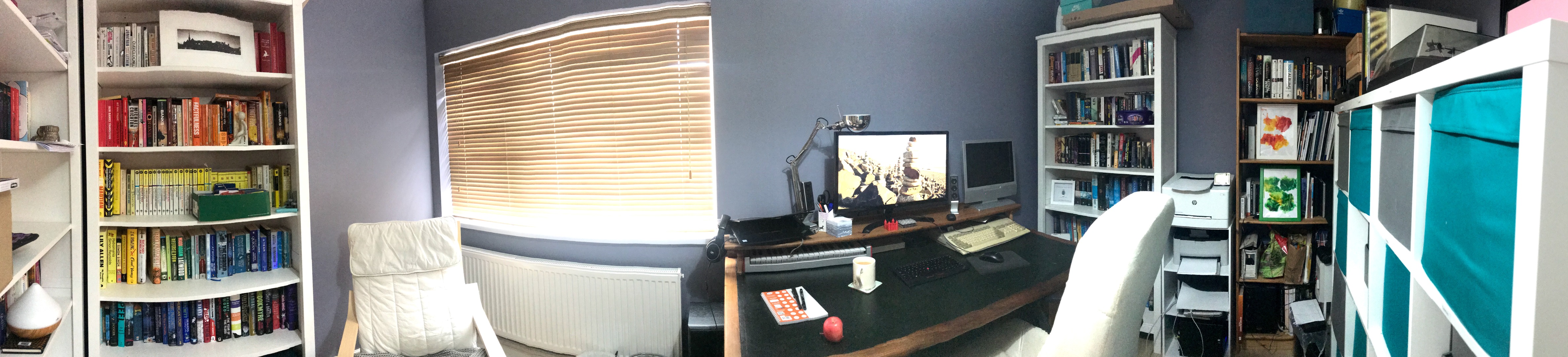
This is a fairly self-indulgent post, sorry! Encouraged by Evgeni, Michael and others, given I'm spending a lot more time at my desk in my home office, here's a picture of it:
Fisheye shot of my home office Fisheye shot of my home office
Near enough everything in the study is a work in progress. The KALLAX behind my desk is a recent addition (under duress) because we have nowhere else to put it. Sadly I can't see it going away any time soon. On the up-side, since Christmas I've had my record player and collection in and on top of it, so I can listen to records whilst working. The arm chair is a recent move from another room. It's a nice place to take some work calls, serving as a change of scene, and I hope to add a reading light sometime. The desk chair is some Ikea model I can't recall, which is sufficient, and just fits into the desk cavity. (I'm fairly sure my Aeron, inaccessible elsewhere, would not fit.) I've had this old mahogany, leather-topped desk since I was a teenager and it's a blessing and a curse. Mostly a blessing: It's a lovely big desk. The main drawback is it's very much not height adjustable. At the back is a custom made, full-width monitor stand/shelf, a recent gift produced to specification by my Dad, a retired carpenter. On the top: my work Thinkpad T470s laptop, geared more towards portable than powerful (my normal preference), although for the forseeable future it's going to remain in the exact same place; an Ikea desk lamp (I can't recall the model); a 27" 4K LG monitor, the cheapest such I could find when I bought it; an old LCD Analog TV, fantastic for vintage consoles and the like. Underneath: An Alesis Micron 2 octave analog-modelling synthesizer; various hubs and similar things; My Amiga 500. Like Evgeni, my normal keyboard is a ThinkPad Compact USB Keyboard with TrackPoint. I've been using different generations of these styles of keyboards for a long time now, initially because I loved the trackpoint pointer. I'm very curious about trying out mechanical keyboards, as I have very fond memories of my first IBM Model M buckled-spring keyboard, but I haven't dipped my toes into that money-trap just yet. The Thinkpad keyboard is rubber-dome, but it's a good one. Wedged between the right-hand bookcases are a stack of IT-related things: new printer; deprecated printer; old/spare/play laptops, docks and chargers; managed network switch; NAS.

Martin Michlmayr: ledger2beancount 2.3 released

I released version 2.3 of ledger2beancount, a ledger to beancount converter. There are three notable changes with this release:
  1. Performance has significantly improved. One large, real-world test case has gone from around 160 seconds to 33 seconds. A smaller test case has gone from 11 seconds to ~3.5 seconds.
  2. The documentation is available online now (via Read the Docs).
  3. The repository has moved to the beancount GitHub organization.
Here are the changes in 2.3: Thanks to Colin Dean for some feedback. Thanks to Stefano Zacchiroli for prompting me into investigating performance issues (and thanks to the developers of the Devel::NYTProf profiler). You can get ledger2beancount from GitHub

25 June 2020

Russell Coker: How Will the Pandemic Change Things?

The Bulwark has an interesting article on why they can t Reopen America [1]. I wonder how many changes will be long term. According to the Wikipedia List of Epidemics [2] Covid-19 so far hasn t had a high death toll when compared to other pandemics of the last 100 years. People s reactions to this vary from doing nothing to significant isolation, the question is what changes in attitudes will be significant enough to change society. Transport One thing that has been happening recently is a transition in transport. It s obvious that we need to reduce CO2 and while electric cars will address the transport part of the problem in the long term changing to electric public transport is the cheaper and faster way to do it in the short term. Before Covid-19 the peak hour public transport in my city was ridiculously overcrowded, having people unable to board trams due to overcrowding was really common. If the economy returns to it s previous state then I predict less people on public transport, more traffic jams, and many more cars idling and polluting the atmosphere. Can we have mass public transport that doesn t give a significant disease risk? Maybe if we had significantly more trains and trams and better ventilation with more airflow designed to suck contaminated air out. But that would require significant engineering work to design new trams, trains, and buses as well as expense in refitting or replacing old ones. Uber and similar companies have been taking over from taxi companies, one major feature of those companies is that the vehicles are not dedicated as taxis. Dedicated taxis could easily be designed to reduce the spread of disease, the famed Black Cab AKA Hackney Carriage [3] design in the UK has a separate compartment for passengers with little air flow to/from the driver compartment. It would be easy to design such taxis to have entirely separate airflow and if setup to only take EFTPOS and credit card payment could avoid all contact between the driver and passengers. I would prefer to have a Hackney Carriage design of vehicle instead of a regular taxi or Uber. Autonomous cars have been shown to basically work. There are some concerns about safety issues as there are currently corner cases that car computers don t handle as well as people, but of course there are also things computers do better than people. Having an autonomous taxi would be a benefit for anyone who wants to avoid other people. Maybe approval could be rushed through for autonomous cars that are limited to 40Km/h (the maximum collision speed at which a pedestrian is unlikely to die), in central city areas and inner suburbs you aren t likely to drive much faster than that anyway. Car share services have been becoming popular, for many people they are significantly cheaper than owning a car due to the costs of regular maintenance, insurance, and depreciation. As the full costs of car ownership aren t obvious people may focus on the disease risk and keep buying cars. Passenger jets are ridiculously cheap. But this relies on the airline companies being able to consistently fill the planes. If they were to add measures to reduce cross contamination between passengers which slightly reduces the capacity of planes then they need to increase ticket prices accordingly which then reduces demand. If passengers are just scared of flying in close proximity and they can t fill planes then they will have to increase prices which again reduces demand and could lead to a death spiral. If in the long term there aren t enough passengers to sustain the current number of planes in service then airline companies will have significant financial problems, planes are expensive assets that are expected to last for a long time, if they can t use them all and can t sell them then airline companies will go bankrupt. It s not reasonable to expect that the same number of people will be travelling internationally for years (if ever). Due to relying on economies of scale to provide low prices I don t think it s possible to keep prices the same no matter what they do. A new economic balance of flights costing 2-3 times more than we are used to while having significantly less passengers seems likely. Governments need to spend significant amounts of money to improve trains to take over from flights that are cancelled or too expensive. Entertainment The article on The Bulwark mentions Las Vegas as a city that will be hurt a lot by reductions in travel and crowds, the same thing will happen to tourist regions all around the world. Australia has a significant tourist industry that will be hurt a lot. But the mention of Las Vegas makes me wonder what will happen to the gambling in general. Will people avoid casinos and play poker with friends and relatives at home? It seems that small stakes poker games among friends will be much less socially damaging than casinos, will this be good for society? The article also mentions cinemas which have been on the way out since the video rental stores all closed down. There s lots of prime real estate used for cinemas and little potential for them to make enough money to cover the rent. Should we just assume that most uses of cinemas will be replaced by Netflix and other streaming services? What about teenage dates, will kissing in the back rows of cinemas be replaced by Netflix and chill ? What will happen to all the prime real estate used by cinemas? Professional sporting matches have been played for a TV-only audience during the pandemic. There s no reason that they couldn t make a return to live stadium audiences when there is a vaccine for the disease or the disease has been extinguished by social distancing. But I wonder if some fans will start to appreciate the merits of small groups watching large TVs and not want to go back to stadiums, can this change the typical behaviour of groups? Restaurants and cafes are going to do really badly. I previously wrote about my experience running an Internet Cafe and why reopening businesses soon is a bad idea [4]. The question is how long this will go for and whether social norms about personal space will change things. If in the long term people expect 25% more space in a cafe or restaurant that s enough to make a significant impact on profitability for many small businesses. When I was young the standard thing was for people to have dinner at friends homes. Meeting friends for dinner at a restaurant was uncommon. Recently it seemed to be the most common practice for people to meet friends at a restaurant. There are real benefits to meeting at a restaurant in terms of effort and location. Maybe meeting friends at their home for a delivered dinner will become a common compromise, avoiding the effort of cooking while avoiding the extra expense and disease risk of eating out. Food delivery services will do well in the long term, it s one of the few industry segments which might do better after the pandemic than before. Work Many companies are discovering the benefits of teleworking, getting it going effectively has required investing in faster Internet connections and hardware for employees. When we have a vaccine the equipment needed for teleworking will still be there and we will have a discussion about whether it should be used on a more routine basis. When employees spend more than 2 hours per day travelling to and from work (which is very common for people who work in major cities) that will obviously limit the amount of time per day that they can spend working. For the more enthusiastic permanent employees there seems to be a benefit to the employer to allow working from home. It s obvious that some portion of the companies that were forced to try teleworking will find it effective enough to continue in some degree. One company that I work for has quit their coworking space in part because they were concerned that the coworking company might go bankrupt due to the pandemic. They seem to have become a 100% work from home company for the office part of the work (only on site installation and stock management is done at corporate locations). Companies running coworking spaces and other shared offices will suffer first as their clients have short term leases. But all companies renting out office space in major cities will suffer due to teleworking. I wonder how this will affect the companies providing services to the office workers, the cafes and restaurants etc. Will there end up being so much unused space in central city areas that it s not worth converting the city cinemas into useful space? There s been a lot of news about Zoom and similar technologies. Lots of other companies are trying to get into that business. One thing that isn t getting much notice is remote access technologies for desktop support. If the IT people can t visit your desk because you are working from home then they need to be able to remotely access it to fix things. When people make working from home a large part of their work time the issue of who owns peripherals and how they are tracked will get interesting. In a previous blog post I suggested that keyboards and mice not be treated as assets [5]. But what about monitors, 4G/Wifi access points, etc? Some people have suggested that there will be business sectors benefiting from the pandemic, such as telecoms and e-commerce. If you have a bunch of people forced to stay home who aren t broke (IE a large portion of the middle class in Australia) they will probably order delivery of stuff for entertainment. But in the long term e-commerce seems unlikely to change much, people will spend less due to economic uncertainty so while they may shift some purchasing to e-commerce apart from home delivery of groceries e-commerce probably won t go up overall. Generally telecoms won t gain anything from teleworking, the Internet access you need for good Netflix viewing is generally greater than that needed for good video-conferencing. Money I previously wrote about a Basic Income for Australia [6]. One of the most cited reasons for a Basic Income is to deal with robots replacing people. Now we are at the start of what could be a long term economic contraction caused by the pandemic which could reduce the scale of the economy by a similar degree while also improving the economic case for a robotic workforce. We should implement a Universal Basic Income now. I previously wrote about the make-work jobs and how we could optimise society to achieve the worthwhile things with less work [7]. My ideas about optimising public transport and using more car share services may not work so well after the pandemic, but the rest should work well. Business There are a number of big companies that are not aiming for profitability in the short term. WeWork and Uber are well documented examples. Some of those companies will hopefully go bankrupt and make room for more responsible companies. The co-working thing was always a precarious business. The companies renting out office space usually did so on a monthly basis as flexibility was one of their selling points, but they presumably rented buildings on an annual basis. As the profit margins weren t particularly high having to pay rent on mostly empty buildings for a few months will hurt them badly. The long term trend in co-working spaces might be some sort of collaborative arrangement between the people who run them and the landlords similar to the way some of the hotel chains have profit sharing agreements with land owners to avoid both the capital outlay for buying land and the risk involved in renting. Also city hotels are very well equipped to run office space, they have the staff and the procedures for running such a business, most hotels also make significant profits from conventions and conferences. The way the economy has been working in first world countries has been about being as competitive as possible. Just in time delivery to avoid using storage space and machines to package things in exactly the way that customers need and no more machines than needed for regular capacity. This means that there s no spare capacity when things go wrong. A few years ago a company making bolts for the car industry went bankrupt because the car companies forced the prices down, then car manufacture stopped due to lack of bolts this could have been a wake up call but was ignored. Now we have had problems with toilet paper shortages due to it being packaged in wholesale quantities for offices and schools not retail quantities for home use. Food was destroyed because it was created for restaurant packaging and couldn t be packaged for home use in a reasonable amount of time. Farmer s markets alleviate some of the problems with packaging food etc. But they aren t a good option when there s a pandemic as disease risk makes them less appealing to customers and therefore less profitable for vendors. Religion Many religious groups have supported social distancing. Could this be the start of more decentralised religion? Maybe have people read the holy book of their religion and pray at home instead of being programmed at church? We can always hope.

21 June 2020

Daniel Lange: Upgrading Limesurvey with (near) zero downtime

Limesurvey is an online survey tool. It is very powerful and commonly used in academic environments because it is Free Software (GPLv2+), allows for local installations protecting the data of participants and allowing to comply with data protection regulations. This also means there are typically no load-balanced multi-server szenarios with HA databases. But simple VMs where Limesurvey runs and needs upgrading in place. There's an LTS branch (currently 3.x) and a stable branch (currently 4.x). There's also a 2.06 LTS branch that is restricted to paying customers. The main developers behind Limesurvey offer many services from template design to custom development to support to hosting ("Cloud", "Limesurvey Pro"). Unfortunately they also charge for easy updates called "ComfortUpdate" (currently 39 for three months) and the manual process is made a bit cumbersome to make the "ComfortUpdate" offer more attractive. Due to Limesurvey being an old code base and UI elements not being clearly separated, most serious use cases will end up patching files and symlinking logos around template directories. That conflicts a bit with the opaque "ComfortUpdate" process where you push a button and then magic happens. Or you have downtime and a recovery case while surveys are running. If you do not intend to use the "ComfortUpdate" offering, you can prevent Limesurvey from connecting to http://comfortupdate.limesurvey.org daily by adding the updatable stanza as in line 14 to limesurvey/application/config/config.php:
  1. return array(
  2. [...]
  3. // Use the following config variable to set modified optional settings copied from config-defaults.php
  4. 'config'=>array(
  5. // debug: Set this to 1 if you are looking for errors. If you still get no errors after enabling this
  6. // then please check your error-logs - either in your hosting provider admin panel or in some /logs directory
  7. // on your webspace.
  8. // LimeSurvey developers: Set this to 2 to additionally display STRICT PHP error messages and get full access to standard templates
  9. 'debug'=>0,
  10. 'debugsql'=>0, // Set this to 1 to enanble sql logging, only active when debug = 2
  11. // Mysql database engine (INNODB MYISAM):
  12. 'mysqlEngine' => 'MYISAM'
  13. , // Update default LimeSurvey config here
  14. 'updatable' => false,
  15. )
  16. );
The comma on line 13 is placed like that in the current default limesurvey config.php, don't let yourself get confused. Every item in a php array must end with a comma. It can be on the next line. The basic principle of low risk, near-zero downtime, in-place upgrades is:
  1. Create a diff between the current release and the target release
  2. Inspect the diff
  3. Make backups of the application webroot
  4. Patch a copy of the application in-place
  5. (optional) stop the web server
  6. Make a backup of the production database
  7. Move the patched application to the production webroot
  8. (if 5) Start the webserver
  9. Upgrade the database (if needed)
  10. Check the application
So, in detail: Continue reading "Upgrading Limesurvey with (near) zero downtime"

17 June 2020

Russ Allbery: Review: Network Effect

Review: Network Effect, by Martha Wells
Series: Murderbot Diaries #5
Publisher: Tor
Copyright: May 2020
ISBN: 1-250-22984-7
Format: Kindle
Pages: 351
Network Effect is the first Murderbot novel, although the fifth story of the series. The previous stories, beginning with All Systems Red, were novellas. Under no circumstances should you start reading the series here. Network Effect builds significantly on the story arc that ended with Exit Strategy and resolves some important loose ends from Artificial Condition. It's meant to be read in series order. I believe this is the first time in my life that I've started reading a book on the night of its release. I was looking forward to this novel that much, and it does not disappoint. I'll try not to spoil the previous books too much in this review, but at this point it's a challenge. Just go read them. They're great. The big question I had about the first Murderbot novel was how would it change the plot dynamic of the series. All of the novellas followed roughly the same plot structure: Murderbot would encounter some humans who need help, somewhat grudgingly help them while pursuing its own agenda, snark heavily about human behavior in the process, once again prove its competence, and do a little bit of processing of its feelings and a lot of avoiding them. This formula works great at short length. Would Wells change it at novel length, or if not, would it get tedious or strained? The answer is that Wells added in quite a bit more emotional processing and relationship management to flesh out the core of the book and created a plot with more layers and complexity than the novella plots, and the whole construction works wonderfully. This is exactly the book I was hoping for when I heard there would be a Murderbot novel. If you like the series, you'll like this, and should feel free to read it now without reading the rest of the review.
Overse added, "Just remember you're not alone here." I never know what to say to that. I am actually alone in my head, and that's where 90 plus percent of my problems are.
Many of the loose ends in the novellas were tied up in the final one, Exit Strategy. The biggest one that wasn't, at least in my opinion, was ART, the research transport who helped Murderbot considerably in Artificial Condition and clearly was more than it appeared to be. That is exactly the loose end that Wells resolves here, to great effect. I liked the dynamic between ART and Murderbot before, but it's so much better with an audience to riff off of (and yet better still when there are two audiences, one who already knew Murderbot and one who already knew ART). I like ART almost as much as Murderbot, and that's saying a lot. The emotional loose end of the whole series has been how Murderbot will decide to interact with other humans. I think that's not quite resolved by the end of the novel, but we and Murderbot have both learned considerably more. The novellas, except for the first, are mostly solo missions even when Murderbot is protecting clients. This is something more complicated; the interpersonal dynamics hearken back to the first novella and then go much deeper, particularly in the story-justified flashbacks. Wells uses Murderbot's irritated avoidance to keep some emotional dynamics underplayed and indirect, letting the reader discover them at opportune moments, and this worked beautifully for me. And Murderbot's dynamic with Amena is just wonderful, mostly because of how smart, matter-of-fact, trusting, and perceptive Amena is. That's one place where the novel length helps: Wells has more room to expand the characterization of characters other than Murderbot, something that's usually limited in the novellas to a character or two. And these characters are great. Murderbot is clearly the center of the story, but the other characters aren't just furniture for it to react to. They have their own story arcs, they're thoughtful, they learn, and it's a delight to watch them slot Murderbot into various roles, change their minds, adjust, and occasionally surprise it in quite touching ways, all through Murderbot's eyes.
Thiago had said he felt like he should apologize and talk to me more about it. Ratthi had said, "I think you should let it go for a while, at least until we get ourselves out of this situation. SecUnit is a very private person, it doesn't like to discuss its feelings." This is why Ratthi is my friend.
I have some minor quibbles. The targetSomething naming convention Murderbot comes up with and then is stuck with because it develops too much momentum is entertaining but confusing. A few of the action sequences were just a little on the long side; I find the emotional processing much more interesting. There's also a subplot with a character with memory holes and confusion that I thought dragged on too long, mostly because I found the character intensely irritating for some reason. But these are just quibbles. Network Effect is on par with the best of the novellas that precede it, and that's a high bar indeed. In this series, Wells has merged the long-running science fiction thread of artificial intelligences and the humanity of robots with the sarcastic and introspective first-person narration of urban fantasy, gotten the internal sensation of emotional avoidance note-perfect without making it irritating (that's some deep magic right there), and added in some top-tier negotiation of friendship and relationships without losing the action and excitement of a great action movie. It's a truly impressive feat and the novel is the best installment so far. I will be stunned if Network Effect doesn't make most of the award lists next year. Followed by Fugitive Telemetry, due out in April of 2021. You can believe that I have already preordered it. Rating: 9 out of 10

15 June 2020

Arturo Borrero Gonz lez: A better Toolforge: a technical deep dive

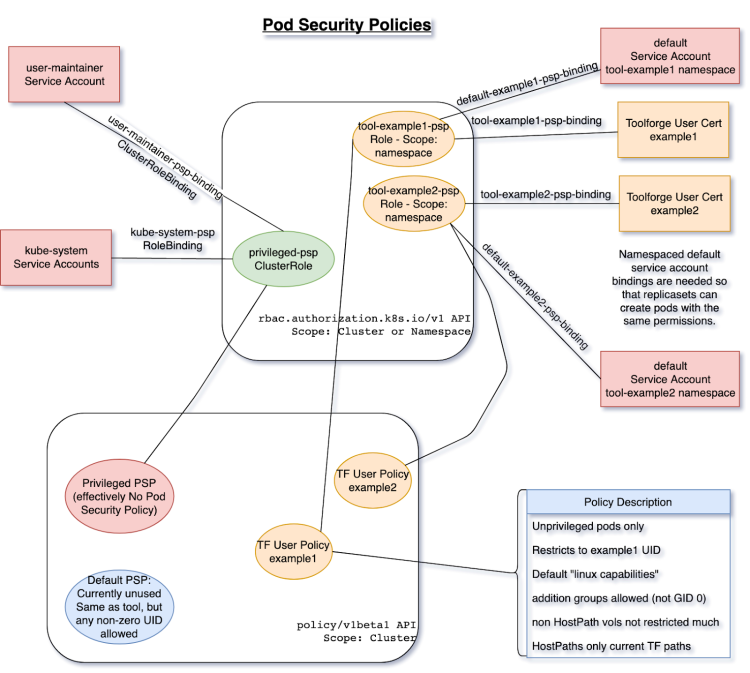
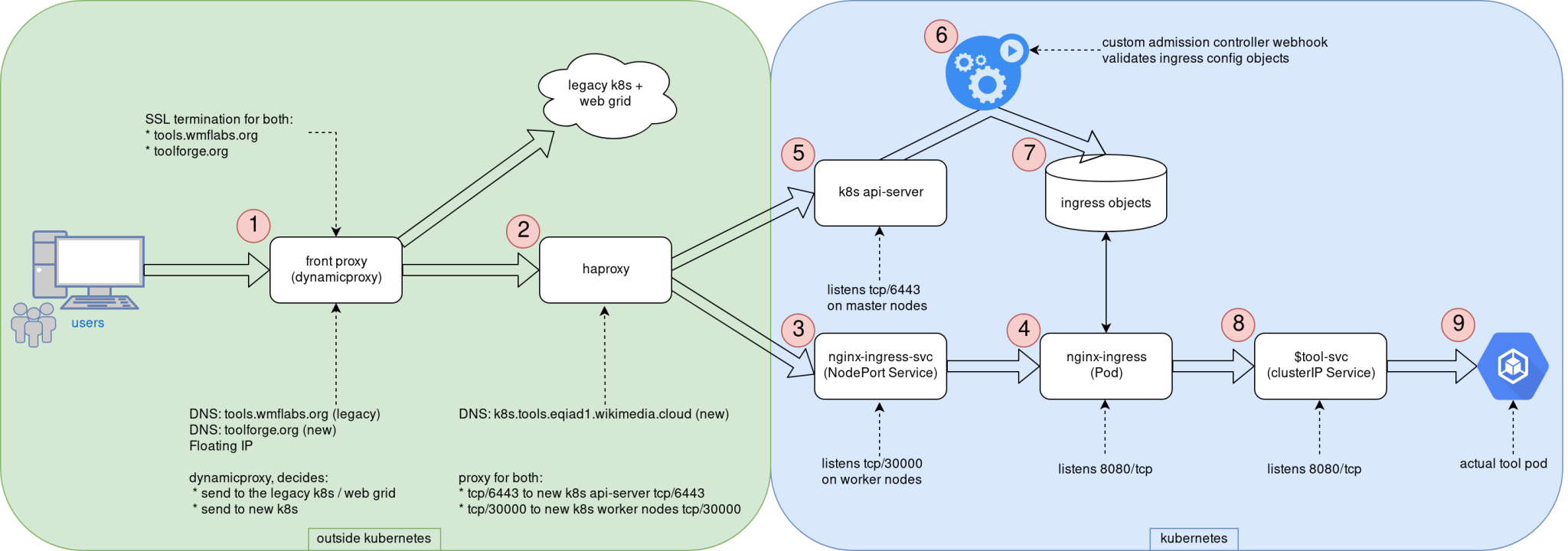
Logos This post was originally published in the Wikimedia Tech blog, and is authored by Arturo Borrero Gonzalez and Brooke Storm. In the previous post, we shared the context on the recent Kubernetes upgrade that we introduced in the Toolforge service. Today we would like to dive a bit more in the technical details. Custom admission controllers One of the key components of the Toolforge Kubernetes are our custom admission controllers. We use them to validate and enforce that the usage of the service is what we intended for. Basically, we have 2 of them: The source code is written in Golang, which is pretty convenient for natively working in a Kubernetes environment. Both code repositories include extensive documentation: how to develop, test, use, and deploy them. We decided to go with custom admission controllers because we couldn t find any native (or built-in) Kubernetes mechanism to accomplish the same sort of checks on user activity. With the Ingress controller, we want to ensure that Ingress objects only handle traffic to our internal domains, which by the time of this writing, are toolforge.org (our new domain) and tools.wmflabs.org (legacy). We safe-list the kube-system namespace and the tool-fourohfour namespace because both need special consideration. More on the Ingress setup later. The registry controller is pretty simple as well. It ensures that only our internal docker registry is used for user-scheduled containers running in Kubernetes. Again, we exclude from the checks containers running in the kube-system namespace (those used by Kubernetes itself). Other than that, the validation itself is pretty easy. For some extra containers we run (like those related to Prometheus metrics) what we do is simply upload those docker images to our internal registry. The controls provided by this admission controller helps us validate that only FLOSS software is run in our environment, which is one of the core rules of Toolforge. RBAC and Pod Security Policy setup I would like to comment next on our RBAC and Pod Security Policy setup. Using the Pod Security Policies (or PSP) we establish a set of constraints on what containers can and can t do in our cluster. We have many PSP configured in our setup: Each user can interact with their own namespace (this is how we achieve multi-tenancy in the cluster). Kubernetes knows about each user by means of TLS certs, and for that we have RBAC. Each user has a rolebinding to a shared cluster-role that defines how Toolforge tools can use the Kubernetes API. The following diagram shows the design of our RBAC and PSP in our cluster: RBAC and PSP for Toolforge diagram RBAC and PSP for Toolforge, original image in wikitech I mentioned that we know about each user by means of TLS certificates. This is true, and in fact, there is a key component in our setup called maintain-kubeusers. This custom piece of Python software is run as a pod inside the cluster and is responsible for reading our external user database (LDAP) and generating the required credentials, namespaces, and other configuration bits for them. With the TLS cert, we basically create a kubeconfig file that is then written into the homes NFS share, so each Toolforge user has it in their shell home directory. Networking and Ingress setup With the basic security controls in place, we can move on to explaining our networking and Ingress setup. Yes, the Ingress word might be a bit overloaded already, but we refer here to Ingress as the path that end-users follow from their web browser in their local machine to a webservice running in the Toolforge cluster. Some additional context here. Toolforge is not only Kubernetes, but we also have a Son of GridEngine deployment, a job scheduler that covers some features not available in Kubernetes. The grid can also run webservices, although we are encouraging users to migrate them to Kubernetes. For compatibility reasons, we needed to adapt our Ingress setup to accommodate the old web grid. Deciding the layout of the network and Ingress was definitely something that took us some time to figure out because there is not a single way to do it right. The following diagram can be used to explain the different steps involved in serving a web service running in the new Toolforge Kubernetes. Toolforge k8s network topology diagram Toolforge k8s network topology, original image in Wikitech The end-user HTTP/HTTPs request first hits our front proxy in (1). Running here is NGINX with a custom piece of LUA code that is able to decide whether to contact the web grid or the new Kubernetes cluster. TLS termination happens here as well, for both domains (toolforge.org and tools.wmflabs.org). Note this proxy is reachable from the internet, as it uses a public IPv4 address, a floating IP from CloudVPS, the infrastructure service we provide based on Openstack. Remember that our Kubernetes is directly built in virtual machines a bare-metal type deployment. If the request is directed to a webservice running in Kubernetes, the request now reaches haproxy in (2), which knows the cluster nodes that are available for Ingress. The original 80/TCP packet is now translated to 30000/TCP; this is the TCP port we use internally for the Ingress traffic. This haproxy instance provides load-balancing also for the Kubernetes API as well, using 6443/TCP. It s worth mentioning that unlike the Ingress, the API is only reachable from within the cluster and not from the internet. We have a NGINX-Ingress NodePort service listening in 30000/TCP in every Kubernetes worker node in (3); this helps the request to eventually reach the actual NGINX-Ingress pod in (4), which is listening in 8080/TCP. You can see in the diagram how in the API server (5) we hook the Ingress admission controller (6) to validate Kubernetes Ingress configuration objects before allowing them in for processing by NGINX-Ingress (7). The NGINX-Ingress process knows which tools webservices are online and how to contact them by means of an intermediate Service object in (8). This last Service object means the request finally reaches the actual tool pod in (9). At this point, it is worth noting that our Kubernetes cluster uses internally kube-proxy and Calico, both using Netfilter components to handle traffic. tools-webservice Most user-facing operations are simplified by means of another custom piece of Python code: tools-webservice. This package provides users with the webservice command line utility in our shell bastion hosts. Typical usage is to just run webservice start stop status. This utility creates all the required Kubernetes objects on-demand like Deployment, ReplicaSet, Ingress and Service to ease deploying web apps in Toolforge. Of course, advanced users can interact directly with Kubernetes API and create their custom configuration objects. This utility is just a wrapper, a shortcut. tool-fourohfour and tool-k8s-status The last couple of custom components we would like to mention are the tool-fourohfour and tool-k8s-status web services. These two utilities run inside the cluster as if they were any other user-created tool. The fourohfour tool allows for a controlled handling of HTTP 404 errors, and it works as the default NGINX-Ingress backend. The k8s-status tool shows plenty of information about the cluster itself and each tool running in the cluster, including links to the Server Admin Log, an auto-generated grafana dashboard for metrics, and more. For metrics, we use an external Prometheus server that contacts the Kubernetes cluster to scrape metrics. We created a custom metrics namespace in which we deploy all the different components we use to observe the behavior of the system: All the Prometheus data we collect is used in several different Grafana dashboards, some of them directed for user information like the ones linked by the k8s-status tool and some others for internal use by us the engineers. These are for internal use but are still public, like the Ingress specific dashboard, or the cluster state dashboard. Working publicly, in a transparent way, is key for the success of CloudVPS in general and Toolforge in particular. Like we commented in the previous post, all the engineering work that was done here was shared by community members. By the community, for the community We think this post sheds some light on how the Toolforge Kubernetes service works, and we hope it could inspire others when trying to build similar services or, even better, help us improve Toolforge itself. Since this was first put into production some months ago we detected already some margin for improvement in a couple of the components. As in many other engineering products, we will follow an iterative approach for evolving the service. Mind that Toolforge is maintained by the Wikimedia Foundation, but you can think of it as a service by the community for the community. We will keep an eye on it and have a list of feature requests and things to improve in the future. We are looking forward to it! This post was originally published in the Wikimedia Tech blog, and is authored by Arturo Borrero Gonzalez and Brooke Storm.

12 June 2020

Ulrike Uhlig: The right to demand change

Two women sit in an office, one asks: "What's the difference between being assertive and being aggressive?" The other replies: "Your gender." (Cartoon by Judy Horacek, 1999.) When a person of a marginalized group (read: a person with less privilege, a person with lower rank) is being framed and blamed as being aggressive, she is being told that her behavior is unacceptable. Marginalized people have learnt that they need to comply to fit, and are likely to suppress their feelings. By being framed as aggressive, the marginalized person is also being told that what they are saying cannot be listened to because the way they are saying it does not comply with expectations. There is a word for this: tone policing. This great comic by Robot Hugs has all the important details. Tone policing is a silencing tactic in which privileged participants of a discussion one-sidedly define the terms of the conversation. This tactic has the interesting side effect of shifting the responsibility to prove that one is not aggressive, hostile, explosive, a minefield, etc. to the person being framed and blamed - proving that one is worthy to be listened to. (Some of those words are actual quotes taken from real life.) Years ago, I worked in a company in which my female developer colleague would put herself in a state of overly expressed sorriness, all the while pretending to be stupid and helpless whenever she needed to ask anything from the sysadmins. When I confronted her with that, she replied: "I do it because it works." In the same company, another woman who generally asked assertively for what she needed ended up being insulted by one of the project managers using the word "dominatrix". While the example comes from my own experience, this kind of thing happens across any oppression/privilege boundaries. In some conversations, be they verbal or written, frustration and anger of one person are sometimes being mistaken by the communication partner for aggressiveness. Why is this happening? Asking a person with privilege to see, question, or change their behavior, questions their privilege. I'm thinking that it might be that most people think of themselves as "being good" and when they are being asked to question themselves or their behavior, their self-image is being challenged. "Me? But I did not do anything wrong! It's certainly not my fault if you are being oppressed! I sacrificed myself to reach my current position in life!" This comic by Toby Morris, "On a Plate", explains it quite nicely. So are we stuck with seeing conversations derail? I'd argue instead that while anger and frustration are unpleasant feelings, they're important: they show us that our boundaries have been crossed, that we want something to change, to stop, or that we need something different right now. We have the right to be angry and to demand change.

9 June 2020

Julian Andres Klode: Review: Chromebook Duet

Sporting a beautiful 10.1 1920x1200 display, the Lenovo IdeaPad Duet Chromebook or Duet Chromebook, is one of the latest Chromebooks released, and one of the few slate-style tablets, and it s only about 300 EUR (300 USD). I ve had one for about 2 weeks now, and here are my thoughts.

Build & Accessories The tablet is a fairly Pixel-style affair, in that the back has two components, one softer blue one housing the camera and a metal feeling gray one. Build quality is fairly good. The volume and power buttons are located on the right side of the tablet, and this is one of the main issues: You end up accidentally pressing the power button when you want to turn your volume lower, despite the power button having a different texture. Alongside the tablet, you also find a kickstand with a textile back, and a keyboard, both of which attach via magnets (and pogo pins for the keyboard). The keyboard is crammed, with punctuation keys being halfed in size, and it feels mushed compared to my usual experiences of ThinkPads and Model Ms, but it s on par with other Chromebooks, which is surprising, given it s a tablet attachment.
fully assembled chromebook duet fully assembled chromebook duet
I mostly use the Duet as a tablet, and only attach the keyboard occasionally. Typing with the keyboard on your lap is suboptimal. My first Duet had a few bunches of dead pixels, so I returned it, as I had a second one I could not cancel ordered as well. Oh dear. That one was fine!

Hardware & Connectivity The Chromebook Duet is powered by a Mediatek Helio P60T SoC, 4GB of RAM, and a choice of 64 or 128 GB of main storage. The tablet provides one USB-C port for charging, audio output (a 3.5mm adapter is provided in the box), USB hub, and video output; though, sadly, the latter is restricted to a maximum of 1080p30, or 1440x900 at 60 Hz. It can be charged using the included 10W charger, or use up to I believe 18W from a higher powered USB-C PD charger. I ve successfully used the Chromebook with a USB-C monitor with attached keyboard, mouse, and DAC without any issues. On the wireless side, the tablet provides 2x2 Wifi AC and Bluetooth 4.2. WiFi reception seemed just fine, though I have not done any speed testing, missing a sensible connection at the moment. I used Bluetooth to connect to my smartphone for instant tethering, and my Sony WH1000XM2 headphones, both of which worked without any issues. The screen is a bright 400 nit display with excellent viewing angles, and the speakers do a decent job, meaning you can use easily use this for watching a movie when you re alone in a room and idling around. It has a resolution of 1920x1200. The device supports styluses following the USI standard. As of right now, the only such stylus I know about is an HP one, and it costs about 70 or so. Cameras are provided on the front and the rear, but produce terrible images.

Software: The tablet experience The Chromebook Duet runs Chrome OS, and comes with access to Android apps using the play store (and sideloading in dev mode) and access to full Linux environments powered by LXD inside VMs. The screen which has 1920x1200 is scaled to a ridiculous 1080x675 by default which is good for being able to tap buttons and stuff, but provides next to no content. Scaling it to 1350x844 makes things more balanced. The Linux integration is buggy. Touches register in different places than where they happened, and the screen is cut off in full screen extremetuxracer, making it hard to recommend for such uses. Android apps generally work fine. There are some issues with the back gesture not registering, but otherwise I have not found issues I can remember. One major drawback as a portable media consumption device is that Android apps only work in Widevine level 3, and hence do not have access to HD content, and the web apps of Netflix and co do not support downloading. Though one of the Duets actually said L1 in check apps at some point (reported in issue 1090330). It s also worth noting that Amazon Prime Video only renders in HD, unless you change your user agent to say you are Chrome on Windows - bad Amazon! The tablet experience also lags in some other ways, as the palm rejection is overly extreme, causing it to reject valid clicks close to the edge of the display (reported in issue 1090326). The on screen keyboard is terrible. It only does one language at a time, forcing me to switch between German and English all the time, and does not behave as you d expect it when editing existing words - it does not know about them and thinks you are starting a new one. It does provide a small keyboard that you can move around, as well as a draw your letters keyboard, which could come in handy for stylus users, I guess. In any case, it s miles away from gboard on Android. Stability is a mixed bag right now. As of Chrome OS 83, sites (well only Disney+ so far ) sometimes get killed with SIGILL or SIGTRAP, and the device rebooted on its own once or twice. Android apps that use the DRM sometimes do not start, and the Netflix Android app sometimes reports it cannot connect to the servers.

Performance Performance is decent to sluggish, with micro stuttering in a lot of places. The Mediatek CPU is comparable to Intel Atoms, and with only 4GB of RAM, and an entire Android container running, it s starting to show how weak it is. I found that Google Docs worked perfectly fine, as did websites such as Mastodon, Twitter, Facebook. Where the device really struggled was Reddit, where closing or opening a post, or getting a reply box could take 5 seconds or more. If you are looking for a Reddit browsing device, this is not for you. Performance in Netflix was fine, and Disney+ was fairly slow but still usable. All in all, it s acceptable, and given the price point and the build quality, probably the compromise you d expect.

Summary tl;dr:
  • good: Build quality, bright screen, low price, included accessories
  • bad: DRM issues, performance, limited USB-C video output, charging speed, on-screen keyboard, software bugs
The Chromebook Duet or IdeaPad Duet Chromebook is a decent tablet that is built well above its price point. It s lackluster performance and DRM woes make it hard to give a general recommendation, though. It s not a good laptop. I can see this as the perfect note taking device for students, and as a cheap tablet for couch surfing, or as your on-the-go laptop replacement, if you need it only occasionally. I cannot see anyone using this as their main laptop, although I guess some people only have phones these days, so: what do I know? I can see you getting this device if you want to tinker with Linux on ARM, as Chromebooks are quite nice to tinker with, and a tablet is super nice.

Molly de Blanc: Racism is a Free Software Issue

Racism is a free software issue. I gave a talk that touched on this at CopyLeft Conf 2019. I also talked a little bit about it at All Things Open 2019 and FOSDEM 2020 in my talk The Ethics Behind Your IoT. I know statistics, theory, and free software. I don t know about race and racism nearly as well. I might make mistakes I have made some and I will make more. Please, when I do, help me do better. I want to look at a few particular technologies and think about how they reinforce systemic racism. Worded another way: how is technology racist? How does technology hurt Black Indigenous People of Color (BIPOC)? How does technology keep us racist? How does technology make it easier to be racist?

Breathalyzers In the United States, Latinx folks are less likely to drink than white people and, overall, less likely to be arrested for DUIs3,4. However, they are more likely to be stopped by police while driving5,6. Who is being stopped by police is up to the police and they pull over a disproportionate number of Latinx drivers. After someone is pulled over for suspected drunk driving, they are given a breathalyzer test. Breathalyzers are so easy to (un)intentionally mis-calibrate that they have been banned as valid evidence in multiple states. The biases of the police are not canceled out by the technology that should, in theory, let us know whether someone is actually drunk.

Facial Recognition I could talk about for quite some time and, in fact, have. So have others. Google s image recognition software recognized black people as gorillas and to fix the issue it removed gorillas from it s image-labeling technology. Facial recognition software does a bad job at recognizing black people. In fact, it s also terrible at identifying indigenous people and other people of color. (Incidentally, it s also not great at recognizing women, but let s not talk about that right now.) As we use facial recognition technology for more things, from automated store checkouts (even more relevant in the socially distanced age of Covid-19), airport ticketing, phone unlocking, police identification, and a number of other things, it becomes a bigger problem that this software cannot tell the difference between two Asian people.

Targeted Advertising Black kids see 70% more online ads for food than white kids, and twice as many ads for junk food. In general BIPOC youth are more likely to see junk food advertisements online. This is intentional, and happens after they are identified as BIPOC youth.

Technology Reinforces Racism; Racism Builds Technology The technology we have developed reinforces racism on a society wide scale because it makes it harder for BIPOC people to interact with this world that is run by computers and software. It s harder to not be racist when the technology around us is being used to perpetuate racist paradigms. For example, if a store implements facial recognition software for checkout, black women are less likely to be identified. They are then more likely to be targeted as trying to steal from the store. We are more likely to take this to mean that black women are more likely to steal. This is how technology builds racism, People are being excluded largely because they are not building these technologies, because they are not welcome in our spaces. There simply are not enough Black and Hispanic technologists and that is a problem. We need to care about this because when software doesn t work for everyone, it doesn t work. We cannot build on the promise of free and open source software when we are excluding the majority of people.

Dirk Eddelbuettel: RcppArmadillo 0.9.900.1.0

armadillo image Armadillo is a powerful and expressive C++ template library for linear algebra aiming towards a good balance between speed and ease of use with a syntax deliberately close to a Matlab. RcppArmadillo integrates this library with the R environment and language and is widely used by (currently) 727 other packages on CRAN. Conrad recently released a new upstream version 9.900.1 of Armadillo which we packaged and tested as usual first as a release candidate build and then as the release. As usual, logs from reverse-depends runs are in the rcpp-logs repo. Apart from the new upstream release, we updated Travis use, ornamented the README a little, and smoothed over a rough corner from the recent R 4.0.0 release. All changes in the new release are noted below.

Changes in RcppArmadillo version 0.9.900.1.0 (2020-06-08)
  • Upgraded to Armadillo release 9.900.1 (Nocturnal Misbehaviour)
    • faster solve() for under/over-determined systems
    • faster eig_gen() and eig_pair() for large matrices
    • expanded eig_gen() and eig_pair() to optionally provide left and right eigenvectors
  • Switch Travis CI testing to R 4.0.0, use bionic as base distro and test R 3.6.3 and 4.0.0 in a matrix (Dirk in #298).
  • Add two badges to README for indirect use and the CSDA paper.
  • Adapt RcppArmadillo.package.skeleton() to a change in R 4.0.0 affecting what it exports in NAMESPACE.

Courtesy of CRANberries, there is a diffstat report relative to previous release. More detailed information is on the RcppArmadillo page. Questions, comments etc should go to the rcpp-devel mailing list off the R-Forge page. If you like this or other open-source work I do, you can now sponsor me at GitHub. For the first year, GitHub will match your contributions.

This post by Dirk Eddelbuettel originated on his Thinking inside the box blog. Please report excessive re-aggregation in third-party for-profit settings.

1 June 2020

Debian GSoC Kotlin project blog: Kotlin Update

A Quick Recap from last year: Kotlin is being packaged under the Google Summer of Code within the Debian organization itself. The major reason behind bringing Kotlin in Debian is to update all the Android packages which are now heavily dependent upon the Kotlin libraries. The major work to bring Kotlin into Debian is done for the version 1.3.30, by Saif Abdul Cassim (goes by m36 on IRC) as a part of his GSoC'2019. All his contributions to the team can be found in his blog posts. So, for now, we have a bootstrap package and a Kotlin package for the version with 1.3.30. There were still changes needed as we lacked some of the dependencies for Kotlin, and the source package lacked copyright information and didn t comply with Debian standards. What's the present year brought for Kotlin? To be specific the following were mainly left dependencies for Kotlin: And, we lack documentation for the newbies in order to get them started :( Most importantly the crucial part was and still is, to figure out how to upload the package? For GSoC'20, three students are selected as a part of project Android SDK tools in Debian. What's the work done/left? Work Done What's Blocking? What is the problem being faced? The Kotlin-Bootstrap package consists of JAR files for various dependencies of kotlin such as Gradle, kotlin compiler, and kotlinx. The package is added to the build-depends of the main package so that the JAR files can be provided. Since the kotlin-bootstrap consists of binaries (JAR files), it is not feasible to upload the package as free software. The other workaround was the Gradle 6.4 version, which consists of Kotlin files and generates a suitable JAR. But since the package needed Kotlin language itself, it was never updated, as it created a cyclic dependency. Final workaround came, which proposed Kotlin to build from itself, that was a pretty impressive suggestion. But, we still have to look if the solution is feasible? Because, as far as I last checked and conversed with ebourg on the mailing list here, Emmanuel Bbourg mentioned very clearly that the rebuilt package is our interest. So, this is under WIP. But, I fail to acknowledge the fact if we can drop the kotlin-bootstrap package totally, Kotlin will not be able to be built because each and every JAR file present in the bootstrap is needed. That pretty much is the ongoing work and the update on the kotlin package. We intend to bring Kotlin to the Debian Archive as soon as possible :) Have any queries or suggestions for Kotlin? Please feel to drop a message at #debian-mobile channel on OFTC.

Paul Wise: FLOSS Activities May 2020

Focus This month I didn't have any particular focus. I just worked on issues in my info bubble.

Changes

Issues

Review

Administration
  • nsntrace: talk to upstream about collaborative maintenance
  • Debian: deploy changes, debug issue with GPS markers file generation, migrate bls/DUCK from alioth-archive to salsa
  • Debian website: ran map cron job, synced mirrors
  • Debian wiki: approve accounts, ping folks with bouncing email

Communication

Sponsors The apt-offline work and the libfile-libmagic-perl backports were sponsored. All other work was done on a volunteer basis.

31 May 2020

Chris Lamb: Free software activities in May 2020

Here is my monthly update covering what I have been doing in the free software world during May 2020 (previous month): In Lintian, the static analysis tool for Debian packages:
Reproducible builds One of the original promises of open source software is that distributed peer review and transparency of process results in enhanced end-user security. However, whilst anyone may inspect the source code of free and open source software for malicious flaws, almost all software today is distributed as pre-compiled binaries. This allows nefarious third-parties to compromise systems by injecting malicious code into ostensibly secure software during the various compilation and distribution processes. The motivation behind the Reproducible Builds effort is to ensure no flaws have been introduced during this compilation process by promising identical results are always generated from a given source, thus allowing multiple third-parties to come to a consensus on whether a build was compromised. The initiative is proud to be a member project of the Software Freedom Conservancy, a not-for-profit 501(c)(3) charity focused on ethical technology and user freedom. Conservancy acts as a corporate umbrella allowing projects to operate as non-profit initiatives without managing their own corporate structure. If you like the work of the Conservancy or the Reproducible Builds project, please consider becoming an official supporter.
Elsewhere in our tooling, I made the following changes to diffoscope, our in-depth and content-aware diff utility that can locate and diagnose reproducibility issues, including preparing and uploading versions 142, 143, 144, 145 and 146 to Debian: I also performed a huge overhaul of diffoscope's website:
Lastly, I made a large number of changes to the main Reproducible Builds website and documentation:
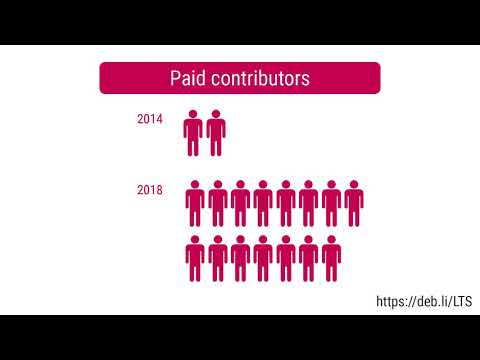
Debian LTS This month I contributed 17 hours to Debian Long Term Support (LTS) and 9 hours on its sister Extended LTS project. You can find out more about the two projects via the following video:
Debian I filed the following bug reports in Debian this month: I also filed a number of bugs against packages that are not compatible with Django 3.x, (organised around a single master bug) including django-taggit, sorl-thumbnail, django-simple-captcha, django-cas-server, django-cors-headers, python-django-csp, django-pipeline, python-django-jsonfield, python-django-contact-form, django-model-utils, django-fsm, django-modeltranslation, django-oauth-toolkit, libthumbor, python-django-extensions, python-django-imagekit, python-django-navtag, python-django-tagging, djangorestframework, django-haystack, django-taggit, django-simple-captcha, python-django-registration, python-django-pyscss, python-django-compressor, python-django-crispy-forms & python-django-mptt,
Lastly, I made the following uploads to Debian: I also sponsored an upload for adminer (4.7.7-1), also uploading it to buster-backports.

30 May 2020

Sean Whitton: GNU Emacs' Transient Mark mode

Something I ve found myself doing as the pandemic rolls on is picking out and (re-)reading through sections of the GNU Emacs manual and the GNU Emacs Lisp reference manual. This has got me (too) interested in some of the recent history of Emacs development, and I did some digging into archives of emacs-devel from 2008 (15M mbox) regarding the change to turn Transient Mark mode on by default and set mark-even-if-inactive to true by default in Emacs 23.1. It s not always clear which objections to turning on Transient Mark mode by default take into account the mark-even-if-inactive change. I think that turning on Transient Mark mode along with mark-even-if-inactive is a good default. The question that remains is whether the disadvantages of Transient Mark mode are significant enough that experienced Emacs users should consider altering Emacs default behaviour to mitigate them. Here s one popular blog arguing for some mitigations. How might Transient Mark mode be disadvantageous? The suggestion is that it makes using the mark for navigation rather than for acting on regions less convenient:
  1. setting a mark just so you can jump back to it (i) is a distinct operation you have to think of separately; and (ii) requires two keypresses, C-SPC C-SPC, rather than just one keypress
  2. using exchange-point-and-mark activates the region, so to use it for navigation you need to use either C-u C-x C-x or C-x C-x C-g, neither of which are convenient to type, or else it will be difficult to set regions at the place you ve just jumped to because you ll already have one active.
There are two other disadvantages that people bring up which I am disregarding. The first is that it makes it harder for new users to learn useful ways in which to use the mark when it s deactivated. This happened to me, but it can be mitigated without making any behavioural changes to Emacs. The second is that the visual highlighting of the region can be distracting. So far as I can tell, this is only a problem with exchange-point-and-mark, and it s subsumed by the problem of that command actually activating the region. The rest of the time Emacs automatic deactivation of the region seems sufficient. How might disabling Transient Mark mode be disadvantageous? When Transient Mark mode is on, many commands will do something usefully different when the mark is active. The number of commands in Emacs which work this way is only going to increase now that Transient Mark mode is the default. If you disable Transient Mark mode, then to use those features you need to temporarily activate Transient Mark mode. This can be fiddly and/or require a lot of keypresses, depending on exactly where you want to put the region. Without being able to see the region, it might be harder to know where it is. Indeed, this is one of the main reasons for wanting Transient Mark mode to be the default, to avoid confusing new users. I don t think this is likely to affect experienced Emacs users often, however, and on occasions when more precision is really needed, C-u C-x C-x will make the region visible. So I m not counting this as a disadvantage. How might we mitigate these two sets of disadvantages? Here are the two middle grounds I m considering. Mitigation #1: Transient Mark mode, but hack C-x C-x behaviour
(defun spw/exchange-point-and-mark (arg)
  "Exchange point and mark, but reactivate mark a bit less often.

Specifically, invert the meaning of ARG in the case where
Transient Mark mode is on but the region is inactive."
  (interactive "P")
  (exchange-point-and-mark
   (if (and transient-mark-mode (not mark-active))
       (not arg)
     arg)))
(global-set-key [remap exchange-point-and-mark] &aposspw/exchange-point-and-mark)
We avoid turning Transient Mark mode off, but mitigate the second of the two disadvantages given above. I can t figure out why it was thought to be a good idea to make C-x C-x reactivate the mark and require C-u C-x C-x to use the action of exchanging point and mark as a means of navigation. There needs to a binding to reactivate the mark, but in roughly ten years of having Transient Mark mode turned on, I ve found that the need to reactivate the mark doesn t come up often, so the shorter and longer bindings seem the wrong way around. Not sure what I m missing here. Mitigation #2: disable Transient Mark mode, but enable it temporarily more often
(setq transient-mark-mode nil)
(defun spw/remap-mark-command (command &optional map)
  "Remap a mark-* command to temporarily activate Transient Mark mode."
  (let* ((cmd (symbol-name command))
         (fun (intern (concat "spw/" cmd)))
         (doc (concat "Call  "
                      cmd
                      "&apos and temporarily activate Transient Mark mode.")))
    (fset fun  (lambda ()
                 ,doc
                 (interactive)
                 (call-interactively #&apos,command)
                 (activate-mark)))
    (if map
        (define-key map (vector &aposremap command) fun)
      (global-set-key (vector &aposremap command) fun))))
(dolist (command &apos(mark-word
                   mark-sexp
                   mark-paragraph
                   mark-defun
                   mark-page
                   mark-whole-buffer))
  (spw/remap-mark-command command))
(with-eval-after-load &aposorg
  (spw/remap-mark-command &aposorg-mark-element org-mode-map)
  (spw/remap-mark-command &aposorg-mark-subtree org-mode-map))
;; optional
(global-set-key "\M-=" (lambda () (interactive) (activate-mark)))
;; resettle the previous occupant
(global-set-key "\C-cw" &aposcount-words-region)
Here we remove both of the disadvantages of Transient Mark mode given above, and mitigate the main disadvantage of not activating Transient Mark mode by making it more convenient to activate it temporarily. For example, this enables using C-M-SPC C-M-SPC M-( to wrap the following two function arguments in parentheses. And you can hit M-h a few times to mark some blocks of text or code, then operate on them with commands like M-% and C-/ which behave differently when the region is active.1 Comparing these mitigations Both of these mitigations handle the second of the two disadvantages of Transient Mark mode given above. What remains, then, is
  1. under the effects of mitigation #1, how much of a barrier to using marks for navigational purposes is it to have to press C-SPC C-SPC instead of having a single binding, C-SPC, for all manual mark setting2
  2. under the effects of mitigation #2, how much of a barrier to taking advantage of commands which act differently when the region is active is it to have to temporarily enable Transient Mark mode with C-SPC C-SPC, M-= or one of the mark-* commands?
These are unknowns.3 So I m going to have to experiment, I think, to determine which mitigation to use, if either. In particular, I don t know whether it s really significant that setting a mark for navigational purposes and for region marking purposes are distinct operations under mitigation #1. My plan is to start with mitigation #2 because that has the additional advantage of allowing me to confirm or disconfirm my belief that not being able to see where the region is will only rarely get in my way.

  1. The idea of making the mark-* commands activate the mark comes from an emacs-devel post by Stefan Monnier in the archives linked above.
  2. One remaining possibility I m not considering is mitigation #1 plus binding something else to do the same as C-SPC C-SPC. I don t believe there are any easily rebindable keys which are easier to type than typing C-SPC twice. And this does not deal with the two distinct mark-setting operations problem.
  3. Another way to look at this is the question of which of setting a mark for navigational purposes and activating a mark should get C-SPC and which should get C-SPC C-SPC.

27 May 2020

Kees Cook: security things in Linux v5.5

Previously: v5.4. I got a bit behind on this blog post series! Let s get caught up. Here are a bunch of security things I found interesting in the Linux kernel v5.5 release: restrict perf_event_open() from LSM
Given the recurring flaws in the perf subsystem, there has been a strong desire to be able to entirely disable the interface. While the kernel.perf_event_paranoid sysctl knob has existed for a while, attempts to extend its control to block all perf_event_open() calls have failed in the past. Distribution kernels have carried the rejected sysctl patch for many years, but now Joel Fernandes has implemented a solution that was deemed acceptable: instead of extending the sysctl, add LSM hooks so that LSMs (e.g. SELinux, Apparmor, etc) can make these choices as part of their overall system policy. generic fast full refcount_t
Will Deacon took the recent refcount_t hardening work for both x86 and arm64 and distilled the implementations into a single architecture-agnostic C version. The result was almost as fast as the x86 assembly version, but it covered more cases (e.g. increment-from-zero), and is now available by default for all architectures. (There is no longer any Kconfig associated with refcount_t; the use of the primitive provides full coverage.) linker script cleanup for exception tables
When Rick Edgecombe presented his work on building Execute-Only memory under a hypervisor, he noted a region of memory that the kernel was attempting to read directly (instead of execute). He rearranged things for his x86-only patch series to work around the issue. Since I d just been working in this area, I realized the root cause of this problem was the location of the exception table (which is strictly a lookup table and is never executed) and built a fix for the issue and applied it to all architectures, since it turns out the exception tables for almost all architectures are just a data table. Hopefully this will help clear the path for more Execute-Only memory work on all architectures. In the process of this, I also updated the section fill bytes on x86 to be a trap (0xCC, int3), instead of a NOP instruction so functions would need to be targeted more precisely by attacks. KASLR for 32-bit PowerPC
Joining many other architectures, Jason Yan added kernel text base-address offset randomization (KASLR) to 32-bit PowerPC. seccomp for RISC-V
After a bit of long road, David Abdurachmanov has added seccomp support to the RISC-V architecture. The series uncovered some more corner cases in the seccomp self tests code, which is always nice since then we get to make it more robust for the future! seccomp USER_NOTIF continuation
When the seccomp SECCOMP_RET_USER_NOTIF interface was added, it seemed like it would only be used in very limited conditions, so the idea of needing to handle normal requests didn t seem very onerous. However, since then, it has become clear that the overhead of a monitor process needing to perform lots of normal open() calls on behalf of the monitored process started to look more and more slow and fragile. To deal with this, it became clear that there needed to be a way for the USER_NOTIF interface to indicate that seccomp should just continue as normal and allow the syscall without any special handling. Christian Brauner implemented SECCOMP_USER_NOTIF_FLAG_CONTINUE to get this done. It comes with a bit of a disclaimer due to the chance that monitors may use it in places where ToCToU is a risk, and for possible conflicts with SECCOMP_RET_TRACE. But overall, this is a net win for container monitoring tools. EFI_RNG_PROTOCOL for x86
Some EFI systems provide a Random Number Generator interface, which is useful for gaining some entropy in the kernel during very early boot. The arm64 boot stub has been using this for a while now, but Dominik Brodowski has now added support for x86 to do the same. This entropy is useful for kernel subsystems performing very earlier initialization whre random numbers are needed (like randomizing aspects of the SLUB memory allocator). FORTIFY_SOURCE for MIPS
As has been enabled on many other architectures, Dmitry Korotin got MIPS building with CONFIG_FORTIFY_SOURCE, so compile-time (and some run-time) buffer overflows during calls to the memcpy() and strcpy() families of functions will be detected. limit copy_ to,from _user() size to INT_MAX
As done for VFS, vsnprintf(), and strscpy(), I went ahead and limited the size of copy_to_user() and copy_from_user() calls to INT_MAX in order to catch any weird overflows in size calculations. Other things
Alexander Popov pointed out some more v5.5 features that I missed in this blog post. I m repeating them here, with some minor edits/clarifications. Thank you Alexander! Edit: added Alexander Popov s notes That s it for v5.5! Let me know if there s anything else that I should call out here. Next up: Linux v5.6.

2020, Kees Cook. This work is licensed under a Creative Commons Attribution-ShareAlike 3.0 License.
Creative Commons License

Russ Allbery: Review: Middlegame

Review: Middlegame, by Seanan McGuire
Publisher: Tor
Copyright: May 2019
ISBN: 1-250-19551-9
Format: Kindle
Pages: 528
Roger and Dodger are cuckoo children, alchemical constructs created by other alchemical constructs masquerading as humans. They are halves of the primal force of the universe, the Doctrine of Ethos (which is not what the Doctrine of Ethos is, but that is one of my lesser problems with this book), divided into language and math and kept separate to properly mature. In this case, separate means being adopted by families on opposite coasts of the United States, ignorant of each other's existence and closely monitored by agents Reed controls. None of that prevents Roger and Dodger from becoming each other's invisible friends at the age of seven, effortlessly communicating psychically even though they've never met. That could have been the start of an enjoyable story that hearkened back to an earlier age of science fiction: the secret science experiments discover that they have more power than their creators expected, form a clandestine alliance, and fight back against the people who are trying to control them. I have fond memories of Escape to Witch Mountain and would have happily read that book. Unfortunately, that isn't the story McGuire wanted to tell. The story she told involves ripping Roger and Dodger apart, breaking Dodger, and turning Roger into an abusive asshole. Whooboy, where to start. This book made me very angry, in a way that I would not have been if it didn't contain the bones of a much better novel. Four of them, to be precise: four other books that would have felt less gratuitously cruel and less apparently oblivious to just how bad Roger's behavior is. There are some things to like. One of them is that the structure of this book is clever. I can't tell you how it's clever because the structure doesn't become clear until more than halfway through and it completely changes the story in a way that would be a massive spoiler. But it's an interesting spin on an old idea, one that gave Roger and Dodger a type of agency in the story that has far-ranging implications. I enjoyed thinking about it. That leads me to another element I liked: Erin. She makes only fleeting appearances until well into the story, but I thought she competed with Dodger for being the best character of the book. The second of the better novels I saw in the bones of Middlegame was the same story told from Erin's perspective. I found myself guessing at her motives and paying close attention to hints that led to a story with a much different emotional tone. Viewing the ending of the book through her eyes instead of Roger and Dodger's puts it in a different, more complicated, and more thought-provoking light. Unfortunately, she's not McGuire's protagonist. She instead is one of the monsters of this book, which leads to my first, although not my strongest, complaint. It felt like McGuire was trying too hard to write horror, packing Middlegame with the visuals of horror movies without the underlying structure required to make them effective. I'm not a fan of horror personally, so to some extent I'm grateful that the horrific elements were ineffective, but it makes for some frustratingly bad writing. For example, one of the longest horror scenes in the book features Erin, and should be a defining moment for the character. Unfortunately, it's so heavy on visuals and so focused on what McGuire wants the reader to be thinking that it doesn't show any of the psychology underlying Erin's decisions. The camera is pointed the wrong way; all the interesting storytelling work, moral complexity, and world-building darkness is happening in the character we don't get to see. And, on top of that, McGuire overuses foreshadowing so much that it robs the scene of suspense and terror. Again, I'm partly grateful, since I don't read books for suspense and terror, but it means the scene does only a fraction of the work it could. This problem of trying too hard extends to the writing. McGuire has a bit of a tendency in all of her books to overdo the descriptions, but is usually saved by narrative momentum. Unfortunately, that's not true here, and her prose often seems overwrought. She also resorts to this style of description, which never fails to irritate me:
The thought has barely formed when a different shape looms over him, grinning widely enough to show every tooth in its head. They are even, white, and perfect, and yet he somehow can't stop himself from thinking there's something wrong with them, that they're mismatched, that this assortment of teeth was never meant to share a single jaw, a single terrible smile.
This isn't effective. This is telling the reader how they're supposed to feel about the thing you're describing, without doing the work of writing a description that makes them feel that way. (Also, you may see what I mean by overwrought.) That leads me to my next complaint: the villains. My problem is not so much with Leigh, who I thought was an adequate monster, if a bit single-note. There's some thought and depth behind her arguments with Reed, a few hints of her own motives that were more convincing for not being fully shown. The descriptions of how dangerous she is were reasonably effective. She's a good villain for this type of dark fantasy story where the world is dangerous and full of terrors (and reminded me of some of the villains from McGuire's October Daye series). Reed, though, is a storytelling train wreck. The Big Bad of the novel is the least interesting character in it. He is a stuffed tailcoat full of malicious incompetence who is only dangerous because the author proclaims him to be. It only adds insult to injury that he kills off a far more nuanced and creative villain before the novel starts, replacing her ambiguous goals with Snidely Whiplash mustache-twirling. The reader has to suffer through extended scenes focused on him as he brags, monologues, and obsesses over his eventual victory without an ounce of nuance or subtlety. Worse is the dynamic between him and Leigh, which is only one symptom of the problem with Middlegame that made me the most angry: the degree to this book oozes patriarchy. Every man in this book, including the supposed hero, orders around the women, who are forced in various ways to obey. This is the most obvious between Leigh and Reed, but it's the most toxic, if generally more subtle, between Roger and Dodger. Dodger is great. I had absolutely no trouble identifying with and rooting for her as a character. The nasty things that McGuire does to her over the course of the book (and wow does that never let up) made me like her more when she tenaciously refuses to give up. Dodger is the math component of the Doctrine of Ethos, and early in the book I thought McGuire handled that well, particularly given how difficult it is to write a preternatural genius. Towards the end of this book, her math sadly turns into a very non-mathematical magic (more on this in a moment), but her character holds all the way through. It felt like she carved her personality out of this story through sheer force of will and clung to it despite the plot. I wanted to rescue her from this novel and put her into a better book, such as the one in which her college friends (who are great; McGuire is very good at female friendships when she writes them) stage an intervention, kick a few people out of her life, and convince her to trust them. Unfortunately, Dodger is, by authorial fiat, half of a bound pair, and the other half of that pair is Roger, who is the sort of nice guy everyone likes and thinks is sweet and charming until he turns into an emotional trap door right when you need him the most and dumps you into the ocean to drown. And then somehow makes you do all the work of helping him feel better about his betrayal. The most egregious (and most patriarchal) thing Roger does in this book is late in the book and a fairly substantial spoiler, so I can't rant about that properly. But even before that, Roger keeps doing the the same damn emotional abandonment trick, and the book is heavily invested into justifying it and making excuses for him. Excuses that, I should note, are not made for Dodger; her failings are due to her mistakes and weaknesses, whereas Roger's are natural reactions to outside forces. I got very, very tired of this, and I'm upset by how little awareness the narrative voice showed for how dysfunctional and abusive this relationship is. The solution is always for Dodger to reunite with Roger; it's built into the structure of the story. I have a weakness for the soul-bound pair, in part from reading a lot of Mercedes Lackey at an impressionable age, but one of the dangerous pitfalls of the concept is that the characters then have to have an almost flawless relationship. If not, it can turn abusive very quickly, since the characters by definition cannot leave each other. It's essentially coercive, so as soon as the relationship shows a dark side, the author needs to be extremely careful. McGuire was not. There is an attempted partial patch, late in the book, for the patriarchal structure. One of the characters complains about it, and another says that the gender of the language and math pairs is random and went either way in other pairs. Given that both of the pairs that we meet in this story have the same male-dominant gender dynamic, what I took from this is that McGuire realized there was a problem but wasn't able to fix it. (I'm also reminded of David R. Henry's old line that it's never a good sign when the characters start complaining about the plot.) The structural problems are all the more frustrating because I think there were ways out of them. Roger is supposedly the embodiment of language, not that you'd be able to tell from most scenes in this novel. For reasons that I do not understand, McGuire expressed that as a love of words: lexicography, translation, and synonyms. This makes no sense to me. Those are some of the more structured and rules-based (and hence mathematical) parts of language. If Roger had instead been focused on stories collecting them, telling them, and understanding why and how they're told he would have had a clearer contrast with Dodger. More importantly, it would have solved the plot problem that McGuire solved with a nasty bit of patriarchy. So much could have been done with Dodger building a structure of math around Roger's story-based expansion of the possible, and it would have grounded Dodger's mathematics in something more interesting than symbolic magic. To me, it's such an obvious lost opportunity. I'm still upset about this book. McGuire does a lovely bit of world-building with Asphodel Baker, what little we see of her. I found the hidden alchemical war against her work by L. Frank Baum delightful, and enjoyed every excerpt from the fictional Over the Woodward Wall scattered throughout Middlegame. But a problem with inventing a fictional book to excerpt in a real novel is that the reader may decide that the fictional book sounds a lot better than the book they're reading, and start wishing they could just read that book instead. That was certainly the case for me. I'm sad that Over the Woodward Wall doesn't exist, and am mostly infuriated by Middlegame. Dodger and Erin deserved to live in a better book. Should you want to read this anyway (and I do know people who liked it), serious content warning for self-harm. Rating: 4 out of 10

18 May 2020

Fran ois Marier: Displaying client IP address using Apache Server-Side Includes

If you use a Dynamic DNS setup to reach machines which are not behind a stable IP address, you will likely have a need to probe these machines' public IP addresses. One option is to use an insecure service like Oracle's http://checkip.dyndns.com/ which echoes back your client IP, but you can also do this on your own server if you have one. There are multiple options to do this, like writing a CGI or PHP script, but those are fairly heavyweight if that's all you need mod_cgi or PHP for. Instead, I decided to use Apache's built-in Server-Side Includes.

Apache configuration Start by turning on the include filter by adding the following in /etc/apache2/conf-available/ssi.conf:
AddType text/html .shtml
AddOutputFilter INCLUDES .shtml
and making that configuration file active:
a2enconf ssi
Then, find the vhost file where you want to enable SSI and add the following options to a Location or Directory section:
<Location /ssi_files>
    Options +IncludesNOEXEC
    SSLRequireSSL
    Header set Content-Security-Policy: "default-src 'none'"
    Header set X-Content-Type-Options: "nosniff"
</Location>
before adding the necessary modules:
a2enmod headers
a2enmod include
and restarting Apache:
apache2ctl configtest && systemctl restart apache2.service
Create an shtml page With the web server ready to process SSI instructions, the following HTML blurb can be used to display the client IP address:
<!--#echo var="REMOTE_ADDR" -->
or any other built-in variable. Note that you don't need to write a valid HTML for the variable to be substituted and so the above one-liner is all I use on my server.

Security concerns The first thing to note is that the configuration section uses the IncludesNOEXEC option in order to disable arbitrary command execution via SSI. In addition, you can also make sure that the cgi module is disabled since that's a dependency of the more dangerous side of SSI:
a2dismod cgi
Of course, if you rely on this IP address to be accurate, for example because you'll be putting it in your DNS, then you should make sure that you only serve this page over HTTPS, which can be enforced via the SSLRequireSSL directive. I included two other headers in the above vhost config (Content-Security-Policy and X-Content-Type-Options) in order to limit the damage that could be done in case a malicious file was accidentally dropped in that directory. Finally, I suggest making sure that only the root user has writable access to the directory which has server-side includes enabled:
$ ls -la /var/www/ssi_includes/
total 12
drwxr-xr-x  2 root     root     4096 May 18 15:58 .
drwxr-xr-x 16 root     root     4096 May 18 15:40 ..
-rw-r--r--  1 root     root        0 May 18 15:46 index.html
-rw-r--r--  1 root     root       32 May 18 15:58 whatsmyip.shtml

17 May 2020

Erich Schubert: Contact Tracing Apps are Useless

Some people believe that automatic contact tracing apps will help contain the Coronavirus epidemic. They won t. Sorry to bring the bad news, but IT and mobile phones and artificial intelligence will not solve every problem. In my opinion, those that promise to solve these things with artificial intelligence / mobile phones / apps / your-favorite-buzzword are at least overly optimistic and blinder Aktionismus (*), if not naive, detachted from reality, or fraudsters that just want to get some funding. (*) there does not seem to be an English word for this doing something just for the sake of doing something, without thinking about whether it makes sense to do so Here are the reasons why it will not work:
  1. Signal quality. Forget detecting proximity with Bluetooth Low Energy. Yes, there are attempts to use BLE beacons for indoor positioning. But these use that you can learn fingerprints of which beacons are visible at which points, combined with additional information such as movement sensors and history (you do not teleport around in a building). BLE signals and antennas apparently tend to be very prone to orientation differences, signal reflections, and of course you will not have the idealized controlled environment used in such prototypes. The contacts have a single device, and they move this is not comparable to indoor positioning. I strongly doubt you can tell whether you are close to someone, or not.
  2. Close vs. protection. The app cannot detect protection in place. Being close to someone behind a plexiglass window or even a solid wall is very different from being close otherwise. You will get a lot of false contacts this way. That neighbor that you have never seen living in the appartment above will likely be considered a close contact of yours, as you sleep next to each other every day
  3. Low adoption rates. Apparently even in technology affine Singapore, fewer than 20% of people installed the app. That does not even mean they use it regularly. In Austria, the number is apparently below 5%, and people complain that it does not detect contact But in order for this approach to work, you will need Chinese-style mass surveillance that literally puts you in prison if you do not install the app.
  4. False alerts. Because of these issues, you will get false alerts, until you just do not care anymore.
  5. False sense of security. Honestly: the app does not pretect you at all. All it tries to do is to make the tracing of contacts easier. It will not tell you reliably if you have been infected (as mentioned above, too many false positives, too few users) nor that you are relatively safe (too few contacts included, too slow testing and reporting). It will all be on the quality of about 10 days ago you may or may not have contact with someone that tested positive, please contact someone to expose more data to tell you that it is actually another false alert .
  6. Trust. In Germany, the app will be operated by T-Systems and SAP. Not exactly two companies that have a lot of fans SAP seems to be one of the most hated software around. Neither company is known for caring about privacy much, but they are prototypical for business first . Its trust the cat to keep the cream. Yes, I know they want to make it open-source. But likely only the client, and you will still have to trust that the binary in the app stores is actually built from this source code, and not from a modified copy. As long as the name T-Systems and SAP are associated to the app, people will not trust it. Plus, we all know that the app will be bad, given the reputation of these companies at making horrible software systems
  7. Too late. SAP and T-Systems want to have the app ready in mid June. Seriously, this must be a joke? It will be very buggy in the beginning (because it is SAP!) and it will not be working reliably before end of July. There will not be a substantial user before fall. But given the low infection rates in Germany, nobody will bother to install it anymore, because the perceived benefit is 0 one the infection rates are low.
  8. Infighting. You may remember that there was the discussion before that there should be a pan-european effort. Except that in the end, everybody fought everybody else, countries went into different directions and they all broke up. France wanted a centralized systems, while in Germany people pointed out that the users will not accept this and only a distributed system will have a chance. That failed effort was known as Pan-European Privacy-Preserving Proximity Tracing (PEPP-PT) vs. Decentralized Privacy-Preserving Proximity Tracing (DP-3T) , and it turned out to have become a big clusterfuck . And that is just the tip of the iceberg.
Iceleand, probably the country that handled the Corona crisis best (they issued a travel advisory against Austria, when they were still happily spreading the virus at apres-ski; they massively tested, and got the infections down to almost zero within 6 weeks), has been experimenting with such an app. Iceland as a fairly close community managed to have almost 40% of people install their app. So did it help? No: The technology is more or less I wouldn t say useless [ ] it wasn t a game changer for us. The contact tracing app is just a huge waste of effort and public money. And pretty much the same applies to any other attempts to solve this with IT. There is a lot of buzz about solving the Corona crisis with artificial intelligence: bullshit! That is just naive. Do not speculate about magic power of AI. Get the data, understand the data, and you will see it does not help. Because its real data. Its dirty. Its late. Its contradicting. Its incomplete. It is all what AI currently can not handle well. This is not image recognition. You have no labels. Many of the attempts in this direction already fail at the trivial 7-day seasonality you observe in the data For example, the widely known John Hopkins Has the curve flattened trend has a stupid, useless indicator based on 5 day averages. And hence you get the weekly up and downs due to weekends. They show pretty up and down indicators. But these are affected mostly by the day of the week. And nobody cares. Notice that they currently even have big negative infections in their plots? There is no data on when someone was infected. Because such data simply does not exist. What you have is data when someone tested positive (mostly), when someone reported symptons (sometimes, but some never have symptoms!), and when someone dies (but then you do not know if it was because of Corona, because of other issues that became just worse because of Corona, or hit by a car without any relation to Corona). The data that we work with is incredibly delayed, yet we pretend it is live . Stop reading tea leaves. Stop pretending AI can save the world from Corona.

14 May 2020

Iustin Pop: New internet provider

Note: all this is my personal experience, on my personal machines, and I don t claim it to be the absolute truth. Also, I don t directly call out names, although if you live in Switzerland it s pretty easy to guess who the old provider is from some hints. For a long time, I wanted to move away from my current (well, now past) provider, for a multitude of reasons. The main being that the company is very classic company, with classic support system, that doesn t work very well - I had troubles with their billing system that left me out cold without internet for 15 days, but for the recent few years, they were mostly OK, and changing to a different provider would have meant me routing a really long Ethernet cable around the apartment, so I kept postponing it. Yes, self-inflicted pain, I know. Until the entire work-from-home thing, when the usually stable connection start degrading in a very linear fashion day-by-day (this is a graph that basically reflects download bandwidth):
1+ month download bandwidth test 1+ month download bandwidth test
At first, I didn t realise this, as even 100Mbps is still fast enough. But once the connection went below (I believe) 50Mbps, it became visible in day to day work. And since I work daily from home yeah. Not fun. So I started doing speedtest.net - and oh my, ~20Mbps was a good result, usually 12-14Mbps. On a wired connection. On a connection that officially is supposed to be 600Mbps down. The upload speed was spot on, so I didn t think it was my router, but: Nothing helped. Once in a blue moon, speedtest would give me 100Mbps, but like once every two days, then it would be back and showing 8Mbps. Eight! It ended up as even apt update was tediously slow, and kernel downloads took ages The official instructions for dealing with bad internet are a joke: And the best part: If you are not satisfied with the results, read our internet optimisation guide. If you are still not happy, use our community forums or our social platforms. Given that it was a decline over 3-weeks, that I don t know of any computer component that would degrade this steadily but not throw any other errors, and that my upload speed was all good, I assumed it s the provider. Maybe I was wrong, but I wanted to do this anyway for a long while, so I went through the find how to route cable, check if other provider socket is good, order service, etc. dance, and less than a week later, I had the other connection. Now, of course, bandwidth works as expected:
1+ month updated bandwidth test 1+ month updated bandwidth test
Both download and upload are fine (the graph above is just download). Latency is also much better, towards many parts of the internet that matter. But what is shocking is the difference in jitter to some external hosts I care about. On the previous provider, a funny thing was that both outgoing and incoming pings had both more jitter and packet loss when done directly (IPv4 to IPv4) than when done over a VPN. This doesn t make sense, since VPN is just overhead over IPv4, but the graphs show it, and what I think happens is that a VPN flow is cached in the provider s routers, whereas a simple ping packet not. But, the fact that there s enough jitter for a ping to a not-very-far host doesn t make me happy. Examples, outgoing:
Outgoing smokeping to public IPv4 Outgoing smokeping to public IPv4
Outgoing smokeping over VPN Outgoing smokeping over VPN
And incoming:
Incoming smokeping to public IPv4 Incoming smokeping to public IPv4
Incoming smokeping over VPN Incoming smokeping over VPN
Both incoming and outgoing show this weirdness - more packet loss and more jitter over VPN. Again, this is not a problem in practice, or not much, but makes me wonder what other shenanigans happen behind the scenes. You can also see clearly when the work from home traffic entered the picture and started significantly degrading my connection, even over the magically better VPN connection. Switching to this week s view shows the (in my opinion) dramatic improvement in consistency of the connection:
Outgoing current week smokeping to public IPv4 Outgoing current week smokeping to public IPv4
Outgoing current week smokeping over VPN Outgoing current week smokeping over VPN
No more packet loss, no more jitter. You can also see my VPN being temporarily down during provider switchover because my firewall was not quite correct for a moment. And the last drill down, at high resolution, one day before and one day after switchover. Red is VPN, blue is plain IPv4, yellow is the missing IPv6 connection :) Incoming old:
Incoming 1-day smokeping, old provider Incoming 1-day smokeping, old provider
and new:
Incoming 1-day smokeping, new provider Incoming 1-day smokeping, new provider
Outgoing old:
Outgoing 1-day smokeping, old provider Outgoing 1-day smokeping, old provider
and new:
Outgoing 1-day smokeping, new provider Outgoing 1-day smokeping, new provider
This is what I expect, ping-over-VPN should of course be slower than plain ping. Note that incoming and outgoing have slightly different consistency, but that is fine for me :) The endpoints doing the two tests are different, so this is expected. Reading the legend on the graphs for the incoming connection (similar story for outgoing): So to my previous provider: it can be done better. Or at least, allow people easier ways to submit performance issue problems. For me, the moral of the story is that I should have switched a couple of years ago, instead of being lazy. And that I m curious to see how IPv6 traffic will differ, if at all :) Take care, everyone! And thanks for looking at these many graphs :)

Next.

Previous.