Search Results: "anbe"

20 April 2013

Dirk Eddelbuettel: RcppArmadillo 0.3.810.0

A new Armadillo release 3.810.0 by Conrad appeared yesterday, and was wrapped up in a new release 0.3.810.0 of RcppArmadillo. Upstream changes bring FFT support as well as more Sparse matrix constructors, and we have an improvement to the sample() function contributed by Christian Gunning. As RcppArmadillo is used by an increasing number of packages---on CRAN alone, we find 34 direct dependencies---I also added the package to Debian and upload there in parallel. The summary of the main changes follows:
Changes in RcppArmadillo version 0.3.810.0 (2013-04-19)
  • Upgraded to Armadillo release Version 3.810.0 (Newell Highway)
    • added fast Fourier transform: fft()
    • added handling of .imbue() and .transform() by submatrices and subcubes
    • added batch insertion constructors for sparse matrices
    • minor fix for multiplication of complex sparse matrices
  • Updated sample() function and test again contributed by Christian Gunning
Courtesy of CRANberries, there is also a diffstat report for the most recent release As always, more detailed information is on the RcppArmadillo page. Questions, comments etc should go to the rcpp-devel mailing list off the R-Forge page.

1 April 2013

Andrew Pollock: [life/repatexpat] On Queensland electricity retailers

So one of the first things I need to do when I get my apartment today is get the electricity on. I've actually already ordered ADSL, which shows you what I think is more important, but without electricity, there is no Internet... It would appear that in 2007, Queensland opened up its electricity and gas markets to "full retail competition". According to Energex, they do the generation, distribution, and the retailer handles connections, disconnections, billing and green energy. I still need to deal directly with Energex for power outages, reporting faulty street lights, requesting a tree that's near power lines be trimmed, and so on. So if the retailers have no say in what price they're paying for the electricity that's being generated by Energex, I'm struggling to see what their point is. I guess they get to differentiate on customer service, but really, that's it? It was also really hard to find a canonical list of retailers to choose from. I would have thought that'd be linked off Energex's "Choosing your electricity retailer" page, but no, it's buried in the FAQ. Now it comes down to a case of doing a comparison between 11 retailers and trying to choose one. Or just going with the first one on the list. It's just electricity, people. It's a utility. I do not want to expend as much time on choosing an electricity retailer as I would my ISP (interestingly, it looks like Dodo has gotten in on the electricity retailing act). But one could say that an upside of having jet lag and being awake since 3am, is that one has time to comparison shop the 11 electricity retailers, except I won't. I'll just write this blog post instead. I have heard of one horror story, where a homeowner returned to living in his house, and had a nightmare time with one retailer because the previous occupants had an outstanding debt with that retailer, and he was trying to get a connection going with a different retailer, and lots of hilarity ensued. Except it wasn't hilarious. So I'll have to keep an eye on that. My current thought is to go with AGL, because What's pretty crazy is that at no point from quickly skimming AGL's landing page for Queensland pricing is there any indication of kWh or an actual price for anything. There's lots of noise about discounts, and flexibility, and other nonsense, but it seems like the actual cost of energy is so buried, it's incredible. It seems to be all about locking in on a contract, which is somewhat amazing. This is just electricity, but they seem to have turned this into a mobile phone plan type of situation. Amazing. After more digging, it looks like I can pay 5.5 cents per kWh for 100% green energy. Maybe.

23 March 2013

Dirk Eddelbuettel: Rcpp 0.10.3

A new relase 0.10.3 of Rcpp is now on CRAN and in Debian. This is the fourth release in the 0.10.* series, and further extends and solidifies the excellent Rcpp attributes. A few other bugs were fixed as well, and support for wide character strings has been added. We once again tested this fairly rigorously by checking against 86 of the 100 CRAN packages depending on Rcpp. All of these passed. So we do not expect any issues with dependent packages, but one never knows. The complete NEWS entry for 0.10.3 is below; more details are in the ChangeLog file in the package and on the Rcpp Changelog page.
Changes in Rcpp version 0.10.3 (2013-03-23)
  • Changes in R code:
    • Prevent build failures on Windowsn when Rcpp is installed in a library path with spaces (transform paths in the same manner that R does before passing them to the build system).
  • Changes in Rcpp attributes:
    • Rcpp modules can now be used with sourceCpp
    • Standalone roxygen chunks (e.g. to document a class) are now transposed into RcppExports.R
    • Added Rcpp::plugins attribute for binding directly to inline plugins. Plugins can be registered using the new registerPlugin function.
    • Added built-in cpp11 plugin for specifying the use of C++11 in a translation unit
    • Merge existing values of build related environment variables for sourceCpp
    • Add global package include file to RcppExports.cpp if it exists
    • Stop with an error if the file name passed to sourceCpp has spaces in it
    • Return invisibly from void functions
    • Ensure that line comments invalidate block comments when parsing for attributes
    • Eliminated spurious empty hello world function definition in Rcpp.package.skeleton
  • Changes in Rcpp API:
    • The very central use of R API R_PreserveObject and R_ReleaseObject has been replaced by a new system based on the functions Rcpp_PreserveObject, Rcpp_ReleaseObject and Rcpp_ReplaceObject which shows better performance and is implemented using a generic vector treated as a stack instead of a pairlist in the R implementation. However, as this preserve / release code is still a little rough at the edges, a new #define is used (in config.h) to disable it for now.
    • Platform-dependent code in Timer.cpp now recognises a few more BSD variants thanks to contributed defined() test suggestions
    • Support for wide character strings has been added throughout the API. In particular String, CharacterVector, wrap and as are aware of wide character strings
Thanks to CRANberries, you can also look at a diff to the previous release 0.10.2. As always, even fuller details are on the Rcpp Changelog page and the Rcpp page which also leads to the downloads, the browseable doxygen docs and zip files of doxygen output for the standard formats. A local directory has source and documentation too. Questions, comments etc should go to the rcpp-devel mailing list off the R-Forge page

13 March 2013

Dirk Eddelbuettel: RcppArmadillo 0.3.800.1

Conrad released a first bug-fix release 3.800.1 of Armadillo earlier today. This has been wrapped up in release 0.3.800.1 of RcppArmadillo as usual. This release also contains a very nice function sample() (contributed by Christian Gunning) which provides sampling (with or without replacement) at the C++ level modeled after what we are used to in R itself. We also refactored the unit tests into just two compilation units to speed testing up a little. The summary of the main changes follows:
Changes in RcppArmadillo version 0.3.800.1 (2013-03-12)
  • Upgraded to Armadillo release Version 3.800.1 (Miami Beach)
    • workaround for a bug in ATLAS 3.8 on 64 bit systems
    • faster matrix-vector multiply for small matrices
  • Added new sample() function and tests contributed by Christian Gunning
  • Refactored unit testing code for faster unit test performance
Courtesy of CRANberries, there is also a diffstat report for the most recent release As always, more detailed information is on the RcppArmadillo page. Questions, comments etc should go to the rcpp-devel mailing list off the R-Forge page.

2 March 2013

Dirk Eddelbuettel: RcppArmadillo 0.3.800.0

A new Armadillo version 3.800.0 is now out. Conrad picked a new numbering scheme to coincide with the relicensing from LGPL to MPL 2.0. The new version 0.3.800.0 of the corresponding RcppArmadillo package (which still uses GPL 2 or later) is now on CRAN. It also contains the updated version of our paper as the package vignette. The summary of the main changes follows:
Changes in RcppArmadillo version 0.3.800.0 (2013-03-01)
  • Upgraded to Armadillo release Version 3.800.0 (Miami Beach)
    • Armadillo is now licensed using the Mozilla Public License 2.0
    • added .imbue() for filling a matrix/cube with values provided by a functor or lambda expression
    • added .swap() for swapping contents with another matrix
    • added .transform() for transforming a matrix/cube using a functor or lambda expression
    • added round() for rounding matrix elements towards nearest integer
    • faster find()
    • fixes for handling non-square matrices by qr() and qr_econ()
    • minor fixes for handling empty matrices
    • reduction of pedantic compiler warnings
  • Updated vignette to paper now in press at CSDA
  • Added CITATION file with reference to CSDA paper
Courtesy of CRANberries, there is also a diffstat report for the most recent release As always, more detailed information is on the RcppArmadillo page. Questions, comments etc should go to the rcpp-devel mailing list off the R-Forge page.

28 February 2013

Dirk Eddelbuettel: inline 0.3.11

A maintenance release of inline is now on CRAN, and is being uploaded to Debian. The release fixes two minor bugs kindly reported by users. As the two previous releases appear to not have been announced here, their NEWS entries are included as well.
Changes in inline version 0.3.11 (2013-02-26)
  • Fix bug in cfunction for .C convention with raw vectors.
  • Correct cfunction to use .Platform$dynlib.ext as the file extension for the library file (unless on Windows).
  • Allow rcpp wrapper to pass another plugin (as eg RcppArmadillo)
Changes in inline version 0.3.10 (2012-10-03)
  • getDynLib() error message corrected as suggested by Yasir Suhail
  • Added rcpp() wrapper for cxxfunction() which sets plugin="Rcpp"
  • Converted NEWS to NEWS.Rd
  • New maintainer, after having coordinated releases (along with Romain) since 0.3.5 in June 2010
Changes in inline version 0.3.9 (2012-10-02)
  • Uncoordinating hijacking of package by CRAN maintainers with a single word change in cfunction.R to prevent an error under an unreleased version of R
Courtesy of CRANberries, there is also a diffstat report for the most recent release. A few more details are available at the R-Forge page.

21 February 2013

Dirk Eddelbuettel: RcppArmadillo 0.3.6.3

A new Armadillo version 3.6.3 came out this morning, and the corresponding RcppArmadillo version is now on CRAN. Changes are incremental:
Changes in RcppArmadillo version 0.3.6.3 (2013-02-20)
  • Upgraded to Armadillo release Version 3.6.3
    • faster find()
    • minor fix for non-contiguous submatrix views to handle empty vectors of indices
    • reduction of pedantic compiler warnings
Courtesy of CRANberries, there is also a diffstat report for the most recent release As always, more detailed information is on the RcppArmadillo page. Questions, comments etc should go to the rcpp-devel mailing list off the R-Forge page.

18 February 2013

Dirk Eddelbuettel: RQuantLib 0.3.10

A new minor release RQuantLib 0.3.10 is now on CRAN and in Debian. RQuantLib combines (some of) the quantitative analytics of QuantLib with the R statistical computing environment and language. The discount curve building code in QuantLib has shown some overly large numerical instabilities. We have used the same example parameters (taken from the Swap example in QuantLib) for years; it currently fails to solve for a rate at some term further out the curve. So I made the decistion to disable this just in the examples in order to not upset the CRAN testing framework. The examples now use a flat curve instead. I also updated one function to silence some new warnings from R-devel about symbols from another packages's namespace (in this case rgl, and it is just for surface plots, a purely cosmetic function). Thanks to CRANberries, there is also a diff to the previous release 0.3.9. Full changelog details, examples and more details about this package are at my RQuantLib page.

16 February 2013

Dirk Eddelbuettel: digest 0.6.3

digest version 0.6.3 is now on CRAN, and I'll upload the Debian package in a minute. This is a minor bug release regarding just the recently-added sha512 support. Turns out the wrong initial buffer size was used on the R side. Hannes fixed that within hours after we got the bug report; but I was a little swamped with multiple deadlines and failed to upload this right away. CRANberries provides the usual summary of changes to version 0.6.2. Our package is available via the R-Forge page leading to svn and tarball access, my digest page, the local directory here as well as via Debian and its mirrors.

7 February 2013

Joey Hess: Sydney nostalgia

Sydney opera house viewed from a ferry Last Saturday, when the bus from Canberra pulled into Sydney's central station, I found myself feeling curiously nostalgic for this city, and particularly this bustling and somewhat seedy[1] neighborhood of Haymarket and Redfern. glowing angels in Kimber lane I only spent 5 days in Sydney, but living in a shared house there, walking up to Central every day, and returning to the outskirts of the Haymarket every evening to slurp noodles or other asian food, I got into a routine. And got a sense of the place that goes perhaps a bit beyond the tourist sights. Manly beach panorama Perhaps if I'd had more time I would have found a decent coffee shop that had both free wifi and abundant seating. They seem scarce in Sydney. I instead often got on the ferry to Manly when I wanted some sit down and code time. Cliffside Protect Our Water Dragons sign
One time when I was exploring the headlands above Manly beach, I noticed this sign.
Then I ran into this guy. Click him for an amusing video.
lizard Anyway, Sydney is on my very short list of cities I'd actually enjoy spending some more time in some day, along with San Francisco, Vancouver, Oslo, and London.
[1] Depending on what's inside all the "VIP lounges" and "Thai massage parlours" on every corner that I did not explore, perhaps thoroughly seedy?

5 February 2013

Joey Hess: LCA2013 wrapup

After 27 hours of travel, I'm finally back from my first Linux.conf.au. This was a great conference! Some of my favorite highlights:
My git-annex talk went ok, despite technical problems with the video output, which the video team did a great job of working around. The first demo went well, and the Q&A was excellent. The demo of the git-annex assistant webapp was marred by, apparently, a bad build of the webapp -- which I ironically used rather than my usual development build because I assumed it'd be less likely to fail. At least I may have a way to reproduce that hang somewhat reliably now, so I can get on with debugging it. I will be redoing a demo of the webapp as a screencast.
Here are some of the best talks I attended. (I have quite a lot more queued up to watch still, and had to cut several due to space.) Click titles for videos, or browse all the videos.

2 February 2013

Dirk Eddelbuettel: RcppExamples 0.1.6

A pure maintenance release 0.1.6 of RcppExamples was made two weeks ago, and never announced. We merely moved the NEWS.Rd file into the proper location in the inst/ directory, and, while were at it, mentioned the new Rcpp Gallery in the DESCRIPTION file. Thanks to CRANberries, there is the standard diff to the previous release 0.1.5. Questions, comments etc should go to the rcpp-devel mailing list off the R-Forge page.

Dirk Eddelbuettel: digest 0.6.2

digest version 0.6.2 came out a few days ago as an almost immediate follow-up to release 0.6.1. We used paste0() in a few places, and this is only available with newer versions of R. To not introduce as somewhat unnessecary dependency, we reverted this to plain old paste(). CRANberries provides the usual summary of changes to version 0.6.1. As usual, our package is available via the R-Forge page leading to svn and tarball access, my digest page, the local directory here as well as via Debian and its mirrors.

1 February 2013

James Bromberger: LCA 2013

LCA Past Organisers

Previous core organisers of Linux.conf.au, taken at Mt Stromolo Observatory during LCA 2013 (pic by Josh Stewart); except one of these people organised CALU, and another hasn t organised one at all!

Thanks to all the people at LCA2013 in Canberra; it was a blast! So good to see old friends and chat freely on what s hot and happening. Radia (known for STP, TRILL), Sir Tim (the web) and old friend Bdale (Debian, SPI, Freedom Box) were inspiring. As was Robert Llewellyn (Kryten, Red Dwarf), who was a complete pleasure he wandered back and talked for a while with the volunteer video crew. Hats off to Pia for organising the TBL tour, to Mary Gardner for being awarded the Rusty Wrench, and to the team from PLUG (Euan, Jason, Leon, Luke) who stepped up to help with the video team and to Paul who graciously accepted the help. Next up LCA2014 Perth! Y all come back now.. it s been a decade.

31 January 2013

Dirk Eddelbuettel: RcppArmadillo 0.3.6.2

A new Armadillo version 3.6.2 came out yesterday, and the corresponding RcppArmadillo version is now on CRAN. Changes are mostky incremental:
Changes in RcppArmadillo version 0.3.6.2 (2013-01-29)
  • Upgraded to Armadillo release Version 3.6.2
    • faster determinant for matrices marked as diagonal or triangular
    • more fine-grained handling of 64 bit integers
  • Added a new example of a Kalman filter implementation in R, and C++ using Armadillo via RcppArmadillo, complete with timing comparison
Courtesy of CRANberries, there is also a diffstat report for the most recent release As always, more detailed information is on the RcppArmadillo page. Questions, comments etc should go to the rcpp-devel mailing list off the R-Forge page.

25 January 2013

Craig Small: Off to LCA2013

While I ve been involve in Linux and Debian for many (15 or more) years, I ve only ever been to one major Linux thing in all that time and that was manning some stall for Debian about 10 years ago. Well, let s call it two because next week I m off to the Linux.conf.au 2013 conference. I can t get too terribly excited about the location because its Canberra, yep my (now) home town and about 4 blocks from my workplace; so no exotic locales for me! I m hoping to catch up with some Debian folk while the conference is on. There is at the very least a keysigning party where there are some others from Debian on Wednesday. PS WordPress update broke the visual editing, I hope it looks ok.

Johannes Schauer: Bootstrappable Debian - New Milestone

This post is about the port bootstrap build ordering tool (naming suggestions welcome) which was started as a Debian Google Summer of Code project in 2012 and continued to be developed afterwards. Sources are available through gitorious. In the end of November 2012, I managed to put down an approximation algorithm to the feedback arc set problem which allowed to break the dependency graph into a directed acyclic graph with only few removed build dependencies. I wrote about this effort on our mailinglist but didnt mention it here because it was still too much of a proof-of-concept. Later, in January 2013, I mentioned the result of this algorithm in an email wookey and me wrote to debian-devel mailinglist. Many things happened since November 2012:
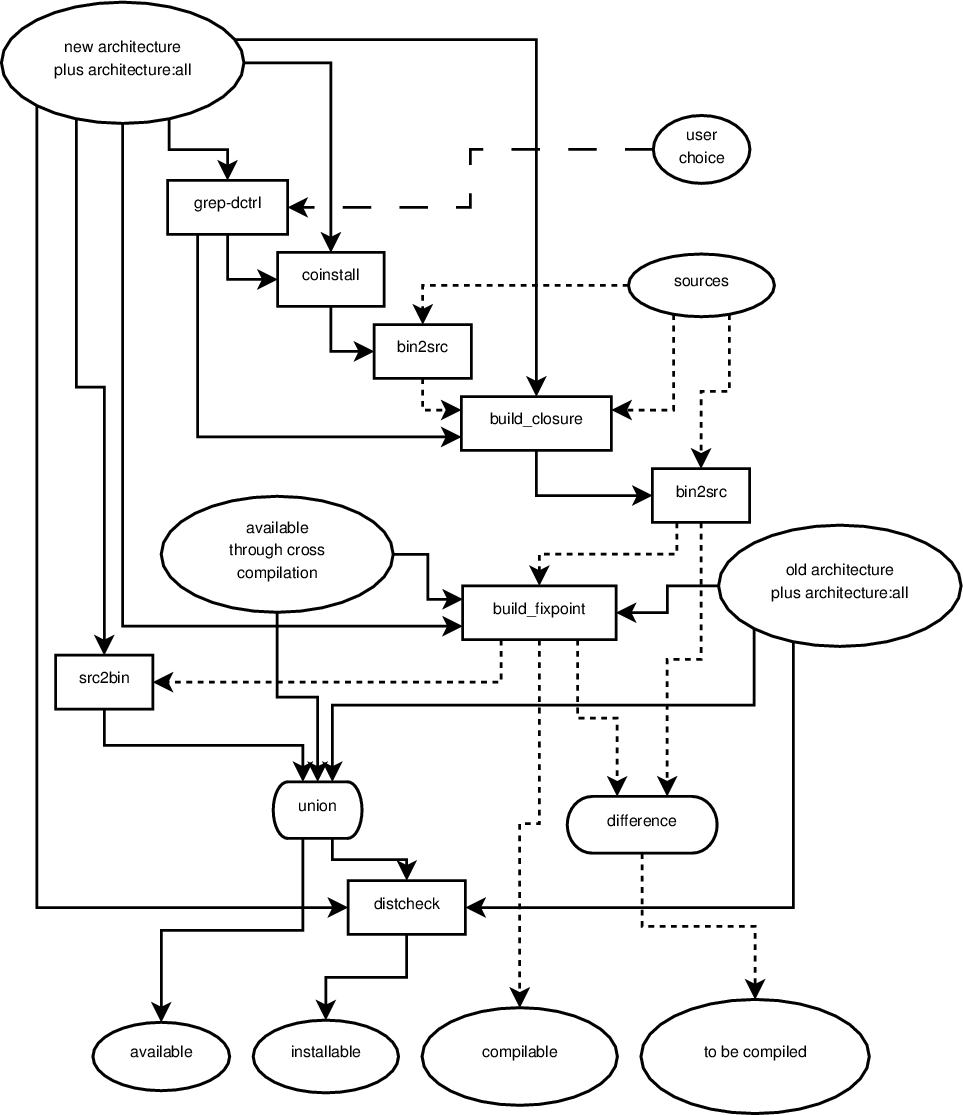
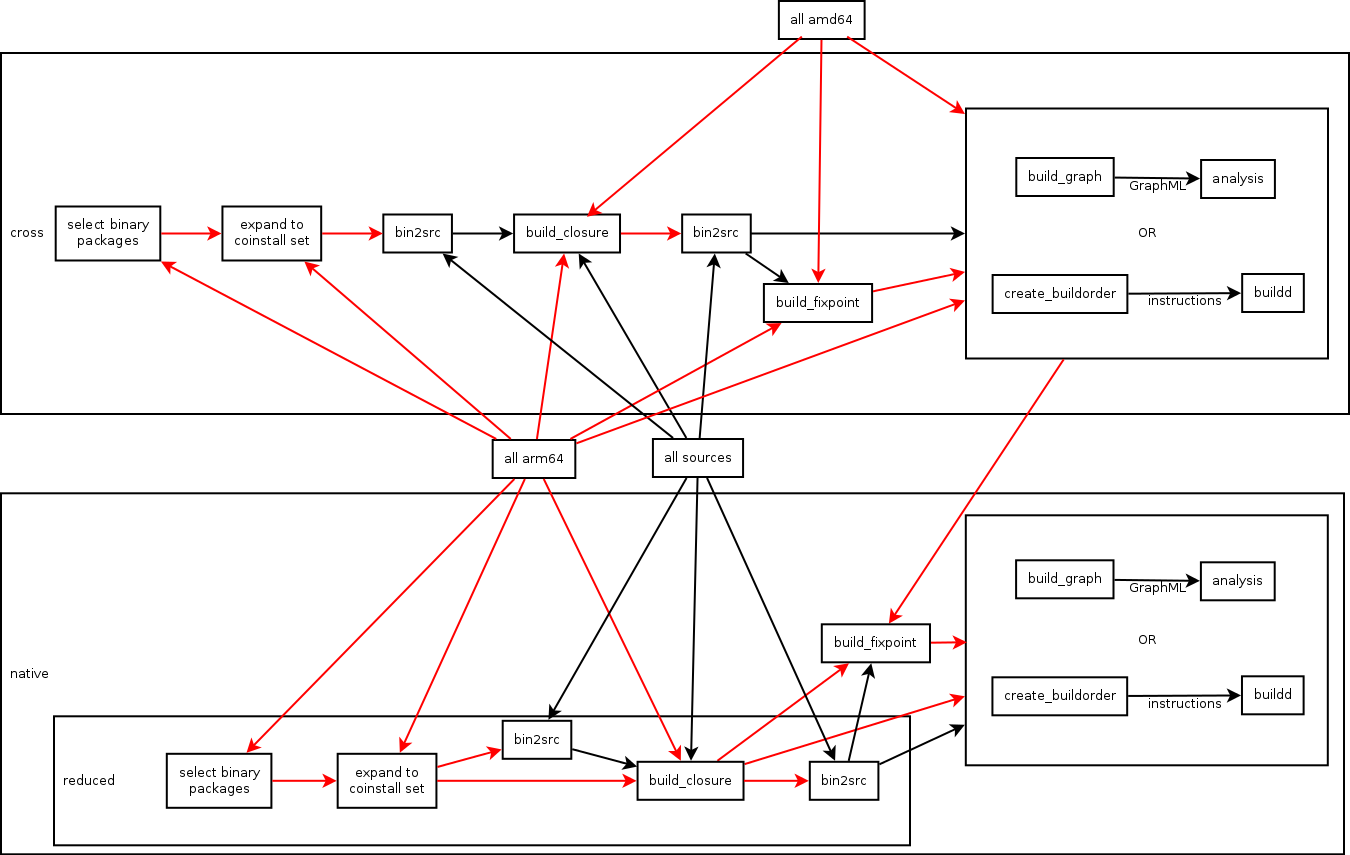
Processing pipeline instead of monolithic tools The tools I developed so far tried to accomplish everything by themselves, reusing functionality implemented in a central library. Therefor, if one wanted to try out even trivial new things, it mostly meant to hack some OCaml code. Pietro Abate suggested to instead develop smaller tools which could work independently of each other, would only execute one algorithm each and could easily be connected together in different ways to achieve different effects. This switch is now done and all functionality from the old tools is moved into a new toolset. The exchange format between the tools is either plain text files in deb822 control format (Packages/Sources files) or a dependency graph. The dependency graph is currently marshalled by OCaml but future versions should work with just passing a GraphML (an XML graph format) representation around. This new way of doing things seems close to the UNIX philosophy (each program does one thing well, data is stored as text, every program is a filter). For example the deb822 control output can easily be manipulated using grep-dctrl(1) and there exist many tools which can read, analyze and manipulate GraphML. It is a big improvement over the old, monolithic tools which did not allow to manipulate any intermediate result by external, existing tools. Currently, a shell script (native.sh) will execute all tools in a meaningful order, connecting them together correctly. The same tools will be used for a future cross.sh but they will be connected differently. I wrote about a first proposal of what the individual tools should do and how they should be connected in this email from which I also linked a confusing overview of the pipeline. This overview has recently been improved to be even more confusing and the current version of the lower half (the native part) now looks like this: native reduced Solid arrows represent a flow of binary packages, dottend arrows represent a flow of source packages, ovals represent a set of packages, boxes with rounded corners represent set operations, rectangular boxes represent filters. There is only one input to a filter, which is the arrow connected to the top of the box. Outgoing arrows from the bottom represent the filtered input. Ingoing arrows to either side are arguments to the filter and control how the filter behaves depending on the algorithm. I will explain this better once the pipeline proved to be less in flux. The pipeline is currently executed like this by native.sh.

Two new ways to break dependency cycles have been discovered So far, we knew of three ways to formally break dependency cycles:
  • remove build dependencies through build profiles
  • find out that the build dependency is only used to build arch:all packages and therefor put it into Build-Depends-Indep
  • cross compile some source packages
Two new methods can be added to the above:

Dependency graph definition changed Back in September when I was visiting irill, Pietro found a flaw in how the dependency graph used to be generated. He supplied a new definition of the dependency graph which does away with the problem he found. After fixing some small issues with his code, I changed all the existing algorithms to use the new graph definition. The old graph is as of today removed from the repository. Thanks to Pietro for supplying the new graph definition - I must still admit that my OCaml foo is not strong enough to have come up with his code.

Added complexity for profile built source packages As mentioned in the introduction, wookey and me addressed the debian-devel list with a proposal on necessary changes for an automated bootstrapping of Debian. During the discussiong, two important things came up which are to be considered by the dependency graph algorithms:
  • profile built source packages may not create all binary packages
  • profile built source packages may need additional build dependencies
Both things make it necessary to alter the dependency graph during the generation of a feedback arc set and feedback vertex set beyond the simple removal of edges. Luckily, the developed approximation algorithms can be extended to support such changes in the graph.

Different feedback arc set algorithms The initially developed feedback arc set algorithm is well suited to discover build dependency edges which should be dropped. It performs far worse when creating the final build order because it only considers edges by itself and not how many edges of a source package can be dropped by profile building it. The adjusted algorithm for generating a build order is more of a feedback vertex set algorithm because instead of greedily finding the edge with most cycles through it, it greedily finds the source package which would break most cycles if it was profile built.

Generating a build order with less profile built source packages After implementing all the features above I now feel more confident to publish the current status of the tools to a wider audience. The following test shows a run of the aforementioned ./native.sh shell script. Its final output is a list of source packages which have to be profile built and a build order. Using the resulting build order, starting from a minimal build system (essential:yes, build-essential and debhelper), all source packages will be compiled which are needed to compile all binary packages in the system. The result will therefor be a list of source and binary packages which fulfill the following property:
  • all binary packages can be built from the available source packages
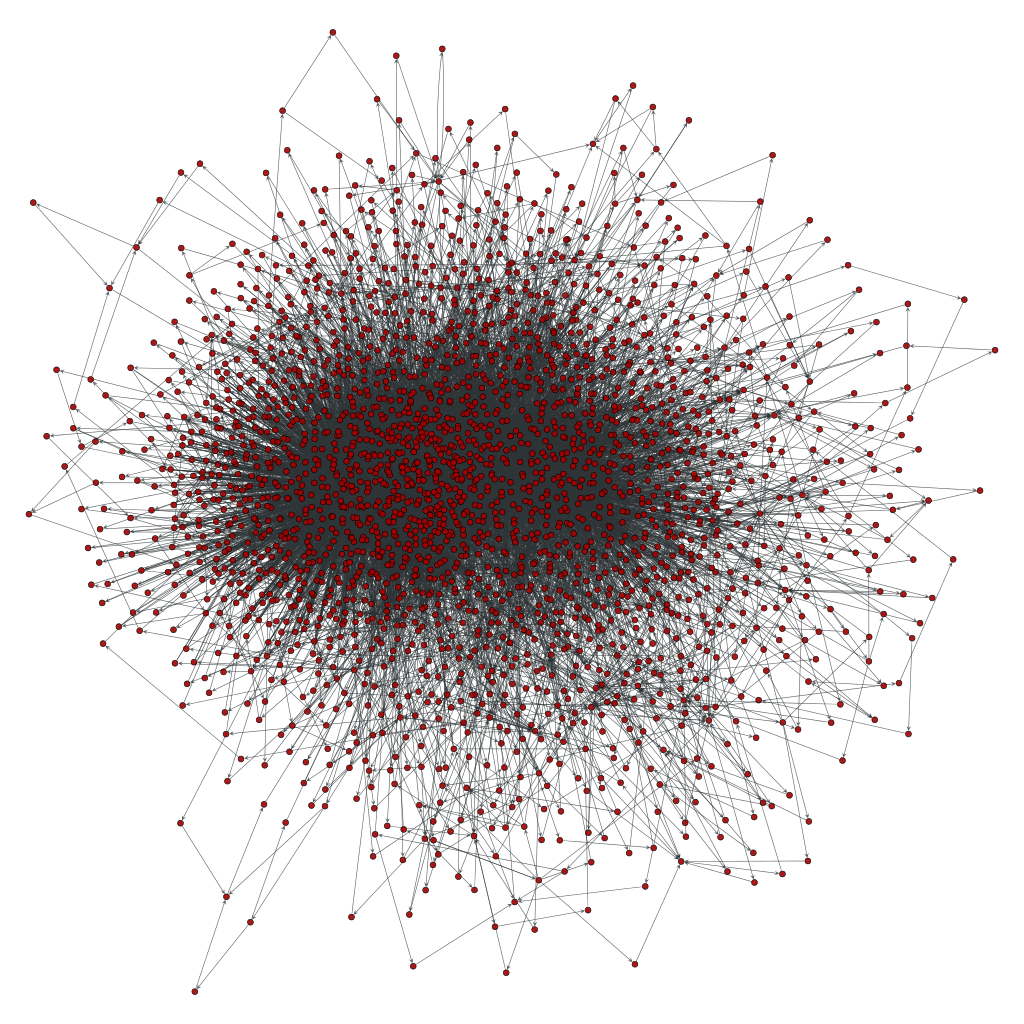
  • all source packages can be built with the available binary packages
I called this a "reduceded distribution" in earlier posts. The interesting property of this specific selection is, that it contains the biggest problem set of Debian when bootstrapping it: a 900 to 1000 nodes big strongly connected component. Here is a visualization of the problem: hideous mess Source packages do not yet come with build profiles and the cross build situation can not yet be analyzed, so the following assumptions were made: The last point is about 14 build dependencies which were decided to be broken by the feedback arc set algorithm but for which other data sources did not indicate that they are actually breakable. Those 14 are dynamically generated by native.sh. If above assumptions should not be too far from the actual situation, then not more than 73 source packages have to be modified to bootstrap a reduced distribution. This reduced distribution even includes dependency-wise "big" packages like webkit, metacity, iceweasel, network-manager, tracker, gnome-panel, evolution-data-server, kde-runtime, libav and nautilus. By changing one line in native.sh one could easily develop a build order which generates gnome-desktop or really any given (meta-)package selection. All of native.sh takes only 80 seconds to execute on my system (Core i5, 2.5 GHz, singlethreaded). Here is the final build order which creates 2044 binary packages from 613 source packages.
  1. nspr, libio-pty-perl, libmcrypt, unzip, libdbi-perl, cdparanoia, libelf, c-ares, liblocale-gettext-perl, libibverbs, numactl, ilmbase, tbb, check, libogg, libatomic-ops, libnl($), orc($), libaio, tcl8.4, kmod, libgsm, lame, opencore-amr, tcl8.5, exuberant-ctags, mhash, libtext-iconv-perl, libutempter, pciutils, gperf, hspell, recode, tcp-wrappers, fdupes, chrpath, libbsd, zip, procps, wireless-tools, cpufrequtils, ed, libjpeg8, hesiod, pax, less, dietlibc, netkit-telnet, psmisc, docbook-to-man, libhtml-parser-perl, libonig, opensp($), libterm-size-perl, linux86, libxmltok, db-defaults, java-common, sharutils, libgpg-error, hardening-wrapper, cvsps, p11-kit, libyaml, diffstat, m4
  2. openexr, enca, help2man, speex, libvorbis, libid3tag, patch, openjade1.3, openjade, expat, fakeroot, libgcrypt11($), ustr, sysvinit, netcat, libirman, html2text, libmad, pth, clucene-core, libdaemon($), texinfo, popt, net-tools, tar, libsigsegv, gmp, patchutils($), dirac, cunit, bridge-utils, expect, libgc, nettle, elfutils, jade, bison
  3. sed, indent, findutils, fastjar, cpio, chicken, bzip2, aspell, realpath, dctrl-tools, rsync, ctdb, pkg-config($), libarchive, gpgme1.0, exempi, pump, re2c, klibc, gzip, gawk, flex-old, original-awk, mawk, libtasn1-3($), flex($), libtool
  4. libcap2, mksh, readline6, libcdio, libpipeline, libcroco, schroedinger, desktop-file-utils, eina, fribidi, libusb, binfmt-support, silgraphite2.0, atk1.0($), perl, gnutls26($), netcat-openbsd, ossp-uuid, gsl, libnfnetlink, sg3-utils, jbigkit, lua5.1, unixodbc, sqlite, wayland, radvd, open-iscsi, libpcap, linux-atm, gdbm, id3lib3.8.3, vo-aacenc, vo-amrwbenc, fam, faad2, hunspell, dpkg, tslib, libart-lgpl, libidl, dh-exec, giflib, openslp-dfsg, ppl($), xutils-dev, blcr, bc, time, libdatrie, libpthread-stubs, guile-1.8, libev, attr, libsigc++-2.0, pixman, libpng, libssh2, sqlite3, acpica-unix, acl, a52dec
  5. json-c, cloog-ppl, libverto, glibmm2.4, rtmpdump, libdbd-sqlite3-perl, nss, freetds, slang2, libpciaccess, iptables, e2fsprogs, libnetfilter-conntrack, bash, libthai, python2.6($), libice($), libpaper, libfontenc($), libxau, libxdmcp($), openldap($), cyrus-sasl2($), openssl, python2.7($)
  6. psutils, libevent, stunnel4, libnet-ssleay-perl, libffi, readline5, file, libvoikko, gamin, libieee1284, build-essential, libcap-ng($), lcms($), keyutils, libxml2, libxml++2.6, gcc-4.6($), binutils, dbus($), libsm($), libxslt, doxygen($)
  7. liblqr, rarian, xmlto, policykit-1($), libxml-parser-perl, tdb, devscripts, eet, libasyncns, libusbx, icu, linux, libmng, shadow, xmlstarlet, tidy, gavl, flac, dbus-glib($), libxcb, apr, krb5, alsa-lib
  8. usbutils, enchant, neon27, uw-imap, libsndfile, yasm, xcb-util, gconf($), shared-mime-info($), audiofile, ijs($), jbig2dec, libx11($)
  9. esound, freetype, libxkbfile, xvidcore, xcb-util-image, udev($), libxfixes, libxext($), libxt, libxrender
  10. tk8.4, startup-notification, libatasmart, fontconfig, libxp, libdmx, libvdpau, libdrm, libxres, directfb, libxv, libxxf86dga, libxxf86vm, pcsc-lite, libxss, libxcomposite, libxcursor, libxdamage, libxi($), libxinerama, libxrandr, libxmu($), libxpm, libxfont($)
  11. xfonts-utils, libxvmc, xauth, libxtst($), libxaw($)
  12. pmake, corosync, x11-xserver-utils, x11-xkb-utils, coreutils, xft, nas, cairo
  13. libedit, cairomm, tk8.5, openais, pango1.0($)
  14. ocaml, blt, ruby1.8, firebird2.5, heimdal, lvm2($)
  15. cvs($), python-stdlib-extensions, parted, llvm-2.9, ruby1.9.1, findlib, qt4-x11($)
  16. xen, mesa, audit($), avahi($)
  17. x11-utils, xorg-server, freeglut, libva
  18. jasper, tiff3, python3.2($)
  19. openjpeg, qt-assistant-compat, v4l-utils, qca2, jinja2, markupsafe, lcms2, sip4, imlib2, netpbm-free, cracklib2, cups($), postgresql-9.1
  20. py3cairo, pycairo, pam, libgnomecups, gobject-introspection($)
  21. gdk-pixbuf, libgnomeprint, gnome-menus, gsettings-desktop-schemas, pangomm, consolekit, vala-0.16($), colord($), atkmm1.6
  22. libgee, gtk+3.0($), gtk+2.0($)
  23. gtkmm2.4, poppler($), openssh, libglade2, libiodbc2, gcr($), libwmf, systemd($), gcj-4.7, java-atk-wrapper($)
  24. torque, ecj($), vala-0.14, gnome-keyring($), gcc-defaults, gnome-vfs($)
  25. libidn, libgnome-keyring($), openmpi
  26. mpi-defaults, dnsmasq, wget, lynx-cur, ghostscript, curl
  27. fftw3, gnupg, libquvi, xmlrpc-c, raptor, liboauth, groff, fftw, boost1.49, apt
  28. boost-defaults, libsamplerate, cmake, python-apt
  29. qjson, qtzeitgeist, libssh, qimageblitz, pkg-kde-tools, libical, dwarves-dfsg, automoc, attica, yajl, source-highlight, pygobject, pygobject-2, mysql-5.5($)
  30. libdbd-mysql-perl, polkit-qt-1, libdbusmenu-qt, raptor2, dbus-python, apr-util
  31. rasqal, serf, subversion($), apache2
  32. git, redland
  33. xz-utils, util-linux, rpm, man-db, make-dfsg, libvisual, cryptsetup, libgd2, gstreamer0.10
  34. mscgen, texlive-bin
  35. dvipng, luatex
  36. libconfig, transfig, augeas, blas, libcaca, autogen, libdbi, linuxdoc-tools, gdb, gpm
  37. ncurses, python-numpy($), rrdtool, w3m, iproute, gcc-4.7, libtheora($), gcc-4.4
  38. libraw1394, base-passwd, lm-sensors, netcf, eglibc, gst-plugins-base0.10
  39. libiec61883, qtwebkit, libvirt, libdc1394-22, net-snmp, jack-audio-connection-kit($), bluez
  40. redhat-cluster, gvfs($), pulseaudio($)
  41. phonon, libsdl1.2, openjdk-6($)
  42. phonon-backend-gstreamer($), gettext, libbluray, db, swi-prolog, qdbm, swig2.0($)
  43. highlight, libselinux, talloc, libhdate, libftdi, libplist, python-qt4, libprelude, libsemanage, php5
  44. samba, usbmuxd, libvpx, lirc, bsdmainutils, libiptcdata, libgtop2, libgsf, telepathy-glib, libwnck3, libnotify, libunique3, gnome-desktop3, gmime, glib2.0, json-glib, libgnomecanvas, libcanberra, orbit2, udisks, d-conf, libgusb
  45. libgnomeprintui, libimobiledevice, nautilus($), libbonobo, librsvg
  46. evas, wxwidgets2.8, upower, gnome-disk-utility, libgnome
  47. ecore, libbonoboui
  48. libgnomeui
  49. graphviz
  50. exiv2, libexif, lapack, soprano, libnl3, dbus-c++
  51. atlas, libffado, graphicsmagick, libgphoto2, network-manager
  52. pygtk, jackd2, sane-backends, djvulibre
  53. libav($), gpac($), ntrack, python-imaging, imagemagick, dia
  54. x264($), matplotlib, iceweasel
  55. strigi, opencv, libproxy($), ffms2
  56. kde4libs, frei0r, glib-networking
  57. kde-baseapps, kate, libsoup2.4
  58. geoclue, kde-runtime, totem-pl-parser, libgweather, librest, libgdata
  59. webkit
  60. zenity, gnome-online-accounts
  61. metacity, evolution-data-server
  62. gnome-panel
  63. tracker
The final recompilation of profile built source packages is omitted. Source packages marked with a ($) are selected to be profile built. All source packages listed in the same line can be built in parallel as they do not depend upon each other. This order looks convincing as it first compiles a multitude of source packages which have no or only few build dependencies lacking. Later steps allow fewer source packages to be compiled in parallel. The amount of needed build dependencies is highest in the source packages that are built last.

21 January 2013

Dirk Eddelbuettel: digest 0.6.1

digest version 0.6.1 is now on CRAN, and I will push the corresponding version into Debian shortly. Duncan Murdoch added AES support, and helped me fix two issues which (annoyingly) made the Rout.save output differ on another platform. CRANberries provides the usual summary of changes to version 0.6.0. As usual, our package is available via the R-Forge page leading to svn and tarball access, my digest page and the local directory here.

30 December 2012

Dirk Eddelbuettel: RcppClassicExamples 0.1.1

Yesterday's initial upload of RcppClassicExamples was lacking a versioned Depends: to prevent builds on older versions of R. This has been added in a new upload 0.1.1. We also added a NEWS file (see below); no code changes were made.
Changes in version 0.1.1 (2012-12-30)
  • Added versioned Depends: in DESCRIPTION to not build under older versions of Rcpp and RcppClassic
Changes in version 0.1.0 (2012-12-27)
Thanks to CRANberries, you can also look at a diff to the previous release 0.1.0. Questions, comments etc should go to the rcpp-devel mailing list off the R-Forge page.

29 December 2012

Dirk Eddelbuettel: RcppExamples 0.1.5 and RcppClassicExamples 0.1.0

The recent releases of Rcpp 0.10.2 and RcppClassic 0.9.3 had one more repercussion. On that dreaded OS, the linker no longer wanted to instantiate a symbol present in both packages; seems to me that the linker in the other two OSs is a little smarter. Anyway -- I didn't fight this but at long last moved all remnands of the long-deprecated older Rcpp API (which is still maintained by package RcppClassic) out of package RcppExamples and into a new package RcppClassicExamples. And the updated version 0.1.5 of the RcppExamples package appeared on CRAN and has now been joined by the initial version 0.1.0 of the new package RcppClassicExamples. No code changed were made; manual pages and descriptions where brushed up and that is about it. Thanks to CRANberries, you can also look at a diff to the previous release 0.1.4 of RcppExamples. Questions, comments etc should go to the rcpp-devel mailing list off the R-Forge page.

Next.

Previous.