Search Results: "sto"

3 November 2010

Matt Zimmerman: Weathering the Ubuntu brainstorm

In our first few years, Ubuntu experienced explosive growth, from zero to millions of users. Because Ubuntu is an open project, these people don t just use Ubuntu, but can see what s happening next and influence it through suggestions and contributions. The volume of suggestions quickly became unmanageable through ad hoc discussion, because the volume of feedback overwhelmed the relatively few people who were actively developing Ubuntu.

Ubuntu Brainstorm logo In order to better manage user feedback at this scale, Ubuntu Brainstorm was created in 2008. It s a collaborative filtering engine which allows anyone to contribute an idea, and have it voted on by others. Since then, it s been available to Ubuntu developers and leaders as an information source, which has been used in various ways. The top ideas are printed in the Ubuntu Weekly Newsletter each week. We experimented with producing a report each release cycle and sharing it with the developer community. People have been encouraged to take these suggestions to the Ubuntu Developer Summits. We continue to look for new and better ways to process the feedback provided by the user community. Most recently, I asked my colleagues on the Ubuntu Technical Board in a meeting whether we should take responsibility for responding to the feedback available in Ubuntu Brainstorm. They agreed that this was worth exploring, and I put forward a proposal for how it might work. The proposal was unanimously accepted at a later meeting, and I m working on the first feedback cycle now. In short, the Technical Board will ensure that, every three months, the highest voted topics on Ubuntu Brainstorm receive an official response from the Ubuntu project. The Technical Board won t respond to all of them personally, but will identify subject matter experts within the project, ask them to write a short response, and compile these responses for publication. My hope is that this approach will bring more visibility to common user concerns, help users understand what we re doing with their feedback, and generally improve transparency in Ubuntu. We ve already selected the topics for the first iteration based on the most popular items of the past six months, and are organizing responses now. Please visit brainstorm.ubuntu.com and cast your votes for next time!

2 November 2010

Sam Hartman: Review of Git DPM

I ve been looking at git dpm. It s a tool for managing Debian packages in git. The description promises the world: use of git to maintain both a set of patches to some upstream software along with the history of those patches both at the same time. It also promises the ability to let me share my development repositories. The overhead is much less than topgit. My feelings are mixed. It does deliver on its promise to allow you to maintain your upstream patches and to use git normallyish. It produces nice quilt patch series. In order to understand the down side, it s necessary to understand a bit about how it works. It maintains your normal branch roughly the way you do things today. There s also a branch that is rebased often that is effectively the quilt series. It starts from the upstream and has a commit for every patch in your quilt series containing exactly the contents of that patch. This branch is merged into your debian branch when you run git dpm update-patches. The down side is that it makes the debian branch kind of fragile. If you commit an upstream change to the Debian branch it will be reverted by the next git dpm update-patches. The history will not be lost, but unless you have turned that change into a commit along your patches branch, git dpm update-patches will remove the change without warning. This can be particularly surprising if the change in question is a merge from the upstream branch. In that case, the merged in changes will all be lost, but since the tip of the upstream branch is in your history, then future merges will not bring them back. If you either also merge your changes into the patches branch, or tell git dpm about a new upstream, then the changes will reappear at the next git dpm update-patches. The other fragility is that rebasing your debian branch can have really unpleasant consequences. The problem is that rebase removes merge commits: it assumes that the only changes introduced by merge commits are resolution of conflicts. However, git dpm synthesizes merge commits. In particular, it takes the debian directory from your debian branch, plus the upstream sources from your upstream branch, plus all the patches you applied and calls that your new debian branch. There s also a metadata file that contains pointers to the upstream branch and the quilt patch series branch. In addition, debian/patches gets populated. Discarding this commit completely would simply roll you back to the previous state of your patches. However, this loses history! There is no reference that is left pointing to the patches branch; the only reason it is still referenced is that it s a parent of the commit rebase is throwing away. This isn t really all that unusual; if you merged in any branch, deleted the branch and rebased away both the merge and the commits from the branch, you d lose history. I do find it a bit easier to do with git dpm. However, it s more likely that you ll manage to rebase and keep the commits from the patches branch. In particular, if the horizon of your rebase includes a merge of the patches branch,then for every patch that involves changes to the debian branch from the point where rebase starts rewriting history, you will see a commit included by your rebase. My suspicion is that this commit is more likely to generate conflicts than usual because it s a patch on top of the upstream sources being applied to a partially patched debian branch. However I have not fully worked through things: it may be that such a patch is exactly as likely to cause conflicts as it would in a git dpm update-patches operation. If that succeeds and you do not manage to fail to pick one of these commits, you ll end up with roughly the same debian sources you started with. There are two key exceptions: the git dpm metadata file is not updated and your debian/patches is not consistent with your sources. The first means you re in the state of the previous paragraph: git dpm update-patches will blow away your changes. The second means that any source package you produce is going to be kind of funky if not out right broken. It is possible to recover from git dpm plus rebase. I think if you git dpm checkout-patches, then cherry pick the patch related commits from your debian branch that were introduced by the rebase, then git dpm update-patches, you ll be in a sane state. Obviously you could also recover by finding the pre-rebase commit and resetting there. I m assuming though that you actually needed to rebase for some reason. Of course git dpm does involve a space penalty. You generate a commit for every patch in your quilt series for every version of the upstream sources you deal with. Also, you will introduce and store every version of the quilt series directly in your debian directory. The extra commits probably aren t a big deal: the blobs probably delta compress well. I m not sure though that the quilt patch blobs will compress well with other things. In my opinion the ability to get nice quilt patches is well worth the space penalty. In conclusion, git dpm is a sharp tool. Actually, I think that s understating things. Git dpm involves a bunch of rotating blades. You stick your face and foot between the blades, and if you use it correctly, there s exactly enough clearance that nothing gets damaged and you get some fairly neat results. Other outcomes are available. I m still trying to evaluate if it is worth it. I think the tradeoff might be different for something like the krb5 package which is maintained by two very experienced maintainers than say for Shibboleth which seems to involve several more maintainers. I m not sure that there is much git dpm can do to make things better. Even detecting loss-of-foot events might be kind of tricky.

Enrico Zini: Using the apt-xapian-index catalogedtime plugin

Using the apt-xapian-index catalogedtime plugin apt-xapian-index has recently gained a catalogedtime plugin, which stores the timestamp of when the package was first cataloged. At first glance this does not mean much, so I'll explain with an example. aptitude can show a list of "New Packages": those packages that it sees now for the first time. It is a very useful feature, but you cannot ask it "what packages became available during last week?" With the catalogedtime plugin, the apt xapian index can now answer that question. You can also sort package results by "newness", or implement a user interface with some sort of "newness timeline" package filter option. Of course you will find documentation about it in /var/lib/apt-xapian-index/README, since the index is self-documenting. As usual in my apt-xapian-index posts, here is a code example:
#!/usr/bin/python
# coding: utf-8
# Show packages that were NEW in the last N days
# (C) 2010 Enrico Zini <enrico@enricozini.org>
# License: WTFPL version 2 (http://sam.zoy.org/wtfpl/)
import axi
import xapian
import time
import sys
class App:
    def __init__(self, days):
        self.db = xapian.Database(axi.XAPIANINDEX)
        # Read the contents of /var/lib/apt-xapian-index/values
        self.values, self.descs = axi.readValueDB()
        # Find the value ID for the catalogedtime timestamps
        self.cattime_vid = self.values["catalogedtime"]
        # Filter packages first seen more than than X days ago
        self.query = xapian.Query(xapian.Query.OP_VALUE_GE, self.cattime_vid,
                    xapian.sortable_serialise(time.time() - 86400*days))
    def main(self):
        # Perform the query
        self.enquire = xapian.Enquire(self.db)
        self.enquire.set_query(self.query)
        # Sort by cataloged time
        self.enquire.set_sort_by_value(self.cattime_vid, True)
        # Print the first 200
        matches = self.enquire.get_mset(0, 200)
        for m in matches:
            name = m.document.get_data()
            val = m.document.get_value(self.cattime_vid)
            fval = xapian.sortable_unserialise(val)
            tm = time.localtime(fval)
            timestr = time.strftime("%c", tm)
            print "%s %s" % (timestr, name)
if __name__ == "__main__":
    try:
        days = int(sys.argv[1])
    except:
        print >>sys.stderr, "Usage: %s days" % sys.argv[0]
        sys.exit(1)
    app = App(days)
    app.main()
    sys.exit(0)
Enjoy!

1 November 2010

Adnan Hodzic: I want Xperia X10 Android 2.1 update now!

Story I bought Xperia X10i this summer during DebConf10 in NYC, I loved this phone from very beginning however what bothered me was that it was still stuck on outdated Android 1.6. To get your own custom Android on it, wasn t quite possible because no one managed to hack bootloader even though some of the guys at XDA where getting pretty close. Long story made short, Sony Ericsson has finally release their Android 2.1 update, but made it available only for Nordic region, they explained it all on their blog where they also sent a message for paranoid users as they called them. I thought, if I gave it all this time I can wait a little bit longer, but then one of my friends (@sahinovic) gave me a good pointer to go in right direction with using custom ROM, Nordic for example? So this is where I got my idea. I want 2.1 update now! Please note steps below will get you Android 2.1 update, but AFAIK you ll also lose your warranty 1. Root your phone If you don t have your phone rooted, this can now be done in single click. Get X10 Root and follow instructions on screen. 2. Edit system/default.prop Get Root Explorer, mount r/w (upper right corner), edit system/default.prop Lines you re concentrating on are 1 and 3 Let s say they are:
ro.semc.version.cust=1237-0333
ro.product.name=X10_1237-0333
Edit them to look like:
ro.semc.version.cust=1234-8465
ro.product.name=X10_1234-8465
Save the file and it s gonna create automatic backup of original file. 3. Get the updates using SEUS Turn off your phone, launch SEUS, plugin in the USB cable while holding back button, SEUS is going to tell you have updates for your phone Smile Follow on screen instructions. Enjoy the update Smile Conclusion X10 is a pretty sweet phone, but with it being so closed, it also closes a lot of doors to hacking it and playing with it, great example would be this update itself, since right now Android 2.1 update is an outdated one. However 2.1 update brings new life into it, just as it s a brand new phone, it s more responsive and much much faster. And do take a backup before this update, because I lost everything from my contacts to internet settings, but all files on my sd card remained intact. If you want to discuss anything regarding this topic please do so in comment area below or find me on Twitter.

Rapha&#235;l Hertzog: 5 free software to support with Flattr

Flattr FOSS LogoIt s already the fourth issue of Flattr FOSS: it means 20 different projects using Flattr that I presented you. Here are the 5 suggestions for November:
  1. Redshift is a small utility that adjusts the color temperature of your screen to make it less aggressive on your eyes, in particular during evening/nights. It uses the time of the day and the geographic location to know whether it s night or day. I discovered it this summer and I liked it, although I m not running it permanently.
  2. Noscript is a Firefox plugin to control what sites can execute javascript, flash and other plugins. All those are creating supplementary security risks and you browse safer if you allow only some sites to run them. This is the number one entry on Flattr in the opensource category, it recently took the place of dpkg.
  3. phyMyAdmin is a web interface to manage MySQL databases. If you have such a database on a web-hosting service, you have likely already seen it in action. It s an award-winning software with a 12 year history, it s not so common for PHP applications. :-)
  4. Chromium maintenance in Debian. Chromium is a rapidly-evolving & complex software and Giuseppe Iuculano has been tirelessly working on packaging it. Almost alone within Debian. He deserves kudos for his work even though he reused work made by Fabien Tassin on the Ubuntu package.
  5. Dulwich is a pure-Python implementation of the Git file formats and protocols. It s an important building block for interoperability between Bazaar and Git: bzr-git (a Bazaar plugin providing Git integration) is notably using it. Given the large usage of bzr in Ubuntu and the popularity of Git world-wide, it s important to have such gateways.
This article is part of the Flattr FOSS project.
Update: mentioned the work of Fabien Tassin on the chromium package within Ubuntu.

Flattr this Share/Bookmark 6 comments Support my work

Russell Coker: Communication Shutdown and Autism

The AEIOU Foundation The AEIOU Foundation [1] is a support and advocacy organisation for people on the Autism Spectrum, note that they clearly say Autism Spectrum Disorder (ASD) on their About page, some of what they write would be less wrong if it was claimed to apply to only non-verbal Autistics or people claimed to be Low Functioning Autistic (LFA). But in regard to the Autism Spectrum they just don t seem to know much about it, a lot of their web pages seem to be based on the assumption that anyone who is on the Spectrum will be lucky if they can ever live independently. However it seems that most people who can be diagnosed with an ASD have typical social skills by the standards of the IT industry and can get by without any special assistance. The entire site seems to be written about people on the Spectrum by people who know little of their experiences and contains hardly any information that matches what I ve read from various people on the Spectrum (of course there are a wide range of experiences that differ greatly). They have a link to Autism Related Sites which starts with Autism Speaks (the Wikipedia page about Autism Speaks is worth reading note the section about immunisation research which has been repeatedly debunked and the section about legal action against a young autistic blogger). There are many good reasons why Autism Speaks is so widely hated among people on the Spectrum. I think that recommending Autism Speaks is a sign of willful ignorance of almost everything related to Autism. In their page about describing Autism to NTs they say Imagine if you suddenly woke up in a foreign country, did not speak the language and had no way of effectively communicating with the people around you . I ve been diagnosed with Asperger Syndrome by a psychologist who considers that to be the same as High Functioning Autism (HFA) and I ve visited more than a few countries. I find the comparison of the Autistic experience to visiting another country to be so strange that I don t even know where I would begin if I was to comment on where it went wrong. Finally they have a scrolling bar listing their advertisers at the bottom of ever single page on their site. If someone was going to design a web site specifically to annoy people on the Spectrum then such a scrolling banner would be a good place to start. Now they probably do some good things to help families with children on the Spectrum. But their ability to do good is really hindered by the lack of input from people on the spectrum, Rachel Cohen-Rottenberg (leader of the Vermont Chapter of the Autistic Self Advocacy Network) wrote an interesting post about AEIOU and noted that none of the people who run AEIOU are Autistic [2]. The Communication Shutdown Someone got the idea that Neuro-Typical people (NTs) should try and understand what it s like to be on the Spectrum which is a reasonable idea. But they decided that the way to do so is to have them refrain from Internet based socialisation and not use Facebook and Twitter for one day. It seems to me that most people on the Spectrum primarily socialise via the Internet, so ceasing Internet based socialisation is likely to make their experience less like that of people on the Spectrum. I m getting a mental image of a bunch of NTs deciding to go to a night-club for their Internet free evening and then imagining that they are somehow empathising with the experience of people who can never enjoy a night-club. As an aside, a web site which has anything at all related to disabilities shouldn t rely on Flash the Communication Shutdown site totally fails in this regard. No Stereotypes Here has an interesting analysis of this situation, among other things they comment on the irony of having someone ask them to stop using twitter as part of this campaign [3]. One thing that they suggest is for NTs to have a day without any communication at all. Some Suggestions for People who Want to Understand As a communication exercise, try going shopping without speaking, just use hand gestures. For bonus points try doing so in a foreign country where you don t know the language so you need bidirectional non-verbal communication with some luck you can complete a transaction without the shopkeeper realising that you are a foreigner. This won t actually give you much of the Autistic experience, but it s a good exercise in understanding how communication works. Someone who wanted to know the down-side of being on the Spectrum could find a sports bar where most patrons support one team and then enter the bar while wearing a jersey indicating support for an opposing team. I don t recommend doing this because it really wouldn t be fun, but for a quick approximation of the experience it would probably work well. It seems to me that paying $5 to a charity and then boasting about doing so on your Facebook page for a day is an easy thing to do. A harder task would be to spend a day reading about the experiences of the people in question and then giving $5 to a charity that is well regarded by the target group. Another possible way of gaining some understanding would be to have a party where everyone brings their laptop and uses only electronic communication no speaking at all. This is in fact fairly close to what some of the Geekier (possibly Autistic) members of the IT community do.

31 October 2010

Jan Wagner: linux-image-2.6.32-bpo.5-xen-686 and xen/xen-common from squeeze broken?

I m experiencing since some time (out of the blue) spontaneous reboots of some of my dom0s on lenny/i386 (others don t have this effect). As result of this, I started rolling out linux-image-2.6.32-bpo.5-xen-686 from bpo and backported xen and xen-common from testing:

# dpkg -l grep xen grep bpo
ii libxenstore3.0 4.0.1-1~bpo50+1 Xenstore communications library for Xen
ii linux-image-2.6.32-bpo.5-xen-686 2.6.32-26~bpo50+1 Linux 2.6.32 for modern PCs, Xen dom0 suppor
ii xen-hypervisor-4.0-i386 4.0.1-1~bpo50+1 The Xen Hypervisor on i386
ii xen-linux-system-2.6.32-bpo.5-xen-686 2.6.32-26~bpo50+1 Xen system with Linux 2.6.32 on modern PCs (
ii xen-tools 4.1-1~bpo50+1 Tools to manage Debian XEN virtual servers
ii xen-utils-4.0 4.0.1-1~bpo50+1 XEN administrative tools
ii xen-utils-common 4.0.0-1~bpo50+1 XEN administrative tools common files
ii xenstore-utils 4.0.1-1~bpo50+1 Xenstore utilities for Xen This fixed the problem of spontaneous reboots for all of the systems I have migrated . until now! Last week I tried this solution on my private system and it failed in some way.
boot problems
A full dump of the syslog is also available. It looks like /etc/rcS.d/S03udev is hanging in some way .. the syslog for this looks like:

Oct 29 20:51:07 mordor kernel: [ 17.728120] Code: 04 00 00 00 00 83 3c 24 10 74 32 77 0c 83 3c 24 08 0f 85 9f 00 00 00 eb 12 83 3c 24 20 74 30 83 3c 24 40 0f 85 8d 00 00 00 eb 35 <0f> b6 01 8b 54 24 20 89 02 c7 42 04 00 00 00 00 eb 79 0f b7 01
Oct 29 20:51:07 mordor kernel: [ 17.731554] EIP: [<c1184d4c>] acpi_ex_system_memory_space_handler+0 189/0 221 SS:ESP 0069:ec135d74
Oct 29 20:51:07 mordor kernel: [ 17.731791] CR2: 00000000eda86000
Oct 29 20:51:07 mordor kernel: [ 17.731881] [ end trace 7b8af581772a1c55 ]
Oct 29 20:51:07 mordor kernel: [ 18.116622] input: PC Speaker as /devices/platform/pcspkr/input/input6
Oct 29 20:51:07 mordor kernel: [ 18.427607] Error: Driver pcspkr is already registered, aborting
Oct 29 20:51:07 mordor kernel: [ 232.381814] Adding 10000452k swap on /dev/sda2. Priority:-1 extents:1 across:10000452k The dom0 is there hanging in some way I don t have an exact way to get the system proceed from there usually I need to wait some seconds and pressing ^C after a while will get the box up.
Anyways I remember there are some problems with udev >= 150 and older kernels, which is also documented in the squeeze release notes. Maybe there is also a problem with older udev and newer kernels? But why is this combination working on other systems? Booting linux-image-2.6.32-bpo.5-686 works without any issue anyways, so it seems xen related. Any idea is appreciated!
UPDATE: I ve also reported this via #602109.

Erich Schubert: The next 'terror lie' - campaign time again

There is something fishy with the latest "printer bomb" reports. One one hand, they claim the parcels were adressed to "jewish synagogues in Chicago". On the other hand, they claim they were meant to explode in the air. So: why would you address them to a synagogue then? Sending a parcel from Jemen to a synagogue probably is a sure thing to have it thoroughly checked? I don't trust any of their reports. Don't get me wrong; for example I do not believe the WTC was blown up using explosives like most of the conspiration theorists out there do. But they are not telling the truth with these parcels, either. Also given that they claimed there were way over 20 parcels sent, and the security was that weak, how come all of them were found? When they decide to make up a story for us (either for having a reason to kill more people in Jemen or just for election reasons) they should at least bother to make up a consistent story ...

30 October 2010

Rapha&#235;l Hertzog: Latest features of dpkg-dev: debian packaging tools

I m attending the mini-Debconf Paris and I just gave a talk about the latest improvement of dpkg-dev the package providing the basic tools used to build Debian packages. Latest is a bit stretched since it embraces the last 2-3 years of development. My talk covered the following topics: The slides are relatively verbose so that you can understand them even if you did not attend the talk. Click here to get the slides. Related links This section points to various articles that cover more extensively some of the features mentioned in my talk. Concerning dpkg-source: Concerning dpkg-maintscript-helper: Concerning dpkg-vendor:

Flattr this Share/Bookmark One comment Support my work

29 October 2010

Evgeni Golov: What to flattr? 2010/10

Another month ending and you still have some clicks left on flattr.com? How about these then?Again, all non-italics text is stolen directly from flattr, and please forgive me if I recommend some thing that hasn t been officialy announced yet :)

28 October 2010

Sam Hartman: Moonshot at Kerberos

At The MIT Kerberos Consortium s 2010 conference, Josh Howlett and Sam Hartman delivered a talk on Moonshot. Slides should be up in a day or so. We reported on status and gave a brief overview. The new material was apropos for the venue. At the bar BOF back in March at IETF 77, we received several comments on Moonshot s limitations. It doesn t work well for services that require rapid authentications for multiple requests. There s not a good story for use when a Moonshot service needs to contact another service. There isn t a good standardized mechanism for mapping in domain-specific policy. We presented a proposal that Luke and Sam developed to optionally provide a Kerberos ticket as part of moonshot authentication. This scales from a service that simply generates its own service tickets all the way through resource domains that have many services and complex policy and provide the client a TGT. Clients can implement the feature in order to achieve better performance. Server can implement the feature in order to get delegation support within a resource domain and to get policy mapping. Luke has prototyped a version of this service involving a service ticket. We plan on briefly mentioning a desire to have extensible fast reauthentication support at the ABFAB meeting in IETF 79. However in the interest of getting the working group off to a good start we re going to focus on the well understand parts of the system and formally propose this extension after IETF 79.

Dirk Eddelbuettel: Google Tech Talk on Integrating R and C++: video and slides

Last Friday, Romain and I were guests of the R intergrouplet (what an adorable name!) at Google's headquarter in Mountain View. This arose out of discussions following useR! 2010 where we met Google's Murray Stokely. There appears to be ever increasing use of R at Google, and so it was a great opportunity to give a Google Tech Talk about R and C++ integration --- centered around our Rcpp, RInside and RProtoBuf packages which facilitate interoperability between R and C++. A video recording of our ninety-minute talk is already available via the YouTube channel for Google Tech Talks. The (large) pdf with slides (which Romain had already posted on slideshare) is also available from my presentations page. The remainder of the weekend was nice too (with the notably exception of the extremly sucky weather). We got to to spend some time at the Google Summer of Code Mentor Summit which is always a fun event and a great way to meet other open source folks in person. And we also took one afternoon off to spend some with John Chambers discussing further work involving Rcpp and the new ReferenceClasses that appeared in the just-released R version 2.12.0. This should be a nice avenue to further integrate R and C++ in the near future.

John Goerzen: Rudy Schmidt & Time Capsules

This evening, I arrived at church for mens chorus practice. I was surprised to see this sign on the door:
Rudy Schmidt died rather unexpectedly, but peacefully on Wednesday morning at his home .
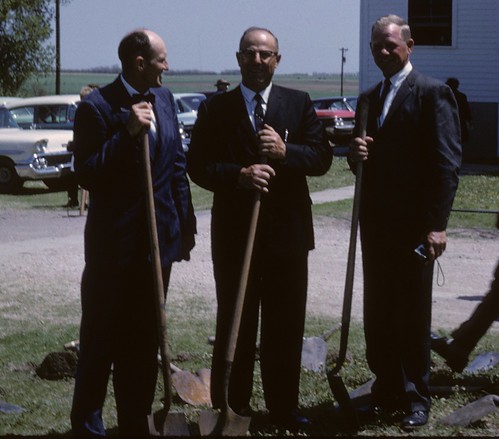
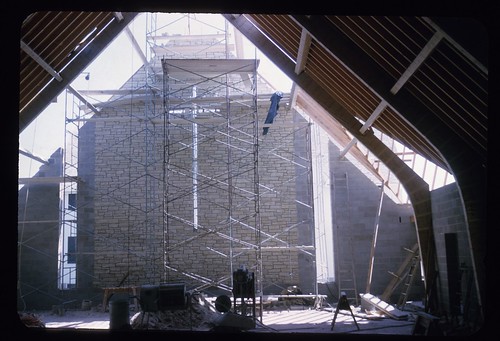
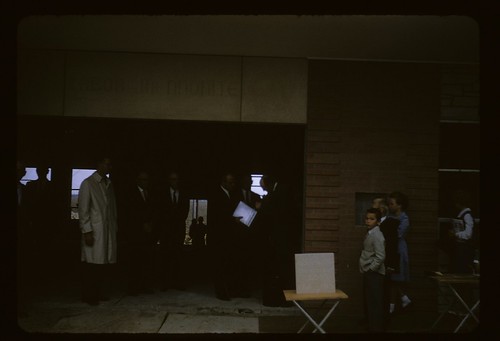
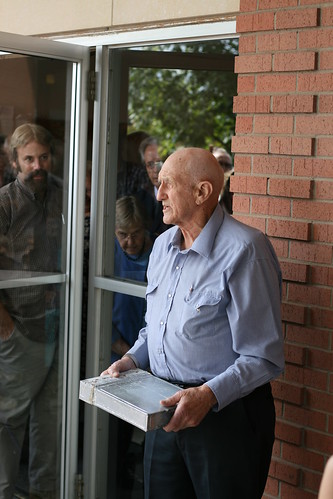
One of the benefits of living in a small community is that I get to know people of all ages around here. Not just people my own age, or coworkers. A few years ago, I worked on a history project for our church s centennial. Back in the 1960s, Rudy was one of the people in charge of building our current church. So he was a person I was interested in visiting with. Here he is, on the left, during the 1964 groundbreaking ceremony for the new building (the old one is visible in the background). 022 stamped may 1964cropped.jpg I and a few others went to his home one time a few years ago and we had a wonderful evening. Rudy shared all sorts of stories with us which I am happy to say I recorded. But moreover, Rudy was an avid photographer. There were some rare and brilliant color slides of the church being built in his collection. He let me borrow and scan some of them. Here are my two favorites: 015 stamped july 1964.jpg 016 stamped oct 1964.jpg Back in 1965, there was a ceremony at the setting of the cornerstone of Tabor Church. The people at the time assembled some papers and memorabilia and put them in a time capsule. Rudy Schmidt sealed the capsule and it was placed in the spot for it behind the cornerstone. Here is a photo of that ceremony. 013 stamped nov 1964.jpg 44 years later, on the occasion of Tabor s centennial, it was time to open the time capsule. The other building committee people, such as Jake Koehn, had passed away, so Rudy was the one to open it. He gave a few words in front of the large crowd, and mentioned that when he sealed it away, he smelled some smoke when he soldered it shut. Jake Koehn told him, Don t worry, nobody will ever see it again anyway and they had a little laugh about it. Now he was going to open it up and see if anything survived. img_6173.jpg It all did just a few minor burn marks. We enjoyed looking at all the items. Then the church placed some new items into the capsule. It was closed up again, to be opened in maybe 50 years. With luck, I ll still be around to see it opened again. Even if I m not, maybe Jacob and Oliver will be able to. And so it seems very fitting that the last hands to touch that box for the next 50 years were Rudy Schmidt s, when he placed it back in its spot on Oct. 12, 2008. img_6243.jpg

27 October 2010

Daniel Stone: how do i progammatically invoke aero peek on a window?

Whenever someone asks how to force their window to be raised to the top in X, because their program is so great that their users shouldn't be allowed to even see other programs, the answer looks a lot like the Windows equivalent:
Yes, I realize you wrote a program so awesome that all other programs pale in comparison, and that part of your mission is to make all the other programs literally pale in comparison to your program. Sorry. Maybe you can meet up with that other program that is the most awesome program in the history of the universe and share your sorrows over a beer.

Joey Hess: three thousand lines of Haskell

Three thousand lines of code is not a huge program, but it is enough to get a pretty good feel for a language. Now that I've completed my first real Haskell program I feel that I've gotten over several of the humps in the learning curve and am starting to get a good feel for it. Actually, I've written closer to five thousand lines, since there were several big refactorings. One was when I stopped manually threading my program state around and added a StateT monad. I did know from the beginning I would need one, but it seemed easier and a better learning exercise to let the program start out with a vesigial tail and gills before growing up into a modern Haskell program. (I suppose it's still written in baby-Haskell, really..) Another refactoring came when I realized I needed to use a custom data type, not String, to represent keys. That was a great experience in type-based refactoring. Being able to keep typing ':make' and landing on the next bit of code that needed fixing was great, and simply adding that one type exposed several non-obvious bugs. I found myself writing code that is much more solid and reusable than normally comes easily. And yet it's also very malleable. Actually, pulling out better data types and abstractions can get a bit addictive. When I realized that I had a similar three-stage control flow being used for each of git-annex's subcommands, and factored that control flow out into a function that used the 3 data types below, I felt I'd gone down that rabbit hole perhaps far enough for now.
type SubCmdStart = String -> Annex (Maybe SubCmdPerform)
type SubCmdPerform = Annex (Maybe SubCmdCleanup)
type SubCmdCleanup = Annex Bool
(That will allow for some nice parallelism later though, and removed dozens of lines of code, so was worth it.) Since git-annex is a very Real World Haskell type program, there is a lot of impure code in it. I could probably do better at factoring out more pure code. I count 117 impure functions, and only 37 pure. Anyhow, from my perspective of a long-time perl programmer, some other random impressions..

Gerfried Fuchs: Report from openSUSE Conference

Like you most likely know, I've been at the openSUSE Conference last week. I've been representing Debian through a talk about Debian - The Project and its Resources, covering services and resources that are usable and useful for other distributions too. The invitation to submit talks were sent to various projects and distributions because of the set topic on Collaboration across Borders for the conference. My impression was that very few distributions have followed the invitation, I am only aware of some Fedora people that have attended. Vincent Untz from GNOME gave a combined keynote with Cornelius Schumacher from KDE. The abstract of my talk and the slides are available from the conference website. The talk was well received and interested people also asked about some of the services like how our buildd network works, or whether the screenshots service has support for localized images too, or if it would be expandable for more general usage of non-Debian based distributions. One topic raised was with respect to the whohas tool: A mapping layer/tool/database for package names. We divert from upstream naming schemes for consistency reasons, like with our library, Perl and Python naming schemes. Other distributions have similar approaches but a different naming scheme. To make inter-distribution tools really useful it would require to have some layer that is able to map the package name from one distribution to another one. One idea for it that was thrown in was to use upstream homepage, but not all packages do have proper homepages, some only live in some git repository, others would either like to link to sourceforge's project page instead of the project's homepage, and other tricky issues. Something unique is clearly called for here and needed to get stored in the package's metadata. Apart from my talk and the occasional mentioning of openSUSE is on my desktop, but I run Debian on my server I noticed that the beverage of openSUSE is their own beer. Taste is a tough topic, personally I rather prefer our Debian wine. And I missed the chance to seduce them into playing Mao, I forgot to bring playing cards along. I hope to get a second chance at anoter event.

/debian permanent link Comments: 3 Flattr this

26 October 2010

Jos? Parrella: Stumbling with Mono and C# applications in Linux

In the past, I ve helped customers run native Windows applications using emulation (wine) and/or virtualization, and in few cases, native support for C# by open source projects such as Mono. But, as it s been said, there are great benefits of having source code, and I recently worked around an issue in Mono by recompiling a whole .NET project in Debian. So here s a brief guide reviewing the issues that I found and how I solved each one of them leading to a natively-compiled C# application that runs seamlessly in Debian and Windows, and please remember I m not a C#/.NET/Mono developer: That said, I had a great time fiddling with this C# application and Mono on my Debian Sid laptop. I was able to properly compile without errors nor framework-related warnings, using an IDE such as MonoDevelop, and have a full-featured native binary that s interoperable.

Jelmer Vernooij: OpenChange server and SOGo

There's more good news on the OpenChange front. Julien has been working together with Wolfgang and Ludovic from Inverse recently to leverage the server-side support in OpenChange to provide native Exchange server support in SOGo. A couple of days ago we announced that there now is an initial version that allows the use of Outlook against a SOGo server through OpenChange.

<object data="http://www.youtube.com/v/oSZJ95YeXYE?fs=1&amp;hl=en_US&amp;hd=1" height="385" type="application/x-shockwave-flash" width="480"><param name="movie" value="http://www.youtube.com/v/oSZJ95YeXYE?fs=1&amp;hl=en_US&amp;hd=1"><param name="movie" value="http://www.youtube.com/v/oSZJ95YeXYE?fs=1&amp;hl=en_US&amp;hd=1"><param name="allowFullScreen" value="true"><param name="allowscriptaccess" value="always"></object> (alternatively you can find the screencast here) As far as I know, this is the first time it's possible to actually use Outlook clients with a non-Microsoft Exchange-compatible server without the need for plugins on the Outlook side. And it's all Free Software. Of course, this is just a preview, and not something we'd recommend everybody to run in production yet. But it's exciting to finally see this come together. We already have OpenChange packages in Debian and Ubuntu but I hope I can help get SOGo packaged for both distributions as well.

Sergio Talens-Oliag: Debian Squeeze, PowerPC and the Linux Containers

Two kids, their really busy mother and my paid job leave me without much time to blog or do Debian related work lately (well, at least on my free time, I do Debian related things at work, but mostly as a user, not as a developer). Anyway, a couple of weeks ago I decided it was time to upgrade my home servers to Squeeze and I did it, but it was harder than expected. At home I'm using two old laptops as servers, an old Aluminium PowerBook and an Asus EeePC; the Asus was installed to replace an older PowerBook (a really old one, BTW) that I was using as home server since my father gave it to me. The plan was to use OpenVZ on the Asus to move all the PowerPC services to a couple of Virtual Environments, but as I wanted to migrate and change almost all the services I never got enough free time to finish the job and when the old PowerBook hardware failed I replaced it with another PowerBook that I wasn't using anymore, but instead of reinstalling the machine I did a clean Lenny install using a kernel with support for linux-vserver (OpenVZ does not work on PowerPC) and transformed the old machine installation (it was an Etch installation at the time) into a Virtual Private Server that run on the new hardware. Having both systems running I upgraded the VPS to Lenny and, as usually happens, left the things as they were without consolidating the services into only one machine, as I initially planned. With this state of affairs I upgraded the Asus to Squeeze without much trouble (in fact I installed a kernel without OpenVZ support, as the services I use from this laptop were running on the host and not on a VE) and did the same with the PowerPC host, but to my surprise the linux-vserver VPS failed to start with a message that seemed to imply that the VServer support was not enabled. I should have filled a bug on the BTS then, but as I looked into how to solve the issue I found bugs saying that the meaning of the message was that I had no support for linux-vserver and I needed to start the VPS ASAP, as it was the machine that runs my SMTP server. Before doing a restore of my last backup I did some digging and found a lot of messages recommending to move OpenVZ and Linux-VServer virtual machines to LXC and decided to give it a try. First I built a container on the Asus and it worked OK, after that I did the same on the PowerPC, but the script failed; luckily the patch was trivial, the problem was on the /usr/lib/lxc/templates/lxc-debian script; it uses arch to get the Debian architecture, but for powerpc it gives ppc instead of powerpc, so it needs to be fixed on the script (Note to self: I have to submit bug + patch to the lxc package to fix it). After creating this container and trying it I tried to boot my old VPS with a LXC configuration: After a couple of tries I noticed that the system was not booting because it was missing the devices files needed; to fix it I copied the /dev directory of my first LXC test and using a chroot I also removed the udev packages from the container. After that last changes the machine booted as expected and all services were running OK. To summarize, I decided to do the move to LXC and fixed the configuration to boot the virtual machines on each restart: I know that LXC is still missing some functionality (I hate the way the container stop function kills everything instead of doing a run-level change, I guess I'll be using hacks until I move to a newer kernel with the proper support enters into Debian), but having the code on the mainline kernel is a great bonus and the user level utilities are good enough for my home needs... and I hope they'll arrive to a point where we'll be able to migrate the OpenVZ containers at work (we are using Proxmox and the support of the OpenVZ patchset is starting to worry us). On my next post: The Freak Firewall or The Story of a HA Firewall based on OpenBSD's pf running on Debian GNU/kFreeBSD hosts.

25 October 2010

Axel Beckert: ratpoison and focus follows mouse

I use ratpoison as window manager on my ASUS EeePC netbook nemo for more than two years now. But although I m very happy with ratpoison in the EeePC, there are two feature wishes which have been refused by upstream: One is more flexibel window name matching for the unmanage command. The other one is focus follows mouse between ratpoison frames. Well, I always guessed that it was possible, but it took until now to find outhow to implement focus follows mouse for ratpoison. There s an ancient but still useful tool called Not a Window Manager (nawm) which is a small awk-like interpreter offering mostly window handling functions. The following .nawmrc implements focus follows mouse in nawm:
window newwin;  # stores window to raise
window lastwin; # stores previous window to prevent race conditions
leave  
    lastwin = currentwindow;
 
enter  
    newwin = pointerwindow();
    if (name(newwin) != "" && newwin != lastwin)  
        raise newwin;
        sync;
     
 
The leave hook is necessary to prevent flapping between two windows if switched between them via ratpoison s commands. I also had to add the following hook to my .ratpoisonrc to work around some cases where ratpoison s own window switching didn t work anymore. Only happened with more than one frame with one frame banishing the mouse cursor was annoying, so I filtered that case:
addhook switchwin exec if [  ratpoison -c fdump fgrep -o frame wc -l  -gt 1 ]; then ratpoison -c banish; fi
Unfortunately nawm has been removed from Debian Sid about a year ago due to being buggy and orphaned. There was not upstream development for seven years or so either. So for the moment you can get nawm either from Debian Lenny or from snapshot.debian.org. But I had to fix a segfault in nawm when calling name() on a window without name to be able to use it at all, so you will probably have to rebuild it anyway with the following patch:
diff -u nawm-0.0.20030130/builtins.c nawm-0.0.20030130-patched/builtins.c
--- nawm-0.0.20030130/builtins.c        2010-10-25 06:00:02.000000000 +0200
+++ nawm-0.0.20030130-patched/builtins.c        2010-10-25 04:15:25.000000000 +0200
@@ -546,8 +546,12 @@
     *name = gcstrdup("");
   else
      
-      *name = gcstrdup((char *)nm);
-      XFree(nm);
+      if ((char *)nm)  
+        *name = gcstrdup((char *)nm);
+        XFree(nm);
+        else  
+        *name = gcstrdup("");
+       
      
  
And yes, I m thinking about adopting and reintroducing the nawm package into Debian Sid. But I d prefer if anyone could give me a hint how to do this with more current and still maintained tools (or a patch against ratpoison :-). I looked into suckless-tools, but I haven t found anything in there which provides hooks on X events. And the Perl module Tk seems to be able to set X event hooks, but only within the application being written itself.

Next.

Previous.