Search Results: "mak"

11 September 2011

John Goerzen: Mexico Part 1: Genesis and Travel

My family and I (including our boys) are just back from a great visit to Mexico. It was my first time there, and also the first time our boys have been outside the USA. I ll be writing about all the fun stuff in the posts to come, so you ll have to bear with me on this one as I describe why we did something that appears to horrify a segment of Americans. About a year ago, I wrote a review of Travel as a Political Act by Rick Steves. Rick s point wasn t actually directly political in the conventional sense, but summed up as:

I ve taught people how to travel. I focus mostly on the logistics: finding the right hotel, avoiding long lines But that s not why we travel. We travel to have enlightening experiences, to meet inspirational people, to be stimulated, to learn, and to grow. Travel has taught me the fun in having my cultural furniture rearranged and my ethnocentric self-assuredness walloped.
He speaks of giving onesself permission to have a conversation with someone that doesn t speak a language you know, for instance. I got an email this spring from my longtime friend Jonathan Hall, who had moved to Mexico a couple of years ago. He invited my family and me to go to Mexico, generously offered to host us and show us around, and specifically mentioned my review of Rick Steves as a reason to do so, this was immediately intriguing. Due to his other plans, it was also something of a limited-time offer. Those of you that don t live in the USA may not know what sort of stories we get about Mexico over here. Most of them involve either illegal immigration to the USA or the Mexican drug war. Occasionally there is some sort of drug-related violence on the US side of the border as well, which always makes the news. There are a lot of people that have the perception that Mexico is a dangerous place to be. Terah even knows some people that grew up in Mexico and are too afraid to return. So we did some research, asked some questions, and it became pretty clear that yes, some parts of Mexico are dangerous, but many parts are really quite safe, and Jonathan had invited us to one of those. The reactions we got from Americans when we told them of our plan ranged from excitement that we would get to visit a beautiful country to concern and worry about our safety. Besides that, I knew almost no Spanish and Terah had a few high school and college classes years ago to go on. And, we knew that Mexico would, in many ways, be more different from the USA than Germany was. We concluded that this would get us out of our comfort zone in a significant way, have lots of great things to do, be a good experience for the boys, and something that we wouldn t do without Jonathan. So we bought the tickets for it! As you might notice, I m quite glad we did. I ll follow up with the details in the next stories, but for today I ll end with the story of getting there. It involves two cute boys, so of course it ll be interesting. Jacob is almost 5 and Oliver is 2, and neither one of them had flown for over a year. Despite leaving home at 5AM to drive to the airport (about an hour away), they were both awake and alert. Jacob was jabbering away the whole way there. He enjoyed the security process and found it interesting I had to explain that they were checking to make sure everyone was following the airplane rules. Then as we walked to our gate, he pressed his face against every window, looking at the parked airplanes in the dark. Oliver would see him doing this and run over to join him. With a bit of help, he noticed some airplanes had United Express painted on them, and others had American with an AA on them. He would talk about American AA and United Express airplanes for the rest of the week whenever he heard one in the sky. I sat between the boys on our flight to Dallas, and Terah was in the row ahead of us. This is how Jacob spent most of the flight. And Oliver, who had the aisle seat, enjoyed paging through the inflight magazines, safety brochure, wifi instruction card, and airsickness bag. The real highlight came at the Dallas/Ft. Worth (DFW) airport, where we had a connection. And the reason: we needed to take a train to get to our connecting gate. The DFW Skylink system really works very well but the boys cared most that it s a TRAIN. It was difficult to get them both away from it when we got off. They wanted to see it leave, stay and watch the next one come, etc. Jacob was only happy when he realized he could see the Skylink trains running high above the window at our departure gate for Guadalajara. The 2.5-hour flight to Guadalajara got a little long for them, but they managed OK. We struck up several conversations with friendly people that knew English as we waited in various lines. It seems to be something of a rarity for American families with young children and no Mexican heritage to visit Mexico. People went out of their way to be friendly and welcoming even the customs officials. It felt like a great start to the visit. One Mexican man who was chatting with me encouraged me to learn some Spanish. I said my wife knows some, and that I had tried to learn some German back when I took foreign language classes. Laughing, he said, Why would you do that? Not as an insult; it just genuinely didn t seem useful to him. I think they were happy and proud that someone wanted to visit Mexico and was excited about it! More to come.

9 September 2011

Mark Brown: Making patches easy to review

One of the big things that seems to cause a learning curve for many new contributors for Linux and other projects that make a big effort with code review is the process of putting patches together in a way that makes the code review process more smoothly. This is a fairly straightforward thing but it takes a bit of getting used to for people who aren t used to the idea of patches and commits as a means of communication rather than just a mechanical thing you do to get changes into the codebase. In cases I ve seen the difficulty . I m mostly going to talk about this in the Linux context where patches are reviewed by e-mail but the same ideas apply if you re using a tool like gerrit to do the reviews; it s also mostly focused on detailed review rather than design level review. The basic idea is fairly simple the goal is to make it as easy as possible for someone to read and understand the change that s being made. The result here should be something that s easy for people to review. Keeping in line with the coding style is just a generally good idea for code legibility which is obviously a key thing for people reading the code to review it. Having a clear description of the change means that the reviewer knows what the patch is supposed to do and can verify that the patch does that rather than having to spend effort figuring out if whatever the code is doing is intentional. Making changes small and simple makes them much easier to think about the idea itself is easier to keep in your head and there s fewer things to check so the process of validating things is easier. It s not just about making life easier for reviewers. The process of making simple changes and describing them clearly can be really helpful for spotting issues when writing code; it forces you to think through what s being done much more clearly than might happen otherwise. There s also an ongoing benefit to anyone working with the code in the future. Since each change ends up including at least some explanation of what the code is supposed to do and since revision control systems generally have some equivalent of git annotate it s usually reasonably straightforward to find the changes that introduced the code that you re looking at. Small changes with good changelog entries mean it s much more likely that the changelog will provide a useful explanation as to what the author was thinking and explain why the code is the way that it is. It s much harder for documentation to go missing from the SCM than it is for it to go missing elsewhere, and it s much more likely that documentation in the commit is going to be up to date than external documentation, especially prewritten design documentation. In the context of large scale reviews the usual technique is to combine reviews of individual changes with a read through of the final code after all the individual changes have been applied. Often the build up of the code through incremental changes is a enough to show the overall design but a read through of the final code can be helpful in allowing people to understand where things are going.

Posted from Santa Rosa, California, United States.

MJ Ray: Help with co-op development? Don t ask here

The blog is back. We ve moved it to our new blog hosting (please contact us if you d like us to host your blog or if you spot a problem with our blog), so the adverts are gone and I m still correcting the plugin setup for the new version. Among the comments was this one:
My small design firm needs to upgrade its software, which is very expensive. I am wondering what the legalities might be of putting together a cooperative of other designers to share the $4900.00 expense + additional seats.
Legalities of a buying co-op for seat-licensed software? I can write reams about co-ops but I shouldn t because:
  1. Our co-op doesn t sell seat-licensed software and we re basically opposed to that concept, preferring co-operative development of free and open source software (FOSS).
  2. This is a site about software, not co-op development. I helped set up our co-op, but I don t know enough to help many others. For co-op development, our co-op is a member of Somerset Co-operative Services and Co-operatives UK who can advise far better on that sort of thing and publish the damn fine Simply series of guides. We refer enquiries about co-op development to them, Co-operative Assistance Network and the co-operative enterprise hub.
  3. Mentioning $ makes me think this is a US-based question, so National Co-op Business Association may be a better place to start. If it s another dollar, the International Cooperative Alliance membership may show the right country. The legalities vary by country.
Anyway, now the blog is back, I ll write about software more soon. If you ve got questions about software for co-ops, co-op-made software and that sort of thing, please leave them in a comment.

Mike Hommey: Initial VMFS 5 support

Today I added an initial VMFS 5 support to vmfs-tools. For the most part, VMFS 5 is VMFS 3, so these should just work as before, and adds new features; but this initial support is very limited: On related news, while the git repository here is kept alive, I also pushed it to github. The main reason I did so is the Issue tracker. Update: It turns out the small file support makes the vmfs-tools crash when accessing files bigger than 256GB, because the assumption made when reverse engineering was wrong and clashes with how files bigger than 256GB are implemented. It also turns out large single extent volumes may be working already because it looks like it was only about tuning an existing value, like smaller sub-block and increased file count. Update 2: Latest master now supports small files without crashing with files bigger than 256GB.

Russell Coker: Modern Laptops Suck

One of the reasons why I m moving from a laptop to a cloud lifestyle [1] is that laptops suck nowadays. Engineering Trade-offs Laptops have always had disadvantages when compared to desktop systems. The screen has to be smaller, the keyboard is inconveniently small on the smaller laptops and netbooks, you don t get PCI slots (CardBus isn t nearly as good), you usually can t have multiple hard drives and expansion options for other things are limited. Also due to the difficulty in designing a computer that uses a small volume it s very difficult to repair a laptop and there are no realistic options for upgrading the motherboard to use a faster CPU etc. This is OK, it s engineering trade-offs that we have to deal with. CPU Speed Modern laptops however have some bad design choices. Firstly they appear to be trying to compete with desktop systems for CPU speed. This was reasonable when desktop systems had 200MHz CPUs which dissipated about 15W (see the Wikipedia page about CPU power dissipation) but now that desktop CPUs are dissipating 65W at the low end and more than 100W at the high end it s really not practical to try and compete. My Thinkpad T61 has a T7500 CPU that can dissipate 35W, getting that much heat out of a laptop case is a significant engineering challenge no matter how you do it. It s a pity that no-one seems to be making laptops with large screens that have a low-power CPU. Sure it takes a moderate amount of CPU power to use a large display for games or playing video, but if you want to use a laptop for work purposes then not much CPU power is required. For tasks which take a lot of CPU power you can offload it to the cloud, I can ssh to a server to do compiles, and one of my clients is setting up an Adobe After Effects render farm [2] (in the broadest sense of the word Cloud can include a server accessed by ssh and a few servers on the LAN running After Effects). Thin Laptops The next problem is laptops being thin, it is really convenient to have a thin laptop, but the thinner it is the smaller the fans have to be and the faster the cooling air has to travel through small heat sinks. At the best of times this results in more noise from the cooling fan (which really isn t so bad). But it also increases the rate at which dust builds up inside the case and insulates the heat sink. When a laptop is thin and light for convenience and also wide to have a large display it just can t be that strong, so laptops tend to bend. If I put an Australian 10c piece (the size of a US Quarter) under one of the feet of my Thinkpad T61 the other three feet touch the desk! Presumably the laptop would bend in every way imaginable if you were to put it on your lap which of course you can t do because there are cooling vents in the bottom so it can give you a hot lap and an overheated laptop. My first Thinkpad was 61mm high according to the IBM spec sheet. I measured my latest one at 34mm. As 61mm wasn t too bad I think I could survive now with a laptop that was 45mm high and had more strength and less cooling problems. My Thinkpad T61 currently has some serious cooling problems, I suspect that something is broken inside. As it s out of warranty I took it apart but couldn t find anything wrong, so I guess I ll have to pay to get it repaired. This will be the third time I ve had a Thinkpad repaired because of cooling problems, but the first time one has been out of warranty. I blame the engineering trade-offs required to make them thin. Portable Desktop/Server systems If you want a small portable computer that delivers great performance then a Mac Mini seems to be a good option [3]. The people who use a laptop at their desk at work and their desk at home would probably be better served by a Mac Mini. The Mac Mini can be purchased with SSD storage to reduce the risk of data loss due to being dropped. Admittedly the Mac Mini needs to be plugged in before it can be used, but if you had a USB Ethernet device and a USB hub then only three cables would be required, power, USB, and video one more cable than the typical office laptop use with Ethernet and power. Some modern laptop/netbook systems (such as the Thinkpad T61 and the EeePC 701) seem to be designed to use the keyboard as part of the cooling system. If you run it with the lid closed then it becomes significantly hotter. This makes laptops unsuitable for use as a portable server. Probably one exception to this is the Apple laptops which have a rubbery keyboard that doesn t allow air flow of course anyone who likes the feel of a real keyboard won t buy an Apple laptop for that reason (but a keyboard that has one really hot section above the CPU doesn t feel great either). In the past I ve used laptops as servers once they become unsuitable for their primary use, probably in future I won t be able to do that. ARM Laptops There are some laptops and tablets with ARM CPUs that should dissipate little heat. But I m not aware of any such devices that I consider to be practical Linux laptops. I ve done some work with iPaQ s running Familiar in the past, it was a nice system but it was a niche market and everything was different from every other system I ve ever used. That made all the work take longer. What would be ideal is an ARM based laptop (not netbook a big screen is good) that boots from a regular CF or SD card (so the main storage can be installed in another machine to fix any boot failures) and which is supported by a major Linux distribution. Does anyone know of any work towards such a goal?

Raphaël Hertzog: People behind Debian: Enrico Zini, member of the New Maintainer Frontdesk

Enrico ZiniEven though Enrico is not smiling on this picture, he s one of the friendliest Debian person that I know. I always enjoy his presentations because he can t refrain from inserting jokes or other funny tricks. :-) That said he s serious too, there s lots of good stuff that he has developed over the years (starting with Debtags) and he has put a lot of effort in reforming the New Maintainer process. Read on to learn more about his various projects. Raphael: Who are you? Enrico: Hi, I m Enrico Zini, a DD from Italy. I m 35 and I work as a freelance Free Software developer. One of my historical roles in Debian is taking care of Debtags, but that is not all I do: my paid work led me to write and maintain some weather forecast related software in Debian, and recently I gained a Front Desk hat, and then a DAM hat. Raphael: How did you start contributing to Debian? Enrico: It was 2001, I was at uni, I was using Debian. At some point I wanted to learn packaging so I read through the whole Policy from top to bottom. Then I thought: why package only for myself? . There were many DDs at my uni, and it only seemed natural to me to join Debian as well. Evidently this was also natural for Zack [Note from editor: Stefano Zacchiroli], who had become DD 6 months earlier and didn t hesitate to advocate me. I found the Policy and the Developer s Reference to be very interesting things to read, and I welcomed my AM s questions as an excuse to learn more. I completely understand those people who have fun trying to answer all the questions in the NM templates while they wait for an AM. With my super DAM powers I can see that my AM report was submitted on October 16, 2001 by my AM Martin Michlmayr, and that James Troup created my account 9 days later, on October 25. Raphael: You have a special interest in the New Maintainer (NM) Process since you are a Debian Account Manager (DAM) and a member of the NM Frontdesk. Thanks to your work the process is much less academic/bureaucratic than it used to be. Can you remember us the main changes? Enrico: One of the first things I noticed when I become a Front Desk member is that there was a tendency to advocate people too early, thinking by the time they ll get an AM, they ll know enough . Unfortunately, this didn t always work, and once the real NM process started it would turn into a very long and demotivating experience both for the applicant and for the AM. So we tried raising the bar on advocacies, and that seems to have helped a lot. If people join NM when they are ready, it means that NM is quick and painless both for them and their AMs, who are therefore able to process more applicants. We also did a rather radical cleanup of the NM templates , which are a repository of questions that Application Managers can ask to their applicants. We realized that AMs were just sending the whole templates to their applicants, so we moved all non-essential questions to separate files, to drastically reduce the amounts of questions that are asked by default. Other improvements in the NM process came from other parts of Debian: nowadays there are lots of ways to learn and gradually gain experience and reputation inside the project before joining NM, which means that we get many candidates who we can process quickly. For example, packages can now be uploaded via sponsors, and the Mentors project helps new contributors to find sponsors and get their first packages reviewed. Then one can now become Debian Maintainer and take full responsibility of their own packages, gaining experience and reputation. The idea of working in teams also helped: big teams like the Perl, Python, KDE, Ocaml, Haskell teams (and many more) are excellent entry points for people who have something to package. But Debian is not just for packagers, and one could join teams like the Website team, the Press and Publicity team, the Events and Merchandise team or their local translation team. Becoming DDs the non-uploading way is not just for non-technical people: one could enjoy programming but not packaging. An interesting way to get involved in that way is to help writing or maintaining some of the many Debian services. Note that I m not suggesting this as a way to learn how to program, but as a way to get involved in Debian by writing code. Finally, we started to appreciate the importance of having people activities in Debian explicitly visible, which means that the more obviously good work one has done in Debian, the less questions we need to ask. Jan Dittberner s DDPortfolio is an excellent resource for AMs and Front Desk, and I m maintaining a service called minechangelogs that for people who have done lots of work in Debian is able to fully replace the Tasks&Skills parts of the NM process. Raphael: What are your plans for Debian Wheezy? Enrico: For Wheezy I hope to be able to streamline and simplify Debtags a bit more. At Debconf11 I had a conversation with FTP-masters on how to make some tags more official, and I now have to work a bit more on that. I d also like to considerably downsize the codebase behind the debtags package, now that its job is quite clear and I don t need to experiment with fancy features the way I did in the past. I have to say that I enjoy programming more than I enjoy packaging, so most of my plans in Debian are not tied to releases. For example, I d like to finish and deploy the new NM website codebase soon: it would mean to have a codebase that s much easier to maintain, and in which it s much easier to implement new features. I d also like to design a way to allow maintainers to review the tag submission to their own packages instead of having to wait for me or David Paleino to do a regular review of all the submissions. Finally, I d like to promote the usage of apt-xapian-index in more cutting-edge packaging applications. And to design a way to maintain up to date popcon information in one s local index. And improve and promote those services that I maintain, and I tend to often have ideas for new ones. Raphael: If you could spend all your time on Debian, what would you work on? Enrico: If I could spend all my time on Debian, I would do a lot of software development: I love doing software development, but most of my development energy is spent on my paid work. I guess I would start my all your time in Debian by taking better care of the things that I m already doing, and by promoting them better so that I wouldn t end up being the only person maintaining them. After that, however, I reckon that I do have a tendency of noticing new, interesting problems in need(?) of a solution, and I guess I would end up wildly experimenting new ideas in Debian much like a victorian mad scientist. Which reminds me that I most definitely need minions! Where can I find minions? Raphael: You re the author of the Debian Community Guidelines. I have always felt that this document should be more broadly advertised. For example by integrating it in the Developer s Reference. What do you think? Enrico: The DCG was really a collection of tips to improve one s online communication, based on ideas and feedback that I collected from pestering many experienced and well-respected people for some time. Like every repository of common sense, I think it should be widely promoted but never ever turned into law. It wouldn t be a bad idea to mention it in the Developer s Reference, or to package it as a separate file in the developers-reference package. The reasons I haven t actively been pushing for that to happen are two: there isn t much in the DCG that is specific to Debian, and I don t have the resources to do a proper job maintaining it. It d be great if somebody could take over its maintenance and make it become some proper, widespread, easy-to-quote online reference document, like one of those HOWTOs that all serious people have read at some point in their lives. Raphael: What s the biggest problem of Debian? Enrico: It s sometimes hard to get feedback or help if you work on something unusual. That is partly to be expected, and partly probably due to me not having yet learnt how to get people involved in what I do. Raphael: What motivates you to continue to contribute year after year? Enrico: Debian keeps evolving, so there is always something to learn. And Debian is real, so everything I do is constantly measured against reality. What more intellectual stimulation could one possibly want? Raphael: Is there someone in Debian that you admire for their contributions? Enrico: I don t think I could reasonably list everyone I admire in Debian: pretty much in every corner of the project there is someone, sometimes not very well known, who is putting a lot of Quality in what they do. Someone who decided that X should work well in Debian or that Debian should work well for Y or that Z is something Debian people can rely on and makes sure that it is so. Those are the people who make sure Debian is and will be not just a hobby, but a base upon which I can rely for my personal and working life.
Thank you to Enrico for the time spent answering my questions. I hope you enjoyed reading his answers as I did.

Subscribe to my newsletter to get my monthly summary of the Debian/Ubuntu news and to not miss further interviews. You can also follow along on Identi.ca, Twitter and Facebook.

5 comments Liked this article? Click here. My blog is Flattr-enabled.

Martin Pitt: Dropping PostgreSQL 9.0 packages for Debian/Ubuntu/backports

PostgreSQL 9.1 has had its first release candidate out for some two weeks without major problem reports, so it s time to promote this more heavily. If you use PostgreSQL, now is the time to try it out and report problems. We always strive to minimize the number of major versions which we have to support. They not only mean more maintenance for developers, but also more upgrade cycles for the users. 9.0 has not been in any stable Debian or Ubuntu release, and 9.1 final will be released soon. So we recently updated the current Ubuntu development release for 11.10 ( oneiric ) to 9.1. In Debian, the migration from 8.4/9.0 to 9.1 is making good progress, and there is not much which is left until postgresql-9.0 can be removed. Consequently, I also removed 9.0 from my PostgreSQL backports PPA, as there is nothing any more to backport it from. However, that mostly means that people will now set up installations with 9.1 instead of 9.0, and won t magically make your already installed 9.0 packages go away. They will just be marked as obsolete in the postgresql-common debconf note. If you want to build future 9.0 packages yourself, you can do this based on the current branch: bzr branch lp:~pitti/postgresql/debian-9.0, get a the new upstream tarball, name it accordingly, add a new changelog with a new upstream version number, and run bzr bd to build the package (you need to install the bzr-builddeb package for this). Update 2011-09-09: As I got a ton of pleas to continue the 9.0 backports for a couple of months, and to keep it in Debian unstable for a while longer, I put them back now. I also updated the removal request in Debian to point out that I m mainly interested in getting 9.0 out of testing. I don t mind much maintaining it for a couple of more months in unstable. My dear, I had no idea that my backports PPA was that popular!

8 September 2011

Jose Luis Rivas Contreras: Moved from approx to apt-cacher-ng

I have been a long-time user of
approx
, I got used to it and knew how to configure it so all my machines + VMs used the same cache and saved me a lot of bandwidth. But that was when I got a stable connection at >100KiB/s in a daily-basis. Now I m with a mobile connection at <30KiB/s and sometimes is intermittent, so
approx
started giving me a lot of headaches. When
approx
tries to connect a host that can t be resolved its domain name, then gets 404. How does that reflects in the
/pool
? Well, you get a file
touch
d and 0 bytes size. When you try again,
approx
will find the same file with 0 bytes size and will gives you again a 404, even if you can now resolve the name address of that domain. And as I like to use what I know, then I made a workaround: Each time this happened I ran:
# find /var/cache/approx -size 0 xargs rm
So next time I requested a file to
approx
it tried to connect to the host. But I got tired. I installed
apt-cacher-ng
, tweaked a bit
/etc/apt-cacher-ng/acng.conf
so it uses port 9999 and the cache dir redirects to the same cache than
approx
and done.
apt-cacher-ng
returns 503 when it can t connect to the peer, even tries to several repositories with only a line in
/etc/apt/sources.list
in my clients. It makes me happy and keeps saving me a lot more of bandwidth than
approx
.

David Welton: Zero to Profitable - LiberWriter Lessons Learned

Here's how I have created the beginnings of a profitable Kindle formatting and conversion service, LiberWriter, from scratch. Last Winter, I read one of the best business books I have read in a long time, Rob Walling's Start Small, Stay Small: <iframe frameborder="0" marginheight="0" marginwidth="0" scrolling="no" src="http://rcm.amazon.com/e/cm?lt1=_blank&amp;bc1=000000&amp;IS2=1&amp;bg1=FFFFFF&amp;fc1=000000&amp;lc1=0000FF&amp;t=dedasys-20&amp;o=1&amp;p=8&amp;l=as4&amp;m=amazon&amp;f=ifr&amp;ref=ss_til&amp;asins=B003YH9MMI" style="width: 120px; height: 240px;"></iframe> Rather than being a "big idea" book that includes one big idea and lots of stories to support it, it's a very practical book on how to go about creating a small online business. I've always been someone who loves to build things, from various open source projects, to diverse web sites that people have found valuable. However, I am not a "business guy". I'm not that good at making money, so the simple approach in the book is really better for people like me: make something and sell it. Advertising can certainly work, but it's so much harder to figure out the numbers compared with a product, where you can compare the cost of providing the product to the price people will pay for it. And that's just one thing; the book has tons of ideas about practical ways of going about putting together a profitable small online business. It's not a "get rich quick" book - part of the idea is that if you are looking at a niche that is fairly small, it will simply not be of interest to larger companies, so you aren't going to get outspent and outcompeted by them. In any event, though, at about the same time I read the book, I was poking around looking at Amazon's KDP, which allows you to self publish for the Kindle, and noticing how difficult the process is. The native format of Amazon's books is HTML with several XML files thrown in for good measure. Now, for someone technical, that's certainly not an insurmountable obstacle, but for many authors, it's a very unpleasant prospect. Granted, you can also manipulate a Word file to make it suitable for the KDP, but even that is something that many people dont' find to be a productive use of their time. They're authors, and they want to write. Having spotted a niche that looked interesting - I love to read, and I like the idea of helping out authors - I discarded the book idea I was looking at myself and did some writing of my own: source code for a project that would automate the process of converting and formatting Kindle books. The core of the system was a fun evenings/weekends project, and soon it was able to produce pretty good books. After "inflicting" the beta version of the system on several people, such as Rich Bowen (thanks again, Rich!), I got it beat into shape and started accepting the first paying customers. It's very exciting to have those first few people pay for something you made - it's a great feeling! Initially, my thought was to sell it as a way to write books directly for the Kindle, however, it soon became evident that 99% of people have already written their books with Microsoft Word, so what they were really interested in was a conversion and formatting system that would take a Word document, poke and prod, stitch and stretch it some, and output a nice looking book for the Kindle. One of the lessons from Rob's book was that stuff doesn't have to be perfect if it works. Initially, I had people putting their word documents into LiberWriter not with the smooth(ish) upload process we have now, but by cutting and pasting in their documents! As a computer guy, doing things in a hacky way is sometimes very unpleasant, but you know what? It worked, and it was easy for people to handle, so I ran with it until a better system was in place. Writing code was the easy part, and definitely within my "comfort zone". Some of the other things I've had to do have been much more difficult, and as a consequence, more of a learning experience. For instance, I realized early on that the process would never be 100% automatic, so I'd have to get some people to work on the books, with the idea being to provide them tools to make the process as simple, quick, and easy as possible. I'm always on the lookout for new things to script within the system. However, need people it does, and finding them and engaging them has been a difficult process. As per the book's suggestion, I've primarily used oDesk to find contractors, and have grardually begun to find some people who work really well. It has taken time, and has not been easy, though. I'm not an introvert, but in some ways I'm happiest when doing my own thing. Being the 'boss' is new. One of the tricky aspects of oDesk is that pretty much any job posting gets tons of responses, some of them from people who appear to have barely read the posting. One trick I learned is to request that the potential contractor creates an account with LiberWriter. Very simple and not a waste of time, and yet a majority of applicants ignored the request. Through most of the spring and summer, LiberWriter remained something strictly for the evenings and weekends, as I was busy with client work during the days, and with my daughter during the afternoons, but as August rolled around, I found some more time on my hands, and really started investing more energy in LiberWriter. It has been very rewarding to see a corresponding increase in the number of customers. We (at this point, between myself and the contractors, LiberWriter is a group, and no longer "I") also raised prices - another valuable piece of advice from the book, and... pretty much anyone who writes for people jumping into online businesses. As tech people, we often tend to aim low in terms of prices. Indeed, soonish, prices will likely go up again. Another challenge has been turning it as much as possible into a "productized service". Since Kindle books are fairly simple in what you can do with them, as long as you don't get too fancy, it's possible to automate *most* things, but not everything, so it's not just a product that people buy and it works and that's that; there's a human element involved, which means more communication, and more potential for things to go off the rails. I've been investing time in automating the workflow of the system, but have a lot more to do on that front. Also, one of the things our customers love about the service is being able to deal with "real people", something that is more difficult at Amazon. That's good for us in one way, but in the future, it will be critical to document things and make them as simple as possible to avoid generating unneccessary support requests, as it can easily take up a lot of time. Indeed, because LiberWriter does attract customers who are often not all that technical, making the user experience as easy and straightforward for them as possible (and then some) is extremely important. It can be exasperating once in a while, but I do my best to channel any frustrated energy on my part into making the site ever easier and ever more straightforward. In other words, instead of "how the heck do they not get that?!" it's "what can I do to make sure the tools and information they need are even easier for them to get?". There's lots to do on that front, but on the whole it's actually part of the project that I've grown to like a lot. Rather than dealing with other techies like myself, our customers are people who really benefit from what we offer because we can save them so much time and frustration. Marketing the system is fun, but another area where I have a lot to learn: I'm not a natural when it comes to marketing or selling. One thing that has worked well so far is finding forums where your target users hang out, and then.... spam them as often as possible? No way! Be yourself, and provide genuine help and value to people in the forums. By being on the level, and not trying to sell! sell! sell! people are friendlier and more receptive to your message. It can be time consuming, but I suppose it's the sort of thing where taking the wrong short cut could be very detrimental over the long haul. Without disclosing too much, I don't think I'll ever get rich from LiberWriter, but it is incredibly satisfying to have created and marketed a product of my own that goes beyond just selling my own time. LiberWriter doesn't bring in as much as consulting, yet, but it feels like much more of an investment, something that will have some momentum of its own, and of course it has been an incredible learning experience. I like programming, but being outside of my "comfort zone", doing stuff that's new and challenging is also a very positive part of the project. If things continue to grow the way they have been, I could envision depending on LiberWriter as my primary source of income in the very near future. That's a bit of a jump into the unknown in some ways, but I'd love it. I have worked very hard on it lately, and one of the things I am enjoying is always having new ideas about how to improve every aspect of the system, from customer service to the mechanics of the conversion process, to tracking the finances. In some ways it's tiring because I'm thinking about it *all* the time, but it's that "good kind of tired". It's been a tumultous summer, and in the past few weeks we (well, my wife much more than me!) had a new baby boy, and bought a house here in Padova. To keep things interesting for the future, I applied to the Startup Chile program with LiberWriter. I suspect they're more interested in startups with high growth potential, but I feel strongly that the approach outlined in Rob's book is one that people outside of Silicon Valley, without easy access to venture capital and the huge talent pool that area has, should consider, rather than trying to copy what makes Silicon Valley work like it does. Whether I get accepted or not, LiberWriter will continue to grow, and, I sincerely hope, thrive. A big thanks to all our customers, and to my wife Ilenia, and children, Helen and Daniel for tollerating all the time I spend with the computer. I wrestled a bit with writing this post, as I don't want to "jinx things", and I've only just got a small taste of "success", but I've always enjoyed reading about how "ordinary people" have managed to create their own small businesses, people like those behind Balsamiq, "Bingo Card Creator", and the like, and I figure that writing up my own experiences is a way of "paying it forward".

Wouter Verhelst: Why I think MySQL is a toy.

A commentor on my previous post asked why I think MySQL is a toy. I've actually blogged about that a number of times, but when wanting to point that out, I found that most of those posts point out just one thing, rather than having one post that enumerates them all. So let's remedy that, shall we? There are many things wrong with MySQL, including, but not limited to: So it's my opinion that any database which fails to store data correctly in its default settings can't be anything but a toy; or that a database which has a comparatively small feature set can't be anything but a toy. But maybe that's just me. [1] No, I haven't used all those features; but I have used asynchronous notification, sequences (other than for primary keys), kerberos auth, custom data types, and (obviously) I have enjoyed the extra peace of mind of knowing that my database is ACID compliant, meaning that it will either accept my transaction as a whole, or reject it as a whole (but usually the former). In addition, I've seen customers use the table inheritance feature.

Russell Coker: Moving from a Laptop to a Cloud Lifestyle

My Laptop History In 1998 I bought my first laptop, it was a Thinkpad 385XD, it had a PentiumMMX 233MHz CPU, 96M of RAM, and an 800*600 display. This was less RAM than I could have afforded in a desktop system and the 800*600 display didn t compare well to the 1280*1024 resolution 17 inch Trinitron monitor I had been using. Having only 1/3 the pixels is a significant loss and a 12.1 inch TFT display of that era compared very poorly with a good Trinitron monitor. In spite of this I found it a much better system to use because it was ALWAYS with me, I used it for many things that were probably better suited to a PDA (there probably aren t many people who have carried a 7.1 pound (3.2Kg) laptop to as many places as I did). But some of my best coding was done on public transport. But I didn t buy my first laptop for that purpose, I bought it because I was moving to another country and there just wasn t any other option for having a computer. In late 1999 I bought my second laptop, it was a Thinkpad 600E [1]. It had twice the CPU speed, twice the RAM, and a 1024*768 display that displayed color a lot better. Since then I had another three Thinkpads, a T21, a T43, and now a T61. One of the ways I measure a display is the number of 80*25 terminal windows that I can display at one time, my first Thinkpad could display four windows with a significant amount of overlap. My second could display four with little overlap, my third (with 1280*1024 resolution) could display four clearly and another two with overlap, and my current Thinkpad does 1680*1050 and can display four windows clearly and another five without excessive overlap. For most of the last 13 years my Thinkpads weren t that far behind what I could afford to get as a desktop system, until now. A Smart Phone as the Primary Computing Device For the past 6 months the Linux system I ve used most frequently is my Sony Ericsson Xperia X10 Android phone [2]. Most of my computer use is on my laptop, but the many short periods of time using my phone add up. This has forced some changes to the way I work. I now use IMAP instead of POP for receiving mail so I can use my phone and my laptop with the same mail spool. This is a significant benefit for my email productivity, instead of having 100 new mailing list messages waiting for me when I get home I can read them on my phone and then have maybe 1 message that can t be addressed without access to something better than a phone. My backlog of 10,000 unread mailing list messages lasted less than a month after getting an Android phone! A few years ago I got an EeePC 701 that I use for emergency net access when a server goes down. But even a 920g EeePC is more weight than I want to carry, as I need to have a mobile phone anyway there is effectively no extra mass or space used to have a phone capable of running a ssh client. My EeePC doesn t get much use nowadays. A Cheap 27 inch Monitor from Dell Dell Australia is currently selling a 27 inch monitor that does 2560*1440 (WQHD) for $899AU. Dell Australia offers a motor club discount which pretty much everyone in Australia can get as almost everyone is either a member of such a club or knows a member well enough to use their membership number for the discount. This discount reduces the price to $764.15. The availability of such a great cheap monitor has caused me to change my working habits. It doesn t make sense to have a reasonably powerful laptop used in one location for almost all the time when a desktop system with a much better monitor can be used. The Plan Now that my 27 inch monitor has arrived I have to figure out a way of making things work. I still need to work from a laptop on occasion but my main computer use is going to be a smart-phone and a desktop system. Email is already sorted out, I already have three IMAP client systems (netbook, laptop, and phone), adding a desktop system as a fourth isn t going to change anything. The next issue is software development. In the past I haven t used version control systems that much for my hobby work, I have just released a new version every time I had some significant changes. Obviously to support development on two or three systems I need to use a VCS rigorously. I m currently considering Subversion and Git. Subversion is really easy to use (for me), but it seems to be losing popularity. Git is really popular so if I use it for my own projects then I could allow anonymous access for anyone who s interested maybe that will encourage more people to contribute. One thing I haven t even investigated yet is how to manage my web browsing work-flow in a distributed manner. My pattern when using a laptop is to have many windows and tabs open at the same time for issues that I am researching and to only close them days or weeks later when I have finished with the issue. For example if I m buying some new computer gear I will typically open a web browser window with multiple tabs related to the equipment (hardware, software, prices, etc) and keep them all open until I have received it and got it working. Chromium, Mozilla, and presumably other modern web browsers have a facility to reopen windows after a crash. It would be ideal for me if there was some sort of similar facility that allowed me to open the windows that are open on another system and to push window open commands to another system. For example when doing web browsing on my phone I would like to be able to push the URLs of pages that can t be viewed on a phone to my desktop system and have them open waiting for me when I get home. It would be nice if web browsing could be conceptually similar to a remote desktop service in terms of what the user sees. Finally in my home directory there are lots of random files. Probably about half of them could be deleted if I was more organised (disk space is cheap and most of the files are small). For the rest it would be good if they could be accessed from other locations. I have read about people putting the majority of their home directory under version control, but I m not sure that would work well for me. It would be good if I could do something similar with editor sessions, if I had a file open in vi on my desktop before I left home it would be good if I could get a session on my laptop to open the same file (well the same named file checked out of the VCS). Configuring the Desktop System One of the disadvantages of a laptop is that RAID usually isn t viable. With a desktop system software RAID-1 is easy to configure but it results in two disks making heat and noise. For my new desktop system I m thinking of using a DRBD device for /home to store the data locally as well as almost instantly copying it to RAID-1 storage on the server. The main advantage of DRBD over NFS, NBD, and iSCSI is that I can keep working if the server becomes unavailable (EG use the desktop system to ask Google how to fix a server fault). Also with DRBD it s a configuration option to allow synchronous writes to return after the data is written locally which is handy if the server is congested. Another option that I m considering is a diskless system using NBD or iSCSI for all storage. This will prevent using swap (you can t swap to a network device to avoid deadlocks) but that won t necessarily be a problem given the decrease in RAM prices as I can just buy enough RAM to not need swap. The Future Eventually I want to be able to use a tablet for almost everything including software development. While a tablet display isn t going to be great for coding I m sure that I can make use of enough otherwise wasted time to justify the expense. I will probably need a tablet that acts like a regular Linux computer not an Android tablet.

6 September 2011

Lars Wirzenius: Entropy key: a review

I recently bought a Simtec Entropy Key. It's a hardware randomness generator encapsulated as a USB device, the size of a flash drive. It's good for any host or cluster that uses a lot of kernel-provided random numbers (/dev/random), or does things that cause the kernel to use a lot of random numbers. Opening a lot of network connections, or generating session keys for public key encryption. That kind of stuff. If the kernel has too little entropy available to generate good random numbers, things will stall until it gets some more. The ekey gives you real random bits, not just software-produced pseudo-random numbers. In other words, it's some kind of magic. I got the device in a DVD box, with a leaflet explaining how to install stuff, a CD with the software, an envelope with a secret key, and the actual device itself. I read the leaflet, which said to install the ekeyd daemon first. I ignored the CD, since a) my laptop has no optical drive and b) the software is in Debian stable (squeeze) anyway, so apt-getting it is easier and faster. I was utterly disappointed with the software. I didn't have to edit a single hard disk sector, or do a BIOS upgrade, or anything. Utterly, totally, boring. I had reserved an afternoon and evening for this, but I had to find something else to do instead. After plugging in the device in a spare USB port, I opened the envelope and ran a command to specify the secret key. The key and host processors use encryption to make sure nobody can eavesdrop on the randomness -- that would give them an edge in cracking SSL and GPG encryption, I guess. Here's an example of how it works. Before I plug in the device, the kernel has some, but not too much entropy available:
liw@havelock$ cat /proc/sys/kernel/random/entropy_avail 
1053
A few seconds after the ekey is inserted:
liw@havelock$ cat /proc/sys/kernel/random/entropy_avail 
3968
And here's the kicker: pretty much regardless of what I do, the entropy stays at about 4 kilounits (I don't know if it's bits or bytes, and I'm too lazy to check). In the end, the only thing I can really complain about is the typography and layout of the leaflet. The text is clear enough, but it's laid out too densely. It needs more whitespace. Some pictures of bunnies or kittens would be nice, too.

5 September 2011

Eugene V. Lyubimkin: cupt: 2.2.0~rc1

It took longer than usual, but I believe it's worth.

I just released Cupt 2.2.0~rc1 to Debian experimental. To experimental, because there are important changes and I would appreciate "in-field" testing before final 2.2.0.

Here are the major changes since 2.1.x:


Enjoy and send the bug reports.

Steve Kemp: Scriptable email clients

This is just a quick post to remind myself in the morning, as soon as I've made it I intend to turn my computer off and leave it off until I can re-organize my office. I've been using mutt for my email for the past few years. Nothing compares to the flexibility of procmail/sieve for organizing server-side mail, and then mutt is ideal for reading them. With the addition of the mutt-patched sidebar mode you can even go for a few days before realizing you're not in a graphical environment. But one thing I do long for is the ability to execute scripts at various times. Thus far I've not actually planned what I'd like to do, but as a starting point imagine being able to execute a hook when new mail arrives? Or when you send a message matching a pattern in some fashion? There are some things out there, such as the various hacks which are designed to abort sending a message if you mention "See attachment" in a message body but fail to add one before sendign the message. These hacks generally abuse the sendmail configuration such that they're extremely ad-hoc and hard to chain/nest. I've mellowed out over the years and I have no interest in attempting to write a mail-client (though at the same time how hard can it be? Just restrict yourself to using inotify on ~/Maildir and offload delivery to exim and you're almost done? I guess the hard part is the UI, though I do like the mutt + sidebar layout. Write the whole thing in some scripty language?) I'll re-examine notmuch and gnus over the next week or two, but I suspect both will continue to disappoint in various ways. Anyway, for the moment I'm just pondering. But threading is an obvious concern. Most current mutt hooks relate to the local folder, or the local message. If I were viewing a message in one directory and a new mail notification fired for a delivery to both ~/Maildir and ~/Maildir/.people.foo I'd need to either serialise them or thread them. Ponder ponder. In other news I've been doing more photography recently. Nothing cohesive except for my recent experiment with shooting a "street-girl" outdoors in falling light, but that was an interesting challenge and the results were sufficient to make me want to try shooting outdoors in an organized fashion again. (Some random images have been linked to from my wee twitter page.) ObFilm: "She doesn't get eaten by the eels at this time " - The Princess Bride

Steve McIntyre: Armhf buildds and porter box hosted at ARM

I'm in the middle of setting up new build machines for the armhf port (see the wiki for more details). We'll shortly have six machines set up in the machine room here at ARM in Cambridge: hartmann All of these machines are Freescale i.MX53 Quickstart (aka "loco") development boards. They include a 1GHz i.MX53 CPU (based around the ARM Cortex A8, one of the ARMv7-A family). They have 1GB of RAM and native SATA. They're lovely little machines, measuring just 3 inches square. To mount them usefully in a machine room, I've mounted each board with a 320GB notebook hard drive and the necessary cabling onto a small perspex card as you can see here. Then we can fit 6 such machines and a normal PC-style ATX PSU into a 3U mini-rack. Well, it almost fits - the power supply pokes out a little so we'll need 4U of space when we come to mount it. armhf mini rack The Quickstart boards have been sponsored by Linaro, and ditto my time setting up these machines. Thanks! As is common with new development boards, these machines are not quite fully supported in Debian yet. The kernels we're using are locally-built, using the sources supplied by Freescale. For now, that means a heavily-patched "2.6.35" kernel but we're expecting to be able to switch to mainline very soon. The .config I'm using is kernel.config, and I've built it natively on harris using fakeroot make -j2 deb-pkg DEBEMAIL=93sam@debian.org DEBFULLNAME="Steve McIntyre" KDEB_PKGVERSION=1buildd1 Similarly to the setup for the armel machines, for now I've tweaked things when installing the kernel: Finally, I've tweaked the uboot config on the machines to use the uImage and uInitrd files that are generated by flash-kernel:
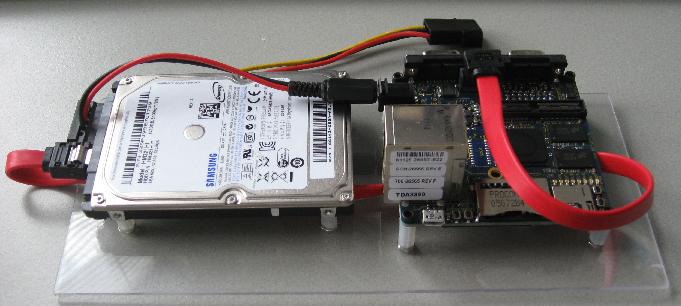
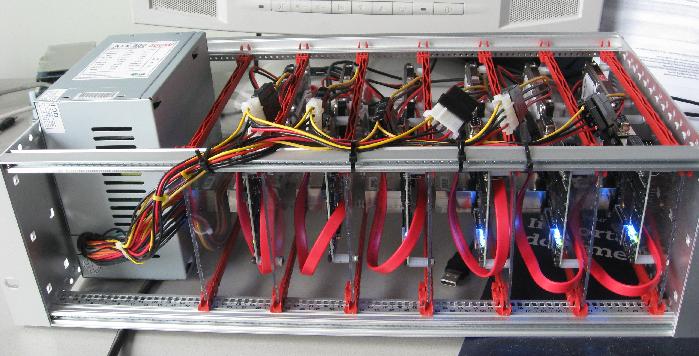
MX53-LOCO U-Boot > setenv loadaddr 0x70800000
MX53-LOCO U-Boot > setenv initrdaddr 0x71000000
MX53-LOCO U-Boot > setenv bootargs_sata set bootargs \$\ bootargs\  root=/dev/sda2 rw rootwait
MX53-LOCO U-Boot > setenv load_sata_kernel ext2load sata 0:1 \$\ loadaddr\  /uImage
MX53-LOCO U-Boot > setenv load_sata_initrd ext2load sata 0:1 \$\ initrdaddr\  /uInitrd
MX53-LOCO U-Boot > setenv load_sata run load_sata_kernel load_sata_initrd
MX53-LOCO U-Boot > setenv bootcmd_sata sata init\; run bootargs_base bootargs_sata load_sata\; bootm \$\ loadaddr\  \$\ initrdaddr\ 
MX53-LOCO U-Boot > setenv bootcmd run bootcmd_sata
And I've added extra config into uboot to use the pre-installed Ubuntu system on the micro SD card as a fall-back:
MX53-LOCO U-Boot > setenv bootcmd_rescue sata init\; run bootargs_base bootargs_sata\; mmc read 0 \$\ loadaddr\  0x800 0x1800\; bootm

Wouter Verhelst: One day

Went to see One Day yesterday. As I usually do after watching a movie, I next went to wikipedia to read up more about it. Was shocked to read that it received 'mostly negative' reviews. I thought it was pretty good. After reading a few of the aforementioned reviews, I understand what the problem is, and though I disagree with the resulting negativity in the review, I can see where it's coming from. You see, One Day is a novel-turned-movie. As with most movies that were sourced from a novel, the movie is a disappointment to those who read the book, mainly because there's always going to be more material in the book, and therefore some of your favourite passages from the book are going to be removed, or changed so that they'll lose some of their original goodness. This is even true for beyond-feature-length movies sourced from novels; for instance, when I saw the horse whisperer after reading the book, I found it a disappointment too, even if my brother and sister who saw it at the same time as me did like it. Ignoring that, there's a second problem; while it's a love story, I don't think it qualifies as a 'romantic comedy'. For it to be a romantic comedy, you'd expect 'happily ever after', and you'd expect a story about two people quickly (or slowly, as the case may be) falling in love with eachother, overcoming some problems that stand in the way of their relationship. Most importantly, you'd expect it to be lighthearted and funny you'd expect it to be a comedy. One day doesn't deliver that; if you go see it, expecting a romantic comedy, you'll be sorely disappointed. But if you accept the fact that it isn't a romantic comedy, it's still a very interesting film. It's not lighthearted, but that doesn't mean there isn't a laugh or a cry in there. And, without wanting to spoil the plot, while the movie doesn't bring 'happily ever after', it does still come up with a believable, emotional, and very compelling ending. The plot takes you through the 15th of July in the lives of the two main characters, every year for two decades. Sometimes they're spending that day together, sometimes they're not. Sometimes they're calling, sometimes they're fighting, sometimes they're kissing. The days shown are snapthots of both their lives; this adds an interesting angle to the plot, as much of the story, much of what is going on, can't actually be shown on-screen, since it happened in between the two 15ths of July. While, as said, I wouldn't describe the movie as a romantic comedy, I think it can be accurately described as a romantic drama. It's not going to be a legendary movie, a must-have-seen, one which you'll grow to hate over watching it on every TV station's prime time over the next few years. But it's a charming, novel, and interesting piece of drama. Did I like it? Definitely. When I go to the movies, sometimes I want a silly movie, some action flick that I can have a bit fun laughing at; but sometimes I want a movie that touches my heart and makes me reflect on my own life while feeling for the characters. When I went to see The Expendables, I have a lot of fun for one night, and then promptly forgot about it. But 'One Day' rang true with me on an emotional level; and for that alone, I can recommend it. Even if that wasn't the reason why I chose to pay 8 for this movie rather than anything else. I'll be perfectly honest: Anne Hathaway. Good actress, and sporting the most interesting pair of bright eyes you've ever seen; what more could one want? A film that allows these two eyes, and acting talent to shine, of course. And One Day delivers.

Kai Wasserb ch: What wasn't said about the Linux graphics stack

This post is a small follow-up on yesterday's post about the Linux graphics stack. I'm still keeping to high level stuff and won't dig too deep, but a few questions arose (others reached me by e-mail), so, here we go. Gallium3D is a framework, initially developed by Tungsten Graphics, which were bought by VMware. The idea behind Gallium3D is, that many functions can be shared between drivers for different GPUs and that the effort to support a new platform/system is for classic drivers pretty high. With Gallium3D you just need a state tracker and a target. The state tracker is code, that gives the pipeline of Gallium3D drivers access to a platform/system, like OpenGL or X on various operating systems. A target is the required as glue between a state tracker and the actual driver. For example: there is a state tracker for video playback acceleration (the recently added g3dvl). The state tracker itself offers the interface and common functions (with some help from the auxilliary stuff) between the Gallium3D pipeline and the userland libraries like libvdpau1. Targets like vdpau-[DRIVER] glue the driver and the state tracker together. The winsys part of Gallium3D is a similar concept but it abstracts the windowing system on the target platform away (e.g. Wayland, X or GDI). I didn't write about the proprietary drivers yesterday, as I don't consider them a real part of the Linux graphics stack, more like parasites, and didn't want to encourage anyone to use them (yes, I know, there are some cases in which you might be better off with them, but generally I'd avoid them). Anyway, I got some questions about those (some by e-mail, the other I'm aware off, can be found behind the link at the beginning of this entry). So, where do the proprietary drivers come in? They are basically the entire stack in a closed form, plugging into the public interfaces of the Kernel (whether that's legal is disputed), some other parts like X (by building a DDX) and building their own libGL. Especially the last part can be a cause for a lot of pain, when you don't use the proprietary driver packages offered by the distribution (e.g. Debian's fglrx packages divert the libGL and restore the default one on unistallation, with the vendor build scripts and tools this is not really guaranteed, which might leave you with a broken OpenGL setup). Another question was, why Mesa was lacking support for a recent OpenGL version (i.e. 4.x). In my opinion there are a few reasons, though I don't really feal like the best person to answer this. The first are design issues by some internal representations (e.g. missing integer support in the intermediate representations). The second is the available number of developers being able to implement new OpenGL functions. Apart from a not all too clear specification the Mesa code base is huge (even if you ignore most of the drivers), which makes it difficult for new developers to start coding away. Then you need an understanding of how modern GPUs operate to find good solutions for the problems faced. If you want to get an idea for this, take a look at Zack Rusin's or Alex Deucher's blog. Then, there is a sad split of developers, on the one hand we've got the Gallium3D-using developers on the other we've got the ones staying with the classic driver model. This means, that you have to implement e.g. GLSL extensions for TGSI and Mesa's IR respectivly. There might be other reasons, I'm totally missing, but this should give you some insight into why it takes so long, to get current OpenGL versions supported. I hope this clears some of the remaining questions, if not, feel free to write me an e-mail, but please remember, that this is not an in-depth analysis.

4 September 2011

Sune Vuorela: Network status aware apps

Am I online or not? There is a summary at the end for the quick readers. It is in many modern applications important to be able to more or less gracefully handle if the application user is online or not. For example, there is no need to try to fetch emails if the device (computer, phone, tablet, laptop, ) doesn t have network (wifi, cable, umts, ip over avian carriers, ..). KDE has of course made nice functionality for this, and here I will try to describe how to make your app network status aware and what to be aware of in the process. Solid background All this is going on in Solid, using two parts of Solid and a bit of KDE s infrastructure: The networkstatus KDED module is trying it best to gather information from the computer to see if one is connected or not. It has the possibility to gather information from various sources, and handle changes and such. The as of writing available sources that the networkstatus module gathers information from is Collecting from different sources is important, because some people might have configurations like Manage wireless thru wicd , manage umts dongle with Network Manager and manage wired network with /etc/network/interfaces and all of it needs to be combined. Solid reports, if wicd thinks online , and network manager thinks offline that the user is Connected.. Solid States There is a enum with 5 values in Solid to describe the current state of the network:

enum Status
Unknown,
Unconnected,
Disconnecting,
Connecting,
Connected
;
Connected is the easy state. Here, Solid knows that you are having some kind of connection according to at least one of the sources. But it might just be a local network connection, and not actually a internet connection. So one here should handle connection failures gracefully. Unconnected is a similar easy state. Here, Solid knows that you don t have any internet connection according to the sources it knows about. One should here not try to do any networking. Connecting and Disconnecting is that a state change is happening, so that you can prepare to react on it. Solid also has the state of Unknown, used for cases where Solid doesn t have the required data to actually know it. A example could be a system without any of the data providers. You should here probably try to connect, and be able to handle failures gracefully. Also described as Proceed with caution . The bright reader might here notice that one both in the Unknown and Connected case actually should do the same. Querying for network status At any given time:

Solid::Networking::Status currentStatus = Solid::Networking::status();
if(currentStatus==Connected currentStatus==Unknown)
//try to do networking things
else
//mark application as offline.

Here, we first query Solid for current status, and then if the state is Connected OR Unknown, then we proceed. Getting notified Maybe you don t want the roundtrip of asking (resulting in a dbus rountrip each time) when you need to know the state changes. Then you of course can get notified. class MyNetworkAwareClass : public QObject
Q_OBJECT
public:
MyNetworkAwareClass();
void doNetworkActivity();
private Q_SLOTS:
void networkStatusChanged(Solid::Networking::Status newstatus);
private:
Solid::Networking::Status m_current_state
;
MyNetworkAwareClass::MyNetworkAwareClass : m_current_state(Solid::Networking::Status())
connect(Solid::Networking::notifier(), SIGNAL(statusChanged(Solid::Networking::Status),this,SLOT(networkStatusChanged(Solid::Networking::Status)));

void MyNetworkAwareClass::networkStatusChanged(Solid::Networking::Status newstate)
m_current_state = newstate;
void MyNetworkAwareClass::doNetworkActivity()
if(m_current_state == Unknown m_current_state == Connected)
//try to do network activity


I guess this should be pretty self explaining. Summary Oh. And I m out looking for a job.

3 September 2011

Benjamin Mako Hill: In Defense of Negativity

I often hear criticism of "negative campaigning" in the free software movement. For example, in reply to a blog post I once wrote about an FSF campaign, several people argued against, "negative campaigning of any sort, in any realm." Drawing an analogy to political smear campaigns, some members of the free software community have taken the position that negative campaigning in general is not useful and that negativity has no place in our advocacy. First, it is important to be clear on what we mean by a negative campaigns. I believe that there is a fundamental difference between speaking out against policies or actions and smear campaigns that employ untrue claims, ad hominem attacks, and that attempt to avoid a real conversation about issues. I will categorically condemn the latter form of smear campaigning in campaigns for software freedom or for anything else. That said, negativity directed at negativity has had a positive effect in many social movements. I have supported and participated in "negative" campaigns against proprietary software, software patents, DRM, centralized network services, and the firms behind these practices. I've done so because I believe that if one is taking an ethical position, it is justified, and often necessary, to not only speak about the benefits of freedom but against acts of dispossession and disenfranchisement. In some of the most effective social movements, unambiguously negative messages have been central. Should a campaign for abolishing child labor talk only about how valuable adult workers are to their employers or how happy kids are when they don't work? Should a campaign trying to abolish land mines talk only about the benefits of bomb-free fields and intact lower limbs? Should a free speech organization only speak out about the social welfare brought by a free press and never against acts of censorship? These may seem like outlandish comparisons but you can find people writing, only a couple centuries ago, about how slavery should be abolished by arguing in favor of the benefits of paid labor. Even if the economic arguments in favor of paid work are strong, these arguments seems irrelevant and offensive today. Whether slavery is more or less efficient is a moot point. Society has rejected it because it is wrong. We have made important strides toward eliminating injustices like child labor and slavery because activists waged decidedly negative campaigns against them and convinced others to join in opposition. In doing so, activists declared the status quo unconscionable and created an ethical responsibility to find alternatives and to redefine what was "realistic." While I will not suggest that the movement for software freedom is comparable in ethical weight to these other causes, I know that the free software mission is similar in kind. Of course, if one does not think that user control over technology is an ethical issue but is instead merely a matter of choice, one will probably oppose negative campaigns. It is also possible that a particular negative campaign is tactically unwise in that it is unlikely to reach a large audience, unlikely to change people's minds, or be difficult to carry out successfully. But such campaigns are a bad idea because they are ineffective, not because they are negative. Additionally, a movement that is purely negative and offers no reasonable alternative to the stated ill may also be unlikely to succeed. This is why, for example, I believe it is good that the FSF uses the large majority of its resources in the "positive" role of supporting free software. For those that do treat technological empowerment as an ethical ideal, it is both justified and essential to condemn the systematic disempowerment of others through non-free software just as we celebrate the benefits of software freedom. "Negative" campaigns against proprietary software, software patents, and DRM in music have already led our community to important -- if incomplete -- victories. The desire to right wrongs has been a critical part of our movement's success and of many others'. We would be wise not to give it up.

2 September 2011

Asheesh Laroia: Debian bug squashing party at SIPB, MIT


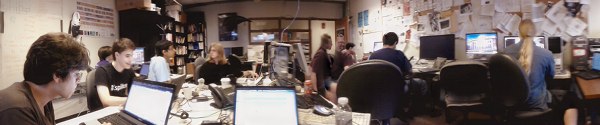
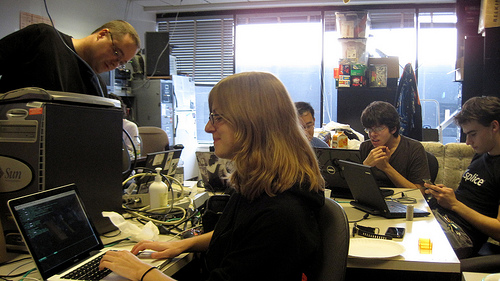
(Photo credit: Obey Arthur Liu; originally on Picasa, license.) Three weekends ago, I participated in a Debian bug squashing party. It was more fun than I had guessed! The event worked: we squashed bugs. Geoffrey Thomas (geofft) organized it as an event for MIT's student computing group, SIPB. In this post, I'll review the good parts and the bad. I'll conclude with beaming photos of my two mentees and talk about the bugs they fixed. So, the good:

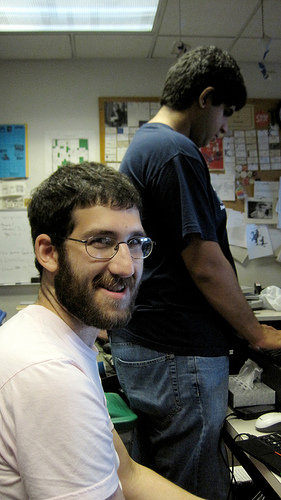
The event was a success, but as always, there are some things that could have gone more smoothly. Here's that list: Still, it turned out well! I did three NMUs, corresponding to three patches submitted for release-critical bugs by my two mentees. Those mentees were: Jessica enjoying herself Jessica McKellar is a software engineer at Ksplice Oracle and a recent graduate of MIT's EECS program. She solved three release-critical bugs. This was her first direct contribution to Debian. In particular: Jessica has since gotten involved in the Twisted project's personal package archive. Toward the end of the sprint, she explained, "I like fixing bugs. I will totally come to the next bug squashing party." Noah grinning Noah Swartz is a recent graduate of Case Western Reserve University where he studied Mathematics and played Magic. He is an intern at the MIT Media Lab where he contributes to DoppelLab in Joe Paradiso's Responsive Environments group. This was definitely his first direct contribution to Debian. It was also one of the most intense command-line experiences he has had so far. Noah wasn't originally planning to come, but we were having lunch together before the hackathon, and I convinced him to join us. Noah fixed #625177, a fails-to-build-from-source (FTBFS) bug in nslint. The problem was that "-Wl" was instead written in all lowercase in the debian/rules file, as "-wl". Noah fixed that, making sure the package properly built in pbuilder, and then spent some quality time with lintian figuring out the right way to write a debian/changelog. That's a wrap! We'll hopefully have one again in a few months, and before that, I hope to write up a guide so that we run things even more smoothly next time.

Next.

Previous.