Search Results: "ema"

21 September 2007

Eddy Petrișor: software for managing finances

Dear lazyweb,

I decided to track our (mine and my fince 's) expenses more closely and I am in search of some software for this task.

The requirements for the software:
I have never used such software before, so I am a total noob in this area. Please be gentile if I might have naively described the problem.

Thanks in advance!

20 September 2007

Michael Prokop: grml-live - mach dir deine eigene Live-CD

grml-live ist ein Framework, mit dessen Hilfe man mit nur 1 Kommando eine auf grml/Debian basierende Linux Live-CD bauen kann. grml-live baut auf FAI (Fully Automatic Installation) auf und nutzt dessen klassenbasiertes Konzept: Screenshot: grml-live In diesem Beispiel habe ich gerade ein gro es grml-ISO gebaut. Dabei habe ich einfach nur den Debian-Mirror in /etc/grml/grml-live.conf auf meinen lokalen Mirror gedreht (um Traffic und Zeit zu sparen) und dann folgendes Kommando aufgerufen:
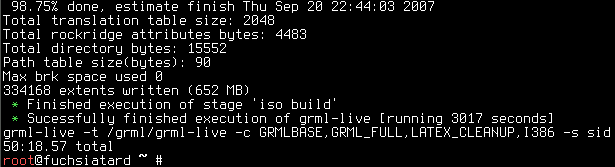
# grml-live -t /grml/grml-live -c GRMLBASE,GRML_FULL,LATEX_CLEANUP,I386 -s sid
Ca. 50 Minuten sp ter habe ich im Ordner grml_isos unter /grml/grml-live/ (-t …) ein fertiges grml-ISO. Dieses wurde auf Basis der Klassen (-c …) GRMLBASE (da steckt alles essenzielle drin), GRML_FULL (Software-Auswahl wie auf der offiziellen gro en grml), LATEX_CLEANUP (ein paar sehr gro e LaTeX-Verzeichnisse aufr umen) und I386 (x86-spezifische Pakete wie z.B. der Kernel) gebaut. Als Debian-Suite (-s) wurde sid (unstable) ausgew hlt. Und das war es auch schon. Ein kleinere grml-Version auf Basis von Debian/stable gef llig? Kein Problem, machen wir es doch einfach mal im Shared-Memory (superschnell und mit genug RAM und den Mountoptionen rw,suid,dev auch kein Problem): Screenshot grml-live: der Start Ein ‘grml-live -t /dev/shm -c GRMLBASE,I386 -s etch’ und keine 5(!) Minuten sp ter hab ich dann mein 135MB kleines grml: Screenshot grml-live: done Mit grml-live kann man sich somit seine pers nlich angepasste Linux Live-CD erstellen, ohne sich erst mit Remastering im Detail besch ftigen zu m ssen. Auch muss man dabei nicht zwingend Debian/unstable nehmen, sondern kann auch Debian/stable als Basis ausw hlen. Durch das Erstellen einer neuen Klasse oder das Anpassen einer existierenden kann man auch spezielle Software-W nsche ganz einfach erf llen. Wird damit das offizielle grml-ISO etwa obsolet? Nein, auf keinen Fall. grml-live soll dem grml-Team als Buildsystem dienen (automatisierte Snapshots auf regelm iger Basis z.B. sind schon in Planung) und die langweilige Arbeit abnehmen, damit wir uns auf die wirklich wichtigen Sachen konzentrieren k nnen: Testen, Bugfixing, Implementieren von neuen Features, Arbeit am Kernel, Qualit tssicherung, Dokumentation,… grml-live hat den Anspruch, auf jedem Debian-basierten System zu funktionieren und wer Interesse daran gefunden hat, kann sich das Debian-Pakete aus dem grml-Repository holen. Den Quellcode gibt es nat rlich auf unserer Mercurial-Webseite. Wer jetzt noch Fragen hat oder mehr Details zu grml-live erfahren m chte, der m ge einfach auf die grml-live-Homepage schauen. Falls dort eine Frage noch nicht beantwortet sein sollte, jemand Feature-Requests, Bugreports oder Patches hat: meine Inbox freut sich ber Post! :-)

Adrian von Bidder: Who'd have thought it?

Who'd have thought it ... Dan Lyons (one of the louder SCO backers) actually published a May Culpa, admitting that he was wrong all the time. A respectful nod in his direction from me, I'd not have expected this. Remains to be said that covering a lawsuit by (judging by the description of what he did before publishing the first article) more or less only talking to one party and, probably, not actually knowing much about the actual topic under discussion still seems to be very bad journalism, but at least he doesn't try to wriggle out of it now. And, IIRC, IBM did not talk much about this lawsuit, while SCO talked to everybody who might listen at length, so you might call that mitigating circumstances. Hmm. Completely unrelated, but ... Konqueror crashes when I try to leave the Forbes web page. Somehow I don't think I'm all too interested in this particular bug being fixed. I still like what the Canberra Times wrote about Forbes Magazine in August 2004:
[Forbes Magazine] looks ... like corporate pornography, giving middle-management dreamers fodder for their fantasies, and this sort of exercise, basically meaningless, hardly seems useful or instructive.

19 September 2007

MJ Ray: Media-sponsored Forums - How to Kill a Community

I was asked for a story on good or bad media sponsored online conversations. I'd not really had much to do with them until this summer. itv is the UK's biggest commercial broadcaster and it had rights to show the Tour de France here this year. Its coverage was pretty good, with daily highlights and live coverage at weekends, mostly on the itv4 satellite/DTT channel. The end of every show plugged their web homepage, which had a prominent link to their forums. I've been on a couple of cycling forums for a while, so I signed up and tried to help explain things that I knew. After a while, I noticed that when I answered a question properly, with links to other authoritative sites like the race teams' own sites, my message was silently removed. This happened a few times. Then I found out that the forum terms of use prohibit linking to any other web sites! This is a big problem, because itv's cycling pages are pretty limited. As a result, the forum was full of hearsay and it's hard to verify anything anyone posts. To cap it all, itv closed the forums for a weekend for an upgrade. Then a weekend became a week, which became a month, which became six weeks. When they finally reopened it, at least they sent me an email, so I tried to login. My login doesn't work and I can't view the forum as a guest any more. I've emailed their support address and had no reply. I don't know if this is a general problem - I can't contact other forum members because I don't have their details. I only saw them on the web forum and members couldn't link their homepages. So, it'll be a long time before I spend much time participating on any media-sponsored sites again, except in a casual throw-away way. Now most of my sports messages will be posted to Cycling Fans and BuzzinFootball like my local news posts go to the community-run WSM Forum. The trouble with media-sponsored forums is that they just don't have the interest in any particular community to want to sustain it. Somewhere, there's a bean-counter saying "so what if we kill this community? We started it from scratch and we'll just do it again." Any messages you post to those forums are usually gone, out of your control, lost to you. Is it worth posting to them? I think Andrew Savory is also spot-on about the problems with forums for technical communities in Bagel Belly Blog: How Open is your Open Source project? He certainly seems in fine form so far this week. I know not all forums are that bad. I'm on a couple of phpbb-powered ones which work well, with added XML feeds and so on. Are any "old media" companies brave enough to run a liberal phpbb? Are there other examples of particularly good or bad forums that you'd like to tell me about?

18 September 2007

Ross Burton: Infinite Undo in Tasks

Yesterday I landed in Subversion a branch of Tasks I've been working on to remove all confirmation dialogs and replace them with infinite undo/redo. I'm really pleased with the end result, there are no more dialogs getting in the way and every action is undoable. To implement this I adapted MarlinUndoManager from Marlin by the most excellent Iain Holmes. The basic design is that the application has a global undo context. When an operation which should be undoable occurs, you start the context, add as many undoables as required, and then end the context. Allowing a single undoable action to consist of multiple undoables lets the application reuse fine-grained logic to build coarse user-level actions (in Tasks this is used to build the Remove Completed action from multiple Delete Task actions). To make integrating this into applications even easier, I wrote a GtkAction which reflects the state of an undo context, so it is trivial to add redo/undo to the interface. There is one remaining task left before this is ready to be released: undo support in the edit dialog entries. Once this is done, the next release of Tasks will be announced. I also plan to work with Iain on cleaning up this code and submitting it for inclusion into GTK+. NP: Money Jungle, Duke Ellington, Charles Mingus, Max Roach

Russell Coker: The Surge and War for Oil

On scienceblogs.com there is an interesting article about statistics and “The Surge” in Iraq [1]. It explains how there is not yet enough data to statistically determine whether The Surge is succeeding in improving the situation in Iraq. Some of the comments point out that the “ethnic cleansing” in some parts of Iraq has been mostly completed. When one of the groups in a disputed area is annihilated or driven out you can expect a reduction in violence. The Guardian reports that Alan Greenspan has stated in his memoirs [2] “I am saddened that it is politically inconvenient to acknowledge what everyone knows: the Iraq war is largely about oil“. His meoirs are published as The Age of Turbulence: Adventures in a New World. I’ve added it to my Amazon Wish List.

Andrew Pollock: [tech] Double drive failure

In other news, it seems that two out of the four drives in the RAID-10 array for the SAN that provides all of the storage for my MythTV installation have decided to fail. I noticed that the array was acting a bit weird and there were a pile of errors reading from one drive yesterday, so I booted it out of the array. This afternoon, I unplugged it, and was going through Seagate's online RMA procedure, when I noticed another drive had failed as well. Miraculously, it seems to have been the one drive that could fail without any data loss. So I'm hoping the two remaining drives were in a different batch or something, otherwise I'm going to have a really bad time really soon.

17 September 2007

MJ Ray: Changes in koha New Model Installer

Stage 1 of the new koha installer uses MakeMaker and some silly tricks to try to install a CGI tree, as well as modules. You can often grab prepatches from mjr-installer if you really want the latest bits sooner. The biggest user-visible change with this installer (compared to 2.2) is that it's dumb. It's dumb in that it's trying to do the simplest thing that could possibly work and it's dumb in that it doesn't ask the installing user any questions. If you know you want to change things, you can tell it, but it doesn't ask you to confirm everything like the 2.2 installer did. Almost immediately, that was criticised on IRC. The first criticism was about a related feature that someone else removed earlier in 3.0, really. The second criticism was stalled by the realisation that if we really want an interface that "questions everything" every time, a wrapper script can ask for all the settings and instruct the dumb installer. I'm not sure whether asking users to confirm everything is a good move, for the sort of reasons in Havoc Pennington's 2002 essay under "The Question of Preferences" - each setting we encourage people to change makes it harder to debug installation problems. That's one of the biggest pains with 2.2 and I think we've started seeing the same happening in 3.0 already. It's not quite "no two installations are identical" but it's not far off. So, the main installer defaults everything to the best values that I can guess that will work within the constraints. It should work for most people and it should be easier for packagers to override. I'd still love to hear about how other Perl CGI scripts install, especially if they use MakeMaker for the basics, then use a CGI interface for the rest. Are you writing one?

Steve McIntyre: Remaining Debconf T-shirts on the way

At/after Debconf it transpired that various people didn't get the T-shirts they should: attendees who left before the Ts were released by customs in the UK, and volunteers and orga team who didn't fit in the small allocation that we had printed up-front. In the weeks since then, we've got more shirts printed thanks to Gunnar and Gaby. I've just sent out (almost) the last of them this weekend to people all over the world, and I'll be hand-delivering the last couple next month. A small number of people also asked for extra Ts if they could pay for them, and I'm emailing them now to confirm what the cost is. UPDATE: Sorry, maybe I wasn't clear enough in the above. We have had more Debconf Ts made for people, but they asked ages ago either at Debconf or shortly afterwards. I'm not planning on getting any more printed for people that ask now. Sorry, it's too late.

16 September 2007

Steve McIntyre: Remaining Debconf T-shirts on the way

At/after Debconf it transpired that various people didn't get the T-shirts they should: attendees who left before the Ts were released by customs in the UK, and volunteers and orga team who didn't fit in the small allocation that we had printed up-front. In the weeks since then, we've got more shirts printed thanks to Gunnar and Gaby. I've just sent out (almost) the last of them this weekend to people all over the world, and I'll be hand-delivering the last couple next month. A small number of people also asked for extra Ts if they could pay for them, and I'm emailing them now to confirm what the cost is.

Gintautas Miliauskas: Opening files quickly in Vim

My Python development environment consists of a GVim window for editing code and a gnome-terminal for running the unit tests. This works out well, but leaves some integration to be desired. In particular, jumping to a test failure point is a little cumbersome. I used to do it this way: copy the filename from the traceback, switch to vim, then type :e, paste the filename with middle-click (now I know I can use * instead) and press Enter, then enter the line number and press G. That is barely acceptable; this particular wart has even contributed to pushing a ex-co-worker towards Emacs (the horror!). I have written a small vimscript function to make the aforementioned use case slightly easier. Now to jump to a failure point, just triple-click the corresponding line in the traceback (that selects the whole line), switch to Vim and invoke the function, which scrapes the clipboard for a filename and line number and opens it in the active buffer. Installation: paste the OpenFileFromClipboard function in your ~/.vimrc and bind it to a key by adding the following lines to your .vimrc:
nmap  :call OpenFileFromClipboard()
imap  :call OpenFileFromClipboard()
These commands bind the key F4 to our function. The first command handles normal mode, and the second handles insert mode (hence the to momentarily escape the insert mode). You can of course change the shortcut to whatever you like. The function should handle following types of references from the clipboard: I hope someone finds this useful.

15 September 2007

Biella Coleman: Save the Arecibo Observatory

There are many amazing things in Puerto Rico and one of them is the technologically (and I would add, aesthetically) stunning Arecibo Observatory, which was featured prominently in the Jodi Foster movie, Contact. Due to massive funding cuts, its future is threatened. This is a site of great scientific and cultural importance for PR, so I really hope they manage to find the funding that will make it survive far into the future. There is a facebook group
(by the name of “Do NOT close the Arecibo Observatory: Earth’s largest radiotelescope”) opposing the closure but I don’t yet know of any other site for halting the cuts. I will post one once I do. And if we lose the observatory, we might sadly lose another fine creature, the mysterious chupacabra who apparently was first called into his goat sucking action thanks to the great observatory of ours, which does send signals to find alien life. So sans Arecibo, we lose a great scientific instrument and may lose the beloved mascot of goat terror, the Chupacabra :(

MJ Ray: Spammers: Total Language Solutions Limited

My personal email account was spammed by Jennifer Kirkham-Sandy (Phone 0800 6 121 151) of Total Language Solutions Limited, 3 The Courtyard, New North Road, Exeter EX4 4EP, Devon. Registered number (England and Wales) at the above address: 03933805. They seemed to be using a service called qwertywordmarketing. I've reported it to the hosting company, so we'll see what happens.

MJ Ray: Low Carbon Lifestyle Tour on TV

It's nice to get email from someone previously mentioned on my site. Mukti Mitchell emailed:
"The Southampton Boatshow programme made by Meridian ITV will include 4 minutes on the Low Carbon Lifestyle Tour and will be screened this week as follows: Sunday 16th September 1800 ITV4; Monday 17th September After Midnight (0100 Tuesday 18th) ITV4; Thursday 20th September 1930 ITV Meridian (ITV1 in South England) (ITV4 Is a national network channel available via your free digi box.) The programme includes footage filmed on board yacht Chance during the round Britain tour. I hope you enjoy the programme."

Chris Lamb: Why does using all the upstream cause lag?

It’s a common story. A housemate starts torrenting some American television series of dubious artistic quality and/or legality, or perhaps starts calling their girlfriend on some fluffy non-free privacy invading spyware and your SSH sessions start to lag. Why does this happen? When the upstream channels become saturated, data must overflow into the modem’s buffers. This causes TCP acknowledgement (ACK) packets originating from your SSH client to be delayed, resulting in an increase in the overall round trip time. This phenomena is usually worse on cable connections as their modems’ buffers are generally larger. Avoiding the problem can be pretty simple — limiting your upstream bandwidth just below its maximum helps, and some smarter solutions involving prioritising ACK packets work even better. Although these are best achieved at your router, a number of applications have their own limiting features: every BitTorrent client will have one, and other tools such as scp (via the ‘-l‘ option) have them too.

14 September 2007

Tollef Fog Heen: Project codenames

I just read Sun's announcement of "Project Hamburg". I am not sure what it is about, but that is not very important in this context. I have worked a bit with Intel lately and gotten introduced into a whole new world of code names such as Mccaslin, Menlow and so on. Up until now, most of them were obscure enough that I thought they were just random names picked from somewhere, but they are, like Sun's names of geographical features, be it towns, cities, rivers or something else. The reason for this naming is, like Sun's, that geographical names can't be trademarked, though in this particular case, Sun supplied a short list of "why Hamburg" with some references to Hamburg's history.

13 September 2007

Biella Coleman: Fair Use and the Economy

Fair use is a small oasis in copyright law that allows you to quote, copy and engage with small bits of copyrighted information usually in the service of education, learning and critique. Despite what I think of as an oasis that is far too small, the economic impact is far reaching, at least according to this report, the first of its kind.

12 September 2007

Brice Goglin: Debian X.org notes - Got specs?

So, this time it was for real! AMD really meant it when they announce the release of specifications of ATI boards last weeks. During XDS2007 at Cambridge, we received the actual specs, 2 PDFs files, 460 pages for the M56 (Mobility X1600, r5xx board) and 436 pages for rv630. The files are now online, but I am not going to give the link here since the web server already suffered too much today (and the URL is easy to find anyway). People should NOT understand this as if we were going to get an open-source driver for all ATI boards next weeks. First, these are only 2D specifications for r500 and r600. 3D specs are expected in a couple weeks once AMD fixes the remaining issues. r300 specs might arrive later. Also, these specifications are pretty hard to use, as expected. There are something like 9000 registers in r6xx boards, and these PDF files are just description of these registers. It's of course far away from being a "How-to write a driver?". So if you want to help, there will be lots of things to do. We also got a demo from some Suse guys of the driver there are working on. They got these specs about 2 months ago. And they already have some part of modesetting working. It means you might get your X server to start. There are about one hundreds different chipsets with their own quirks, so still lots of work to do. And then lots of performance things, 3D, ... to do. This driver is called "Radeon HD" so far. It will remain separated for now, but it might end up being merged with the upstream ATI driver later since the 3D engine are very similar (I personally hope it will happen). The reverse-engineered Avivo driver is dead now then. Fortunately, Jerome Glisse has been aware of the event for a couple months now, so he didn't waste to much time working on it. xserver-xorg-video-avivo will remain in Debian experimental until the new driver arrives. The good thing about Avivo is that it (and the ongoing Nouveau driver for Nvidia) led to the development of very nice reverse-engineering tools (revenge, renouveau, mmio trace, ...). They will be very useful for other graphic boards, or even some network hardware. Of course, many thanks to AMD for making this happen!
(Permanent link) 

Christian Perrier: RWC: Argentina still there, Italy wakes up

After one day off, we watched Argentina-Georgia yesterday evening. Interesting game because it directly affect France's chances to qualify after Argentina's win on Friday. Argentina had a big disadvantage by playing only 4 days after their historic battle against France. As a logical consequence, they appeared quite tired and very imprecise. On the other hand, Georgia fought very courageously with a strong pack of forwards, encouraged by most of the crowd in Lyon. Finally, Argentina won *and* scored the bonus point by scoring a try in the very last minute (which might become very important to qualify in this pool. Good game even if Argentina was not that impressive, but I still think this is mostly because of the 4-days delay. Today, 3 games were scheduled. We didn't watch USA-Tonga (15-25). USA was slightly favourite for that one but they also were quite tired by playing 4 days only after their battle against England on Saturday. This was the first match for Tonga and obviously the island players were less tired and played a good rugby to win that one. Japan-Fidji (31-35) seems to have been the most uncertain match as of now. I somewhat regret not watching it as these two are among the teams I like watching and 7 tries in the match probably made it very interesting. Tonight, we watched Italy-Romania (24-18). The italians compete with Scotland for the remaining qualifying spot in that pool, if one assumes that New Zealand will obviously win all its matches. So, Italy *had* to win that match. The quality of romanian rugby has decreased in the last 10 years, but they still have a good set of great players, most of them playing...in France (just like one third of the italian team, indeed). The match was quite indecise with italy keeping the ball all first half long, but only leading 8-0 on half time....and being surprised by two romanian tries at the beginning of second half (8-12). After a strong domination of Italy, Romania was logically sanctioned by one expulsion and a penalty try (for successive voluntary faults), but, until the end, Italy was still in danger. They finally made it, which was the most important for them, 4 days after they were sweeped out by the All Blacks. We're now eagerly waiting for *THE* game of this week, England-South Africa in the Stade de France on Friday. Elizabeth found out that a few tickets are still available, but for 253 euros each, we decided to watch it on TV. So, between 21:00 and 23:00UTC that day, don't even think about pinging me on IRC. I still haven't decided who I'll support the most as I'm not a huge fan of either team....but they're still among the best in the world, of course.

Erich Schubert: Gnuplot grep

For my diploma thesis (on clustering of high dimensional data, especially correlation clustering, i.e. clustering data by properties such as data correlation) I needed an easy way to filter out data from CSV files as used by gnuplot (actually, they are whitespace-separated).I hacked together a small tool that would allow me to easily 'grep' out certain parts of the datasets. If you know of a similar tool, please send me an email to erich AT debian DOT org.Currently, the tool allows you to do commands such as:
gpgrep "1~5$" "1200"  out/3d-2lin-noise.variances
to select ('grep') all sets where the first column ends with a 5 (regular expression match) and where the first column is less than 199.The tool is still in early development. Syntax may change, and I guess I'll add some more filters. But you get the idea. Focus is on a very compact syntax.A future filter I'm considering would e.g. select 20 random rows (with a fixed seed value, so it's reproduceable!) for sampling and a modulo-match to select e.g. every 7th row.Maybe I'll also add some output processing later, such as averaging values, calculating variances and mean deviations, stripping away columns (but you can do that in Gnuplot already). I don't want to overdo it though - it's just meant as a mini filter you can add to script output visualization. It's not meant to replace a full statistics toolkit.So if you know of a simple tool that can do that already, please tell me.P.S. a few people have pointed out awk. Yes, it can do most of this. One thing I also need, and I'm not sure on how to do that the easiest way in awk is to preserve 'blocking'. That is empty lines. Because the data set
1 1
2 2
1 2 2 1 are two lines with two points each in gnuplot, not one with four points. I guess you could just do a "/^$/ print ", though... hmm... looks like I finally have to learn awk. So far I've always been refusing to learn awk, I was happy with sed, perl and python...

Next.

Previous.