Search Results: "ana"

16 May 2008

Jeff Bailey: Gay-Marriage in California

One of the proudest moments I had as a Canadian was sitting in the Senate visitor's gallery watching the debates on same-sex marriage that led to the full legalisation in Canada. In coming down to the US for work, I was sad to come to a place that not only didn't allow it, but had actually had a number of ballots in states voting specifically that the marriage referred to "One Man, One Woman".

I found a transcription of the Hansard of Prime Minister Paul Martin's introduction of Bill C-38 (The Civil Marriage Act). The logic in there for why Canada needed to legalise same-sex marriage is quite specific to Canada, but he talks about why it's important for the issue not to come to a vote:

The Charter was enshrined to ensure that the rights of minorities are not subjected, are never subjected, to the will of the majority. The rights of Canadians who belong to a minority group must always be protected by virtue of their status as citizens, regardless of their numbers. These rights must never be left vulnerable to the impulses of the majority.


I don't really understand the US system of rights. I hope that the protection of the right to love another consenting adult and make a commitment to them becomes the law of the land throughout the United States.

I love being married. I get the joy of being able to come home to my belle and share my day, spend time, and know that to the best of our ability, we're going to try to grow old together. I'm so happy that this ruling has come down and that in California the debate is now over.

15 May 2008

Thijs Kinkhorst: Setting up Mailman to store members in a MySQL database

Little Mailman For a project I was looking for a way to use GNU Mailman for mailinglist management (especially its powerful web based moderation, bounce handling and attachment scrubbing features) but storing the mailinglist member information in a SQL database. That's useful when you want to relate mailinglist members to extra information already in a database and functionality on an interactive website, and it's possible on a per-mailinglist basis. This turned out to be not very difficult but just not that clearly documented. What I used: This explanation assumes you know how to work with Mailman in a regular setup, and things like creating databases and users under MySQL. Take the following steps:
  1. Install and set up mailman as you would otherwise.
  2. Put the MysqlMemberships.py file into the dir that is Mailman's base, this normally already has files like MemberAdaptor.py in it. For Debian this is /usr/lib/mailman/Mailman. You only need to add MysqlMemberships.py, the other files from rezo.net are not needed.
  3. The create table query in MysqlMemberships.py does not work with MySQL 5, I had to apply this patch which I've sent to MySQLMembership's author in the meantime. This patch has been applied by Fil.
  4. Create a database and a MySQL user, and add that information into your mm_cfg.py, like this:
    MYSQL_MEMBER_DB_NAME = "mailman"
    MYSQL_MEMBER_DB_USER = "mailman"
    MYSQL_MEMBER_DB_PASS = "somethingrandom"
    MYSQL_MEMBER_DB_HOST = "localhost"
    MYSQL_MEMBER_TABLE_TYPE = "wide"        # wide means one table per list, flat = one large table
  5. Create a mailinglist like your normally would (e.g. via newlist). To enable the MySQL backend for just that list, create a file extend.py under /var/lib/mailman/lists/listname with the following content:
    from Mailman.MysqlMemberships import MysqlMemberships
    def extend(list):
            list._memberadaptor = MysqlMemberships(list)
    
    (whitespace is significant in Python).
  6. It should work now! Upon receiving the first request for your list, the database table will be created automatically, which you can then populate. You may need to restart the mailman qrunner after you make further changes to your setup.

14 May 2008

John Goerzen: Thoughtfulness on the OpenSSL bug

By now, I'm sure you all have read about the OpenSSL bug discovered in Debian.

There's a lot being written about it. There's a lot of misinformation floating about, too. First thing to do is read this post, which should clear up some of that.

Now then, I'd like to think a little about a few things people have been saying.

People shouldn't try to fix bugs they don't understand.

At first, that sounds like a fine guideline. But when I thought about it a bit, I think it's actually more along the lines of useless.

First of all, there is this problem: how do you know whether or not you understand it? Obviously, sometimes you know you don't understand code well. But there are times when you think you do, but don't. Especially when we're talking about C and its associated manual memory management and manual error handling. I'd say that, for a C program of any given size, very few people really understand it. Especially since you may be dealing with functions that call other functions 5 deep, and one of those functions modifies what you thought was an input-only parameter in certain rare cases. Maybe it's documented to do that, maybe not, but of course documentation cannot always be trusted either.

I'd say it's more useful to say that people should get peer review of code whenever possible. Which, by the way, did occur here.

The Debian maintainer of this package is an idiot, should be fired, should be banned

I happen to know that the Debian programmer that made this patch is a very sharp individual. I have worked with him on several occasions and I would say that kicking him out of maintaining OpenSSL would be a quite stupid thing to do.

He is, like the rest of us, human. We might find that other people are considerably less perfect than he.

Nobody that isn't running Debian or Ubuntu has any need to worry. This is all Debian's fault.

I guess you missed the part of the advisory that mentioned that it also fixed an OpenSSL upstream bug (that *everyone* is vulnerable to) that permitted arbitrary code execution in a certain little-used protocol? OpenSSL has a history of security bugs over the years.

Of course, the big keygen bug is a Debian-specific thing.

Debian should send patches upstream

This is general practice in Debian. It happens so often, in fact, that the Debian bug-tracking system has had -- for probably more than a decade -- a feature that lets a Debian developer record that a bug reported to Debian has been forwarded to an upstream developer or bug-tracking system.

It is routine to send both bug reports and patches upstream. Some Debian developers are more closely aligned with upstream than others. In some cases, Debian developers are part of the upstream team. In others, upstream may be friendly and responsive enough that Debian developers run any potential patches to upstream code by them before committing them to Debian. (I tend to do this for Bacula). In some cases, upstream is busy and doesn't respond fast or reliably or helpfully enough to permit Debian to make security updates or other important fixes in a timely manner. And sometimes, upstream is plain AWOL.

Of course, it benefits Debian developers to send patches upstream, because then they have a smaller diff to maintain when each new version comes out.

In this particular case, communication with upstream happened, but the end result just fell through the cracks.

Debian shouldn't patch security-related stuff itself, ever

Well, that's not a very realistic viewpoint. Every Linux distribution does this, for several reasons. First, a given stable release of a distribution may be older than the current state of the art upstream software, and some upstreams are not interested in patching old versions, while the new upstream versions introduce changes too significant to go into a security update. Secondly, some upstreams do not respond in a timely manner, and Debian wants to protect its users ASAP. Finally, some upstreams are simply bad at security, and having smart folks from Debian -- and other distributions -- write security patches is a benefit to the community.

13 May 2008

Biella Coleman: What Sorts of People Should There Be?

I am affiliated with a project whose origin is the northern parts of Canada, although whose members span the globe called What Sort of People Should There Be?. The idea behind this nifty and catchy title is to get a bunch of researchers in various fields, from disability studies to philosophy and everything that comes in between to start asking a series of questions about the role of human enhancement today and eugenics in the past, all within the context of thinking about the experience and politics of disability. I am super excited about the project because it spans the past and present to confront what it means to be human, how we value variation, how we seek to support or erase difference, and lastly something close to my academic heart, the role of technology in facilitating and dampening the politics of possibility and hope when it comes to disability. The project has recently launched an multi-author blog and I will be posting there from time to time. If you are interested in this topic, do come by for a visit. I am sure you won’t be disappointed. My most recent post is here and it covers an interesting article in the New York Times on Mad Pride, which oddly enough is in the Fashion & Style section.

John Goerzen: Imagine 1

Imagine, for a moment, that you are a young man in your 20s, trying to make your way in the world. You are married and have a young daughter, just old enough to start to talk. You live in a run-down neighborhood, long passed-over by any economic advances. What schools you had access to barely taught anyone much. The few jobs you can reach have fierce competition, even though the pay is low. You worry about your health, but even more about that of your wife and child. Finding food is a constant concern. Although you are still healthy now, and you are willing and able to be a hard worker, there is simply nobody hiring people in your area. Not to mention the gunfights that erupt between gangs or drug dealers. Oh, and did I mention that your wife is 4 months pregnant?

Your top priority is to do your best to keep your family safe. You're afraid that your whole family will starve, or be killed by an errant bullet. You've tried for a long time -- it seems like forever -- to do everything you can think of, with no success. Finally, you decide that the only way you can have the hope for a better life is to move somewhere where the economy is better, and the drug dealers are fewer.

But moving hundreds or thousands of miles away is no easy task when you have no money to move. Somehow, with some luck, ingenuity, and tenacity, you have finally managed to find a way. You have no job offer in your new town, but conditions are so bleak at home that you just can't risk staying there. So the three of you move 1500 miles away.

You arrive with no money, no apartment, and don't know anybody. But you're a hard worker, and have talked yourself into a job. It pays what passes for minimum wage in your new home, but it's a fortune compared to what you made before. It's backbreaking work, and you work long hours. But soon you can afford a cramped apartment, and keep your refrigerator stocked with food. What a luxury!

Pretty soon your new baby son is born. You can afford to feed him, your daughter, your wife, and yourself, every day. When you're really lucky, you even have some money left over to send to your brother back home, who is still struggling to make ends meet there. You seem to have climbed the first rung on the American Dream ladder.

Years pass. Your old home becomes a memory; your daily life revolves around new struggles now. Your oldest child is in school, your wife finds part-time work sometimes too, cleaning houses for rich people. You've been laid off several times, your income isn't guaranteed, and the others in your new home don't take kindly to strangers -- and they still think you're one. But it's better than flying bullets and never knowing where your next meal will come from.

Then one day, while you are at work, federal agents show up. You are arrested and taken to jail. Agents show up at home, too, arresting your wife. It turns out that they realized you entered the country illegally from Ecuador those years ago. Meanwhile, your wife wonders what will happen to your son that was playing in a neighbor's yard while she was arrested, or to your daugther that was at school.

After months in jail, with little contact with each other, and poor medical care, the government decides to deport you to Mexico. Why Mexico? Well, it's cheaper, and there's no documentation showing where you came from. Apparently you "look" Mexican, and they don't believe your story.

After months in jail with no income, you are once again bankrupt. A government bus takes you to Mexico and drops you down someplace there, with your wife and your oldest child. Your younger child was born in the United States, and so is an American citizen and can't be deported. But the government isn't going to give him a free ride on a prison bus (and Mexico wouldn't take him anyway, since everyone knows he's American). You have no idea where he is. You have no idea how you're going to find food in Mexico, no idea how to find your son, no idea where to find refuge from the ever more prevalent drug dealers. Meanwhile, the Americans think you're scum because you wanted to protect your family, and it's going to be much more difficult to get back in to try to reunite your family.

This story is based on true events.

It's truly easy to demonize illegal immigrants, isn't it? Easy to round them up by the thousands, easy to build a bigger fence, easy to lock them away.

Sometimes it seems like this nation built on freedom, supposedly on Christian values, has lost sight of compassion for the lowly. In this country, we would throw in jail parents that didn't do everything humanly possible to find food for their children. We also throw in jail parents that grew up in other countries that are just doing the same.

How sad that we have people going on TV, suggesting we round up millions of Americans that happened to come here illegally, breaking up millions of families, creating an immense foster child problem, a human tragedy on a mass scale. How incredible that some of these people on TV wear the title "senator" or "candidate for president". How stupid do they think we are, suggesting that a poor South American family would somehow be able to navigate the arcane American immigration system and wait the 15 years to get here legally, if they manage to come up with all the necessary money somehow?

Politicians have been pushing our buttons for too long. We aren't a nation of selfish hoarders; we came together through tough times, survived the Depression, put in place the Berlin Airlift that saved countless lives in West Berlin. But the thought of someone with darkish skin coming to this country and building highways is enough to send some people looking for a rifle.

I hope that we will someday do better.

Russell Coker: Release Dates for Debian

Mark Shuttleworth has written an interesting post about Ubuntu release dates [1]. He claims that free software distributions are better able to meet release dates than proprietary OSs because they are not doing upstream development. The evidence that free software distributions generally do a reasonable job of meeting release dates (and Ubuntu does an excellent job) is clear. But the really interesting part of his post is where he offers to have Ubuntu collaborate with other distributions on release dates. He states that if two out of Red Hat (presumably Enterprise Linux), Novell (presumably SLES), and Debian will commit to the same release date (within one month) and (possibly more importantly) to having the same versions of major components then he will make Ubuntu do the same. This is a very significant statement. From my experience working in the Debian project and when employed by Red Hat I know that decisions about which versions of major components to include are not taken lightly, and therefore if the plan is to include a new release of a major software project and that project misses a release date then it forces a difficult decision about whether to use an older version or delay the release. For Ubuntu to not merely collaborate with other distributions but to instead follow the consensus of two different distributions would be a massive compromise. But I agree with Mark that the benefits to the users are clear. I believe that the Debian project should align it’s release cycles with Red Hat Enterprise Linux. I believe that RHEL is being released in a very sensible manner and that the differences of opinion between Debian and Red Hat people about how to manage such things are small. Note that it would not be impossible to have some variations of version numbers of components but still stick mostly to the same versions. If Debian, Ubuntu, and RHEL released at about the same time with the same versions of the kernel, GCC, and major applications and libraries then it would make it much easier for users who want to port software between distributions and run multiple distributions on the same network or the same hardware. The Debian Social Contract [2] states that “Our priorities are our users and free software“. I believe that by using common versions across distributions we would help end-users in configuring software and maintaining networks of Linux systems running different distributions, and also help free software developers by reducing the difficulty in debugging problems. It seems to me that the best way of achieving the goal that Mark advocates (in the short term at least) is for Debian to follow Red Hat’s release cycle. I think that after getting one release with common versions out there we could then discuss how to organise cooperation between distributions. I also believe that a longer support cycle would be a good thing for Debian. I’m prepared to do the necessary work for the packages that I maintain and would also be prepared to do some of the work in other areas that is needed (EG back-porting security fixes).

Jeff Bailey: Out and about!

As some people have guessed, not posting means that I'm doing quite well these days! The major advancements in my life since the last post are:

* Feeling comfortable enough to drive a car.

I finally feel like I can look around enough to shoulder check, although I can't twist enough to back the car up. When it comes time to park in out parking spot, I get Angie to do that bit.

* I'm allowed in the hot tub!

While this one seems like less of a big deal, since sitting in a hot tub in mid-20 degree weather is a bit weird, it's one more thing to do when I'm at home, and really pleasant on my back and shoulder muscles.

* My first HIV test came back negative.

Yay blood transfusion. The doctors consider the risk to be so negligible that they don't actively recommend that people get tested. They do, however, make you sign scary paperwork. So in order to be a responsible partner, and not a hypocrite when I teach OWL, I'm getting tested. One more test at 3 months, one more at 6 months to go.

Otherwise, things are going well. Physical Therapy is continue to put me on harder weights and Therabands almost every week. I'm continuing to reduce my meds at one pill per week (So I think I might be able to have a "Yay, I've got a 5-year visa" celebratory drink when I can back!). I'm still taking the anti-nausea drugs almost every day, but hopefully as I get off the pain killers, that will be less of a problem.

Oh, and I got our Canadian taxes mailed off (yay!). Now if we can only get the accountant to get the US ones off...

We're going up to Vancouver soon. There'll be at least one party for Leif, please email me if you want info. When we get back, I'll be straight into work, so forgive me if I suddenly go silent for a few weeks. =)

Now, back to homework. A course started a month earlier than I thought it did. =(

10 May 2008

Dirk Eddelbuettel: Quarryman Challenge 2008

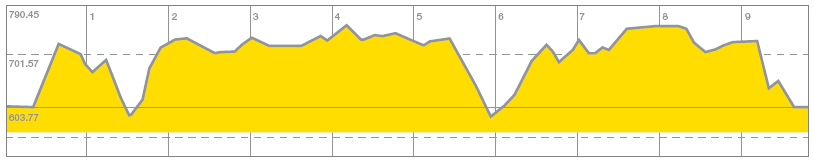
This morning was the 2008 edition of Quarryman Challenge, a 5km and 10mile race in Lemont, which is southwest of Chicago along the Illinois-Michigan Canal. Three of us ran the 10 mile race, which was nicely organised. But is it ever friggin' hilly there: the race course takes three turns from the lower levels near the canal up towards those hills. As the elevation chart (that I cut out of this pdf file with the course map) shows, it is not so much the total elevation but rather how steep the incline is. Quarryman Challenge elevation profile That said, I did okay: even though the legs were really tired throughout from those inclines, I finished in 1:12:08 for a pace of 7:13. And given the reasonably small field, that yielded 34th place overall and third in my age group.

Michal Čihař: Gammu stable version 1.20.0

Good news everyone, new stable Gammu release is out. Since 1.19.91 it brings only few small fixes in OBEX and EMS, but there is quite big list of changes compared to 1.19.0: You can download from usual place: http://cihar.com/gammu/.

Vincent Fourmond: My lastest fight with udev...

Important note: This post has been modified according to a private remark from Marco d'Itri, thanks to him for his explanations ! I've been trying for a very long while to learn to write udev rules, but I've mostly been unsuccessful, or rather, successful by chance, which is hardly better, as it implies no understanding whatsoever of what I'm doing. My game, today, was to create a symlink for a loop device (loop7) and set the device's group to cdrom (I might elaborate some time later why I need that). So, here is what I learned: With that in mind, the following snippet worked for me, under the name 40-private-loop.rules:
KERNEL=="loop7", SYMLINK="videoloop", GROUP="cdrom"
Enjoy !

9 May 2008

David Welton: LangPop.com - programming language popularity - update

These few days when Ilenia and Helen are still in the hospital are the eye of the storm for me. It's quiet at home and I actually have a few free hours when I'm not allowed to be in the hospital, or when they need to get some rest. One of the things I managed to do recently was some Javascript hacking in order to create a timeline for LangPop.com: http://www.langpop.com/timeline.html. It was fun, because most of the "heavy lifting" is done by Timeplot, and I just had to push the data into place. Of course, there isn't much interesting there because the site is relatively new, but it should be interesting to see how languages fare over time. I did some hacking on Timeplot to make it easier to host it on my own server, and to load a bit faster by stuffing it into one big ugly blob of Javascript. When I get a bit of time, I'll make my changes public, as I think they're fairly useful for anyone who wants to fiddle around with Timeplot some, and thus host it themselves. The other thing I did with the site was switch the X and Y axis of the charts, because that works out better in terms of screen space for the labels, with so many languages to keep track of.

8 May 2008

Matthew Garrett

Modern CPUs are great. They have all sorts of advanced power saving features, which is one of those nice cases where everyone can save money, gain performance and claim environmental credentials at the same time. Everyone's a winner.


Well. Everyone's a winner as long as your software doesn't suck.

I've talked about the benefits of the tickless kernels and reducing wakeups and spending longer in deep C states before, so if you don't know about them then go and read that first. This time I'm going to focus on a different level of hardware, and a different level of suck.

For a long time, laptops supported changing the speed of processors when switching between AC and battery. CPU power consumption is proportional to frequency, so dropping the frequency meant a longer battery life. Of course, it also meant that it took longer to get anything done - the reason this was still a win was because CPUs in those days consumed just as much power when idle as when running. Transmeta introduced a technology called Longrun with their Crusoe processors, bringing the ability to drop both the frequency and the voltage of the CPU simultaneously. With power consumption being proportional to the square of the voltage, even a small drop resulted in worthwhile power savings. As the only really worthwhile thing Transmeta brought to the x86 world[1], this was unsurprisingly ripped off by everyone else. Intel introduced their Enhanced Speedstep, AMD gave people PowerNow and VIA have Longhaul.

Obviously, reducing the frequency of the CPU increased battery life. Everyone's happy?

No[2].

The problem is that nowadays, processors don't consume as much energy when they're idle as when they're running. The aforementioned C states mean that an idle processor consumes a tiny percentage of a loaded one - an ultra-low voltage Intel part will draw on the order of a watt. Executing code, even at the lowest voltage and frequency, will draw far more power. Obviously, we want to keep the processor idle for as long as possible. The easiest way to do this would be to never run anything, but that's not a real option. The alternative is to run when we have to, but make sure that we get it over with as quickly as possible so we can return to the idle state. Counterintuitively, that means switching to the highest voltage and frequency, executing the code and then dropping back into the idle state. By going faster, we save power[3].

In summary, the only sensible way to use a CPU is to run it as fast as possible in order to let it idle as much as possible, and drop the frequency and voltage when it's not doing anything. The. Only. Sensible. Way.

Some people write software that lets you choose different power profiles depending on whether you're on AC or battery. Typically, one of the choices lets you reduce the speed of your processor when you're on battery. This is bad. It is wrong. The people who implement these programs are dangerous. Do not listen to them. Do not endorse their product and/or newsletter. Do not allow your eldest child to engage in conjugal acts with them. Doing this will reduce your battery life. It will heat up your home. It will kill baby seals. The sea will rise and your car will float away. If you are already running it, make sure that it always sets your cpufreq governor to ondemand and does not limit the frequencies in use. Failure to do so will result in me setting you on fire[4].

The only legitimate reasons for limiting the speed of your CPU are to avoid overheating (which should be fixed in the kernel, really - having userspace in charge of ensuring the continued functioning of the machine is madness) or to make the machine quieter. And if you want your machine to be quieter, there should be a tickbox marked "Reduce performance in order to reduce noise" or something, which would take into account all the sources of heat in your machine rather than just your CPU. Encouraging the managing of acoustic levels by asking users to restrict the functionality of their CPU is just another way of saying "Look! We suck!". Letting the user choose a specific CPU governor or a specific frequency is not a useful thing to do. Don't do it unless you want to see dead kittens. Delivered by UPS.

[1] And, presumably, whatever else Intel and everyone else ended up licensing off them which resulted in their reinvention as an IP company rather than a CPU one, but that's just not interesting to me.

[2] Even ignoring the people that are unhappy for entirely unrelated reasons, such as injured toenails or the brutal murder of their family

[3] There's a corner case here, which is a system that is always entirely CPU bound. Say we halve the CPU's speed. Along with the voltage drop, that gets us down to about 20% of the original power consumption. Of course, it now takes twice as long to do anything and your screen, RAM, hard drive, chipset and so on are still drawing power, so will end up costing you twice as much power as they would have done if you'd run at full speed. If you do the maths, it works out that you save power if your processor's full-speed power consumption is more than 1.7 times that of the rest of the platform. In the real world, things are made more complicated by the rest of your platform consuming more power if you're working over a longer period of time - your hard drive is going to end up spending more time spun up, your memory bus is going to be active for longer and so on. You're basically not going to hit this case.

[4] While the burning of your body will result in carbon emissions, the reduction in power usage should offset this in the long run

7 May 2008

Gintautas Miliauskas: Europanto

This made my day! Here's an excerpt if you're too lazy to click on the link: "Als humanos, tambien nations, after seine geborn, become bambinos und grow adult. Aber als humanos, sommige nations never become adult und necessite psychiatrico help", dixit once Sigmund Freud aan Herr Kanzelier Otto Von Bismarck attemptante de le convince que Germania eine tumultuosa puberty was traversante.
Otto Von Bismarck ignored die wise parolas des fader des psychanalyse und wat happened aan Germania next, wir know mucho well.
Die freudiana diagnose noch todag applicable und validissima est, by exemplo, por wat Grosse Britannia betreft. Eine nation die encore play mit kleine soldatos und make carnaval parades out des season, mature est suremente nicht.
Wat pushe flegmaticos aged britannicos de dresse in hooliganicos costumes und parade mit tambouros und trompettes in der nordirlandico landscape? Sicheremente eine mucho neglected mentale desease.
Eine people waar hombres can wel dress in skirts, waar animals habe more rights dann mensen, waar man drive op de wronge side des strada, must echtemente seriose problemas van personnality habe. Eine people die nicht only play cricket und darts, aber les regarde tambien op TV, bastante insane must definitamente esse.
(...)
There are more texts in this, er, language, on the Europanto main site. Edit: fixed link

Eddy Petrișor: Motorcycles DO EXIST on the road!

Some of you might have noticed that in the recent weeks I wasn't active at all online. This was because I was on a vacation in Italy. On the way back I was eager to write about my experiences, but after entering Romania, I found out that may parents had been involved in a motorcycle accident due to a careless driver.


The accident took place on the second day of the Orthodox Easter (on the 28th of April)[1] while my parents were coming back from my sister's, just 20 km away from my home town, Caracal, in a village called Z noaga. There, a Daewoo Cielo was parked on the left side of the road[2], facing the direction towards Caracal. The driver decided that it was a good idea to turn his vehicle and, according to his declaration, instead of looking himself if there was anything comming, he asked a passenger if there were any cars comming.

Since a motorcycle is not a car, I guess the passenger thought it was OK to answer "no".

So the driver simply started his maneuver and managed to occupy the entire right lane, according to the accident schematics (I saw the official police schematics of the accident site with my own eyes). There were only 30 cm from the front most point of the car to the ditch on the right side of road, while the rear wheels were on the mark indicating the axis of the road. That left only 2 meters free on the opposite lane out of the 6.60 meters wide road, so there was no way for my father (driving the motorcycle) to avoid the collision, in spite of the fact he was travelling at about 40-50 km/h[3], within the legal speed limit (50 km/h).

My father barely had enough time to avoid the central pillar and aim for the rear right door of the car, obviously, a safer place to hit. Still, this wasn't enough to keep my mother on the motorcycle, a safer place for her than anywhere on the road.

My mother was projected over my father and over the car, and, luckily, landed on the side of the road, between the asphalt and the ditch, on an area covered with grass. She landed straight onto her head (the helmet protected her really well), and the shock of the landing propagated along the spine, resulting in the fracture of the L1 vertebra. She also got a fissure in the right clavicula, but that should already be OK now.

My father managed to remain on the motorcycle, but the impact was violent enough that he managed to bend the gas tank and has two huge bruises on the inside of his thighs (one for each leg). He also accuses pains in his shoulders and the lower end of the spine (unfortunately he "managed" not to do the medical investigations after the accident), but I hope all of these will pass soon and will have no ill effects. Also, out of sheer luck, at that time, my father was wearing a full-face helmet, contrary to his habit of earing an open-face helmet; due to this, his face was protected and suffered no harm, while the chin of the helmet broke after the impact with the motorcycle windshield. Also some deep scratches starting from the half of the helmet windshield up to the top of the helmet were the signs of a (probably second) violent impact with the motorcycle windshield.


So, the next time you are on the wheel, please look out for motorcycles, too. Motorcycles do exist on the road!

Also, I advice anyone driving a motorcycle to wear good protection equipment like a full-face helmet, jacket, pants, boots, gloves, etc. These helped a lot my parents, and will help you too, if, God forbid, you are involved in an accident.


My mother is in a cast that covers her from hips to shoulders to help with the fracture recovery and also wears a collar (just for safety reasons since she is suffering of spondyloses).
My father is able to walk (with some pain) and seems not to have any injures (I will take him for a close investigation some time soon in spite of his stubbornness).


[1] worrying for us (me and my future spouse), my parents didn't told us and waited for us to return to Romania
[2] in Romania the vehicles travel on the right side of the road, so the driver also drove on opposite lane, a fact which, according to the law, is punished with the suspension of the driving license
[3] he speed was confirmed by the measurements done by the police

Clint Adams: Ruuuuuucolaaa

Th s, in the U.S. we call it arugula and have bred all the flavor out of it so it can be just as non-threatening as Iceberg lettuce. Americans who go to the UK will be hesitant to pay 12 for a rocket sandwich, as without being able to see a TSA seal of approval, they will fear the Washington school bus's re-entry shield.

Thijs Kinkhorst: 16% is not that much

A survey has shown that 16% of youth doesn't know why we're celebrating the 5th of May. According to quality news show Editie NL, this is a worrying fact. Well, is it? I find it rather reassuring that appearently 84% of the younger generation do know that 5 May is about the libration from German occupation (I remember now that I forgot to thank the Canadiens when I was there two weeks ago). 16% is not much: if you get a 16% discount you're usually not making a great deal. Actually, I would be very surprised of a survey that would show that less than 16% of people are completely ignorant of the world around them. These same people probably would't know the connection between the colour of the national team's shirts and the royal house, or be able to tell whether St Nicolaas is a protestant or catholic. Or the ones that claim money because -6 is larger than -5. Every country has its fair share of "challenged" people. Also in recent news is that Barack Obama is losing votes because he admitted to eating rucola (arugula) from time to time. Voter's "reasoning" boils down to "if I don't know what that is, then a president that eats it can't be trusted". It gets even more sad when you realise that these people probably do know it, but don't realise they call it rocket. Great way to lose votes.

Kapil Paranjape: Setting up this blog

One of the biggest questions which has to be answered when one starts a blog is what is the blog engine going to be? (Using a readymade hosted solution like LiveJournal or blogspot is for wimps.) Since the blog is going to be on IMSc's "people" server, there are a lot of choices. The scripting language for the engine is usually a choice between PHP, Perl, Ruby and Python (though with nanoblogger, even a POSIX shell is possible!). The gem looked tempting for a while. Eventually, I realised that the engine is far less important than the entries. Start writing the entries with some engine. It should be "relatively easy" to migrate the entries to a different engine. In some sense, having put essays on the web in the past, a change of engine (from wetware to software) is what I am doing anyway!So the temporary choice is the snake --- think of this is as the snake in the monkey's shadow. Specifically, this blog is currently powered by pyblosxom.

Configuring pyblosxom

StructureSince everything on this blog is meant to be public, all of its data and configuration information is kept in public_html. As far as I can see this causes no security issues --- but if some turn up then it may change!Current directory structure is
blog/ ->
    config.py   Configuration file
    drafts/     -> draft entries
    sources/    -> sources where required
    entries/    -> format of entries is "string"-"date"
    flavours/   -> not tutti-fruity!
    plugins/    -> actual plugins used
    style/      -> stylesheets and images
    index.cgi   -> pyblosxom.cgi renamed
    .htaccess   -> for apache2
Any and all of these files (except drafts) can be examined by extending the URL http://www.imsc.res.in/~kapil/blog by the file or directory name.The development of my web pages is done on my user machine and these are synchronised with the "real" web pages using unison. The local copy of my web pages is managed using git.The plugins were downloaded from the pyblosxom web site.The flavour was downloaded from snarfed.org.Since everything about this blog is visible, there is probably no need to document things further.
Minor cribsI couldn't find anyone who had documented how they had setup their blog using pyblosxom. This meant that it took a while for me to set things up.The apache2 web server behaved rather differently from mathopd. In particular, the latter does not need or use .htaccess files and just declaring that index.cgi was the a CGI script and was the "index file" for the blog/ directory was enough for the blog to start working. However, I had to struggle with apache2 as it needed "Rewrite*" entries in the .htaccess file in order to pick up the style sheets and the blog pages.

6 May 2008

Biella Coleman: Summer Reading: Dominican nerdiness

It is the end of the semester as well as the end of my first year of full time teaching. It has been quite a handful, mouthful, and especially mindful but I am happy to say that I like a lot more than I dislike it, which bodes well for the future. I would like to spend some time writing about teaching and what I enjoyed to teach (and what the students like) but for now I want to note what was my favorite book of the academic year, which unsurprisingly, was fiction (and thus nothing I taught). The book is The Brief Wondrous Life of Oscar Wao by MIT professor, Junot D az and I read it over my winter break. It is a heart breaking but deeply humorous story that I could barely put down and I can’t wait till his next novel and will gladly wait the 10 years it took him to write this one after his amazing book Drown. It is about the life, trials, and tribulations of an unlikely character, a Dominican SUPER NERD by the name of Oscar Wao who has more than a lot of trouble scoring with the ladies (a “lovesick ghetto nerd” in the words of the author. Or to put in Dominican speak, he is no “tigre”). In the process of his many failures and attempt at love and lust, you learn about the experiences of Dominican immigrants in the tri-state area, the brutal history of the Trujillo dictatorship in the Dominican Republic as well as a good dose of odd culture folklore (both geek and Dominican, if you can believe it!) and all of this is told in a style that manages to combine the rhythm and passion of a poetry slam with classic issues of tragedy common in Greek literature. It is books like these which make me a little down on purely academic ones which tend to lack the style, pizazz, rhythm, flow, narrative, and heart needed to make you fall in love with words on a page.

Steve Kemp: Only after disaster can we be resurrected

I leave my main desktop logged in for months a time; as demonstrated by my previous bug with the keyboard transition for xorg. The screen is setup to lock after 5 minutes of idle, so there's no real security issue, and it is extremely convenient. Every few weeks though my desktop gets into a funny state where no new windows may be opened.. Existing applications continue running without any problems, but no new windows/shells/whatever may be opened. Tonight it happened again. And the lightbulb went on in my head: My flat uses CFEngine to manage itself. (Two physical servers here, with 5-10 Xen guests, and a number of remote servers.) One of the things that CFengine is configued to do is to tidy directories of files which are older than 30 days. Including /tmp. So that explains that. Every month the magic cookie in $TMP would be nuked, and X would disallow new connections. I guess the next time this happens I should look at using Xauth to fix the issue, but generally I just logout, make coffee, smoke a cigarette, and login again. In conclusion: I'm a stupid-head. ObQuote: Fight Club

Next.

Previous.