I am very happy that 19 contributors who were waiting for their accounts, sometimes for a very long time, became Debian Developers today. This is great news for them, and for the project as a whole. Many thanks to all people involved for making this possible, including Joerg Jaspert, Steve McIntyre and James Troup. And congratulations to (using their account names) kibi, plessy, gregoa, goneri, tincho, akumar, filipe, miriam and the others I haven’t had the chance to work with yet.
It also seems that the various pending issues (updating keys that expired, etc.) have been resolved, which is great news for several of our current DDs.
But this doesn’t solve the DAM problem on a permanent basis. Something interesting about today’s events is that the account manager asked the system administrators to create the accounts, which is a nice way to offload part of the process. But the keyring maintainance is still a SPOF. A tool has been developed to allow multiple people to collaboratively edit the same keyring (and it’s used to maintain the Debian Maintainers keyring), but I’ve heard that some people weren’t satisfied with it, unfortunately. Let’s hope that this is solved soon, so the next ones to go through NM won’t have to wait that long!
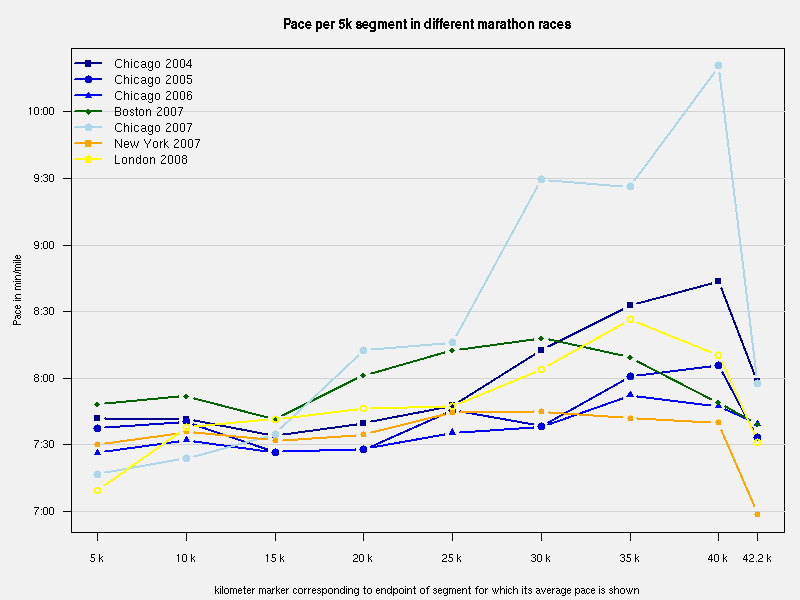
A few months ago, I had shown a
chart with per-5k-segment paces
of my prior marathons runs (or at least those for which organisers had 5k splits). Since then, I ran two more:
New York in November and
London last Sunday. I have updated
the charts to show both of these:
A few things stand out:
For the second year in a row, I didn't vote in the DPL election. Not because I have lost interest in Debian affairs but because nothing is really going on that demands my attention. All three of the candidates who ran this year were eminently capable of representing of Debian and its ideals, all three had more or less the same vision for the role of DPL (IMO. See here for platforms,) and all three are, as far as I know, nice people. Organizational and social problems that previously existed have been fixed. The only problem I have with Debian these days is a lack of time but I can hardly expect the DPL to do anything about that.

However, a recent post from Lucas reminded me that there is one group for which all is not fine and dandy. Given that this is the same complaint that has been made for atleast five years nows, one has to wonder why it remains singularly unfixable? Well I don't know but this delegation makes me confident that we will finally see the end of this last bottleneck too. Joerg is the one who sped up NEW package processing and I am sure he will have account creation humming along in no time.
I sympathize with the frustration people stuck in NM feel, but I would like to remind them that Debian acts the way Winston Churchill observed the United States does:
"Americans can always be depended upon to do the right thing—after they've tried everything else."
It's time for me to stop complaining about the commercialisation of SourceForge and vote with my code. I'm leaving for brighter, bluer pastures at Alioth.
This week I'm in Mountain View for the X Developers' Conference, where I gave a presentation on things graphics drivers have to care about in order to make suspend/resume work reliably. Various people suggested that I write up an explanation of the current situation, along with some best practices for manufacturers.
A lot of haskell-related projects use the darcs version control system. Darcs has the nice feature that you can easily submit a patch by e-mail, usually sent to the project maintainer or a mailing list. What has bothered me in the past was that I had to manually check whether my patch was applied yet.So this week, I wrote DarcsWatch. DarcsWatch receives submitted patches and compares them to the repositories it knows about, whether the patch is missing there or not. You either send your patches to DarcsWeb directly when submitting them, using CC, or DarcsWatch is subscribed to the project mailing list itself, which is the case for the darcs-devel and xmonad lists. Other than that, not much is to do, and you ll find a nice overview of your patches, like this overview of my patches, with diffs and download links.If you want to use DarcsWatch for your contributions to other projects, or for your own projects, have a look the documentation. There are probably still bugs around, and the problem of marking patches as obsolete is not really solved yet, so if you have ideas about it, mail me, comment here, or come to #darcs on freenode. Patches are always welcome, you can get the source from DarcsWatch s repository.
Not done one of these round-ups for a while and
I'm really pushed for time today, so
here are some sites that I've written on:

Allow archives to be passed in as string Currently, we only allow opened filehandles or filenames, but not strings. The internals would need some reworking to facilitate stringified archives.Fortunately, it does allow you to use a filehandle. I've previously mentioned about how useful the IO::Handle subsystem in perl is. And we should be able to use it in this case. The module we'll want is IO::String, which is a IO::Handle over a perl scalar. We can use it:
my $tar = new Archive::Tar(new IO::String($data));Unfortunately when we run this now we get:
Cannot read compressed format in tar-mode at Foo.pm line 41 No data could be read from file at Foo.pm line 41It turns out that this is because Archive::Tar uses IO::Zlib internally if the file isn't uncompressed, but this doesn't provide the ability to uncompress from a filehandle. The answer is to uncompress the data before passing it to Archive::Tar and the easiest way to do this is to use the IO::Uncompress::Gunzip module, so we can rewrite our code to:
my $tar = new Archive::Tar(new IO::Uncompress::Gunzip(new IO::String($data)));Now when you run the script, Archive::Tar has an uncompressed tar stream. Yet another situation where IO::Handles comes to the rescue.
A bug was reported on linux-parisc@ last week, that “ls -l” was whinging about “Operation not supported” once per file. Easy, I thought, I’ll just break out strace, figure out which syscall it is, and Bob’s your uncle, we’ll have it fixed.
Not so, unfortunately, as strace was bloody broken.
upeek: ptrace(PTRACE_PEEKUSER,2606,4294967292,0): Input/output error
Again, no big deal, some kernel change must have broken ptrace(2) on me. git logs didn’t shed any light on it, so I pulled an old strace binary out of an etch chroot and tried that, which failed as well. Wonderful. But… curious… it still works inside the chroot.
At this point I was a little bit beyond annoyed, but the fact that it worked in the chroot was a big clue. Anyway, long story short, strace decides to assume that you can have up to 32 possible syscall arguments (wtf?#1) which is all well and good and generally harmless. However, it also decides to yank MAX_ARGS of them out with ptrace(PEEK_USER, …) if strace is unaware of the syscall prototype. Again, this would be mostly harmless, on every other architecture.
On parisc though, argument registers count down from %r26 through %r20, which is the syscall number. Instrumenting the PEEK_USER path through sys_ptrace in the kernel made it pretty obvious when a consecutive request was suddenly 0xfffffffc (which is 0-4, especially suspicious given the previous values of 4, 8, 16…) that I needed to find a loop in ptrace. Searching through all the HPPA specific syscall code found it quickly,
for (i = 0; i < tcp->u_nargs; i++)
if (upeek(pid, PT_GR26-4*i, &tcp->u_arg[i]) < 0)
return -1;
where “i” is 0 .. u_nargs, which is set to either the known number of syscall args, or MAX_ARGS (which, remember, was 32.)
There, the culprit found, and with a simple one line fix, strace works again. In case you’re curious, the reason things worked inside the chroot, is because the syscall being strace’d was dependant on libselinux being loaded.
syscall_298(0x400e0fbc, 0x58, 0xfb444310, 0, 0x409878ac, 0x409878ac) = -1 (errno 2)
Which is statfs64.
The moral of the story here? strace is out of date and doesn’t yet support recently added syscalls. Also, the code quality is pretty atrocious.
Oh, and the problems with ls? getxattr was returning -EOPNOTSUP because the filesystem doesn’t support
It's stories like the following that make you realise just how puny your
talents are...
(Reposted from a place not to be named, by the legendary Al Viro)
Give them what I got yesterday. As in, box that got
a) Linux kernel running.
b) init and bash running.
c) serial and floppy - built as modules. And not loaded.
d) no sash.
e) no ethernet.
f) bloody large number-crunching that Should Not Be Aborted(tm).
g) libc and ld-linux.so - unlinked (self-LART by owner).
Now, I could tell the guy to piss off, but... WTF? He had decent beer and
was properly scared. Oh, well... So we have no exec() for anything
dynamically
linked. And we have no chance to access any external stuff - insmod is
linked
dynamically, so no insmod floppy for you. Shutting the system down was not
an
option due to (f) (aside of dealing with fsck later - umount(8) is
dynamically
linked too). Now, I knew that both /lib/libc.so-2.1.2 and
/lib/ld-linux.so-2.1.2 were still alive - mmaped by init, for one. And
/proc/1/maps would even contain their inumbers. So the plan of attack was
to create a file in root and then cannibalize the entry (change inumber in
the directory). Alas - not enough. In-core inode got zero i_nlink and
if I would just create a link by hands it would not become positive. I.e.
still remove-upon-close. But. But if we will manage to call link() on the
hand-made link we will get i_nlink raised to 1 - iget() will find the same
in-core inode, so we are OK. We'll have to revert the phony link to avoid
PO'd fsck, but that's not a problem...
So there we go: assuming that we got static ln
echo >foo
ln foo bar
flip inumber in foo entry to point to libc
ln foo /lib/libc.so-2.1.2
flip inumber.......................... bar
repeat for ld-linux.so
rm foo bar
begin recovering other damage (self-LART was a bit larger).
But... we don't have this flip stuff and we don't have (aaarrgh)
static
ln. Oh, shit... OK, but all we really need is a couple of syscalls, right?
There we go:
eax=__NR_link;
ebx=s1;
ecx=s2;
int 0x80;
eax=__NR_exit;
ebx=0;
int 0x80;
s1: "foo"
s2: "bar"
The next step was getting the syscall numbers. grep? We don't need no
stinkin'
grep.
# while read i; do case $i in *__NR_link*) echo $i;; esac;
done </usr/include/asm/unistd.h
#define __NR_link 9
# while read i; do case $i in *__NR_exit*) echo $i;; esac;
done </usr/include/asm/unistd.h
#define __NR_exit 1
#define __NR__exit __NR_exit
Now, scratching the head and recalling intel code...
start: b8 09 00 00 00
bb (address of s1)
b9 (address of s2)
cd 80
b8 01 00 00 00
bb 00 00 00 00
cd 80
s1: 66 6f 6f 00
s2: 62 61 72 00
Fine, but... a.out support is compiled... you guessed it, as module and not
currently loaded. So we are in for crufting up an ELF binary. OK, we don't
actually need 100%-correct ELF, just something that will pass for the
exec(). Now, we don't have shell scripts, but . will work. So the next
step was rolling more(1) in shell and reading through the relevant code
(surprisingly small - binfmt_elf.c and two headers). After much swearing
the following abortion was created:
7f 45 4c 46 00 00 00 00 00 00 00 00 00 00 00 00
02 00 03 00 01 00 00 00 start______ 34 00 00 00
00 00 00 00 00 00 00 00 34 00 20 00 01 00 28 00
00 00 00 00 01 00 00 00 00 00 00 00 base_______
base_______ size_______ size_______ 05 00 00 00
00 10 00 00
start:
b8 09 00 00 00 bb start+1d___ b9 start+21___ cd
80 b8 01 00 00 00 bb 00 00 00 00 cd 80 66 6f 6f
00 62 61 72 00
OK, set base to something page-aligned, start=base+54, size=79. There we go:
7f 45 4c 46 00 00 00 00 00 00 00 00 00 00 00 00
02 00 03 00 01 00 00 00 54 00 00 80 34 00 00 00
00 00 00 00 00 00 00 00 34 00 20 00 01 00 28 00
00 00 00 00 01 00 00 00 00 00 00 00 00 00 00 80
00 00 00 80 79 00 00 00 79 00 00 00 05 00 00 00
00 10 00 00 b8 09 00 00 00 bb 71 00 00 80 b9 75
00 00 80 cd 80 b8 01 00 00 00 bb 00 00 00 00 cd
80 66 6f 6f 00 62 61 72 00
well, while read l; do for i in echo $l ; do echo -ne "\\$i"; done; done
made for oct2bin, overwriting /usr/bin/emacs with the output of that gave
us static equivalent of ln foo bar. And it worked. The rest was essentially
the same - the only tricky part was to find the location of directory entry.
Which was done with (lseek, read byte, exit(said_byte)) and shell wrapper
around that. So we had a way to read a block and dump it on the console.
The rest was obvious - start from relevant block in inode table and walk
through the references... Once we got that, it was an easy ride - trick
with inumber flipping brought libc and dynamic linker back and after that
we had 99% of system back into the working state. Amazing how little you
actually need to bring the system back to life...
Hot damn that's some deep hackery...

16:46 < epmf> tp-glib is made of magic—#telepathy, 2008-04-15
Rob pointed out today that I'd been promising to blog about telepathy-glib for several months and still haven't done so. I think there's too much to cover in one blog post, so I'll start with the oldest part - implementing a service (typically a Telepathy connection manager).
While telepathy-glib is (obviously) intended for Telepathy implementors, I think the ideas we've been implementing are likely to be useful for any D-Bus API, particularly flexible/complex APIs where an object implements many interfaces.
(credit: daf)
commit 355ef78d98d6fc65715845d56232199162cab12a
Author: Steve Frécinaux <steve istique net>
Date: Thu Aug 17 11:48:20 2006 +0200
Interface support for bindings.
Instead of running dbus-binding-tool or creating GObjects with D-Bus
interfaces, we put the entire Telepathy spec through
glib-ginterface-gen.py, a distant descendant of Gabble's gengobject.py.
For each interface in the spec, we generate a GInterface that mirrors the
D-Bus interface. Any GObject that implements the GInterface automatically
gets the D-Bus interface if it's exported onto D-Bus.
There are a few non-obvious refinements, though:
The signature of the method implementation is always in the mode that dbus-glib calls "asynchronous", where the method implementation can either send a reply message before or after it returns. For "slow" methods, this is the only thing you can do. For instance, many Telepathy D-Bus methods can't return anything until some TCP round-trips to the server have happened. This is also the only thing you can do if you want to extract extra information, like the sender's unique name, from the method-call message (dbus-glib's "synchronous" API doesn't allow this to be done). For "fast" methods, sending a reply message before returning is just as easy as using the "synchronous" API (it's just a difference of syntax), and has an API consistent with that of the "slow" methods, making it easier for service authors.
The layout of the GInterface vtable is private, and (auto-generated) accessor functions are used to fill in implementations. This means our ABI doesn't change just because we re-ordered functions in the spec.
If no implementation is provided for a method, we just raise an appropriate error (org.freedesktop.Telepathy.Errors.NotImplemented), rather than suffering an assertion failure. This means we can safely add methods to an interface.
While we're generating code anyway, we generate some static inline wrapper functions which wrap dbus_g_method_return(), to have type-safe method returns. You can easily check that a method replies with correct types, by checking that the implementation of Foo() replies by calling tp_svc_some_interface_return_from_foo().
Similarly, we generate wrapper functions to emit signals, to get type-safe signal emission.


I'm still ill with quite heavy fever, I feel like doing nothing, I'm even to weak to walk the dog properly... but he copes well and is great as usual :-)
Another
zero-day announcement of a Software in the Public Interest online meeting
has been posted.
The announcement mentions "one motion has been raised" but
the agenda
doesn't include any motions, so I'm not sure what.
Also, the agenda lists "Debian logo licence" as up for discussion but I thought
last month's meeting
resolved that.
I watch SPI fairly closely and I'm confused.
How about the rest of you?
SPI isn't alone in this: many software organisations seem
to suffer from similar problems. For example, I ranted
in passing about
Free Software Manchester
yesterday, who just posted
the notes from their own zero-day meeting
and I've suggested possible ways of reforming
debian's currently-stalled New Maintainer process
more than once.
Are free software users particularly bad at the basics
of running an interest society (like welcoming and
expiring members, calling meetings, publishing routine
communications, and so on), have I been spoiled
by cooperatives with
their friendly Member Services departments or secretariats,
or what?
Is this why so many free software orgs seem to include
self-perpetuating leadership groups?
Is this a serious problem if, as reported,
Software Development is a Team Sport [etbe]?
Are there fully-working free software mass participation
groups out there?
I feel a lot of these problems are caused by attempting
to order our inherently entropy-filled world completely
and insisting everything follows petty rules, such as refusing
to answer a question because the "wrong" member asked it.
The world will not become less random just because hackers
try to impose arbitrary rules. Sometimes it's good to
put down minimum standards (because calling zero-day meetings
is a mostly-avoidable way of excluding some members) but it
will always be a poor alternative to
trying to do the best you can for others.
How do we get past this? My
pro-cooperation-and-better-business platform for SPI board
went pretty badly and I've had some anti-cooperative flames
back from someone starting another free software group
this month, so I don't think I can fix these existing
organisations any time soon. About 1 in 6 people in the UK
are members of a cooperative, so even if that is reflected
among hackers (and I think it's lower), all of them
would not be enough to reform much.
One of the most common memes in free software is "show us
the code" and the few other free software cooperatives I've
seen have mostly failed, with a few surviving but hitting a size limit.
As a result, I'm currently negotiating the start of a new
free software cooperative. So far, I'm really happy
with how that's going. Many cooperators learn at the feet of
large consumer cooperatives like
the Cooperative Group
who run training courses for new members about putting
cooperative values and principles
into practice,
which we smaller groups couldn't run ourselves.
As a result, most cooperators already know how to work
well together.
Should large software societies like SPI try commissioning
similar courses?
Next.