
i've been on an IPv6 kick recently, getting dual-stack systems up and working for a bunch of folks.I'd like to make some of these services reachable by IPv6-only clients. this suggests that i need a range of details sorted out, but i think the one piece left for me is the glue records for the nameservice. i use in-bailiwick nameservers for DNS where possible, which means i want mandatory glue records. that is, the primary namserver for
example.org is probably something like
ns0.example.org, which means that the
org nameservers themselves need to store not only the
NS record, but an
A record that corresponds to the name pointed to by the
NS. But for IPv6-only clients that do their own name resolution, i need
AAAA glue records, and i haven't yet found a registrar that will push
AAAA glue records
for the same names as the existing A glue into the
org zone. Do you know of a registrar that will do this?I've tried:
- dotster
- Dotster seems to only allow IPv4 glue to be entered on their Register Nameserver config page (needs a dotster login to see it). They haven't yet yet responded to my query through their support web form about submitting AAAA glue
- gandi
- gandi at least offers the opportunity to enter AAAA glue, but apparently can't let me have both AAAA and A glue for the same name. A note to their support team got me a response that this is planned
for Q1 or Q2 of 2011
.
Any suggestions for reasonable registrars that offer this today? Am i being silly in wanting
AAAA and
A glue for the same names? i note that the root zone and the
org zone both offer
A and
AAAA records for each of their dual-stack nameservers. You can check for yourself:
 dig @a.root-servers.net ns org
 dig @a.root-servers.net ns .
if i don't go for dual records, i could instead use gandi and go with distinct names for the v6 and v4 servers, like this:
;; QUESTION SECTION:
;example.org.				IN	NS
;; AUTHORITY SECTION:
example.org.      172800	IN	NS	a.ns.example.org.
example.org.      172800	IN	NS	b.ns.example.org.
example.org.      172800	IN	NS	c.ns.example.org.
example.org.      172800	IN	NS	d.ns.example.org.
;; ADDITIONAL SECTION:
a.ns.example.org. 172800	IN	A	192.0.2.3
b.ns.example.org. 172800	IN	A	192.0.2.4
c.ns.example.org. 172800	IN	AAAAA	2001:db8::3
d.ns.example.org. 172800	IN	AAAAA	2001:db8::4
But of course what i really want is this:
;; QUESTION SECTION:
;example.org.				IN	NS
;; AUTHORITY SECTION:
example.org.      172800	IN	NS	a.ns.example.org.
example.org.      172800	IN	NS	b.ns.example.org.
;; ADDITIONAL SECTION:
a.ns.example.org. 172800	IN	A	192.0.2.3
a.ns.example.org. 172800	IN	AAAAA	2001:db8::3
b.ns.example.org. 172800	IN	A	192.0.2.4
b.ns.example.org. 172800	IN	AAAAA	2001:db8::4
My concern about this is if some IPv4-only system gets a list like the first one, and decides to use
c.ns.example.org or
d.ns.example.org, which doesn't have an
A record at all. That would be a silly implementation, of course. but uh, we have a lot of silly implementations of things out there.Feedback welcome!Tags:
dns,
ipv6
The Debian Release Team has made a status update on Debian 6.0, Squeeze . They are proud to report that Debian is moving towards the release like a glacier: inevitably and unstoppingly .
Squeeze is almost in its final state: testing of the installer and upgrades are welcome. Once the latest version of the Debian Installer is added, a deep freeze will begin, with minimal changes allowed while the remaining bugs are fixed. Your help is welcome in:
There are two upcoming bug squashing parties you can join: Bern, Switzerland, November 27-28; and Boulogne-Billancourt, France,December 4-5.
My telco Three have just offered me a deal on getting a new phone a couple of months earlier than my contract was supposed to expire, presumably they have some competition and want to get me locked into another 2 year contract a couple of months before anyone else has the chance.My current phone is a
LG U990 Viewty [1] which I am reasonably happy with for the regular phone and camera functionality (apart from it being too slow to take a photo), it s on a $29 per month plan. I also have a 3G modem which is on a $15 per month plan for 1G of data per month for a total cost of $44 per month. As new phones have advanced client functionality (ssh, IMAP, etc) and have Wifi support for providing net access to a laptop there seems to be less need to have a separate phone and modem. So I am considering getting a high-end phone to replace the phone and modem, so while I don t want to pay a lot more than I currently pay, a $49 contract would be quite affordable and a $59 contract is something I can consider.What I need is a system with a good ssh client implementation, a high resolution screen (800*480 or better), preferably a slide out keyboard and an option to use a Bluetooth keyboard.The best option for the OS seems to be
Android as it s based on Linux, it s moderately open, and it has a good range of applications. The
Nokia N900 has been recommended based on features but a friend had a bad experience with a N900 that broke and didn t get good warranty support. Also the N900 doesn t have a digital compass (so can t do augmented reality). While I m primarily buying a phone for making phone calls, using the net, and being a ssh client I want to be able to do cool things like do Google searches on things that I photograph and have an annotated star map when I point my phone at the sky. Also as I m not using Windows or Apple phones for obvious reasons that leaves Android phones as the only suitable phones that are on offer from my Telco.I have checked some options for buying a grey-market phone, given that I need to get a more expensive phone contract to have the voice and data access I need the cost of buying a grey-market phone and having a no-phone contract would be unreasonable. So selecting a phone that s on offer by Three/Vodaphone seems to be the best option. Moving to another telco would be inconvenient as I would have to convince the relatives that I call often to switch as well (I get free calls to other Three/Vodaphone customers).
I previously listed some phones that seemed good without regard as to where I could buy them [2] and some people wrote some really interesting and informative comments (thanks a lot!). But after considering all the options it seems that the costs of the various options force me to choose something that Three offers.
Currently the best option from Three for an Android phone seems to be the HTC Desire HD [3]. It has a 800*480 screen, an 8MP camera with face-detection and geo-tagging, wifi, an accelerometer, GPS, and a digital compass. It also runs Android 2.2 (the latest release). Generally it has everything I want apart from a slide-out keyboard. It seems that Bluetooth keyboards are about $100 each, so I could buy such a keyboard and have options of taking just the phone, the phone and keyboard, or phone and laptop depending on how much I can carry and what I expect to be doing.Three PricesThe Desire HD is free on a $59 plan, or costs $15 per month on the $29 plan. So for $44 per month (the same as what I spend now) I can get a Desire HD! The down-side is that the $29 plan only allows 200MB of data per month and has an excess data fee of $0.50 per meg. My average usage has been about 300MB per month, I could reduce this a bit but I do occasionally have a month where I need a lot of data transfer. For an extra $8 per month I can get an additional 500MB of data transfer. That would give me a total cost of $52 per month for my phone, and I could get the same phone for my wife for $44 per month (I doubt that she would use the 200MB of data included). That would take a typical Three bill from $73 to $96.I might just wait a few months. The Viewty and 3G modem combination is working reasonably well, presumably there will be some better deals if I wait a while. At least now after considering all the options I could find and determining that a Desire HD from Three is the best option for me I can now evaluate any new options by comparing them to that.

I received a few emails from my blog post about my MythTV dilemma.
Suggestions ranged from using VGA to DVI to HDMI adapters, to getting
different TVs that still have VGA connectors, to getting an older NVIDIA
card off eBay that has lower power requirements.
Firstly, VGA is dead. It's time to make the move. I don't think VGA for a TV
the size I'm looking at is ideal for HD anyway. I'm pretty much fixated on
the Sony TV as well, because I want to get Google TV. So I need HDMI.
Similarly, I suspect that the picture quality of something run through a VGA
to HDMI conversion will be similarly shite, so I'm not too keen on that
option, although it would tide me over initially, so I'll look into that
further.
Another suggestion was the
fit-PC2,
which was something I was already aware of, but I'd heard
terrible
things about the general Linux support for the graphics adapter.
I did some more research into the
Boxee Box, (it really is new, it's
only been out for 6 days) and it
appears to
have the same video chipset as the fit-PC2, which seems rather
unfortunate. But then, if the Boxee Box is running Linux, then they've
obviously got a driver, so the question is how easy is it to transplant this
driver from the Boxee distro to, say, Debian?
I'm curious enough to place an order soon. Anyone got any interesting
Poulsbo-on-Linux war stories they want to share? I know it
makes Matthew Garrett
sad.

For the last few years, I ve been a mostly happy customer of Sivit (now bought by Nerim). But recently, technical problems have become more frequent, and today, for the first time, a crash made me lose some data which was rather painful to restore from backups. Also, they are still stuck on with an ancient 2.6.16 kernel.
So, I m looking into alternatives, and a promising one is Gandi hosting, based on virtual machines like Sivit.
- Would you recommend it for a mission-critical server?
- What s your uptime? When was the last time your server had an unscheduled outage?
- When was the last time you lost data because of Gandi?
- What are the limits due to the Xen-based hosting? Can you run your own kernel (like the squeeze one)? Can you build additional modules (like tun)?
- What else should I know?
Thanks!
I'm considering replacing our 5 year old 32" TV with a
40"
Sony Internet TV, largely "just because" it has
Google TV. That and I have spousal
approval to get a new, bigger TV (it just has to be wall mounted).
The dilemma is
MythTV. It's currently
still running on the Dell Dimension 3100 that I bought years ago, and
connected via VGA to the TV. The Sony Internet TV is HDMI or nothing, so at
the very least, I need to get a DVI-capable video card in my MythTV box.
The more or less natural choice would be an NVIDIA card, despite them having
a closed-source driver. At least it's well supported under Linux. The
problem is, as far as I can determine, NVIDIA cards require at least a 300
watt power supply, and the Dimension 3100 has only a 230 watt power supply.
So now I'm looking at having to replace the MythTV box. I'm currently
running the front end and the back end on the same box, so it'd be a fairly
simple case of splitting the back end from the front end, and just getting
something new to be the front end.
So now I'm in the market for something small, low-power, has a HDMI (or
DisplayPort) interface, and enough grunt for HD playback. I'm wondering if
the Boxee Box is the solution. Interface-wise, it has HDMI, so I'm good
there, and I believe the marketing claims it can do HD playback. I just
don't know how hackable it is. I
think it's running Linux, so in
theory this should be doable, so long as there isn't some weird hardware in
it with a binary-only driver. For the price, it's probably worth just
getting one to see.
The annoying thing is, I have nothing in the house that is DVI or HDMI
capable, so I have no way of testing this out prior to buying the TV.

During the weekend, I've found some time to improve documentation for Gammu. One of user accessible things which did lack documentation are native
file formats used by Gammu.
There is not that much of them as Gammu supports standard formats for most data (like vCard, vCalendar, iCalendar), but there are things where standard simply does not exists and we need to store that data as well. This is the case for backups (both data and SMS), where
SMS backup format is used as well for
files backend in
Gammu SMSD.
So I went through the SMS backup internals and wrote the
documentation. While reading the code I of course discovered quite obvious
bug, which was for some reason undiscovered for very long time.
Filed under:
Gammu
0 comments
Flattr this!

Unfortunately, for many people "File Transfer" equals FTP. I dislike
this; but if the customer insists that "HTTP" is not a suitable file
transfer protocol, then the customer is king. For all its usage and
updates, FTP
still requires the use of two TCP connections,
which makes firewalling hell. Oh well; at least in this particular
instance, the firewall is not my job.
At least the customer does have some clue, and insists that no
passwords should be sent over the wire in the clear. On that, we
agree. Now there are several methods of securing passwords when doing
something for which the name involves "ftp".
- The most well-known is "sftp", a part of the OpenSSH package.
This has nothing to do with the FTP protocol; it uses a tunneled SSH
connection to get at files. This means that usually, in order to get
people to files on a server, you must give them shell access too
(although there are ways around this). Also, not all file transfer
clients support sftp (though some do). The URI scheme used for this is,
usually, 'sftp://'
- Another one is FTPS, which involves opening an encrypted control
connection to port 990, and then doing FTP as usual much in the
same way that HTTPS uses a different port, too. The URI scheme used for
that one is, clearly, 'ftps://'
- Yet another one is using the method described in RFC4217 (October
2005) which involves an AUTH TLS command. Clearly this is superior to
the ftps option (who likes to create more holes than necessary in their
firewall?). Two problems with this RFC:
- I haven't found what the URI scheme is.
- Since there does not appear to be an RFC for the second method
above, the existence of an RFC for this method appears to confuse many
people, including (but not limited to) some who should know better (SEE
ALSO section) that it is about ftps, which it isn't.
The fun bit is that vsftpd supports the latter two; but because
everyone confused FTPS with RFC4217, the version that's packaged for
rhel 5 supports the latter but not the former, while most clients
support the former but not the latter.
FTP, how I loathe thee.
 This brief announcement was published in the debian-devel-announce mailing list and I repeat it here for your information.
Hi!
Since there has been a lot happening in the Debian Multimedia world during the Squeeze release, so we figured we should give you an update on that.
Who are we?
In the dark old ages, there were two teams involved in multimedia: the
Debian Multimedia and
Debian Multimedia Packages teams. Please note that neither of them is related to
debian-multimedia.org (which is maintained by Christian Marillat, and is known to break current
ffmpeg-based applications like mplayer and vlc in Debian Squeeze.). During late 2008, both teams were merged into one, the Debian Multimedia Maintainers team, to avoid effort fragmentation. Since then, there has been a lot of work done:
Consumer Multimedia in Debian
Consumer Multimedia is about playing and, well, consuming multimedia.
Squeeze will feature:
- FFmpeg 0.5.2, finally uncrippled thanks to zack! No mp3/h264 encoder, though. (still in NEW).
- mplayer 1.0rc3, finally with mencoder enabled.
- VLC 1.1.3
- VDPAU hardware acceleration in ffmpeg/mplayer (but feedback is welcome!)
- Guayadeque 0.2.5
- gmusicbrowser 1.0.2
Squeeze will not feature:
- FFmpeg 0.6 (But already available in experimental)
- Hardware acceleration with VA-API (packages also in experimental, for support on Intel hardware).
Producer Multimedia in Debian
Producer multimedia is software for producing multimedia. Squeeze will
feature:
End user applications:
- Ardour 2.8.11
- Audacity 1.3.12
- Composite 0.006
- Csound 5.12. The QuteCsound frontend is also available.
- FluidSynth 1.1.1
- Hydrogen 0.9.4.1
- Internet DJ Console 0.8.3
- Jokosher 0.11.5
- LiVES 1.3.4
- mhWaveEdit 1.4.20
- morituri 0.1.1
- QTractor 0.4.6
- Rosegarden 10.04.2
- SooperLooper 1.6.14
- Traverso 0.49.1
- X Jack Video Monitor 0.4.13
- Yoshimi 0.058.1
Platforms and technologies:
- JACK versions 0.118 and 1.9.6 (aka, jackd1 and jackd2). You can choose to install any of them (but only one at a time).
- LV2 plugins are supported. Ardour has support for them, and there are a bunch of them provided in Debian.
- LADSPA plugins are still supported.
- DSSI updated to 1.0.0, many plugins are available.
- FireWire sound devices are supported with libffado, and is supported by JACK.
Squeeze will not feature:
- JACK session support.
- Ardour 3 (it s not out yet, so it did not make it in time for squeeze).
- SuperCollider. There is a package in the works, but did not make it to Squeeze.
- Toonloop: This live stop-motion animation editor has been packaged only recently.
- NASPRO: Convenient library to implement LV2 dynamic manifest plugins. It s available in Sid.
- Mixxx: 1.7 series had RC bugs, and 1.8 was too late for squeeze.
Debian Multimedia Blend
There is also an effort to start a Debian Multimedia Blend to give a better overview about what multimedia applications are available in Debian. There is a
short list for a quick overview as well as a long package list separated in sections to give a
more detailed overview (including translations, screenshots, popularity of package etc). You are invited to help improving the tasks either
directly in SVN or by sending patches to Andreas Tille <
tille@debian.org> or
debian-multimedia@lists.debian.org (see below). Note that not all of the packages listed in the tasks pages are maintained by the Debian Multimedia team, since they are aimed at producing useful package sets instead of showing only our own packages.
For those who want to squash some bugs in multimedia packages there is also the bugs page generated by the
Blends tools, or our
team bug page.
Other activity
The team has seen a lot of growth since the merger. Of the current 52 members of the Alioth team, 20 were added during 2009 and 18 in 2010, many of whom are involved in upstream development as well as the debian packaging. The number of packages has also grown, with 112 of the current 205 git repositories in our team area having its first commit during 2010.
Where to reach us
The Debian Multimedia Maintainers can be reached at
pkg-multimedia-maintainers@lists.alioth.debian.org, should you have any questions. We have also decided to repurpose the old
debian-multimedia@lists.debian.org address for user and more general discussion. We would like to invite everyone interested in multimedia to join us there. Interested developers/packagers can also join us at the first address. Some of the team members are also in the #debian-multimedia channel on
OFTC.
Regards,
Alessio Treglia on behalf of the Debian Multimedia Maintainers

(Mainly for my own information, so I can find this again
later!)
I'm running Debian Squeeze on my Lenovo Thinkpad X200 laptop, using
the amd64 version so that I can make the most of the 64-bit
CPU. However, I also need a range of 32-bit apps too for now,
typically proprietary rubbish like the Flash plug-in for
Firefox^WIceweasel. So I set up a 32-bit chroot with a small Debian
installation in there too. (Roll on multi-arch!) That's been working
ok for a while, except that I couldn't get working audio in my
browser. I didn't really pay much attention to that until recently: I
wanted to watch some videos on YouTube and the sound mattered!
After some digging, it became clear that Iceweasel inside the
chroot just wasn't talking to the currently-running pulseaudio server
outside the chroot. I had installed all the required libs in the
chroot too, but still no joy. After some searching (thanks to the
folks on the Archlinux wiki
for
this!)
I've now been able to configure my chroot correctly. 2 bits
needed:
1. Configure alsa in the chroot to use pulse by default by
creating/editing /etc/asound.conf:
pcm.pulse
    type pulse

ctl.pulse
    type pulse

pcm.!default
    type pulse

ctl.!default
    type pulse
2. The dbus machine ID in the chroot needs to be the same as
that of the main host, which it wasn't for me. That caused audio apps
to report "connection refused" when I tested them. The machine ID is
stored in
/var/lib/dbus/machine-id. Either copy that file
from the host system into the chroot, or add /var/lib/dbus as a
bind-mount along with the usual suspects like
/home
and
/tmp.
Job done, I can watch movie trailers etc. with sound in my
browser. Yay! :-)

I need to look this up every time I need a backport (mostly PostgreSQL) at a
customer site with limited networking:
$ lftp -c 'mget http://backports.debian.org/debian-backports/pool/main/p/postgresql-8.4/*_8.4.5-1~bpo50+1_amd64.deb'
Hopefully I can remember this in the future.
I need to look up this every time I need a backport (mostly PostgreSQL) at a
customer site with limited networking:
$ lftp -c 'mget http://backports.debian.org/debian-backports/pool/main/p/postgresql-8.4/*_8.4.5-1~bpo50+1_amd64.deb'
Hopefully I can remember that in the future.

In my professional role as Ubuntu CTO, I take on a number of different perspectives, which sometimes compete for my attention, including:
- Inward supporting the people in my department, alignment with other departments in Canonical and reporting upward
- Outward connecting with customers, partners and the free software community, including Debian
- Forward considering the future of the Ubuntu platform and products, based on the needs of their users, our customers and business stakeholders within Canonical
- Outside-in taking off my Canonical hat and putting on an Ubuntu hat, and looking at what we re doing from an outside perspective
My recent work, as Canonical has gone through a period of organizational growth and change, has prioritized the inward perspective. I took on a six-month project which was inwardly focused, temporarily handing off many of my day-to-day responsibilities (well done,
Robbie!). I ve grappled with an assortment of growing pains as many new people joined Canonical over the past year.
With that work behind me, it s time to rebalance myself and focus more outside of Canonical again. It s good to be back!
In my outward facing capacity, I ll shortly be attending
Web 2.0 Summit in San Francisco. I attend several free software conferences each year, but this is a different crowd. I hope to renew some old ties, form some new ones, and generally derive inspiration from the people and organizations represented there. Being in the San Francisco Bay area will also give me an opportunity to meet with some of Canonical s partners there, as well as friends and acquaintances from the free software community. With my head down, working hard to make things happen, it s easy to lose perspective on how that work fits into the outside world. Spending more time with people outside of Canonical and Ubuntu is an important way of balancing that effect.
Looking forward, I ll be thinking about the longer term direction for the Ubuntu platform. The platform is the layer of Ubuntu which makes everything else possible: it s how we weave together products like Desktop Edition and Server Edition, and it s what developers target when they write applications. Behind the user interfaces and applications, there is a rich platform of tools and services which link it all together. It s in this aspect of Ubuntu that I ll be investing my time in research, experimentation and imagination. This includes considering how we
package and distribute software, how we
adapt to technological shifts, and highlighting
opportunities to cooperate with other open source projects.
My primary outside-in role is as chair of the
Ubuntu Technical Board. In this capacity, I m accountable to the Ubuntu project, the interests of its members, and the people who use the software we provide. Originally, the TB was closely involved with a range of front-line technical decisions in Ubuntu, but today, there are strong, autonomous teams in place for the most active parts of the project, so we only get involved when there is a problem, or if a technical question comes up which doesn t fit the charter of an established team. It s something of a catch-all. I d like to re-establish the TB in a more central role in Ubuntu, looking after concerns which affect the project as a whole, such as
transparency and development processes. I m also
re-joining Debian as a non-uploading contributor, to work on stimulating and coordinating cooperation between Debian and Ubuntu. I m looking forward to working more with
Zack on joint projects in this area.
This change will help me to support Canonical and Ubuntu more effectively as they continue to grow and change. I look forward to exercising some mental muscles I haven t used very much lately, and facing some new challenges as well.


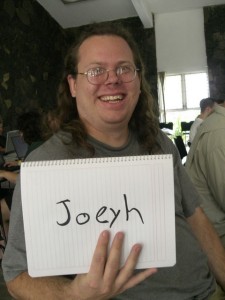
I decided recently to publish interviews from Debian contributors and I picked Joey Hess as my first target. He s one of the few who have heavily influenced Debian by creating software that have become building blocks of the project, like the debian-installer (Joey uses the shorthand d-i to refer to it).
My questions are in bold, the rest is by Joey (except for the additional information that I inserted in italics).
Who are you?
Hello, I m Joey Hess. I m one of the oldtimers in Debian. Actually, I just checked, and there are still up to nineteen active Debian Developers who joined the project before I did, in 1996. I got started fairly young, and am just 34 years old.
I spend part of my time working with Lars Wirzenius, another Debian oldtimer, on
Branchable. It makes it dead-easy for anyone to make a website that is built from Git, using my Ikiwiki engine to do wiki and blog style things. These days I spend the rest of my time working on free software, when I should really be looking for work to pay the bills.
What s your biggest achievement within Debian or Ubuntu?
I guess I m mostly known by Debian developers for writing debhelper and perhaps debconf. Probably founding the Debian Installer project has been a bigger impact for users. I m fairly equally proud of all three projects. But while it might sound corny, I am more proud of the accumulation of all the smaller things done in the context of Debian. It s more of a deep connection to the project. All the bugs fixed, and filed, and packages uploaded, and late night discussions, and just being a part of the larger project.
What are your plans for Debian Wheezy?
Hmm, I stopped thinking of Debian releases by code names back around Slink.

So, few specific plans for Wheezy. The main thing I would like to help make happen in Debian next is Constantly Usable Testing, and it transcends releases anyway. The only specific plans I have for Wheezy are that there will probably be a new debhelper compat level, and I hope d-i will finally switch to using git.
RH: You can learn more about Constantly Usable Testing in my article Can Debian offer a Constantly Usable Testing distribution?.
If you could spend all your time on Debian, what would you work on?
Getting Debian on all these computers that we carry around in our pockets and can t easily run apt-get on and hack on. Phones that is. It s a bigger problem than just Debian, but I think Debian needs to find a way to be part of the eventual solution. The FreedomBox concept at least hints at a way around the current situation with embedded computers in general.
What s the biggest problem of Debian?
I believe that the biggest problem is institutional, social and technological inertia. Every specific case of something that frustrates me about Debian today can be traced back to that.
You contribute regularly to Debian mailing lists, yet I don t remember any aggressive/frustrated mail of you. How do you manage that? Are you avoiding heated discussions?
Rats, sounds like all my wonderful flames of years past have been forgotten!
Seriously though, after I noticed
thread patterns, I started trying to avoid participating in the bad patterns myself. Now I limit myself to one expression of an opinion, and I don t care who gets the last word. If people can t be convinced, it s time to find another approach to the problem. Also, code talks.
Most of the programs you wrote for Debian are in Perl. Do you regret this choice?
I love that question! No, no regrets. My only concern is whether the language limits contributors or users. I have not seen Perl significantly limiting the use of anything except for debconf (we had to rewrite it in C for d-i). And I do not notice fewer contributions to my Perl-based code than to other code.
I do sometimes regret when someone tells me they had to learn or re-learn Perl to work on something I wrote. But while I m enjoying writing new things in Haskell now, and while I hope it will mean less maintenance burden later, I don t think using Haskell will make it easier for others to contribute to my programs. Anyway, for me the interesting thing about writing a program is the problem it solves and the decisions made doing it. Choice of language is one of the less interesting decisions.
Is there someone in Debian that you admire for his contributions?
Well, lots. You re tempting me to throw a dart at a map. So arbitrarily, I ll say Anthony Towns. We could all learn something from how he s approached making big, fundamental changes, like introducing Testing, and making Debian Maintainers happen.
Thank you to Joey for the time spent answering my questions. I hope you enjoyed reading his answers as I did.
Subscribe to my newsletter and don t miss further interviews. You can also follow along on
Identi.ca,
Twitter and
Facebook.
PS: If you want to suggest me someone to interview, leave a comment or mail me.
3 comments Liked this article? Click here. My blog is Flattr-enabled.


If you want to see a really big Google Calendar, check out
this calendar. Essentially, it is all the events from over 100 other calendars (all containing swing dancing events) merged into one, resulting in often more than 50 events every day, occasionally over 20 at the same time).
The data is approximately the same that can be seen
on this map; in fact I'm trying to
move the data keeping from a custom database (which has superior filtering
capabilities such as synonyms in text search) to just having Google keep the
data for me (meaning it will eventually not require me to have an own web
server for this).
I'm doing some filtering such as removing events that don't have parseable
geo information (I'm adding GeoRSS:where elements, in fact), some text to html
conversion of the entry contents and filtering out inappropriate events via
some regular expressions (e.g. only including "Swing" not "Ballroom" events
from a calendar)
There are still a couple of things to resolve. I'm not sure that recurrence
exceptions are propagated properly to the combined calendar; the updates could
work more incrementally, and I have to resolve some timezone issues due to the
global nature of the calendar: I need to make sure the timezone information is
preserved, since usually it makes more sense to give the events in local (to
the event) time.
P.S. sorry, the code is too specialized and needs cleanup, I won't share it
yet.
I
wrote yesterday about our scare with Jacob. It s been quite the day.
Before I go into it, I want to say thank you to all the many of you that have sent comments and support our way. Terah and I haven t had the chance to reply to many of them, but we have read every one, and very much appreciate it!
Terah spent the night with Jacob, and I spent the day with him today (others were present for parts of it too). Jacob was mostly in good spirits. He was up and around, pushed his IV around himself in the room and to the bathroom. He called it my VI machine (not a typo take that, Emacs, eh?) He continued to enjoy measuring his trips to the bathroom. We went exploring a few times. He would walk or run down one of the long corridors in the hospital, holding my hand, while I pulled the IV along. We often went by the cafeteria, which he called the kitchen. One time he insisted that I get a cup of coffee from the free coffee dispenser. I insisted that I didn t want to, but eventually asked, Shall I get a pretend cup of coffee? Yeah! So he watched me get a pretend cup, pretend to fill it, and pretend to drink it and smiled and clapped for me after.
He spent hours watching videos of trains on YouTube. This is a favorite activity at home too, but we obviously limit the amount of time he can spend doing it. I had to limit the amount of time he spent with it today too, of course, but he got rather more time with it than usual.
Jacob had his usual books, but I thought we might try something new today. This morning, I loaded
The Tale of Peter Rabbit (with illustrations) onto my Kindle. Jacob loved it, and enjoyed pressing the Next Page button in the Kindle. We read it twice, and he is interested by the promise of other stories about rabbits. It also probably didn t hurt that his grandma had given him a rabbit in the hospital yesterday.
As we got on towards evening, I told him that tomorrow could be a normal day. His response: enthusiastic applause and a big grin, plus YAY!
Jacob loved eating today. He wolfed down breakfast and lunch. He enjoyed the lemonade I brought for him again, and played with some toys, and yes, watched some more train videos in the afternoon. He also pretended to ignore the visitors he got as much as possible (pretty typical for him actually).
The doctor came by at about 6:00PM and again was just stunned at how well he s doing. Jacob neither complained of any pain nor acted like he had any even when the nurses would rub neosporin on his wounds. The doctor was still just stunned at how well he was doing. He told us his last tractor accident resulted in a death before LifeWatch could arrive, and the one before that turned a good student and a promising athlete into a wheelchair-bound person with a vocabulary of 20 words. I can t believe I m discharging him today, but try as I might, as I go over all the details, there s no reason for him to stay. I thanked him for all his help, and he said, I didn t do anything for him. All I did was figure out what had happened to him . I guess we have the CT to prove that something really did happen, but the fact that he showed up at my office in the first place was stunning enough.
Jacob started to get more excited after the IV was unhooked from him. He didn t particularly like having the needle removed, due to the pain of taking off the tape, but was happy to have it gone. He was making plans: will we stop by the train station on the way home? It s the middle of the night maybe a train will be there! (If it s dark outside, it s middle of the night to him) We agreed to stop by the cafeteria to pick him up one last lemonade, than stop at the train station.
The nurses offered a wheelchair to take him out to the car with. I said I didn t think he d want it. One of them said, Wouldn t you like a FUN ride in a WHEELCHAIR? Jacob: No. Me: I suspect he will want to run out of here. Nurse: OK then.
We walked, or half ran, to the cafeteria to get his lemonade. Then we went out to the car. He was excitedly jabbering about everything: the car, my radio, and especially the train station. We did drive by, and at least got to see a freight engine go past. He noticed the Christmas lights starting to be set out along Main Street, and said, Dad, it s CHRISTMAS! Well, almost Then he got quiet, and eventually fell asleep in the car. He had almost fallen asleep while eating his lunch, but stayed awake, and then got interested in other things so he had no nap today.
When we got home, I unbuckled him and pulled him out of his seat. He opened his eyes for just a second, wrapped his arms tightly around my neck, put his head on my shoulder, and fell back asleep while I carried him up to his room. I put him down on his own bed. He had a contented sigh, pulled his favorite blanket up to his neck like he loves to do, and was back asleep in no time. Our little boy is home, safe and sound. It s a happy day.
It ain t what you don t know that gets you into trouble. It s what you know for sure that just ain t so
attributed to Mark Twain
There is a lot that I don t know about what goes on in my organization. This isn t only because I can t observe everything, or because it s too complex, or because I make mistakes. These are all true, of course, but they re also obvious. Much more devious is the way the flow of information to me is distorted. It s distorted by me, and by the people around me, whether any of us are aware of it or not. This is most apparent in considering how people feel about their managers: this is why
I have a deeply flawed view of what it s really like to work for me.
My theory is that power bends information like gravity bends light. The effect is more pronounced with people of greater mass (more authority), and lessened with distance (less direct influence). The more directly you influence someone else s fate, the more it is in their self-interest to be guarded around you. This means that the people closest to you, who you receive the most information from, may have the most difficulty being open with you, especially if it s bad news. It also means that the higher your standing in the corporate hierarchy, the more influence you wield, the more people are affected by this.
Pretty scary, right?
Some managers respond to this terrifying reality by trying to collect more information. They ll quietly cross-check what people are telling them, asking people in different levels of the organization, routing around managers, hoping to get the real story . This usually backfires, because it signals distrust to the people involved and makes the distortion worse.
Another common response is to check in constantly, trying to monitor and control the work as closely as possible (so-called micro-management). This is even worse; not only does it signal distrust, but managers who do this become more personally attached to outcomes, and lose perspective on progress and quality due to information overload, self-enhancement bias, and neglect of managerial work. The more it becomes your work rather than the team s, the harder it is to see it objectively.
So what s a better way to respond to this phenomenon? Here s what I try to do:
- Accept it You ll never have certainty about what s happening, so get used to it, and don t let it paralyze you. Learn decision making strategies which cope well with information noise, and allow you to experiment and adapt.
- Admit it Everyone else knows that you have this distortion field around you. If you pretend it isn t there, you ll appear deluded. Acknowledge that you don t know, don t understand, and can t control.
- Trust The more you trust someone, the more they trust you. The more someone trusts you, the more confident they can be in telling you what they think. Be grateful for bad news, and never shoot the messenger.
- Delegate Enable people with a less distorted view of the situation to make local decisions. Don t make people wait for information to propagate through you before acting, unless there is a clear and sufficient benefit to the organization.
I was inspired to think and write about this today after listening to Prof. Robert Sutton s
speech at the California Commonwealth Club, which Lindsay Holmwood shared with me.


A few months after starting the
NM process, I have just been accepted as a Debian Developer.
My account name is simply:
julien
I have been a Debian user for about 10 years now, and have begun contributing to Debian in 2005. I have then been
accepted as a Debian Maintainer in 2007.
This post is mainly to thank:
- all my sponsors: Christoph Haas (haas) , Lo c Minier (lool), Free Ekanayaka (freee), Maximiliano Curia (maxy) and Micah Anderson (micah),
- my advocate: Matthijs M hlman (matthijs)
- my AM (who actually make it happen in a really short time frame, thanks a lot to him): Xavier Oswald (xoswald)
- all people who helped me during the process, to name a few: Christoph Berg (myon), Enrio Zini (enrico), Peter Palfrader (weasel)
Also thanks to all people who have already sent their congratulations, it makes me very proud!
I had been planning to write today about my great uncle Milt Goerzen. Milt passed away last Thursday after a long struggle with dementia, and his funeral was this morning. I was there, and was inspired by a few things I heard.
But that will have to wait, because today brought one of those few moments in life that s a sense of an impending possible great loss. I can remember two others: one was when Terah passed out, and the other was when we heard that our place was on fire and our house had burned down (it turned out the house hadn t, but much of the rest had).
I got a call during Milt s funeral. I didn t answer because I was, well, at a funeral, and the phone was on vibrate. When I had the chance to check the voicemail, it went something like this: I think we have an emergency with Jacob. He got run over by a tractor. He says he s OK, but I m taking him to the doctor right now. I tried to return the call, but cell phone reception wasn t cooperating. The most I got was he s OK .
It s hard to describe how a moment like that feels. My mind jumped to telling Jacob I love you , and how lately when he hears that, he will snuggle in for a big hug, and say, Dad, I love you toooooooooo! On the one hand, I heard the he s OK part, and on the other hand I couldn t forget the tractor running over him part, and my mind leapt at the worst.
It turns out that, while I was at the funeral, Jacob had been standing on his usual spot on the tractor, sort of to the side of the driver. He was enjoying himself like usual. The tractor hit a large hole that wasn t really visible. The combination of the jolt and the dip the tractor took towards Jacob s side knocked him off and he went directly under the big rear wheel before the tractor could be brought to a stop.
I caught up with him and his grandpa after he had seen the doctor and just as he was being admitted to the hospital. He saw me and crawled over, making his sort of sad and scared sound he sometimes doesn t want to verbalize things when he s in that mood. I held him close and he seemed to appreciate it.
He had to have blood drawn, and he was scared of that. I remembered his inquisitive mind, and reminded him how much he liked watching the tube fill up with blood last time he had a blood test (which he calls a blood shot ). That wasn t helping, until the actual blood test started. He cried when the needle went in, but then calmed down as the nurse, getting into the act, pointed out that there was blood filling up the tube. Hmmm! said Jacob. Then she gave him a band-aid. It has an airplane, said the nurse. Um-hmm! said Jacob. I pointed out that it looked like the airplane we were on when we flew home from New York. Jacob got a big smile and said, Yes, it IS that one!
He got a sticker there too.
Then it was off for an x-ray to check for broken bones and a CT scan to check for internal injuries the tractor had gone right over his abdomen. He had to get an IV at the CT scan, which he certainly didn t like. After it happened, however, he found it very interesting especially when the nurses explained that they would give him a drink through the hose attached to his hand.
After that, we went to his room, with orders for him not to eat or drink anything until it was clear he didn t have digestive problems.
While we waited at various steps along the way, Jacob wanted to sit on my lap and watch train videos on YouTube on my phone. He loves train videos, and brought my phone s battery nearly to depletion through the course of the afternoon.
Jacob eventually seemed to get back to a bit of his usual self. At one point, while Terah had made a run home to pack an overnight bag and grandpa ran some errands of his own, Jacob wanted to leave the room. He had gone exploring in the hospital with me before: when Oliver was born, and when Terah had her thyroid surgery. So this was something he just associated with the hospital. That and lemonade, which is free any time of the day or night in the cafeteria.
So we went exploring, even ventured outside into a courtyard for a bit. He was walking fast and seemed good. We had several visitors: grandparents and his aunt and uncle. Jacob got a stuffed rabbit and a colorful bug box with windows (for putting bugs inside for observation).
Eventually the doctor came by and gave us the results: the x-rays showed no problems. The labs showed some elevated liver enzymes, which he expected, but no serious trouble. The CT showed contusions on his lung and bruising on his heart which would heal completely in time. He allowed Jacob to have a liquid supper (so I quickly got him the lemonade he had been wanting while the nurses got him some Jello).
The doctor examined Jacob, pushing at various places, asking Does it hurt here? No. Does it hurt here? No. Here? No. Are you hungry? Yes. Does it hurt here? No. He gave me a look that said: really? It doesn t hurt ANYWHERE? What could I do but shrug my shoulders?
Jacob has some abrasions on his face, arms, and back, which will probably eventually hurt (and sure enough, about 10 minutes later he started getting a little pain when he tried to move, which the doctor checked out)
Then the doctor said, I hope you know you have a walking miracle today. This is just amazing. You have some thanking to whatever guardian angels you like tonight all I can say about this is that the Lord must have had some other plan for him. There s no way he could have survived that.
Jacob s doctor is one that we really respect: he s scientific in his analysis, cites studies as a matter of routine, doesn t prescribe antibiotics for things that he knows they have a small chance of helping, is common-sense about not over-treating things and yet always engaged in an emergency. That little speech from him was something I d never expected to hear from him.
He went on to add that I always visit my sickest patients first. You were my last visit this evening, so that should tell you something. Any other kid as healthy as he is, I might discharge already but I m just not justified doing that with a boy that s, well, been driven over by a tractor this morning. He also wanted to monitor Jacob s progress throughout the coming day, especially his digestive system.
They wanted to measure his urine output, which he, predictably, found to be very interesting. Terah said I think it is about 150 ml. Jacob said, No mom, it is closer to the two hundred line. Me: Since when does Jacob know about the number 200? Terah: I don t know . he s 4, where would he have gotten it? Between that, and using every opportunity to tell people that there were not one but TWO red light switches in the x-ray room, Jacob s definitely himself in some ways already.
So, that feeling of some impeding great loss is gone, replaced by being more than a bit overwhelmed by how fortunate we were today. We also appreciate all the help we ve had with Jacob and Oliver today.

I would tell you about the phone call I had with a company where the CEO acknowledged that they were behaving in criminal activity in multiple jurisdictions but promised that they'd probably stop in a few weeks and so I shouldn't worry, but it seems that in the modern Internet
I'm not allowed to because there were no independent witnesses and I haven't called the police, and also if I wanted people to respect my copyright I shouldn't have put my software on the internet where I'm just begging for it to be taken advantage of. Also, in future I won't be fixing any bugs unless they happen to me because you might just be making them up make my code look bad, and also you shouldn't accept any patches from me because I might by lying about things just to inflate my patch count and make myself look better at the expense of competing companies.
(for anyone missing the point: THIS IS A SERIES OF ANALOGIES INTENDED TO INDICATE THAT THIS ARGUMENT IS FACILE)