Search Results: "tar"

15 June 2012

Paul Tagliamonte: debtree.pault.ag - my latest toy

I ve pushed up some code (named familytree) to my GitHub, which lets folks browse the social connections that make up Debian. Many thanks to the number of people who gave me feedback (arno, luca, algernon (at least!)) Y all rock! I ve taken the dump of information from nm.debian.org, and rendered it out into four datasets. Mashing this up with an example d3 page, I ve come up with what I m calling debgraph . Here are some notable examples that I think are rad :) By the way - green lines indicate sponsorship, black lines indicate sponsors, and dashed lines indicate AM-ing. Tan nodes are DD-emeritus, and blue is active. I don t think this handles MIA correctly. Anyway, here it is: Me! (paultag) Algernon tbm (OK, this one is massive, I ve scaled it down a skitch old computer warning, it ll peg your CPU!) zack

14 June 2012

John Goerzen: How to debugging Linux failure to resume from suspend?

I m running a computer with a Gigabyte Z68A-D3H-B3 motherboard, and have never been able to get it to properly resume from suspend to RAM in Linux. It has worked fine on the rare occasion I ve tried it in Windows 7. My somewhat limited usual for debugging aren t particularly helpful. The system appears to suspend perfectly fine. It just doesn t resume. To be more precise, when I push the button to resume, the power comes up (fans whir, HDD spins up, etc.) but nothing happens. The USB keyboard and mouse don t respond, Caps Lock doesn t toggle any LEDs, it doesn t respond on the wired LAN, and the display stays off. Although it s a desktop, I d really like to save power on this thing by suspending it when it s not in use. There s no sense in wasting power I don t need to be consuming. I ve tried what I used to try on laptops. I tried running in single-user mode, without X, or even the kernel modules for video acceleration loaded. I tried unloading whatever hardware modules I thought I could without completely destabilizing the system. I updated the BIOS to the latest release. I tried various combinations of video tweaks. I tried using s2ram from uswsusp instead of pm-suspend. Nothing made any difference. They all behaved exactly the same. Googling showed a lot of resources for people that had trouble getting their machines to go to sleep. And also for people whose machines would wake up but just wouldn t re-activate the display. But precious little for people with my particular symptoms. What s a good place to start looking to fix something like this? Some details CPU is Core i5-2400. Kernel is wheezy s 3.2.0-2-amd64, though this problem has persisted as long as I ve had this machine, which was running squeeze at install time. Video is NVidia GeForce GTX 560 (GF114). Hard drives are SATA, Ethernet is integrated RTL8111/8168B. Userland is up-to-date amd64 wheezy.

Russell Coker: The Financial Value of a University Degree

I ve read quite a few articles about the value of a degree. Most of them come from the US where the combination of increasing tuition fees and uncertain job market makes a degree seem like a risky investment. I think that most analysis of the value of a degree are missing some important points. The Value of Money at Different Times The value of money is different at various stages of your life. The impression that I get is that when a married couple have their house fully paid off and they either don t/won t have children or their children are old enough to leave home the amount of money that they earn seems to matter a lot less. Doing a university degree involves 3 or 4 years not earning money (or more if doing post-graduate studies), which is usually starting at the age of 18. Effectively getting a degree involves giving up some money while young for the opportunity to earn more when older. Any analysis based on directly comparing the money spent on the degree to the amount of financial return without considering when money is needed is not very useful. I think that a reasonable analysis would exclude income earned after the age of about 45. By that age most people have either achieved a solid financial position and learned to live within their means or messed up their finances so badly that they won t live long enough to recover. A Degree as a Signal The Wikipedia page on economic signalling gives education as an example of a signal. A signal in this case means something that doesn t inherently mean anything but which signifies something else. So completing a degree doesn t necessarily mean that you learned anything relevant to work, but if you are able to do it then it means that you can probably also do things which are economically useful for an employer. This raises the question of how else one might signal their ability to work. One obvious answer is by working, someone who has remained steadily employed for 3 or 4 years has demonstrated their ability to work reliably and get along with other people which should be at least as useful as a signal. It s Not Only the Degree Most analysis seem to compare average income of people with degrees with the average of income with people who didn t attend university. That is based on the assumption that the degree was the only difference. When I was young my parents spent a moderate amount of money on a full set of paper encyclopedias (about 2 meters of shelf space). I m sure that this gave me some educational benefit as they intended, and it was something that was apparently quite rare I don t recall seeing a full encyclopedia in anyone else s house before the Wikireader [1]. My parents also bought me quite a lot of computer gear (back when hardware was really expensive), were always available to drive me to computer users group meetings etc, and did everything else that seemed likely to have an educational benefit. The value of such learning opportunities is significant. I think that almost everyone who had similar learning opportunities to me when they were young will probably have experienced similar support and pressure to attend university. I also think that almost everyone who receives such opportunities will be able to earn more than the median income even if they don t attend university. To a large extent people who are going to be successful attend university. A university degree doesn t make anyone successful if they couldn t succeed without a degree. There are some careers that just aren t options if you don t have a relevant degree (such as medicine and law). But I believe that anyone who is capable of completing a difficult course such as medicine or law (or any other career that has legal requirements for a degree) is capable of being successful without a degree in many other fields. So comparing the wages of a doctor or a lawyer to an average person doesn t make sense, it makes more sense to try and compare their wages to someone of similar skill who didn t have such a qualification. Conclusion It seems to me that the question is, of the people who had great learning opportunities when they were young and who wanted to succeed, would they have earned much less if they hadn t attended university? The next question is, of the people who might earn significantly less without getting a degree, would that salary difference really have mattered, or would it just be a matter of earning some luxury money when they are too old to really need it? Related posts:
  1. Ideas for a Home University There seems to be a recent trend towards home-schooling. The...
  2. university degrees Recently someone asked me for advice on what they can...
  3. Microsoft Hires University Drop-Out for Recruiting Campaign news.com.au reports that MS has hired former Miss Australia Erin...

13 June 2012

MJ Ray: Bibliohack London

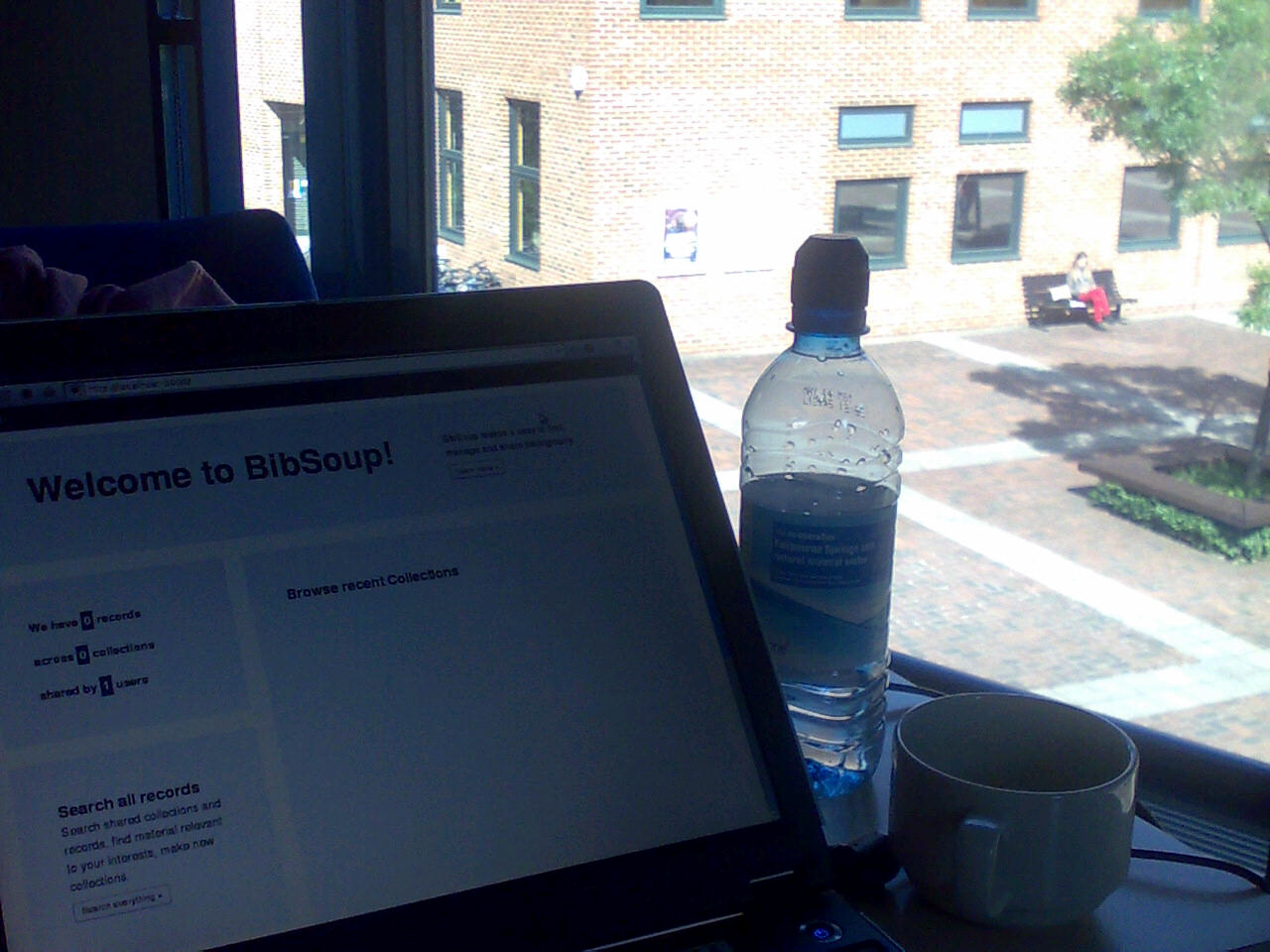
Well this isn t Edinburgh. This is London calling. More from kohacon later. 20120613_164236.jpg Today I was at OKFN s bibliohack . There were several interesting projects there and it was a good opportunity to get back into coding, metadata and APIs after thinking about conference practicalities for too long. BibSoup and its biblioserver software was my chosen hack. I didn t really make the most of it because I had to workaround broken wifi drivers that I hadn t noticed before, and I had to fix a broken java install that I did know about. BibSoup is mostly python and I think web.py, but it uses elasticsearch which is java. Oh and it s python 2.7 with virtualenv which is, erm, entertaining to get working on debian 6.0, as far as I can tell: I installed python2.7 from testing, backport python-virtualenv and I don t think anything broke. The approach to a hackfest was very different to kohacon s. Whereas people at kohacon hackfest were gathered around tables, moving to the talks table(s) when there was a talk they wanted, bibliohack started off classroom-style and didn t gather into workgroups until after coffee. The so-called non-coders were shunted off elsewhere after the welcome to do I-don t-know-what (maybe Library Co-op will write about it) and weren t seen again until the day s end. There were some nudging comments about being able to hack late into the night, which I m not sure is healthy if you ve done a full day. I left feeling a bit unsettled and disconnected from reality, although I got what I wanted from it playing with some new tech that we can maybe do good things with: thanks OKFN!
Paul Tagliamonte: Poshto: an update

I ve been working on Poshto a bit, and after a few shots at getting it right, I ve started another rewrite. The code started getting pretty krufty, so a rewrite was in order. To keep a clear head, I ve also removed all the front-end code I had. I m breaking it into a sync routine and a front-end. It s seeming to work OKish so far, but hopefully there will be even more progress soon.

12 June 2012

Bernd Zeimetz: bug squashing party in Salzburg

bsp_2012_salzburg Just as a little reminder, the Bug Squashing Party in Salzburg will start in three days. We still have sponsored accomodation for five four people left, so don't hesitate to come! Squashing as many RC bugs for Wheezy as possible is on the TODO list for the weekend! Also we'll work on making Debian a proper Spacewalk client. This might be a bit too late for Wheezy, but there will be backports :) See YOU in Salzburg!

11 June 2012

Aigars Mahinovs: New camera research

So, I was reading the coverage of the newly announced Canon 650D last week and it so happened that a friend needed a camera, so I sold my old Canon 550D and started looking for a replacement. For the last few years 95+% of the photos I have taken were with Canon 35mm f/2.0 lens on my Canon 550D, sometimes helped with a bounce&swivel flash. Which is very close to 50mm in full-frame equivalent. So I am looking to continue shooting in a similar way with a near-50mm prime lens and sometimes with bounce flash. As a given I have: Canon 35mm f/2.0, Canon 50mm f/1.8, Canon Speedlite 430EX II (bounce&swivel flash) and a budget of around 1k USD. It is a fun time to be looking around for a new camera body, so I found that I have many interesting options: Option 1: safe bet. Wait a bit and get the new Canon 650D body and continue shooting with the 35mm and the Canon flash. Pros: safe, new tech, good video. Cons: rather bulky and heavy, boring. Option 2: old school. Get a used Canon 5D Mark II body that pros are selling off to buy their Mark III and then start taking photos with the Canon 50mm f/1.8 lens and the Canon flash. Sell Canon 35mm f/2.0 to cover the price difference between bodies. Pros: full frame, higher resolution, huge viewfinder. Cons: very heavy and bulky, evolutionary dead-end, used, bad corner performance even with best lenses. Option 3: new wave. Sell the rest of my Canon stuff and buy into one of the new mirrorless cameras. The problem with this approach is that I can not find a mirrorless camera with all of: 18+ Mpix, sharp and fast near-50mm-equivalent prime autofocus lens, bounce&swivel external flash. Pros: light and small, new tech, funky. Cons: lens fragmentation, bad adapters (no AF), bad flashes. So, basically I am torn three ways. Any advice? Which mirrorless camera system would best match my needs? P.S. Due to work issues and the long distance, I am *not* attending this years Debconf.

P.P.S. To keep this slightly more on-topic how is the RAW files support on Linux for the new crop of the mirrorless cameras?

Maximilian Attems: 1.5M CPU hours in 2012

1.5M CPU hours runs on the Vienna Scientific Cluster by my 3D+3V hard expanding loops code. It is simulating the Chromo-Weibel instability of a non-Abelian plasma in an 1d expanding background to account for the expansion of a Quark-Gluon plasma fireball in a heavy ion collision. The code is parallellised using Open MPI and one single run roughly needs 0.5TB memory to hold all the needed 5-dimensional matrices and ~ 72h to complete. The resulting heavy operation is of course matrix multiplication of those physical and auxilliary fields. I tried to use git-annex on the resulting physical fields data output of ~ 150Gb and 300k files. Currently I do prefer git itself for it's speed and it only doubles the amounted space. I'm thrilled to see that git annex is still considering this "semi-extreme" usecase of lots of data files as it would help collaborators to have partial checkouts for laptop usage and quick checks. As the git-annex kickstarter is a rocket, i'd add my wish to see the current symlink mess go: desymlink git-annex. Now it is the time to properly analyse all this data and get the full 3d paper follow up on Instabilities of an anisotropically expanding non-Abelian plasma: 1D+3V discretized hard-loop simulations (previous paper) out maybe soon. (;

Brett Parker: Newsflesh Trilogy

So, on Thursday the final part of the Newsflesh trilogy by Mira Grant came out, I'd only been waiting on it for a year. The series is fantastic, and the last book answers the over hanging questions from the second nicely - there's some twists along the way, and it's a Damned Good read. I didn't pick up Blackout (the last book) until Saturday night, as I was re-reading Feed and Deadline first - I'd finished Feed on Wednesday but didn't finish Deadline until Saturday. I picked up Blackout Saturday night at ~ 2200 and didn't go to sleep until ~ 0200 - then, waking up on Sunday, other than doing a few bits of work from 1100 till about 2100 I read the rest of Blackout, it's kinda addictive. It ends a bit abruptly, but well. If you've not read this series - pick up Feed - if you like it, you'll love the series... also, if you don't cry at at least 2 points in Feed, you're obviously a heartless bastard!

10 June 2012

Gregor Herrmann: RC bugs 2012/23

here's the list of RC bugs I've worked on during the last week:

9 June 2012

Christian Perrier: [Running] Caen "Courants de la Libert " marathon

I'm about to leave today for St-Aubin sur Mer close to the start line of the Courants de la Libert marathon. This race, meant to celebrate the June 6th 1944 D-Day, arrives at Caen, close to the WW2 memorial. We'll spend a night in a hotel in St-Aubin and as of tomorrow 9h French time, I'll be on my way to try breaking my best time (3h4029"). Training has been as expected: no injury, all 32 trainings completed, with many many interval training (and some of them really though!). So, I'm going there with great confidence. The only minor problem are weather conditions as the forcast announces some rain and 20-30km/h wind, from South (which we should be facing from km 20 to 25 and in the last kilometers). I'll have my Runtastic and Endomondo Android apps running, so, in case looking at a blue spot on a French map for over 3 hours sounds interesting, you can go there or there (and send cheers, etc...but I'll switch off my phone's loudspeaker to avoid looking silly during the race!). See you tomorrow for the outcome!

Neil Williams: Going to Nicaragua


Not DebCamp this year, but I intend to get to more talks than I did in Bosnia and still get some work done on Emdebian Integration into Debian as well as working on as many RC bugs as I can manage during the week.

Possibly easy targets via UDD

A couple of my usual RC bug filter queries:


wheezy-and-sid, ignoring patch, pending, security, claimed and not in main.
(483 bugs)


wheezy-or-sid, ignoring merged and done
(987 bugs)

Neil McGovern: Anti-ACTA Demo my speech

I'm on my way back from the Anti ACTA demo in London, at which I was asked to speak. I was good to see a number of people attend. I bumped into the wonderful Bridget Fox too! Here's my speech:

As I was travelling here on the train, I found myself thinking: why am I here?
What has gone so wrong with the political system that politicians pass laws - the DMCA, the DEA, SOPA, PIPA, ACTA. Laws that look attractive on the surface, but are so deeply flawed. Why have they stopped listening?
But, they haven't stopped listening. They're falling in to a trap set by big businesses with vested interests. The ones with money to influence policy, the lobbying firms, the corporate hospitality arrangements. They hear that the economy is bumbling along the bottom. That many businesses are struggling, and these are hard problems to solve. And suddenly a shining beacon is held out - support our creative industries and all will be well. No one is interested in this new fangled Internet thing anyway. Well, apart from the people stood here today! People like you, and me. People like Julian Huppert - we helped take a motion to the Liberal Democrat Conference to repeal the damaging parts of the Digital Economy Act. The Alliance of Liberals and Democrats in Europe will vote against ACTA, and in three major committees it has already been rejected it. Something has changed. The people who represent us are starting to hear our stories. How we will not put up with censorship, interference and snooping. And let me tell you this. The big industries are scared. Shady back room negotiations so that they may be able to slip it past the public. Thanks to you, this won't work anymore. We have a voice, and it's here today. It's not too late to stop damaging our freedoms. Go visit your elected representatives. Tell them why we need to stop these bad laws. Help them understand that it's not ok to pass these. Write about it, tell people, shout in the streets! We know ACTA is bad. Let's tell the world.

8 June 2012

Paul Tagliamonte: so, who wants to write an awesome unity lens?

As most of you know by now, I don t like Unity, and I don t think I will. That being said, there are a few users, and I ve got a neat idea for one of them lenses . First one to write this gets mad gangster-props from me. So, the idea here is to show off US Political data in a cool way. I ve written python-sunlight, and it s super easy to use. The idea here is to have a lens that you can pick what sort of thing you re entering (legislator, political donor, corporation), as well as what level they are on (if they re a person), such as state or federal, to let people search (quickly) for things they care about. Documentation can be found on read the docs, and I d be happy to help write the parts that talk python-sunlight. Any takers?

Dmitrijs Ledkovs: Hello Debian, Planet and Debconf12

I am going to Debconf12
I'm going to Debconf12
Hello Debian Planet!

I have recently became a Debian Developer. One of the first things I did, was fix some RC bugs in my packages due to an ABI break from upstream in a point release. Then I fixed some bugs in offlineimap... Little did I know, that I broke it for many Debian developers including my ex boss and the Debian Project Leader all at the same time.

Speaking of which, any help will be appreciated in hunting down a memory leak in offlineimap.

I am going to Debconf12, thanks to my employer. I am interested in Python/dh_python[2-3], dh, 3.0 (quilt) with a DVCS, lvm2, mdadm, btrfs-tools, autofs, e2fsprogs, dm-crypt, debian-installer, init-systems & friends, OpenERP, offlineimap... if you are as well, find me and talk to me =)))

Regards,
xnox

Joey Hess: going to DebConf 12

going to Debconf button Nicaragua here I come! I plan to be at DebCamp for a few days too, taking advantage of some time on internet-better-than-dialup to work on fixing the tasks on the CDs. Also will be available for one-on-one sessions on debhelper, debconf, debian-installer development, pristine-tar, or git-annex. Give me a yell if you'd like to spend some time learning about any of these. Also, my git-annex Kickstarter ends in 3 days. It has reached heights that will fund me, at a modest rate, for a full year of development! (I'm also about to start renting my house for the first time. Whee!)

Lars Wirzenius: Obnam 1.0 (backup software); a story in many words

tl;dr: Version 1.0 of Obnam, my snapshotting, de-duplicating, encrypting backup program is released. See the end of this announcement for the details. Where we see the hero in his formative years; parental influence From the very beginning, my computing life has involved backups. In 1984, when I was 14, my father was an independent telecommunications consultant, which meant he needed a personal computer for writing reports. He bought a Luxor ABC-802, a Swedish computer with a Z80 microprocessor and two floppy drives. My father also taught me how to use it. When I needed to save files, he gave me not one, but two floppies, and explained that I should store my files one one, and then copy them to the other one every now and then. Later on, over the years, I've made backups from a hard disk (30 megabytes!) to a stack of floppies, to a tape drive installed into a floppy interface (400 megabytes!), to a DAT drive, and various other media. It was always a bit tedious. The start of the quest; lengthy justification for NIH In 2004, I decided to do a full backup, by burning a copy of all my files onto CD-R disks. It took me most of the day. Afterwards, I sat admiring the large stack of disks, and realized that I would not ever do that again. I'm too lazy for that. That I had done it once was an aberration in the space-time continuum. Switching to DVD-Rs instead CD-Rs would reduce to the number of disks to burn, but not enough: it would still take a stack of them. I needed something much better. I had a little experience with tape drives, and that was enough to convince me that I didn't want them. Tape drives are expensive hardware, and the tapes also cost money. If the drive goes bad, you have to get a compatible one, or all your backups are toast. The price per gigabyte was coming down fast for hard drives, and it was clear that they were about to be very competitive with tapes for price. I looked for backup programs that I could use for disk based backups. rsync, of course, was the obvious choice, but there were others. I ended up doing what many geeks do: I wrote my own wrapper around rsync. There's hundred, possibly thousands, of such wrappers around the Internet. I also got the idea that doing a startup to provide online backup space would be a really cool thing. However, I didn't really do anything about that until 2007. More on that later. The rsync wrapper script I wrote used hardlinked directory trees to provide a backup history, though not in the smart way that backuppc does it. The hardlinks were wonderful, because they were cheap, and provided de-duplication. They were also quite cumbersome, when I needed to move my backups to a new disk the first time. It turned out that a lot of tools deal very badly with directory trees with large numbers of hardlinks. I also decided I wanted encrypted backups. This led me to find duplicity, which is a nice program that does encrypted backups, but I had issues with some of its limitations. To fix those limitations, I would have had to re-design and possibly re-implement the entire program. The biggest limitation was that it treated backups as full backup, plus a sequence of incremental backups, which were deltas against the previous backup. Delta based incrementals make sense for tape drives. You run a full backup once, then incremental deltas for every day. When enough time has passed since the full backup, you do a new full backup, and then future incrementals are based on that. Repeat forever. I decided that this makes no sense for disk based backups. If I already have backed up a file, there's no point in making me backup it again, since it's already there on the same hard disk. It makes even less sense for online backups, since doing a new full backup would require me to transmit all the data all over again, even though it's already on the server. The first battle I could not find a program that did what I wanted to do, and like every good NIHolic, I started writing my own. After various aborted attempts, I started for real in 2006. Here is the first commit message:
revno: 1
committer: Lars Wirzenius <liw@iki.fi>
branch nick: wibbr
timestamp: Wed 2006-09-06 18:35:52 +0300
message:
  Initial commit.
wibbr was the placeholder name for Obnam until we came up with something better. We was myself and Richard Braakman, who was going to be doing the backup startup with me. We eventually founded the company near the end of 2006, and started doing business in 2007. However, we did not do very much business, and ran out of money in September 2007. We ended the backup startup experiment. That's when I took a job with Canonical, and Obnam became a hobby project of mine: I still wanted a good backup tool. In September 2007, Obnam was working, but it was not very good. For example, it was quite slow and wasteful of backup space. That version of Obnam used deltas, based on the rsync algorithm, to backup only changes. It did not require the user to do full and incremental backups manually, but essentially created an endless sequence of incrementals. It was possible to remove any generation, and Obnam would manage the deltas as necessary, keeping the ones needed for the remaining generations, and removing the rest. Obnam made it look as if each generation was independent of each other. The wasteful part was the way in which metadata about files was stored: each generation stored the full list of filenames and their permissions and other inode fields. This turned out to be bigger than my daily delta. The lost years; getting lost in the forest For the next two years, I did a little work on Obnam, but I did not make progress very fast. I changed the way metadata was stored, for example, but I picked another bad way of doing it: the new way was essentially building a tree of directory and file nodes, and any unchanged subtrees were shared between generations. This reduced the space overhead per generation, but made it quite slow to look up the metadata for any one file. The final battle; finding cows in the forest In 2009 I decided to leave Canonical and after that, my Obnam hobby picked up in speed again. Below is a table of the number of commits per year, from the very first commit (bzr log -n0 awk '/timestamp:/ print $3 ' sed 's/-.*//' uniq -c awk ' print $2, $1 ' tac):
2006 466
2007 353
2008 402
2009 467
2010 616
2011 790
2012 282
During most of 2010 and 2011 I was unemployed, and happily hacking Obnam, while moving to another country twice. I don't recommend that as a way to hack on hobby projects, but it worked for me. After Canonical, I decided to tackle the way Obnam stores data from a new angle. Richard told me about the copy-on-write (or COW) B-trees that btrfs uses, originally designed by Ohad Rodeh (see his paper for details), and I started reading about that. It turned out that they're pretty ideal for backups: each B-tree stores data about one generation. To start a new generation, you clone the previous generation's B-tree, and make any modifications you need. I implemented the B-tree library myself, in Python. I wanted something that was flexible about how and where I stored data, which the btrfs implementation did not seem to give me. (Also, I worship at the altar of NIH.) With the B-trees, doing file deltas from the previous generation no longer made any sense. I realized that it was, in any case, a better idea to store file data in chunks, and re-use chunks in different generations as needed. This makes it much easier to manage changes to files: with deltas, you need to keep a long chain of deltas and apply many deltas to reconstruct a particular version. With lists of chunks, you just get the chunks you need. The spin-off franchise; lost in a maze of dependencies, all alike In the process of developing Obnam, I have split off a number of helper programs and libraries: I have found it convenient to keep these split off, since I've been able to use them in other projects as well. However, it turns out that those installing Obnam don't like this: it would probably make sense to have a fat release with Obnam and all dependencies, but I haven't bothered to do that yet. The blurb; readers advised about blatant marketing The strong points of Obnam are, I think: Backups may be stored on local hard disks (e.g., USB drives), any locally mounted network file shares (NFS, SMB, almost anything with remotely Posix-like semantics), or on any SFTP server you have access to. What's not so strong is backing up online over SFTP, particularly with long round trip times to the server, or many small files to back up. That performance is Obnam's weakest part. I hope to fix that in the future, but I don't want to delay 1.0 for it. The big news; readers sighing in relief I am now ready to release version 1.0 of Obnam. Finally. It's been a long project, much longer than I expected, and much longer than was really sensible. However, it's ready now. It's not bug free, and it's not as fast as I would like, but it's time to declare it ready for general use. If nothing else, this will get more people to use it, and they'll find the remaining problems faster than I can do on my own. I have packaged Obnam for Debian, and it is in unstable, and will hopefully get into wheezy before the Debian freeze. I provide packages built for squeeze on my own repository, see the download page. The changes in the 1.0 release compared to the previous one: The future; not including winning lottery numbers I expect to get a flurry of bug reports in the near future as new people try Obnam. It will take a bit of effort dealing with that. Help is, of course, welcome! After that, I expect to be mainly working on Obnam performance for the foreseeable future. There may also be a FUSE filesystem interface for restoring from backups, and a continous backup version of Obnam. Plus other features, too. I make no promises about how fast new features and optimizations will happen: Obnam is a hobby project for me, and I work on it only in my free time. Also, I have a bunch of things that are on hold until I get Obnam into shape, and I may decide to do one of those things before the next big Obnam push. Where; the trail of an errant hacker I've developed Obnam in a number of physical locations, and I thought it might be interesting to list them: Espoo, Helsinki, Vantaa, Kotka, Raahe, Oulu, Tampere, Cambridge, Boston, Plymouth, London, Los Angeles, Auckland, Wellington, Christchurch, Portland, New York, Edinburgh, Manchester, San Giorgio di Piano. I've also hacked on Obnam in trains, on planes, and once on a ship, but only for a few minutes on the ship before I got seasick. Thank you; sincerely SEE ALSO

Matthew Garrett: The security of Secure Boot

The other complaint about UEFI Secure Boot is that it doesn't add any security. There's two aspects to this - people either think it'll be quickly broken, or people think that the public availability of signing services will render it useless.
Will Secure Boot be broken?Almost certainly, yes. I'd put a significant amount of money on it. The most obvious avenue of attack is probably a malformed FAT on a USB stick, or alternatively a programmable USB device that can trigger undesired behaviour in the USB stack. If you're really lucky then you might be able to corrupt the filesystem on the EFI system partition in such a way that this happens on every boot, even if there's no USB hardware connected. It's possible that there'll be a bug in the binary validation process and a cleverly designed binary may be able to validate even though it contains unsigned code. Various vendors will probably manage to produce signed option ROMs that rely on unsigned data in such a way that they can be forced to misbehave. But most of these attacks will either involve physical access or depend on the target machine having a specific piece of hardware installed, and I'd also put money on each of them being quickly fixed once they're found. And, eventually, people will run out of new attacks.

People desperately want to believe that the Secure Boot implementation is fundamentally broken, and that's just not true. It's based on well-tested encryption technology. You calculate a SHA256 of the binary you want to sign. You encrypt that hash with the private half of a 2048-bit RSA key. You embed the encrypted hash in the binary. When someone tries to run the binary you decrypt the hash with the public key in your firmware. You then calculate the hash of the binary and compare the two. If they match then you know that (a) whoever signed the binary had access to the private half of a key you trust, and (b) the binary hasn't been modified since then.

The difference between Secure Boot and things like CSS or WEP is that Secure Boot uses existing cryptographic techniques and has been designed by people who actually understand how they work. Precisely the same technology is used in Microsoft's driver signing, and people decided it was easier to steal a key from Realtek than it was to break the underlying technology. Unless there's a crippling bug in the implementation that nobody's noticed yet, the only real way to attack this is to either force a SHA256 collision (achievable with current technology, as long as you're willing to spend many orders of magnitude more time than the universe has existed) or break RSA (which would also mean that SSL is broken). If anyone can do either of these things then we are so unbelievably fucked that Secure Boot should not be the thing you're most worried about.

So, in summary: Yes, Secure Boot will be broken. And then it will be fixed. And after this happens a few times, there will be no further breaks.
Everyone can sign, so what's the pointAnyone can pay $99 and get their binaries signed. So why won't malware authors just do that? For starters, you'll need to provide some form of plausible ID for Verisign to authenticate you and hand over access. So, sure, you provide some sort of fake ID. That's the kind of thing that tends to irritate local authorities - not only are you talking about breaking into a bunch of computers, you're talking about committing the sort of crime that results in genuinely bad things happening to you if you get caught. And secondly, the only way you get access to the system is using some physical smartcards that Verisign send you. So you've also had to hand over an actual physical address, and even if you've used some sort of redirection service that's still going to make it easier to track you down. You're taking some fairly significant real-world risks.

But ok, you're willing to do that and you obtain a signing key and you sign some malware. You'll infect some number of machines. But eventually you'll be noticed, and then Microsoft produce a key revocation blob and vendors push it out via their OS update mechanisms. If your malware was basically harmless then that's probably the end of it, but if you were using it as the basis for an attack on people's banking details then a lot of people are suddenly going to be very interested in the person who bought that key, and also your malware isn't going to be able to infect any more machines.

To put this in perspective - Windows is the dominant desktop operating system. If you want to run a botnet or steal people's bank details then Windows is the obvious thing to attack. Windows security has now improved to the point where it's not massively straightforward to do that from userspace, so the logical thing to do would be to run your malware in the kernel. The easiest way to do that would be to load a driver, but Windows won't load unsigned drivers. So you'd need a signed driver. How do you get one? With the same $99 access to the Microsoft signing service that you'd use for signing an EFI binary.

Anyone could already use the signing service to attack Windows. But people haven't. The Stuxnet authors thought it was easier to steal a key from a real hardware vendor than it was to buy their own key. So, yes, in theory an attacker could obtain signing services. But the real world evidence suggests that that's not how they behave.
SummarySecure Boot is unlikely to be broken via fundamental flaws in its implementation, and there's no evidence that public availability of the signing service will result in an explosion of boot level malware.

comment count unavailable comments

6 June 2012

Tanguy Ortolo: Beware of the newest Intel Atom GPU

Do you remember how Intel used to be the white knight of graphic card manufacturers, the one from which you could buy hardware without looking, being sure that it would be supported by GNU/Linux directly? Do you remember how they broke that by releasing the infamous Poulsbo card? Well, they did it again. The newest Intel Atom D2500, D2550, D2700, N2600 and N2800 processors, codenamed CedarView and Cedar Trail , include a graphic core that is only supported by a proprietary driver only available on Meego (read: unusable on regular GNU/Linux.So, if you plan to buy a netbook, beware! Intel is not a manufacturer you can trust to provide freely usable hardware. Just like other manufacturers, check that the hardware you are planning to buy is supported, by asking on #intel-gfx on Freenode. The most relevant course of action probably consists in buying a previous model or waiting for the next models.

Craig Small: pam bugs hurt

I did some upgrades of what seemed like a million packages today on my debian sid computer. I was doing this remotely and when I tried to ssh back in I got kicked out after entering my password, hmmm. OK, so I waited until I could get in front of it and tried to login to the console and was greeted with the message Cannot make/remove an entry and kicked out, even as root; double hmmm. So it was boot into single user time which, thankfully worked. bash loaded ok so it wasn t a shell problem. However su failed which means we are into pam problem territory. I found a bug report that sounded like my problem, but with no clear solution except upgrade in Ubuntu. The solution was pretty simple for me. It s something funky with /etc/pam.d/common-sesssion and a simple /usr/sbin/pam-auth-update fixed it for me.

Next.

Previous.