Search Results: "ema"

13 October 2007

Biella Coleman: On Networks and Experimental Writing

One of my dissertation thesis advisors, Christopher Kelty, is teaching a superb looking course at Harvard this fall on networks. The only thing I would add to that syllabus right now is a book by a department colleague, Alexander Galloway, who just published a book with Eugene Thacker The Exploit. And while I have not read more than a chapter, what I like about it is its experimental style. They open this book with the following orientation:
It is our intention in this book to avoid the limits of academic writing in favor of a more experimental, speculative approach. To that end, we adopt a two-tier format. Throughout Part I, “Nodes,” you will find a number of condensed, italicized header that are glued together with more standard prose. For quick immersion, we suggest skikking Part I by reading the italicized sections only…. In this sense, we hope you will experience the book not as the step-by-step propositional evolution of a complete theory but as a series of marginal claims, disconnected in a living environment of many thoughts, distributed across as many pages.
The good thing is while the form is experimental, at the sentence level, things are quite clear. I have often had the experience of reading experimental work whose content was the experiment but not the form, and basically I did not understand a thing. In this case, it is the form that achieves their desire to explore and present their marginal claims. Annemarie Mol in The Body Multiple also uses a two-tiered experimental approach that is just fantastic, especially since her writing is especially accessible.

12 October 2007

Biella Coleman: New York Public Library Labs

Interested in what it would be like to digitize a good chunk of the New York Public Library? If yes, join the good folks at the library who are experimenting and implementing new methods, protocols, and best practices and documenting it all on a very nifty blog, NYPL Labs. One of the brains behind these mass movements and migrations is Josh Greenberg, the Director of Digital Strategy and Scholarship. In many respects, it is a dream job for an academic (he got his PhD from the venerable Cornell STS Program and is the author of a forthcoming book, From Betamax to Blockbuster: The Invention of Movies on Video) because he can have a more dramatic and lasting impact on the world in comparison to most social science and humanities work, and in the process he and others will collect and gather all sorts of experiences that I am sure will become rich food for thought and future academic work on digitization, cultural preservation, and access.

Benjamin Mako Hill: Ubuntu (w/ Special Guests) in Boston

There are quite a few important events related to Ubuntu -- and to free software communities more generally -- in the Boston area in the next few weeks. I plan to participate in many of them. First, this coming Saturday, October 13, there will be an Ubuntu install party hosted at MIT and organized by the Ubuntu Massachusetts local community team. It promises to be a lot of fun and a great opportunity to have a gaggle of geeks install a free OS on your computer for you. If you've been thinking about installing free software but been hesitant (my guess is that this is not the majority of my readers), this is the event for you. I'll probably be doing RockBox installs as well so backup your music and bring an iPod if you're unfortunate enough to have funded Apple through the purchase of one. Next week on October 18, Ubuntu Massachusetts will be hosting a party at the Globe Bar and Cafe to celebrate the (scheduled) release of the Gutsy Gibbon. I am not thrilled about everything in this release -- like Compiz by default -- but I am happy about the progress of the distribution both technically and in reaching out to an ever-wider and ever-larger group of users. On the week of October 29-November 2, Canonical is hosting the Ubuntu Developer Summit in Cambridge. I'll definitely drop by for a least a day or two to make some strategic interjections and to participate in a few specifications that I care about. The summit is just down the street from my office at the Hotel at MIT so I have little excuse to not show up. I'll also being hanging out with friends from Ubuntu during the week. Finally, as part of the Ubuntu conference, Canonical is sponsoring FOSSCamp. It promises to be a Foocamp/Barcamp style "un-conference" with a focus on free software and open source. I'll be there and, if there's demand, will run sessions on Selectricity and a quick Making Debian/Ubuntu Packages for Sysadmins talk -- basically a more polished version of what I did at the Ubucon in New York. All events are open to the public although people who are not Ubuntu developers may be a little bored at the developer summit. I look forward to seeing both old and new faces around the project in the next month.

Eddy Petrișor: SELinux: unusable from a newbie perspective

Thanks Russell for the explanations on the execmem bits.

Now I am trying to go further and set up my system to really work with SELinux enabled because, although the promise of the targeted policy is to allow you to do your job mostly as you did before, that "mostly" has a really wide meaning, more than you'd think you bargained for.

Examples from my laptop: hald does not start by default (various denials), resolvconf is denied some getattr operations on tmpfs, hald-addon-dell-backlight is denied access to some character device I just know it should have access to, etc. Of course, this means that automatic mounting does not work anymore and there is a decrease in usability just because of the "mostly" part.

I am sure that some of the denials are correct (see the execstack stuff or the memexec), but there are cases where this "mostly" is stretched way too much. IMHO, desktop installs should suffer no restrictions when using the targeted policy (and I mean "no restrictions that would make my system less than it was before enabling and enforcing SELinux").


But let me tell a reason why SELinux sucks without any help from others:

The interface sucks big time.

Probably there is are good reasons, but if you need to create and use a new policy based on the denials found in the logs, you need to use no less than 4 (four) different tools with the right incantation (although you can use just 2, if you don't want to customize the rules[1]):
In the end, you still hit the bad interface:

bounty:~# semodule -i local.pp
libsepol.check_assertion_helper: assertion on line 0 violated by allow hald_t memory_device_t:chr_file read ;
libsepol.check_assertions: 1 assertion violations occured
libsemanage.semanage_expand_sandbox: Expand module failed
semodule: Failed!

Now what? That error message doesn't tell me much, except that some assertion failed. But where does the assertion come from? Why is it an assertion? What is bad about that line?
To me that really looks like an internal error or an inconsistency in what the SELinux tools generate.


[1] still, why advertise the longer path as the Fedora FAQ does? I would have done it the other way around.

Ian Wienand: Scrambled text

There's this thing going around on Facebook suggesting you are smart if you can read a paragaph where the middle letters of the words are scrambled. Everything old is new again, since I remember reading about this in 2003. As far as I remember being able to read the scrambled text was not related to intelligence in any way. Anyway, as a Friday afternoon distraction I wrote a little javascript to scramble text.
PlainScrambled
Scramble It Ahh, the good-olde Fisher-Yates shuffle algorithm, friend of the first year tutorial!

Raphaël Hertzog: The DSA dilemma

For once, Clint blogged on something that I can understand. :-) I don’t buy everything he says, but in the case of DSA, the part where he says “you cannot have a functional and respectable subgroup if it maintains autonomy like that” is a real problem. The leadership problem I mentioned is real. And it can theoretically be solved by undelegating one of the problematic side of this DSA-internal dispute. But which one? Given the unwillingness of Joey to discuss the problems, he makes an easy target… which would leave DSA up to Ryan, James and Phil. But is that a desirable thing? If DSA is perceived as being an “autonomous” group which is not involved in Debian’s main discussions and which is somewhat disconnected from Debian’s day-to-day life, it’s largely due to the behavior of James and Ryan. E-mail communication with them is very difficult as they’ll respond only if they really care about something. And despite the setup of the request tracker, they have barely been able to make proper usage of it… the idea was to use RT tickets to track everything that DSA does but they don’t use it as such. For example, James setup a “wikiadm” group and he never reported anything to the related ticket (#194) (I did it myself once I found out). Also there’s an internal ticket about the replacement of ftp.debian.org (that I created because ftp.d.o ran out of space regularly) and AFAIK Jeroen has been in touch with James to setup that replacement, but nothing got reported to the tracker. Ryan promised me once to put his DSA TODO list in the tracker so that other people can jump in and help out. He never did. So while Joey is definitely a pain for DSA, at least he’s a visible participant of the team and he interacts with the community. James and Ryan are not, they interact only through private channels and do not share their opinions or their vision of Debian.
I believe this is a real problem. On the other hand, most of the interesting changes in the last months are the results of James’s work. But he’s also implicitly blocking addition of new members as long as the leadership problem is not solved. I tried to fill the communication void of the DSA team by various means. I follow everything as closely as I can so that I can report changes on other channels, mailing lists when needed. I made efforts to document stuff on the wiki page, etc. But this is not a long term solution, the communication issue must be fixed within the team. The path ouf of this mess is still not very clear, but something is going to change soon. Not quite sure what though. What would you suggest? And if you were DPL, what would you do? Since private discussions and negotiations lead nowhere, it’s tempting to bring the issue in the public area. In theory, they have no way to escape discussions and they’ll have to communicate their grudges against the other side if they want to have some fair judgment between both parties. Unfortunately, given the habits of James and Ryan, they probably won’t participate in any public discussion and either resign or stay where they are waiting for any decision… Comments welcome. Partagez cet article / Share This

11 October 2007

MJ Ray: Current Issues / Re: Walking and Cycling in WsM

There were some surprising numbers given at yesterday's workshop: a quarter of Weston-super-Mare households don't use a car, while only 37% of men and 24% of women take the minimum recommended exercise (at least 30 minutes 5 days a week).  Meanwhile, the West of England's traffic is growing at three times the national average and congestion is already a big problem, WsM's population has grown 34% in a decade and the southwards expansion of the town around the dual carriageway seems unlikely to slow that.

Two-fifths of WsM journeys are under 5km, but over half of those are done by car.  In short, if we don't get walking, cycling and mass transport working, this town is going to become very ugly, and expensive to live and work in.  The walking and cycling strategy is being developed now with Halcrow consultants and a draft will be published in December, to help shape planning and transport policies, as well as works programmes.

So, yesterday, they seemed particularly interested in: what stops people from walking and cycling more?  What can be done to put them right?  What do people think of shared-use paths?  Do cyclists prefer to be on-road?  What stops them being on-road?  I guess answers from non-Weston-residents would also be interesting in the forum or comments box...

Sorry for the short notice of yesterday's event. It's been a bit manic here lately and I believed that there was a shortage of places - as it happened, there could easily have been three times as many people there.  I guess that means you're likely to have an effect if you email your thoughts and suggestions to sustainable.travel@n-somerset.gov.uk telephone 01934 634848 or post them to The Sustainable Travel Team, North Somerset Council, Somerset House, Oxford Street, Weston-super-Mare BS23 1TG.

Russell Coker: Getting People into IT

Pia writes about the difficulty in getting young women and young people in general into the computer industry [1]. While I agree that having more women in the computer industry would be a good thing, I have difficulty believing some of the claims that Pia makes. For example the claim that “[girls] are more career focused earlier in their school life“. I chose my career when I was about 11 years old [2] and several of my friends made similar decisions at similar ages. I would be interested to read anecdotal evidence from women in the computer industry about how old they were when they decided on their career and if their friends did the same, a reference to any research on this topic would also be useful. I tend to believe that boys are more career focussed at all stages of their life but have little evidence to support this idea. One fact that seems obvious is that the idea that “if you don’t succeed in your career then you can always marry someone who does” is almost non-existent among boys. It seems likely that such ideas have a statistically relevant affect on the focus on career of boys vs girls. Also the Australian Bureau of Statistics reports that the MEDIAN income for women is significantly lower than for men [4], I find it difficult to imagine that girls could be more career focussed from a younger age and yet get significantly lower pay (note the fact that it’s median not mean income is very significant as it removes the “glass ceiling” effect). Phillip Greenspun writes about why there are so few women doing scientific research [6] and makes some good points about why scientific research is generally not well paid and therefore a university student would choose a career in some other area and suggests that it’s a macho thing that guys enter such competitive fields for relatively low wages. Maybe some women correctly assess the costs and benefits of a career in scientific research and then make the mistake of equating Computer Science to other branches of science. But the median income suggests that although there may be some valid reasons for avoiding science that would only cover a small portion of the problem (the difference in median income can not be explained by misplaced attempts to maximise income). One problem that is significant is the quality of school education for girls. Not only is there the issue that boys may crowd-out girls for some subjects that are supposedly traditionally for boys (such as all science) but even girls schools aren’t as good as they should be. Some time ago I was talking to a teacher at an all-girls school, the school was moderately expensive and parents were paying the extra money presumably to give their daughters educational opportunities that they might miss in a co-ed school. However the school did not teach hard maths (”Maths B” was the official name at the time) and only taught the easy maths (official name “Maths A” and unofficial name “Vegie Maths“) because they didn’t have many girls demanding it (which is probably difficult to measure if you don’t offer it as a reasonable option) and the girls who wanted to study it could always move to a different school. So the choice facing girls at the exclusive school in question was “skip the subject that is most useful for further studies in most science subjects” or “go to a different school and miss most of your friends“, this sort of decision would surely discourage some potential female computer programemers. Also I think that the difference between boys and girls in regard to studying computer science has a lot to do with the fact that given a choice between missing most of their friends and missing out on something related to computers would be a no-brainer for most boys. Paul Graham’s article about Nerds has some interesting points to make in this regard - maybe the problem is that girls aren’t Nerdish enough [5]. Pia also writes about parents and teachers advising children not do study IT because of a perceived lack of jobs. I think that the problem here is not just bad advice, but also a bad tendency to take advice. Someone who wants to study in an established field which changes little over time (law and accounting spring to mind) probably should take careful note of the advice that they are given - things haven’t changed much in the last few decades. But someone who wants to study in a field that changes rapidly and where every year has new and significant developments (of which the best example is the computer industry) should probably be quite skeptical of all advice - most advice about the computer industry concerns how things used to be not how things are. Finally when considering whether to accept advice you should consider who is offering it. For example advice from a hiring manager should be carefully noted (as the manager will tell you precisely what factors influence their own decisions on hiring). Advice from people who are successful in the industry should also be noted. Advice from a school career advisor who gets paid about 1/3 what any 25yo can earn in the computer industry should be entirely ignored. I wonder whether being hesitant to ignore advice is a problem for girls in this regard. When I was in year 11 I had to take a subject related to career planning. It covered some things that were of minor use (such as writing CVs) and had an assignment of writing a fictional CV for yourself a few years after leaving university. I received bad marks for preparing a CV that involved changing jobs as companies went bankrupt or projects failed due to bad management, I was told that if your employer fails in the market it makes you look bad! However my fictional CV did bear some resemblance to what really happened… In terms of what industries have jobs available, the best advice I can give students is to actively do some research of their own. It’s not difficult to get the jobs sections of some newspapers and do a quick scan to see how many positions are open in a field, and it’s even easier to do some searches on online jobs sites (which usually tell you how many positions posted in the last X days match your criteria). For example I just visited jobserve.com.au and found 1724 Engineering jobs and 5622 IT jobs advertised. If you compare this to the university intake (I visited the Swinburne university courses list [3] and found 25 IT courses vs 29 Engineering course) it seems that the ratio of Engineering graduates to jobs is not likely to be as good as that for CS graduates. Of course it may be that all the other universities have hardly any Engineering courses and balance the ratio out (but I doubt it). In any case this would be a good way of injecting some facts into a discussion of the relative merits of different career choices and avoiding it being an issue of parents/teachers not liking computers vs children liking them. Determining the relative pay rates of different industries is a lot more difficult (and requires a significant amount of work), some recruiting agencies publish statistics - but those stats only apply to the positions that they fill (which is a sub-set of the actual positions). Finally as a piece of advice for children, try and find a job that you enjoy. If you earn $30K doing something you enjoy then you’ll probably be happier than if you earn $100K doing something you hate. Also if you enjoy your work then you will probably be able to take the extra steps needed to become successful - often it’s not a choice between having fun or making good money but a choice between fun and good money or the absence of both. If someone tells you to avoid doing what you love and instead do something boring for some unsubstantiated belief that there would be more money in it then be a nerd and tell them that their opinion is not relevant (it does tend to make teachers angry though).

Andrew Pollock: [tech] Dell really is hopeless

It's funny. I was reading Planet Debian, whilst I sat on hold with Dell myself, and I read John Goerzen's post, which prompted to write this one, when I wouldn't have otherwise bothered. Dell's customer service has completely degraded over the years, I think. I've been trying for a few days now to get pricing on replacement hard drives for my PowerEdge 1850. When I bought it, I made the mistake of skimping on getting the 140 Gb disks because of cost, and the 70 Gb ones are approaching capacity. As I'm going to be back in Australia soon, I'll have an opportunity to visit daedalus and physically upgrade the disks, so I thought I'd start looking into ordering some new disks now. I called the Australian 1800 number. It went something like this: Dell: Press 1 for sales and pricing information I press 1 Dell: Press 1 for home crap, 2 for small businesses with 3-400 people, press 3 for education and businesses with 400+ people I press 2 since I figure home users don't buy PowerEdge 1850s. Dell: "Dell switchboard this is blah, how may I direct your call?" Me: "I'd like to get pricing on some replacement hard drives for a PowerEdge 1850." Dell: "I'll just put you through to sales" Dell: "Home sales, how may I help you?" Me: "I'd like to get pricing on some replacement hard drives for a PowerEdge 1850." Dell: "I'm sorry, you'll need the server people, let me transfer you" Dell: "Dell switchboard this is blah, how may I direct your call?" Me: "I'd like to get pricing on some replacement hard drives for a PowerEdge 1850." Dell: "I'll just put you through to sales" Dell: "Home sales, how may I help you?" Rinse and repeat something like three times before the switchboard operator couldn't hear me and hung up on me. I swear I got the same sales droid in Home Sales at least once. Retards. So I called back, opted for the 400+ employees option, got the same thing, but this time the switchboard operator put me through to spare parts, where I sat on hold for a while and then hit voicemail. Maybe I'll be lucky tomorrow.

10 October 2007

Martin F. Krafft: Packaging with Git

Introduction I gave a joint presentation with Manoj at Debconf7 about using distributed version control for Debian packaging, and I volunteered to do an on-line workshop about using Git for the task, so it's about time that I should know how to use Git for Debian packaging, but it turns out that I don't. Or well, didn't. After I made a pretty good mess out of the mdadm packaging repository (which is not a big problem as it's just ugly history up to the point when I start to get it right), I decided to get down with the topic and figure it out once and for all. I am writing this post as I put the pieces together. It's been cooking for a week, simply so I could gather enough feedback. I am aware that Git is not exactly a showcase of usability, so I took some extra care to not add to the confusion. It may be the first post in a series, because this time, I am just covering the case of mdadm, for which upstream also uses Git and where I am the only maintainer, and I shall pretend that I am importing mdadm to version control for the first time, so there won't be any history juggling. Future posts could well include tracking Subversion repositories with git-svn, and importing packages previously tracked therewith, but this ain't no promise! (well, that last post is already being drafted, but far from finished; you have been warned!) I realise that git-buildpackage exists, but imposes a rather strict branch layout and tagging scheme, which I don't want to adhere to. And gitpkg (Romain blogged about it recently), deserves another look since, according to its author, it does not impose anything on its user. But in any case, before using such tools (and possibly extending them to allow for other layouts), I'd really rather have done it by hand a couple of times to get the hang of it and find out where the culprits lie. Now, enough of the talking, just one last thing: I expect this blog post to change quite a bit as I get feedback. Changes shall be highlighted in bold typeface.
Setting up the infrastructure First, we prepare a shared repository on git.debian.org for later use (using collab-maint for illustration purposes), download the Debian source package we want to import (version 2.6.3+200709292116+4450e59-3 at time of writing, but I pretend it's -2 because we shall create -3 further down ), set up a local repository, and link it to the remote repository. Note that there are other ways to set up the infrastructure, but this happens to be the one I prefer, even though it's slightly more complicated:
$ ssh alioth
$ cd /git/collab-maint
$ ./setup-repository pkg-mdadm mdadm Debian packaging
$ exit
$ apt-get source --download-only mdadm
$ mkdir mdadm && cd mdadm
$ git init
$ git remote add origin ssh://git.debian.org/git/collab-maint/pkg-mdadm
$ git config branch.master.merge refs/heads/master
Now we can use git-pull and git-push, except the remote repository is empty and we can't pull from there yet. We'll save that for later. Instead, we tell the repository about upstream's Git repository. I am giving you the git.debian.org URL though, simply because I don't want upstream repository (which lives on an ADSL line) hammered in response to this blog post:
$ git remote add upstream-repo git://git.debian.org/git/pkg-mdadm/mdadm
Since we're using the upstream branch of the pkg-mdadm repository as source (and don't want all the other mess I created in that repository), we'll first limit the set of branches to be fetched (I could have used the -t option in the above git-remote command, but I prefer to make it explicit that we're doing things slightly differently to protect upstream's ADSL line).
$ git config remote.upstream-repo.fetch \
    +refs/heads/upstream:refs/remotes/upstream-repo/upstream
And now we can pull down upstream's history and create a local branch off it. The "no common commits" warning can be safely ignored since we don't have any commits at all at that point (so there can't be any in common between the local and remote repository), but we know what we're doing, even to the point that we can forcefully give birth to a branch, which is because we do not have a HEAD commit yet (our repository is still empty):
$ git fetch upstream-repo
warning: no common commits
[ ]
  # in the real world, we'd be branching off upstream-repo/master
$ git checkout -b upstream upstream-repo/upstream
warning: You appear to be on a branch yet to be born.
warning: Forcing checkout of upstream-repo/upstream.
Branch upstream set up to track remote branch
  refs/remotes/upstream-repo/upstream.
$ git branch
* upstream
$ ls   wc -l
77
Importing the Debian package Now it's time to import Debian's diff.gz remember how I pretend to use version control for package maintenance for the first time. Oh, and sorry about the messy file names, but I decided it's best to stick with real data in case you are playing along: Since we're applying the diff against version 2.6.3+200709292116+4450e59, we ought to make sure to have the repository at the same state. Upstream never "released" that version, but I encoded the commit ID of the tip when I snapshotted it: 4450e59, so we branch off there. Since we are actually tracking the git.debian.org pkg-mdadm repository instead of upstream, you can use the tag I made. Otherwise you could consider tagging yourself:
$ #git tag -s mdadm-2.6.3+200709292116+4450e59 4450e59
$ git checkout -b master mdadm-2.6.3+200709292116+4450e59
$ zcat ../mdadm_2.6.3+200709292116+4450e59-2.diff.gz   git apply
The local tree is now "debianised", but Git does not know about the new and changed files, which you can verify with git-status. We will split the changes made by Debian's diff.gz across several branches.
The idea of feature branches We could just create a debian branch, commit all changes made by the diff.gz there, and be done with it. However, we might want to keep certain aspects of Debianisation separate, and the way to do that is with feature branches (also known as "topic" branches). For the sake of this demonstration, let's create the following four branches in addition to the master branch, which holds the standard Debian files, such as debian/changelog, debian/control, and debian/rules:
  • upstream-patches will includes patches against the upstream code, which I submit for upstream inclusion.
  • deb/conffile-location makes /etc/mdadm/mdadm.conf the default over /etc/mdadm.conf and is Debian-specific (thus the deb/ prefix).
  • deb/initramfs includes the initramfs hook and script, which I want to treat separately but not submit upstream.
  • deb/docs similarly includes Debian-only documentation I add to the package as a service to Debian users.
If you're importing a Debian package using dpatch, you might want to convert every dpatch into a single branch, or at least collect logical units into separate branches. Up to you. For now, our simple example suffices. Keep in mind that it's easy to merge two branch and less trivial to split one into two. Why? Well, good question. As you will see further down, the separation between master and deb/initramfs actually makes things more complicated when you are working on an issue spanning across both. However, feature branches also bring a whole lot of flexibility. For instance, with the above separation, I could easily create mdadm packages without initramfs integration (see #434934), a disk-space-conscious distribution like grml might prefer to leave out the extra documentation, and maybe another derivative doesn't like the fact that the configuration file is in a different place from upstream. With feature branches, all these issues could be easily addressed by leaving out unwanted branches from the merge into the integration/build branch (see further down). Whether you use feature branches, and how many, or whether you'd like to only separate upstream and Debian stuff is entirely up to you. For the purpose of demonstration, I'll go the more complicated way.
Setting up feature branches So let's commit the individual files to the branches. The output of the git-checkout command shows modified files that have not been committed yet (which I trim after the first example); Git keeps these across checkouts/branch changes. Note that the ./debian/ directory does not show up as Git does not know about it yet (git-status will tell you that it's untracked, or rather: contains untracked files since Git does not track directories at all):
$ git checkout -b upstream-patches mdadm-2.6.3+200709292116+4450e59
M Makefile
M ReadMe.c
M mdadm.8
M mdadm.conf.5
M mdassemble.8
M super1.c
$ git add super1.c     #444682
$ git commit -s
  # i now branch off master, but that's the same as 4450e59 actually
  # i just do it so i can make this point 
$ git checkout -b deb/conffile-location master
$ git add Makefile ReadMe.c mdadm.8 mdadm.conf.5 mdassemble.8
$ git commit -s
$ git checkout -b deb/initramfs master
$ git add debian/initramfs/*
$ git commit -s
$ git checkout -b deb/docs master
$ git add RAID5_versus_RAID10.txt md.txt rootraiddoc.97.html
$ git commit -s
  # and finally, the ./debian/ directory:
$ git checkout master
$ chmod +x debian/rules
$ git add debian
$ git commit -s
$ git branch
  deb/conffile-location
  deb/docs
* master
  upstream
  upstream-patches
At this time, we push our work so it won't get lost if, at this moment, aliens land on the house, or any other completely plausible event of apocalypse descends upon you. We'll push our work to git.debian.org (the origin, which is the default destination and thus needs not be specified) by using git-push --all, which conveniently pushes all local branches, thus including the upstream code; you may not want to push the upstream code, but I prefer it since it makes it easier to work with the repository, and since most of the objects are needed for the other branches anyway after all, we branched off the upstream branch. Specifying --tags instead of --all pushes tags instead of heads (branches); you couldn't have guessed that! See this thread if you (rightfully) think that one should be able to do this in a single command (which is not git push refs/heads/* refs/tags/*)
$ git push --all
$ git push --tags
Done. Well, almost
Building the package (theory) Let's build the package. There seem to be two (sensible) ways we could do this, considering that we have to integrate (merge) the branches we just created, before we fire off the building scripts:
  1. by using a temporary (or "throw-away") branch off upstream, where we integrate all the branches we have just created, build the package, tag our master branch (it contains debian/changelog), and remove the temporary branch. When a new package needs to be built, we repeat the process.
  2. by using a long-living integration branch off upstream, into which we merge all our branches, tag the branch, and build the package off the tag. When a new package comes around, we re-merge our branches, tag, and build.
Both approaches have a certain appeal to me, but I settled for the second, for two reasons, the first of which leads to the second:
  1. When I upload a package to the Debian archive, I want to create a tag which captures the exact state of the tree from which the package was built, for posterity (I will return to this point later). Since the throw-away branches are not designed to persist and are not uploaded to the archive, tagging the merging commit makes no sense. Thus, the only way to properly identify a source tree across all involved branches would be to run git-tag $branch/$tagname $branch for each branch, which is purely semantic and will get messy sooner or later.
  2. As a result of the above: when Debian makes a new stable release, I would like to create a branch corresponding to the package in the stable archive at the time, for security and other proposed updates. I could rename my throw-away branch, if it still existed, or I could create a new branch and merge all other branches, using the (semantic) tags, but that seems rather unfavourable.
So instead, I use a long-living integration branch, notoriously tag the merge commits which produced the tree from which I built the package I uploaded, and when a certain version ends up in a stable Debian release, I create a maintenance branch off the one, single tag which corresponds to the very version of the package distributed as part of the Debian release. So much for the theory. Let's build, already!
Building the package (practise) So we need a long-living integration branch, and that's easier done than said:
$ git checkout -b build mdadm-2.6.3+200709292116+4450e59
Now we're ready to build, and the following procedure should really be automated. I thus write it like a script, called poor-mans-gitbuild, which takes as optional argument the name of the (upstream) tag to use, defaulting to upstream (the tip):
#!/bin/sh
set -eu
git checkout master
debver=$(dpkg-parsechangelog   sed -ne 's,Version: ,,p')
git checkout build
git merge $ 1:-upstream 
git merge upstream-patches
git merge master
for b in $(git for-each-ref --format='%(refname)' refs/heads/deb/*); do
  git merge -- $b
done
git tag -s debian/$debver
debuild   # will ignore .git automatically
git checkout master
Note how we are merging each branch in turn, instead of using the octopus merge strategy (which would create a commit with more than two parents) for reasons outlined in this post. An octopus-merge would actually work in our situation, but it will not always work, so better safe than sorry (although you could still achieve the same result). If you discover during the build that you forgot something, or the build script failed to run, just remove the tag, undo the merges, checkout the branch to which you need to commit to fix the issue, and then repeat the above build process:
$ git tag -d debian/$debver
$ git checkout build
$ git reset --hard upstream
$ git checkout master
$ editor debian/rules    # or whatever
$ git add debian/rules
$ git commit -s
$ poor-mans-gitbuild
Before you upload, it's a good idea to invoke gitk --all and verify that all goes according to plan:
screenshot of gitk after the above steps
When you're done and the package has been uploaded, push your work to git.debian.org, as before. Instead of using --all and --tags, I now specify exactly which refs to push. This is probably a good habit to get into to prevent publishing unwanted refs:
$ git push origin build tag debian/2.6.3+200709292116+4450e59-3
Now take your dog for a walk, or play outside, or do something else not involving a computer or entertainment device.
Uploading a new Debian version If you are as lucky as I am, the package you uploaded still has a bug in the upstream code and someone else fixes it before upstream releases a new version, then you might be in the position to release a new Debian version. Or maybe you just need to make some Debian-specific changes against the same upstream version. I'll let the commands speak for themselves:
$ git checkout upstream-patches
$ git-apply < patch-from-lunar.diff   #444682 again
$ git commit --author 'J r my Bobbio <lunar@debian.org>' -s
  # this should also be automated, see below
$ git checkout master
$ dch -i
$ dpkg-parsechangelog   sed -ne 's,Version: ,,p'
2.6.3+200709292116+4450e59-3
$ git commit -s debian/changelog
$ poor-mans-gitbuild
$ git push
$ git push origin tag debian/2.6.3+200709292116+4450e59-3
That first git-push may require a short explanation: without any arguments, git-push updates only the intersection of local and remote branches, so it would never push a new local branch (such as build above), but it updates all existing ones; thus, you cannot inadvertedly publish a local branch. Tags still need to be published explicitly.
Hacking on the software Imagine: on a rainy Saturday afternoon you get bored and decide to implement a better way to tell mdadm when to start which array. Since you're a genius, it'll take you only a day, but you do make mistakes here and there, so what could be better than to use version control? However, rather than having a branch that will live forever, you are just creating a local branch, which you will not publish. When you are done, you'll feed your work back into the existing branches. Git makes branching really easy and as you may have spotted, the poor-mans-gitbuild script reserves an entire branch namespace for people like you:
$ git checkout -b tmp/start-arrays-rework master
Unfortunately (or fortunately), fixing this issue will require work on two branches, since the initramfs script and hook are maintained in a separate branch. There are (again) two ways in which we can (sensibly) approach this:
  • create two separate, temporary branches, and switch between them as you work.
  • merge both into the temporary branch and later cherry-pick the commits into the appropriate branches.
I am undecided on this, but maybe the best would be a combination: merge both into a temporary branch and later cherry-pick the commits into two additional, temporary branches until you got it right, and then fast-forward the official branches to their tips:
$ git merge master deb/initramfs
$ editor debian/mdadm-raid                     #  
$ git commit -s debian/mdadm-raid
$ editor debian/initramfs/script.local-top     #  
$ git commit -s debian/initramfs/script.local-top
[many hours of iteration pass ]
[  until you are done]
$ git checkout -b tmp/start-arrays-rework-init master
  # for each commit $c in tmp/start-arrays-rework
  # applicable to the master branch:
$ git cherry-pick $c
$ git checkout -b tmp/start-arrays-rework-initramfs deb/initramfs
  # for each commit $c in tmp/start-arrays-rework
  # applicable to the deb/initramfs branch:
$ git cherry-pick $c
This is assuming that all your commits are logical units. If you find several commits which would better be bundled together into a single commit, this is the time to do it:
$ git cherry-pick --no-commit <commit7>
$ git cherry-pick --no-commit <commit4>
$ git cherry-pick --no-commit <commit5>
$ git commit -s
Before we now merge this into the official branches, let me briefly intervene and introduce the concept of a fast-forward. Git will "fast-forward" a branch to a new tip if it decides that no merge is needed. In the above example, we branched a temporary branch (T) off the tip of an official branch (O) and then worked on the temporary one. If we now merge the temporary one into the official one, Git determines that it can actually squash the ancestry into a single line and push the official branch tip to the same ref as the temporary branch tip. In cheap (poor man's), ASCII notation:
- - - O             >> merge T >>     - - - = - - OT
         - - T      >>  into O >>
This works because no new commits have been made on top of O (if there would be any, we might be able to rebase, but let's not go there quite yet; rebasing is how you shoot yourself in the foot with Git). Thus we can simply do the following:
$ git checkout deb/initramfs
$ git merge tmp/start-arrays-rework-initramfs
$ git checkout master
$ git merge tmp/start-arrays-rework-init
and test/build/push the result. Or well, since you are not an mdadm maintainer (We^W I have open job positions! Applications welcome!), you'll want to submit your work as patches via email:
$ git format-patch -s -M origin/master
This will create a number of files in the current directory, one corresponding for each commit you made since origin/master. Assuming each commit is a logical unit, you can now submit these to an email address. The --compose option lets you write an introductory message, which is optional:
$ git send-email --compose --to your@email.address <file1> <file2> < >
Once you've verified that everything is alright, swap your email address for the bug number (or the pkg-mdadm-devel list address). Thanks (in advance) for your contribution! Of course, you may also be working on a feature that you want to go upstream, in which case you'd probably branch off upstream-patches (if it depends on a patch not yet in upstream's repository), or upstream (if it does not):
$ git checkout -b tmp/cool-feature upstream
[ ]
when a new upstream version comes around After a while, upstream may have integrated your patches, in addition to various other changes, to give birth to mdadm-2.6.4. We thus first fetch all the new refs and merge them into our upstream branch:
$ git fetch upstream-repo
$ git checkout upstream
$ git merge upstream-repo/master
we could just as well have executed git-pull, which with the default configuration would have done the same; however, I prefer to separate the process into fetching and merging. Now comes the point when many Git people think about rebasing. And in fact, rebasing is exactly what you should be doing, iff you're still working on an unpublished branch, such as the previous tmp/cool-feature off upstream. By rebasing your branch onto the updated upstream branch, you are making sure that your patch will apply cleanly when upstream tries it, because potential merge conflicts would be handled by you as part of the rebase, rather than by upstream:
$ git checkout tmp/cool-feature
$ git rebase upstream
What rebasing does is quite simple actually: it takes every commit you made since you branched off the parent branch and records the diff and commit message. Then, for each diff/commit_message pair, it creates a new commit on top of the new parent branch tip, thus rewrites history, and orphans all your original commits. Thus, you should only do this if your branch has never been published or else you would leave people who cloned from your published branch with orphans.
If this still does not make sense, try it out: create a (source) repository, make a commit (with a meaningful commit message), branch B off the tip, make a commit on top of B (with a meaningful message), clone that repository and return to the source repository. There, checkout the master, make a commit (with a ), checkout B, rebase it onto the tip of master, make a commit (with a ), and now git-pull from the clone; use gitk to figure out what's going on.
So you should almost never rebase a published branch, and since all your branches outside of the tmp/* namespace are published on git.debian.org, you should not rebase those. But then again, Pierre actually rebases a published branch in his workflow, and he does so with reason: his patches branch is just a collection of branches to go upstream, from which upstream cherry-picks or which upstream merges, but which no one tracks (or should be tracking). But we can't (or at least will not at this point) do this for our feature branches (though we could treat upstream-patches that way), so we have to merge. At first, it suffices to merge the new upstream into the long-living build branch, and to call poor-mans-gitbuild, but if you run into merge conflicts or find that upstream's changes affect the functionality contained in your feature branches, you need to actually fix those. For instance, let's say that upstream started providing md.txt (which I previously provided in the deb/docs branch), then I need to fix that branch:
$ git checkout deb/docs
$ git rm md.txt
$ git commit -s
That was easy, since I could evade the conflict. But what if upstream made a change to Makefile, which got in the way with my configuration file location change? Then I'd have to merge upstream into deb/conffile-location, resolve the conflicts, and commit the change:
$ git checkout deb/conffile-location
$ git merge upstream
CONFLICT!
$ git-mergetool
$ git commit -s
When all conflicts have been resolved, I can prepare a new release, as before:
$ git checkout master
$ dch -i
$ dpkg-parsechangelog   sed -ne 's,Version: ,,p'
2.6.3+200709292116+4450e59-3
# git commit -s debian/changelog
$ poor-mans-gitbuild
# git push
$ git push origin tag debian/2.6.3+200709292116+4450e59-3
Note that Git often appears smart about commits that percolated upstream: since upstream included the two commits in upstream-patches in his 2.6.4 release, my upstream-patches branch got effectively annihilated, and Git was smart enough to figure that out without a conflict. But before you rejoice, let it be told that this does not always work.
Creating and using a maintenance branch Let's say Debian "lenny" is released with mdadm 2.7.6-1, then:
$ git checkout -b maint/lenny debian/2.7.6-1
You might do this to celebrate the release, or you may wait until the need arises. We've already left the domain of reality ("lenny" is not yet released), so the following is just theory. Now, assume that a security bug is found in mdadm 2.7.6 after "lenny" was released. Upstream is already on mdadm 2.7.8 and commits deadbeef and c0ffee fix the security issue, then you'd cherry-pick them into the maint/lenny branch:
$ git checkout upstream
$ git pull
$ git checkout maint/lenny
$ git cherry-pick deadbeef
$ git cherry-pick c0ffee
If there are no merge conflicts (which you'd resolve with git-mergetool), we can just go ahead to prepare the new package:
$ dch -i
$ dpkg-parsechangelog   sed -ne 's,Version: ,,p'
2.7.6-1lenny1
$ git commit -s debian/changelog
$ poor-mans-gitbuild
$ git push origin maint/lenny
$ git push origin tag debian/2.7.6-1lenny1
Future directions It should be trivial to create the Debian source package directly from the repository, and in fact, in response to a recent blog post of mine on the dispensability of pristine upstream tarballs, two people showed me their scripts to do it. My post also caused Joey Hess to clarify his position on pristine tarballs, before he went out to implement dpkg-source v3. This looks very promising. Yet, as Romain argues, there are benefits with simple patch management systems. Exciting times ahead! In addition to creating source packages from version control, a couple of other ideas have been around for a while:
  • create debian/changelog from commit log summaries when you merge into the build branch.
  • integrate version control with the BTS, bidirectionally:
    • given a bug report, create a temporary branch and apply any patches found in the bug report.
    • upon merging the temporary branch back into the feature branch it modifies, generate a patch, send it to the BTS and tag the bug report + pending patch.
And I am sure there are more. If you have any, I'd be interested to hear about them!
Wrapping up I hope this post was useful. Thank you for reading to the end, this was probably my longest blog post ever. I want to thank Pierre Habouzit, Johannes Schindelin, and all the others on the #git/freenode IRC channel for their tutelage. Thanks also to Manoj Srivastava, whose pioneering work on packaging with GNU arch got me started on most of the concepts I use in the above. And of course, the members of the the vcs-pkg mailing list for the various discussions on this subject, especially those who participated in the thread leading up to this post. Finally, thanks to Linus and Junio for Git and the continuously outstanding high level of support they give. If you are interested in the topic of using version control for distro packaging, I invite you to join the vcs-pkg mailing list and/or the #vcs-pkg/irc.oftc.net IRC channel. NP: Aphex Twin: Selected Ambient Works, Volume 2 (at least when I started writing )

MJ Ray: Current Issues / Walking and Cycling in WsM

I'm going to the Weston-super-Mare walking and cycling strategy consultation event this evening.

What messages should I take with me?  What topics should I watch out for?  I'll check for replies in the forum and my email and comment form before I leave (5.20pm, I guess).

For cycling, I think the key points will be: no confusing facilities, better route signs and fewer junctions.  I think walking is probably mostly about keeping paths clear, open and safe.  Have I missed something obvious?

Adam Rosi-Kessel: MBTA Responds

To follow up on yesterday’s MBTA philippic, I received a response from the T’s customer service regarding my complaints. Although it doesn’t give me hope that things will improve, it’s nice that they have at least hired someone to write personalized, polished replies. At least they can do that right:
Dear Mr. Kessel, Thank you for your email concerning service on the Needham Line. The past couple of months have been difficult for our passengers, and I want you to know we are very sorry for the inconveniences this has been causing. The causes of these delays have ranged from signal and mechanical issues to long stops boarding passengers at stations, and even track work on other lines. I know that it may seem odd that trains on other lines can impact your trains, but I assure you that is true. The Franklin, Needham, Providence, and Stoughton lines, as well as Amtrak all share the rail between Hyde Park and Boston. All it takes is one delayed train in this area to cause a cascading effect that delays other lines. There’s also the fact that trains may come in from one line to go out as another. For example, a train on the Worcester Line comes to Boston, and either the train set, or the crew (sometimes both) head out as an outbound Needham train. If the inbound is late from Worcester, then the outbound Needham will be late, which also means that its “turn,” the next inbound, will be delayed. In response to your comment about the doors not all being opened, even with a full compliment of conductors, crews are not able to staff every door, and especially at ground level stations we want to ensure that all customers are able to board and detrain safely. This is why conductors do not open all doors to the train. I contacted our Mechanical Department, asking that the PA system on train 625 be checked out to make sure everything is working properly. Please know that delays in service are not something that we take lightly, and all departments are committed to working together to ensure that our customers receive timely, safe, and reliable service. Once again, I am sorry for the inconvenience this has caused you. Thank you for writing. Sincerely, Linda Dillon
MBCR Customer Service Manager

Biella Coleman: Good Copy, Bad Copy

If you are in NYC, check out the Free Screening of Good Copy, Bad Copy hosted by NYU’s Free Culture chapter.
Good Copy Bad Copy Screening
Followed by Q&A with Co-Director Henrik Moltke and Fritz Attaway, MPAA
Tuesday, October 16th 2007
9:15pm - 11:15pm
NYU s Courant Institute
251 Mercer Street b/w Bleecker and W. 4th
Room #109
Free and Open to the Public (bring ID if non-NYU)

Adam Rosi-Kessel: MBTA Out of Order

Steve points out that the T has been falling apart lately. My own experience gives it a solid D minus as well. Over the three years I’ve lived in Roslindale, I’ve been quite satisfied with the commuter rail. Unlike other lines (e.g., Worcester), the Needham Heights line does not share tracks with other carriers, and thus does not regularly get tens of minutes off schedule waiting for freight or other traffic to pass. (Why freight gets priority over passengers is a question for another day.) I live about 90 seconds walk from the commuter rail station, and I could calibrate my departure to be within one minute of the train every time. Over the past few months, however, it has been a steady downhill slide. None of these complaints are novel, but I’ll enumerate them anyway: Trains have been canceled without notice (you didn’t really need to be at work by 9am, did you?). Nearly every train is late — I’ve started thinking of the 8:23am as the “8:30″ because it hasn’t arrived before that time since early in the summer. Many trains are missing cars, so the remaining cars end up being standing-room only. Almost every day the train needs to wait for a free track at South Station, no matter which train I’m on. (I’ve never understood why this happens with 12 tracks, many of them empty.) Trains are often short conductors, which means not all the doors open at stops, which further exacerbates delay. And my personal favorite complaint: the PA system is often so loud that passengers have to cover their ears. Except when it’s broken and you can’t hear any announcements. I hate to kvetch, but there must be something wrong here beyond technical glitches. Perhaps the most frustrating part is having no clue about the inner machinations that provide this result. Other complaints from today (about different parts of the system).

Cyril Brulebois: Linking on hppa

Problem present in openscenegraph 1.9.x and 2.x series: bug #425837. Looking at the build logs of unstable or experimental for the hppa architecture, there's a linking problem around. Shorten error message:
/usr/bin/g++ -fPIC -shared -Wl,-soname,libosgUtil.so.6 
    -o ../../lib/libosgUtil.so.6.0.0 "many *.o"
    -L/build/buildd/openscenegraph-2.2/build/osg/lib  -losg
    -lOpenThreads -lGLU -lGL -lSM -lICE -lX11 -lXext -lm -lpthread
    -Wl,-rpath,/build/buildd/openscenegraph-2.2/build/osg/lib 
/usr/bin/ld: CMakeFiles/osgUtil.dir/Optimizer.o(.text._ZNSt8_Rb_tree 
     IjSt4pairIKjSt3setIPN3osg9Texture2DESt4lessIS5_ESaIS5_EEESt10_S 
     elect1stISA_ES6_IjESaISA_EE9_M_insertEPSt18_Rb_tree_node_baseSH 
     _RKSA_("unmangled name"): cannot reach 0000393f__ZNSt10_Select1 
     stISt4pairIKjSt3setIPN3osg9Texture2DESt4lessIS5_ESaIS5_EEEEC1Ev+0,
    recompile with -ffunction-sections
/usr/bin/ld: final link failed: Bad value
First, just in case demangling is needed (that's not the case, but imagine), there's a nice tool to get the signature back (output skipped, it is very huge, that C++!). That's c++filt from the binutils package:
c++filt _ZNSt8_Rb_treeIjSt4pairIKjSt3setIPN3osg9Texture2DESt4lessIS\
5_ESaIS5_EEESt10_Select1stISA_ES6_IjESaISA_EE9_M_insertEPSt18_Rb_tr\
ee_node_baseSH_RKSA_
Then, one tends to trust the compiler. Added the following to the cmake command in debian/rules:
-D CMAKE_CXX_CFLAGS='-ffunction-sections'
But not much better. Oh wait, there's a quite interesting string in the build log now: cannot handle R_PARISC_PCREL17F, which looks like quite arch-dependant and perfect to be searched through the internets. Some old bugreports came out: bug #334959 and bug #416496 and the solution: use -mlong-calls. From http://www.projectblackdog.com/3rdParty/gcc/HPPA-Options.html, the relevant parts: Generate code that uses long call sequences. This ensures that a call is always able to reach linker generated stubs. [ ] It is normally not desirable to use this option as it will degrade performance. However, it may be useful in large applications, particularly when partial linking is used to build the application. It looks like it might do the job. And indeed it does. Conditionally added for the hppa architecture. And -ffunction-sections isn't even needed. Thanks to the http://www.parisc-linux.org/ folks for the access to their cluster, which really helped finding out a fix very quickly! And it looks like the number of blockers for the transition to testing has been reduced. \o/

9 October 2007

Romain Francoise: Herding my electric sheep

New converts: libpcap0.8, visitors, hping2, hping3, emacs-snapshot.

Git sucks less.

Biella Coleman: Rage against the Machine

Actually, granny rage against the machine….

Chris Lamb: Optimal solution for the block stacking problem found

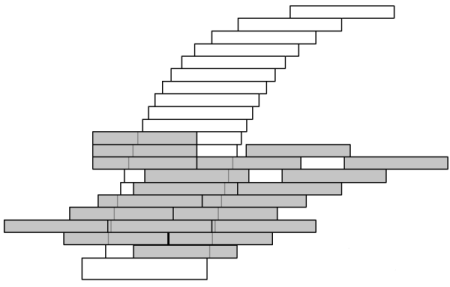
I attended an interesting seminar on the block stacking problem today given by Professor Mike Paterson of the University of Warwick. Like all good problems, it can be stated simply: how far can a stack of n identical blocks be made to hang over the edge of a table? The answer was widely believed to be of order log n (like the white shaded example above), but Mike Paterson and Uri Zwick previously constructed overhangs of order n^ 1/3 . In the seminar today, Paterson and his co-authors presented their proof that order n^ 1/3 is indeed the upper bound possible, resolving a long-standing mathematical problem. Professor Paterson is an excellent orator, highly recommended.

Ross Burton: Experiments with GUPnP

Now that through black magic, voodoo, and a working network driver I have Avahi working on my NAS and UPnP working on my SoundBridge, I can get back to the task of learning a bit about GUPnP, a GObject-based library for UPnP. My first hack is a simple tool that pops up notification bubbles when the currently playing track changes, and it was surprisingly easy. First, wecreate a Control Point for the service we want to control. This object will emit signals when devices on the network are discovered which provide this service, so by connecting to that signal all of the discovery is handled for us.
GUPnPContext *context = gupnp_context_new (NULL, NULL, 0, &error);
GUPnPControlPoint *cp = gupnp_control_point_new (context, "urn:schemas-upnp-org:service:AVTransport:1");
g_signal_connect (cp, "service-proxy-available",
                  G_CALLBACK (service_proxy_available_cb), NULL);
gssdp_resource_browser_set_active (GSSDP_RESOURCE_BROWSER (cp), TRUE);
Now in service_proxy_available_cb we are passed a Service Proxy object to which represents a device providing the service we asked for. Service proxies can have actions invoked on them, or we can be notified when a State Variable change. There is a state variable in AVTransport called CurrentTrackMetaData but don't let that fool you: for reasons too boring to detail that doesn't cause notifications. The only interesting state variable in AVTransport is LastChange, which is basically a meta-variable which contains the name and value of the last variable which changed. Madness, I agree. This is where we come to the problem with GUPnP: it makes the protocol seem so clean and simple that when warts like this become obvious, they stand out. Anyway, we want to listen for changes to the LastChange state variable. This involves adding a notify and then subscribing to the proxy. Luckily state variables emit their current value when we subscribe to them, so we never need to fetch the current value.
static void
service_proxy_available_cb (GUPnPControlPoint *cp, GUPnPServiceProxy *proxy)
 
    gupnp_service_proxy_add_notify (proxy, "LastChange",
                                    G_TYPE_STRING, notify_cb, NULL);
    gupnp_service_proxy_set_subscribed (proxy, TRUE);
 
Believe it or not, we're actually nearly finished. Now to implement notify_cb. This is passed the variable name and a GValue containing the new value. A basic implementation is pretty simple.
static void
notify_cb (GUPnPServiceProxy *proxy,
           const char        *variable,
           GValue            *value,
           gpointer           user_data)
 
    g_print ("%s changed to %s\n", variable, g_value_get_string (value));
 
And we're done! When the program starts it discovers any devices on the network, creates proxies and watches the variables, printing them as they change. Devices can come and go, GUPnP handles that automatically. Easy as pie. Well, sort of. The string is an XML document which could contain any variable, so we need to parse it looking for a CurrentTrackMetaData node. On that node the val attribute contains an escaped XML document describing the metadata in the (and I kid you not) DIDL-Lite format. The saving grace here is that at least its partially Dublin Core, but that needs to be parsed for the title and artist information. This is all standard XML mojo, and quite boring. The end result is that my first hack application is 150 lines long, the first 100 of which are entirely devoted to XML parsing. The next step is to write a convenience library around DIDL to avoid having to parse it manually. It's not exactly a complicated task, but quite tiresome. For the curious, the full source is in this Bazaar branch. NP: Directions EP, Variou (from Acroplane I think)

Zak B. Elep: Working with Mac-sent attachments in Linux

If you’re reading mails offline on Linux (or if you’re browsing from GMail,) and you have some contacts using a Mac who sends you emails with attachments from Mail.app, you may some of the time get attachments that may seem to be unreadable by the intended application (like, when some Mac guy sends you a mindmap file in FreeMind that you can read in Ubuntu.) I recently hit this snag at work, so I did a little looking around to see why this is so, and how to fix it. The first thing I did, after downloading the attachment, was to obviously pager it. :P What seems to be a single attachment is in fact a couple of MIME objects, one an application/applefile’ object, and an application/octet-stream’ object. Since both are Base64-encoded parts, I can run a simple filter (using Perl’s MIME::Base64::decode_base64 routine) on both to get the raw parts. It turns out that the first part is an AppleDouble-encoded resource fork that describes the metadata for the actual file (called the data fork in AppleDouble parlance.) One can read this on Linux via Perl using the Mac::AppleSingleDouble module to get Finder information, among other things. However, for non-Mac users, what they’re really interested in getting is the the data fork. This can be done by using Email::MIME on the original message to get the data fork subpart, then filtering it through MIME::Base64. (Or you can cheat by using the already-downloaded AppleDouble attachment and extract+decode the octet-stream part as mentioned earlier.)

Next.

Previous.