Vincent Sanders: Strive for continuous improvement, instead of perfection.
Kim Collins was perhaps thinking more about physical improvement but his advice holds well for software.
A lot has been written about the problems around software engineers wanting to rewrite a codebase because of "legacy" issues. Experience has taught me that refactoring is a generally better solution than rewriting because you always have something that works and can be released if necessary.
Although that observation applies to the whole of a project, sometimes the technical debt in component modules means they need reimplementing. Within NetSurf we have historically had problems when such a change was done because of the large number of supported platforms and configurations.
HistoryA year ago I implemented a Continuous Integration (CI) solution for NetSurf which, combined with our switch to GIT for revision control, has transformed our process. Making several important refactor and rewrites possible while being confident about the overall project stability.
I know it has been a year because the VPS hosting bill from Mythic turned up and we are still a very happy customer. We have taken the opportunity to extend the infrastructure to add additional build systems which is still within the NetSurf projects means.
Over the last twelve months the CI system has attempted over 100,000 builds including the projects libraries and browser. Each commit causes an attempt to build for eight platforms, in multiple configurations with multiple compilers. Because of this the response time to a commit is dependant on the slowest build slave (the mac mini OS X leopard system).
Currently this means a browser build, not including the support libraries, completes in around 450 seconds. The eleven support libraries range from 30 to 330 seconds each. This gives a reasonable response time for most operations. The worst case involves changing the core buildsystem which causes everything to be rebuilt from scratch taking some 40 minutes.
The CI system has gained capability since it was first set up, there are now jobs that:
- Perform and publish the results of a static analysis for each component using the llvm/clang project scan-build tool.
- Run coverage reports on modules which support gcov.
- Build and install full toolchains for the cross compiled target platforms.
- Run components automated tests on native platforms
- Generate release sources and packages on a correctly tagged git commit.
- Generates and publishes the automated Doxygen documentation.
DownsidesIt has not all been positive though, the administration required to keep the builds running has been more than expected and it has highlighted just how costly supporting all our platforms is. When I say costly I do not just refer to the physical requirements of providing build slaves but more importantly the time required.
Some examples include:
- Procuring the hardware, installing the operating system and configuring the build environment for the OS X slaves
- Getting the toolchain built and installed for cross compilation
- Dealing with software upgrades and updates on the systems
- Solving version issues with interacting parts, especially limiting is the lack of JAVA 1.6 on PPC OS X preventing jenkins updates
This administration is not interesting to me and consumes time which could otherwise be spent improving the browser. Though the benefits of having the system are considered by the development team to outweigh the disadvantages.
The highlighting of the costs of supporting so many platforms has lead us to reevaluate their future viability. Certainly the PPC mac os X port is in gravest danger of being imminently dropped and was only saved when the build slaves drive failed because there were actual users.
There is also the question of the BeOS platform which we are currently unable to even build with the CI system at all as it cannot be targeted for cross compilation and cannot run a sufficiently complete JAVA implementation to run a jenkins slave.
An unexpected side effect of publishing every CI build has been that many non developer user are directly downloading and using these builds. In some cases we get messages to the mailing list about a specific build while the rest of the job is still ongoing.
Despite the prominent warning on the download area and clear explanation on the mailing lists we still get complaints and opinions about what we should be "allowing" in terms of stability and features with these builds. For anyone else considering allowing general access to CI builds I would recommend a very clear statement of intent and to have a policy prepared for when when users ignore the statement.
Tools
Using jenkins has also been a learning experience. It is generally great but there are some issues I have which, while not insurmountable, are troubling:
- Configuration and history cannot easily be stored in a revision control system.
- This means our system has to be restored from a backup in case of failure and I cannot simply redeploy it from scratch.
- Job filtering, especially for matrix jobs with many combinations, is unnecessarily complicated.
- This requires the use of a single text line "combination filter" which is a java expression limiting which combinations are built. An interface allowing the user to graphically select from a grid similar to the output tables showing success would be preferable. Such a tool could even generate the textural combination filter if thats easier.This is especially problematic of the main browser job which has options for label (platform that can compile the build), javascript enablement, compiler and frontend (the windowing toolkit if you prefer e.g. linux label can build both gtk and framebuffer). The filter for this job is several kilobytes of text which due to the first issue has to be cut and pasted by hand.
- Handling of simple makefile based projects is rudimentary.
- This has been worked around mainly by creating shell scripts to perform the builds. These scripts are checked into the repositories so they are readily modified. Initially we had the text in each job but that quickly became unmanageable.
- Output parsing is limited.
- Fortunately several plugins are available which mitigate this issue but I cannot help feeling that they ought to be integrated by default.
- Website output is not readily modifiable.
- Instead of perhaps providing a default css file and all generated content using that styling someone with knowledge of JAVA must write a plugin to change any of the look and feel of the jenkins tool. I understand this helps all jenkins instances look like the same program but it means integrating jenkins into the rest of our projects web site is not straightforward.
 The first alpha of

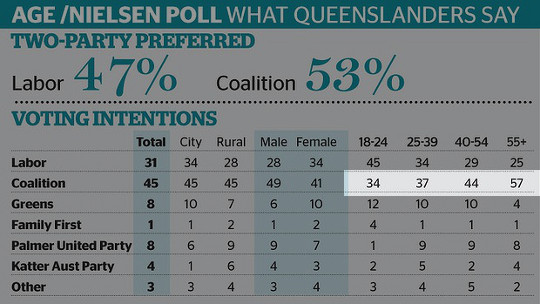 Big bad baby boomers
It is obvious that older voters prefer the conservative "coalition" parties, 57% of over-55s in particular. It is a huge jump from the 44% of voters in the age group below them.
What this table doesn't tell us is that Australia's population is top-heavy with
 Altimeter Testing at Airfest
Bdale and I, along with AJ Towns and Mike Beattie, spent last weekend
in Argonia, Kansas, flying rockets with our Kloudbusters friends at


 The Garmin 910XT is the premier GPS watch for triathlon training and racing.
 I discovered


 Note: This post will probably not be on the liking of those who think free software is always preferable to closed source software, so if you are such a person, please take this article as an invitation to implement better open source alternatives that can realistically compete with the closed source applications I am mentioning here. I am not going to mention here where the open source alternatives are not up to the same level as the commercial tools, I'll leave that for the readers or for another article.


 This is my monthly summary of my free software related activities. If you re among the people who
 On the positive side, Marko has gotten some feedback from people who like the new PTS and are using it daily already. And several persons have expressed their interest to work on the new codebase already.
On my side, I created a package so that it s easy to deploy for derivatives. In this process, I revamped the way we manage the Django settings (for development and for production). The package is not finished yet, but it s mostly usable already. But I still want to do some cleanup/refactoring in the models before others start deploying it. We must also enable South to make it possible to upgrade easily afterwards.
DebConf 13 in Vaumarcus
From August 10th to 17th, I was attending DebConf 13. It matched the only week of vacation that my wife had this summer so we went there with the whole family (that is with a 3 years old son, and 6 months old one). Thus I could not immerse myself in Debconf and missed all the nice things that happen outside of the talk rooms. I picked 3-4 interesting talks per day and I spent the rest with my family.
On the positive side, I was pleased that my wife could meet (or at least see) some other Debian people. She knows quite a few (of you) by name because I have been telling her Debian stories for years now
Debian France
Debian France sold quite some merchandise during Debconf but I didn t take care of that. It was supervised by Sylvestre Ledru but fortunately he got the help of multiple persons, both to bring everything there, to sell it, and to bring back the rest.
The good news of the month is that the
 I ve been pretty absent from the net over the last 3 weeks, (and for the first time in well over a year, I missed a week of blogging)
I ve been pretty busy with real-life-stuff, nothing ultra interesting to report, I ve been working away with the ftpteam more (as I m sure some of you have noticed), and doing Hy work when I can. Nothing major on either front yet :)

 The GUI is written using the PyQT Toolkit and the options in the GUI are generated at runtime, based on the list of available power saving modules.
Apart from the GUI configuration tool, this release also includes some bug fixes:

 One of the
 This DebConf has been the first one where I ran every day. That proved
to be kinda hard on some mornings, but I found a way to circumvent
that by proposing group runs at the end of the relevant days.
In total, I managed to run 12 days in a row, for a grand total of
186.88km, in 21h22', for a total height difference of 6972m. In short,
I nearly climbed Mount Aconcagua, Americas highest peak..:-)
Most of these runs were quite slow ones and rather "short" ones
(around 15km), because of the nature of the paths around (nearly
impossible to find something flat except by running around the
football field).
The longest run was for the DayTrip, with about 25km in about 4 hours
(including some pauses) and 1600m height difference. I'm definitely
working on my moutain running skills more than marathon and other kind
of "speed" races.
That followed a great results for my last race, the "EDF Cenis Tour"
50km trail race in Lanslebourg, French Alps, where I completed the
race in 6h38, nearly the sametime than Mont-Blanc marathon, 1 month
earlier....which was 8 kilometers shorter.
I'm apparently ready for very long distance mountain races, now, as it
seems. Thanks you DebConf 13 organizers for choosing such a great
locations for us, crazy runners.
And, despite that, my next running goal is a "classical" marathon, the
Toulouse marathon in late October, where I expect breaking the 3h30
barrier, that would indeed be a qualifier for the Boston Marathon, one
of my dreams for the future (and, yes, it is still a dream, despite
this year's events).