Search Results: "mak"

21 October 2011

Tollef Fog Heen: Today's rant about RPM

Before I start, I'll admit that I'm not a real RPM packager. Maype I'm approaching this from completely the wrong direction, what do I know? I'm in the process of packaging Varnish 3.0.2 which includes mangling the spec file. The top of the spec file reads:
%define v_rc
%define vd_rc % ?v_rc:-% ?v_rc 
Apparently, this is not legal, since we're trying to define v_rc as a macro with no body. It's however not possible to directly define it as an empty string which can later be tested on, you have to do something like:
%define v_rc % nil 
%define vd_rc % ?v_rc:-% ?v_rc 
Now, this doesn't work correctly either. % ?macro tests if macro is defined, not whether it's an empty string so instead of two lines, we have to write:
%define v_rc % nil 
%if 0% ?v_rc  != 0
%define vd_rc % ?v_rc:-% ?v_rc 
%endif
The 0 ?v_rc != 0 workaround is there so that we don't accidentially end up with == 0 which would be a syntax error. I think having four lines like that is pretty ugly, so I looked for a workaround and figured that, ok, I'll just rewrite every use of % vd_rc to % ?v_rc:-% ?v_rc . There are only a couple, so the damage is limited. Also, I'd then just comment out the v_rc definition, since that makes it clear what you should uncomment to have a release candidate version. In my naivety, I tried:
# %define v_rc ""
# is used as a comment character in spec files, but apparently not for defines. The define was still processed and the build process stopped pretty quickly. Luckily, doing # % define "" seems to work fine and is not processed. I have no idea how people put up with this or if I'm doing something very wrong. Feel free to point me at a better way of doing this, of course.

Russell Coker: Occupy Main Street

The Occupy Wall St blog has an informative summary of attempts to reclaim the American political process which has been pwned badly by financiers in recent times [1]. The basic concept is that people who represent the 99% of the population who aren t super rich have protests in Wall St and now other business areas. Care2 has an interesting article about US marines opposing the brutal actions of police against Occupy Wall St protesters [2], apparently they treated Iraqis better than US police are treating Americans. The movement has spread to other locations, the OccupyTogether.org site has information on related events all around the world [3]. We have an ongoing event in Melbourne, Australia. It s been going for a week and yesterday Robert Doyle (the Mayor of Melbourne) ordered police to disperse the protest, so riot police and mounted police forced the protesters out of the city square [4]. According to the news reports there were only 100 people there at the time, here is a Google Maps link to the location, as you can see 100 people would not take up much of that space, not even with banners etc. The smart move would have been for the government to ignore it all until the protesters got bored. Now of course we will have more and bigger protests. The use of riot police will probably be considered as a good thing by some of the more aggressive protesters, but anyone who doesn t want to make the government (and the corporations that control it) look bad would consider it a gross error. Robert Doyle needs to be replaced, the liberal reason for replacing him is that we just don t want unnecessary force used against peaceful protesters. The conservative reason for replacing him is that he s grossly incompetent, he transformed a small protest that wasn t getting much media attention and appeared to be losing interest into a large protest with a lot of media attention. It will be interesting to see what happens next.

Russell Coker: Dedicated vs Virtual Servers

A common question about hosting is whether to use a dedicated server or a virtual server. Dedicated Servers If you use a dedicated server then you will face the risk of problems which interrupt the boot process. It seems that all the affordable dedicated server offerings lack any good remote management, so when the server doesn t boot you either have to raise a trouble ticket with the company running the Data-Center (DC) or use some sort of hack. Hetzner is a dedicated server company that I have had good experiences with [1], when a server in their DC fails to boot you can use their web based interface (at no extra charge or delay) to boot a Linux recovery environment which can then be used to fix whatever the problem may be. They also charge extra for hands-on support which could be used if the Linux recovery environment revealed no errors but the system just didn t work. This isn t nearly as good as using something like IPMI which permits remote console access to see error messages and more direct control of rebooting. The up-side of a dedicated server is performance. Some people think that avoiding virtualisation improves performance, but in practice most virtual servers use virtualisation technologies that have little overhead. A bigger performance issue than the virtualisation overhead is the fact that most companies running DCs have a range of hardware in their DC and your system (whether a virtual server or a dedicated server) will be on a random system from their DC. I have observed hosting companies to give different speed CPUs and for dedicated servers different amounts of RAM for the same price. I expect that the disk IO performance also varies a lot but I have no evidence. As long as the hosting company provides everything that they offered before you sign the contract you can t complain. It s worth noting that CPU performance is either poorly specified or absent in most offers and disk IO performance is almost never specified. One advantage of dedicated servers in this regard is that you get to know the details of the hardware and can therefore refuse certain low spec hardware. The real performance benefit of a dedicated server is that disk IO performance won t be hurt by other users of the same system. Disk IO is the real issue as CPU and RAM are easy to share fairly but disk performance is difficult to share and is also a significant bottleneck on many servers. Dedicated servers also have a higher minimum price due to the fact that a real server is being used which involves hardware purchase and rack space. Hetzner s offers which start at E29 per month are about as cheap as it s possible to get. But it appears that the E29 offer is for an old server new hardware starts at E49 per month which is still quite cheap. But no dedicated server compares to the virtual servers which can be rented for prices less than $10 per month. Virtual Servers A virtual server will typically have an effective management interface. You should expect to get web based access to the system console as well as ssh console access. If console access is not sufficient to recover the system then there is an option to boot from a recovery device. This allows you to avoid many situations that could potentially result in down-time and when things go wrong it allows you to recover faster. Linode is an example of a company that provides virtual servers and provides a great management interface [2]. It would take a lot of work with performance monitoring and graphing tools to give the performance overview that comes for free with the Linode interface. Disk IO performance can suck badly on virtual servers and it can happen suddenly and semi-randomly. If someone else who is using a virtual server on the same hardware is the target of a DoS attack then your performance can disappear. Performance for CPU is generally fairly reliable though. So a CPU bound server would be a better fit on the typical virtual server options than a disk IO bound server. Virtual servers are a lot cheaper at the low end so if you don t need the hardware capabilities of a minimal dedicated server (with 1G of RAM for Hetzner and a minimum of 8G of RAM for some other providers) then you can save a lot of money by getting a virtual server. Finally the options for running a virtual machine under a virtual machine aren t good, AFAIK the only options that would work on a commercial VPS offering are QEMU (an x86 CPU instruction emulator), Hercules (a S/370 S/390, and Z series IBM mainframe emulator), and similar CPU emulators. Please let me know if there are any other good options for running a virtual machine on a VPS. Now while these emulators are apparently good for debugging OS development they aren t something that are generally useful for running a virtual machine. I knew someone who ran his important servers under Hercules so that x86 exploits couldn t be used for attacking them, but apart from that CPU emulation isn t generally useful for servers. Summary If you want to have entire control of the hardware or if you want to run your own virtual machines that suit your needs (EG one with lots of RAM and another with lots of disk space) then a dedicated server is required. If you want to have minimal expense or the greatest ease of sysadmin use then a virtual server is a better option. But the cheapest option for virtual hosting is to rent a server from Hetzner, run Xen on it, and then rent out DomUs to other people. Apart from the inevitable pain that you experience if anything goes wrong with the Dom0 this is a great option. As an aside, if anyone knows of a reliable company that offers some benefits over Hetzner then please let me know. What I would Like to See There is no technical reason why a company like Linode couldn t make an offer which was a single DomU on a server taking up all available RAM, CPU, and disk space. Such an offer would be really compelling if it wasn t excessively expensive. That would give Linode ease of management and also a guarantee that no-one else could disrupt your system by doing a lot of disk IO. This would be really easy for Linode (or any virtual server provider) to implement. There is also no technical reason why a company like Linode couldn t allow their customers to rent all the capacity of a physical system and then subdivide it among DomUs as they wish. I have a few clients who would be better suited by Linode DomUs that are configured for their needs rather than stock Linode offerings (which never seem to offer the exact amounts of RAM, disk, or CPU that are required). Also if I had a Linode physical server that only had DomUs for my clients then I could make sure that none of them had excessive disk IO that affected the others. This would require many extra features in the Linode management web pages, so it seems unlikely that they will do it. Please let me know if there is someone doing this, it s obvious enough that someone must be doing it. Update: A Rimuhosting employee pointed out that they offer virtual servers on dedicated hardware which meets this criteria [3]. Rimuhosting allows you to use their VPS management system for running all the resources in a single server (so no-one else can slow your VM down) and also allow custom partitioning of a server into as many VMs as you desire.

20 October 2011

Maximilian Attems: New meme: OS of your president web presence

Let's start that a new meme on planet, haven't seen one for a while. The Austrian president starts the relaunched web presence with a "Putin" style parachute jump.
 lynx -dump -head http://www.bundespraesident.at/ 
HTTP/1.1 200 OK
Date: Thu, 20 Oct 2011 08:42:35 GMT
Server: Apache/2.2.16 (Debian)
X-Powered-By: PHP/5.3.3-7+squeeze3
So apparently the used typo3 installation is newer, but the used OS for the Austrian presidential web site is: Debian Squeeze.

Andrew Pollock: [life] Sponsoring a child in Africa

I've been wanting to sponsor a child in Africa for many, many years. I remember seeing a photo of a sponsored child on a couple of sets of friends' mantelpieces in Canberra, and saying to myself how I should really do that too. Of course, for no really good reason, fast-forwarding to 6+ years later, I still hadn't gotten around to it. Until last month. I was walking out of the Apple Store in Palo Alto. I was accosted by one of those people on the street, with the clipboard and all that. I usually manage to brush these sorts of people off. I really hate solicited donations. I'd rather consciously make a donation to a charity, than do it because someone on the street was paid to ask me to, or knocked on my door, or whatever. But I was distracted, or in a good mood, or something, and so I missed the initial opportunity to deflect her. I'm really glad I did, because as I said, this is something that I've wanted to do for years, so I barely hesitated, and signed up on the spot. I received the welcome kit in the mail a couple of days ago. I've been allocated a 6 year old boy named Armando, from Mozambique. I'm looking forward to corresponding with him. Our friends, and former neighbours, the Harvetts have moved back to South Africa, and I hope one day to be able to visit them. Since we'll be in the vicinity, I hope one day to be able to visit Armando as well. I'm pleased to see that Save the Children gets a good rap in Charity Navigator. I was worried that I'd get home and find out I'd signed up with one of those charities that blows half their money on overhead, but that's not the case.

19 October 2011

Yves-Alexis Perez: Debian grsec kernels

I received recently a mail about my attempt to provide Grsecurity kernels in Debian. The sender found the bug by accident, and asked me why I didn't do some more publicity here. So here we are. I won't go into details on what grsecurity is, it's fairly complex. But it's basically a hardening patch for the Linux kernel, with three main components: A lot of this touches low level stuff in the kernel, especially memory management. Ideally this patch would be pushed upstream, but Brad Spengler (grsecurity main developper) already said he wasn't interested in upstreaming it and upstream already said the patch was too huge and invasive to include it like that (especially since the original authors aren't interested in maintaining it upstream). There's an ongoing effort to split the patch and merge things little by little, but in the meanwhile having a mid-term solution would be nice. I know Debian users rebuilding grsecurity-patched kernels themselves, and I know some of them would appreciate having them included in the Debian kernel. Fortunately, the linux-2.6 source package has a nice feature which is called featureset. Basically it's a way to build some (binary) packages using a different set of patches and a different config. For example this was used to provide xen/openvz/vserver patchsets, and is now used to provide rt kernels. So I though it'd be nice to provide a grsec featureset, and starting doing the work. I have a working setup for producing those kernels, so I've opened a wishlist bug against the kernel (#605090) to have this merged. Those packages follow the sid kernel. There's an ongoing work for Squeeze, but it's a bit harder there because both the grsecurity patchset and the Debian kernel ship a whole lot of backports to the Linux kernel, meaning the grsecurity patch doesn't apply directly to the Debian source package. Basically I need to remove some of the hunks (since they are already applied to the source) and port some others (since there are some backported code not present in the vanilla 2.6.32, for example the drm code). Until the patches are merged and the bug is closed, I host some of the built packages at:

deb http://molly.corsac.net/~corsac/debian/kernel-grsec/packages/ sid/ The repository is signed by my key which you can add to your apt setup using apt-key add. If you want to rebuild the packages yourself, here's the method:

mkdir kernel-grsec
cd kernel-grsec
svn checkout svn://svn.debian.org/svn/kernel/dists/sid/linux-2.6
git clone git://anonscm.debian.org/users/corsac/grsec-patches.git
wget http://www.kernel.org/pub/linux/kernel/v3.0/linux-3.0.tar.bz2
wget http://www.kernel.org/pub/linux/kernel/v3.0/linux-3.0.tar.bz2.sign
gpg --verify linux-3.0.tar.bz2
cd linux-2.6
apt-get build-dep linux-2.6
export QUILT_PATCHES=../grsec-patches
quilt push -a
python debian/bin/genorig.py ../linux-3.0.tar.bz2
debian/rules orig
fakeroot debian/rules source
fakeroot make -f debian/rules.gen binary-arch_amd64_grsec_amd64 You could also do dpkg-buildpackage, pdebuild or whatever. Kernel handbook is a nice reading too if you want more information on how to rebuild Debian kernels. The quilt push -a may fail if you checkout an svn version more recent than mine. I try to keep patches up to date but I usually have some delay. Note that installing the kernel will require installing linux-grsec-base package. Binary is not yet available on my mirror but you can easily build it. Source can be found on git.debian.org. If you're interested by this, don't hesitate to mail me or the bug.

Alastair McKinstry: Dear Lazyweb,

I'm building a debian package, CDAT. The latest version 6.0.alpha uses CMAKE to build, rather than configure. The trouble is that CMake doesn't build. It doesn't even fail.
$ mkdir build
$ cd build
$ cmake ..
()-- Configuring done
-- Generating done
-- Build files have been written to: /home/amckinstry/deb-packages /cdat/cdat-6.0.alpha/build
$ make
$
The problem is, 'make' does nothing. A Makefile is generated by CMake, which calls cmake which calls make again on ./CMakeFiles/Makefile2 ... which does nothing useful. Apparently the CMake is supposed to put useful stuff in there, but doesn't. What puts stuff into Makefile2, and where should I pick up the bugs trail? Tags , ,

Matthew Garrett: Management of UEFI secure booting

This post is made in a personal capacity. While it represents the outcome of multiple discussions on the topic with a variety of people, nothing written below should be construed as Red Hat's corporate position

The FSF have released a statement on UEFI secure boot. It explains the fundamental issue here, which isn't something as simple as "will OEMs let me install Linux". It's "Does the end user have the ability to manage their own keys".

Secure boot is a valuable feature. It does neatly deal with the growing threat of pre-OS malware. There is an incentive for it to be supported under Linux. I discussed the technical aspects of implementing support for it here - it's not a huge deal of work, and it is being worked on. So let's not worry about that side of things. The problem is with the keys.

Secure boot is implemented in a straightforward way. Each section of a PE-COFF file is added together and a hash taken[1]. This hash is signed with the private half of a signing key and embedded into the binary. When you attempt to execute a file under UEFI, the firmware attempts to decrypt the embedded hash. This requires that the firmware have a either a copy of the public half of the signing key in its key database, or for there to be a chain of trust from the signing key to a key in its key database. Once it has the decrypted hash, it generates its own hash of the binary and compares them. If they match, the binary is executed.

What happens if it doesn't match? Per the UEFI specification, the firmware can then prompt the user and ask if they want to execute it anyway. If the user accepts then the hash of the binary is remembered[4] and can continue to be executed in future. This is similar to what you get when you visit a self-signed https site, or when you connect to an ssh server for the first time - the user must explicitly state that they trust the software that is being booted.

This is a little awkward for a couple of reasons. First, it means that any updates to the bootloader would require the user to manually accept the binary again. Second, as we've seen with https, there's the risk of uesrs just blindly accepting things. If it's acceptable to do this off internal media[5] then malware could just rely on some number of users saying "yes". And thirdly, we've been told that Microsoft's Windows logo requirements forbid this option.

The first is problematic but manageable with appropriate documentation. The second is a real risk that makes this approach far less compelling. And the third is probably a showstopper.

So signed but untrusted binaries are probably out, on technological, UI and policy grounds. What else?

We can sign binaries with a trusted key. This gets us interoperability, but comes at a cost. The first issue here is that we still don't know what the process for getting a trusted key is going to be. One option is for something like a generic Linux key that's provided by all firmware vendors. As long as the OEM doesn't remove it, then that Linux key could be used to sign other keys that are used by individual Linux vendors. The main difficulty involved in this is having the Linux key be managed by an authority that OEMs can trust to only provide keys to trustworthy organisations and maintain control of the private half of the key. Remember, if any malware is signed with any of these keys, it'll boot on any machine carrying this key. It's a lot of trust. It's not obvious that there's an organisation with sufficient trust at the moment.

The second approach is for each Linux vendor to generate their own key and get every OEM to carry it. Let's rule this out on the basis that it's an approach that doesn't scale at all. Red Hat could probably get its key into a bunch of OEM systems. Canonical too. Oracle? Probably for the vendors they care about. It's likely to be much harder for everyone else, and you still end up with the risk that you've just bought a computer that'll boot Red Hat but not Ubuntu.

The third approach is for each Linux vendor to obtain a key from someone who's already trusted. The most obvious authority here is Microsoft. Ignoring the PR unpleasantness involved with Linux vendors having to do business with Microsoft to get signed, so far Microsoft haven't given us any indication that this will be possible.

So every approach that involves us signing with a trusted key comes with associated problems. There's also a common problem with all of them - you only get to play if you have your own trusted key. Corporate Linux vendors can probably find a way to manage this. Everyone else (volunteer or hobbyist vendors, end users who want to run their own OS, anyone who wants to use a modified bootloader or kernel) is shut out.

The obvious workaround is for them to just turn off secure boot. Ignoring the arguments over whether or not OEMs will provide that option[6], it benefits nobody for Linux installation to require disabling a legitimate security feature. It's also not likely to be in a standard location on all systems and may have different naming. It's a support nightmare. Let's focus on trying to find a solution that provides the security and doesn't have obvious scaling issues.

There's a pretty simple one. If the problem centres around installing signing keys, why not have a standardised way of installing signing keys?

What we've proposed for this is an extension of the current UEFI standard for booting off removable media. There's a standardised location for putting the bootloader for USB sticks or optical media. For 32-bit PCs, it's EFI/BOOT/BOOTIA32.EFI. For 64-bit, it's EFI/BOOT/BOOTX64.EFI. Our proposal is to specify a path for key storage on the media. If the user attempts to boot off an item of removable media and finds a key file, we would like the firmware to prompt the user to install the key. Once the key is installed, the firmware will attempt to boot the bootloader on the removable media.

How does this avoid the problems associated with prompting the user to boot untrusted binaries? The first is that there's no problem with updates. Because a key has been imported, as long as future bootloader updates are signed with the same key, they'll boot without prompting the user. The second is that it can be limited to removable media. If malware infects the system and installs itself onto the hard drive, the firmware won't prompt for key installation. It'll just refuse to boot and fall back on whatever recovery procedures the OEM has implemented. The only way it could get on the system would involve the user explicitly booting off removable media, which would be a significant hurdle. If you're at that stage then you can also convince the user to disable secure boot entirely.

This proposal has been brought up with the UEFI standards working group, and with the UEFI plugfest taking place next week we're hoping it'll be discussed. It seems to satisfy the dual requirements of maintaining system security and ensuring that users have the flexibility to choose what they run on their system. But as with all technical proposals, feedback is entirely welcome.

[1] Hilariously, Microsoft's signing tool gets this wrong by also adding the contents of gaps between sections in direct contravention of their own specification. This is fine for binaries generated by Microsoft's toolchain because they don't have any gaps, but since our binaries do contain gaps[2] and since the standard firmware implementation[3] does implement the specification correctly, any Linux-generated binaries signed with the Microsoft tool fail validation. Go team.
[2] Something that is, as far as we can tell, permitted by the PE-COFF specification
[3] Written by Intel, not Microsoft
[4] Note that this means that only the specific binary is considered trusted. No key is imported, and any other binaries signed with the same key will also need to be manually trusted in the same way.
[5] As would be required if you ever want to be able to update your bootloader
[6] And to forestall panic, at this point we expect that most OEMs will provide this option on most hardware, if only because customers will still want to boot Windows 7. We do know that some hardware will ship without it. It's not implausible that some OEMs will remove it in order to reduce their support burden. But for the foreseeable future, you'll be able to buy hardware that runs Linux.

comment count unavailable comments

Lior Kaplan: LibreOffice Conference 2011

I ve recently been to the LibreOffice Conference 2011 in Paris. It s very nice to finally meet in person all those names from the malinglist and the bug reports. Although meeting most people for the first time, I left the conference with a strong feeling of a community (which I m proud to be a member of), this is a very motivating feeling. During the conference I had the chance to work on LibreOffice related issues: The 3 patches began when I noticed a few weird strings to translate in the context of installation media good luck to those who will try to install LibreOffice from 5.25 disk, 3.5 disk or a tape drive. These 3 strings are now removed from the code with other 36 unused strings. So translators please take the strings to translate with a grain of salt. Post conference tasks (always ending up with more stuff to do after a conference):
Filed under: LibreOffice, Openoffice.org

Steve Langasek: Debian: not stale, just hardened

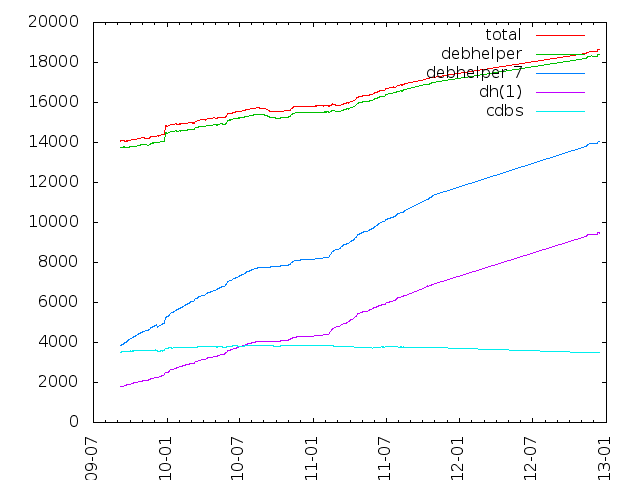
Rapha l Hertzog recently announced a new dpkg-buildflags interface in dpkg that at long last gives the distribution, the package maintainers, and users the control they want over the build flags used when building packages. The announcement mail gives all the gory details about how to invoke dpkg-buildflags in your build to be compliant; but the nice thing is, if you're using dh(1) with debian/compat=9, debhelper does it for you automatically so long as you're using a build system that it knows how to pass compiler flags to. So for the first time, /usr/share/doc/debhelper/examples/rules.tiny can now be used as-is to provide a policy-compliant package by default (setting -g -O2 or -g -O0 for your build regardless of how debian/rules is invoked). Of course, none of my packages actually work that way; among other things I have a habit of liberally sprinkling DEB_MAINT_CFLAGS_APPEND := -Wall in my rules, and sometimes DEB_LDFLAGS_MAINT_APPEND := -Wl,-z,defs and DEB_CFLAGS_MAINT_APPEND := $(shell getconf LFS_CFLAGS) as well. And my upstreams' build systems rarely work 100% out of the box with dhauto* without one override or another somewhere. So in practice, the shortest debian/rules file in any of my packages seems to be 13 lines currently. But that's 13 lines of almost 100% signal, unlike the bad old days of cut'n'pasted dh_* command lists. The biggest benefit, though, isn't in making it shorter to write a rules file with the old, standard build options. The biggest benefit is that dpkg-buildflags now also outputs build-hardening compiler and linker flags by default on Debian. Specifically, using the new interface lets you pick up all of these hardening flags for free:
-fstack-protector --param=ssp-buffer-size=4 -Wformat -Wformat-security -Werror=format-security -Wl,-z,relro
It also lets you get -fPIE and -Wl,-z,now by adding this one line to your debian/rules (assuming you're using dh(1) and compat 9):
export DEB_BUILD_MAINT_OPTIONS := hardening=+pie,+bindnow
Converting all my packages to use dh(1) has always been a long-term goal, but some packages are easier to convert than others. This was the tipping point for me, though. Even though debhelper compat level 9 isn't yet frozen, meaning there might still be other behavior changes to it that will make more work for me between now and release, over the past couple of weekends I've been systematically converting all my packages to use it with dh. In particular, pam and samba have been rebuilt to use the default hardening flags, and openldap uses these flags plus PIE support. (Samba already builds with PIE by default courtesy of upstream.) You can't really make samba and openldap out on the graph, but they're there (with their rules files reduced by 50% or more). I cannot overstate the significance of proactive hardening. There have been a number of vulnerabilities over the past few years that have been thwarted on Ubuntu because Ubuntu is using -fstack-protector by default. Debian has a great security team that responds quickly to these issues as soon as they're revealed, but we don't always get to find out about them before they're already being exploited in the wild. In this respect, Debian has lagged behind other distros. With dpkg-buildflags, we now have the tools to correct this. It's just a matter of getting packages to use the new interfaces. If you're a maintainer of a security sensitive package (such as a network-facing daemon or a setuid application), please enable dpkg-buildflags in your package for wheezy! (Preferably with PIE as well.) And if you don't maintain security sensitive packages, you can still help out with the hardening release goal.

18 October 2011

Raphaël Hertzog: What about creating The Ubuntu Administrator s Handbook?

I am currently running a crowdfunding campaign whose ultimate goal is to liberate the English translation of a French book that I have written. This book will be named The Debian Administrator s Handbook because it has primarily been written for Debian. Creating a new Ubuntu book based on The Debian Administrator s Handbook But since Ubuntu is based on Debian, a large part of its content applies equally well to Ubuntu. While discussing with Mark Shuttleworth, he suggested me to reuse those parts and to create a new book dedicated to Ubuntu. It would also cover the latest cloud technologies that Ubuntu has been delivering (since this is a topic that the current book does not cover). This is something that I have been envisioning for a while and something that I would be ready to try if we manage to complete the liberation of the current book. This project would then bring a truly free book to the Ubuntu ecosystem. Why? The official Ubuntu books are not really free There s a policy in place that ensures that official Ubuntu books use a free software/culture license and they are effectively available under the terms of a Creative Commons Share Alike license. But try to create a derivative book you won t find the sources (LaTeX or DocBook usually with most big books). You can only find a few PDF copies if you google for it. But this is really not the preferred form of modification for such a book. Those books are also not packaged. Ubuntu much like Debian deserves to have a good book embodying the values of free software that can be shipped together with its product. When I speak of liberation of the book, I really mean it in the way that free software hackers are used to: a public Git repository containing the DocBook sources, the pictures and the .dia files for the various schemas. Help Ubuntu by spreading the word I understand that at this point this proposed Ubuntu book is really hypothetical ( vaporware one could say) but we need to go step by step to make it a reality. And the first step is to ensure that we manage to liberate the Debian Administrator s Handbook. For this I am seeking the support of the Ubuntu community to promote the current fundraising campaign. If the perspective of the Ubuntu book is not enough to convince you, you ll be glad to learn that I also commit to give back to Ubuntu 15% of the money raised via the link below (once VAT has been subtracted). Click here to go to the crowdfunding campaign page and pledge a few euros. Then share this article (or the link http://debian-handbook.info/go/ulule-ubuntu/) and convince others to participate. At this point, the liberation target is entirely reachable with your help and the help of the community: the remaining 18 K needed in the liberation fund represent 720 persons giving 25 EUR each or 1800 persons giving 10 EUR each. Thank you very much for your support and your help in this project!

One comment Liked this article? Click here. My blog is Flattr-enabled.

17 October 2011

Peter Makholm: Splicing two sockets in Perl (request for help)

A couple of times I have written code which basically does this:

  1. accept() an incoming connection
  2. do some magic to get another socket
  3. start passing bit between the two sockets
  4. perform a correct close down sequence
An example use case of this is a proxy implementing the HTTP CONNECT method, but in for some known hostnames it will log a message and mangle the hostname before proceeding. This has been used as a legacy fall back solution while changing a network setup. But my uses are not restricted to HTTP proxies I have done the same for a few legacy protocols where the magic has been of different complexities. The two final steps are quite general and it would be nice to have a module doing just that. Take two sockets and make it easy (or even automatic) to pass bytes between them. The na ve non-blocking solution would use a scalar string buffer for each direction and perform a select loop while maintaining the write vector depending on which buffers contain data. I have written this code multiple times. In development this is usually quite successful, in production less so. While Perl might be quite suited for the magic in step 2, the na ve way of passing bytes have quite an overhead for the buffer management. A less na ve way would use a array of strings for buffers, but I m not quite sure if this would be a win in all cases. You might be able to get away with some string operations on the read side of the buffer, but it might be more expensive on the write side. I have not benchmarked this. Most of the time I don t care about Perl level IO handles. I know that there is a real C level file descriptor beneath. So an even better POSIX compliant solution might be to use XS to have plain C strings and use readv()/writev() and a iovec structure as buffer. Can we do even better? At least on Linux we can. With the Linux splice() specific system call it is possible to us a pipe as buffer and never to have to copy data from and to user space. I have not been able to find any off the shelf solution on CPAN. So I think I need to write it myself, but what would the nice and general API be? I guess the basic interface would be something like:
    my $chain = IO::Splice->new($fh1, $fh2);
    $chain->pump(); # read and write from both handles if possible and needed
    $chain->read($fh1);  # read to buffer from one specific handle
    $chain->write($fh2); # write from buffer to one specific handle
    $chain->can_write(); # returns the handles it needs to write to
but it might be simpler to have two callbacks for setting a file handle in write or no-write state:
    my $readset  = IO::Select->new( $fh1, $fh2);
    my $writeset = IO::Select->new();
    my $chain = IO::Splice->new( $fh1, $fh2,
        writable => sub    $writeset->add( shift )  ,
        unwritable => sub   $writeset->remove( shift )  
    );
    while ( ... select ... )  
        $chain->pump();
     
As said, I think I have plenty of implementations of the na ve way but before releasing some code it would be nice to get some input on the API. But the best feedback would be a module that already have a usable API but might not implement the Linux specific way. That would allow me to steal the interface

16 October 2011

Biella Coleman: What a Hackable World?

I really don t know what to make of this Cisco-made video What a Hackable World. It is sort of interesting that Anonymous and Lulzsec made it in but the video is not all that clever. And what up with the nerd-o-matic sys admin (most sys admin I know are more hoodie, less nerdie). But can anyone explain what/who the main featured dude is supposed to be? Hacker detective/destroyer? Cisco customer?

Biella Coleman: Going to S o Paulo next week

lolcat_brazilian First, is that image really the best LOLcat referencing Brazil that exists out on the Internets? I sure hope not as it is sort of lame but it was the only one I could find (in the 30 seconds I looked, which I admit, is not all that much time). But all of this lolcat in Brazil stuff is really to say, I am heading to S o Paulo tomorrow to give a talk on Anon on Thursday at this conference. If you are an Anon in the city and can make it, please do. If you are not Anon and are still interested, come along as well ;=) If there are Debian developers as well in the city, it would be great to meet at some point. I am there from Tuesday morning to Friday night.

Jamie McClelland: Capitalism Is Crashed

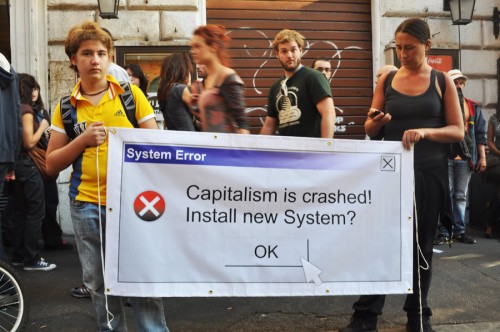
The Occupy Wall Street protests taking place around the world are incredibly moving. And, at May First/People Link, the joint us jumping with new projects. Occupy Together was the first to join, followed by the Occupy Wall Street Journal. We then launched boggs.mayfirst.org as our dedicated Occupy Wall Street shared server and the radical tech work keeps on coming (OccupyTechnoloyg, OccupyProvidence, OccupyColumbus GA just to name a few). It's also great to see free software and responsible software as a service making it's way into the conversation. I've heard many reports about the politics of technology taking it's rightful place in the realm of political decisions being made. I don't have the context for this photo from the blog non ti stavo cercando, but it sure sums up the connection : Capitalism is Crashed! Install news system?

Tim Retout: BITE server

This week, Google released an extension called BITE which lets you file bug reports from within Chrome (or Chromium). If you are testing web applications, it lets you attach screenshots and/or automated tests to reproduce the bug you've found. There's just one small catch: they haven't released a server to go with the client. Oops. Apparently the internal systems are too tightly integrated to make that possible. I have hacked up enough stubs of a BITE server in Perl to get the client to "log in" and show off some features. (Warning: it doesn't actually do anything useful yet.) So far, I have learnt:

Alastair McKinstry: Testing DIASPORA*

As you may have noticed, I'm testing DIASPORA* as a blogging platform. Its been working reasonably well recently for me, with friends and family; even though the "Main" platform joindiaspora.com is not giving general invites, the code works and a bunch of distributed 'pods' have been set up. You can make entries public, and I've tested a public address for this: http://diaspora.sceal.ie/u/amckinstry which looks ok, a bit plain for the moment, but I'll work on that later. The problem has been the atom feed is garbage. (It's putting the content into both the Subject line (as unadulterated MarkDown, no less), and into the content). So, I've put the old blog back up for the moment. While I debug some Ruby on Rails, not a language i'm too familiar with ... Note: only logged in DIASPORA users can leave notes on the Diaspora site, but go to the login page and registrations are open. At least until spammers notice... Tags , , ,

Alastair McKinstry: Dear Lazyweb, I'm building a #debian package, CDAT. The latest version 6.0.alpha uses CMAKE to build, rather than configure. The trouble is that CMake doesn't build. It doesn't even fail. $ mkdir build $ cd build $ cmake .. ()-- Configuring done -- Generating done -- Build files have been written to: /home/amckinstry/deb-packages /cdat/cdat-6.0.alpha/build $ make $ The problem is, 'make' does nothing. A Makefile is generated by CMake, which calls cmake which calls make again on ./CMakeFiles/Makefile2 ... which does nothing useful. Apparently the CMake is supposed to put useful stuff in there, but doesn't. What puts stuff into Makefile2, and where should I pick up the bugs trail? (It would appear I also have issues with DIASPORA*'s Markdown over RSS to fix ...)

Dear Lazyweb, I'm building a #debian package, CDAT. The latest version 6.0.alpha uses CMAKE to build, rather than configure. The trouble is that CMake doesn't build. It doesn't even fail. $ mkdir build $ cd build $ cmake .. ()-- Configuring done -- Generating done -- Build files have been written to: /home/amckinstry/deb-packages /cdat/cdat-6.0.alpha/build $ make $ The problem is, 'make' does nothing. A Makefile is generated by CMake, which calls cmake which calls make again on ./CMakeFiles/Makefile2 ... which does nothing useful. Apparently the CMake is supposed to put useful stuff in there, but doesn't. What puts stuff into Makefile2, and where should I pick up the bugs trail? (It would appear I also have issues with DIASPORA*'s Markdown over RSS to fix ...)

Alastair McKinstry: #### Debugging CMake issues #### Dear Lazyweb, I'm building a #debian package, [CDAT](http://bugs.debian.org/584637). The latest version 6.0.alpha uses CMAKE to build, rather than configure. The trouble is that CMake doesn't build. It doesn't even fail. $ mkdir build $ cd build $ cmake .. <lots of output, ending in ...> ()-- Configuring done -- Generating done -- Build files have been written to: /home/amckinstry/deb-packages /cdat/cdat-6.0.alpha/build $ make $ The problem is, 'make' does nothing. A Makefile is generated by CMake, which calls cmake which calls make again on ./CMakeFiles/Makefile2 ... which does nothing useful. Apparently the CMake is *supposed* to put useful stuff in there, but doesn't. *What* puts stuff into Makefile2, and where should I pick up the bugs trail?

#### Debugging CMake issues #### Dear Lazyweb, I'm building a #debian package, [CDAT](http://bugs.debian.org/584637). The latest version 6.0.alpha uses CMAKE to build, rather than configure. The trouble is that CMake doesn't build. It doesn't even fail. $ mkdir build $ cd build $ cmake .. <lots of output, ending in ...> ()-- Configuring done -- Generating done -- Build files have been written to: /home/amckinstry/deb-packages /cdat/cdat-6.0.alpha/build $ make $ The problem is, 'make' does nothing. A Makefile is generated by CMake, which calls cmake which calls make again on ./CMakeFiles/Makefile2 ... which does nothing useful. Apparently the CMake is *supposed* to put useful stuff in there, but doesn't. *What* puts stuff into Makefile2, and where should I pick up the bugs trail?

15 October 2011

Joachim Breitner: Help wanted maintaining link-monitor-applet

Jean-Yves Lefort s link-monitor-applet, an applet for the GNOME panel, is a great tool for those with often-changing and possibly unreliable network connection. It allows me to see, at one glance, whether I can reach the router, the internet and/or my VPN. Furthermore, the latency display tells me whether there is a point in working over SSH right now. I often observe other people, e.g. on conferences, to stare for a while at a non-loading web page, then fire up a terminal window and run random ping commands, while I immediately see that the network is down and can relax.
Unfortunately, Jean-Yves seems to have stopped working on link-monitor-applet and does not reply to bug reports. This was not a big deal as long as I could use the last released version with minor patches of mine, but now gnome-panel 3 is coming up and all applets need porting to GTK3. Yesterday and today I worked on that, and got it so far that the applet is fully functional, although the visual styling is not perfect yet, because I m not sure how to do what Jean-Yves did with GtkStyle and GdkGC now with GtkStyleContext and Cairo. The code is in the gnome3 branch of my git repository.
For this issue, and any further maintenance work, I m looking for someone who is willing to take upstream responsibility for link-monitor-applet, e.g. making sure it works with the latest GNOME (well, GNOME in fallback mode) and that bug reports are handled. The code base is not too big, and both the non-standard build system and the gob-enhanced C code are fine to work with. I ll still be happy to serve as the maintainer of the Debian package of link-monitor-applet.

Flattr this post

Next.

Previous.