Search Results: "ina"

1 March 2012

Raphaël Hertzog: My Debian Activities in February 2012

This is my monthly summary of my Debian related activities. If you re among the people who made a donation to support my work (384.14 , thanks everybody!), then you can learn how I spent your money. Otherwise it s just an interesting status update on my various projects. Dpkg and multiarch The month started with a decision of the technical committee which allowed me to proceed with an upload of a multiarch dpkg even if Guillem had not yet finished his review (and related changes). Given this decision, Guillem made the experimental upload himself. I announced the availability of this test version and invited people to test it. This lead to new discussions on debian-devel. We learned in those discussions that Guillem changed his mind about the possibility of sharing (identical) files between multiple Multi-Arch: same packages, and that he dropped that feature. But if this point of the multiarch design had been reverted, it would mean that we had to update again all library packages which had already been updated for multi-arch. The discussions mostly stalled at this point with a final note of Guillem explaining that there was a tension between convenience and doing the right things every time that we discuss far-reaching changes. After a few weeks (and a helpful summary from Russ Allbery), Guillem said that he remained unconvinced but that he put back the feature. He also announced that he s close to having completed the work and that he would push the remaining parts of the multiarch branch to master this week (with the 1.16.2 upload planned next week). That s it for the summary. Obviously I participated in the discussions but I didn t do much besides this I have a mandate to upload a multiarch dpkg to sid but I did not want to make use of it while those discussions remained pretty unconclusive. Also Guillem made it pretty clear that the multiarch implementation was buggy , not right and not finished and that he had reworked code fixing at least some of the issues since he never shared that work in progress, I also had no way to help even just by reviewing what he s doing. We also got a few multiarch bug reports, but I couldn t care to get them fixed since Guillem clearly held a lock on the codebase having done many private changes it s not quite like this that I expect to collaborate on a free software project but life is full of surprises! I ll be relieved once this story is over. In the mean time, I have added one new thing on my TODO list since I made a proposal to handle bin-nmu changelogs and it s something that could also fix #440094. Misc dpkg stuff After a discussion with Guillem, we agreed that copyright notices should only appear in the sources and not in manual pages or --version output, both of which are translated and cause useless work to translators when updated. Guillem already had some code to do it for --version strings, and I took care of the changes for the manual pages. I merged some minor documentation updates, fixed a bug with a missing manpage. Later I discovered that some recent changes lead to the loss of all the translated manual pages. I suggested an improvement to dh_installman to fix this (and even prepared a patch). In the end, Guillem opted for another way of installing translated manual pages. Triggered by a discussion on debian-devel, I added a new entry to my TODO list: implementing dpkg-maintscript-helper rm_conffile_if_owner to deal with the case where a conffile is taken over by another package which might (or might not) be installed. Misc packaging At the start of the month, I packaged quilt 0.51. The number of Debian specific patches is slowly getting down. With version 0.51, we dropped 5 patches and introduced a new one. Later in the month I submitted 4 supplementary patches upstream which have been accepted for version 0.60. This new version (just released, I will package it soon) is an important milestone since it s the first version without any C code (Debian had this for a long time but we were carrying an intrusive patch for this). Upstream developer Jean Delvare worked on this and based his work on our patch, but he went further to make it much more efficient. Besides quilt, I also uploaded dh-linktree 0.2 (minor doc update), sql-ledger 2.8.36 (new upstream version), logidee-tools 1.2.12 (minor fixes) and publican 2.8-2 (to fix release critical bug #660795). Debian Consultants The Debian Project Leader is working on federating Debian Companies. As the owner of Freexian SARL, I was highly interested in it since Freexian contributes to Debian, offers support for Debian and has a strategic interest in Debian . There s only one problem, you need to have at least 2 Debian developers on staff but I have no employees (it s me only). I tried to argue that I have already worked with multiple Debian developers (as contractors) when projects were too big for me alone (or when I did not have enough time). Alas this argument was not accepted. Instead, and since our fearless leader is never afraid to propose compromises, he suggested me (and MJ Ray who argued something similar than me) to try to bring life to the Debian Consultants list which (in his mind) would be more appropriate for one-man companies like mine. I accepted to help animate the list, and on his side, he s going to promote both the Debian Companies and the Debian Consultants lists. In any case, the list has seen some traffic lately and you re encouraged to join if you re a freelancer offering services around Debian. The most promising thing is that James Bromberger offered to implement a real database of consultants instead of the current static page. Book update We made quite some progress this month. There s only one chapter left to translate. I thus decided to start with proofreading. I made a call for volunteers and I submitted one (different) chapter to 5 proofreaders. The liberation campaign made a nice leap forwards thanks to good coverage on barrapunto.com. We have reached 80% while we were only at 72% at the start of the month (thanks to the 113 new supporters!). There s thus less than 5000 EUR to raise before the book gets published under a free license. Looking at the progression in the past months, this is unlikely to be completed on time for the release of the book in April. It would be nice though so please share the news around you. Speaking of the book s release, I m slowly preparing it. Translating docbook files is not enough, I must be able to generate HTML, ePub and PDF versions of the book. I m using Publican for most formats, but for the PDF version Publican is moving away of fop and the replacement (webkit-based) is far from being satisfactory to generate a book ready for print. So I plan to use dblatex and get Publican to support dblatex as a backend. I have hired Beno t Guillon, the upstream author of dblatex, to fix some annoying bugs and to improve it to suit my needs for the book (some results are already in the upstream CVS repository). I m also working with a professional book designer to get a nice design. I have also started to look for a Python Django developer to build the website that I will use to commercialize the book. The website will have a larger goal than just this though ( helping to fund free software developers ) but in free software it s always good to start with your own case. :-) Hopefully everything will be ready in April. I m working hard to meet that deadline (you might have noticed that my blog has been relatively quiet in the last month ). Thanks See you next month for a new summary of my activities.

No comment Liked this article? Click here. My blog is Flattr-enabled.

Rudy Godoy: DebianPeru

Hello, this is just a quick post to announce some good news. Back in 2004 we ve formed a local Debian group in Peru. We were active and spread the word country-wide. There were good times. As time passed and interests changed things slowed down. Past two weeks we are rebooting it. We ll be working with focus towards mentoring people to contribute upstream and Debian. We ll also host meetings for teaching new users in a more concrete problem solving or the basics . Finally, we will be glad to host Debian Developers, as we have done in the past with people that landed in Peru, and organize either social or technical meetings. We ve set a Wiki page, that will be our official site, and has information regarding our group. Also our mailing list is getting traction. We ll be hosting a social meeting during the Creative Commons Movie Festival this Thursday March 1st. That s it!

29 February 2012

Joey Hess: leap day

This leap day saw me driving along the river on a rainy, with 4 chickens in the car's trunk, and 3 terabytes of disk (and a half a bale of straw) in the back seat. I may have not been blogging much lately about life, because these situations can be hard to explain. (Or because "joined the Debian haskell team and spent two days working on rebuilds for the ghc 7.4 transition" is not thrilling reading.)
hens in a car
The Light Sussex chickens are my sister's spare flock, which are "too tame". They're now cozily installed into a coop we built last weekend. In return I gave her a 6 foot long APC power strip, which had been mounted on the wall of my office. I'm preparing my house in town to be rented, and have little need for two dozen power outlets here in solar power land. Google <3s Your Work Indeed, today is a gift economy day all around -- when I arrived at the cabin, there on the porch was an unexpected package from Google. Particularly surprising since I never get deliveries here, since the driveway is a mile long and often seems like it could dead-end into the woods at any moment. The combination of technological wackiness (I also debugged a laptop whose USB hub hangs when a particular trackball is plugged in) and in your face country texture (including coal trains, being stuck behind a tractor, and miles of amazing tree-height mist) made this a memorable day.

Antonio Terceiro: Thesis submitted

Last Friday, after 5 long years, I have finally submitted my PhD thesis. It was quite a relief, more or less as if an elephant was taken off my back. An English title for my thesis would be Structural Complexity Characterization in Software Systems. Here is an abstract:
This thesis proposes a theory to characterize structural complexity in software systems. This theory aims to identify (i) the contribution of several factors to the structural complexity variation and (ii) the effects of structural complexity in software projects. Possible factors in the structural complexity variation include: human factors, such as general experience of the developers and their familiarity with the different parts of the system; factors related to the changes performed on the system, such as size variation and change diffusion; and organizational factors, such as the maturity of the software development process and the communication structure of the project. Effects of structural complexity include higher effort, and consequently higher cost, in software comprehension and maintenance activities. To test the validity of the proposed theory, four empirical studies were performed, mining data from free software project repositories. We analyzed historical data from changes performed in 13 systems from different application domains and written in different programming languages. The results of these studies indicated that all the factors studied influenced the structural complexity variation significantly in at least one of the projects, but different projects were influenced by different sets of factors. The models obtained were capable of describing up to 93% of the structural complexity variation in the projects analyzed. Keywords: Structural Complexity, Software Maintainance, Human factors in Software Engineering, Mining Software Repositories, Theories in Software Engineering, Empirical Software Engineering, Free/Open Source Software Projects.
Those who read Portuguese can check out the actual thesis text as a PDF file. Most of the studies discussed in the thesis are presented in English in papers I have published during the last years. My defense is going to be on March 23rd. If you happen to be at Salvador at that day, please feel cordially invited.

Marco d'Itri: The role of niche architectures and toy ports in Debian

In the last few days, people on the debian-devel mailing list have been debating again (and again, and again...) how much the ports and architectures used only by an handful of people should influence the direction of the project. With this post I want to briefly summarize my position. The reason we support niche architectures and toy ports is that that some people are interested in doing the work, and that these do not hinder development of the architectures that people actually use. When m68k started inconveniencing too much the real world development, the port was killed and the sky did not fall, notwithstanding the complaints of the few retrocomputing enthusiasts who still used and developed it. I do not mind if some people like to play with kFreeBSD and Hurd as long as they do not inconvenience me too much, both as a user and as a developer. While it is true that targeting multiple architectures helps finding bugs, after we have covered all the useful combinations of endianity, size of variables and char signedness the incremental benefits of adopting a new architecture just for its sake are minimal. I am a Red Hat customer (also because of Debian shortcomings), I do not like it much and I do not want to be one forever: please do not kill my hopes.

28 February 2012

Jon Dowland: Budgeting

I'm seeking advice on budgeting. Historically, I've been crap at managing money. Things have improved in recent years. My main tool is Martin Lewis' Money Saving Expert budget planner. It's simply a spreadsheet, into which you feed your income and outgoings. You can supply each line item as either a daily, monthly or annual income or expense. The sheet works out both a monthly and an annual total for each and the difference (be it positive or negative). The monthly summary is a useful benchmark against which you can compare your monthly bank statements, but it's not sufficient. Consider a one-off annual expense, such as a holiday payment. On the budget planner, the expense will be divided up into monthly chunks and deducted from your monthly income. However, the expense won't be on your bank statements, unless you've made a special arrangement to pay out a monthly sum to another account, such as savings account, for every annual expense. Therefore you can't just compare the planner's monthly summary against your bank statement summary and hope the two match. I really need to see what my monthly outgoings should total to, rather than what all my outgoings are, presented monthly, in order to meaningfully compare the two. How should I handle this? Should I do as I suggested there and total up my annual one-offs, divide by twelve and make a monthly payment for that sum to a savings account? I'd still want to be able to quickly look at my main statement and judge the overall figure as either 'good' or 'bad'. Perhaps I should feed my various statements into one place, perhaps a finance tool, in which case, which one? How do you manage your finances?

Paul Wise: Debian/Ubuntu games screenshot party results

The Debian/Ubuntu games team recently organised a half-day screenshots party for creating screenshots for all the games that are available in Debian/Ubuntu. Unfortunately, only 5 people participated in the screenshots party, I had hoped that we would get more folks turn up. Only one of those was not already involved in the games team and that one person found out via our spam on the #debian-mentors IRC channel. This means that most of our promotion of the event was ineffective. Hopefully for future games parties we can improve this, please let us know if you have any ideas about that. We also had 7 other people on the channel during the party lurking, discussing and or working on other things, in particular Ben Armstrong was working on a games live CD. Over the 7 hours of the party, we uploaded 100 screenshots for 40 different packages. Of the packages, 2 are available only in Debian (auralquiz, cutechess), one is available only in Ubuntu (plasma-widget-tictactoe) and the rest are available in both. I think we got quite a bit done for such a small group. Some of us could not resist filing some bugs on packages that had issues preventing or delaying us from taking screenshots. I also suggested to one maintainer that his package (acm4) be removed from Debian, since it is obsoleted by acm and unusable. If you want to play some games, check out goplay, which is a tool for browsing available games using debtags that displays screenshots from the games-thumbnails package, which has just been updated with the screenshots created during the party. goplay needs some more development, if you would like to help out with that, you would be most welcome. If you are interested to see our screenshots, they are all on the screenshots.debian.net website and the packages are auralquiz, cardstories, londonlaw, cube2font, ardentryst, cutechess, pianobooster, emacs-chess, xye, flare, tmw, garden-of-coloured-lights, flight-of-the-amazon-queen, geekcode, glpeces, fofix, unknown-horizons, klickety, polygen, tictactoe, xscreensaver-screensaver-dizzy, goban-original-games, xjokes, mudlet, xabacus, xtux-client, connectagram, crystalspace, pescetti, purity-ng, qstat, slashem, sudoku, minetest, xscavenger, plasma-widget-tictactoe, xbomb, xfrisk, xpilot-ng and xsok.

27 February 2012

Iustin Pop: doc-rfc update

Thanks to Thomas' help and gentle reminder, I finally managed to upload a new version of doc-rfc. Why is this noteworthy? It's not really, I just wanted to say: any package for which running lintian on it takes around 5 times the build time, is special .

Mark Brown: Yahoo! Groups spam

Yahoo! Groups have for a long time had big problems with allowing people to create obvious spam groups (randomly generated names, no meaningful description and so on) and then add people without any confirmation. This was annoying but at least they have an obvious abuse reporting link in the subscription mails. Sadly rather than improve the situation they appear to have just changed the link to not be a direct link to the reporting form but instead to be a generic help page. The link didn t change, the content just got even less useful. I m strongly tempted to just block all of Yahoo! from the mail systems I control.

Michal &#268;iha&#345;: phpMyAdmin translations status

With first RC for phpMyAdmin 3.5, we're really close to final release, so let's again look at translations status. Here comes fourth round of translation status update. Since last update we have three new translations at 100%: There are few which are really close to 100% and I hope they will get there soon: As you can see, there is still lot of languages missing, this might be your opportunity to contribute to phpMyAdmin.

Filed under: English Phpmyadmin 2 comments Flattr this!

26 February 2012

Lars Wirzenius: Soile's Kickstarter campaign a succes

Soile, my fiancee, has had a successful Kickstarter campaign. The minimum requirement has been met. There's a couple more days to go still, so maybe it will go beyond the minimum, even. <iframe allowfullscreen="allowFullScreen" frameborder="0" height="220" mozallowfullscreen="mozallowfullscreen" src="http://player.vimeo.com/video/36767480?title=0&amp;byline=0&amp;portrait=0" webkitallowfullscreen="webkitAllowFullScreen" width="400"></iframe> Maria Eveliina's Valentine from Soile Mottisenkangas on Vimeo. (See https://vimeo.com/36767480 if the embedded video doesn't work.) She's also created some designs for merchandise. Exciting times.

Joachim Breitner: GHC 7.4.1 speeds up arbtt by a factor of 22

More than two years ago I wrote arbtt, a tool that silently records what programs you are using and allows you to do statistics on that data later, based on rules that you define afterwards, hence the name automatic rule based time tracker. I wasn t doing much with it recently (the last release has been half a year ago), but it nevertheless was running on my machine and by now has tracked a total time span of 248 days in 350000 records. Yesterday, I had a use for it again: measuring the time spent creating a certain document with LaTeX. So I added a rule to my categorize.cfg and ran arbtt-stats. I knew that it was not very fast, and that my data set has grown considerably since I last used it. And indeed, it took more than 6 minutes to process the data and spit out the result. Since I m currently working on the GHC 7.4.1 transition in Debian anyways, I decided to check what happens if I compile the code with that version of the Haskell compiler, instead of the previous version 7.0.4. And behold: The whole process took merely 17.3 seconds to complete! At first I did not believe it, but the result was identical, both binaries were built with the same option, i.e. no profiling enabled or anything like that. Wouldn t you also like to have such speed ups for free, just by waiting for someone else to improve their work?

I tried to find out the reason for the speed up and created profiling output from both the old and the new binary. The old binary spends 83% of the time in Categorize.checkRegex, which basically just call Text.Regex.PCRE.Light.match. Since the version of pcre-light is the same in both binaries, I conclude that the Foreign Function Interface that GHC provides to interact with C libraries (libpcre in this case) is much faster now, although I do not find any mention in the release notes. And even if I do not count the 83% time spent in checkRegex, the code from the new compiler is still 2.7 times faster. Thanks, GHC devs, great work!

Flattr this post

Iustin Pop: First running event of 2012

Today I had the first running race of 2012. Well, actually, it was my first race in Switzerland ever so double first. And, if I have to be precise, it was my first run with a shiny new Garmin 910XT; while I had it ordered for more than a month, out-of-stock and other delays converged such that I received the new toy the evening before the run. After getting it, I walked around a bit to confirm it's not DOA, read the manual, and hoped it's not too different in basic operation to my old Garmin. So a triple first. Also, (this is the last one, I promise!) this was the first time I ran with a foot pod (pedometer), so it was the first time I got actual cadence measurements. The run I went to the Bremgarter Reusslauf, which is an 11km flat run held in the woods near Bremgarten, a very very nice small town. I have never before visited it (even though it's quite close to Z rich), and I was pleasantly surprised by it. I should go sometimes back and visit a bit more. The weather was cloudy (and just a tiny bit foggy), a bit cold but not much. From this point of view, it was good running weather, but it detracted from the scenery. Otherwise, the course itself was very very enjoyable, I could have used a camera lots. At one point, in the middle of the (light, not dense) woods, the course passed beneath the arm of an excavator which was like a mechanical arch (in the middle of nature); at another point, we crossed the river, and the sight was so nice I had to stop myself from stopping and admiring the view . The course is marked as a 'flat' one, but I've read some blog posts saying that this is not entirely true, so I was prepared for 'the worst'. Actually, I found it to be surprisingly well behaved; even though the finish was near the start, it seemed to me to be 60% downhill, 30% flat and only 10% somewhat-uphill. Garmin 910XT I didn't quite know what to expect, upgrading from my Forerunner 205. I read the very nice review on dcrainmaker, but in practice I didn't know what to expect (review awesome, but soo detailed). The new toy seems more stylish, so I expected worse UI or behaviour. On the contrary, it worked very well; much more responsive to changes in direction/pace (my 205 used to delays tens before adjusting the pace, the 910 is very fast), and new minor features (like auto-lap) were nice (I was able to track average speed on each 1KM lap, very useful). It's a ++ on the upgrade, with the big downside that so far it doesn't seem to work under Linux . It also has a barometric altimeter, but I didn't calibrate it (explicitly); so while the absolute measurements might be off, the relative elevation changes were much more sane than with 205 (GPS is not too good at elevation changes, as far as I know). One funny thing about the delays in getting the device: before the race, another runner asks me (note: the conversation was in German, accuracy not guaranteed):
Is that the new Garmin? Yes, it is, just got it last evening. (showing me his identical watch) Ha! Me too, I got this only two days ago!
So yes, I think a few people were happy to get their new toy before the race. I also have now a heartbeat sensor, but as I never used one before, I didn't want to try it the first time during a race; so I skipped on that. The foot pod on the other hand is practically ignorable, so I took that along (sometime I think I run just because there are nice running toys ). As to accuracy, it was quite OK; it measured 10.86 km instead of the official 11 km, but most/all of the difference was in the first km of the run (inaccuracy while starting to run? who knows). I'll have to see how the watch performs while cycling (uh, I didn't do that in a long while) or swimming ( I didn't do that in an even longer while), but for running it's a good upgrade from my old watch. Results My normal run pace is about 6min/km, which is quite slow. So I didn't expect anything of the race, except to finish it. There were lots of people participating (> 2,600 in the main 11km category). I started slow, because I know I usually start too fast and get tired quickly. This allowed me to not feel the first, and only, significant hill, and after that it was or seemed all downhill (literally, I mean, not figuratively), so in the end I had (for me) a very good time. By the Garmin, I run 10.86 km in 59:01, to an average 5.26 min/km. By the official results, I had 11 km in 58:56, with a pace of 5.21 min/km. I have never before run 10k faster than 5:30, so I was very very happy. As for individual laps (1 km) as recorded by the Garmin: On the overall ranking, I ended up 362 out of 394 in my category. Hah! I'll try to remember this race simply for my own pace results, and ignore the ranking . Honestly I'm not sure how people can run twice as fast need to train more! The foot pod gave me a cadence of 83 steps per minute (average, max 88). This was quite surprising for me, I expected to be significantly below the much talked about 90 steps per minute. But anyway, I have lots of work ahead of me to improve my running speed. Overall, it was an excellent day, and I'm looking forward to the next races in/around Z rich. But I should be careful not to overdo-it, like I do whenever I get excited about something .

25 February 2012

Andreas Barth: Traveling to DebConf 11 - M nchen to Zagreb

These articles cover my way to DebConf 11 through Hrvatska and Bosna i Hercegovina. After telling my initial plans to go by train (mostly) and bus (where it couldn't be avoided) on IRC, I was warned that public transport is quite bad and unreliable. Also, as I live in M nchen, of course this part of Europe was always known as "near" and "could be visited any time" (which means "one never gets to it"; and I can still remember the time when it was Yugoslavia - there are and always were many people living here from that part of Europe; in fact, it's nearer than some parts of Germany). I plan to publish more parts of my way within the next days. Already at home I also learned that most trains in Hrvatska (and all in Bosna i Hercegovina) are not part of the usual train information system, so it was a bit more advanced to find out the appropriate connections. And in both countries there are only a few trains running, so one shouldn't miss a train ("few" means e.g. two per day and direction - but one at most unappropriate times, so really only one suiteable). The first day saw me boarding the Suburban train (S-Bahn) at my usual station, changing platforms and trains at M nchen Ost station and then I was sitting in a train to Zagreb. Nothing strange there, except that the coach I had an seat reserved in was missing. I learned later on that it happens more often that the coach from Serbia is not there because it's technically too unfit to send it to Germany -- and usually, there will be more coaches added in Ljubljana. Border checks were uneventfull but at the slovenijan border my passport was stamped (not sure why, didn't happen on the way back).
Train in sterreich After arriving in Zagreb and dropping off my luggage in the hotel, I first got some Kunas and then bought my ticket to Split for the next day (as a direct ticket from M nchen to Split was not available). After having done that, I took a brief tour through Zagreb until it became dark, with visiting some of the tourist places.
Zagreb

Russ Allbery: Copyright format 1.0 published

Four and a half years after Sam Hocevar started a draft proposal on the Debian Wiki, we've published revision 1.0 of the machine-readable format for debian/copyright files. The format (as DEP-5) has been in widespread use for some time, but there have been multiple versions of the format and multiple transitional versioned URLs. Everyone can now update to the same version of the document and use a stable format URL. Below is the text of the annoucement that I just sent to debian-devel-announce. Version 1.0 of the machine-readable format for debian/copyright files (the culmination of the DEP-5 process) has now been published. The canonical URL (and also the URL to use in the Format field in such files) is:
http://www.debian.org/doc/packaging-manuals/copyright-format/1.0/
For those who have adopted various iterations of the DEP-5 format for your packages, please consider updating to this format the next time you revise your package. Use of this format in Debian packages is optional. Thanks to all of the people who have contributed to this work over its long evolution. Particular thanks go to Steve Langasek, Charles Plessy, and Lars Wirzenius, who kept this document moving through its extended DEP discussion process, and Sam Hocevar, who started this work in 2007. The copyright format specification is now being maintained as part of the debian-policy package and will follow the same update process that's used for other parts of Policy. See:
http://wiki.debian.org/PolicyChangesProcess
for that process. For this specification, we're trying something new for Debian technical policies. This document is versioned, and older versions of the specification will be maintained to not invalidate older references in copyright files that have not been moved to newer versions. This is similar to the way that specifications are handled by some other projects, particularly the freedesktop.org standards. The plan, going forward, is that informative changes (changes that do not change the requirements or the contents of compliant copyright files) will be made following the same relaxed procedure as other informative changes to Policy, and new versions will only informative changes will be published with the same version number. So the existing 1.0 document may receive further improvements in wording, examples, or similar changes that don't modify its meaning. Normative changes (changes that change requirements for compliant files, which includes addition of new standardized license short names) will follow the normative Policy change process, including formal seconds. Once normative changes are accepted, the next release of this specification will receive a new version number (1.1, for example). The previous version, prior to the normative changes, will be frozen, and from that point forward will not be changed except as required to continue to publish it. This includes further informative changes. We will continue publishing these frozen older versions of the standard on www.debian.org and in the debian-policy package for some time: possibly forever, and at least as long as they're still referred to by packages distributed by the project. The hope is that this will provide a good balance between specification stability, editing for clarity, and specification changes to meet changing requirements, while not invalidating the URLs in older files and while continuing to provide the information required to interpret older files.

24 February 2012

Guido G nther: Iodine plugin for network-manager

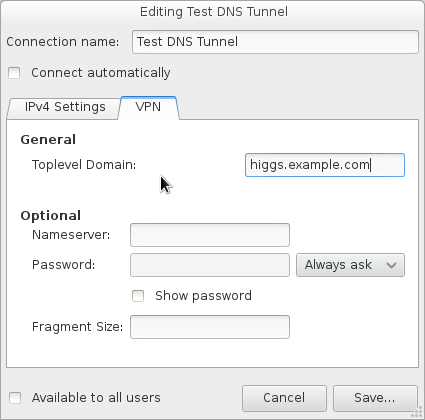
During FOSDEM I finally got around to hack on a iodine plugin for network manager. Given a suitably prepared server on the other end this allows you to tunnel connections over DNS when all other traffic is firewalled. The basic configuration only needs the domain name set: Network Manager Iodine Configuration You can grab the sources from git.gnome.org, a Debian package is also available. This blog is flattr enabled.

Richard Hartmann: apt-get install vcsh

apt-get install vcsh I finally got around to package vcsh and David Bremner was kind enough to sponsor it. vcsh is available in testing, unstable, and squeeze-backports. Also, Ubuntu seems to have copied it over into their repositories automagically. As you probably don't know, vcsh is a tool to manage config files in git. Say you want to maintain one repository for zsh, one for vim, one for ssh, one for mplayer, and one for mr, but obviously there can only be one .git in $HOME. vcsh helps by moving $GIT_DIR into $XDG_CONFIG_HOME/vcsh/repo.d/ but keeping $GIT_WORK_TREE in $HOME. The splitting of configuration sets into separate repositories allows you avoid checking out, say, mplayer's config on your servers, or checking out your ssh config at work. If this sounds complicated, it's not; vcsh hides all of the dirty details from you. vcsh integrates nicely with mr by means of a plugin, making handling your configurations even more trivial. If you do get stuck along the way, simply drop into #vcs-home on irc.oftc.net or send email to the vcs-home mailing list. popcon tells me that there are more users than I know about directly, so pipe up if you're one of them. And if you are one of the people who have it installed but don't use it, I am even more interested. I would love to know why so I can improve it. Long story short, if you care about the integrity and/or history of your configuration, or if you use one or more computers, you should definitely give vcsh a try. Any kind of feedback appreciated :)

Dominique Dumont: Config::Model: new cme command is available

Hello I ve (finally) released a new version of Config::Model. The main change for users is the deprecation of the config-edit program in favor of cme program. Instead of using options, this cme uses command keywords like git, so users will have more possibilities while typing less. bash completion is provided for cme command and options. Following Debian annoucement regarding the recommended format of Debian copyright file (aka DEP-5), I ve also updated the URL in Debian copyright model. If your package is already in a DEP-5 format, you can update the URL with this simple command: cme fix dpkg-copyright Check the wiki on github for more example of cme command. All the best

23 February 2012

Mike Hommey: Fun with weak symbols

Consider the following foo.c source file:
extern int bar() __attribute__((weak));
int foo()
return bar();
And the following bar.c source file:
int bar()
return 42;
Compile both sources:
$ gcc -o foo.o -c foo.c -fPIC
$ gcc -o bar.o -c bar.c -fPIC
In the resulting object for foo.c, we have an undefined symbol reference to bar. That symbol is marked weak. In the resulting object for bar.c, the bar symbol is defined and not weak. What we expect from linking both objects is that the weak reference is fulfilled by the existence of the bar symbol in the second object, and that in the resulting binary, the foo function calls bar.
$ ld -shared -o test1.so foo.o bar.o
And indeed, this is what happens.
$ objdump -T test1.so grep "\(foo\ bar\)"
0000000000000260 g DF .text 0000000000000007 foo
0000000000000270 g DF .text 0000000000000006 bar
What do you think happens if the bar.o object file is embedded in a static library?
$ ar cr libbar.a bar.o
$ ld -shared -o test2.so foo.o libbar.a
$ objdump -T test2.so grep "\(foo\ bar\)"
0000000000000260 g DF .text 0000000000000007 foo
0000000000000000 w D *UND* 0000000000000000 bar
The bar function is now undefined and there is a weak reference for the symbol. Calling foo will crash at runtime. This is apparently a feature of the linker. If anyone knows why, I would be interested to hear about it. Good to know, though.

22 February 2012

Bartosz Fe&#324;ski: [B]ack[U]p and [R]estore [P]rogram

One of the most popular backup solution under Linux is Bacula, but it s quite complicated to setup. The same for Amanda.
Since my last sponsored upload we ve got another alternative in Debian. It s called burp. Let s enumerate its features as of version 1.3.0: Sounds good and this project is only 1 year old! Author claims that setup is much easier than with Bacula. Let s find out is that truth ;) Since we ve got this software in Debian installing it on unstable is as simple as apt-get install burp .
Both client and server came from the same binary package. Now let s configure server side. Well in fact we just have to run it, so just change RUN=no to RUN=yes in /etc/default/burp and launch it using /etc/init.d/burp start . Now the client side. If the client is on the same machine then you re ready. Yes you re ready! Let s do our first backup:
backup ~ # burp -a b
2012-02-22 17:53:03: burp[30584] Listing configured paths:
2012-02-22 17:53:03: burp[30584] include: /home
2012-02-22 17:53:03: burp[30584] Listing starting paths:
2012-02-22 17:53:03: burp[30584] /home
2012-02-22 17:53:03: burp[30584] before client
2012-02-22 17:53:03: burp[30584] begin client
2012-02-22 17:53:03: burp[30584] auth ok
2012-02-22 17:53:03: burp[30584] Compression level: 9
2012-02-22 17:53:03: burp[30584] do backup client
2012-02-22 17:53:03: burp[30584] Phase 1 begin (file system scan)
 
ddwdffffddffdfdfdddfffffdddfffffffdfffdfdfffffdfdfdffdddddfffddff 64
[...a lot of output...]
 
2012-02-22 17:53:03: burp[30584] Phase 1 end (file system scan)
2012-02-22 17:53:03: burp[30584] Phase 2 begin (send file data)
 
ffffffffffffffffffffffffffffffffffffffffffffffffffffffffffffffff 64
[...a lot of output...]
 
--------------------------------------------------------------------------------
Start time: 2012-02-22 17:53:03
  End time: 2012-02-22 17:53:07
Time taken: 00:04
                             New   Changed Unchanged     Total    Scanned
                       --------------------------------------------------
                Files:       100         0         -       100        100
          Directories:         -         -         -         -         76
           Soft links:         -         -         -         -          1
          Grand total:       100         0         -       100        177
                       --------------------------------------------------
 
             Warnings:             1
 
      Bytes estimated:      17628946 (16.81 MB)
      Bytes in backup:      17628946 (16.81 MB)
       Bytes received:             0
           Bytes sent:      17628946 (16.81 MB)
--------------------------------------------------------------------------------
2012-02-22 17:53:07: burp[30584] Phase 2 end (send file data)
2012-02-22 17:53:07: burp[30584] backup finished ok
2012-02-22 17:53:07: burp[30584] after client
backup ~ #
Yes. By default it is so extremely simple! Of course this way we can make backup of /home (that s default) to /var/spool/burp (also default location) but you can easily change this.
For the simplest scenario (backing up laptop to remote server) all I had to change was server = 127.0.0.1 in /etc/burp/burp.conf on the client side. Burp comes with handy tool called burp_ca and it simplifies setting up encrypted backups. In fact there is step by step howto in documentation.
Other options are quite self explanatory and well documented in both client and server config files that came with the package. Happy backuping!

Next.

Previous.