Search Results: "ema"

22 October 2007

Russell Coker: Lentil as Anything

I just read an interesting post by Kylie Willison [1] which mentions the restaurant Lentil as Anything [2]. The restaurant chain is noteworthy for charging what people believe that the food is worth (poor people can eat for free). I think that there are cultural similarities with the Linux community, so we should have a Linux meeting at one of those restaurants some time. Comment or email me if you are interested, I’ll probably arrange the details on the LUV-talk mailing list [3].

Holger Levsen: Small report from the meeting in Extremadura

The last five days I've spent at the combined Debian Edu, FAI and CDD meeting in M rida in Extremadura, together with 17 others. The Debian Edu / Skolelinux crowd was the biggest, followed by FAI, followed by CDD people, though many were part of more than one project. "As usual" it was great to meet many known faces and some unknown ones and to be able to discuss stuff in RL.

Besides various small different things, I worked on the Debian Edu etch r1 release, our lenny roadmap (see the bottom of our roadmap page which also covers etch r1) and the (technical side of the) german translation of the Debian Edu documentation. Non edu related the new setupharddisk2 for FAI took most of my brain activity. And I've signed all keys allready :-)

We stayed at a very nice hotel in the even much nicer city of Merida, which features a lot of roman ruins and history. For example, we walked over the biggest roman bridge in the world! The only thing that was bigger was the amount of good food we were forced to eat every day... Incredible. This was my second visit to Merida and this time I finally managed to visit the amphitheatre (with seats for 15000 people) and the Roman theatre. (Unfortunatly the english page about Emerita Augusta is a stub.) If you happen to come around that area make sure to spend some time sight seeing, it is really worth it! People living in Merida literally fear to rebuild their houses, because as soon as they start to dig, they find something historical and have to turn their property into a museum :-)

In case you have not seen it yet, you should watch this small movie from euro news about the free software efforts in Extremadura. Insightful and very good promotion, also to show around.

Many thanks to C sar, Jos Luis and the Junta de Extremdura for hosting such a great meeting! You rock!

On a unrelated note, spam has gone crazy yesterday while traveling back, 15000 mails were not catched by my so far well working setup. ARG. I still used to have a catchall setting, which was useful to give out addresses like $company@mydomain, but now I will explicitly list those addresses and disable catchall. And luckily for you I will not blog about every spam mail I got... :) Generally I dont consider spam (the source of) evil, it's money: as long as money rules the world, there will be spam. So since it's a social problem, it is hardly solvable by technology. (That is, as long as you want to receive mails from strangers, which I do.) IMO what's worse than spammers are autoresponders to spam. Most of those 15000 mails were auto-replies to spam. OMFSM.

21 October 2007

Russell Coker: Open Hardware - What Would Change

I have just read an interesting post speculating about the possibility of open source hardware [1]. To some extent things have been following a trend in that direction. Back in the bad old days every computer manufacturer wanted to totally control their market segment and prevent anyone else from “stealing their business”. Anti-competitive practices were standard in the computer industry, when you bought a mainframe you were effectively making a commitment to buy all peripherals and parts from the same company. The problems were alleviated by government action, but the real change came from the popularity of PC clones. White-box clones where every part came from a different company truly opened up the hardware development, and it wasn’t all good. When running a simple single-tasking OS such as MS-DOS the problems were largely hidden. But when running a reliable multi-tasking OS such as Linux hardware problems became apparent. The PCI bus (which autoconfigured most things) reduced the scope of the problem but there are still ways that white-box machines can fail you. Now when I get a white-box machine I give it away to members of my local LUG. My time is too valuable to waste on debugging white-box hardware, I would rather stick to machines from IBM and HP which tend to just work. Nowadays I buy only name-brand machines, all the parts were designed and tested to work together - this doesn’t guarantee that the machine will be reliable but it does significantly improve the probability. Fortunately modern hardware is much faster than I require for the work I do, so buying second-hand name-brand machines (for less money than a new white-box machine) is a viable option. The PCI bus [2] standard from Intel can be compared to some of the “Open Source” licenses from companies where anyone can use the software but only one company can really be involved in developing it. One significant impediment to open hardware development is the proprietary nature of CPU manufacture. Currently there are only a few companies that have the ability to fabricate high-end CPUs so projects such as OpenRISC [3] which develop free CPU designs will be limited to having their CPUs implemented with older technology (which means lower clock speeds). However this doesn’t mean that they aren’t useful, tailoring factors such as the number of registers, the bus width of the CPU, and the cache size to match the target application has the potential to offset the performance loss from a lower clock speed. But this doesn’t mean that an OpenRISC or similar open core would be ideal for your typical desktop machine. If companies such as Intel and AMD were compelled to fabricate any competing CPU design at a reasonable cost (legislation in this regard is a possibility as the two companies collectively dominate the world computer industry and it would be easy for them to form a cartel) then designs such as OpenRISC could be used to implement new CPUs for general purpose servers. Another issue is the quality of support for some optional extra features which are essential for some operations. For example Linux software RAID is quite good for what it does (basic mirroring, striping, RAID-5 and RAID-6), but it doesn’t compare well with some hardware RAID implementations (which actually are implemented in software with a CPU on the RAID controller). For example with a HP hardware RAID device you can start with two disks in a RAID-1 and then add a third disk to make it a RAID-5 (I’ve done it). Adding further disks to make it a larger RAID-5 is possible too. Linux software RAID does not support such things (and I’m not aware of any free software RAID implementation which does). It would certainly be possible to write such code but no-one has done so - and HP seem happy to make heaps of money selling their servers with the RAID features as a selling point. Finally there’s the issue of demand. When hardware without free software support (such as some video cards which need binary-only drivers for best performance) is discussed there is always a significant group of people who want it. The binary-only drivers in question are of low quality, often don’t support the latest kernels, and have such a history of causing crashes that kernel developers won’t accept bug reports from people who use them, but still people use them. In the short-term at least I expect that an open hardware design would deliver less performance and in spite of the fact that it would have the potential to offer better reliability the majority of the market would not accept it. The production volume of electronics gear is the major factor determining the price so it would cost more. I think that both IBM and HP provide hardware that is open enough for my requirements, they both have engineers working on their Linux support and the interfaces are well enough documented that we generally don’t have any problems with them. Both Intel and AMD and the major system vendors are all working on making things more open, so I expect some small bug significant improvements in the near future.

20 October 2007

Jordi Mallach: You might get an email from me tonight

Sometime in August, I said I would watch the Inbox Zero talk later on that day. Well, I finally did today. And I'm ready to mass-murder my (now not so) fat inbox folder and start from scratch, and becoming a good boy. In fact, I've been on probation for a few weeks. While I wasn't watching the talk (which is pretty insightful and fun, and useful if you also have these horrid mail handling problems) I did roll up my sleeves a few times and worked on reducing the problem. After a few rounds of fighting, things were looking slightly better. I deleted TONS of spam which still was sitting in there. I deleted entire threads of list mail which for some reason wasn't being filtered properly. I archived a lot of random, misc email. I even replied to some job offers, for a change. I fixed my .procmailrc a little to get rid of lots of useless stuff that appears in my mail. It got better, but not entirely better. I went from the 6600~ which was probably the figure when I said Enough! to around 2580. It's still a lot, and I can still get rid of a lot more with easy pattern searches in mutt. The good news is that, for the first time in ages, the number of emails in the mailbox has stayed stable for more than a month. I tell you: I'm proud! So Merlin gets asked in the talk what to do when you've been a naughty boy for a long time, and you've ended up with this HUGE mailbox you can't handle anymore. His answer was what some people suggested in blog comments: put it aside, start from zero. Merlin calls it mail-DMZ, and that's probably what I'll do in a few hours, admittedly with a sentiment of guilt deep in my chest. And from that point, I'll have my mailbox be a TODO list. Delete. Defer. Delegate. Respond. Do. Simple! Other Planet Debian participants like joeyh commented that something that really helps is reducing the number of times you poll for email. For me, that means
set daemon      1800            # Pool every 30 minutes
when it was 5 minutes before. I hope I won't find myself issuing awaken commands often... I remember when, more than five years ago, having more than 100 mails made me feel bad and go cleanup. After some vacation, it went up to 150. Then Christmas came along, 300, until I found myself nearing 7000 last summer. Before moving my junk to a demilitarised mailbox, I'm having some fun replying to some email. The first one in my mailbox is from a member of a Catalan "Mallach" family.
From: Conchita Broquetas <familia_mallach_broquetas@yahoo.es>
Subject: Hola!
To: jordi@sindominio.net
Date: Sun, 17 Jun 2001 16:55:17 +0200 (CEST)
who discovered there was a "Jordi Mallach" other than his brother in the Internet. Apparently we had an exchange on where our families came from (Mallach is all but a common surname... anywhere, and my family has always wondered where it came from). So that's more than 6 years ago. I think I'd love to get a reply to some email sent by me years ago which has been sitting for years in a mailbox, because "I need to reply to this sometime". I think the Mallach-Broquetas are getting one tonight. If you think I'm dumping random thoughts on a vim buffer, it's probably due to me feeling sad today. Sorry, but I feel like typing, and I don't have a typewriter with me. Speaking of sad, nothing beats the next email which sat for some dramatic 6 months in my messy inbox until I found out in the worst of the possible scenarios. Let's go back to late February, 2004, when I had no job, and I didn't have a clue on what to do with my life.
From: Mark Shuttleworth <mark@hbd.com>
Subject: New project to discuss
To: Jordi Mallach <jordi@debian.org>
Date: Sun, 29 Feb 2004 18:33:51 +0000
[...]
I'm hiring a team of debian developers to work full time on a new
distribution based on Debian. We're making internationalisation a prime
focus, together with Python and regular release management. I've discussed
it with a number of Debian leaders and they're all very positive about it.
[...]
I'm not sure if I totally missed it as it came in, or I skimmed through it and thought WTF?! Dude on crack or I just forgot I need to reply to this email , but I'd swear it was the former. Not long after, no-name-yet.com popped up, the rumours started spreading around Debian channels. Luckily, I got a job at LliureX two months later, where I worked during the following 2 years, but that's another story. I guess it was July or so when Ubuntu was made public, and Mark and his secret team organised a conference (blog entries [1] [2] [3] [4] [5]), just before the Warty release, and I was invited to it, for the same reasons I got that email. During that conference, probably because Mark sent me some email and I applied a filter to get to it, I found the lost email, and felt like digging a hole to hide for a LONG while. I couldn't believe the incredible opportunity I had missed. I went to Mark and said "hey, you're not going to believe this", and he did look quite surprised about someone being such an idiot. I wonder if I should reply to his email today...

Jan Wagner: wordpress plugin and widget packages

Yesterday I was going through the plugins and widgets, if there are any updates or such. I realized again, that updating of plugins (and maybe searching for the relocated download source) makes me mad. Also testing and switching back is annoying much.
So I decided to package plugins and widgets I use. Since some plugins and widgets are not maintained long enought for any debian release cycle or getting obsolet with new wordpress releases, I decided to maintain the packages outside of the debian project. Anyways … some people are also scared about the security situation of wordpress. I guess this isn’t much better for wordpress extensions. Next pity, some extensions or any equivalents aren’t available for wordpress 2.3 (yet). If you run multiple blogs via the stock debian package and wan’t to make use of the new wordpress version in any of your sites, you have update all at once … which maybe not a way you want to go. I decided to repackage wordpress 2.3.0 as wordpress23, which allows you to install wordpress (<<2.3.0) and wordpress23 at same time. If you want to use debian plugin, widget or theme packages or use these from your normal wordpress installation (/usr/share/wordpress) with wordpress23, you need to symlink the dirs. For example:

# mv /usr/share/wordpress23/wp-content/plugins/ /usr/share/wordpress23/wp-content/plugins.orig
# mv /usr/share/wordpress23/wp-content/themes/ /usr/share/wordpress23/wp-content/themes.orig
# ln -s /usr/share/wordpress23/wp-content/plugins /usr/share/wordpress/wp-content/plugins
# ln -s /usr/share/wordpress23/wp-content/themes /usr/share/wordpress/wp-content/themes Remember that package updates of wordpress or wordpress23 may overwrite parts of /usr/share/wordpress/wp-content/[plugins themes] in such situation. BE CAREFULL! You can get the stuff via apt-line:

deb ftp://ftp.cyconet.org/debian wordpress main non-free contrib Or directly from: http://ftp.cyconet.org/debian/archive/wordpress/ The actual package list is: wordpress-plugin-af-extended-live-archive
wordpress-plugin-ald-spa
wordpress-plugin-all-in-one-seo-pack
wordpress-plugin-exec-php
wordpress-plugin-google-sitemap-generator
wordpress-plugin-landingsites
wordpress-plugin-lightbox-2
wordpress-plugin-now-reading
wordpress-plugin-page-links-to
wordpress-plugin-photopress
wordpress-plugin-related-posts
wordpress-plugin-rolemanager
wordpress-plugin-sideblog
wordpress-plugin-spam-karma
wordpress-plugin-stats
wordpress-plugin-ubernyms
wordpress-plugin-utw
wordpress-plugin-utwgooglesitemaps
wordpress-plugins
wordpress-widget-category-cloud
wordpress-widget-samsarin-php
wordpress-widget-utw-cloud
wordpress-widgets
wordpress23 If you want a plugin or widget included and it makes sence to do so, drop me a mail, where to grab. Be aware that UTW isn’t supported since wordpress 2.3 anymore. A tag system was included into wordpress and you need to search replacements for all the nice UTW extension! Stay tuned! , , , , ,

John Goerzen: Short-Term Thinking

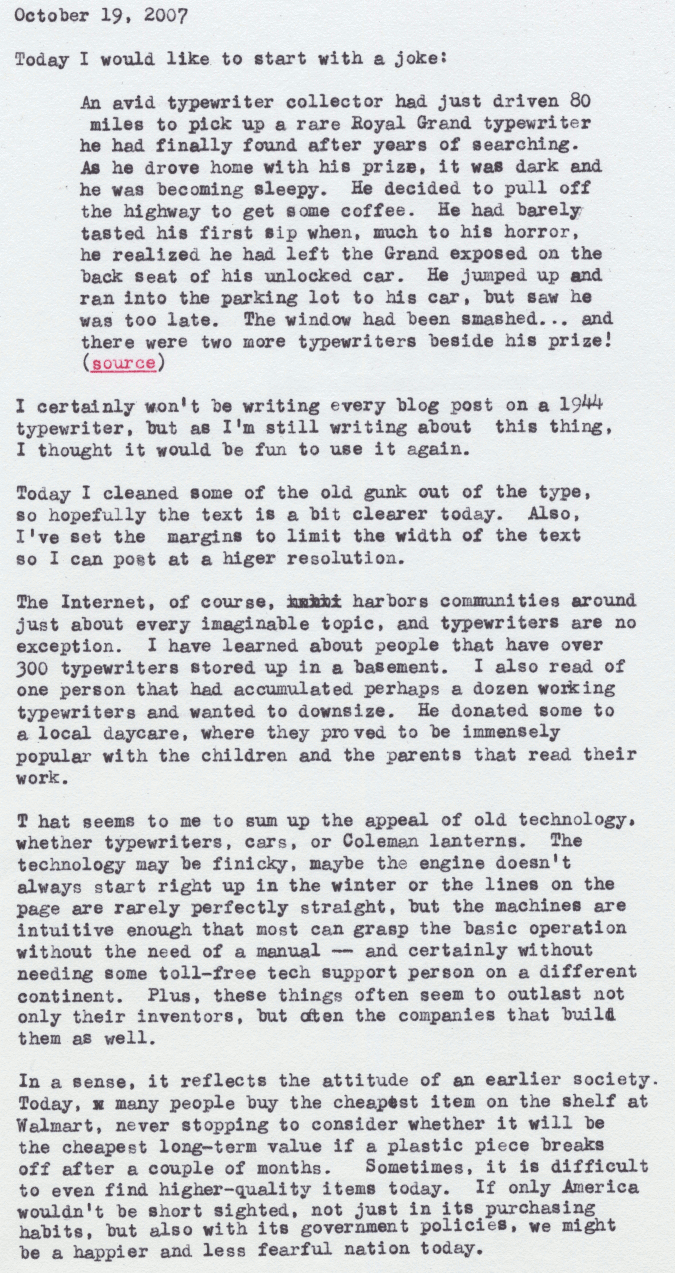
Today I would like to start with a joke:
An avid typewriter collector had just driven 80 miles to pick up a rare Royal
Grand typewriter he had finally found after years of searching.  As he drove
home with his prize, it was dark and he was becoming sleepy.  He decided
to pull off the highway to get some coffee.  He had barely tasted his first
sip when, much to his horror, he realized he had left the Grand exposed on
the back seat of his unlocked car.  He jumped up and ran into the parking
lot to his car, but saw he was too late.  The window had been smashed...
and there were two more typewriters beside his prize!
I certainly won't be writing every blog post on a 1944 typewriter, but I'm
still writing about this thing, I thought it would be fun to use it again.
Today I cleaned some of the old gunk out of the type, so hopefully the
text is a bit clearer today.  Also, I've set the margins to limit the width
of the text so I can post at a higher resolution.
The Internet, of course, harbors communities around just about every
imaginable topic, and typewriters are no exception.  I have learned about people that have over 300 typewriters stored up in a basement.  I also read of one person that had accumulated perhaps a dozen working typewriters and wanted to downsize.  He donated some to a local daycare, where they proved to be immensely popular with the children and the parents that read their work.
That seems to sum up the appeal of old technology, whether typewriters, care, or Coleman lanterns.  The technology may be finicky, maybe the engine doesn't always start right up in the winter or the lines on the page are rarely perfectly straight, but the machines are intuitive enough that most can grasp the basic operation without the need of a manual -- and certainly without needing some toll-free tech support person on a different continent.  Plus, these things often seem to outlast not only their inventors, but often the companies that build them as well.
In a sense, it reflects the attitude of an earlier society.  Today, many people buy the cheapest item on the shelf at Walmart, never stopping to consider whether it will be the cheapest long-term value if a plastic piece breaks off after a couple of months.  Sometimes, it is difficult to even find higher-quality items today.  If only America wouldn't be short sighted, not just in its purchasing habits, but also with its government policies, we might be a happier and less fearful nation today. flickr page

Andreas Schuldei: Dear Lazyweb: Au-Pair wanted!

So we will move back from Sweden to Germany after 7.5 years. Besides swedish nature and working culture we will surely also miss swedish broadband. On the other hand we survived swedish health care without serious repercussions and look forward to the german alternative.
So after having found a really nice house in L beck's historic center we now look for an swedish Au-Pair. One of the main goals with that would be to help our children to keep their swedish language skills. If anyone reading this knows someone interested in working as an Au-Pair during 2008 please have them contact me.

This years first Extremadura work meeting with people from Debian Edu, FAI, Debian-Science and Debian-Med takes place at time of writing. The group is 20 people (with some locals included). There is a rich supply of good spanish food so I skipped dinner yesterday in order to let my digestive system recuperate and get work done at the same time. I feel tempted to do that again today. Having stared and poked at FAIs new partition framework makes me consider partman as an alternative.

19 October 2007

Ian Haken: Long Time, No Update

So I've clearly neglected giving frequent updates, so I'll try to summarize everything that's been going on and maybe try to post more frequently in the future (I feel like I've said that many times before).

The summer ended very well, I think. My GSoC project vlosuts concluded with a fully working version, and so hopefully some guys over at Quality Assurance can be goaded into giving it a try. Once Lars and I find some time (it seems like both our lives have been quite hectic) we'll be submitting it to the unstable branch. I intend to continue supporting and developing it; in fact last night I just checked in the first update for VirtualBox support, as recommended by Jon in my comments. It does seem to work faster than QEMU and Innotek did a quality job (in my opinion at least) of packaging it. The biggest kink is that it does not support raw disk images, and so vlosuts gets slowed down by having to convert to VMDK and back, for which I am using qemu-img (and does anyone know why VBoxManage unregisterimage doesn't seem to be working for VMDKs?). If it's possible to do a loopback mount of VMDK (without VMware's utility) it would probably make more sense to use VMDK instead of a raw image to begin with, but I'm not familiar with any way to do this. At any rate, first version of VirtualBox is there for anyone who'd like to give it a shot.

Anyone not concerned with the personal going-ons of my life should stop reading right about now. Since my semester started up again at the end of August, I've pretty much hit the ground running. I'm taking 20 units (I think the average is around 15), one of which is a mathematics graduate course. I'm also doing a research project in computer science, working a part time job (which I try to do for about 10 hours a week), and getting my graduate school applications taken care of. For anyone who is curious, the GRE is a terrible thing. Graduate school and fellowship applications have been a particular headache, but fortunately I'm just about finished up with the essays. For the curious I'll be applying to mathematics departments with an emphasis in logic and foundations at the following universities (list subject to change frequently): MIT, Berkeley, Stanford, Carnegie Mellon, Urbana-Champaign, UMich.

Mike Hommey: Gobuntu and Firefox

You may remember, a while ago, Mark Shuttleworth announced that there would be a 100% free version of Ubuntu Gutsy Gibbon :
Ubuntu 7.10 will feature a new flavour - as yet unnamed - which takes an ultra-orthodox view of licensing: no firmware, drivers, imagery, sounds, applications, or other content which do not include full source materials and come with full rights of modification, remixing and redistribution.
Later, we learned it would be named Gobuntu. Well, they didn’t quite follow their promise. Yes, Gobuntu includes Firefox, making it a pretty useless failed attempt. By the way, I’m still amazed so many people believe it was all about the trademarks. For them, I’ll quote something I wrote a year ago:
Trademark and copyright are different things. Mozilla has unnecessarily given a non-free license to clarify the trademark situation, but that is not required. To make it clear: Debian thinks the logos are not free because they are not free. Period.
I’m glad at least Mark Pilgrim got it right. Update: And as seen on Planet Mozilla, Robert Sayre obviously still hasn’t understood the issue.

Raphael Geissert: DeBaBaReTools: The de-what?

It's been a while since I wanted to post about a project I started.
But today when I read Russell Coker's post about his SE Linux repository I decided it was time to blog about DeBaBaReTools.


So, what is/are DeBaBaReTools?
is: a project which tries to unify different packages-building systems (pbuilder, buildd, etc) and different repository tools (debarchiver, reprepro, etc) in a single system by providing an incoming/ system.

are: Debian Bash-Based Repository Tools.

Or in other words:
DeBaBaReTools handles new packages by:


DeBaBaReTools is NOT a rewrite of a repository tool (like reprepro, debpool or debarchiver), neither yet an other building tool (like buildd or pbuilder). It is rather a glue between those two kind of tools.

So, how does DeBaBaReTools work?
As already said, they are a set of scripts which do all the work.
These are some of the scripts (more might be written later, they are under development):


Note that at the moment these are the only supported backends: gpgv, du, md5sums (all built in checkSums), pbuilder and reprepro.

Sounds interesting, doesn't it? :)

So, here's the magic:

The backends system
DeBaBaReTools doesn't try to re-invent the wheel, but it makes use of all the available tools so it works as less as possible.

This is where the backends take action. They are even more shell (even tough DeBaBaReTools clearly specifies they are Bash scripts they should work on any other POSIX-compatible shell) scripts which are loaded on demand and according to the user settings.

This opens a wide range of possible combinations of backends; making DeBaBaReTools work with almost anything.

The probe.sh script searches different directories for the specified backend (and will soon support user-hinted backends).

I think an example says more than a thousand words:
When needsBuild finds a package that needs to be built in a given architecture, the toBuild shell function is called. In order to provide the already said flexibility, needsBuild will at startup time call probeFile "buildQueue" which will then check several directories for the required backend (buildQueue in this case). Once it finds the given backend (backends/buildQueue/) it will check for any user hint (which will specify the real backend to be used) and then for a default one (default.sh which is a symlink to a real backend, plaintext.sh by default).

So, if somebody at some point wants to use a sqlite database to store all that information, that person would have to write a file called backends/buildQueue/sqlite.sh (or make it available in any of the include paths which can be extended via the EXTRA_PROBE_DIRS env variable) and either set a user hint or make default.sh point to it.
The sqlite.sh script can then call any external tools (or even more scripts) to insert the information in the database, read it and more.

I know this is a lot of blahblahblah but no single line of code is shown.
I've already requested an alioth project but it was denied because the package isn't already in the Debian archive.
If you are a DD and you think this sounds like a good project please contact the Alioth admins and convince them to create a project account for DeBaBaReTools.
Once created, many other people will be able to work on it and make it work with virtually any tool.

Any kind of feedback is very welcomed but I hope they are constructive ideas.

Why did I start this crazy project?
Because AFAIR only dak is able to do such job but I think dak is just too complex for a simple system to manage an a repository with an incoming system. And AFAIK there's no script which is able to do this job besides dak.

I hope this post makes sense because I don't want to review it again (I'm tired) :)

:bye: all

18 October 2007

Russell Coker: My SE Linux Etch Repository

deb http://www.coker.com.au etch selinux The above sources.list line has all the i386 packages needed for running SE Linux with strict policy on Etch as well as a couple of packages that are not strictly needed but which are really convenient (to solve the executable stack issue). gpg --keyserver hkp://subkeys.pgp.net --recv-key F5C75256
gpg -a --export F5C75256 apt-key add - To use it without warnings you need to download and install my GPG key, the above two commands do this. You will of course have to verify my key in some way to make sure that it has not been replaced in a MITM attack. The only thing missing is a change to /etc/init.d/udev to have a new script called /sbin/start_udev used to replace the make_extra_nodes function (so that the make_extra_nodes functionality can run in a different context). Of course a hostile init script could always exploit this to take over the more privileged domain, but I believe that running the init scripts in a confined domain does produce some minor benefits against minor bugs (as opposed to having the init scripts entirely owned). I back-ported all the SE Linux libraries from unstable because the version in Etch doesn’t support removing roles from a user definition by the “semanage user -m” command (you can grant a user extra roles but not remove any roles). Trying to determine where in the libraries this bug occurred was too difficult. Does anyone know of a good document on how to create repositories with apt-ftparchive? My current attempts are gross hacks but I’ve gone live anyway as the package data is good and the apt configuration basically works.

Russell Coker: Reach Out - Only to People with New Computers

There are currently some adverts on Trams in Melbourne for some sort of community organisation. They have an amusing picture of an “Amazon” character from an RPG with statistics such as Self Esteem at zero. They have a web site at www.reachoutcentral.com.au which firstly tries to launch a popup window (did the web designers not notice that almost everyone blocks popups?) then uses a refresh for a redirect (with a message to click on an icon if it doesn’t work) and finally demands that Flash be installed. So someone who is in need of whatever counselling the Inspire Foundation (the organisation that registered the domain) offers is likely to be told that their computer is not adequate, I’m sure that they’ll appreciate that. As will the visually impaired people who will get even less out of the site. Is the web site offering a service that might tend to be needed by people who don’t have the latest computer gear and can’t run the latest version of Flash? It’s not only Linux users who are unwilling or unable to use Flash, older Windows installations also apparently have problems. Are people who can’t afford a broadband net connection likely to need the service in question? Dial-up network access is cheaper (and many people will be hesitant to visit a web site related to personal problems in a public place such as an Internet Cafe).

Jeff Bailey: One step closer to here

Angie and I wrote out written tests today for the California driver's license. We've been issued temporary licenses because we had current out-of-country licenses. We've been talking about possibly finding a drivers-ed instructor for a couple hours of private lessons to make sure that we'll actually pass the road test. After 13 years of driving, am I still likely to be able to pass a road test? Who knows? =)

I've thought before that the road test should be redone every 5 years. If the fees cover the cost of administering the test, then all it can do is make the roads safer and reduce the traffic on the road. Maybe if it were that much hassle, the demand from transit would increase enough that people wanted to use it.

I remember that I got my license so I could take a friend of mine to her prom. I wonder how Alicia's doing? For all the old faces on Facebook, I haven't come across her yet.

Next step: Move into new condo on Friday/Saturday (address is on Facebook, I'll update Orkut and the Debian DB shortly), followed by 3 university exams next week. And there's still a dayjob tucked in and around all of this! =)

John Goerzen: First Typeblogging Experiment

Now that I have my 1944 Smith-Corona typewriter working, it's time
      to find an actual use for it.  Maybe it wil be fun to blog with a
      typewriter.
      
      I'm calling this typoblogging because I own no correction fluid,
      correction tape, or any other of those things that help a typist
      hide mistakes.  So, by calling it 'typoblogging,' I can pretend
      that all the inevitable mistakes are somehow a trendy part of the
      medium.
      
      Earlier, I was wondering whether using a typewriter would change
      how I write.  I think it has.  Before I started writing this post,
      I gave the overall structure much more thought than I normall would.
      I find I'm even planning out each sentence in greater detail.  I have
      a greater sense of accomplishment after each paragraph that comes
      out of this thing intact, too.
      
      As I was writing this, Jacob's bedtime arrived.  I started thinking
      about the things I needed to do before putting him to bed.  But
      there was nothing.  No documents to save, no place to keep.  Nothing to turn off or lock up.  That felt somehow liberating.
      
      The last question is: how do I provide a text version of this post?  I
      will try gocr on it, but I'm not sure how well it will do.  The letters
      on the typewriter need to be cleaned, and some characters like Note: red underlined links are clickable flickr photo page for this post

John Goerzen: First Typoblogging Experiment

Now that I have my 1944 Smith-Corona typewriter working, it's time
      to find an actual use for it.  Maybe it wil be fun to blog with a
      typewriter.
      
      I'm calling this typoblogging because I own no correction fluid,
      correction tape, or any other of those things that help a typist
      hide mistakes.  So, by calling it 'typoblogging,' I can pretend
      that all the inevitable mistakes are somehow a trendy part of the
      medium.
      
      Earlier, I was wondering whether using a typewriter would change
      how I write.  I think it has.  Before I started writing this post,
      I gave the overall structure much more thought than I normally would.
      I find I'm even planning out each sentence in greater detail.  I have
      a greater sense of accomplishment after each paragraph that comes
      out of this thing intact, too.
      
      As I was writing this, Jacob's bedtime arrived.  I started thinking
      about the things I needed to do before putting him to bed.  But
      there was nothing.  No documents to save, no place to keep.  Nothing to turn off or lock up.  That felt somehow liberating.
      
      The last question is: how do I provide a text version of this post?  I
      will try gocr on it, but I'm not sure how well it will do.  The letters
      on the typewriter need to be cleaned, and some characters like 'e'
      have gunk in them.  Once I have the text, though, perhaps I can put
      it in as the ALT text for the IMG tag.
      
      Anyway, to answer the question I started with: yep, this is fun. Note: red underlined links are clickable flickr photo page for this post

17 October 2007

Biella Coleman: My Ongoing Saga with BCBS

It is clear to me that a “clearinghouse site” for complaints against Blue Cross Blue Shield would yield a lot of traffic. My post complaining about my problems with BCSJ Horizon of NJ has received constant comments with people posting their horror stories. I have not moved to create such a site yet, because I am hoping that the outcome of my appeal will be positive and that I can report that going through the appeal process as they set up can lead to fair and just outcome. But the frustrating thing is 3 emails and 2 phone calls placed this and last week to inquire simply about the status of my appeal has been met with a wall of silence. Frustrating…. I am going to try to contact them again this week and if not… I will have to file another complaint with the dept of Banking and Insurance over their inability to respond to me about the appeal process.

John Goerzen: Unexpected Interest

A few days ago, I wrote about my recent purchase of an old Smith-Corona manual typewriter built in 1944. Terah and I were at an antique store, and it was $25 and sorta an impulse buy.

Since then, something unexpected has happened: I'm getting interested in using manual typewriters.

I've been busily tracking down ribbons (Nukote BW277 doesn't work on it, even though their website says it does), typing paper (business-supplies.com has it at a decent price with free overnight shipping on most orders over $50), and various tidbits of knowledge (such as: what does the lever numbered 0 to 6 beneath the right ribbon spool do?)

Today I went to a local office supply store. Not OfficeMax or OfficeDepot -- they do carry ribbons for typewriters of this era, but not the right ones for my particular machine. But the store that has been owned by the same family since it opened in 1899 on Main Street, where it remains.

And, surprise, they had the ribbon I need!

It seems that typewriters are experiencing a certain resurgence in popularity. People that have computers -- and perhaps never knew a world without them -- are buying typewriters. Because of interest, novelty, or even usefulness. There are quite a few typewriter repair shops that still exist, most of them happy to work on typewriters up to a century old.

So why am I excited about it?

Part of it is the fun of making a really old piece of technology work.

Perhaps part of it is knowing that I'll be typing at a machine that was built the same year as D-Day, the year when the first German city fell in World War II. Part of it is knowing that this 40-pound machine was built to last, in an era before planned obsolescence. And, to a certain extent, it has outlasted its manufacturer.

Part of it is curiosity: will I write differently on a typewriter than a computer? It seems that most people that have tried both say that their writing is different on a typewriter, and often better. Perhaps it is the difficulty of editing that forces more rigorous thought up front.

Christopher Watkins wrote:

[Manual typewriters] just plain shame me into working. As with any fine instrument, they're made to be used, their very design bespeaks this, and there's been many a night I've caught one of my typewriters glaring sternly at me from the shadows, implicating me in a grand failure to honor their structural destinies. Chagrined and challenged, I dutifully sit down to see what I can do to contribute to the machine-age legacy I've been called on to uphold. . .

When you sit down to write a song at the piano, you're going to write differently than if you have a banjo in your lap. And if one instrument isn't bringing the magic and the muse, maybe another will. Typewriters are the same; they make me write in a different fashion, and also provide an alternate trigger for inspiration. And as an electric guitar is different from an acoustic steel-string guitar is different from a nylon-string classical guitar is different from a national steel resonator guitar; so does each individual typewriter differ. My Underwood is different from my Royal is different from my Remington is different from my Corona is different from my Hermes. And if one isn't giving me the juice, another might.


Brian Drake added (emphasis mine):

Or you print out the document again because someone misplaced it. Misplaced it! When we were on typewriters, let me tell you, no one misplaced a hundred-page contract! That meant another two days of typing, and tying up at least two secretaries to get it done then. . .

Gore Vidal said he could tell when a book had been written on a word processor. I can, too. Sometimes I can see the cut-and-paste.

I've worked as a professional proofreader and copyeditor, and I can attest that the computer has not led to better writing. What it has led to is more writing, acres and acres of it. Books have grown fatter and fatter while their content grows slimmer and slimmer.


These seem to resonate well. More typewriter essays here.

And perhaps a typewritten blog post or two, once I try out my new ribbon.

Simon Richter: Lazyweb: printing few pages

Since I now have a business licence so I can actually charge people if they ask me questions about computers, I need to occasionally send a letter to the tax office. This means that I finally need a printer. Since I expect to be using it for about 50 pages a year, I don't really see the point in spending too much money on it, but I expect it to work those few times I actually need it. The ability to print documents that remain readable for ten years is important, so it's probably laser or thermal transfer; colour printing isn't important to me. I've had a pretty bad experience with a Lexmark Optra E (squeaky noise, crumpled envelopes, feed not working, collecting dust in the mechanics due to being top-fed). So, I'm interested in printer stories.

16 October 2007

Biella Coleman: Archive of Audio Speeches

From Stallman to Che to Thomas Edison to Martin Luther King… Check it out.

Biella Coleman: Topics in Digital Media

Next semester I am teaching one (yay one) course and it is a graduate course on digital media. This is the description I have so far and I will post the tentative syllabus in the next few week.
Computers, especially in their networked dimension, have sparked a series of ethical, political, and social debates that often revolve around a series of stark and connected dualities: control and freedom; pleasure and exploitation; creativity and constraint. In this course we will approach topics in digital media via an historical angle that squarely addresses these dualities. To this end, we will often cross-cut readings on similar topics and material whose conclusion about the nature of computing will often vary considerably. The goal, however, is not to determine the correct or right side of these dualities but have students come away with a firm understanding of the following: 1) the history of computing and networking in light of the ways the authors as well as technologists/inventors construct or understand these dualities; 2) the various sources technological, social, and political that may shape or drive any of these elements; 3) unpack the political and social relationships, if any, between them and the stakes involved in how these authors represent the nature of computing and networking. The course primarily concentrates on computers and networks and is roughly chronological, starting with the first digital computers and ending with our digital present. Particular topics we address are: cybernetics and liberalism; networks and the cold war; personal computers and online communities; hackers, the free software movement and intellectual property; labor, development, and computers; peer-to-peer knowledge production; computer gaming; and counter-globalization and computer networking.

Next.

Previous.
