Search Results: "ana"

15 June 2008

Jeff Bailey: I need a TV-B-Gone for the gym

Dear CNN,

The US presidential election race between senators McCain and Obama is not a "battleground". Battlegrounds are where people get killed. Using the same words for what passes as democracy in this country as for the military massacres in foreign countries is incredibly sad and disgusting.

That, and it's only vaguely less stupid than Toronto's "War on Fire".

14 June 2008

Wouter Verhelst: AOL

Yes, me too. I actually booked a while ago, but never got around to blogging about it. Oh well. In case you care, my flights:
 BRUSSELS        IB 3207 L  02AUG 0755  LHPX2MBE            23AUG 2PC OK
 MADRID BARAJAS                   ARRIVAL TIME: 1010
 TERMINAL:4
 MADRID BARAJAS  IB 6845 L  02AUG 1225  LHPX2MBE            23AUG 2PC OK
 TERMINAL:4S
 BUENOS AIRES EZ                  ARRIVAL TIME: 1940
 BUENOS AIRES EZ IB 6844 N  18AUG 2145  NPRO21BE      09AUG 23AUG 2PC OK
 MADRID BARAJAS                   ARRIVAL TIME: 1430
 TERMINAL:4S
 MADRID BARAJAS  IB 3214 N  19AUG 1620  NPRO21BE      09AUG 23AUG 2PC OK
 TERMINAL:4
 BRUSSELS                         ARRIVAL TIME: 1835
Now most people will be taking the bus from Buenos Aires to Mar del Plata, where Debconf8 will be. However after looking at a map of Argentina, and remembering what happened when I flew to Australia with the flute choir back in 2001, when we had to do a bus ride after landing, I decided against doing the bus thing this time around. So:
 BUENOS AIRES AE AR 1626 V  03AUG 2000  VVD                       15K OK
 MAR DEL PLATA                    ARRIVAL TIME: 2055
 MAR DEL PLATA   AR 1627 V  17AUG 2120  VVD                       15K OK
 BUENOS AIRES AE                  ARRIVAL TIME: 2215
Which means I'll have a night in Buenos Aires in both cases, to rest and to avoid having to do the bus trip. And perhaps to see the city, too. All that's left now is not to forget about the passport thing. I'm sure I'll manage.

13 June 2008

Theodore Ts'o: Learning how to communicate

Pity poor Dr. Ari Jaaksi from Nokia. He gave a talk at the Handsets World conference in Berlin on Tuesday, where according to ZDnet, he lectured Open Source Developers that they needed to learn why DRM and other closed technologies were necessary, because of business issues such as subsidized (device) business models. I suspect he wasn’t prepared for the reaction, which took the form of a major fuss on Slashdot, as well as some declarations from a few people on the maemo-users mailing lists that they would never buy another Nokia device. Dr Jaaski then posted today on his blog an entry entitled, “Some learning to do?”, where he stated that while Nokia needs to learn how the open source world works (not just licenses and legal issues, but also the spirit), that the open source world also needed to learn as well — about WHY things are the way they are. He ended the post with “I’m not a teacher, I’m a learner” — which is fair enough. I actually think that Dr. Jaaksi is right; we all should be interested in learning, and having talked with a number of Nokia employees, I can testify that their hearts are very much in the right place, and there are some strong reasons regarding the demands of carriers, the subsidized business model of handsets in the US, the attitudes of suppliers for components in mobile devices, that very much tie their hands — as well the hands of every other handset company out there. Progress in this space will come slowly, and but I believe there is hope that in the long run things will get better. However, at the same time, I would suggest to Dr. Jaaksi that it’s also important how to communicate with the open source community — or with any community that holds views sometimes with great passion. Many people do not react well to being told that they need to learn something — even if it is true that they do. Admitting that they need to learn is for some people tantamount to admitting ignorance, or even worse admitting stupidity, and so they are loath to do this. Telling them this just makes them defensive and angry. My suggestion for how get people to learn without making them defensive is to use a modified Socratic method. It works especially well with the Open Source crowd, because many of them are engineers, and engineers are by nature problem solvers. So if you give them a problem to solve, they will go to work trying to find potential solutions, and thus start thinking and learning about the problem from a different point of view. Hence, a better approach is to give them a series of business constraints (time to market, the demands of carriers, the fact that most end users prefer to buy subsidized phones with 1-2 year lock-in contracts, the intransigence of suppliers, why a single company can’t afford to create their own chipsets from scratch and have to rely on companies like Broadcom, etc.) and then tell them — we’d love to delight our customers in any way we can, and clearly you are very passionate about DRM, open device drivers, and other OSS issues. We however have to create successful products and sell them at a price such that we don’t go out of business — can you help us work through all of these constraints? Let’s work together so we can make an open source mobile platform that meets the spirit as well as the legal requirements of the open source world! Dr. Jaaksi and his team are struggling with a hard problem, and I am very sympathetic to their issues. And, they have to be commended for investing as much time and effort on the Maemo platform, as well as other Linux and Open Source platforms as they have to date. The strength of the Open Source community is that we work together to solve our mutual problems, while celebrating and giving permission to people to “scratch their own itches”. In order to do that, we need to learn how to better communicate with each other, and that is something that goes in both directions. When I was at MIT as an undergraduate, far too many years ago than I care to admit, I took economics classes and Sloan School of Management classes (even though they were not necessary for a Computer Science degree) for that very reason. I encourage open source advocates to learn how to walk a mile or two in business people’s shoes, since if you want to influence them them to change in the ways that you desire, you need to know where they are coming from — just shouting and throwing rotten tomatoes generally won’t get you very far. On the flip side, people who are on the corporate side of the divide also need to understand that certain ways of engaging the community can be more productive than others. At the end of the day, hopefully we can all agree with Dr. Jaaksi that everyone will benefit if we all commit to learning from each other. Update: I’ve fixed Dr. Jaaksi’s name so it is spelled correctly; my apologies for the error.

Clint Adams: Cayrin

We sat at the round table, decanting the Tokaji. Elkins gave me a quizzical look. Podjad stared at the label on the bottle. Elkins wiggled her nose at me. It was then that I knew I was going to lose. The Scourge of Scranton made his entrance, striding just so to maximize his projection of gravitas. His long, purple velvet cape trailed behind him as his knee-high leather boots clacked on the parlor floor. Podjad studied a word etched on the carafe. Elkins smirked. The Scourge of Scranton stood before the table as beads of sweat collected on his widow's peak. He looked at us. We looked at him. He strode out whence he came.

Enrico Zini: Send a fax from the laptop

Send a fax from the laptop My bank sent me a PDF form via e-mail. I needed to fill it in, then send it back via fax. Send it back via e-mail would not work because it's not secure. The bank agrees that this is fantastically silly, but apparently this requirement is not their fault. Step 1: send a fax with the laptop
  1. apt-get source sl-modem-daemon efax-gtk
  2. patch as instructed in the Debian BTS
  3. pbuilder-satisfydepends, debuild, dpkg -i
  4. slmodemd -c ITALY --alsa hw:0,6
  5. echo ATDmymobilenumber > /dev/ttySL0 and my mobile phone rung
  6. efax-gtk
Believe it or not, at this point I managed to successfully send a test fax. Background: the laptop's modem is actually a sound card, and is ashamed to admit that it can also work as a modem:
$ lspci
00:1b.0 Audio device: Intel Corporation 82801H (ICH8 Family) HD Audio Controller (rev 03)

But the sound card actually has its own bus, which you can query with aplay -l:
$ aplay -l
**** List of PLAYBACK Hardware Devices ****
card 0: Intel [HDA Intel], device 0: ALC861VD Analog [ALC861VD Analog]
  Subdevices: 1/1
  Subdevice #0: subdevice #0
card 0: Intel [HDA Intel], device 6: Si3054 Modem [Si3054 Modem]
  Subdevices: 0/1
  Subdevice #0: subdevice #0

Then you learn that sl-modem-daemon can drive it both on i386 and on amd64, but you get period size 48 is not supported by playback (64) when trying to dial. But then you find the patch to get rid of that, and it works. The modem was the last device in the new laptop that I had not yet attempted to use. I can now claim that every single piece of hardware on my ASUS F9E-2P119E laptop can be made to work with Debian. Oh, yes! Step 2: fill in the form Much to my surprise, evince allowed me to just click in the form fields and type text. Even checkboxes worked. "Save a copy", however, did not retain the field contents: I had to print to file to get another PDF with the fields filled in. Update: this could be a limitation of that specific PDF, see this thread on the Adobe forums (thanks to Tomas Weber). However, evince did not allow me to import an image with my signature and paste it in the right place. Inkscape, however, successfully managed to import the PDF as an editable vector drawing that I could change at will. Again, that was impressive. From there, it was just a matter of pasting the signature in the right place, save as PostScript, give it to efax-gtk and phone the bank to learn that, in fact, the fax was received and was perfectly readable.

12 June 2008

Enrico Zini: How to autologin X without a display manager

How to autologin X without a display manager Problem: configure a custom Debian box used to drive some industrial machinery. The system should boot directly into the GUI control application, that runs full screen, with root privileges. Everything should respawn if X is killed or the control application dies. In theory, you'd run an X display manager with autologin, then run matchbox-window-manager and the control application as the X session. You wish. At the end of the post is an explanation of why this way failed. So, here is how to get the whole thing to work, without a display manager. Use init to drive the whole thing:
6:23:respawn:/sbin/getty -L -n -l /usr/local/sbin/autologin

This will respawn everything if it dies, stop respawning if it dies all the time, avoid starting it in single user mode, and not ask for a username. /usr/local/sbin/autologin contains:
#!/bin/sh
/bin/login -f root MAINAPP=true

This will autologin as root, setting an extra env variable. Then comes root's ~/.bash_profile, that just starts X if we are doing autologin:
if [ "$MAINAPP" = "true" ]
then
    startx
    logout
fi

If the application was running as a special user, we could have made things simpler and just used startx as the shell for that user; however, we still want root to have bash as the shell, and the above hack does it. Finally, root's ~/.xsession:
#!/bin/sh
matchbox-window-manager &
# If the touch screen is not calibrated, run the calibration
while [ ! -f /etc/touchscreen-calibration ]
do
        calibrate-touchscreen
done
# Run the main application: if it ends, the session ends
main-application

And there we go, no dependencies at all. Why not using a display manager gdm and kdm seem to do autologin, but their dependency list is not acceptable for something that should just respawn an X server in an industrial system that must be kept simple. xdm on the other hand has a small set of dependencies, but its developers seem to have decided that autologin is a ""glitz", and there is no need for it in such a bare-bones display manager". Dict for "glitz" gives "tasteless showiness". What one has to bear... wdm seems however even more disconcerting, as it "doesn't actually support autologin but you can set the default user and default password in /etc/X11/wdm/wdm-config. Now, [...] you only need to press Enter twice [...] to login". Figure how this would look in the manual: "After powering up the unit, attach a USB keyboard and press enter twice to start the system". And this is why we are not using a display manager.

Jeff Bailey

Dear recruiters #2: There are now *two* standards to follow: not only can you not send me posts from a noreply address, you should also try to convince me that your founders are insane ;)

I seem to have quite accidentally set a new standard in what it takes to hire me. According to Slashdot, Google co-founder Sergey Brin is planning to go to the ISS. The founder of Ubuntu, Mark Shuttleworth did the same.

" You know we're sitting on four million pounds of fuel, one nuclear weapon and a thing that has 270,000 moving parts built by the lowest bidder. Makes you feel good, doesn't it?"

Actually, looking back at almost all the jobs I've ever had, the founders or key management folks were almost *always* insane. I remember a fun conversation with Jane, the COO of Canonical about how I wanted the senior management of any place I work to have such a big vision and to drive relentlessly towards it.

I think she thought *I* was insane. Probably still does ;)

Thinking of which, I'm so happy to be back at work. I'd forgotten what the pace here was like, or maybe it's just coming off of heavy drugs and spinning up to this pace. I feel a bit like a Smart Car on the New Jersey Turnpike. I'll make freeway speeds, but I need a few more days. =)

I reduced the drugs quite rapidly in the last week, and am now down to one Ultram per day, with extra-strength Tylenol supplementing. I also got my second HIV test results back, and it's non-reactive. So it's 99% probable that the blood transfusions were clean. Yay!

Biella Coleman: Free Speech: A Comparative Perspective

While free speech rights are valued and recognized in most liberal democracies, the degree and scope of these rights are by no means uniform. The United States, which has the most expansive free speech protections in the world, actually stands apart as this New York Times article on the subject makes clear. The article covers familiar ground (at least for those who follow free speech debates) but it does so well and discusses an interesting case now unfolding in Canada, concerning a pretty inflammatory magazine article denouncing Islam. The magazine is currently under trial for violating provincial hate laws.

Edd Dumbill: Gandi's VM hosting beta now closed to new users

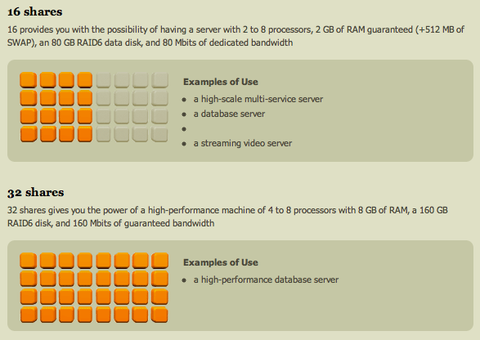
I've been experimenting with Gandi's virtual hosting service recently. In fact, this blog is now hosted on it. Gandi have created by far the easiest hosting service I've used. The web interface allows you to buy credit, create pre-installed virtual machines and log in, all in under 15 minutes. Add the ease of Ubuntu to the mix (just one of the preinstalled images you can choose from), and commissioning times for new services are low indeed. The hosting service is based on Xen, and allows you to dynamically change the resources your VMs can access (CPU/memory/disk), on a scheduled basis if required. It has an API which provides enough functionality for you to white-label hosting as part of your own web app. Gandi's hosting options
Excerpt from Gandi's explanation of the amount of resource you can allocate to a virtual machine Gandi's service isn't yet as flexible as Amazon's EC2, but it comes at the problem from the other end — its initial offering "just works" as an alternative hosting solution, with the added flexibility their Xen infrastructure brings to the mix. Even with all its tool support, Amazon EC2 feels like stepping into an alternate universe. I'm pretty excited about the directions in which Gandi's service will develop. And yes, now I've told you all this, unfortunately you can't yet play with the beta service if you've not got an account already. The initial success means Gandi are closing new signups for a little time to concentrate on improving their infrastructure. The good news is that Gandi say this is the final step before the full release of the system. I can't wait! It's so good to see innovative, high-quality internet solutions coming from Europe.Join the conversation about this post

Tollef Fog Heen: Zombie meme

Various people have been posting about what to do when the zombies attack.
You are in a mall when zombies attack. You have:
1. One weapon
2. One song blasting on the speakers
3. One famous person to fight along side you.
  1. Katana. Doesn't run out of ammo and should slice up those zombies quite nicely.
  2. One of the songs from the soundtrack of "The Rock". I can't remember which right now, since it seems to have disappeared from my music collection.
  3. Given I'm facing undeads, somebody holy. I suppose Jesus might work well.

11 June 2008

Evan Prodromou: 24 Prairial CCXVI

Quick shout to announce an event here in Montreal. In response to the announced introduction of legislation to change Canadian copyright, commonly called the "Canadian DMCA" since the drafts presented so far have closely resembled that American law, the Montreal Chapter of Fair Copyright for Canada is holding an emergency organizational meeting Thursday, June 12th from 6-8PM. The event will be at Station C, 5369 Saint-Laurent #430, in the Mile End neighborhood of Montreal. It's open to anyone interested in learning more about this bill and helping to oppose it. tags:

Clint Adams: Floating job control

Francois-Denis, you can get more bash-like behavior by doing setopt nohup, or you can disown the jobs before exiting, or you can background and disown immediately by running program & . Also, that silly non-free window manager, ion3, is decent with the small popups.

Obey Arthur Liu: debian.org domainsquatted ? (1)

debian.org domain squatted I was like “wtf?!”. Debian.org replaced by a link farm ? debian.org being actually domainsquatted is highly unlikely, so I started searching how this could happen. First, a little explanation of the setup : Now there are some peculiarities to the situation : Some hints : Now for the challenge : how could this happen ?

Gunnar Wolf: No, it's not

Several people have approached me (or I've stumbled upon their sites) asking me about something called Debian 5.0 Beta 2.
It. Is. Not. That.
Please read clearly the announcement for Debian Installer lenny beta 2 - Yes, I understand this reached many people who are not involved in Debian but are enthusiastic users nevertheless. In short: The only thing that reached the beta is the debian-installer program (usually called just d-i), the amazing piece of code that handles a Debian installation in your system. And yes, it is meant for wide testing and work.
But please, do not take this as a preview of the new Debian release - it is not. If you install a system using this version of d-i, you will be tracking the Testing branch of Debian, and your system will be in a continuous state of flux. Yes, we do expect a freeze of Lenny in the next couple of weeks, after what it will be quite close to a Beta release (i.e. almost no new versions, no fresh software, just bug fixes). But hey - A Beta is supposed to be close to release quality. And if you look at the release-critical bugs affecting the Testing branch (green line), you will clearly see we have over 400 bugs to fix before Lenny is allowed to be called stable. And that's only one of the criteria needed to reach Lenny - Glance over at the Debian Release Management page to quickly understand the nature of changes still to come.
Oh, and of course - Even if it is not necessarily up-to-date, I have found the Wiki page created by Peter Eisentraut as an excellent place to start working whenever I have some free time: Lenny Release Goals.
so... If you are not yet working towards making Debian the best distribution ever, and Lenny the best Debian release ever, you now know where we need your help ;-)
(side note: d-i team, maybe the next announcement could use some words pointing out we are not doing a Debian beta program, just a d-i beta release?)

10 June 2008

Gunnar Wolf: Nekkid city - yet again!

After thinking it over a couple of times, I did it. I told you here about the World Naked Bike Ride. Thousands of bikers, in over 130 cities around the world, voiced their concerns about the lack of caution drivers have towards us, about the abuse of fossil fuels for urban transportation, about the easy we are not to be seen. Many among us have been run over by careless drivers (in my case, no consequences except a broken helmet - And yes, MJ: although the impact was on the flat surface of the road and not on the kerb, the strength of the impact still amazes me). We feel naked against the motorized traffic. So, the WNBR decides to show it by taking the streets of our many cities - Naked.
It was a completely different experience of the massive naked Spencer Tunick photo, as we were there not just to show our freedom and enjoy, but to get the people to look at us. There were some of the same elements of comradeship and trust we had there (and, of course, that many of us learnt in Finland when we became GNUdists at DebConf 5's unforgettable saunas).
Anyway... I did not make the full route (I rode Chapultepec-Z calo-Diana, ~15Km, but missed the Diana-Gandhi-Cibeles part, maybe some 5Km) as I had an appointment I was already late for. But it was a unique, great experience. If you are interested, we got a fair share of press coverage. Oh, and I must say: I am famous now. And in my favorite newspaper, nothing less :).

Romain Beauxis: Liquidsoap 0.3.7 is out !

We eventually released liquidsoap 0.3.7 !!
For those who don't know about this software, liquidsoap is a scripting language designed for building audio streams. It was initially aimed at web radios, as an alternative shoucast/icecast source client, but quickly turned to a much more general tool.
For those who read debaday, I already blogged about it few months before. There, you'll find more explanations on how the program operates.
A simple example could be: #!/usr/bin/liquidsoap # (...)

9 June 2008

Russ Allbery: Lintian and Policy updates

I'm a bit slow on the journal-writing front, but belatedly I should mention here that I did upload the new Policy (3.8.0.0) and then a quick bug-fix. If you have a trigger-enabled dpkg, you don't see that you're registering non-existent doc-base files. Lintian should catch that, but doesn't. Yet. I've been trying to find time to kick off the next round of Policy updates. There are several proposals that just need text written for them: #143941 and #241333 are obvious at this point, #416450 should be fairly simple, and I think the due diligence has been done on #470994. There are other fairly straightforward ones too. If anyone beats me to it for any of those (or even better, other bugs), I won't complain. I also closed all of the old Policy bugs that we'd tagged wontfix except for one that I forwarded to the tech-ctte. I also uploaded Lintian 1.24.0 on Saturday. This contains the first steps in a better documented and hopefully faster and cleaner way of extracting information from the lab. Rather than opening and reading files in every check that need data, there are now Lintian::Collect modules that can hold common code and cache the results across multiple different check scripts. Currently, they're not widely used, but they're now available to all checks (hence the version bump). This release also contains some truly fantastic work by Jord Polo Bard s on the web site. Look at lintian.debian.org now. It looks like a real web site! Jord is working on a Google Summer of Code project for Lintian, but it wasn't even the web pages; that was just a bonus. I'm very happy with the outcome. Lintian is still above 100 bugs and I want to start expanding the new infrastructure, so there's more work to be done, but I'm very happy with the progress lately. And it was fun to spend two days solid working on Policy and Lintian for a change, instead of lots of different work projects (or feeling low on energy and barely managing to get a handful of things done).

David Welton: Startups: government help and hindrance

Aaron Swartz writes about what government might do to encourage entrepreneurship: http://www.aaronsw.com/weblog/prostartup As an American who has lived in Europe for a while, I've seen both sides of the coin (or pond, as it were), and feel qualified to add a few things to the conversation, even if many of these points merit a discussion of their own. And here are some thoughts of my own: I think it's best to focus on the startup "curve", and costs associated with various points on it: when people are just getting started, keep state-imposed costs low. If someone makes a lot of money, worry about taxing it then. This is quite different than what has previously been the norm in many places in Europe, which have policies akin to slaughtering the goose before it lays any eggs, let alone golden ones. Italy is a particularly bad example, but it's the place I know best, and not too far off what happens elsewhere in terms of policy: fixed, sunk, startup costs are in the order of 10,000 Euro, which for most people is a lot of money. This creates a bias towards people who already have a lot of money, and away from random people who happen to have good ideas and a strong desire to execute on them. This is something that the US more or less gets right: it cost me $55 in state fees to start DedaSys LLC as a limited liability company (even throwing in money for lawyers and the like, you're still far under the thousands it costs in many European countries). Incidentally, it looks like Germany may be on the right track, if you look at the "Mini-GmbH" mentioned in the article. It's progress, if nothing else. Beyond that, there is a lot more red tape in Europe, and that, I think, rather than a bit higher taxes for companies that are profitable, is the thing that, outside of culture, probably weighs most heavily on European startups. Culture, however, is also a very key factor, and not something that will change soon or easily. In Italy, there's a lot of pressure to land a permanent job, from which you can basically never be fired. The idea of striking out on your own is probably simply not on most people's radar screens. I think culture is what means that Europe produces tons of great open source software, for example, but relatively fewer startups (if you're just counting open source startups though, Europe does ok). Perhaps this is slowly changing, but it will take a while, and without some policy changes, the incentives won't even materialize. Returning to things that government can do, something critical that many people don't get is that government funded startups are usually big failures (see the French "Google competitor") and a big waste of money that would probably simply be better to spend in lowering taxes, improving education, or other "level playing field" initiatives, rather than having government employees attempting to "pick winners". This is a common problem in Europe, but also in many areas of the US that want to replicate Silicon Valley's success. Going back to the US, which was Aaron's original point of focus, beyond health care, what could the US improve? At the moment, immigration seems to be the big problem: people from all over the world want to go to the US to work and start companies, but look at what kinds of hoops someone (who is coming to spend money and create jobs!) has to jump through to do so: http://www.techcrunch.com/2008/05/02/coming-to-america-getting-visas-to-do-business-in-silicon-valley/ Embarrassing and shameful. In conclusion, I think the common theme is that the government can't really do much to actively promote startups, but can certainly hinder them by setting too high a bar in terms of bureaucracy and fixed costs. Lowering those fixed costs for new companies, be it through at least basic health care for everyone, or lower taxes and less paperwork should be what governments aim for. Given the right conditions and incentives, bright, hard workers will do the rest.


Matthew Garrett

Things in your computer that you do not have the source code for:Anyone think of anything I've missed?

Things people have suggested:
More suggestions:

Pierre Habouzit: reportbug-ng

Dear Bastian let's fix your blog post.
Philipp thinks, the fact that rng is not using the information in /usr/share/bug renders rng unfit for release and upgraded the corresponding bugreport from wishlist to serious. Moreover: since I dared to downgrade the report back to wishlist he decided to remove rng from testing and block it until the bug is fixed.
s/Philipp/the Release Team/g. And yes, we believe that reportbug-ng goes against the Maintainers wishes, and doesn't help users that don't know how to report a bug (and which are rng audience unless I'm mistaken).
I don t want to heat the debate about this bug again, but Philipp s decision seems arbitrary for me and I wonder if the same standard is applied to every other Debian package.
It's not, it was discussed in the Release Team and was not Philipp on his own alone. And yes, the same standards of quality is wanted for every package in Debian.
I mean, rng has no release critical defects.
That's you claiming that, there have been really constructive remarks in both bug that we upgraded, and that I think explain wisely why the current reportbug-ng behaviour doesn't makes it a suitable reportbug tool right now. I think for example that Sam's and Michael Biebl contributions in both bugs are good explanations of what is wrong and why.
It just does not use the aforementioned scripts as additional information in bugreports does this really render the software unfit for release ?
Yes it does. Again, people that use rng are I think, less experienced users, who need guidance through the bug reporting process. The kind of users that often send annoying bug reports. Instead of lowering the annoyance factor, you aggravate it. In the end, rng makes the frustration higher, and totally fails to meet its primary goals: making bug reporting nicer, simpler, and more efficient for the Reporter and the Maintainer. While it's probably nicer for the reporter, you totally fail on the other part of the contract. And if you don't care about the Maintainer, then well, reportbug-ng is just a spam machine to them, and your careless attitude toward them is unfit for release for sure.

Next.

Previous.