Some time ago, Ubuntu had Ubuntu Brainstorm, a website where non-developers could submit ideas of improvements, and other people could comment and vote on them. I was wondering if there was existing software to deploy a similar service, e.g. as a plugin to popular forum software. I ve found ideascale.com, but relying on the Cloud for that is not acceptable for my planned use.
(For clarification: my immediate interest for that is unrelated to Debian work)
Continuing last month progress report onOUnit2. The release is just a few days away, I am testing real life application and the core of the work is already in the VCS.
The basic features:
better configuration setup
environment variable
command line options
configuration files
improved output of the tests:
allow vim quickfix to jump in the log file where the error has happened
output HTML report
output JUnit report
systematic logging (verbose always on), but output log in a file
choose how to run your test:
run tests in parallel using processes (auto-detect number of CPU and run as many worker processes)
run tests concurrently using threads
use the old sequential runner
choose which test to run with a chooser that can do smart selection of tests:
simple: just run test in sequence
failfirst: run the tests that failed in the last run first and skip the success if they are still failing
some refactoring:
bracket: use a registration in the context but easier to use
remove all useless functions in the OUnit2 interface
non-fatal section: allow to fail inside non-fatal section without quitting immediately the whole test
allow to use OUnit1 test inside OUnit2 (smooth the transition)
timer that makes tests fail if they take too long, only when using the processes runner (I was not able to do it cleanly using threads and sequential)
allow to parametrize filenames so that you can use OUNIT_OUTPUT_FILE=ounit-$(suite_name),log and have $(suite_name) replace by the test suite name
create locks to avoid accessing the same resources within a single process or the whole application (typically to avoid doing a chdir while another thread is doing a chdir elsewhere)
create a in_testdata_dir function to locate test data, if any
Still remaining to do, but quite straightforward:
sys admin (website, release process)
update the whole documentation
Some things that I decided not to do for OUnit 2.0 release:
introduce a 'cached' state to avoid rerunning a test if you can programmaticaly determine that the result will be the same.
The main development is now done, but before releasing I decided to test it first on a real scale application. The first big migration to OUnit2, will be the OASIS test suite. This is a pretty big test suite (100+ tests) that takes a fair amount of time to run. I hope that during the next week I will be able to port the whole test suite and come back with some timing results.
You can follow my progress on porting OASIS to OUnit 2.0, in github.
Help wanted
If you have a long standing issue with OUnit, this is the time to submit a bug.
OUnit BTS
If you want to try the dev version of OUnit:
$> darcs get http://forge.ocamlcore.org/anonscm/darcs/ounit/ounit
Patches always welcome.
You can read the documentation of the devel version the website.
As a maintainer of several software packages I often find myself copying text snippets from the README file into different places (savannah, github, freecode, emails, etc). Recently I had a need to generate a list of software packages that included every project s name, brief summary, license and URL. I could have generated that list manually by copying the text from every project s README and COPYING files. However then I would have to maintain my list manually to keep it in sync with all the projects. This easily leads to stale information, so I thought a better approach would be to put the information I needed into each projects source code version control system. The advantage is that the manual work to extract the information may be automated by a script, since the data is in a usable format. I ll explain here how my solution works.
To be able to find the information using only the URL to the repository, I needed a filename convention. The filename I chose was BLURB; for the etymology, see Wikipedia s page about Blurb. The data format in the file is similar to normal email headers.
An example illustrate the principles well. Below is the BLURB file for one of my projects.
Author: Yubico
Basename: libyubikey
Homepage: http://opensource.yubico.com/yubico-c/
License: BSD-2-Clause
Name: Yubico C low-level Library
Project: yubico-c
Summary: C library for manipulating Yubico YubiKey One-Time Passwords (OTPs)
The format is simple: UTF-8 text with each line starting with a header followed by a colon ( : ), some whitespace, and some content. If a line starts with whitespace, it is a continuation of the previous line s content (trim leading whitespace). The following table describes the fields that I use. I may update this blog post in the future with new fields or improved explanations (for reference, current date is 2013-09-24).
Header
Meaning
Project
Short identifier for the project (e.g., gcc , emacs )
Name
Official name of the project in English
Summary
Brief one-line summary of the project s purpose in English
The tarball basename, if different from the project name
Finally some reflection of the solution. After quick design, I thought that I couldn t be the first one with this problem, and I tried to find other similar efforts. I haven t been able to find any standardization effort that have the following properties:
Stores the information inside each upstream project s own source code repository
Provides a filename convention so that it is possible to find the data with only the source code repository link
Encode data in a format that is easy to extract using simple command line tools
Not encode information about releases (i.e., what happened in a particular version)
The related efforts that I found were SPDX which at first look seemed to offer what I wanted. However on closer examination it failed to deliver on all the requirements above, and appeared to have somewhat different goals. However I found the SPDX license list useful and refer to it. Another effort is Eric S. Raymond s freecode-submit and shipper but its primary focus is to encode information about each release. The design of the BLURB file is clearly influenced by these tools. Another influence has been Debian s specification for machine-readable copyright information. The Free Software Foundation s list of software projects seemed like another candidate, but it doesn t suggest any way to store the information in the upstream project itself.
You are in need of support and you go ask in project x's forums (mailing list, online board, etc.) and get something worse than no support:
Responses from an incompetent with plenty of time and lots of FUD to spread.
Now that we have "umarell" thanks to Enrico Zini and other Italian folks, we need a name for the above.
Apologies to some readers who might be disappointed by this post. I don't like calling people names but I've seen too many of the above in less than two hours not to be tired.
The third lesson of the Arte y cultura en circulaci n: crear y compartir en tiempos digitales course was quite easy, at least for me, as it's one of the topics I've been involved with for a long time: Authors' rights and ways to exercise them.
This lesson starts by talking about the paradoxes created in the reality beneath copyright mostly due to the zero-cost-for-perfect-copy reality we live in today, and then goes on to introduce the most widely spread licensing schemes for cultural works nowadays: The Creative Commons licensing schemes.
What I felt very interesting is that the lesson tackles the most common issues raised by authors choosing CC licensing: The Non-Commercial and Non-Derivatives restrictions. While authors are usually not very hard to convince about the virtues (and their personal benefit) in CC licensing, it's usually hard for authors to accept and relinquish the "locks" on non-derivability and non-commercial-use.
Now, as to the homework: This time, I have to admit it was a no-brainer to me. The homework was to take part of a "Licenciat n": Publish some work under a open or free license (a work of any kind; it can be text, photo, video, etc.; it can be a new or a pre-existing work) and argue as to why did you choose said license.
Even the act of writing this blog post means I'm releasing some work. The bottom of my blog reads, All the material found at this site is freely available, and you can use it as you wish, except when the document mentions explicitly different conditions. Yes, this is not a widely known, preexisting licensing scheme, and more or less goes along the lines of CC0 There are some good things I have posted in this blog, some things I am proud about. This post goes more towards the average quality: Not adding anything of great value to the world, just reiterating/reposting what is already said. But I know this blog is syndicated over several different places, and its content might be copied over to other places. I don't need to know or be notified about it. I just care for people to be able to reach back if they want to do it.
But, of course, if I'm asked to do a homework, I prefer not to have it so self-referential. What else to license?
We are over halfway across the Wiki Loves Monuments contest for 2013. This year I am clearly not as active on it as I was last year, but yesterday I uploaded about 60 photos from our recent trips, from historical monuments in some towns/cities within ~150Km of Mexico City: Puebla, Tlaxcala, Cacaxtla, Toluca, Santiago Tianguistenco. I intend to upload more. Those photos are licensed CC-BY-SA. Why? Mainly, because it is the defaul for the contest. One of the lessons learned working on Debian is that the less the license I choose deviates from what the upstream authors of a larger project prefer, the more useful my work will be. And being Wikimedia a host of many related projects, I prefer to completely abide by their recommendations unless there is a real, strong reason not to do so.
Also, I know that at least most the photos I am uploading are not of contest quality (although some are quite nice, but we don't take that long to take a shot, and our camera is probably too basic to get a quality shot, if not by mere chance). I am using the WLM contest as an excuse to categorize and upload my pictures Of course, I'm not including personal photos, but... If I found a building, place or landscape interesting enough to take a photo of, why not make said photo available for whoever needs it, in a canonical, easy to reach media repository (as Wikimedia Commons) is)?
And finally, I think it's time to start getting more open and forward-going with a project that I have been giving a lot of work during the past year, a project that has been even eating quite a bit of my Debian time: My upcoming book. While this book is not yet freely licensed (it is freely distributed online, but does not yet have an explicit license, and I mention it on my teaching/project page. Why? Because it still has some figures and data which are not mine, and which I have to re-elaborate to be able to legally license it.
But anyway I am writing a book on the subject of Operating Systems, and am basing my teaching on it. The first semester was basically hell for me, as I was working almost full time on it, and needed to allocate some time as well to the rest of my formal work. This second semester has been quite smoother. And there is a very important (to me) initiative to which I (or should I now start saying, we) submitted this work: The LATIn Project: An initiative to collaboratively create quality, freely redistributable text books for the university level, natively in Spanish, for their use in Latin American countries.
I was not able to propose this book due to some formalities Projects have to be proposed by professors in participant universities, and UNAM is not one of them. However, I offered this work to people in the Universidad Nacional de Rosario, Argentina, and they managed to push the project forward. Together with people from Universidad Aut noma de Aguascalientes (M xico) and Universidad del Cauca (Colombia), the project was approved by LATIn.
And this LATIn project can also be seen as a why do you agree to license your work this way? candidate: I have already written most of what I'd be happy to call a full book. Of course, I do expect my colleagues to chime in with more content, and I expect us to produce a true collaborative project. But as I am not part of the member universities, they will get paid for their contribution And not me. What do I have to gain from this?
More than anything else, the circulation of my work. I'm sure that, were I to publish from UNAM, I would have a good projection. I was (am!) thinking of looking for opportunities to present the book to teachers on the subject, as well as to computing engineering/science students, but the most attractive part (for me) for LATIn is that part of the prize will be that the book will be used to base work on for teaching at least during 2014 in the three said universities And of course, my/our work will only start then, as we will have to further circulate the work.
Anyway... I expected this post to be small. But as you can see, I am happy with important work perspectives :-)
This is a bug-fix release to my POD translator package, which contains
Pod::Man and Pod::Text and is used by Perl core to format POD
documentation. This is not, alas, the long-awaited overhaul of UTF-8
handling; that's still coming at some point in the future.
The primary changes in this release are various performance patches from
Dagfinn Ilmari Manns ker from work on profiling all the Perl core modules.
I learned from merging those packages that reversing a long string can
make regex replacement operations on the tail faster, even with the time
required to reverse the string twice. I'm surprised.
This release also wraps the Pod::Simple parse_lines and
parse_string_document to set the default output to STDOUT, similar to what
was already done with parse_file, since some of the one-liners that people
were testing would have produced confusing error messages without this.
It fixes handling of POD documents with error sections and no other
content, thanks to a bug report by Andreas Koenig. And it fixes typos and
other documentation issues, thanks to Andreas, David Steinbrunner, and
Brian Gottreu.
You can get the latest release from the podlators distribution page.
One of the earlier examples of students using MIT computer resources
to lay the groundwork for a later commercial endeavour, Zork was
originally written in a LISP derivative called MDL.
This was later tuned into the Zork Implementation Language, a domain
specific language that was compiled to target the Z-machine rather
than a specific piece of hardware. Combined with machine-specific
Z-machine interpreters, this allowed rapid porting of games to a wide
range of platforms - the only thing that needed to be rewritten was
the interpreter, and that could be reused for any future games running
on the same hardware.
Infocom were eventually acquired and killed off, but fan interest in
their games continued. New Z-machine interpreters were written in
order to allow their games (including Zork) to be run on platforms
that Infocom had never targetted. One of the best known is Frotz. This has the advantage
of being (a) portable and (b) including a "dumb" UI that makes no
assumptions about the availablity of any vaguely useful
functionality. Like, say, a Curses library.
So, Frotz seemed like the natural choice when this happened. But despite having a set of functionality that makes it look much
more like an OS than a boot environment, UEFI doesn't actually expose
a standard C library. The EFI
Application Development Kit solves this particular design
decision. Porting Frotz ended up involving far more fixing up of Frotz
bugs that tripped up -Werror than anything else. One note, though -
make sure you include DevShell in the list of required packages at
build time, otherwise file i/o will mysteriously fail.
The tying of file i/o to the shell protocol unfortunately means that
Frotz can't be directly launched by the firmware. The Boot to Zork images
therefore contain a UEFI shell in the standard boot location
(\EFI\BOOT\BOOTX64.EFI) which is executed when the firmware attempts
to boot the device. The shell then looks for a file called
"startup.nsh" in the root directory of the boot device and executes
it. Unfortunately this doesn't actually set the shell equivalent of
the current device, and so just launching Frotz from startup.nsh fails
when Frotz can't open the Zork data file. The solution for this is
simple, if ugly - the script walks through the list of devices,
looking for one that contains ZORK1.DAT in the root directory. It then
changes to that device and launches Frotz. If Frotz exits, it then
resets the system.
This could be avoided by doing some more work and turning Frotz into a
more UEFI-native application. Teaching Frotz to make native UEFI calls
would avoid the requirement for the shell protocols, and the firmware
provides a mechanism to obtain the path of the currently running
executable which would avoid the need to explicitly locate the
device. But I'm lazy and this was a "I'm spending the day on a plane"
project initially inspired by a Sazerac-fuelled conversation during
the UEFI plugfest, not a demonstration of UEFI best practices.
UEFI Boot To Zork and the source code to the modified Frotz can be downloaded here.
Today I had to pleasure of releasing Lintian 2.5.18.1. It is a minor bug fix release on top of Lintian 2.5.18 (which I also released today ). When I was about to deploy the new version of Lintian on lintian.debian.org, I noticed a couple of errors in the log file that smelled of bugs. Indeed, when I investigated them I found two bugs, which were both introduced in Lintian 2.5.17.
Due to another bug in 2.5.17 and the some of the false-positives fixes, we are now doing a full run on lintian.debian.org. After having run for 7 hours, Lintian passed cipux . My rough estimate suggests that it will take 8 days at the current rate. For comparision, when we added amd64, Lintian spent 5 days processing all the new binaries (plus their source and the old binaries built from those source packages).
Of course estimate is rather rough. In particular, I am not sure that the heavy duty groups (e.g. linux and libreoffice) are evenly spread out among the letters of the alphabeth. Anyhow, there will be no updates on lintian.debian.org for the next week or so.
Review: Throne of the Crescent Moon, by Saladin Ahmed
Series:
Crescent Moon Kingdoms #1
Publisher:
DAW
Copyright:
January 2013
ISBN:
0-7564-0778-8
Format:
Mass market
Pages:
367
Doctor Adoulla Makhslood is the last ghul hunter in Dhamsawaat. He's an
old man, and tired, and increasingly uncertain whether he wants to
continue putting his life in danger to fight one more fight. But there
are no replacements; his young and idealistic dervish apprentice, despite
obvious skill, is too inexperienced and uninterested in the knowledge and
investigation that makes Adoulla so good at what he does. So, when a
young boy shows up on his doorstep, a survivor of a vicious ghul attack,
he goes hunting once again. And both finds something much darker and
stronger than he expected and meets an unexpected ally: a shape-shifting
girl who is herself a survivor of something far worse than ghuls.
Throne of the Crescent Moon is a first-novel fantasy that has made
quite a splash, including a Hugo nomination (although I thought a win was
unlikely, and I was right). One of the more interesting comments I've
read about it was the observation by
Jo Walton that if it had come out in 1980, it would have been an
amazing, unusually wonderful, non-normative book. That it isn't is
evidence of the changes in fantasy since then. The field has grown.
As you might guess from the publisher's insistence on comparing it with
The Arabian Nights, and from the names mentioned above, this book
is set in an unspecified Middle Eastern culture and draws heavily from its
mythology. It does not contain any western characters; the entire story
is native to its region. The same is true of the mythology, which gave it
a refreshing originality for me. And while I'm not the best one to judge,
the presentation of that setting seemed free of the tint of the exotic.
People live here, there are factions and multiple cultures, and the
supernatural is a backdrop to most of the city.
This would be very unusual decades ago. It's a bit less unusual now, and
the story itself is a familiar ensemble fantasy, if refreshingly free of
extended map exploration journeys. Ahmed brings together five characters
with very different backgrounds and throws their varying talents at a
problem. A few of those elements are a bit too familiar: female
sexuality as a threat to male power is a world-building element that I
could do without, for example. I also found the villain completely
inadequate in its unidimensional evil (reinforced with a few more torture
scenes than I needed to read), and even the attempted complication felt
too predictable to me.
Except for one touch of perspective, I'd call Throne of the
Crescent Moon a competent, enjoyable, but somewhat forgettable fantasy
novel, albeit one that's refreshingly concerned with a city instead of
countrysides and travel. That touch is in the age of several of the
protagonists. We get sections following several of the main characters
in tight third person, but Adoulla is the first protagonist and the focus
of much of the book. And Adoulla is neither young nor inexperienced,
and is not going through the typical fantasy bildungsroman.
He's old, experienced, a bit set in his ways, cranky, cantankerous, and
deeply in love with his city. In tone, this shifts the story towards
Star Wars as seen through the eyes of Obi-Wan Kenobi instead of
Luke Skywalker. And that change I really liked, and would be happy to see
become more common in fantasy.
There was a bit of a downside for me in three of the five main characters
being older. At times, Throne of the Crescent Moon has an elegiac
tone, a feeling of life, power, and time slipping away and cultures and
ways of life being lost. That's not my favorite thematic element. I tend
to find it more depressing than I really want in my reading. But, here,
the mature perspective more than makes up for some occasional negativity.
I particularly liked how the older characters treated the likely budding
young romance, which would have been the center of many books in this
genre, with bemused detachment and playful encouragement without giving it
more significance than it deserves. There's another romance that ends up
being more significant, and which needs the weight of time and well-lived
lives to become so.
I don't think this book deserves a Hugo, but it is an enjoyable fantasy
with some interesting characters and a refreshing perspective and setting.
The villain really isn't adequate to the story, there's a bit too much
torture for my liking, and I could have done without a few of the tropes,
but it's a solid entry in its genre and a pleasant few hours of reading.
And despite being advertised as the first of a series, it comes to a
satisfying conclusion.
Rating: 7 out of 10
On a regular basis, I find myself the odd-man-out when it comes to talking
about how to work with Python on Debian systems. I'm going to write this and
post it so that I might be able to point people at my thoughts without having
to write the same email in response to each thread that pops up.
Turns out I don't fit in with the Debian hardliners (which is to say, the
mindset that pip sucks and shouldn't exist), nor do I fit in with the Python
hardliners (which is to say apt and dpkg are out of date, and neither have
a place on a Development machine).
I think our discourse on this topic has become petty and stupid in general.
Let's all try to step back and drop a bit of the attitude.
pip doesn't suck, and neither does apt.
The truth is, both sides are wrong. As with any subject, the real
answer here is much more nuanced than either side presents it. I'm going to
try and present my opinion on this, in the way that both my Pythonista self
and my Debianite self see the issue. Hopefully I can keep this short, to
the point, and caked with logic.
The case for dpkg (the Debianite in me)
In defense of dpkg and apt, imagine having to install python-gnome2
on all your systems when you install. It'd be hell on earth.
Imagine having a user try to do this. It's insane to assume that
end-users will be using pip for this purpose.
pip is fun and all, but it's also installing 100% untrusted code to your
system (perhaps as root, if you're using pip with sudo for some reason),
and hasn't been reviewed for software freeness, which is something Debian
(and Debian users) take seriously. This isn't even to mention the hell that
pip wreaks on dpkg controlled files / packages.
Try to remember how much of your system running (yes, right now) is running
because of Python or Python modules. Try to imagine how much of a pain in
the ass it'd be if you couldn't boot into GNOME to use nm-applet to connect
to wifi to pip install something. I'm sure even the most extreme pip'er
understands the need for Operating System level package management.
Debian also has a bigger problem scope - we're not maintaining a library
in Debian for kicks, we're maintaining it so that end user applications may
use the library. When we update something like Django, we have to make sure
that we don't break anything using it (although, to be honest, the fact that we
package webapps is an entire rant for later) before we get to update it to the
newest release.
Hell, with a few coffees, I could automate the process of releasing a .deb
with a new upstream release, 100% unattended. I won't, however, since this is
an insane idea. Let's go over a brief list of things I do before uploading a
new package:
Review the entire codebase for simple mistakes.
Review the entire codebase for license issues.
Review the entire codebase for files without source, and track down
(and include source for) any sourceless files (such as pickle
files, etc).
Get to know the upstream, get to know open bugs, write something using
the lib, in case I need to debug later.
Install the package.
Test the package.
Work out any Debian package issues (this is easy).
Now, a brief list of things I do before I update a package:
Review the changes between the last uploaded version (in diff format, if
it's sane, otherwise get the VCS and review), ensure all the above are still
OK.
Review for Debian-local issues (such as how it will upgrade, using
piuparts, and adequate, etc).
Check to make sure it won't break any reverse dependencies.
Review for bugfixes that I might need to bring back to the stable release.
Figure out if I should (or even can) backport the package, if API is
stable.
Review for bugs (upstream or in Debian) that I need to mention in the
debian/changelog.
Clearly, this isn't a quick-and-dirty task. It's not a matter of getting a
package updated (technically), it's a much more detailed process than that.
This is also why Debian is so highly regarded for its technical virtuosity,
and why the
ISS decided to deploy Debian in space,
despite other commercial distros such as Red Hat, or Ubuntu, and
community distros, such as Fedora or Arch.
It's also not Debian's job to package the world in the archive. This is an
insane task, and it's not Debian's place to do it. We introduce libraries
as things need them, not because we wrote some new library that someone
may find slightly useful at some point in the future. maybe.
Upstream developers and language communities (not only Python here) tend to
lose sight of why we're doing this in the first place, which
is our users. This isn't some sort of technical pissing contest to see who can
distribute the software in the best way. Debian-folk always keep end users
as our highest priority.
I quote the
Debian Social Contract, when I say
that Our priorities are our users and free software. No one's trying to
get developers to use dpkg to create software. In fact, as you'll see
below, I actively discourage using system modules for development.
The case for pip (the Pythonista in me)
In defense of pip, the idea that Debian will keep the latest versions of
packages is insane. The idea that we can keep pace with upstream releases is
nuts, and the idea that every upstream release on pypi is ready to ship is
bananas. b-a-n-a-n-a-annas.
As a developer, I don't want to support every release, and I surely don't want
other people depending on some random snapshot.
Often times, I'll put stuff up on pypi as a preview, or to release often, and
solicit feedback without having to give out instructions on using a git
checkout (it's also easier to have them try a version from pypi so I can
cross-ref the git tag to reproduce issues when they file them)
pypi is easy, ubiquitous and works regardless of the platform, which means
less of my development time is spent packaging stuff up for platforms I don't
really care about (Arch, Fedora, OSX, Windows), even though I value
feedback from users on those systems. The effort it takes to release something
is limited to python setup.py sdist upload, and it's in a place (and in a
shape) that anyone can use it without having 10 sets of platform-local
instructions.
Even ignoring all the above, when I'm writing a new app or bit of code,
I want to be sure I'm targeting the latest version of the code I depend on,
so that future changes to API won't hit me as hard. By following
along with my dependencies' development, I can be sure that my code breaks
early, and breaks in development, not production. Upstreams also tend to not
like bug reports against old branches, so ensuring I have the latest code from
pypi means I can properly file bugs.
Lastly, I prefer virtualenv based setups for development, since I'm usually
working on many things at once. This often means version mismatches in
libraries, which brings in API changes (another whole rant here as well).
I don't want to keep installing and uninstalling packages to switch between
the two projects, and using a chroot(8) means a lot of overhead and that it's
disconnected from my development environment / filesystem, so I resort to
virtualenv to isolate my Development environment.
Final notes
I don't want to keep arguing about this. Just accept that the world's a big
place and that there exist use-cases that both apt and pip need to exist
and work in the way they're working now. At the very least, try and understand
there exist smart people on both sides, and no one is trying to screw anyone
over or keep their own little private club to themselves. Hopefully, going
forward, we can make sure that the integration between these two tools gets
better, not worse.
Help make this dream a reality. Contribute to a productive tone, not a
destructive one. In short:
Use pip without sudo always. Don't tell people to use sudo.
Use apt or dpkg when deploying system-wide.
Understand people are going to package, and they will be more concerned
about software using your library then keeping your library up to date.
Understand Debian Developers and package maintainers have to do a lot of
work when updating or sponsoring an upload.
Understand upstream developers can't be bothered to fix every issue
with every release (release early, release often) with some snapshot
you introduced into unstable.
Use pip and virtualenv in development setups, so we can upgrade your
app when we upgrade the lib.
Well at least he should be according to Sartre though I am not entirely convinced the repercussions of my choice to manufacture another folding chair were entirely thought through.
After my most recent posting the urge to do "just one more iteration" became too great and I succumbed. I therefore present version 4 of my folding chair which corrects all the previously discovered issues.
The popliteal height (420mm) and buttock popliteal length (400mm) are both comfortable for a wide selection of people. The seat slopes a few degrees front to back and the back rest no longer comes further forward than the rear of the seat.
There is a small gap above where the seat folds in when flat but that is only an aesthetic issue when being stored.
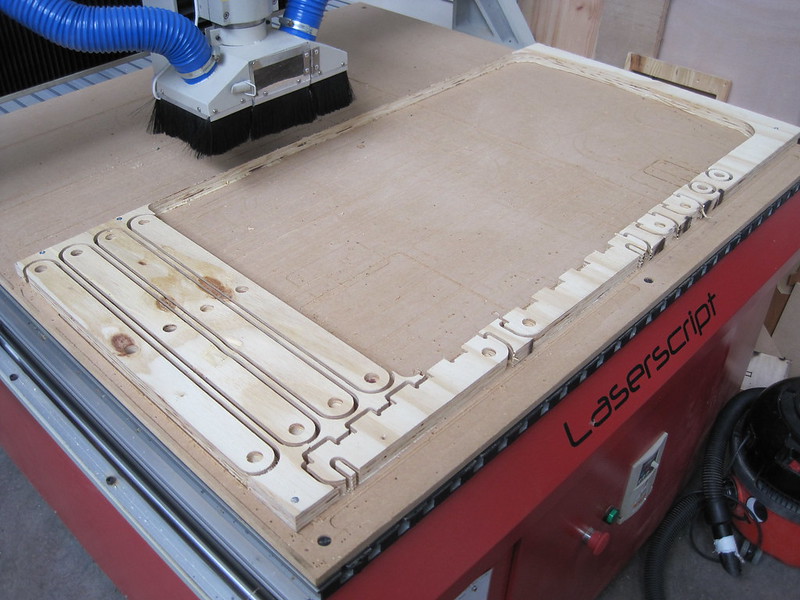
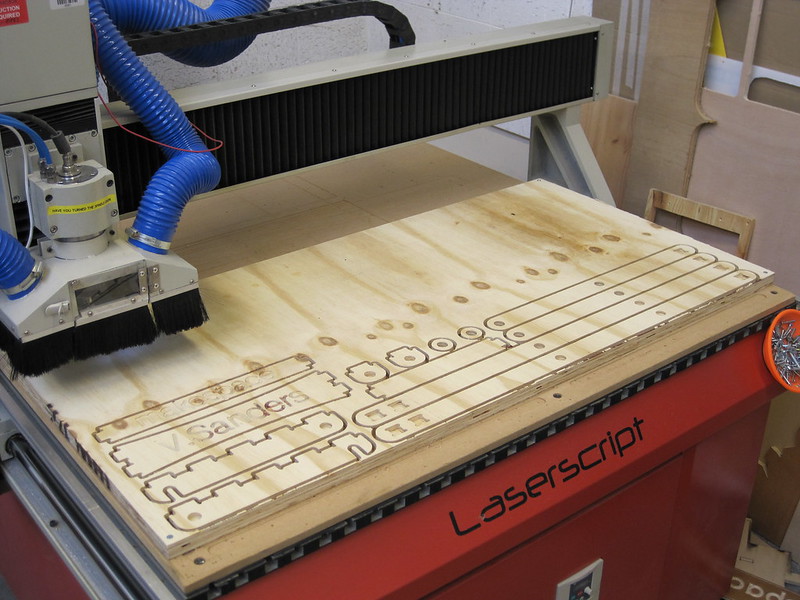
Manufacture wise the design is simple to produce although I really will have to teach our CNC router how to use the round over bit to reduce the finishing steps as currently that takes longer than the CNC operation.
In future if I make more of these I will use this design and, once she is less annoyed at me for making another chair, I am going to consult with my wife on adding some cushioning material to the seat and backrest.
And of course that concludes my furniture making for a while...yeah, right!
there have been comments which have complained about my usage of space on sheets and suggested I waste too much material. That is probably true and in my own defence I have not been working with this machine for very long and am not quite used to what I can "get away with" yet.
I was looking at the sheet after removing the last chair design and had a thought, I had not attempted a side X type folding design and perhaps I could squeeze one into the offcuts? I kinda got carried away, it roughly went:
Measure the available offcut space
Measured the remaining 18mm dowel leftover from my dowel hinge experiments
Found the largest width and height area I could get out of the sheet the CNC router ruined.
Sketched a design
Capture design to a DXF
Carefully spread the pieces over the available material in the CAM software
Generate a toolpath.
Cut material
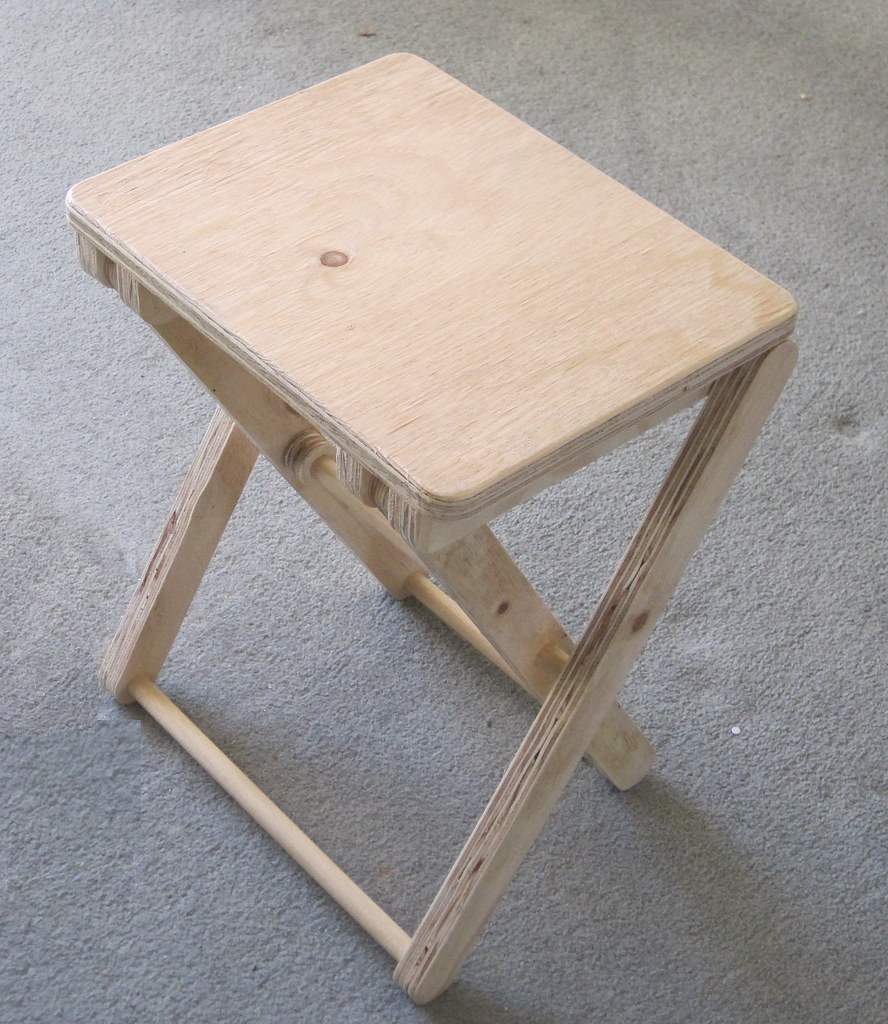
If all of that sounds like and utterly mad way to design a size X stool, you are of course correct, but it worked, and it was a very fast process taking less than four hours from idea to stool.
There are a couple of issues:
the popliteal height is 470mm ( I was aiming at 420 and missed...badly)
It uses a lot of expensive hardwood dowel (1373mm plus cutting width and only way I could get it accurate was to use the disc sander to remove fractions till the length was correct)
I used pockets for the interference seat joints rather than through cuts and discovered that you need to allow tolerance depth (the pegs are 10mm deep and the sockets need to be at least 10.2 not the 10mm I cut)
Dowel joints are great but have a small surface area so friction fit joints work loose.
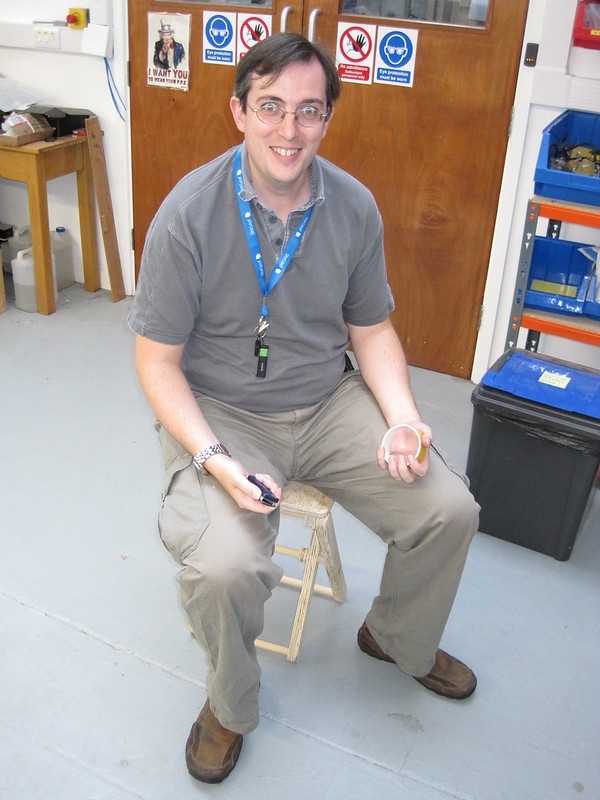
The seat went together dry fit and Paul tested it for me, however that last issue soon made me realise that this time I was going to have to resort to glue. Yes, sorry, this design needs to be glued to remain stable (I know plywood contains glue...please stop telling me that).
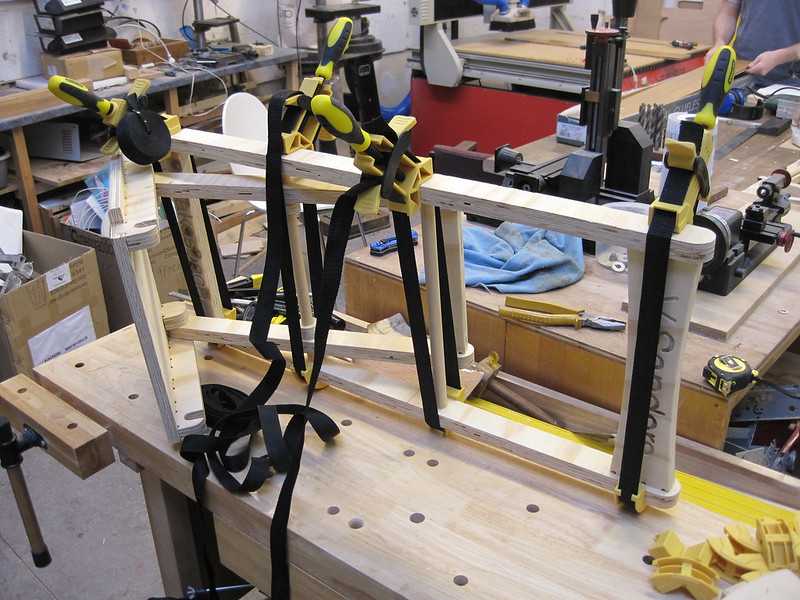
It is pretty simple to put together and aside from needing half the clamps in makespace to hold it in place while the glue dried, I had no trouble.
Though this is definitely not a case of use glue "sparingly" I put generous amounts in all the dowel joints and all the seat slots and got very little ooze so I guess it could have used more.
The final varnished stool is pretty robust but folds up nicely the concept of hooking to its own pivot dowel means it stays closed when flat which makes it very portable.
Total cost was an estimated 10.00 ( 4.25 dowel, 2.50 of 24mm ply, 1.75 for 18mm ply, 0.50 tool wear, 1.00 varnish) though the materials in my case could be argued to have cost nothing.
It has been suggested that I could make an entire picnic table and chairs set this way but if I did I would reduce the stool height by 50mm and examine ways to use less dowel.
Or in this case my final (and yes I am going to do something else next) chair design. It is based on the stool, in fact it is the stool design with the outer legs extended and a back rest added.
The modified design reduces the dowel requirements to 775mm but requires a bit more sheet material (cannot get this one entirely from offcuts).
Total cost was an estimated 10.50 ( 2.50 dowel, 4.50 of 24mm ply, 1.75 for 18mm ply, 0.50 tool wear, 1.25 varnish).
Because it is based on the stool design it suffers from the height issue and in addition the back rest is a bit far back to be completely comfortable.
Neither of the side X designs have flaws that interest me enough to follow the iterative approach again to solve them. Both the designs work well enough and rounded out my adventures with folding chairs and indeed furniture for now.
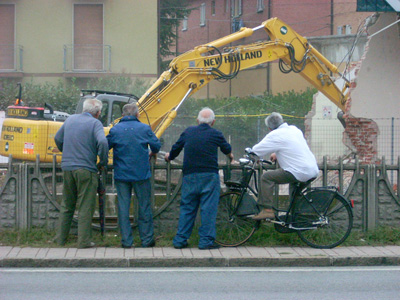
Umarell /uma'r l/ (oo-mah-rell), n; pl. Umarells. People in a community who
offer all sorts of comments to those who are trying to get some work done,
but who are not doing any work themselves.
Etymology and further details
Umarell is a word that entered Italian slang in Bologna and is spreading to
nearby towns, occasionally even across Italy. It comes from the
Bolognese for "cute/odd
little man".
"Umarells" are those people, usually retired men, who spend time watching
construction works, often holding their hands behind their back, occasionally
commenting on what is going on, sometimes trying to tell the workers what to
do.
It's easy to find exampleson theinternet; the word was popularised
by a blog collecting photos, which has even
been published into a book.
With some Italian Debian friends, we realised that umarell is the perfect
word to describe those people in a community, who offer all sorts of comments
to those who are trying to get some work done, but who are not doing any work
themselves.
I think that it is a word that fits perfectly, and since I'm likely going to
use it blissfully anywhere, here is a page that temporarily explains what it
means until the Oxford English Dictionary picks it up.
I have just bought a wireless phone charging system based on the Qi Inductive Power Standard. I bought a charging device which connects to a standard micro-USB cable and receivers for the Samsung Galaxy Note 2 and Samsung Galaxy S3 phones I own. Both those phones have contacts in the back of their case that are designed for wireless charging so you can install a charging device inside them. The charging devices make the case fit a little tight, and the charging device is stuck to the phone battery with contact adhesive, this makes it impractical to change the battery on a phone with such a device and makes it a little more difficult to swap out a battery case. One nice feature of the Nexus 4 is that it has Qi charging built in, that saved me $19 and was also more convenient.
I believe that the main advantage of a wireless charger is to avoid the risk of damage to the phone if it s dropped while connected to a USB charger. This allows the phone to be charged in situations where you might need to quickly or regularly unplug it to go somewhere. One example of how I might use it is when working at an office so I could charge my phone while at my desk and then quickly take it with me if I had to go to a meeting (sadly I have worked in many offices where they have so many meetings). Another example is for sysadmin work where I have to frequently visit devices to fix them.
The wireless charging mat that I bought from Kogan connects to a standard micro-USB plug, the good thing about this is that it s easy to find cables and it can take power from any PC. The bad thing about this is that the resistance of the USB cable is a factor that limits the power that a phone can receive, when using wireless charging you have the limit of the cable resistance as well as some power loss from the wireless transmission. After any extended period of charging the charging mat feels warm to the touch and the phone that s been resting on it feels warmer than usual. The warmth is an indication of energy loss which means longer charging times, a longer charging time isn t necessarily a problem as the convenience of wireless charging can allow longer charging times, but if you want to charge your phone in a hurry before you go somewhere then wireless isn t a good choice.
In the past I ve discovered that the battery in a Samsung Galaxy S3 can t be charged if the phone is at 46C [1]. 46C might seem extremely hot to people in some parts of the world (EG northern Europe and Canada) but the temperature in even southern parts of mainland Australia can get that hot and it can be hotter in central and northern parts, so phone temperature can be a real issue. Currently my house is at 21C according to a digital thermometer, the Galaxy S3 and the Note 2 are being charged from USB and report temperatures of 27C and 23C respectively. While the thermometer in my house and those in the phones probably aren t really accurate it seems reasonable to assume that the battery of a relatively idle smart-phone that s being charged will be a few degrees warmer than the ambient temperature. The Qi charger makes things a lot worse as it even feels warm to the touch. So maybe a phone on a Qi charger would be 8 degrees warmer than the ambient temperature or more. That implies that in Australian summer weather a Qi charger won t be useful outside or in any building that lacks air-conditioning. So I think we can give up on the idea of using Qi devices to charge phones at a BBQ.
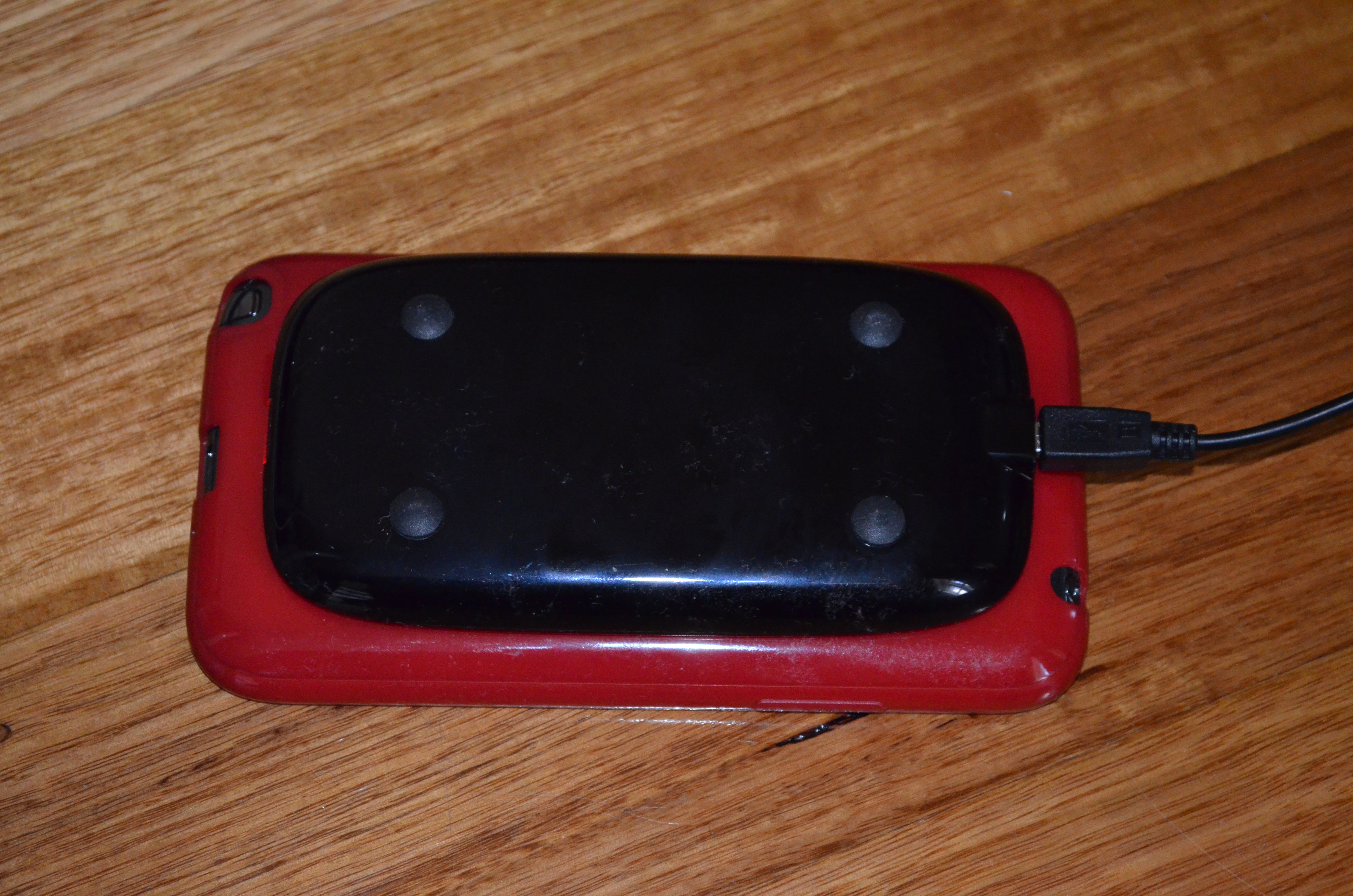
The final problem I have is that the Qi device is quite small, I took the above picture with my phone face-down because no part of the charger is visible in normal use. With that size I can t just dump a phone like a Note 2 on top of the charging mat and expect it to work. I have to carefully place it so that it balances and so that the wireless receptor inside the phone matches the transmitter in the mat, if the phone isn t placed correctly then the Qi mat won t detect it and won t supply full power to the transmitter.
Conclusion
I m fairly disappointed in this device. The waste heat makes it unsuitable for Australian summer conditions and slows charging. The difficulty of correctly placing the phone reduces the convenience which is one of the major features.
The price was $19 for each charging card for the Note 2 and the S3 and $29 for the charging mat to give a total of $67. I think it s worth the money for me to cover the risk of one of my phones having it s USB port damaged. Using a Qi charger on occasion will decrease the probability of such damage and allow the phone to be used after receiving certain types of damage.
The prices of those phones nowadays are $389 for a Galaxy S3 (Kogan price), $250 for a Nexus 4 (when it was on sale in the Google store), and probably about $500 for a Galaxy Note 2 (last time Kogan offered them). So by paying $67 for Qi charging I believe that I m getting some degree of damage insurance for just over $1100 worth of phones. It seems likely that the Nexus 5 will ship with Qi charging support and that the Galaxy Note 3 will also support an optional Qi charging card (which will probably also be $19 or some similar price) so the charging mat should be useful for a long time.
While I m disappointed I don t regret buying the device. But I would be hesitant to recommend it to other people and definitely wouldn t recommend it to someone who doesn t have a significant interest and investment in smart phones.
Some time ago, I provided an installation report for installing Debian wheezy onto a btrfs RAID1 filesystem.
It is not supported directly from the installer partitioning menu partman, but it is not hard to trick the installer to do it, as described in the bug report.
I believe this may be a worthy release goal for Debian 8 (jessie), but it is not something I can commit to facilitate myself so I am sharing my experience with it for those who may want to volunteer.
Anybody wanting to test it can easily do so with VirtualBox if they don't want to dedicate a real machine to it or if they don't have two real disks in their test machine. My own testing simply involved creating two VirtualBox virtual disks on a single SATA disk.
Procedure
Here is an abbreviated version of the procedure from the installation report linked above.
Run the Debian installer as normal up to the partitioning menu
Use manual partition mode
Create one big btrfs partition on one HDD (either on a raw partition or on an LV)
Designate the partition on one disk as the root FS, designate the partition on the other as unused/unformatted.
Continue through the setup, installing to one disk
After rebooting into Debian, follow these steps to add the other disk into a RAID1
A variation of this procedure is to use a shell while the installer is running to make the RAID1 during the installation and observe whether /etc/fstab is created correctly.
Potential gotchas: is the default fstab sufficient or does it need to be modified after the conversion to RAID1? Does the initframfs need to be regenerated (and potentially modified by hand?) to make it work?
Issues to be discussed / resolved
Mixing BTRFS filesystems with Logical Volume Management - how many permutations should the installer support? What do people expect/need/require?
How to boot if a disk fails? Can grub boot from either?
Warning the user when the FS detects instability or failure in either disk
A client has recently asked for my advice on web editing software. There are lots of programs out there for editing web sites and according to a quick Google search there are free Windows programs to do most things that you would want to do.
The first thing I m wondering about is whether the best option is to just get a Linux PC for web editing. PCs capable of running Linux are almost free nowadays (any system which is too slow for the last couple of Windows versions will do nicely). While some time will have to be spent in learning a new OS someone who uses Linux for such tasks will be able to use fully-featured programs such as the GIMP which are installed as part of the OS. While it is possible to configure a Windows system to run rsync to copy a development site to the production server and to have all the useful tools installed it s much easier to run a few apt-get or yum commands to install the software and then copy some scripts to the user s home directory.
The next issue is whether web editing is the best idea. Sites that are manually edited tend to be very simple, inconsistent, or both. Some sort of CMS seems to be the better option. WordPress is a CMS that I m very familiar with so it s easy for me to install it for a client, while I try and resist the temptation to force my favorite software on clients there is the issue that I can install WordPress quickly which therefore saves money for my client. WordPress is a CMS that supports installing different themes (and has a huge repository of free themes). The content that it manages consists of pages and posts , two arbitrary types of document. Supporting two types of document with a common look and feel and common important data in a side-bar seems to describe the core functionality used by most web sites for small businesses.
Does anyone have any other ideas for ways of solving this problem? Note that it should be reasonably easy to use for someone who hasn t had much experience at doing such things, it shouldn t take much sysadmin time to install or cost to run.
The bashism of this week deals again with tests. How do you compare two strings to tell which one goes before or after the other in the alphabet in a shell script? (also know as lexicographic comparison)
If you are familiar with perl and the relationship between its comparison operators and that of shell scripts, you would probably write the test as follows:
$ test bar '<' foo
$ test foo '>' bar
And yes, that would work, but not with all shells. I'm afraid to tell you that the < and > comparison operators are not required by the POSIX:2001 specification and are, therefore, bashisms.
What does this have to do with perl? well, the shell way is the inverse of the perl way. What? In Perl you test the equality of two numbers with '==', in shell you use '-eq'; in perl the equality of strings is 'eq', in shell it is '='. In shell scripts you can compare two numbers with -gt (test 1 -gt 0) while in perl the equivalent comparison is with > (1 > 0).
So in this case the perl way is "bar lt foo" and based on the above the shell way should be "bar < foo". However, care must be taken when using such operators in shell scripts. Since < and > are used for redirections in shell scripts, one must quote them even when using bash. An alternative is to use the [[ special test function of bash which alters the shell syntax.
This time I didn't write a function to portably (or "somewhat portably") replace such comparisons. Feel free to share your solution in the comments, with bonus points if you come up with a solution without using external commands.
While I suspect that professional speakers have separate presentation
laptops that they use only to give talks, I don't do this often enough to
justify the hassle and cost of a separate machine. However, I do use a
separate user account to present from.
It allows me to focus on my presentation and not stress out about running
into configuration problems or exposing private information. But mostly, I
think it's about removing anything that could be distracting for the
audience.
The great thing of having a separate user for this is that you can do whatever
you want in your normal account and still know that the other account is ready
to go and configured for presenting on a big screen.
Basics
The user account I use when giving talks is called presenter and it has
the same password as my main user account, just to keep things
simple. However, it doesn't need to belong to any of the UNIX groups that my
main user account belongs to.
In terms of configuration, it looks like this:
power management and screen saver are turned off
all sound effects are turned off
window manager set to the default one (as opposed to a weird tiling one)
desktop notifications are turned off
Of course, this user account only has the software I need while
presenting. You won't find an instant messaging, IRC or Twitter client
running on there.
The desktop only has the icons I need for the presentation: slides and
backup videos (in case the network is down and/or prevents me from doing a
live demo).
Web browsers
While I usually have my presentations in PDF format (for maximum
compatibility, you never know when you'll have to borrow someone else's
laptop), I use web browsers (different ones to show that my demos work with
all of them) all the time for demos.
Each browser:
clears everything (cookies, history, cache, etc.) at the end of the session
has the site I want to demo as the homepage
only contains add-ons or extensions I need for the demos
has the minimal number of toolbars and doesn't have any bookmarks
has search suggestions turned off
never asks to remember passwords
Terminal and editors
Some of my demos may feature coding demos and running scripts, which is why
I have my terminal and editor set to:
a large font size
a color scheme with lots of contrast
It's all about making sure that the audience can see everything and follow
along easily.
Also, if you have the sl package installed system-wide, you'll
probably want to put the following in your ~/.bashrc:
alias sl="ls"
alias LS="ls"
Rehearsal
It's very important to rehearse the whole presentation using this
account to make sure that you have everything you need and that you are
comfortable with the configuration (for example, the large font size).
If you have access to a projector or a digital TV, try connecting your
laptop to it. This will ensure that you know how to change the resolution
of the external monitor and to turn mirroring ON and OFF ahead of time
(especially important if you never use the default window manager or desktop
environment). I keep a shortcut to the display settings in the sidebar.
Localization
Another thing I like to do is to set my operating system and browser
locales to the one where I am giving a talk, assuming that it is a western
language I can understand to some extent.
It probably doesn't make a big difference, but I think it's a nice touch and
a few people have commented on this in the past. My theory is that it might
be less distracting to the audience if they are shown the browser UI and
menus they see every day. I'd love to have other people's thoughts on this
point though.
Also, pay attention to the timezone since it could be another source of
distraction as audience members try to guess what timezone your computer is
set to.
Anything else?
If you also use a separate account for your presentations, I'd be curious to
know whether there are other things you've customised. If there's anything I
missed, please leave a comment!
all your ctag (and checksum) are belong to us
A few months after the initial
announcement, here are some news about the sources.d.n service. I've been late
in blogging this, but most of it has been implemented by myself and
Matthieu Caneill during DebConf13, which has been a
great DebConf, totally exceeding my expectations (and they were
already fairly high!).
First, you might have noticed some user-visible
changes:
there is now an advanced
search page, which complements the already existing
regex code search with
the possibility of searching source files by their
sha256, or the ctags defined
therein
on the same topic, when browsing through a package and using
regex search, you'll now search by default within that
package, allowing to focus your searches more easily than before.
(You can easily override this by editing the search box and
removing the package: predicate.)
for the data geeks (or the wannabe host), there are now disk usage
stats (note that they don't include the database size,
though, see below for that)
the website also got a significant facelift, as
part of which we have moved the detailed explanations of what the
service is about out of your way. You now immediately get to the
various browsing options.
On the other hand, under the hood:
to implement ctags and sha256 searches we needed a serious DBMS,
so we switched from SQLite to PostgreSQL.
Again, for the data geek: storing ctags/sha256 for all of
sources.d.n content with decent indexes takes about 37 GB, for
about 160 million rows in the ctags table and 20 million rows in
the checksums one. (Currently filenames are duplicated between the
two tables so, probably, the DB disk size might be reduced
some.)
together with the switch to a serious DBMS, the update logics
has been completely rewritten in Python (from Bash...), and should
now be entirely transactional.
... and given it was going to be Python anyhow, better to enjoy
what it has to offer, no? So there is now a plugin
mechanism that makes it easier to add extra data
extractors, triggering them at each package update. Currently there
are plugins for sha256sum, ctags, and sloccount (even though the
latter is not yet exposed via the web interface). An added benefit
of this is that if you want to deploy debsources elsewhere, you can
easily disable the most time consuming extractors: running ctags
and sha256sum on the fabulous 3 chromium/libreoffice/linux
is not for the faint of disks...
we now receive push updates from the Debian
mirror network, so that you'll get updates on sources.d.n as soon
as a package hits Debian mirrors (+ processing time, which is about
15-20 minutes on the average update run). Many thanks to Simon
Paillard and Adam Lackorzynski for their help in setting this
up.
thanks to a suggestion by kugel we have
adopted Geany's conventions for
filetype detection, and we now take into account both file
extensions and shebang lines (when available)
As you usual, your bug reports (and patches!) are more than
welcome, just check
BUGS before reporting to avoid duplicates.
That's all!
I love to say that Python is a nice subset of Lisp, and I discover that it's
getting even more true as time passes. Recently, I've stumbled upon the
PEP 443 that describes a way to
dispatch generic functions, in a way that looks like what CLOS, the Common
Lisp Object System, provides.
What are generic functions
If you come from the Lisp world, this won't be something new to you. The
Lisp object system provides a really good way to define and handle method
dispatching. It's a base of the Common Lisp object system.
For my own pleasure to see Lisp code in a Python post, I'll show you how
generic methods work in Lisp first.
To begin, let's define a few very simple classes.
(defclasssnare-drum() ())
(defclasscymbal() ())
(defclassstick() ())
(defclassbrushes() ())
This defines a few classes: snare-drum, symbal, stick and brushes,
without any parent class nor attribute. These classes compose a drum kit,
and we can combine them to play sound. So we define a play method that
takes two arguments, and returns a sound (as a string).
(defgenericplay(instrumentaccessory) (:documentation"Play sound with instrument and accessory."))
This only defines a generic method: it has no body, and cannot be called
with any instance yet. At this stage, we only inform the object system that
the method is generic and can be then implemented with various type of
arguments. We'll start by implementing versions of this method that knows
how to play with the snare-drum.
Now we just defined concrete methods with code. They also takes two
arguments: instrument which is an instance of snare-drum and accessory
that is an instance of stick or brushes.
At this stage, you should note the first difference with object system as
built into language like Python: the method isn't tied to any class in
particular. The methods are generic, and any class can implement them, or
not.
Let's try it.
As you see, the function called depends on the class of the arguments. The
object systems dispatch the function calls to the right function for us,
depending on the arguments classes. If we call play with instances that
are not know to the object system, an error will be thrown.
Inheritance is also supported and the equivalent (but more powerful and less
error prone) equivalent of Python's super() is available via
(call-next-method).
In this example, we define the stick and brushes classes as subclass of
the accessory class. The play method defined will return the sound
BIIING! regardless of the accessory instance that is used to play the
cymbal. Except in the case where it's a brushes instance; only the most
precise method is always called. The (call-next-method) function is used
to call the closest parent method, in this case that would be the method
returning _"BIIING!".
Note that CLOS is also able to dispatch on object instances themself by
using the eql specializer.
But if you're really curious about all features CLOS provides, I suggest you
read the
brief guide to CLOS by Jeff Dalton
as a starter.
Python implementation
Python implements a simpler equivalence of this workflow with the
singledispatch function. It will be provided with Python 3.4 as part of
the functools module. Here's a rough equivalence of the above Lisp
program.
@functools.singledispatch defplay(instrument,accessory): raiseNotImplementedError("Cannot play these")
@play.register(SnareDrum) def_(instrument,accessory): ifisinstance(accessory,Stick): return"POC!" ifisinstance(accessory,Brushes): return"SHHHH!" raiseNotImplementedError("Cannot play these")
We define our four classes, and a base play function that raises
NotImplementedError, indicating that by default we don't know what to do.
We can then write specialized version of this function with a first
instrument, the SnareDrum. We then check for the accessory type that we
get, and return the appropriate sound or raise NotImplementedError again
if we don't know what to do with it.
If we run it, it works as expected:
The singledispatch module looks through the classes of the first argument
passed to the play function, and calls the right version of it. The first
defined version of the play function is always run for the object class,
so if our instrument is a class that we did not register for, this base
function will be called.
For whose eager to try and use it, the singledispatch function is
provided Python 2.6 to 3.3 through the Python Package Index.
Limitations
First, as you noticed in the Lisp version, CLOS provides a multiple
dispatcher that can dispatch on the type of any of the argument defined
in the method prototype, not only the first one. Unfortunately, Python
dispatcher is named singledispatch for this good reason: it only knows to
dispatch on the first argument. Guido van Rossum wrote a short article about
the subject that he called
multimethod a
few years ago.
Then, there's no way to call the parent function directly. There's no
equivalent of the (call-next-method) from Lisp nor the super() function
that allows to do that in Python class system. This means you will have to
use various trick to bypass this limitation.
So while I am really glad that Python is going toward that direction, as
it's a really powerful way to enhance an object system, it really lacks a
lot of more advanced features that CLOS provides out of the box.
Though, improving this could be an interesting challenge. Especially to
bring more CLOS power to Hy. :-)
A book I'm writing that will be launched soon, talking about
designing Python applications, state of the art, and various
Python tips.
If you want to be the first to hear about the launch, subscribe
now.
 Some time ago, Ubuntu had Ubuntu Brainstorm, a website where non-developers could submit ideas of improvements, and other people could comment and vote on them. I was wondering if there was existing software to deploy a similar service, e.g. as a plugin to popular forum software. I ve found ideascale.com, but relying on the Cloud for that is not acceptable for my planned use.
(For clarification: my immediate interest for that is unrelated to Debian work)
 Continuing last month progress report on

 The third lesson of the
 One of the earlier examples of students using MIT computer resources
to lay the groundwork for a later commercial endeavour,

 On a regular basis, I find myself the odd-man-out when it comes to talking
about how to work with Python on Debian systems. I'm going to write this and
post it so that I might be able to point people at my thoughts without having
to write the same email in response to each thread that pops up.
Turns out I don't fit in with the Debian hardliners (which is to say, the
mindset that





 While I suspect that professional speakers have separate presentation
laptops that they use only to give talks, I don't do this often enough to
justify the hassle and cost of a separate machine. However, I do use a
separate user account to present from.
It allows me to focus on my presentation and not stress out about running
into configuration problems or exposing private information. But mostly, I
think it's about removing anything that could be distracting for the
audience.
The great thing of having a separate user for this is that you can do whatever
you want in your normal account and still know that the other account is ready
to go and configured for presenting on a big screen.
 I love to say that Python is a nice subset of Lisp, and I discover that it's
getting even more true as time passes. Recently, I've stumbled upon the