Search Results: "mak"

6 November 2011

Dirk Eddelbuettel: Rcpp talk at Seattle RUG next month

The Seattle R User Group was kind enough to invite me to give a talk about R, C++ and Rcpp. So if you can make it to the Thomas building of the Fred Hutchinson Cancer Research Center in Seattle, WA, on December 7, I would love to see you there. I have some ideas about freshening up the presentation(s) based on material Romain and I have used in the past. This should make the why as well as how a little clearer; now I just have to find some to put this together. And if there are particular aspects you would like to see covered, please do get in touch with me.

5 November 2011

Christian Perrier: People behind Debian: Rapha l Hertzog, dpkg maintainer, book author

It's about time that Rapha l is interviewed in the "People behind Debian" series he initiated on his blog. Indeed, when he interviews people, Rapha l asks about other people they could suggest for next interviews. So, during mine, I suggested him to be a next "victim". As he couldn't interview himself, I volunteered for this. As you'll see below, Rapha l (who's a friend of mine as I'm a friend of his) likes to speak and that shows in the length of his answers :-) but you always know more about Debian when reading his blog posts, books, mails, etc. I personnally think that he is among the best promoters of the project for years and it was a pleasure for me to conduct this interview. My questions are in bold, the rest is by Rapha l. Who are you? Hi, Rapha l Hertzog, I'm a 32 years old French Debian developer who is married and who has a 2-year old son. I'm running my own company (Freexian) since 2005, I started it 3 years after the end of my computer science studies. I'm also a very proud author of the Cahier de l'Admin Debian, a French book about Debian. You often wrote about your attempts to make your living partly, if not completely, out of your Debian work. Can you describe the way you're trying to do this? My first try has been with Freexian. I always advertised this company as being specialized in Debian GNU/Linux. While Freexian is successful enough to provide me a decent income, I'm not really satisfied with the result because very few of my contracts are about improving Debian. I use Debian daily for the benefit of my customers, writing new customer specific (embedded) software, deploying a service on Debian servers, etc. But except for the occasional bugfix, all this work does not improve Debian (the only exception has been the dpkg multiarch implementation work sponsored by Linaro). The positive side is that I don't need to fill my entire schedule to earn enough money to live. So I'm regularly taking some days off work to be able to contribute to Debian. This is a freedom that I enjoy... My French book has also been a bestseller and depending on the years the royalties represented between 1 and 2 months of supplementary time that I can spend on Debian (that is between 2000 and 4000 EUR of income). Now since last year, I decided to actively work towards my goal of making a living out of my Debian work. I want to build on what has been most successful for me up to now, that is my book. My strategy has been to build an audience around my blog: with a direct contact with my readers I have the opportunity to sell e-books, and without any intermediary taking the biggest part of the price, I don't need a very large audience to be successful. I have also been experiencing micro-donations with Flattr, people who are enjoying my articles on my blog can use it to give a few cents for each article they find useful. With a large enough userbase, this could fund free documentation and would avoid the need for commercial e-books but we're not there currently and I don't know if it will ever reach the critical mass. Last but not least, I'm soliciting donations for my Debian work on the sidebar of my blog, and I have the chance to a have a few (regular) donators. You're a proud father since last year. How do you manage your commitment to the project with your family life? There are few things that I put above Debian in my life, but my family certainly is. I try to handle most of my Debian duties during work hours so that I can spend time with my family on evenings and during week-ends but in truth I never really disconnect from Debian. It happens quite often that I say to my wife I'll come in a few minutes, let me finish this and then I end up responding to a Debian mail, or an IRC query and take 30 minutes instead of the 5 expected ones. I try hard to avoid this but it's difficult. Luckily for me, my wife is very supportive of my Debian involvement and knows me well... By the way my wife is using Debian on her computer, and my son has already played with DoudouLinux (a Debian derivative!). Have you already been accused of self-promotion in your writings? If that would ever happen, what would you answer to that? Yes, more than once. I am proud of what I do for Debian, I enjoy sharing the result of my work. Because of this, some people believe that I'm selfish and egocentric. And this has somewhat increased since I have been soliciting donations: for me it's important to be transparent towards donators so that they see what I really do for Debian. But some people have the feeling that I'm getting undeserved attention and that I bring everything towards my own person. On the other side, as an author, I'm a public figure who is definitely seeking some attention... I don't have any miraculous answer, we are a large and diverse community, it's next to impossible to please everybody. I listen to all the concerns that people bring forward, I take them into account as much as possible, in particular when I believe they are reasonable/well justified, or when they come from people that I highly respect. But sometimes I have to plainly ignore them too... in particular when they are trying to impose their own political view on a topic that's not directly related to the only value that we all share: the social contract. Contributing to Debian is a challenge, we all have to make efforts to put aside our differences and to concentrate on the work that brings us closer to the best free software operating system ever built. You recently launched a campaign to free out the soon-to-be-published "Debian Administrator Handbook", an English version of your well-known book about Debian in French. Can you tell us more about this project? My French book has been very successful at helping people to get started with Debian, and like I already explained, it was also effective to fund a part of my Debian work. So I wanted to make it available world-wide by publishing an English translation of it. I tried to find an English-speaking editor willing to take on the challenge but I found none interested. Not put off by a setback, Roland (my co-author) and I decided to negotiate with our French editor Eyrolles to recuperate the necessary rights to translate the book into English. Handling everything ourselves represents a lot of work, but it also means that we have the freedom required to decide of the license of the resulting book. We would love to see it under a license compatible with the Debian Free Software Guidelines. But at the same time we firmly believe that we deserve a reasonable monetary compensation for the work on the book, so we conditioned its liberation to a predefined amount of money (25 K ) in what we call the "liberation fund". And since we wanted to be sure that we would have the required means to complete the translation, we used a crowfunding platform to seek support of people interested by the book. With such a platform you're only debited if the minimal requested amount is reached. Anyone can participate, pre-order the book and/or put some money in the liberation fund. As of today, we already reached the minimal funding goal (15 K ) so the book translation will happen. But the liberation target has not yet been reached so we don't know yet if the book will be free from the start... you can follow the progress right on the fundraising page or on the website dedicated to the book. PS: If you want to contribute to this project and also make a donation to Debian at the same time, you should check out this page. You're one of the main developers of dpkg, a critical tool for Debian systems. Can you tell us more about the current development challenges it is facing? What will be the new dpkg features for wheezy? The current challenges are not really technical. dpkg is a relatively mature piece of software and it will continue to work for the foreseeable future without needing much maintenance work. The real challenge is trying to setup a healthy developement community around it so that we can keep tackling new interesting problems (there are many listed in the roadmap and in the 225 wishlist bugs). There is a real problem of leadership and communication in the current team. We used to be three, and we're only two nowadays. Guillem is the legitimate leader since he's involved in dpkg's developement since early 2006 while I joined only in late 2007. But in the last 4 years, we did not manage to recruit anyone else on the team. Some persons tried to contribute significant new features (like Sean Finney with a rework of the way we handle configuration files) but they gave up frustrated after a while because we did not manage to review their work (and discuss the design) in any reasonable timeframe. Another famous case is Ian Jackson with his trigger work. His work got merged, but so late that in the mean time he blew up while trying to hijack the maintenance of dpkg. For a long time I was concentrating my work on the Perl part of dpkg (aka dpkg-dev mainly), so I did not feel qualified to review and merge work related to the C part and I was just a worried observator of this situation. I tried to improve it by setting up some basic review infrastructure, it should have brought some lisibility to the status of each change left to be reviewed... but it has not been used and it changed nothing. Over the years, I became much more interested in the C part. My first big contribution in C has been the rewrite of update-alternatives (from Perl to C). I made other small changes in between, but at the start of this year I had this great opportunity to work on the multiarch implementation (FYI, multiarch is the possibility to mix packages from several architectures on a single system). This really forced me to jump into the C codebase and learn a lot about how dpkg is implemented. Thanks to this I have been able to tackle other small projects (like the improved triggers). This would be all great if my multiarch work was already merged, but it's not. It's a large work, I do not mind waiting a bit in particular since Guillem is a highly skilled C programmer. His sharp analysis of new designs are invaluable, when he reviews code he always finds something to improve. I learnt a lot just by reviewing the code he wrote over the years. That said I have been waiting since April without almost no updates from him. With the release team asking us to hurry up, the situation is getting somewhat strained as I really want to see multiarch in Wheezy and I do not really want to short-circuit Guillem. Hum, I may have drifted a bit from your original question... what great new features can people expect? Well multiarch is supposed to be the big new feature, apart from that there aren't many things that matter to the end users. But there are already quite a few changes that are of interest to package maintainers (like hardened build flags, source package improvements, improved triggers, ). What's the biggest problem of Debian? Manicheism and a tendency to quickly polarize the discussions. In reality, there are very few situations where everything is all good or all bad. Ever since I have read The 7 Habits of Highly Effective People I try hard to put into practice the habits of interdependence . Instead of having only my point of view in mind, I try to understand the motivations from the other party ( Seek First to Understand, Then to be Understood ) in order to be able to put forward solutions acceptable to both parties ( Think Win-Win ). I highly recommend this book to anyone. And I invite everybody to at least try to follow those simple advices. Is there someone in Debian you admire for their contributions? There are many and I can't give an exhaustive list... here are some that I would like to highlight (in no particular order): Most of those people are working on improving Debian's infrastructure so that we can all be more effective and do an even better work. This kind of work is not always very visible but it's crucial to Debian's future. Thank you to Rapha l for the time spent answering my questions. I hope you enjoyed reading his answers as I did. And, anyway, it was fun to just play the game "the other way".

4 November 2011

Kai Wasserb ch: Greasemonkey scripts on dev.carbon-project.org

If you value your privacy, you might want to use a search engine like Ixquick which tries to protect your privacy. But if you value your privacy you probably have NoScript installed and have it hide <noscript> elements, as many pages hide tracking methods for users with deactivated JS in such tags. That makes every result page (but the first) inaccessible, because Ixquick has its non-JS navigation in noscript tags too. Now you could either activate JavaScript for Ixquick or work around this problem. Thanks to Greasemonkey and a little script I wrote, working around this issue is really easy. At this point, there is only this one script on dev.carbon-project.org, but in case I write another one, it'll end up there too. ;-)

Josselin Mouette: This is not a giant root exploit, this is a feature

So, there is some history of organisations doing a poor job at managing security bugs. We saw the This is not really a security hole jokes just to avoid having bad statistics in the front page. We saw the OMFG you must update to the latest version RIGHT NOW and no I m not telling why panic. We still frequently see security fixes hidden in unrelated public commits, just to make them harder to backport for distributors. But really, there is absolutely no match for that. Kudos for setting a new standard in the worse way of dealing with security issues, guys. Update: one of the developers has started insulting a pair of professional IT security experts who came and tried to educate him. Awesome reading, don t forget the popcorn.

3 November 2011

Andrew Pollock: [life] Zoe at 18 months

Wow, a lot (of travel) has happened in the last three months. Zoe has been to Chicago, Langkawi, Brisbane, and is now back in Mountain View. I'm actually feeling really guilty about our carbon footprint for this year. She spent the last about 3.5 weeks in Brisbane with Sarah after the wedding in Langkawi, until I flew there last weekend for my sister's wedding. Losing and finding Smudge helped pass the time, as did having Liam stay with me while he was visiting from Zurich. I could have done without the former, but really appreciated the timing of the latter. There was quite a noticeable vocabulary difference when I finally saw Zoe again. I can't keep up with all the words she can say now, and she's starting to grasp concepts as well. For example, she opened a small cardboard box, and declared it "empty". Apparently we say "uh oh" a lot, as this is one of her favourite things to blurt out whenever anything happens, ranging from my sister's bridal train dragging on the ground at her wedding, to vomiting all over herself in the back of the car. She's definitely not going to be a girly girl. When the flight from Brisbane landed in Los Angeles she yelled out a big "WHOA!" and then "Again!" while furiously doing the baby sign language for "more". Fortunately we were able to oblige for the flight from LAX to San Jose, and she again enjoyed the landing (she got to sit in her own seat for this one) and did a loud "Wow!" and "Again!" I'm looking forward to taking her on her first roller coaster ride. Her canine teeth still haven't come through yet, but I think they've just started to make an appearance. We're still trying to de-jetlag her at the moment, so it's unclear if the wake-ups throughout the night are because of jetlag or teeth issues (or a combination of both). She handled all of the travel fairly well, although she's now too long for a aeroplane bassinet. She didn't get a lot of sleep on the 12.5 hour flight from Brisbane to Los Angeles (which meant we got none), but she was pretty well behaved for the bulk of it. She's good enough on her legs now that she can just tear up and down the aisles without incident, so we made countless laps of the plane to keep her occupied. The return flight was on Halloween, and the cabin crew had gotten into the spirit with temporary face tattoos, some cabin decorations and some "costumes". The trip back home was actually epic in that it was littered with minor annoyances, but I'll save that for a separate blog post. This Christmas should be a fun one, as she'll be old enough to be a bit more interactive about the whole thing. She may also freak out sitting on Santa's knee, so we may not get quite as nice a photo as we got last year.

Matthew Garrett: Understanding the current state of UEFI

This story has been floating around for a week or so. The summary is that someone bought a system that has UEFI and is having trouble installing Linux on it. In itself, not a problem. But various people have either conflated this with the secure boot issue or suggested that UEFI is a fundamentally anti-Linux technology.

Right now there are no machines shipping to the public with secure boot enabled. None at all. If you're having problems installing Linux on a machine with UEFI then it's not because of secure boot. So what is actually causing the problem?

UEFI is a complicated specification, with 2.3.1A being 2214 pages long. It's a large body of code. There's a lot of subtleties. It's very easy for people to get things wrong. For example, we've seen issues where calling SetVirtualAddressMap() resulted in the firmware referencing boot services code, a clear violation of the spec on the firmware authors' part. We've also found machines that failed to boot because grub wasn't aligning its stack properly, a clear violation of the spec on our part.

Software is difficult. People make mistakes. When something mysteriously fails to work the immediate assumption should be that you've found a bug, not a conspiracy. Over time we'll find those bugs and fix them, but until then just treat UEFI boot failures like any other bug - annoying, but not malicious.

comment count unavailable comments

John Goerzen: Greece part 4: Food and Shopping

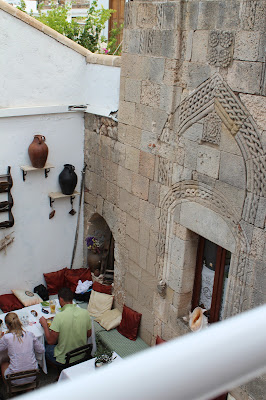
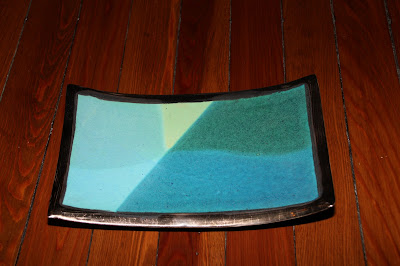
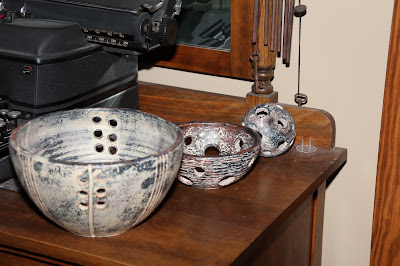
See also parts 1, 2, and 3. I am a person that enjoys food that s different from what s at home, and Rhodes didn t disappoint. Terah and I used to live close to an excellent Greek restaurant in Indianapolis, so we were already familiar in some way with the food. But there isn t any Greek restaurant at all in the Wichita area, so we missed it. Our favorite restaurant on Rhodes was Kalypso of Lindos. Everything there was just excellent, starting with the saganaki, one of my favorite Greek appetizers. I had yogurt with honey there for dessert both times we visited, a surprisingly tasty desert. Like many restaurants in Lindos, Kalypso had the option of eating on the rooftop, or at ground level. We ate on the roof, which had a nice view of the Lindos Acropolis. Being outdoors, there were sometimes cats around. This kitten enjoyed playing games with my shoestrings for awhile. Kalypso is at a 17th century captain s house. Here s a view of it from the rooftop: We, of course, had the chance to eat at quite a few different places during our visit, and I d go on way too long if I mentioned them all. Terah particularly enjoyed the gelaterie.gr ice cream shop in the square in Rhodes. We liked our lunch at Maria s Taverna in Lindos and enjoyed chatting with the staff there. I recently talked about shopping in Mexico, and perhaps learned a thing or two from that. I won t say we never buy them, but in general we don t buy souvenirs like t-shirts, plastic things made in China, etc. We prefer to buy local. Those items tend to be higher quality, more interesting, and we like to support the local economy. We also don t have lots of room for things, so we try to choose carefully. So it was something of a surprise to Terah, and perhaps even to me, when I suggested we go shopping one day. Terah typically enjoys shopping a lot more than I do. Anyhow, off we went to Lindos. One of the first things that had caught our eye in Lindos was the shop selling glass. But it wasn t just any glass; it appeared to be made with some sort of layered process, and has a distinctly three-dimensional feel to it. As you move around, it looks like the background shifts. We wound up with this item, which was made in Athens: By the time we visited Lindos specifically for shopping, we had a good feel for when the busy times of day were, so we could avoid them. It gave us the opportunity to visit with people and when they weren t busy, many shopkeepers liked to chat. I enjoy hearing people s stories and we heard several. One ceramics shop the Musa Shop -caught Terah s eye. They had such incredible and beautiful pieces outside that we just had to go in. We wound up with two pieces from there, both in shades of blue: Both remind me of the Aegean Sea and the deep blue sky of Rhodes. And then, as we were walking along, I pointed inside a shop and said to Terah, Hey, those look different. We went in, and eventually wound up buying these: The appearance, and even feel, of them is unlike anything I d seen. Quite interesting. And seeing those particular items in the Lakis Place shop led to making some new friends I ll write about it in the next post.

2 November 2011

Benjamin Mako Hill: Slouching Toward Autonomy

I care a lot about free network services. Recently, I have been given lots of reasons to be happy with the progress the free software community has made in developing services that live up to my standards. I have personally switched from a few proprietary network services to alternative systems that respect my autonomy and have been very happy both with the freedom I have gained and with the no-longer-rudimentary feature sets that the free tools offer. Although there is plenty left to do, here are four tools I'm using now instead of the proprietary tools that many people use, or that I used to use myself: In trying to switch away from proprietary services, I have found that there still a lack of good information comparing the different systems out there and giving folks advice on who might be able to help with things like setup or hosting. I really value hearing from other people about what they use and what they find useful but finding this information online still seems to be a struggle. The autonomo.us wiki seems like the natural place to host or summarize this discussion and to collect and share information useful for those of us slouching (or running) toward autonomy in our use of network services. I invite folks to get involved in improving that already useful resource. For example, this week, I spent a few hours researching free social bookmarking tools and produced a major update to the (already useful) social bookmarking page on the autonomo.us wiki. Of course, I can imagine lots of ways to improve that page and to collect similar information on other classes of network services. Please join me in that effort!

Jon Dowland: Greece (Dodecanese islands)

private pool in Kos private pool in Kos
In August 2010, Sarah and I had a lovely (but short) week-long holiday in Rhodes, Greece. We thoroughly enjoyed it but I didn't document it here. When John Goerzen was looking for European holiday destinations earlier this year, I had no hesitation in recommending Rhodes. I am surprised and delighted that John took up my suggestion and loved it too! See John's holiday blogging for more on this beautiful place. This year we wanted to take a two-week holiday and have a similar experience again. We ended up choosing Kos, Greece. Kos was, perhaps not surprisingly, quite similar to Rhodes. We were based in "Hotel Oceanis" in Psalidi, on the north-east side, about ten minutes bus journey from Kos town. The hotel was very relaxing with plenty of space. It's based on the sea-side and has two public pools: the large main one and a smaller (but seemingly deeper) one adjacent to a snack bar. We were very lucky to find that the hotel had put is in a room with a private swimming pool! In total, we had four separate places to swim in the hotel. Kos town was similar to Rhodes town, but not quite as "historic" feeling. It was a bit larger/more spread-out. Some areas of the town are quite lively but we always managed to find pleasant and quiet places to eat and drink together. We had twice as much time and took advantage of that by hiring a car and visiting the rest of the island. In particular we loved the beach in Mastichari (middle-North), which had quite turbulent rolling waves. "Sunny beach" on the south coast was absolutely packed with holiday makers, but was none-the-less worth the look. All in all, my first two experiences of Greek islands were wonderful. One day, I'm sure we will return to (at least) Rhodes, but we may leave it for a while and see what the rest of the world has to offer in the mean time.

1 November 2011

Steve Kemp: Slaughter is at the cross-roads

There are many system administration and configuration management tools available, I've mentioned them in the past and we're probably all familiar with our pet favourites. The "biggies" include CFEngine, Puppet, Chef, BFG2. The "minis" are largely in-house tools, or abuses of existing software such as fabric. My own personal solution manages my home network, and three dedicated servers I pay for in various ways. Currently I've been setting up some configuration "stuff" for a friend and I've elected to manage some of the setup with this system of my own, and I guess I need to decide what I'm going to do going forward. slaughter is well maintained, largely by virtue of not doing too much. The things it does are genuinely useful and entirely sufficient to handle a lot of the common tasks - and because the server-side requirement is a HTTP server, and the only client-side requirement is CRON it is trivial to deploy. In the past I've thought of three alternatives that would make it more complex: Each approaches have their appeal. I like the idea of only executing GPG-signed policies, and that would be trivial if there was a real server in place. It could also use SSL because that's all you need for security (ha!). On the other hand using rsync allows me to trivially implement the only missing primitive I actually miss at times - the ability to recursively download and install a remote directory tree. (I solve this problem by downloading a .tar file and unpacking it. Not good. Doesn't cope with template expansion and is fiddlier than I like). In the lifetime of the project I think I've had 20-50 feature requests or comments, which suggests it might actually be used by 50-100 people. (Ha! Optimism) In the meantime I'll keep a careful eye on the number of people who download the tarball & the binary packages... ObQuote: "I have vermin to kill. " - Kill Bill

Sylvain Beucler: Build a SFML project with CMake

[Latest version of these instructions can be found at the SFML Wiki] CMake allows your project to be built in various environments, including command-line make, Code::Blocks project files, Eclipse project files, etc. It's used in SFML 2.0. In this tutorial we'll write a simple CMake configuration file with centralized version numbering, and see how to integrate SFML in it. The source files First, create a cmake_modules directory and copy FindSFML.cmake in it. FindXXXX is automatically searched by CMake's find_package command. Then create a main.cpp, for instance:
#include "config.h"
#include <iostream>
#include <SFML/Window.hpp>
using namespace std;
int main(int argc, char* argv[])  
  cout << "Version " << myproject_VERSION_MAJOR << "." << myproject_VERSION_MINOR << endl;
  sf::Window screen(sf::VideoMode(800, 600), "myproject");
  bool running = true;
  while (running)  
    screen.Display();
   
 
We use a config.h file that is built by CMake, let's also create a config.h.in file:
#define myproject_VERSION_MAJOR @myproject_VERSION_MAJOR@
#define myproject_VERSION_MINOR @myproject_VERSION_MINOR@
And place your project license (such as the GNU GPL) in a file named COPYING. CMake configuration Let's describe our project configuration in the CMakeLists.txt file:
cmake_minimum_required(VERSION 2.6)
project(myproject)
# Set version information in a config.h file
set(myproject_VERSION_MAJOR 1)
set(myproject_VERSION_MINOR 0)
configure_file(
  "$ PROJECT_SOURCE_DIR /config.h.in"
  "$ PROJECT_BINARY_DIR /config.h"
  )
include_directories("$ PROJECT_BINARY_DIR ")
# Define sources and executable
set(EXECUTABLE_NAME "myproject")
add_executable($ EXECUTABLE_NAME  main.cpp)
# Detect and add SFML
set(CMAKE_MODULE_PATH "$ CMAKE_SOURCE_DIR /cmake_modules" $ CMAKE_MODULE_PATH )
find_package(SFML 1.6 REQUIRED system window graphics network audio)
target_link_libraries($ EXECUTABLE_NAME  $ SFML_LIBRARIES )
# Install target
install(TARGETS $ EXECUTABLE_NAME  DESTINATION bin)
# CPack packaging
include(InstallRequiredSystemLibraries)
set(CPACK_RESOURCE_FILE_LICENSE "$ CMAKE_SOURCE_DIR /COPYING")
set(CPACK_PACKAGE_VERSION_MAJOR "$ myproject_VERSION_MAJOR ")
set(CPACK_PACKAGE_VERSION_MINOR "$ myproject_VERSION_MINOR ")
include(CPack)
The interesting part is:
# Detect and add SFML
set(CMAKE_MODULE_PATH "$ CMAKE_SOURCE_DIR /cmake_modules" $ CMAKE_MODULE_PATH )
find_package(SFML 1.6 REQUIRED system window graphics network audio)
target_link_libraries($ EXECUTABLE_NAME  $ SFML_LIBRARIES )
Compilation To build with Make and the GCC compiler on the command-line:
cd build/  # a separate directory so we can easily remove all the CMake work files
cmake ..  # generate Makefile's
make
To create Code::Blocks project files:
cmake .. -G "CodeBlocks - Unix Makefiles"
and open project.cbp with Code::Blocks. Installation CMake supports the classic:
make install
It also supports DESTDIR, useful in packaging:
make install DESTDIR= pwd /myworkdir
You can also define CMAKE_INSTALL_PREFIX when invoking cmake to change the default install path (/usr/local under Unix). DESTDIR would still override this setting. Packaging You then can use cpack to make a project release:
# Binary package:
cpack -C CPackConfig.cmake
# Source package:
cpack -C CPackSourceConfig.cmake
You will get a nice myproject-1.0.tar.gz, among others. Further information
$ cmake --help-variable CMAKE_SOURCE_DIR
cmake version 2.8.5
  CMAKE_SOURCE_DIR
       The path to the top level of the source tree.
       This is the full path to the top level of the current CMake source
       tree.  For an in-source build, this would be the same as
       CMAKE_BINARY_DIR.

Bernhard R. Link: File ownership and permissions in Debian packages

As you will know, every file on a unixoid system has some meta-data like owner, group and permission bits. This is of course also true for files part of some Debian package. And it is not very surprising that different files should have different permissions. Or even different owners or groups. Which file has which settings is of course for the package maintainer to decide and Debian would not be Debian if there were not ways for the user to give their own preferences and have them preserved. This post is thus about how those settings end up in the package and what is to be observed when doing it. As you will also have heard, a .deb file is simply a tar archive stored as part of an ar archive, as you can verify by unpacking a package manually:
$ ar t reprepro_4.8.1-1_amd64.deb
debian-binary
control.tar.gz
data.tar.gz
$ ar p reprepro_4.8.1-1_amd64.deb data.tar.gz   gunzip   tar -tvvf -
drwxr-xr-x root/root         0 2011-10-10 12:05 ./
drwxr-xr-x root/root         0 2011-10-10 12:05 ./etc/
drwxr-xr-x root/root         0 2011-10-10 12:05 ./etc/bash_completion.d/
-rw-r--r-- root/root     19823 2011-10-10 12:05 ./etc/bash_completion.d/reprepro
drwxr-xr-x root/root         0 2011-10-10 12:05 ./usr/
drwxr-xr-x root/root         0 2011-10-10 12:05 ./usr/share/
--More--
(For unpacking stuff from scripts, you should of course use dpkg-deb --fsys-tarfile instead of ar gunzip. Above example is about the format, not a recipe to unpack files). This already explains how the information is usually encoded in the package: A tar file contains that information for each contained file and dpkg is simply using that information. (As tar stores numeric owner and group information, that limits group and owner information to users and groups with fixed numbers, i.e. 0-99. Other cases will be covered later.) The question for the maintainer is now: Where is the information which file has which owner/group/permissions in the .tar inside the .deb, and the answer is simple: It's taken from the files to be put into the .deb. This means that package tools could simply be implemented first by simply calling tar and there is no imminent need to write you own tar generator. It also means that the maintainer has full control and does not have to learn new descriptive languages or tools to change permissions, but can simply put the usually shell commands into debian/rules. There are some disadvantages, though: A normal user cannot change ownership of files and one has to make sure all files have proper permissions and owners. This means that dpkg-deb -b (or the usually used wrapper dh_builddeb) must be run in some context where you could change the file ownership to root first. This means you either need to be root, or at least to fake being root by using fakeroot. (While this could be considered some ugly workaround, it also means upstream's make install is run believing to be root, which also avoids some -- for a packager -- quite annoying automatisms in upstream build scripts assuming a package is not installed system wide if not installed as root). Another problem are random build host characteristics changing how files are created in the directory later given to dpkg-deb -b. For example an umask which might make all files non-world-readable by default. The usual workaround is to first fix up all those permissions. Most packages use dh_fixperms for this, which also sets executable bits according to some simple rules and has some more special cases so that the overall majority of packages does not need to look at permissions at all. So using some debhelper setup, every special permissions and all owner/group information for owner groups with fixed numbers only needs to be set using the normal command line tools between dh_fixperms and dh_builddeb. Everything else happens automatically. Note that games is a group with fixed gid. So it is not necessary (and usually a bug) to change group-ownership of files withing the package to group games in maintainer scripts (postinst,...). If a user wants to change permissions or ownership of a file, dpkg allows this using the dpkg-statoverride command. This command essentially manages a list of files to get special treatment and ownership and permission information they should get. This way a user can specify that files should have different permissions and this setting is applied if a new version of this file is installed by dpkg. Being a user setting especially means, that packages (that means their maintainer scripts) should not usually use dpkg-statoverride. There are two exceptions, though: Different permissions based on interaction with the user (e.g. asking question with debconf) and dynamically allocated users/groups with dynamic id. In both cases one should note that settings to dpkg-statoverride are settings of the user, so the same care should be given as to files in /etc, especially one should never override something the user has set in there. (I can think of no example where calling dpkg-statoverride --add without dpkg-statoverride --list in some maintainer script is not a serious bug: Either you override user settings or you are using debconf as a registry. Moral To recap, your package is doing something wrong if:

Michal &#268;iha&#345;: New Pootle on l10n.cihar.com

Translation server for phpMyAdmin and Gammu/Wammu has been updated to run latest Pootle. I had to do this upgrade to be able to run on latest Django, which is used by other websites as well (this blog is one of them). Unfortunately it was not as easy as running apt-get upgrade as Pootle package has been dropped from Debian recently. So I had to make quick and dirty packages myself (no removal of embedded software and so on). Installing newer version lead to major breakage as the database upgrade silently failed and I had to recover manually. In the end I've dropped all pootle_* tables and recreated them again. Unfortunately this lead to loss of some data from user profiles, but I could not see other way around. Anyway the service should be now back running in normal shape, so go ahead and translate :-).

Filed under: Debian English Phpmyadmin 0 comments Flattr this!

Philipp Kern: Useful Firefox extensions

Many people around me switched to Chrome or Chromium. I also used it for a bit, but I was a bit disappointed about the extensions available. To show why, here's a list of the extensions I've currently installed:
If Firefox on Android were quicker to start and faster overall, I might even use it there. But as-is it's not very useful. Sadly this also means that I can't use Firefox Sync on my phone and as I don't use Chrome on my desktop I also can't use Chrome to Phone. So I usually go and build a QR code on my laptop and read that with Android's Barcode Scanner.

Of course I'm actually using Iceweasel and I'm very grateful for Mike Hommey's efforts to track the release channel on mozilla.debian.net.

Rapha&#235;l Hertzog: My Debian activities in October 2011

This is my monthly summary of my Debian related activities. If you re among the people who made a donation to support my work (130.30 , thanks everybody!), then you can learn how I spent your money. Otherwise it s just an interesting status update on my various projects. Dpkg work The month started with fixing newly reported bugs to prepare the 1.16.1.1 release: With the help of Guillem, we decided on a proper fix for a race condition sometimes triggered by parallel builds when 2 concurrent dpkg-gencontrol try to update debian/files (see #642608). This ended up requiring a new package (libfile-fcntllock-perl) that the Debian perl team kindly packaged for us. With all this sorted, it was a rather easy fix. Multiarch progress I also spent lots of time on multiarch. I fixed an old bug that requested to support the multi-arch paths in case of cross-building (see #595144), the discussion was not really conclusive on which of the two proposed patches was better so I ended up picking my own patch because it was closer to how we currently deal with cross-building. Then I fixed 2 issues that have been reported on Ubuntu s dpkg. The first one (LP #863675) was rather severe since an installed package ended being disappeared in favor of its foreign counterpart that was removed (but that had some config files left). The second one (LP #853679) only affected dselect users (apparently there are still some!) who had a self-conflicting library (Provides: foo, Conflicts: foo) installed for multiple architectures. But the bulk of the time spent on multiarch has been spent discussing with various parties on how to go forward with multiarch. The release team commented on the schedule of the merge to ensure it makes it into Wheezy, and the Debian project leader also commented on the problems encountered so far. While not the best course of action I could have hoped for, it certainly helped since Guillem started pushing some reviewed commits. Out of the 66 commits that were in my pu/multiarch/full branch one week ago, 20 have been merged in the master branch already. Python-django security update and RC bug Since python-django s maintainer did not manage to prepare the required security updates, I stepped in and prepared version 1.2.3-3+squeeze2 for Squeeze and 1.0.2-1+lenny3 for Lenny. Unfortunately this security update is an example of how an inactive maintainer is likely to result in a severe delay for the release of security updates. Furthermore in this specific case, the security team did not want to release the Squeeze security update until the Lenny one had been investigated (which required some time since upstream no longer supports the version in Lenny) but they did not make this very clear. Later another release critical bug had been filed against the package (#646634) but after investigation, it turned out to be a local configuration problem so I downgraded it. I still forwarded the test suite failure to upstream authors since the test could be enhanced. In any case, co-maintainers for python-django are welcome. I really preferred the situation where I can quietly sit down as backup maintainer :-) WordPress packaging WordPress sounds similar to python-django. I m also only a backup maintainer but Giuseppe has been inactive for many months and I had to step in August because I wanted the new upstream version. I discovered a bit late that I was not subscribed to wordpress bugs and thus the release critical bug #639733 (that I introduced with my new upstream version) went unattended for a rather long time. Once aware, though, I quickly fixed it. I also took the opportunity to start a discussion on debian-devel about how to deal with embedded javascript libraries and proposed a mechanism of opportunistic replacement with symlinks . WordPress is my testbed package for this mechanism, you can check out its debian/dh_linktree that implements the replacement logic. The discussion has not been very interesting but at least I learned that Debian now requires that each source package shipping minified javascript files includes the original files too. It s somewhat of a pain since it s not a license requirement in many cases (many of those libraries are not under the GPL), but just a Debian requirement that many upstreams are not complying with. WordPress is affected and Jakub Wilk thus opened #646729 which is going to be a long-standing RC bug. To give good measures, I spent several hours investigating the case of each javascript file in the WordPress source package and I filed a new ticket on the upstream bugtracker. Dropbox packaging work A few months after the introduction of nautilus-dropbox to Debian and Ubuntu, I can say that the decision to only support the download of dropbox in the postinst has been a mistake. Because of this decision I had to make the postinst fail if the download failed. Even if the error message is relatively clear, this lead to many (mostly automated) bug reports on the Ubuntu side. Various other problems cropped up on top of this (trying to start dropbox while the package was not configured would result in an error because the user did not have the required rights to install the software, reinstalling the package while dropbox was running would result in a failure too, etc.). I have fixed all those issues in the version 0.7.0-2 of the package. Now if the user has to install dropbox, it will use PolicyKit to request the root rights. The postinst will no longer fail if the dropbox download fails since it can be run later by the user. And I fixed the download code to remove the replaced file before unpacking a new file (insead of overwriting the existing file). All this work has been forwarded upstream. The Debian Administrator s Handbook Update I m glad to tell you that the translation will happen because we reached the minimal funding goal on October 22th with the help of 380 supporters. Now the fundraising continues, but this time the goal is the liberation of the resulting book. For this to happen, we need to reach 25000 EUR in the liberation fund. So far we re at 37% of this goal with 9400 EUR in the liberation fund (which means that 59% of the money raised has been put in the liberation fund).

Click here if you want to contribute towards the liberation of this book. With (less than) 27 days left, it s going to be a challenge to meet the goal, but we do like challenges, don t we? Misc work

Thanks See you next month for a new summary of my activities.

2 comments Liked this article? Click here. My blog is Flattr-enabled.

31 October 2011

Jon Dowland: Rage

Rage is the latest game by Id Software, a company whose prior work I have an immense fondness for. I picked it up at the same time as buying a refurbished Playstation 3 a few weeks ago. Sadly, I'm not too impressed. The graphics are very pretty, most of the time, but the PS3 suffers the same problem which has plagued the PC version, namely, texture pop-up: A noticeable delay for a low-resolution texture to be swapped in for a high-resolution one. I'm only about 45 minutes in but my experience mirrors that of Rock Paper Shotgun's: It's desperately trying to disguise it's own linearity. Finally, and most crucially, I'm suffering majorly from motion sickness after more than a few minutes of play. This might be related to the fact that Rage's framerate is apparently double that of most games at 60 frames per second. Whatever the explanation, I can't play it if it makes me sick to do so! I may trade it in for the similarly-themed Fallout: New Vegas, which I held off buying simply because I thought two post-apocalyptic FPS games was too many. I loved Fallout 3 (albeit on Xbox 360), logging perhaps 50+ hours of play with plenty more to do; but I don't think I could return to the beginning of that game.

Gregor Herrmann: RC bugs 2011/43

a bit late & short (I was travelling the last days) but here it is: the recent update of my RC bug acitivities:

Russell Coker: SE Linux Status in Debian 2011-10

Debian/Unstable Development deb http://www.coker.com.au wheezy selinux The above APT sources.list line has my repository for SE Linux packages that have been uploaded to Unstable and which will eventually go to testing and then the Wheezy release (if they aren t obsoleted first). I have created that repository for people who want to track SE Linux development without waiting for an Unstable mirror to update. In that repository I ve included a new version of policycoreutils that now includes mcstrans and also has support for newer policy such that the latest selinux-policy-default package can be installed. The version that is currently in Testing supports upgrading policy on a running system but doesn t support installing the policy on a system that previously didn t run SE Linux. I have also uploaded SE Linux Policy packages from upstream release 20110726 compared to the previous packages which were from upstream release 20100524. As the numbers imply there is 14 months of upstream policy development which changes many things. Many of the patches from my Squeeze policy packages are not yet incorporated in the policy I have uploaded to Unstable. I won t guarantee that an Unstable system in Enforcing mode will do anything other than boot up and allow you to login via ssh. It s definitely not ready for production but it s also very suitable for development (10 years ago I did a lot of development on SE Linux systems that often denied login access, it wasn t fun). Kyle Moffett submitted a patch for libselinux which dramatically changed the build process. As Manoj (who wrote the previous build scripts) was not contactable I accepted Kyle s patch as provided. Thanks for the patch Kyle, and thanks for all your work over the years Manoj. Anyway the result of these changes should mean that it s easier to bootstrap Debian on a new architecture and easier to support multi-arch but I haven t tested either of these. Squeeze The policy packages from Squeeze can t be compiled on Unstable. The newer policy compilation tool chain is more strict about how some things can be declared and used, thus some policy which was fairly dubious but usable is now invalid. While it wouldn t be difficult to fix those problems I don t plan to do so. There is no good reason for compiling Squeeze policy on Unstable now that I ve uploaded a new upstream release. deb http://www.coker.com.au squeeze selinux I am still developing Squeeze policy and releasing it in the above APT repository. I will also get another policy release in a Squeeze update if possible to smooth the transition to Wheezy the goal is that Squeeze policy will be usable on Wheezy even if it can t be compiled. Also note that the compilation failures only affect the Debian package, it should still be possible to make modules for local use on a Wheezy system with Squeeze policy. MLS On Wednesday I m giving a lecture at my local LUG about MLS on SE Linux. I hope to have a MLS demonstration system available to LUG members by then. Ideally I will have a MLS system running on a virtual server somewhere that s accessible as well as a Xen/KVM image on a USB stick that can be copied by anyone at the meeting. I don t expect to spend much time on any aspect of SE Linux unrelated to MLS for the rest of the week. Version Control I need to change the way that I develop SE Linux packages, particularly the refpolicy source package (source of selinux-policy-default among others). A 20,000 line single patch is difficult to work with! I will have to switch to using quilt, once I get it working well it should save me time on my own development as well as making it easier to send patches upstream. Also I need to setup a public version control system so I can access the source from my workstation, laptop, and netbook. While doing that I might as well make it public so any interested people can help out. Suggestions on what type of VCS to use are welcome. How You Can Help Sorting out the mess that is the refpolicy package, sending patches upstream and migrating to a VCS is a fair bit of work. But there are lots of small parts. Sending patches upstream is a job that could be done in small pieces. Writing new policy is not something to do yet. There s not much point in doing that while I still haven t merged all the patches from Squeeze maybe next week. However I can provide the missing patches to anyone who wants to review them and assist with the merging. I have a virtual server that has some spare capacity. One thing I would like to do is to have some virtual machines running Unstable with various configurations of server software. Then we could track Unstable on those images and use automated testing to ensure that nothing breaks. If anyone wants root access on a virtual server to install their favorite software then let me know. But such software needs to be maintained and tested!

30 October 2011

Vincent Sanders: Software that adds another dimension to things

I think that it will come as no surprise to my fellow software engineers if I note that I almost never write new software any more. I maintain, I augment, I refactor, I debug but very, very rarely do I start something new.

This probably has something to do with my maturity as a code monkey, my immediate reaction is to seek out a solution to a problem that already exists and perhaps extend it to fulfil my requirements.

Partially this comes from my innate laziness but also over time I have discovered that I am a "finisher" the role I invariably end up in involves doing all the final bits to make the client accept a project. Because I know my reaction is to always finish something I start, I avoid starting things.

Anyhow, enough introspection, a couple of months ago I was talking on IRC about my 3D printer and was asked "can you print the Debian logo?". So I hunted around for software that would let me convert a bitmap into a suitable 3d format. The result was rather disappointing, the few tools I could find were generally python scripts which simply generated a matrix of cuboids, one for each pixel their heights corresponding to the pixel value.

I used one such script to generate a file for the Debian swirl and imported it into the OpenScad 3d modelling application. I got an inkling of the issues involved after the scene render took over half an hour. The resulting print was blocky and overall I was not terribly happy with the outcome.

So I decided I would write a program to convert images into a 3D representation. I asked myself, how hard can it be?

Sometimes starting from an utterly naive approach with no knowledge of a problem can lead to new insights. In this case I have spent all my free coding time for a month producing a program which I am now convinced has barely even scratched the surface of the possible solutions.

Having said that I have started from a blank editor window and a manual gcc command line compilation and progressed to an actually useful tool and, arguably, of more import to me I have learned and implemented a load of new algorithms which has actually been mentally stimulating and fun!

The basic premise of the tool is to take a PNG image, quantise it into a discrete number of levels , convert that as a height map into a triangle mesh, index that mesh (actually a very hard problem to solve efficiently), simplify the indexed mesh and output the result in a selection of 3D file formats.

The mesh generation alone is a complex field which it appears often devolves into the marching cubes algorithm simply out of despair of anything better ;-) I have failed to implement marching cubes so far (though I have partially implemented marching squares, an altogether simpler algorithm)

The mesh indexing creates an indexed list of vertices from the generated mesh and back annotates it with which faces are connected to which vertices. This effectively generates a useful representation of the meshes topology which can then be used to reduce the complexity of the mesh, or at least describe it. To gain efficiency I implemented my first ever bloom filter as part of my solution. I also learned that generating a plausible hash for said filter is a lot harder than it would seem. In the end I simply used the FNV hash which produces excellent results for very little computation cost.

The mesh simplification area is awash with academic research, most of which I ended up skipping and simply went for the absolute simplest edge removal algorithm. Implementing even this and maintaining a valid mesh topology was challenging.

By comparison the output of the various formats was positively trivial, mainly littered with head scratching over the bizzare de-facto "extensible" formats where only one trivial corner is ever actually implemented.

All in all I have had fun creating the PNG23D project and have actually used it to generate some useful output. I have even printed some of it to generate a lithophane of Turing. I now look forward to several years of maintaining and debugging it and doing all the other things I do instead of writing new software ;-)

29 October 2011

Joey Hess: two random thoughts about bugs

First thought is this: A bug's likelyhood of ever being fixed decays with time, starting when I first read it. If I have to read it a second time, the bug has already become more complex, since something prevented me from just fixing it the first time. If more information has to be added to the bug, that makes it yet more complex. If there is an argument in the bug about whether it is a bug, or how to fix it, just revisiting the bug at a later date can become more expensive than it's worth. Much of what is involved in filing good and effective bug reports are obvious corollaries of this. It also follows that it's best to either fix, or at least plan how to fix a bug immediatly upon reading it. Second thought is about "wontfix". A bug submitter and the developer responsible for the bug see this state in very different ways, but the name hides what it really means, which is that there is a meta-bug affecting either the bug submitter, the developer, or both. Once you realize this, wontfix bugs, from either side, become a bit personally insulting. They also quickly decay to uselessness (see first thought), and then just lurk there wasting the developer's time in various ways. Bug tracking systems should not provide a "wontfix" state; if they want to track meta-bugs they should provide a way to reassign such a bug to some other party who can actually resolve such a meta-bug.

Next.

Previous.