Search Results: "tim"

3 October 2013

Jelmer Vernooij: Porcelain in Dulwich

"porcelain" is the term that is usually used in the Git world to refer to the user-facing parts. This is opposed to the lower layers: the plumbing. For a long time, I have resisted the idea of including a porcelain layer in Dulwich. The main reason for this is that I don't consider Dulwich a full reimplementation of Git in Python. Rather, it's a library that Python tools can use to interact with local or remote Git repositories, without any extra dependencies. dulwich has always shipped a 'dulwich' binary, but that's never been more than a basic test tool - never a proper tool for end users. It was a mistake to install it by default. I don't think there's a point in providing a dulwich command-line tool that has the same behaviour as the C Git binary. It would just be slower and less mature. I haven't come across any situation where it didn't make sense to just directly use the plumbing. However, Python programmers using Dulwich seem to think of Git operations in terms of porcelain rather than plumbing. Several convenience wrappers for Dulwich have sprung up, but none of them is very complete. So rather than relying on external modules, I've added a "porcelain" module to Dulwich in the porcelain branch, which provides a porcelain-like Python API for Git. At the moment, it just implements a handful of commands but that should improve over the next few releases:
from dulwich import porcelain
r = porcelain.init("/path/to/repo")
porcelain.commit(r, "Create a commit")
porcelain.log(r)

Michal Čihař: Call for Weblate translations

Weblate, a free web-based translation management system, of course also needs to be translated. Now it's right time to complete translation into your language before Weblate 1.7 will be released. The release is currently planned on Monday, to have clean table before hacking on Weblate during Hackweek. There is not much time left so jump in right now and start translating :-). Translation status

Filed under: English SUSE Weblate 0 comments Flattr this!

Joachim Breitner: Experimenting with the TI eZ430 Chronos

For a while I have been eyeing with the TI eZ430 Chronos watch, a slightly bulky sports watch that not only comes with a built-in thermometer, barometer and accelerometer, but also a freely programmable micro controller (from the TI MSP430 family hence the name). In addition it has a small radio chip included and can communicate wirelessly with the computer, or possibly other devices. All in all, a very geeky toy. A week ago I managed to buy one quite cheaply via eBay (30 including shipping). It took me a while to get an overview of the various resources about the device. Here is what I have learned. After I found that out, I tried to hack a bit on the various software. The first issue I had (and still have) is that I cannot use the buttons of the device while it is attached to the debug board. They do work if forget to take out the battery, but supposedly that is bad for the battery. So my compile-upload-test-cycle becomes a compile-upload-detach-insert-battery-test-remove-battery-attach-cycle. I could not find out how to emulate button presses using mspdebug. Any suggestions are welcome. The other problem was the new altimeter hardware: Neither OpenChronos nor openchronos-ng support that yet. I originally planned to port the driver from the official software to a random OpenChronos fork when I read that Richard Rondu did that to openchronos-ng yet. I found the code in a month-old merge-request. I tried it, it worked, and I started to clean up the code a bit and add a variometer mode to it, e.g. displaying the current rate of climb my ultimate goal is to use this as a surprisingly cheap variometer for paragliding. After a day of hacking and quickly lifting the watch from the room floor to the room ceiling and back I believe that it works okish, although quite a few parameter can benefit from more tweaking: sample rate (currently 20Hz), length of history (currently 2s) and the linear regression method (currently simply the difference between the average of the samples of the current second with the samples of the last second). As always, patches welcome, the code is in my fork on sf.net.
Next to do would be to enable some buzzing noise depending on the rate of change; during flight I don t want to decipher a low-contract LCD screen. But it is questionable whether the buzzer is loud enough we ll see. I was also happy to hear that there are other zE430-hackers in Karlsruhe, one of them for example tries to make the alarm clock sleep-cycle-aware.

Michal Čihař: Hiking in Slovenia

Continuing in photo blog posts, here is our last vacation - in the beginning of September we've traveled around Slovenia, mostly for hiking, but we've enjoyed other things as well. Our first short hike was around lake Bled, which is nice lake placed in between mountains: Afternoon we had some time left, so we've walked around Peri nik waterfall, which was close to Mojstrana where we were accommodated (if you will be looking for accommodation there, check River Cottage): Then it came time for some serious hiking and we went up to the mountains, in the end we did not make it to Triglav because of weather, but we've gone on Cmir: After that we had to relax a bit and visited Ljubljana and ended up near kocjan Caves which we've visited on next day: After relaxing evening in Saksida winery, it was time to go back to mountains. We've started visiting Tolmin gorges, which is nice natural area worth short detour: Last days we've spent near Bovec and hiked around a bit, one of the things we've enjoyed most is trip to Krnsko lake: This was definitely not our last trip to Slovenia as there are still some places we want to visit :-).

Filed under: English Photography Travelling 2 comments Flattr this!

Tollef Fog Heen: Fingerprints as lightweight authentication

Dustin Kirkland recently wrote that "Fingerprints are usernames, not passwords". I don't really agree, I think fingerprints are fine for lightweight authentication. iOS at least allows you to only require a pass code after a time period has expired, so you don't have to authenticate to the phone all the time. Replacing no authentication with weak authentication (but only for a fairly short period) will improve security over the current status, even if it's not perfect. Having something similar for Linux would also be reasonable, I think. Allow authentication with a fingerprint if I've only been gone for lunch (or maybe just for a trip to the loo), but require password or token if I've been gone for longer. There's a balance to be struck between convenience and security.

2 October 2013

Joey Hess: insured

Here in the US, the Affordable Care Act is finally going into effect, with accompanying drama. I managed to get signed up today at healthcare.gov. After not having health insurance since 2000, I will finally be covered starting January 1 2014. Since my income is mosty publically known anyway, I thought it might be helpful to blog about some details. I was uninsured for 14 years due to a combination of three factors:
  1. Initially, youthful stupidity and/or a perfectly resonable cost/benefit analysis. (Take your pick.)
  2. Due to the US health insurance system being obviously broken, and my preference to avoid things that are broken. Especially when the breakage involved insurers refusing to cover me at any sane level due to a minor and easily controlled pre-existing condition.
  3. Since I'm not much motivated by income levels, and am very motivated to have time to work on things that are important to me, my income has been on average pretty low, and perhaps more importantly, I have intentionally avoided being a full-time employee of anyone at any point in the past 14 years (have rejected job offers), and so was not eligible for any employee plans which were the only reasonable way to be covered in the US. (See point #2.)
So, if you're stuck waiting in line on healthcare.gov (is this an entirely new online experience brought to us by the US government?), or have seen any of the dozen or so failure modes that I saw just trying to register for a login to the site, yeah, it's massively overloaded right now, and it's also quite broken on a number of technical levels. But you can eventually get though it. Based on some of the bugs I saw, it may help to have an large number of email addresses and use a different one for each application attempt. It also wouldn't hurt to write some programs to automate the attempts, because otherwise you may have to fill out the same form dozens of times. And no, you can't use "you+foo@bar.com" for your email; despite funding the development of RFC-822 in the 80's, the US government is clueless about what consititutes a valid email address. But my "favorite" misfeature of the site is that it refuses to let you enter any accented characters, or characters not in the latin alphabet when signing up. Even if they're, you know, part of your name. (Welcome back to Ellis Island..) I want to check the git repository to see if I can find the backstory for these and other interesting technical decisions, but they have forgotten to push anything to it for over 3 months. The good news is that once you get past the initial signup process, and assuming you get the confirmation mail before the really short expiration period of apparently less than 1 hour (another interesting technical choice, given things like greylisting), the actual exchange is not badly overloaded, and nor is it very buggy (comparatively). I was able to complete an application in about an hour. The irony is that after all that, I was only able to choose from one health insurer covering my area on the so-called "exchange". (Blue Cross/Blue Shield) I also signed up for dental insurance (it was a welcome surprise that the site offers this at all) and had a choice of two insurers for that. The application process was made more uncertian for me since I have no idea what I'll end up doing for money once my current crowdsourced year of work is done. The site wants you to know how much income you'll have in 2014, and my guess is anywhere between $6000 (from a rental property) and about what I made this year (approx $25000 before taxes). Or up, if I say, answered the Google pings. The best choice seemed to be to answer what I made this year, which is also close to what I made last year. So, I'll be paying around $200/month for a combination of not very good health insurance, and not very good dental insurance. There is around $750/year of financial aid to people at my guesstimated 2014 income level, which would drop that to $140/month, but I will let them refund me whatever that turns out to be in a lump sum later instead. For comparison, I am lucky to spend rather less renting a three bedroom house situated in 25 acres of woods.. It's strange to think that all of this is an improvement to the system here in the US, especially given all the better options that could have been passed instead, but it seems that it probably is. Especially when I consider the many people around me who are less fortunate than myself. If you'd like a broader perspective on this, see Tobias Buckell's "American healthcare was already socialized by Reagan, we re just fighting about how to pay for it".

Matthew Garrett: The state of XMir

XMir's been delayed from Ubuntu 13.10. The stated reason is that multi-monitor support isn't sufficiently reliable. That's true, but it's far from the only problem that XMir still has:

It's clear that XMir has turned into a larger project than Canonical had originally anticipated, but that's hardly surprising. There's only one developer with previous X experience working on it full-time, and the announced schedule provided no opportunity to deal with unexpected problems. As if that weren't enough, there's obvious conflict between Ubuntu Desktop and Ubuntu Phone when it comes to developer time and required functionality. The one hardware vendor who's willing to take a public stand has demonstrated that they have no interest in supporting XMir, despite Canonical assuring people that they were already engaging in productive negotiations with GPU manufacturers.

Multiple monitor support may be the single most obvious feature where XMir is lacking, but it's not the only one. Technically and politically, this code is a long way from being ready for prime time. Without significant community contribution, Canonical need to focus on prioritising it appropriately rather than expecting a tiny number of developers to perform miracles. Or, alternatively, they could just drop XMir entirely and focus on Unity 8.

comment count unavailable comments

Axel Beckert: How to make wget honour Content-Disposition headers

Download links often point to CGI scripts which actually generate (or just fetch, i.e. proxy) the actual file to be downloaded, e.g. URLs like http://www.example.com/download.cgi?file=foobar.txt. Most of such CGI scripts send the real file name in the Content-Disposition header as specified in the MIME Specification. All browsers I know (well, at least those I use regularily :-) handle that perfectly and propose the file name sent in the Content-Disposition header as file name for saving the downloaded name which is usually exactly what I want. All browsers do that, , just not my favourite commandline download tool GNU Wget Downloading the above URL with wget would look like this with default settings:
$ wget 'http://www.example.com/download.cgi?file=foobar.txt'
--2013-10-02 16:04:16--  http://www.example.com/download.cgi?file=foobar
Resolving www.example.com (www.example.com)... 93.184.216.119, 2606:2800:220:6d:26bf:1447:1097:aa7
Connecting to www.switch.ch (www.example.com) 2606:2800:220:6d:26bf:1447:1097:aa7 :80... connected.
HTTP request sent, awaiting response... 200 OK
Length: 2020 (2.0K) [text/plain]
Saving to:  download.cgi?file=foobar.txt'
100%[============================================>] 2,020       --.-K/s   in 0s
2013-10-02 16:04:24 (12.5 MB/s) -  download.cgi?file=foobar.txt' saved [2020/2020]
Meh! But luckily Wget can do that, it s just not enabled by default because it s an experimental and possibly buggy feature, at least according to the man page. Well, works for me! :-) You can easily enabled it by default for either your user or the whole system by placing the following line in your ~/.wgetrc or /etc/wgetrc:
content-disposition = on
Given the CGI script sends an appropriate Content-Disposition header, the above output now looks like this:
$ wget 'http://www.example.com/download.cgi?file=foobar.txt'
--2013-10-02 16:04:16--  http://www.example.com/download.cgi?file=foobar
Resolving www.example.com (www.example.com)... 93.184.216.119, 2606:2800:220:6d:26bf:1447:1097:aa7
Connecting to www.switch.ch (www.example.com) 2606:2800:220:6d:26bf:1447:1097:aa7 :80... connected.
HTTP request sent, awaiting response... 200 OK
Length: 2020 (2.0K) [text/plain]
Saving to:  foobar.txt'
100%[============================================>] 2,020       --.-K/s   in 0s
2013-10-02 16:04:24 (12.5 MB/s) -  foobar.txt' saved [2020/2020]
Now Wget does what I mean! You can also set this as flag on the commandline, but typing wget --content-disposition everytime is surely not what I want. ;-)

Chris Lamb: Readers-writers lock in eventlet

The problem: You want to have a critical section of code where concurrent read operations are permitted but exclusive access for write operations multiple readers may read data in parallel but only a single writer is allowed to write data at any one time. Here's an implementation using the eventlet library:
from eventlet import greenthread, hubs
class ReadWriteLock(object):
    """
    Usage::
        lock = ReadWriteLock()
        with lock.reader():
            do_read_ops()
        with lock.writer():
            do_write_ops()
    """
    def __init__(self):
        self.counter = 0
        self._read_waiters = set()
        self._write_waiters = set()
    def reader(self):
        return self.Reader(self)
    def writer(self):
        return self.Writer(self)
    class Base(object):
        def __init__(self, parent):
            self.parent = parent
        def _acquire(self, waiters):
            waiters.add(greenthread.getcurrent())
            try:
                while self.parent.counter != 0:
                    hubs.get_hub().switch()
            finally:
                waiters.discard(greenthread.getcurrent())
        def _exit(self):
            for waiters, fn in (
                (self.parent._read_waiters, lambda x: x >= 0),
                (self.parent._write_waiters, lambda x: x == 0),
            ):
                if not waiters:
                    continue
                hubs.get_hub().schedule_call_global(
                    0, self._release, waiters, fn,
                )
        def _release(self, waiters, fn):
            if waiters and fn(self.parent.counter):
                waiters.pop().switch()
    class Reader(Base):
        def __enter__(self):
            if self.parent.counter < 0:
                self._acquire(self.parent._read_waiters)
            self.parent.counter += 1
        def __exit__(self, *args, **kwargs):
            self.parent.counter -= 1
            self._exit()
    class Writer(Base):
        def __enter__(self):
            if self.parent.counter != 0:
                self._acquire(self.parent._write_waiters)
            self.parent.counter -= 1
        def __exit__(self, *args, **kwargs):
            self.parent.counter += 1
            self._exit()

1 October 2013

Gunnar Wolf: Piracy and culture circulation: #encirc13

This week's lesson on the Arte y cultura en circulaci n: crear y compartir en tiempos digitales course talks about piracy and the circulation of culture, a topic that over time has been debated over and over. And a topic, yes, that can always lead to interesting discussions. This time, we are requested to choose one among ten ideas among the media groups' discourse on what piracy is and means for the "cultural industry". There are tons of material written already on several of those ten lines (i.e. piracy disincentivates creativity, or two that can be seen as two faces of the same argument, If a consumer can have free access to cultural products, he will stop spending his money on them and Every time a consumer has access to an illegal copy, the industry loses a sale), and some are quite obvious (i.e. Piracy makes job positions be lost... Just look at the amount of people the unauthorized distribution industry feeds! Or possibly, Piracy is a prosper industry that gives money to people distributing illegal products Of course, that is true. The problem is, what causes said products to be illegal to begin with? Should they be so?). Some other ideas talk about harsher penalties and ways to punish illegal copying in order to drive actors out of that sector (and into the... void?) So, I chose item #4: Cultural products have a high cost because their production is complex (and a tag could be made, linking complex with expensive). I think this item can lead to a long discussion as to what does this complexity and cost mean. Some cultural products do require quite a bit of investment, yes. Others don't. How do content producers make the jump to produce expensive works? If I am a new programmer/artist/writer/screenplayer/whatever, most likely, my products will be not very complex or expensive. I will start small. And if I excel at my work, somebody will look at me and, in some way, become my patron, my sponsor. Being a sponsor might mean that, based on the results of my good work, I could get hired as a software developer at a large company, or an editorial company would buy the patrimonial rights of my book/music (be it for a fixed fee or for a percentage of sales), or whatever. But the leap is not made quantically A newcomer to the cultural scene will at first, most likely, have a hard time selling his products. At first, it takes convincing just getting people to take a shot at looking at your work ( Hey, please take a look at my program and tell me what you think about it! , Would you be interested in listening to my latest song? And those two are by far ahead of the first attempts where the interactions would more likely be Turn off that $#^#!^ computer, it's well past bedtime or stop murdering that guitar, I'm having a headache ). Maybe the toughest part is to get people to agree to read/hear your work. And there, you start into a continuum Selling your CDs while performing on the street, then getting to play to a bar, then getting somebody to want to produce (maybe even "discover"!) you. Publish some short stories in your school magazine, then in a "From our audience" section in a larger magazine, then a collective book, your self-published book, yet-unwritten books by contract... The same story over and over again, in each different field. Ok, yes, but... This logic succession still leaves space for the Important Producers with the Mighty Big Pockets for the most wanted/largest productions, right? And were unauthorized distribution (piracy) to be the norm (as it currently is, dare I say), wouldn't they stop producing an important portion of cultural works? I'd be tempted to say so. However, a different actor comes into play. When Mighty Big Pockets comes into play, they no longer worry only about getting money from each cultural creation, but from all derived uses of it. And the cultural creation industry (when seen as an industry) goes very much hand in hand with the advertising, marketing industries They end up blending with each other. So, the biggest best sellers will most likely have a hit from illegal copiers. Books are still a great business, but hey An even better business is (usually) movie making. And when you make a movie out of a great story, you will surely link some advertising into it (or at the very least, push advertising/product pushing campaigns to go after it). And there, illegal distribution actually helps the money circle to grow stronger. In the early 1990s, the link between dinosaurs and carbonated drinks was a top seller (because Pepsi was a Jurassic Park sponsor). Although I have always loathed the madness around the World Cups (and basically anything that involves football of any kind), I can perfectly remember several of the theme songs for most of the world cups played during my lifetime. So, in short... No. Illegal distribution does marginally little harm to the money income to the cultural business, at any level. And where it does get some direct harm, it increases the money flux given the auxiliary channels.

30 September 2013

Sylvain Le Gall: OUnit 2.0, official release

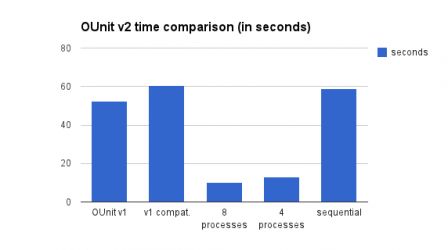
After 1.5 month of work, I am proud to officialy release OUnit 2.0.0. This is a major rewrite of OUnit to include various feature that I think was missing from OUnit1. The very good news is that the port of the OASIS test suite has proven that this new version of OUnit can drastically improve the running time of a test suite. OUnit is a unit test framework for OCaml. It allows one to easily create unit-tests for OCaml code. It is based on HUnit, a unit testing framework for Haskell. It is similar to JUnit, and other XUnit testing frameworks. Download OUnit v2.0.0 Documentation of v2.0.0 Website The basic features: Migration path OUnit 2.0.0 still provides the OUnit module which is exactly the same as the last OUnit 1.X version. This way, you are not forced to migrate. However, this means that you will gain no advantage of the new release and even some slowdown due to increase complexity of the code. Though, I strongly recommend to upgrade to OUnit2. Here is a checklist to do the migration: The OASIS test suite migration In order to check that everything was working correctly, I have migrated the OASIS test suite to OUnit2. This is a big test suite (210 test cases) and it includes quite big sequences of tests (end to end tests from calling oasis setup to compiling and installing the results). This was really time consuming and I wish to see a significant speedup for the tests with OUnit2. You can see the result in term of code of the full migration here. Here are the results on my Intel Core i7 920/SSD: OUnit v2 benchmark The migration was quite heavy because this test suite had a big design problem. It uses in-place modification of the test data. I think I pick this design because I thought this was a good idea to decrease the running time. As a matter of fact, this was a huge mistake, that keeps popping failed test cases because one of the previous tests was failing. I have refactored all this and now we start by copying the test data into a temporary directory, which ensure that everything is always starting from pristine test data. During the redesign, I have decided to reduce the number of tests by merging some of them. This should have no big impact on the running time, although this is not as pure 1:1 comparison with OUnit v1. Although it is still testing exactly the same thing. This explain the loss of ~50 tests, which in fact has been merged in other tests. The overall speedup is 4x compared to OUnit v1, when using processes. However there is a 12% increase compared to OUnit v1 for sequential and a 15% increase when using OUnit v1 compatibility layer. While this is not very good score, I hope this is small enough to compensate the huge win of being able to run tests in parallel with processes. And now the magic ! At this point, if you read carefully the numbers, you would have noticed that there is a 4.5x decrease in speed when you compare sequential and 4 processes for OUnit2. Since we are only actively testing in 4 shards, it looks strange. I don't expect a super-linear speedup due to the use of processes. I have checked that every tests was indeed running and found no solutions to this mystery. Right now, I think this is due to the fact that we are running less tests in more processes which should lighten the load of the GC (which may not trigger at all). I am not sure about this explanation and will welcome any bug report which shows a problem in the implementation of either sequential or processes runner. Although, this is great. Help still wanted If you find any bugs with OUnit v2, this is the time to submit a bug. OUnit BTS If you want to try to fix bugs by yourself, please checkout the latest version of OUnit:
 $> darcs get http://forge.ocamlcore.org/anonscm/darcs/ounit/ounit
Patches always welcome.

Russell Coker: Links September 2013

Matt Palmer wrote an insightful post about the use of the word professional [1]. It s one factor that makes me less inclined to be a member of professional societies. The TED blog has an interesting article about Wikihouse which is a project to create a set of free designs for houses to be cut out of plywood with a CNC milling machine [2]. The article also links to a TED talk by Alastair Parvin of the Wikihouse project which covers many interesting things other than designing houses. An XKCD comic has one of the best explanations of bullying I ve ever seen [3]. If you aren t familiar with XKCD then make sure you hover your mouse over it to read the hidden text. The Fair Phone is a project to develop a smart phone starting with conflict-free resources and with fully free software (not like a typical Android build) [4]. It s an interesting project and the price and specs seem within the normal range so you re not paying a huge premium for a conflict-free phone. Unfortunately they only have one model with a 4.3 display, if they had a competitor for the Galaxy Note then I d be interested. Patrick Stokes wrote an insightful article about why I m entitled to my opinion is a bogus argument [5]. Jim Daly wrote an interesting TED blog post interviewing Rishi Manchanda about Upstream Doctors who look for the root causes of medical problems rather than just treating the symptoms [6]. Brian Krebs wrote an insightful article about the value of a hacked email account [7]. If you are trying to convince your users to use better passwords then this should help. Ron Garrett wrote an insightful series or articles on morality hooked on the premise of whether it s wrong to torture kittens [8]. Part of his conclusion is that people who believe it s wrong to do such things tend to be more capable of working in large groups and forming a productive and efficient society. The TED blog has an interesting post by Karen Eng summarising Andreas Raptopoulos talk about using autonomous drones to deliver parcels in parts of the world that don t have usable roads [9]. Delivering parcels (which would start with medical supplies but would presumably move on to commercial transport) by drone is apparently really cheap. Being cheaper than building roads isn t going to be difficult but it seems that they are going to make it cheaper than paying people to deliver parcels even if the roads were built. The main web site about this project is www.matternet.us, they are hiring electrical engineers. Here is the link for Andreas TED talk [10]. The TOR blog has an interesting article by Emily Asher-Perrin comparing the different houses of Hogwarts [11]. It s an insightful article about personality attributes and gives more information than is available in the movies (I d read the books if I had time).

29 September 2013

Dirk Eddelbuettel: Rcpp 0.10.5

A new version of Rcpp is now on the CRAN network for GNU R; binaries for Debian have been uploaded as well. Once more, this release brings a large number of exciting changes to Rcpp. Some concern usability, some bring new features, some increase performance; see below for the detailed list. We have now released three updates on a quarterly cycle; if we keep this up the next version ought to be ready at the end of December. As in the past, we tested the release rather rigorously by checking against all packages I could (relatively easily) built on my server: this time it successfully passed \code R CMD check for all 107 packages I can build locally out of a total of 136 packages. (Two failed: one for an error in \code Makevars , and one for the need of an X11 server during tests; this may get addressed in the in test script next time). As all of these 107 packages passed, we do not expect any issues with dependent packages. Should there be issues we would appreciate a note, preferably with reproducible code, to the rcpp-devel mailing list. The complete NEWS entry for 0.10.4 is below; more details are in the ChangeLog file in the package and on the Rcpp Changelog page.
Changes in Rcpp version 0.10.5 (2013-09-28)
  • Changes in R code:
    • New R function demangle that calls the DEMANGLE macro.
    • New R function sizeof to query the byte size of a type. This returns an object of S3 class bytes that has a print method showing bytes and bits.
  • Changes in Rcpp API:
    • Add defined(__sun) to lists of operating systems to test for when checking for lack of backtrace() needed for stack traces.
    • as<T*>, as<const T*>, as<T&> and as<const T&> are now supported, when T is a class exposed by modules, i.e. with RCPP_EXPOSED_CLASS
    • DoubleVector as been added as an alias to NumericVector
    • New template function is<T> to identify if an R object can be seen as a T. For example is<DataFrame>(x). This is a building block for more expressive dispatch in various places (modules and attributes functions).
    • wrap can now handle more types, i.e. types that iterate over std::pair<const KEY, VALUE> where KEY can be converted to a String and VALUE is either a primitive type (int, double) or a type that wraps. Examples :
      • std::map<int, double> : we can make a String from an int, and double is primitive
      • boost::unordered_map<double, std::vector<double> >: we can make a String from a double and std::vector<double> can wrap itself
      Other examples of this are included at the end of the wrap unit test file (runit.wrap.R and wrap.cpp).
    • wrap now handles containers of classes handled by modules. e.g. if you expose a class Foo via modules, then you can wrap vector<Foo>, ... An example is included in the wrap unit test file.
    • RcppLdFlags(), often used in Makevars files of packages using Rcpp, is now exported from the package namespace.
  • Changes in Attributes:
    • Objects exported by a module (i.e. by a RCPP_MODULE call in a file that is processed by sourceCpp) are now directly available in the environment. We used to make the module object available, which was less useful.
    • A plugin for openmp has been added to support use of OpenMP.
    • Rcpp::export now takes advantage of the more flexible as<>, handling constness and referenceness of the input types. For users, it means that for the parameters of function exported by modules, we can now use references, pointers and const versions of them. The file Module.cpp file has an example.
    • No longer call non-exported functions from the tools package
    • No longer search the inline package as a fallback when loading plugins for the the Rcpp::plugins attribute.
  • Changes in Modules:
    • We can now expose functions and methods that take T& or const T& as arguments. In these situations objects are no longer copied as they used to be.
  • Changes in sugar:
    • is_na supports classes DatetimeVector and DateVector
  • Changes in Rcpp documentation:
    • The vignettes have been moved from inst/doc/ to the vignettes directory which is now preferred.
    • The appearance of the vignettes has been refreshed by switching to the Bistream Charter font, and microtype package.
  • Deprecation of RCPP_FUNCTION_*:
    • The macros from the preprocessor_generated.h file have been deprecated. They are still available, but they print a message in addition to their expected behavior.
    • The macros will be permanently removed in the first Rcpp release after July 2014.
    • Users of these macros should start replacing them with more up-to-date code, such as using 'Rcpp attributes' or 'Rcpp modules'.
Thanks to CRANberries, you can also look at a diff to the previous release 0.10.4. As always, even fuller details are on the Rcpp Changelog page and the Rcpp page which also leads to the downloads, the browseable doxygen docs and zip files of doxygen output for the standard formats. A local directory has source and documentation too. Questions, comments etc should go to the rcpp-devel mailing list off the R-Forge page

Lars Wirzenius: My GTD booklet no longer on Amazon

I wrote a very short book on Getting Things Done for hackers, which I also put up for sale on Amazon as a Kindle book, in addition to allowing people to get it for free from my website. As expected, it didn't sell much, perhaps a few dozen copies in total, but I got a small kick out of having a book for sale. However, Amazon now wants me to set up some kind of US tax account, which is all fine and good and legal and appropriate, but it's not worth my time to do that. I've removed the book from Amazon, to keep my life simple. It continues to be available on its own website, including in a Kindle format. For free. Under a CC-BY-SA 3.0 license. Since I see the download statistics for it, I know how many people download it. The PDF form is most popular, as it happens. All good.

Joachim Breitner: Heidelberg Laureates Forum 2013

During the last week I was attending the first Heidelberg Laureates Forum as one of the lucky 200 accepted young scientists. The HFL is a (from now on hopefully yearly) event that brings together Fields Medalists, Abel Prize laureates and Turing Award winners with young scientists (undergraduates, Ph.D. students and postdocs) from both fields in the city of Heidelberg. The extremely well organized week consisted of lectures from the laureates, some workshops held by postdocs, excursions and plenty of good food. Videos of the lectures are available (but don t work on Linux, at least not for me ), and I have shot a few pictures of the event as well. I believe that my favourite lectures where Michael Atiyah s Advice to a Young Mathematician , Vladimir Voevodsky s Univalent Foundations of Mathematics , William Morton Kahan s Desperately Needed Remedies for the Undebuggability of Large-Scale Floating-Point Computations in Science and Engineering and Alan Kay s Putting Turing to Work . Where are all the functional programmers? During that event, one gets to talk to many other math and computer scientists researchers; sometimes just Where are you from? and What do you do? , sometimes long discussions. Unfortunately, I hardly found one who is into functional programming language research is that only because the event was parallel to ICFP (which I really would have liked to attend as well), or is functional programming really just about 1% of all computer science? What is a proof? My other research interest lies in interactive theorem proving, especially using Isabelle. Of course that is a topic that one can discuss with almost everyone at that event, including the mathematicians. The reactions were rather mixed: On the one end of the spectrum, some mathematicians seriously doubt that they would ever trust a computer to check proofs and that it would ever be efficient enough to use. Others would not mind having a button that tells whether their paper written in LaTeX is correct , but were not keen to invest time or thought into making the proof readable by the computer. And then there were some (but very few!) who had not heard of theorem proving before and were very excited by the prospect of being able to obtain certainty about their proofs immediately and without having to bother other scientists with it. During the mathematician s panel discussions, where I posed the question Do you see value in or even a need for machine-checked proofs in mathematics. , Efim Zelmanov (Fields Medal 1994) said a proof is what other mathematicians see as a proof . I found this attitude a bit surprising for me, a proof has always been a rigorous derivation within a formal system (say, ZFC set theory), and what we write in papers is a (less formal) description of the actual proof, whose existence we believe in. Therefore I was very happy to see Vladimir Voevodsky give a very committed talk about Univalent Foundations and how using that as the language for mathematics will allow more of mathematics to be cast in a formal, machine-checked form. I got the chance to discuss this with him in person, as I wanted to hear his option on Isabelle, and especially on the usefulness of the style of structured proof that Isar provides, and which is closer to the style of proofs that mathematicians use in papers. He said that he enjoyed writing his proof in the style required in Type Theory and in Coq, and that maybe mathematicians should and will adjust to the language of the system, while I believe that a structured proof languages like Isar, independent of the underlying logic (HOL in this case; which is insufficient to form a base for all of abstract mathematics), is a very useful feature and that proof assistants should adjust to the mathematicians.
We also briefly discussed the idea of mine to work with theorem provers already with motivated students in high schools, e.g. in math clubs, and found that simple proofs about arithmetic of natural numbers could be feasible here, without being too trivial. All in all a very rewarding and special week, and I can only recommend to try to attend one of the next forums, if possible.

MJ Ray: Send updates to live cycling news reports to the speech synth

The BBC coverage of the UCI Women Road Race World Championship wasn t starting until 3pm, BBC Radio 5 Live had football and Sports Extra was playing an advert loop (really BBC?), Eurosport wasn t covering the race at all, RAI Sport 2 had coverage which was fine while I was watching the TV, but my Italian isn t good enough to follow the commentary and I wanted to get some other stuff done. So the obvious thing is to have the computer watch for changes to the great http://live.cyclingnews.com/ ticker and read them out, right? Well, it was to me. Here s the script I used:
#!/usr/bin/rc
# Send updates to live cycling news reports to the speech synth
# initialise
url=http://live.cyclingnews.com/
if (~ $1 *:*)  
  url=$1
 
last=""
while (true)  
    # download the update and strip html - if you don't have html2text try
    # sed -e '1,/<ol/d;s/<br[^>]*>/n/g;s/<[^>]*>//g;s/ / /g;s/[[:space:]]*$//'
    next= () curl -s $url   html2text -width 9999   sed -e 's/^ *[0-9]*. //'  
    # look for some added lines in the update section - timezone will need changing for non-European races
    say= () diff -u < echo $last  < echo $next  
        sed -ne '/^+/!d;s///;s/**//g;/ CES*T/,/^ *$/p'   head -9  
    # feed them to the speech synth in reverse order
    echo $say '
      Race Update'   tac   spd-say -e
    # update variables, pause and loop
    last=$next
    # set this to a prime number over 60, like 61, 67, 71, 73, 79, 83, 89
    sleep 67
 
Any questions, comments or improvements? I could have done more, like not saying Race Update even when there was no update, but I wanted to start listening as soon as possible!

27 September 2013

Erich Schubert: Big Data madness and reality

"Big Data" has been hyped a lot, and due to this now is burning down to get some reality checking. It's been already overdue, but it is now happening.
I have seen a lot of people be very excited about NoSQL databases; and these databases do have their use cases. However, you just cannot put everything into NoSQL mode and expect it to just work. That is why we have recently seen NewSQL databases, query languages for NoSQL databases etc. - and in fact, they all move towards relational database management again.
Sound new database systems seem to be mostly made up of three aspects: in-memory optimization instead of optimizing for on-disk operation (memory just has become a lot cheaper the last 10 years), the execution of queries on the servers that store the actual data (you may want to call this "stored procedures" if you like SQL, or "map-reduce" if you like buzzwords), and optimized memory layouts (many of the benefits of "colum store" databases come from having a single, often primitive, datatype for the full column to scan, instead of alternating datatypes in records.

However, here is one point you need to consider:
is your data actually this "big"? Big as in: Google scale.
I see people use big data and Hadoop a lot when they just shouldn't. I see a lot of people run Hadoop in a VM on their laptop. Ouch.
The big data technologies are not a one-size-fits-all solution. They are the supersize-me solution, and supersize just does not fit every task.
When you look at the cases where Hadoop is really successful, it is mostly in keeping the original raw data, and enabling people to re-scan the full data again when e.g. their requirements changed. This is where Hadoop is really good at: managing 100 TB of data, and allowing you to quickly filter out the few GB that you really need for your current task.
For the actual analysis - or when you don't have 100 TB, and a large cluster anyway - then just don't try to hadoopify everything.
Here is a raw number from a current experiment. I have a student work on indexing image data; he is implementing some state of the art techniques. For these, a large number of image features are extracted, and then clustering is used to find "typical" features to improve image search.
The benchmarking image set is 56 GB (I have others with 2 TB to use next). The subset the student is currently processing is 13 GB. Extracting 2.3 million 128 dimensional feature vectors reduces this to about 1.4 GB. As you can see, the numbers drop quickly.
State of the art seems to be to load the data into Hadoop, and run clustering (actually, this is more of a vector quantization than clustering) into 1000 groups. Mahout is the obvious candidate to run this on Hadoop.
However, as I've put a lot of effort into the data mining software ELKI, I considered also to try processing it in ELKI.
By cutting the data into 10 MB blocks, Mahout/Hadoop can run the clustering in 52x parallel mappers. k-Means is an iterative algorithm, so it needs multiple processes. I have fixed the number of iterations to 10, which should produce a good enough approximation for my use cases.
K-means is embarrassingly parallel, so one would expect the cluster to really shine at this task. Well, here are some numbers:

So what is happening? Why is ELKI beating Mahout by a factor of 10x?
It's (as always) a mixture of a number of things:
Let me emphasize this: I'm not saying, Hadoop/Mahout is bad. I'm saying: this data set is not big enough to make Mahout beneficial.

Conclusions: As long as your data fits into your main memory and takes just a few hours to compute, don't go for Hadoop.
It will likely be faster on a single node by avoiding the overhead associated with (current) distributed implementations.
Sometimes, it may also be a solution to use the cluster only for preparing the data, then get it to a powerful workstation, and analyze it there. We did do this with the images: for extracting the image features, we used a distributed implementation (not on Hadoop, but on a dozen PCs).
I'm not saying it will stay that way. I have plans for starting "Project HELKI", aka "ELKI on Hadoop". Because I do sometimes hit the barrier of what I can compute on my 8 core CPU in an "reasonable" amount of time. And of course, Mahout will improve over time, and hopefully lose some of its "Java boxing" weight.
But before trying to run everything on a cluster, always try to run it on a single node first. You can still figure out how to scale up later, once you really know what you need.
And last but not least, consider whether scaling up really makes sense. K-means results don't really get better with a larger data set. They are averages, and adding more data will likely only change the last few digits. Now if you have an implementation that doesn't pay attention to numerical issues, you might end up with more numerical error than you gained from that extra data.
In fact, k-means can effectively be accelerated by processing a sample first, and only refining this on the full data set then. And: sampling is the most important "big data" approach. In particular when using statistical methods, consider whether more data can really be expected to improve your quality.
Better algorithms: K-means is a very crude heuristic. It optimizes the sum of squared deviations, which may be not too meaningful for your problem. It is not very noise tolerant, either. And there are thousands of variants. For example bisecting k-means, which no longer is embarrassingly parallel (i.e. it is not as easy to implement on MapReduce), but took just 7 minutes doing 20 iterations for each split. The algorithm can be summarized as starting with k=2, then always splitting the largest cluster in two until you have the desired k. For many use cases, this result will be just as good as the full k-means result.
Don't get me wrong. There are true big data problems. Web scale search, for example. Or product and friend recommendations at Facebook scale. But chances are that you don't have this amount of data. Google probably doesn't employ k-means at that scale either. (actually, Google runs k-means on 5 mio keypoints for vector quantization; which, judging my experience here, can still be done one a single host; in particular with hierarchical approaches such as bisecting k-means)
Don't choose the wrong tool for the wrong problem!

26 September 2013

Steve Kemp: Random hacking for fun

Recently I've been playing gtetrinet, against the publicly accessible server at tetrinet.debian.net. If you're unfamiliar with the game it is a multi-player variant of Tetris. You clear many lines and your opponents suffer. Want to make them suffer some more? Use the special blocks you acquire. Special blocks? How about shuffling your opponents playing field? Adding new semi-formed rows? etc. All good stuff. There is support for up to six players. To fire a special block at the player in field 1 you press "1". To fire the special block to the player in field 6 press "6". But to fire a block at yourself, to clear your playing field ("nuke") or remove a single line ("clear") you have to know what player-number you are, which will change from day to day, as it is literally a marker for the order you joined the channel in. It seems obvious that there should be a special-case keybinding "fire to self", and indeed there was bug #291844 filed in 2005 saying as much. I've just submitted a functional patch to resolve this, and already my playing is getting better. Join me sometime.

25 September 2013

Daniel Kahn Gillmor: half a minute for science!

A friend is teaching a class on data analysis. She is building a simple and rough data set for the class to examine, and to spur discussion. You can contribute in half a minute! Here's how:
  1. get a stopwatch or other sort of timer (whatever device you're reading this on probably has such a thing).
  2. start the timer, but don't look at it.
  3. wait for what you think is 30 seconds, and then look at the timer
  4. how many actual seconds elapsed?
The data doesn't need to be particularly high-precision (whole second values are fine). The other data points my friend is looking for are age (in years, again, whole numbers are fine) and gender. You can send me your results by e-mail, (i suspect you can find my address if you're reading this blog). Please put "half a minute for science" in the subject line, and make sure you include: Science thanks you!Tags: science

Jon Dowland: Married

Jon and Sarah
I got married! Sarah and I tied the knot on the 10th August this year. We married in a registry office where we live and had an evening reception on Tynemouth beach. A fantastic time was had by all. We honeymooned in Sorrento, Italy, which was fantastic. We spent one day visiting Pompeii (my fourth visit: about 6 hours on our feet this time, and we walked from one side right to the other); another day in Herculaneum (my second visit); one day visiting the village near where we were staying, where we visited a local food festival and bought the nicest Marmelade I've ever tasted; a few day and evenings in Sorrento town itself; but most of the time we just relaxed, swam, snoozed, read.

Next.

Previous.