Search Results: "reg"

6 June 2007

Michael Prokop: Python on the console

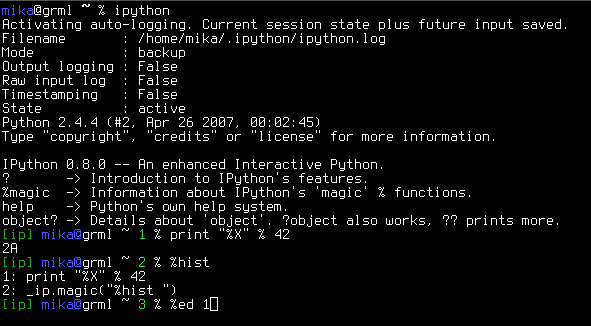
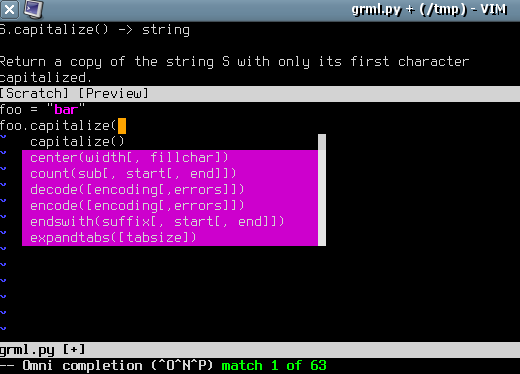
I wrote a small python webpage for the grml-wiki to provide some information regarding Python-development on grml. I just upgraded Vim on my main system to version 7.1 and omnicompletion with vim-python became better once more. So time for a short demo of ctrl-x-o: Python coding in Vim 7.1 - Screenshot I also very much like ‘%ed’ within ipython using the following snippet in my ~/.ipython/ipythonrc:
editor 1
editor /usr/bin/vim.python
Notice: Don’t wonder about the prompt style of the following ipython-screenshot, I customized it a little bit (see python-webpage in the grml-wiki again to get an idea). ipython demo - Screenshot So running the last line containing ‘%ed 1′ will execute /usr/bin/vim.python providing the code from the first command line of ipython and I can use all the magic of Vim for editing the code. When exiting the editor I have the code within ipython. Rocking. :) Oh, don’t forget to check out the Quick tips of ipython when exploring it. Now what’s missing in ipython is the edit-command-line feature of Zsh. That would allow me to edit already typed (but not yet executed) code with an external editor. Anyone out there with an according tip? ;-)

Jan Wagner: PHP packages in etch and binary compatibility to 3rd party extensions

Since etch php is compiled with large file support. This breakes binary compatibility to other packages, which are commonly not compiled with LFS and leads into trouble with 3rd party extensions, cause these are precompiled against the ABI of upstream and LFS not turned on. One example is Zend Optimizer. You may say this will only hit closed source applications, but if these are customer requirements, you have to solve the issue in some way.
You can do this by compiling your php and all extension from source without LFS enabled, but here you have to care about bugs, regressions and exploits for your own.
An other solution is to rebuild the packages from etch with LFS disabled. I’ve done this with the source packages of php4 and php5 from etch. Additionaly I did backport php-suhosin from unstable against this php packages for php4 and php5. Packages are available at http://ftp.cyconet.org/debian/archive/special/ or via

deb http://ftp.cyconet.org/debian etch-special-cyconet main non-free contrib If there are any DSA popping up, you can expect updates with a short delay. Please keep in mind, that you cant install php extension directly from etch. You need to rebuild them against php[45]-dev with disabled LFS. Other php packages may apear later. , , , , ,

Bastian Venthur: Rebuilding the Archive Using Cowbuilder (II)

A few months ago I wrote a script to rebuild the archive using cowbuilder. This script had a subtle bug: If you where running a sid machine and wanted to rebuild testing, the script would fetch the sources from sid (via apt-get source) and build this package in a testing environment. Thanks to Gregor Herrmann (Currently unassigned NM with ~180 packages in the archive!) this bug is fixed now and it should be possible to rebuild the archive correctly for every host/build-environment combo. To rebuild the archive, just get the scripts and

sudo aptitude install cowdancer grep-dctrl
sudo cowbuilder --create --distribution lenny --basepath /var/cache/pbuilder/testing-base.cow
./getlist lenny                  # get the list of packages
./buildall list.lenny.i386 lenny # build all packages in list.lenny.i386 in a lenny environment
Thanks Gregor for your patches and good luck with your NM process!

5 June 2007

Martin-Éric Racine: New Blogation

Elver convinced me to start blogging again. This time, instead of bothering with setting up my own blog engine, I decided to go back and try Blogger again. Hacking the CSS template to match my regular website took even less time than I expected. Elver took the opportunity to ask his pal X-G for a second opinion on the current template. The result is what you see. Here I go again, blogging in excess. A new blogation.

Martin-Éric Racine: Buzzword opportunism won't do

Being involved in no less than four different projects, all with excellent prospects for a permanent job, reminds me of why riding the Free Software bandwagon as yet another opportunistic buzzword won't do: In three of the projects, people insist upon communicating using the closed source VoIP application Skype. There indeed is a crude port for Linux on i386 (though not for amd64, powerpc, or any other architecture), but the dependencies are broken and my friends at Skype emphasize that Linux is a non-market for them, so I should not expect any solution any time soon. Still, the people behind some of these projects regularly threaten that I'm wasting their time by "refusing" to install Skype on my computer. Free Software promoters who don't understand what "non-free" means. In two of the projects, the corporate homepage is made as a single Flash animation. Mentioning that Flash support is extremely broken and thus essentially non-existent on Free Software platforms is pointless: the people behind the project are Windows users and yet they insist that their project is about promoting the free circulation of ideas using Free Software. Free Software promoters who don't understand interoperability. In one particular project, the product follows the Googlesque model of "the Web as my application and file server". Great idea, except that ― once again ― the people behind the project are Windows users and they insist that the Thin Client hardware must have a standard set of applications pre-installed and some storage media, thus defeating the purpose of this business model. Promoters of "the Web as my application and file server" model who don't understand the implications of a Thin Client solution. In all cases, the people behind the project mean well, but ― not being Free Software users themselves ― they clearly don't understand the profound implications of the Free Software agenda; they only see it as a license-free technology to connect the masses for cheap and they evidently find it difficult to think outside the Windows PC framework. Free Software as a business model, in a nutshell: data interoperability and the client-server model. Either get it or you're wasting my time ...and yours too. Nothing personal; just business. PS: I sincerely hope that anybody who recognizes themselves in the above rant will acknowledge my honest concerns and embrace this opportunity to truly adopt Free Software. Just do it! It doesn't matter where you get the FOSS. Just make sure that the FOSS gets you! (inspired by a great Candy Dulfer song currently blasting through the headphones).

MJ Ray: Wondering about Fon Rangers

While I was in Paris, I used a FON WiFi Access Point a couple of times. The rate seemed very reasonable - EUR 3 for a day's access compared to 10 (EUR 15) per day for The Cloud - and I paid with some money that's currently trapped by paypal's incompetence (they wouldn't accept letters in a UK Companies House registration number). I'm wondering whether to run a FON point. I've line-of-sight down the hill to a holiday park less than 400m away. If I aim a 6dBi directional antenna at it from inside a window, will it reach? Would the 2dBi built-in antenna reach the pub and shops 100m away? I used wifi while on a city break, but do people want internet while on a seaside holiday? Fon has adopted Ubuntu as its preferred operating system and the CEO also wrote:
"Fon already is an Open Source company and our software is an Open Source project called http://www.openwrt.org and we should support other Open Source movements/companies"
which is a good cooperative viewpoint, in my opinion. I'm a bit troubled by its Skype, Paypal and Google promotions, BBC Panorama: Wi-Fi: a warning signal and Andrew Savory's Fon not so much fun but it seems like a good idea at the moment because it would save or make money and I'd finally have OpenWRT on a router. Are those good enough reasons? Are there other options? What are they?

Martin-Éric Racine: Alpha debian-installer bounty

From my good friend Eki:
I'd appreciate you informing people that I'm commiting a 100 euro bounty towards upgrading debian-installer images with MILO support for the Debian Etch release. I can personally help with development by testing the upgraded installer images on any of my 11 Alpha machines.
If you have MILO knowledge and are willing to produce updated debian-installer images for Etch and to submit your work to the debian-boot team, contact eki at his regular sci.fi account. Kiitos!

Martin-Éric Racine: Life after Etch

This week, following the announce of the freeze, I upgraded most of my home cluster to Etch. The upgrade went surprisingly smoothly, although I had a bit of a scare when the kernel upgrade pulled in a bunch of dependencies that resulted in the forced removal of all previous kernels. This minor scare asides, kudos to everyone who made this new Debian release possible! My only disappointment about Etch is that we're stuck with Firefox 1.5.0.7 instead of 2.0.1 or Iceweasel. Then again, speaking of Iceweasel: Forget it! Breakages it introduces have been marked as pending or patched for a number of weeks and yet there's still no updated package. At this rate, better wait until Etch r1 or Lenny to introduce it, rather than release Etch with a browser fork that has not undergone several months of thorough testing! This got me thinking about life after Etch, or more specifically, about what I'm gonna do with the packages I maintain. The Dunc Tank debacle and similar other unfortunate events that overtook Debian this year have prompted me to reevaluate my motivation. Another unrelated issue is, I've been working in software development for more than 10 years and my guts are telling me that it's time to move on so, while my computers will still run on Debian or Ubuntu, I don't intend on doing any more development per-se. Thus, I have already taken the initiative of soliciting co-maintainers for most of my packages. The Debian GNOME team agreed to be added for Planner, which is nice given the sheer number of bugs that are regularly found against this package. CUPS-PDF, Gaim-IRChelper and NumlockX haven't seen a meaningful bug in ages and can be rebuilt using bin-NMU magic, so they're pretty much taken care of. This leaves the issue of the Estonian and Russian dictionaries (plus a large patch in my personal repository that would upgrade Aigars' Latvian dictionary to generate the Aspell wordlist from his MySpell wordlist) open. For these, native speakers that develop for Debian or Ubuntu would be welcome to join me. What next? I have a couple of interesting offers, one on the Business side of computer hardware manufacturing in Estonia and another one as the manager of a western company's Latvian office. The tricky part in either case would be the immigration process: despite close to 9 years of living right here in Europe, I am still perceived as foreign labor whose hiring must be thoroughly justified (in the case of Estonia, I even need to request an explicit exemption to the immigration quotas), whereas if I had been granted EC Long-Term Resident status or Finnish citizenship, I could just sign the contract and notify the local authorities of my change of address. Instead, 9 years later, I'm stuck at the passport control queues for non-EU citizens with its disgustingly suspicious border guards. Sigh! Thus, while I indeed have shares in Linutop (yes, we are finally shipping - stay tuned for details) that might eventually turn into gold, I also have close to zero motivation left in my personal life, because lingering European bureaucrazy prevents my talent from reaching its customers - turning all my attempts at having a career into a neverending series of bitter disappointments. Is it any wonder that I'm so adamant about getting out of the Rat Race to return to more gratifying creative activities like composing and photography, then? Post Scriptum Actually, there is a second disappointment about Etch: we are stuck with Evince 0.4.0, at a time where upstream just released 0.7.0 with strong recommendations that everyone upgrade to that. Heck, even Ubuntu has 0.6.0 already. I find the Evince situation way more annoying than the Firefox one, because, from a user's perspective, Evince 0.4.0 fails to display several PDF documents that more recent releases handle just fine.

Martin-Éric Racine: Free Software annoyance: Gaim

Dear Lazy Web: I am developing a severe hatred of Gaim 2.0, because some of its dumb features hamper my productivity. Are there any simple configuration tricks that could fix the following issues: Would you happen to know the answer to any of the above? Best Regards, Mr.Linutop

Martin-Éric Racine: Almost there: granny-friendly PDF writing

One aspect of Ubuntu that I really enjoy is the sheer amount of constructive feedback a maintainer gets about the usability of their packages. In my case, CUPS-PDF [1] [2] has been a landmark example of how beneficial this feedback can be: See, one long-standing goal at Ubuntu has been to include the capability to generate PDF documents "out of the box" and regardless of which Desktop Environment is used. Many people considered that CUPS-PDF would be an excellent tool, but various technical issues prevented this from working in a security-conscious way. Once that issue was taken care of, someone pondered how the PDF queue could be automatically created at installation time? It turns out that we're almost there: with the upload of version 2.4.6 into Debian today (which should propagate into Ubuntu within a few days), only one configuration step remains: the selection of a PPD driver. Everything else is automatically detected and configured by CUPS itself. Kudos to our friendly upstream, Volker, for implementing this driver magic in his back-end code! Enjoy!

Eddy Petrișor: insurance card and debconf

Dear lazyweb,

I have remembered about the European Health Insurance Card too late to able to make it in reasonable conditions[*], so I am thinking of using a regular insurance policy for the period spent abroad.

Dear lazyweb, is there any reason to be worried if I want to make this policy instead of using the card? My reason tells me no, but I want to be in the safe side.


[*] there is a 7 days waiting period for the emission; I work in Bucharest but I have to go to my home county which is 150km away and compared to the tax for the emission, the trip cost is 20 times more expensive

Rob Bradford: Up (very) late

You know you are up late when you hear Sailing By on the radio. I’ve just made a new release of Dates, including a build for the 770. If you want to try this out then you need to add the OpenedHand repository to your application catalogue:
Web address: http://maemo.o-hand.com/packages
Distribution: gregale/
Components:
Note that these are built for the latest release of OS2006 (gregale/2.2). They may work on earlier OS2006 releases. Here is the obligatory screenshot.
Dates on the Nokia 770. Just a subtle hint.

4 June 2007

Evan Prodromou: 15 Prairial CCXV

I'm sitting in our suite in the Doubletree on Times Square in New York City, catching up with some email and generally trying to pull myself together. It's been a remarkably busy week and this is the first time I've been able to sit down to blog for a while. We moved to our new house at 4690 rue Pontiac last Wednesday, and most of my time last week was taken up either packing things (clothes, computers, dishes), unpacking the same things, or taking things that I didn't want to pack/unpack to various charitable organizations. Our move-in went smoothly -- the hardest part was moving our old fridge and stove to our new house, then moving the fridge and stove and deep freeze from our new house to the old apartment for Julia and Antoine to use. The new house came with a lot of new goodies, too. We bought a new couch for our new livingroom, and a new king-size bed for our new bedroom. On top of all that, I signed us up for Vid otron cable Internet instead of our old reliable Bell Canada DSL, and it's turned out to be quite fast and easy to use. So on top of the excitement of having a new place to live, there have been a lot of new toys to play with. Thankfully, our cats and our daughter have adapted quite well to their new environment. Amita June has a new bedroom, but she's been through so much travel -- hotel rooms and friends' homes -- that she's able to sleep just about anywhere. Topaz and Xe (the cats) don't usually adapt very well, but Maj kept them in the upstairs bathroom for a few days The thing that's surprised me the most about moving into the new house is how seldom we go upstairs. All our bedrooms are downstairs, as well as the new office/den, and we seem to get a lot of our needs met down there. The upstairs area is really really nice, though: lots of light and air. But the stairs are a real energy barrier. I guess my legs are going to get stronger and I'll get used to running up and down them several times a day. Probably the biggest disappointment of the move-in was that our new paint job, which had been so lovingly planned, got pretty marked-up in certain parts of the house -- specifically, the halls and stairs. We'll be doing some touch-up painting ourselves, but it is still kind of a bummer to see all these nicks and scratches on the otherwise pristine walls. tags:

Train in vain We're in New York City for the awards ceremony for the Webby Awards. Wikitravel won the Webby award for best travel Web site of 2007 -- quite an honor. We came right after our move-in, so it feels a little rushed. We're just here for about 72 hours. We'd thought about going down to visit family in New Jersey, but we really need to finish getting unpacked and settled in to the new house. We're planning on coming down for a relaxed family visit in NJ later this summer, instead -- maybe combining it with a trip to the Jersey Shore. Although there are plenty of flights between Montreal and New York, and it's only about a 6- to 8-hour drive, we decided to try something different this time. We took the Adirondack (Amtrak) train, which runs down the shores of Lake Champlain and the Hudson River Valley. My theory was that the train trip would let us stretch our legs, read, and get some work done, and that AJ could run around and enjoy herself, rather than being cooped up in a car or airplane seat. Although the train was the slowest option (it's scheduled as a 9-hour trip), it might end up being the most comfortable. I think the results were mixed. Indeed, the trip was a comfortable one, and Amita June got to run up and down the aisles and climb all over the empty seats. However, we got stopped at the US border due to an elevated terror alert, and what was supposed to be a 30-minute scheduled customs stop dragged into a two-and-a-half hour inspection. By the time we got to New York, we were more than two hours late. Among other things, this meant that I missed the opening cocktail reception for the Webbies, which was kind of a bummer. It was dumping down rain in torrents when we finally got to Penn Station, though, so I think that the rooftop reception probably wasn't all that much fun. I got soaked trying to get us a cab, but we had a decent ride to our hotel -- the functional but unexciting DoubleTree Suites on Times Square. We had a hard time finding a hotel that would be even remotely affordable, in Manhattan, and had junior suite rooms. Suites are great when you're traveling with a toddler -- it means you can put them to bed at 8PM and then go in the other room to stay up the rest of the evening. We had a decent room-service dinner -- Caesar's, nachos, 2 Heinekens -- and crashed out. This morning I woke up to a text message from my friend Ben Cerveny. He's also in New York for a few days -- he figured out that we were both going to be here using the cool Dopplr service. I rousted up Maj and Amita June -- late sleepers, lately -- and we all went down to Greenwich Village to meet Ben at The Grey Dog. The caf had decent coffee and pretty hearty breakfasts. We stayed for about 2 hours. We ambled over to the Center for Architecture to check out a few exhibits and stretch our legs. It turned out to be a great place to bring a toddler -- not too crowded, and pretty noise-tolerant. Amita burned herself out running through the exhibits. We left Ben behind and headed back to the room for naps and computer time. I was going to try to go to the Webby event for film and video tonight, but there was some complicated signup thing I was supposed to do, and I ended up failing to do it. It's probably just as well -- Maj isn't feeling great. So we're going to just get some dinner together and call it an early evening. tags:

Certifi.ca re-certified For the last month I've had a TODO item on my list: New SSL cert for certifi.ca. Of course, I let it slide and slide -- definitely not an urgent item, right? Well, not until the cert expired last Sunday. Oops. It took me a while to get certifi.ca a new cert -- I wanted to get it with the name of the new corporation I've started to manage my OpenID sites, called Control Yourself, Inc. or, in French, Contr lez-vous, Inc.. (I'm not even sure if contr lez-vous makes any sense, actually.) The folks at Comodo had a hard time with the Quebec corporate registration and asked for a lot of extra documentation, which dragged things out a few days. On top of that, I got distracted by the move, so I haven't had much time to think about SSL certs. But I got the cert late last week, and ended up with another problem: when I replaced the old cert and "ca-bundle" files with the new ones, Apache mysteriously failed to start up -- at all. It just kerploded with no error log information. I was unable to find any documentation on why this would be the case. I spent some extra time debugging this afternoon, and came to an embarrassing conclusion. The program I used to feed a password to Apache (using SSLPassPhraseDialog) was giving it the password for the old key. Doh! Fixing that made Apache start up just fine. I wish I had a good way to attract Google searches for this, but maybe this sentence will work: If your Apache server with mod_ssl fails mysteriously right after startup, make sure that the passphrase is generated correctly. tags:

Creative Commons shrinks a bit Kudos to Creative Commons, who have retired their controversial Developing Nations and Sampling licenses. Critics have pointed out that all CC licenses allowed a basic universal right -- verbatim, non-commercial copying -- except for the Sampling and DevNations. I think the move has helped to focus CC somewhat. Although Creative Commons started as a way to explore novel methods for letting people share certain rights to their works, this move will set a baseline for what's an acceptable CC license and what's just not enough. As Lawrence Lessig says in the announcement: There is a strong movement to convince Creative Commons that our core licenses at least permit the freedom to share a work noncommercially. Creative Commons supports that movement. We will not adopt as a Creative Commons license any license that does not assure at least this minimal freedom at least not without substantial public discussion. It's a good idea, and I'm glad CC is taking this tack. I hope that those people who've criticized CC in the past for not having such a baseline will take the opportunity for a rapprochement. tags:

Funds for Standout Jobs Congrats to Montreal entrepreneurs Fred Ngo, Ben Yoskovitz, and Austin Hill. Their new high-high-end recruiting engine, Standout Jobs, just got an angel round of funding to the tune of $1.5 million. Yeah, they're only Canadian dollars (see Journal/1 Brumaire CCXV), but that means a lot more today. Fred, Ben and Austin have all done a lot to advance the local technology community. I'm glad to hear that their project is taking the first steps to success. tags:

3 June 2007

Michael Prokop: Linuxdays in Vienna 2007: done

Linuxdays in vienna were fun (as usual). Lessons learnt: I was responsible for the booth of grml (Linux live-cd for sysadmins and texttool users) as well as for the ones of Debian and Debienna (Debian in vienna) - especially in the first two days, until Markus and Kira joined. Regarding the grml booth: It was once more amazing to see how many people already know and use grml. I had the pleasure to meet people from a professional data rescue organization who use grml in their daily business. Not to forget to mention all the people who let me know how often grml managed to save their lif^Wdata. Oh, and some nice ideas were brought to my attention and are now part of the todo list for grml. Very geeky was the 13 year old boy who visited our booth and when asking him whether he knows how to work on the console (he was staring at our grml-CDs with shining eyes) he replied: "YES, of couuuuurse!" 8-) I couldn’t resist in giving him a grml-CD. Oh, and we were running out of grml-CDs earlier than expected. Thanks to my girlfriend - who can even explain the difference between grml meilenschwein and grml64 to you now :-) - I had the chance to attend some few talks - besides my own one about grml of course. I once more didn’t manage it to take just a single picture :-( but I just received a pointer to the linuxdays photogallery of jostusz, thanks Sven.

Matthew Palmer: OfflineIMAP and Deleting Folders

(File this under "Reminders for the future Matt") I use, and highly recommend, OfflineIMAP for the synchronisation of your e-mail between your daily working machine and your IMAP server (if you don't have an IMAP server available for your mail, it's high time you got one). You point it at an IMAP server somewhere far, far away, and a local Maildir, and all of your mail and folders magically get synchronised in both directions. New folder on the server? After the next run, it'll be on your local machine. Even more magical, though, is that any new mail or folders you create on your local machine will be uploaded to the server. Woohoo! Offsite Backups! (Before you GUI mail users say "pfft, my client does that all for me", I'll remind you that I don't need to chew several hundred megs of core to delete my spam) I've got some magical procmail rules (specifically, look for "ARTFUL PROCMAIL") that automatically filter list e-mail into individual folders (with automatic creation of the folder if necessary, of course). This makes mailing lists soooo much easier to handle. Of course, when I unsubscribe from the list a couple of weeks later, that folder is still sitting there, empty and forlorn. I don't mind empty directories, except that they slow down the OfflineIMAP sync run, since it asks "any new mail in here?" for every one of them. I'd just delete them from my local machine periodically, except that OfflineIMAP can't delete folders off the server if you remove them from your local Maildir (and vice versa). Instead, the folder gets re-created on the local machine, which is definitely not the result I'm looking for. I'm pretty sure this is an IMAP limitation, so I'm not criticising John Goerzen for not implementing this particular feature. However, the empty folders bother me a bit, so I decided to do something about it. Namely, I hacked up some little shell one-liners. These one-liners are all dependant on you having the same IMAP server (Courier) and folder name mapping (none) as me, otherwise there's a good chance that your file names won't match the patterns I've used. For reference, My folders on the server are dot-directories under $HOME/Maildir, and my folders all start with INBOX. on the client. Also, both sides use periods to separate folder levels. As an example, e-mail to the debian-devel-announce list gets stored in $HOME/Maildir/.lists.debian-devel-announce on the server, and $HOME/Maildir/INBOX.lists.debian-devel-announce on the client. I've got one big before you start warning: this process involves deleting things. If you're not able to verify that what these snippets are doing is correct for your particular situation, then please do not run them. Also, if running them causes all your e-mail to disappear or your cat to fall pregnant (despite being spayed and/or male), then that isn't my fault. The only warranty I give is that It Works For Me. It May Not Work For You. As a first step, make sure that your local and remote mail stores are in sync -- presumably by running OfflineIMAP. Otherwise, a folder which is empty on one side might not be quite-so-empty on the other side, and that would possibly make for sadness. Stopping e-mail from coming into your mailboxes would be good, too -- I just turned off my MTA for a few minutes, because clogging other people's queues is fun. Doing something smart with procmail would also work. On the OfflineIMAP client machine (laptop, home desktop, whatever), cd into your local mail store, and run this to generate a list of IMAP folders that don't have anything in them:
 for i in INBOX.*; do find $i -type f   grep -q $i   \
 (echo $i   sed 's/^INBOX//'); done >/tmp/empties
The contents of /tmp/empties should look something like:
 .Deleted
 .junk
 .lists.debian-devel-announce
 .lists.something-funny
 .spam
Review the list of folders it produced (just to make sure nothing really unpleasant ended up in the list), and then run:
 for i in $(cat /tmp/empties); do rm -rf INBOX$i; done
to delete all the empty folders. Next, copy the list of folders onto the IMAP server (yes, you need shell access on the server to do all of this; that's why I run a Linode), cd into your Maildir on the server, and run this:
 rm -rf $(cat /tmp/empties)
That removes the folders from the server as well. For some reason, OfflineIMAP doesn't notice that a folder has gone away, and so it doesn't remove the metadata for the deleted folders from it's cache. I'm not sure if that hurts performance or is otherwise injurious to your health. To be ultra-neat, go into $HOME/.offlineimap (or wherever your metadata dir is) on the client machine and run
 for i in $(cat /tmp/empties); do find . -name INBOX$ i ; done  xargs rm -rf
And that makes everything clean and tidy. Now, of course, someone's going to point me to a small script that finds all of your local empty folders and deletes them locally then issues an IMAP "delete folder" command on the server. But I had fun working all this out, so it's not a complete waste.
Matthew Palmer: Get Your War On

I've got a number of web comics in my rotation, which I read with varying regularity. I don't know if I'd call "Get Your War On" one of my "favourites" (if only because I don't think it should need to exist), but it does have some viciously biting commentary on the Iraq war. Some of the ones I wish I had on T-shirts: Culturally Sensitive @ Get Your War On Shiite Death Squad Productivity @ Get Your War On The Power of Freedom @ Get Your War On The Writ of Habeus Corpus @ Get Your War On

Bernd Zeimetz: gimp-plugin-registry

gimp-plugin-registry Dear lazyweb, since a few days there s gimp-plugin-registry waiting in unstable. At the moment the package contains several tiny GIMP plugins I like to use and which are not included in the gimp package or in other gimp-* packages. In my opinion a collection like this one was missing in Debian, since there re a lot of very nice plugins/scripts out there, which are too small to package them on their own.
Which plugins would you like to see in the collection? Packaging all plugins from http://registry.gimp.org/ doesn t make sense, so I d like to know which plugins other people are using and put them into the next release of the package. Any feedback is appreciated. P.S.: As I didn t find a real alternative for my needs, I ll stay with Dokuwiki. As far as I remember is a rss feed with proper html on Andi s todo list, and there re more other nice features going to come :-) Although somehow I still would like to rewrite Dokuwiki in python ;-)

2 June 2007

Frank Lichtenheld: packages.debian.org status and development

Copy of a mail I sent to debian-www earlier today. I don't think it warrants posting to -devel-announce, but I post it here to make it visible to people not usually following debian-www. Since I seem to sense an increased stream of offers to help out with packages.d.o coming my way (but maybe that is just wishful thinking ;) I wanted to give a short update on the development of the current code and the status of the infrastructure so that nobody can claim he wanted to help but failed due to lack of information.

1 June 2007

Edd Dumbill: Launching Expectnation

I'm very pleased to announce the launch of Expectnation, a web application for managing conferences. Expectnation logo What does it do? Expectnation is intended to replace the ad-hoc collection of emails, spreadsheets, documents and hacks that hold together the organization of most conferences. The aim is to improve the quality and reliability of communication between the organizers, speakers and attendees. But it doesn't stop there. What I'm really excited about is the chance to enhance the conference experience through the web. Expectnation is capable of managing the complete web site for a conference, which provides many opportunities for bringing the best of the social software world to augment events. Our tagline is "build your conference into a community", which underpins a key aim: to help organizers make events more relevant and useful to attendees, and to live on beyond the event itself. We do this in two ways: saving time, so you can spend it on improving your conference, and providing online tools to support community building.
Right now Expectnation is able to manage the proposal, review, scheduling and publication of presentations, along with the conference web site and smart emailing to speakers, reviewers and chairs. Over the next two months we'll be introducing our registration module, with optional online payments, and working on extending the social software features available for attendees. Take a look  I'm really excited about letting users get started with Expectnation, and seeing the uses it gets put to. We believe Expectnation will be just as handy for organizing events inside an organization as for traditional conferences. So, if you organize, speak at, or attend conferences of any sort, please check out Expectnation and recommend it to a conference organizer near you!Related links

31 May 2007

Clint Adams: Lindsey Buckingham was nowhere to be found

In the middle of the forest on the hill is a ley, and through that ley runs a creek, and across that creek rests a weir, and by that weir stands a detached concrete wall. By that wall is a table of wrought iron, and surrounding that table are three wrought iron chairs, upon which there are no cushions. Were one to query a being seated upon one of these chairs, one might be told that it was a most uncomfortable place for one's hindquarters. In the days of yore, one Philip discovered this place, and this Philip did seek out his friend Paul to show him the glorious place that he had found. Paul was readily impressed, and the two of them appointed themselves the caretakers of this place by the weir in the creek in the ley in the forest on the hill. They built a shed next to the detached concrete wall, and in that shed they placed tools of the sort used for groundskeeping, and eventually they acquired an old riding mower that someone had been in the process of discarding, and they placed the mower also in the shed, and worried about the value of the mower in the shed, they procured a large combination lock for the door of the shed, and installed it hastily. As the trove in the shed burgeoned, Philip and Paul invited more friends to share enjoyment of their place by the weir in the creek in the ley in the forest on the hill. People would come every day and watch them cut the grass and kill the moss on the detached concrete wall. On rare occasions a guest would say, Need any help with that? and Philip would shout back, No, thanks, we've got it all under control! This golden age continued for quite some time, but as with all glorious things, one small event disturbs the balance, things spiral out of control, and despite anyone's efforts, nothing succeeds in restoring the state which many found so very acceptable. HOW IT HAPPEN: Philip had a dream about an angel on the beach. This dream plagued him day in and day out. It plagued him like the wind. Finally, sitting on the detached concrete wall, murdering some moss, he snapped. If I can't get an angel, I can still get a boy, and a boy'll be the next thing to an angel, he announced. The next best thing to an angel, he clarified. A boy'll be the next best thing. Then, to further illustrate the progress of his nervous breakdown, he leapt off the wall and ran into the forest. What? replied Paul, and continued his labors. Need any help? some guests inquired. No, we've got it all under control, Paul answered. The days went by, and Philip remained absent. Paul started to work more slowly, and neglected certain parts of their sanctuary. Soon he only showed up every other day. Hey, guys! Philip shouted, arriving to find most of the regulars there. Sorry I haven't had time to attend to things, but I've been busy. Do you need any help? someone grunted half-heartedly. Naw! Philip answered, I'll just catch up now. Thus he spake, and thus he did. Inspired by Philip's toil, Paul resumed his efforts more heartily, even though Philip disappeared again. The days went by, and Philip remained absent. Paul started to work more slowly, and neglected certain parts of their sanctuary. Eventually he was doing almost nothing at all. Is. There. Something. We. Can. Do. To. Help? asked the peanut gallery. I don't know, Paul snapped. If you want to help, ask Philip. He stormed off.

Next.

Previous.