Search Results: "mak"

17 November 2011

Timo Jyrinki: On discussing free software mobile phones

Since I think I just summarized a few thoughts of mine well at LWN, I'll copy-paste it here:
I can grumble about Android from time to time, but I do not say that it sucks. Extreme views are what are annoying. Android is what it is and it's great as it is, even though it could be different as well.

When it comes to discussing about free software and mobile phones, I'm especially annoyed by two types of comments:

1. People essentially saying that there is no value in an open project, ie. free software code dumps should be enough for everybody. I'm interested in the long term viability of free software projects, and it is hard to have successful projects without there being all sorts of factors that make up a good project - like transparency, inclusion, meritocracy. Even though the mobile projects have had little resources and a hard road, it's not useful to forget about these goal in the longer term. For example Debian, Mer, SHR, KDE Plasma Active have some of these in the mobile sector. I hope the best for them (and participate).

2. People complaining about something being not 100% free software, while not themselves actually even interested in it for other sake than complaining. When I've been talking about free software mobile phones, from time to time there is someone complaining about eg. not open GSM stack, wlan firmwares etc.. and to put it sharply probably writing the message from iPhone, while I'm reading it on Neo FreeRunner. If the complainer would be Harald Welte, I'd probably listen and agree with him.

So there. For more civilized discussion.

Russell Coker: Cruises

It seems that in theory cruises can make for quite economical vacations. The cheapest prices tend to be around $100 per person per night for an inside cabin (IE no window) with two people (there is a significant extra fee for having a cabin with only one person). If you book a room in a half-decent hotel with a pool in some moderately desirable place then you will probably pay about $200 per night which might get you free breakfast but won t include lunch or dinner. Cruises include all the free food you can eat for at least 16 hours of the day with maybe an extra fee for getting food in the middle of the night. When a cruise ship stops at the port you can pay for an expensive shore trip arranged by the cruise company or have a cheap trip that involves walking on the beach or taking a taxi to somewhere local. Of course there are lots of extras that can make a cruise really expensive, but if you don t plan to eat at speciality restaurants or drink much alcohol then that shouldn t be a problem. I ve just booked a short luxury cruise, mostly as a trial of the cruise concept. The process of doing so was difficult enough that even if I hadn t previously needed a holiday then I d probably need one now. It would be interesting to compare the amount of time that a reasonable person would be likely to spend choosing a holiday and purchasing it for the different types of holiday, I expect that cruising would be a long way behind everything that involves flying to a foreign city and staying in a hotel. The Issues of Booking When booking a regular holiday you choose where to visit, then choose the time of year, the accommodation, and travel. While the order can vary it s generally a sequential process without too many variables at any stage. With a cruise one of the first decisions is to choose the cruise line, different lines cater to various market segments it s clear what Disney cruises aim for but often not so clear for others. Apart from Disney the other cruise lines don t seem to make clear statements about who they are and aren t targeting. Then there are a variety of ships run by each cruise line which in many cases offer different features, do you want 1 pool or 4? Do you want ice skating? The cruise lines that I have investigated don t offer clear comparisons of their ships. As a cruise ship is essentially a hotel, a collection of restaurants, and some other entertainment you can t just arbitrarily choose one the way you might choose a random hotel with a suitable price and rating. Now while you can choose a hotel and generally get a room when you want a cruise booking has to be made when the ship is in a convenient port. So your holiday needs to be scheduled around the availability of the ship. CruiseCritic.com is an excellent source of information on cruises and has a very active and useful advice forum [1]. The forum appears to be dominated by retirees, presumably because retirees have time to just wait for a ship they like to visit their local port while people who have to schedule holidays around work projects etc. When booking a hotel I have found that Wotif.com is really good for comparing hotels and finding a reasonably cheap one and they also have periodic mail-outs about special deals. I have made a couple of short vacations based on Wotif offering me unusually good prices on a hotel in a place that I was mildly interested in visiting. There are also special deals on cruises, but it s a lot more difficult to take them. Firstly as cruises aren t as interchangeable as hotels it s not as appealing to take an offer of a cruise you didn t previously consider because it s going cheap. The second factor is that according to cruise reviews there is more variation among cabins than there is among hotel rooms. The design of the ship that is needed to cram everything in the available space means that some cabins apparently have noise pollution from various activities on the ship while others are considered to have problems for people prone to sea-sickness. Discounts probably only apply after people who pay non-discount rates have had a chance to book what might be considered the better cabins. Of course it could be a good thing to have most of the ship booked out, CruiseCritic.com has some reviews of individual cabins and presumably there are people who compare hundreds of cabins to discover what is ideal for them. The Problem with Princess I have booked a Princess cruise. I chose it because it was going cheap, but the first two travel agents that advertised it were unable to take my order because Princess only allows US based agencies (which means the discount agents on the net) to sell to US customers I don t think that the people who run the Princess cruise company know what the Internet is about. So I booked the cruise through the Princess web site, they took my money, told me that a good chunk of that money would never be returned if I cancelled, and then sent me to the web page for providing all the information that they need which is a lot. The big problem was when their web site absolutely demanded a passport number and said that I would not be allowed to board without one even though their FAQ (and common sense) indicated that a cruise which doesn t involve any international travel has no need of a passport. Taking someone s money and then telling them that they can t attend due to not having a valid passport is one way of making a future passenger very unhappy. I called the support people (which was Carnival) and had to listen to some really strange hold music it was difficult to determine if the music was produced by someone with unusual tastes in electronic music vastly different from my own preference or whether the computer which manages the phone calls was producing noise instead of music. Eventually I got through to an operator who was very helpful and stored my drivers license number which was adequate. While on the topic of their web site, when booking a cruise with Princess they list which types of cabin (interior, balcony, etc) are available and list the price for the cheapest category of cabin in each price. However if the cheapest category is all sold out then it will still list that cheapest price and thus be advertising a price that can t be booked. This is misleading and annoying. Further Hassle But the difficulty doesn t end here. On a cruise you have to book in advance for which dinner seating you desire which is usually only early or late but some ships offer anytime . Then if you happen to be travelling with people who are in a separate cabin and paying separately (which one would expect to be fairly common) there is no obvious way of synchronising dinner preferences the ship people might assign people to different tables. I admit that I haven t fully explored the post-booking part of the Princess web site, maybe I can arrange a shared table but for the moment my pain threshold for the cruise booking process has been exceeded. Other Cruising Stuff Insight Cruises (formerly Geek Cruises) offers a variety of educational cruises including science, astronomy, chess, art, history, and some other things [2]. From a casual inspection of their web site it seems that the cruise prices are around $300 per night for a 2 person cabin and the registration fees for the conferences are between $1200 and $1500. Most readers of my blog will consider this to be unreasonably expensive as registration for a Linux conference tends to be a lot less than $1000. But when compared to typical for-profit conferences $1500 isn t anywhere near the high end of the range. Also while someone who is choosing a cruise holiday can easily get a cruise that costs less than $200 per day for a 2 person cabin, for commercial conferences it s not uncommon to spend more than $300 per night for two people on accommodation and food. So the only noteworthy part about the cost is that accommodation will be quite expensive if you aren t sharing a room. If you want to run a conference on a cruise there are companies which specialise in such things, Landry and Kling is one company that specialises in planning corporate events [3]. They do seem to aim for the high end of the market, including chartering a small cruise ship or half a large cruise ship that means ~1000 passengers. While there are some conferences with more than 1000 delegates it seems that most conferences top out at about 500 delegates. However I know that some conferences have limited the number of delegates to the maximum capacity of the biggest lecture hall available as some cruise ships have a theater with more than 1000 seats it seems that similar conferences could potentially arrange a half ship charter. A half ship charter apparently allows exclusive access to one of the theaters (at least when it s not needed for evening entertainment) and exclusive seating at the main dining room. It s a standard feature that cruise ships have all the equipment you might need to run a conference. Autism on the Seas is a brand used by the Alumni Cruise company for their holiday packages for special needs children [4]. They sell cruise tickets at the regular list price and the commission that they receive when acting as a travel agency is enough to hire staff to look after the kids while presumably still running at a profit. It seems to me that a similar model could be used for a computer conference, make a profit on cruise ticket sales and then have no extra costs for the conference for people sharing a room that would be cheaper than most Linux conferences I ve attended. For smaller conferences and un-conferences there is no minimum reservation size. One down-side for a computer conference is the cost of Internet access, according to Wikipedia a personal installation of satellite net access costs $5 per megabyte and ship pricing for their Internet access is up around $30-$100 per hour per person! But in the old days when attending a conference meant a week of no net access we survived somehow. It also seems to me that if a company had a small development team it could be productive to put everyone on a cruise ship with a server for testing and version control. They could do 9 hour days on board and still have lots of time for relaxation as it s only a few minutes walk to the pool. Of course this wouldn t work if some members of the team wanted to stay home due to slow and expensive net access.

15 November 2011

Michael Casadevall: Secure Boot - its here and been here for quite awhile ...

There's been a lot of noise with Microsoft requiring Secure Boot for Windows 8 OEMs. For those of you unfamiliar with it, Secure Boot requires that the boot chain is signed, and this 'feature' must be enabled by default. Although I have been unable to find specific details, it appears that the chain of trust needs to extend from BIOS/UEFI all the way down to the kernel. Obviously, requiring a signed boot chain makes using FOSS platforms like Ubuntu or Debian an impossibility short of having the UEFI Platform Key and resigning the entire chain.

Steven Sinofsky's MSDN blog has a fairly good overview how it works. Canonical and Red Hat also have a good white paper on why secure boot is a serious problem for Linux distributions. Even if secure boot itself can be disabled, it *greatly* rises the bar for general end-users to successfully install Ubuntu on their machine. In addition, it is the responsibility of OEM and BIOS manufacturers to provide the option to disable it.

There already has been a long history of OEMs removing BIOS options or introducing DRM; for instance, locking out VTx on Sony laptops, or restricting laptops to only accept 'branded' wifi and 3G cards. Given this track record, can OEMs realistically be trusted to have this option available?

What most people don't realize is that secure boot itself is not a new concept; its simply part of the Trusted Computing initiative, and has been implemented on embedded platforms for many years. If you own any iPhone, or one of the vast majority of Android devices, you are using a device that either has the secure boot feature, or something very close. This especially painful in Android as Google's security system restricts users to a *very* limited shell and subset of utilities which can be used on non-rooted devices. WebOS, Maemo, and to my knowledge Meego give the end-user full unrestricted access to the boot chain and you can swap kernels and even the entire OS out if one was so motivated.

Although it is still an ongoing problem, several vendors such as HTC, Samsung, Motorola (kinda), and even Sony. In the Android community, having unlockable bootloaders has been a welcome middle ground in the traditionally restrictive and locked-down world of cellular devices.

While some may argue that such locks are necessary to protect consumers, it is perfectly feasible to create devices with unlocked bootloaders that are still secure. The Nook Color's is an Android powered eReader. It's stock firmware doesn't allow sideloaded applications or even access to a user shell via adb, but the BootROM on the device attempts to boot from the microSD card before eMMC, making it possible for enterprising users to easily modify the underlying OS (as well as making it physically impossible to brick the device due to a bad flash). Barnes and Nobles even sells a book on rooting the Nook Color; it was right next to the devices on display at the time. In addition, they've continued the tradition of easily modifiable devices with both the Nook Simple Touch, and the Nook Tablet.

One of the most impressive attributes is the possibility of running Ubuntu on it. The absolute poster child for this is the Toshiba AC100. For those of you unfamiliar, it ultralight netbook that shipped with Android 2.1/2.2 with easy access to the built in flash via the mini-USB port on the side of the device. Due to the valiant efforts of the AC100 community, Ubuntu was ported to this device, and became a supported platform with images available on cdimages.ubuntu.com. If you were an attendee at UDS, you likely saw several AC100s all running Ubuntu.

This brings me to the point that motivated me to write this post in the first place. One of the most impressive tablets I've seen to date is the ASUS eeePad Transformer, an Android tablet with fully dockable keyboard. I have one of these devices, and its one of the most impressive and usable Android tablets I own. Sadly, such a powerful device was hobbled from its true potential due to ASUS's decision to ship the device with a locked and encrypted bootloader. Surprisingly, the Secure Boot Key (SBK) was acquired and released to the wild, making it possible to reflash the device. Sadly, even with the SBK, the device's bootloader is still extremely hobbled compared to the AC100 making flashing a slow and difficult process.

In response, ASUS refreshed the eeePad's hardware to the new B70 SKU, which has a new Secure Boot. Despite this, a root exploit was recently found to allow people to circumvent these restrictions and install customs ROMs. It is however only a manor of time before ASUS responds and releases a new update that fixes this bug.

Steven Barker (lilstevie) on xda-developers successfully created a port of Ubuntu to the Transformer. Currently, installing Ubuntu on the Transformer requires nvflash access, so its not possible to use his image on the newly liberated B70 devices. I am certain that a new method of installing via an update.zip will be developed for those of us with hobbled devices.

It is a showcase of what is possible when you have open hardware, and also proves one indisputable point: any 'trusted boot' or DRM scheme can and will be defeated; at best you piss off your userbase, and at worst, you force users to exploit bugs to gain control of their device. As it is impossible to reflash these devices from the bootloader, a failed kernel flash WILL brick these devices, increasing warranty and support costs as users try to return their now broken devices.

In closing, while there have been some victories in ongoing war of open hardware vs. trusted comptuing, the road ahead still remains very murky. Victories in the mobile market have shown that there is a market for open devices. Google's own Nexus One was sold as a developers phone and as a way to encourage manufacturers to raise the bar. It sold well enough to recoup its development costs.. While there is no official statements, the Nokia N900 is suspected to have broken all sales expectations, backed up by the fact that Angry Birds sold extremely well on the Ovi Store for the N900.

From the article in question:
What reaction have you had in terms of sales and customer feedback?

Angry Birds had already been launched on App Store before it came out on Ovi Store, and it had a great review average from iPhone reviewers and users alike, so we expected a good reception from N900 users as well.

Even so, we were quite surprised by just how the N900 community immediately took the game to heart. The game obviously made many people very happy, and that is really the greatest achievement that anyone who creates entertainment for a living can hope for. Well, maybe the greatest achievement is huge bundles of cash, but making people happy comes a close second.

In the first week that Angry Birds has been on the Ovi Store, it has been downloaded almost as many times as the iPhone version in six weeks. Given that most N900 users have not even used Ovi Store yet, we are confident that there will be many more downloads in the months to come, and are sure that the N900 version will be very profitable.

That being said, with Microsoft pushing secure boot and trusted computing down everyone's throats with Windows 8, it is hard to say what the future might hold for those of us who want to own our devices.

Michal Čihař: QtSDK installation troubles

Recently my installation of Qt SDK I use for development of applications for Nokia N950 (N9) got broken. It happened by update some postinst script failed what caused almost no part of Harmattan SDK to be installed. I hoped this to be temporary error which will get fixed by later updates, but it turned out to persist even for 1.1.4 which has been released week ago. Yesterday I finally got time to look into it and after some debugging I found out that it was trying to install x86_64 version, which was not downloaded because I was using 32bit installer. I quickly realized this was caused by using 64-bit kernel, while running 32-bit userspace, for which the installer somehow was not prepared. Fortunately there is easy workaround for that:
linux32 ./Qt_SDK_Lin32_online_v1_1_4_en.run
What will run the binary in 32-bit personality and make kernel pretend it is compiled for 32-bit.

Filed under: English Meego 2 comments Flattr this!

14 November 2011

Francois Marier: Ideal OpenSSL configuration for Apache and nginx

After recently reading a number of SSL/TLS-related articles, I decided to experiment and look for the ideal OpenSSL configuration for Apache (using mod_ssl since I haven't tried mod_gnutls yet) and nginx.

By "ideal" I mean that this configuration needs to be compatible with most user agents likely to interact with my website as well as being fast and secure.

Here is what I came up with for Apache:
SSLProtocol TLSv1
SSLHonorCipherOrder On
SSLCipherSuite RC4-SHA:HIGH:!kEDH
and for nginx:
ssl_protocols  TLSv1;
ssl_ciphers RC4-SHA:HIGH:!kEDH;
ssl_prefer_server_ciphers on;

Cipher and protocol selectionIn terms of choosing a cipher to use, this configuration does three things:

Testing toolsThe main tool I used while testing various configurations was the SSL labs online tool. The CipherFox extension for Firefox was also quite useful to quickly identify the selected cipher.

Of course, you'll want to make sure that your configuration works in common browsers, but you should also test with tools like wget, curl and httping. Many of the online monitoring services are based on these.

Other considerationsTo increase the performance and security of your connections, you should ensure that the following features are enabled:
Note: If you have different SSL-enabled name-based vhosts on the same IP address (using SNI), make sure that their SSL cipher and protocol settings are identical.

Bdale Garbee: RF Immunity

We've had sporadic Altus Metrum customer reports about RF susceptibility issues with their TeleMetrum installations. In almost every case, these problems have been completely resolved by either making sure the system battery has sufficient charge before launch, or through the application of standard engineering techniques such as twisting wire pairs to reduce differential coupling. However, even when every technique we could think of had been applied, once in a while someone still had issues. Around the time of LDRS this year, the incidence of such reports seemed to increase. One customer, in particular, had an installation in which he virtually always saw continuous resets of the board once his 54mm airframe was put on a launch rail, and several customers reported seeing board resets during ejection charge firing. Keith and I saw a board reset during main charge firing happen in person at NCR's Oktoberfest, and with a couple days available to work together after that launch, we decided it was time to figure out what was really going on. Here's what we've learned. In bench testing, it quickly became clear that the problem was the 3.3 volt power supply rail getting pulled down far enough to reset the CPU. This most frequently happened during ejection charge firing, when the input of the LDO regulator is pulled down by the near-short presented by the e-match when a pyro FET is turned on. To keep the 3.3 volt rail voltage up during firing, we include a 100uF bulk capacitor on the regulator's output. In all of our prior bench testing, we never saw the 3.3 volt rail droop significantly. Clearly something had changed... or maybe several things had changed? The first thing I wondered about was whether the new Kalman filtering code, which requires more compute cycles from the processor, might be consuming enough more power to pull the rail down faster during charge firing. After poking around at it, though, we have no data to suggest the new code makes a measurable difference in power consumption. The next thing we pondered was that at least some of the e-matches we and others are using in the hobby now come from the fireworks industry, where it is apparently considered a feature for the match to retain continuity after firing. This means the input of the LDO gets held down for longer than with the e-matches we used to use and Quest Q2G2 igniters that open when fired. But that still didn't make sense as the root cause, as we chose the FET firing time such that even with a dead short across the igniter terminals, the 3.3 volt rail wouldn't be pulled down far enough to cause trouble during firing. One of the big changes between v1.0 and v1.1 on TeleMetrum was that the newer boards incorporate a better reset circuit. This helps ensure the GPS chip always comes up running at power on, which was a problem at temperature extremes with older boards. However, a side-effect of this change is that a v1.1 board will reset any time the 3.3 volt rail drops below 3.15 volts, whereas older boards didn't trip until a much lower voltage. So the recent increase in reports might just be related to more v1.1 boards being placed in service? While experimenting on the bench, we observed that injecting RF energy into the input of the LDO regulator had the effect of pulling down the output voltage, presumably because the internal reference source accumulates charge and is fooled into thinking the output is too high. Since our designs all have the power switch contacts ahead of the LDO, the wires going out to the switch and back are effectively an antenna... as are, to a lesser extent, the wires going to the e-matches. There is some variability from part to part in just how badly the LDO reacts. But by attaching a tuned length of wire as an antenna to the LDO input and playing around, we were finally able to reproduce the problem reliably on a test board at my bench! On further analysis, we realized that the output of the USB battery charger chip and the input of the LDO both expect a 1uF bypass cap to ground. At some point, those looked redundant and we eliminated one of the two. Unfortunately, we weren't internalizing the fact that the switch leads were between the two caps, and the one we left was on the output of the charger and not at the input of the LDO. Placing a suitable bypass cap right at the input of the LDO turns out to have a truly dramatic effect on RF immunity! Once we realized that RF getting into the LDO input was the problem, Keith pointed out that we used to see "noise" in the accelerometer data on earlier boards that was caused by the 3.3 volt rail moving slightly during radio transmit, which we fixed with a hardware change on v1.1. We are now convinced that this was at least partly related to RF coupling to the LDO input, not just the change in power consumption on the LDO output. We didn't realize what was going on in earlier testing because we often didn't have ematches wired up, so RF coupling was minimal. But going back to flights logged with v1.0 boards that included deployment, and studying the magnitude of the "steps" in acceleration data observed when the transmitter was on, Keith was able to compute the amount the 3.3 volt rail must have sagged if the real acceleration wasn't changing... which in some cases was as much as 180mV! We think this proves that RFI could cause the LDO to drop its output voltage below the reset controller set point on v1.1 boards. Based on these observations, I'm making two hardware changes for the next version of TeleMetrum (version 1.2), and Keith is also making a software change. We have tested all of these changes on real boards both on the bench and in test flights, and the net effect is a major improvement in the RF immunity of TeleMetrum. The first hardware change is moving to a slightly lower trip voltage on the reset controller. Instead of 3.15, the new part trips at 3.00 volts nominal. This gives us more "headroom" to tolerate 3.3 volt rail droop during charge firing, and will allow the board to operate longer on a given battery charge. This change is not relevant for v1.0 and prior. The second hardware change is adding an appropriate bypass capacitor right at the LDO input. This requires a PCB update, but it's possible for me to update existing production boards by adding an 0402 cap right across the appropriate pins on the regulator chip. The software change prevents our altimeters from turning on the radio transmitter while an ejection charge is firing. Since the RF transmitter draws substantial additional power, this should help keep the 3.3 volt rail from drooping. This may not really matter, but it feels like the right thing to do. This change will be part of our next stable firmware release. We think most TeleMetrum customers need not worry about these updates. But if you have seen odd resets on the rail or during ejection charge firing in flight with a TeleMetrum v1.1, feel free to contact me about updating your existing board to include these improvements.

13 November 2011

Benjamin Mako Hill: Famous in Scratch

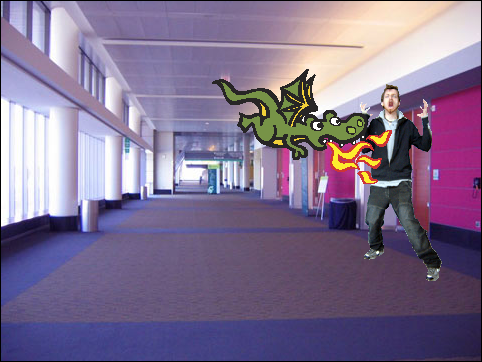
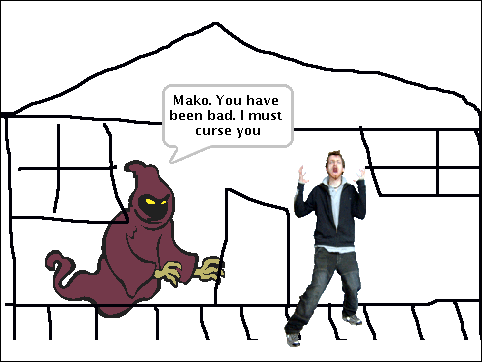
A few years ago, I ran into my friend Jay in the MIT Infinite Corridor. He was looking for volunteers to have their pictures taken and then added to the library of freely licensed and remixable media that would ship with every version of Scratch -- the graphical programming language built by Mitch Resnick's Lifelong Kindergarten group that is designed to let kids create animations and interactive games. Jay suggested I make some emotive faces and I posed for three images that made the final cut: /copyrighteous/images/scratchlib-mako-laughing.gif /copyrighteous/images/scratchlib-mako-screaming.gif /copyrighteous/images/scratchlib-mako-stop.gif But although I've spent quite a bit of time studying the Scratch community in the last few years as it is grown to include millions of participants and projects, I forgot about about Jay's photo shoot. A couple months ago, Acetarium resident Andres Lombana Bermudez pointed out that there was a mako tag on the Scratch website and that a whole bunch of users had been publishing projects using the pictures of me which, apparently, shipped in Scratch under my name. For example, in this project in which I dance in front of a enormous "MAKO" banner: /copyrighteous/images/scratchweb-dance.png That said, given the rather emotive nature of the pictures, I seem to usually end up being blown up shot, shrunk, set on fire by dragons, or meeting other similarly unfortunate ends. /copyrighteous/images/scratchweb-bad_mako.png /copyrighteous/images/scratchweb-looks_arent_everything.png There's quite many more entertaining examples under the tag and many more elsewhere on the Scratch website although they are a little trickier to track down. Jonathan Zittrain likes to say that the best technologies are generative in the sense that they encourage their users to make things with them that the designer never forsaw or anticipated. I feel generative.


Gregor Herrmann: RC bugs 2011/45

& another mix of various RC bug fixes: applying patches from others, fixing stuff myself, closing obsolete bugs: in somehow related news: the perl 5.14 transition has begun. that also means that the severity of some bug reports was raised, & maybe we'll see some new ones. but it also means these bugs are easier to fix now that perl 5.14 is in unstable.

Guido G nther: Testing libvirt and KVM/QEMU with libvirt-tck

Debian's libvirt in unstable finally passes the Technology Compatibility Kit (libvirt-tck) for qemu:///system:
Files=59, Tests=1579, 315 wallclock secs ( 0.77 usr  1.02 sys + 31.40 cusr 10.14 csys = 43.33 CPU)
Result: PASS
We're running libvirt's internal test suite since 0.9.0 but this doesn't launch any real virtual machines to check things like suspend, resume, snapshotting, migration and it doesn't create storage pools and volumes or networks. This means a lot of testing was done manually with each release. libvirt-tck provides a framework to perform these kinds of integration testing between libvirt and it's drivers, comes with hundreds of testcases already and it's easy to set up since it's available in experimental:
apt-get install -t experimental libvirt-tck
Edit /etc/libvirt-tck/default.cfg if you don't want to use the default connection URI. Then just run libvirt-tck:
libvirt-tck
Since this is supposed to stress libvirtd and the hypervisor and since it creates and deletes storage pools, networks and virtual machines it's recommended to run this on a dedicated system to make sure the tests don't blow away any precious config. If a test fails one can debug that single test using:
LIBVIRT_TCK_CONFIG=/etc/libvirt-tck/default.cfg prove --verbose /usr/share/libvirt-tck/tests/hooks/051-daemon-hook.t
This already revealed errors in our package like a missing parted build dependency breaking the creation of disk based storage pools, bugs in libvirt, crashes in QEMU and minor errors in the test suite itself. We're currently cheating a bit since the tests for hooks and nwfilter are currently disabled due to license problems with the used Perl modules. libvirt-tck can easily be integrated into Jenkins since it can now use libtap-formatter-junit-perl to generate JUnit XML. To do so simply configure a free-style software project to execute these commands:
rm -f libvirt-tck.xml
sudo libvirt-tck --timer --format junit --force > libvirt-tck.xml
allow Jenkins to run libvirt-tck as root
jenkins ALL=(ALL) NOPASSWD: /usr/bin/libvirt-tck --timer --format junit --force
and configure it to publish a JUnit test result report. Currently I'm only running the tests for qemu:///system so any help running and debugging this for LXC, VirtualBox or XEN is very welcome. Many thanks go to Salvatore Bonaccorso for packaging the missing Perl modules needed by libvirt-tck.

12 November 2011

John Goerzen: Greece part 5: Friends and Radios

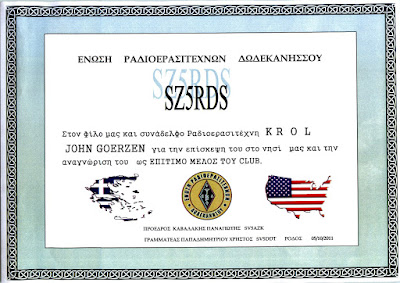
See also parts 1, 2, 3, and 4. This is the biggest highlight of our trip to Greece for me. I enjoy having the chance to meet people, visit for awhile, and make new friends and that certainly happened in Greece. In one of the shops we happened to step into, I noticed a radio behind the counter. That s not unusual itself; radios often catch my eye these days. But this radio was tuned to 21.070, an amateur radio frequency. So I asked the shop owner if he happened to be a ham. And indeed he was. He was Lakis (SV5KKU), and Terah and I had a great time visiting with him. Terah took some photos of us, and then we made our purchases and headed out. I had brought my HT (handheld radio, weighs a few ounces and is powered by batteries) with me, and Lakis told me about the repeaters in the area. I had known about some of that since I had emailed Panos of the amatuer radio club in Rhodes before leaving home (I found his name via Google). A couple of days later, on Tuesday, we found ourselves back in Lindos. It was mid-afternoon, so the shops were quiet. After a late lunch, I thought it would be nice to drop in on Lakis one more time, since we were scheduled to fly back the following morning. I m not sure how long we stayed it must have been at least an hour and enjoyed the fresh orange juice he prepared. After we got back to our hotel Tuesday, I learned that our flights on Wednesday were canceled due to a nationwide air traffic controller strike in Greece. After 3 hours on the phone with Delta (more on that experience later), we got rescheduled to fly back Friday. On Wednesday morning, I remembered that the Rhodes amateur radio club meets every Wednesday evening, and now I would be able to go! I knew how to contact Lakis by email and on the radio, and he kindly offered to pick me up and take me there. So that evening, I got a tour of his impressive mountaintop installation, and then it was on to the club the Radio Amateur Association of the Dodecanese (SZ5RDS). There I met Panos, whom I had emailed earlier (and I think surprised him a bit). It was a friendly group, and they translated into English for me every so often so I knew what was being discussed. When I was about to leave, they gave me this: The translation, partly from my memory and partly with the help of Google Translate, is:
Radio Amateur Association of the Dodecanese, SZ5RDS Our friend and radio colleague KR0L JOHN GOERZEN, who visited the island, has our recognition as an HONORARY CLUB MEMBER. PRESIDENT KAVALAKIS PANAGIOTIS SV5AZK (Panos) SECRETARY PAPADIMITRIOU CHRISTOS SV5DDT RHODES Oct. 5, 2011
(I hope that any Greeks reading this will send me corrections.) I truly appreciated that gesture and meeting all the people in the club. On the way back to the hotel, Lakis and I stopped by a restaurant, which I believe had the best souvlaki I ve ever tasted thanks! We brought some back for Terah. She had chosen to stay at the hotel that evening and had a small hotel meal earlier, but enjoyed the souvlaki and pita. Terah had explained to the ma tre d that I wasn t along that evening because I had gone to an amateur radio club meeting. Judging by the surprised reaction, this was probably the first time they had heard that particular comment! Experiences like this make travel fun and worthwhile. Thank you very much, Lakis and everyone in the club I hope to have a chance to visit again.

Kai Wasserb ch: New Greasemonkey script available for WotC's Magic section

No matter whether you're a professional or hobby player, if you play Magic: The Gathering, you certainly visit Wizards of the Coast's homepage from time to time. And while other parts of the WotC's page have been made unusable without ECMAScript enabled, the MTG part can be used without it mostly. The one part, that didn't work (and I needed) was card links. They have some ECMAScript to fetch the image from the Gatherer and overlay that on the current page, if you hover over a card link. If you click, it's again some script, that opens a Gatherer window. I just want all card links to be plain links pointing to the respective entries in the rather lightweight magiccards.info card search, which displays all relevant data in a compact layout. Today I finally got around to throw the ten or so lines of ECMAScript together, Greasemonkey needs to make that happen. If you like to give it a try, you can download it from my Greasemonkey script collection (direct link for the impatient: wotc_with_noscript_and_card_links.user.js). As an additional note: I'd like to point out, that there are other scripts available from userscripts.org which can do the same. But all those scripts did a lot else (like using jQuery to fetch the image on mouse over from magiccards.info).

11 November 2011

Niels Thykier: build-arch for everyone

The other day, I was asked if it was really possible to get build-arch support in Wheezy (as in, buildds using build-arch) by adding these optional targets. Lets have a look at the data that is available to us: To simplify my calculation I will assume we can fix packages over a course of 150 days (which is 5 months of ~30 days or every day in Dec to April). So 500/150 = 10/3 =~ 3.3 packages from the reduced set should be fixed every day. Erring on the side of caution, we should make that 4 packages every day. So if we fix 4 packages from the reduced set every day, we will definitely fix all of them before Wheezy. But the reduced set are only the source packages that could possibly benefit from having a build-arch target (it builds both arch:all and non-arch:all packages). There could (and probably will) still be sources building non-arch:all packages without a build-arch target. Furthermore, with the rate of 4 a day we will only have a month to get dpkg and buildd support In short, no. I do not expect us to get archive-wide build-arch support on buildds for Wheezy. But I will do my best to ensure that option #4 flip the switch becomes very attractive early in the Wheezy + 1 development schedule. I hope you will join us in this endeavour. Most of the time it is a trivial 3-4 line fix and often you can even throw in some hardening flags to spice it up a bit. The easiest way to help is to fix your (team s) packages listed in the reduced set . Once you are done with that you can look at the rest of your (team s) packages (see the full dd-list). The most important thing to remember is that Build-Depends-Indep is still broken! That is, you cannot rely on Build-Depends-Indep being installed on a buildd in the build target. So any existing workarounds have to stay for now (i.e. check for certain commands or deferring indep till binary-indep is called). If you are in doubt about how to fix a certain package feel free to ask for help. Note: I pull the data directly from lintian.d.o (full set) and UDD (reduced set). I try to remember to refresh it daily. The full set is basically (z)grep cut uniq on the lintian log, the reduced set is found using the UDD query from this script (based on a query done by Jakub Wilk). Since all data is (in)directly based on lintian.d.o only packages that are in sid are considered.

Felipe Sateler: Finding packages not directly depended upon

Today I was removing KDE from my laptop, when I realized that kde-window-manager would not go away (even when it was automatically installed) since it provides x-window-manager, which is needed by gdm. I manually removed it, but that got me thinking that maybe I had other packages that were in this situation. So I picked aptitude and tried to build some search-fu. Here is the resulting query:
aptitude search '?for x:
?x:installed
?x:automatic
?x:provides(?virtual ?reverse-depends(?installed))
?not(?x:reverse-depends(?installed(?depends(?=x))))'


Now, lets go over the query. The first part ?for x: allows us to refer to the package currently being matched. See the documentation for details. We'll see later why we need this. Basically we are saying: give me all packages x that match the following pattern. The second and third parts are trivial: we only want automatically installed packages.
The fourth part, ?x:provides(?virtual ?reverse-depends(?installed)) was easy: find all packages that provide a virtual package that is depended upon by some other installed package.
The fifth and final part, ?not(?x:reverse-depends(?installed(?depends(?=x)))) is why we needed the bound variable x. We want to filter out (hence the ?not) the packages that have some reverse dependency that depends directly on the package x. That way, in my case, metacity won't show up since gnome-core directly depends on it and is installed.

Unfortunately, this query doesn't grok alternative dependencies. For example, if gnome-core depended on metacity x-window-manager then this query wouldn't show metacity, since it is depended upon by a package. If someone can make this query understand that so that it only eliminates packages directly depended upon with no alternatives dependencies, please let me know!Tags: aptitude, cleaning, tip, tips

10 November 2011

Adnan Hodzic: Linux power regression + overheating problem on ThinkPad [fixed?]

This blog post isn t only directed to ThinkPad owners as most notebook Linux users with Intel Core Duo 1/2 and i3/i5/i7 processors have been affected by this bug if not all. And yes, this problem is present on latest Debian Unstable and Ubuntu 11.10. Prelude I m owner of Thinkpad X300, great machine except the fact that just recently I replaced its 3rd cooling fan! Yea, I do a lot of compiling and it s on all the time, but still this kind of things shouldn t happen. I first linked this problem to the fact that Thinkpad fan on Linux (as of 2.6.22) always works at what s its basically maximum RPM, thus the reason there are numerous fan control scripts. My favorite one is Thinkfan, but controlling fan doesn t really help if you have a overheating problem. For matter of a fact it working on its maximum speed might only help, with its own toll. As of kernel 2.6.38 up until 3.1 (still present) there has been a problem of power regression but besides this I had slight problem with overheating. Regarding overheating in beginning I tried reporting bugs, tried different Thinkfan configurations, blamed proprietary software such as Adobe Flash for spiking up CPU temperature, however this problem was somewhat solved. After numerous battery calibrations and as these didn t work in the end for battery life getting poorer with each day, I just blamed the factor that notebook was getting pretty old (~3 years). Then the consumer woke up inside of me and I thought it was time to get new notebook. I laid my eyes upon ThinkPad X1 thing of beauty except one mayor drawback, its price. I did some reading on X1 and interesting enough, X300 comes with Core Duo 2 L7100 but overheating + power regression was still present even on latest Intel Core I* series. Reading this killed the consumer and woke up the hacker side. Solution Initial workaround to the problems of power regression is to add pcie_aspm=force besides existing GRUB boot arguments, this did help to some point but what really helped in both cases was also adding i915.i915_enable_rc6=1 or at least I thought so since this line only applies to Sandy Bridge (i3/i5/i7) and latter. In the end my /etc/default/grub looks like:
GRUB_CMDLINE_LINUX_DEFAULT="quiet splash pcie_aspm=force i915.i915_enable_rc6=1"
and make sure you run update-grub after making these changes. Besides the arguments I used there are other ones you can use and for more info please head to Tweaks To Extend The Battery Life Of Intel Linux Notebooks . Results I ended up with such simple tweak are more then satisfactory as I got some ~45 extra minutes of battery life besides the fact that it lowered temperature by some ~10 C. Guess this also gives me extra time until I get a chance to lay my hands on X1 Smile P.S: After I posted this some argued that this is a workaround rather then a fix and folks at [Phoronix] just posted what they call a proper solution to this problem. Also please note although Sandy Bridge users that enable this might sometimes get a video corruption bug, i915_enable_rc6 is still supposed to get enabled by default in 3.2. So logical conclusion you can come up with is unless you re troubled by this problem, you might not want to use this work around/fix at this point. And hope it ll be fixed in future releases of your favorite Linux distribution.

Michal Čihař: phpMyAdmin demo server updates

phpMyAdmin demo server got some updates recently. First of all I've updated MySQL and MariaDB version it uses (MySQL is now on 5.5.7 and MariaDB on 5.3.2). Later I've finally found time to make mentions of demo server less intrusive and fit more in existing interface. I've used jQuery to inject information about demo server to main page as one of standard boxes. It fits there nicely and puts information on main page where most users land anyway (you can see it for example here). With most important information on main page, the other pages could be reduced and now only mentions demo server and Git revision it is using. This brings user experience closer to real phpMyAdmin without intrusive information shown on top of every page. I hope you will like it :-).

Filed under: English Phpmyadmin 0 comments Flattr this!

9 November 2011

Gunnar Wolf: On the social-based Web and my reluctance to give it my time

I recently started getting mails from no-reply@joindiaspora.com. Usually, a mail from no-reply@whatever is enough to make me believe that the admins of said whatever are clueless regarding what e-mail means and how should it work. And in this case, it really amazes me If I get an invite to Diaspora*, right, I should not pester a hypothetical sysadmin@joindiaspora.com to get me off his list, but I should be able to reply to the person mailing me Maybe requesting extra details on what he is inviting me to, or allowing me to tell him why I'm not interested. But yes, Diaspora* has fallen to the ease of requiring me to join their network to be able to communicate back with the "friend" who invited me. Some of the (three?) readers of this site might not be familiar with the Diaspora* project. It is a free reimplementation (as far as I know) of something similar to Facebook Free not only in the sense that it runs free software, but also because it is federated Your data will not belong to a specific company (that is, you are not the value object they sell and make money with), but you can choose and switch (or become) the provider for your information. A very interesting proposal, socially and technically. I find that a gross violation of netiquette. I should be able to reply to the mail - Even if in this case it were to (and sorry As you are spreading my name/mail, you will excuse me if I spread your name ;-) ) fernando.estrada.invite1501335@joindiaspora.com. Such an (fictional FWIW) address would allow for mail to reach back the submitter by the same medium it was sent, without allowing open spamming into the network. Now, what prompted me to write this mail (just before adding no-reply@joindiaspora.com to my blacklist) is the message I got (in an ugly HTML-only mail which erroneously promised to be text/plain, sigh...) is that Fernando sent me as the inviting message, So, at least are you going to give Diaspora a chance? The answer is: No.. But not because of being a fundamentalist. Right, I am among what many people qualify as Free Software zealots, but many of my choices (as this one is) is in no way related to the software's freeness. I use non-free Web services, as much as many of you do. Yes, I tend to use them less, rather than more (as the tendency goes). But the main reason I don't use Twitter is the same reason I don't use Identi.ca, its free counterpart And the reason I'm not interested in Facebook is the same reason I will not join Diaspora* Because I lack time for yet another stream of activity, of information, of things to do and think about. Yes, even if I care about you and I want to follow what's going on in your life: The best way to do it is to sit over a cup of coffee, or have some dinner, or to meet once a year in the most amazing conference ever. Or we can be part of distributed projects together, and we will really interact lots. Or you can write a blog! I do follow the blogs of many of my friends (plus several planets), even if they have fallen out of fashion A blog post pulls me to read it as it is a unit of information, not too much depending on context (a problem when I read somebody's Twitter/Identica lines: You have to hunt a lot of conversations to understand what's going on), gives a true dump of (at least one aspect of) your state of (mind life work), and is a referenceable unit I can forward to other people, or quote if needed. So, yes, I might look old-fashioned, clinging to the tools of the last-decade for my Social Web presence. I will never be a Social Media Expert. I accept it But please, don't think it is a Stallmanesque posture from me. It is just that of a person who can lose too much time, and needs to get some work done in the meantime. (oh, of course: Blog posts also don't have to make much sense or be logically complete. But at least they allow me to post a full argument!)

Jon Dowland: Minecraft

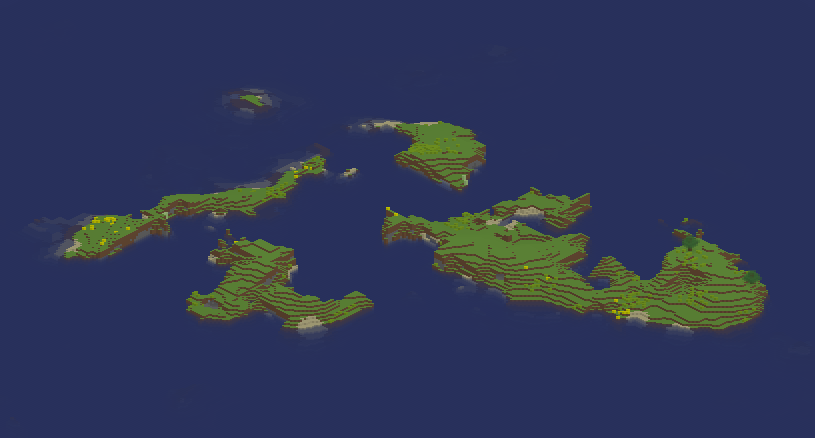
The Archipelago The Archipelago
Bird's eye view Bird's eye view
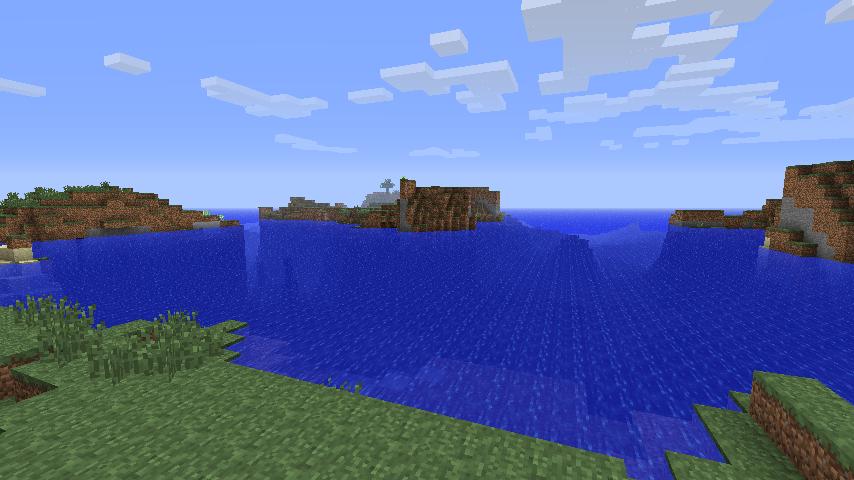
You're on a small island in the middle of a vast ocean. There's nothing but dirt, stone and grass on the your island, which is part of a tiny archipelago. One of the nearby islands features a dark cave, with what looks like a coal seam near the entrance. You can glimps two small trees on another island nearby. All around your little clutch of islands is what appears to be vast, unending ocean in all directions. It's midday and you need to make yourself safe for the night. You can use the wood from the trees to craft a pickaxe. With this, you can fetch some coal from the seam. With the coal, you can create some torches, to see in the dark. You might have enough wood left over to make a door, if you're lucky. Or perhaps you should save it to craft a boat, or a sword. Groans from something unknown emanate worryingly closely from the darkness of the cave. You're lucky: one of your two trees has dropped a sapling. You eagerly plant it. In a few days time, you might be able to harvest some more wood. You've been granted a temporary reprieve, but the law of diminishing returns means at some point, and soon, you'll run out of wood. Swimming is time-consuming. By the time you have assembled a meagre supply of wood and coal, it's almost sunset. You nervously dig a burrow in the mud of your original island, light it with a torch and block the entrance back up. Night passes slowly as you listen to things crawling around in the darkness outside. I first learned about Minecraft from this blog post by Mike Watson last year. Mike did a great job of demonstrating the narrative power of the game and his post left a lasting impression on me. Every now and then I dip in to Minecraft to see what's new since the last time I played it. In the last few months version 1.8 was released and so I started a new map to check it out. I ended up with a corker of a randomly-generated map. Inspired by Mike's post, I thought I'd write a bit about it. In a follow-up post I will provide the map itself.

8 November 2011

Jonathan McDowell: The cost of progress

You should probably ignore this post. I'm just venting. I'll be better after a nice cup of tea. Things that are causing me to fume about the fact Gnome Shell just hit Debian/Testing: I update my testing boxes (work + home laptops) almost every day. It rarely breaks, and certainly when it does I accept that's what I get for doing rolling upgrades. I can't remember the last time I did an upgrade that actually made me angry. Also I suspect this thing is going to have a complete fit on my binary nVidia/hacked up DisplayLink configuration at work (the DisplayLink side refuses to do 3D for starters). Perhaps better not to upgrade there until I have a sufficient block of free time. Maybe it's time to go back to evilwm. I only stopped because I wanted a dock for wifi/bluetooth etc applets on my laptop that didn't get hidden when I fullscreened things. Implementing _NET_WM_STRUT might make that doable... (I'm sure some of this is just dealing with the change but it's a bit bloody difficult to deal with a complete change in user interface that hasn't even managed to carry across settings from the old one.)

7 November 2011

Jo Shields: Bansheegeddon

It s seeming increasingly likely that reports regarding the future of Banshee, Tomboy, and the rest of the Mono stack in the default Ubuntu desktop install are accurate. Ubuntu 12.04 will likely be the first Ubuntu release since 5.10 not to ship with any Mono apps in the default install ending a run of 12 releases over 6 years. The decision seems to have come about during the default apps session at the Ubuntu Developer Summit just ended in Orlando, Florida. Prior to heavy vandalism, the only reasons cited for the change in the UDS session log are Banshee not well maintained and porting music store to GTK3 is blocked on banshee ported to GTK3 . Other reasons mentioned but not in the session logs are complaints that it doesn t work on ARM. I m using a lot of conjecture in this first paragraph because the news about the decision appeared on the blogosphere before anywhere else. The first many Banshee or Tomboy developers read about it was reading a flurry of activity on the Tweetosphere from the anti-Mono activists declaring victory. So first, a word on the cited reasoning. Banshee works fine on ARM, since Mono works fine on ARM. Xamarin, the company behind most upstream Mono work, earns their income almost entirely from ARM versions of Mono, running on the varied ARM implementations found in smartphones. Every major Banshee release is personally tested on my Genesi EfikaMX, an ARM system with a Freescale i.mx51 processor. I ve also demonstrated Banshee running in an Ubuntu chroot on my HP Touchpad, an ARM-based tablet. What is known is that Banshee has some problems running on Texas Instruments OMAP4 processors the target ARM platform for Canonical s ARM work. None of the Banshee upstream developers, Mono upstream developers, or Mono Ubuntu team has ever been able to reproduce the cited problems, since problems specific to an exact ARM chip are impossible to reproduce without the requisite hardware and none of us owns an ARM system matching Canonical s target. That Banshee is still a GTK+2 app is true. A port to GTK+3 is almost complete, but blocking on a single technical bug deep within GTK# s guts, which could be fixed by someone with sufficient knowledge of GTK+ semantics. Nobody with the required GTK+ knowledge has stepped forward with a fix at this point in time. As for the final point, that Banshee is not well maintained, this seems like a directed personal insult against the active and responsive Banshee maintainer, Chow Loong Jin, and upstream bug triager David Nielsen, in addition to the immeasurable hours contributed free of charge for the benefit of Ubuntu users by various other members of related Mono app and library teams, including myself. I need to stress at this point that my annoyance with this decision has nothing to do with the actual app changes. Keeping Tomboy and gbrainy, at a cost of about 25 meg of unsquashed disk space, is a hard argument to make compared with those two plus Banshee for 40 meg. Dropping gbrainy and Tomboy, and switching to Rhythmbox, will save about 30 meg of unsquashed space, all told.I m unconvinced that Rhythmbox is a technically superior app to Banshee several features which were gained by the first app swap will be lost again but that s another long tedious argument to be had. No, what has me deeply angered is the shambolic way the changes were made and announced. Significant accommodations were made by Banshee upstream in order to make life easier for Canonical to integrate Banshee into their OS. For one thing, that s why the Ubuntu One Music Store support is a core Banshee feature, not part of the third-party community extensions package. If Banshee was being considered for replacement due to unresolved technical issues, then perhaps it would have been polite to, I don t know, inform upstream that it was on the cards? Or, if Canonical felt that problems specific to their own itches required scratching, then is it completely beyond the realm of possibility to imagine they might have spent developer resources on bug fixing their OS and sending those fixes upstream? Or even and call me crazy providing access for upstream to specialized hardware such as a $174 Pandaboard to empower upstream to isolate and fix unreproducible bugs specific to Canonical s target hardware? And here s where it gets more astonishing for me Canonical paid money to ship one of the community-based packagers responsible for the stack, Iain Lane, to Orlando for UDS, and didn t think it was worth bothering to perhaps inform him hey, the stuff you work on is in danger of being axed from the default install, maybe you should go to this session . So I m not cross that the stuff I work on has been removed from the default install. I intend to continue working on it as I have for the last 4 years, through my work in Debian. No, why I m cross that I heard about it from fucking Boycott Novell. Regardless of your opinions regarding Banshee or its stack, if you read the above and don t see it as an abysmal failure of community engagement by a company whose community manager wrote a book on the damn topic, then there s something seriously wrong with your understanding of how community labour should be seen as a resource. Maybe someone at Canonical should try reading Jono s book. It s not a first-time offence, and this mail from a PiTiVi developer regarding changes in 11.10 makes for useful further reading. [edit] There is some worthwhile discussion going on on the ubuntu-desktop mailing list covering the technical issues surrounding the decision, I would suggest it s a good place for ongoing technical discussion.
Timo Jyrinki: Free software mobile phone galore

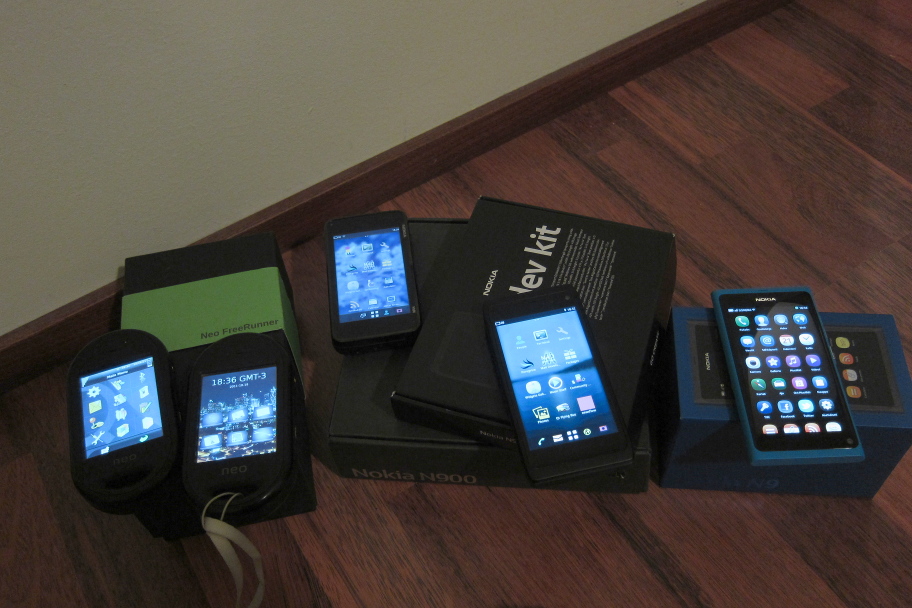
Almost forgot to post this. My mobile phones running free software in photos. From left to right:


All of that software running on the devices is more or less free software, with Harmattan obviously being by far the least free, especially applications, but still better than any other on-the-shelf phone software *), and the others being 99% or "Ubuntu like" free ie. possibly with firmware and a few driver exceptions. N9 needs some bootloader work still before Nemo, Debian, Ubuntu etc. can be run there. I've collected a few things about N9 from this point of view at a wiki page.
*) Not sure about every Android phone, but Android is not openly developed anyway so it's hardly a similar free software project such as freedesktop.org projects or Qt

I gave my N900 away now since obviously I cannot make full use of each one of these. I'm multi-SIMming my N9 and the GTA02a7 Neo FreeRunner for daily use, while the other FreeRunner and N950 are purely for tinkering related purposes. The development FreeRunner will get on upgrade to GTA04 once it's available, and then hopefully that can be made into a daily usable phone as well.

By the way, see you in FSCONS in Gothenburg next weekend. Even rms will be there, which is always interesting of course :)

Next.

Previous.