Search Results: "ina"

20 March 2012

Dirk Eddelbuettel: R / Finance 2012 Open for Registration

The annoucement below just went to the R-SIG-Finance list. More information is as usual the the R / Finance page:
Now open for registrations: R / Finance 2012: Applied Finance with R
May 11 and 12, 2012
Chicago, IL, USA
The registration for R/Finance 2012 -- which will take place May 11 and 12 in Chicago -- is NOW OPEN! Building on the success of the three previous conferences in 2009, 2010, and 2011, we expect more than 250 attendees from around the world. R users from industry, academia, and government will join 40+ presenters covering all areas of finance with R. This year's conference will start earlier in the day on Friday, to accommodate the tremendous line up of speakers for 2012, as well as to provide more time between talks for networking. We are very excited about the four keynotes by Paul Gilbert, Blair Hull, Rob McCulloch, and Simon Urbanek. The main agenda includes nineteen full presentations and eighteen shorter "lightning talks". We are also excited to offer six optional pre-conference seminars on Friday morning. Once again, we are hosting the R/Finance conference dinner on Friday evening, where you can continue conversations while dining and drinking atop a West Loop restaurant overlooking the Chicago skyline. More details of the agenda are available at:
http://www.RinFinance.com/agenda/
Registration information is available at
http://www.RinFinance.com/register/
and can also be directly accessed by going to
http://www.regonline.com/RFinance2012
On behalf of the committee and sponsors, we look forward to seeing you in Chicago!
Gib Bassett, Peter Carl, Dirk Eddelbuettel, Brian Peterson,
Dale Rosenthal, Jeffrey Ryan, Joshua Ulrich
Our 2012 Sponsors:
International Center for Futures and Derivatives at UIC Revolution Analytics
Sybase
MS-Computational Finance at University of Washington Google
lemnica
OpenGamma
OneTick
RStudio
Tick Data
See you in Chicago in May!!

19 March 2012

Petter Reinholdtsen: Debian Edu interview: John Ingleby

Debian Edu / Skolelinux users are spread all across the globe. The second inteview after the Squeeze release was publised is with John Ingleby, a teacher and long time Linux user in United Kingdom. Who are you, and how do you spend your days? I teach ICT part time at the Rudolf Steiner School in Kings Langley, near London, UK. Previously I worked as a technical author/trainer while my children attended the school, and I also contributed to the Schoolforge UK community with the aim of encouraging UK schools to adopt free/open source software. Five or six years ago we had about 50 schools interested in some way, but we weren't able to convert many of them into sustainable installations. How did you get in contact with the Skolelinux/Debian Edu project? Skolelinux had two representatives at an early Edubuntu meeting in London which I attended. However at that time our school network had just been installed using CentOS, LTSP 4 and GNOME. When LTSP 5 came along we switched to Edubuntu thin client servers so now we have a mixed environment which includes Windows PCs and student laptops, as well as their MacBooks and iPads. However, the proprietary systems have always been rather problematic, and we never built a GUI for the LDAP server, so when I discovered Skolelinux is configured for all these things we decided to try it. What do you see as the advantages of Skolelinux/Debian Edu? By far the biggest advantage is the Debian Edu community. Apart from that I have always believed in the same "sustainable computing" goals that Skolelinux is built on: installing Linux on computers which would otherwise be thrown away, to provide a reliable, secure and low-cost IT environment for schools. From my own experience I know that a part-time person can teach and manage a network of about 25 Linux computers, but it would take much more of my time if we had proprietary software everywhere. What do you see as the disadvantages of Skolelinux/Debian Edu? As a newcomer I'm just finding out who's who in the community and how you're organised, and what your procedures are for dealing with various things such as editing manual pages and so-on. The only English language mailing list seems to be for developers as well as users, so my inbox needs heavy pruning each day! Which free software do you use daily? Besides the software already mentioned at school we use Samba, OpenLDAP, CUPS, Nagios and Dansguardian for the network, and on the desktops we have LibreOffice, Firefox, GIMP and Inkscape. At home I use Ubuntu and an Android 4 eePad Transformer (but I'm not sure if that counts...) Which strategy do you believe is the right one to use to get schools to use free software? That's a tough question! For very many years UK schools installed and taught only proprietary software, so that at the highest levels the notion of "computer" means simply "proprietary office applications". However, schools today are experiencing budget constraints, and many are having to think hard about upgrading Windows XP. At the same time, we have students showing teachers how to use iPads, MacBooks and Android, so the choice of operating system is no longer quite so automatic. What is more, our government at last realised that we need people with programming skills, so they're putting coding back in the curriculum! And it's encouraging that the first 10,000 Raspberry Pi units sold out in 2 hours. I don't really know what strategy is going to get UK schools to use free software, but building an active community of Skolelinux/Debian Edu users in this country has to be part of it.

Benjamin Mako Hill: A Manhattan Project for Clich Collection

This weekend, I launched an extremely ambitious effort to collect evidence of extremely ambitious efforts. The result was a short program that searched the web and revealed the: [Previously in this series: frailty, the invisible hand, science as dance.]

Cosimo Alfarano: Facebook provider for GNOME Online Accounts

Following Xavier's steps, last week a new patch set has been commited to GNOME Online Account master repo, this time to add support for Facebook client-side auth flow, which does not require secret keys to work.

This means that since GNOME 3.4 it will be possible to enable Facebook support at configure time (yep, by default it's still disabled. Distributions will explicitly need to enable it for now). Currently only chat is supported.


The steps to enable it are easy:
Use --enable-facebook at configure time and compile+install as usual.A default FB application id is used, so you don't need to provide it.
Using the freshly updated goa-daemon (use --replace in case you're unsure) select online accounts from the control panel, add a facebook account (which should be now possible to select, along with at Google and Windows live if you've enabled it) and follow the on-screen instruction.
You'll need to authenticate yourself against Facebook and authorize the GNOME application.
Once your account has been created, set your presence to Available using Empathy or gnome-shell.
Now chat with your Facebook buddies \o/

It requires empathy (>=3.3.2), telepathy-gabble (>= 0.15.0) and of course gnome-online-accounts (the soon soon to be released 3.4.0, or directly git master)

Thanks to Xavier who backported to 3.4 my patches, originally meant for 3.6, and to Collabora who allowed us to improve Gnome Online Accounts!

18 March 2012

Aurelien Jarno: 10 years ago

Date: Mon, 18 Mar 2002 18:22:10 +0000
From: James Troup <troup@samosa.debian.org>
To: Aurelien Jarno <aurelien@aurel32.net>
Cc: da-manager@debian.org
Subject: New Debian maintainer Aurelien Jarno [ This is a long (automatically-generated) mail, but it contains
important information, please read it all carefully. ] Dear Aurelien Jarno! An account has been created for you on developer-accessible machines with username aurel32 . The password for this account can be found encrypted with your PGP or GPG key and appended to this message. A list of machines available to Debian developers can be found at <URL:http://db.debian.org/machines.cgi>. Please take a minute now to familiarize yourself with the Debian Machine Usage Policy, available at <URL:http://www.debian.org/devel/dmup> You have been subscribed to the debian-private mailing list as <aurel32@debian.org>. Please respect the privacy of that list and don t forward mail from it elsewhere. E-mail to <aurel32@debian.org> will be forwarded to <aurelien@aurel32.net>. To change this, please see <URL:http://db.debian.org/forward.html> Also, please subscribe to debian-devel-announce, if you haven t done so already. We strongly suggest that you use your aurel32@debian.org address for the maintainer field in your packages, because that one will be valid as long as you are a Debian developer, even if you change jobs, leave university or change Internet Service providers. If you do so, please add that address to your PGP/GPG key(s) (using gpg edit-key YOUR USER ID ) and send it to the keyring server at keyring.debian.org with gpg keyserver keyring.debian.org send-keys YOUR USER ID . You can find more information useful to developers at <URL:http://www.debian.org/devel/> (in particular, see the subsection titled Debian Developer s reference ). We suggest that you subscribe to debian-mentors@lists.debian.org. This list is for new maintainers who seek help with initial packaging and other developer-related issues. Those who prefer one-on-one help can also post to the list, and an experienced developer may volunteer to help you. You can get online help on IRC, too, if you join the channel #debian-devel on irc.debian.org. Take a look at the support section on www.debian.org in order to find out more information. You should have read these documents before working on your packages. o The Debian Social Contract
<URL:http://www.debian.org/social_contract.html> o The Debian Policy Manual
<URL:http://www.debian.org/doc/debian-policy/> If you have some spare time and want to contribute it to Debian you may wish to take a look at the Work-Needing and Prospective Packages for Debian GNU/Linux also known as WNPP that can be found at <URL:http://www.debian.org/devel/wnpp/> If you plan to make a Debian package from a not yet packaged piece of software you *must* announce your intention on the debian-devel mailing list to make sure nobody else is working on them. The machine ftp-master.debian.org is our main archive server. Every uploaded package finds it s way there (except for Packages covered by US crypto laws which go to non-us.debian.org) eventually. master.debian.org is the home of our bug tracking system. Project web pages and CVS archives are hosted on klecker.debian.org (aka cvs/www.debian.org), klecker is also our general shell server. Web pages should be placed in public_html on klecker and refered to by http://people.debian.org/~aurel32 You should use ssh to log into the machines instead of regular telnet or rlogin. Our LDAP directory is able to share ssh RSA keys among machines, please see <URL:http://db.debian.org/doc-mail.html> Otherwise when you first login a ~/.ssh directory will be created with the appropriate permissions. Please be aware of the security implications of using RSA authentication and ssh agents. Finally, please take a minute to visit <URL:http://db.debian.org/>.
Login using the password information appended to this email, and update your personal information. The information is used to maintain your accounts on various Debian machines, and also to allow other developers and general users to find out more about you. Many of the fields are only visible to other registered Debian developers. This is also the only way to change your password. The passwd program does not yet work. Welcome to the project!
The Debian New Maintainer Team

Andrew Pollock: [life] Guantanamo: My Journey

I first learned that David Hicks had written an autobiography when I saw some press coverage of there being an attempt by the Australian Government to ban the sale of it, so I asked my sister if she could get me a copy for my birthday before any ban happened. The book doesn't appear to be available on Amazon. I sat down and tried to read it almost immediately, but at the time found his writing style to be rather inarticulate, so I put the book down for a month or so. When I next had a platelet donation to make, I took it along with me, and forced myself to read it for duration of the donation. On the second reading, I managed to engage with the book, and from that point on, once I made it through his early years in that initial forced reading session, it ended up being quite enthralling. I plugged my way through the 456 pages in a bit over a month I guess. We'll never truly know the full story of David Hicks, because I'm sure that unless there's some sort of inquiry (and even then, there's multiple country's governments involved), the full story won't come out. I was always sympathetic to Hicks' plight, since I don't believe that anyone should be held without due process let alone for anywhere near as long as he was. Certainly, the way the book reads, Hicks comes across as a very young, naive, but principled individual. Like many Australians, he got the travel bug, and by way of it, got to interact with some different cultures, which awakened a hunger for social justice in him (at least that's my interpretation of his portrayal). I guess I have a different mental image of torture than Hicks did, because I didn't really find any incidences of what I'd consider torture in his story. There was plenty of despicable, inhumane treatment though, so I can see how the line might get blurry, particularly if you're the one experiencing it. Specifically on the (mis)treatment of the detainees: it was pretty bad, based on the book. I'm surprised there haven't been more whistle blowers that have come out. I can't believe that the many soldiers who were stationed there could treat detainees the way Hicks says they were treated and then can look themselves in the mirror. The ICRC seemed well apprised of the detainees conditions (since they seemed to have the most access to them of any non-military people). I don't know what confidentiality is imposed on them in return for that access, though. The fact that he's able to string a sentence together at all after the treatment he describes for the length of time he received it, I think is pretty amazing. I couldn't imagine having to endure what he says he went through. I did feel quite appalled by my own country's complete disregard for his plight, and similarly in the way the US Government treated these detainees for as long as they did. Given there are still 171 detainees in Guantanamo today, it makes me wonder what the conditions and treatment are like there now. It certainly seems to have fallen out of the mainstream press. Overall, not the most well written book, but a fascinating and shocking account of what happened to one person. I think Hicks should be congratulated for the courage to relive his experiences to get them down on paper, and Random House should also be congratulated for publishing his work, which I'm sure put them under some political pressure. I have no idea how well the book has sold, or how widely it has been read, but I certainly recommend it.

Charles Plessy: Debian-installer in a cloud.

Debian Med prepares a metapackage for multi-purpose image machines, containing packages for bioinformatics that can be used in command line or via scripts, and that do not depend on too many other packages. I would like to prepare such an image for the Amazon cloud in the most secure manner, and the simplest way is to build it automatically in order to not have to clean anything at the end of the process. I tried for months so use the Debian installer, but banged my head against walls repeatedly, as it was impossible to re-partition the volume on which the installer was started. In the end, I figured out that this was not necessary. For instance, one can start an image containing the installer on a micro instance (-t t1.micro), with an additional volume of one gibibyte (-b /dev/sdb=:1:false) to install Debian on, and preseed the installer via instance metadata (-f preseed.txt) using a file prepared in advance. When the installation finishes, the instance terminates instead of stopping (--instance-initiated-shutdown-behavior terminate), and its volumes disappear, except the one where Debian was installed (/dev/sdb=:1:false). Debian-installer in Stable is not often updated, and its size is very small. One can therefore think of releasing one machine image per zone and architecture. I did so for T ky (ap-northeast-1) on amd64. It contains the kernel, its initrd, and a GRUB 1 menu for pvgrub, that passes the following options: console=hvc0 auto=true priority=critical url=http://169.254.169.254/latest/user-data DEBIAN_FRONTEND=text. Two key pieces are missing in the resulting system. When the kernel is installed or updated, the GRUB 1 configuration file for pvgrub must be refreshed. Also, the system must be able to retrieve a public SSH key provided through the instance metadata, to allow one to log in without using a predefined password. These two functions are provided by the cloud-init package, available in Ubuntu and Fedora. I am looking for volunteers to maintain or co-maintain cloud-init in Debian.

Soeren Sonnenburg: Shogun got accepted at Google Summer of Code 2012

SHOGUN has been accepted for Google Summer of Code 2012. SHOGUN is a machine learning toolbox, which is designed for unified large-scale learning for a broad range of feature types and learning settings. It offers a considerable number of machine learning models such as support vector machines for classification and regression, hidden Markov models, multiple kernel learning, linear discriminant analysis, linear programming machines, and perceptrons. Most of the specific algorithms are able to deal with several different data classes, including dense and sparse vectors and sequences using floating point or discrete data types. We have used this toolbox in several applications from computational biology, some of them coming with no less than 10 million training examples and others with 7 billion test examples. With more than a thousand installations worldwide, SHOGUN is already widely adopted in the machine learning community and beyond. SHOGUN is implemented in C++ and interfaces to all important languages like MATLAB, R, Octave, Python, Lua, Java, C#, Ruby and has a stand-alone command line interface. The source code is freely available under the GNU General Public License, Version 3 at http://www.shogun-toolbox.org. During Summer of Code 2012 we are looking to extend the library in three different ways:
  1. Improving accessibility to shogun by developing improving i/o support (more file formats) and mloss.org/mldata.org integration.
  2. Framework improvements (frameworks for regression, multiclass, structured output problems, quadratic progamming solvers).
  3. Integration of existing and new machine algorithms.
Check out our ideas list and if you are a talented student, consider applying!

17 March 2012

Matthew Garrett: More ways for firmware to screw you

Some of my recent time has been devoted to making our boot media more Mac friendly, which has entailed rather a lot of rebooting. This would have been fine, if tedious, except that some number of boots would fall over with either a clearly impossible kernel panic or userspace segfaulting in places that made no sense. Something was clearly wrong. Crashes that shouldn't happen are generally an indication of memory corruption. The question is how that corruption is being triggered. Hunting that down wasn't terribly easy.

My first thought was that we were possibly managing to load the kernel over a region used by UEFI code. UEFI defines two types of code - boot services and runtime services. While runtime services code and data must be preserved by the OS, in theory boot services code and data is available to the OS once the firmware has exited. In practice, that's not true. It seemed entirely possible that the kernel might be ending up on top of some of that boot services code or data and getting trodden on. Grub now has code to avoid putting the kernel on boot services, so testing the latest code seemed like a good plan. But no, crashes still happened.

That pretty much ruled out the bootloader. My next thought was that executing some of the firmware code was triggering a write to some other memory that contained the kernel. Josh Boyer suggested the next trick, which was to try marking the kernel read-only to see whether anything was hitting it. x86 lets you mark pages as read-only - any attempt to write to them should take a fault. UEFI functions are executed in the context of the kernel, so share the same page tables. That let me rule this out, since everything still went just as wrong and I wasn't taking an extra fault first.

However, at this point I was reasonably happy that it wasn't the kernel itself being overwritten - faults were occurring in userspace code as well. That was a pretty strong indication that what was happening was continuing to happen once userspace had started, so it wasn't a direct response to a firmware call. I made sure of that by stubbing out all the calls that could be triggered after kernel initialisation, and saw the same failures. Once all attempts to be clever have failed, it's time to just start using brute force. The kernel lets you reserve areas of RAM by passing arguments like memmap=0xlength$0xstart to block length bytes starting at start from being used. It took a while, but I finally found a 256MB range that made a difference - reserving it resulted in the machine booting reliably, letting the OS use it resulted in occasional crashes.

Definite progress. Comparing that memory range to the EFI memory map was helpful. There were several blocks of UEFI boot services data present there, which really seemed like too much of a coincidence. By reserving each of them in turn, I'd traced it down to a single 31MB region of boot service data - that is, memory reserved by the firmware for use by the UEFI boot services. Per spec, this is available to the OS once the boot environment has been exited. Nothing other than the OS should be touching this after boot, but something clearly was. Tracking down what was far easier than I expected, although the first attempt was a failure. Setting it read-only should have triggered a fault, but didn't. That was rather confusing. But, rather than give up, I patched the kernel to fill the region with 0xff at kernel init. Then I booted the system, read it back and looked for values that weren't 0xff. I got this:
00000000  ff ff ff ff ff ff ff ff  ff ff ff ff ff ff ff ff   ................ 
*
001568a0  ff ff ff ff ff ff ff ff  ff ff ff ff 84 00 00 00   ................ 
001568b0  00 20 a7 ac 46 00 00 00  00 00 00 00 00 00 06 01   . ..F........... 
001568c0  c2 0b 0c 00 ff ff ff ff  ff ff ff ff ff ff ff ff   ................ 
001568d0  ff ff 0a 04 f0 03 82 0d  40 00 00 00 ff ff ff ff   ........@....... 
001568e0  ff ff 00 21 00 36 9a 80  ff ff ff ff ff ff 00 7e   ...!.6.........~ 
001568f0  00 09 43 48 41 2d 47 75  65 73 74 01 04 02 04 0b   ..CHA-Guest..... 
00156900  16 32 08 0c 12 18 24 30  48 60 6c 2d 1a 0e 18 1a   .2....$0H l-.... 
00156910  ff ff 00 00 00 00 00 00  00 00 00 00 00 00 00 00   ................ 
00156920  00 00 00 00 00 00 00 dd  09 00 10 18 02 00 10 01   ................ 
00156930  00 00 dd 1e 00 90 4c 33  0e 18 1a ff ff 00 00 00   ......L3........ 
00156940  00 00 00 00 00 00 00 00  00 00 00 00 00 00 00 00   ................ 
00156950  00 00 bd ea f8 b3 ff ff  ff ff ff ff ff ff ff ff   ................ 
00156960  ff ff ff ff ff ff ff ff  ff ff ff ff ff ff ff ff   ................ 
*
022fb000
That's a lot of 0xffs (around 31MB of them) with one small section that contains an 802.11 probe packet with the SSID of the hospital across the road from my house. Apple support network booting off wireless networks. It seems that the firmware brought up the wireless card, associated with this network (it's the only public one nearby) and then left the card DMAing packets into RAM. The read-only page attribute only applies to CPU-initiated accesses, so it could do this without triggering a page fault. It also explained why it was so random - whether memory corruption occurred would depend on whether a packet appeared between that memory being used by the OS and the kernel reinitialising the wireless card. It certainly explains why I couldn't reproduce it when I left the machine repeatedly rebooting on the bus home.

How do we fix this? Unsure. With luck disconnecting the UEFI driver in the bootloader should quiesce the hardware, but without testing I'm not sure of that yet. For now it's just another example of firmware managing to break expectations in deeply strange ways.

comment count unavailable comments

Ana Beatriz Guerrero Lopez: Debian accepted for the Google Summer of Code 2012. Students wanted!

Great news! Debian has been accepted into the Google Summer of Code (GSoC) program this year for the seventh time. Now we are looking for students to work this summer with us in one of our exciting projects. If you are interested, now would be a good time to get in touch with the mentors; remember that discussing your application before submitting it is always recommended so that you can get feedback from the community.

Please also read the FAQ and timeline in the Google Summer of Code website. Besides contacting with the mentors, you can also get in touch with us on our IRC channel #debian-soc (in irc.debian.org) and the soc-coordination mailing list if you have any questions. I am hoping to see many great applications from students wainting to improve Debian :)

16 March 2012

Christian Perrier: [life] Running update

We're now 2.5 months in 2012 and I'm indeed getting closer of my first big goal of the year : the 80km run of Paris Ecotrail. The race takes place next Saturday, March 24th, with a start at 12:00 in the South-West of Paris area (close to our place). The race is mostly a trail race in woods and forests in the neighbourhood of Paris, going up and down in our small hills and valleys, passing along pools and lakes and indeed showing the natural beauties we have less than 20km away from center Paris. The race ends at the Eiffel Tower. And they really mean it! The race ends at Eiffel Tower's *first floor* after climbing the steps there. Those of you who have been there can imagine the surprise of tourists from all over the world when hundreds of "road warriors" wearing water backpacks, head lamps and looking a bit tired come and climb the Old Lady's stairs. So, in case you happen to be touring in Paris on the week-end of March 24-25, just pop up at Eiffel Tower around 10-11pm (yes, at night) and try to spot a bubulle crawling up there to reach the finish line..:-) To prepare this, I already ran 538km in 2012, mostly done either with my daily commute runs...or with week-end long runs (up to 37km on march 4th, and many others above 20km). I ran two half-marathons as well: one in February, where I nearly broke my record, finishing it in 1h37'45" even though this is a quite though race with two hills. I was very in shape that day and was lucky to run with a friend setting the pace for me, which helps a lot. Another half-marathon last Sunday in Rambouillet was also a good race, though I was secretly hoping to break my record there (the race is flat, much more than the former one). I had however to slow down from a 4'35"/km pace to 4'50"/km in order to preserve my condition. And, finally, I completed the race in 1h39'53". So, two half-marathons in less than 1h40 again. That sounds promising for the Ecotrail (even if there nothing similar between a flat half-marathon and a hilly ultra-trail) and also for the next marathon, in June. I'll keep you posted about the Ecotrail race but I can announce in advance that I'll be using the Runtastic app on my brand new Android phone, and people will be able to follow my race live here. And you'll even be able to cheer at /me..:-) Next running update on Sunday 25th to give you the outcome....

Petter Reinholdtsen: Writing and translating documentation in Debian Edu

Documentation in Debian Edu is provided in several languages, and it is important to make it both easy to contribute and to keep the translated versions in sync. To do this we have come up with what we believe is a very efficient work flow.
  1. The documentation is written in a moinmoin wiki (see for example the Squeeze release manual) with support for exporting the content as docbook XML.
  2. This docbook document is given to po4a to extract a gettext style .pot file with the content, which in turn is used to create .po files with the translated text.
  3. The .po files are given to translators, and they can always tell which part of the original wiki document is new or changed. They can use their normal translation tools like lokalize or poedit to write the translation. There is even a system in place to handle translated images.
  4. The translated .po files are combined with the original docbook XML document using po4a to create a translated docbook document.
  5. The final step is to use all the generated docbook files and create PDF and HTML version of the original and translated documents.
This setup work very well, but have a few issues. The biggest issue is that the docbook support we use in moinmoin is not actively maintained. The docbook support is also buggy, and our build system contain workarounds to make sure the generated docbook is usable despite these bugs. If you want to have a look at our setup, it is all there in the debian-edu-doc package.

Christian Perrier: [life] No more teens at home...

So, since Wednesday, we have no more teenagers among our children. Indeed, our youngest, Magali, turned 20 and we happily celebrated that in a japanese restaurant in Paris : Magali is living in a (very) small flat in Paris as she attends preparation courses for exams meant to enter physical therapist schools. She's currently working very hard to prepare these and is left with only one week before the first exam. We're 100% confident that she'll succeed. Really, the days where our little shrimp was crawling across her bed, turning clockwise and finally sleeping in the width of the bed....do not seem so far. And still, these folks we call "our kids" are now grown-up persons living their own lives : Jean-Baptiste (some of my friends reading this blog have met him at DebConf 10) will soon enter profesionnal life after graduating an engineering school in electronics, at 24. Sophie, now 22, will resume her social worker school in Bordeaux in September and will probably start working as social worker ("assistante sociale", in French) afterwards. And we hope that our little shrimp (which her sister calls "mini-poop") starts a physical therapist school next year. So, well, more and more, Elisabeth and I are old parents and weeks where we're indeed both alone at home are now common (not to mention weeks where only one of us is alone either because she has professionnal commitments on some other side of the planet or I have some free software event on another side of the planet). It is indeed really likely that this year's holidays will be the first ones where we have a distant travel...which we'll be doing alone. Holidays in Nicaragua (you probably guess why Nicaragua) are much awaited and will be enjoyed a lot, but still...:-) So, well, to all those of you who read this and are parents, or plan to become parents, be happy. The wonder that it is lasts for years and it's very hard to describe precisely the link that connects parents and their children. At least the one we have with our children, which both us and them are proud of. And that pride and this link have no price. I really wish you guys to develop the same with your newborns (particularly those of you who very very very recently became parents anbd, yes I mean you who know who you are...).

Dirk Eddelbuettel: digest 0.5.2

A new version of the digest package (which generates hash function summaries for arbitrary (and possibly nested) R objects using any of the standard md5, sha-1, sha-256 or crc32 algorithms) is now on CRAN. Murray Stokely noticed a corner case where a file that was inaccessible lead to a segmentation fault. Thanks to his patch, this is now caught and flagged. He even added a test for it and fixed another one of my idioms. Nice work, so keep the patches coming folks :) CRANberries provides the usual summary of changes to version 0.5.1. As usual, our package is available via the R-Forge page leading to svn and tarball access, my digest page and the local directory here.

15 March 2012

Andreas Barth: Traveling to DebConf 11 - Mostar to Sarajevo

During daytime, I finally bought a train ticket from Mostar to Sarajevo. The ticket for the 100 kilometers trip was 10 KM, which are 5 Euro.
Mostar train station Right on time the train entered the station. However, we had a 30 minutes delay there without any obvious cause or communications. This train was (as well as the previous in Hrvatska) between full and overcrowded, in spite of the bad connections. I however learned soon why these carriages shouldn't go to other parts of europe: The window in our compartment was replaced, so it couldn't be opened any more (and we had no means of fresh air). That wasn't as bad as it sounded, as the train doors weren't locked, so someone opened the door while the train was moving and "locked" it with paper so we could get fresh air (and this configuration stayed all the way to Sarajevo at least, so it was that way for about 4 hours). After leaving Mostar, there were soon signs between the train and the river that the area was mined, so one shouldn't go there. The train drives through beautiful landscape. After it got dark, the electric light within the train was not working, so we had (at best) our mobil phones to provide us with light (strange modern times).
Mine warning between the train tracks and the River Neretva In spite (or: because?) of these technical issues, I meet a few local people from Sarajevo and from all parts of Europe. So the train trip proved to be nice and entertaining, and I learned a bit about government issues there. Along the tracks, the signals were non-functional. The trains were directed only by flags (and hand-lights) from personal. On entering any station the train had to slow down till I got shown the relevant flag or hand-light that allowed it to leave the station again. Another heritage from the last war. With due delay, the train arrived in Sarajevo. Due to missing information at the tram stop, I didn't know that the trams to the train station didn't run that late (but I had the information that there would be trams if the train was on time). As it was late, I shortcut that by taking a taxi to the hotel (if I were to arrive in Sarajevo again, I would walk one tram station to the main line - but well, travelling is also about experiences). Unplanned that evening was also the Sarajevo film festival, with one stage opposite of the hotel window. As this was almost closing down when I arrived in Sarajevo, nothing to worry but to enjoy.

Erich Schubert: ELKI applying for GSoC 2012

I've submitted an organization application to the Google Summer of Code 2012 for ELKI - an open source data mining framework I'm working on.
ELKI
I hope I can get spots for 1-2 students to help implementing additional state of the art methods, to allow for even more broad comparisons. Acceptance notification will be tomorrow. I have no idea how high out chances are of getting accepted. We're open source, as part of the university we have a proven record of educating students (in fact, around two dozen have by now contributed to ELKI, although not all of this has been "released" yet). We're rather small compared to e.g. Gnome, Debian or Apache and just a few years old. But I believe we are trying to fill an important gap in the research and open source interaction: way too many algorithms get published in science, but are never made available as source code to test and compare. This is where we try to step in: make many largely overlooked methods available. Of course we also have k-means (who hasn't?), but there is much more than just k-means! And there are plenty of methods often cited in scientific literature, yet nobody seems to have a working implementation of them ...

While most people equal data mining to prediction and classification (both of which are actually more machine learning topics), ELKI is strong on cluster analysis and outlier detection as well as index structures. Plus, it is much more flexible than other frameworks. For example, we allow almost arbitrary combinations of algorithms and distance functions. So with our tool, you can easily test your own distance function by plugging it into various algorithms. Otherwise we could just have used Weka.
The other reason why we did not extend Weka (or used R) is that we actually wanted to not just implement some algorithms, but actually be able to study the effects of index structures on the algorithms. And in my opinion, this is actually the key difference between true data mining and ML, AI or "statistics". In ML and statistics, the key objective is the result quality. Which is often rather easy to measure, too. For "full" data mining, one also needs to consider all the issues of actually managing the data, indexing it to accelerate computations. Plus, the prime objective is to discover something new, that you did not know before.
Of course these things cannot be completely separated. You can of course discover patterns and rules in the data that will allow you to make good predictions. But data mining is not just prediction and classification!

The next release of ELKI, 0.5, will be released in early april. ELKI 0.4 is already available in Debian testing and Ubuntu. The next release has a focus on comparing clustering results, including an experimental visualization for clustering differences, which will be presented at the ICDE 2012 conference.
On the big to-do list is a lot of stuff. In particular, ELKI is currently mostly useful for research, as it is too difficult to use for the average business guy wanting to do data mining. You can think of it more as a prototyping system: try out what works for you, then implement that within your larger project in an integrated and optimized way. The other big thing that I'm unhappy with is the visualization speed. SVG is great for print export, but Batik can be really slow, and the XML-DOM-API isn't exactly "accessible" to students wanting to add new visualizations. Right now, it is all useful and okay for my kind of experiments, but it could be so much more if we could solve the speed (and memory) issues of the pure SVG based approach. I'd love to see something much faster here, but with a SVG export for editing and printing.

Debian Med: Bits from Debian Med team (Posted by Andreas Tille)

Hi,

in this bits:
  1. Debian Med Bug Squashing Advent Calendar 2011
  2. Anniversary of Debian Med
  3. Second Debian Med sprint (Southport, 27th-29th January 2012)
  4. Mentoring of Month (MoM)
  5. DDs who came to Debian because of Debian Med
  6. Future plans
  7. General lessons learned

Debian Med Bug Squashing Advent Calendar 2011In December last year Thorsten Alteholz has started a nice QA initiative which might be interesting for other teams next Advent. The Debian Med team was able to fix about 70 bugs in this time. Thanks to Thorsten for this nice piece of motivation and thanks to everybody who took part in the bug squashing.

Anniversary of Debian MedOn Mon, 7 Jan 2002 the Debian Med project was first officially announced. I submitted a short blog posting about this and perhaps you might like to see a long sequence of talks about this topic.

Second Debian Med sprint (Southport, 27th-29th January 2012)In end of January 2012 the Debian Med team has met to the second sprint. As last year I would call this a very successfull event and I would recommend other teams to instanciate such meetings as well. Feel free to read my more verbose report.

Mentoring of Month (MoM)I have started this project for the following reasons:
I made a short summary how the first MoM project worked (see at bottom).

DDs who came to Debian because of Debian MedAfter realising that several members of the Debian Med team finally became DDs I made a little survey to find out about their reasons to become DD / DM. I came to the conclusion that a Blend could be a nice entry point for people to join Debian because newcomers can identify themselves with a known topic (the scope of the Blend - in this case medicine and bioinformatics) first and learn Debian rules in a team with common interest. This perfectly fits my expectation which I had from the beginning 10 years ago and I would be very happy if other Blends would follow this example to be nice, inviting and try to *actively* ask people for cooperation (see some simple rules which I learned in this process below). In the teammetrics GSOC project some graphs were created where you can see the level of contribution of these people (and other team members).

Future plansCurrently some heavy work regarding bringing bibliographic references about packages straight into package information is going on. This topic is specifically interesting in Biology because programs are frequently connected to some publication about the methods used inside the code. This topic is as well relevant to Debian Science and DebiChem. Thanks to the patient work done by Charles Plessy we now have about 70 packages featuring debian/upstream files featuring bibliographic references and there is ongoing work to move these data to UDD to enable further usage. We are in the process of final polishing the format and finishing scripts for the import. If people are interested to join this effort this would be the right moment to raise their hand.

General lessons learned
  1. Do not let wait anybody who wants to do work.
  2. Newcomers are frequently shy - try to invite them kindly and patiently.
  3. Tell people verbosely about your project - it is astonishing how less people know and what wrong assumptions they make about your project.

Kind regards
Andreas.

14 March 2012

Stefano Zacchiroli: not a catchy headline

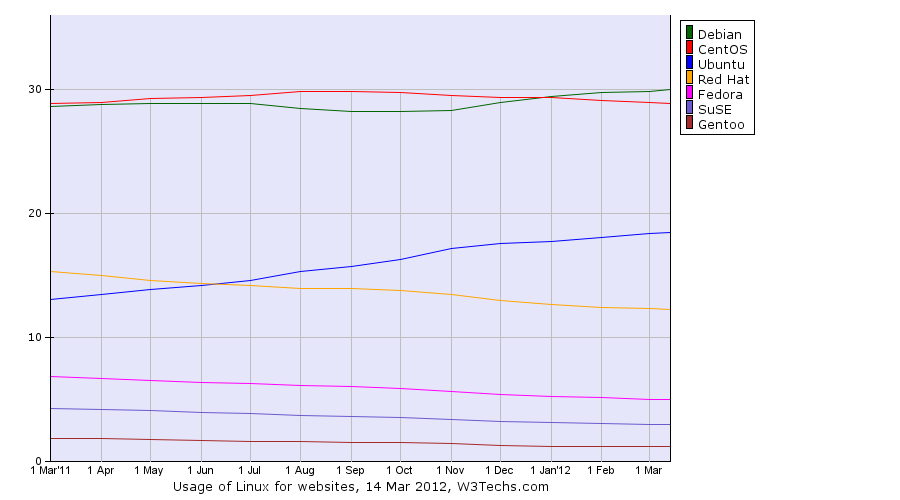
As we're doing trends today, I got curious about Debian. I don't particularly care about popularity contests other than popcon, and Debian choices surely aren't driven by them. But hey, curiosity is curiosity, right? So, here are today's w3techs trends for websites using GNU/Linux, with all lines shown:
Debian: 30%; CentOS: 28,9%; Ubuntu: 18,4%; Red Hat: 12,2%; Fedora: 5%; SuSE: 3%; Gentoo: 1,2%
(As thou shall always read methodologies before stats, here is the technologies overview page.) Debian is the top entrant with 30% of the websites using GNU/Linux. What I find interesting is that Debian has jumped at first place in January 2012, significantly after the release of our current stable release, Squeeze, that dates back to February 2011. It is also interesting to see community distros (Debian and CentOS) starkly ahead of commercially backed distros. That is what I find most fascinating about our projects. Whether that will remain the case or not is, for me, one of the big questions of the decade for the self-determination of Free Software communities.

Lisandro Dami&aacute;n Nicanor P&eacute;rez Meyer: QtSerialPort: a new hope

Some time ago I wrote about the status of Qt-based libs for using the serial port. Some days later I was pointed to the QtSerialPort project. The good news on this is that this is a project aimed to enter into Qt 5.

I have tested the lib with some apps that originally used QExtSerialPort. So far, so good. The license terms seems pretty OK (it wouldn't have got that far in the Qt code review if it weren't).

In the meantime, I received a reply to one of my messages from an upstream dev of QSerialPort (note that is Q and not Qt). He was very kind, but considering the effort to get QtSerialPort inside Qt itself, I think it's better to try to develop with this last lib.

Maybe I should try to package it and upload it to experimental.

Richard Hartmann: FOSDEM 2012, the aftermath

FOSDEM 2012 was very nice, as expected. This year, I decided to stop consuming only and getting more involved. I helped staff the token sale and held two Lightning Talks. This turned out to be an awesome experience. During the beer event, we sold 4600 beer tokens (FOSDEM does not earn anything from this; all proceeds go to Cafe Delirium). The sale was staffed with one to three people at all times which made for a constant but mostly bearable workload. While the others made good-natured fun of me and my German efficiency, I like to think that I helped make things run a tad more smoothly. Along those lines, we will have a sign asking people for exact change and/or to buy stacks that can be paid in bills if possible, next year; that should help streamline the whole thing even more. All in all, it turned out to be quite stressful, but tons of fun. I am looking forward to chuck in again next year. The two Lighting Talks (vcsh on Saturday and git-annex on Sunday) I held very rather well received. Feedback after the talks and online was very positive which is always nice. There's been a slight increase in help requests and generic questions, so I assume people are trying vcsh and git-annex as a consequence of those talks, which is even nicer. Also, I met a lot of people. Most of the meetings were pre-arranged, some by chance. Carrying a name tag at all times, I was approached by several people who knew me online but didn't know my face. I will try to always carry a name tag on conferences now and I suggest others do the same. Finally, a huge thank you to everyone who helped make FOSDEM happen; you rock!

Next.

Previous.