Search Results: "sto"

6 January 2011

Daniel Kahn Gillmor: Liberating Knowledge: A Librarian's Manifesto

A friend just pointed me to Liberating Knowledge: A Librarian's Manifesto for Change by Barbara Fister, an academic librarian who also happens to write mystery novels. She has an excellent perspective on the meaning of libraries, and the tradeoffs involved with the current societal trend toward privatizing knowledge through so-called "intellectual property" regulations. In a great critique of the passivity of academia and libraries in the face of attempts at intellectual enclosure by private corporations, she writes:
This uninformed indifference is laying the groundwork for a new tragedy of the commons: a world in which knowledge is turned into intellectual property, monetizied, and made artificially scarce.
She closes with a six-point manifesto that begins:
Liberation bibliography arises out of outrage at the injustice of the current system. It s not about saving money, it s about the empowering nature of knowledge and the belief that it shouldn t be a luxury good for the few.
The article abounds in examples of heinous arrangements in the current system that seem to be accepted as standard procedure, and clear thinking about what the actual tradeoffs are (and how we, as a society, are making them poorly). If i had one objection, it would be that she neglects to mention increased surveillance as one of the problems that come with privatization of knowledge. Our abilities to read privately and anonymously, and to correspond confidentially are at risk because of these systems of control. Anyway, I'd love to see more open allegiances between librarians and free software folks; the ideals and struggles are very much in parallel. Go talk to your librarian friends about this stuff today!Tags: academia, freedom, intellectual property, libraries

Enrico Zini: Streaming JSON objects with python

Streaming JSON objects with python Dear Lazyweb, Suppose I'd like to create an HTTP service that gives you a looong list of JSON objects. For example, one JSON object for every package in Debian. One way I could do that is to just transfer a big, dozens of megabytes JSON array with one element per package. With the standard json module in python, this requires the client to buffer all the data in memory for decoding, as the JSON result would be something like this:
[
    info for package 1  ,
    info for package 2  ,
  ...dozens of megabytes...
    info for package 30000  ,
  ...
]
However, it would be reasonable to engineer things so that the client can process packages one at a time, as they are produced. This can dramatically reduce client memory usage, as well as remove a large latency between the start of the request and the start of processing. One trivial idea would be to just send JSON objects one after the other, and sort of call load multiple times. It doesn't work:
import json
from cStringIO import StringIO
a = StringIO()
json.dump( 1:3 , a)
json.dump( 2:4 , a)
a.reset()
print a.getvalue()
print json.load(a)
gives:
$ python z1.py 
 "1": 3 "2": 4 
Traceback (most recent call last):
  File "z1.py", line 8, in <module>
    print json.load(a)
  File "/usr/lib/python2.6/json/__init__.py", line 267, in load
    parse_constant=parse_constant, **kw)
  File "/usr/lib/python2.6/json/__init__.py", line 307, in loads
    return _default_decoder.decode(s)
  File "/usr/lib/python2.6/json/decoder.py", line 322, in decode
    raise ValueError(errmsg("Extra data", s, end, len(s)))
ValueError: Extra data: line 1 column 8 - line 1 column 16 (char 8 - 16)
And the json module documentation does not provide any way of telling the "stream" decoder to just stop parsing after the first valid object. An alternative can be to use chunked transfer encoding and transfer each JSON object in a separate HTTP chunk. It would add the overhead of a little HTTP header per JSON object, which could be significant when generating lots of small JSON objects, but it would be an implementation that strictly follows HTTP and JSON standards to the letter in a clean way. Except:
  1. How do you stream HTTP chunks in WSGI? The WSGI specification's only mention of chunks is that if you produce a result as a generator of "chunks", they are just sent one after the other (effectively, concatenated) in the response stream.
  2. How do you read and process one chunk at a time with urllib/urllib2? I searched on Google but I only found people in tears.
Another alternative is to wrap the JSON objects in some custom container protocol, but then we are not talking standards anymore. Is this all you can do with the standard python library? Can this only be done by adding a dependency on a C library with two obscure separately maintained bindings, or by writing my own JSON parser? Ideas? Please mail enrico@enricozini.org and I'll add them here. Updates Wouter van Heyst mentions that he heard of ijson, which indeed has my exact use case in the synopsis, but after some research looks like a third binding for yajl. Aigars Mahinovs suggests using YAML instead of JSON. Indeed YAML supports streaming very well (it's even already supported in DDE, but last time I tried to do anything serious with it, PyYaml was slooow. Of course, this being the Python ecosystem, There Are Lots Other Ways To Do It And You Shall Be Patronised For Not Chosing The Proper One, but Debian only has PyYaml. Another itch with YAML is that there is no YAML parser in the standard python library, which requires clients to add an extra dependency. Jyrki Pulliainen has so far mailed my favourite solution: disable formatting in the encoder and separate JSON objects with newlines:
we built a streaming JSON app as a part of our platform. However, we
didn't stream a single JSON object as that was a bit cumbersome. When
having syntax like:
[
  <json-obj1>,
  <json-obj2>,
  ....
  <json-objN>
]
The reader has some problems. Should it read the whole stream to find
the closing bracket ] even if the stream would me tens of megabytes?
Should it try to split on , and parse single objects? What if the
objects contain , so should there be some regexp magic?
We ended up streaming separate JSON objects separated by newlines
(\n). This way the reader can read until hitting \n or end of stream
and then split the result on newlines. The new stream looked like
this:
<json-obj1>\n
<json-obj2>\n
...
<json-objN>\n
This way we could efficiently stream hundreds of thousands of JSON
objects from server to client without reserving a load of memory. For
the WSGI part how to do this, the best would probably to do a
generator that would yield a single JSON object with the newline (we
didn't use WSGI back then). Reading can be done using any reader
capable of handling streams. We used pycurl for reading, but I can't
really recommend it as it is way too complicated for a simple task
like this :p
Hopefully this helps!
This means that if the client has no access to a JSON reader that supports a stream of concatenated toplevel objects, they can still trivially code it on top of any JSON library. This means that working clients can be written based just on Squeeze's python standard library. That's what I'm going to do; I'll probably implement it as a separate 'jsons' output format for DDE, because producing a JSON response with multiple toplevel obejcts somehow breaks the JSON standard. Thanks to all who provided this excellent information!

5 January 2011

Iustin Pop: More Haskell

It's no secret to the people I around me that over the past two years I've become a Haskell fan, to put it mildly. I mean, what's not to like? Just in the past month: The downside is that whenever I feel Ok, now I kind of know my way around Haskell , I learn of another thing that completely resets how I feel about my Haskell understanding. The most recent example is Template Haskell. I mean, there are people who already blame Haskell for its arcane syntax, which I like. But Template Haskell goes a step forward and allows you to use a Haskell library to write Haskell code, with an even more contorted syntax or at least that how it looks for now to my eyes. Gladly this is not easily doable in a recursive way (meta-TH code writing TH code that will write Haskell code), otherwise heads would explode (at least mine). But even though it seems very complicated, I feel that the power that it enables (a macro system that generates code that will be statically checked) is removing one of the last big advantages that (for me) Python had over Haskell: it's easy to do class modification in Python and introspection (e.g. via metaclasses) to automate boiler plate away, but it's of course not type safe (so unittests galore). With TH, you can do the same customization of data types (and not only) and compile-time introspection (called reification) to alter (some) of the properties of the respective type, for example automatic instance derivation, so one less reason to say this particular problem is harder to do in Haskell than in other languages . I haven't yet used TH for my own code and until I actually use it extensively I won't be sure it's actually a good replacement for throw a __metaclass__ in there and automate the boring parts away . But in any case, it looks to be yet another awesome tool in the Haskell programmer's toolbox, which I can't wait to use.

Christoph Berg: Julia

Jan 5 2011, 3070g, 54cm Julia, Mom and Dad are all well and very happy.

4 January 2011

Adrian von Bidder: Cyrus

Just say no. Filed under Debian since this is a Univention system which is based on Debian (still etch, though.) And what specifically annoyed me was today I knew from other experiences that one shouldn't use cyrus, but it can't be said often enough... And since I usually don't use it, it amazes me anew every time I have to babysit an installation. While I don't have a similarly big installation to compare it, I've found Dovecot to be very nice. Admittedly it doesn't have that many features.

John Goerzen: Looking back at 2010: reading

A year ago, I posted my reading list for 2010. I listed a few highlights, and a link to my Goodreads page, pointing out that this wasn t necessarily a goal, just a list of things that sounded interesting. I started off with Homer s Iliad, which I tremendously enjoyed and found parallels to modern life surprisingly common in that ancient tale. I enjoyed it so much, in fact, that I quickly jumped to a book that wasn t on my 2010 list: The Odyssey. I made a somewhat controversial post suggesting that the Old Testament of the Bible can be read similar to how we read The Odyssey. Homer turned out to be much more exciting than I d expected. Jordan s Fires of Heaven (WoT #5) was a good read, though it is one of those books that sometimes is action-packed and interesting, and other times slow-moving and almost depressing. I do plan to continue with the series but I m not enjoying it as much as I did at first. War and Peace is something I started late last year. I m about 400 pages into it, which means I ve not even read a third of it yet. It has some moving scenes, and is a fun read overall, but the work it takes to keep all the many characters straight can be a bit frustrating at times. Harvey Cox s The Future of Faith was one of the highlights of the year. A thought-provoking read by someone that embraces both science and religion, and shows a vision of religion that returns to its earlier roots, less concerned about what particular truths a person believes in than it is about more fundamental issues. Marcus Borg s Jesus: Uncovering the Life, Teachings, and Relevance of a Religious Revolutionary began with a surprisingly engaging history lesson on how agriculture caused the formation of domination societies. It also described in a lot of detail how historians analyze ancient texts their drafting, copying, etc. It paints a vivid portrait of Jewish society in the time that Jesus would have lived, and follows the same lines of thought as Cox regarding religion finally moving past the importance of intellectual assent to a set of statements. Among books that weren t on my 2010 list, I also read and here I m not listing all of them, just some highlights: The Cricket on the Hearth in something of a Christmastime tradition of reading one of the shorter Dickens works. I enjoyed it, but not as much as I enjoyed A Christmas Carol last year. Perhaps I made up for that by watching Patrick Stewart as Scrooge instead. How to Disappear Completely was a fun short humorous read, with a very well-developed first-person narrative. Paralleling my interest in amateur radio, I read and studied three books in order to prepare myself for the different exams. In something of a surprise, I laughed a lot at Sh*t My Dad Says, which was more interesting and funny than I expected it to be. All I can say is that Justin s got quite the dad and quite the interesting childhood. I even read two other recent releases: The Politician (about John Edwards) and Game Change (about the 2008 presidential race). Both were interesting, vibrant, and mostly unsourced so hard to know exactly how much to take from them. And finally, reflecting on and travel before my first trip to Europe, Travel as a Political Act, which encourages us to find the fun in my cultural furniture rearranged and my ethnocentric self-assuredness walloped. And that was fun. Now to make up the 2011 list

3 January 2011

Michal &#268;iha&#345;: Sonata and others in Debian

There seems to be a little bit of confusion caused by my new year blog post, so it's probably best to clarify that right now. I'm not going to give up maintenance of mpd related packages right now.. I've even not yet asked for adopting and I clearly have no plans on orphaning the package completely if nobody will step up. Anyway if somebody is interested help is always welcome (though most of time you will spent on these packages is forwarding bugs upstream) and I can of course still do package uploads when he is not a Debian developer. All sources are stored in public VCS, so ready for cooperation.

Filed under: Debian English 1 comments Flattr this!

Mike Hommey: The measured effect of I/O on application startup

I did some experiments with the small tool I wrote in previous post in order to gather some startup data about Firefox. It turns out it can t flush directories and other metadata from the page cache, making it unfortunately useless for what I m most interested in. So, I gathered various startup information about Firefox, showing how page cache (thus I/O) has a huge influence on startup. The data in this post are mean times and 95% confidence interval for 50 startups with an existing but fresh profile, in a mono-processor GNU/Linux x86-64 virtual machine (using kvm) with 1GB RAM and a 10GB raw hard drive partition over USB, running, except when said otherwise, on an i7 870 (up to 3.6GHz with Intel Turbo Boost). The Operating System itself is an up-to-date Debian Squeeze running the default GNOME environment. Firefox startup time is measured as the difference between the time in ms right before starting Firefox and time in ms as returned by javascript in a data:text/html page used as home page. Startup vs. page cache
Average startup time (ms)
Entirely cold cache (drop_caches) 5887.62 0.88%
Cold cache after boot 3382.0 0.51%
Selectively cold cache (see below) 2911.46 0.48%
Hot cache (everything previously in memory) 250.74 0.18%
The selectively cold cache case makes use of the flush program from previous post and a systemtap script used to get the list of files read during startup. This script will be described in a separate post. As you can see, profiling startup after echo 3 > /proc/sys/vm/drop_caches takes significantly more time than in the normal conditions users would experience, because of all system libraries that would normally be in the page cache being flushed, hence biasing the view one can have of the actual startup performance. Mozilla build bots were running, until recently, a ts_cold startup test that, as I understand it, had this bias (which is part of why it was stopped). The Hot cache value is also interesting because it shows that the vast majority of cold startup time is due to hard disk I/O (and no, there is no page faults number difference). I/O vs CPU Interestingly, testing on a less beefy machine (Core 2 Duo 2.2GHz) with the same USB disk and kvm setup shows something not entirely intuitive:
Average (ms)
Entirely cold cache 6748.42 1.01%
Cold cache after boot 3973.64 0.53%
Selectively cold cache 3445.7 0.43%
Hot cache 570.58 0.70%
I, for one, would have expected I/O bound startups to only be slower by around 320ms, which is roughly the hot cache startup difference, or, in other words, the CPU bound startup difference. But I figured I was forgetting an important factor. I/O vs. CPU scaling Modern processors do frequency scaling, which allows the processor to run slowly when underused, and faster when used, thus saving power. It was first used on laptop processors to reduce power drawn from the battery, allowing batteries to last longer, and is now used on desktop processors to reduce power consumption. It unfortunately has a drawback, in that it introduces some latency when the scaling kicks in. A not so nice side effect of frequency scaling is that when a process is waiting for I/O, the CPU is underused, making the CPU usually run at its slowest frequency. When the I/O ends and the process runs again, the CPU can go back to full speed. This means every I/O can induce, on top of latency because of, e.g. disk seeks, CPU scaling latency. And it actually has much more impact than I would have thought. Here are results on the same Core 2 Duo, with frequency scaling disabled, and the CPU forced to its top speed :
Average (ms)
Entirely cold cache 5824.1 1.13%
Cold cache after boot 3441.8 0.43%
Selectively cold cache 3025.72 0.29%
Hot cache 576.88 0.98%
(I would have liked to do the same on the i7, but Intel Turbo Boost complicates things and I would have needed to get two new sets of data) Update: I actually found a way to force one core at its max frequency and run kvm processes on it, giving the following results:
Average (ms)
Entirely cold cache 5395.94 0.83%
Cold cache after boot 3087.47 0.31%
Selectively cold cache 2673.64 0.21%
Hot cache 258.52 0.35%
I haven t gathered enough data to have accurate figures, but it also seems that forcing the CPU frequency to a fraction of the fastest supported frequency gives the intuitive results where the difference between all I/O bound startup times is the same as the difference for hot cache startup times. As such, I/O bound startup improvements would be best measured as an improvement in the difference between cold and hot cache startup times, i.e. (cold2 - hot2) - (cold1 - hot1), at a fixed CPU frequency. Startup vs. desktop environment We saw above that the amount of system libraries in page cache directly influences application startup times. And not all GNU/Linux systems are made equal. While the above times were obtained under a GNOME environment, some other desktop environments don t use the same base libraries, which can make Firefox require to load more of them at cold startup. The most used environment besides GNOME is KDE, and here is what cold startup looks like under KDE:
Average startup time (ms)
GNOME cold cache 3382.0 0.51%
KDE cold cache 4031.9 0.48%
It s significantly slower, yet not as slow as the entirely cold cache case. This is due to KDE not using (thus not pre-loading) some of the GNOME core libraries, yet using libraries in common, like e.g. libc (obviously), or dbus.

2 January 2011

Jelmer Vernooij: On the way to Samba 4: Part 2

It's been more than a month since the last status update on my Samba 4 work - much more than the two weeks I promised. During the holidays I finally managed to release the new alpha of Samba 4, as well as releases of some of our companion libraries (tdb, talloc, tevent and ldb). The release includes a significant amount of bug fixes and a lot of work towards a properly functioning Active Directory DC, too much to list here. This release I've mainly been involved in improving our Python bindings and our handling of internal and external libraries. We now use symbol versioning for our copy of Heimdal Kerberos as well as some of our other libraries. Hopefully this will fix some of the issues users of the evolution-mapi plugin have been seeing where they end up with both MIT Kerberos and Heimdal Kerberos loaded into the same process (with all the consequences of overlapping symbol names). Samba 4 now also has the ability to work with the system Heimdal rather than using the bundled copy. I have packaged alpha14 for Debian and Ubuntu (fixing most of the open bugs against the Samba 4 package in the BTS), but am currently waiting for the new release of ldb to pass through NEW before I can upload. The next release is scheduled for the first week of February. cp: Stream of Passion - Haunted

Lucas Nussbaum: Giving up on Ruby packaging

I have finally reached a decision regarding my involvement in the Debian Ruby packaging efforts. I have decided to stop. This has been a very hard decision to make. I have invested huge amounts of time in that work over the years. I still love the language, and will continue to use it on a daily basis for my own developments. I still hope that it will succeed. I know that some people will be disappointed by that decision (and that others will think your work was useless anyway, people should use RVM and rubygems ). But I also know that I won t be able to push for all the required changes alone. I just don t have the time, nor the motivation. For the record, here are the changes I would have liked to see in the Ruby community. The core Ruby development community should mature.

The core Ruby development community is still dominated by Japanese developers. While not a bad thing in itself, it is easily explained by the fact that the main development mailing list, where most of the important decisions are taken, is in japanese. ruby-dev@ should be closed, and all the technical discussions should happen on the english-speaking ruby-core@ list instead. The release management process should also improve. Currently, it looks like a total mess. The following Ruby development branches are actively maintained:
ruby_1_8 (106 commits over the last six months)
ruby_1_8_6 (4 commits over the last six months)
ruby_1_8_7 (35 commits over the last six months)
ruby_1_9_1 (4 commits over the last six months)
ruby_1_9_2 (227 commits over the last six months)
trunk (1543 commits over the last six months) While the state of the ruby_1_8_6 and ruby_1_9_1 branches is clear (very important bugfixes only), the state of all of the other branches is rather unclear.
What s the stable Ruby branch? 1.8 or 1.9? If it s 1.9, why are people still actively developing in the ruby_1_8 branch? How long will they continue to be maintained in parallel, dividing the manpower? Is a Ruby 1.8.8 release to be expected? Will it be ABI/API compatible with 1.8.7? Is the ruby_1_8_7 branch really bugfixes-only? How much testing of it has been done? If it s bugfixes-only and regression-free, I should push it to Debian squeeze, due to be released in a few weeks. But would you recommend that? Due to past breakages in the ruby_1_8_7 branch, it s unlikely that we will do it.
Is the ruby_1_9_2 a regression-free, bugfix-only branch? If yes, isn t 227 commits over 6 months a lot? What will be the version of the next release of trunk ? When is it expected? Will it be ABI-compatible with the current ruby_1_9_2 branch? API-compatible?
New releases in the 1.8.7 and 1.9.2 branches were done on december 25th. Why were they no betas or RCs allowing wider testing? How much testing has been done behind the scenes? Most of those questions have no clear answer. The Ruby development community should build a common understanding of the status of the various branches, and of their release expectations. Releasing on december 25th of each year sounds fun, but is releasing when everybody is on vacation really a good idea? It would be fantastic to have something similar to Python Enhancement Proposals in the Ruby community. But having open discussions in english about the major issues would already be great. Ruby is not just the interpreter.
The Ruby development community should clearly define what the Ruby platform is. There are some big players, like Rails, and newer interpreter releases should not be done before ensuring that those big players still work. Also, since we have alternative Ruby interpreters, like JRuby, Rubinius and MacRuby, we need a clear process on how they integrate with the rest of the ecosystem. For example, having each of them rely on their own outdated fork of the whole stdlib is ridiculous, since it s not where they compete. The Ruby community should acknowledge that RVM and Rubygems are not for everybody. People who say so should be laughed at. Of course, RVM and Rubygems are nice tools for some people. But it is completely wrong to believe that compiling from source using RVM should be the standard way of installing Ruby, or that all people interested in installing Redmine should know that Ruby has its own specific packaging system. The Ruby community should work with their target platforms to improve how Ruby is distributed instead of reinventing the wheel. That includes Debian, but also RedHat-based distros, for example. It is likely that it won t be possible to reach a one-size-fits-all situation. But that s real life. Some people in the Ruby community should stop behaving like assholes. As one of the Debian Ruby maintainers, I have been routinely accused of creating crippled packages on purpose (FTR, I don t think that the Debian packages are crippled, despite what the rumors says). Debian is not the only target of that. Just yesterday, someone called for abandonning YARV (the new Ruby VM in Ruby 1.9), calling it Yet Another Random Vailure. This kind of comments is really hurting the people who are investing their free time in Ruby, and is turning away people who consider getting involved. In Debian, we have had a lot of problems getting people to help with Ruby maintenance since they are getting shit from the community all the time. So, what s the future for Ruby in Debian? Update: there s also a number of interesting comments about this post on this site.
Update 2: First, thanks a lot for all the interesting comments. I will make some follow-up posts trying to summarize what was said. It seems that this post also triggered some reactions on ruby-core@, with Charles Olivier explaining the JRuby stdlib fork, and Yui Naruse clarifying that all questions are welcomed on ruby-core@. This is great, really.

31 December 2010

Julien Viard de Galbert: Triage X Bugs of the last 2010 Week (TXBW8)

Happy new year ! The X Strike Force (still) needs you ! You can have a look at the X Strike Force Bug Closing Procedure and check XSF unstable bugs sorted by date.

Lars Wirzenius: Micro-optimizing btree

Benchmark results before:
num_operations: 1000000
insert      : 191.090 s (  5238.3/s) CPU; 191.106 s (  5237.7/s) wall clock
lookup      : 30.430 s ( 33068.8/s) CPU; 30.428 s ( 33064.0/s) wall clock
lookup_range: 85.700 s ( 11694.5/s) CPU; 85.700 s ( 11693.6/s) wall clock
insert2     : 143.320 s (  6986.7/s) CPU; 143.315 s (  6986.6/s) wall clock
remove      : 246.010 s (  4068.0/s) CPU; 246.013 s (  4067.9/s) wall clock
remove_range: 225.210 s (  4444.0/s) CPU; 225.286 s (  4442.4/s) wall clock
That's insert, lookup, and remove operations (and range operations) on a B-tree with one million keys. insert2 is insertions where keys are sorted. All nodes are stored in memory, not on disk. After some micro-optimization (replacing my own flexible bsearch implementation with the Python standard library one):
num_operations: 1000000
insert      : 97.850 s ( 10237.5/s) CPU; 97.860 s ( 10237.1/s) wall clock
lookup      : 12.430 s ( 81566.1/s) CPU; 12.429 s ( 81609.8/s) wall clock
lookup_range: 52.670 s ( 19047.6/s) CPU; 52.669 s ( 19050.0/s) wall clock
insert2     : 72.600 s ( 13806.4/s) CPU; 72.595 s ( 13808.6/s) wall clock
remove      : 134.510 s (  7443.8/s) CPU; 134.512 s (  7444.0/s) wall clock
remove_range: 169.740 s (  5897.3/s) CPU; 169.795 s (  5895.6/s) wall clock
Not bad, for a train ride's work, with some additional improvements late at night in a hotel room. Code is clearer too, now, at least mostly. And there's less of it: duplicating standard library functionality always maks me feel icky. The numbers for removals look bad, really bad. Espcially range removal should be much better. If anyone wanted to get familiar with my btree code base, that would be an excellent place to start from. See the README for instructions.

Joey Hess: on not coding late

It's midnight and I really want to be coding. I'm half way or so through adding a git-annex-shell to git-annex, which will enable some nice features with ssh access. I've done the research, and written the documentation[1], laid all the necessary refactoring groundwork, and written much of the code and just have to connect it all up and test it. This is a dangerous point to be at, because I have it all in my head, but I'm tired. If I start coding now, I could make a stupid mistake and find myself stuck in a blind alley at 5 am. I've been there before. Even if I avoid hard stuff, I'd surely look up and an hour or more would have gone by, it'd be past 1 am -- and I know that once I stop coding it can take me hours to spin my thoughts back down to the point where I can go to sleep. Also, I can feel the back of my mind still working on something. Some bits feel like they might not quite mesh up right in my mental model. I don't consciously know what the problem is. I need to sleep on it; it will probably be clearer later. Like yesterday when I lifted a bag of groceries into the car and paused, realizing code I'd written two months ago had a major bug, one I'd never seen, in an edge case that had never came up, but was surely there. I always assumed that when programmers got older and stopped coding late it was because they couldn't take the strain. Nah. We're just coding even as we sleep. :)

[1] Documentation is where I do my design. This is why git-annex has quantities of documentation that Linux Weekly News finds surprising.

30 December 2010

Matthew Garrett: Android tablet GPL summary

It's after Christmas, and the stores are full of Android tablets ranging in quality from mediocre to competent. Obviously, they're also ranging in terms of GPL compliance from "utter failure" to "pretty good". I've written a summary page here so you have: The vast majority of Android tablets I've been able to find are shipping without any source being made available, and that includes devices from well-known vendors. It's pretty much a given from the ones you've never heard of.

It's probably also worth noting that many of the devices in this list are probably rebadged versions of identical hardware, and that in some cases the same model may in fact refer to wildly different devices. There's a few cases where I've ended up with model numbers without any idea who the vendor is. If anyone has any corrections or updates, please feel free to let me know.

(Side note: People sometimes ask why Google aren't doing more to prevent infringing devices. For the vast majority of these cases, Google's sole contribution has been to put Android source code on a public website. Red Hat own more of the infringing code than Google do. There's no real reason why Google should be the ones taking the lead role here, and there's fairly sound business reasons why it's not in their interest to do so)

Bastian Venthur: Canon IXUS 130

Dear Lazyweb, Today I bought me a Canon IXUS 130 and was quite disappointed to see that it couldn t properly connect to my Debian/Sid machine via USB. Apparenty the camera is not recognized as a USB Mass Storage Device but utilizes PTP. I upgraded to libgphoto2 (2.4.10.1-3) from experimental and added a proper udev rule with vendor- and product-id but it did not help. Is there anything more I can try? Update: Accessing the camera actually works, even with ligbphoto2 (2.4.6) from unstable. I can access the camera with gphoto2 and download pictures (but not with KDE s filemanager). My problem was that I had rhythmbox running and the camera was automatically mounted by it as a media device. When KDE s filemanager or gphoto2 tried to access the camera I got an error like: ( Could not lock the device ): Camera is already in use., which is probably also a bug. Closing rhythmbox solved the issue and I was able to download images with gphoto2.

29 December 2010

Mike Hommey: Efficient way to get files off the page cache

There s this great feature in modern operating systems called the page cache. Simply put, it keeps in memory what normally is stored on disk and helps both read and write performance. While it s all nice for a day to day use, it often gets in the way when one wants to track performance issues with cold cache (when the files you need to access are not in the page cache yet). A commonly used command to flush the Linux page cache is the following:
# echo 3 > /proc/sys/vm/drop_caches
Unfortunately, its effect is broad, and it flushes the whole page cache. When working on cold startup performance of an application like Firefox, what you really want is to have your page cache in a state close to what it was before you started the application. One way to get in a better position than flushing the entire page cache is to reboot: the page cache will be filled with system and desktop environment libraries during the boot process, making the application startup closer to what you want. But it takes time. A whole lot of it. In one of my what if moments, I wondered what happens to the page cache when using posix_fadvise with the POSIX_FADV_DONTNEED hint. Guess what? It actually reliably flushes the page cache for the given range in the given file. At least it does so with Debian Squeeze s Linux kernel. Provided you have a list of files your application loads that aren t already in the page cache, you can flush these files and only these from the page cache. The following source code compiles to a tool to which you give a list of files as arguments, and that flushes these files:
#include <unistd.h>
#include <fcntl.h>
#include <sys/stat.h>
int main(int argc, char *argv[])  
  int i, fd;
  for (i = 1; i < argc; i++)  
    if ((fd = open(argv[i], O_RDONLY)) != -1)  
      struct stat st;
      fstat(fd, &st);
      posix_fadvise(fd, 0, st.st_size, POSIX_FADV_DONTNEED);
      close(fd);
     
   
  return 0;
 
It s actually a pretty scary feature, especially on multi-user environments, because any user can flush any file she can open, repeatedly, possibly hitting system performance. By the way, on systems using lxc (and maybe other containers, I don t know), running the echo 3 > /proc/sys/vm/drop_caches command from a root shell in a container does flush the host page cache, which could be dangerous for VPS hosting services using these solutions. Update: I have to revise my judgment, it appears posix_fadvise(,,,POSIX_FADV_DONTNEED) doesn t flush (parts of) files that are still in use by other processes, which still makes it very useful for my usecase, but also makes it less dangerous than I thought. The drop_cache problem is still real with lxc, though.

Evgeni Golov: because people asked: my irssi advanced windowlist setup

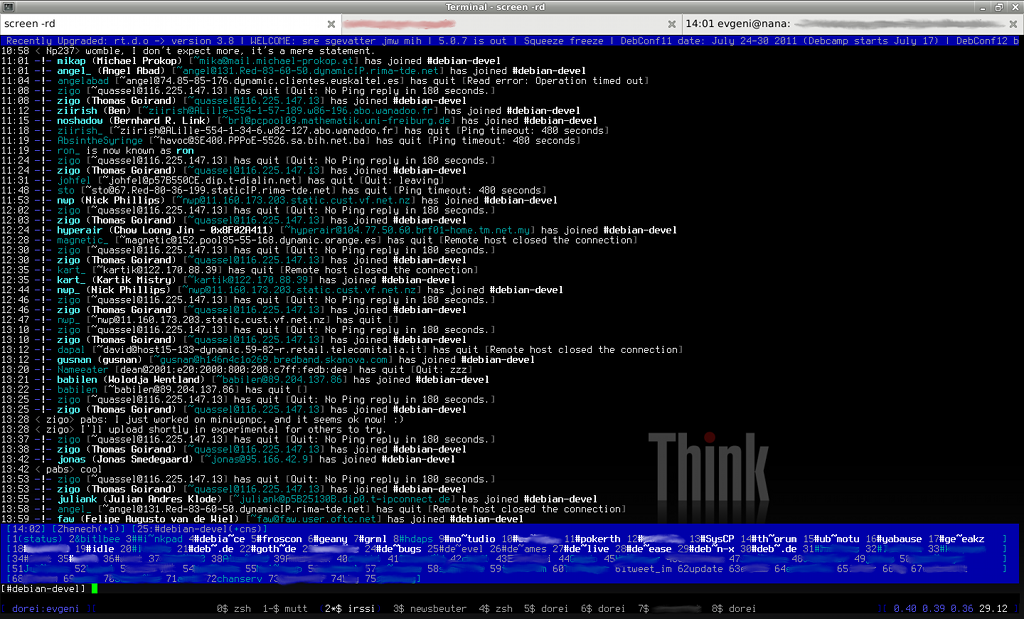
As XTaran and uschebit asked yesterday at the 27C3 about my nice windowlist in irssi, here is what I use: adv_windowlist.pl. Download it, put it into you ~/.irssi/scripts and load it with /script load adv_windowlist. Now you have a list with all those window names in them, but it s still a bit ugly ;)First of all, get rid of the default Act list of irssi: /statusbar window remove actNow let s customize awl a bit:Done! Your irssi should look like this now:
Christoph Egger: Debian GNU/kFreeBSD

So when I was travveling to my parent's for christmas it looked like I'd have limited computer access. My Netbook is quite OK for reading mail but not really useable for any real hacking. And my trusty Thinkpad (Z61m) was oopsing when X was running so not much useable either. But as some Live CDs placed here were working well I decided that this would be fixed by an reinstall. And as I was reinstalling anyway I decided I could just choose kfreebsd-amd64. Turned out to be a quite entertaining decision with lots of stuff to hack away with wireless Bad news: there's no wireless support on Debian GNU/kFreeBSD at the moment. This problem is tracked as Bug #601803 so for wireless internet you will need a (plain) Freebsd chroot. Haven't tried this myself yet -- busy figuring other stuff out. SBCL Having a FreeBSD chroot I decided to give SBCL on GNU/kFreeBSD another try after having failed to get it working in a VM some time ago. With quite some help on SBCL's IRC channel I managed to build a patch that enables building (you need to force a :os-provides-dlopen to the feature list additionally). There's currently no multi-threading working so I hae a project for the rest of the hoidays (well lots of other stuff to do as well ;)) Audio Some more user-related stuff now. As it is this time of the year I wanted to listen to some 27c3 streams so I needed working audio. However there's no OSS device available. Turned out you just need to kldload the right module (here snd_hda) to get sound working. Volume was rather low although hardware controls of the soundcard where at max. As that's all OSS there's no point looking for alsamixer. Turns out aumix can do that here. IPv6 aiccu stuff Installing aiccu, copying the config in and starting did not work out as well. I already tried to do that from within the FreeBSD chroot already (which doesn't work for some reason) until I discovered just loading the if_tun kernel module solves the aiccu on Debian issue quite well. To get a default route up the last step was finding /lib/freebsd/route again -- /sbin/route is a wrapper around that abstracting differences in BSD route but not supporting IPv6.

28 December 2010

Wouter Verhelst: On moving pianos

John Goerzen blogs about moving pianos complete with outdoors music. While I don't have a similar story, my dad does. It doesn't involve a pickup (what with that being the standard american car type) but instead a piano which at an angle is stuck through the roof of a 2CV. I wasn't there (my parents hadn't even met yet), but I'm told it was great fun. In the not so distant future, however, I may have another story to tell about moving pianos. Currently, I live right above my office. Due mainly to bureaucratic reasons, this will change in the near future (it's a long story). Now when I moved into the apartment, moving the piano involved several people, a ladderlift, and some extra helping hands from another apartment a few blocks down the road where they just happened to be moving, too, just to lift it 10 cm up and over the window sill. Then, we just tried to avoid dropping it to the floor, about a meter down. Now if me, my three brothers, a friend, and an extra hand were only just enough to lift it for just 10 cm, I'm a bit worried as to how we'll be moving it out again, which would involve moving it up about a meter. To be continued, I'm sure.

John Goerzen: Christmas Gatherings, a Piano, and a Pickup

Perhaps I am not very imaginative. Or perhaps insufficiently adventurous. But when I woke up today, a day that would actually get a little bit above freezing, I didn t have a thought of riding without a coat in the bed of a pickup. Nor did I expect to be involved with moving a piano. I didn t have any thought of listening to piano music outdoors. And I certainly didn t anticipate the fun to be had doing all of these things simultaneously. Now, let me back up and set the scene. This was our annual Goerzen Christmas today. We already ate and exchanged gifts. Here s the thing about moving pianos, especially the old heavy ones with the cast iron frame inside: it s not something where a group of people just get together, count to 3, and that s that. No, you ve got to start the project out right. You have to break the news that people will be moving a piano gently. And then, of course, you get a room full of people usually mostly men and at this point, before any lifting happens, you ve got to plan. Tape measures must be produced, measurements taken, plans made for how to lift and who should lift where. Differing points of view have to be considered carefully. Then, of course, you have too many people for each one to actually help lift so each person not lifting has to find a job. And then when things actually start going, you realize that not one of the plans fully accounted for the unprecedented weight and maddening stubbornness of the piano, and you have to stop every few feet to plan anew. I don t think I ve ever seen a piano move happen in any other fashion. So, today, my uncle, whose house our gathering was at this year, said, Ahh good, lots of young backs. Just what I need. Mildly concerned glances pass between my brothers, my cousins, and I. One brother looks like he s pretending not to have heard. We have a few things to move. Anticipation. A small couch probably not too bad, right? An upholstered chair maybe a bit unruly but still not too bad. And an old piano is going to a neighbor. Full alert now more glances, a pause for a second, and then acceptance: Oh! Uhm great! My uncle s friend Ken teaches music at the local college, and on the side, Ken also teaches children how to play piano. One of Ken s students didn t have a piano at home, and my uncle and aunt had an old one they weren t using, which they would give to the family of the student just a couple of blocks away. All that remained was moving it. There was the inevitable measuring, planning, re-planning, until we got it out of the house and onto the back of my uncle s pickup. We have about 8 men involved, plus my aunt. Most of us rode in the back of the pickup with the piano. And of course, there came the inevitable request: Ken, play for us! So Ken sat on the edge of the pickup, at the piano, playing as we and the piano went through town in the open air. He started with Joplin s Entertainer, then broke out into some Christmas music We Wish You a Merry Christmas, followed by Nun Ist Sie Erschienen and a few others. It must be said that small towns in Kansas are probably not accustomed to their Christmas carolers having a piano with them, much less being played from the bed of a pickup. But there we were, mostly laughing too hard or enjoying the ride too much to sing. To add excitement, or perhaps embarrassment, my uncle was sounding the horn. Some thought that his intent was to have it in time with the piano music from the back, but I ll give him the benefit of the doubt and say that he meant to sound the horn in that rather random fashion. Eventually we got to the neighbor s house, and my dad and another uncle who hadn t been on the pickup came running up. We hopped down and asked them where they wanted the piano. Upstairs! That got repeated among everyone there, producing laughter each time. More tape measures were produced, as it was a narrow staircase. The conclusion was that the piano could make it with about an inch (2.54cm) to spare. So we got it out of the pickup and onto the porch, then into the house. Now, how to get it upstairs? This called for an extra helping of planning and calculating. Ken, the unofficial piano moving boss, kept reminding us in jest that I grew up on a farm . He said he could be alone at the top of the piano while we pushed. This quickly turned out to not be practical; due to the incline, the weight at the bottom was just too much to get it up over the stairs. Ken then went and picked up a wooden contraption they use to move pianos at the college. We tried that, but its supports underneath got stuck on the steps as well. Various ideas were tossed around at this point, until I pointed out that four of us on the bottom couldn t get it up over a step, so when we get it into the stairway only wide enough for 2 we won t be able to get it up anyhow. That being considered a good point, various other ideas were tossed around. They all seemed to be wanting either for practicality or, perhaps, safety. Though the idea of having a dozen Goerzens stand at the top of the staircase pulling it up by a rope did have some excellent humor value. In the end, perhaps wanting our group of free, highly ambitious, but somewhat less effective piano movers out of their house, the neighbors found a place for it on the ground floor. We all piled back into the pickup for the ride back, which was rather more quiet due to lack of horn and piano music. So there you have it. The most fun I have ever had moving a piano. (Really, the only fun I have ever had moving a piano.)

Next.

Previous.