Search Results: "reg"

14 June 2007

MJ Ray: Cracking Open Minds to Discover Debian Developer Joining Dates BOF

Ben Armstrong commented:

"When trying to pin down the exact date when I joined, the keyring changelog is no help. First entry for me is in 2000, which is 3 years later. The web archive is no good, as I joined too late in 1997. Searching for me in the PTS shows my first changelog entry 6 Nov 1997, but that's a bit sloppy because that datestamp was added when the packaging process started. It doesn't reflect when the package was finally uploaded. Mailing list posts are little help. But the first file on master is Dec 8 1997 .Xauthority. So I know it was between November 6th and Dec 8th. Not too bad, but I'd love to know the exact day."
Glad it was some use. I have my suspicions that the only way to find the exact date is to get all the keyring maintainers from that time and regress them under hypnosis. Do you think we can arrange that as a BOF at Debconf next week? The "Cracking Open Minds to Discover Debian Developer Joining Dates BOF"?

13 June 2007

MJ Ray: Data Protection Racketeers Jailed

PDF press release saying
"The Information Commissioner's Office is again reminding businesses across the UK not to be misled by bogus agencies that send notices demanding money to register under the Data Protection Act 1998 (DPA). The warning comes after Leeds Crown Court sentenced three men to prison on Friday 8 June for their involvement in fake data protection agencies."
They earned 62,575 before they were closed (that's a lot of 135-a-time victims) and got up to two and a half years in jail (tip to PL&B for emailing me). I feel this type of scam only works so well because most of the official advice is vague and unhelpful, while the most useful notification page is three-clicks deep in a section that few businessmen would choose unless they already knew about it.

Adam Rosi-Kessel: Parmet on Public Health and Individualism

Via Jason, my brilliant former Constitutional Law professor Wendy Parmet weighs in on the XDR-TB scare. Unlike most coverage, Professor Parmet brings out the big picture of how the incident fits into a larger flawed public health policy:
…It is trite but true that in America we admire individual self-sufficiency and rugged individualism. Not only do we admire this taking care of number 1 attitude, but public health has encouraged it. Over the last several decades, public health has emphasized the role that individuals can and should play in determining their own health. Indeed, every day of week, we are bombarded with messages about how we can do this or that to take care of ourselves. Sometimes the message extends to what we can do for our families. Seldom are we told what or how we can do for unnamed others. Even infectious disease policies perpetuate this myth of self-control. We are told to vaccinate our children to protect them. We are told to help ourselves by getting a flu shot. And the federal government provides us with information about how we should prepare to help ourselves and our family in the event of an influenza pandemic. This privatization of infectious disease control is even evident in the U.S. approach to quarantine. During the SARS epidemic, governments in Canada and in Asia quickly realized that quarantines would not be effective without income protection. So laws were passed to assure that people would receive compensation while under quarantine. In the United States, in contrast, despite all the efforts that have been made at public health preparedness and public health law modernization, income replacement remains off the table (the Family and Medical Leave Act only guarantees unpaid leaves for some ill employees). Perhaps even more astonishingly, in its proposed quarantine regulations, the CDC failed to ensure that it would provide all necessary health care to those it quarantined. …

12 June 2007

Rob Bradford: GUADEC Speaker Registrations

We interrupt this transmission to provide this valuable news flash: I’ve just sent emails to everyone who is on my list of speakers for GUADEC asking them to complete their details. If you are expecting to talk at GUADEC and don’t get an email asking you to provide your details then please email Ross and CC me in. We now return to our scheduled broadcast…

Michal Čihař: Troubles on being popular

phpMyAdmin is quite popular tool and it attracts people who want to earn money on it. For long time Navicat company used phpMyAdmin name to propagate their completely different product, but this seems to be gone now (probably with help from Google, but I haven't receive reply from them, but short after my complain, all their ads abusing phpMyAdmin were gone). Today Marc spotted that somebody just stole our website added Google shopping cart and started to sell phpMyAdmin: Main stolen page screenshot Buy page screenshot Lets see how long will it take to get them down. PS: There is intentionally no link in this post, you can see URL on screenshot, if you really want. Update: It looks like hosting is very responsible on such problems, they just disabled this domain:
Hello, Thank-you for your e-mail enquiry. Please be advised that we have disabled site php-my-admin.awardspace.com. AWARDSPACE.COM provides legitimate web hosting services and has a ZERO tolerance policy towards these violations. We apologize for the inconvenience this has caused you. If you still have any concerns in regards this matter feel free to contact us. Best Regards, Harry AWARDSPACE Dedicated Support Team support@awardspace.com /"Your winning web hosting provider"/ http://www.awardspace.com

Antti-Juhani Kaijanaho: On recursion

Note: This entry has been edited a couple of times (and might be edited in the future) to remove errors. Thanks to Benja Fallenstein for critique. My previous post about recursion drew some comments. This is a topic that frequently confuses me, and there is a lot of confusion (some of it mine) in the blog post and its comments. On reflection, it seems prudent to examine what recursion really is. Consider the following recursive definition: 0 is an expression; if T is an expression, then sT is an expression; nothing is an expression that doesn’t have one of these two forms. Now, it is clear that 0 is an expression. It is equally clear that sssssK is not an expression. In some applications, it makes sense to consider infinite expressions like “…ssssss0“; that is, an infinite number of ss before the final 0, and in others it doesn’t. Is that infinite utterance and expression? It does have one of the forms given in the definitions, so it is not forbidden from being an expression, but neither is there anything in the definition requiring that it is. It is helpful to do this a bit more formally. Let us translate the self-referential definition into a set equation: The set of expressions is the set E that satisfies the equation

E = 0 ∪ se e ∈ E

But this definition is bogus! There are more than one set E that satisfies the equation, as remarked above, and thus there is no “the set E”! We need to fix the definition in a way that makes the set E unique. The key question is, do we want to regard the infinite utterance discussed above as an expression. It is simplest to just say “the set of expressions is the smallest set E that …” if we want it to not be an expression, and if we want it to be an expression we should say “the set of expressions is the largest set E that …” Let us make the following definitions:
Consider the set equation S = … S …, in which the set S is alone on the left-hand side and occurs at least once on the right-hand side. This equation is a recursive definition of the smallest set S satisfying this equation, and a corecursive definition of the largest set S satisfying this equation.
Thus, a definition like

E = 0 ∪ se e ∈ E

is not recursive because of its form; it is self-referential. By itself, it is an ambiguous and thus bogus definition. We use the words “recursive” and “corecursive” to indicate the intended method of disambiguation. A rather nice example of this can be seen in the treatment of algebraic data types in strict (ML-style) and nonstrict (Haskell-style) functional programming languages. Consider the declaration (using Haskell syntax)
data IntList = Nil   Cons Int IntList
This can be read as a set equation as follows:

IntList = Nil ∪ Cons n x n ∈ Int ∧ x ∈ IntList

Now, as a recursive definition, it is restricted to finite lists as found in ML, but as a corecursive definition, it also allows infinite lists as found in Haskell. (It unfortunately fails to address the question of bottom-terminated lists, which also can be found in Haskell.) As it happens, the technique is not limited to set definitions; but to generalise it, we need to discuss a bit what we mean by the terms “smallest” and “largest”. In a set context, a set is smaller than another set if it is the other’s subset. Notice how this makes the ordering partial, that is, there are sets that are not comparable (for example 1 and 2 ; neither is smaller than the other, but neither are they equal). A collection of sets does not necessarily have a “smallest” set (that is, one of the sets that is a subset of all the others). However, we can always find the lowest upper bound (”lub” or “join”) of a collection of sets as the union of the sets, and the greatest lower bound (”glb” or “meet”) as the intersection of the sets, and if the lub or glb is itself a member of the collection, it is the smallest or largest set of the collection. Haskellists will find things instantly familiar when I say that the smallest element of a mathematical universe (if it exists) is called bottom and is denoted by ⊥; somewhat less familiar will be that the greatest element (if it exists) is called top and is denoted by ⊤. A partial function is any function that needs not be defined everywhere. For example, f(x) = 1/x is a partial function on the reals (it is not defined for x = 0). We can form a partial ordering of (partial) functions having the same domain and codomain by specifying that f is smaller than g if f(x) = g(x) for all such x that f(x) is defined. Sometimes it will make sense to specify that f is smaller than g if f(x) is smaller than g(x) for all such x that f(x) is defined. Now, it happens that all collections of functions have a lub; and in particular, the partial function that is defined nowhere is the smallest function (the bottom function). Now, with this definition of “ordering” of functions we can apply the definitions of recursion and corecursion to functions. For example, consider f(x) = f(x) + 1. The bottom function (defined nowhere) qualifies, since undefined + 1 is undefined; thus it is the smallest solution to the equation and thus this equation is a recursive definition of bottom. However, consider f(x) = if x = 0 then 1 else x*f(x-1): any solution to this equation must have f(0) = 1 and thus the bottom function is disqualified. In fact, the smallest solution is the factorial function, and thus the equation is a recursive definition of factorial. In the comments to my previous entry, I was asked whether the Haskell definition “ones = 1 : ones” is recursive. Of course, the question in itself is nonsensical; whether it is a recursive definition or something else (such as corecursive) depends on what the programmer intends. I will interpret this question as whether the equation is a recursive definition of the intended result, the infinite list of all ones. First, observe that we can order Haskell lists (including the special “undefined” list) partially as follows: l1 is smaller than l2 if l1 is undefined, if they both are empty lists or if a) the first element of l1 is smaller than the first element of l2 and b) the tail (the list with the first element removed) of l1 is smaller than the tail of l2. The undefined list does not qualify as a solution for “ones = 1 : ones”. No finite list qualifies either. The infinite list of all ones does qualify, and it is the only solution; hence, the equation is a recursive definition of the infinite list of all ones; it is also a corecursive definition of the same list. Finally, let us consider the question that started it all: what should we make of the definition “recursion: see recursion”. First, note that a equation x = x admits all elements of the universe as a solution; hence, the proper reading of “recursion: see recursion” as a definition is that it is ambiguous and hence bad. It is a recursive definition of the bottom element of the universe (whatever that might be for a dictionary), and a corecursive definition of the top element of the universe (whatever that might be). In any case, it does not define recursion (unless of course, the concept of recursion is the smallest or the largest concept in the universe of concepts).

Michael Prokop: Error handling: ENOSPC

Hopefully fuzz testing is well known nowadays, right? But did you check how smart your software can handle ENOSPC - the ‘No space left on device’ error? I like stress testing software (to be honest: no, not really). Yesterday I debugged a problem regarding zsh history writing on ENOSPC. Usually I use the grml Linux live-cd for stress testing (often running inside Qemu, Virtbox, VMware,…) like in:
dd if=/dev/zero of=/tmp/home.lo count=1000
losetup /dev/loop1 /tmp/home.lo
mkfs.ext3 /dev/loop1
mount /dev/loop1 /home
mkdir /home/grml
chown grml: /home/grml
Now after restarting the shell session of user grml I can play with ‘No space left on device’ situations. (Notice: I adjust the count=… according to what type of application I want to test.) Too many applications don’t really cope with the ENOSPC situation. Firefox for example is very funny, depending on the situation it either just segfaults when trying to start up, or decides to not start up at all and just exits with ‘1′. See the relevant strace output:
mkdir("/home", 0700)                    = -1 EEXIST (File exists)
access("/home", F_OK)                   = 0
mkdir("/home/grml", 0700)               = -1 EEXIST (File exists)
access("/home/grml", F_OK)              = 0
mkdir("/home/grml/.mozilla", 0700)      = -1 ENOSPC (No space left on device)
access("/home/grml/.mozilla", F_OK)     = -1 ENOENT (No such file or directory)
exit_group(1)                           = ?
Opera also just exits when already running and receiving an ENOSPC - I encountered data loss (for example the transfer history got lost) more than once. Very "funny" to see how applications like dillo, joe, wireshark,… behave in the ENOSPC situation. Not. Oh, your application handles ENOSPC just fine? Then continue testing with read-only filesystem, using NFS, removing files randomly,…

11 June 2007

Martín Ferrari: Debconf 7

Ah, finally I'm at Teviot, keeping up with mail and hacking a little. The place is wonderful, as is the hostel. The whole city seems taken from a fairy tale. There are a little too much regulations, and security cameras, but well... A word of advice to other travellers: avoid Iberia at all costs! The fuckers caused us a hell of problems, we arrived 14 hours after what was initially planned, we had to wait long hours in airports, chase our luggage, argue with many employees... On the bright side, the delay of the first flight caused a change of company for the next two flights. The moment we went to the KLM desk in Barajas, all of our problems vanished. Talk about customer satisfaction!

Russell Coker: Prius vs small non-hybrid car

In response to my comment and post about the cost of driving to work there was a comment on the blog post I responded to suggesting that a small car is better value for money than a hybrid car. The claim was made regarding a Nissan Pulsar, but to investigate this I decided to compare the Prius with the Corolla Hatchback, as far as I can tell the Corolla Hatchback is the nearest non-hybrid car to the Prius that Toyota sells (being similar in size, weight, and performance). Comparing cars of different make adds extra variables into the equation. Unfortunately the Toyota web site fails to provide specifications for the Prius and only provides a PDF file with minimal information on the Corolla, but it is enough for some minimal calculations. A car company run by intelligent people would publish the specs on all their vehicles and provide a search form to compare selected models. The Standard Performance Evaluation Corporation has a good search method that allows easy comparison and ranking of items in their database (here is an example). It would be good if Toyota would permit us to compare models in their car range in a similar manner. According to the Toyota web site the Prius uses 4.4L/100Km when driving in the city and the manual transmission version of the Corolla Hatchback uses 7.4L/100Km (7.7 for the auto). For the average 16,000Km that an average Prius owner drives that would save 480L of petrol which would save about $700 at current petrol prices. The Corolla Ascent Hatchback (the cheapest of all Corollas) is $21,000 while the cheapest Prius is $37,400. If you compare the Prius with the cheapest Corolla then it’s a $16,400 price difference. If you save $700 per annum then it won’t cover the interest on a $16,400 loan or match the interest rates earned by a bank term-deposit if the $16,400 was invested. So it seems apparent that at current petrol prices (NB petrol prices are expected to increase) and with average Prius driving patterns a Prius will not be more economical than a cheap Corolla. Currently the Commonwealth Bank of Australia offers 6.05% interest on term deposits of between $10,000 and $25,000. This means that $700 per annum would be the interest on a term deposit of $11,500. If we compare the Corolla Ultima Sedan at $32,000 with the Prius at $37,400 the difference in price is less than $11,500 - but the cars have incomparable sets of luxury and safety features. The Prius i-tech appears to have a super-set of the luxury and safety features of the Corolla Ultima Sedan but at $46,900 is again going to cost more for the average Prius driver. The Prius is a very quiet car to drive, there is almost no engine noise (when driving at speeds where the Petrol engine is operating there is usually more noise from other vehicles) and no gear changes (handy if passengers are consuming hot or sticky drinks). It has a good set of safety and luxury features and is also a prestige car (no-one will say “oh wow, you’ve got a Corolla”). If you assign a dollar value to these features then a Prius may be the most economical car that meets your requirements! Finally, let’s keep in mind the fact that petrol prices are steadily increasing. If you save $700 by driving a Prius this year then you may save $1000 next year. There is also the option of converting a Prius to a plug-in hybrid which will be a useful option if petrol prices hit $10/L! Also the amount of money saved will depend on the use of the car. If you are running a courier or taxi business then a Prius will probably be a lot more economical than a Corolla due to the greater distances travelled and the travel in the slow city traffic that the Prius was designed for. PS All prices are in Australian dollars and concern products on offer in Australia, I would like to see comments from other people who perform the same calculations for their countries.

10 June 2007

Adam Rosi-Kessel: Hospital Thoughts

Hospital CEO Paul Levy is seeking responses to some remarkably frank comments on competition in the hospital industry:
…Please remember that health care is not like other industries, in which companies are rewarded in the marketplace for being the high-quality, low-cost provider. That situation does not yet exist in the health care system. So, am I better off being a industry leader with regard to that approach, or am I better off biding my time and continuing to follow the traditional path until there is a real sign of change in the marketplace?
As I’ve written before, this kind of openness is refreshing and potentially a brilliant business strategy. (It may continue to be so even once every one is doing it.) Paul’s comments and receptivity to feedback remind me of my numerous concerns about Children’s Hospital Boston, which, as far as I know, has no analogous public forum. I’ve sent in comment cards, but they may just drop into a black hole. Two principal complaints about Children’s Hospital: television and food. There are TVs everywhere, including in the waiting rooms. They are always on, even if no one is watching them. On one occasion, we were the only ones in the waiting room. When we attempted to turn the TV off, the staff told us we couldn’t. When we went in examination rooms and our daughter was unhappy, the first response by the medical staff was often to turn on a TV. Our daughter (just over two years old) has never watched TV, and doesn’t find it comforting. Research indicates that TV is not good for young kids, and especially not infants:
Babies are glued to television sets these days, with 40 percent of 3-month- olds and 90 percent of 2-year-olds regularly watching TV, according to a University of Washington study released Monday. …”While appropriate television viewing at the right age can be helpful for both children and parents, excessive viewing before age 3 has been shown to be associated with problems of attention control, aggressive behavior and poor cognitive development,” Frederick Zimmerman, the UW study’s lead author, said in a news release…. The American Academy of Pediatrics recommends no television for children younger than 2, and only one to two hours a day of quality programming for older children.
Recently, we had to stay over in the hospital for a night. There were no private rooms available, so we requested at least not to be stuck in a room where the TV would always be on. They looked at us like we were from Mars. (In the end, our roommate’s TV was always on. The three month old patient didn’t care, but his private nurse wanted to watch TV.) Why is a pediatric healthcare facility encouraging TV for infants? The food complaint is similar: so much of the hospital food provided for children is high in fat, refined sugar, white flour, and artificial ingredients. I was looking for a fruit-juice popsicle for our daughter (what she eats at home), and the only options the hospital could offer had high glucose corn syrup as the first ingredient after water. Again, this is not rocket science — these are not appropriate foods for one- and two-year old children. I realize in both cases (TV and food), the hospital is just mirroring popular culture in an attempt to provide familiarity for most kids, but I wish they would at least provide an option for those families whose kids don’t watch TV and eat a high-sugar diet.

Mike Hommey: Sudoku perverts

You might remember the Sudoku solver in XSLT. Now let me introduce you another range of perverts with solvers in SQL and regular expressions.

Matthew Garrett

Modern Intel SATA chipsets (anything from the ICH6m onwards) can be driven in two modes - one that looks awfully like an old-fashioned PATA controller, and one that conforms to the AHCI specification. Windows deals badly with AHCI, so BIOS authors tend to program them to PIIX mode. Some BIOSes have an option to let you choose which is used, but most don't so you end up stuck with PIIX mode.

This is a bit of a shame, since AHCI supports functionality that isn't really present in PIIX mode. For laptop users, one of the more interesting features is AHCI's link-level power saving. At the cost of some performance, it's possible to save 0.5W or so. There are patches beginning to appear for this, but it's no help to people stuck with PIIX support. Over the past couple of days I've been looking into what's necessary to reprogram the chipset into AHCI mode. The biggest issue is finding some MMIO space for the AHCI registers. Most BIOS authors don't program the AHCI base address register, which means trying to find some spare address space to map it. I've hacked support for this into the PCI layer and added a quirk that attempts to reprogram chips into AHCI mode. It's not really ready for proper use yet, but it'd be good to get some amount of testing to see if there are obvious issues. The code is here and ought to apply to current git. Obviously, you'll need ahci support in your kernel.

Russell Coker: submissions for LCA and other conferences

In this post I recommended that job seekers not publish their CV. In a comment Gunnar suggested having a special CV for conferences. I think that Gunnar’s idea is good and have started writing my conference CV at http://etbe.coker.com.au/conferences. When I complete it I will make it part of every submission for speaking at a conference. The LCA 2008 call for presentations is now open. One of the most interesting, noteworthy, and slightly controversial items is the suggestion that people submit a video. I think that the video submission is a great idea, either a video or testimony from audience members from past presentations should be required for all submissions (NB I’m not involved with organising LCA2008 so my opinion means little in this regard). The reason is that I have attended many presentations which fell far short of their potential due to poor speaking skills. I’ve been to great presentations by people with strong accents, by people with speech impediments, by people who are incredibly shy, and by people who just don’t have a clue about public speaking. However my observation is that if a speaker has more than one of these disadvantages then the presentation is likely to fail. I have previously written at length about how to give a good presentation to a technical audience (such as is found at LCA). Dave Hall blogs about Should I do a presentation at LCA 2008. He mentions lack of a web-cam as a disincentive, but I am happy to lend him my digital camera (which makes really high quality movies) to solve this problem. In fact I have considered recording some short Linux talks at the SGI office during lunch breaks (Dave and I both work for SGI). Dave also mentions a nightmare scenario about a laptop not working with presentation hardware. My post about getting laptops working for presentations will hopefully help some people in this regard. I’m not sure if I’ll make an offer for LCA this year, I haven’t been doing much cutting-edge work recently. Maybe I’ll just offer some talks for mini-confs, I could probably get several offers accepted by mini-conf organisers if I try.

9 June 2007

Axel Beckert: .org registration rules arbitrariness

For about nine years, my domain deuxchevaux.org was hosted (which means web, DNS and a catchall e-mail forward) by Internett at Saarbr cken. Although it was a sponsered hosting without much support I was quite happy with their service. But especially my ideas and demands regarding spam filtering grew out of the possibilities of a mass hosting solution. Since I run my own web, mail and name servers for a while now, it was no question that also deuxchevaux.org should become self-hosted. Since I run a root-server at Hetzner and their “robot” also offers domain handling, I planned to transfer deuxchevaux.org to them. Therefore I first had to register my two DNS servers (sym.noone.org and virt.noone.org) with them. In the documentation there was a note that for .org domains, name servers in a .org domain have to be registered with the same registrar. And just a few hours after registering the name servers via their web interface I got a mail from Hetzner Support that the domain of my name servers are not registered with Hetzner and so I cannot use them form .org domains. Asking for the cause of this rule, I got the answer that this is a rule by Hetzner’s upstream registrar, Cronos AG. Well, since I don’t understand such arbitrarily looking rules, I was looking around for another registrar with usable web interface. On the DaLUG mailing list, someone recommended eDNS. Since their single user account is free of setup and monthly fees, I signed up with them and started playing around with their web interface. When I tried to transfer deuxchevaux.org using the Auth-Code, I got the response that the transfer failed and when I clicked on “Details”, I got “$VAR1 = [];” as detailed information about the failure. Data::Dumper says hello. I wrote them and asked if they can tell me, what that should mean last Thursday and got no answer so far. I don’t think, I’ll register domains with them anymore. So where to try it now? Someone recommended GoDaddy, but I neither like their website (way too much targeted on beginners and mainstream) nor do I want to apply for a credit card or a PayPal account to be able to pay their bills. So a bill from my UML hoster Korypet (aka VD Server) caught my eye: They were lowering prices for registrations at some top level domains (and in comparison to the recent lowerings at eDNS the new prices also apply to existing contracts) including .at and .org (and I only have .at, .ch and .org domains). I didn’t knew they also do domains outside of selling them in packages with UML hosts. So I wrote to Korypet support, if they offer a web interface for domain handling and got a reply less than two hours later: Not yet, but they’re working on it. Until then, I can request domain handling tasks by e-mail to their support. Since I know their UML managing web interface – which works fine – and since I’m happy with their support, service and prices since years (I’m customer there since 2003), I replied with all the necessary data for the transfer. Well, the transfer failed, too. But in comparsion to Hetzner or eDNS, they made the effort to exactly find out, what happened. So what did happen? The rule which the Hetzner support guy told me that it was from their upstream registrar wasn’t from there but from Public Internet Registry (PIR) itself. And the rule seems to match not that often, so that many people involved in domain registration don’t know about it (and usually neither understand its existence when they hear about it). Also I have no understanding for this harassment and so I felt the strong urge to get one over on them. Korypet suggested several solutions fitting my needs (i.e. the usage of my DNS servers for my domains). They even offered A records under some of their PIR registrered domains pointing to the IP addresses of my DNS servers for no fee, but luckily some A records under my own .ch domain sufficed. So the transfer was successful on Friday evening, 6pm local time, my own mail server (running Postfix) was happily rejecting a lot of spam to (and even from) non-existing users (which came in over the catch-all before) as well as hosts greeting with not fully qualified or invalid HELOs and greylisting others via David Schweikert’s Postgrey. The number of accepted mails and recognized spam sunk immediately by approximately factor four on the whole mail server, although deuxchevaux.org isn’t the only domain that receives mail there (but was the only one which had a catch-all before). So in the long run, I’ll probably move all .org and .at domains over to Korypet since they have not only fair prices but also a competent and individual support. (And yes, this is a recommendation. ;-)

Andrew McMillan: For Brenda...

I followed the advice of the lazywebs a while ago and bought myself a phone (Nokia 6100) on the local auction website then went around to the local Vodafone dealer and bought a SIM card for it. When I signed up I ticked the box saying "Enable Global Roaming" and now that I'm travelling I realise I should have actually confirmed that happened before I left the country, because it didn't happen. Now I'm sitting in Melbourne with only the (free :-) Wifi to keep me company. So looking at the Vodafone site, it appears that I could dial "777" to enable global roaming. Apparently I should have done that a few days ago, because it sure won't work now. Perhaps this "Manage Your Account" thingy will work? A period of perusing pages of FAQs follows, and I eventually conclude that it would work. Except that when I try and register for the service I am told that my phone number is not valid. Yes, I moved my old number across to Vodafone, about the same time Brenda was lamenting the inadequate preparation Vodafone did for Mobile Number Portability, and while the actual phone has been working, Brenda did note back on April 1st that "you can't use the website to manage your account". Two months on and it still isn't possible, which is pretty poor really - you would think Vodafone would be actively encouraging people to move across to their network. So I'm effectively phoneless until I get to Edinburgh and can buy a SIM card. At least I can still get on IRC and ask someone to call Heather and tell her why I'm not phoning.

8 June 2007

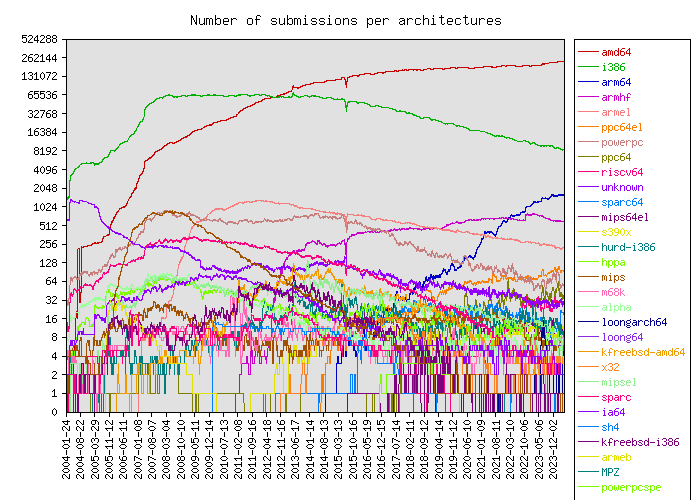
Riku Voipio: state of arm port

All doom and gloom? far away from that.

The good:

* Arm port is now third most popular port according to popcon.
* This mostly thanks to the popularity of Linksys NSLU-2, a tiny 80 computer able to run Debian. Do you have a old pentium sucking up electricity in your closet? Do a service to earth and replace it with a NSLU-2!
* Armel (Arm EABI) is now at "63.41% up-to-date. That's 4515 packages built out of 7121". See the fancy Graph for the progress. Catching up sid has been achieved with just two buildd's (Thecus N2100) in my apartment and Aurelien Jarno building selected packages. Plus of course pioneering work from Lennert Buytenhek and people who created EABI in upstream.
* All core packages except apt (which hasn't seen a upload to sid since etch) have now armel support in official Debian packages.
* the old arm port has started catching up in up-to-dateness again, now that all buildd's have a recent enough kernel for glibc 2.5 (2.6.12+)

The bad:

* We need someone to take responsibility on the toolchain for arm. Java is semi broken on arm, Fortran, Java and objc need work for armel.
* There is still communications problems. It took quite a while to find out why glibc 2.5 doesn't work on some buildd's.
* People have lost interest in Bigendian arm port after nslu-2 started working with the regular Little-Endian arm port. General consensus is that bigendian port would only matter for highend networking gear.

The future:

* More supported devices. Now we support NSLU-2, Thecus N2100 and a few related IOP based devices plus netwinders. Arm boasts their partners shipped 2450 Million units based Arm technology in 2006. Would you like to run Debian on your brand new scsi RAID card? mp3 player? Cellphone? Internet Tablet? Washing machine? Your choice!
* Better recovery options. Many arm devices are headless, and if it crashes or doesn't boot, figuring out what went wrong is tricky. This is not really arm specific, but comes up often enough in debian-arm list.
* Anti-bloat festival. Many arm devices have very little storage and RAM available. To run debian on these, we need to figure out who to get rid of extra FAT. Less bloated software is everyones advantage.

MJ Ray: Comments on dropping and not subscribing to feeds

tm suggested:
"delete the feeds you find yourself reading less and less frequently"
In general, maybe, but there are always exceptions, like feeds which rarely update but carry important information when they do. I guess I should scan my subscriptions to see if there are any extremely unupdated feeds. Update: tm clarified:
"I meant those feeds you've subscribed to, but find out you don't read so often, regardless of how often they're updated. for me, one of those is/was: http://feeds.howstuffworks.com/DailyStuff"
That's not so easy for me to tell. I read my subscriptions through a planet-like page, so they appear in the page flow whether or not I expand them or not. Matt Palmer replied:
"I've got to say that I've never had a problem commenting on Limes & Lycopene. I suspect that the problem you had with Alexis Sukrieh's blog was likely unrelated to SpamKarma2 (or if it was SK2, it was a dodgy deployment -- you don't sound too sure what the cause of his breakage was). On the other hand, if there is anything broken on a blog, the polite thing to do is to tell the owner about it -- it might not necessarily be a problem for everyone (although with SQL errors and things like that, it should be possible for the site owner to get error reports via e-mail, but how often do you reckon that gets done?). And yes, Captchas give me the faeces too. For L&L, at least, I know for a fact that any problems will get looked at and fixed up damn quick. Contact e-mail is on Kathryn's site."
I sent a pingback. No response yet. I'll try email if there's no response later.
"Oh, and a comment on your comment system -- the text entry box is tiny (6 lines by maybe 35 characters just isn't enough for a literate comment)."
My preference is for 40x20 but if I make it that big, I get feedback that it's too big. It's always a compromise. It's meant to be about 22x8 now, but what size should it be?

Ian Murdock: Where do I download OpenSolaris ?

Quick poll: What do you think of when you hear the name “OpenSolaris”? It’s an operating system? The community version of Solaris? Right? Not quite. Like Linux, OpenSolaris is a kernel. Except that it’s more than a kernel. Or, rather, more than a kernel but not quite a complete operating system. Are you confused yet? This comment from a recent Register article sums up the problem quite nicely:
If you go to the OpenSolaris web site, all bright eyed and eager to download a new operating system, you will walk away in bitter disappointment. Sure, it says the word “open” in two dozen languages on the web page, but when you go hunting for an installer disk to download, suddenly you are cast into a maze. Nevada builds? What the hell is Nevada? Oh, it’s what they’re calling the OpenSolaris code base. You’ll need to download these components and build them. Well, how do I install it? Oh, you can’t do that, you need to have a Solaris machine up already to build on. But you can get started if you go to Sun’s site and download their Solaris Express Enterprise Pro Champion Edition (after dutifully registering), and then enjoy that pleasant install experience. And when that’s done, you still have the work ahead of you of getting ON (what the hell is that? Oh, OS and Network. Sorry, I don’t work at Sun) built and updated. Did I miss anything? We haven’t gotten to packages to make the system usable yet.
Now, I’m willing to wager most of you reading this have probably heard about DTrace, ZFS, Zones, and the other great stuff Solaris has to offer, not to mention that Solaris is about as enterprise grade as they come, having been at the heart of the data center longer than many of the alternatives have even existed. And don’t forget about more mundane but critical things like backward compatibility, where Solaris has excelled for a very long time. But how many of you have actually experienced this great stuff first hand? How many hands go down if you’re under 30 and don’t remember the Sun workstation—i.e., you’re one of the many for whom Linux = Unix for as long as you’ve been in the computer business? How many of you would take Solaris for a spin if doing so was as easy as, say, downloading the latest version of Ubuntu and installing it? In other words, with all the buzz about making Solaris more familiar to Linux users, it turns out the widest part of the familiarity gap isn’t even technological. So, how do we bridge it? We need to make “OpenSolaris” something you can touch, something you can “Download Now!” and run on your laptop to try out the latest and greatest from the OpenSolaris community. We need to clearly articulate the link between Solaris and OpenSolaris in ways the industry understands—namely, that OpenSolaris is the rapidly moving version that delivers the latest innovations, and that Solaris is the enterprise-grade, supported-for-many-years, backward-compatibility- guaranteed version for the data center. Furthermore, the link needs to be more than just “OpenSolaris as upstream for Solaris”. Given how many more copies of Fedora and Ubuntu are running in the world than the enterprise Linuxes, there is significant opportunity here if we can get the model right. In short, to make OpenSolaris (and, by extension, Solaris) more familiar to Linux users, the first thing we need to do is make it a “distro” in the Linux sense of the word. After all, when people say they know “Linux”, that’s what they’re talking about—how many people really care about the Linux kernel underneath? What they care about is the GNU tools, the desktop, the development environment, and all the other things their favorite distro bundles—and the package system that holds it all together. There’s no reason in the world why (Open)Solaris can’t deliver those same things. Oh yeah, and DTrace, ZFS, Zones, enterprise grade security/scalability/performance/etc., backward compatibility, etc. too. Put this way, it’s easy to imagine what OpenSolaris needs to look like. That’s why the issues here are not primarily technological. This is the essence of the Project Indiana you’ve read so much about in the past several weeks. Our goal is to create a binary distribution of OpenSolaris that simultaneously delivers what people have come to expect from “Linux” alongside the great stuff that make Solaris unique. What comes next? We’re working that out in real time. If you’re interested in following along, participating, or just giving us your two cents, I encourage you to join the indiana-discuss mailing list we just created. We’re particularly interested in hearing from you if you consider yourself a “Linux user” and have been interested in taking Solaris for a spin but, for whatever reason, have considered the gap too wide. What would it take to get you running Solaris?

7 June 2007

Matthew Palmer: For Your General Good Health...

Read Limes & Lycopene, the regularly updated blog of nutritionist Kathryn Elliott. It regularly has interesting and healthy recipes, discussions of current food-related news and fads, and Kathryn has recently started up "Q & A Thursday", where you can ask questions throughout the week and get a big dump of interesting answers each Thursday. My favourite from today's burst is "What should your dinner plate look like?" (apart from flat and round, of course...) In the recipe arena, I can't recommend the Pumpkin and Cinnamon Ristto highly enough -- it is absolutely delicious.

Next.

Previous.