Search Results: "ed"

14 July 2016

Andrew Cater: Who wrote Hello world

Who wrote "Hello, world" ?
Rereading Kernighan and Ritchie's classic book on C - https://en.wikipedia.org/wiki/The_C_Programming_Language - almost the first thing you find is the listing for hello world. The comments make it clear that this is a commonplace - the sort of program that every programmer writes as a first test - the new computer works, the compiler / interpreter produces useful output and so on. It' s the classic, canonical thing to do.

A long time back, I got asked whether programming was an art or a science: it's both, but most of all it's only good insofar as it's shared and built on. I used hello world as an example: you can write hello world. You decide to add different text - a greeting (Hej! / ni hao / Bonjour tout le monde! )for friends.

You discover at / cron / anacron - now you can schedule reminders "It's midnight - do you know where your code is?" "Go to bed, you have school tomorrow"

You can discover how to code for a graphical environment: how to build a test framework around it to check that it _only_ prints hello world and doesn't corrupt other memory ... the uses are endless if it sparks creativity.

If you feel like it, you can share your version - and learn from others. Write it in different languages - there's the analogous 99 bottles of beer site showing how to count and use different languages at www.99-bottles-of-beer.net

Not everyone will get it: not everyone will see it but everyone needs the opportunity

Everyone needs the chance to share and make use of the commons, needs to be able to feel part of this

Needs to be included: needs to feel that this is part of common heritage.
If you work for an employer: get them to contribute code / money / resources - even if it's as a charitable donation or to offset against taxes

If you work for a government: get them to use Free/Libre/Open Source products

If you work for a hosting company / ISP - get them to donate bandwidth for schools/coding clubs.

Give your time, effort, expertise to help: you gained from others, help others gain

If you work for an IT manufacturer - get them to think of FLOSS as the norm, not the exception



Steve Kemp: Adding lua to all the things!

Recently Antirez made a post documenting a simple editor in 1k of pure C, the post was interesting in itself, and the editor is a cute toy because it doesn't use curses - instead using escape sequences. The github project became very popular and much interesting discussion took place on hacker news. My interest was piqued because I've obviously spent a few months working on my own console based program, and so I had to read the code, see what I could learn, and generally have some fun. As expected Salvatore's code is refreshingly simple, neat in some areas, terse in others, but always a pleasure to read. Also, as expected, a number of forks appeared adding various features. I figured I could do the same, so I did the obvious thing in adding Lua scripting support to the project. In my fork the core of the editor is mostly left alone, instead code was moved out of it into an external lua script. The highlight of my lua code is this magic:
  --
  -- Keymap of bound keys
  --
  local keymap =  
  --
  --  Default bindings
  --
  keymap['^A']        = sol
  keymap['^D']        = function() insert( os.date() ) end
  keymap['^E']        = eol
  keymap['^H']        = delete
  keymap['^L']        = eval
  keymap['^M']        = function() insert("\n") end
I wrote a function invoked on every key-press, and use that to lookup key-bindings. By adding a bunch of primitives to export/manipulate the core of the editor from Lua I simplified the editor's core logic, and allowed interesting facilities: All in all I had fun, and I continue to think a Lua-scripted editor would be a neat project - I'm just not sure there's a "market" for another editor. View my fork here, and see the sample kilo.lua config file.

Sune Vuorela: Leaky lambdas and self referencing shared pointers

After a bit of a debugging session, I ended up looking at some code in a large project
m_foo = std::make_shared<SomeQObject>();
/* plenty of lines and function boundaries left out */ 
(void)connect(m_foo.get(), &SomeQObject::someSignal, [m_foo]()  
  /* */
 );
The connection gets removed when the pointer inside m_foo gets de-allocated by the shared_ptr.
But the connection target is a lambda that has captured a copy of the shared_ptr There is at least a couple of solutions. I guess the lesson learnt is be careful when capturing shared pointers.

Norbert Preining: Osamu Dazai No Longer Human

Japanese authors have a tendency to commit suicide, it seems. I have read Ryunosuke Akutagawa ( , at 35), Yukio Mishima ( , at 45), and also Osamu Dazai ( , at 39). Their end often reflects in their writings, and one of these examples is the book I just finished, No Longer Human. Dazai_Osamu-No_Longer_Human Considered as Dazai s master piece, and with Soseki s Kokoro the best selling novels in Japan. The book recounts the life of Oba Yozo, from childhood to the end in a mental hospital. The early years, described in the first chapter ( Memorandum ), are filled with the feeling of differentness, alienation from the rest, and Oba starts his way of living by playing the clown, permanently making jokes. The Second Memorandom spans the time to university, where he drops out, tries to become a painter, indulges in alcohol, smoking and prostitutes, leading to a suicide attempt together with a married woman, but he survived. The first part of the Third Memorandom sees a short recovering due to his relationship with a woman. He stops drinking and works as cartoonist, but in the last part his drinking pal from university times shows up again and they return into an ever increasing vicious drinking. Eventually he is separated from his wife, and confined to a mental hospital. Very depressing to read, but written in a way that one cannot stop reading. The disturbing thing about this book is that, although the main actor conceives many bad actions, we feel somehow attached to him and feel pity for him. It is somehow a exercise how circumstances and small predispositions can make a huge change in our lives. And it warns us that each one of us can easily come to this brink.

13 July 2016

Steinar H. Gunderson: Cubemap 1.3.0 released

I just released version 1.3.0 of Cubemap, my high-performance video reflector. For a change, both new features are from (indirect) user requests; someone wanted support for raw TS inputs and it was easy enough to add. And then I heard a rumor that people had found Cubemap useless because it was logging so much . Namely, if you have a stream that's down, Cubemap will connect to it every 200 ms, and log two lines for every failed connection attempt. Now, why people discard software on ~50 MB/day of logs (more like 50 kB/day after compression) on a broken setup (if you have a stream that's not working, why not just remove it from the config file and reload?) instead of just asking the author is beyond me, but hey, eventually it reached my ears, and after a grand half hour of programming, there's rate-limiting of logging failed connection attempts. :-) The new version hasn't hit Debian unstable yet, but I'm sure it will very soon.

Niels Thykier: Selecting key packages via UDD

Thanks to Lucas Nussbaum, we now have a UDD script to filter/select key packages. Some example use cases: Which key packages used compat 4?
# Data file compat-4-packages (one *source* package per line)
$ curl --silent --data-binary @compat-4-packages \
  https://udd.debian.org/cgi-bin/select-key-packages.cgi
alsamixergui
apg
[...]
sgml-base
wwwconfig-common
Also useful for things like bug#830997, which was my excuse for requesting this.:) Is package foo a key package (yet)?

$ is-key-pkg()   
 RES=$(echo "$1"   curl --silent --data-binary @- \
    https://udd.debian.org/cgi-bin/select-key-packages.cgi)
 if [ "$RES" ]; then
   echo yes
 else
   echo no
 fi
 
$ is-key-pkg bash
yes
$ is-key-pkg mscgen
no
$ is-key-pkg NotAPackage
no
Above shell snippets might need tweaking for better error handling, etc. Once again, thanks to Lucas for the server-side UDD script.:)
Filed under: Debian

Dominique Dumont: A survey for developers about application configuration

Hello Markus Raab, the author of Elektra project, has created a survey to get FLOSS developer s point of view on the configuration of application. If you are a developer, please fill this survey to help Markus work on improving application configuration management. Feeling this survey should take about 15 mns. Note that the survey will close on July 18th. The fact that this blog comes 1 month after the beginning of the survey is entirely my fault. Sorry about that All the best
Tagged: configuration, Perl

Reproducible builds folks: Reprotest containers are (probably) working, finally

Author: ceridwen After testing and looking at the code for Plumbum, I decided that it wouldn't work for my purposes. When a command is created by something like remote['ls'], it actually looks up which ls executable will be run and uses in the command object an internal representation of a path like /bin/ls. To make it work with autopkgtest's code would have required writing some kind of middle layer that would take all of the Plumbum code that makes subprocess calls, does path lookups, or uses the Python standard library to access OS functions and convert them into shell scripts. Another similar library, sh, has the same problems. I think there's a strong argument that something like Plumbum's or sh's API would be much easier to work with than adt_testbed, and I may take steps to improve it at some point, but for the moment I've focused on getting reprotest working with the existing autopkgtest/adt_testbed API. To do this, I created a minimalistic shell AST library in _shell_ast.py using the POSIX shell grammar. I omitted a lot of functionality that wasn't immediately relevant for reprotest and simplified the AST in some places to make it easier to work. Using this, it generates a shell script and runs it with adt_testbed.Testbed.execute(). With these pieces in place, the tests succeed for both null and schroot! I haven't tested the rest of the containers, but barring further issues with autopkgtest, I expect they should work. At this point, my goal is to push the next release out by next week, though as usual it will depend on how many snags I hit in the process. I see the following as the remaining blockers:

Norbert Preining: Jonas Jonasson The Girl Who Saved the King of Sweden

Just finished my first book of Jonas Jonasson, a Swedish journalist and author. Most famous for his book The Hundred-Year-Old Man Who Climbed Out the Window and Disappeared, but author of two others. The one I read was The Girl Who Saved the King of Sweden, which strange enough became in German Die Analphabetin die rechnen konnte (The analphabet who could compute). Jonas Jonasson - Die Analphabetin, die rechnen konnte The story recounts the countless turns the life of Nombeko Mayeki, a black girl born in Soweto as latrine cleaner, who manages to save the Swedish king as well as most of the world from an atomic desaster by first getting driven over by a drunkard of South African nuclear bomb engineer, then meeting a clique of three Chinese sisters excelling in faking antiquities, and two Mossad agents. With the (unwilling) help of those agents she escapes to Sweden (including the atomic bomb) where she meets twins of a psychotic father who brought them up as one child so that the spare one can eradicate the Swedish monarchy. After many twists and setbacks, including several meetings with the Chinese premier Hu Jintao, she finally manages to get rid of the atomic bomb, get her undercover twin a real identity, and set up a proper life ah, and not to forget, save the King of Sweden! A fast paced, surprisingly funny and lovely story about how little things can change our lives completely.

12 July 2016

Steinar H. Gunderson: Cisco WLC SNMP password reset

If you have a Cisco wireless controller whose admin password you don't know, and you don't have the right serial cable, you can still reset it over SNMP if you forgot to disable the default read/write community:
snmpset -Os -v 2c -c private 192.168.1.1 1.3.6.1.4.1.14179.2.5.5.1.3.5.97.100.109.105.110 s foobarbaz
Thought you'd like to know. :-P (There are other SNMP-based variants out there that rely on the CISCO-CONFIG-COPY-MIB, but older versions of the WLc software doesn't suppport it.)

Olivier Gr goire: Seventh week: create a new architecture and send a lot of information

At the begin of this week, I thought my architecture needed to be closer to the call . The goal was to create one class per call to save the different information. With this method, I only need to call the instance who I am interested and I can easly pull the information.
So, I began to rewrite my architecture on the daemon to create an instance of my class link directly with the callID.
After implementing it, I was really disappointed. This class was hardly to call from the upper software layers. Indeed, I didn t know what is the current call display on my client.
I change my mind and I rewrite the architecture again. I observed the information I want to pull (frame rate, bandwidth, resolution ) and they are all generating in my daemon. Therefore, it will update every time something change in the client. So, I just need to catch it and send it to the upper software layers. My new architecture is simply a singleton because I just need one instance and I need to pull it from everywhere in my program.

Beyond that, I wanted to pull some information about the video (frame rate, resolution, codec for the local and remote computer). So, I looked to understand how the frame generate work. Now I can pull:
-Local and remote video codec
-Local and remote frame rate
-Remote audio codec
-Remote resolution
-CallID

Next week, I will begin with working on creating an API on the client library. After that, I will continue to retrieve other information.

Norbert Preining: Michael K hlmeier: Zwei Herren am Strand

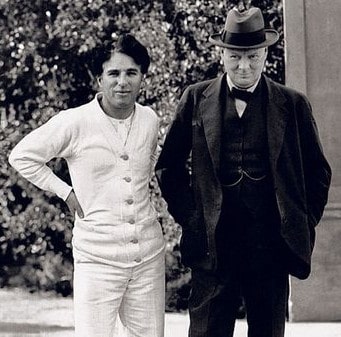
This recent book of the Austrian author Michael K hlmeier, Zwei Herren am Strand (Hanser Verlag), spins a story about an imaginative friendship between Charlie Chaplin and Winston Churchill. While there might not as be more different people than these two, in the book they are connected by a common fight the fight against their own depression, explicitly as well as implicitly by fighting Nazi Germany. Zwei Herren am Strand_ Roman - Michael Koehlmeier Michael K hlmeier s recently released book Zwei Herren am Strand tells the fictive story of Charlie Chaplin and Winston Churchill meeting and becoming friends, helping each other fighting depression and suicide thoughts. Based on a bunch of (fictive) letters of a (fictive) private secretary of Churchill, as well as (fictive) book on Chaplin, the first person narrator dives into the interesting time of the mid-20ies to about the Second World War. churchill-chaplinChaplin is having a hard time after the divorce from his wife Rita, paired with the difficulties at the production of The Circus, and is contemplating suicide. He is conveying this fact to Churchill during a walk on the beach. Churchill is reminded of his own depressions he suffers from early age on. The two of them agree to make a pact fighting the Black Dog inside. Later Churchill asks Chaplin about his method to overcome the phases of depression, and Chaplin explains him the Method of the Clown : Put a huge page of paper on the floor, lie yourself facing down onto the paper and start writing a letter to yourself while rotating clockwise and creating a spiral inward. According to Chaplin, he took this method from Buster Keaton and Harold Lloyd (hard to verify), and it works by making oneself ridiculous, so that one part of oneself can laugh about the other part. The story continues into the early stages of the world war, with both sides fighting Hitler, one politically, one by comedy. The story finishes somewhere in the middle when the two meet while Chaplin is in a deep depression during cutting his movie
The great dictator, and together to manage once more to overcome the black dog .
The book is pure fiction, and K hlmeier dives into a debaucherous story telling, jumping back and forth between several strands of narration lines. An entertaining and very enjoyable book if you are the type of reader that enjoys story telling. For me this book is in best tradition of Michael K hlmeier, whom I consider an excellent story teller. I loved his (unfinished trilogy of) books on Greek mythology (Telemach and Calypso), but found that after these books he got lost too much in radio programs of story telling. While in itself good, I preferred his novels. Thus, I have to admit that I have forgotten about K hlmeier for some years, until recently I found this little book, which reminded me of him and his excellent stories. A book that is if you are versed in German well worth enjoying, especially if one likes funny and a bit queer stories.

Dirk Eddelbuettel: RProtoBuf 0.4.4, and new JSS paper

A new release 0.4.4 of RProtoBuf is now on CRAN, and corresponds to the source archive for the Journal of Statistical Software paper about RProtoBuf as JSS vol71 issue 02. The paper is also included as a pre-print in the updated package. RProtoBuf provides R bindings for the Google Protocol Buffers ("Protobuf") data encoding library used and released by Google, and deployed as a language and operating-system agnostic protocol by numerous projects. This release brings small cleanups as well as build-system updates for the updated R 3.3.0 infrastructure based on g++ 4.9.*.
Changes in RProtoBuf version 0.4.4 (2016-07-10)
  • New vignette based on our brand-new JSS publication (v71 i02)
  • Some documentation enhancements were made, as well as other minor cleanups to file modes and operations
  • Unit-test vignette no longer writes to /tmp per CRAN request
  • The new Windows toolchain (based on g++ 4.9.*) is supported
CRANberries also provides a diff to the previous release. The RProtoBuf page has an older package vignette, a 'quick' overview vignette, a unit test summary vignette, and the pre-print for the JSS paper. Questions, comments etc should go to the GitHub issue tracker off the GitHub repo.

This post by Dirk Eddelbuettel originated on his Thinking inside the box blog. Please report excessive re-aggregation in third-party for-profit settings.

Mateus Bellomo: Get presence from buddies

Now it s also implemented the functionality that allows a user to see his contacts presence. At first week I ve implemented only the Telepathy part of this methods and back then I didn t comprehend that this information would come in the form of a NOTIFY SIP message. I also needed to use the SUBSCRIPTION mechanism properly so the presence server could send me the NOTIFY message. To be able to create those messages was necessary a better understanding of resip/stack, resip/recon and resip/dum API s. Not that I master this libraries now, but at least I m not totally lost anymore =) Looking into this libraries I could see how much work was done by all of resiprocate contributors (and I imagine I don t even saw the tip of the iceberg). There is so many features ready for use that now I think twice before start implementing something. Since I didn t find any reference explicitly showing the contact s status in RFC3863 [1], I got this information by changing a contact presence (in a different machine logged in Jitsi [2]) and looking into the NOTIFY message received at resiprocate. Follow some images about contact s presence at Empathy:
status_OnlineOnline status
status_OfflineOffline status
status_Busy (DND)Busy DND status
status_AwayAway status
status_In a meetingIn a meeting status
status_UnknownUnknow status
[1] https://tools.ietf.org/html/rfc3863 [2] https://jitsi.org/

Joey Hess: twenty years of free software -- part 13 past and future

This series has focused on new projects. I could have said more about significant work that didn't involve starting new projects. A big example was when I added dh to debhelper, which led to changes in a large percentage of debian/rules files. And I've contributed to many other free software projects. I guess I've focused on new projects becuase it's easier to remember things I've started myself. And because a new project is more wide open, with more scope for interesting ideas, especially when it's free software being created just because I want to, with no expectations of success. But starting lots of your own projects also makes you responsible for maintaining a lot of stuff. Ten years ago I had dozens of projects that I'd started and was still maintaining. Over time I started pulling away from Debian, with active projects increasingly not connected with it. By the end, I'd left and stopped working on the old projects. Nearly everything from my first decade in free software was passed on to new maintainers. It's good to get out from under old projects and concentrate on new things. I saved propellor for last in this series, because I think it may point toward the future of my software. While git-annex was the project that taught me Haskell, propellor's design is much more deeply influenced by the Haskell viewpoint. Absorbing that viewpoint has itself been a big undertaking for me this decade. It's like I was coasting along feeling at the top of my game and wham got hit by the type theory bus. And now I see that I was stuck in a rut before, and begin to get a feeling of many new possibilities. That's a good feeling to have, twenty years in.

11 July 2016

Niels Thykier: mips64el added to Debian testing

Today, we have completed our first Britney run with mips64el enabled in testing. :) At the current time, the set of packages in mips64el are not very connected (and you probably cannot even install build-essential yet[1]). Hopefully this will change over the next few days. For now, Britney does not enforce installability of packages on mips64el in general, so do not expect the architecture to be stable at the moment. Cheat sheet for package maintainers: We will slowly remove these special cases for mips64el as it matures in testing. [1] Update on this: mips64el currently does not have a libc library yet, so build-essential is definitely not installable at the moment. It will hopefully migrate very soon.
Filed under: Debian, Release-Team

Jonathan Dowland: iPod

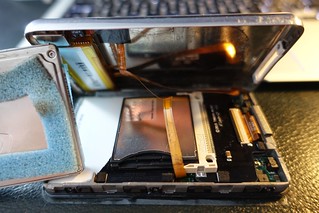
iPod iPod with rockbox
opened up open iPod with iFlash
It's been four years since I last wrote about music players. In the meantime of my Sansa Fuzes broke, and the third does not have great rockbox support. I've also been using a Sansa Clip+ (a leaving present from my last job, thanks again!) and a Sansa Clip Zip. Unfortunately Sandisk's newer Sansa devices (Sport, Jam - the only ones still in production) are not supported by Rockbox. The Clips have been very reliable and sturdy players, but I have missed the larger display of the Fuze. Since I've been exploring HD audio I've also been interested in something with an A/D converter that can handle it. I also still wish to carry my entire music library around with me, which limits my options. I decided to try an iPod. The older iPods had a Wolfson-manufacturered ADC which had a good reputation and supported (in headline terms at least) 24/48. The iPod colour (aka "4th gen") and subsequent models have a large colour display. The click-wheel interface is also very nice. Apple have now discontinued the "classic" iPod and their second hand value has greatly increased, but I managed to get an older 5th generation model ("video", with a base capacity of 30G) whilst trading in some unwanted DVDs. The case was scratched to heck but a replacement was readily and cheaply available from auction sites. Rockbox support in these iPods is pretty good, and you can mod the hardware to support CF or SD cards with kits such as the iFlash kits by Tarkan Akdam, which I picked up, along with a new 128G SD card. Unfortunately I have found writing to the iPod to be very poor with Rockbox, but it's fine for playback, and booting the iPod in OF or DFU mode is very easy and works reliably. Whilst Rockbox on the iPod works pretty well, installing it is far harder than on the Sandisk Sansa devices. The difficulty in my case is because rockbox requires a PC-formatted iPod to install, and I had a Mac-formatted one. I couldn't find a way to convert the iPod to PC format using a Mac. I tried doing so on a PC but for some reason the PC wasn't playing ball so I gave up after a few hours. In the end I assembled the filesystem by hand using dd(1) and dumps of partition tables from other people's iPods, via a Linux machine. This was enough to convince iTunes on Mac to restore it's hidden partition and boot software without reverting back to a Mac disklabel format.

Daniel Pocock: Let's Encrypt torpedoes cost and maintenance issues for Free RTC

Many people have now heard of the EFF-backed free certificate authority Let's Encrypt. Not only is it free of charge, it has also introduced a fully automated mechanism for certificate renewals, eliminating a tedious chore that has imposed upon busy sysadmins everywhere for many years. These two benefits - elimination of cost and elimination of annual maintenance effort - imply that server operators can now deploy certificates for far more services than they would have previously. The TLS chapter of the RTC Quick Start Guide has been updated with details about Let's Encrypt so anybody installing SIP or XMPP can use Let's Encrypt from the outset. For example, somebody hosting basic Drupal or Wordpress sites for family, friends and small community organizations can now offer them all full HTTPS encryption, WebRTC, SIP and XMPP without having to explain annual renewal fees or worry about losing time in their evenings and weekends renewing certificates manually. Even people who were willing to pay for a single certificate for their main web site may have snubbed their nose at the expense and ongoing effort of having certificates for their SMTP mail server, IMAP server, VPN gateway, SIP proxy, XMPP server, WebSocket and TURN servers too. Now they can all have certificates. Early efforts at SIP were doomed without encryption In the early days, SIP messages would be transported across the public Internet in UDP datagrams without any encryption. SIP itself wasn't originally designed for NAT and a variety of home routers were created with "NAT helper" algorithms that would detect and modify SIP packets to try and work through NAT. Sadly, in many cases these attempts to help actually clash with each other and lead to further instability. Conversely, many rogue ISPs could easily detect and punish VoIP users by blocking their calls or even cutting their DSL line. Operating SIP over TLS, usually on the HTTPS port (TCP port 443) has been an effective way to quash all of these different issues. While the example of SIP is one of the most extreme, it helps demonstrate the benefits of making encryption universal to ensure stability and cut out the "man-in-the-middle", regardless of whether he is trying to help or hinder the end user. Is one certificate enough? Modern SIP, XMPP and WebRTC require additional services, TURN servers and WebSocket servers. If they are all operated on port 443 then it is necessary to use different hostnames for each of them (e.g. turn.example.org and ws.example.org. Each different hostname requires a certificate. Let's Encrypt can provide those additional certificates too, without additional cost or effort. The future with Let's Encrypt The initial version of the Let's Encrypt client, certbot, fully automates the workflow for people using popular web servers such as Apache and nginx. The manual or certonly modes can be used for other services but hopefully certbot will evolve to integrate with many other popular applications too. Currently, Let's Encrypt's certbot tool issues certificates to servers running on TCP port 443 or 80. These are considered to be a privileged ports whereas any port over 1023, including the default ports used by applications such as SIP (5061), XMPP (5222, 5269) and TURN (5349), are not privileged ports. As long as certbot maintains this policy, it is generally necessary to either run a web server for the domain associated with each certificate or run the services themselves on port 443. There are other mechanisms for domain validation and various other clients supporting different subsets of them. Running the services themselves on port 443 turns out to be a good idea anyway as it ensures that RTC services can be reached through HTTP proxy servers who fail to let the HTTP CONNECT method access any other ports. Many configuration tasks are already scripted during the installation of packages on a GNU/Linux distribution (such as Debian or Fedora) or when setting up services using cloud images (for example, in Docker or OpenStack). Due to the heavily standardized nature of Let's Encrypt and the widespread availability of the tools, many of these package installation scripts can be easily adapted to find or create Let's Encrypt certificates on the target system, ensuring every service is running with TLS protection from the minute it goes live. If you have questions about Let's Encrypt for RTC or want to share your experiences, please come and discuss it on the Free-RTC mailing list.
Dirk Eddelbuettel: Rcpp now used by over 700 CRAN packages

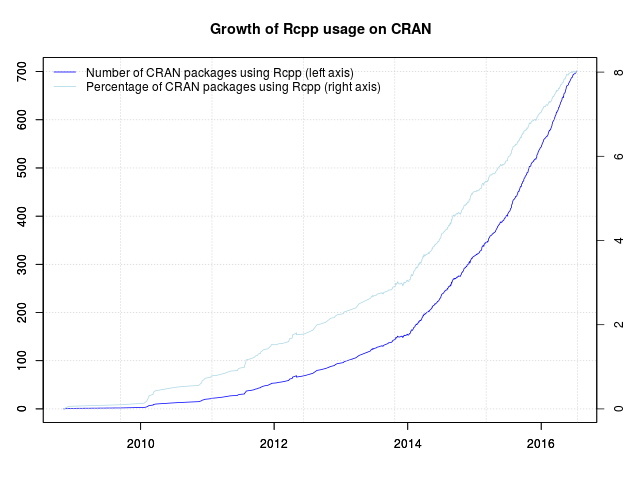
600 Rcpp packages Earlier this morning, Rcpp reached another milestone: 701 packages on CRAN now depend on it (as measured by Depends, Imports and LinkingTo declarations). The graph is on the left depicts the growth of Rcpp usage over time. Rcpp cleared 300 packages in November 2014. It passed 400 packages in June of last year (when I only tweeted about it), 500 packages in late October and 600 packages exactly four months ago in March. The chart extends to the very beginning via manually compiled data from CRANberries and checked with crandb. Then next part uses manually saved entries, and the final and largest part of the data set was generated semi-automatically via a short script appending updates to a small file-based backend. A list of packages using Rcpp is kept on this page. Also displayed in the graph is the relative proportion of CRAN packages using Rcpp. The four per-cent hurdle was cleared just before useR! 2014 where I showed a similar graph (as two distinct graphs) in my invited talk. We passed five percent in December of 2014, six percent last July, seven percent just before Christmas and now criss-crosses 8 eight percent, or a little less than one in twelve R packages. 700 user packages is a really large and humbling number. This places quite some responsibility on us in the Rcpp team as we continue to try our best try to keep Rcpp as performant and reliable as it has been. So with that a very big Thank You! to all users and contributors of Rcpp for help, suggestions, bug reports, documentation or, of course, code.

This post by Dirk Eddelbuettel originated on his Thinking inside the box blog. Please report excessive re-aggregation in third-party for-profit settings.

10 July 2016

Simon D saulniers: [GSOC] Week 5&6 Report

During week 5 and 6, I have been to the debian conference 2016. It was really interesting meeting with a lot of people all so involved in Debian.

Key signing party Each year, this is a really important tradition: people gather together and exchange GPG public key fingerprint and sign each other s keys. This contributes greatly to the growth of the web of trust.
I did exchange public key fingerprint with others. It was the first opportunity become more connected in the PGP web of trust. I think this is something that needs to make its way to the less technical people so that everyone can benefit from the network privacy features. There is support for some mail clients like Thunderbird, but I think there is still work to do there and mostly there is work to do about the opinion or point of view people have about encryption ; people don t care enough and they don t really know what encryption can do for them (digital signature, trust and privacy).

Ring now part of Debian During the first week at debcamp, Alexandre Viau, an employee at Savoir-Faire Linux and a also a Debian developer (DD for short), has packaged Ring for Debian. Users can now install Ring like so:
$ sudo apt-get install ring
This is an important moment as more people are now going to easily try Ring and potentially contribute to it.

Presentating Ring Alexandre Viau and I have been thinking about presenting Ring at debconf 2016. We finally did it.

Next.

Previous.