Search Results: freedom

6 September 2008

Benjamin Mako Hill: Happy Birthday GNU

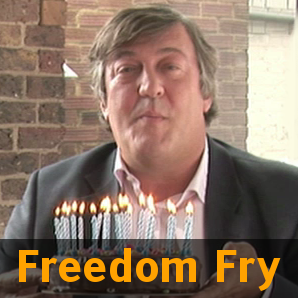
Nearly a week after its release, I suspect most of my audience has seen the FSF's Freedom Fry video of Stephen Fry wishing the GNU project and the free software movement a happy birthday. While I'm not usually one for birthdays, I thought I'd at least reflect on it briefly. Certainly, it's a wonderful video -- for which Matt Lee at others at the FSF should be proud. But it's fact that the GNU project is now twenty-five years old that is truly noteworthy. /copyrighteous/images/freedom_fry.png Wikipedia says that a generation (i.e., the average interval between the birth of parents and of their offspring) is somewhere between 25-30 years in most of the Western world. Twenty-five years isn't just a big number divisible by five, it marks a generational shift. Certainly, GNU has matured and accomplished wonderful things in last quarter-century. More importantly perhaps, it's produced wonderful progeny. It has spawned hundreds of thousands of free software projects, thousands of free or nearly-free operating systems, and an unbelievably vibrant global free and open source software community. Beyond the software realm, the free culture movement, most free licensing projects, and much of the access to knowledge movement can trace a connection back to GNU. We are living, and building, a new generation of the free software movement. It's not been an entirely smooth ride, feelings have been hurt, and it's hard for GNU's proponents -- myself included -- to not wince at some of what has been done in GNU's name and because of its example. But even cynics must admit: the world is an undeniably better place because of GNU and the efforts and ideas that it has motivated. I turn 28 in December and have spent my entire computing life in world where free software was a viable option and an active form of resistance. Here's to another generation! May we be half as productive and positive as the last!

5 September 2008

MJ Ray: Friday Opinion Request 2: Are Your Free Software T-Shirts Ethical?

News reports have described the use of forced child labour for cotton harvesting in Uzbekistan, which is then used in t-shirts and so on, including those sold by some major shops in England like Asda/Wal-Mart, as I mentioned on the debian-project email list last autumn. When you buy badly-produced T-shirts to support free software projects, you may be helping provide freedom for more software users in your country, but you may also be helping to enslave vulnerable workers in other countries. If you buy Debian T-shirts from the UK, you’re probably OK. This is something that the Debian UK Society seems to do right. Their buyer (and current Debian Project Leader) Steve McIntyre wrote:
“[Fruit of the Loom premium Ts, Kustom Kit Augusta/405 polo shirts ...] both FotL and KK have ethics statements that describe their standards. The KK one is linked off the front page of their website; the FotL details I have in .doc format that I’ll pass on if people would like to see them.” (original)
I also asked my local perl mongers group to do similar but there’s been no response to that yet (or any t-shirts AFAIK). I’ve been told that all of the FSF Europe gear is Fair Trade but it doesn’t say that on their web shop. How about other free software projects? Have you asked about your T-shirts? Is there a central site for this sort of information?

1 September 2008

Daniel Baumann: Debian not complying to licenses

First of all, I don't want to blame individual persons. This is just a note of how disappointed I'm about some parts of Debian that are not complying to licenses when it comes to distributing software. debian-cd embedds copy of syslinux without source A couple of years ago, I took over the maintenance of the syslinux package since its previous maintainer was MIA. The takeover was motivated by to the fact, that having started to take care about live systems, I also started to use syslinux on a daily basis and that the syslinux package in Debian was horribly outdated. At that time, I found out that debian-cd, the toolkit to build the official Debian Installer images, doesn't take syslinux out of the archive at build-time of the image, but rather embedds a copy of the required binaries inside the package itself. So I asked Steve to update the binary what he did. Before the etch release, I needed to ask the debian-cd team to sync again their embedded syslinux copy to match the one I had uploaded to the archive, as it was again outdated. On the other hand, live-helper, the toolkit to build the official Debian Live images, was always using the package out of the archive and did never had that problem. After we have released the Debian Lenny Live Beta 1 images last week, we got reports from people trying them on Apple MacBooks and failed because syslinux, taken out of the archive (version 3.71), is broken on that hardware. Some people stated that Debian Installer images do work. That is because debian-cd has an embedded copy of syslinux (version 3.63) which doesn't have that regressions. Since syslinux version 3.71 is present in testing/lenny as well as unstable/sid, and stable/etch has version 3.31, that means... if debian-cd is embedding a syslinux binary with a different version, it must contain the sources for it (it also needs to contain the sources for it anyway, even if it would embedd binaries of the current version, however, it would be a tiny bit less arguable if its sources would be at least present in the Debian archive). So I checked debian-cd, and surprise, it doesn't contain syslinux sources. Syslinux is licensed under the GNU General Public License, version 2 or later. That means, that if you distribute the binaries and sources together, you can remove both at the same time if you decide to no longer distribute the binary (that is what Debian uses to do). This let me to bug #497270. The option to distribute the binary with a note on how to get the sources, valid for three years, could theoretically be done, but isn't used so far (since it has pretty bad practical implications of keeping sources arround even after having stopped to distribute the binaries). Debian sarge release has incomplete source images Checking fo the consequences for embedding bootloader binaries in debian-cd, I just saw that the Debian sarge release does ship syslinux version 2.04 in its images, but is shipping syslinux 2.11 in its source images. This is another violation of the GPL and I've filled this as bug #497471. ...and syslinux is just one bootloader, only used for i386 and amd64. Someone still needs to check for all the other bootloaders for the other architectures we support (and those also for the etch release). cdimage.debian.org distributes images without sources While browsing arround on cdimage.debian.org, I also found the kde4beta livecds made by the Debian KDE team back in November 2007. Although these images are nice, there is no source available for them at all. They use packages that are not available anymore in Debian since a long time. This time, this doesn't only violate the GPL as in the previous two cases, but almost any copyleft license under which we distribute software in main and that is included on these images. I've filled this as bug #497462. Again, this is not about blaming individual persons. But I'm pretty disappointed by these things. In Debian, we spend a big chunk of time checking licenses of packages before we start distributing them. We have our beloved NEW queue where, after the Debian Developer who has initial uploaded a package and has checked the sources, also ftp-masters are re-checking each and every package to ensure that our archive is kept legal. The NEW queue is a mesurement that consumes a big deal of our time, making uploading packages new packages slow, but this is the prize we pay for ensuring our freedom. And we do also make a big fuss about cluebating upstreams that don't respect licenses (be it intentionally or by accident). However, it appears that as good as our package checks are, we spend little to no time to check our resulting products made from these packages. Update: kde4beta livecds have been removed now from cdimage.debian.org, see #497462. Update 2: debimg does the same crap.

27 August 2008

MJ Ray: Forthcoming Attractions: Software Cooperative Events for Late 2008

Some interesting events that I’ve heard about recently, with a bit of a focus on software, cooperatives and the South-West:- I’m pretty sure I’ll go to the *d ones - which others do you think I should go to? Will you be at any of these? Any comments to make on/to any of them? Any more to add to the list?

22 August 2008

MJ Ray: Bristol and Bath LUG Meeting 23 August 2008

Apparently the LUG’s website is still off-line and there’s no idea when it will return, so let me use this site to help announce that the LUG’s regular meeting at the Knights Templar public house, near Isambard Walk, Bristol, will happen tomorrow Saturday 23 August from noon-ish until whenever people drift away. Software Freedom Day happens between this meeting and the next one. Is anyone interested in running a Bristol-area event and do you know of a suitable/available venue? I’m finding the SFD official site somewhat dysfunctional (I’m not in the Northern Caucasus, damnit), so I’ve not found a nearby team registered yet…

8 August 2008

Benjamin Mako Hill: Revealing Errors OSCON Keynote

When I gave a Revealing Errors talk at Lug Radio Live USA, I had the misfortune of being up against Robert Love's talk on Android which many people at the conference wanted to see -- myself included! One person who showed up to my talk anyway was Allison Randall. She was apparently entertained enough to invite me to give a short version of the talk as one of the keynote presentations at OSCON 2008! In the talk, I covered the ideas behind my Revealing Errors project and quickly walked through a few examples that showcase what I'm trying to do. I'm happy with the result: a couple thousand people showed up for the talk despite the fact that it was at 8:45 AM after the biggest "party night" of the conference! For those that missed it for whatever reason, you can watch a video recording that O'Reilly made and that I've embedded below. A larger version of the Flash video as well as a QuickTime version is over on blip.tv and I've created an OGG Theora version for all my freedom loving readers.

Jaldhar Vyas: Worse Than Software Patents. More Restrictive Than the DMCA

Today is Galactic Freedom Day. Debian needs to join in and ensure future generations have full access to the source code of their anal probes.

6 August 2008

Pablo Lorenzzoni: 100-thousand and counting

For those of you wondering how is the battle against the Brazilian Internet Surveillance Bill, I have to report we already got more than 100-thousand people to sign the petition. You can check the current count in the image on the right. I am updating it every 15 minutes, so you can even use its URL in another place (as are some people doing already). The bill will be voted by the Chamber-of-Deputies any time now We heard it would be on yesterday, but apparently it was not even enlisted for this week. This doesn t mean much, since the Deputies can hold an out-of-list voting we ll be watching. Meanwhile, I read an article by S rgio Amadeu that summarizes some of our feeling about that bill. Are we in the Western World (allegedly freedom lovers) turning into control-freaks? A whole lot of people I know are not even offended by this bill! These are the same people that don t think it s weird that USA claimed the right to seize any storage device entering their borders, for any time they want, with no warranted privacy. Are we in a middle of a paradigm shift? Are we accepting less freedom? What would George Orwell think of that? Maybe we got in a wormhole and ended up in 1984

30 July 2008

Juan Luis Belmonte: Open Source people life cycle


First lets talk about freedom. Is not an utopia, freedom can be conquered in a lot of little bits of our life, just because we are not always free somewhere or somehow. We cant forget that there are billions of other things you can do to feel the freedom. You lose your freedom when if you stop looking for it. We can also talk about technology. It is everywhere, satellites, tvs, cell phones, internet, computers, games, microwaves, dvd… Is part of our life. What happen if we mix this all together? Well let’s talk about … me? Fourteen years old. My parents bought a computer , with his Windows 98. Everything works till it brokes. I brought it to a technician, and I had to spent all of my pocket money. So I promised my self not to bring my pc again to a technician. That made me a bit more free, I learned how to fix it and then I was able to do what I want with the machine, so I had the way to fix it without spending money. Great!. The magic tool exists is knowledge. In a couple of years, nothing in that windows was enough so, I started very light to read some about that thing called “linux” affiliate to some news account. But i was 17 when I started to use half linux and half windows. Things weren’t very trivial and I hadn’t broadband, so I had a quite big amount of CDs with different distros, and when i want to use my winmodem, I used suse, for little funny games redhat, and other times, mandrake, Caldera… I didn’t know how anything was working, but was funny and each time easier to deal with it. So the first step in open source was experimenting, sometimes a bit frustrating but… is part of the game. When the broadband was up to my pocket. I got my connection, and started to learn from forums, online tutorials, irc… Debian, seven Debian CDs. … that day I wasn’t conscious, what that will supose for me, and my future. I’ve annoyed a lot of people with questions, read a lot of tutorials, spent hours learning of other people experiences… But all of that is something that one day you will give it back to someone else, is the cycle. One day is you who helps other to begin with his distro, or compiling an app, or making his sound card to work. I’ve studied computer engineering and I’ve been in touch with free software the last 5 years, I don’t have to pay for my software, i can do with it what I want. One more step is promote it. Convincing people, telling how wonderful it is, and how many people you’ve met, and how you can enjoy it, and what advantages are ready for you and for free. 6 years using linux, make me to work as system administrator and i love it. So the free software one day let me to earn money and build my life. Now the last part. CONTRIBUTE! Is the best part, documentation, developing, translating, whatever you want, you can do things for people as people has done for you. A popular sensation when you begin, is that there a lot of gurus, and you are not able to be in this world, everywhere are levels, you can be an user, a contributor, or just become a fan :) Experiment, Use, Share, Work, Contribute. But never finish, is an inphinite cycle where you can always learn from everybody and you have a lot to teach the other. Isn’t that the freedom?. Enjoy it.

23 July 2008

Pablo Lorenzzoni: The new Brazilian Internet surveillance

Here I am writing today to tell something that might not be known outside Brazil at least, I haven t read much in English about it the attempt to turn the Internet into a government surveillance device. This story goes back to 2006 (and even back), when we first successfully blocked the approval of a bill that would, in effect, turn the Brazilian Internet into a giant Big Brother. This bill was introduced by Senator Eduardo Azeredo as a replacement to a series of other similar bills that were attempted before and was followed by a strong resistance by civil organizations, one of those being ASL, of which I am proud of being one of the founders. By that time we ended having it postponed for more debate. It happened that the bill made a come back last weeks, and was pushed into approval by a subcommittee of the Senate (one that was suppose to deal with the constitutionality of bills) and now is heading to the Chamber of Deputies for appreciation. Apart from the first debates back in 2006, nothing happened between then and the approval. The bill have changed a little bit, but not much as to change its effects. In Brazil, we have two legislative houses, Federal Senate and Chamber of Deputies. If a Law Project is proposed by one, is revised by the other. So we have already lost 50% of the fight. Ronaldo Lemos, professor of Funda o Get lio Vargas (think about a Brazilian version of Harvard Law School ) have already stated how dangerous such a Law can be, once approved. In his own words: The wording of the law is too broad, and can be applied in several cases. The interpretation of what is a crime or not will be done by a criminal judge, who is used to deal with homicides and not with technology . Since its approval in Senate, several people have been putting together a resistance. Central to it is a Petition, hosted at Petition Online, that already holds 64-thousand signatures. One of the writers of that petition, Andr Lemos, a university professor and researcher, have said that the regular user will have the feeling of being watched, and not knowing if what he s doing in legal or not: For instance, if I disseminate a virus without knowing, will I be arrested? Can I exchange my files in P2P networks (my pictures, my musics, my text files) without asking for permission? How will the ISPs interpretate these exchanges? Can I copy a part of a text from a blog and paste it into mine? This law creates a feeling of insecurity and generalized fear . FGV s Center for Society and Technology have published an analysis of the Law Project, and have spotted a lot of problems in it. For instance: Thinking of how I can help, after sending an email to every Deputy whose email address I was able to get, I decided to translate the law into English (I also uploaded a version with indentation, since it s pretty hard to understand the whole law without it, if you re not used to), so the World can be made aware of what s going on in Brazil. I also just sent an email with it to EFF, asking for their help. Not that I think they can do much, but they surely will know one or two strings to pull in order to put more pressure on the Brazilian government. I also hope that, once this post reaches Planet Debian, even more people become aware of the issue. In a sense, this is an appeal for all the Freedom Culture lovers out there to take any actions they can to help us prevent this Law Project to become a Law. (In time, I d like to thank Alexandre Oliva, who revised the translation). Update (2008-07-23 11:50): Steve Langasek also revised the translation of the Law Project and I ve made a cherry-pick merge , which resulted in the version currently linked in the text above. Older version of the plain and the indented documents are still available. Thanks Steve!

MJ Ray: LugRadio Live Event Review, Part Web2.0


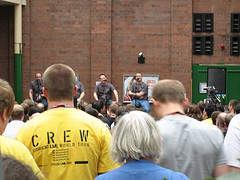
LUGRadioLive 2008 by sheilaellen (cc-by-2.0) One aspect I didn’t mention in the LugRadio Live Event Review was how old-fashioned it seemed in some ways. I guess I’ve got used to seeing conferences experimenting with various web2.0 toys like live-blogging, feedback walls and so on, or the excellent live video streaming of DebConfs, but it was a bit of a surprise to find myself the only person in the audience who connected to the IRC channel from the event. One possible reason for that was that the wireless network was a bit difficult, or at least that was what I was told. I felt quite smug with my 3G smartphone IRC client (which I’ll blog about later) until Rufus Pollock mentioned the 800+ patents involved in 3G. Damn - I guess I hate freedom. In one way, I guess it’s appropriate if the network wasn’t up to the task. Broken networks were a regular feature of early ALUG meetings, as the end of this email hints. Web2.0 was there a little bit. There was a facebook page (which I accidentally spammed while travelling to the event), flickr:lugradiolive and a twitter link of #lugradiolive - but how does that work? There’s no user called lugradiolive and you can’t have usernames containing # Update: twitter:#lugradiolive (thanks to Dave Briggs for the explanation in a comment). Anyway, seeing as there will be another LUG Radio Live, maybe we can arrange something more interactive but free-software-friendly for 2009? More reviews I’ve read: davee: Lugradio-in makes me feel good , Peter Cannon: The party’s over for LugRadio Live and No’: Lugradio Undead - but why aren’t more people writing about this event? There seemed to be enough there. Or are they out there but I’m just not seeing them?

21 July 2008

Benjamin Mako Hill: OSCON and More

I'm in Portland, Oregon for the week where I'll be at OSCON. I'll be giving two talks on the final day of the conference (July 25): the first will be a 15 minute keynote on Revealing Errors at 8:45 in the Portland Ballroom; the second is a full-length normal talk on Selectricity at 11:35AM in Portland 255. It will be my first long-form talk about Selectricity and I'm looking forward to it. Because myself, a few Free Software Foundation staff members including Campaign Manager Joshua Gay, and quite a few FSF associate members will be in town, we're going to hold a small FSF Associate Members event in Portland (the first outside Boston!). It's going to be in the form of a pizza party with a few small talks from FSF folk including myself. Here are the details:
FSF Associate Members (& friends!) Event
July 22nd 6:30-9:00PM
Old Town Pizza
226 NW Davis St
Portland, OR 97209
It's free and open to all but is designed to provide a forum for members and friends. If you are an FSF member, please consider coming. If you're not a member yet, please don't let it keep you away; staff will be able to sign up new members there. RSVPs to Deborah Nicholson aren't necessary to attend but would be welcome. I'll be heading to Seattle right after the conference for a few days. If you would like to meet up in Seattle or Portland this week, please don't hesitate to get in contact.

Benjamin Mako Hill: I Will Revise

Once again, Wikimania was wonderful. I gave my scheduled talk on Autonomo.us and network freedom and network services. I also filled in for a few speakers to give a "Zotero for Wikipedians" demo and to say a few words about the BY-SA/FDL work as part of a Creative Commons panel. Perhaps the most memorable part of the conference was the writing and performance of I Will Revise. A couple days before the conference, a small group of Wikipedians -- The Difftones -- wrote the song at a karaoke bar in Alexandria. We had a wonderful time leading a room full of lightning talk attendees in song and a final rendition by a massive, fully-packed, stage at the party on the final night! It's online on meta.wikimedia.org. You should feel free to revise it, add verses, and improve it!

14 July 2008

Benjamin Mako Hill: Autonomo.us and the Franklin Street Statement

Recently, I've been doing a lot of thinking -- and a bit of talking -- about what software freedom means in the context of network services. I gave a talk on this subject at the most recent FSF members meeting and at Sun's Community One. In a few days, I'll be giving another at Wikimania in Alexandria, Egypt. A few months ago, I worked with the FSF to organize a meeting of free software hackers and scholars to talk about the issues. Today, that group is announcing the first two concrete results of that project. The first is a blog and a wiki called autonomo.us. The project aims to provide a space to continue, expand, and open up the work that was done at the FSF in March. Our aim is to explore the implications and responses to network services in relation to software. We're going to do that by continuing to take notes in the wiki and by publishing articles, essays, and documents that help inform the discussion about software freedom and network policies. We will be working independently from, but closely with, the Free Software Foundation, and with others in the free and open source software communities. Our goal is not to set policy, but to explore the space and inform the discussion about autonomy and user freedom in cloud computing and software as a service. The second announcement is the first concrete product of autonomo.us's work: a statement we're calling the Franklin Street Statement on Freedom and Network Services. It lays out our initial consensus on positive steps that developers, service providers, and users can take. If you want to follow our work, please subscribe to the autonomo.us blog and check out some of our work so far. If you've got thoughts and things to contribute, you can mail or get to work in our wiki. You can read our about page for more information about us and our goals. In a coordinated move, the Open Knowledge Foundation (which I help advise) is launching the 1.0 version of their Open Software Service Definition. There is a whole lot we need to learn, think through, and do before we have reasonable answers to the problems to freedom posed by network services. Today marks the beginning of several wonderful steps toward some of these answers.

Evan Prodromou: 26 Messidor CCXVI

Since the launch of Identi.ca a few weeks ago, I've had a very busy time. Not much sleep, but lots of fulfilling and exciting work. It's invigorating to work on something that is popular and that you believe in. And I'm glad that the Franklin Street Statement so succinctly encapsulates those beliefs. As some people may have read in my previous blog post about the motivations behind creating Identi.ca (see Journal/14 Messidor CCXVI), I was part of a group convened at the FSF to discuss the impact of the growth of software as a service on user autonomy. It was a very loose organization of hackers, activists, and scholars who come from different backgrounds but all share an interest in user rights online. As computing moves into "the cloud" (see cloud computing), what power does the user retain to control their own computing experience? As much of our social lives -- romance, family, work, friends -- becomes Web-enhanced, what can we do to assert our right to manage that data and its use? How can software developers and service providers gauge their own proper ethical behaviour, and how can users of services judge what is and is not acceptable to use? We didn't come up with any easy answers, but we've summarized our thinking in a new document: the Franklin Street Statement on Freedom and Network Services. In essence, we've tried to point a direction towards what software developers, service providers, and software users should think hard about when thinking about network services. [image] Our group will continue to explore these issues on our new group blog, http://autonomo.us/ . We're going to concentrate on the effects of software services on user autonomy -- people's ability to make their own informed choices about their data and creative works and the software that processes them. It is a realm that as a society -- a cluster of societies -- we're only beginning to understand, and I think that there is still a lot of exploration to do. Autonomo.us includes a wiki where we'll be exploring some of these ideas, and the blog will feature guest submissions about the subject. We're a loose and unofficial group with some smiling benevolence but no sanction from the FSF or any related organization, so we're really going to dig into some of the gray areas of this issue without worrying about making official statements for any one organization. I'm looking forward to the coming months and I hope this issue captures the imagination of the Web's Open Source and Open Content communities. P.S. You can see the FSF press release about the statement and the launch of autonomo.us. tags:

Open Service Definition On a related note, one of the first organizations to approach the issue of Open Services has been the Open Knowledge Foundation. Today they've launched the 1.0 version of the Open Software Service Definition (OSSD). I think the OSSD 1.0 is a great step. It's a bar against which we can start measuring Open Software Services. For example, I think that Identi.ca meets the requirements of the OSSD. Other sites, like Wikipedia, are also clearly compliant. Some services that I really like, such as OpenStreetMap and geonames.org, seem to be compliant. But are they? It's good to start this investigation. I think other kinds of services are on their way there. The announcement by Reddit that their code will now be Open Source is a great step for user autonomy in the social news arena. Now, Reddit needs to consider what an Open Content/Open Data policy would mean for their service... or see others implement it on other sites. I look forward to a rich ecology of open software services growing, now that we have a name for it and a clear community of people interested in the topic. tags:

9 July 2008

David Welton: Google, Android, and the case of the missing communication

Like many people, I participated in the Google Android contest this spring, and like most of them, I didn't win, but I did enjoy working with the platform, and am very excited about the idea of an open source mobile platform that's relatively powerful. From the outset, due to the lack of actual source code for a lot of the system, there have been "doubters" about what Google is really up to. I'm not one of them, and am largely ok with their reasons for holding back: I buy their reasoning that the long term benefits of a strong, properly QA'ed launch probably outweigh the possibility of failure that might come from the press and the public at large that doesn't care much about software freedom seeing phones come out with half-baked, early implementations. I think most of us working with Android were ok with that strategy, and the ones who weren't self-selected out of the platform, most likely. However, lately Google has made something of a mess of their communications regarding Android. The problem stems from the fact that they gave an updated version of the SDK only to the winners of the competition, which for a lot of people felt like a bit of a slap in the face: they helped popularize the platform by participating in the contest and writing applications for it, and in return got excluded from the upgrade path. Personally, it's not really any skin off my nose, as I'm sanguine about the Hecl port proceeding apace when the new SDK is public, but I can see that if you were, say, a company porting your app to the platform and now are left behind the competition winners, you might be a bit irritated. The biggest mistake they've made though, is a big lack of communication regarding this business. As I said, I don't really have that much skin in the game, and if they explained in a convincing way why they needed to do things that way, they would go a long ways to allaying the frustrations felt by many. I'm not much of a believer in conspiracy theories and plots, especially where companies are concerned. Inept bumbling is a far more likely explanation in most cases, including this one. What is odd, though, is that Google has a lot of people who "get it". I met Dan Morrill at the Munich Android event, and he definitely gets it. He writes about his frustrations as a developer advocate and all the crazy things people say. Well, one way to reduce the number of batty internet theories (eliminating them is clearly impossible due to the alien mind control rays) is to consistently communicate quality information about what's really going on, something that has been lacking with regards to the SDK question. Here's another Google employee who understands this need to communicate, and apparently does so despite being worried about being "slapped for talking publicy about all this": http://groups.google.com/group/android-developers/msg/244edfad99870c63
But the root of the problem is certainly not licensing but that there hasn't been a new public SDK release since M5, while at the same time a small group of people received updated versions privately. I really don't know precisely why this happened; but I'm sure it has more to do with logistics and reducing the burden of support while we shift priorities (to shipping real devices) rather than politics or any will of our part to "hurt the community" (come one guys, we are not that stupid... !) While others in the team may disagree, I think it was very very unfortunate; some of us are trying to prepare a new SDK release, but it's a lot harder than I can comment on here, so don't hold your breath because it might not happen that soon.
This explains things in part, but still leaves us in the dark, and leaves me with the feeling that someone in power, somewhere at Google, despite his or her clued in colleagues, really doesn't get it with regards to open source. I'm still unconcerned about the Android source code: I think we'll see it, but to be a true open source project, Android will need an open community as well, not one where decisions are taken exclusively at Google, and not even communicated to the development community at large. All in all, this mistake is more molehill than mountain, but however you look at it, in terms of open source, it is a step backwards.

3 July 2008

John Goerzen: Video uploading sites?

I'm working on switching from using a Mac to using Linux for editing video. I have a mini-DV camcorder that a bought a few years back, and I've been looking at capture and editing software for Linux.

Along with that, I want to post some videos online for family to be able to see I want to preserve the original quality as much as possible, offer the option to download the video, and be able to share some videos with family only (not the entire Internet).

I've been looking at various reviews of video sites (such as this PCWorld one) and decided to look at blip.tv and Vimeo in more detail.

Blip seems to have lots of controls, options, etc. And, they seem to really care about end users, respond fast, and care about freedom. There's an impressive response from their support team concerning Ogg Theora out there. They offer FTP uploads (which are a huge improvement over HTTP POST uploading, in my opinion, and easily scriptable). They can also automatically post your video to archive.org or about a dozen other video or blogging sites.

But what I want to do is not really what they are aiming at. They are set up for "channels" (you can apparently only have one channel per user), and for more professional users. Most notably, you can't make videos private or restricted without paying for their $100/year or so "pro" account.

Vimeo looks very much like the Flickr of video. They do offer various options for restricting who can see a video. When they transcode video to Flash, they have the option of preserving it in HD, which blip.tv doesn't (both go 640x480 or so by default, and blip maximizes out that that). Though both offer the option to download the full, unmodified original. Vimeo has only one option for uploading, and it doesn't seem to work well with Firefox. They have little detail about anything in their docs. Maybe it's more the Photobucket of video than the Flickr of video. (Oh, who am I kidding -- that's Youtube).

Of course, there is Youtube. Maxes out at 320x240, doesn't offer the original for downloading. Doesn't make me think all that positively about them.

I could also use Flickr. I'm not sure if they offer the original, but there's a 90-second limit on uploads there.

Any other thoughts?

30 June 2008

Russell Coker: The History of MS

Jeff Bailey writes about the last 26 years of Microsoft [1]. He gives Microsoft credit for “saving us from the TRS 80″, however CP/M-86 was also an option for the OS on the IBM PC [2]. If MS hadn’t produced MS-DOS for a lower price then CP/M would have been used (in those days CP/M and MS-DOS had the same features and essentially the same design). He notes the use of the Terminate and Stay Resident (TSR) [3] programs. As far as I recall the TSR operation was undocumented and was discovered by disassembling DOS (something that the modern MS EULAs forbid). Intel designed the 8086 and 80286 CPUs to permit code written for an 8086 to run unchanged in “protected mode” on an 80286 (as noted in the Wikipedia page about the 80286 [4]). Basically all that you needed to do to write a DOS program with the potential of being run directly in protected mode (or easily ported) was to allocate memory by requesting it from the OS (not just assuming that every address above your heap was available to write on) and by addressing memory only by the segment register returned from the OS when allocating memory (IE not assuming that incrementing a segment register is equivalent to adding 16 to the offset). There were some programs written in such a manner which could run on both DOS and text-mode OS/2 (both 1.x and 2.x), I believe that such programs were linked differently. The term Fat Binary [5] is often used to refer to an executable which has binary code for multiple CPUs (EG PPC and M68K CPUs on the Macintosh), I believe that a similar concept was used for DOS / OS/2 programs but the main code of the application was shared. Also compilers which produce object code which doesn’t do nasty things could have their object code linked to run in protected mode. Some people produced a set of libraries that allowed linking Borland Turbo Pascal code to run as OS/2 16bit text-mode applications. The fact that OS/2 (the protected-mode preemptively multi-tasking DOS) didn’t succeed in the market was largely due to MS. I never used Windows/386 (a version of Windows 2.x) but used Windows 3.0 a lot. Windows 3.0 ran in three modes, “Real Mode” (8086), “Standard Mode” (80286), and “Enhanced Mode” (80386). Real Mode was used for 8086 and 8088 CPUs, for 80286 systems if you needed to run one DOS program (there was no memory for running more than one), and for creating or adjusting the swap-file size for an 80386 system (if your 80386 system didn’t have enough swap you had to shut everything down, start Real Mode, adjust the swap file, and then start it again in Enhanced Mode). Standard Mode was the best mode for running Windows programs (apart from the badly written ones which only ran on Real Mode), but due to the bad practices implemented by almost everyone who wrote DOS programs MS didn’t even try to run DOS programs in 286 protected mode and thus Standard Mode didn’t support DOS programs. Enhanced Mode allowed multitasking DOS programs but as hardly anyone had an 80386 class system at that time it didn’t get much use. It was just before the release of Windows 3.1 that I decided to never again use Windows unless I was paid to do so. I was at a MS presentation about Windows 3.1 and after the marketing stuff they had a technical Q/A session. The questions were generally about how to work around bugs in MS software (mainly Windows 3.0) and the MS people had a very detailed list of work-arounds. Someone asked “why don’t you just fix those bugs” and we were told “it’s easier to teach you how to work around them than to fix them“. I left the presentation before it finished, went straight home and deleted Windows from my computer. I am not going to use software written by people with such a poor attitude if given a choice. After that I ran the DOS multi-tasker DesqView [6] until OS/2 2.0 was released. Desqview allowed multitasking well written DOS programs in real mode, Quarterdeck was the first company to discover that almost 64K of address space could be used above the 1MB boundary from real-mode on a 80286 (a significant benefit when you were limited to 640K of RAM), as well as multitasking less well behaved DOS programs with more memory use on an 80386 or better CPU. OS/2 [7] 2.x was described as “A Better DOS than DOS, a Better Windows than Windows”. That claim seemed accurate to me. I could run DOS VM86 sessions under OS/2 which could do things that even Desqview couldn’t manage (such as having a non-graphical DOS session with 716K of base memory in one window and a graphical DOS session in another). I could also run combinations of Windows programs that could not run under MS Windows (such as badly written windows programs that needed Real Mode as well as programs that needed the amount of memory that only Standard or Enhanced mode could provide). Back to Bill Gates, I recently read a blog post Eight Years of Wrongness [5] which described how Steve Ballmer has failed MS stockholders by his poor management. It seems that he paid more attention to fighting Linux, implementing Digital Restrictions Management (DRM), and generally trying to avoid compatibility with other software than to actually making money. While this could be seen as a tribute to Bill Gates (Steve Ballmer couldn’t do the job as well), I think that Bill would have made the same mistakes for the same reasons. MS has always had a history of treating it’s customers as the enemy. Jeff suggests that we should learn from MS that the freedom to tinker is important as is access to our data. These are good points but another important point is that we need to develop software that does what users want and acts primarily in the best interests of the users. Overall I think that free software is quite well written in regard to acting on behalf of the users. The issue we have is in determining who the “user” is, whether it’s a developer, sys-admin, or someone who wants to just play games and do some word-processing.

28 June 2008

Jeff Bailey: A retrospective on 26 years of Microsoft in my life

It's interesting to think about Bill Gates retiring. When I think back to how much Microsoft has brought us over the years, both happiness and grief, it's a bit of a happy/sad end to an era for me.

Microsoft is what saved us from the TRS-80, and brought us into a world where clone hardware drove prices down to where everyone could afford them. MS-DOS may have been a bad rip off of CP/M and Unix, but to business operations brought us the ability to bring computing power right down to the desk and generally got out of the way. Dos had the neat ability to have TSRs that could deliver waiting applications at a keystroke (remember Sidekick?) Windows 386 and 3.0 brought us preemptive multitasking for DOS apps that weren't written for that in mind, and brought us the first environment the mass market had seen where any manufacturer could write drivers to a known programming interface and bring their hardware to the world. They brought us a world where hardware innovation was bringing crazy new things to us that had only been possible in Sci-Fi movies before. My first voice-recognition system on the computer was in 1990. =)

Windows 95 pushed that even further. No longer were drivers crazy TSRs, but actually loaded into the control panel with standard was of using them for established services such as Networking and Sound. For everything else, the model was extensible so that if you had a neat idea, you could bring it out to the world. I remember installing TwinBridge at work so that people could type in double-wide Chinese characters, despite the OS not being intended for that in the slightest.

Windows 98 brought us games that were better than we were seeing in DOS. DirectX and DirectSound were finally providing a good enough abstraction on top of the hardware that it was easier for authors to code to that than to code right to your Adlib card and whatever display adapter you had (were we using S3s yet, then?)

But that seems to have been the top point of their reign. At this point, as a user I was now so far from the guts of the machine, I no longer could easily tinker. I'd once coded in Z80 asm and 8086 asm to write little hacks, but Windows 98 was getting to the opinionated software stage: There were things you just couldn't do, for no reason other than the designers at Microsoft didn't think it was important.

I realise I'm not the usual mass-market type, but now the system that had been such a source of inspiration was now becoming a barrier to trying new ideas.

I had started playing with Linux in 1995, but 1998 had started to use it as my main machine at home. I had a roommate who had a dumb cheap machine that was slaved off of my main machine so that he could play Medievia all day and night. Setting up this networking, and the on-demand ISDN dialing was trivial to do under Linux, and nearly impossible under the Windows systems of the time.

The only thing one could say for FVWM95 at the time was that it was better than twm. We suffered through Enlightenment, said hello to wine, and joined an online community of people who'd all come together from various places in order to be free to play with the systems we had.

Microsoft became steadily less relevant to my day to day computing. My girlfriend (now wife) suffered through early incarnations of MS Word for windows 2.0 under Wine because it was still easier than teaching her emacs. And steadily, the system got better until we could honestly look at our family members and tell them that if they wanted to run Windows that was fine, but please don't call me about it.

We need to both say thank-you to Microsoft and learn from it. Microsoft made a business model of bringing us the technology we craved as geeks, and that society wanted to play with and integrated into our lives. Microsoft also taught us what it means to be the dominant player. For most of us, I suspect it was our only view into the world where a single player dominates and strives to cut down its competition. It's easy to romanticise the small business owner, and just as easy to forget that just about every small business owner wants to be a millionaire and a large business owner.

We need to remember that the pretty fancy interfaces can be as much about helping people do things as keeping them from doing things. We need to demand the freedom to tinker with our software and our devices, even if we choose to never do so. And after all that, we need to be able to take our data from a device, and take it to somewhere else. I think ultimately, this is what Microsoft has taught us. As we look for new companies to deliver us greater and shinier technology, this is a lesson we need to keep close at hand.

18 June 2008

Benjamin Mako Hill: Ubuntu Book Third Edition

Another year has past and another edition of the Official Ubuntu Book has been finished and will be released soon. Over the last two years, the two previous editions of the book have grown along-side Ubuntu. The book has continued to sell very well, received almost universally favorable reviews, and been translated into more than half a dozen languages While Jono Bacon has mostly been pulled into other projects, Corey Burger stepped up to help play the major supporting role in this version of the book's production. The whole text was updated to reflect changes in Ubuntu over the last year including a major rewrite of the chapter on Kubuntu and important work on the Edubuntu chapter. If you use either, you'll understand that there's plenty of churn to report. In a sort of experiment, Barnes and Noble will also be selling a custom edition with an extra chapter by Matthew Helmke on the Ubuntu Forums which I hope to include in the next edition of the book. It's an excellent introduction to the best support resource Ubuntu has to offer that I hope many beginners -- the group that always been the book's audience -- will find useful. You can pre-order the custom edition from B&N or get the book from Amazon or many other sources. Like all previous editions, the book is licensed under the Creative Commons Attribution ShareAlike license and soft-copies should be up on the publisher's website once the book is released. Please support commercial free culture publishing by buying a copy if you find the book useful.

Next.

Previous.