Search Results: "xam"

19 January 2023

Antoine Beaupr : Mastodon comments in ikiwiki

Today I noticed bounces in my mail box. They were from ikiwiki trying to send registration confirmation email to users who probably never asked for it. I'm getting truly fed up with spam in my wiki. At this point, all comments are manually approved and I still get trouble: now it's scammers spamming the registration form with dummy accounts, which bounce back to me when I make new posts, or just generate backscatter spam for the confirmation email. It's really bad. I have hundreds of users registered on my blog, and I don't know which are spammy, which aren't. So. I'm considering ditching ikiwiki comments altogether. I am testing Mastodon as a commenting platforms. Others (e.g. JAK) have implemented this as a server but a simpler approach is toload them dynamically from Mastodon, which is what Carl Shwan has done. They are using Hugo, however, so they can easily embed page metadata in the template to load the right server with the right comment ID. I wasn't sure how to do this in ikiwiki: it's typically hard to access page-specific metadata in templates. Even the page name is not there, for example. I have tried using templates, and that (obviously?) fails because the <script> stuff gets sanitized away. It seems I would need to split the JavaScript out of the template into a base template and then make the page template refer to a function in there. It's kind of horrible and messy. I wish there was a way to just access page metadata from the page template itself... I found out the meta plugin passes along its metadata, but that's not (easily) extensible. So i'd need to either patch that module, and my history of merged patches is not great so far. So: another plugin. I have something that kind of works that's a combination of a page.tmpl patch and a plugin. The plugin adds a mastodon directive that feeds the page.tmpl with the right stuff. On clicking a button, it injects comments from the Mastodon API, with a JavaScript callback. It's not pretty (it's not themed at all!), but it works. If you want to do this at home, you need this page.tmpl (or at least this patch and that one) and the mastodon.pm plugin from my mastodon-plugin branch. I'm not sure this is a good idea. The first test I did was a "test comment" which led to half a dozen "test reply". I then realized I couldn't redact individual posts from there. I don't even know if, when I mute a user, it actually gets hidden from everyone else too... So I'll test this for a while, I guess. I have also turned off all CGI on this site. It will keep users from registering while I cleanup this mess and think about next steps. I have other options as well if push comes to shove, but I'm unlikely to go back to ikiwiki comments. Mastodon comments are nice because they don't require me to run any extra software: either I have my own federated service I reuse, or I use someone else's, but I don't need to run something extra. And, of course, comments are published in a standard way that's interoperable with everything... On the other hand, now I won't have comments enabled until the blog is posted on Mastodon... Right now this happens only when feed2exec runs and the HTTP cache expires, which can take up to a day. I should probably do this some other way, like flush the cache when a new post arrives, or run post-commit hooks, but for now, this will have to do. Update: I figured out a way to make this work in a timely manner:
  1. there's a post-merge hook in my ikiwiki git repository which calls feed2exec in /home/w-anarcat/source/.git/hooks/ took me a while to find it! I tried post-update and post-receive first, but ikiwiki actually pulls from the bare directory in the source directory, so only post-merge fires (even though it's not a merge)
  2. feed2exec then finds new blog posts (if any!) and fires up the new ikiwikitoot plugin which then...
  3. posts the toot using the toot command (it just works, why reinvent the wheel), keeping the toot URL
  4. finds the Markdown source file associated with the post, and adds the magic mastodon directive
  5. commits and pushes the result
This will make the interaction with Mastodon much smoother: as soon as a blog post is out of "draft" (i.e. when it hits the RSS feeds), this will immediately trigger and post the blog entry to Mastodon, enabling comments. It's kind of a tangled mess of stuff, but it works! I have briefly considered not using feed2exec for this, but it turns out it does an important job of parsing the result of ikiwiki's rendering. Otherwise I would have to guess which post is really a blog post, is this just an update or is it new, is it a draft, and so on... all sorts of questions where the business logic already resides in ikiwiki, and that I would need to reimplement myself. Plus it goes alongside moving more stuff (like my feed reader) to dedicated UNIX accounts (in this case, the blog sandbox) for security reasons. Whee!

18 January 2023

Matthew Garrett: PKCS#11. hardware keystores, and Apple frustrations

There's a bunch of ways you can store cryptographic keys. The most obvious is to just stick them on disk, but that has the downside that anyone with access to the system could just steal them and do whatever they wanted with them. At the far end of the scale you have Hardware Security Modules (HSMs), hardware devices that are specially designed to self destruct if you try to take them apart and extract the keys, and which will generate an audit trail of every key operation. In between you have things like smartcards, TPMs, Yubikeys, and other platform secure enclaves - devices that don't allow arbitrary access to keys, but which don't offer the same level of assurance as an actual HSM (and are, as a result, orders of magnitude cheaper).

The problem with all of these hardware approaches is that they have entirely different communication mechanisms. The industry realised this wasn't ideal, and in 1994 RSA released version 1 of the PKCS#11 specification. This defines a C interface with a single entry point - C_GetFunctionList. Applications call this and are given a structure containing function pointers, with each entry corresponding to a PKCS#11 function. The application can then simply call the appropriate function pointer to trigger the desired functionality, such as "Tell me how many keys you have" and "Sign this, please". This is both an example of C not just being a programming language and also of you having to shove a bunch of vendor-supplied code into your security critical tooling, but what could possibly go wrong.

(Linux distros work around this problem by using p11-kit, which is a daemon that speaks d-bus and loads PKCS#11 modules for you. You can either speak to it directly over d-bus, or for apps that only speak PKCS#11 you can load a module that just transports the PKCS#11 commands over d-bus. This moves the weird vendor C code out of process, and also means you can deal with these modules without having to speak the C ABI, so everyone wins)

One of my work tasks at the moment is helping secure SSH keys, ensuring that they're only issued to appropriate machines and can't be stolen afterwards. For Windows and Linux machines we can stick them in the TPM, but Macs don't have a TPM as such. Instead, there's the Secure Enclave - part of the T2 security chip on x86 Macs, and directly integrated into the M-series SoCs. It doesn't have anywhere near as many features as a TPM, let alone an HSM, but it can generate NIST curve elliptic curve keys and sign things with them and that's good enough. Things are made more complicated by Apple only allowing keys to be used by the app that generated them, so it's hard for applications to generate keys on behalf of each other. This can be mitigated by using CryptoTokenKit, an interface that allows apps to present tokens to the systemwide keychain. Although this is intended for allowing a generic interface for access to such tokens (kind of like PKCS#11), an app can generate its own keys in the Secure Enclave and then expose them to other apps via the keychain through CryptoTokenKit.

Of course, applications then need to know how to communicate with the keychain. Browsers mostly do so, and Apple's version of SSH can to an extent. Unfortunately, that extent is "Retrieve passwords to unlock on-disk keys", which doesn't help in our case. PKCS#11 comes to the rescue here! Apple ship a module called ssh-keychain.dylib, a PKCS#11 module that's intended to allow SSH to use keys that are present in the system keychain. Unfortunately it's not super well maintained - it got broken when Big Sur moved all the system libraries into a cache, but got fixed up a few releases later. Unfortunately every time I tested it with our CryptoTokenKit provider (and also when I retried with SecureEnclaveToken to make sure it wasn't just our code being broken), ssh would tell me "provider /usr/lib/ssh-keychain.dylib returned no slots" which is not especially helpful. Finally I realised that it was actually generating more debug output, but it was being sent to the system debug logs rather than the ssh debug output. Well, when I say "more debug output", I mean "Certificate []: algorithm is not supported, ignoring it", which still doesn't tell me all that much. So I stuck it in Ghidra and searched for that string, and the line above it was

iVar2 = __auth_stubs::_objc_msgSend(uVar7,"isEqual:",*(undefined8*)__got::_kSecAttrKeyTypeRSA);

with it immediately failing if the key isn't RSA. Which it isn't, since the Secure Enclave doesn't support RSA. Apple's PKCS#11 module appears incapable of making use of keys generated on Apple's hardware.

There's a couple of ways of dealing with this. The first, which is taken by projects like Secretive, is to implement the SSH agent protocol and have SSH delegate key management to that agent, which can then speak to the keychain. But if you want this to work in all cases you need to implement all the functionality in the existing ssh-agent, and that seems like a bunch of work. The second is to implement a PKCS#11 module, which sounds like less work but probably more mental anguish. I'll figure that out tomorrow.

comment count unavailable comments

Arnaud Rebillout: Build container images in GitLab CI (iptables-legacy at the rescue)

It's 2023 and these days, building a container image in a CI pipeline should be straightforward. So let's try. For this blog post we'll focus on GitLab SaaS only, that is, gitlab.com, as it's what I use for work and for personal projects. To get started, we just need two files in our Git repository: Here is our Git tree:
$ ls -A
Containerfile  .git  .gitlab-ci.yml
$ cat Containerfile 
FROM debian:stable
RUN  apt-get update
CMD  echo hello world
$ cat .gitlab-ci.yml 
build-container-image:
  stage: build
  image: debian:testing
  before_script:
    - apt-get update
    - apt-get install -y buildah ca-certificates
  script:
    - buildah build -t $CI_REGISTRY_IMAGE .
    - buildah login -u $CI_REGISTRY_USER -p $CI_JOB_TOKEN $CI_REGISTRY
    - buildah push $CI_REGISTRY_IMAGE
A few remarks: Now let's push that. Does the CI pass? No, of course, otherwise I wouldn't be writing this blog post ;) The CI fails at the buildah build command, with a rather cryptic error:
$ buildah build --tag $CI_REGISTRY_IMAGE .
[...]
STEP 2/3: RUN  apt-get update
error running container: did not get container start message from parent: EOF
Error: building at STEP "RUN apt-get update": netavark: code: 4, msg: iptables v1.8.8 (nf_tables): Could not fetch rule set generation id: Invalid argument
The hint here is nf_tables... Back in July 2021, GitLab did a major update of their shared runners infrastructure, and broke nftables support in the process, as it seems. So we have to use iptables instead. Let's fix our .gitlab-ci.yml, which now looks like that:
$ cat .gitlab-ci.yml 
build-container-image:
  stage: build
  image: debian:testing
  before_script:
    - apt-get update
    - apt-get install -y buildah ca-certificates
    -  
      # Switch to iptables legacy, as GitLab CI doesn't support nftables.
      apt-get install -y --no-install-recommends iptables
      update-alternatives --set iptables /usr/sbin/iptables-legacy
  script:
    - buildah build -t $CI_REGISTRY_IMAGE .
    - buildah login -u $CI_REGISTRY_USER -p $CI_JOB_TOKEN $CI_REGISTRY
    - buildah push $CI_REGISTRY_IMAGE
And push again. Does that work? Yes! If you're interested in this issue, feel free to fork https://gitlab.com/arnaudr/gitlab-build-container-image and try it by yourself. It's been more than a year since this change, and I'm surprised that I didn't find much about it on the Internet, neither mentions of the issue, nor of a workaround. Maybe nobody builds container images in GitLab CI, or maybe they do it another way, I don't know. In any case, now it's documented in this blog, hopefully some will find it useful. Happy 2023!

16 January 2023

Russ Allbery: Review: The Truth

Review: The Truth, by Terry Pratchett
Series: Discworld #25
Publisher: Harper
Copyright: November 2000
Printing: August 2014
ISBN: 0-06-230736-3
Format: Mass market
Pages: 435
The Truth is the 25th Discworld novel. Some reading order guides group it loosely into an "industrial revolution" sequence following Moving Pictures, but while there are thematic similarities I'll talk about in a moment, there's no real plot continuity. You could arguably start reading Discworld here, although you'd be spoiled for some character developments in the early Watch novels. William de Worde is paid to write a newsletter. That's not precisely what he calls it, and it's not clear whether his patrons know that he publishes it that way. He's paid to report on news of Ankh-Morpork that may be of interest of various rich or influential people who are not in Ankh-Morpork, and he discovered the best way to optimize this was to write a template of the newsletter, bring it to an engraver to make a plate of it, and run off copies for each of his customers, with some minor hand-written customization. It's a comfortable living for the estranged younger son of a wealthy noble. As the story opens, William is dutifully recording the rumor that dwarfs have discovered how to turn lead into gold. The rumor is true, although not in the way that one might initially assume.
The world is made up of four elements: Earth, Air, Fire, and Water. This is a fact well known even to Corporal Nobbs. It's also wrong. There's a fifth element, and generally it's called Surprise. For example, the dwarfs found out how to turn lead into gold by doing it the hard way. The difference between that and the easy way is that the hard way works.
The dwarfs used the lead to make a movable type printing press, which is about to turn William de Worde's small-scale, hand-crafted newsletter into a newspaper. The movable type printing press is not unknown technology. It's banned technology, because the powers that be in Ankh-Morpork know enough to be deeply suspicious of it. The religious establishment doesn't like it because words are too important and powerful to automate. The nobles and the Watch don't like it because cheap words cause problems. And the engraver's guild doesn't like it for obvious reasons. However, Lord Vetinari knows that one cannot apply brakes to a volcano, and commerce with the dwarfs is very important to the city. The dwarfs can continue. At least for now. As in Moving Pictures, most of The Truth is an idiosyncratic speedrun of the social effects of a new technology, this time newspapers. William has no grand plan; he's just an observant man who likes to write, cares a lot about the truth, and accidentally stumbles into editing a newspaper. (This, plus being an estranged son of a rich family, feels very on-point for journalism.) His naive belief is that people want to read true things, since that's what his original patrons wanted. Truth, however, may not be in the top five things people want from a newspaper. This setup requires some narrative force to push it along, which is provided by a plot to depose Vetinari by framing him for murder. The most interesting part of that story is Mr. Pin and Mr. Tulip, the people hired to do the framing and then dispose of the evidence. They're a classic villain type: the brains and the brawn, dangerous, terrifying, and willing to do horrible things to people. But one thing Pratchett excels at is taking a standard character type, turning it a bit sideways, and stuffing in things that one wouldn't think would belong. In this case, that's Mr. Tulip's deep appreciation for, and genius grasp of, fine art. It should not work to have the looming, awful person with anger issues be able to identify the exact heritage of every sculpture and fine piece of goldsmithing, and yet somehow it does. Also as in Moving Pictures (and, in a different way, Soul Music), Pratchett tends to anthropomorphize technology, giving it a life and motivations of its own. In this case, that's William's growing perception of the press as an insatiable maw into which one has to feed words. I'm usually dubious of shifting agency from humans to things when doing social analysis (and there's a lot of social analysis here), but I have to concede that Pratchett captures something deeply true about the experience of feedback loops with an audience. A lot of what Pratchett puts into this book about the problematic relationship between a popular press and the truth is obvious and familiar, but he also makes some subtle points about the way the medium shapes what people expect from it and how people produce content for it that are worthy of Marshall McLuhan. The interactions between William and the Watch were less satisfying. In our world, the US press is, with only rare exceptions, a thoughtless PR organ for police propaganda and the exonerative tense. Pratchett tackles that here... sort of. William vaguely grasps that his job as a reporter may be contrary to the job of the Watch to maintain order, and Vimes's ambivalent feelings towards "solving crimes" push the story in that direction. But this is also Vimes, who is clearly established as one of the good sort and therefore is a bad vehicle for talking about how the police corrupt the press. Pratchett has Vimes and Vetinari tacitly encourage William, which works within the story but takes the pressure off the conflict and leaves William well short of understanding the underlying politics. There's a lot more that could be said about the tension between the press and the authorities, but I think the Discworld setup isn't suitable for it. This is the sort of book that benefits from twenty-four volumes of backstory and practice. Pratchett's Ankh-Morpork cast ticks along like a well-oiled machine, which frees up space that would otherwise have to be spent on establishing secondary characters. The result is a lot of plot and social analysis shoved into a standard-length Discworld novel, and a story that's hard to put down. The balance between humor and plot is just about perfect, the references and allusions aren't overwhelming, and the supporting characters, both new and old, are excellent. We even get a good Death sequence. This is solid, consistent stuff: Discworld as a mature, well-developed setting with plenty of stories left to tell. Followed by Thief of Time in publication order, and later by Monstrous Regiment in the vaguely-connected industrial revolution sequence. Rating: 8 out of 10

14 January 2023

Ian Jackson: SGO (and my) VPN and network access tools - in bookworm

Recently, we managed to get secnet and hippotat into Debian. They are on track to go into Debian bookworm. This completes in Debian the set of VPN/networking tools I (and other Greenend) folks have been using for many years. The Sinister Greenend Organisation s suite of network access tools consists mainly of: secnet secnet is our very mature VPN system. Its basic protocol idea is similar to that in Wireguard, but it s much older. Differences from Wireguard include: secnet was originally written by Stephen Early, starting in 1996 or so. I inherited it some years ago and have been maintaining it since. It s mostly written in C. Hippotat Hippotat is best described by copying the intro from the docs:
Hippotat is a system to allow you to use your normal VPN, ssh, and other applications, even in broken network environments that are only ever tested with web stuff . Packets are parcelled up into HTTP POST requests, resembling form submissions (or JavaScript XMLHttpRequest traffic), and the returned packets arrive via the HTTP response bodies.
It doesn t rely on TLS tunnelling so can work even if the local network is trying to intercept TLS. I recently rewrote Hippotat in Rust. userv ipif userv ipif is one of the userv utilities. It allows safe delegation of network routing to unprivileged users. The delegation is of a specific address range, so different ranges can be delegated to different users, and the authorised user cannot interfere with other traffic. This is used in the default configuration of hippotat packages, so that an ordinary user can start up the hippotat client as needed. On chiark userv-ipif is used to delegate networking to users, including administrators of allied VPN realms. So chiark actually runs at least 4 VPN-ish systems in production: secnet, hippotat, Mark Wooding s Tripe, and still a few links managed by the now-superseded udptunnel system. userv userv ipif is a userv service. That is, it is a facility which uses userv to bridge a privilege boundary. userv is perhaps my most under-appreciated program. userv can be used to straightforwardly bridge (local) privilege boundaries on Unix systems. So for example it can: userv services can be defined by the called user, not only by the system administrator. This allows a user to reconfigure or divert a system-provided default implementation, and even allows users to define and implement ad-hoc services of their own. (Although, the system administrator can override user config.) Acknowledgements Thanks for the help I had in this effort. In particular, thanks to Sean Whitton for encouragement, and the ftpmaster review; and to the Debian Rust Team for their help navigating the complexities of handling Rust packages within the Debian Rust Team workflow.

comment count unavailable comments

11 January 2023

Dirk Eddelbuettel: qlcal 0.0.4 on CRAN: Extended and Updated

The fourth release of the still new-ish qlcal package arrivied at CRAN just now. qlcal is based on the calendaring subset of QuantLib. It is provided (for the R package) as a set of included files, so the package is self-contained and does not depend on an external QuantLib library (which can be demanding to build). qlcal covers over sixty country / market calendars and can compute holiday lists, its complement (i.e. business day lists) and much more. This release generalizes the advanceDate() function (similar to what advanceUnits() already had), and updates several calendars along with the upcoming QuantLib 1.29 release. This includes updates for the UK and Australia related to changes in the monarchy, an update for South Africa and the additional of 2023 holidays for China.

Changes in version 0.0.4 (2023-01-11)
  • The advanceDate function can now selects a business day convention, a time unit and an end-of-month convention
  • Calendars routines for Australia, China, South Africa, UK, US have been updated to current versions from QuantLib 1.29.

Courtesy of my CRANberries, there is a diffstat report for this release. See the project page and package documentation for more details, and more examples. If you like this or other open-source work I do, you can now sponsor me at GitHub.

This post by Dirk Eddelbuettel originated on his Thinking inside the box blog. Please report excessive re-aggregation in third-party for-profit settings.

8 January 2023

Petter Reinholdtsen: LinuxCNC MQTT publisher component

I watched a 2015 video from Andreas Schiffler the other day, where he set up LinuxCNC to send status information to the MQTT broker IBM Bluemix. As I also use MQTT for graphing, it occured to me that a generic MQTT LinuxCNC component would be useful and I set out to implement it. Today I got the first draft limping along and submitted as a patch to the LinuxCNC project. The simple part was setting up the MQTT publishing code in Python. I already have set up other parts submitting data to my Mosquito MQTT broker, so I could reuse that code. Writing a LinuxCNC component in Python as new to me, but using existing examples in the code repository and the extensive documentation, this was fairly straight forward. The hardest part was creating a automated test for the component to ensure it was working. Testing it in a simulated LinuxCNC machine proved very useful, as I discovered features I needed that I had not thought of yet, and adjusted the code quite a bit to make it easier to test without a operational MQTT broker available. The draft is ready and working, but I am unsure which LinuxCNC HAL pins I should collect and publish by default (in other words, the default set of information pieces published), and how to get the machine name from the LinuxCNC INI file. The latter is a minor detail, but I expect it would be useful in a setup with several machines available. I am hoping for feedback from the experienced LinuxCNC developers and users, to make the component even better before it can go into the mainland LinuxCNC code base. Since I started on the MQTT component, I came across another video from Kent VanderVelden where he combine LinuxCNC with a set of screen glasses controlled by a Raspberry Pi, and it occured to me that it would be useful for such use cases if LinuxCNC also provided a REST API for querying its status. I hope to start on such component once the MQTT component is working well. As usual, if you use Bitcoin and want to show your support of my activities, please send Bitcoin donations to my address 15oWEoG9dUPovwmUL9KWAnYRtNJEkP1u1b.

Anuradha Weeraman: Parallelizing and running distributed builds with distcc

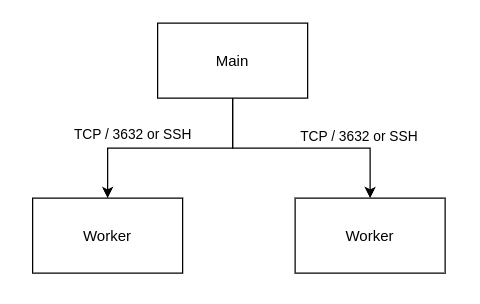
Parallelizing the compilation of a large codebase is a breeze with distcc, which allows you to spread the load across multiple nodes and speed up the compilation time.Here s a sample network topology for a distributed build:
Install distcc on the three Debian/Ubuntu-based nodes:
# apt install distcc
Edit /etc/default/distcc and set:
STARTDISTCC="true"

# Customize for your environment
ALLOWEDNETS="192.168.2.0/24"

# Specify your network device
LISTENER="192.168.2.146"
Additionally, the JOBS and NICE variables can be tweaked to suit the compute power that you have available.Start distcc:
# systemctl start distcc
Do the same all the nodes, and if you have a firewall enabled with ufw, you will need to open up the port 3632 to the master node.
# ufw allow 3632/tcp
Additionally, if you d like to use ssh over untrusted networks so code and communication with the worker nodes happen over a secure channel, ensure that SSH is running and is opened up to the master node in the same manner as above with the key of the master node in ~/.ssh/authorized_keys of the worker nodes. Opening port 3632 in this manner is a security hole, so take precautions over untrusted networks.Back in the master node, setup a DISTCC_HOSTS environment variable that lists the worker nodes, including the master node. Note the order of the hosts, as it is important. The first host will be more heavily used, and distcc has no way of knowing the capacity and capability of the hosts, so specify the most powerful host first.
export DISTCC_HOSTS='localhost 192.168.2.107 192.168.2.91'
At this point, you re ready to compile.Go to your codebase, in this case we use the Linux kernel source code for the purpose of example.
$ make tinyconfig
$ time make -j$(nproc) CC=distcc bzImage
On another terminal, you can monitor the status of the distributed compilation with distmoncc-text or tools such as top or bpytop.Network throughput and latency will be a big factor in how much distcc will help speed up your build process. Using ssh may additionally introduce overhead, so play with the variables to see how much distcc can help speed up or optimize the build for your specific scenario. You may want to additionally consider ccache to speed up the build process.There are some aspects of the build process that are not effectively parallizable in this manner, such as the final linking step of the executable, for which you will not see any performance improvement with distcc.Give distcc a spin, and put any spare compute you have lying around in your home lab to good use.

Antoine Beaupr : 20 years blogging

Many folks have woken up to the dangers of commercialization and centralisation of this very fine internet we have around here. For many of us, of course, it's one big "I told you so"... (To fair, I stopped "telling you so" because evangelism is pretty annoying. It's certainly dishonest coming from an atheist, so I preach by example now. I often wonder what works better. But I digress.) Colleagues have been posting about getting back into blogging. This post from gwolf, in particular, reviews his yearly blog output, and that made me wonder how that looked like from my end. The answer, of course, is simple to generate:
anarcat@angela:~$ cd anarc.at
/home/anarcat/wikis/anarc.at
anarcat@angela:anarc.at$ ls blog   grep '^[0-9][0-9][0-9][0-9]'   sed s/-.*//   sort   uniq -c    sort -n -k2
     62 2005
     49 2006
     26 2007
     25 2008
      8 2009
     16 2010
     24 2011
     19 2012
     17 2013
      7 2014
     19 2015
     32 2016
     43 2017
     40 2018
     27 2019
     33 2020
     22 2021
     45 2022
      1 2023
(I thought of drawing this as a sparkline but it looks like Sparklines are kind of dead. https://sparkline.org/ doesn't resolve and the canonical PHP package is gone from Debian. The plugin is broken in ikiwiki anyway...) So it seems like I've been doing this very blog for 18 years, and it's not even my first blog. I actually started in 2003, which makes this year my 20-year blogging anniversary. (And even if that sounds really old, note that I was not actually an early adopter. Jorn Barger having coined the term "weblog" in 1997. Yes, in another millenia.) Reading back some of the headlines in those older posts, I have definitely changed style. I used to write shorter, more random ideas, and more often. I somehow managed to write more than one article per week in 2005! Now, I take more time writing, a habit I picked up while writing for LWN (those articles), which started in 2016. But interestingly, it seems I started producing more articles then: I hit 43 articles per year in 2017, my fourth best year ever. The best years in terms of numbers are the first two years (2005 and 2006, I didn't check the numbers on earlier years), but I doubt they are the best in terms of content. Really, the best writing I have ever did was for LWN. I dare hope I have kept the quality I was encouraged (forced?) to produce, but I know I cannot come anywhere close to what the LWN editors were juicing out of me. You can also see that I immediately dropped to a more normal 27 article in 2019, once I stopped writing for LWN... Back when I started blogging, my writing was definitely more personal. I had less concerns about privacy back then; now, I would never write about my personal life like I did back then (e.g. "I have a cold"). I was also writing mostly in French back then, and it's sad to think that I am rarely writing in my native language here anymore. I guess that brings me an international audience, which is simultaneously challenging, gratifying, and terrifying. But it also means I reach out to people that do not speak English (or French, for that matter) as their first language. For me that is more valuable than catering to my little corner of culture, at least for now, and especially when writing technical topics, which is most of what I do now anyways. Interestingly, I wrote a lot in 2022. People sometimes ask me how I manage to write so much: I don't actually know. I don't have a lot of free time on my hand, and even less than before in the past two years, but somehow I keep feeding this blog. I guess I must have something to say. Can't quite figure out what yet, so maybe I should just keep trying. Or, if you're new to this Internet thing, Bring Back Blogging! Whee! PS: I wish I had time to do a review of my visitors like i did for 2021 but time is missing.

Russ Allbery: Review: Postwar

Review: Postwar, by Tony Judt
Publisher: Penguin Books
Copyright: 2005
ISBN: 1-4406-2476-3
Format: Kindle
Pages: 835
Tony Judt (1948 2010) was a British-American historian and Erich Maria Remarque Professor in European Studies at New York University. Postwar is his magnum opus, a history of Europe from 1945 to 2005. A book described as a history of Europe could be anything from a textbook to a political analysis, so the first useful question to ask is what sort of history. That's a somewhat difficult question to answer. Postwar mentions a great deal of conventional history, including important political movements and changes of government, but despite a stated topic that would suit a survey textbook, it doesn't provide that sort of list of facts and dates. Judt expects the reader to already be familiar with the broad outlines of modern European history. However, Postwar is also not a specialty history and avoids diving too deep into any one area. Trends in art, philosophy, and economics are all mentioned to set a broader context, but still only at the level of a general survey. My best description is that Postwar is a comprehensive social and political history that attempts to focus less on specific events and more on larger trends of thought. Judt grounds his narrative in concrete, factual events, but the emphasis is on how those living in Europe, at each point in history, thought of their society, their politics, and their place in both. Most of the space goes to exploring those nuances of thought and day-to-day life. In the US university context, I'd place this book as an intermediate-level course in modern European history, after the survey course that provides students with a basic framework but before graduate-level specializations in specific topics. If you have not had a solid basic education in European history (and my guess is that most people from the US have not), Judt will provide the necessary signposts, but you should expect to need to look up the signposts you don't recognize. I, as the dubious beneficiary of a US high school history education now many decades in the past, frequently resorted to Wikipedia for additional background. Postwar uses a simple chronological structure in four parts: the immediate post-war years and the beginning of the Cold War (1945 1953), the era of rapidly growing western European prosperity (1953 1971), the years of recession and increased turmoil leading up to the collapse of communism (1971 1989), and the aftermath of the collapse of communism and the rise of the European Union (1989 2005). Each part is divided into four to eight long chapters that trace a particular theme. Judt usually starts with the overview of a theme and then follows the local manifestations of it on a spiral through European countries in whatever order seems appropriate. For the bulk of the book that covers the era of the Cold War, when experiences were drastically different inside or outside the Soviet bloc, he usually separates western and eastern Europe into alternating chapters. Reviewing this sort of book is tricky because so much will depend on how well you already know the topic. My interest in history is strictly amateur and I tend to avoid modern history (usually I find it too depressing), so for me this book was remedial, filling in large knowledge gaps that I ideally shouldn't have had. Postwar was a runner up for the Pulitzer Prize for General Non-Fiction, so I think I'm safe saying you won't go far wrong reading it, but here's the necessary disclaimer that the rest of my reactions may not be useful if you're better versed in modern European history than I was. (This would not be difficult.) That said, I found Postwar invaluable because of its big-picture focus. The events and dates are easy enough to find on the Internet; what was missing for me in understanding Europe was the intent and social structures created by and causing those events. For example, from early in the book:
On one thing, however, all were agreed resisters and politicians alike: "planning". The disasters of the inter-war decades the missed opportunities after 1918, the great depression that followed the stock-market crash of 1929, the waste of unemployment, the inequalities, injustices and inefficiencies of laissez-faire capitalism that had led so many into authoritarian temptation, the brazen indifference of an arrogant ruling elite and the incompetence of an inadequate political class all seemed to be connected by the utter failure to organize society better. If democracy was to work, if it was to recover its appeal, it would have to be planned.
It's one thing to be familiar with the basic economic and political arguments between degrees of free market and planned economies. It's quite another to understand how the appeal of one approach or the discredit of another stems from recent historical experience, and that's what a good history can provide. Judt does not hesitate to draw these sorts of conclusions, and I'm sure some of them are controversial. But while he's opinionated, he's rarely ideological, and he offers no grand explanations. His discussion of the Yugoslav Wars stands out as an example: he mentions various theories of blame (a fraught local ethnic history, the decision by others to not intervene until the situation was truly dire), but largely discards them. Judt's offered explanation is that local politicians saw an opportunity to gain power by inflaming ethnic animosity, and a large portion of the population participated in this process, either passively or eagerly. Other explanations are both unnecessarily complex and too willing to deprive Yugoslavs of agency. I found this refreshingly blunt. When is more complex analysis a way to diffuse responsibility and cling to an ideological fantasy that the right foreign policy would have resolved a problem? A few personal grumblings do creep in, particularly in the chapters on the 1970s (and I think it's not a coincidence that this matches Judt's own young adulthood, a time when one is prone to forming a lot of opinions). There is a brief but stinging criticism of postmodernism in scholarship, which I thought was justified but probably incomplete, and a decidedly grumpy dismissal of punk music, which I thought was less fair. But these are brief asides that don't detract from the overall work. Indeed, they, along with the occasional wry asides ("respecting long-established European practice, no one asked the Poles for their views [on Poland's new frontiers]") add a lot of character. Insofar as this book has a thesis, it's in the implications of the title: Europe only exited the postwar period at the end of the 20th century. Political stability through exhaustion, the overwhelming urgency of economic recovery, and the degree to which the Iron Curtain and the Cold War froze eastern Europe in amber meant that full European recovery from World War II was drawn out and at times suspended. It's only after 1989 and its subsequent upheavals that European politics were able to move beyond postwar concerns. Some of that movement was a reemergence of earlier European politics of nations and ethnic conflict. But, new on the scene, was a sense of identity as Europeans, one that western Europe circled warily and eastern Europe saw as the only realistic path forward.
What binds Europeans together, even when they are deeply critical of some aspect or other of its practical workings, is what it has become conventional to call in disjunctive but revealing contrast with "the American way of life" the "European model of society".
Judt also gave me a new appreciation of how traumatic people find the assignment of fault, and how difficult it is to wrestle with guilt without providing open invitations to political backlash. People will go to great lengths to not feel guilty, and pressing the point runs a substantial risk of creating popular support for ideological movements that are willing to lie to their followers. The book's most memorable treatment of this observation is in the epilogue, which traces popular European attitudes towards the history of the Holocaust through the whole time period. The largest problem with this book is that it is dense and very long. I'm a fairly fast reader, but this was the only book I read through most of my holiday vacation and it still took a full week into the new year to finish it. By the end, I admit I was somewhat exhausted and ready to be finished with European history for a while (although the epilogue is very much worth waiting for). If you, unlike me, can read a book slowly among other things, that may be a good tactic. But despite feeling like this was a slog at times, I'm very glad that I read it. I'm not sure if someone with a firmer grounding in European history would have gotten as much out of it, but I, at least, needed something this comprehensive to wrap my mind around the timeline and fill in some embarrassing gaps. Judt is not the most entertaining writer (although he has his moments), and this is not the sort of popular history that goes out of its way to draw you in, but I found it approachable and clear. If you're looking for a solid survey of modern European history with this type of high-level focus, recommended. Rating: 8 out of 10

7 January 2023

Dirk Eddelbuettel: RcppSpdlog 0.0.12 on CRAN: Added Stopwatch

Version 0.0.12 of RcppSpdlog is now on CRAN and in Debian. RcppSpdlog bundles spdlog, a wonderful header-only C++ logging library with all the bells and whistles you would want that was written by Gabi Melman, and also includes fmt by Victor Zverovich. This release adds support for the stopwatch object, a simple container around a std::chrono object. It makes (simple) time measurements of routines and code segments trivially easy. Instantiate a stopwatch object, and formatting it in a logging string displays elapsed time. And given that the whole mojo of RcppSpdlog (and its sibbling package spdl) is to make use easy in both R and C++ we can do this nicely and consistently in both languages. The vignette has an added section with a concrete example. The NEWS entry for this release follows.

Changes in RcppSpdlog version 0.0.12 (2023-01-07)
  • Addeed support for 'stopwatch' object allowing for simple timing (from both C++ and R) via the logging framework.
  • The spdlog logging pattern is documented via a reference.

Courtesy of my CRANberries, there is also a diffstat report. More detailed information is on the RcppSpdlog page, or the package documention site. If you like this or other open-source work I do, you can sponsor me at GitHub.

This post by Dirk Eddelbuettel originated on his Thinking inside the box blog. Please report excessive re-aggregation in third-party for-profit settings.

Reproducible Builds: Reproducible Builds in December 2022

Welcome to the December 2022 report from the Reproducible Builds project.
We are extremely pleased to announce that the dates for the Reproducible Builds Summit in 2023 have been announced in 2022 already: We plan to spend three days continuing to the grow of the Reproducible Builds effort. As in previous events, the exact content of the meeting will be shaped by the participants. And, as mentioned in Holger Levsen s post to our mailing list, the dates have been booked and confirmed with the venue, so if you are considering attending, please reserve these dates in your calendar today.
R my Gr nblatt, an associate professor in the T l com Sud-Paris engineering school wrote up his pain points of using Nix and NixOS. Although some of the points do not touch on reproducible builds, R my touches on problems he has encountered with the different kinds of reproducibility that these distributions appear to promise including configuration files affecting the behaviour of systems, the fragility of upstream sources as well as the conventional idea of binary reproducibility.
Morten Linderud reported that he is quietly optimistic that if Go programming language resolves all of its issues with reproducible builds (tracking issue) then the Go binaries distributed from Google and by Arch Linux may be bit-for-bit identical. It s just a bit early to sorta figure out what roadblocks there are. [But] Go bootstraps itself every build, so in theory I think it should be possible.
On December 15th, Holger Levsen published an in-depth interview he performed with David A. Wheeler on supply-chain security and reproducible builds, but it also touches on the biggest challenges in computing as well. This is part of a larger series of posts featuring the projects, companies and individuals who support the Reproducible Builds project. Other instalments include an article featuring the Civil Infrastructure Platform project and followed this up with a post about the Ford Foundation as well as a recent ones about ARDC, the Google Open Source Security Team (GOSST), Jan Nieuwenhuizen on Bootstrappable Builds, GNU Mes and GNU Guix and Hans-Christoph Steiner of the F-Droid project.
A number of changes were made to the Reproducible Builds website and documentation this month, including FC Stegerman adding an F-Droid/apksigcopier example to our embedded signatures page [ ], Holger Levsen making a large number of changes related to the 2022 summit in Venice as well as 2023 s summit in Hamburg [ ][ ][ ][ ] and Simon Butler updated our publications page [ ][ ].
On our mailing list this month, James Addison asked a question about whether there has been any effort to trace the files used by a build system in order to identify the corresponding build-dependency packages. [ ] In addition, Bernhard M. Wiedemann then posed a thought-provoking question asking How to talk to skeptics? , which was occasioned by a colleague who had published a blog post in May 2021 skeptical of reproducible builds. The thread generated a number of replies.

Android news obfusk (FC Stegerman) performed a thought-provoking review of tools designed to determine the difference between two different .apk files shipped by a number of free-software instant messenger applications. These scripts are often necessary in the Android/APK ecosystem due to these files containing embedded signatures so the conventional bit-for-bit comparison cannot be used. After detailing a litany of issues with these tools, they come to the conclusion that:
It s quite possible these messengers actually have reproducible builds, but the verification scripts they use don t actually allow us to verify whether they do.
This reflects the consensus view within the Reproducible Builds project: pursuing a situation in language or package ecosystems where binaries are bit-for-bit identical (over requiring a bespoke ecosystem-specific tool) is not a luxury demanded by purist engineers, but rather the only practical way to demonstrate reproducibility. obfusk also announced the first release of their own set of tools on our mailing list. Related to this, obfusk also posted to an issue filed against Mastodon regarding the difficulties of creating bit-by-bit identical APKs, especially with respect to copying v2/v3 APK signatures created by different tools; they also reported that some APK ordering differences were not caused by building on macOS after all, but by using Android Studio [ ] and that F-Droid added 16 more apps published with Reproducible Builds in December.

Debian As mentioned in last months report, Vagrant Cascadian has been organising a series of online sprints in order to clear the huge backlog of reproducible builds patches submitted by performing NMUs (Non-Maintainer Uploads). During December, meetings were held on the 1st, 8th, 15th, 22nd and 29th, resulting in a large number of uploads and bugs being addressed: The next sprint is due to take place this coming Tuesday, January 10th at 16:00 UTC.

Upstream patches The Reproducible Builds project attempts to fix as many currently-unreproducible packages as possible. This month, we wrote a large number of such patches, including:

Testing framework The Reproducible Builds project operates a comprehensive testing framework at tests.reproducible-builds.org in order to check packages and other artifacts for reproducibility. In October, the following changes were made by Holger Levsen:
  • The osuosl167 machine is no longer a openqa-worker node anymore. [ ][ ]
  • Detect problems with APT repository signatures [ ] and update a repository signing key [ ].
  • reproducible Debian builtin-pho: improve job output. [ ]
  • Only install the foot-terminfo package on Debian systems. [ ]
In addition, Mattia Rizzolo added support for the version of diffoscope in Debian stretch which doesn t support the --timeout flag. [ ][ ]

diffoscope diffoscope is our in-depth and content-aware diff utility. Not only can it locate and diagnose reproducibility issues, it can provide human-readable diffs from many kinds of binary formats. This month, Chris Lamb made the following changes to diffoscope, including preparing and uploading versions 228, 229 and 230 to Debian:
  • Fix compatibility with file(1) version 5.43, with thanks to Christoph Biedl. [ ]
  • Skip the test_html.py::test_diff test if html2text is not installed. (#1026034)
  • Update copyright years. [ ]
In addition, Jelle van der Waa added support for Berkeley DB version 6. [ ] Orthogonal to this, Holger Levsen bumped the Debian Standards-Version on all of our packages, including diffoscope [ ], strip-nondeterminism [ ], disorderfs [ ] and reprotest [ ].
If you are interested in contributing to the Reproducible Builds project, please visit our Contribute page on our website. You can get in touch with us via:

6 January 2023

Jonathan McDowell: Finally making use of bpftrace

I am old enough to remember when BPF meant the traditional Berkeley Packet Filter, and was confined to filtering network packets. It s grown into much, much, more as eBPF and getting familiar with it so that I can add it to the suite of tips and tricks I can call upon has been on my to-do list for a while. To this end I was lucky enough to attend a live walk through of bpftrace last year. bpftrace is a high level tool that allows the easy creation and execution of eBPF tracers under Linux. Recently I ve been working on updating the RetroArch packages in Debian and as I was doing so I realised there was a need to update the quite outdated retroarch-assets package, which contains various icons and images used for the user interface. I wanted to try and re-generate as many of the artefacts as I could, to ensure the proper source was available. However it wasn t always clear which files were actually needed and which were either source or legacy. So I wanted to trace file opens by retroarch and see when it was failing to find files. Traditionally this is something I d have used strace for, but it seemed like a great opportunity to try out bpftrace. It turns out bpftrace ships with an example, opensnoop.bt which provided details of hooking the open syscall entry + exit and providing details of all files opened on the system. I only wanted to track opens by the retroarch binary that failed, so I made a couple of modifications:
retro-failed-open-snoop.bt
#!/usr/bin/env bpftrace
/*
 * retro-failed-open-snoop - snoop failed opens by RetroArch
 *
 * Based on:
 * opensnoop	Trace open() syscalls.
 *		For Linux, uses bpftrace and eBPF.
 *
 * Copyright 2018 Netflix, Inc.
 * Licensed under the Apache License, Version 2.0 (the "License")
 *
 * 08-Sep-2018	Brendan Gregg	Created this.
 */
BEGIN
 
	printf("Tracing open syscalls... Hit Ctrl-C to end.\n");
	printf("%-6s %-16s %3s %s\n", "PID", "COMM", "ERR", "PATH");
 
tracepoint:syscalls:sys_enter_open,
tracepoint:syscalls:sys_enter_openat
 
	@filename[tid] = args->filename;
 
tracepoint:syscalls:sys_exit_open,
tracepoint:syscalls:sys_exit_openat
/@filename[tid]/
 
	$ret = args->ret;
	$errno = $ret > 0 ? 0 : - $ret;
	if (($ret <= 0) && (strncmp("retroarch", comm, 9) == 0) )  
		printf("%-6d %-16s %3d %s\n", pid, comm, $errno,
		    str(@filename[tid]));
	 
	delete(@filename[tid]);
 
END
 
	clear(@filename);
 
I had to install bpftrace (apt install bpftrace) and then I ran bpftrace -o retro.log retro-failed-open-snoop.bt as root and fired up retroarch as a normal user.
bpftrace failed open log for retroarch
Attaching 6 probes...
Tracing open syscalls... Hit Ctrl-C to end.
PID    COMM             ERR PATH
3394   retroarch          2 /usr/lib/x86_64-linux-gnu/pulseaudio/glibc-hwcaps/x86-64-v2/lib
3394   retroarch          2 /usr/lib/x86_64-linux-gnu/pulseaudio/tls/x86_64/x86_64/libpulse
3394   retroarch          2 /usr/lib/x86_64-linux-gnu/pulseaudio/tls/x86_64/libpulsecommon-
3394   retroarch          2 /usr/lib/x86_64-linux-gnu/pulseaudio/tls/libpulsecommon-16.1.so
3394   retroarch          2 /usr/lib/x86_64-linux-gnu/pulseaudio/x86_64/x86_64/libpulsecomm
3394   retroarch          2 /usr/lib/x86_64-linux-gnu/pulseaudio/x86_64/libpulsecommon-16.1
3394   retroarch          2 /etc/gcrypt/hwf.deny
3394   retroarch          2 /lib/x86_64-linux-gnu/glibc-hwcaps/x86-64-v2/libgamemode.so.0
3394   retroarch          2 /lib/x86_64-linux-gnu/tls/x86_64/x86_64/libgamemode.so.0
3394   retroarch          2 /lib/x86_64-linux-gnu/tls/x86_64/libgamemode.so.0
3394   retroarch          2 /lib/x86_64-linux-gnu/tls/libgamemode.so.0
3394   retroarch          2 /lib/x86_64-linux-gnu/x86_64/x86_64/libgamemode.so.0
3394   retroarch          2 /lib/x86_64-linux-gnu/x86_64/libgamemode.so.0
3394   retroarch          2 /lib/x86_64-linux-gnu/libgamemode.so.0
3394   retroarch          2 /usr/lib/x86_64-linux-gnu/glibc-hwcaps/x86-64-v2/libgamemode.so
3394   retroarch          2 /usr/lib/x86_64-linux-gnu/tls/x86_64/x86_64/libgamemode.so.0
3394   retroarch          2 /usr/lib/x86_64-linux-gnu/tls/x86_64/libgamemode.so.0
3394   retroarch          2 /usr/lib/x86_64-linux-gnu/tls/libgamemode.so.0
3394   retroarch          2 /usr/lib/x86_64-linux-gnu/x86_64/x86_64/libgamemode.so.0
3394   retroarch          2 /usr/lib/x86_64-linux-gnu/x86_64/libgamemode.so.0
3394   retroarch          2 /usr/lib/x86_64-linux-gnu/libgamemode.so.0
3394   retroarch          2 /lib/glibc-hwcaps/x86-64-v2/libgamemode.so.0
3394   retroarch          2 /lib/tls/x86_64/x86_64/libgamemode.so.0
3394   retroarch          2 /lib/tls/x86_64/libgamemode.so.0
3394   retroarch          2 /lib/tls/libgamemode.so.0
3394   retroarch          2 /lib/x86_64/x86_64/libgamemode.so.0
3394   retroarch          2 /lib/x86_64/libgamemode.so.0
3394   retroarch          2 /lib/libgamemode.so.0
3394   retroarch          2 /usr/lib/glibc-hwcaps/x86-64-v2/libgamemode.so.0
3394   retroarch          2 /usr/lib/tls/x86_64/x86_64/libgamemode.so.0
3394   retroarch          2 /usr/lib/tls/x86_64/libgamemode.so.0
3394   retroarch          2 /usr/lib/tls/libgamemode.so.0
3394   retroarch          2 /usr/lib/x86_64/x86_64/libgamemode.so.0
3394   retroarch          2 /usr/lib/x86_64/libgamemode.so.0
3394   retroarch          2 /usr/lib/libgamemode.so.0
3394   retroarch          2 /lib/x86_64-linux-gnu/libgamemode.so
3394   retroarch          2 /usr/lib/x86_64-linux-gnu/libgamemode.so
3394   retroarch          2 /lib/libgamemode.so
3394   retroarch          2 /usr/lib/libgamemode.so
3394   retroarch          2 /lib/x86_64-linux-gnu/libdecor-0.so
3394   retroarch          2 /usr/lib/x86_64-linux-gnu/libdecor-0.so
3394   retroarch          2 /lib/libdecor-0.so
3394   retroarch          2 /usr/lib/libdecor-0.so
3394   retroarch          2 /etc/drirc
3394   retroarch          2 /home/noodles/.drirc
3394   retroarch          2 /etc/drirc
3394   retroarch          2 /home/noodles/.drirc
3394   retroarch          2 /usr/lib/x86_64-linux-gnu/dri/tls/iris_dri.so
3394   retroarch          2 /lib/x86_64-linux-gnu/../lib/glibc-hwcaps/x86-64-v2/libedit.so.
3394   retroarch          2 /lib/x86_64-linux-gnu/../lib/tls/x86_64/x86_64/libedit.so.2
3394   retroarch          2 /lib/x86_64-linux-gnu/../lib/tls/x86_64/libedit.so.2
3394   retroarch          2 /lib/x86_64-linux-gnu/../lib/tls/libedit.so.2
3394   retroarch          2 /lib/x86_64-linux-gnu/../lib/x86_64/x86_64/libedit.so.2
3394   retroarch          2 /lib/x86_64-linux-gnu/../lib/x86_64/libedit.so.2
3394   retroarch          2 /lib/x86_64-linux-gnu/../lib/libedit.so.2
3394   retroarch          2 /etc/drirc
3394   retroarch          2 /home/noodles/.drirc
3394   retroarch          2 /etc/drirc
3394   retroarch          2 /home/noodles/.drirc
3394   retroarch          2 /etc/drirc
3394   retroarch          2 /home/noodles/.drirc
3394   retroarch          2 /home/noodles/.Xdefaults-udon
3394   retroarch          2 /home/noodles/.icons/default/cursors/00000000000000000000000000
3394   retroarch          2 /home/noodles/.icons/default/index.theme
3394   retroarch          2 /usr/share/icons/default/cursors/000000000000000000000000000000
3394   retroarch          2 /usr/share/pixmaps/default/cursors/0000000000000000000000000000
3394   retroarch          2 /home/noodles/.icons/Adwaita/cursors/00000000000000000000000000
3394   retroarch          2 /home/noodles/.icons/Adwaita/index.theme
3394   retroarch          2 /usr/share/icons/Adwaita/cursors/000000000000000000000000000000
3394   retroarch          2 /usr/share/pixmaps/Adwaita/cursors/0000000000000000000000000000
3394   retroarch          2 /home/noodles/.icons/hicolor/cursors/00000000000000000000000000
3394   retroarch          2 /home/noodles/.icons/hicolor/index.theme
3394   retroarch          2 /usr/share/icons/hicolor/cursors/000000000000000000000000000000
3394   retroarch          2 /usr/share/pixmaps/hicolor/cursors/0000000000000000000000000000
3394   retroarch          2 /usr/share/pixmaps/hicolor/index.theme
3394   retroarch          2 /home/noodles/.XCompose
3394   retroarch          2 /home/noodles/.icons/default/cursors/00000000000000000000000000
3394   retroarch          2 /home/noodles/.icons/default/index.theme
3394   retroarch          2 /usr/share/icons/default/cursors/000000000000000000000000000000
3394   retroarch          2 /usr/share/pixmaps/default/cursors/0000000000000000000000000000
3394   retroarch          2 /home/noodles/.icons/Adwaita/cursors/00000000000000000000000000
3394   retroarch          2 /home/noodles/.icons/Adwaita/index.theme
3394   retroarch          2 /usr/share/icons/Adwaita/cursors/000000000000000000000000000000
3394   retroarch          2 /usr/share/pixmaps/Adwaita/cursors/0000000000000000000000000000
3394   retroarch          2 /home/noodles/.icons/hicolor/cursors/00000000000000000000000000
3394   retroarch          2 /home/noodles/.icons/hicolor/index.theme
3394   retroarch          2 /usr/share/icons/hicolor/cursors/000000000000000000000000000000
3394   retroarch          2 /usr/share/pixmaps/hicolor/cursors/0000000000000000000000000000
3394   retroarch          2 /usr/share/pixmaps/hicolor/index.theme
3394   retroarch          2 /usr/share/libretro/assets/xmb/monochrome/png/disc.png
3394   retroarch          2 /usr/share/libretro/assets/xmb/monochrome/sounds
3394   retroarch          2 /usr/share/libretro/assets/sounds
3394   retroarch          2 /sys/class/power_supply/ACAD
3394   retroarch          2 /usr/share/libretro/assets/xmb/monochrome/png/disc.png
3394   retroarch          2 /usr/share/libretro/assets/ozone/sounds
3394   retroarch          2 /usr/share/libretro/assets/sounds
This was incredibly useful - the only theme image I was missing is disc.png from XMB Monochrome (which fails to have SVG source). I also discovered the runtime optional loading of GameMode. This is available in Debian so it was a simple matter to add libgamemode0 to the binary package Recommends. So, a very basic example of using bpftrace, but a remarkably useful intro to it from my point of view!

5 January 2023

Matthew Garrett: Changing firmware config that doesn't want to be changed

Update: There's actually a more detailed writeup of this here that I somehow missed. Original entry follows:

Today I had to deal with a system that had an irritating restriction - a firmware configuration option I really wanted to be able to change appeared as a greyed out entry in the configuration menu. Some emails revealed that this was a deliberate choice on the part of the system vendor, so that seemed to be that. Thankfully in this case there was a way around that.

One of the things UEFI introduced was a mechanism to generically describe firmware configuration options, called Visual Forms Representation (or VFR). At the most straightforward level, this lets you define a set of forms containing questions, with each question associated with a value in a variable. Questions can be made dependent upon the answers to other questions, so you can have options that appear or disappear based on how other questions were answered. An example in this language might be something like:
CheckBox Prompt: "Console Redirection", Help: "Console Redirection Enable or Disable.", QuestionFlags: 0x10, QuestionId: 53, VarStoreId: 1, VarStoreOffset: 0x39, Flags: 0x0
In which question 53 asks whether console redirection should be enabled or disabled. Other questions can then rely on the answer to question 53 to influence whether or not they're relevant (eg, if console redirection is disabled, there's no point in asking which port it should be redirected to). As a checkbox, if it's set then the value will be set to 1, and 0 otherwise. But where's that stored? Earlier we have another declaration:
VarStore GUID: EC87D643-EBA4-4BB5-A1E5-3F3E36B20DA9, VarStoreId: 1, Size: 0xF4, Name: "Setup"
A UEFI variable called "Setup" and with GUID EC87D643-EBA4-4BB5-A1E5-3F3E36B20DA9 is declared as VarStoreId 1 (matching the declaration in the question) and is 0xf4 bytes long. The question indicates that the offset for that variable is 0x39. Rewriting Setup-EC87D643-EBA4-4BB5-A1E5-3F3E36B20DA9 with a modified value in offset 0x39 will allow direct manipulation of the config option.

But how do we get this data in the first place? VFR isn't built into the firmware directly - instead it's turned into something called Intermediate Forms Representation, or IFR. UEFI firmware images are typically in a standardised format, and you can use UEFITool to extract individual components from that firmware. If you use UEFITool to search for "Setup" there's a good chance you'll be able to find the component that implements the setup UI. Running IFRExtractor-RS against it will then pull out any IFR data it finds, and decompile that into something resembling the original VFR. And now you have the list of variables and offsets and the configuration associated with them, even if your firmware has chosen to hide those options from you.

Given that a bunch of these config values may be security relevant, this seems a little concerning - what stops an attacker who has access to the OS from simply modifying these variables directly? UEFI avoids this by having two separate stages of boot, one where the full firmware ("Boot Services") is available, and one where only a subset ("Runtime Services") is available. The transition is triggered by the OS calling ExitBootServices, indicating the handoff from the firmware owning the hardware to the OS owning the hardware. This is also considered a security boundary - before ExitBootServices everything running has been subject to any secure boot restrictions, and afterwards applications can do whatever they want. UEFI variables can be flagged as being visible in both Boot and Runtime Services, or can be flagged as Boot Services only. As long as all the security critical variables are Boot Services only, an attacker should never be able to run untrusted code that could alter them.

In my case, the firmware option I wanted to alter had been enclosed in "GrayOutIf True" blocks. But the questions were still defined and the code that acted on those options was still present, so simply modifying the variables while still inside Boot Services gave me what I wanted. Note that this isn't a given! The presence of configuration options in the IFR data doesn't mean that anything will later actually read and make use of that variable - a vendor may have flagged options as unavailable and then removed the code, but never actually removed the config data. And also please do note that the reason stuff was removed may have been that it doesn't actually work, and altering any of these variables risks bricking your hardware in a way that's extremely difficult to recover. And there's also no requirement that vendors use IFR to describe their configuration, so you may not get any help here anyway.

In summary: if you do this you may break your computer. If you don't break your computer, it might not work anyway. I'm not going to help you try to break your computer. And I didn't come up with any of this, I just didn't find it all written down in one place while I was researching it.

comment count unavailable comments

4 January 2023

Enrico Zini: Staticsite redesign

These are some notes about my redesign work in staticsite 2.x. Maping constraints and invariants I started keeping notes of constraints and invariants, and this helped a lot in keeping bounds on the cognitive efforts of design. I particularly liked how mapping the set of constraints added during site generation has helped breaking down processing into a series of well defined steps. Code that handles each step now has a specific task, and can rely on clear assumptions. Declarative page metadata I designed page metadata as declarative fields added to the Page class. I used typed descriptors for the fields, so that metadata fields can now have logic and validation, and are self-documenting! This is the core of the Field implementation. Lean core I tried to implement as much as possible in feature plugins, leaving to the staticsite core only what is essential to create the structure for plugins to build on. The core provides a tree structure, an abstract Page object that can render to a file and resolve references to other pages, a Site that holds settings and controls the various loading steps, and little else. The only type of content supported by the core is static asset files: Markdown, RestructuredText, images, taxonomies, feeds, directory indices, and so on, are all provided via feature plugins. Feature plugins Feature plugins work by providing functions to be called at the various loading steps, and mixins to be added to site pages. Mixins provided by feature plugins can add new declarative metadata fields, and extend Page methods: this ends up being very clean and powerful, and plays decently well with mypy's static type checking, too! See for example the code of the alias feature, that allows a page to declare aliases that redirect to it, useful for example when moving content around. It has a mixin (AliasPageMixin) that adds an aliases field that holds a list of page paths. During the "generate" step, when autogenerated pages can be created, the aliases feature iterates through all pages that defined an aliases metadata, and generates the corresponding redirection pages. Self-documenting code Staticsite can list loaded features, features can list the page subclasses that they use, and pages can list metadata fields. As a result, each feature, each type of page, and each field of each page can generate documentation about itself: the staticsite reference is autogenerated in that way, mostly from Feature, Page, and Field docstrings. Understand the language, stay close to the language Python has matured massively in the last years, and I like to stay on top of the language and standard library release notes for each release. I like how what used to be dirty hacks have now found a clean way into the language:

31 December 2022

Chris Lamb: Favourite films of 2022

In my four most recent posts, I went over the memoirs and biographies, the non-fiction, the fiction and the 'classic' fiction I enjoyed reading in 2022. But in the very last of my roundup posts and in relatively less detail I'll be quickly sketching out the favourite movies that were new to me in 2022:

La Ronde (1950) An all-knowing narrator (Adolf Wohlbr ck) guides us through a series of vignettes in 1900s Vienna a soldier meets an eager young lady of the evening, and later he has an affair with a young lady who becomes a maid and who then does similarly with the young man of the house. On and on it goes, spinning on the carousel of life. A wonderfully beguiling movie, and a reminder that 'innocent' and 'charming' doesn't always imply 'childish'.

A Man Escaped (1956) A Man Escaped is the story of a WW2 resistance fighter who wishes to escape from a prison. Filmed in Robert Bresson's quasi-minimalistic style (and touching on his usual themes of Christian redemption), this deceptively simple-looking film rewards deeper analysis.

The Music Room (1958) In The Music Room, Satyajit Ray (best known for his Apu Trilogy) tells the story of a wealthy landlord who lives a decadent life with his wife and son. His passion is for music, however, and he spends a significant portion of his fortune on concerts held for the locals in his magnificent music room (or 'jalsaghar). However, his obsession for music (and its attendant quest for respect from his peers) is his eventual undoing, as he sacrifices both his family and wealth whilst trying to retain it. Indeed, The Music Room is less of an examination of a single rich man (or of the hypnotic sitar music by Vilayat Khan) than of the dying Bengali landowning class, which I read as symbolic of what was about to vanish from Indian culture in the post-Independence drive toward modernity. Still, this is a multi-layered and textured film, as this is also an intensely moving portrait of a highly-detached man as well.

The Hustler (1961) 'Fast Eddie' Felson is a small-time pool hustler with a lot of talent but a self-destructive attitude. His bravado causes him to challenge the legendary Minnesota Fats to a high-stakes match. The stakes are always much bigger than just money though, as Fast Eddie's ego is on the line. Despite not caring so much about the game, I was completely gripped by Paul Newman's superb performance. Almost certainly the best film about pool ever made, and probably the best sports film as well.

Picnic at Hanging Rock (1975) One Valentine's Day in early-1900s Australia, an upper-class school takes its girls on a field trip to a scenic volcanic formation in the middle of the brush. Despite all the rules against it, however, several of the girls venture off onto the rock, and it's not until the end of the day that the group realises some of the girls and one of the teachers have disappeared without a trace. A mesmerising film about colonialism, sexual repression and Antonioni-esque alienation, Picnic at Hanging Rock's dreamlike aesthetic is haunting.

Jeanne Dielman, 23, quai du Commerce, 1080 Bruxelles (1976) Jeanne Dielman is a three-and-a-half-hour film that shows a widowed housewife doing her daily chores and taking care of her apartment. Yet in its uncompromising nature, it raises the tedium of her life to the level of profundity. I watched this radically political film a few months before it was recently voted as the 'greatest of all time'), but despite its relentless rigorous nature (and long running time), the conclusion when it comes is shattering.

Raise the Red Lantern (1991) Set in China during the 1920s, Raise the Red Lantern tells the story of a young woman who has become the new concubine of a wealthy man. However, as he has three wives already (each living in a separate house within his castle) she becomes are engaged in an extremely complicated competition attention and the privileges that come with it. Richly colourful, both in its visuals and symbolism, this is film both specifically about China at the time and human universals.

Moonlight (2016) A heartbreaking story of a young man's struggle to find himself, told across three defining chapters in his life as he experiences the pain and beauty of falling in love, whilst grappling with his own sexuality within the ambient weather of race and class in the United States. Absolutely spellbinding and visually stunning.

Drive My Car (2021) Yusuke Kafuku is a stage director who is unable to cope with the loss of his wife, and has therefore accepted an invitation to direct Anton Chekhov's [Uncle Vanya][https://en.wikipedia.org/wiki/Uncle_Vanya] at a festival in Hiroshima, Japan. Yet whilst many reviewers have focused on the compelling relationship between Yusuke and Misaki (the introverted young woman who has been appointed to drive his car), what I found devastating was the embedded meditation on language, communication, understanding and empathy, especially concerning what happens when these break down or are no longer possible. Drive My Car touches on the limits of each of these phenomena connecting to the next: being able to speak the same language as another doesn't mean you can communicate with them; and being able to communicate doesn't mean you can understand someone, let alone empathise with them. All of this through the near-ungraspable emotion of grief as well, and the portion of this film where the actress was silently employing Korean Sign Language was the most moving thing I saw this year.

30 December 2022

Chris Lamb: Favourite books of 2022: Non-fiction

In my three most recent posts, I went over the memoirs and biographies, classics and fiction books that I enjoyed the most in 2022. But in the last of my book-related posts for 2022, I'll be going over my favourite works of non-fiction. Books that just missed the cut here include Adam Hochschild's King Leopold's Ghost (1998) on the role of Leopold II of Belgium in the Congo Free State, Johann Hari's Stolen Focus (2022) (a personal memoir on relating to how technology is increasingly fragmenting our attention), Amia Srinivasan's The Right to Sex (2021) (a misleadingly named set of philosophic essays on feminism), Dana Heller et al.'s The Selling of 9/11: How a National Tragedy Became a Commodity (2005), John Berger's mindbending Ways of Seeing (1972) and Louise Richardson's What Terrorists Want (2006).

The Great War and Modern Memory (1975)
Wartime: Understanding and Behavior in the Second World War (1989) Paul Fussell Rather than describe the battles, weapons, geopolitics or big personalities of the two World Wars, Paul Fussell's The Great War and Modern Memory & Wartime are focused instead on how the two wars have been remembered by their everyday participants. Drawing on the memoirs and memories of soldiers and civilians along with a brief comparison with the actual events that shaped them, Fussell's two books are a compassionate, insightful and moving piece of analysis. Fussell primarily sets himself against the admixture of nostalgia and trauma that obscures the origins and unimaginable experience of participating in these wars; two wars that were, in his view, a "perceptual and rhetorical scandal from which total recovery is unlikely." He takes particular aim at the dishonesty of hindsight:
For the past fifty years, the Allied war has been sanitised and romanticised almost beyond recognition by the sentimental, the loony patriotic, the ignorant and the bloodthirsty. I have tried to balance the scales. [And] in unbombed America especially, the meaning of the war [seems] inaccessible.
The author does not engage in any of the customary rose-tinted view of war, yet he remains understanding and compassionate towards those who try to locate a reason within what was quite often senseless barbarism. If anything, his despondency and pessimism about the Second World War (the war that Fussell himself fought in) shines through quite acutely, and this is especially the case in what he chooses to quote from others:
"It was common [ ] throughout the [Okinawa] campaign for replacements to get hit before we even knew their names. They came up confused, frightened, and hopeful, got wounded or killed, and went right back to the rear on the route by which they had come, shocked, bleeding, or stiff. They were forlorn figures coming up to the meat grinder and going right back out of it like homeless waifs, unknown and faceless to us, like unread books on a shelf."
It would take a rather heartless reader to fail to be sobered by this final simile, and an even colder one to view Fussell's citation of such an emotive anecdote to be manipulative. Still, stories and cruel ironies like this one infuse this often-angry book, but it is not without astute and shrewd analysis as well, especially on the many qualitative differences between the two conflicts that simply cannot be captured by facts and figures alone. For example:
A measure of the psychological distance of the Second [World] War from the First is the rarity, in 1914 1918, of drinking and drunkenness poems.
Indeed so. In fact, what makes Fussell's project so compelling and perhaps even unique is that he uses these non-quantitive measures to try and take stock of what happened. After all, this was a war conducted by humans, not the abstract school of statistics. And what is the value of a list of armaments destroyed by such-and-such a regiment when compared with truly consequential insights into both how the war affected, say, the psychology of postwar literature ("Prolonged trench warfare, whether enacted or remembered, fosters paranoid melodrama, which I take to be a primary mode in modern writing."), the specific words adopted by combatants ("It is a truism of military propaganda that monosyllabic enemies are easier to despise than others") as well as the very grammar of interaction:
The Field Service Post Card [in WW1] has the honour of being the first widespread exemplary of that kind of document which uniquely characterises the modern world: the "Form". [And] as the first widely known example of dehumanised, automated communication, the post card popularised a mode of rhetoric indispensable to the conduct of later wars fought by great faceless conscripted armies.
And this wouldn't be a book review without argument-ending observations that:
Indicative of the German wartime conception [of victory] would be Hitler and Speer's elaborate plans for the ultimate reconstruction of Berlin, which made no provision for a library.
Our myths about the two world wars possess an undisputed power, in part because they contain an essential truth the atrocities committed by Germany and its allies were not merely extreme or revolting, but their full dimensions (embodied in the Holocaust and the Holodomor) remain essentially inaccessible within our current ideological framework. Yet the two wars are better understood as an abyss in which we were all dragged into the depths of moral depravity, rather than a battle pitched by the forces of light against the forces of darkness. Fussell is one of the few observers that can truly accept and understand this truth and is still able to speak to us cogently on the topic from the vantage point of experience. The Second World War which looms so large in our contemporary understanding of the modern world (see below) may have been necessary and unavoidable, but Fussell convinces his reader that it was morally complicated "beyond the power of any literary or philosophic analysis to suggest," and that the only way to maintain a na ve belief in the myth that these wars were a Manichaean fight between good and evil is to overlook reality. There are many texts on the two World Wars that can either stir the intellect or move the emotions, but Fussell's two books do both. A uniquely perceptive and intelligent commentary; outstanding.

Longitude (1995) Dava Sobel Since Man first decided to sail the oceans, knowing one's location has always been critical. Yet doing so reliably used to be a serious problem if you didn't know where you were, you are far more likely to die and/or lose your valuable cargo. But whilst finding one's latitude (ie. your north south position) had effectively been solved by the beginning of the 17th century, finding one's (east west) longitude was far from trustworthy in comparison. This book first published in 1995 is therefore something of an anachronism. As in, we readily use the GPS facilities of our phones today without hesitation, so we find it difficult to imagine a reality in which knowing something fundamental like your own location is essentially unthinkable. It became clear in the 18th century, though, that in order to accurately determine one's longitude, what you actually needed was an accurate clock. In Longitude, therefore, we read of the remarkable story of John Harrison and his quest to create a timepiece that would not only keep time during a long sea voyage but would survive the rough ocean conditions as well. Self-educated and a carpenter by trade, Harrison made a number of important breakthroughs in keeping accurate time at sea, and Longitude describes his novel breakthroughs in a way that is both engaging and without talking down to the reader. Still, this book covers much more than that, including the development of accurate longitude going hand-in-hand with advancements in cartography as well as in scientific experiments to determine the speed of light: experiments that led to the formulation of quantum mechanics. It also outlines the work being done by Harrison's competitors. 'Competitors' is indeed the correct word here, as Parliament offered a huge prize to whoever could create such a device, and the ramifications of this tremendous financial incentive are an essential part of this story. For the most part, though, Longitude sticks to the story of Harrison and his evolving obsession with his creating the perfect timepiece. Indeed, one reason that Longitude is so resonant with readers is that many of the tropes of the archetypical 'English inventor' are embedded within Harrison himself. That is to say, here is a self-made man pushing against the establishment of the time, with his groundbreaking ideas being underappreciated in his life, or dishonestly purloined by his intellectual inferiors. At the level of allegory, then, I am minded to interpret this portrait of Harrison as a symbolic distillation of postwar Britain a nation acutely embarrassed by the loss of the Empire that is now repositioning itself as a resourceful but plucky underdog; a country that, with a combination of the brains of boffins and a healthy dose of charisma and PR, can still keep up with the big boys. (It is this same search for postimperial meaning I find in the fiction of John le Carr , and, far more famously, in the James Bond franchise.) All of this is left to the reader, of course, as what makes Longitute singularly compelling is its gentle manner and tone. Indeed, at times it was as if the doyenne of sci-fi Ursula K. LeGuin had a sideline in popular non-fiction. I realise it's a mark of critical distinction to downgrade the importance of popular science in favour of erudite academic texts, but Latitude is ample evidence that so-called 'pop' science need not be patronising or reductive at all.

Closed Chambers: The Rise, Fall, and Future of the Modern Supreme Court (1998) Edward Lazarus After the landmark decision by the U.S. Supreme Court in *Dobbs v. Jackson Women's Health Organization that ended the Constitutional right to abortion conferred by Roe v Wade, I prioritised a few books in the queue about the judicial branch of the United States. One of these books was Closed Chambers, which attempts to assay, according to its subtitle, "The Rise, Fall and Future of the Modern Supreme Court". This book is not merely simply a learned guide to the history and functioning of the Court (although it is completely creditable in this respect); it's actually an 'insider' view of the workings of the institution as Lazurus was a clerk for Justice Harry Blackmun during the October term of 1988. Lazarus has therefore combined his experience as a clerk and his personal reflections (along with a substantial body of subsequent research) in order to communicate the collapse in comity between the Justices. Part of this book is therefore a pure history of the Court, detailing its important nineteenth-century judgements (such as Dred Scott which ruled that the Constitution did not consider Blacks to be citizens; and Plessy v. Ferguson which failed to find protection in the Constitution against racial segregation laws), as well as many twentieth-century cases that touch on the rather technical principle of substantive due process. Other layers of Lazurus' book are explicitly opinionated, however, and they capture the author's assessment of the Court's actions in the past and present [1998] day. Given the role in which he served at the Court, particular attention is given by Lazarus to the function of its clerks. These are revealed as being far more than the mere amanuenses they were hitherto believed to be. Indeed, the book is potentially unique in its the claim that the clerks have played a pivotal role in the deliberations, machinations and eventual rulings of the Court. By implication, then, the clerks have plaedy a crucial role in the internal controversies that surround many of the high-profile Supreme Court decisions decisions that, to the outsider at least, are presented as disinterested interpretations of Constitution of the United States. This is of especial importance given that, to Lazarus, "for all the attention we now pay to it, the Court remains shrouded in confusion and misunderstanding." Throughout his book, Lazarus complicates the commonplace view that the Court is divided into two simple right vs. left political factions, and instead documents an ever-evolving series of loosely held but strongly felt series of cabals, quid pro quo exchanges, outright equivocation and pure personal prejudices. (The age and concomitant illnesses of the Justices also appears to have a not insignificant effect on the Court's rulings as well.) In other words, Closed Chambers is not a book that will be read in a typical civics class in America, and the only time the book resorts to the customary breathless rhetoric about the US federal government is in its opening chapter:
The Court itself, a Greek-style temple commanding the crest of Capitol Hill, loomed above them in the dim light of the storm. Set atop a broad marble plaza and thirty-six steps, the Court stands in splendid isolation appropriate to its place at the pinnacle of the national judiciary, one of the three independent and "coequal" branches of American government. Once dubbed the Ivory Tower by architecture critics, the Court has a Corinthian colonnade and massive twenty-foot-high bronze doors that guard the single most powerful judicial institution in the Western world. Lights still shone in several offices to the right of the Court's entrance, and [ ]
Et cetera, et cetera. But, of course, this encomium to the inherent 'nobility' of the Supreme Court is quickly revealed to be a narrative foil, as Lazarus soon razes this dangerously na ve conception to the ground:
[The] institution is [now] broken into unyielding factions that have largely given up on a meaningful exchange of their respective views or, for that matter, a meaningful explication or defense of their own views. It is of Justices who in many important cases resort to transparently deceitful and hypocritical arguments and factual distortions as they discard judicial philosophy and consistent interpretation in favor of bottom-line results. This is a Court so badly splintered, yet so intent on lawmaking, that shifting 5-4 majorities, or even mere pluralities, rewrite whole swaths of constitutional law on the authority of a single, often idiosyncratic vote. It is also a Court where Justices yield great and excessive power to immature, ideologically driven clerks, who in turn use that power to manipulate their bosses and the institution they ostensibly serve.
Lazurus does not put forward a single, overarching thesis, but in the final chapters, he does suggest a potential future for the Court:
In the short run, the cure for what ails the Court lies solely with the Justices. It is their duty, under the shield of life tenure, to recognize the pathologies affecting their work and to restore the vitality of American constitutionalism. Ultimately, though, the long-term health of the Court depends on our own resolve on whom [we] select to join that institution.
Back in 1998, Lazurus might have had room for this qualified optimism. But from the vantage point of 2022, it appears that the "resolve" of the United States citizenry was not muscular enough to meet his challenge. After all, Lazurus was writing before Bush v. Gore in 2000, which arrogated to the judicial branch the ability to decide a presidential election; the disillusionment of Barack Obama's failure to nominate a replacement for Scalia; and many other missteps in the Court as well. All of which have now been compounded by the Trump administration's appointment of three Republican-friendly justices to the Court, including hypocritically appointing Justice Barrett a mere 38 days before the 2020 election. And, of course, the leaking and ruling in Dobbs v. Jackson, the true extent of which has not been yet. Not of a bit of this is Lazarus' fault, of course, but the Court's recent decisions (as well as the liberal hagiographies of 'RBG') most perforce affect one's reading of the concluding chapters. The other slight defect of Closed Chambers is that, whilst it often implies the importance of the federal and state courts within the judiciary, it only briefly positions the Supreme Court's decisions in relation to what was happening in the House, Senate and White House at the time. This seems to be increasingly relevant as time goes on: after all, it seems fairly clear even to this Brit that relying on an activist Supreme Court to enact progressive laws must be interpreted as a failure of the legislative branch to overcome the perennial problems of the filibuster, culture wars and partisan bickering. Nevertheless, Lazarus' book is in equal parts ambitious, opinionated, scholarly and dare I admit it? wonderfully gossipy. By juxtaposing history, memoir, and analysis, Closed Chambers combines an exacting evaluation of the Court's decisions with a lively portrait of the intellectual and emotional intensity that has grown within the Supreme Court's pseudo-monastic environment all while it struggles with the most impactful legal issues of the day. This book is an excellent and well-written achievement that will likely never be repeated, and a must-read for anyone interested in this ever-increasingly important branch of the US government.

Crashed: How a Decade of Financial Crises Changed the World (2018)
Shutdown: How Covid Shook the World's Economy (2021) Adam Tooze The economic historian Adam Tooze has often been labelled as an unlikely celebrity, but in the fourteen years since the global financial crisis of 2008, a growing audience has been looking for answers about the various failures of the modern economy. Tooze, a professor of history at New York's Columbia University, has written much that is penetrative and thought-provoking on this topic, and as a result, he has generated something of a cult following amongst economists, historians and the online left. I actually read two Tooze books this year. The first, Crashed (2018), catalogues the scale of government intervention required to prop up global finance after the 2008 financial crisis, and it characterises the different ways that countries around the world failed to live up to the situation, such as doing far too little, or taking action far too late. The connections between the high-risk subprime loans, credit default swaps and the resulting liquidity crisis in the US in late 2008 is fairly well known today in part thanks to films such as Adam McKay's 2015 The Big Short and much improved economic literacy in media reportage. But Crashed makes the implicit claim that, whilst the specific and structural origins of the 2008 crisis are worth scrutinising in exacting detail, it is the reaction of states in the months and years after the crash that has been overlooked as a result. After all, this is a reaction that has not only shaped a new economic order, it has created one that does not fit any conventional idea about the way the world 'ought' to be run. Tooze connects the original American banking crisis to the (multiple) European debt crises with a larger crisis of liberalism. Indeed, Tooze somehow manages to cover all these topics and more, weaving in Trump, Brexit and Russia's 2014 annexation of Crimea, as well as the evolving role of China in the post-2008 economic order. Where Crashed focused on the constellation of consequences that followed the events of 2008, Shutdown is a clear and comprehensive account of the way the world responded to the economic impact of Covid-19. The figures are often jaw-dropping: soon after the disease spread around the world, 95% of the world's economies contracted simultaneously, and at one point, the global economy shrunk by approximately 20%. Tooze's keen and sobering analysis of what happened is made all the more remarkable by the fact that it came out whilst the pandemic was still unfolding. In fact, this leads quickly to one of the book's few flaws: by being published so quickly, Shutdown prematurely over-praises China's 'zero Covid' policy, and these remarks will make a reader today squirm in their chair. Still, despite the regularity of these references (after all, mentioning China is very useful when one is directly comparing economic figures in early 2021, for examples), these are actually minor blemishes on the book's overall thesis. That is to say, Crashed is not merely a retelling of what happened in such-and-such a country during the pandemic; it offers in effect a prediction about what might be coming next. Whilst the economic responses to Covid averted what could easily have been another Great Depression (and thus showed it had learned some lessons from 2008), it had only done so by truly discarding the economic rule book. The by-product of inverting this set of written and unwritten conventions that have governed the world for the past 50 years, this 'Washington consensus' if you well, has yet to be fully felt. Of course, there are many parallels between these two books by Tooze. Both the liquidity crisis outlined in Crashed and the economic response to Covid in Shutdown exposed the fact that one of the central tenets of the modern economy ie. that financial markets can be trusted to regulate themselves was entirely untrue, and likely was false from the very beginning. And whilst Adam Tooze does not offer a singular piercing insight (conveying a sense of rigorous mastery instead), he may as well be asking whether we're simply going to lurch along from one crisis to the next, relying on the technocrats in power to fix problems when everything blows up again. The answer may very well be yes.

Looking for the Good War: American Amnesia and the Violent Pursuit of Happiness (2021) Elizabeth D. Samet Elizabeth D. Samet's Looking for the Good War answers the following question what would be the result if you asked a professor of English to disentangle the complex mythology we have about WW2 in the context of the recent US exit of Afghanistan? Samet's book acts as a twenty-first-century update of a kind to Paul Fussell's two books (reviewed above), as well as a deeper meditation on the idea that each new war is seen through the lens of the previous one. Indeed, like The Great War and Modern Memory (1975) and Wartime (1989), Samet's book is a perceptive work of demystification, but whilst Fussell seems to have been inspired by his own traumatic war experience, Samet is not only informed by her teaching West Point military cadets but by the physical and ontological wars that have occurred during her own life as well. A more scholarly and dispassionate text is the result of Samet's relative distance from armed combat, but it doesn't mean Looking for the Good War lacks energy or inspiration. Samet shares John Adams' belief that no political project can entirely shed the innate corruptions of power and ambition and so it is crucial to analyse and re-analyse the role of WW2 in contemporary American life. She is surely correct that the Second World War has been universally elevated as a special, 'good' war. Even those with exceptionally giddy minds seem to treat WW2 as hallowed:
It is nevertheless telling that one of the few occasions to which Trump responded with any kind of restraint while he was in office was the 75th anniversary of D-Day in 2019.
What is the source of this restraint, and what has nurtured its growth in the eight decades since WW2 began? Samet posits several reasons for this, including the fact that almost all of the media about the Second World War is not only suffused with symbolism and nostalgia but, less obviously, it has been made by people who have no experience of the events that they depict. Take Stephen Ambrose, author of Steven Spielberg's Band of Brothers miniseries: "I was 10 years old when the war ended," Samet quotes of Ambrose. "I thought the returning veterans were giants who had saved the world from barbarism. I still think so. I remain a hero worshiper." If Looking for the Good War has a primary thesis, then, it is that childhood hero worship is no basis for a system of government, let alone a crusading foreign policy. There is a straight line (to quote this book's subtitle) from the "American Amnesia" that obscures the reality of war to the "Violent Pursuit of Happiness." Samet's book doesn't merely just provide a modern appendix to Fussell's two works, however, as it adds further layers and dimensions he overlooked. For example, Samet provides some excellent insight on the role of Western, gangster and superhero movies, and she is especially good when looking at noir films as a kind of kaleidoscopic response to the Second World War:
Noir is a world ruled by bad decisions but also by bad timing. Chance, which plays such a pivotal role in war, bleeds into this world, too.
Samet rightfully weaves the role of women into the narrative as well. Women in film noir are often celebrated as 'independent' and sassy, correctly reflecting their newly-found independence gained during WW2. But these 'liberated' roles are not exactly a ringing endorsement of this independence: the 'femme fatale' and the 'tart', etc., reflect a kind of conditional freedom permitted to women by a post-War culture which is still wedded to an outmoded honour culture. In effect, far from being novel and subversive, these roles for women actually underwrote the ambient cultural disapproval of women's presence in the workforce. Samet later connects this highly-conditional independence with the liberation of Afghan women, which:
is inarguably one of the more palatable outcomes of our invasion, and the protection of women's rights has been invoked on the right and the left as an argument for staying the course in Afghanistan. How easily consequence is becoming justification. How flattering it will be one day to reimagine it as original objective.
Samet has ensured her book has a predominantly US angle as well, for she ends her book with a chapter on the pseudohistorical Lost Cause of the Civil War. The legacy of the Civil War is still visible in the physical phenomena of Confederate statues, but it also exists in deep-rooted racial injustice that has been shrouded in euphemism and other psychological devices for over 150 years. Samet believes that a key part of what drives the American mythology about the Second World War is the way in which it subconsciously cleanses the horrors of brother-on-brother murder that were seen in the Civil War. This is a book that is not only of interest to historians of the Second World War; it is a work for anyone who wishes to understand almost any American historical event, social issue, politician or movie that has appeared since the end of WW2. That is for better or worse everyone on earth.

Simon Josefsson: Preseeding Trisquel Virtual Machines Using netinst Images

I m migrating some self-hosted virtual machines to Trisquel, and noticed that Trisquel does not offer cloud-images similar to the Debian Cloud and Ubuntu Cloud images. Thus my earlier approach based on virt-install --cloud-init and cloud-localds does not work with Trisquel. While I hope that Trisquel will eventually publish cloud-compatible images, I wanted to document an alternative approach for Trisquel based on preseeding. This is how I used to install Debian and Ubuntu in the old days, and the automated preseed method is best documented in the Debian installation manual. I was hoping to forget about the preseed format, but maybe it will become one of those legacy technologies that never really disappears? Like FAT16 and 8-bit microcontrollers. Below I assume you have a virtual machine host server up that runs libvirt and has virt-install and similar tools; install them with the following command. I run a pre-release version of Trisquel 11 aramo on my VM-host, but I believe any recent dpkg-based distribution like Trisquel 9/10, PureOS 10, Debian 11 or Ubuntu 20.04/22.04 would work.
apt-get install libvirt-daemon-system virtinst genisoimage cloud-image-utils osinfo-db-tools
The approach can install Trisquel 9 (etiona), Trisquel 10 (nabia) and the pre-release of Trisquel 11. First download and verify the integrity of the netinst images that we will need. Unfortunately the Trisquel 11 netinst beta image does not have any checksum or signature available.
mkdir -p /root/iso
cd /root/iso
wget -q https://mirror.fsf.org/trisquel-images/trisquel-netinst_9.0.2_amd64.iso
wget -q https://mirror.fsf.org/trisquel-images/trisquel-netinst_9.0.2_amd64.iso.asc
wget -q https://mirror.fsf.org/trisquel-images/trisquel-netinst_9.0.2_amd64.iso.sha256
wget -q https://mirror.fsf.org/trisquel-images/trisquel-netinst_10.0.1_amd64.iso
wget -q https://mirror.fsf.org/trisquel-images/trisquel-netinst_10.0.1_amd64.iso.asc
wget -q https://mirror.fsf.org/trisquel-images/trisquel-netinst_10.0.1_amd64.iso.sha256
wget -q -O- https://archive.trisquel.info/trisquel/trisquel-archive-signkey.gpg   gpg --import
sha256sum -c trisquel-netinst_9.0.2_amd64.iso.sha256
gpg --verify trisquel-netinst_9.0.2_amd64.iso.asc
sha256sum -c trisquel-netinst_10.0.1_amd64.iso.sha256
gpg --verify trisquel-netinst_10.0.1_amd64.iso.asc
wget -q https://cdbuilds.trisquel.org/aramo/trisquel-netinst_11.0-20221225_amd64.iso
echo '179566639ca8f14f0c3d5658209c59a0916d9e3bf9c026660cc07b28f2311631  trisquel-netinst_11.0-20221225_amd64.iso'   sha256sum -c
I have developed the following fairly minimal preseed file that works with all three Trisquel releases. Compare it against the official Trisquel 11 preseed skeleton and the Debian 11 example preseed file. You should modify obvious things like SSH key, host/IP settings, partition layout and decide for yourself how to deal with passwords. While Ubuntu/Trisquel usually wants to setup a user account, I prefer to login as root hence setting passwd/root-login to true and passwd/make-user to false.

root@trana:~# cat>trisquel.preseed 
d-i debian-installer/locale select en_US
d-i keyboard-configuration/xkb-keymap select us
d-i netcfg/choose_interface select auto
d-i netcfg/disable_autoconfig boolean true
d-i netcfg/get_ipaddress string 192.168.10.201
d-i netcfg/get_netmask string 255.255.255.0
d-i netcfg/get_gateway string 192.168.10.46
d-i netcfg/get_nameservers string 192.168.10.46
d-i netcfg/get_hostname string trisquel
d-i netcfg/get_domain string sjd.se
d-i clock-setup/utc boolean true
d-i time/zone string UTC
d-i mirror/country string manual
d-i mirror/http/hostname string ftp.acc.umu.se
d-i mirror/http/directory string /mirror/trisquel/packages
d-i mirror/http/proxy string
d-i partman-auto/method string regular
d-i partman-partitioning/confirm_write_new_label boolean true
d-i partman/choose_partition select finish
d-i partman/confirm boolean true
d-i partman/confirm_nooverwrite boolean true
d-i partman-basicfilesystems/no_swap boolean false
d-i partman-auto/expert_recipe string myroot :: 1000 50 -1 ext4 \
     $primary    $bootable    method  format   \
     format    use_filesystem    filesystem  ext4   \
     mountpoint  /   \
    .
d-i partman-auto/choose_recipe select myroot
d-i passwd/root-login boolean true
d-i user-setup/allow-password-weak boolean true
d-i passwd/root-password password r00tme
d-i passwd/root-password-again password r00tme
d-i passwd/make-user boolean false
tasksel tasksel/first multiselect
d-i pkgsel/include string openssh-server
popularity-contest popularity-contest/participate boolean false
d-i grub-installer/only_debian boolean true
d-i grub-installer/with_other_os boolean true
d-i grub-installer/bootdev string default
d-i finish-install/reboot_in_progress note
d-i preseed/late_command string mkdir /target/root/.ssh ; echo ssh-ed25519 AAAAC3NzaC1lZDI1NTE5AAAAILzCFcHHrKzVSPDDarZPYqn89H5TPaxwcORgRg+4DagE cardno:FFFE67252015 > /target/root/.ssh/authorized_keys
^D
root@trana:~# 
Use the file above as a skeleton for preparing a VM-specific preseed file as follows. The environment variables HOST and IPS will be used later on too.

root@trana:~# HOST=foo
root@trana:~# IP=192.168.10.197
root@trana:~# sed -e "s,get_ipaddress string.*,get_ipaddress string $IP," -e "s,get_hostname string.*,get_hostname string $HOST," < trisquel.preseed > vm-$HOST.preseed
root@trana:~# 
The following script is used to prepare the ISO images with the preseed file that we will need. This script is inspired by the Debian Wiki Preseed EditIso page and the Trisquel ISO customization wiki page. There are a couple of variations based on earlier works. Paths are updated to match the Trisquel netinst ISO layout, which differ slightly from Debian. We modify isolinux.cfg to boot the auto label without a timeout. On Trisquel 11 the auto boot label exists, but on Trisquel 9 and Trisquel 10 it does not exist so we add it in order to be able to start the automated preseed installation.

root@trana:~# cat gen-preseed-iso 
#!/bin/sh
# Copyright (C) 2018-2022 Simon Josefsson -- GPLv3+
# https://wiki.debian.org/DebianInstaller/Preseed/EditIso
# https://trisquel.info/en/wiki/customizing-trisquel-iso
set -e
set -x
ISO="$1"
PRESEED="$2"
OUTISO="$3"
LASTPWD="$PWD"
test -f "$ISO"
test -f "$PRESEED"
test ! -f "$OUTISO"
TMPDIR=$(mktemp -d)
mkdir "$TMPDIR/mnt"
mkdir "$TMPDIR/tmp"
cp "$PRESEED" "$TMPDIR"/preseed.cfg
cd "$TMPDIR"
mount "$ISO" mnt/
cp -rT mnt/ tmp/
umount mnt/
chmod +w -R tmp/
gunzip tmp/initrd.gz
echo preseed.cfg   cpio -H newc -o -A -F tmp/initrd
gzip tmp/initrd
chmod -w -R tmp/
sed -i "s/timeout 0/timeout 1/" tmp/isolinux.cfg
sed -i "s/default vesamenu.c32/default auto/" tmp/isolinux.cfg
if ! grep -q auto tmp/adtxt.cfg; then
    cat<<EOF >> tmp/adtxt.cfg
label auto
	menu label ^Automated install
	kernel linux
	append auto=true priority=critical vga=788 initrd=initrd.gz --- quiet
EOF
fi
cd tmp/
find -follow -type f   xargs md5sum  > md5sum.txt
cd ..
cd "$LASTPWD"
genisoimage -r -J -b isolinux.bin -c boot.cat \
            -no-emul-boot -boot-load-size 4 -boot-info-table \
            -o "$OUTISO" "$TMPDIR/tmp/"
rm -rf "$TMPDIR"
exit 0
^D
root@trana:~# chmod +x gen-preseed-iso 
root@trana:~# 
Next run the command on one of the downloaded ISO image and the generated preseed file.

root@trana:~# ./gen-preseed-iso /root/iso/trisquel-netinst_10.0.1_amd64.iso vm-$HOST.preseed vm-$HOST.iso
+ ISO=/root/iso/trisquel-netinst_10.0.1_amd64.iso
+ PRESEED=vm-foo.preseed
+ OUTISO=vm-foo.iso
+ LASTPWD=/root
+ test -f /root/iso/trisquel-netinst_10.0.1_amd64.iso
+ test -f vm-foo.preseed
+ test ! -f vm-foo.iso
+ mktemp -d
+ TMPDIR=/tmp/tmp.mNEprT4Tx9
+ mkdir /tmp/tmp.mNEprT4Tx9/mnt
+ mkdir /tmp/tmp.mNEprT4Tx9/tmp
+ cp vm-foo.preseed /tmp/tmp.mNEprT4Tx9/preseed.cfg
+ cd /tmp/tmp.mNEprT4Tx9
+ mount /root/iso/trisquel-netinst_10.0.1_amd64.iso mnt/
mount: /tmp/tmp.mNEprT4Tx9/mnt: WARNING: source write-protected, mounted read-only.
+ cp -rT mnt/ tmp/
+ umount mnt/
+ chmod +w -R tmp/
+ gunzip tmp/initrd.gz
+ echo preseed.cfg
+ cpio -H newc -o -A -F tmp/initrd
5 blocks
+ gzip tmp/initrd
+ chmod -w -R tmp/
+ sed -i s/timeout 0/timeout 1/ tmp/isolinux.cfg
+ sed -i s/default vesamenu.c32/default auto/ tmp/isolinux.cfg
+ grep -q auto tmp/adtxt.cfg
+ cat
+ cd tmp/
+ find -follow -type f
+ xargs md5sum
+ cd ..
+ cd /root
+ genisoimage -r -J -b isolinux.bin -c boot.cat -no-emul-boot -boot-load-size 4 -boot-info-table -o vm-foo.iso /tmp/tmp.mNEprT4Tx9/tmp/
I: -input-charset not specified, using utf-8 (detected in locale settings)
Using GCRY_000.MOD;1 for  /tmp/tmp.mNEprT4Tx9/tmp/boot/grub/x86_64-efi/gcry_sha512.mod (gcry_sha256.mod)
Using XNU_U000.MOD;1 for  /tmp/tmp.mNEprT4Tx9/tmp/boot/grub/x86_64-efi/xnu_uuid.mod (xnu_uuid_test.mod)
Using PASSW000.MOD;1 for  /tmp/tmp.mNEprT4Tx9/tmp/boot/grub/x86_64-efi/password_pbkdf2.mod (password.mod)
Using PART_000.MOD;1 for  /tmp/tmp.mNEprT4Tx9/tmp/boot/grub/x86_64-efi/part_sunpc.mod (part_sun.mod)
Using USBSE000.MOD;1 for  /tmp/tmp.mNEprT4Tx9/tmp/boot/grub/x86_64-efi/usbserial_pl2303.mod (usbserial_ftdi.mod)
Using USBSE001.MOD;1 for  /tmp/tmp.mNEprT4Tx9/tmp/boot/grub/x86_64-efi/usbserial_ftdi.mod (usbserial_usbdebug.mod)
Using VIDEO000.MOD;1 for  /tmp/tmp.mNEprT4Tx9/tmp/boot/grub/x86_64-efi/videotest.mod (videotest_checksum.mod)
Using GFXTE000.MOD;1 for  /tmp/tmp.mNEprT4Tx9/tmp/boot/grub/x86_64-efi/gfxterm_background.mod (gfxterm_menu.mod)
Using GCRY_001.MOD;1 for  /tmp/tmp.mNEprT4Tx9/tmp/boot/grub/x86_64-efi/gcry_sha256.mod (gcry_sha1.mod)
Using MULTI000.MOD;1 for  /tmp/tmp.mNEprT4Tx9/tmp/boot/grub/x86_64-efi/multiboot2.mod (multiboot.mod)
Using USBSE002.MOD;1 for  /tmp/tmp.mNEprT4Tx9/tmp/boot/grub/x86_64-efi/usbserial_usbdebug.mod (usbserial_common.mod)
Using MDRAI000.MOD;1 for  /tmp/tmp.mNEprT4Tx9/tmp/boot/grub/x86_64-efi/mdraid09.mod (mdraid09_be.mod)
Size of boot image is 4 sectors -> No emulation
 22.89% done, estimate finish Thu Dec 29 23:36:18 2022
 45.70% done, estimate finish Thu Dec 29 23:36:18 2022
 68.56% done, estimate finish Thu Dec 29 23:36:18 2022
 91.45% done, estimate finish Thu Dec 29 23:36:18 2022
Total translation table size: 2048
Total rockridge attributes bytes: 24816
Total directory bytes: 40960
Path table size(bytes): 64
Max brk space used 46000
21885 extents written (42 MB)
+ rm -rf /tmp/tmp.mNEprT4Tx9
+ exit 0
root@trana:~#
Now the image is ready for installation, so invoke virt-install as follows. The machine will start directly, launching the preseed automatic installation. At this point, I usually click on the virtual machine in virt-manager to follow screen output until the installation has finished. If everything works OK the machines comes up and I can ssh into it.

root@trana:~# virt-install --name $HOST --disk vm-$HOST.img,size=5 --cdrom vm-$HOST.iso --osinfo linux2020 --autostart --noautoconsole --wait
Using linux2020 default --memory 4096
Starting install...
Allocating 'vm-foo.img'                                                                                                                                     0 B  00:00:00 ... 
Creating domain...                                                                                                                                          0 B  00:00:00     
Domain is still running. Installation may be in progress.
Waiting for the installation to complete.
Domain has shutdown. Continuing.
Domain creation completed.
Restarting guest.
root@trana:~# 
There are some problems that I have noticed that would be nice to fix, but are easy to work around. The first is that at the end of the installation of Trisquel 9 and Trisquel 10, the VM hangs after displaying Sent SIGKILL to all processes followed by Requesting system reboot. I kill the VM manually using virsh destroy foo and start it up again using virsh start foo. For production use I expect to be running Trisquel 11, where the problem doesn t happen, so this does not bother me enough to debug further. The remaining issue that once booted, a Trisquel 11 VM has lost its DNS nameserver configuration, presumably due to poor integration with systemd-resolved. Both Trisquel 9 and Trisquel 10 uses systemd-resolved where DNS works after first boot, so this appears to be a Trisquel 11 bug. You can work around it with rm -f /etc/resolv.conf && echo 'nameserver A.B.C.D' > /etc/resolv.conf or drink the systemd Kool-Aid. If you want to clean up and re-start the process, here is how you wipe out what you did. After this, you may run the sed, ./gen-preseed-iso and virt-install commands again. Remember, use virsh shutdown foo to gracefully shutdown a VM.

root@trana:~# virsh destroy foo
Domain 'foo' destroyed
root@trana:~# virsh undefine foo --remove-all-storage
Domain 'foo' has been undefined
Volume 'vda'(/root/vm-foo.img) removed.
root@trana:~# rm vm-foo.*
root@trana:~# 
Happy hacking on your virtal machines!

29 December 2022

Chris Lamb: Favourite books of 2022: Memoir/biography

In my two most recent posts, I listed the fiction and classic fiction I enjoyed the most in 2022. I'll leave my roundup of general non-fiction until tomorrow, but today I'll be going over my favourite memoirs and biographies, in no particular order. Books that just missed the cut here include Roisin Kiberd's The Disconnect: A Personal Journey Through the Internet (2019), Steve Richards' The Prime Ministers (2019) which reflects on UK leadership from Harold Wilson to Boris Johnson, Robert Graves Great War memoir Goodbye to All That (1929) and David Mikics's portrait of Stanley Kubrick called American Filmmaker.

Afropean: Notes from Black Europe (2019) Johny Pitts Johny Pitts is a photographer and writer who lives in the north of England who set out to explore "black Europe from the street up" those districts within European cities that, although they were once 'white spaces' in the past, they are now occupied by Black people. Unhappy with the framing of the Black experience back home in post-industrial Sheffield, Pitts decided to become a nomad and goes abroad to seek out the sense of belonging he cannot find in post-Brexit Britain, and Afropean details his journey through Paris, Brussels, Lisbon, Berlin, Stockholm and Moscow. However, Pitts isn't just avoiding the polarisation and structural racism embedded in contemporary British life. Rather, he is seeking a kind of super-national community that transcends the reductive and limiting nationalisms of all European countries, most of which have based their national story on a self-serving mix of nostalgia and postcolonial fairy tales. Indeed, the term 'Afropean' is the key to understanding the goal of this captivating memoir. Pitts writes at the beginning of this book that the word wasn't driven only as a response to the crude nativisms of Nigel Farage and Marine Le Pen, but that it:
encouraged me to think of myself as whole and unhyphenated. [ ] Here was a space where blackness was taking part in shaping European identity at large. It suggested the possibility of living in and with more than one idea: Africa and Europe, or, by extension, the Global South and the West, without being mixed-this, half-that or black-other. That being black in Europe didn t necessarily mean being an immigrant.
In search of this whole new theory of home, Pitts travels to the infamous banlieue of Clichy-sous-Bois just to the East of Paris, thence to Matong in Brussels, as well as a quick and abortive trip into Moscow and other parallel communities throughout the continent. In these disparate environs, Pitts strikes up countless conversations with regular folk in order to hear their quotidian stories of living, and ultimately to move away from the idea that Black history is defined exclusively by slavery. Indeed, to Pitts, the idea of race is one that ultimately restricts one's humanity; the concept "is often forced to embody and speak for certain ideas, despite the fact it can't ever hold in both hands the full spectrum of a human life and the cultural nuances it creates." It's difficult to do justice to the effectiveness of the conversations Pitts has throughout his travels, but his shrewd attention to demeanour, language, raiment and expression vividly brings alive the people he talks to. Of related interest to fellow Brits as well are the many astute observations and comparisons with Black and working-class British life. The tone shifts quite often throughout this book. There might be an amusing aside one minute, such as the portrait of an African American tourist in Paris to whom "the whole city was a film set, with even its homeless people appearing to him as something oddly picturesque." But the register abruptly changes when he visits Clichy-sous-Bois on an anniversary of important to the area, and an element of genuine danger is introduced when Johny briefly visits Moscow and barely gets out alive. What's especially remarkable about this book is there is a freshness to Pitt s treatment of many well-worn subjects. This can be seen in his account of Belgium under the reign of Leopold II, the history of Portuguese colonialism (actually mostly unknown to me), as well in the way Pitts' own attitude to contemporary anti-fascist movements changes throughout an Antifa march. This chapter was an especial delight, and not only because it underlined just how much of Johny's trip was an inner journey of an author willing have his mind changed. Although Johny travels alone throughout his journey, in the second half of the book, Pitts becomes increasingly accompanied by a number of Black intellectuals by the selective citing of Frantz Fanon and James Baldwin and Caryl Phillips. (Nevertheless, Jonny has also brought his camera for the journey as well, adding a personal touch to this already highly-intimate book.) I suspect that his increasing exercise of Black intellectual writing in the latter half of the book may be because Pitts' hopes about 'Afropean' existence ever becoming a reality are continually dashed and undercut. The unity among potential Afropeans appears more-and-more unrealisable as the narrative unfolds, the various reasons of which Johny explores both prosaically and poetically. Indeed, by the end of the book, it's unclear whether Johny has managed to find what he left the shores of England to find. But his mix of history, sociology and observation of other cultures right on my doorstep was something of a revelation to me.

Orwell's Roses (2021) Rebecca Solnit Orwell s Roses is an alternative journey through the life and afterlife of George Orwell, reimaging his life primarily through the lens of his attentiveness to nature. Yet this framing of the book as an 'alternative' history is only revisionist if we compare it to the usual view of Orwell as a bastion of 'free speech' and English 'common sense' the roses of the title of this book were very much planted by Orwell in his Hertfordshire garden in 1936, and his yearning of nature one was one of the many constants throughout his life. Indeed, Orwell wrote about wildlife and outdoor life whenever he could get away with it, taking pleasure in a blackbird's song and waxing nostalgically about the English countryside in his 1939 novel Coming Up for Air (reviewed yesterday).
By sheer chance, I actually visited this exact garden immediately to the publication of this book
Solnit has a particular ability to evince unexpected connections between Orwell and the things he was writing about: Joseph Stalin's obsession with forcing lemons to grow in ludicrously cold climates; Orwell s slave-owning ancestors in Jamaica; Jamaica Kincaid's critique of colonialism in the flower garden; and the exploitative rose industry in Colombia that supplies the American market. Solnit introduces all of these new correspondences in a voice that feels like a breath of fresh air after decades of stodgy Orwellania, and without lapsing into a kind of verbal soft-focus. Indeed, the book displays a marked indifference towards the usual (male-centric) Orwell fandom. Her book draws to a close with a rereading of the 'dystopian' Nineteen Eighty-Four that completes her touching portrait of a more optimistic and hopeful Orwell, as well as a reflection on beauty and a manifesto for experiencing joy as an act of resistance.

The Disaster Artist (2013) Greg Sestero & Tom Bissell For those not already in the know, The Room was a 2003 film by director-producer-writer-actor Tommy Wiseau, an inscrutable Polish immigr with an impenetrable background, an idiosyncratic choice of wardrobe and a mysterious large source of income. The film, which centres on a melodramatic love triangle, has since been described by several commentators and publications as one of the worst films ever made. Tommy's production completely bombed at the so-called 'box office' (the release was actually funded entirely by Wiseau personally), but the film slowly became a favourite at cult cinema screenings. Given Tommy's prominent and central role in the film, there was always an inherent cruelty involved in indulging in the spectacle of The Room the audience was laughing because the film was astonishingly bad, of course, but Wiseau infused his film with sincere earnestness that in a heartless twist of irony may be precisely why it is so terrible to begin with. Indeed, it should be stressed that The Room is not simply a 'bad' film, and therefore not worth paying any attention to: it is uncannily bad in a way that makes it eerily compelling to watch. It unintentionally subverts all the rules of filmmaking in a way that captivates the attention. Take this representative example:
This thirty-six-second scene showcases almost every problem in The Room: the acting, the lighting, the sound design, the pacing, the dialogue and that this unnecessary scene (which does not advance the plot) even exists in the first place. One problem that the above clip doesn't capture, however, is Tommy's vulnerable ego. (He would later make the potentially conflicting claims that The Room was both an ironic cult success and that he is okay with people interpreting it sincerely). Indeed, the filmmaker's central role as Johnny (along with his Willy-Wonka meets Dracula persona) doesn't strike viewers as yet another vanity project, it actually asks more questions than it answers. Why did Tommy even make this film? What is driving him psychologically? And why and how? is he so spellbinding? On the surface, then, 2013's The Disaster Artist is a book about the making of one the strangest films ever made, written by The Room's co-star Greg Sestero and journalist Tom Bissell. Naturally, you learn some jaw-dropping facts about the production and inspiration of the film, the seed of which was planted when Greg and Tommy went to see an early screening of The Talented Mr Ripley (1999). It turns out that Greg's character in The Room is based on Tommy's idiosyncratic misinterpretation of its plot, extending even to the character's name Mark who, in textbook Tommy style, was taken directly (or at least Tommy believed) from one of Ripley's movie stars: "Mark Damon" [sic]. Almost as absorbing as The Room itself, The Disaster Artist is partly a memoir about Thomas P. Wiseau and his cinematic masterpiece. But it could also be described as a biography about a dysfunctional male relationship and, almost certainly entirely unconsciously, a text about the limitations of hetronormativity. It is this latter element that struck me the most whilst reading this book: if you take a step back for a moment, there is something uniquely sad about Tommy's inability to connect with others, and then, when Wiseau poured his soul into his film people just laughed. Despite the stories about his atrocious behaviour both on and off the film set, there's something deeply tragic about the whole affair. Jean-Luc Godard, who passed away earlier this year, once observed that every fictional film is a documentary of its actors. The Disaster Artist shows that this well-worn aphorism doesn't begin to cover it.

28 December 2022

Chris Lamb: Favourite books of 2022: Classics

As a follow-up to yesterday's post detailing my favourite works of fiction from 2022, today I'll be listing my favourite fictional works that are typically filed under classics. Books that just missed the cut here include: E. M. Forster's A Room with a View (1908) and his later A Passage to India (1913), both gently nudged out by Forster's superb Howard's End (see below). Giuseppe Tomasi di Lampedusa's The Leopard (1958) also just missed out on a write-up here, but I can definitely recommend it to anyone interested in reading a modern Italian classic.

War and Peace (1867) Leo Tolstoy It's strange to think that there is almost no point in reviewing this novel: who hasn't heard of War and Peace? What more could possibly be said about it now? Still, when I was growing up, War and Peace was always the stereotypical example of the 'impossible book', and even start it was, at best, a pointless task, and an act of hubris at worst. And so there surely exists a parallel universe in which I never have and will never will read the book... Nevertheless, let us try to set the scene. Book nine of the novel opens as follows:
On the twelfth of June, 1812, the forces of Western Europe crossed the Russian frontier and war began; that is, an event took place opposed to human reason and to human nature. Millions of men perpetrated against one another such innumerable crimes, frauds, treacheries, thefts, forgeries, issues of false money, burglaries, incendiarisms and murders as in whole centuries are not recorded in the annals of all the law courts of the world, but which those who committed them did not at the time regard as being crimes. What produced this extraordinary occurrence? What were its causes? [ ] The more we try to explain such events in history reasonably, the more unreasonable and incomprehensible they become to us.
Set against the backdrop of the Napoleonic Wars and Napoleon's invasion of Russia, War and Peace follows the lives and fates of three aristocratic families: The Rostovs, The Bolkonskys and the Bezukhov's. These characters find themselves situated athwart (or against) history, and all this time, Napoleon is marching ever closer to Moscow. Still, Napoleon himself is essentially just a kind of wallpaper for a diverse set of personal stories touching on love, jealousy, hatred, retribution, naivety, nationalism, stupidity and much much more. As Elif Batuman wrote earlier this year, "the whole premise of the book was that you couldn t explain war without recourse to domesticity and interpersonal relations." The result is that Tolstoy has woven an incredibly intricate web that connects the war, noble families and the everyday Russian people to a degree that is surprising for a book started in 1865. Tolstoy's characters are probably timeless (especially the picaresque adventures and constantly changing thoughts Pierre Bezukhov), and the reader who has any social experience will immediately recognise characters' thoughts and actions. Some of this is at a 'micro' interpersonal level: for instance, take this example from the elegant party that opens the novel:
Each visitor performed the ceremony of greeting this old aunt whom not one of them knew, not one of them wanted to know, and not one of them cared about. The aunt spoke to each of them in the same words, about their health and her own and the health of Her Majesty, who, thank God, was better today. And each visitor, though politeness prevented his showing impatience, left the old woman with a sense of relief at having performed a vexatious duty and did not return to her the whole evening.
But then, some of the focus of the observations are at the 'macro' level of the entire continent. This section about cities that feel themselves in danger might suffice as an example:
At the approach of danger, there are always two voices that speak with equal power in the human soul: one very reasonably tells a man to consider the nature of the danger and the means of escaping it; the other, still more reasonably, says that it is too depressing and painful to think of the danger, since it is not in man s power to foresee everything and avert the general course of events, and it is therefore better to disregard what is painful till it comes and to think about what is pleasant. In solitude, a man generally listens to the first voice, but in society to the second.
And finally, in his lengthy epilogues, Tolstoy offers us a dissertation on the behaviour of large organisations, much of it through engagingly witty analogies. These epilogues actually turn out to be an oblique and sarcastic commentary on the idiocy of governments and the madness of war in general. Indeed, the thorough dismantling of the 'great man' theory of history is a common theme throughout the book:
During the whole of that period [of 1812], Napoleon, who seems to us to have been the leader of all these movements as the figurehead of a ship may seem to a savage to guide the vessel acted like a child who, holding a couple of strings inside a carriage, thinks he is driving it. [ ] Why do [we] all speak of a military genius ? Is a man a genius who can order bread to be brought up at the right time and say who is to go to the right and who to the left? It is only because military men are invested with pomp and power and crowds of sychophants flatter power, attributing to it qualities of genius it does not possess.
Unlike some other readers, I especially enjoyed these diversions into the accounting and workings of history, as well as our narrow-minded way of trying to 'explain' things in a singular way:
When an apple has ripened and falls, why does it fall? Because of its attraction to the earth, because its stalk withers, because it is dried by the sun, because it grows heavier, because the wind shakes it, or because the boy standing below wants to eat it? Nothing is the cause. All this is only the coincidence of conditions in which all vital organic and elemental events occur. And the botanist who finds that the apple falls because the cellular tissue decays and so forth is equally right with the child who stands under the tree and says the apple fell because he wanted to eat it and prayed for it.
Given all of these serious asides, I was also not expecting this book to be quite so funny. At the risk of boring the reader with citations, take this sarcastic remark about the ineptness of medicine men:
After his liberation, [Pierre] fell ill and was laid up for three months. He had what the doctors termed 'bilious fever.' But despite the fact that the doctors treated him, bled him and gave him medicines to drink he recovered.
There is actually a multitude of remarks that are not entirely complimentary towards Russian medical practice, but they are usually deployed with an eye to the human element involved rather than simply to the detriment of a doctor's reputation "How would the count have borne his dearly loved daughter s illness had he not known that it was costing him a thousand rubles?" Other elements of note include some stunning set literary pieces, such as when Prince Andrei encounters a gnarly oak tree under two different circumstances in his life, and when Nat sha's 'Russian' soul is awakened by the strains of a folk song on the balalaika. Still, despite all of these micro- and macro-level happenings, for a long time I felt that something else was going on in War and Peace. It was difficult to put into words precisely what it was until I came across this passage by E. M. Forster:
After one has read War and Peace for a bit, great chords begin to sound, and we cannot say exactly what struck them. They do not arise from the story [and] they do not come from the episodes nor yet from the characters. They come from the immense area of Russia, over which episodes and characters have been scattered, from the sum-total of bridges and frozen rivers, forests, roads, gardens and fields, which accumulate grandeur and sonority after we have passed them. Many novelists have the feeling for place, [but] very few have the sense of space, and the possession of it ranks high in Tolstoy s divine equipment. Space is the lord of War and Peace, not time.
'Space' indeed. Yes, potential readers should note the novel's great length, but the 365 chapters are actually remarkably short, so the sensation of reading it is not in the least overwhelming. And more importantly, once you become familiar with its large cast of characters, it is really not a difficult book to follow, especially when compared to the other Russian classics. My only regret is that it has taken me so long to read this magnificent novel and that I might find it hard to find time to re-read it within the next few years.

Coming Up for Air (1939) George Orwell It wouldn't be a roundup of mine without at least one entry from George Orwell, and, this year, that place is occupied by a book I hadn't haven't read in almost two decades Still, the George Bowling of Coming Up for Air is a middle-aged insurance salesman who lives in a distinctly average English suburban row house with his nuclear family. One day, after winning some money on a bet, he goes back to the village where he grew up in order to fish in a pool he remembers from thirty years before. Less important than the plot, however, is both the well-observed remarks and scathing criticisms that Bowling has of the town he has returned to, combined with an ominous sense of foreboding before the Second World War breaks out. At several times throughout the book, George's placid thoughts about his beloved carp pool are replaced by racing, anxious thoughts that overwhelm his inner peace:
War is coming. In 1941, they say. And there'll be plenty of broken crockery, and little houses ripped open like packing-cases, and the guts of the chartered accountant's clerk plastered over the piano that he's buying on the never-never. But what does that kind of thing matter, anyway? I'll tell you what my stay in Lower Binfield had taught me, and it was this. IT'S ALL GOING TO HAPPEN. All the things you've got at the back of your mind, the things you're terrified of, the things that you tell yourself are just a nightmare or only happen in foreign countries. The bombs, the food-queues, the rubber truncheons, the barbed wire, the coloured shirts, the slogans, the enormous faces, the machine-guns squirting out of bedroom windows. It's all going to happen. I know it - at any rate, I knew it then. There's no escape. Fight against it if you like, or look the other way and pretend not to notice, or grab your spanner and rush out to do a bit of face-smashing along with the others. But there's no way out. It's just something that's got to happen.
Already we can hear psychological madness that underpinned the Second World War. Indeed, there is no great story in Coming Up For Air, no wonderfully empathetic characters and no revelations or catharsis, so it is impressive that I was held by the descriptions, observations and nostalgic remembrances about life in modern Lower Binfield, its residents, and how it has changed over the years. It turns out, of course, that George's beloved pool has been filled in with rubbish, and the village has been perverted by modernity beyond recognition. And to cap it off, the principal event of George's holiday in Lower Binfield is an accidental bombing by the British Royal Air Force. Orwell is always good at descriptions of awful food, and this book is no exception:
The frankfurter had a rubber skin, of course, and my temporary teeth weren't much of a fit. I had to do a kind of sawing movement before I could get my teeth through the skin. And then suddenly pop! The thing burst in my mouth like a rotten pear. A sort of horrible soft stuff was oozing all over my tongue. But the taste! For a moment I just couldn't believe it. Then I rolled my tongue around it again and had another try. It was fish! A sausage, a thing calling itself a frankfurter, filled with fish! I got up and walked straight out without touching my coffee. God knows what that might have tasted of.
Many other tell-tale elements of Orwell's fictional writing are in attendance in this book as well, albeit worked out somewhat less successfully than elsewhere in his oeuvre. For example, the idea of a physical ailment also serving as a metaphor is present in George's false teeth, embodying his constant preoccupation with his ageing. (Readers may recall Winston Smith's varicose ulcer representing his repressed humanity in Nineteen Eighty-Four). And, of course, we have a prematurely middle-aged protagonist who almost but not quite resembles Orwell himself. Given this and a few other niggles (such as almost all the women being of the typical Orwell 'nagging wife' type), it is not exactly Orwell's magnum opus. But it remains a fascinating historical snapshot of the feeling felt by a vast number of people just prior to the Second World War breaking out, as well as a captivating insight into how the process of nostalgia functions and operates.

Howards End (1910) E. M. Forster Howards End begins with the following sentence:
One may as well begin with Helen s letters to her sister.
In fact, "one may as well begin with" my own assumptions about this book instead. I was actually primed to consider Howards End a much more 'Victorian' book: I had just finished Virginia Woolf's Mrs Dalloway and had found her 1925 book at once rather 'modern' but also very much constrained by its time. I must have then unconsciously surmised that a book written 15 years before would be even more inscrutable, and, with its Victorian social mores added on as well, Howards End would probably not undress itself so readily in front of the reader. No doubt there were also the usual expectations about 'the classics' as well. So imagine my surprise when I realised just how inordinately affable and witty Howards End turned out to be. It doesn't have that Wildean shine of humour, of course, but it's a couple of fields over in the English countryside, perhaps abutting the more mordant social satires of the earlier George Orwell novels (see Coming Up for Air above). But now let us return to the story itself. Howards End explores class warfare, conflict and the English character through a tale of three quite different families at the beginning of the twentieth century: the rich Wilcoxes; the gentle & idealistic Schlegels; and the lower-middle class Basts. As the Bloomsbury Group Schlegel sisters desperately try to help the Basts and educate the rich but close-minded Wilcoxes, the three families are drawn ever closer and closer together. Although the whole story does, I suppose, revolve around the house in the title (which is based on the Forster's own childhood home), Howards End is perhaps best described as a comedy of manners or a novel that shows up the hypocrisy of people and society. In fact, it is surprising how little of the story actually takes place in the eponymous house, with the overwhelming majority of the first half of the book taking place in London. But it is perhaps more illuminating to remark that the Howards End of the book is a house that the Wilcoxes who own it at the start of the novel do not really need or want. What I particularly liked about Howards End is how the main character's ideals alter as they age, and subsequently how they find their lives changing in different ways. Some of them find themselves better off at the end, others worse. And whilst it is also surprisingly funny, it still manages to trade in heavier social topics as well. This is apparent in the fact that, although the characters themselves are primarily in charge of their own destinies, their choices are still constrained by the changing world and shifting sense of morality around them. This shouldn't be too surprising: after all, Forster's novel was published just four years before the Great War, a distinctly uncertain time. Not for nothing did Virginia Woolf herself later observe that "on or about December 1910, human character changed" and that "all human relations have shifted: those between masters and servants, husbands and wives, parents and children." This process can undoubtedly be seen rehearsed throughout Forster's Howards End, and it's a credit to the author to be able to capture it so early on, if not even before it was widespread throughout Western Europe. I was also particularly taken by Forster's fertile use of simile. An extremely apposite example can be found in the description Tibby Schlegel gives of his fellow Cambridge undergraduates. Here, Timmy doesn't want to besmirch his lofty idealisation of them with any banal specificities, and wishes that the idea of them remain as ideal Platonic forms instead. Or, as Forster puts it, to Timmy it is if they are "pictures that must not walk out of their frames." Wilde, at his most weakest, is 'just' style, but Forster often deploys his flair for a deeper effect. Indeed, when you get to the end of this section mentioning picture frames, you realise Forster has actually just smuggled into the story a failed attempt on Tibby's part to engineer an anonymous homosexual encounter with another undergraduate. It is a credit to Forster's sleight-of-hand that you don't quite notice what has just happened underneath you and that the books' reticence to honestly describe what has happened is thus structually analogus Tibby's reluctance to admit his desires to himself. Another layer to the character of Tibby (and the novel as a whole) is thereby introduced without the imposition of clumsy literary scaffolding. In a similar vein, I felt very clever noticing the arch reference to Debussy's Pr lude l'apr s-midi d'un faune until I realised I just fell into the trap Forster set for the reader in that I had become even more like Tibby in his pseudo-scholarly views on classical music. Finally, I enjoyed that each chapter commences with an ironic and self-conscious bon mot about society which is only slightly overblown for effect. Particularly amusing are the ironic asides on "women" that run through the book, ventriloquising the narrow-minded views of people like the Wilcoxes. The omniscient and amiable narrator of the book also recalls those ironically distant voiceovers from various French New Wave films at times, yet Forster's narrator seems to have bigger concerns in his mordant asides: Forster seems to encourage some sympathy for all of the characters even the more contemptible ones at their worst moments. Highly recommended, as are Forster's A Room with a View (1908) and his slightly later A Passage to India (1913).

The Good Soldier (1915) Ford Madox Ford The Good Soldier starts off fairly simply as the narrator's account of his and his wife's relationship with some old friends, including the eponymous 'Good Soldier' of the book's title. It's an experience to read the beginning of this novel, as, like any account of endless praise of someone you've never met or care about, the pages of approving remarks about them appear to be intended to wash over you. Yet as the chapters of The Good Soldier go by, the account of the other characters in the book gets darker and darker. Although the author himself is uncritical of others' actions, your own critical faculties are slowgrly brought into play, and you gradully begin to question the narrator's retelling of events. Our narrator is an unreliable narrator in the strict sense of the term, but with the caveat that he is at least is telling us everything we need to know to come to our own conclusions. As the book unfolds further, the narrator's compromised credibility seems to infuse every element of the novel even the 'Good' of the book's title starts to seem like a minor dishonesty, perhaps serving as the inspiration for the irony embedded in the title of The 'Great' Gatsby. Much more effectively, however, the narrator's fixations, distractions and manner of speaking feel very much part of his dissimulation. It sometimes feels like he is unconsciously skirting over the crucial elements in his tale, exactly like one does in real life when recounting a story containing incriminating ingredients. Indeed, just how much the narrator is conscious of his own concealment is just one part of what makes this such an interesting book: Ford Madox Ford has gifted us with enough ambiguity that it is also possible that even the narrator cannot find it within himself to understand the events of the story he is narrating. It was initially hard to believe that such a carefully crafted analysis of a small group of characters could have been written so long ago, and despite being fairly easy to read, The Good Soldier is an almost infinitely subtle book even the jokes are of the subtle kind and will likely get a re-read within the next few years.

Anna Karenina (1878) Leo Tolstoy There are many similar themes running through War and Peace (reviewed above) and Anna Karenina. Unrequited love; a young man struggling to find a purpose in life; a loving family; an overwhelming love of nature and countless fascinating observations about the minuti of Russian society. Indeed, rather than primarily being about the eponymous Anna, Anna Karenina provides a vast panorama of contemporary life in Russia and of humanity in general. Nevertheless, our Anna is a sophisticated woman who abandons her empty existence as the wife of government official Alexei Karenin, a colourless man who has little personality of his own, and she turns to a certain Count Vronsky in order to fulfil her passionate nature. Needless to say, this results in tragic consequences as their (admittedly somewhat qualified) desire to live together crashes against the rocks of reality and Russian society. Parallel to Anna's narrative, though, Konstantin Levin serves as the novel's alter-protagonist. In contrast to Anna, Levin is a socially awkward individual who straddles many schools of thought within Russia at the time: he is neither a free-thinker (nor heavy-drinker) like his brother Nikolai, and neither is he a bookish intellectual like his half-brother Serge. In short, Levin is his own man, and it is generally agreed by commentators that he is Tolstoy's surrogate within the novel. Levin tends to come to his own version of an idea, and he would rather find his own way than adopt any prefabricated view, even if confusion and muddle is the eventual result. In a roughly isomorphic fashion then, he resembles Anna in this particular sense, whose story is a counterpart to Levin's in their respective searches for happiness and self-actualisation. Whilst many of the passionate and exciting passages are told on Anna's side of the story (I'm thinking horse race in particular, as thrilling as anything in cinema ), many of the broader political thoughts about the nature of the working classes are expressed on Levin's side instead. These are stirring and engaging in their own way, though, such as when he joins his peasants to mow the field and seems to enter the nineteenth-century version of 'flow':
The longer Levin mowed, the more often he felt those moments of oblivion during which it was no longer his arms that swung the scythe, but the scythe itself that lent motion to his whole body, full of life and conscious of itself, and, as if by magic, without a thought of it, the work got rightly and neatly done on its own. These were the most blissful moments.
Overall, Tolstoy poses no didactic moral message towards any of the characters in Anna Karenina, and merely invites us to watch rather than judge. (Still, there is a hilarious section that is scathing of contemporary classical music, presaging many of the ideas found in Tolstoy's 1897 What is Art?). In addition, just like the earlier War and Peace, the novel is run through with a number of uncannily accurate observations about daily life:
Anna smiled, as one smiles at the weaknesses of people one loves, and, putting her arm under his, accompanied him to the door of the study.
... as well as the usual sprinkling of Tolstoy's sardonic humour ("No one is pleased with his fortune, but everyone is pleased with his wit."). Fyodor Dostoyevsky, the other titan of Russian literature, once described Anna Karenina as a "flawless work of art," and if you re only going to read one Tolstoy novel in your life, it should probably be this one.

Next.

Previous.