Search Results: "tats"

22 July 2010

Kartik Mistry: Love to see gwibber 2 in Debian?

* Testing needed from more people. Feel free to break your working gwibber with, http://people.debian.org/~kartik/packages/gwibber/ and let me know at usual address. Known issues: + Read README.Debian after installing package (Thanks to Dionisio E Alonso (Baco)) + Facebook updates seems broken and also pidgin integration. + Tray icon is missing (It use indicator now!) + Lots of hidden issues!!
Dionisio E Alonso (Baco)

21 July 2010

Marco Túlio Gontijo e Silva: Immix on GHC Summer of Code weekly report #10

My project. This post assumes that the reader has read my last post. This weekly report is late, because I was too interested in the project to stop working on it to write. Next week it have to be earlier, since I m going to New York on Sunday, and will have to take a time from the project. First of all, I need to say that I thought all problems were gone in my last post, but I noticed after a lot of testing that there is a segfault (or memory corruption or etc) that happens about one of five times I ran the real/maillist benchmark. I tried a lot of combinations of parameters to the RTS (-C0 -A4k -i0 -DS and others) to make it behave deterministically, and it did, without segfaults. I could not reproduce the segfault deterministically, because all of these parameters made the segfault disappear. My old debugging technique, of printing a log to see where the program has went before the segfault happened, also is causing the segfault to disappear, so this one is being much harder to debug than the last ones. I m still looking at it. In a moment of this week I thought of pulling the latests patches from GHC, which created the need of rebuilding the whole system. I probably rebuilt with a different mk/build.mk, so I got some very distorted benchmark results when comparing before executions from before this build and after them. Because this distortion only made itself visible in a benchmark where I ve introduced some improvements which I was very positive about, I naively thought that the -46% results were actually real. After a reasonable disbelief of my mentor, I remembered the complete rebuild and thought that was the cause. I reran the pre-rebuild benchmarks, and got the updated results. This whole week I kept on benchmarking. At first I was using my usual system, but I noticed some very unexpected results, so I decided to run them in single-user mode, running nothing in parallel. In this condition, I belive the distortions are minimized. I organized my changes in sequential patches to the repository, to make it easier to measure. It takes a long time to run nofib, specially gc/gc_bench. While I organized the code, I notice the segfault was gone. I don t know still what was causing it, but I m not worrying very much, since it s gone. I m planning to write a bigger report next week with the complete results of the benchmarks.

19 July 2010

Christian Perrier: Debian Installer final localization stats for upcoming squeeze beta1

After a quite long string freeze and last minute efforts by translators, I finally stopped the clock on Sunday July 11th for D-I localization update meant for the release of the beta1 version of debian-installer for squeeze. We finally have 65 supported languages. In a final effort, Belarusian, Ukrainian, Hungarian, Tagalog, Kurdish, Croatian and Macedonian were "rescued" and completed enough for being included in the release. Unfortunately, I had to deactivate Wolof, Serbian and Welsh because of lack of activity. For Serbian, this is very infortunate as new translators indeed tried to contact me with updates, which I missed and discovered only after it wasn't possible to revert the change. Good news are that Serbian is now already reactivated for the next release and we will even have both the Cyrillic and Latin versions of it. The mass upload of D-I packages happened mostly on Sunday 12th (you probably noticed that if you follow debian-devel-changes). It is already possible to test what will be D-I beta1: just go to the D-I development web page, then choose to download the daily built netboot image. Boot it with "install mirror/suite=unstable". This is not *exactly* what beta1 will give as this will install unstable and not testing, for non D-I packages...but I think that, until D-I packages migrate to testing, this is the best way to test beta1. The next step in D-I release preparation should be the mass migration to testing of most udeb packages.

16 July 2010

Alexander Reichle-Schmehl: Release Critical Bug report for Week 28

The unofficial rc bug tracker currently knows about the following bugs:
In Total:476
Affecting Squeeze:377
Squeeze only:71
Remaining to be fixed in Squeeze:306
Of these 306 bugs, the following tags are set:
Pending in Squeeze:16
Patched in Squeeze:46
Duplicates in Squeeze:37
Contrib or non-free in Squeeze:13
Claimed in Squeeze:3
Delayed in Squeeze:7
Can fixed in a security Update:29
Otherwise fixed in Squeeze:27
Ignoring all the above (multiple tags possible), 171 bugs need to be fixed by Debian Contributers to get Debian 6.0 Squeeze released. However, with the view of the Release Managers, 279 need to be dealt with for the release to happen. Please see my older post for an explanation of the different numbers.

Dominique Dumont: Config::Model presentation done for Frankfurt Perl Mongers

Hello I was on business trip last week in Frankfurt. During the preparation of this trip, I had a sudden inspiration: why not benefit from this HP paid trip to meet other Perl or Debian guys. I googled for some Frankfurt am Main Perl or Debian group. (Please mind the am Main part, it s important as I ve learned there are several Frankfurt city in Germany ;-) ) I was lucky enough that Frankfurt-pm monthly meeting occurred on one free evening during my trip. So I looked for the agenda (good, they welcome presentations), subscribed to their mailing list (mostly German, but English is accepted) and proposed a presentation similar to the one I gave in Fosdem. So here I am, Tuesday evening, after a long meeting day for business, ready to give this presentation in a Japanese restaurant in Frankfurt. Since the audience was different from FOSDEM s, I offered to tune the presentation with more Perl related details. Thanks to LyX, Beamer and some evil red TeX, I quickly re-inserted some Perlish slides, and off we go. Well almost. Food came in just after the first slide. So we interrupted the session for excellent japanese plates :-p Among the audience, one guy was following the presentation with acute concentration. Max was already thinking on how to use Config::Model for Padre s configuration. After the presentations, We discussed a bit on the work needed to use Config::Model with Padre. Roughly and not necessarily in that order: Time will tell if this idea will be done or not, but I really enjoy the idea. This would be a great use case for Config::Model. All the best

15 July 2010

Kartik Mistry: MiniDebConf in India

* Yes. $subject is true!! We re going to have Mini DebConf here in India. (You may call it Micro too!) If you re not going to DebConf10 and/or nearby Pune, India (or even far!) you re most welcome! Many many thanks to Praveen for taking lead & organizing event. We plan to focus on getting <more> people into the Debian. Good thing is that many Ubuntu contributors will be there and that will probably bring both distribution much more closer! (Hello, Onkar!) Many thanks to Nexenta for traveling support. And, since Sham is also attending We can have MiniNexenta Meet also! Anil and Garrett are meeting on the other end of the world at the same time :) Be there!! Stay tuned at Wiki page for more update. My blogging frequency is not better nowadays..

14 July 2010

Scott Kitterman: No, it s not a bug in my site

I maintain a Sender Policy Framework (SPF) record testing tool. If you happen to use it and it says your record isn t valid, your first action should not be to email me and ask if it s a bug in the tool. That is all.

12 July 2010

Matt Zimmerman: Read, listen, or comprehend: choose two

I have noticed that when I am reading, I cannot simultaneously understand spoken words. If someone speaks to me while I am reading, I can pay attention to their voice, or to the text, but not both. It s as if these two functions share the same cognitive facility, and this facility can only handle one task at a time. If someone is talking on the phone nearby, I find it very difficult to focus on reading (or writing). If I m having a conversation with someone about a document, I sometimes have to ask them to pause the conversation for a moment while I read. This phenomenon isn t unique to me. In Richard Feynman s What Do You Care what Other People Think?, there is a chapter entitled It s as Simple as One, Two, Three where he describes his experiments with keeping time in his head. He practiced counting at a steady rate while simultaneously performing various actions, such as running up and down the stairs, reading, writing, even counting objects. He discovered that he could do anything while counting to [himself] except talk out loud . What s interesting is that the pattern varies from person to person. Feynman shared his discovery with a group of people, one of whom (John Tukey) had a curiously different experience: while counting steadily, he could easily speak aloud, but could not read. Through experimenting and comparing their experiences, it seemed to them that they were using different cognitive processes to accomplish the task of counting time. Feynman was hearing the numbers in his head, while Tukey was seeing the numbers go by. Analogously, I ve met people who seem to be able to read and listen to speech at the same time. I attributed this to a similar cognitive effect: presumably some people speak the words to themselves, while others watch them. Feynman found that, although he could write and count at the same time, his counting would be interrupted when he had to stop and search for the right word. Perhaps he used a different mental faculty for that. Some people seem to be able to listen to more than one person talking at the same time, and I wonder if that s related. I was reminded of this years later, when I came across this video on speed reading. In it, the speaker explains that most people read by silently voicing words, which they can do at a rate of only 120-250 words per minute. However, people can learn to read visually instead, and thereby read much more quickly. He describes a training technique which involves reading while continuously voicing arbitrary sounds, like the vowels A-E-I-O-U. The interesting part, for me, was the possibility of learning. I realized that different people read in different ways, but hadn t thought much about whether one could change this. Having learned a cognitive skill, like reading or counting time, apparently one can re-learn it a different way. Visual reading would seem, at first glance, to be superior: not only is it faster, but I have to use my eyes to read anyway, so why tie up my listening facility as well? Perhaps I could use it for something else at the same time. So, I tried the simple technique in the video, and it had a definite effect. I could feel that I wasn t reading in the same way that I had been before. I didn t measure whether I was going any faster or slower, because I quickly noticed something more significant: my reading comprehension was completely shot. I couldn t remember what I had read, as the memory of it faded within seconds. Before reaching the end of a paragraph, I would forget the beginning. It was as if my ability to comprehend the meaning of the text was linked to my reading technique. I found this very unsettling, and it ruined my enjoyment of the book I was reading. I ll probably need to separate this practice from my pleasure reading in order to stick with it. Presumably, over time, my comprehension will improve. I m curious about what net effect this will have, though. Will I still comprehend it in the same way? Will it mean the same thing to me? Will I still feel the same way about it? The many levels of meaning are connected to our senses as well, and the same idea, depending on whether it was read or heard, may not have the same meaning to an individual. Even our tactile senses can influence our judgments and decisions. I also wonder whether, if I learn to read visually, I ll lose the ability to read any other way. When I retrained myself to type using a Dvorak keyboard layout, rather than QWERTY, I lost the ability to type on QWERTY at high speed. I think this has been a good tradeoff for me, but raises interesting questions about how my mind works: Why did this happen? What else changed in the process that might have been less obvious? Have you tried re-training yourself in this way? What kind of cognitive side effects did you notice, if any? If you lost something, do you still miss it? (As a sidenote, I am impressed by Feynman s exuberance and persistence in his personal experiments, as described in his books for laypeople. Although I consider myself a very curious person, I rarely invest that kind of physical and intellectual energy in first-hand experiments. I m much more likely to research what other people have done, and skim the surface of the subject.)

10 July 2010

Colin Watson: debhelper statistics, redux

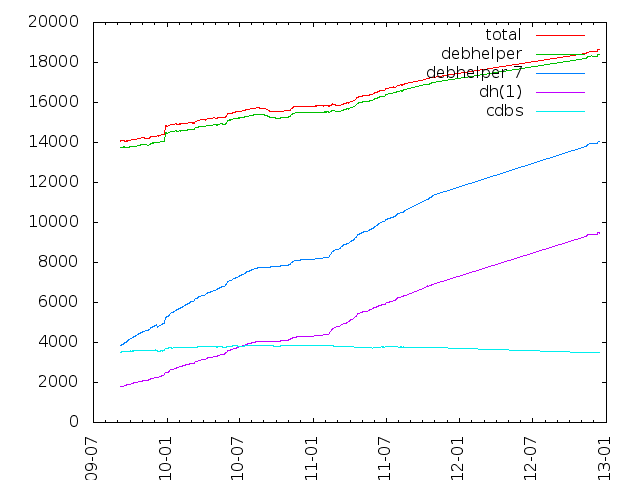
Apropos of my previous post, I see that dh has now overtaken CDBS as the most popular rules helper system of its kind in Debian unstable, and shows no particular sign of slowing its rate of uptake any time soon. The resolution of the graph is such that you can't see it yet, but dh drew dead level with CDBS on Thursday, and today 3836 packages are using dh as opposed to 3823 using CDBS.

9 July 2010

Julian Andres Klode: Nokia/Intel/Google/Canonical openness and professionality in MeeGo, Android, Ubuntu

MeeGo (Nokia/Intel): Openness does not seem to be very important for Nokia and Intel. They develop their stuff behind closed doors and then do a large code drop (once dropped, stuff gets developed in the open). In terms of professionality, it does not look much better: If you look at the meego-dev mailing list, you feel like you are in some kind of a kindergarten for open source developers Things like HTML emails and top-posting appear to be completely normal for them, they don t even follow the basic rules for emails and they also appear to ignore any advice on this topic. Oh, and writing a platform in GTK+ while pushing Qt as the supported toolset is not a good idea. Android (Google): The situation with Android appears to be even worse. Google keeps an internal development tree and the only time the public sees changes is when a new release is coming and Google does a new code drop. Such a behavior is not acceptable. Ubuntu (Canonical): Canonical does an outstanding job on openness. Canonical employees develop their software completely in the open, and there are no big code drops. They basically have no competitive advantage and allow you to use their work for your own project before they use it themselves. Canonical employees basically behave like normal free software developers doing stuff in his free time, the only exception being that they are paid for it. Most Canonical employees also know how to behave on mailing lists and do not post HTML emails or do top-posting. There are of course also other people: The design process of the Ubuntu font on the other hand is a disaster, with the font being created using proprietary software running on Windows; for a free software company, that s not acceptable (such persons should probably not be hired at all). Furthermore, the quality of Ubuntu packages is often bad when compared to the quality of a Debian package (especially in terms of API documentation of Canonical-created software); a result of vastly different development cycles and different priorities. On a scale from 0 to 15 (15 being the best), Nokia/Intel receive 5 points ( D in U.S. grades), Google receives 3 points ( F in U.S. grades), and Canonical receives 12 points ( B in U.S. grades). Please note that those grades only apply for the named projects, the companies may behave better or worse in other projects. Final tips for the companies:
Filed under: General, Ubuntu

Alexander Reichle-Schmehl: Release Critical Bug report for Week 27

The unofficial rc bug tracker currently knows about the following bugs:
In Total:501
Affecting Squeeze:401
Squeeze only:95
Remaining to be fixed in Squeeze:306
Of these 306 bugs, the following tags are set:
Pending in Squeeze:16
Patched in Squeeze:49
Duplicates in Squeeze:38
Contrib or non-free in Squeeze:12
Claimed in Squeeze:5
Delayed in Squeeze:6
Can fixed in a security Update:35
Otherwise fixed in Squeeze:33
Ignoring all the above (multiple tags possible), 163 bugs need to be fixed by Debian Contributers to get Debian 6.0 Squeeze released. However, the with the view of the Release Managers, 310 need to be dealt with for the release to happen. Please see my older post for an explanation of the different numbers.

Julian Andres Klode: Build systems

In the past weeks, I was looking at several build systems. As it turned out, there is not a single sane generic build system out there. Autotools: Autotools are ugly, slow, and require an immense amount of code copies in the source tree. WAF: WAF is not as ugly as autools and it s faster and does not generate Makefiles or stuff like this. But it has serious issues: It requires one to copy it to the source tarball, has no stable API, and requires Python for building. Furthermore, support for unit testing is broken: It runs the unit tests, but does not abort the build process if the tests fail and does not display why the tests fail. CMake: The syntax is ugly, it generates Makefiles, and support for pkg-config seems to be very very basic. So how should a build system look like? So, why is there no sane build system?
Filed under: General

8 July 2010

Tiago Bortoletto Vaz: Just a record from my first jazz performance in SP

Recital SouzaLima - 2010.1 Songs: * Affirmation (Jose Feliciano)
* Breezin (Bob Woomack)
* Phase dance (Pat Metheny)
* gua de beber (Tom Jobim / Vinicius de Morais)
* Marina (Dorival Caymi)
* Samba de Orly (V. de Morais / Chico Buarque / Toquinho)
* de manh (Caetano Veloso)
* Cora o leviano (Paulinho da Viola)
* Pecado capital (Paulinho da Viola)
* Folhetim (Chico Buarque)
* com esse que eu vou (Pedro Caetano)
* libi (Djavan)
* Capim (Djavan) Thanks to friends who came out to hear us // #fun :)

7 July 2010

Marco T&uacute;lio Gontijo e Silva: Immix on GHC Summer of Code weekly report #9

My project. This post assumes that the reader has read my last post. I m posting this weekly report earlier this week because there are too many things to tell already. I ve found the reason behind the segfault I m looking for so much time. The last problem, which is the only I know exactly when was fixed, because the programs started working, was related to allocating two times in the same region of memory. This happened because in each major GC the list of free line groups is generated again, but my old code was still allocating in the same line group of the last generation. So the last part of the line group, which was not yet used, would be a part of a line group in generated in the new collection, and it will be used for allocation two times: one in the allocation of the current line group, and another when this new line group starts being allocated. The implementation of the allocation of memory in lines is not very complicated, but it has some details that should be paid attention, and that were the cause of most trouble last weeks, and still need improvement. Initially I was allocating one object per line, just to see if it would work. As it didn t, I kept on improving the approach until I could find the problem. The next attempt was by setting ws->todo_free and ws->todo_lim in alloc_for_copy() in rts/sm/Evac.c. I think this is not ideal, because I didn t want the code to become too inconsistent with the way memory was allocated using these pointers before my changes. So I created new variables, line_free and line_lim, at first in the gen_workspace ws, the same place that todo_free and todo_lim are, but because of the last problem I described in the previous paragraph I changed it to generation. I m still not sure about where to place these pointers, this is something that can be improved. Another problem that I took a long time to understand is that the object need to be scavenged after being allocated. When it was allocated in todo_free, it was being scavenged by scavenge_block() in rts/sm/Scav.c, because the block in which it s in, todo_bd, is scavenged by this function. As I didn t wanted to the whole block where the free line group is to get scavenged again, I didn t want to send it to this function. So I thought about creating a way to scavenge only part of a block, that is, the space in the free line group that was allocated. This is still a valid idea, but I noticed that it was easier to use the mark stack. So I mark the object that is allocated in the line and push it in the mark stack. The main problem with this approach it s only possible to allocate in lines during major GCs, since only in this kind of GCs the mark stack is active. This is certainly the place where I can make more improvement. The patch of these changes and another one for the sanity checking explained in the last post. I m now benchmarking these changes with nofib, to see how much it affects the performance.

6 July 2010

Matt Zimmerman: We ve packaged all of the free software what now?

Today, virtually all of the free software available can be found in packaged form in distributions like Debian and Ubuntu. Users of these distributions have access to a library of thousands of applications, ranging from trivial to highly sophisticated software systems. Developers can find a vast array of programming languages, tools and libraries for constructing new applications. This is possible because we have a mature system for turning free software components into standardized modules (packages). Some software is more difficult to package and maintain, and I m occasionally surprised to find something very useful which isn t packaged yet, but in general, the software I want is packaged and ready before I realize I need it. Even the long tail of niche software is generally packaged very effectively. Thanks to coherent standards, sophisticated management tools, and the principles of software freedom, these packages can be mixed and matched to create complete software stacks for a wide range of devices, from netbooks to supercomputing clusters. These stacks are tightly integrated, and can be tested, released, maintained and upgraded as a unit. The Debian system is unparalleled for this purpose, which is why Ubuntu is based on it. The vision, for a free software operating system which is highly modular and customizable, has been achieved. Rough edges This is a momentous achievement, and the Debian packaging system fulfills its intended purpose very well. However, there are a number of areas where it introduces friction, because the package model doesn t quite fit some new problems. Most of these are becoming more common over time as technology evolves and changes shape. Why are we stuck?
I suppose it is tempting, if the only tool you have is a hammer, to treat everything as if it were a nail.
Abraham Maslow
The packaging ecosystem is very strong. Not only do we have powerful tools for working with packages, we also benefit from packages being a well-understood concept, and having established processes for developing, exchanging and talking about them. Once something is packaged, we know what it is and how to work with it, and it fits into everything else. So, it is tempting to package everything in sight, as we already know how to make sense of packages. However, this may not always be the right tool for the job. Various attempts have been made to extend the packaging concept to make it more general, for example: Other package managers aim to solve a specific problem, such as providing lightweight package management for embedded systems, or lazy dependency installation, or fixing the filesystem hierarchy. There is a long list of package managers of various levels which solve different problems. Most of these systems suffer from an important fundamental tradeoff: they are designed to manage the entire system, from the kernel through applications, and so they must be used wholesale in order to reap their full benefit. In other words, in their world, everything is a package, and anything which is not a package is out of scope. Therefore, each of these systems requires a separate collection of packages, and each time we invent a new one, its adherents set about packaging everything in the new format. It takes a very long time to do this, and most of them lose momentum before a mature ecosystem can form around them. This lock-in effect makes it difficult for new packaging technologies to succeed. Divide and Conquer No single package management framework is flexible enough to accommodate all of the needs we have today. Even more importantly, a generic solution won t account for the needs we will have tomorrow. I propose that in order to move forward, we must make it possible to solve packaging problems separately, rather than attempting to solve them all within a single system. But I like things how they are! We don t have a choice. The world is changing around us, and distributions need to evolve with it. If we don t adapt, we will eventually give way to systems which do solve these problems. Take, for example, modern web browsers like Firefox and Chromium. Arguably the most vital application for users, the browser is coming under increasing pressure to keep up with the breakneck pace of innovation on the web. The next wave of real-time collaboration and multimedia applications relies on the rapid development of new capabilities in web browsers. Browser makers are responding by accelerating deployment in the field: both aggressively push new releases to their users. A report from Google found that Chrome upgrades 97% of their users within 21 days of a new release, and Firefox 85% (both impressive numbers). Mozilla recently changed their maintenance policies, discontinuing maintenance of stable releases and forcing Ubuntu to ship new upstream releases to users. These applications are just the leading edge of the curve, and the pressure will only increase. Equally powerful trends are pressing server applications, embedded systems, and data to adapt as well. The ideas I ve presented here are only one possible way forward, and I m sure there are more and better ideas brewing in distribution communities. I m sure that I m not the only one thinking about these problems. Whatever it looks like in the end, I have no doubt that change is ahead.

5 July 2010

Marco T&uacute;lio Gontijo e Silva: Immix on GHC Summer of Code weekly report #8

My project. This post assumes that the reader has read my last post. This week I could get my focus on the project again, since most of my classes are already over. I ve investigated the segfault that was happening in GHC with +RTS -w -DS, and I noticed that the code in rts/sm/Sanity.c assumed that all objects in the allocated area of the block are being used.
    for (; bd != NULL; bd = bd->link)  
	p = bd->start;
	while (p < bd->free)  
	    nat size = checkClosure((StgClosure *)p);
	    /* This is the smallest size of closure that can live in the heap */
	    ASSERT( size >= MIN_PAYLOAD_SIZE + sizeofW(StgHeader) );
	    p += size;
	    /* skip over slop */
	    while (p < bd->free &&
		   (*p < 0x1000   !LOOKS_LIKE_INFO_PTR(*p)))   p++;  
	 
     
Since this is true for copy collection and mark compact, it was only with mark sweep that the error happened. The only way I could manage to make the segfault disappear by now was marking the swept blocks with a new flag, and avoid running this code in them. So I went back to my old problem with the allocation of memory in lines. I noticed that (one of) the problem(s) may be that the object that is allocated in the free line is not scavenged after the evacuation. When the object is allocated in a block, using the current allocation method, it will eventually be scavenged, because all blocks that were being used to allocation are scavenged. I m planning to implement a list of lines that need to be scavenged and code to scavenge the lines in this list, and the current line. It ll be very similar to the code that does this with blocks.

Julian Andres Klode: Review: Lenovo ThinkPad Edge 15

Wednesday, after some weeks with a flickering screen (or more precisely, something is causing GTK+ to redraw and the kernel to print ^@ in the terminal when you touch the screen, see http://jak-linux.org/tmp/20100628_002.mp4) in my 3 years old HP Compaq 6720s (which seems to be a software-hardware combination problem, at least it works in Ubuntu); I decided to buy a new laptop. It took me a few minutes to find the Lenovo ThinkPad Edge 15 NVL7VGE; which I ordered at notebooksbilliger.de at around 14:30 CEST using Express. On Thursday morning at 6:40 CEST, the device arrived. The laptop features an Intel Core i5 430 M processor with integrated graphics, 4 GiB of RAM, 320 GB hard disk storage, matte screen, and of course a TrackPoint. The machine comes pre-installed with Windows 7 Professional which is not very nice (and Lenovo does not take Windows licenses back). I booted Ubuntu 10.04 from an USB disk which worked a few times, but not always, so I upgraded the BIOS to make USB booting reliable (as Lenovo published multiple BIOS updates already, one fixing this USB booting issue). The first step was booting Ubuntu 10.04 from an USB hard disk to check the Linux support. Using Ubuntu, everything worked out of the box, including stuff like HDMI audio support or output switching. An exception may be the DVD drive, which only works if you set the SATA mode to compatibility. Non-DVD media also works in AHCI mode, but only if you start with a disc inserted in the drive. Playing DVDs requires setting a region code using setregion(8) [otherwise they do not work at all] and SATA compatibility mode [otherwise they only work partially]. Another issue is the HDMI output, as the TV is not correctly detected and some parts at the top and the bottom of the image are missing (that is, the GNOME panels) (but that happens with different screens and ATI cards as well). Oh, and closing the lid with a screen attached and the internal screen disabled works only as long as you do not open it again, because that causes the GPU to stop. On the input side, we have one keyboard, one TrackPoint, and a touch pad. All of them work out of the box, but they have a few problems on the hardware side: The cursor keys on the keyboard are incredibly small and the touchpad is very large. The keyboard is different from the one in the HP Compaq: First of all, there is space between the keys (like Apple keyboards); and secondly, you need to apply more pressure in order to use the keys. The device feels more solid than the HP Compaq 6720s, especially touching the screen does not change the colors on the screen. I don t know how long the keyboard will last, but I hope that I will still have symbols on them in 5 months (which was not the case for the HP Compaq 6720s keyboard). Power consumption is another interesting point. When the device is idle and the screen is disabled, the device seems to consume about 10W. With screen enabled, consumption varies between 13W (idle) 35W (building source code); if the values received via ACPI are correct. The device ships with a 48 Wh battery which after some time was displayed as 53 Wh in gnome-power-statistics (only the when loaded state, capacity is displayed as 47.5Wh). According to Lenovo, the laptop lasts 4.5 hours on battery, meaning consumption of 47.5 Wh / 4.5 h = 10.5 Wh which is a bit overly optimistic if you want to work on the device. After checking everything, I took over my Debian sid installation from my old laptop (which I installed in 2008). It runs happely now, although I still need to get accustomed to the new keyboard and the large touch pad. All in all, the price of 765 I paid for the device seems to be OK. Now I only need to remove the Windows 7 sticker and hope that the device lasts long enough until I want to buy a new one (probably 2013, if the aliens don t invade us 2012).
Filed under: General

2 July 2010

Gunnar Wolf: Debian by its numbers, as seen by keyring-maint

At keyring-maint, we got a request by our DPL, querying for the evolution of the number of keys per keyring This can be almost-mapped to the number of Debian Developers, Debian Maintainers, retired and deleted accounts over time since the keyrings are maintained over version control. Stefano insisted this was more out of curiosity than anything else, but given the task seemed easy enough, I came up with the following dirty thingy. I'm sure there are better ways than cruising through the whole Bazaar history, but anyway - In case you want to play, you can clone an almost-up-to-date copy of the tree: bzr clone http://bzr.debian.org/keyring/debian-keyring/
  1. #!/bin/perl
  2. use strict;
  3. my ($lastrev, @keyrings, %revs, $fh);
  4. open $fh, '>growth_stats.txt' or die $!;
  5. @keyrings = sort qw(debian-keyring-gpg debian-keyring-pgp
  6. debian-maintainers-gpg
  7. emeritus-keyring-gpg emeritus-keyring-pgp
  8. removed-keys-gpg removed-keys-pgp);
  9. system('bzr unbind'); # Huge speed difference :-P
  10. $lastrev = bzr revno ;
  11. for my $entry (split /^---+$/m, bzr log )
  12. my ($rev, $stamp);
  13. for my $line (split(/\n/, $entry))
  14. next unless $line =~ /^(revno timestamp): (.*)/;
  15. $rev = $2 if $1 eq 'revno';
  16. $stamp = $2 if $1 eq 'timestamp';
  17. $revs $rev = stamp => $stamp ;
  18. spew('Revision', 'Date', @keyrings);
  19. system('bzr bind')
  20. for my $rev (sort $a<=>$b keys %revs)
  21. system("bzr update -r $rev");
  22. spew($rev, $revs $rev stamp ,
  23. map my @keys=<$_/*>;scalar(@keys) @keyrings);
  24. sub spew
  25. print $fh join(' ', @_),"\n"
And as a result... Yes, I fired up OpenOffice instead of graphing from within Perl, which could even have been less painful ;-) I had intended to leave graphing the data raw (also attached here) as an excercise to the [rl]eader... But anyway, the result is here (click to view it in full resolution, I don't want to mess your reading experience with a >1000px wide image): A couple of notes: Anyway, have fun with this. Graphics are always fun!
AttachmentSize
Debian by its numbers, as seen by keyring-maint62.79 KB
Raw data31.78 KB

Alexander Reichle-Schmehl: Release Critical Bug report for Week 26

The inofficial rc bug tracker currently knows about the following bugs:
In Total:498
Affecting Squeeze:397
Squeeze only:72
Remaining to be fixed in Squeeze:325
Of these 325 bugs, the following tags are set:
Pending in Squeeze:22
Patched in Squeeze:50
Duplicates in Squeeze:51
Contrib or non-free in Squeeze:12
Claimed in Squeeze:4
Delayed in Squeeze:11
Can fixed in a security Update:30
Otherwise fixed in Squeeze:31
Ignoring all the above (multiple tags possible), 166 bugs need to be fixed by Debian Contributers to get Debian 6.0 Squeeze released. However, the with the view of the Release Managers, 306 need to be dealt with for the release to happen. Please see my older post for an explanation of the different numbers.

1 July 2010

Robert Collins: Subunit and nose

Looks like someone has come up with a nose plugin for subunit excellent! http://www.liucougar.net/blog/projects/nose-subunit In their post the author notes that subunit is not easy_installable at the moment. It will be shortly. Thanks to Tres Seaver there is a setup.py for the python component of Subunit, and he has offered to maintain that going forward. His patch is in trunk, and the next release will include a pypi upload. The next subunit release should be pretty soon too the unicode support in testtools has been overhauled thanks to Martin[gz], and so we re in much better shape on Python 2.x than we were before. Python3 for testtools is trouble free in this area because confused strings don t exist there :)

Next.

Previous.