Search Results: "spa"

22 May 2024

Evgeni Golov: Upgrading CentOS Stream 8 to CentOS Stream 9 using Leapp

Warning to the Planet Debian readers: the following post might shock you, if you're used to Debian's smooth upgrades using only the package manager. Leapp?! Contrary to distributions like Debian and Fedora, RHEL can't be upgraded using the package manager alone. Instead there is a tool called Leapp that takes care of orchestrating the update and also includes a set of checks whether a system can be upgraded at all. Have a look at the RHEL documentation about upgrading if you want more details on the process itself. You might have noticed that the title of this post says "CentOS Stream" but here I am talking about RHEL. This is mostly because Leapp was originally written with RHEL in mind. Upgrading CentOS 7 to EL8 When people started pondering upgrading their CentOS 7 installations, AlmaLinux started the ELevate project to allow upgrading CentOS 7 to CentOS Stream 8 but also to AlmaLinux 8, Rocky 8 or Oracle Linux 8. ELevate was essentially Leapp with patches to allow working on CentOS, which has different package signature keys, different OS release versioning, etc. Sadly these patches were never merged back into Leapp. Making Leapp work with CentOS Stream 8 (and other distributions) At some point I noticed that things weren't moving and EL8 to EL9 upgrades were coming closer (and I had my own systems that I wanted to be able to upgrade in place). Annoyed-Evgeni-Development is best development? Not sure, but it produced a set of patches that allowed some movement: However, this is not yet the end of the story. At least convert dot-less CentOS versions to X.999 is open, and another followup would be needed if we go that route. But I don't expect this to be merged soon, as the patch is technically wrong - yet it makes things mostly work. The big problem here is that CentOS Stream doesn't have X.Y versioning, just X as it's a constant stream with no point releases. Leapp however relies on X.Y versioning to know which package changes it needs to perform. Pretending CentOS Stream 8 is "RHEL" 8.999 works if you assume that Stream is always ahead of RHEL. This is however a CentOS only problem. I still need to properly test that, but I'd expect things to work fine with upstream Leapp on AlmaLinux/Rocky if you feed it the right signature and repository data. Actually upgrading CentOS Stream 8 to CentOS Stream 9 using Leapp Like I've already teased in my HPE rant, I've actually used that code to upgrade virt01.conova.theforeman.org to CentOS Stream 9. I've also used it to upgrade a server at home that's responsible for running important containers like Home Assistant and UniFi. So it's absolutely battle tested and production grade! It's also hungry for kittens. As mentioned above, you can't just use upstream Leapp, but I have a Copr: evgeni/leapp.
# dnf copr enable evgeni/leapp
# dnf install leapp leapp-upgrade-el8toel9
Apart from the software, we'll also need to tell it which repositories to use for the upgrade.
# vim /etc/leapp/files/leapp_upgrade_repositories.repo
[c9-baseos]
name=CentOS Stream $releasever - BaseOS
metalink=https://mirrors.centos.org/metalink?repo=centos-baseos-9-stream&arch=$basearch&protocol=https,http
gpgkey=file:///etc/pki/rpm-gpg/RPM-GPG-KEY-centosofficial
gpgcheck=1
repo_gpgcheck=0
metadata_expire=6h
countme=1
enabled=1
[c9-appstream]
name=CentOS Stream $releasever - AppStream
metalink=https://mirrors.centos.org/metalink?repo=centos-appstream-9-stream&arch=$basearch&protocol=https,http
gpgkey=file:///etc/pki/rpm-gpg/RPM-GPG-KEY-centosofficial
gpgcheck=1
repo_gpgcheck=0
metadata_expire=6h
countme=1
enabled=1
Depending on the setup and installed packages, more repositories might be needed. Just make sure that the $stream substitution is not used as Leapp doesn't override that and you'd end up with CentOS Stream 8 repos again. Once all that is in place, we can call leapp preupgrade and let it analyze the system. Ideally, the output will look like this:
# leapp preupgrade
 
============================================================
                      REPORT OVERVIEW                       
============================================================
Reports summary:
    Errors:                      0
    Inhibitors:                  0
    HIGH severity reports:       0
    MEDIUM severity reports:     0
    LOW severity reports:        3
    INFO severity reports:       3
Before continuing consult the full report:
    A report has been generated at /var/log/leapp/leapp-report.json
    A report has been generated at /var/log/leapp/leapp-report.txt
============================================================
                   END OF REPORT OVERVIEW                   
============================================================
But trust me, it won't ;-) As mentioned above, Leapp analyzes the system before the upgrade. Some checks can completely inhibit the upgrade, while others will just be logged as "you better should have a look". Firewalld Configuration AllowZoneDrifting Is Unsupported EL7 and EL8 shipped with AllowZoneDrifting=yes, but since EL9 this is not supported anymore. As this can potentially break the networking of the system, the upgrade gets inhibited. Newest installed kernel not in use Admit it, you also don't reboot into every new kernel available! Well, Leapp won't let that pass and inhibits the upgrade. Cannot perform the VDO check of block devices In EL8 there are two ways to manage VDO: using the dedicated vdo tool and via LVM. If your system uses LVM (it should!) but not VDO, you probably don't have the vdo package installed. But then Leapp can't check if your LVM devices really aren't VDO without the vdo tooling and will inhibit the upgrade. So you gotta install vdo for it to find out that you don't use VDO LUKS encrypted partition detected Yeah. Sorry. Using LUKS? Straight into the inhibit corner! But hey, if you don't use LUKS for / you can probably get away by deleting the inhibitwhenluks actor. That worked for me, but remember the kittens! Really upgrading CentOS Stream 8 to CentOS Stream 9 using Leapp The headings are getting silly, huh? Anyway, once leapp preupgrade is happy and doesn't throw any inhibitors anymore, the actual (real?) upgrade can be done by calling leapp upgrade. This will download all necessary packages and create an intermediate initramfs that contains all the things needed for the upgrade and ask you to reboot. Once booted, the upgrade itself takes somewhere between 5 and 10 minutes. Then another minute or 5 to relabel your disks with the new SELinux policy. And three reboots (into the upgrade initramfs, into SELinux relabel, into real OS) of a ProLiant DL325 - 5 minutes each? And then for good measure another one, to flip SELinux from permissive to enforcing. Are we done yet? Nope. There are a few post-upgrade tasks you get to do yourself. Yes, the switching of SELinux back to enforcing is one of them. Please don't forget it. Using the system after the upgrade A customer once said "We're not running those systems for the sake of running systems, but for the sake of running some application ontop of them". This is very true. libvirt doesn't support Spice/QXL In EL9, support for Spice/QXL was dropped, so if you try to boot a VM using it, libvirt will nicely error out with
Error starting domain: unsupported configuration: domain configuration does not support video model 'qxl'
Interestingly, because multiple parts of the VM are invalid, you can't edit it in virt-manager (at least the one in Fedora 39) as removing/fixing one part requires applying the new configuration which is still invalid. So virsh edit <vm> it is! Look for entries like
    <channel type='spicevmc'>
      <target type='virtio' name='com.redhat.spice.0'/>
      <address type='virtio-serial' controller='0' bus='0' port='2'/>
    </channel>
    <graphics type='spice' autoport='yes'>
      <listen type='address'/>
    </graphics>
    <audio id='1' type='spice'/>
    <video>
      <model type='qxl' ram='65536' vram='65536' vgamem='16384' heads='1' primary='yes'/>
      <address type='pci' domain='0x0000' bus='0x00' slot='0x01' function='0x0'/>
    </video>
    <redirdev bus='usb' type='spicevmc'> 
      <address type='usb' bus='0' port='2'/> 
    </redirdev> 
    <redirdev bus='usb' type='spicevmc'> 
      <address type='usb' bus='0' port='3'/> 
    </redirdev>
and either just delete the or (better) replace them with VNC/cirrus
    <graphics type='vnc' port='-1' autoport='yes'>
      <listen type='address'/>
    </graphics>
    <audio id='1' type='none'/>
    <video>
      <model type='cirrus' vram='16384' heads='1' primary='yes'/>
      <address type='pci' domain='0x0000' bus='0x00' slot='0x01' function='0x0'/>
    </video>
Podman needs re-login to private registries One of the machines I've updated runs Podman and pulls containers from GitHub which are marked as private. To do so, I have a personal access token that I've used to login to ghcr.io. After the CentOS Stream 9 upgrade (which included an upgrade to Podman 5), pulls stopped working with authentication/permission errors. No idea what exactly happened, but a simple podman login fixed this issue quickly.
$ echo ghp_token   podman login ghcr.io -u <user> --password-stdin
shim has an el8 tag One of the documented post-upgrade tasks is to verify that no EL8 packages are installed, and to remove those if there are any. However, when you do this, you'll notice that the shim-x64 package has an EL8 version: shim-x64-15-15.el8_2.x86_64. That's because the same build is used in both CentOS Stream 8 and CentOS Stream 9. Confusing, but should really not be uninstalled if you want the machine to boot ;-) Are we done yet? Yes! That's it. Enjoy your CentOS Stream 9!

21 May 2024

Michael Ablassmeier: lvm thin send/recv

A few days ago i found this mail on the LKML that introduces support for userspace access to LVM thin provisioned metadata snapshots. I didn t know this is possible. Using the thin provisioning tools you can then export the metadata information for your LVM snapshots to track changed regions between them. The workflow is pretty straight forward, yet not really documented:
# lvcreate -ay -Ky --snapshot -n full_backup thingroup/vol1
  # dmsetup message /dev/mapper/thingroup-thinpool-tpool 0 reserve_metadata_snap
  # lvcreate -ay -Ky --snapshot -n inc_backup thingroup/vol1
  # thin_delta  -m --snap1 $(lvs --noheadings -o thin_id thingroup/full_backup) --snap2 $(lvs --noheadings -o thin_id thingroup/inc_backup) > delta_dump
  # dmsetup message /dev/mapper/thingroup-thinpool-tpool 0 release_metadata_snap
This all has already been implemented by a nice utility called thin-send-recv, which based on this functionality allows to (incrementally) send LVM snapshots to remote systems just like zfs send or zfs recv.

20 May 2024

Debian Brasil: MiniDebConf Belo Horizonte 2024 - um breve relato

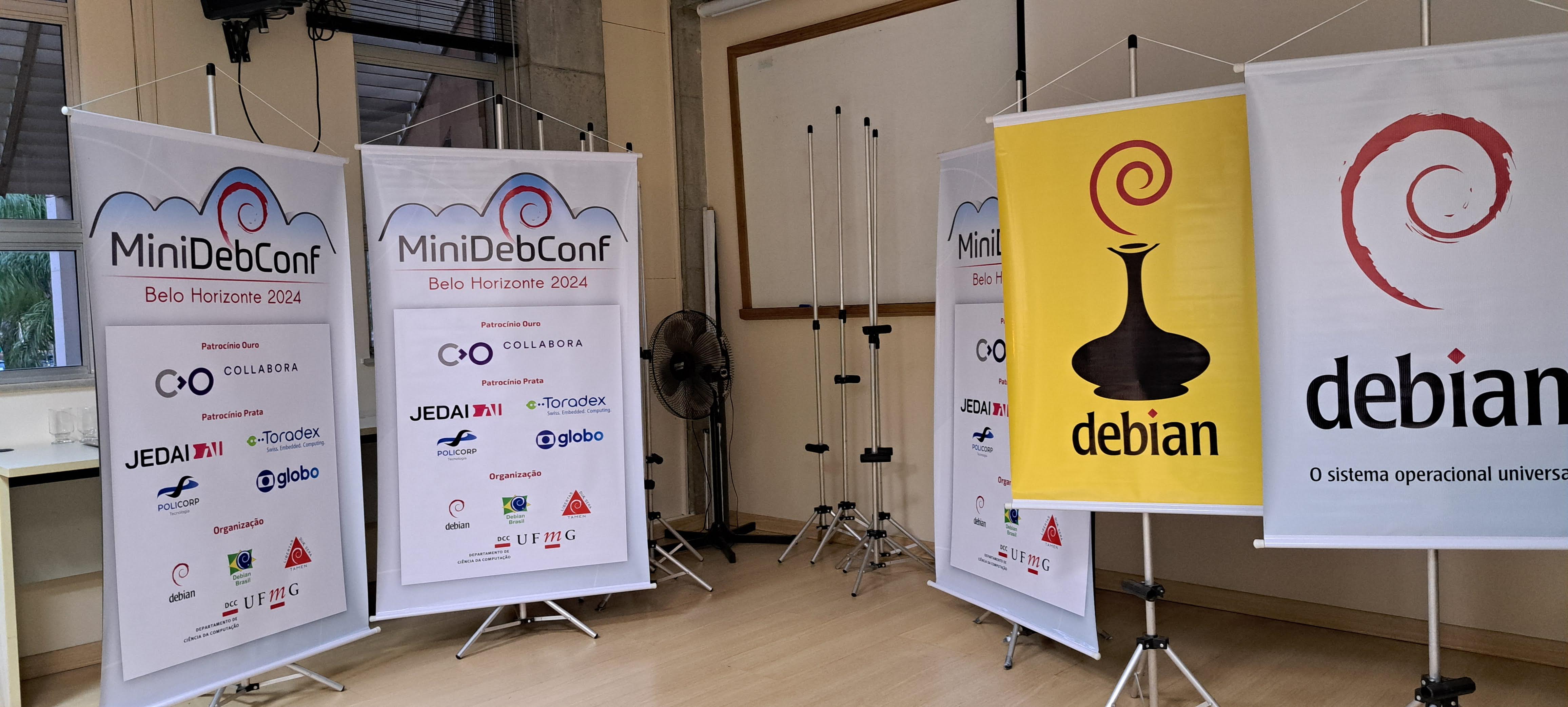
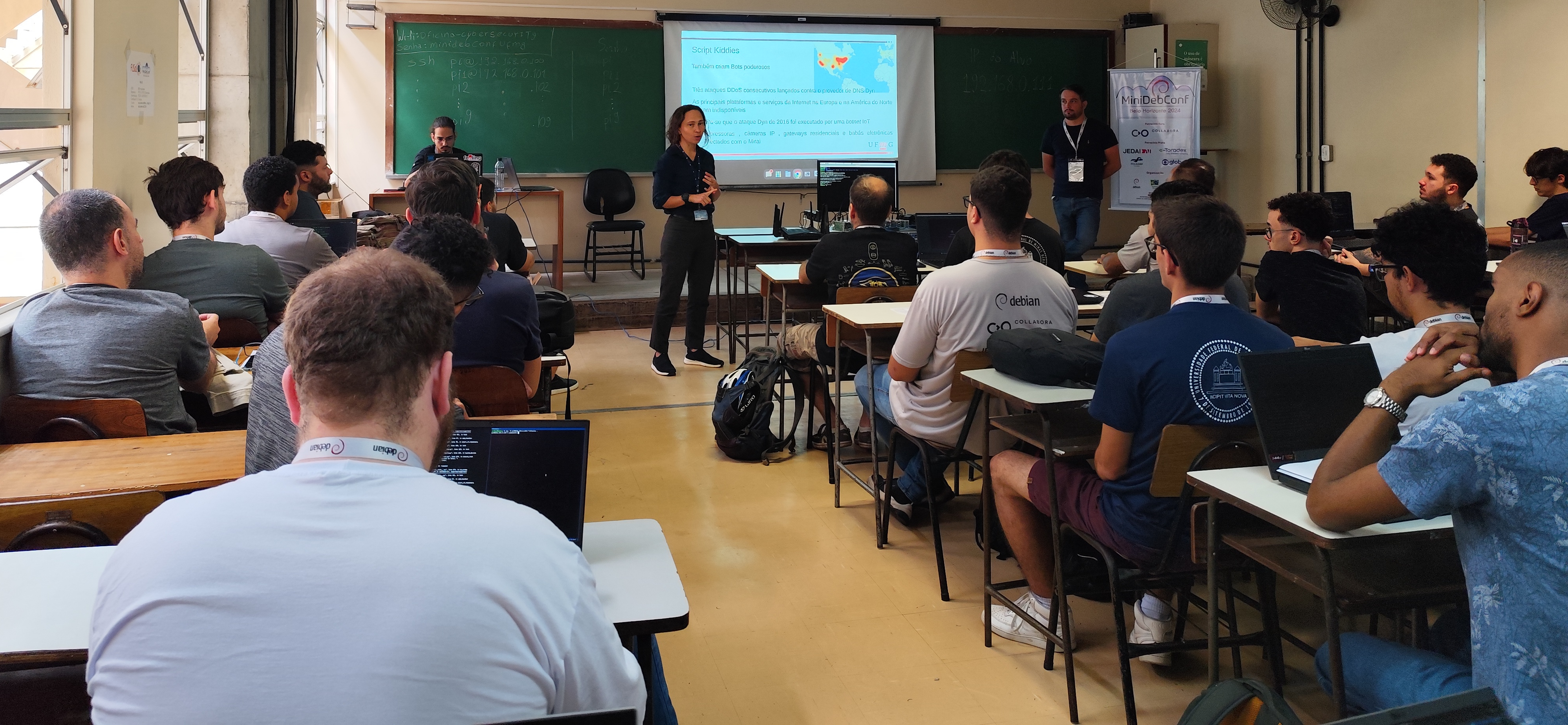
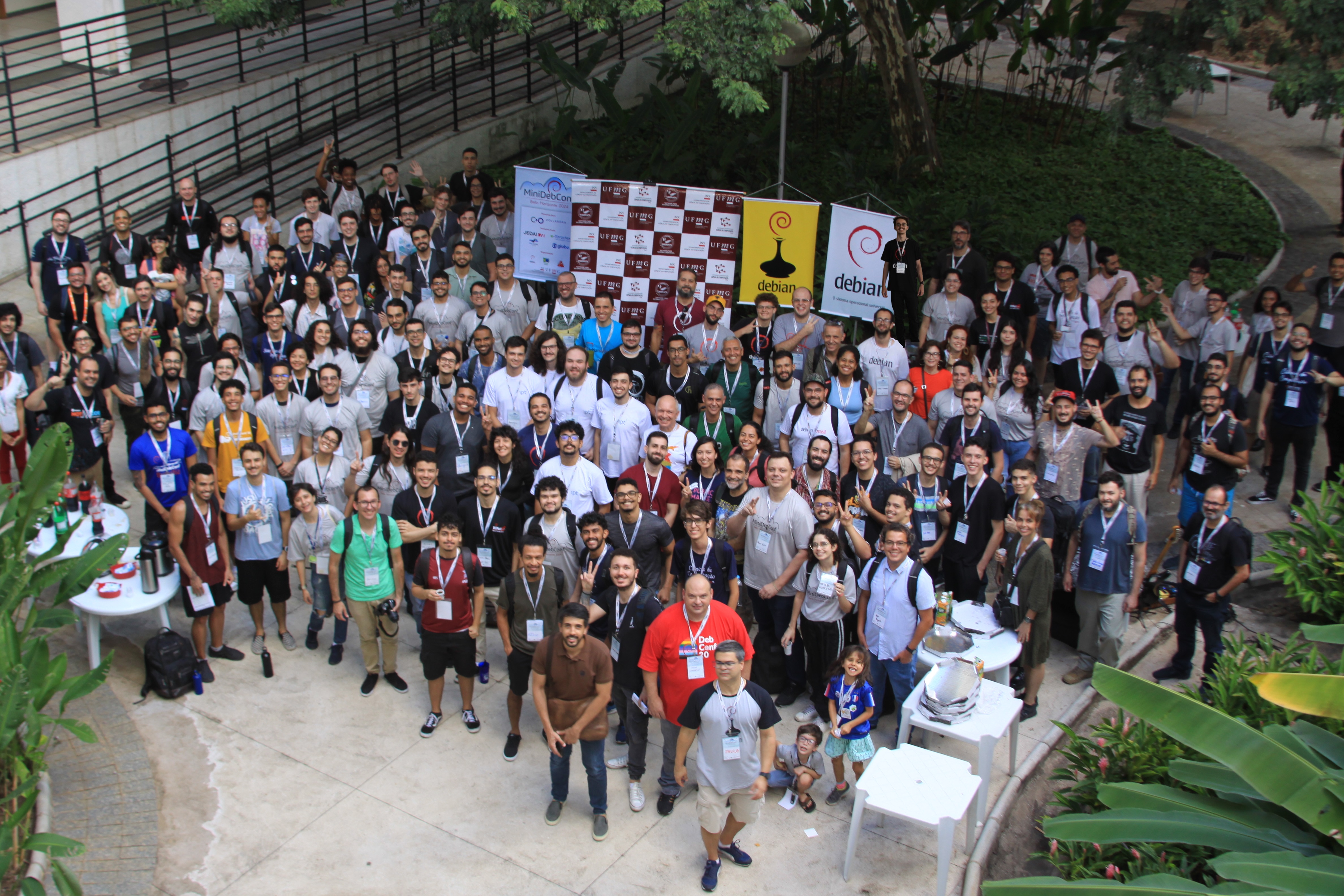
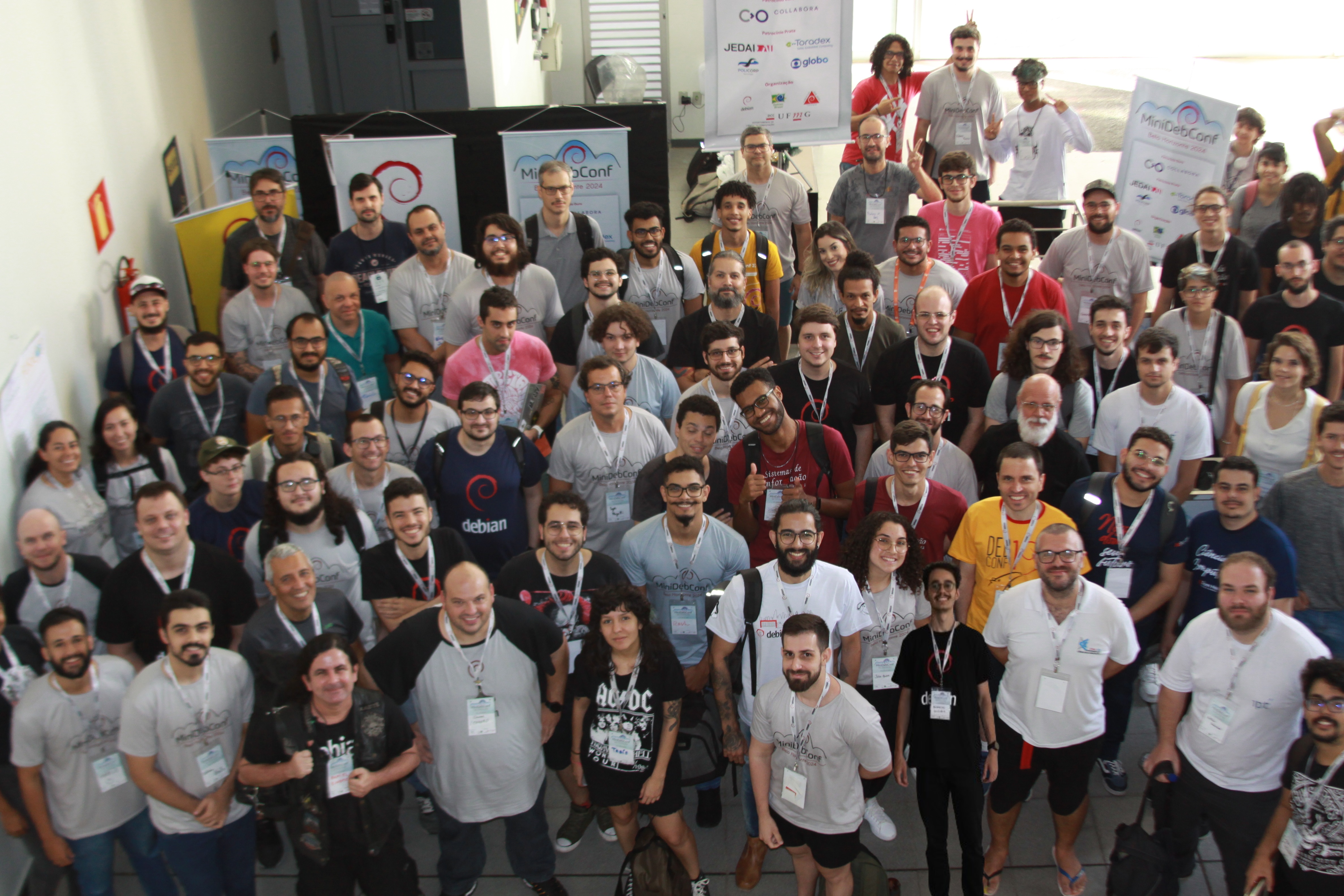
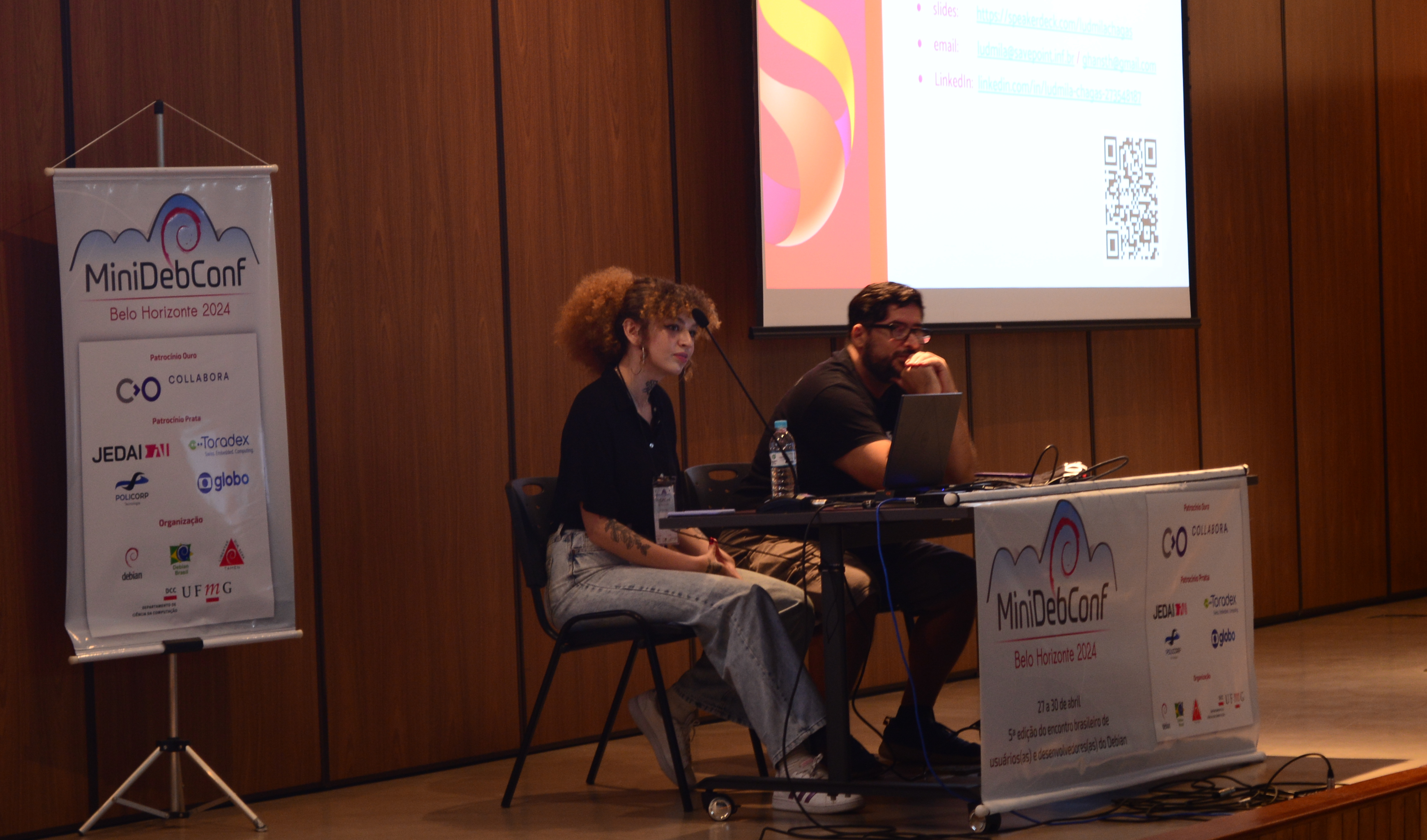
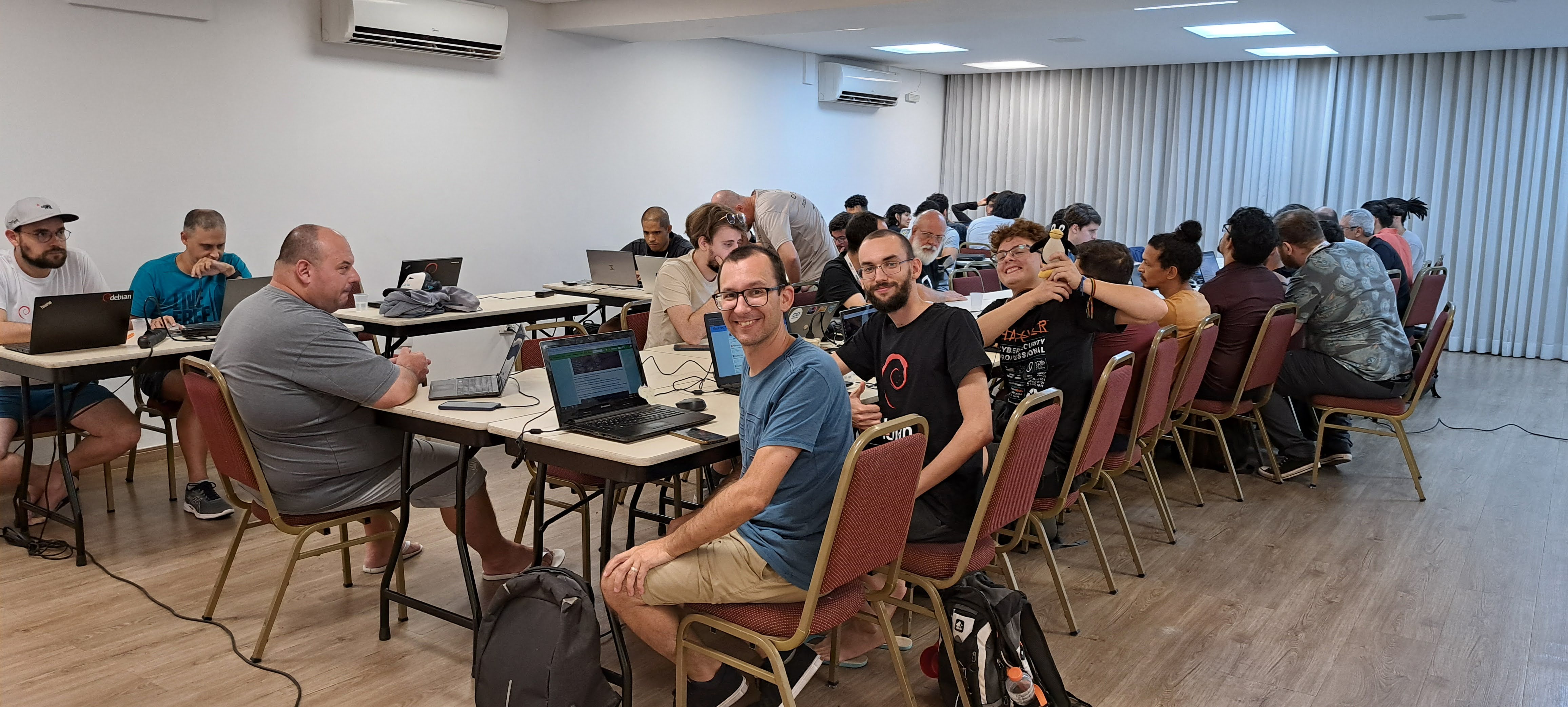
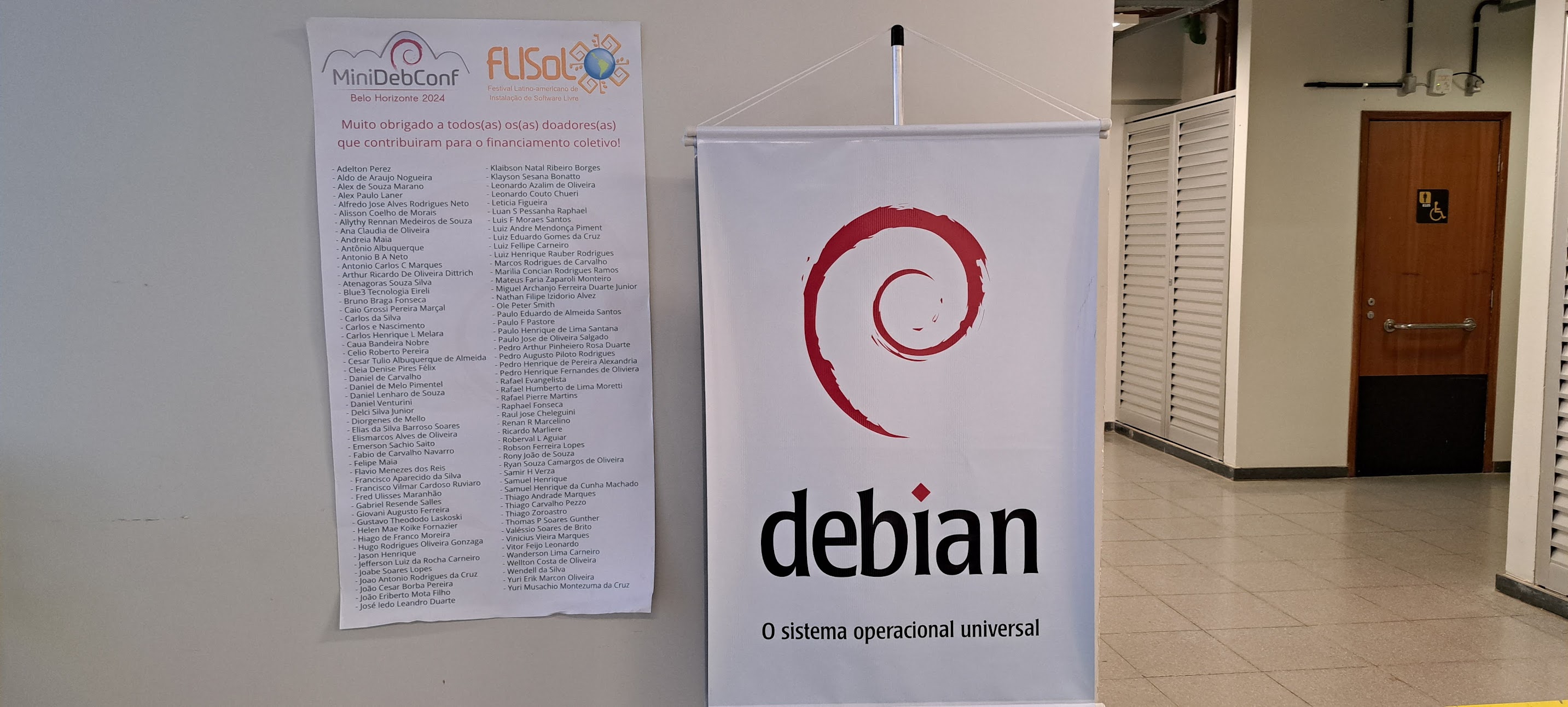
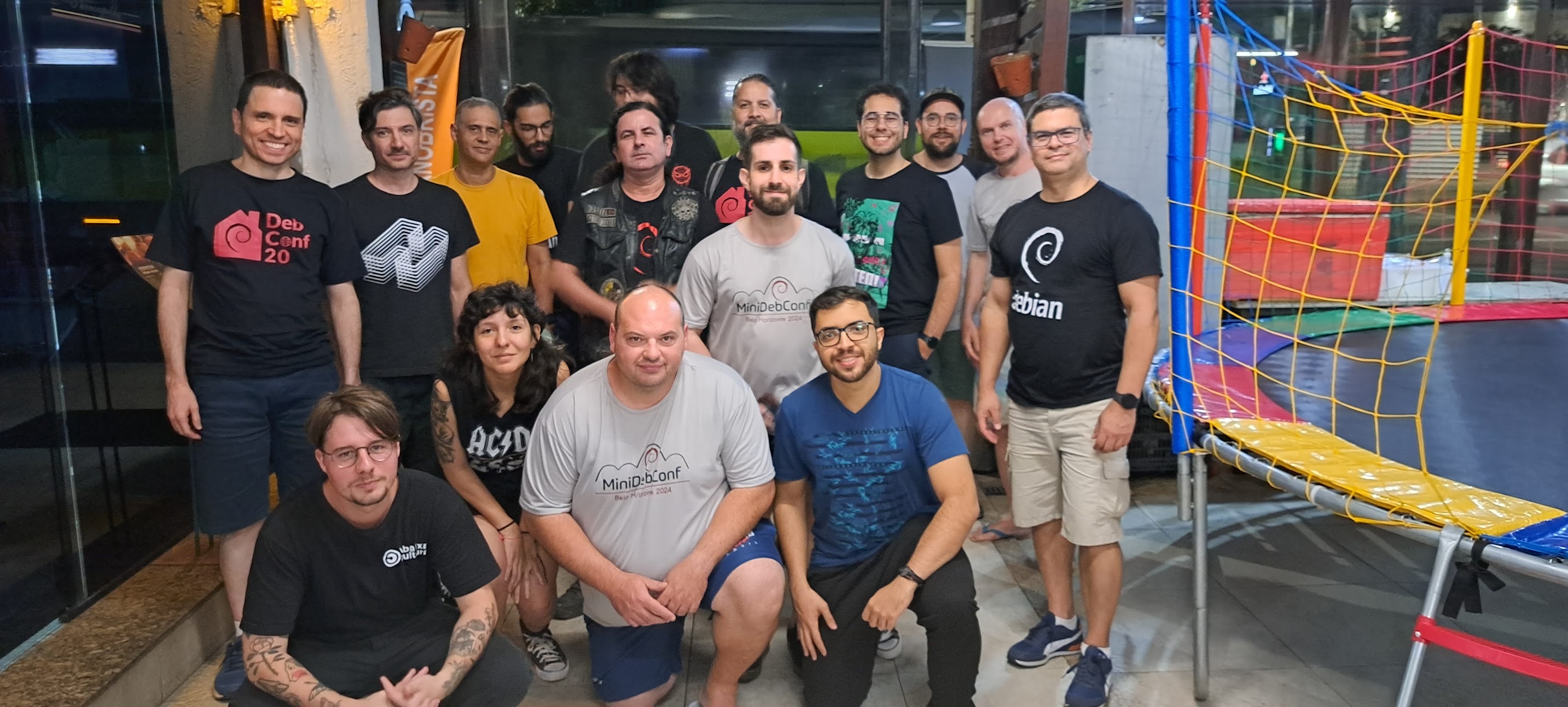
De 27 a 30 de abril de 2024 foi realizada a MiniDebConf Belo Horizonte 2024 no Campus Pampulha da UFMG - Universidade Federal de Minas Gerais, em Belo Horizonte - MG. MiniDebConf BH 2024 banners Esta foi a quinta vez que uma MiniDebConf (como um evento presencial exclusivo sobre Debian) aconteceu no Brasil. As edi es anteriores foram em Curitiba (2016, 2017, e 2018), e em Bras lia 2023. Tivemos outras edi es de MiniDebConfs realizadas dentro de eventos de Software Livre como o FISL e a Latinoware, e outros eventos online. Veja o nosso hist rico de eventos. Paralelamente MiniDebConf, no dia 27 (s bado) aconteceu o FLISOL - Festival Latino-americano de Instala o de Software Livre, maior evento da Am rica Latina de divulga o de Software Livre realizado desde o ano de 2005 simultaneamente em v rias cidades. A MiniDebConf Belo Horizonte 2024 foi um sucesso (assim como as edi es anteriores) gra as participa o de todos(as), independentemente do n vel de conhecimento sobre o Debian. Valorizamos a presen a tanto dos(as) usu rios(as) iniciantes que est o se familiarizando com o sistema quanto dos(as) desenvolvedores(as) oficiais do projeto. O esp rito de acolhimento e colabora o esteve presente em todos os momentos. MiniDebConf BH 2024 flisol N meros da edi o 2024 Durante os quatro dias de evento aconteceram diversas atividades para todos os n veis de usu rios(as) e colaboradores(as) do projeto Debian. A programa o oficial foi composta de: MiniDebConf BH 2024 palestra Os n meros finais da MiniDebConf Belo Horizonte 2024 mostram que tivemos um recorde de participantes. Dos 224 participantes, 15 eram contribuidores(as) oficiais brasileiros sendo 10 DDs (Debian Developers) e 05 (Debian Maintainers), al m de diversos(as) contribuidores(as) n o oficiais. A organiza o foi realizada por 14 pessoas que come aram a trabalhar ainda no final de 2023, entre elas o Prof. Lo c Cerf do Departamento de Computa o que viabilizou o evento na UFMG, e 37 volunt rios(as) que ajudaram durante o evento. Como a MiniDebConf foi realizado nas instala es da UFMG, tivemos a ajuda de mais de 10 funcion rios da Universidade. Veja a lista com os nomes das pessoas que ajudaram de alguma forma na realiza o da MiniDebConf Belo Horizonte 2024. A diferen a entre o n mero de pessoas inscritas e o n mero de pessoas presentes provavelmente se explica pelo fato de n o haver cobran a de inscri o, ent o se a pessoa desistir de ir ao evento ela n o ter preju zo financeiro. A edi o 2024 da MiniDebconf Belo Horizonte foi realmente grandiosa e mostra o resultado dos constantes esfor os realizados ao longo dos ltimos anos para atrair mais colaboradores(as) para a comunidade Debian no Brasil. A cada edi o os n meros s aumentam, com mais participantes, mais atividades, mais salas, e mais patrocinadores/apoiadores. MiniDebConf BH 2024 grupo

MiniDebConf BH 2024 grupo Atividades A programa o da MiniDebConf foi intensa e diversificada. Nos dias 27, 29 e 30 (s bado, segunda e ter a-feira) tivemos palestras, debates, oficinas e muitas atividades pr ticas. MiniDebConf BH 2024 palestra J no dia 28 (domingo), ocorreu o Day Trip, um dia dedicado a passeios pela cidade. Pela manh sa mos do hotel e fomos, em um nibus fretado, para o Mercado Central de Belo Horizonte. O pessoal aproveitou para comprar v rias coisas como queijos, doces, cacha as e lembrancinhas, al m de experimentar algumas comidas locais. MiniDebConf BH 2024 mercado Depois de 2 horas de passeio pelo Mercado, voltamos para o nibus e pegamos a estrada para almo armos em um restaurante de comida t pica mineira. MiniDebConf BH 2024 palestra Com todos bem alimentados, voltamos para Belo Horizonte para visitarmos o principal ponto tur stico da cidade: a Lagoa da Pampulha e a Capela S o Francisco de Assis, mais conhecida como Igrejinha da Pampulha. MiniDebConf BH 2024 palestra Voltamos para o hotel e o dia terminou no hacker space que montamos na sala de eventos para o pessoal conversar, empacotar, e comer umas pizzas. MiniDebConf BH 2024 palestra Financiamento coletivo Pela terceira vez fizemos uma campanha de financiamento coletivo e foi incr vel como as pessoas contribu ram! A meta inicial era arrecadar o valor equivalente a uma cota ouro de R$ 3.000,00. Ao atingirmos essa meta, definimos uma nova, equivalente a uma cota ouro + uma cota prata (R$ 5.000,00). E novamente atingimos essa meta. Ent o propusermos como meta final o valor de uma cota ouro + prata + bronze, que seria equivalente a R$ 6.000,00. O resultado foi que arrecadamos R$ 7.239,65 com a ajuda de mais de 100 pessoas! Muito obrigado as pessoas que contribu ram com qualquer valor. Como forma de agradecimento, listamos os nomes das pessoas que doaram. MiniDebConf BH 2024 doadores Bolsas de alimenta o, hospedagem e/ou passagens para participantes Cada edi o da MiniDebConf trouxe alguma inova o, ou algum benef cio diferente para os(a) participantes. Na edi o deste ano em Belo Horizonte, assim como acontece nas DebConfs, oferecemos bolsas de alimenta o, hospedagem e/ou passagens para ajudar aquelas pessoas que gostariam de vir para o evento mas que precisariam de algum tipo de ajuda. No formul rio de inscri o, colocamos a op o para a pessoa solicitar bolsa de alimenta o, hospedagem e/ou passagens, mas para isso, ela deveria se identificar como contribuidor(a) (oficial ou n o oficial) do Debian e escrever uma justificativa para o pedido. N mero de pessoas beneficiadas: A bolsa de alimenta o forneceu almo o e jantar todos os dias. Os almo os inclu ram pessoas que moram em Belo Horizonte e regi o. J o jantares foram pagos para os(as) participantes que tamb m receberam a bolsa de hospedagem e/ou passagens. A hospedagem foi realizada no Hotel BH Jaragu . E as passagens inclu ram de avi o ou de nibus, ou combust vel (para quem veio de carro ou moto). Boa parte do dinheiro para custear as bolsas vieram do Projeto Debian, principalmente para as passagens. Enviamos um or amento o ent o l der do Debian Jonathan Carter, e ele prontamente aprovou o nosso pedido. Al m deste or amento do evento, o l der tamb m aprovou os pedidos individuais enviados por alguns DDs que preferiram solicitar diretamente para ele. A experi ncia de oferecer as bolsas foi realmente muito boa porque permitiu a vinda de v rias pessoas de outras cidades. MiniDebConf BH 2024 grupo Fotos e v deos Voc pode assistir as grava es das palestras nos links abaixo: E ver as fotos feitas por v rios(as) colaboradores(as) nos links abaixo: Agradecimentos Gostar amos de agradecer a todos(as) os(as) participantes, organizadores(as), volunt rios(as), patrocinadores(as) e apoiadores(as) que contribu ram para o sucesso da MiniDebConf Belo Horizonte 2024. MiniDebConf BH 2024 grupo Patrocinadores Ouro: Prata: Bronze: Apoiadores Organiza o

16 May 2024

John Goerzen: Review of Reputable, Functional, and Secure Email Service

I last reviewed email services in 2019. That review focused a lot of attention on privacy. At the time, I selected mailbox.org as my provider, and have been using them for these 5 years since. However, both their service and their support have gone significantly downhill since, so it is time for me to look at other options. Here I am focusing strongly on email. Some of the providers mentioned here provide other services (IM, video calls, groupware, etc.), and to the extent they do, I am ignoring them.

What Matters in 2024
I want to start off by acknowledging that what you need in email probably depends on your circumstances and the country in which you live. For me, I begin by naming that the largest threat most of us face isn t from state actors but from criminals: hackers, ransomware gangs, etc. It is important to take as many steps as possible to secure one s account against that. Privacy and security are both part of the mix. I still value privacy but I am acknowledging, as Migadu does, that Email as we know it and encryption are incompatible. Although some of these services strongly protect parts of the conversation, the reality is that most people will be emailing people using plain old email services which don t. For stronger security, something like Signal would be needed. (I wrote about Signal in 2021 also.) Interestingly, OpenPGP support seems to be something of a standard feature in the providers I reviewed by this point. All or almost all of them provide integration with browser-based encryption as well as server-side encryption if you prefer that. Although mailbox.org can automatically PGP-encrypt every message that arrives in plaintext, for general use, this is unwieldy; there isn t good tooling for searching mailboxes where every message is encrypted, etc. So I never enabled that feature at Mailbox. I still value security and privacy, but a pragmatic approach addresses the most pressing threats first.

My criteria
The basic requirements for an email service include:
  1. Ability to use my own domains
  2. Strong privacy policy
  3. Ability for me to use my own IMAP and SMTP clients on both desktop and mobile
  4. It must be extremely reliable
  5. It must not be free
  6. It must have excellent support for those rare occasions when it is needed
  7. Support for basic aliases
Why do I say it must not be free? Because if someone is providing a service with the quality I m talking about here, and not charging for it, it implies something is fishy: either they are unscrupulous, are financially unstable, or the product is something else like ads. I am not aware of any provider that matches the other criteria with a free account anyhow. These providers range from about $30 to $90 per year, so cheaper than a Netflix subscription. Immediately, this rules out several options:
  • Proton doesn t let me use my own clients on mobile (their bridge is desktop-only)
  • Tuta also doesn t let me use my own clients
  • Posteo doesn t let me use my own domain
  • mxroute.com lacks a strong privacy policy, and its policy has numerous causes for concern (for instance, If you repeatedly send email to invalid/unroutable recipients, they may be published on our GitHub )
I will have a bit more to say about a couple of these providers below. There are some additional criteria that are strongly desired but not absolutely required:
  1. Ability to set individual access passwords for every device/app
  2. Support for two-factor authentication (2FA/TFA/TOTP) for web-based access
  3. Support for basics in filtering: ability to filter on envelope recipient (so if I get BCC d, I can still filter), and ability to execute more than one action on filter match (eg, deliver to two folders, or deliver to a folder and forward to someone else)
IMAP and SMTP don t really support 2FA, so by setting individual passwords for every device, you can at least limit the blast radius and cut off a specific device if something is (or might be) compromised.

The candidates
I considered these providers: Startmail, Mailfence, Runbox, Fastmail, Kolab, Mailbox.org, and Migadu. I ll review each, and highlight the pricing of the plan I would most likely use. Each provider offers multiple plans; some may be more expensive and some may be cheaper than the one I reviewed. I included a link to each provider s full pricing information so you can compare for your needs. I set up trials with each of these (except Mailbox.org, with which I already had a paid account). It so happend that I had actual questions for support for each one, which gave me an opportunity to see how support responded. I did not fabricate questions, and would not have contacted support if I didn t have real ones. (This means that I asked different questions of each provider, because they were the REAL questions I had.) I ll jump to the spoiler right now: I eventually chose Migadu, with Fastmail and Mailfence as close seconds. I looked for providers myself, and also solicited recommendations in a Mastodon thread.

Mailbox.org
I begin with Mailbox, as it was my top choice in 2019 and the incumbent. Until this year, I had been quite happy with it. I had cause to reach their support less than once a year on average, and each time they replied the same day or next day. Now, however, they are failing on reliability and on support. Their spam filter has become overly aggressive. It has blocked quite a bit of legitimate mail. When contacting their support about a prior issue earlier this year, they initially took 4 days to reply, and then 6 days to reply after that. Ouch. They had me disable some spam settings. It didn t really help. I continue to lose mail. I don t know how much, because they block a lot of it before it even hits the spam folder. One of my friends texted to say mail was dropping. I raised a new ticket with mailbox, which took them 5 days to reply to. Their reply was unhelpful. As the Internet is not a static system, unforeseen events can always occur. Well yes, that s true, and I get it, false positives exist with email. But this was from an ISP s mail system with an address that had been established for years, and it was part of a larger pattern of rejecting quite a bit of legit mail. And every interaction with them recently hasn t resulted in them actually doing anything to resolve anything. It s just a paragraph or two of reply that does nothing and helps nothing. When I complained that it took 5 days to reply, they said We have not been able to reply sooner as we are currently experiencing a high volume of customer enquiries. Even though their SLA for my account is a not-great 48 business hour turnaround, they still missed it and their reason is we re busy. I finally asked what RBL had caught the blocked email, since when I checked, the sender wasn t on any RBL. Mailbox s reply: they only keep their logs for 7 days, so next time I should contact them within 7 days. Which, of course, I DID; it was them that kept delaying. Ugh! It s like they ve become a cable company. Even worse is how they have been blocking mail from GrapheneOS s discussion form. See their thread about it. In short, Graphene s mail server has a clean reputation and Mailbox has no problem with it. But because one of Graphene s IPv6 webservers has an IPv6 allocation of a size Mailbox doesn t like, they drop mail. It s ridiculous, and Mailbox was dismissive of this well-known and well-regarded Open Source project. So if the likes of GrapheneOS can t get good faith effort to deliver their mail, what chance does an individual like me have? I m sorry, but I m literally paying you to deliver email for me and provide good support. If you can t do either of those, you don t get to push that problem down onto me. Hire appropriate staff. On the technical side, they support aliases, my own clients, and have a reasonable privacy policy. Their 2FA support exists for the web interface (though weirdly not the support site), though it is somewhat weird. They do not support app passwords. A somewhat unique feature is the @secure.mailbox.org domain. If you try to receive mail at that address, mailbox.org will block it unless it uses TLS. Same for sending. This isn t E2EE, but it does at least require things not be in plaintext for the last hop to Mailbox. Verdict: not recommended due to poor reliability and support. Mailbox.Org summary:
  • Website: https://mailbox.org/en/
  • Reliability: iffy due to over-aggressive spam filtering
  • Support: Poor; takes 4-6 days for a reply and replies are unhelpful
  • Individual access passwords: No
  • 2FA: Yes, but with a PIN instead of a password as the other factor
  • Filtering: Full SIEVE feature set and GUI editor
  • Spam settings: greylisting on/off, reject some/all spam, etc. But they re insufficient to address Mailbox s overzealousness, which support says I cannot workaround within the interface.
  • Server storage location: Germany
  • Plan as reviewed: standard [pricing link]
    • Cost per year: EUR 30 (about $33)
    • Mail storage included: 10GB
    • Limits on send/receive volume: none
    • Aliases: 50 on your domain name, 25 on mailbox.org
    • Additional mailboxes: Available; each one at the same fee as the primary mailbox

Startmail
I really wanted to like Startmail. Its vault is an interesting idea and should contribute to the security and privacy of an account. They clearly care about privacy. It falls down in filtering. They have no way to filter on envelope recipient (BCC or similar). Their support confirmed this to me and that s a showstopper. Startmail support was also as slow as Mailbox, taking 5 days to respond to me. Two showstoppers right there. Verdict: Not recommended due to slow support responsiveness and weak filtering. Startmail summary:
  • Website: https://www.startmail.com/
  • Reliability: Seems to be fine
  • Support: Mediocre; Took 5 days for a reply, but the reply was helpful
  • Individual app access passwords: Yes
  • 2FA: Yes
  • Filtering: Poor; cannot filter on envelope recipient, and can t build filters with multiple actions
  • Spam settings: None
  • Server storage location: The Netherlands
  • Plan as reviewed: Custom domain (trial was Personal), [pricing link]
    • Cost per year: $70
    • Mail storage included: 20GB
    • Limits on send/receive volume: none
    • Aliases: unlimited, with lots of features: can set expiration, etc.
    • Additional mailboxes: not available

Kolab
Kolab Now is mainly positioned as a full groupware service, but they do have a email-only option which I investigated. There isn t much documentation about it compared to other providers, and also not much in the way of settings. You can turn greylisting on or off. And . that s it. It has a full suite of filtering options. They set an X-Envelope-To header which you can use with the arbitrary header match to do the right thing even for BCC situations. Filters can have multiple conditions and multiple actions. It is SIEVE-based and you can download your SIEVE definitions. If you enable 2FA, you disable IMAP and SMTP; not great. Verdict: Not an impressive enough email featureset to justify going with it. Kolab Now summary:
  • Website: https://kolabnow.com/
  • Reliability: Seems to be fine
  • Support: Fine responsiveness (next day)
  • Invidiaul app passwords: no
  • 2FA: Yes, but if you enable it, they disable IMAP and SMTP
  • Filtering: Excellent
  • Spam settings: Only greylisting on/off
  • Server storage location: Switzerland; they have lots of details on their setup
  • Plan as reviewed: Just email [pricing link]
    • Cost per year: CHF 60, about $66
    • Mail storage included: 5GB
    • Limitations on send/receive volume: None
    • Aliases: Yes. Not sure if there are limits.
    • Additional mailboxes: Yes if you set up a group account. Flexible pricing based on user count is not documented anywhere I could find.

Mailfence
Mailfence is another option, somewhat similar to Startmail but without the unique vault. I had some questions about filters, and support was quite responsive, responding in a couple of hours. Some of their copy on their website is a bit misleading, but support clarified when I asked them. They do not offer encryption at rest (like most of the entries here). Mailfence s filtering system is the kind I d like to see. It allows multiple conditions and multiple actions for each rule, and has some unique actions as well (notify by SMS or XMPP). Support says that Recipients matches envelope recipients. However, one ommission is that I can t match on arbitrary headers; only the canned list of headers they provide. They have only two spam settings:
  • spam filter on/off
  • whitelist
Given some recent complaints about their spam filter being overly aggressive, I find this lack of control somewhat concerning. (However, I discount complaints about people begging for more features in free accounts; free won t provide the kind of service I m looking for with any provider.) There are generally just very few settings for email as well. Verdict: Response and helpful support, filtering has the right structure but lacks arbitrary header match. Could be a good option. Mailfence summary:
  • Website: https://mailfence.com/
  • Reliability: Seems to be fine
  • Support: Excellent responsiveness and helpful replies (after some initial confusion about my question of greylisting)
  • Individual app access passwords: No. You can set a per-service password (eg, an IMAP password), but those will be shared with all devices speaking that protocol.
  • 2FA: Yes
  • Filtering: Good; only misses the ability to filter on arbitrary headers
  • Spam settings: Very few
  • Server storage location: Belgium
  • Plan as reviewed: Entry [pricing link]
    • Cost per year: $42
    • Mail storage included: 10GB, with a maximum of 50,000 messages
    • Limits on send/receive volume: none
    • Aliases: 50. Aliases can t be deleted once created (there may be an exeption to this for aliases on your own domain rather than mailfence.com)
    • Additional mailboxes: Their page on this is a bit confusing, and the pricing page lacks the information promised. It looks like you can pay the same $42/year for additional mailboxes, with a limit of up to 2 additional paid mailboxes and 2 additional free mailboxes tied to the account.

Runbox
This one came recommended in a Mastodon thread. I had some questions about it, and support response was fantastic I heard from two people that were co-founders of the company! Even within hours, on a weekend. Incredible! This kind of response was only surpassed by Migadu. I initially wrote to Runbox with questions about the incoming and outgoing message limits, which I hadn t seen elsewhere, as well as the bandwidth limit. They said the bandwidth limit is no longer enforced on paid accounts. The incoming and outgoing limits are enforced, and all email (even spam) counts towards the limit. Notably the outgoing limit is per recipient, so if you send 10 messages to your 50-recipient family group, that s the limit. However, they also indicated a willingness to reset the limit if something happens. Unfortunately, hitting the limit results in a hard bounce (SMTP 5xx) rather than a temporary failure (SMTP 4xx) so it can result in lost mail. This means I d be worried about some attack or other weirdness causing me to lose mail. Their filter is a pain point. Here are the challenges:
  • You can t directly match on a BCC recipient. Support advised to use a headers match, which will search for something anywhere in the headers. This works and is probably good enough since this data is in the Received: headers, but it is a little more imprecise.
  • They only have a contains , not an equals operator. So, for instance, a pattern searching for test@example.com would also match newtest@example.com . Support advised to put the email address in angle brackets to avoid this. That will work mostly. Angle brackets aren t always required in headers.
  • There is no way to have multiple actions on the filter (there is just no way to file an incoming message into two folders). This was the ultimate showstopper for me.
Support advised they are planning to upgrade the filter system in the future, but these are the limitations today. Verdict: A good option if you don t need much from the filtering system. Lots of privacy emphasis. Runbox summary:
  • Website: https://runbox.com/
  • Reliability: Seems to be fine, except returning 5xx codes if per-day limits are exceeded
  • Support: Excellent responsiveness and replies from founders
  • Individual app passwords: Yes
  • 2FA: Yes
  • Filtering: Poor
  • Spam settings: Very few
  • Server storage location: Norway
  • Plan as reviewed: Mini [pricing link]
    • Cost per year: $35
    • Mail storage included: 10GB
    • Limited on send/receive volume: Receive 5000 messages/day, Send 500 recipients/day
    • Aliases: 100 on runbox.com; unlimited on your own domain
    • Additional mailboxes: $15/yr each, also with 10GB non-shared storage per mailbox

Fastmail
Fastmail came recommended to me by a friend I ve known for decades. Here s the thing about Fastmail, compared to all the services listed above: It all just works. Everything. Filtering, spam prevention, it is all there, all feature-complete, and all just does the right thing as you d hope. Their filtering system has a canned dropdown for To/Cc/Bcc , it supports multiple conditions and multiple actions, and just does the right thing. (Delivering to multiple folders is a little cumbersome but possible.) It has a particularly strong feature set around administering multiple accounts, including things like whether users can prevent admins from reading their mail. The not-so-great part of the picture is around privacy. Fastmail is based in Australia, where the government has extensive power around spying on data, even to the point of forcing companies to add wiretap capabilities. Fastmail s privacy policy states user data may be held in Australia, USA, India, and Netherlands. By default, they share data with unidentified spam companies , though you can disable this in settings. On the other hand, they do make a good effort towards privacy. I contacted support with some questions and got back a helpful response in three hours. However, one of the questions was about in which countries my particular data would be stored, and the support response said they would have to get back to me on that. It s been several days and no word back. Verdict: A featureful option that just works , with a lot of features for managing family accounts and the like, but lacking in the privacy area. Fastmail summary:
  • Website: https://www.fastmail.com/
  • Reliability: Seems to be fine
  • Support: Good response time on most questions; dropped the ball on one tha trequired research
  • Individual app access passwords: Yes
  • 2FA: Yes
  • Filtering: Excellent
  • Spam settings: Can set filter aggressiveness, decide whether to share spam data with spam-fighting companies , configure how to handle backscatter spam, and evaluate the personal learning filter.
  • Server storage locations: Australia, USA, India, and The Netherlands. Legal jurisdiction is Australia.
  • Plan as reviewed: Individual [pricing link]
    • Cost per year: $60
    • Mail storage included: 50GB
    • Limits on send/receive volume: 300/hour
    • Aliases: Unlimited from what I can see
    • Additional mailboxes: No; requires a different plan for that

Migadu
Migadu was a service I d never heard of, but came recommended to me on Mastodon. I listed Migadu last because it is a class of its own compared to all the other options. Every other service is basically a webmail interface with a few extra settings tacked on. Migadu has a full-featured email admin console in addition. By that I mean you can:
  • View usage graphs (incoming, outgoing, storage) over time
  • Manage DNS (if you want Migadu to run your nameservers)
  • Manage multiple domains, and cross-domain relationships with mailboxes
  • View a limited set of logs
  • Configure accounts, reset their passwords if needed/authorized, etc.
  • Configure email address rewrite rules with wildcards and so forth
Basically, if you were the sort of person that ran your own mail servers back in the day, here is Migadu giving you most of that functionality. Effectively you have a web interface to do all the useful stuff, and they handle the boring and annoying bits. This is a really attractive model. Migadu support has been fantastic. They are quick to respond, and went above and beyond. I pointed out that their X-Envelope-To header, which is needed for filtering by BCC, wasn t being added on emails I sent myself. They replied 5 hours later indicating they had added the feature to add X-Envelope-To even for internal mails! Wow! I am impressed. With Migadu, you buy a pool of resources: storage space and incoming/outgoing traffic. What you do within that pool is up to you. You can set up users ( mailboxes ), aliases, domains, whatever you like. It all just shares the pool. You can restrict users further so that an individual user has access to only a subset of the pool resources. I was initially concerned about Migadu s daily send/receive message count limits, but in visiting with support and reading the documentation, what really comes out is that Migadu is a service with a personal touch. Hitting the incoming traffic limit will cause a SMTP temporary fail (4xx) response so you won t lose legit mail and support will work with you if it s a problem for legit uses. In other words, restrictions are soft and they are interpreted reasonably. One interesting thing about Migadu is that they do not offer accounts under their domain. That is, you MUST bring your own domain. That s pretty easy and cheap, of course. It also puts you in a position of power, because it is easy to migrate email from one provider to another if you own the domain. Filtering is done via SIEVE. There is a GUI editor which lets you accomplish most things, though it has an odd blind spot where you can t file a message into multiple folders. However, you can edit a SIEVE ruleset directly and you get the full SIEVE featureset, which is extensive (and does support filing a message into multiple folders). I note that the SIEVE :envelope match doesn t work, but Migadu adds an X-Envelope-To header which is just as good. I particularly love a company that tells you all the reasons you might not want to use them. Migadu s pro/con list is an honest drawbacks list (of course, their homepage highlights all the features!). Verdict: Fantastically powerful, excellent support, and good privacy. I chose this one. Migadu summary:
  • Website: https://migadu.com/
  • Reliability: Excellent
  • Support: Fantastic. Good response times and they added a feature (or fixed a bug?) a few hours after I requested it.
  • Individual access passwords: Yes. Create identities to support them.
  • 2FA: Yes, on both the admin interface and the webmail interface
  • Filtering: Excellent, based on SIEVE. GUI editor doesn t support multiple actions when filing into a folder, but full SIEVE functionality is exposed.
  • Spam settings:
    • On the domain level, filter aggressiveness, Greylisting on/off, black and white lists
    • On the mailbox level, filter aggressiveness, black and whitelists, action to take with spam; compatible with filters.
  • Server storage location: France; legal jurisdiction Switzerland
  • Plan as reviewed: mini [pricing link]
    • Cost per year: $90
    • Mail storage included: 30GB ( soft quota)
    • Limits on send/receive volume: 1000 messgaes in/day, 100 messages out/day ( soft quotas)
    • Aliases: Unlimited on an unlimited number of domains
    • Additional mailboxes: Unlimited and free; uses pooled quotas, but individual quotas can be set

Others
Here are a few others that I didn t think worthy of getting a trial:
  • mxroute was recommended by several. Lots of concerning things in their policy, such as:
    • if you repeatedly send mail to unroutable recipients, they may publish the addresses on Github
    • they will terminate your account if they think you are rude or want to contest a charge
    • they reserve the right to cancel your service at any time for any (or no) reason.
  • Proton keeps coming up, and I will not consider it so long as I am locked into their client on mobile.
  • Skiff comes up sometimes, but they were acquired by Notion.
  • Disroot comes up; this discussion highlights a number of reasons why I avoid them. Their Terms of Service (ToS) is inconsistent with a general-purpose email account (I guess for targeting nonprofits and activists, that could make sense). Particularly laughable is that they claim to be friends of Open Source, but then would take down your account if you upload copyrighted material. News flash: in order for an Open Source license to be meaningful, the underlying work is copyrighted. It is perfectly legal to upload copyrighted material when you wrote it or have the license to do so!

Conclusions
There are a lot of good options for email hosting today, and in particular I appreciate the excellent personal support from companies like Migadu and Runbox. Support small businesses!

15 May 2024

Evgeni Golov: Using HPONCFG on CentOS Stream 9 with OpenSSL 3.2

Today I've updated an HPE ProLiant DL325 G10 from CentOS Stream 8 to CentOS Stream 9 (details on that to follow) and realized that hponcfg was broken afterwards. As I do not have a support contract with HPE, I couldn't just yell at them in private, so I am doing this in public now ;-)
# hponcfg
HPE Lights-Out Online Configuration utility
Version 5.6.0 Date 11/30/2020 (c) 2005,2020 Hewlett Packard Enterprise Development LP
Error: Unable to locate SSL library.
       Install latest SSL library to use HPONCFG.
Welp, what the heck? But wait, 5.6.0 from 2020 looks old, let's update this first! hponcfg is part of the "Management Component Pack" (at least if you're not running RHEL or SLES where you get it via the "Service Pack for ProLiant" which requires a support contract) and can be downloaded from the Software Delivery Repository. The Software Delivery Repository tells you to configure it in /etc/yum.repos.d/mcp.repo as
[mcp]
name=Management Component Pack
baseurl=http://downloads.linux.hpe.com/repo/mcp/dist/dist_ver/arch/project_ver
enabled=1
gpgcheck=0
gpgkey=file:///etc/pki/rpm-gpg/GPG-KEY-mcp
gpgcheck=0? Suuure! Plain HTTP? Suuure! But it gets better! When you look at https://downloads.linux.hpe.com/repo/mcp/centos/ (you have to substitute dist with your distribution!) you'll see that there is no 9 folder and thus no packages for CentOS (Stream) 9. There are however folders for Oracle, Rocky and Alma. Phew. Let's take one of these!
[mcp]
name=Management Component Pack
baseurl=https://downloads.linux.hpe.com/repo/mcp/rocky/9/x86_64/current/
enabled=1
gpgcheck=1
gpgkey=https://downloads.linux.hpe.com/repo/mcp/GPG-KEY-mcp
dnf upgrade hponcfg updates it to hponcfg-6.0.0-0.x86_64 and:
# hponcfg
HPE Lights-Out Online Configuration utility
Version 6.0.0 Date 10/30/2022 (c) 2005,2022 Hewlett Packard Enterprise Development LP
Error: Unable to locate SSL library.
       Install latest SSL library to use HPONCFG.
Fuck. ldd doesn't show hponcfg being linked to libssl, do they dlopen() at runtime and fucked something up? ltrace to the rescue!
# ltrace hponcfg
 
popen("strings /bin/openssl   grep 'Ope"..., "r")            = 0x621700
fgets("OpenSSL 3.2.1 30 Jan 2024\n", 256, 0x621700)          = 0x7ffd870e2e10
strstr("OpenSSL 3.2.1 30 Jan 2024\n", "OpenSSL 3.0")         = nil
 
WAT? They run strings /bin/openssl grep 'OpenSSL' and compare the result with "OpenSSL 3.0"?! Sure, OpenSSL 3.2 in EL9 is rather fresh and didn't hit RHEL/Oracle/Alma/Rocky yet, but surely there are better ways to check for a compatible version of OpenSSL than THIS?! Anyway, I am not going to downgrade my OpenSSL. Neither will I patch it to pretend to be 3.0. But I can patch the hponcfg binary!
# vim /sbin/hponcfg
<go to line 146>
<replace 3.0 with 3.2>
:x
Yes, I used vim. Yes, it works. No, I won't guarantee this won't kill a kitten somewhere.
# ./hponcfg
HPE Lights-Out Online Configuration utility
Version 6.0.0 Date 10/30/2022 (c) 2005,2022 Hewlett Packard Enterprise Development LP
Firmware Revision = 2.44 Device type = iLO 5 Driver name = hpilo
USAGE:
  hponcfg  -?
  hponcfg  -h
  hponcfg  -m minFw
  hponcfg  -r [-m minFw] [-u username] [-p password]
  hponcfg  -b [-m minFw] [-u username] [-p password]
  hponcfg  [-a] -w filename [-m minFw] [-u username] [-p password]
  hponcfg  -g [-m minFw] [-u username] [-p password]
  hponcfg  -f filename [-l filename] [-s namevaluepair] [-v] [-m minFw] [-u username] [-p password]
  hponcfg  -i [-l filename] [-s namevaluepair] [-v] [-m minFw] [-u username] [-p password]
  -h,  --help           Display this message
  -?                    Display this message
  -r,  --reset          Reset the Management Processor to factory defaults
  -b,  --reboot         Reboot Management Processor without changing any setting
  -f,  --file           Get/Set Management Processor configuration from "filename"
  -i,  --input          Get/Set Management Processor configuration from the XML input
                        received through the standard input stream.
  -w,  --writeconfig    Write the Management Processor configuration to "filename"
  -a,  --all            Capture complete Management Processor configuration to the file.
                        This should be used along with '-w' option
  -l,  --log            Log replies to "filename"
  -v,  --xmlverbose     Display all the responses from Management Processor
  -s,  --substitute     Substitute variables present in input config file
                        with values specified in "namevaluepairs"
  -g,  --get_hostinfo   Get the Host information
  -m,  --minfwlevel     Minimum firmware level
  -u,  --username       iLO Username
  -p,  --password       iLO Password
For comparison, here is the diff --text output:
# diff -u --text /sbin/hponcfg ./hponcfg
--- /sbin/hponcfg   2022-08-02 01:07:55.000000000 +0000
+++ ./hponcfg   2024-05-15 09:06:54.373121233 +0000
@@ -143,7 +143,7 @@
 helpget_hostinforesetwriteconfigallfileinputlogminfwlevelxmlverbosesubstitutetimeoutdbgverbosityrebootusernamepasswordlibpath%Ah*Ag7Ar=AwIAaMAfRAiXAl\AmgAvrAs At Ad Ab Au Ap Azhgrbaw:f:il:m:vs:t:d:z:u:p:tmpXMLinputFile%2d.xmlw+Error: Syntax Error - Invalid options present.
 =O@aQ@aQ@aQ@aQ@aQ@aQ@aQ@aQ@aQ@aQ@aQ@aQ@aQ@aQ@aQ@aQ@aQ@aQ@aQ@aQ@aQ@aQ@aQ@aQ@aQ@aQ@aQ@aQ@aQ@aQ@aQ@aQ@aQ@ M@ M@aQ@ M@aQ@ N@ M@ N@ P@aQ@aQ@ M@ M@aQ@aQ@LN@aQ@ M@ O@ M@ M@ M@ M@aQ@aQ@ M@<!----><LOGINUSER_LOGINPASSWORD<LOGIN USER_LOGIN="%s" PASSWORD="%s"ERROR: LOGIN tag is missing.
 >ERROR: LOGIN end tag is missing.
-strings    grep 'OpenSSL 1'   grep 'OpenSSL 3'OpenSSL 1.0OpenSSL 1.1OpenSSL 3.0which openssl 2>&1/usr/bin/opensslOpenSSL location - %s
+strings    grep 'OpenSSL 1'   grep 'OpenSSL 3'OpenSSL 1.0OpenSSL 1.1OpenSSL 3.2which openssl 2>&1/usr/bin/opensslOpenSSL location - %s
 Current version %s
 No response from command.
Pretty sure it won't apply like this with patch, but you get the idea. And yes, double-giggles for the fact that the error message says "Install latest SSL library to use HPONCFG" and the issues is because I have the latest SSL library installed

14 May 2024

Evgeni Golov: Using Packit to build RPMs for projects that depend on or vendor your code

I am a huge fan of Packit as it allows us to provide RPMs to our users and testers directly from a pull-request, thus massively tightening the feedback loop and involving people who otherwise might not be able to apply the changes (for whatever reason) and "quickly test" something out. It's also a great way to validate that a change actually builds in a production environment, where no unnecessary development and test dependencies are installed. You can also run tests of the built packages on Testing Farm and automate pushing releases into Fedora/CentOS Stream, but this is neither a (plain) Packit advertisement post, nor is that functionality that I can talk about with a certain level of experience. Adam recently asked why we don't have Packit builds for our our Puppet modules and my first answer was: "well, puppet-* doesn't produce a thing we ship directly, so nobody dared to do it". My second answer was that I had blogged how to test a Puppet module PR with Packit, but I totally agree that the process was a tad cumbersome and could be improved. Now some madman did it and we all get to hear his story! ;-) What is the problem anyway? The Foreman Installer is a bit of Ruby code1 that provides a CLI to puppet apply based on a set of Puppet modules. As the Puppet modules can also be used outside the installer and have their own lifecycle, they live in separate git repositories and their releases get uploaded to the Puppet Forge. Users however do not want to (and should not have to) install the modules themselves. So we have to ship the modules inside the foreman-installer package. Packaging 25 modules for two packaging systems (we support Enterprise Linux and Debian/Ubuntu) seems like a lot of work. Especially if you consider that the main foreman-installer package would need to be rebuilt after each module change as it contains generated files based on the modules which are too expensive to generate at runtime. So we can ship the modules inside the foreman-installer source release, thus vendoring those modules into the installer release. To do so we use librarian-puppet with a Puppetfile and either a Puppetfile.lock for stable releases or by letting librarian-puppet fetch latest for nightly snapshots. This works beautifully for changes that land in the development and release branches of our repositories - regardless if it's foreman-installer.git or any of the puppet-*.git ones. It also works nicely for pull-requests against foreman-installer.git. But because the puppet-* repositories do not map to packages, we assumed it wouldn't work well for pull-requests against those. How can we solve this? Well, the "obvious" solution is to build the foreman-installer package via Packit also for pull-requests against the puppet-* repositories. However, as usual, the devil is in the details. Packit by default clones the repository of the pull-request and tries to create a source tarball from that using git archive. As this might be too simple for many projects, one can define a custom create-archive action that runs after the pull-request has been cloned and produces the tarball instead. We already use that in the Packit configuration for foreman-installer to run the pkg:generate_source rake target which executes librarian-puppet for us. But now the pull-request is against one of the Puppet modules, so Packit will clone that, not the installer. We gotta clone foreman-installer on our own. And then point librarian-puppet at the pull-request. Fun. Cloning is relatively simple, call git clone -- sorry Packit/Copr infrastructure. But the Puppet module pull-request? One can use :git => 'https://git.example.com/repo.git' in the Puppetfile to fetch a git repository. In fact, that's what we already do for our nightly snapshots. It also supports :ref => 'some_branch_or_tag_name', if the remote HEAD is not what you want. My brain first went "I know this! GitHub has this magic refs/pull/1/head and refs/pull/1/merge refs you can checkout to get the contents of the pull-request without bothering to add a remote for the source of the pull-request". Well, this requires to know the ID of the pull-request and Packit does not expose that in the environment variables available during create-archive. Wait, but we already have a checkout. Can we just say :git => '../.git'? Cloning a .git folder is totally possible after all.
[Librarian]     --> fatal: repository '../.git' does not exist
Could not checkout ../.git: fatal: repository '../.git' does not exist
Seems librarian disagrees. Damn. (Yes, I checked, the path exists.) does it maybe just not like relative paths?! Yepp, using an absolute path absolutely works! For some reason it ends up checking out the default HEAD of the "real" (GitHub) remote, not of ../. Luckily this can be fixed by explicitly passing :ref => 'origin/HEAD', which resolves to the branch Packit created for the pull-request. Now we just need to put all of that together and remember to execute all commands from inside the foreman-installer checkout as that is where all our vendoring recipes etc live. Putting it all together Let's look at the diff between the packit.yaml for foreman-installer and the one I've proposed for puppet-pulpcore:
--- a/foreman-installer/.packit.yaml    2024-05-14 21:45:26.545260798 +0200
+++ b/puppet-pulpcore/.packit.yaml  2024-05-14 21:44:47.834162418 +0200
@@ -18,13 +18,15 @@
 actions:
   post-upstream-clone:
     - "wget https://raw.githubusercontent.com/theforeman/foreman-packaging/rpm/develop/packages/foreman/foreman-installer/foreman-installer.spec -O foreman-installer.spec"
+    - "git clone https://github.com/theforeman/foreman-installer"
+    - "sed -i '/theforeman.pulpcore/ s@:git.*@:git => \"# __dir__ /../.git\", :ref => \"origin/HEAD\"@' foreman-installer/Puppetfile"
   get-current-version:
-    - "sed 's/-develop//' VERSION"
+    - "sed 's/-develop//' foreman-installer/VERSION"
   create-archive:
-    - bundle config set --local path vendor/bundle
-    - bundle config set --local without development:test
-    - bundle install
-    - bundle exec rake pkg:generate_source
+    - bash -c "cd foreman-installer && bundle config set --local path vendor/bundle"
+    - bash -c "cd foreman-installer && bundle config set --local without development:test"
+    - bash -c "cd foreman-installer && bundle install"
+    - bash -c "cd foreman-installer && bundle exec rake pkg:generate_source"
  1. It clones foreman-installer (in post-upstream-clone, as that felt more natural after some thinking)
  2. It adjusts the Puppetfile to use # __dir__ /../.git as the Git repository, abusing the fact that a Puppetfile is really just a Ruby script (sorry Ben!) and knows the __dir__ it lives in
  3. It fetches the version from the foreman-installer checkout, so it's sort-of reasonable
  4. It performs all building inside the foreman-installer checkout
Can this be used in other scenarios? I hope so! Vendoring is not unheard of. And testing your "consumers" (dependents? naming is hard) is good style anyway!

  1. three Ruby modules in a trench coat, so to say

Freexian Collaborators: Monthly report about Debian Long Term Support, April 2024 (by Roberto C. S nchez)

Like each month, have a look at the work funded by Freexian s Debian LTS offering.

Debian LTS contributors In April, 19 contributors have been paid to work on Debian LTS, their reports are available:
  • Abhijith PA did 0.5h (out of 0.0h assigned and 14.0h from previous period), thus carrying over 13.5h to the next month.
  • Adrian Bunk did 35.75h (out of 17.25h assigned and 40.5h from previous period), thus carrying over 22.0h to the next month.
  • Bastien Roucari s did 25.0h (out of 25.0h assigned).
  • Ben Hutchings did 24.0h (out of 9.0h assigned and 15.0h from previous period).
  • Chris Lamb did 18.0h (out of 18.0h assigned).
  • Daniel Leidert did 10.0h (out of 10.0h assigned).
  • Emilio Pozuelo Monfort did 46.0h (out of 12.0h assigned and 34.0h from previous period).
  • Guilhem Moulin did 14.75h (out of 20.0h assigned), thus carrying over 5.25h to the next month.
  • Lee Garrett did 51.25h (out of 0.0h assigned and 60.0h from previous period), thus carrying over 8.75h to the next month.
  • Markus Koschany did 40.0h (out of 40.0h assigned).
  • Ola Lundqvist did 22.5h (out of 19.5h assigned and 4.5h from previous period), thus carrying over 1.5h to the next month.
  • Roberto C. S nchez did 11.0h (out of 9.25h assigned and 2.75h from previous period), thus carrying over 1.0h to the next month.
  • Santiago Ruano Rinc n did 20.0h (out of 20.0h assigned).
  • Sean Whitton did 9.5h (out of 4.5h assigned and 5.5h from previous period), thus carrying over 0.5h to the next month.
  • Stefano Rivera did 1.5h (out of 0.0h assigned and 10.0h from previous period), thus carrying over 8.5h to the next month.
  • Sylvain Beucler did 12.5h (out of 22.75h assigned and 35.0h from previous period), thus carrying over 45.25h to the next month.
  • Thorsten Alteholz did 14.0h (out of 14.0h assigned).
  • Tobias Frost did 10.0h (out of 12.0h assigned), thus carrying over 2.0h to the next month.
  • Utkarsh Gupta did 3.25h (out of 28.5h assigned and 29.25h from previous period), thus carrying over 54.5h to the next month.

Evolution of the situation In April, we have released 28 DLAs. During the month of April, there was one particularly notable security update made in LTS. Guilhem Moulin prepared DLA-3782-1 for util-linux (part of the set of base packages and containing a number of important system utilities) in order to address a possible information disclosure vulnerability. Additionally, several contributors prepared updates for oldstable (bullseye), stable (bookworm), and unstable (sid), including:
  • ruby-rack: prepared for oldstable, stable, and unstable by Adrian Bunk
  • wpa: prepared for oldstable, stable, and unstable by Bastien Roucari s
  • zookeeper: prepared for stable by Bastien Roucari s
  • libjson-smart: prepared for unstable by Bastien Roucari s
  • ansible: prepared for stable and unstable, including autopkgtest fixes to increase future supportability, by Lee Garrett
  • wordpress: prepared for oldstable and stable by Markus Koschany
  • emacs and org-mode: prepared for oldstable and stable by Sean Whitton
  • qtbase-opensource-src: prepared for oldstable and stable by Thorsten Alteholz
  • libjwt: prepared for oldstable by Thorsten Alteholz
  • libmicrohttpd: prepared for oldstable by Thorsten Alteholz
These fixes were in addition to corresponding updates in LTS. Another item to highlight in this month s report is an update to the distro-info-data database by Stefano Rivera. This update ensures that Debian buster systems have the latest available information concerning the end-of-life dates and other related information for all releases of Debian and Ubuntu. As announced on the debian-lts-announce mailing list, it is worth to point out that we are getting close to the end of support of Debian 10 as LTS. After June 30th, no new security updates will be made available on security.debian.org. However, Freexian and its team of paid Debian contributors will continue to maintain Debian 10 going forward for the customers of the Extended LTS offer. If you still have Debian 10 servers to keep secure, it s time to subscribe!

Thanks to our sponsors Sponsors that joined recently are in bold.

Matthew Palmer: "Is This Project Still Maintained?"

If you wander around a lot of open source repositories on the likes of GitHub, you ll invariably stumble over repos that have an issue (or more than one!) with a title like the above. Sometimes sitting open and unloved, often with a comment or two from the maintainer and a bunch of I ll help out! followups that never seemed to pan out. Very rarely, you ll find one that has been closed, with a happy ending. These issues always fascinate me, because they say a lot about what it means to maintain an open source project, the nature of succession (particularly in a post-Jia Tan world), and the expectations of users and the impedence mismatch between maintainers, contributors, and users. I ve also recently been thinking about pre-empting this sort of issue, and opening my own issue that answers the question before it s even asked.

Why These Issues Are Created As both a producer and consumer of open source software, I completely understand the reasons someone might want to know whether a project is abandoned. It s comforting to be able to believe that there s someone on the other end of the line , and that if you have a problem, you can ask for help with a non-zero chance of someone answering you. There s also a better chance that, if the maintainer is still interested in the software, that compatibility issues and at least show-stopper bugs might get fixed for you. But often there s more at play. There is a delusion that maintained open source software comes with entitlements an expectation that your questions, bug reports, and feature requests will be attended to in some fashion. This comes about, I think, in part because there are a lot of open source projects that are energetically supported, where generous volunteers do answer questions, fix reported bugs, and implement things that they don t personally need, but which random Internet strangers ask for. If you ve had that kind of user experience, it s not surprising that you might start to expect it from all open source projects. Of course, these wonders of cooperative collaboration are the exception, rather than the rule. In many (most?) cases, there is little practical difference between most projects that are maintained and those that are formally declared unmaintained . The contributors (or, most often, contributor singular) are unlikely to have the time or inclination to respond to your questions in a timely and effective manner. If you find a problem with the software, you re going to be paddling your own canoe, even if the maintainer swears that they re still maintaining it.

A Thought Appears With this in mind, I ve been considering how to get ahead of the problem and answer the question for the software projects I ve put out in the world. Nothing I ve built has anything like what you d call a community ; most have never seen an external PR, or even an issue. The last commit date on them might be years ago. By most measures, almost all of my repos look unmaintained . Yet, they don t feel unmaintained to me. I m still using the code, sometimes as often as every day, and if something broke for me, I d fix it. Anyone who needs the functionality I ve developed can use the code, and be pretty confident that it ll do what it says in the README. I m considering creating an issue in all my repos, titled Is This Project Still Maintained? , pinning it to the issues list, and pasting in something I m starting to think of as The Open Source Maintainer s Manifesto . It goes something like this:

Is This Project Still Maintained? Yes. Maybe. Actually, perhaps no. Well, really, it depends on what you mean by maintained . I wrote the software in this repo for my own benefit to solve the problems I had, when I had them. While I could have kept the software to myself, I instead released it publicly, under the terms of an open licence, with the hope that it might be useful to others, but with no guarantees of any kind. Thanks to the generosity of others, it costs me literally nothing for you to use, modify, and redistribute this project, so have at it!

OK, Whatever. What About Maintenance? In one sense, this software is maintained , and always will be. I fix the bugs that annoy me, I upgrade dependencies when not doing so causes me problems, and I add features that I need. To the degree that any on-going development is happening, it s because I want that development to happen. However, if maintained to you means responses to questions, bug fixes, upgrades, or new features, you may be somewhat disappointed. That s not maintenance , that s support , and if you expect support, you ll probably want to have a support contract , where we come to an agreement where you pay me money, and I help you with the things you need help with.

That Doesn t Sound Fair! If it makes you feel better, there are several things you are entitled to:
  1. The ability to use, study, modify, and redistribute the contents of this repository, under the terms stated in the applicable licence(s).
  2. That any interactions you may have with myself, other contributors, and anyone else in this project s spaces will be in line with the published Code of Conduct, and any transgressions of the Code of Conduct will be dealt with appropriately.
  3. actually, that s it.
Things that you are not entitled to include an answer to your question, a fix for your bug, an implementation of your feature request, or a merge (or even review) of your pull request. Sometimes I may respond, either immediately or at some time long afterwards. You may luck out, and I ll think hmm, yeah, that s an interesting thing and I ll work on it, but if I do that in any particular instance, it does not create an entitlement that I will continue to do so, or that I will ever do so again in the future.

But I ve Found a Huge and Terrible Bug! You have my full and complete sympathy. It s reasonable to assume that I haven t come across the same bug, or at least that it doesn t bother me, otherwise I d have fixed it for myself. Feel free to report it, if only to warn other people that there is a huge bug they might need to avoid (possibly by not using the software at all). Well-written bug reports are great contributions, and I appreciate the effort you ve put in, but the work that you ve done on your bug report still doesn t create any entitlement on me to fix it. If you really want that bug fixed, the source is available, and the licence gives you the right to modify it as you see fit. I encourage you to dig in and fix the bug. If you don t have the necessary skills to do so yourself, you can get someone else to fix it everyone has the same entitlements to use, study, modify, and redistribute as you do. You may also decide to pay me for a support contract, and get the bug fixed that way. That gets the bug fixed for everyone, and gives you the bonus warm fuzzies of contributing to the digital commons, which is always nice.

But My PR is a Gift! If you take the time and effort to make a PR, you re doing good work and I commend you for it. However, that doesn t mean I ll necessarily merge it into this repository, or even work with you to get it into a state suitable for merging. A PR is what is often called a gift of work . I ll have to make sure that, at the very least, it doesn t make anything actively worse. That includes introducing bugs, or causing maintenance headaches in the future (which includes my getting irrationally angry at indenting, because I m like that). Properly reviewing a PR takes me at least as much time as it would take me to write it from scratch, in almost all cases. So, if your PR languishes, it might not be that it s bad, or that the project is (dum dum dummmm!) unmaintained , but just that I don t accept this particular gift of work at this particular time. Don t forget that the terms of licence include permission to redistribute modified versions of the code I ve released. If you think your PR is all that and a bag of potato chips, fork away! I won t be offended if you decide to release a permanent fork of this software, as long as you comply with the terms of the licence(s) involved. (Note that I do not undertake support contracts solely to review and merge PRs; that reeks a little too much of pay to play for my liking)

Gee, You Sound Like an Asshole I prefer to think of myself as forthright and plain-speaking , but that brings to mind that third thing you re entitled to: your opinion. I ve written this out because I feel like clarifying the reality we re living in, in the hope that it prevents misunderstandings. If what I ve written makes you not want to use the software I ve written, that s fine you ve probably avoided future disappointment.

Opinions Sought What do you think? Too harsh? Too wishy-washy? Comment away!

Taavi V n nen: Wikimedia Hackathon Tallinn 2024

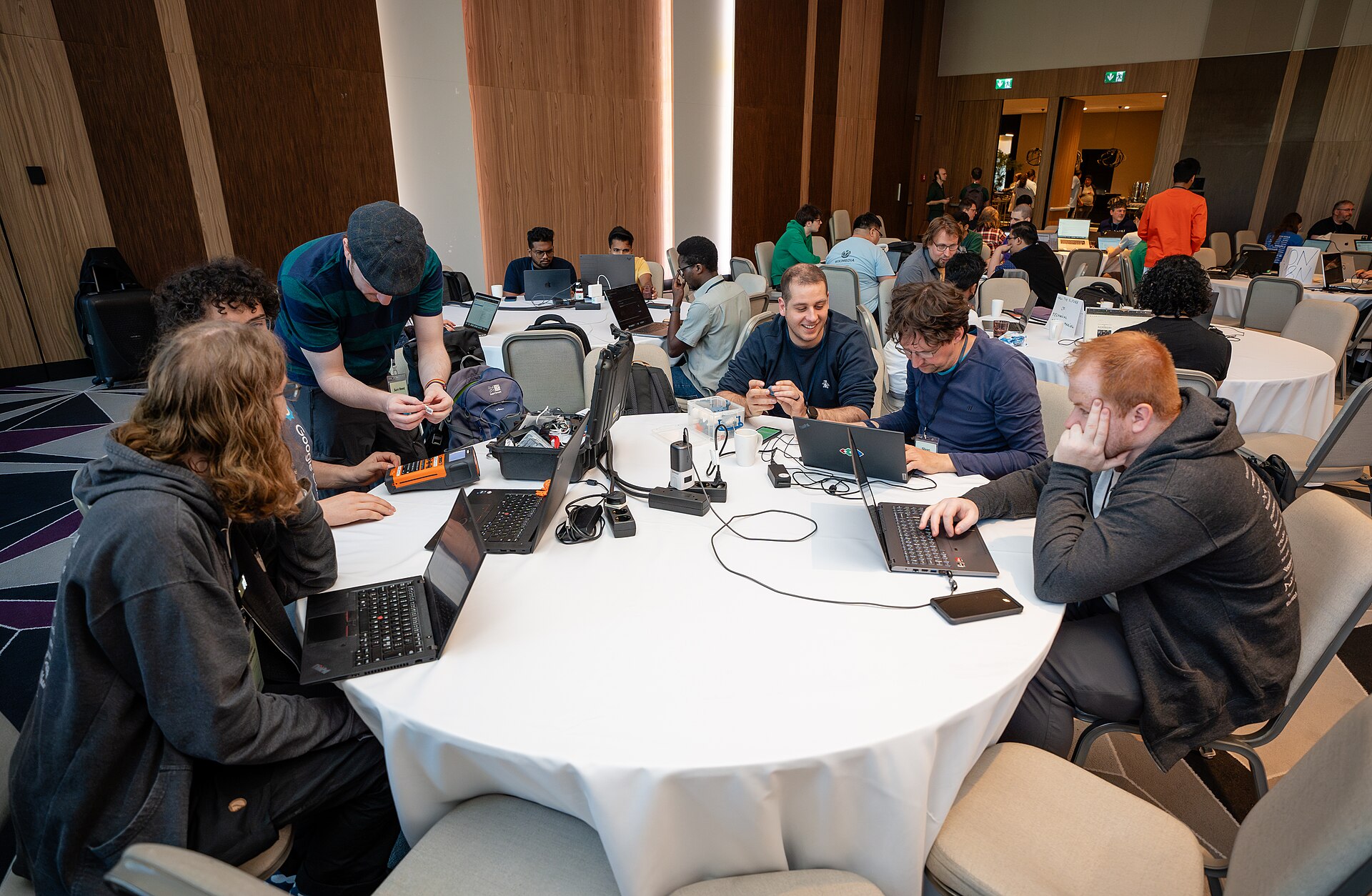
This year's Wikimedia Hackathon was held in early May in Tallinn, Estonia. Like last year, it was a great opportunity to both see people I work with regularly, including people in my own team that I had not seen in person before, and to work with and help people that I have had very limited interactions with before. Me talking with Addshore at the Wikimedia Hackathon 2024 hacking room.
Image by Olari Pilnik is licensed under CC BY-SA 4.0.
I presented a session about Puppet (slides), the configuration management tool used on Wikimedia infrastructure (and some other projects I've been involved on) which I think went quite well. I also organized (read: picked a spot for in the schedule) the cuteness meetup. In addition to the sessions, the main focus of the event was, of course, hacking. As usual, I didn't make any major plans beforehand, and instead ended up working on several smaller projects as they popped up. Here is a list of things I can remember working on: Finally, a conversation I had at the hackathon resulted in me nominating Novem Linguae for mediawiki/* +2 access a few days after the hackathon. I had a great time, and the ferry trip to Tallinn was much nicer than the very early flight I had last year. I can't wait to see you all again :-) Disclosure: I am currently a Wikimedia Foundation contractor, and the Foundation did pay for my travel to Tallinn. This is my personal blog and these are my own opinions.

  1. Since backporting this change felt too risky to do on the weekend, and also I have a feeling I'd get in troble if I ran an unapproved bot that edited on random wikis on our production wiki farm.
  2. Anyone who got 5 or more patches to core.git merged during the Hackathon got a cool MediaWiki T-shirt.

12 May 2024

Elana Hashman: I am very sick

I have not been able to walk since February 18, 2023. When people ask me how I'm doing, this is the first thing that comes to mind. "Well, you know, the usual, but also I still can't walk," I think to myself. If I dream at night, I often see myself walking or running. In conversation, if I talk about going somewhere, I'll imagine walking there. Even though it's been over a year, I remember walking to the bus, riding to see my friends, going out for brunch, cooking community dinners. But these days, I can't manage going anywhere except by car, and I can't do the driving, and I can't dis/assemble and load my chair. When I'm resting in bed and follow a guided meditation, I might be asked to imagine walking up a staircase, step by step. Sometimes, I do. Other times, I imagine taking a little elevator in my chair, or wheeling up ramps. I feel like there is little I can say that can express the extent of what this illness has taken from me, but it's worth trying. To an able-bodied person, seeing me in a power wheelchair is usually "enough." One of my acquaintances cried when they last saw me in person. But frankly, I love my wheelchair. I am not "wheelchair-bound" I am bed-bound, and the wheelchair gets me out of bed. My chair hasn't taken anything from me. *** In October of 2022, I was diagnosed with myalgic encephalomyelitis. Scientists and doctors don't really know what myalgic encephalomyelitis (ME) is. Diseases like it have been described for over 200 years.1 It primarily affects women between the ages of 10-39, and the primary symptom is "post-exertional malaise" or PEM: debilitating, disproportionate fatigue following activity, often delayed by 24-72 hours and not relieved by sleep. That fatigue has earned the illness the misleading name of "Chronic Fatigue Syndrome" or CFS, as though we're all just very tired all the time. But tired people respond to exercise positively. People with ME/CFS do not.2 Given the dearth of research and complete lack of on-label treatments, you may think this illness is at least rare, but it is actually quite common: in the United States, an estimated 836k-2.5m people3 have ME/CFS. It is frequently misdiagnosed, and it is estimated that as many as 90% of cases are missed,4 due to mild or moderate symptoms that mimic other diseases. Furthermore, over half of Long COVID cases likely meet the diagnostic criteria for ME,5 so these numbers have increased greatly in recent years. That is, ME is at least as common as rheumatoid arthritis,6 another delightful illness I have. But while any doctor knows what rheumatoid arthritis is, not enough7 have heard of "myalgic encephalomylitis." Despite a high frequency and disease burden, post-viral associated conditions (PASCs) such as ME have been neglected for medical funding for decades.8 Indeed, many people, including medical care workers, find it hard to believe that after the acute phase of illness, severe symptoms can persist. PASCs such as ME and Long COVID defy the typical narrative around common illnesses. I was always told that if I got sick, I should expect to rest for a bit, maybe take some medications, and a week or two later, I'd get better, right? But I never got better. These are complex, multi-system diseases that do not neatly fit into the Western medical system's specializations. I have seen nearly every specialty because ME/CFS affects nearly every system of the body: cardiology, nephrology, pulmonology, neurology, opthalmology, and, many, many more. You'd think they'd hand out frequent flyer cards, or a medical passport with fun stamps, but nope. Just hundreds of pages of medical records. And when I don't fit neatly into one particular specialist's box, then I'm sent back to my primary care doctor to regroup while we try to troubleshoot my latest concerning symptoms. "Sorry, can't help you. Not my department." With little available medical expertise, a lot of my disease management has been self-directed in partnership with primary care. I've read hundreds of articles, papers, publications, CME material normally reserved for doctors. It's truly out of necessity, and I'm certain I would be much worse off if I lacked the skills and connections to do this; there are so few ME/CFS experts in the US that there isn't one in my state or any adjacent state.9 So I've done a lot of my own work, much of it while barely being able to read. (A text-to-speech service is a real lifesaver.) To facilitate managing my illness, I've built a mental model of how my particular flavour of ME/CFS works based on the available research I've been able to read and how I respond to treatments. Here is my best attempt to explain it: The best way I have learned to manage this is to prevent myself from doing activities where I will exceed that aerobic threshold by wearing a heartrate monitor,12 but the amount of activity that permits in my current state of health is laughably restrictive. Most days I'm unable to spend more than one to two hours out of bed. Over time, this has meant worsening from a persistent feeling of tiredness all the time and difficulty commuting into an office or sitting at a desk, to being unable to sit at a desk for an entire workday even while working from home and avoiding physically intense chores or exercise without really understanding why, to being unable to leave my apartment for days at a time, and finally, being unable to stand for more than a minute or two or walk. But it's not merely that I can't walk. Many folks in wheelchairs are able to live excellent lives with adaptive technology. The problem is that I am so fatigued, any activity can destroy my remaining quality of life. In my worst moments, I've been unable to read, move my arms or legs, or speak aloud. Every single one of my limbs burned, as though I had caught fire. Food sat in my stomach for hours, undigested, while my stomach seemingly lacked the energy to do its job. I currently rely on family and friends for full-time caretaking, plus a paid home health aide, as I am unable to prep meals, shower, or leave the house independently. This assistance has helped me slowly improve from my poorest levels of function. While I am doing better than I was at my worst, I've had to give up essentially all of my hobbies with physical components. These include singing, cooking, baking, taking care of my houseplants, cross-stitching, painting, and so on. Doing any of these result in post-exertional malaise so I've had to stop; this reduction of activity to prevent worsening the illness is referred to as "pacing." I've also had to cut back essentially all of my volunteering and work in open source; I am only cleared by my doctor to work 15h/wk (from bed) as of writing. *** CW: severe illness, death, and suicide (skip this section) The difficulty of living with a chronic illness is that there's no light at the end of the tunnel. Some diseases have a clear treatment path: you take the medications, you complete the procedures, you hit all the milestones, and then you're done, perhaps with some long-term maintenance work. But with ME, there isn't really an end in sight. The median duration of illness reported in one 1997 study was over 6 years, with some patients reporting 20 years of symptoms.13 While a small number of patients spontaneously recover, and many improve, the vast majority of patients are unable to regain their baseline function.14 My greatest fear since losing the ability to walk is getting worse still. Because, while I already require assistance with nearly every activity of daily living, there is still room for decline. The prognosis for extremely ill patients is dismal, and many require feeding tubes and daily nursing care. This may lead to life-threatening malnutrition;15 a number of these extremely severe patients have died, either due to medical neglect or suicide.16 Extremely severe patients cannot tolerate light, sound, touch, or cognitive exertion,17 and often spend most of their time lying flat in a darkened room with ear muffs or an eye mask.18 This is all to say, my prognosis is not great. But while I recognize that the odds aren't exactly in my favour, I am also damn stubborn. (A friend once cheerfully described me as "stubbornly optimistic!") I only get one shot at life, and I do not want to spend the entirety of it barely able to perceive what's going on around me. So while my prognosis is uncertain, there's lots of evidence that I can improve somewhat,19 and there's also lots of evidence that I can live 20+ years with this disease. It's a bitter pill to swallow, but it also means I might have the gift of time something that not all my friends with severe complex illnesses have had. I feel like I owe it to myself to do the best I can to improve; to try to help others in a similar situation; and to enjoy the time that I have. I already feel like my life has been moving in slow motion for the past 4 years there's no need to add more suffering. Finding joy, as much as I can, every day, is essential to keep up my strength for this marathon. Even if it takes 20 years to find a cure, I am convinced that the standard of care is going to improve. All the research and advocacy that's been happening over the past decade is plenty to feel hopeful about.20 Hope is a discipline,21 and I try to remind myself of this on the hardest days. *** I'm not entirely sure why I decided to write this. Certainly, today is International ME/CFS Awareness Day, and I'm hoping this post will raise awareness in spaces that aren't often thinking about chronic illnesses. But I think there is also a part of me that wants to share, reach out in some way to the people I've lost contact with while I've been treading water, managing the day to day of my illness. I experience this profound sense of loss, especially when I think back to the life I had before. Everyone hits limitations in what they can do and accomplish, but there is so little I can do with the time and energy that I have. And yet, I understand even this precious little could still be less. So I pace myself. Perhaps I can inspire you to take action on behalf of those of us too fatigued to do the advocacy we need and deserve. Should you donate to a charity or advocacy organization supporting ME/CFS research? In the US, there are many excellent organizations, such as ME Action, the Open Medicine Foundation, SolveME, the Bateman Horne Center, and the Workwell Foundation. I am also happy to match any donations through the end of May 2024 if you send me your receipts. But charitable giving only goes so far, and I think this problem deserves the backing of more powerful organizations. Proportionate government funding and support is desperately needed. It's critical for us to push governments22 to provide the funding required for research that will make an impact on patients' lives now. Many organizers are running campaigns around the world, advocating for this investment. There is a natural partnership between ME advocacy and Long COVID advocacy, for example, and we have an opportunity to make a great difference to many people by pushing for research and resources inclusive of all PASCs. Some examples I'm aware of include: But outside of collective organizing, there are a lot of sick individuals out there that need help, too. Please, don't forget about us. We need you to visit us, care for us, be our confidantes, show up as friends. There are a lot of people who are very sick out here and need your care. I'm one of them.

11 May 2024

Sven Hoexter: xdg and mime types - stuff I would've loved to know a week ago

Learned a few things about xdg and mimetype registration in the last week that could be helpful to have condensed in a single place. No Need to Ship a Mailcap Mime File If you already ship a .desktop file (that is what ends up in /usr/share/applications/) which has a MimeType declared, there is no need to also ship a mailcap file (that is what ends up in /usr/lib/mime/packages/). Some triggers will do the conversion work for you. See also Debian Policy 4.9. Reverse DNS Naming Convention for .desktop Files Seems to be a closely guarded secret, maybe mainly known inside the Gnome world, but it's in the spec. Also not very widely known inside Debian if I look at my local system as not very representative sample. Your hicolor Theme App Icon can be a Mime Type Icon as Well In case you didn't know the hicolor icon theme is the default fallback theme. Many of us already install application icons e.g. in /usr/share/icons/hicolor/48x48/apps/ which is used in conjunction with the Icon field in the .desktop file to locate the application icon. Now the next step, and there it seems quite of few us miss out, is to create a symlink to also provide a mime type icon, so it's displayed in graphical file managers for the application data files. The schema here is simple: Take the MimeType e.g. application/x-vymand replace the / with a - and use that as file name in e.g. /usr/share/icons/hicolor/48x48/mimetypes/. In the vym case that is /usr/share/icons/hicolor/48x48/mimetypes/application-x-vym.png. If you have one use a scalable .svg file instead of .png. This seems to be an area where Debian lacks a bit of tooling to automatically convert application icons to all the different sizes and install it in all the appropriate places. What is already there is a trigger to run gtk-update-icon-cache when you install new icons into one of the icon theme folder so they're picked up. No Priority or Order in .desktop Files Likely something that hapens on all my fresh installations: Libreoffice is installed and xdg-open starts to open pdf files with Libreoffice instead of evince. Now I've to figure out again to run xdg-mime default org.gnome.Evince.desktop application/pdf to change that (at least for my user). Background here is that the desktop file spec explicitly mandates "Priority for applications is handled external to the .desktop files.". That's why we got in addition to all of that mimeapps.list files. And now, after running the xdg-mime command from above, we've a ~/.config/mimeapps.list defining
[Default Applications]
application/pdf=org.gnome.Evince.desktop
Debian as whole seems to be not very keen on shipping something like a sensible default mimeapps.list outside of desktop environment specific ones. A quick search gave me just
$ apt-file search mimeapps.list
cinnamon-desktop-data: /usr/share/applications/x-cinnamon-mimeapps.list
gdm3: /usr/share/gdm/greeter/applications/mimeapps.list
gnome-session-common: /usr/share/applications/gnome-mimeapps.list
plasma-workspace: /usr/share/applications/kde-mimeapps.list
sxmo-utils: /usr/share/applications/mimeapps.list
sxmo-utils: /usr/share/sxmo/xdg/mimeapps.list
While it's a bit anoying to run into that pdf vs Libreoffice thing every now and then, it's maybe better to not have long controversial threads about default pdf viewer, like the ones we already had about the default MTA choices. ;) And while we're at it: everyone using Libreoffice should give a virtual hug to rene@ for taming that beast since 2010 and OpenOffice.org before.

9 May 2024

Dirk Eddelbuettel: RcppArmadillo 0.12.8.3.0 on CRAN: Upstream Bugfix

armadillo image Armadillo is a powerful and expressive C++ template library for linear algebra and scientific computing. It aims towards a good balance between speed and ease of use, has a syntax deliberately close to Matlab, and is useful for algorithm development directly in C++, or quick conversion of research code into production environments. RcppArmadillo integrates this library with the R environment and language and is widely used by (currently) 1144 other packages on CRAN, downloaded 34.2 million times (per the partial logs from the cloud mirrors of CRAN), and the CSDA paper (preprint / vignette) by Conrad and myself has been cited 583 times according to Google Scholar. Conrad released a new upstream bugfix yesterday (for a corner case with fftw3). We uploaded it yesterday too but it took a day for the hard-working CRAN maintainers to concur that the one (!) NOTE from reverse-dependency checking over 1100 packages was in a fact a false positve. And so it appeared on CRAN (very) early this morning. We also made a change removing a long-redundant setter for C++11 mode via the plugin. No other changes were made. The set of changes since the last CRAN release follows.

Changes in RcppArmadillo version 0.12.8.3.0 (2024-05-07)
  • Upgraded to Armadillo release 12.8.3 (Cortisol Injector)
    • Fix issue in fft() and fft2() in multi-threaded contexts with FFTW3 enabled
  • No longer set C++11 for the Rcpp plugin as this standard has been the default by R for very long time now.

Courtesy of my CRANberries, there is a diffstat report relative to previous release. More detailed information is on the RcppArmadillo page. Questions, comments etc should go to the rcpp-devel mailing list off the Rcpp R-Forge page. If you like this or other open-source work I do, you can sponsor me at GitHub.

This post by Dirk Eddelbuettel originated on his Thinking inside the box blog. Please report excessive re-aggregation in third-party for-profit settings.

7 May 2024

Melissa Wen: Get Ready to 2024 Linux Display Next Hackfest in A Coru a!

We re excited to announce the details of our upcoming 2024 Linux Display Next Hackfest in the beautiful city of A Coru a, Spain! This year s hackfest will be hosted by Igalia and will take place from May 14th to 16th. It will be a gathering of minds from a diverse range of companies and open source projects, all coming together to share, learn, and collaborate outside the traditional conference format.

Who s Joining the Fun? We re excited to welcome participants from various backgrounds, including:
  • GPU hardware vendors;
  • Linux distributions;
  • Linux desktop environments and compositors;
  • Color experts, researchers and enthusiasts;
This diverse mix of backgrounds are represented by developers from several companies working on the Linux display stack: AMD, Arm, BlueSystems, Bootlin, Collabora, Google, GravityXR, Igalia, Intel, LittleCMS, Qualcomm, Raspberry Pi, RedHat, SUSE, and System76. It ll ensure a dynamic exchange of perspectives and foster collaboration across the Linux Display community. Please take a look at the list of participants for more info.

What s on the Agenda? The beauty of the hackfest is that the agenda is driven by participants! As this is a hybrid event, we decided to improve the experience for remote participants by creating a dedicated space for them to propose topics and some introductory talks in advance. From those inputs, we defined a schedule that reflects the collective interests of the group, but is still open for amendments and new proposals. Find the schedule details in the official event webpage. Expect discussions on:

KMS Color/HDR
  • Proposal with new DRM object type:
    • Brief presentation of GPU-vendor features;
    • Status update of plane color management pipeline per vendor on Linux;
  • HDR/Color Use-cases:
    • HDR gainmap images and how should we think about HDR;
    • Google/ChromeOS GFX view about HDR/per-plane color management, VKMS and lessons learned;
  • Post-blending Color Pipeline.
  • Color/HDR testing/CI
    • VKMS status update;
    • Chamelium boards, video capture.
  • Wayland protocols
    • color-management protocol status update;
    • color-representation and video playback.
Display control
  • HDR signalling status update;
  • backlight status update;
  • EDID and DDC/CI.
Strategy for video and gaming use-cases
  • Multi-plane support in compositors
    • Underlay, overlay, or mixed strategy for video and gaming use-cases;
    • KMS Plane UAPI to simplify the plane arrangement problem;
    • Shared plane arrangement algorithm desired.
  • HDR video and hardware overlay
Frame timing and VRR
  • Frame timing:
    • Limitations of uAPI;
    • Current user space solutions;
    • Brainstorm better uAPI;
  • Cursor/overlay plane updates with VRR;
  • KMS commit and buffer-readiness deadlines;
Power Saving vs Color/Latency
  • ABM (adaptive backlight management);
  • PSR1 latencies;
  • Power optimization vs color accuracy/latency requirements.
Content-Adaptive Scaling & Sharpening
  • Content-Adaptive Scalers on display hardware;
  • New drm_colorop for content adaptive scaling;
  • Proprietary algorithms.
Display Mux
  • Laptop muxes for switching of the embedded panel between the integrated GPU and the discrete GPU;
  • Seamless/atomic hand-off between drivers on Linux desktops.
Real time scheduling & async KMS API
  • Potential benefits: lower latency input feedback, better VRR handling, buffer synchronization, etc.
  • Issues around async uAPI usage and async-call handling.

In-person, but also geographically-distributed event This year Linux Display Next hackfest is a hybrid event, hosted onsite at the Igalia offices and available for remote attendance. In-person participants will find an environment for networking and brainstorming in our inspiring and collaborative office space. Additionally, A Coru a itself is a gem waiting to be explored, with stunning beaches, good food, and historical sites.

Semi-structured structure: how the 2024 Linux Display Next Hackfest will work
  • Agenda: Participants proposed the topics and talks for discussing in sessions.
  • Interactive Sessions: Discussions, workshops, introductory talks and brainstorming sessions lasting around 1h30. There is always a starting point for discussions and new ideas will emerge in real time.
  • Immersive experience: We will have coffee-breaks between sessions and lunch time at the office for all in-person participants. Lunches and coffee-breaks are sponsored by Igalia. This will keep us sharing knowledge and in continuous interaction.
  • Spaces for all group sizes: In-person participants will find different room sizes that match various group sizes at Igalia HQ. Besides that, there will be some devices for showcasing and real-time demonstrations.

Social Activities: building connections beyond the sessions To make the most of your time in A Coru a, we ll be organizing some social activities:
  • First-day Dinner: In-person participants will enjoy a Galician dinner on Tuesday, after a first day of intensive discussions in the hackfest.
  • Getting to know a little of A Coru a: Finding out a little about A Coru a and current local habits.
Participants of a guided tour in one of the sectors of the Museum of Estrella Galicia (MEGA). Source: mundoestrellagalicia.es
  • On Thursday afternoon, we will close the 2024 Linux Display Next hackfest with a guided tour of the Museum of Galicia s favorite beer brand, Estrella Galicia. The guided tour covers the eight sectors of the museum and ends with beer pouring and tasting. After this experience, a transfer bus will take us to the Maria Pita square.
  • At Maria Pita square we will see the charm of some historical landmarks of A Coru a, explore the casual and vibrant style of the city center and taste local foods while chatting with friends.

Sponsorship Igalia sponsors lunches and coffee-breaks on hackfest days, Tuesday s dinner, and the social event on Thursday afternoon for in-person participants. We can t wait to welcome hackfest attendees to A Coru a! Stay tuned for further details and outcomes of this unconventional and unique experience.

3 May 2024

Colin Watson: Playing with rich

One of the things I do as a side project for Freexian is to work on various bits of business automation: accounting tools, programs to help contributors report their hours, invoicing, that kind of thing. While it s not quite my usual beat, this makes quite a good side project as the tools involved are mostly rather sensible and easy to deal with (Python, git, ledger, that sort of thing) and it s the kind of thing where I can dip into it for a day or so a week and feel like I m making useful contributions. The logic can be quite complex, but there s very little friction in the tools themselves. A recent case where I did run into some friction in the tools was with some commands that need to present small amounts of tabular data on the terminal, using OSC 8 hyperlinks if the terminal supports them: think customer-related information with some links to issues. One of my colleagues had previously done this using a hack on top of texttable, which was perfectly fine as far as it went. However, now I wanted to be able to add multiple links in a single table cell in some cases, and that was really going to stretch the limits of that approach: working out the width of the displayed text in the cell was going to take an annoying amount of bookkeeping. I started looking around to see whether any other approaches might be easier, without too much effort (remember that a day or so a week bit above). ansiwrap looked somewhat promising, but it isn t currently packaged in Debian, and it would have still left me with the problem of figuring out how to integrate it into texttable, which looked like it would be quite complicated. Then I remembered that I d heard good things about rich, and thought I d take a look. rich turned out to be exactly what I wanted. Instead of something like this based on the texttable hack above:
import shutil
from pyxian.texttable import UrlTable
termsize = shutil.get_terminal_size((80, 25))
table = UrlTable(max_width=termsize.columns)
table.set_deco(UrlTable.HEADER)
table.set_cols_align(["l"])
table.set_cols_dtype(["u"])
table.add_row(["Issue"])
table.add_row([(issue_url, f"# issue_id ")]
print(table.draw())
now I can do this instead:
import rich
from rich import box
from rich.table import Table
table = Table(box=box.SIMPLE)
table.add_column("Issue")
table.add_row(f"[link= issue_url ]# issue_id [/link]")
rich.print(table)
While this is a little shorter, the real bonus is that I can now just put multiple [link] tags in a single string, and it all just works. No ceremony. In fact, once the relevant bits of code passed type-checking (since the real code is a bit more complex than the samples above), it worked first time. It s a pleasure to work with a library like that. It looks like I ve only barely scratched the surface of rich, but I expect I ll reach for it more often now.

1 May 2024

Antoine Beaupr : Tor migrates from Gitolite/GitWeb to GitLab

Note: I've been awfully silent here for the past ... (checks notes) oh dear, 3 months! But that's not because I've been idle, quite the contrary, I've been very busy but just didn't have time to write about anything. So I've taken it upon myself to write something about my work this week, and published this post on the Tor blog which I copy here for a broader audience. Let me know if you like this or not.
Tor has finally completed a long migration from legacy Git infrastructure (Gitolite and GitWeb) to our self-hosted GitLab server. Git repository addresses have therefore changed. Many of you probably have made the switch already, but if not, you will need to change:
https://git.torproject.org/
to:
https://gitlab.torproject.org/
In your Git configuration. The GitWeb front page is now an archived listing of all the repositories before the migration. Inactive git repositories were archived in GitLab legacy/gitolite namespace and the gitweb.torproject.org and git.torproject.org web sites now redirect to GitLab. Best effort was made to reproduce the original gitolite repositories faithfully and also avoid duplicating too much data in the migration. But it's possible that some data present in Gitolite has not migrated to GitLab. User repositories are particularly at risk, because they were massively migrated, and they were "re-forked" from their upstreams, to avoid wasting disk space. If a user had a project with a matching name it was assumed to have the right data, which might be inaccurate. The two virtual machines responsible for the legacy service (cupani for git-rw.torproject.org and vineale for git.torproject.org and gitweb.torproject.org) have been shutdown. Their disks will remain for 3 months (until the end of July 2024) and their backups for another year after that (until the end of July 2025), after which point all the data from those hosts will be destroyed, with only the GitLab archives remaining. The rest of this article expands on how this was done and what kind of problems we faced during the migration.

Where is the code? Normally, nothing should be lost. All repositories in gitolite have been either explicitly migrated by their owners, forcibly migrated by the sysadmin team (TPA), or explicitly destroyed at their owner's request. An exhaustive rewrite map translates gitolite projects to GitLab projects. Some of those projects actually redirect to their parent in cases of empty repositories that were obvious forks. Destroyed repositories redirect to the GitLab front page. Because the migration happened progressively, it's technically possible that commits pushed to gitolite were lost after the migration. We took great care to avoid that scenario. First, we adopted a proposal (TPA-RFC-36) in June 2023 to announce the transition. Then, in March 2024, we locked down all repositories from any further changes. Around that time, only a handful of repositories had changes made after the adoption date, and we examined each repository carefully to make sure nothing was lost. Still, we built a diff of all the changes in the git references that archivists can peruse to check for data loss. It's large (6MiB+) because a lot of repositories were migrated before the mass migration and then kept evolving in GitLab. Many other repositories were rebuilt in GitLab from parent to rebuild a fork relationship which added extra references to those clones. A note to amateur archivists out there, it's probably too late for one last crawl now. The Git repositories now all redirect to GitLab and are effectively unavailable in their original form. That said, the GitWeb site was crawled into the Internet Archive in February 2024, so at least some copy of it is available in the Wayback Machine. At that point, however, many developers had already migrated their projects to GitLab, so the copies there were already possibly out of date compared with the repositories in GitLab. Software Heritage also has a copy of all repositories hosted on Gitolite since June 2023 and have continuously kept mirroring the repositories, where they will be kept hopefully in eternity. There's an issue where the main website can't find the repositories when you search for gitweb.torproject.org, instead search for git.torproject.org. In any case, if you believe data is missing, please do let us know by opening an issue with TPA.

Why? This is an old project in the making. The first discussion about migrating from gitolite to GitLab started in 2020 (almost 4 years ago). But going further back, the first GitLab experiment was in 2016, almost a decade ago. The current GitLab server dates from 2019, replacing Trac for issue tracking in 2020. It was originally supposed to host only mirrors for merge requests and issue trackers but, naturally, one thing led to another and eventually, GitLab had grown a container registry, continuous integration (CI) runners, GitLab Pages, and, of course, hosted most Git repositories. There were hesitations at moving to GitLab for code hosting. We had discussions about the increased attack surface and ways to mitigate that, but, ultimately, it seems the issues were not that serious and the community embraced GitLab. TPA actually migrated its most critical repositories out of shared hosting entirely, into specific servers (e.g. the Puppet Git repository is just on the Puppet server now), leveraging Git's decentralized nature and removing an entire attack surface from our infrastructure. Some of those repositories are mirrored back into GitLab, but the authoritative copy is not on GitLab. In any case, the proposal to migrate from Gitolite to GitLab was effectively just formalizing a fait accompli.

How to migrate from Gitolite / cgit to GitLab The progressive migration was a challenge. If you intend to migrate between hosting platforms, we strongly recommend to make a "flag day" during which you migrate all repositories at once. This ensures a smoother transition and avoids elaborate rewrite rules. When Gitolite access was shutdown, we had repositories on both GitLab and Gitolite, without a clear relationship between the two. A priori, the plan then was to import all the remaining Gitolite repositories into the legacy/gitolite namespace, but that seemed wasteful, particularly for large repositories like Tor Browser which uses nearly a gigabyte of disk space. So we took special care to avoid duplicating repositories. When the mass migration started, only 71 of the 538 Gitolite repositories were Migrated to GitLab in the gitolite.conf file. So, given that we had hundreds of repositories to migrate:, we developed some automation to "save time". We already automate similar ad-hoc tasks with Fabric, so we used that framework here as well. (Our normal configuration management tool is Puppet, which is a poor fit here.) So a relatively large amount of Python code was produced to basically do the following:
  1. check if all on-disk repositories are listed in gitolite.conf (and vice versa) and either add missing repositories or delete them from disk if garbage
  2. for each repository in gitolite.conf, if its category is marked Migrated to GitLab, skip, otherwise;
  3. find a matching GitLab project by name, prompt the user for multiple matches
  4. if a match is found, redirect if the repository is non-empty
    • we have GitLab projects that look like the real thing, but are only present to host migrated Trac issues
    • in such cases we cloned the Gitolite project locally and pushed to the existing repository instead
  5. otherwise, a new repository is created in the legacy/gitolite namespace, using the "import" mechanism in GitLab to automatically import the repository from Gitolite, creating redirections and updating gitolite.conf to document the change
User repositories (those under the user/ directory in Gitolite) were handled specially. First, the existing redirection map was checked to see if a similarly named project was migrated (so that, e.g. user/dgoulet/tor is properly treated as a fork of tpo/core/tor). Then the parent project was forked in GitLab and the Gitolite project force-pushed to the fork. This allows us to show the fork relationship in GitLab and, more importantly, benefit from the "pool" feature in GitLab which deduplicates disk usage between forks. Sometimes, we found no such relationships. Then we simply imported multiple repositories with similar names in the legacy/gitolite namespace, sometimes creating forks between user repositories, on a first-come-first-served basis from the gitolite.conf order. The code used in this migration is now available publicly. We encourage other groups planning to migrate from Gitolite/GitWeb to GitLab to use (and contribute to) our fabric-tasks repository, even though it does have its fair share of hard-coded assertions. The main entry point is the gitolite.mass-repos-migration task. A typical migration job looked like:
anarcat@angela:fabric-tasks$ fab -H cupani.torproject.org gitolite.mass-repos-migration 
[...]
INFO: skipping project project/help/infra in category Migrated to GitLab
INFO: skipping project project/help/wiki in category Migrated to GitLab
INFO: skipping project project/jenkins/jobs in category Migrated to GitLab
INFO: skipping project project/jenkins/tools in category Migrated to GitLab
INFO: searching for projects matching fastlane
INFO: Successfully connected to https://gitlab.torproject.org
import gitolite project project/tor-browser/fastlane into gitlab legacy/gitolite/project/tor-browser/fastlane with desc 'Tor Browser app store and deployment configuration for Fastlane'? [Y/n] 
INFO: importing gitolite project project/tor-browser/fastlane into gitlab legacy/gitolite/project/tor-browser/fastlane with desc 'Tor Browser app store and deployment configuration for Fastlane'
INFO: building a new connect to cupani
INFO: defaulting name to fastlane
INFO: importing project into GitLab
INFO: Successfully connected to https://gitlab.torproject.org
INFO: loading group legacy/gitolite/project/tor-browser
INFO: archiving project
INFO: creating repository fastlane (fastlane) in namespace legacy/gitolite/project/tor-browser from https://git.torproject.org/project/tor-browser/fastlane into https://gitlab.torproject.org/legacy/gitolite/project/tor-browser/fastlane
INFO: migrating Gitolite repository project/tor-browser/fastlane to GitLab project legacy/gitolite/project/tor-browser/fastlane
INFO: uploading 399 bytes to /srv/git.torproject.org/repositories/project/tor-browser/fastlane.git/hooks/pre-receive
INFO: making /srv/git.torproject.org/repositories/project/tor-browser/fastlane.git/hooks/pre-receive executable
INFO: adding entry to rewrite_map /home/anarcat/src/tor/tor-puppet/modules/profile/files/git/gitolite2gitlab.txt
INFO: modifying gitolite.conf to add: "config gitweb.category = Migrated to GitLab"
INFO: rewriting gitolite config /home/anarcat/src/tor/gitolite-admin/conf/gitolite.conf to change project project/tor-browser/fastlane to category Migrated to GitLab
INFO: skipping project project/bridges/bridgedb-admin in category Migrated to GitLab
[...]
In the above, you can see migrated repositories skipped then the fastlane project being archived into GitLab. Another example with a later version of the script, processing only user repositories and showing the interactive prompt and a force-push into a fork:
$ fab -H cupani.torproject.org  gitolite.mass-repos-migration --include 'user/.*' --exclude '.*tor-?browser.*'
INFO: skipping project user/aagbsn/bridgedb in category Migrated to GitLab
[...]
INFO: skipping project user/phw/atlas in category Migrated to GitLab
INFO: processing project user/phw/obfsproxy (Philipp's obfsproxy repository) in category Users' development repositories (Attic)
INFO: Successfully connected to https://gitlab.torproject.org
INFO: user repository detected, trying to find fork phw/obfsproxy
WARNING: no existing fork found, entering user fork subroutine
INFO: found 6 GitLab projects matching 'obfsproxy' (https://gitweb.torproject.org/user/phw/obfsproxy.git)
0 legacy/gitolite/debian/obfsproxy
1 legacy/gitolite/debian/obfsproxy-legacy
2 legacy/gitolite/user/asn/obfsproxy
3 legacy/gitolite/user/ioerror/obfsproxy
4 tpo/anti-censorship/pluggable-transports/obfsproxy
5 tpo/anti-censorship/pluggable-transports/obfsproxy-legacy
select parent to fork from, or enter to abort: ^G4
INFO: repository is not empty: in-pack: 2104, packs: 1, size-pack: 414
fork project tpo/anti-censorship/pluggable-transports/obfsproxy into legacy/gitolite/user/phw/obfsproxy^G [Y/n] 
INFO: loading project tpo/anti-censorship/pluggable-transports/obfsproxy
INFO: forking project user/phw/obfsproxy into namespace legacy/gitolite/user/phw
INFO: waiting for fork to complete...
INFO: fork status: started, sleeping...
INFO: fork finished
INFO: cloning and force pushing from user/phw/obfsproxy to legacy/gitolite/user/phw/obfsproxy
INFO: deleting branch protection: <class 'gitlab.v4.objects.branches.ProjectProtectedBranch'> =>  'id': 2723, 'name': 'master', 'push_access_levels': [ 'id': 2864, 'access_level': 40, 'access_level_description': 'Maintainers', 'deploy_key_id': None ], 'merge_access_levels': [ 'id': 2753, 'access_level': 40, 'access_level_description': 'Maintainers' ], 'allow_force_push': False 
INFO: cloning repository git-rw.torproject.org:/srv/git.torproject.org/repositories/user/phw/obfsproxy.git in /tmp/tmp6orvjggy/user/phw/obfsproxy
Cloning into bare repository '/tmp/tmp6orvjggy/user/phw/obfsproxy'...
INFO: pushing to GitLab: https://gitlab.torproject.org/legacy/gitolite/user/phw/obfsproxy
remote: 
remote: To create a merge request for bug_10887, visit:        
remote:   https://gitlab.torproject.org/legacy/gitolite/user/phw/obfsproxy/-/merge_requests/new?merge_request%5Bsource_branch%5D=bug_10887        
remote: 
[...]
To ssh://gitlab.torproject.org/legacy/gitolite/user/phw/obfsproxy
 + 2bf9d09...a8e54d5 master -> master (forced update)
 * [new branch]      bug_10887 -> bug_10887
[...]
INFO: migrating repo
INFO: migrating Gitolite repository https://gitweb.torproject.org/user/phw/obfsproxy.git to GitLab project https://gitlab.torproject.org/legacy/gitolite/user/phw/obfsproxy
INFO: adding entry to rewrite_map /home/anarcat/src/tor/tor-puppet/modules/profile/files/git/gitolite2gitlab.txt
INFO: modifying gitolite.conf to add: "config gitweb.category = Migrated to GitLab"
INFO: rewriting gitolite config /home/anarcat/src/tor/gitolite-admin/conf/gitolite.conf to change project user/phw/obfsproxy to category Migrated to GitLab
INFO: processing project user/phw/scramblesuit (Philipp's ScrambleSuit repository) in category Users' development repositories (Attic)
INFO: user repository detected, trying to find fork phw/scramblesuit
WARNING: no existing fork found, entering user fork subroutine
WARNING: no matching gitlab project found for user/phw/scramblesuit
INFO: user fork subroutine failed, resuming normal procedure
INFO: searching for projects matching scramblesuit
import gitolite project user/phw/scramblesuit into gitlab legacy/gitolite/user/phw/scramblesuit with desc 'Philipp's ScrambleSuit repository'?^G [Y/n] 
INFO: checking if remote repo https://git.torproject.org/user/phw/scramblesuit exists
INFO: importing gitolite project user/phw/scramblesuit into gitlab legacy/gitolite/user/phw/scramblesuit with desc 'Philipp's ScrambleSuit repository'
INFO: importing project into GitLab
INFO: Successfully connected to https://gitlab.torproject.org
INFO: loading group legacy/gitolite/user/phw
INFO: creating repository scramblesuit (scramblesuit) in namespace legacy/gitolite/user/phw from https://git.torproject.org/user/phw/scramblesuit into https://gitlab.torproject.org/legacy/gitolite/user/phw/scramblesuit
INFO: archiving project
INFO: migrating Gitolite repository https://gitweb.torproject.org/user/phw/scramblesuit.git to GitLab project https://gitlab.torproject.org/legacy/gitolite/user/phw/scramblesuit
INFO: adding entry to rewrite_map /home/anarcat/src/tor/tor-puppet/modules/profile/files/git/gitolite2gitlab.txt
INFO: modifying gitolite.conf to add: "config gitweb.category = Migrated to GitLab"
INFO: rewriting gitolite config /home/anarcat/src/tor/gitolite-admin/conf/gitolite.conf to change project user/phw/scramblesuit to category Migrated to GitLab
[...]
Acute eyes will notice the bell used as a notification mechanism as well in this transcript. A lot of the code is now useless for us, but some, like "commit and push" or is-repo-empty live on in the git module and, of course, the gitlab module has grown some legs along the way. We've also found fun bugs, like a file descriptor exhaustion in bash, among other oddities. The retirement milestone and issue 41215 has a detailed log of the migration, for those curious. This was a challenging project, but it feels nice to have this behind us. This gets rid of 2 of the 4 remaining machines running Debian "old-old-stable", which moves a bit further ahead in our late bullseye upgrades milestone. Full transparency: we tested GPT-3.5, GPT-4, and other large language models to see if they could answer the question "write a set of rewrite rules to redirect GitWeb to GitLab". This has become a standard LLM test for your faithful writer to figure out how good a LLM is at technical responses. None of them gave an accurate, complete, and functional response, for the record. The actual rewrite rules as of this writing follow, for humans that actually like working answers provided by expert humans instead of artificial intelligence which currently seem to be, glorified, mansplaining interns.

git.torproject.org rewrite rules Those rules are relatively simple in that they rewrite a single URL to its equivalent GitLab counterpart in a 1:1 fashion. It relies on the rewrite map mentioned above, of course.
RewriteEngine on
# this RewriteMap connects the gitweb projects to their GitLab
# equivalent
RewriteMap gitolite2gitlab "txt:/etc/apache2/gitolite2gitlab.txt"
# if this becomes a performance bottleneck, convert to a DBM map with:
#
#  $ httxt2dbm -i mapfile.txt -o mapfile.map
#
# and:
#
# RewriteMap mapname "dbm:/etc/apache/mapfile.map"
#
# according to reports lavamind found online, we hit such a
# performance bottleneck only around millions of entries, which is not our case
# those two rules can go away once all the projects are
# migrated to GitLab
#
# this matches the request URI so we can check the RewriteMap
# for a match next
#
# WARNING: this won't match URLs without .git in them, which
# *do* work now. one possibility would be to match the request
# URI (without query string!) with:
#
# /git/(.*)(.git)?/(((branches hooks info objects/).*) git-.* upload-pack receive-pack HEAD config description)?.
#
# I haven't been able to figure out the actual structure of
# those URLs, so it's really hard to figure out the boundaries
# of the project name here. I stopped after pouring around the
# http-backend.c code in git
# itself. https://www.git-scm.com/docs/http-protocol is also
# kind of incomplete and unsatisfying.
RewriteCond % REQUEST_URI  ^/(git/)?(.*).git/.*$
# this makes the RewriteRule match only if there's a match in
# the rewrite map
RewriteCond $ gitolite2gitlab:%2 NOT_FOUND  !NOT_FOUND
RewriteRule ^/(git/)?(.*).git/(.*)$ https://gitlab.torproject.org/$ gitolite2gitlab:$2 .git/$3 [R=302,L]
# Fallback everything else to GitLab
RewriteRule (.*) https://gitlab.torproject.org [R=302,L]

gitweb.torproject.org rewrite rules Those are the vastly more complicated GitWeb to GitLab rewrite rules. Note that we say "GitWeb" but we were actually not running GitWeb but cgit, as the former didn't actually scale for us.
RewriteEngine on
# this RewriteMap connects the gitweb projects to their GitLab
# equivalent
RewriteMap gitolite2gitlab "txt:/etc/apache2/gitolite2gitlab.txt"
# special rule to process targets of the old spec.tpo site and
# bring them to the right redirect on the new spec.tpo site. that should turn, for example:
#
# https://gitweb.torproject.org/torspec.git/tree/address-spec.txt
#
# into:
#
# https://spec.torproject.org/address-spec
RewriteRule ^/torspec.git/tree/(.*).txt$ https://spec.torproject.org/$1 [R=302]
# list of endpoints taken from cgit's cmd.c
# those two RewriteCond are necessary because we don't move
# all repositories at once. once the migration is completed,
# they can be removed.
#
# and yes, they are copied all over the place below
#
# create a match for the project name to check if the project
# has been moved to GitLab
RewriteCond % REQUEST_URI  ^/(.*).git(/.*)?$
# this makes the RewriteRule match only if there's a match in
# the rewrite map
RewriteCond $ gitolite2gitlab:%1 NOT_FOUND  !NOT_FOUND
# main project page, like summary below
RewriteRule ^/(.*).git/?$ https://gitlab.torproject.org/$ gitolite2gitlab:$1 / [R=302,L]
# summary
RewriteCond % REQUEST_URI  ^/(.*).git/.*$
RewriteCond $ gitolite2gitlab:%1 NOT_FOUND  !NOT_FOUND
RewriteRule ^/(.*).git/summary/?$ https://gitlab.torproject.org/$ gitolite2gitlab:$1 / [R=302,L]
# about
RewriteCond % REQUEST_URI  ^/(.*).git/.*$
RewriteCond $ gitolite2gitlab:%1 NOT_FOUND  !NOT_FOUND
RewriteRule ^/(.*).git/about/?$ https://gitlab.torproject.org/$ gitolite2gitlab:$1 / [R=302,L]
# commit
RewriteCond % REQUEST_URI  ^/(.*).git/.*$
RewriteCond $ gitolite2gitlab:%1 NOT_FOUND  !NOT_FOUND
RewriteCond "% QUERY_STRING " "(.*(?:^ &))id=([^&]*)(&.*)?$"
RewriteRule ^/(.*).git/commit/? https://gitlab.torproject.org/$ gitolite2gitlab:$1 /-/commit/%2 [R=302,L,QSD]
RewriteCond % REQUEST_URI  ^/(.*).git/.*$
RewriteCond $ gitolite2gitlab:%1 NOT_FOUND  !NOT_FOUND
RewriteRule ^/(.*).git/commit/? https://gitlab.torproject.org/$ gitolite2gitlab:$1 /-/commits/HEAD [R=302,L]
# diff, incomplete because can diff arbitrary refs and files in cgit but not in GitLab, hard to parse
RewriteCond % REQUEST_URI  ^/(.*).git/.*$
RewriteCond $ gitolite2gitlab:%1 NOT_FOUND  !NOT_FOUND
RewriteCond % QUERY_STRING  id=([^&]*)
RewriteRule ^/(.*).git/diff/? https://gitlab.torproject.org/$ gitolite2gitlab:$1 /-/commit/%1 [R=302,L,QSD]
# patch
RewriteCond % REQUEST_URI  ^/(.*).git/.*$
RewriteCond $ gitolite2gitlab:%1 NOT_FOUND  !NOT_FOUND
RewriteCond % QUERY_STRING  id=([^&]*)
RewriteRule ^/(.*).git/patch/? https://gitlab.torproject.org/$ gitolite2gitlab:$1 /-/commit/%1.patch [R=302,L,QSD]
# rawdiff, incomplete because can show only one file diff, which GitLab cannot
RewriteCond % REQUEST_URI  ^/(.*).git/.*$
RewriteCond $ gitolite2gitlab:%1 NOT_FOUND  !NOT_FOUND
RewriteCond % QUERY_STRING  id=([^&]*)
RewriteRule ^/(.*).git/rawdiff/?$ https://gitlab.torproject.org/$ gitolite2gitlab:$1 /-/commit/%1.diff [R=302,L,QSD]
# log
RewriteCond % REQUEST_URI  ^/(.*).git/.*$
RewriteCond $ gitolite2gitlab:%1 NOT_FOUND  !NOT_FOUND
RewriteCond % QUERY_STRING  h=([^&]*)
RewriteRule ^/(.*).git/log/?$ https://gitlab.torproject.org/$ gitolite2gitlab:$1 /-/commits/%1 [R=302,L,QSD]
RewriteCond % REQUEST_URI  ^/(.*).git/.*$
RewriteCond $ gitolite2gitlab:%1 NOT_FOUND  !NOT_FOUND
RewriteRule ^/(.*).git/log/?$ https://gitlab.torproject.org/$ gitolite2gitlab:$1 /-/commits/HEAD [R=302,L]
RewriteCond % REQUEST_URI  ^/(.*).git/.*$
RewriteCond $ gitolite2gitlab:%1 NOT_FOUND  !NOT_FOUND
RewriteRule ^/(.*).git/log(/?.*)$ https://gitlab.torproject.org/$ gitolite2gitlab:$1 /-/commits/HEAD$2 [R=302,L]
# atom
RewriteCond % REQUEST_URI  ^/(.*).git/.*$
RewriteCond $ gitolite2gitlab:%1 NOT_FOUND  !NOT_FOUND
RewriteCond % QUERY_STRING  h=([^&]*)
RewriteRule ^/(.*).git/atom/?$ https://gitlab.torproject.org/$ gitolite2gitlab:$1 /-/commits/%1 [R=302,L,QSD]
RewriteCond % REQUEST_URI  ^/(.*).git/.*$
RewriteCond $ gitolite2gitlab:%1 NOT_FOUND  !NOT_FOUND
RewriteRule ^/(.*).git/atom/?$ https://gitlab.torproject.org/$ gitolite2gitlab:$1 /-/commits/HEAD [R=302,L,QSD]
# refs, incomplete because two pages in GitLab, defaulting to "tags"
RewriteCond % REQUEST_URI  ^/(.*).git/.*$
RewriteCond $ gitolite2gitlab:%1 NOT_FOUND  !NOT_FOUND
RewriteRule ^/(.*).git/refs/?$ https://gitlab.torproject.org/$ gitolite2gitlab:$1 /-/tags [R=302,L]
RewriteCond % REQUEST_URI  ^/(.*).git/.*$
RewriteCond $ gitolite2gitlab:%1 NOT_FOUND  !NOT_FOUND
RewriteCond % QUERY_STRING  h=([^&]*)
RewriteRule ^/(.*).git/tag/? https://gitlab.torproject.org/$ gitolite2gitlab:$1 /-/tags/%1 [R=302,L,QSD]
# tree
RewriteCond % REQUEST_URI  ^/(.*).git/.*$
RewriteCond $ gitolite2gitlab:%1 NOT_FOUND  !NOT_FOUND
RewriteCond % QUERY_STRING  id=([^&]*)
RewriteRule ^/(.*).git/tree(/?.*)$ https://gitlab.torproject.org/$ gitolite2gitlab:$1 /-/tree/%1$2 [R=302,L,QSD]
RewriteCond % REQUEST_URI  ^/(.*).git/.*$
RewriteCond $ gitolite2gitlab:%1 NOT_FOUND  !NOT_FOUND
RewriteRule ^/(.*).git/tree(/?.*)$ https://gitlab.torproject.org/$ gitolite2gitlab:$1 /-/tree/HEAD$2 [R=302,L]
# /-/tree has no good default in GitLab, revert to HEAD which is a good
# approximation (we can't assume "master" here anymore)
RewriteCond % REQUEST_URI  ^/(.*).git/.*$
RewriteCond $ gitolite2gitlab:%1 NOT_FOUND  !NOT_FOUND
RewriteRule ^/(.*).git/tree/?$ https://gitlab.torproject.org/$ gitolite2gitlab:$1 /-/tree/HEAD [R=302,L]
# plain
RewriteCond % REQUEST_URI  ^/(.*).git/.*$
RewriteCond $ gitolite2gitlab:%1 NOT_FOUND  !NOT_FOUND
RewriteCond % QUERY_STRING  h=([^&]*)
RewriteRule ^/(.*).git/plain(/?.*)$ https://gitlab.torproject.org/$ gitolite2gitlab:$1 /-/raw/%1$2 [R=302,L,QSD]
RewriteCond % REQUEST_URI  ^/(.*).git/.*$
RewriteCond $ gitolite2gitlab:%1 NOT_FOUND  !NOT_FOUND
RewriteRule ^/(.*).git/plain(/?.*)$ https://gitlab.torproject.org/$ gitolite2gitlab:$1 /-/raw/HEAD$2 [R=302,L]
# blame: disabled
#RewriteCond % REQUEST_URI  ^/(.*).git/.*$
#RewriteCond $ gitolite2gitlab:%1 NOT_FOUND  !NOT_FOUND
#RewriteCond % QUERY_STRING  h=([^&]*)
#RewriteRule ^/(.*).git/blame(/?.*)$ https://gitlab.torproject.org/$ gitolite2gitlab:$1 /-/blame/%1$2 [R=302,L,QSD]
# same default as tree above
#RewriteCond % REQUEST_URI  ^/(.*).git/.*$
#RewriteCond $ gitolite2gitlab:%1 NOT_FOUND  !NOT_FOUND
#RewriteRule ^/(.*).git/blame(/?.*)$ https://gitlab.torproject.org/$ gitolite2gitlab:$1 /-/blame/HEAD/$2 [R=302,L]
# stats
RewriteCond % REQUEST_URI  ^/(.*).git/.*$
RewriteCond $ gitolite2gitlab:%1 NOT_FOUND  !NOT_FOUND
RewriteRule ^/(.*).git/stats/?$ https://gitlab.torproject.org/$ gitolite2gitlab:$1 /-/graphs/HEAD [R=302,L]
# still TODO:
# repolist: once migration is complete
#
# cannot be done:
# atom: needs a feed token, user must be logged in
# blob: no direct equivalent
# info: not working on main cgit website?
# ls_cache: not working, irrelevant?
# objects: undocumented?
# snapshot: pattern too hard to match on cgit's side
# special case, we keep a copy of the main index on the archive
RewriteRule ^/?$ https://archive.torproject.org/websites/gitweb.torproject.org.html [R=302,L]
# Fallback: everything else to GitLab
RewriteRule .* https://gitlab.torproject.org [R=302,L]
The reference copy of those is available in our (currently private) Puppet git repository.

Colin Watson: Free software activity in April 2024

My Debian contributions this month were all sponsored by Freexian. You can support my work directly via Liberapay.

28 April 2024

Evgeni Golov: Running Ansible Molecule tests in parallel

Or "How I've halved the execution time of our tests by removing ten lines". Catchy, huh? Also not exactly true, but quite close. Enjoy! Molecule?! "Molecule project is designed to aid in the development and testing of Ansible roles." No idea about the development part (I have vim and mkdir), but it's really good for integration testing. You can write different test scenarios where you define an environment (usually a container), a playbook for the execution and a playbook for verification. (And a lot more, but that's quite unimportant for now, so go read the docs if you want more details.) If you ever used Beaker for Puppet integration testing, you'll feel right at home (once you've thrown away Ruby and DSLs and embraced YAML for everything). I'd like to point out one thing, before we continue. Have another look at the quote above. "Molecule project is designed to aid in the development and testing of Ansible roles." That's right. The project was started in 2015 and was always about roles. There is nothing wrong about that, but given the Ansible world has moved on to collections (which can contain roles), you start facing challenges. Challenges using Ansible Molecule in the Collections world The biggest challenge didn't change since the last time I looked at the topic in 2020: running tests for multiple roles in a single repository ("monorepo") is tedious. Well, guess what a collection is? Yepp, a repository with multiple roles in it. It did get a bit better though. There is pytest-ansible now, which has integration for Molecule. This allows the execution of Molecule and even provides reasonable logging with something as short as:
% pytest --molecule roles/
That's much better than the shell script I used in 2020! However, being able to execute tests is one thing. Being able to execute them fast is another one. Given Molecule was initially designed with single roles in mind, it has switches to run all scenarios of a role (--all), but it has no way to run these in parallel. That's fine if you have one or two scenarios in your role repository. But what if you have 10 in your collection? "No way?!" you say after quickly running molecule test --help, "But there is "
% molecule test --help
Usage: molecule test [OPTIONS] [ANSIBLE_ARGS]...
 
  --parallel / --no-parallel      Enable or disable parallel mode. Default is disabled.
 
Yeah, that switch exists, but it only tells Molecule to place things in separate folders, you still need to parallelize yourself with GNU parallel or pytest. And here our actual journey starts! Running Ansible Molecule tests in parallel To run Molecule via pytest in parallel, we can use pytest-xdist, which allows pytest to run the tests in multiple processes. With that, our pytest call becomes something like this:
% MOLECULE_OPTS="--parallel" pytest --numprocesses auto --molecule roles/
What does that mean? However, once we actually execute it, we see:
% MOLECULE_OPTS="--parallel" pytest --numprocesses auto --molecule roles/
 
WARNING  Driver podman does not provide a schema.
INFO     debian scenario test matrix: dependency, cleanup, destroy, syntax, create, prepare, converge, idempotence, side_effect, verify, cleanup, destroy
INFO     Performing prerun with role_name_check=0...
WARNING  Retrying execution failure 250 of: ansible-galaxy collection install -vvv --force ../..
ERROR    Command returned 250 code:
 
OSError: [Errno 39] Directory not empty: 'roles'
 
FileExistsError: [Errno 17] File exists: b'/home/user/namespace.collection/collections/ansible_collections/namespace/collection'
 
FileNotFoundError: [Errno 2] No such file or directory: b'/home/user/namespace.collection//collections/ansible_collections/namespace/collection/roles/my_role/molecule/debian/molecule.yml'
You might see other errors, other paths, etc, but they all will have one in common: they indicate that either files or directories are present, while the tool expects them not to be, or vice versa. Ah yes, that fine smell of race conditions. I'll spare you the wild-goose chase I went on when trying to find out what the heck was calling ansible-galaxy collection install here. Instead, I'll just point at the following line:
INFO     Performing prerun with role_name_check=0...
What is this "prerun" you ask? Well "To help Ansible find used modules and roles, molecule will perform a prerun set of actions. These involve installing dependencies from requirements.yml specified at the project level, installing a standalone role or a collection." Turns out, this step is not --parallel-safe (yet?). Luckily, it can easily be disabled, for all our roles in the collection:
% mkdir -p .config/molecule
% echo 'prerun: false' >> .config/molecule/config.yml
This works perfectly, as long as you don't have any dependencies. And we don't have any, right? We didn't define any in a molecule/collections.yml, our collection has none. So let's push a PR with that and see what our CI thinks.
OSError: [Errno 39] Directory not empty: 'tests'
Huh?
FileExistsError: [Errno 17] File exists: b'remote.sh' -> b'/home/runner/work/namespace.collection/namespace.collection/collections/ansible_collections/ansible/posix/tests/utils/shippable/aix.sh'
What?
ansible_compat.errors.InvalidPrerequisiteError: Found collection at '/home/runner/work/namespace.collection/namespace.collection/collections/ansible_collections/ansible/posix' but missing MANIFEST.json, cannot get info.
Okay, okay, I get the idea But why? Well, our collection might not have any dependencies, BUT MOLECULE HAS! When using Docker containers, it uses community.docker, when using Podman containers.podman, etc So we have to install those before running Molecule, and everything should be fine. We even can use Molecule to do this!
$ molecule dependency --scenario <scenario>
And with that knowledge, the patch to enable parallel Molecule execution on GitHub Actions using pytest-xdist becomes:
diff --git a/.config/molecule/config.yml b/.config/molecule/config.yml
new file mode 100644
index 0000000..32ed66d
--- /dev/null
+++ b/.config/molecule/config.yml
@@ -0,0 +1 @@
+prerun: false
diff --git a/.github/workflows/test.yml b/.github/workflows/test.yml
index 0f9da0d..df55a15 100644
--- a/.github/workflows/test.yml
+++ b/.github/workflows/test.yml
@@ -58,9 +58,13 @@ jobs:
       - name: Install Ansible
         run: pip install --upgrade https://github.com/ansible/ansible/archive/$  matrix.ansible  .tar.gz
       - name: Install dependencies
-        run: pip install molecule molecule-plugins pytest pytest-ansible
+        run: pip install molecule molecule-plugins pytest pytest-ansible pytest-xdist
+      - name: Install collection dependencies
+        run: cd roles/repository && molecule dependency -s suse
       - name: Run tests
-        run: pytest -vv --molecule roles/
+        run: pytest -vv --numprocesses auto --molecule roles/
+        env:
+          MOLECULE_OPTS: --parallel
   ansible-lint:
     runs-on: ubuntu-latest
But you promised us to delete ten lines, that's just a +7-2 patch! Oh yeah, sorry, the +10-20 (so a net -10) is the foreman-operations-collection version of the patch, that also migrates from an ugly bash script to pytest-ansible. And yes, that cuts down the execution from ~26 minutes to ~13 minutes. In the collection I originally tested this with, it's a more moderate "from 8-9 minutes to 5-6 minutes", which is still good though :)

Russell Coker: Galaxy Note 9 Droidian

Droidian Support for Note 9 Droidian only supported the version of this phone with the Exynos chipset. The GSM Arena specs page for the Note 9 shows that it s the SM-N960F part number [1]. In Australia all Note 9 phones should have the Exynos but it doesn t hurt to ask for the part number before buying. The status of the Note9 in Droidian went from fully supported to totally unsupported in the time I was working on this blog post. Such a rapid change is disappointing, it would be good if they at least kept the old data online. It would also be good if they didn t require a hash character in the URL for each phone which breaks the archive.org mirroring. Installing Droidian Firstly Power+VolumeDown will reboot in some situations where Power button on its own won t. The Note 9 hardware keys are: The Droidian install document for the Galaxy Note 9 9 now deleted is a bit confusing and unclear. Here is the install process that worked for me.
  1. The doc says to start by installing Android 10 (Q) stock firmware , but apparently a version of Android 10 that s already on the phone will do for that.
  2. Download the rescue.img file and the Droidian s image files from the Droidian page and extract the Droidian s image zip.
  3. Connect your phone to your workstation by USB, preferably USB 3 because it will take a few minutes to transfer the image at USB 2 speed. Install the Debian package adb on the workstation.
  4. To Unlock the bootloader you can apparently use a PC and the Samsung software but the unlock option in the Android settings gives the same result without proprietary software, here s how to do it:
    1. Connect the phone to Wifi. Then in settings go to Software update , then click on Download and install . Refuse to install if it offers you a new version (the unlock menu item will never appear unless you do this, so you can t unlock without Internet access).
    2. In settings go to About phone , then Software information , then tap on Build number repeatedly until Developer mode is enabled.
    3. In settings go to the new menu Developer options then turn on the OEM unlocking option, this does a factory reset of the phone.
  5. To flash the recovery.img you apparently use Odin on Windows. I used the heimdall-flash package on Debian. On your Linux workstation run the commands:
    adb reboot download
    heimdall flash --RECOVERY recovery.img
    Then press VOLUME-UP+BIXBY+POWER as soon as it reboots to get into the recovery image. If you don t do it soon enough it will do a default Android boot which will wipe the recovery.img you installed and also do a factory reset which will disable Developer mode and you will need to go back to step 4.
  6. If the above step works correctly you will have a RECOVERY menu where the main menu has options Reboot system now , Apply update , Factory reset , and Advanced in a large font. If you failed to install recovery.img then you would get a similar menu but with a tiny font which is the Samsung recovery image which won t work so reboot and try again.
  7. When at the main recovery menu select Advanced and then Enter fastboot . Note that this doesn t run a different program or do anything obviously different, just gives a menu that s OK we want it at this menu.
  8. Run ./flash_all.sh on your workstation.
  9. Then it should boot Droidian! This may take a bit of time.
First Tests Battery The battery and its charge and discharge rates are very important to me, it s what made the PinePhonePro and Librem5 unusable as daily driver phones. After running for about 100 minutes of which about 40 minutes were playing with various settings the phone was at 89% battery. The output of upower -d isn t very accurate as it reported power use ranging from 0W to 25W! But this does suggest that the phone might last for 400 minutes of real use that s not CPU intensive, such as reading email, document editing, and web browsing. I don t think that 6.5 hours of doing such things non-stop without access to a power supply or portable battery is something I m ever going to do. Samsung when advertising the phone claimed 17 hours of video playback which I don t think I m ever going to get or want. After running for 11 hours it was at 58% battery. Then after just over 21 hours of running it had 13% battery. Generally I don t trust the upower output much but the fact that it ran for over 21 hours shows that its battery life is much better than the PinePhonePro and the Librem5. During that 21 hours I ve had a ssh session open with the client set to send ssh keep-alive messages every minute. So it had to remain active. There is an option to suspend on Droidian but they recommend you don t use it. There is no need for the caffeine mode that you have on Mobian. For comparison my previous tests suggested that when doing nothing a PinePhonePro might last for 30 hours on battery while the Liberem5 might only list 10 hours [2]. This test with Droidian was done with the phone within my reach for much of that time and subject to my desire to fiddle with new technology so it wasn t just sleeping all the time. When charging from the USB port on my PC it went from 13% to 27% charge in half an hour and then after just over an hour it claimed to be at 33%. It ended up taking just over 7 hours to fully charge from empty that s not great but not too bad for a PC USB port. This is the same USB port that my Librem5 couldn t charge from. Also the discharge:charge ratio of 21:7 is better than I could get from the PinePhonePro with Caffeine mode enabled. rndis0 The rndis0 interface used for IP over USB doesn t work. Droidian bug #36 [3]. Other Hardware The phone I bought for testing is the model with 6G of RAM and 128G of storage, has a minor screen crack and significant screen burn-in. It s a good test system for $109. The screen burn-in is very obvious when running the default Android setup but when running the default Droidian GNOME setup set to the Dark theme (which is a significant power saving with an AMOLED screen) I can t see it at all. Buying a cheap phone with screen burn-in is something I recommend. The stylus doesn t work, this isn t listed on the Droidian web page. I m not sure if I tested the stylus when the phone was running Android, I think I did. D State Processes I get a kernel panic early in the startup for unknown reasons and some D state kernel threads which may or may not be related to that. Droidian bug #37 [4]. Second Phone The Phone I ordered a second Note9 on ebay, it had been advertised at $240 for a month and the seller accepted my offer of $200. With postage that s $215 for a Note9 in decent condition with 8G of RAM and 512G of storage. But Droidian dropped support for the Note9 before I got to install it. At the moment I m not sure what I ll do with this, maybe I ll keep it on Android. I also bought four phone cases for $16. I got spares because of the high price of postage relative to the case cost and the fact that they may be difficult to get in a few years. The Tests For the next phone my plan was to do more tests on Android before upgrading it to Debian. Here are the ones I can think of now, please suggest any others I should do. Droidian and Security When I tell technical people about Droidian a common reaction is great you can get a cheap powerful phone and have better security than Android . This is wrong in several ways. Firstly Android has quite decent security. Android runs most things in containers and uses SE Linux. Droidian has the Debian approach for most software (IE it all runs under the same UID without any special protections) and the developers have no plans to use SE Linux. I ve previously blogged about options for Sandboxing for Debian phone use, my blog post is NOT a solution to the problem but an analysis of the different potential ways of going about solving it [5]. The next issue is that Droidian has no way to update the kernel and the installation instructions often advise downgrading Android (running a less secure kernel) before the installation. The Android Generic Kernel Image project [6] addresses this by allowing a separation between drivers supplied by the hardware vendor and the kernel image supplied by Google. This also permits running the hardware vendor s drivers with a GKI kernel released by Google after the hardware vendor dropped security support. But this only applies to Android 11 and later, so Android 10 devices (like the Note 9 image for Droidian) miss out on this.

25 April 2024

Dirk Eddelbuettel: RQuantLib 0.4.22 on CRAN: Maintenance

A new minor release 0.4.22 of RQuantLib arrived at CRAN earlier today, and has been uploaded to Debian. QuantLib is a rather comprehensice free/open-source library for quantitative finance. RQuantLib connects (some parts of) it to the R environment and language, and has been part of CRAN for more than twenty years (!!) as it was one of the first packages I uploaded there. This release of RQuantLib updates to QuantLib version 1.34 which was just released yesterday, and deprecates use of an access point / type for price/yield conversion for bonds. We also made two minor earlier changes.

Changes in RQuantLib version 0.4.22 (2024-04-25)
  • Small code cleanup removing duplicate R code
  • Small improvements to C++ compilation flags
  • Robustify internal version comparison to accommodate RC releases
  • Adjustments to two C++ files for QuantLib 1.34

Courtesy of my CRANberries, there is also a diffstat report for the this release. As always, more detailed information is on the RQuantLib page. Questions, comments etc should go to the rquantlib-devel mailing list. Issue tickets can be filed at the GitHub repo. If you like this or other open-source work I do, you can now sponsor me at GitHub.

This post by Dirk Eddelbuettel originated on his Thinking inside the box blog. Please report excessive re-aggregation in third-party for-profit settings.

Petter Reinholdtsen: 45 orphaned Debian packages moved to git, 391 to go

Nine days ago, I started migrating orphaned Debian packages with no version control system listed in debian/control of the source to git. At the time there were 438 such packages. Now there are 391, according to the UDD. In reality it is slightly less, as there is a delay between uploads and UDD updates. In the nine days since, I have thus been able to work my way through ten percent of the packages. I am starting to run out of steam, and hope someone else will also help brushing some dust of these packages. Here is a recipe how to do it. I start by picking a random package by querying the UDD for a list of 10 random packages from the set of remaining packages:
PGPASSWORD="udd-mirror" psql --port=5432 --host=udd-mirror.debian.net \
  --username=udd-mirror udd -c "select source from sources \
   where release = 'sid' and (vcs_url ilike '%anonscm.debian.org%' \
   OR vcs_browser ilike '%anonscm.debian.org%' or vcs_url IS NULL \
   OR vcs_browser IS NULL) AND maintainer ilike '%packages@qa.debian.org%' \
   order by random() limit 10;"
Next, I visit http://salsa.debian.org/debian and search for the package name, to ensure no git repository already exist. If it does, I clone it and try to get it to an uploadable state, and add the Vcs-* entries in d/control to make the repository more widely known. These packages are a minority, so I will not cover that use case here. For packages without an existing git repository, I run the following script debian-snap-to-salsa to prepare a git repository with the existing packaging.
#!/bin/sh
#
# See also https://bugs.debian.org/804722#31
set -e
# Move to this Standards-Version.
SV_LATEST=4.7.0
PKG="$1"
if [ -z "$PKG" ]; then
    echo "usage: $0 "
    exit 1
fi
if [ -e "$ PKG -salsa" ]; then
    echo "error: $ PKG -salsa already exist, aborting."
    exit 1
fi
if [ -z "ALLOWFAILURE" ] ; then
    ALLOWFAILURE=false
fi
# Fetch every snapshotted source package.  Manually loop until all
# transfers succeed, as 'gbp import-dscs --debsnap' do not fail on
# download failures.
until debsnap --force -v $PKG   $ALLOWFAILURE ; do sleep 1; done
mkdir $ PKG -salsa; cd $ PKG -salsa
git init
# Specify branches to override any debian/gbp.conf file present in the
# source package.
gbp import-dscs  --debian-branch=master --upstream-branch=upstream \
    --pristine-tar ../source-$PKG/*.dsc
# Add Vcs pointing to Salsa Debian project (must be manually created
# and pushed to).
if ! grep -q ^Vcs- debian/control ; then
    awk "BEGIN   s=1   /^\$/   if (s==1)   print \"Vcs-Browser: https://salsa.debian.org/debian/$PKG\"; print \"Vcs-Git: https://salsa.debian.org/debian/$PKG.git\"  ; s=0     print  " < debian/control > debian/control.new && mv debian/control.new debian/control
    git commit -m "Updated vcs in d/control to Salsa." debian/control
fi
# Tell gbp to enforce the use of pristine-tar.
inifile +inifile debian/gbp.conf +create +section DEFAULT +key pristine-tar +value True
git add debian/gbp.conf
git commit -m "Added d/gbp.conf to enforce the use of pristine-tar." debian/gbp.conf
# Update to latest Standards-Version.
SV="$(grep ^Standards-Version: debian/control awk ' print $2 ')"
if [ $SV_LATEST != $SV ]; then
    sed -i "s/\(Standards-Version: \)\(.*\)/\1$SV_LATEST/" debian/control
    git commit -m "Updated Standards-Version from $SV to $SV_LATEST." debian/control
fi
if grep -q pkg-config debian/control; then
    sed -i s/pkg-config/pkgconf/ debian/control
    git commit -m "Replaced obsolete pkg-config build dependency with pkgconf." debian/control
fi
if grep -q libncurses5-dev debian/control; then
    sed -i s/libncurses5-dev/libncurses-dev/ debian/control
    git commit -m "Replaced obsolete libncurses5-dev build dependency with libncurses-dev." debian/control
fi
Some times the debsnap script fail to download some of the versions. In those cases I investigate, and if I decide the failing versions will not be missed, I call it using ALLOWFAILURE=true to ignore the problem and create the git repository anyway. With the git repository in place, I do a test build (gbp buildpackage) to ensure the build is actually working. If it does not I pick a different package, or if the build failure is trivial to fix, I fix it before continuing. At this stage I revisit http://salsa.debian.org/debian and create the project under this group for the package. I then follow the instructions to publish the local git repository. Here is from a recent example:
git remote add origin git@salsa.debian.org:debian/perl-byacc.git
git push --set-upstream origin master upstream pristine-tar
git push --tags
With a working build, I have a look at the build rules if I want to remove some more dust. I normally try to move to debhelper compat level 13, which involves removing debian/compat and modifying debian/control to build depend on debhelper-compat (=13). I also test with 'Rules-Requires-Root: no' in debian/control and verify in debian/rules that hardening is enabled, and include all of these if the package still build. If it fail to build with level 13, I try with 12, 11, 10 and so on until I find a level where it build, as I do not want to spend a lot of time fixing build issues. Some times, when I feel inspired, I make sure debian/copyright is converted to the machine readable format, often by starting with 'debhelper -cc' and then cleaning up the autogenerated content until it matches realities. If I feel like it, I might also clean up non-dh-based debian/rules files to use the short style dh build rules. Once I have removed all the dust I care to process for the package, I run 'gbp dch' to generate a debian/changelog entry based on the commits done so far, run 'dch -r' to switch from 'UNRELEASED' to 'unstable' and get an editor to make sure the 'QA upload' marker is in place and that all long commit descriptions are wrapped into sensible lengths, run 'debcommit --release -a' to commit and tag the new debian/changelog entry, run 'debuild -S' to build a source only package, and 'dput ../perl-byacc_2.0-10_source.changes' to do the upload. During the entire process, and many times per step, I run 'debuild' to verify the changes done still work. I also some times verify the set of built files using 'find debian' to see if I can spot any problems (like no file in usr/bin any more or empty package). I also try to fix all lintian issues reported at the end of each 'debuild' run. If I find Debian specific patches, I try to ensure their metadata is fairly up to date and some times I even try to reach out to upstream, to make the upstream project aware of the patches. Most of my emails bounce, so the success rate is low. For projects with no Homepage entry in debian/control I try to track down one, and for packages with no debian/watch file I try to create one. But at least for some of the packages I have been unable to find a functioning upstream, and must skip both of these. If I could handle ten percent in nine days, twenty people could complete the rest in less then five days. I use approximately twenty minutes per package, when I have twenty minutes spare time to spend. Perhaps you got twenty minutes to spare too? As usual, if you use Bitcoin and want to show your support of my activities, please send Bitcoin donations to my address 15oWEoG9dUPovwmUL9KWAnYRtNJEkP1u1b. Update 2024-05-04: There is an updated edition of my migration script, last updated 2024-05-04.

Next.

Previous.