Search Results: "rra"

20 October 2016

Daniel Pocock: Choosing smartcards, readers and hardware for the Outreachy project

One of the projects proposed for this round of Outreachy is the PGP / PKI Clean Room live image. Interns, and anybody who decides to start using the project (it is already functional for command line users) need to decide about purchasing various pieces of hardware, including a smart card, a smart card reader and a suitably secure computer to run the clean room image. It may also be desirable to purchase some additional accessories, such as a hardware random number generator. If you have any specific suggestions for hardware or can help arrange any donations of hardware for Outreachy interns, please come and join us in the pki-clean-room mailing list or consider adding ideas on the PGP / PKI clean room wiki. Choice of smart card For standard PGP use, the OpenPGP card provides a good choice. For X.509 use cases, such as VPN access, there are a range of choices. I recently obtained one of the SmartCard HSM cards, Card Contact were kind enough to provide me with a free sample. An interesting feature of this card is Elliptic Curve (ECC) support. More potential cards are listed on the OpenSC page here. Choice of card reader The technical factors to consider are most easily explained with a table:
On disk Smartcard reader without PIN-pad Smartcard reader with PIN-pad
Software Free/open Mostly free/open, Proprietary firmware in reader
Key extraction Possible Not generally possible
Passphrase compromise attack vectors Hardware or software keyloggers, phishing, user error (unsophisticated attackers) Exploiting firmware bugs over USB (only sophisticated attackers)
Other factors No hardware Small, USB key form-factor Largest form factor
Some are shortlisted on the GnuPG wiki and there has been recent discussion of that list on the GnuPG-users mailing list. Choice of computer to run the clean room environment There are a wide array of devices to choose from. Here are some principles that come to mind:
  • Prefer devices without any built-in wireless communications interfaces, or where those interfaces can be removed
  • Even better if there is no wired networking either
  • Particularly concerned users may also want to avoid devices with opaque micro-code/firmware
  • Small devices (laptops) that can be stored away easily in a locked cabinet or safe to prevent tampering
  • No hard disks required
  • Having built-in SD card readers or the ability to add them easily
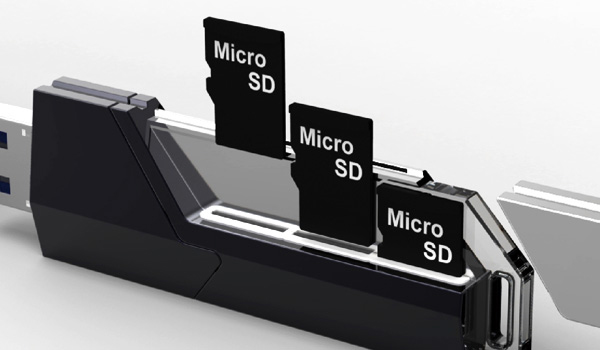
SD cards and SD card readers The SD cards are used to store the master private key, used to sign the certificates/keys on the smart cards. Multiple copies are kept. It is a good idea to use SD cards from different vendors, preferably not manufactured in the same batch, to minimize the risk that they all fail at the same time. For convenience, it would be desirable to use a multi-card reader: although the software experience will be much the same if lots of individual card readers or USB flash drives are used. Other devices One additional idea that comes to mind is a hardware random number generator (TRNG), such as the FST-01. Can you help with ideas or donations? If you have any specific suggestions for hardware or can help arrange any donations of hardware for Outreachy interns, please come and join us in the pki-clean-room mailing list or consider adding ideas on the PGP / PKI clean room wiki.

18 October 2016

Enrico Zini: debtags and aptitude forget-new

I like to regularly go through the new packages section in aptitude to see what interesting new packages entered testing, but recently that joyful moment got less joyful for me because of a barrage of obscurely named packages. I have just realised that aptitude forget-new supports search patterns, and that brought back the joy. I put this in a script that I run before looking for new packages in aptitude:
aptitude forget-new '?tag(field::biology)
                     ?tag(devel::lang:ruby)
                     ?tag(devel::lang:perl)
                     ?tag(role::shared-lib)
                     ?tag(suite::openstack)
                     ?tag(implemented-in::php)
                     ~n^node-'
The actual content of the search pattern is purely a matter of taste. I'm happy to see how debtags becomes quite useful here, to keep my own user experience manageable as the size of Debian keeps growing. Update: pabs suggested to use apt post-invoke hooks. For example:
        $ cat /etc/apt/apt.conf.d/99forget-new
        APT::Update::Post-Invoke   "aptitude forget-new '~sdebug'";  ;

17 October 2016

Arturo Borrero Gonz lez: nftables in Debian Stretch

Debian - Netfilter The next Debian stable release is codenamed Stretch, which I would expect to be released in less than a year. The Netfilter Project has been developing nftables for years now, and the status of the framework has been improved to a good point: it s ready for wide usage and adoption, even in high-demand production environments. The last released version of nft was 0.6, and the Debian package was updated just a day after Netfilter announced it. With the 0.6 version the software framework reached a good state of maturity, and I myself encourage users to migrate from iptables to nftables. In case you don t know about nftables yet, here is a quick reference: To run nftables in Debian Stretch you need several components:
  1. nft: the command line interface
  2. libnftnl: the nftables-netlink library
  3. linux kernel: a least 4.7 is recommended
A simple aptitude run will put your system ready to go, out of the box, with nftables:
root@debian:~# aptitude install nftables
Once installed, you can start using the nft command:
root@debian:~# nft list ruleset
A good starting point is to copy a simple workstation firewall configuration:
root@debian:~# cp /usr/share/doc/nftables/examples/syntax/workstation /etc/nftables.conf
And load it:
root@debian:~# nft -f /etc/nftables.conf
Your nftables ruleset is now firewalling your network:
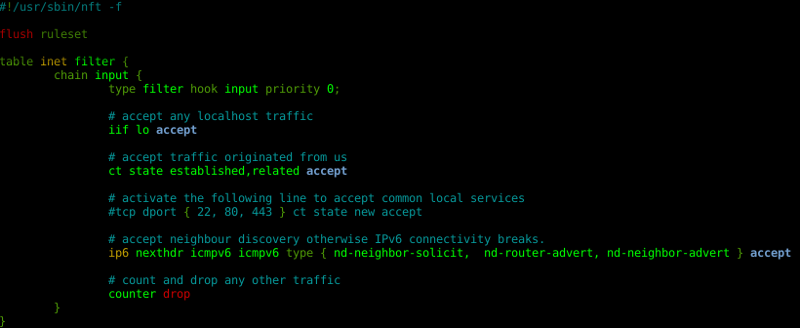
root@debian:~# nft list ruleset
table inet filter  
        chain input  
                type filter hook input priority 0;
                iif lo accept
                ct state established,related accept
                ip6 nexthdr icmpv6 icmpv6 type   nd-neighbor-solicit,  nd-router-advert, nd-neighbor-advert   accept
                counter drop
         
 
Several examples can be found at /usr/share/doc/nftables/examples/. A simple systemd service is included to load your ruleset at boot time, which is disabled by default. If you are running Debian Jessie and want to give a try, you can use nftables from jessie-backports. If you want to migrate your ruleset from iptables to nftables, good news. There are some tools in place to help in the task of translating from iptables to nftables, but that doesn t belong to this post :-) nft The nano editor includes nft syntax highlighting. What are you waiting for to use nftables?

14 October 2016

Antoine Beaupr : Managing good bug reports

Bug reporting is an art form that is too often neglected in software projects. Bug reports allow contributors to participate without deep technical knowledge and at the same time provide a crucial space for developers to be made aware of issues with their software that they could not have foreseen or found themselves, for lack of resources, variety or imagination.

Prior art Unfortunately, there are rarely good guidelines for submitting bug reports. Historically, people have pointed towards How to report bugs effectively or How to ask questions the smart way. While those guides can be useful for motivated people and may seem attractive references for project managers, they suffer from serious issues:
  • they are written by technical people, for non-technical people
  • as a result, they have a deeply condescending attitude such as calling people "stupid" or various animal names like "mongoose"
  • they are also very technical themselves: one starts with a copyright notice and a changelog, the other uses magic words like "Core dumps" and $Id$
  • they are too long: sgtatham's is about 3600 words long, esr's is even longer at about 11800 words. those texts will take about 20 to 60 minutes to read by an average reader, according to research
Individual projects have their own guides as well. Linux has the REPORTING_BUGS file that is a much shorter 1200 that can be read under 5 minutes, provided that you can understand the topic at hand. Interestingly, that guide refers to both esr's and sgtatham's guidelines, which means, in the degenerate case where the user hasn't had the "privilege" of reading esr's prose already, they will have an extra hour and a half of reading to do to have honestly followed the guidelines before reporting the bug. I often find good documentation in the Tails project. Their bug reporting guidelines are easily accessible and quick to read, although they still might be too technical. It could be argued that you need to get technical at some point to get that information out, of course. In the Monkeysign project, I have started a bug reporting guide that doesn't yet address all those issues. I am considering writing a new guide, but I figured I would look at other people's work and get feedback before writing my own standard.

What's the point? Why have those documents been written? Are people really expected to read them before seeking help? It seems to me unlikely that someone would:
  1. be motivated enough to do something about a broken part of their computer
  2. figure out they can do something about it
  3. read a fifteen thousand words novel about how to report a bug...
  4. just to finally write a 20-line bug report that has no warranty of support attached to it
And if I would be a paying customer, I wouldn't want to be forced to waste my time reading that prose either: it's your job to help me fix your broken things, not the reverse. As someone doing consulting these days: I totally understand: it's not you, the user, it's us, the developers, that have a problem. We have been socialized through computers, and it makes us weird and obtuse, but that's no excuse, and we need to clean up our act. Furthermore, it's surprising how often we get (and make!) bug reports that can be difficult to use. The Monkeysign project is very "technical" and I have expected that the bug reports I would get would be well written, with ways to reproduce and so on, but it happened that I received bug reports that were all over the place, didn't have any ways of reproducing or were simply incomplete. Those three bug reports were filed by people that I know to be very technically capable: one is a fellow Debian developer, the second had filed a good bug report 5 days before, and the third one is a contributor that sent good patches before. In all three cases, they knew what they were doing. Those three people probably read the guidelines mentioned in the past. They may have even read the Monkeysign bug reporting guidelines as well. I can only explain those bug reports by the lack of time: people thought the issue was obvious, that it would get fixed rapidly because, obviously, something is broken. We need a better way.

The takeaway What are those guides trying to tell us?
  1. ask questions in the right place
  2. search for similar questions and issues before reporting the bug
  3. try to make the developers reproduce the issues
  4. failing that, try to describe the issue as well as you can
  5. write clearly, be specific and verbose yet concise
There are obviously contradictions in there, like sgtatham telling us to be verbose and esr tells us to, basically, not be verbose. There is definitely a tension in there, and there are many, many more details about how great bug reports can be if done properly. I tend towards the side of terseness in our descriptions: people that will know how to be concise will be, people that don't will most likely not learn by reading a 12 000 words novel that, in itself, didn't manage to be parsimonious. But I am willing to allow for verbosity in bug reports: I prefer too many details instead of missing a key bit of information.

Issue trackers Step 1 is our job: we should send people in the right place, and give them the right tools. Monkeysign used to manage bugs with bugs-everywhere and this turned out to be a terrible idea: you had to understand git and bugs-everywhere to file any bug reports. As a result, there were exactly zero bug reports filed by non-developers during the whole time BE was used, although some bugs were filed in the Debian Bugtracker. So have a good bug tracker. A mailing list or email address is not a good bug tracker: you lose track of old issues, and it's hard for newcomers to search the archives. It does have the advantage of having a unified interface for the support forum and bug tracking, however. Redmine, Gitlab, Github and others are all decent-enough bug trackers. The key point is that the issue tracker should be publicly available, and users should be able to register easily to file new issues. You should also be able to mass-edit tickets and users should be able to discover the tracker's features easily. I am sorry to say that the Debian BTS somewhat falls short on those two features. Step 2 is a shared responsibility: there should be an easy way to search for issues, and we should help the user looking for similar issues. Stackexchange sites do an excellent job at this, by automatically searching for similar questions while you write your question, suggesting similar ones in an attempt to weed out duplicates. Duplicates still happen, but they can then clearly be marked and linked with a distinct mechanism. Most bug trackers do not offer such high level functionality, but should, so I feel the fault lies more on "our" end than at the user's end.

Reproducing the environment Step 3 and 4 are more or less the user's responsibility. We can detail in our documentation how to clearly share the environment where we reproduced the bug, for example, but in the end, the user decides if they want to share that information or not. In Monkeysign, I have finally implemented joeyh's suggestion of shipping the test suite with the program. I can now tell people to run the test suite in their environment to see if this is a regression that is specific to their environment - so a known bug, in a way - or a novel bug for which I can look at writing a new unit test. I also include way more information about the environment in the --version output, an idea I brought forward in the borg project to ease debugging. That way, people can just send the output of monkeysign --test and monkeysign --version, and I have a very good overview of what is happening on their end. Of course, Monkeysign also supports the usual --verbose and --debug flag that users should enable when reproducing issues. Another idea is to report bugs directly from the application. We have all seen Firefox or other software have automatic bug reporting tools, but somehow those seem unsatisfactory for a user: we have no feedback of where the report goes, if it's followed up on. It is useful for larger project to get statistical data, but not so useful for users in the short term. Monkeysign tries to handle exceptions in the code in a graceful way, but could do better. We use a small library to handle exceptions, but that library has since then been improved to directly file bugs against the Github project. This assumes the user is logged into Github, but it is nice to pre-populate bug reports with the relevant information up front.

Issue templates In the meantime, to make sure people provide enough information, I have now moved a lot of the bug reporting guidelines to a separate issue template. That issue template is available through the issue creation form now, although it is not enabled by default, a weird limitation of Gitlab. Issue templates are available in Gitlab and Github. Issue templates somewhat force users in a straight jacket: there is already something to structure their bug report. Those could be distinct form elements that had to be filled in, but I like the flexibility of the template, and the possibility for users to just escape the formalism and just plead for help in their own way.

Issue guidelines In the end, I opted for a short few paragraphs in the style of the Tails documentation, including a reference to sgtatham, as an optional future reference:
  • Before you report a new bug, review the existing issues in the online issue tracker and the Debian BTS for Monkeysign to make sure the bug has not already been reported elsewhere.
  • The first aim of a bug report is to tell the developers exactly how to reproduce the failure, so try to reproduce the issue yourself and describe how you did that.
  • If that is not possible, try to describe what went wrong in detail. Write down the error messages, especially if they have numbers.
  • Take the necessary time to write clearly and precisely. Say what you mean, and make sure it cannot be misinterpreted.
  • Include the output of monkeysign --test, monkeysign --version and monkeysign --debug in your bug reports. See the issue template for more details about what to include in bug reports.
If you wish to read more about issues regarding communication in bug reports, you can read How to Report Bugs Effectively, which takes around 20 to 30 minutes.
Unfortunately, short of rewriting sgtatham's guide, I do not feel there is much more we can do as a general guide. I find esr's guide to be too verbose and commanding, so sgtatham it will be for now.

The prose and literacy In the end, there is a fundamental issue with reporting bugs: it assumes our users are literate and capable of writing amazing prose that we will enjoy reading as the last J.K. Rowling novel (if you're into that kind of thing). It's just an unreasonable expectation: some of your users don't even speak the same language as you, let alone read or write it. This makes for challenging collaboration, to say the least. This is where automated reporting makes sense: it doesn't require user's intervention, and the communication is mediated by machines without human intervention and their pesky culture. But we should, as maintainers, "be liberal in what we accept and conservative in what we send". Be tolerant, and help your users in fixing their issues. It's what you are there for, after all. And in the end, we all fail the same way. In an attempt to improve the situation on bug reporting guides, I seem to have myself written a 2000 short story that will have taken up a hopefully pleasant 10 minutes of your time at minimum. Hopefully I will have succeeded at being clear, specific, verbose and concise all at once and look forward to your feedback on how to improve our bug reporting culture.

Daniel Silverstone: Gitano - Approaching Release - Changes

Continuing on from the previous article, here is a (probably incomplete) list of the critical changes to Gitano which have been, or will be, worked on during the run toward a 1.0 release. Each of these will have a blog posting to discuss what the changes mean for current and future users. Sometimes I'll aggregate postings, sometimes I won't. The following are some highlights from the past little while of development which has been undertaken by Richard and myself. Each item is, I feel, important enough to warrant commentary, even for those who already use Gitano. Any number of smaller things have been done which fall below some arbitrary barrier for telling you about. If you're aware of any of them and feel they are worthwhile telling the world about, then please prod me and I'll add an article to the series. Finally it's worth noting that the effort to get all this into Debian Stretch proceeds apace. Of the eight packages needed, at the time of posting: one was already in and has been updated (luxio), three have been accepted into Debian already (supple, clod, lua-scrypt), two are in NEW (gall and lace), and that leaves the newest library (tongue) and then Gitano itself still to go. The Debian FTP team have been awesome in helping me with all this, so thanks go to them.

11 October 2016

Russ Allbery: remctl 3.13

remctl is a client and server that forms a very simple remote RPC system, normally authenticated with Kerberos, although including a remctl-shell variant that works over ssh. This release adds forced-command support for remctl-shell, which allows it to work without enabling setting environment variables in authorized_keys. This may be a preferrable configuration to using it as an actual shell. Also in this release, the summary configuration option is allowed for commands with subcommands other than ALL, which allows proper generation of command summaries even for users who only have access to a few subcommands of a command. It also adds some build system support for building binaries with -fPIE. You can get the latest release from the remctl distribution page.

Russ Allbery: rra-c-util 6.1

This is my collection of supporting libraries, Autoconf macros, and test code for various projects. This release fixes return-value checks for snprintf to avoid a few off-by-one errors (none of which should have been exploitable, but better to be safe and correct). It adds a new RRA_PROG_CC_FLAG macro to test compiler support for a specific flag and a new RRA_PROG_CC_WARNINGS_FLAGS macro to probe for all the flags I use as my standard make warnings target. And it fixes some problems with one utility due to the removal of the current directory from @INC in the latest Perl release. You can get the latest version from the rra-c-util distribution page.

9 October 2016

Craig Sanders: Converting to a ZFS rootfs

My main desktop/server machine (running Debian sid) at home has been running XFS on mdadm raid-1 on a pair of SSDs for the last few years. A few days ago, one of the SSDs died. I ve been planning to switch to ZFS as the root filesystem for a while now, so instead of just replacing the failed drive, I took the opportunity to convert it. NOTE: at this point in time, ZFS On Linux does NOT support TRIM for either datasets or zvols on SSD. There s a patch almost ready (TRIM/Discard support from Nexenta #3656), so I m betting on that getting merged before it becomes an issue for me. Here s the procedure I came up with: 1. Buy new disks, shutdown machine, install new disks, reboot. The details of this stage are unimportant, and the only thing to note is that I m switching from mdadm RAID-1 with two SSDs to ZFS with two mirrored pairs (RAID-10) on four SSDs (Crucial MX300 275G at around $100 AUD each, they re hard to resist). Buying four 275G SSDs is slightly more expensive than buying two of the 525G models, but will perform a lot better. When installed in the machine, they ended up as /dev/sdp, /dev/sdq, /dev/sdr, and /dev/sds. I ll be using the symlinks in /dev/disk/by-id/ for the zpool, but for partition and setup, it s easiest to use the /dev/sd? device nodes. 2. Partition the disks identically with gpt partition tables, using gdisk and sgdisk. I need: ZFS On Linux uses partition type bf08 ( Solaris Reserved 1 ) natively, but doesn t seem to care what the partition types are for ZIL and L2ARC. I arbitrarily used bf08 ( Solaris Reserved 2 ) and bf09 ( Solaris Reserved 3 ) for easy identification. I ll set these up later, once I ve got the system booted I don t want to risk breaking my existing zpools by taking away their ZIL and L2ARC (and forgetting to zpool remove them, which I might possibly have done once) if I have to repartition. I used gdisk to interactively set up the partitions:
# gdisk -l /dev/sdp
GPT fdisk (gdisk) version 1.0.1
Partition table scan:
  MBR: protective
  BSD: not present
  APM: not present
  GPT: present
Found valid GPT with protective MBR; using GPT.
Disk /dev/sdp: 537234768 sectors, 256.2 GiB
Logical sector size: 512 bytes
Disk identifier (GUID): 4234FE49-FCF0-48AE-828B-3C52448E8CBD
Partition table holds up to 128 entries
First usable sector is 34, last usable sector is 537234734
Partitions will be aligned on 8-sector boundaries
Total free space is 6 sectors (3.0 KiB)
Number  Start (sector)    End (sector)  Size       Code  Name
   1              40            2047   1004.0 KiB  EF02  BIOS boot partition
   2            2048         2099199   1024.0 MiB  EF00  EFI System
   3         2099200         6293503   2.0 GiB     8300  Linux filesystem
   4         6293504        14682111   4.0 GiB     8200  Linux swap
   5        14682112       455084031   210.0 GiB   BF07  Solaris Reserved 1
   6       455084032       459278335   2.0 GiB     BF08  Solaris Reserved 2
   7       459278336       537234734   37.2 GiB    BF09  Solaris Reserved 3
I then cloned the partition table to the other three SSDs with this little script: clone-partitions.sh
#! /bin/bash
src='sdp'
targets=( 'sdq' 'sdr' 'sds' )
for tgt in "$ targets[@] "; do
  sgdisk --replicate="/dev/$tgt" /dev/"$src"
  sgdisk --randomize-guids "/dev/$tgt"
done
3. Create the mdadm for /boot, the zpool, and and the root filesystem. Most rootfs on ZFS guides that I ve seen say to call the pool rpool, then create a dataset called "$(hostname)-1" and then create a ROOT dataset under that. so on my machine, that would be rpool/ganesh-1/ROOT. Some reverse the order of hostname and the rootfs dataset, for rpool/ROOT/ganesh-1. There might be uses for this naming scheme in other environments but not in mine. And, to me, it looks ugly. So I ll use just $(hostname)/root for the rootfs. i.e. ganesh/root I wrote a script to automate it, figuring I d probably have to do it several times in order to optimise performance. Also, I wanted to document the procedure for future reference, and have scripts that would be trivial to modify for other machines. create.sh
#! /bin/bash
exec &> ./create.log
hn="$(hostname -s)"
base='ata-Crucial_CT275MX300SSD1_'
md='/dev/md0'
md_part=3
md_parts=( $(/bin/ls -1 /dev/disk/by-id/$ base *-part$ md_part ) )
zfs_part=5
# 4 disks, so use the top half and bottom half for the two mirrors.
zmirror1=( $(/bin/ls -1 /dev/disk/by-id/$ base *-part$ zfs_part    head -n 2) )
zmirror2=( $(/bin/ls -1 /dev/disk/by-id/$ base *-part$ zfs_part    tail -n 2) )
# create /boot raid array
mdadm "$md" --create \
    --bitmap=internal \
    --raid-devices=4 \
    --level 1 \
    --metadata=0.90 \
    "$ md_parts[@] "
mkfs.ext4 "$md"
# create zpool
zpool create -o ashift=12 "$hn" \
    mirror "$ zmirror1[@] " \
    mirror "$ zmirror2[@] "
# create zfs rootfs
zfs set compression=on "$hn"
zfs set atime=off "$hn"
zfs create "$hn/root"
zpool set bootfs="$hn/root"
# mount the new /boot under the zfs root
mount "$md" "/$hn/root/boot"
If you want or need other ZFS datasets (e.g. for /home, /var etc) then create them here in this script. Or you can do that later after you ve got the system up and running on ZFS. If you run mysql or postgresql, read the various tuning guides for how to get best performance for databases on ZFS (they both need their own datasets with particular recordsize and other settings). If you download Linux ISOs or anything with bit-torrent, avoid COW fragmentation by setting up a dataset to download into with recordsize=16K and configure your BT client to move the downloads to another directory on completion. I did this after I got my system booted on ZFS. For my db, I stoppped the postgres service, renamed /var/lib/postgresql to /var/lib/p, created the new datasets with:
zfs create -o recordsize=8K -o logbias=throughput -o mountpoint=/var/lib/postgresql \
  -o primarycache=metadata ganesh/postgres
zfs create -o recordsize=128k -o logbias=latency -o mountpoint=/var/lib/postgresql/9.6/main/pg_xlog \
  -o primarycache=metadata ganesh/pg-xlog
followed by rsync and then started postgres again. 4. rsync my current system to it. Logout all user sessions, shut down all services that write to the disk (postfix, postgresql, mysql, apache, asterisk, docker, etc). If you haven t booted into recovery/rescue/single-user mode, then you should be as close to it as possible everything non-esssential should be stopped. I chose not to boot to single-user in case I needed access to the web to look things up while I did all this (this machine is my internet gateway). Then:
hn="$(hostname -s)"
time rsync -avxHAXS -h -h --progress --stats --delete / /boot/ "/$hn/root/"
After the rsync, my 130GB of data from XFS was compressed to 91GB on ZFS with transparent lz4 compression. Run the rsync again if (as I did), you realise you forgot to shut down postfix (causing newly arrived mail to not be on the new setup) or something. You can do a (very quick & dirty) performance test now, by running zpool scrub "$hn". Then run watch zpool status "$hn". As there should be no errorss to correct, you should get scrub speeds approximating the combined sequential read speed of all vdevs in the pool. In my case, I got around 500-600M/s I was kind of expecting closer to 800M/s but that s good enough .the Crucial MX300s aren t the fastest drive available (but they re great for the price), and ZFS is optimised for reliability more than speed. The scrub took about 3 minutes to scan all 91GB. My HDD zpools get around 150 to 250M/s, depending on whether they have mirror or RAID-Z vdevs and on what kind of drives they have. For real benchmarking, use bonnie++ or fio. 5. Prepare the new rootfs for chroot, chroot into it, edit /etc/fstab and /etc/default/grub. This script bind mounts /proc, /sys, /dev, and /dev/pts before chrooting: chroot.sh
#! /bin/sh
hn="$(hostname -s)"
for i in proc sys dev dev/pts ; do
  mount -o bind "/$i" "/$ hn /root/$i"
done
chroot "/$ hn /root"
Change /etc/fstab (on the new zfs root to) have the zfs root and ext4 on raid-1 /boot:
/ganesh/root    /         zfs     defaults                                         0  0
/dev/md0        /boot     ext4    defaults,relatime,nodiratime,errors=remount-ro   0  2
I haven t bothered with setting up the swap at this point. That s trivial and I can do it after I ve got the system rebooted with its new ZFS rootfs (which reminds me, I still haven t done that :). add boot=zfs to the GRUB_CMDLINE_LINUX variable in /etc/default/grub. On my system, that s:
GRUB_CMDLINE_LINUX="iommu=noagp usbhid.quirks=0x1B1C:0x1B20:0x408 boot=zfs"
NOTE: If you end up needing to run rsync again as in step 4. above copy /etc/fstab and /etc/default/grub to the old root filesystem first. I suggest to /etc/fstab.zfs and /etc/default/grub.zfs 6. Install grub Here s where things get a little complicated. Running install-grub on /dev/sd[pqrs] is fine, we created the type ef02 partition for it to install itself into. But running update-grub to generate the new /boot/grub/grub.cfg will fail with an error like this:
/usr/sbin/grub-probe: error: failed to get canonical path of  /dev/ata-Crucial_CT275MX300SSD1_163313AADD8A-part5'.
IMO, that s a bug in grub-probe it should look in /dev/disk/by-id/ if it can t find what it s looking for in /dev/ I fixed that problem with this script: fix-ata-links.sh
#! /bin/sh
cd /dev
ln -s /dev/disk/by-id/ata-Crucial* .
After that, update-grub works fine. NOTE: you will have to add udev rules to create these symlinks, or run this script on every boot otherwise you ll get that error every time you run update-grub in future. 7. Prepare to reboot Unmount proc, sys, dev/pts, dev, the new raid /boot, and the new zfs filesystems. Set the mount point for the new rootfs to / umount-zfs-root.sh
#! /bin/sh
hn="$(hostname -s)"
md="/dev/md0"
for i in dev/pts dev sys proc ; do
  umount "/$ hn /root/$i"
done
umount "$md"
zfs umount "$ hn /root"
zfs umount "$ hn "
zfs set mountpoint=/ "$ hn /root"
zfs set canmount=off "$ hn "
8. Reboot Remember to configure the BIOS to boot from your new disks. The system should boot up with the new rootfs, no rescue disk required as in some other guides the rsync and chroot stuff has already been done. 9. Other notes 10. Useful references Reading these made it much easier to come up with my own method. Highly recommended. Converting to a ZFS rootfs is a post from: Errata

6 October 2016

Joey Hess: keysafe with local shares

If your gpg key is too valuable for you to feel comfortable with backing it up to the cloud using keysafe, here's an alternative that might appeal more. Keysafe can now back up some shares of the key to local media, and other shares to the cloud. You can arrange things so that the key can't be restored without access to some of the local media and some of the cloud servers, as well as your password. For example, I have 3 USB sticks, and there are 3 keysafe servers. So let's make 6 shares total of my gpg secret key and require any 4 of them to restore it. I plug in all 3 USB sticks and look at mount to get the paths to them. Then, run keysafe, to back up the key spread amoung all 6 locations.
keysafe --backup --totalshares 6 --neededshares 4 \
    --add-storage-directory /media/sdc1 \
    --add-storage-directory /media/sdd1 \
    --add-storage-directory /media/sde1
Once it's done, I can remove the USB sticks, and distribute them to secure places. To restore, I need at least one of the USB sticks. (If some of the servers are down, more USB sticks will be needed.) Again I tell keysafe the paths where USB stick(s) are mounted.
keysafe --restore --totalshares 6 --neededshares 4 \
    --add-storage-directory /media/sdb1
Using keysafe this way, physical access to the USB sticks is the first level of defense, and hopefully you'll know if that's breached. The keysafe password is the second level of defense, and cracking that will take a lot of work. Leaving plenty of time to revoke your key, etc, if it comes to that. I feel this is better than the methods I've been using before to back up my most important gpg keys. With paperkey, physical access to the printout immediately exposes the key. With Shamir Secret Sharing and manual distribution of shares, the only second line of defense is the much easier to crack gpg passphrase. Using OpenPGP smartcards is still a more secure option, but you'd need 3 smartcards to reach the same level of redundancy, and it's easier to get your hands on 3 USB sticks than 3 smartcards. There's another benefit to using keysafe this way. It means that sometimes, the data stored on the keysafe servers is not sufficient to crack a key. There's no way to tell, so an attacker risks doing a lot of futile work. If you're not using an OpenPGP smartcard, I encourage you to back up your gpg key with keysafe as described above. Two of the three necessary keysafe servers are now in operation, and I hope to have a full complement of servers soon. (This was sponsored by Thomas Hochstein on Patreon.)

5 October 2016

Russ Allbery: Review: Uprooted

Review: Uprooted, by Naomi Novik
Publisher: Del Rey
Copyright: 2015
Printing: 2016
ISBN: 0-8041-7904-2
Format: Kindle
Pages: 465
Agnieszka lives in a small peasant village on the border of the Wood. The malevolent forest is the source of dark corruption, illnesses that turn people into ravaging monsters, and lures and traps for the unwary who disappear into the Wood. Or, worse, return and appear the same, and then do horrific things, smiling all the time. This neighboring storehouse of horrors is not what occupies Agnieszka's thoughts at the start of the book, however. Instead, it's the village's protector against the Wood: the Dragon. The Dragon is not a flying lizard; he's a man, a wizard who has lived in his tower for living memory and fights back against the Wood with magic. And, once every ten years, he takes a girl from a village. They go to his tower and serve him for ten years, and then leave, generally to move to some far-away city and never return to their village. Each says afterwards that the Dragon never did anything untoward to them. No one entirely believes them. Agnieszka was born in the year that makes her one of the candidates for being taken by the Dragon. But that's not what she's worried about. She's known for certain since she was a small child that her best friend, Kasia, would be the one taken by the Dragon. Kasia was always the exceptional one: the most beautiful, the most talented, the one who stood out among all the girls in the neighboring villages. And she's about to be taken out of Agnieszka's life, to a mysterious and unknown fate. It will hopefully surprise no fantasy reader (and hence not be much of a spoiler) that awkward Agnieszka, who can't keep her dress unstained for more than five minutes and has none of the skills that Kasia has, is the one the Dragon chooses. I think a warning is important here, since I'm about to recommend this book highly. However, it is very fond of its stereotypes. Most of the other wizards are men, and they focus on books and formal understanding of magic. The one female wizard whose magic we see in some detail is a smith described as wearing male clothing. Uprooted then introduces a different type of magic that's much more intuitive, described largely through natural metaphors, and doesn't play well with formal rules... and is practiced by a woman. This is, unfortunately, persistently gendered, although the book never comes right out and calls it female magic. There are also quite a few traditional gender roles scattered through the rest of the book (although it does get a bit of a pass due to its obvious deep roots in traditional fairy tales). Uprooted is still an excellent book despite this, but it's best read when you're in the mood to tolerate this sort of story. If you go in feeling irritated about gender stereotypes, you'll probably get frustrated by the book, overwhelming its merits. Best saved for a forgiving mood (or skipped entirely if this style of story just doesn't sound fun). The beginning of Uprooted is about Agnieszka finding her feet in her bizarre arrangement with the Dragon, who turns out to be nothing like what either her or the reader expected. I think her panic and confusion drags on a little long, but Novik makes up for that by the delightful descriptions of Agnieszka's eventual understanding and the Dragon's frustrated consternation. Fantasy is full of prickly, arrogant wizards, but few have felt quite so human to me as the Dragon. Agnieszka is clearly nothing like he expected or like he's dealt with before, and his path from arrogant contempt to outrage to prickly confusion to uncomfortable respect is a delight. This is, of course, a coming-of-age story for Agnieszka, and by the end the book deals with both the origins of the Wood and some sort of resolution. But the path there wanders through an exploration of a rather interesting magic system, quite a lot of court intrigue, and Agnieszka persistently defying everyone's expectations. As with the introductory panic and confusion, I could have done with less of her awkward bumbling at court (in general, I think the book could have been a bit tighter), but once I reached the second half of the book I couldn't put it down. I've previously read a fair chunk of Novik's Temeraire series, which were fun (at least in spots), but Uprooted is definitely better. There is a fair bit of horror-tinged stuff in this book, as well as the stereotypes mentioned above, so it won't be for everyone. But I usually hate horror of any kind, and I still loved this. Agnieszka is sufficiently positive and solution-focused that the story never falls into the constant fear and panic and disgust that I particularly dislike in horror. If you're in the mood for a good fantasy coming-of-age story coupled with delightful disruption of the life of a prickly, cynical, but surprisingly ethical wizard, give this one a try. Rating: 8 out of 10

Kees Cook: security things in Linux v4.8

Previously: v4.7. Here are a bunch of security things I m excited about in Linux v4.8: SLUB freelist ASLR Thomas Garnier continued his freelist randomization work by adding SLUB support. x86_64 KASLR text base offset physical/virtual decoupling On x86_64, to implement the KASLR text base offset, the physical memory location of the kernel was randomized, which resulted in the virtual address being offset as well. Due to how the kernel s -2GB addressing works (gcc s -mcmodel=kernel ), it wasn t possible to randomize the physical location beyond the 2GB limit, leaving any additional physical memory unused as a randomization target. In order to decouple the physical and virtual location of the kernel (to make physical address exposures less valuable to attackers), the physical location of the kernel needed to be randomized separately from the virtual location. This required a lot of work for handling very large addresses spanning terabytes of address space. Yinghai Lu, Baoquan He, and I landed a series of patches that ultimately did this (and in the process fixed some other bugs too). This expands the physical offset entropy to roughly $physical_memory_size_of_system / 2MB bits. x86_64 KASLR memory base offset Thomas Garnier rolled out KASLR to the kernel s various statically located memory ranges, randomizing their locations with CONFIG_RANDOMIZE_MEMORY. One of the more notable things randomized is the physical memory mapping, which is a known target for attacks. Also randomized is the vmalloc area, which makes attacks against targets vmalloced during boot (which tend to always end up in the same location on a given system) are now harder to locate. (The vmemmap region randomization accidentally missed the v4.8 window and will appear in v4.9.) x86_64 KASLR with hibernation Rafael Wysocki (with Thomas Garnier, Borislav Petkov, Yinghai Lu, Logan Gunthorpe, and myself) worked on a number of fixes to hibernation code that, even without KASLR, were coincidentally exposed by the earlier W^X fix. With that original problem fixed, then memory KASLR exposed more problems. I m very grateful everyone was able to help out fixing these, especially Rafael and Thomas. It s a hard place to debug. The bottom line, now, is that hibernation and KASLR are no longer mutually exclusive. gcc plugin infrastructure Emese Revfy ported the PaX/Grsecurity gcc plugin infrastructure to upstream. If you want to perform compiler-based magic on kernel builds, now it s much easier with CONFIG_GCC_PLUGINS! The plugins live in scripts/gcc-plugins/. Current plugins are a short example called Cyclic Complexity which just emits the complexity of functions as they re compiled, and Sanitizer Coverage which provides the same functionality as gcc s recent -fsanitize-coverage=trace-pc but back through gcc 4.5. Another notable detail about this work is that it was the first Linux kernel security work funded by Linux Foundation s Core Infrastructure Initiative. I m looking forward to more plugins! If you re on Debian or Ubuntu, the required gcc plugin headers are available via the gcc-$N-plugin-dev package (and similarly for all cross-compiler packages). hardened usercopy Along with work from Rik van Riel, Laura Abbott, Casey Schaufler, and many other folks doing testing on the KSPP mailing list, I ported part of PAX_USERCOPY (the basic runtime bounds checking) to upstream as CONFIG_HARDENED_USERCOPY. One of the interface boundaries between the kernel and user-space are the copy_to_user()/copy_from_user() family of functions. Frequently, the size of a copy is known at compile-time ( built-in constant ), so there s not much benefit in checking those sizes (hardened usercopy avoids these cases). In the case of dynamic sizes, hardened usercopy checks for 3 areas of memory: slab allocations, stack allocations, and kernel text. Direct kernel text copying is simply disallowed. Stack copying is allowed as long as it is entirely contained by the current stack memory range (and on x86, only if it does not include the saved stack frame and instruction pointers). For slab allocations (e.g. those allocated through kmem_cache_alloc() and the kmalloc()-family of functions), the copy size is compared against the size of the object being copied. For example, if copy_from_user() is writing to a structure that was allocated as size 64, but the copy gets tricked into trying to write 65 bytes, hardened usercopy will catch it and kill the process. For testing hardened usercopy, lkdtm gained several new tests: USERCOPY_HEAP_SIZE_TO, USERCOPY_HEAP_SIZE_FROM, USERCOPY_STACK_FRAME_TO,
USERCOPY_STACK_FRAME_FROM, USERCOPY_STACK_BEYOND, and USERCOPY_KERNEL. Additionally, USERCOPY_HEAP_FLAG_TO and USERCOPY_HEAP_FLAG_FROM were added to test what will be coming next for hardened usercopy: flagging slab memory as safe for copy to/from user-space , effectively whitelisting certainly slab caches, as done by PAX_USERCOPY. This further reduces the scope of what s allowed to be copied to/from, since most kernel memory is not intended to ever be exposed to user-space. Adding this logic will require some reorganization of usercopy code to add some new APIs, as PAX_USERCOPY s approach to handling special-cases is to add bounce-copies (copy from slab to stack, then copy to userspace) as needed, which is unlikely to be acceptable upstream. seccomp reordered after ptrace By its original design, seccomp filtering happened before ptrace so that seccomp-based ptracers (i.e. SECCOMP_RET_TRACE) could explicitly bypass seccomp filtering and force a desired syscall. Nothing actually used this feature, and as it turns out, it s not compatible with process launchers that install seccomp filters (e.g. systemd, lxc) since as long as the ptrace and fork syscalls are allowed (and fork is needed for any sensible container environment), a process could spawn a tracer to help bypass a filter by injecting syscalls. After Andy Lutomirski convinced me that ordering ptrace first does not change the attack surface of a running process (unless all syscalls are blacklisted, the entire ptrace attack surface will always be exposed), I rearranged things. Now there is no (expected) way to bypass seccomp filters, and containers with seccomp filters can allow ptrace again. That s it for v4.8! The merge window is open for v4.9

2016, Kees Cook. This work is licensed under a Creative Commons Attribution-ShareAlike 3.0 License.
Creative Commons License

1 October 2016

Ritesh Raj Sarraf: GNOME Shell Extensions and Chromium

Most GNOME users may be using one or more extensions for the GNOME Shell. These extensions allow extending functionality for the shell, or modify default behavior, to suit the taste of many users, who may want more than the default. Having flexibility to customize the desktop to ones personal need is a great feature, and the extensions help achieve them. The GNOME Shell Extensions distribution mechanism is primarily through the web. I think they aspire to achieve something similar to Chrome's Web Store. Up till recently, the ability to install those Shell Extensions was a) Through your distribution channel, where your distribution may have packaged some of the extensions. b) Through the Firefox web browser. GNOME Shell Extensions installation from the web, to most of what I'm aware of, until recently, only worked with Firefox browser. With the chrome-gnome-shell package, which is now available in Debian, Debian GNOME users should be able to use the Chromium browser for managing their GNOME Shell Extensions.
  1. Install package chrome-gnome-shell
  2. Open Chromium Browser and go to Web Store
  3. Install Chrome Shell Integration extension for Chromium
    1. .
  4. Point your browser to: https://extensions.gnome.org/local
In future releases, the plan is to automate the installation of the browser extension (step 3), when the package is installed. This feature is Chromium specific and will be achieved using a system-wide chromium browser policy, which can be set/overridden by an administrator.

Categories:

Keywords:

Like:

Russ Allbery: Review: Sailing to Sarantium

Review: Sailing to Sarantium, by Guy Gavriel Kay
Series: Sarantine Mosaic #1
Publisher: HarperPrism
Copyright: 1998
Printing: January 2000
ISBN: 0-06-105990-0
Format: Mass market
Pages: 533
Crispin is a well-respected mosaicist, a Rhodian, heir to a long tradition of artistic accomplishment. Rhodias is largely in ruins, and the kings that fight over its land are far removed from the emperors of Rhodias at its height, but there's still demand for skilled craftsmanship. Crispin has a partner, assistants, and the opportunity to do at least adequate work. It's not a bad life, or at least wasn't before plague took his wife and daughters while he watched, helpless. Now, he's closed off, angry, and consumed by fatalism and futility. His partner, Martinian, could never say why, when the imperious and obnoxious courier came from the far-off and half-legendary of Sarantium to summon him to assist with the rebuilding of the Sanctuary of Jad, he pretended not to be himself and pointed the courier at Crispin instead. Nor was Crispin entirely sure why he played along, although the courier was so arrogant and officious that he invited such treatment. He had no intention of going in Martinian's place and name until his friends intervened, united in their conviction that he needed something to focus on and a reason to live. But nothing about Sarantium is simple. Even before Crispin leaves, the local queen, precariously balancing between warring factions, reveals her own reason to send Crispin to the capital of the far-off empire: using him as a desperate messenger to propose an alliance through marriage. And when he finally arrives, after unexpected perils on the road, he tumbles immediately into the deep complexities of the Sarantine court and its remarkable rulers. Most of Guy Gavriel Kay's work is historical fiction with the serial numbers partly filed off and some magic added. The degree to which the serial numbers are removed varies by work; here, the history is obvious. Sarantium is Byzantium, fallen Rhodias is Rome, and the emperor Valerius and his former dancer empress Alixana are clearly Justinian and Theodora. Knowing that will provide a lot of context, but can also be distracting, since the temptation to scramble for Wikipedia and line things up with real history is strong. I read this book the first time without knowing the history and this second time knowing it. I think I enjoyed it a bit more on its own terms, instead of as a reflection and reinterpretation. Either way, though, it's one of Kay's best novels, which is saying quite a bit. Sailing to Sarantium has two very different parts: Crispin's journey to Sarantium, and then what happens when he arrives. The first is a fairly linear travel narrative mixed with old religion, magic, and an experience in the woods that's a little disconnected from the rest of the story. The second is the fast-entangling politics and factionalism of the city itself, which wastes no time pulling Crispin into meetings with the most influential people at court. In my memory, I liked the Sarantium narrative the best, and found the travel story less significant. Re-reading, I'm not sure I agree with my earlier self. Kay does write some of the best conversations in fiction; if you want to see careful verbal maneuvering or gut reactions with wide-ranging consequences, I can't think of any author who shows both the words and the nuances as well as Kay. He makes the court maneuvering feel truly epic. Watching Crispin's blunt competence cut through the Sarantine court, and seeing him stay focused on his life work despite all those distractions, is a truly rewarding experience. But that second part of the book also has some structural problems, and a few characterization problems. The structural problem is that Kay wants to tell the same story from multiple angles, viewpoints, and timelines to show the reader every implication of the hornet's nest that Crispin kicks over, since quite a lot happens in the course of one day and night. This mostly works, but it is so laden with flashbacks, foreshadowing, and rewinds that I started losing track of the time relationship between the scenes. Kay is a very skilled author, so he avoids confusing the reader entirely, but I think he still tried too complex of a temporal structure here. The characterization problem is that I previously wasn't paying as close of attention to Kay's portrayal of women and of male sexual reactions to women. It didn't bother me before; this time, it started getting on my nerves. Yes, this is historical fiction (although limitations on roles for women in history is rather overstated in fiction), and to give Kay credit it does feature a very strong female character in Alixana. But the male protector and female seducer dynamic is very strong, and all the women in this book seem to get shoehorned into it. And perhaps I'm missing some weakness that other men have, but I have never had the sort of overwhelming, thought-destroying reaction to the presence of a seductive woman as Kay's men seem to routinely have in this book. To give Crispin credit, he maneuvers his way through those conversations without doing anything stupid. (Kay's characters very rarely do stupid things, which is refreshing.) But the effort required started undermining my suspension of disbelief. Even making allowances for a culture that might consider a woman with her hair down the equivalent of an entirely nude woman, I simply don't believe that a man who had been married with two daughters, had a long career, and had the life experience Crispin had would have that much difficulty with an aggressively seductive woman that he already doesn't trust. As a result, as much as I love Kay's political conversational fencing, I enjoyed the travel portion of the book more on this re-read. Crispin is a type of character Kay writes extremely well: an honest, honorable man trying to navigate unfamiliar waters without a lot of context, but with a firm sense of internal morality, a lot of natural intelligence, and a true passion for something. At one point in this book, another character decides to walk away from his current job and follow Crispin wherever he goes. Kay makes you believe that and want to do it yourself. It's a very rewarding experience as a reader to watch a character you can trust find careful, courageous, and tricky solutions to complicated problems. But I think the best part of this book is Kay's ability to put Crispin's art, the creation of mosaics, on the page in a way that lets the reader viscerally appreciate it. Crispin is passionate about mosaics, about how to make them and how to think about them, and the passion is contagious and forms the heart and soul of this novel. Kay manages to make mosaics overshadow some of the most dramatic politics in history, which says quite a lot. There is almost nothing I love more than reading about talented, passionate people doing things they are extremely good at. I know nothing about mosaic that I haven't read in this book and its sequel, so I have no basis from which to judge the accuracy of Kay's portrayal, but he made me feel like I could appreciate some of the nuance, skill, and design constraints of the art form. It's a wonderful reading experience. Sailing to Sarantium is best thought of half of a long book that was divided for publication reasons, so don't expect much of an ending here. It can only be read in combination with Lord of Emperors, which you'll want to have on hand when you finish this book so that you can continue the story. Followed by Lord of Emperors. Rating: 9 out of 10

25 September 2016

Vincent Sanders: I'll huff, and I'll puff, and I'll blow your house in

Sometimes it really helps to have a different view on a problem and after my recent writings on my Public Suffix List (PSL) library I was fortunate to receive a suggestion from my friend Enrico Zini.

I had asked for suggestions on reducing the size of the library further and Enrico simply suggested Huffman coding. This was a technique I had learned about long ago in connection with data compression and the intervening years had made all the details fuzzy which explains why it had not immediately sprung to mind.

A small subset of the Public Suffix List as stored within libnspslHuffman coding named for David A. Huffman is an algorithm that enables a representation of data which is very efficient. In a normal array of characters every character takes the same eight bits to represent which is the best we can do when any of the 256 values possible is equally likely. If your data is not evenly distributed this is not the case for example if the data was english text then the value is fifteen times more likely to be that for e than k.

every step of huffman encoding tree build for the example string tableSo if we have some data with a non uniform distribution of probabilities we need a way the data be encoded with fewer bits for the common values and more bits for the rarer values. To be efficient we would need some way of having variable length representations without storing the length separately. The term for this data representation is a prefix code and there are several ways to generate them.

Such is the influence of Huffman on the area of prefix codes they are often called Huffman codes even if they were not created using his algorithm. One can dream of becoming immortalised like this, to join the ranks of those whose names are given to units or whole ideas in a field must be immensely rewarding, however given Huffman invented his algorithm and proved it to be optimal to answer a question on a term paper in his early twenties I fear I may already be a bit too late.

The algorithm itself is relatively straightforward. First a frequency analysis is performed, a fancy way of saying count how many of each character is in the input data. Next a binary tree is created by using a priority queue initialised with the nodes sorted by frequency.

The resulting huffman tree and the binary representation of the input symbols
The two least frequent items count is summed together and a node placed in the tree with the two original entries as child nodes. This step is repeated until a single node exists with a count value equal to the length of the input.

To encode data once simply walks the tree outputting a 0 for a left node or 1 for right node until reaching the original value. This generates a mapping of values to bit output, the input is then simply converted value by value to the bit output. To decode the data the data is used bit by bit to walk the tree to arrive at values.

If we perform this algorithm on the example string table *!asiabvcomcoopitamazonawsarsaves-the-whalescomputebasilicata we can reduce the 488 bits (61 * 8 bit characters) to 282 bits or 40% reduction. Obviously in a real application the huffman tree would need to be stored which would probably exceed this saving but for larger data sets it is probable this technique would yield excellent results on this kind of data.

Once I proved this to myself I implemented the encoder within the existing conversion program. Although my perl encoder is not very efficient it can process the entire PSL string table (around six thousand labels using 40KB or so) in less than a second, so unless the table grows massively an inelegant approach will suffice.

The resulting bits were packed into 32bit values to improve decode performance (most systems prefer to deal with larger memory fetches less frequently) and resulted in 18KB of output or 47% of the original size. This is a great improvement in size and means the statically linked test program is now 59KB and is actually smaller than the gzipped source data.

$ ls -alh test_nspsl
-rwxr-xr-x 1 vince vince 59K Sep 25 23:58 test_nspsl
$ ls -al public_suffix_list.dat.gz
-rw-r--r-- 1 vince vince 62K Sep 1 08:52 public_suffix_list.dat.gz

To be clear the statically linked program can determine if a domain is in the PSL with no additional heap allocations and includes the entire PSL ordered tree, the domain label string table and the huffman decode table to read it.

An unexpected side effect is that because the decode loop is small it sits in the processor cache. This appears to cause the string comparison function huffcasecmp() (which is not locale dependant because we know the data will be limited ASCII) performance to be close to using strcasecmp() indeed on ARM32 systems there is a very modest improvement in performance.

I think this is as much work as I am willing to put into this library but I am pleased to have achieved a result which is on par with the best of breed (libpsl still has a data representation 20KB smaller than libnspsl but requires additional libraries for additional functionality) and I got to (re)learn an important algorithm too.

Julian Andres Klode: Introducing TrieHash, a order-preserving minimal perfect hash function generator for C(++)

Abstract I introduce TrieHash an algorithm for constructing perfect hash functions from tries. The generated hash functions are pure C code, minimal, order-preserving and outperform existing alternatives. Together with the generated header files,they can also be used as a generic string to enumeration mapper (enums are created by the tool). Introduction APT (and dpkg) spend a lot of time in parsing various files, especially Packages files. APT currently uses a function called AlphaHash which hashes the last 8 bytes of a word in a case-insensitive manner to hash fields in those files (dpkg just compares strings in an array of structs). There is one obvious drawback to using a normal hash function: When we want to access the data in the hash table, we have to hash the key again, causing us to hash every accessed key at least twice. It turned out that this affects something like 5 to 10% of the cache generation performance. Enter perfect hash functions: A perfect hash function matches a set of words to constant values without collisions. You can thus just use the index to index into your hash table directly, and do not have to hash again (if you generate the function at compile time and store key constants) or handle collision resolution. As #debian-apt people know, I happened to play a bit around with tries this week before guillem suggested perfect hashing. Let me tell you one thing: My trie implementation was very naive, that did not really improve things a lot Enter TrieHash Now, how is this related to hashing? The answer is simple: I wrote a perfect hash function generator that is based on tries. You give it a list of words, it puts them in a trie, and generates C code out of it, using recursive switch statements (see code generation below). The function achieves competitive performance with other hash functions, it even usually outperforms them. Given a dictionary, it generates an enumeration (a C enum or C++ enum class) of all words in the dictionary, with the values corresponding to the order in the dictionary (the order-preserving property), and a function mapping strings to members of that enumeration. By default, the first word is considered to be 0 and each word increases a counter by one (that is, it generates a minimal hash function). You can tweak that however:
= 0
WordLabel ~ Word
OtherWord = 9
will return 0 for an unknown value, map Word to the enum member WordLabel and map OtherWord to 9. That is, the input list functions like the body of a C enumeration. If no label is specified for a word, it will be generated from the word. For more details see the documentation C code generation
switch(string[0]   32)  
case 't':
    switch(string[1]   32)  
    case 'a':
        switch(string[2]   32)  
        case 'g':
            return Tag;


return Unknown;
Yes, really recursive switches they directly represent the trie. Now, we did not really do a straightforward translation, there are some optimisations to make the whole thing faster and easier to look at: First of all, the 32 you see is used to make the check case insensitive in case all cases of the switch body are alphabetical characters. If there are non-alphabetical characters, it will generate two cases per character, one upper case and one lowercase (with one break in it). I did not know that lowercase and uppercase characters differed by only one bit before, thanks to the clang compiler for pointing that out in its generated assembler code! Secondly, we only insert breaks only between cases. Initially, each case ended with a return Unknown, but guillem (the dpkg developer) suggested it might be faster to let them fallthrough where possible. Turns out it was not faster on a good compiler, but it s still more readable anywhere. Finally, we build one trie per word length, and switch by the word length first. Like the 32 trick, his gives a huge improvement in performance. Digging into the assembler code The whole code translates to roughly 4 instructions per byte:
  1. A memory load,
  2. an or with 32
  3. a comparison, and
  4. a conditional jump.
(On x86, the case sensitive version actually only has a cmp-with-memory and a conditional jump). Due to https://gcc.gnu.org/bugzilla/show_bug.cgi?id=77729 this may be one instruction more: On some architectures an unneeded zero-extend-byte instruction is inserted this causes a 20% performance loss. Performance evaluation I run the hash against all 82 words understood by APT in Packages and Sources files, 1,000,000 times for each word, and summed up the average run-time:
host arch Trie TrieCase GPerfCase GPerf DJB
plummer ppc64el 540 601 1914 2000 1345
eller mipsel 4728 5255 12018 7837 4087
asachi arm64 1000 1603 4333 2401 1625
asachi armhf 1230 1350 5593 5002 1784
barriere amd64 689 950 3218 1982 1776
x230 amd64 465 504 1200 837 693
Suffice to say, GPerf does not really come close. All hosts except the x230 are Debian porterboxes. The x230 is my laptop with a a Core i5-3320M, barriere has an Opteron 23xx. I included the DJB hash function for another reference. Source code The generator is written in Perl, licensed under the MIT license and available from https://github.com/julian-klode/triehash I initially prototyped it in Python, but guillem complained that this would add new build dependencies to dpkg, so I rewrote it in Perl. Benchmark is available from https://github.com/julian-klode/hashbench Usage See the script for POD documentation.
Filed under: General

24 September 2016

Ritesh Raj Sarraf: Laptop Mode Tools 1.70

I'm pleased to announce the release of Laptop Mode Tools, version 1.70. This release adds support for AHCI Runtime PM, introduced in Linux 4.6. It also includes many important bug fixes, mostly related to invocation and determination of power states. Changelog: 1.70 - Sat Sep 24 16:51:02 IST 2016
* Deal harder with broken battery states
* On machines with 2+ batteries, determine states from all batteries
* Limit status message logging frequency. Some machines tend to send
ACPI events too often. Thanks Maciej S. Szmigiero
* Try harder to determine power states. As reports have shown, the
power_supply subsystem has had incorrect state reporting on many machines,
for both, BAT and AC.
* Relax conditional events where Laptop Mode Tools should be executed. This
affected for use cases of Laptop being docked and undocked
Thanks Daniel Koch.
* CPU Hotplug settings extended
* Cleanup states for improved Laptop Mode Tools invocation
Thanks: Tomas Janousek
* Align Intel P State default to what the actual driver (intel_pstate.c)
uses
Thanks: George Caswell and Matthew Gabeler-Lee
* Add support for AHCI Runtime PM in module intel-sata-powermgmt
* Many systemd and initscript fixes
* Relax default USB device list. This avoids the long standing issues with
USB devices (mice, keyboard) that mis-behaved during autosuspend Source tarball, Feodra/SUSE RPM Packages available at:
https://github.com/rickysarraf/laptop-mode-tools/releases Debian packages will be available soon in Unstable. Homepage: https://github.com/rickysarraf/laptop-mode-tools/wiki
Mailing List: https://groups.google.com/d/forum/laptop-mode-tools

Categories:

Keywords:

Like:

20 September 2016

Vincent Sanders: If I see an ending, I can work backward.

Now while I am sure Arthur Miller was referring to writing a play when he said those words they have an oddly appropriate resonance for my topic.

In the early nineties Lou Montulli applied the idea of magic cookies to HTTP to make the web stateful, I imagine he had no idea of the issues he was going to introduce for the future. Like most of the web technology it was a solution to an immediate problem which it has never been possible to subsequently improve.

Chocolate chip cookie are much tastier than HTTP cookiesThe HTTP cookie is simply a way for a website to identify a connecting browser session so that state can be kept between retrieving pages. Due to shortcomings in the design of cookies and implementation details in browsers this has lead to a selection of unwanted side effects. The specific issue that I am talking about here is the supercookie where the super prefix in this context has similar connotations as to when applied to the word villain.

Whenever the browser requests a resource (web page, image, etc.) the server may return a cookie along with the resource that your browser remembers. The cookie has a domain name associated with it and when your browser requests additional resources if the cookie domain matches the requested resources domain name the cookie is sent along with the request.

As an example the first time you visit a page on www.example.foo.invalid you might receive a cookie with the domain example.foo.invalid so next time you visit a page on www.example.foo.invalid your browser will send the cookie along. Indeed it will also send it along for any page on another.example.foo.invalid

A supercookies is simply one where instead of being limited to one sub-domain (example.foo.invalid) the cookie is set for a top level domain (foo.invalid) so visiting any such domain (I used the invalid name in my examples but one could substitute com or co.uk) your web browser gives out the cookie. Hackers would love to be able to set up such cookies and potentially control and hijack many sites at a time.

This problem was noted early on and browsers were not allowed to set cookie domains with fewer than two parts so example.invalid or example.com were allowed but invalid or com on their own were not. This works fine for top level domains like .com, .org and .mil but not for countries where the domain registrar had rules about second levels like the uk domain (uk domains must have a second level like .co.uk).

 NetSurf cookie manager showing a supercookieThere is no way to generate the correct set of top level domains with an algorithm so a database is required and is called the Public Suffix List (PSL). This database is a simple text formatted list with wildcard and inversion syntax and is at time of writing around 180Kb of text including comments which compresses down to 60Kb or so with deflate.

A few years ago with ICANN allowing the great expansion of top level domains the existing NetSurf supercookie handling was found to be wanting and I decided to implement a solution using the PSL. At this point in time the database was only 100Kb source or 40Kb compressed.

I started by looking at limited existing libraries. In fact only the regdom library was adequate but used 150Kb of heap to load the pre-processed list. This would have had the drawback of increasing NetSurf heap usage significantly (we still have users on 8Mb systems). Because of this and the need to run PHP script to generate the pre-processed input it was decided the library was not suitable.

Lacking other choices I came up with my own implementation which used a perl script to construct a tree of domains from the PSL in a static array with the label strings in a separate table. At the time my implementation added 70Kb of read only data which I thought reasonable and allowed for direct lookup of answers from the database.

This solution still required a pre-processing step to generate the C source code but perl is much more readily available, is a language already used by our tooling and we could always simply ship the generated file. As long as the generated file was updated at release time as we already do for our fallback SSL certificate root set this would be acceptable.

wireshark session shown NetSurf sending a co.uk supercookie to bbc.co.uk
I put the solution into NetSurf, was pleased no-one seemed to notice and moved on to other issues. Recently while fixing a completely unrelated issue in the display of session cookies in the management interface and I realised I had some test supercookies present in the display. After the initial "thats odd" I realised with horror there might be a deeper issue.

It quickly became evident the PSL generation was broken and had been for a long time, even worse somewhere along the line the "redundant" empty generated source file had been removed and the ancient fallback code path was all that had been used.

This issue had escalated somewhat from a trivial display problem. I took a moment to asses the situation a bit more broadly and came to the conclusion there were a number of interconnected causes, centered around the lack of automated testing, which could be solved by extracting the PSL handling into a "support" library.

NetSurf has several of these support libraries which could be used separately to the main browser project but are principally oriented towards it. These libraries are shipped and built in releases alongside the main browser codebase and mainly serve to make API more obvious and modular. In this case my main aim was to have the functionality segregated into a separate module which could be tested, updated and monitored directly by our CI system meaning the embarrassing failure I had found can never occur again.

Before creating my own library I did consider a library called libpsl had been created since I wrote my original implementation. Initially I was very interested in using this library given it managed a data representation within a mere 32Kb.

Unfortunately the library integrates a great deal of IDN and punycode handling which was not required in this use case. NetSurf already has to handle IDN and punycode translations and uses punycode encoded domain names internally only translating to unicode representations for display so duplicating this functionality using other libraries requires a great deal of resource above the raw data representation.

I put the library together based on the existing code generator Perl program and integrated the test set that comes along with the PSL. I was a little alarmed to discover that the PSL had almost doubled in size since the implementation was originally written and now the trivial test program of the library was weighing in at a hefty 120Kb.

This stemmed from two main causes:
  1. there were now many more domain label strings to be stored
  2. there now being many, many more nodes in the tree.
To address the first cause the length of the domain label strings was moved into the unused padding space within each tree node removing a byte from each domain label saving 6Kb. Next it occurred to me that while building the domain label string table that if the label to be added already existed as a substring within the table it could be elided.

The domain labels were sorted from longest to shortest and added in order searching for substring matches as the table was built this saved another 6Kb. I am sure there are ways to reduce this further I have missed (if you see them let me know!) but a 25% saving (47Kb to 35Kb) was a good start.

The second cause was a little harder to address. The structure representing nodes in the tree I started with was at first look reasonable.

struct pnode  
uint16_t label_index; /* index into string table of label */
uint16_t label_length; /* length of label */
uint16_t child_node_index; /* index of first child node */
uint16_t child_node_count; /* number of child nodes */
;

I examined the generated table and observed that the majority of nodes were leaf nodes (had no children) which makes sense given the type of data being represented. By allowing two types of node one for labels and a second for the child node information this would halve the node size in most cases and requiring only a modest change to the tree traversal code.

The only issue with this would be that a way to indicate a node has child information. It was realised that the domain labels can have a maximum length of 63 characters meaning their length can be represented in six bits so a uint16_t was excessive. The space was split into two uint8_t parts one for the length and one for a flag to indicate child data node followed.

union pnode  
struct
uint16_t index; /* index into string table of label */
uint8_t length; /* length of label */
uint8_t has_children; /* the next table entry is a child node */
label;
struct
uint16_t node_index; /* index of first child node */
uint16_t node_count; /* number of child nodes */
child;
;

static const union pnode pnodes[8580] =
/* root entry */
.label = 0, 0, 1 , .child = 2, 1553 ,
/* entries 2 to 1794 */
.label = 37, 2, 1 , .child = 1795, 6 ,

...

/* entries 8577 to 8578 */
.label = 31820, 6, 1 , .child = 8579, 1 ,
/* entry 8579 */
.label = 0, 1, 0 ,

;

This change reduced the node array size from 63Kb to 33Kb almost a 50% saving. I considered using bitfields to try and reduce the label length and has_children flag into a single byte but such packing will not reduce the length of a node below 32bits because it is unioned with the child structure.

A possibility of using the spare uint8_t derived by bitfield packing to store an additional label node in three other nodes was considered but added a great deal of complexity to node lookup and table construction for saving around 4Kb so was not incorporated.

With the changes incorporated the test program was a much more acceptable 75Kb reasonably close to the size of the compressed source but with the benefits of direct lookup. Integrating the libraries single API call into NetSurf was straightforward and resulted in correct operation when tested.

This episode just reminded me of the dangers of code that can fail silently. It exposed our users to a security problem that we thought had been addressed almost six years ago and squandered the limited resources of the project. Hopefully a lesson we will not have to learn again any time soon. If there is a positive to take away it is that the new implementation is more space efficient, automatically built and importantly tested

19 September 2016

Mike Gabriel: Rocrail changed License to some dodgy non-free non-License

The Background Story A year ago, or so, I took some time to search the internet for Free Software that can be used for controlling model railways via a computer. I was happy to find Rocrail [1] being one of only a few applications available on the market. And even more, I was very happy when I saw that it had been licensed under a Free Software license: GPL-3(+). A month ago, or so, I collected my old M rklin (Digital) stuff from my parents' place and started looking into it again after +15 years, together with my little son. Some weeks ago, I remembered Rocrail and thought... Hey, this software was GPLed code and absolutely suitable for uploading to Debian and/or Ubuntu. I searched for the Rocrail source code and figured out that it got hidden from the web some time in 2015 and that the license obviously has been changed to some non-free license (I could not figure out what license, though). This made me very sad! I thought I had found a piece of software that might be interesting for testing with my model railway. Whenever I stumble over some nice piece of Free Software that I plan to use (or even only play with), I upload this to Debian as one of the first steps. However, I highly attempt to stay away from non-free sofware, so Rocrail has become a no-option for me back in 2015. I should have moved on from here on... Instead... Proactively, I signed up with the Rocrail forum and asked the author(s) if they see any chance of re-licensing the Rocrail code under GPL (or any other FLOSS license) again [2]? When I encounter situations like this, I normally offer my expertise and help with such licensing stuff for free. My impression until here already was that something strange must have happened in the past, so that software developers choose GPL and later on stepped back from that decision and from then on have been hiding the source code from the web entirely. Going deeper... The Rocrail project's wiki states that anyone can request GitBlit access via the forum and obtain the source code via Git for local build purposes only. Nice! So, I asked for access to the project's Git repository, which I had been granted. Thanks for that. Trivial Source Code Investigation... So far so good. I investigated the source code (well, only the license meta stuff shipped with the source code...) and found that the main COPYING files (found at various locations in the source tree, containing a full version of the GPL-3 license) had been replaced by this text:
Copyright (c) 2002 Robert Jan Versluis, Rocrail.net
All rights reserved.
Commercial usage needs permission.
The replacement happened with these Git commits:
commit cfee35f3ae5973e97a3d4b178f20eb69a916203e
Author: Rob Versluis <r.j.versluis@rocrail.net>
Date:   Fri Jul 17 16:09:45 2015 +0200
    update copyrights
commit df399d9d4be05799d4ae27984746c8b600adb20b
Author: Rob Versluis <r.j.versluis@rocrail.net>
Date:   Wed Jul 8 14:49:12 2015 +0200
    update licence
commit 0daffa4b8d3dc13df95ef47e0bdd52e1c2c58443
Author: Rob Versluis <r.j.versluis@rocrail.net>
Date:   Wed Jul 8 10:17:13 2015 +0200
    update
Getting in touch again, still being really interested and wanting to help... As I consider such a non-license as really dangerous when distributing any sort of software, be it Free or non-free Software, I posted the below text on the Rocrail forum:
Hi Rob,
I just stumbled over this post [3] [link reference adapted for this
blog post), which probably is the one you have referred to above.
It seems that Rocrail contains features that require a key or such
for permanent activation.  Basically, this is allowed and possible
even with the GPL-3+ (although Free Software activists will  not
appreciate that). As the GPL states that people can share the source
code, programmers can  easily deactivate license key checks (and
such) in the code and re-distribute that patchset as they  like.
Furthermore, the current COPYING file is really non-protective at
all. It does not really protect   you as copyright holder of the
code. Meaning, if people crash their trains with your software, you  
could actually be legally prosecuted for that. In theory. Or in the
U.S. ( ;-) ). Main reason for  having a long long license text is to
protect you as the author in case your software causes t trouble to
other people. You do not have any warranty disclaimer in your COPYING
file or elsewhere. Really not a good idea.
In that referenced post above, someone also writes about the nuisance
of license discussions in  this forum. I have seen various cases
where people produced software and did not really care for 
licensing. Some ended with a letter from a lawyer, some with some BIG
company using their code  under their copyright holdership and their
own commercial licensing scheme. This is not paranoia,  this is what
happens in the Free Software world from time to time.
A model that might be much more appropriate (and more protective to
you as the author), maybe, is a  dual release scheme for the code. A
possible approach could be to split Rocrail into two editions:  
Community Edition and Professional/Commercial Edition. The Community
Edition must be licensed in a  way that it allows re-using the code
in a closed-source, non-free version of Rocrail (e.g.   MIT/Expat
License or Apache2.0 License). Thus, the code base belonging to the
community edition  would be licensed, say..., as Apache-2.0 and for
the extra features in the Commercial Edition, you  may use any
non-free license you want (but please not that COPYING file you have
now, it really  does not protect your copyright holdership).
The reason for releasing (a reduced set of features of a) software as
Free Software is to extend  the user base. The honey jar effect, as
practise by many huge FLOSS projects (e.g. Owncloud,  GitLab, etc.).
If people could install Rocrail from the Debian / Ubuntu archives
directly, I am  sure that the user base of Rocrail will increase.
There may also be developers popping up showing  an interest in
Rocrail (e.g. like me). However, I know many FLOSS developers (e.g.
like me) that  won't waste their free time on working for a non-free
piece of software (without being paid).
If you follow (or want to follow) a business model with Rocrail, then
keep some interesting  features in the Commercial Edition and don't
ship that source code. People with deep interest may  opt for that.
Furthermore, another option could be dual licensing the code. As the
copyright holder of Rocrail  you are free to juggle with licenses and
apply any license to a release you want. For example, this  can be
interesing for a free-again Rocrail being shipped via Apple's iStore. 
Last but not least, as you ship the complete source code with all
previous changes as a Git project  to those who request GitBlit
access, it is possible to obtain all earlier versions of Rocrail. In 
the mail I received with my GitBlit credentials, there was some text
that  prohibits publishing the  code. Fine. But: (in theory) it is
not forbidden to share the code with a friend, for local usage.  This
friend finds the COPYING file, frowns and rewinds back to 2015 where
the license was still  GPL-3+. GPL-3+ code can be shared with anyone
and also published, so this friend could upload the  2015-version of
Rocrail to Github or such and start to work on a free fork. You also
may not want  this.
Thanks for working on this piece of software! It is highly
interesing, and I am still sad, that it  does not come with a free
license anymore. I won't continue this discussion and move on, unless
you  are interested in any of the above information and ask for more
expertise. Ping me here or directly  via mail, if needed. If the
expertise leads to parts of Rocrail becoming Free Software again, the 
expertise is offered free of charge ;-).
light+love
Mike
Wow, the first time I got moderated somewhere... What an experience! This experience now was really new. My post got immediately removed from the forum by the main author of Rocrail (with the forum's moderator's hat on). The new experience was: I got really angry when I discovererd having been moderated. Wow! Really a powerful emotion. No harassment in my words, no secrets disclosed, and still... my free speech got suppressed by someone. That feels intense! And it only occurred in the virtual realm, not face to face. Wow!!! I did not expect such intensity... The reason for wiping my post without any other communication was given as below and quite a statement to frown upon (this post has also been "moderately" removed from the forum thread [2] a bit later today):
Mike,
I think its not a good idea to point out a way to get the sources back to the GPL periode.
Therefore I deleted your posting.
(The phpBB forum software also allows moderators to edit posts, so the critical passage could have been removed instead, but immediately wiping the full message, well...). Also, just wiping my post and not replying otherwise with some apology to suppress my words, really is a no-go. And the reason for wiping the rest of the text... Any Git user can easily figure out how to get a FLOSS version of Rocrail and continue to work on that from then on. Really. Now the political part of this blog post... Fortunately, I still live in an area of the world where the right of free speech is still present. I found out: I really don't like being moderated!!! Esp. if what I share / propose is really noooo secret at all. Anyone who knows how to use Git can come to the same conclusion as I have come to this morning. [Off-topic, not at all related to Rocrail: The last votes here in Germany indicate that some really stupid folks here yearn for another this time highly idiotic wind of change, where free speech may end up as a precious good.] To other (Debian) Package Maintainers and Railroad Enthusiasts... With this blog post I probably close the last option for Rocrail going FLOSS again. Personally, I think that gate was already closed before I got in touch. Now really moving on... Probably the best approach for my new train conductor hobby (as already recommended by the woman at my side some weeks back) is to leave the laptop lid closed when switching on the train control units. I should have listened to her much earlier. I have finally removed the Rocrail source code from my computer again without building and testing the application. I neither have shared the source code with anyone. Neither have I shared the Git URL with anyone. I really think that FLOSS enthusiasts should stay away from this software for now. For my part, I have lost my interest in this completely... References light+love,
Mike

15 September 2016

Craig Sanders: Frankenwheezy! Keeping wheezy alive on a container host running libc6 2.24

It s Alive! The day before yesterday (at Infoxchange, a non-profit whose mission is Technology for Social Justice , where I do a few days/week of volunteer systems & dev work), I had to build a docker container based on an ancient wheezy image. It built fine, and I got on with working with it. Yesterday, I tried to get it built on my docker machine here at home so I could keep working on it, but the damn thing just wouldn t build. At first I thought it was something to do with networking, because running curl in the Dockerfile was the point where it was crashing but it turned out that many programs would segfault e.g. it couldn t run bash, but sh (dash) was OK. I also tried running a squeeze image, and that had the same problem. A jessie image worked fine (but the important legacy app we need wheezy for doesn t yet run in jessie). After a fair bit of investigation, it turned out that the only significant difference between my workstation at IX and my docker machine at home was that I d upgraded my home machines to libc6 2.24-2 a few days ago, whereas my IX workstation (also running sid) was still on libc6 2.23. Anyway, the point of all this is that if anyone else needs to run a wheezy on a docker host running libc6 2.24 (which will be quite common soon enough), you have to upgrade libc6 and related packages (and any -dev packages, including libc6-dev, you might need in your container that are dependant on the specific version of libc6). In my case, I was using docker but I expect that other container systems will have the same problem and the same solution: install libc6 from jessie into wheezy. Also, I haven t actually tested installing jessie s libc6 on squeeze if it works, I expect it ll require a lot of extra stuff to be installed too. I built a new frankenwheezy image that had libc6 2.19-18+deb8u4 from jessie. To build it, I had to use a system which hadn t already been upgraded to libc6 2.24. I had already upgraded libc6 on all the machines on my home network. Fortunately, I still had my old VM that I created when I first started experimenting with docker crazily, it was a VM with two ZFS ZVOLs, a small /dev/vda OS/boot disk, and a larger /dev/vdb mounted as /var/lib/docker. The crazy part is that /dev/vdb was formatted as btrfs (mostly because it seemed a much better choice than aufs). Disk performance wasn t great, but it was OK and it worked. Docker has native support for ZFS, so that s what I m using on my real hardware. I started with the base wheezy image we re using and created a Dockerfile etc to update it. First, I added deb lines to the /etc/apt/sources.list for my local jessie and jessie-updates mirror, then I added the following line to /etc/apt/apt.conf:
APT::Default-Release "wheezy";
Without that, any other apt-get installs in the Dockerfile will install from jesssie rather than wheezy, which will almost certainly break the legacy app. I forgot to do it the first time, and had to waste another 10 minutes or so building the app s container again. I then installed the following:
apt-get -t jessie install libc6 locales libc6-dev krb5-multidev comerr-dev zlib1g-dev libssl-dev libpq-dev
To minimise the risk of incompatible updates, it s best to install the bare minimum of jessie packages required to get your app running. The only reason I needed to install all of those -dev packages was because we needed libpq-dev, which pulled in all the rest. If your app doesn t need to talk to postgresql, you can skip them. In fact, I probably should try to build it again without them I added them after the first build failed but before I remembered to set Apt::Default::Release (OTOH, it s working OK now and we re probably better off with libssl-dev from jessie anyway). Once it built successfully, I exported the image to a tar file, copied it back to my real Docker machine (co-incidentally, the same machine with the docker VM installed) and imported it into docker there and tested it to make sure it didn t have the same segfault issues that the original wheezy image did. No problem, it worked perfectly. That worked, so I edited the FROM line in the Dockerfile for our wheezy app to use frankenwheezy and ran make build. It built, passed tests, deployed and is running. Now I can continue working on the feature I m adding to it, but I expect there ll be a few more yaks to shave before I m finished. When I finish what I m currently working on, I ll take a look at what needs to be done to get this app running on jessie. It s on the TODO list at work, but everyone else is too busy a perfect job for an unpaid volunteer. Wheezy s getting too old to keep using, and this frankenwheezy needs to float away on an iceberg. Frankenwheezy! Keeping wheezy alive on a container host running libc6 2.24 is a post from: Errata

12 September 2016

Ritesh Raj Sarraf: apt-offline 1.7.1 released

I am happy to mention the release of apt-offline, version 1.7.1. This release includes many bug fixes, code cleanups and better integration.
  • Integration with PolicyKit
  • Better integration with apt gpg keyring
  • Resilient to failures when a sub-task errors out
  • New Feature: Changelog
    • This release adds the ability to deal with package changelogs ('set' command option: --generate-changelog) based on what is installed, extract changelog (Currently support with python-apt only) from downloaded packages and display them during installation ('install' command opiton: --skip-changelog, if you want to skip display of changelog)
  • New Option: --apt-backend
    • Users can now opt to choose an apt backend of their choice. Currently support: apt, apt-get (default) and python-apt
Hopefully, there will be one more release, before the release to Stretch. apt-offline can be downloaded from its homepage or from Github page. Update: The PolicyKit integration requires running the apt-offline-gui command with pkexec (screenshot). It also work fine with sudo, su etc.

Categories:

Keywords:

Like:

Next.

Previous.