Search Results: "ron"

4 August 2024

Matthias Klumpp: Freedesktop Specs Website Update

The Freedesktop.org Specifications directory contains a list of common specifications that have accumulated over the decades and define how common desktop environment functionality works. The specifications are designed to increase interoperability between desktops. Common specifications make the life of both desktop-environment developers and especially application developers (who will almost always want to maximize the amount of Linux DEs their app can run on and behave as expected, to increase their apps target audience) a lot easier. Unfortunately, building the HTML specifications and maintaining the directory of available specs has become a bit of a difficult chore, as the pipeline for building the site has become fairly old and unmaintained (parts of it still depended on Python 2). In order to make my life of maintaining this part of Freedesktop easier, I aimed to carefully modernize the website. I do have bigger plans to maybe eventually restructure the site to make it easier to navigate and not just a plain alphabetical list of specifications, and to integrate it with the Wiki, but in the interest of backwards compatibility and to get anything done in time (rather than taking on a mega-project that can t be finished), I decided to just do the minimum modernization first to get a viable website, and do the rest later. So, long story short: Most Freedesktop specs are written in DocBook XML. Some were plain HTML documents, some were DocBook SGML, a few were plaintext files. To make things easier to maintain, almost every specification is written in DocBook now. This also simplifies the review process and we may be able to switch to something else like AsciiDoc later if we want to. Of course, one could have switched to something else than DocBook, but that would have been a much bigger chore with a lot more broken links, and I did not want this to become an even bigger project than it already was and keep its scope somewhat narrow. DocBook is a markup language for documentation which has been around for a very long time, and therefore has older tooling around it. But fortunately our friends at openSUSE created DAPS (DocBook Authoring and Publishing Suite) as a modern way to render DocBook documents to HTML and other file formats. DAPS is now used to generate all Freedesktop specifications on our website. The website index and the specification revisions are also now defined in structured TOML files, to make them easier to read and to extend. A bunch of specifications that had been missing from the original website are also added to the index and rendered on the website now. Originally, I wanted to put the website live in a temporary location and solicit feedback, especially since some links have changed and not everything may have redirects. However, due to how GitLab Pages worked (and due to me not knowing GitLab CI well enough ) the changes went live before their MR was actually merged. Rather than reverting the change, I decided to keep it (as the old website did not build properly anymore) and to see if anything breaks. So far, no dead links or bad side effects have been observed, but: If you notice any broken link to specifications.fd.o or anything else weird, please file a bug so that we can fix it! Thank you, and I hope you enjoy reading the specifications in better rendering and more coherent look!

2 August 2024

Colin Watson: Free software activity in July 2024

My Debian contributions this month were all sponsored by Freexian. You can also support my work directly via Liberapay. OpenSSH At the start of the month, I uploaded a quick fix (via Salvatore Bonaccorso) for a regression from CVE-2006-5051, found by Qualys; this was because I expected it to take me a bit longer to merge OpenSSH 9.8, which had the full fix. This turned out to be a good guess: it took me until the last day of the month to get the merge done. OpenSSH 9.8 included some substantial changes to split the server into a listener binary and a per-session binary, which required some corresponding changes in the GSS-API key exchange patch. At this point I was very grateful for the GSS-API integration test contributed by Andreas Hasenack a little while ago, because otherwise I might very easily not have noticed my mistake: this patch adds some entries to the key exchange algorithm proposal, and on the server side I d accidentally moved that to after the point where the proposal is sent to the client, which of course meant it didn t work at all. Even with a failing test, it took me quite a while to spot the problem, involving a lot of staring at strace output and comparing debug logs between versions. There are still some regressions to sort out, including a problem with socket activation, and problems in libssh2 and Twisted due to DSA now being disabled at compile-time. Speaking of DSA, I wrote a release note for this change, which is now merged. GCC 14 regressions I fixed a number of build failures with GCC 14, mostly in my older packages: grub (legacy), imaptool, kali, knews, and vigor. autopkgtest I contributed a change to allow maintaining Incus container and VM images in parallel. I use both of these regularly (containers are faster, but some tests need full machine isolation), and the build tools previously didn t handle that very well. I now have a script that just does this regularly to keep my images up to date (although for now I m running this with PATH pointing to autopkgtest from git, since my change hasn t been released yet):

RELEASE=sid autopkgtest-build-incus images:debian/trixie
RELEASE=sid autopkgtest-build-incus --vm images:debian/trixie
Python team I fixed dnsdiag s uninstallability in unstable, and contributed the fix upstream. I reverted python-tenacity to an earlier version due to regressions in a number of OpenStack packages, including octavia and ironic. (This seems to be due to #486 upstream.) I fixed a build failure in python3-simpletal due to Python 3.12 removing the old imp module. I added non-superficial autopkgtests to a number of packages, including httmock, py-macaroon-bakery, python-libnacl, six, and storm. I switched a number of packages to build using PEP 517 rather than calling setup.py directly, including alembic, constantly, hyperlink, isort, khard, python-cpuinfo, and python3-onelogin-saml2. (Much of this was by working through the missing-prerequisite-for-pyproject-backend Lintian tag, but there s still lots to do.) I upgraded frozenlist, ipykernel, isort, langtable, python-exceptiongroup, python-launchpadlib, python-typeguard, pyupgrade, sqlparse, storm, and uncertainties to new upstream versions. In the process, I added myself to Uploaders for isort, since the previous primary uploader has retired. Other odds and ends I applied a suggestion by Chris Hofstaedtler to create /etc/subuid and /etc/subgid in base-passwd, since the login package is no longer essential. I fixed a wireless-tools regression due to iproute2 dropping its (/usr)/sbin/ip compatibility symlink. I applied a suggestion by Petter Reinholdtsen to add AppStream metainfo to pcmciautils.

1 August 2024

Guido G nther: Free Software Activities July 2024

A short status update on what happened on my side last month. Looking at unified push support for Chatty prompted some libcmatrix fixes and Chatty improvements (benefiting other protocols like SMS/MMS as well). The Bluetooth status page in Phosh was a slightly larger change code wise as we also enhanced our common widgets for building status pages, simplifying the Wi-Fi status page and making future status pages simpler. But as usual investigating bugs, reviewing patches (thanks!) and keeping up with the changing world around us is what ate most of the time. Phosh A Wayland Shell for mobile devices Phoc A Wayland compositor for mobile devices libphosh-rs Phosh Rust bindings phosh-osk-stub A on screen keyboard for Phosh phosh-mobile-settings phosh-wallpapers Wallpapers, Sounds and other artwork git-buildpackage Suite to help with Debian packages in Git repositories Whatmaps Tool to find processes mapping shared objects Debian The universal operating system Mobian A Debian derivative for mobile devices Calls PSTN and SIP calls for GNOME Livi Minimalistic video player targeting mobile devices libcall-ui Common user interface parts for call handling in GNOME and Phosh. feedbackd DBus service for haptic/visual/audio feedback Chatty Messaging application for mobile and desktop libcmatrix A matrix client client library Eigenvalue A libcmatrix test client Help Development If you want to support my work see donations. This includes list of hardware we want to improve support for.

Dirk Eddelbuettel: RQuantLib 0.4.24 on CRAN: Robustification

A new minor release 0.4.24 of RQuantLib arrived on CRAN this afternoon (just before the CRAN summer break starting tomorrow), and has been uploaded to Debian too. QuantLib is a rather comprehensice free/open-source library for quantitative finance. RQuantLib connects (some parts of) it to the R environment and language, and has been part of CRAN for more than twenty-one years (!!) as it was one of the first packages I uploaded. This release of RQuantLib follows the recent release from last week which updated to QuantLib version 1.35 released that week, and solidifies conditional code for older QuantLib versions in one source file. We also updated and extended the configure source file, and increased the mininum version of QuantLib to 1.25.

Changes in RQuantLib version 0.4.24 (2024-07-31)
  • Updated detection of QuantLib libraries in configure
  • The minimum version has been increased to QuantLib 1.25, and DESCRIPTION has been updated to state it too
  • The dividend case for vanilla options still accommodates deprecated older QuantLib versions if needed (up to QuantLib 1.25)
  • The configure script now uses PKG_CXXFLAGS and PKG_LIBS internally, and shows the values it sets

Courtesy of my CRANberries, there is also a diffstat report for the this release. As always, more detailed information is on the RQuantLib page. Questions, comments etc should go to the rquantlib-devel mailing list. Issue tickets can be filed at the GitHub repo. If you like this or other open-source work I do, you can now sponsor me at GitHub.

This post by Dirk Eddelbuettel originated on his Thinking inside the box blog. Please report excessive re-aggregation in third-party for-profit settings.

31 July 2024

Jonathan McDowell: Using QEmu for UEFI/TPM testing

This is one of those posts that s more for my own reference than likely to be helpful for others. If you re unlucky it ll have some useful tips for you. If I m lucky then I ll get a bunch of folk pointing out some optimisations. First, what I m trying to achieve. I want a virtual machine environment where I can manually do tests on random kernels, and also various TPM related experiments. So I don t want something as fixed as a libvirt setup. I d like the following: That turns out to be possible, but it took a bunch of trial and error to get there. So I m writing it down. I generally do this on a Fedora based host system (FC40 at present, but this all worked with FC38 + FC39 too), and I run Debian 12 (bookworm) as the guest. At present I m using qemu 8.2.2 and swtpm 0.9.0, both from the FC40 packages. One other issue I spent too long tracking down is that the version of grub 2.06 in bookworm does not manage to pass the TPMEventLog through to the guest kernel properly. The events get measured and the PCRs updated just fine, but /sys/kernel/security/tpm0/binary_bios_measurements doesn t even get created. Using either grub 2.06 from FC40, or the 2.12 backport in bookworm-backports, makes this work just fine. Anyway, for reference, the following is the script I use to start the swtpm, and then qemu. The debugcon line can be dropped if you re not interested in OVMF debug logging. This needs the guest OS to be configured up for a serial console, but avoids the overhead of graphics emulation. As I said at the start, I m open to any hints about other options I should be passing; as long as I get acceptable performance in the guest I care more about reducing host load than optimising for the guest.
#!/bin/sh
BASEDIR=/home/noodles/debian-qemu
if [ ! -S $ BASEDIR /swtpm/swtpm-sock ]; then
    echo Starting swtpm:
    swtpm socket --tpmstate dir=$ BASEDIR /swtpm \
        --tpm2 \
        --ctrl type=unixio,path=$ BASEDIR /swtpm/swtpm-sock &
fi
echo Starting QEMU:
qemu-system-x86_64 -enable-kvm -m 2048 \
    -machine type=q35 \
    -smbios type=1,serial=N00DL35,uuid=fd225315-f72a-4d66-9b16-55363c6c938b \
    -drive if=pflash,format=qcow2,readonly=on,file=/usr/share/edk2/ovmf/OVMF_CODE_4M.qcow2 \
    -drive if=pflash,format=raw,file=$ BASEDIR /OVMF_VARS.fd \
    -global isa-debugcon.iobase=0x402 -debugcon file:$ BASEDIR /debian.ovmf.log \
    -device virtio-blk-pci,drive=drive0,id=virblk0 \
    -drive file=$ BASEDIR /debian-12-efi.qcow2,if=none,id=drive0,discard=on \
    -net nic,model=virtio -net user \
    -chardev socket,id=chrtpm,path=$ BASEDIR /swtpm/swtpm-sock \
    -tpmdev emulator,id=tpm0,chardev=chrtpm \
    -device tpm-tis,tpmdev=tpm0 \
    -display none \
    -nographic \
    -boot menu=on

Russ Allbery: Review: The Book That Wouldn't Burn

Review: The Book That Wouldn't Burn, by Mark Lawrence
Series: Library Trilogy #1
Publisher: Ace
Copyright: 2023
ISBN: 0-593-43793-4
Format: Kindle
Pages: 561
The Book That Wouldn't Burn is apparently high fantasy, but of the crunchy sort that could easily instead be science fiction. It is the first of a trilogy. Livira is a young girl, named after a weed, who lives in a tiny settlement in the Dust. She is the sort of endlessly curious and irrepressible girl who can be more annoying than delightful to adults who are barely keeping everyone alive. Her settlement is not the sort of place that's large enough to have a name; only their well keeps them alive in the desert and the ever-present dust. There is a city somewhere relatively near, which Livira dreams of seeing, but people from the settlement don't go there. When someone is spotted on the horizon approaching the settlement, it's the first time Livira has ever seen a stranger. It's also not a good sign. There's only one reason for someone to seek them out in the Dust: to take. Livira and the other children are, in short order, prisoners of the humanoid dog-like sabbers, being dragged off to an unknown fate. Evar lives in the library and has for his entire life. Specifically, he lives in a square room two miles to a side, with a ceiling so high that it may as well be a stone sky. He lived there with his family before he was lost in the Mechanism. Years later, the Mechanism spit him out alongside four other similarly-lost kids, all from the same library in different times. None of them had apparently aged, but everyone else was dead. Now, years later, they live a strange and claustrophobic life with way too much social contact between way too few people. Evar's siblings, as he considers them, were each in the Mechanism with a book. During their years in the Mechanism they absorbed that book until it became their focus and to some extent their personality. His brothers are an assassin, a psychologist, and a historian. His sister, the last to enter the Mechanism and a refugee from the sabber attack that killed everyone else, is a warrior. Evar... well, presumably he had a book, since that's how the Mechanism works. But he can't remember anything about it except the feeling that there was a woman. Evar lives in a library in the sense that it's a room full of books, but those books are not on shelves. They're stacked in piles and massive columns, with no organizational system that any of them could discern. There are four doors, all of which are closed and apparently impenetrable. In front of one of them is a hundred yards of char and burned book remnants, but that door is just as impenetrable as the others. There is a pool in the center of the room, crops surrounding it, and two creatures they call the Soldier and the Assistant. That is the entirety of Evar's world. As you might guess from the title, this book is about a library. Evar's perspective of the library is quite odd and unexplained until well into the book, and Livira's discovery of the library and subsequent explorations are central to her story, so I'm going to avoid going into too many details about its exact nature. What I will say is that I have read a lot of fantasy novels that are based around a library, but I don't think I've ever read one that was this satisfying. I think the world of The Book That Wouldn't Burn is fantasy, in that there are fundamental aspects of this world that don't seem amenable to an explanation consistent with our laws of physics. It is, however, the type of fantasy with discoverable rules. Even better, it's the type of fantasy where discovering the rules is central to the story, for both the characters and the readers, and the rules are worth the effort. This is a world-building tour de force: one of the most engrossing and deeply satisfying slow revelations that I have read in a long time. This book is well over 500 pages, the plot never flags, new bits of understanding were still slotting into place in the last chapter, and there are lots of things I am desperately curious about that Lawrence left for the rest of the series. If you like puzzling out the history and rules of an invented world and you have anything close to my taste in characters and setting, you are going to love this book. (Also, there is at least one C.S. Lewis homage that I will not spoil but that I thought was beautifully done and delightfully elaborated, and I am fairly sure there is a conversation happening between this book and Philip Pullman's His Dark Materials series that I didn't quite untangle but that I am intrigued by.) I do need to offer a disclaimer: Livira is precisely the type of character I love reading about. She's stubborn, curious, courageous, persistent, egalitarian, insatiable, and extremely sharp. I have a particular soft spot for exactly this protagonist, so adjust the weight of my opinion accordingly. But Lawrence also makes excellent use of her as a spotlight to illuminate the world-building. More than anything else in the world, Livira wants to understand, and there is so much here to understand. There is an explanation for nearly everything in this book, and those explanations usually both make sense and prompt more questions. This is such a tricky balance for the writer to pull off! A lot of world-building of this sort fails either by having the explanations not live up to the mysteries or by tying everything together so neatly that the stakes of the world collapse into a puzzle box. Lawrence avoids both failures. This world made sense to me but remained sufficiently messy to feel like humans were living in it. I also thought the pacing and timing were impeccable: I figured things out at roughly the same pace as the characters, and several twists and turns caught me entirely by surprise. I do have one minor complaint and one caveat. The minor complaint is that I thought one critical aspect of the ending was a little bit too neat and closed. It was the one time in the book where I thought Lawrence simplified his plot structure rather than complicated it, and I didn't like the effect it had on the character dynamics. There is, thankfully, the promise of significant new complications in the next book. The caveat is a bit harder to put my finger on, but a comparison to Alaya Dawn Johnson's The Library of Broken Worlds might help. That book was also about a library, featured a protagonist thrown into the deep end of complex world-building, and put discovery of the history and rules at the center of the story. I found the rules structure of The Book That Wouldn't Burn more satisfyingly complicated and layered, in a way that made puzzle pieces fit together in my head in a thoroughly enjoyable way. But Johnson's book is about very large questions of identity, history, sacrifice, and pain, and it's full of murky ambiguity and emotions that are only approached via metaphor and symbolism. Lawrence's book is far more accessible, but the emotional themes are shallower and more straightforward. There is a satisfying emotional through-line, and there are some larger issues at stake, but it won't challenge your sense of morality and justice the way that The Library of Broken Worlds might. I think which of those books one finds better will depend on what mood you're in and what reading experience you're looking for. Personally, I was looking for a scrappy, indomitable character who would channel her anger into overcoming every obstacle in the way of thoroughly understanding her world, and that's exactly what I got. This was my most enjoyable reading experience of the year to date and the best book I've read since Some Desperate Glory. Fantastic stuff, highly recommended. Followed by The Book That Broke the World, and the ending is a bit of a cliffhanger so you may want to have that on hand. Be warned that the third book in the series won't be published until 2025. Rating: 9 out of 10

30 July 2024

Russell Coker: Links July 2024

Interesting Scientific American article about the way that language shapes thought processes and how it was demonstrated in eye tracking experiments with people who have Aboriginal languages as their first language [1]. David Brin wrote an interesting article Do We Really Want Immortality [2]. I disagree with his conclusions about the politics though. Better manufacturing technology should allow decreasing the retirement age while funding schools well. Scientific American has a surprising article about the differences between Chimp and Bonobo parenting [3]. I d never have expected Chimp moms to be protective. Sam Varghese wrote an insightful and informative article about the corruption in Indian politics and the attempts to silence Australian journalist Avani Dias [4]. WorksInProgress has an insightful article about the world s first around the world solo yacht race [5]. It has some interesting ideas about engineering. Htwo has an interesting video about adverts for fake games [6]. It s surprising how they apparently make money from advertising games that don t exist. Elena Hashman wrote an insightful blog post about Chronic Fatigue Syndrome [7]. I hope they make some progress on curing it soon. The fact that it seems similar to long Covid which is quite common suggests that a lot of research will be applied to that sort of thing. Bruce Schneier wrote an insightful blog post about the risks of MS Copilot [8]. Krebs has an interesting article about how Apple does Wifi AP based geo-location and how that can be abused for tracking APs in warzones etc. Bad Apple! [9]. Bruce Schneier wrote an insightful blog post on How AI Will Change Democracy [10]. Charles Stross wrote an amusing and insightful post about MS Recall titled Is Microsoft Trying to Commit Suicide [11]. Bruce Schneier wrote an insightful blog post about seeing the world as a data structure [12]. Luke Miani has an informative YouTube video about eBay scammers selling overprices MacBooks [13]. The Yorkshire Ranter has an insightful article about Ronald Coase and the problems with outsourcing big development contracts as an array of contracts without any overall control [14].

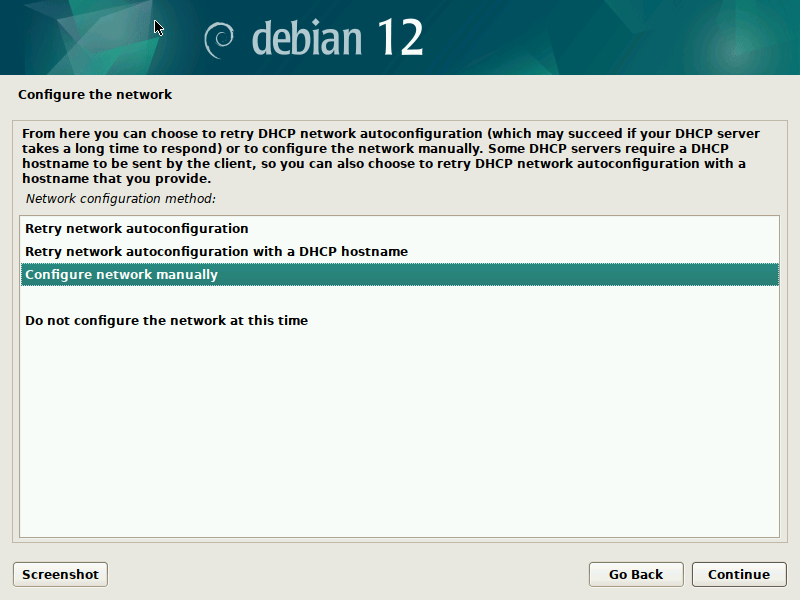
Lukas M rdian: Creating a Netplan enabled system through Debian-Installer

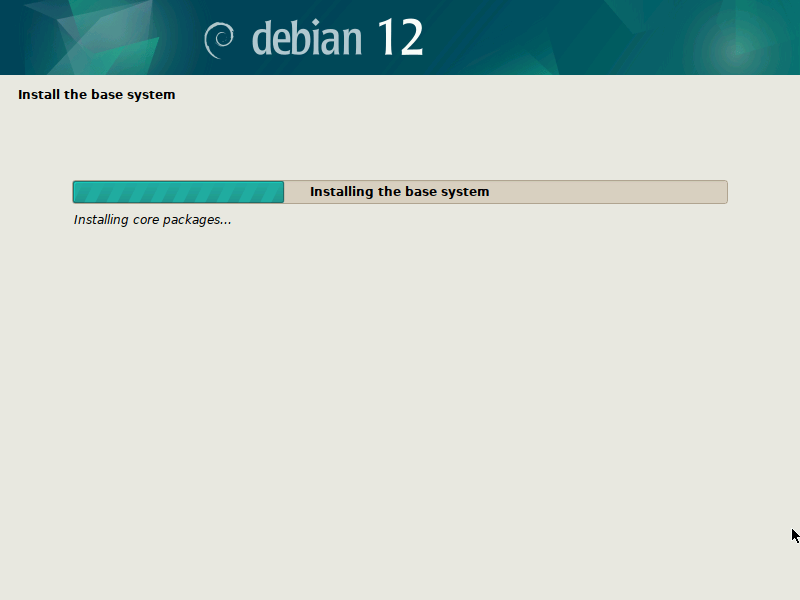
With the work that has been done in the debian-installer/netcfg merge-proposal !9 it is possible to install a standard Debian system, using the normal Debian-Installer (d-i) mini.iso images, that will come pre-installed with Netplan and all network configuration structured in /etc/netplan/. In this write-up, I d like to run you through a list of commands for experiencing the Netplan enabled installation process first-hand. Let s start with preparing a working directory and installing the software dependencies for our virtualized Debian system:
$ mkdir d-i_tmp && cd d-i_tmp
$ apt install ovmf qemu-utils qemu-system-x86
Now let s download the official (daily) mini.iso, linux kernel image and initrd.gz containing the Netplan enablement changes:
$ wget https://d-i.debian.org/daily-images/amd64/daily/netboot/gtk/mini.iso
$ wget https://d-i.debian.org/daily-images/amd64/daily/netboot/gtk/debian-installer/amd64/initrd.gz
$ wget https://d-i.debian.org/daily-images/amd64/daily/netboot/gtk/debian-installer/amd64/linux
Next we ll prepare a VM, by copying the EFI firmware files, preparing some persistent EFIVARs file, to boot from FS0:\EFI\debian\grubx64.efi, and create a virtual disk for our machine:
$ cp /usr/share/OVMF/OVMF_CODE_4M.fd .
$ cp /usr/share/OVMF/OVMF_VARS_4M.fd .
$ qemu-img create -f qcow2 ./data.qcow2 20G
Finally, let s launch the debian-installer using a preseed.cfg file, that will automatically install Netplan (netplan-generator) for us in the target system. A minimal preseed file could look like this:
# Install minimal Netplan generator binary
d-i preseed/late_command string in-target apt-get -y install netplan-generator
For this demo, we re installing the full netplan.io package (incl. the interactive Python CLI), as well as the netplan-generator package and systemd-resolved, to show the full Netplan experience. You can choose the preseed file from a set of different variants to test the different configurations: We re using the linux kernel and initrd.gz here to be able to pass the preseed URL as a parameter to the kernel s cmdline directly. Launching this VM should bring up the official debian-installer in its netboot/gtk form:
$ export U=https://people.ubuntu.com/~slyon/d-i/netplan-preseed+full.cfg
$ qemu-system-x86_64 \
	-M q35 -enable-kvm -cpu host -smp 4 -m 2G \
	-drive if=pflash,format=raw,unit=0,file=OVMF_CODE_4M.fd,readonly=on \
	-drive if=pflash,format=raw,unit=1,file=OVMF_VARS_4M.fd,readonly=off \
	-device qemu-xhci -device usb-kbd -device usb-mouse \
	-vga none -device virtio-gpu-pci \
	-net nic,model=virtio -net user \
	-kernel ./linux -initrd ./initrd.gz -append "url=$U" \
	-hda ./data.qcow2 -cdrom ./mini.iso;
Now you can click through the normal Debian-Installer process, using mostly default settings. Optionally, you could play around with the networking settings, to see how those get translated to /etc/netplan/ in the target system.
After you confirmed your partitioning changes, the base system gets installed. I suggest not to select any additional components, like desktop environments, to speed up the process.
During the final step of the installation (finish-install.d/55netcfg-copy-config) d-i will detect that Netplan was installed in the target system (due to the preseed file provided) and opt to write its network configuration to /etc/netplan/ instead of /etc/network/interfaces or /etc/NetworkManager/system-connections/.
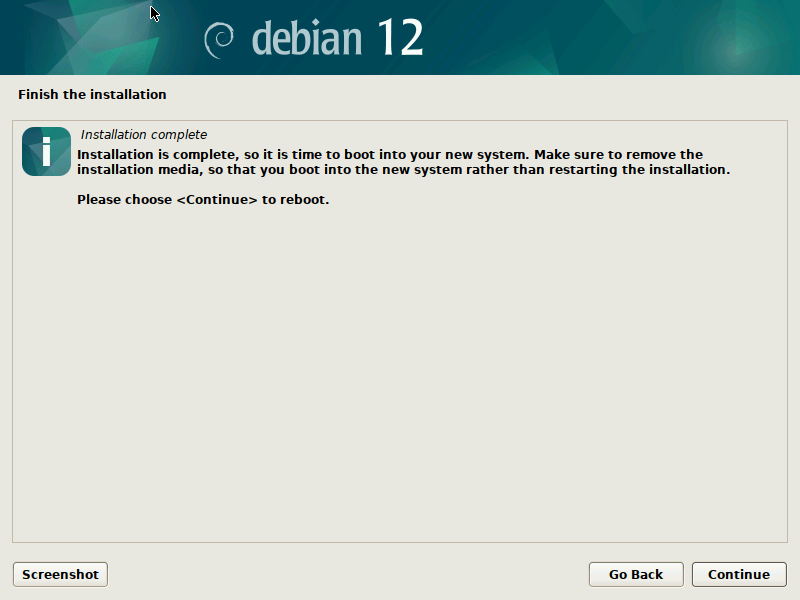
Done! After the installation finished, you can reboot into your virgin Debian Sid/Trixie system. To do that, quit the current Qemu process, by pressing Ctrl+C and make sure to copy over the EFIVARS.fd file that was modified by grub during the installation, so Qemu can find the new system. Then reboot into the new system, not using the mini.iso image any more:
$ cp ./OVMF_VARS_4M.fd ./EFIVARS.fd
$ qemu-system-x86_64 \
        -M q35 -enable-kvm -cpu host -smp 4 -m 2G \
        -drive if=pflash,format=raw,unit=0,file=OVMF_CODE_4M.fd,readonly=on \
        -drive if=pflash,format=raw,unit=1,file=EFIVARS.fd,readonly=off \
        -device qemu-xhci -device usb-kbd -device usb-mouse \
        -vga none -device virtio-gpu-pci \
        -net nic,model=virtio -net user \
        -drive file=./data.qcow2,if=none,format=qcow2,id=disk0 \
        -device virtio-blk-pci,drive=disk0,bootindex=1
        -serial mon:stdio
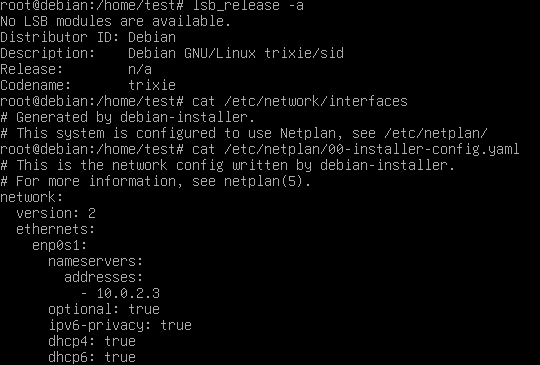
Finally, you can play around with your Netplan enabled Debian system! As you will find, /etc/network/interfaces exists but is empty, it could still be used (optionally/additionally). Netplan was configured in /etc/netplan/ according to the settings given during the d-i installation process.
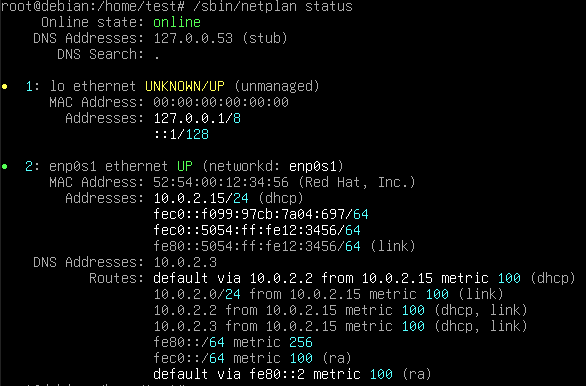
In our case, we also installed the Netplan CLI, so we can play around with some of its features, like netplan status:
Thank you for following along the Netplan enabled Debian installation process and happy hacking! If you want to learn more, find us at GitHub:netplan.

28 July 2024

Vincent Bernat: Crafting endless AS paths in BGP

Combining BGP confederations and AS override can potentially create a BGP routing loop, resulting in an indefinitely expanding AS path. BGP confederation is a technique used to reduce the number of iBGP sessions and improve scalability in large autonomous systems (AS). It divides an AS into sub-ASes. Most eBGP rules apply between sub-ASes, except that next-hop, MED, and local preferences remain unchanged. The AS path length ignores contributions from confederation sub-ASes. BGP confederation is rarely used and BGP route reflection is typically preferred for scaling. AS override is a feature that allows a router to replace the ASN of a neighbor in the AS path of outgoing BGP routes with its own. It s useful when two distinct autonomous systems share the same ASN. However, it interferes with BGP s loop prevention mechanism and should be used cautiously. A safer alternative is the allowas-in directive.1 In the example below, we have four routers in a single confederation, each in its own sub-AS. R0 originates the 2001:db8::1/128 prefix. R1, R2, and R3 forward this prefix to the next router in the loop.
BGP routing loop involving 4 routers: R0 originates a prefix, R1, R2, R3 make it loop using next-hop-self and as-override
BGP routing loop using a confederation
The router configurations are available in a Git repository. They are running Cisco IOS XR. R2 uses the following configuration for BGP:
router bgp 64502
 bgp confederation peers
  64500
  64501
  64503
 !
 bgp confederation identifier 64496
 bgp router-id 1.0.0.2
 address-family ipv6 unicast
 !
 neighbor 2001:db8::2:0
  remote-as 64501
  description R1
  address-family ipv6 unicast
  !
 !
 neighbor 2001:db8::3:1
  remote-as 64503
  advertisement-interval 0
  description R3
  address-family ipv6 unicast
   next-hop-self
   as-override
  !
 !
!
The session with R3 uses both as-override and next-hop-self directives. The latter is only necessary to make the announced prefix valid, as there is no IGP in this example.2 Here s the sequence of events leading to an infinite AS path:
  1. R0 sends the prefix to R1 with AS path (64500).3
  2. R1 selects it as the best path, forwarding it to R2 with AS path (64501 64500).
  3. R2 selects it as the best path, forwarding it to R3 with AS path (64500 64501 64502).
  4. R3 selects it as the best path. It would forward it to R1 with AS path (64503 64502 64501 64500), but due to AS override, it substitutes R1 s ASN with its own, forwarding it with AS path (64503 64502 64503 64500).
  5. R1 accepts the prefix, as its own ASN is not in the AS path. It compares this new prefix with the one from R0. Both (64500) and (64503 64502 64503 64500) have the same length because confederation sub-ASes don t contribute to AS path length. The first tie-breaker is the router ID. R0 s router ID (1.0.0.4) is higher than R3 s (1.0.0.3). The new prefix becomes the best path and is forwarded to R2 with AS path (64501 64503 64501 64503 64500).
  6. R2 receives the new prefix, replacing the old one. It selects it as the best path and forwards it to R3 with AS path (64502 64501 64502 64501 64502 64500).
  7. R3 receives the new prefix, replacing the old one. It selects it as the best path and forwards it to R0 with AS path (64503 64502 64503 64502 64503 64502 64500).
  8. R1 receives the new prefix, replacing the old one. Again, it competes with the prefix from R0, and again the new prefix wins due to the lower router ID. The prefix is forwarded to R2 with AS path (64501 64503 64501 64503 64501 64503 64501 64500).
A few iterations later, R1 views the looping prefix as follows:4
RP/0/RP0/CPU0:R1#show bgp ipv6 u 2001:db8::1/128 bestpath-compare
BGP routing table entry for 2001:db8::1/128
Last Modified: Jul 28 10:23:05.560 for 00:00:00
Paths: (2 available, best #2)
  Path #1: Received by speaker 0
  Not advertised to any peer
  (64500)
    2001:db8::1:0 from 2001:db8::1:0 (1.0.0.4), if-handle 0x00000000
      Origin IGP, metric 0, localpref 100, valid, confed-external
      Received Path ID 0, Local Path ID 0, version 0
      Higher router ID than best path (path #2)
  Path #2: Received by speaker 0
  Advertised IPv6 Unicast paths to peers (in unique update groups):
    2001:db8::2:1
  (64503 64502 64503 64502 64503 64502 64503 64502 64503 64502 64503 64502 64503 64502 64503 64502 64503 64502 64503 64502 64503 64502 64503 64502 64503 64502 64503 64502 64503 64502 64503 64502 64503 64502 64503 64502 64503 64502 64503 64502 64503 64502 64503 64502 64503 64502 64503 64502 64503 64502 64503 64502 64503 64502 64503 64502 64503 64502 64503 64502 64503 64502 64503 64502 64503 64502 64503 64502 64503 64502 64503 64502 64503 64502 64503 64502 64503 64502 64503 64502 64503 64502 64503 64502 64503 64502 64503 64502 64503 64502 64503 64502 64503 64502 64503 64502 64503 64502 64503 64502 64503 64502 64500)
    2001:db8::4:0 from 2001:db8::4:0 (1.0.0.3), if-handle 0x00000000
      Origin IGP, metric 0, localpref 100, valid, confed-external, best, group-best
      Received Path ID 0, Local Path ID 1, version 37
      best of AS 64503, Overall best
There s no upper bound for an AS path, but BGP messages have size limits (4096 bytes per RFC 4271 or 65535 bytes per RFC 8654). At some point, BGP updates can t be generated. On Cisco IOS XR, the BGP process crashes well before reaching this limit.5
The main lessons from this tale are:

  1. When using BGP confederations with Cisco IOS XR, use allowconfedas-in instead. It s available since IOS XR 7.11.
  2. Using BGP confederations is already inadvisable. If you don t use the same IGP for all sub-ASes, you re inviting trouble! However, the scenario described here is also possible with an IGP.
  3. When an AS path segment is composed of ASNs from a confederation, it is displayed between parentheses.
  4. By default, IOS XR paces eBGP updates. This is controlled by the advertisement-interval directive. Its default value is 30 seconds for eBGP peers (even in the same confederation). R1 and R2 set this value to 0, while R3 sets it to 2 seconds. This gives some time to watch the AS path grow.
  5. This is CSCwk15887. It only happens when using as-override on an AS path with a too long AS_CONFED_SEQUENCE. This should be fixed around 24.3.1.

27 July 2024

Bits from Debian: DebConf24 starts today in Busan on Sunday, July 28, 2024

DebConf24, the 25th annual Debian Developer Conference, is taking place in Busan, Republic of Korea from July 28th to August 4th, 2024. Debian contributors from all over the world have come together at Pukyong National University, Busan, to participate and work in a conference exclusively ran by volunteers. Today the main conference starts with around 340 expected attendants and over 100 scheduled activities, including 45-minute and 20-minute talks, Bird of a Feather ("BoF") team meetings, workshops, a job fair, as well as a variety of other events. The full schedule is updated each day, including activities planned ad-hoc by attendees over the course of the conference. If you would like to engage remotely, you can follow the video streams available from the DebConf24 website for the events happening in the three talk rooms: Bada, Somin and Pado. Or you can join the conversations happening inside the talk rooms via the OFTC IRC network in the #debconf-bada, #debconf-somin, and #debconf-pado channels. Please also join us in the #debconf channel for common discussions related to DebConf. You can also follow the live coverage of news about DebConf24 provided by our micronews service or the @debian profile on your favorite social network. DebConf is committed to a safe and welcoming environment for all participants. Please see our Code of Conduct page for more information on this. Debian thanks the commitment of numerous sponsors to support DebConf24, particularly our Platinum Sponsors: Proxmox, Infomaniak and Wind River. DebConf24 logo

Bits from Debian: DebConf24 welcomes its sponsors!

DebConf24 logo DebConf24, the 25th edition of the Debian conference is taking place in Pukyong National University at Busan, Republic of Korea. Thanks to the hard work of its organizers, it again will be an interesting and fruitful event for attendees. We would like to warmly welcome the sponsors of DebConf24, and introduce them to you. We have three Platinum sponsors. Our Gold sponsors are: Our Silver sponsors are: Bronze sponsors: And finally, our Supporter level sponsors: A special thanks to the Pukyong National University, our Venue Partner and our Network Partners KOREN and KREONET! Thanks to all our sponsors for their support! Their contributions make it possible for a large number of Debian contributors from all over the globe to work together, help and learn from each other in DebConf24.

24 July 2024

Gunnar Wolf: DebConf24 Continuous Key-Signing Party

Yay, party!

Yay, crypto! DebCamp has started, and in a couple of days, we will fully be in DebConf24 mode! As most of you know, an important part that binds Debian together is our cryptographic identity assurance, and that is in good measure tightened by the Continuous Key-Signing Parties we hold at DebConfs and other Debian and Free Software gatherings. As I have done during (most of) the past DebConfs, I have prepared a set of pseudo-social maps to help you find where you are in the OpenPGP mesh of our conference. Naturally, Web-of-Trust maps should be user-centered, so find your own at: https://people.debian.org/~gwolf/dc24_ksp/ The list is now final and it will not receive any modifications (I asked for them some days ago); if your name still appears on the list and you don t want to be linked to the DC24 KSP in the future, tell me and I ll remove it from future versions of the list (but it is part of the final DC24 file, as its checksum is already final) Speaking of which! If you are to be a part of the keysigning, get the final DC24 file and, on a device you trust, check its SHA256 by running:
$ sha256sum dc24_fprs.txt
11daadc0e435cb32f734307b091905d4236cdf82e3b84f43cde80ef1816370a5  dc24_fprs.txt
Make sure the resulting number matches the one I m presenting. If it doesn t, ensure your copy of the file is not corrupted (i.e. download again). If it still doess not match, notify me immediately. Does any of the above confuse you? Please come to (or at least, follow the stream for) my session on DebConf opening day, Continuous Key-Signing Party introduction, 10:30 Korean time; I will do my best to explain the details to you. PS- I will soon provide a simple, short PDF that will probably be mass-printed at FrontDesk so that you can easily track your KSP progress.

Dirk Eddelbuettel: RQuantLib 0.4.23 on CRAN: Updates

A new minor release 0.4.23 of RQuantLib just arrived at CRAN earlier today, and will be uploaded to Debian in due course. QuantLib is a rather comprehensice free/open-source library for quantitative finance. RQuantLib connects (some parts of) it to the R environment and language, and has been part of CRAN for more than twenty-two years (!!) as it was one of the first packages I uploaded. This release of RQuantLib updates to QuantLib version 1.35 released this morning. It accommodates some removals following earlier deprecations, and also updates most of the code in the function for a more readable and compact form of creating shared pointers via make_shared() along with auto.

Changes in RQuantLib version 0.4.23 (2024-07-23)
  • Adjustments for QuantLib 1.35 and removal of deprecated code (in utility functions and dividend case of vanilla options)
  • Adjustments for new changes in QuantLib 1.35
  • Refactoring most C++ files making more use of both auto and make_shared to simplify and shorten expressions

Courtesy of my CRANberries, there is also a diffstat report for the this release. As always, more detailed information is on the RQuantLib page. Questions, comments etc should go to the rquantlib-devel mailing list. Issue tickets can be filed at the GitHub repo. If you like this or other open-source work I do, you can now sponsor me at GitHub.

This post by Dirk Eddelbuettel originated on his Thinking inside the box blog. Please report excessive re-aggregation in third-party for-profit settings.

Dirk Eddelbuettel: qlcal 0.0.12 on CRAN: Calendar Updates

The twelveth release of the qlcal package arrivied at CRAN today. qlcal delivers the calendaring parts of QuantLib. It is provided (for the R package) as a set of included files, so the package is self-contained and does not depend on an external QuantLib library (which can be demanding to build). qlcal covers over sixty country / market calendars and can compute holiday lists, its complement (i.e. business day lists) and much more. Examples are in the README at the repository, the package page, and course at the CRAN package page. This releases synchronizes qlcal with the QuantLib release 1.35 (made today) and contains more updates to 2024 calendars.

Changes in version 0.0.12 (2024-07-22)
  • Synchronized with QuantLib 1.35 released today
  • Calendar updates for Chile, India, United States, Brazil

Courtesy of my CRANberries, there is a diffstat report for this release. See the project page and package documentation for more details, and more examples. If you like this or other open-source work I do, you can sponsor me at GitHub.

This post by Dirk Eddelbuettel originated on his Thinking inside the box blog. Please report excessive re-aggregation in third-party for-profit settings.

21 July 2024

Mike Gabriel: Polis - a FLOSS Tool for Civic Participation -- Issues extending Polis and adjusting our Goals

Here comes the 3rd article of the 5-episode blog post series on Polis, written by Guido Berh rster, member of staff at my company Fre(i)e Software GmbH. Enjoy also this read on Guido's work on Polis,
Mike
Table of Contents of the Blog Post Series
  1. Introduction
  2. Initial evaluation and adaptation
  3. Issues extending Polis and adjusting our goals (this article)
  4. Creating (a) new frontend(s) for Polis
  5. Current status and roadmap
Polis - Issues extending Polis and adjusting our Goals After the initial implementation of limited branding support, user feedback and the involvement of an UX designer lead to the conclusion that we needed more far-reaching changes to the user interface in order to reduce visual clutter, rearrange and improve UI elements, and provide better integration with the websites in which conversations are embedded. Challenges when visualizing Data in Polis Polis visualizes groups using a spatial projection of users based on similarities in voting behavior and places them in two to five groups using a clustering algorithm. During our testing and evaluation users were rarely able to interpret the visualization and often intuitively made incorrect assumptions e.g. by associating the filled area of a group with its significance or size. After consultation with a member of the Multi-Agent Systems (MAS) Group at the University of Groningen we chose to temporarily replace the visualization offered by Polis with simple bar charts representing agreement or disagreement with statements of a group or the majority. We intend to revisit this and explore different forms of visualization at a later point in time. The different factors playing into the weight attached to statements which determine the pseuodo-random order in which they are presented for voting ( comment routing ) proved difficult to explain to stakeholders and users and the admission of the ad-hoc and heuristic nature of the used algorithm1 by Polis authors lead to the decision to temporarily remove this feature. Instead, statements should be placed into three groups, namely
  1. metadata questions,
  2. seed statements,
  3. and participant statements
Statements should then be sorted by group but in a fully randomized order within the group so that metadata questions would be presented before seed statements which would be presented before participant s statements. This simpler method was deemed sufficient for the scale of our pilot projects, however we intend to revisit this decision and explore different methods of comment routing in cooperation with our scientific partners at a later point in time. An evaluation of the requirements for implementing mandatory authentication and adding support for additional authentication methods to Polis showed that significant changes to both the administration and participation frontend were needed due to a lack of an abstraction layer or extension mechanism and the current authentication providers being hardcoded in many parts of the code base. A New Frontend is born: Particiapp Based on the implementation details of the participation frontend, the invasive nature of the changes required, and the overhead of keeping up with active upstream development it became clear that a different, more flexible approach to development was needed. This ultimately lead to the creation of Particiapp, a new Open Source project providing the building blocks and necessary abstraction layers for rapid protoyping and experimentation with different fontends which are compatible with but independent from Polis.
  1. Small, Christopher T., Bjorkegren, Michael, Erkkil , Timo, Shaw, Lynette and Megill, Colin (2021). Polis: Scaling deliberation by mapping high dimensional opinion spaces. Recerca. Revista de Pensament i An lisi, 26(2), pp. 1-26.

17 July 2024

Dirk Eddelbuettel: Rcpp 1.0.13 on CRAN: Some Updates

rcpp logo The Rcpp Core Team is once again pleased to announce a new release (now at 1.0.13) of the Rcpp package. It arrived on CRAN earlier today, and has since been uploaded to Debian. Windows and macOS builds should appear at CRAN in the next few days, as will builds in different Linux distribution and of course r2u should catch up tomorrow too. The release was uploaded last week, but not only does Rcpp always gets flagged because of the grandfathered .Call(symbol) but CRAN also found two packages regressing which then required them to take five days to get back to us. One issue was known; another did not reproduce under our tests against over 2800 reverse dependencies leading to the eventual release today. Yay. Checks are good and appreciated, and it does take time by humans to review them. This release continues with the six-months January-July cycle started with release 1.0.5 in July 2020. As a reminder, we do of course make interim snapshot dev or rc releases available via the Rcpp drat repo as well as the r-universe page and repo and strongly encourage their use and testing I run my systems with these versions which tend to work just as well, and are also fully tested against all reverse-dependencies. Rcpp has long established itself as the most popular way of enhancing R with C or C++ code. Right now, 2867 packages on CRAN depend on Rcpp for making analytical code go faster and further, along with 256 in BioConductor. On CRAN, 13.6% of all packages depend (directly) on Rcpp, and 59.9% of all compiled packages do. From the cloud mirror of CRAN (which is but a subset of all CRAN downloads), Rcpp has been downloaded 86.3 million times. The two published papers (also included in the package as preprint vignettes) have, respectively, 1848 (JSS, 2011) and 324 (TAS, 2018) citations, while the the book (Springer useR!, 2013) has another 641. This release is incremental as usual, generally preserving existing capabilities faithfully while smoothing our corners and / or extending slightly, sometimes in response to changing and tightened demands from CRAN or R standards. The move towards a more standardized approach for the C API of R leads to a few changes; Kevin did most of the PRs for this. Andrew Johnsom also provided a very nice PR to update internals taking advantage of variadic templates. The full list below details all changes, their respective PRs and, if applicable, issue tickets. Big thanks from all of us to all contributors!

Changes in Rcpp release version 1.0.13 (2024-07-11)
  • Changes in Rcpp API:
    • Set R_NO_REMAP if not already defined (Dirk in #1296)
    • Add variadic templates to be used instead of generated code (Andrew Johnson in #1303)
    • Count variables were switches to size_t to avoid warnings about conversion-narrowing (Dirk in #1307)
    • Rcpp now avoids the usage of the (non-API) DATAPTR function when accessing the contents of Rcpp Vector objects where possible. (Kevin in #1310)
    • Rcpp now emits an R warning on out-of-bounds Vector accesses. This may become an error in a future Rcpp release. (Kevin in #1310)
    • Switch VECTOR_PTR and STRING_PTR to new API-compliant RO variants (Kevin in #1317 fixing #1316)
  • Changes in Rcpp Deployment:
    • Small updates to the CI test containers have been made (#1304)

Thanks to my CRANberries, you can also look at a diff to the previous release Questions, comments etc should go to the rcpp-devel mailing list off the R-Forge page. Bugs reports are welcome at the GitHub issue tracker as well (where one can also search among open or closed issues). If you like this or other open-source work I do, you can sponsor me at GitHub.

This post by Dirk Eddelbuettel originated on his Thinking inside the box blog. Please report excessive re-aggregation in third-party for-profit settings.

Russell Coker: Samsung Galaxy Note 9 Review

After the VoLTE saga [1] and the problems with battery life on the PinePhonePro [2] (which lasted 4 hours while idle with the screen off in my last test a few weeks ago) I m running a Galaxy Note 9 [3] with the default Samsung OS as my daily driver. I don t think that many people will be rushing out to buy a 2018 phone regardless of my review. For someone who wants a phone of such age (which has decent hardware and a low price) then good options are the Pixel phones which are all supported by LineageOS. I recommend not buying this phone due to the fact that it doesn t have support for VoLTE with LineageOS (and presumably any other non-Samsung Android build) and doesn t have support from any other OS. The One Plus 6/6T has Mobian support [4] as well as LineageOS support and is worth considering. The Note 9 still has capable hardware by today s standards. A 6.4 display is about as big as most people want in their pocket and 2960 1440 resolution in that size (516dpi) is probably as high as most people can see without a magnifying glass. The model I m using has 8G of RAM which is as much as the laptop I was using at the start of this year. I don t think that many people will have things that they actually want to do on a phone which needs more hardware than this. The only hardware feature in new phones which beats this is the large folding screen in some recent phones, but $2500+ (the price of such phones in Australia) is too much IMHO and the second hand market for folding phones is poor due to the apparently high incidence of screens breaking. The Note 9 has the Dex environment for running as a laptop if you connect it to a USB-C dock. It can run nicely with a 4K monitor with USB keyboard and mouse. The UI is very similar to that of older versions of Windows. The Samsung version of Android seems mostly less useful than the stock Google version or the LineageOS version. The Samsung keyboard flags words such as gay as spelling errors and it can t be uninstalled even when you install a better keyboard app. There is a Bixby button on the side of the phone to launch the Bixby voice recognition app which can t be mapped to any useful purpose, The Google keyboard has a voice dictation option which I will try out some time but that s all I desire in terms of voice recognition. There are alerts about Samsung special deals and configuration options including something about signing in to some service and having it donate money to charity, I doubt that any users want such features. Apart from Dex the Samsung Android build is a good advert for LineageOS. The screen has curved sides for no good reason. This makes it more difficult to make a protective phone case as a case can t extend beyond the screen at the sides and therefore if it s dropped and hits an edge (step, table, etc) then the glass can make direct contact with something. Also the curved sides reflect sunlight in all directions, this means that the user has to go to more effort to avoid reflecting the sun into their eyes and that a passenger can more easily reflect sunlight into the eyes of a car driver. It s an impressive engineering feat to make a curved touch-screen but it doesn t do any good for users. The stylus is good as always and the screen is AMOLED so it doesn t waste much power when in dark mode. There is a configuration option to display a clock all the time when the screen is locked because that apparently doesn t use much power. I haven t felt inclined to enable the always on screen but it s a nice feature for those who like such things. The VoLTE implementation is apparently a bit unusual so it s not supported by LineageOS and didn t work on Droidian for the small amount of time that Droidian supported it. Generally this phone is quite nice hardware it s just a pity that it demonstrates all of the downsides to buying a non-Pixel phone.

14 July 2024

Ravi Dwivedi: Kenya Visa Process

Prior to arrival in Kenya, you need to apply for an Electronic Travel Authorization (eTA) on their website by uploading all the required documents. This system is in place since Jan 2024 after the country abolished the visa system, implementing the eTA portal. The required documents will depend on the purpose of your visit, which in my case, was to attend a conference. Here is the list of documents I submitted for my eTA: Reservation means I didn t book the flights and hotels, but rather reserved them. Additionally, optional means that those documents were not mandatory to submit, but I submitted them in the Other Documents section in order to support my application. After submitting the eTA, I had to make a payment of around 35 US Dollars (approximately 3000 Indian Rupees). It took 40 hours for me to receive an email from Kenya stating that my eTA has been approved, along with an attached PDF, making this one of my smoothest experiences of obtaining travel documents to travel to a country :). An eTA is technically not a visa, but I put the word visa in the title due to familiarity with the term.

12 July 2024

Freexian Collaborators: Monthly report about Debian Long Term Support, June 2024 (by Roberto C. S nchez)

Like each month, have a look at the work funded by Freexian s Debian LTS offering.

Debian LTS contributors In June, 18 contributors have been paid to work on Debian LTS, their reports are available:
  • Adrian Bunk did 47.0h (out of 74.25h assigned and 11.75h from previous period), thus carrying over 39.0h to the next month.
  • Arturo Borrero Gonzalez did 6.0h (out of 6.0h assigned).
  • Bastien Roucari s did 20.0h (out of 20.0h assigned).
  • Ben Hutchings did 15.5h (out of 16.0h assigned and 8.0h from previous period), thus carrying over 8.5h to the next month.
  • Chris Lamb did 18.0h (out of 18.0h assigned).
  • Daniel Leidert did 4.0h (out of 8.0h assigned and 2.0h from previous period), thus carrying over 6.0h to the next month.
  • Emilio Pozuelo Monfort did 23.25h (out of 49.5h assigned and 10.5h from previous period), thus carrying over 36.75h to the next month.
  • Guilhem Moulin did 4.5h (out of 13.0h assigned and 7.0h from previous period), thus carrying over 15.5h to the next month.
  • Lee Garrett did 17.0h (out of 25.0h assigned and 35.0h from previous period), thus carrying over 43.0h to the next month.
  • Lucas Kanashiro did 5.0h (out of 10.0h assigned and 10.0h from previous period), thus carrying over 15.0h to the next month.
  • Markus Koschany did 40.0h (out of 40.0h assigned).
  • Ola Lundqvist did 10.0h (out of 6.5h assigned and 17.5h from previous period), thus carrying over 14.0h to the next month.
  • Roberto C. S nchez did 5.25h (out of 7.75h assigned and 4.25h from previous period), thus carrying over 6.75h to the next month.
  • Santiago Ruano Rinc n did 22.5h (out of 14.5h assigned and 8.0h from previous period).
  • Sean Whitton did 6.5h (out of 6.0h assigned and 0.5h from previous period).
  • Stefano Rivera did 0.5h (out of 0.0h assigned and 10.0h from previous period), thus carrying over 9.5h to the next month.
  • Sylvain Beucler did 9.0h (out of 24.5h assigned and 35.5h from previous period), thus carrying over 51.0h to the next month.
  • Thorsten Alteholz did 14.0h (out of 14.0h assigned).

Evolution of the situation In June, we have released 31 DLAs. Notable security updates in June included:
  • git: multiple vulnerabilities, which may result in privilege escalation, denial of service, and arbitrary code execution
  • sendmail: SMTP smuggling allowed remote attackers bypass SPF protection checks
  • cups: arbitrary remote code execution
Looking further afield to the broader Debian ecosystem, LTS contributor Bastien Roucari s also patched sendmail in Debian 12 (bookworm) and 11 (bullseye) in order to fix the previously mentioned SMTP smuggling vulnerability. Furthermore, LTS contributor Thorsten Alteholz provided fixes for the cups packages in Debian 12 (bookworm) and 11 (bullseye) in order to fix the aforementioned arbitrary remote code execution vulnerability. Additionally, LTS contributor Ben Hutchings has commenced work on an updated backport of Linux kernel 6.1 to Debian 11 (bullseye), in preparation for bullseye transitioning to the responsibility of the LTS (and the associated closure of the bullseye-backports repository). LTS Lucas Kanashiro also began the preparatory work of backporting parts of the rust/cargo toolchain to Debian 11 (bullseye) in order to make future updates of the clamav virus scanner possible. June was the final month of LTS for Debian 10 (as announced on the debian-lts-announce mailing list). No additional Debian 10 security updates will be made available on security.debian.org. However, Freexian and its team of paid Debian contributors will continue to maintain Debian 10 going forward for the customers of the Extended LTS offer. Subscribe right away if you sill have Debian 10 which must be kept secure (and which cannot yet be upgraded).

Thanks to our sponsors Sponsors that joined recently are in bold.

11 July 2024

Russ Allbery: podlators v6.0.0

podlators is the collection of Perl modules and front-end scripts that convert POD documentation to *roff manual pages or text, possibly with formatting intended for pagers. This release continues the simplifications that I've been doing in the last few releases and now uniformly escapes - characters and single quotes, disabling all special interpretation by *roff formatters and dropping the heuristics that were used in previous versions to try to choose between possible interpretations of those characters. I've come around to the position that POD simply is not semantically rich enough to provide sufficient information to successfully make a more nuanced conversion, and these days Unicode characters are available for authors who want to be more precise. This version also drops support for Perl versions prior to 5.12 and switches to semantic versioning for all modules. I've added a v prefix to the version number, since that is the convention for Perl module versions that use semantic versioning. This release also works around some changes to the man macros in groff 1.23.0 to force persistent ragged-right justification when formatted with nroff and fixes a variety of other bugs. You can get the latest release from CPAN or from the podlators distribution page.

Next.

Previous.