Search Results: "nic"

12 July 2024

Freexian Collaborators: Monthly report about Debian Long Term Support, June 2024 (by Roberto C. S nchez)

Like each month, have a look at the work funded by Freexian s Debian LTS offering.

Debian LTS contributors In June, 18 contributors have been paid to work on Debian LTS, their reports are available:
  • Adrian Bunk did 47.0h (out of 74.25h assigned and 11.75h from previous period), thus carrying over 39.0h to the next month.
  • Arturo Borrero Gonzalez did 6.0h (out of 6.0h assigned).
  • Bastien Roucari s did 20.0h (out of 20.0h assigned).
  • Ben Hutchings did 15.5h (out of 16.0h assigned and 8.0h from previous period), thus carrying over 8.5h to the next month.
  • Chris Lamb did 18.0h (out of 18.0h assigned).
  • Daniel Leidert did 4.0h (out of 8.0h assigned and 2.0h from previous period), thus carrying over 6.0h to the next month.
  • Emilio Pozuelo Monfort did 23.25h (out of 49.5h assigned and 10.5h from previous period), thus carrying over 36.75h to the next month.
  • Guilhem Moulin did 4.5h (out of 13.0h assigned and 7.0h from previous period), thus carrying over 15.5h to the next month.
  • Lee Garrett did 17.0h (out of 25.0h assigned and 35.0h from previous period), thus carrying over 43.0h to the next month.
  • Lucas Kanashiro did 5.0h (out of 10.0h assigned and 10.0h from previous period), thus carrying over 15.0h to the next month.
  • Markus Koschany did 40.0h (out of 40.0h assigned).
  • Ola Lundqvist did 10.0h (out of 6.5h assigned and 17.5h from previous period), thus carrying over 14.0h to the next month.
  • Roberto C. S nchez did 5.25h (out of 7.75h assigned and 4.25h from previous period), thus carrying over 6.75h to the next month.
  • Santiago Ruano Rinc n did 22.5h (out of 14.5h assigned and 8.0h from previous period).
  • Sean Whitton did 6.5h (out of 6.0h assigned and 0.5h from previous period).
  • Stefano Rivera did 0.5h (out of 0.0h assigned and 10.0h from previous period), thus carrying over 9.5h to the next month.
  • Sylvain Beucler did 9.0h (out of 24.5h assigned and 35.5h from previous period), thus carrying over 51.0h to the next month.
  • Thorsten Alteholz did 14.0h (out of 14.0h assigned).

Evolution of the situation In June, we have released 31 DLAs. Notable security updates in June included:
  • git: multiple vulnerabilities, which may result in privilege escalation, denial of service, and arbitrary code execution
  • sendmail: SMTP smuggling allowed remote attackers bypass SPF protection checks
  • cups: arbitrary remote code execution
Looking further afield to the broader Debian ecosystem, LTS contributor Bastien Roucari s also patched sendmail in Debian 12 (bookworm) and 11 (bullseye) in order to fix the previously mentioned SMTP smuggling vulnerability. Furthermore, LTS contributor Thorsten Alteholz provided fixes for the cups packages in Debian 12 (bookworm) and 11 (bullseye) in order to fix the aforementioned arbitrary remote code execution vulnerability. Additionally, LTS contributor Ben Hutchings has commenced work on an updated backport of Linux kernel 6.1 to Debian 11 (bullseye), in preparation for bullseye transitioning to the responsibility of the LTS (and the associated closure of the bullseye-backports repository). LTS Lucas Kanashiro also began the preparatory work of backporting parts of the rust/cargo toolchain to Debian 11 (bullseye) in order to make future updates of the clamav virus scanner possible. June was the final month of LTS for Debian 10 (as announced on the debian-lts-announce mailing list). No additional Debian 10 security updates will be made available on security.debian.org. However, Freexian and its team of paid Debian contributors will continue to maintain Debian 10 going forward for the customers of the Extended LTS offer. Subscribe right away if you sill have Debian 10 which must be kept secure (and which cannot yet be upgraded).

Thanks to our sponsors Sponsors that joined recently are in bold.

11 July 2024

Russ Allbery: podlators v6.0.0

podlators is the collection of Perl modules and front-end scripts that convert POD documentation to *roff manual pages or text, possibly with formatting intended for pagers. This release continues the simplifications that I've been doing in the last few releases and now uniformly escapes - characters and single quotes, disabling all special interpretation by *roff formatters and dropping the heuristics that were used in previous versions to try to choose between possible interpretations of those characters. I've come around to the position that POD simply is not semantically rich enough to provide sufficient information to successfully make a more nuanced conversion, and these days Unicode characters are available for authors who want to be more precise. This version also drops support for Perl versions prior to 5.12 and switches to semantic versioning for all modules. I've added a v prefix to the version number, since that is the convention for Perl module versions that use semantic versioning. This release also works around some changes to the man macros in groff 1.23.0 to force persistent ragged-right justification when formatted with nroff and fixes a variety of other bugs. You can get the latest release from CPAN or from the podlators distribution page.

10 July 2024

Petter Reinholdtsen: Some notes from the 2024 LinuxCNC Norwegian developer gathering

The Norwegian The LinuxCNC developer gathering 2024 is over. It was a great and productive weekend, and I am sad that it is over. Regular readers probably still remember what LinuxCNC is, but her is a quick summary for those that forgot? LinuxCNC is a free software system for numerical control of machines such as milling machines, lathes, plasma cutters, routers, cutting machines, robots and hexapods. It eats G-code and produce motor movement and other changes to the physical world, while reading sensor input. I am not quite sure about the total head count, as not all people were present at the gathering the entire weekend, but I believe it was close to 10 people showing their faces at the gathering. The "hard core" of the group, who stayed the entire weekend, were two from Norway, two from Germany and one from England. I am happy with the outcome from the gathering. We managed to wrap up a new stable LinuxCNC release 2.9.3 and even tested it on real hardware within minutes of the release. The release notes for 2.9.3 are still being written, but should show up on on the project site in the next few days. We managed to go through around twenty pull requests and merge then into either the stable release (2.9) or the development branch (master). There are still around thirty pull requests left to process, so we are not out of work yet. We even managed to fix/improve a slightly worn lathe, and experiment with running a mechanical clock using G-code. The evening barbeque worked well both on Saturday and Sunday. It is quite fun to light up a charcoal grill using compressed air. Sadly the weather was not the best, so we stayed indoors most of the time. This gathering was made possible partly with sponsoring from both Redpill Linpro, Debian and NUUG Foundation, and we are most grateful for the support. I would also like to thank the local school for lending us some furniture, and of course the rest of the members of the organizers team, Asle and Bosse, for their countless contributions. The gathering was such success that we want to do it again next year. We plan to organize the next Norwegian LinuxCNC developer gathering at the end of June next year, the weekend Friday 27th to Sunday 29th of June 2025. I recommend you reserve the dates on your calendar today. Other related communities are also welcome to join in, for example those working on systems like FreeCAD and opencamlib, as I am sure we have much in common and sharing experiences would be very useful to all involved. We are of course looking for sponsors for this gathering already. The total budget for this gathering was around NOK 25.000 (around EUR 2.300), so our needs are quite modest. Perhaps a machine or tools company would like to help out the free software manufacturing community by sponsoring food, lodging and transport for such gathering?

Freexian Collaborators: Debian Contributions: YubiHSM packaging, unschroot, live-patching, and more! (by Stefano Rivera)

Debian Contributions: 2024-06 Contributing to Debian is part of Freexian s mission. This article covers the latest achievements of Freexian and their collaborators. All of this is made possible by organizations subscribing to our Long Term Support contracts and consulting services.

YubiHSM packaging, by Colin Watson Freexian is starting to use YubiHSM devices (hardware security modules) as part of some projects, and we wanted to have the supporting software directly in Debian rather than needing to use third-party repositories. Since Yubico publish everything we need under free software licences, Colin packaged yubihsm-connector, yubihsm-shell, and python-yubihsm from https://developers.yubico.com/, in some cases based partly on the upstream packaging, and got them all into Debian unstable. Backports to bookworm will be forthcoming once they ve all reached testing.

unschroot by Helmut Grohne Following an in-person discussion at MiniDebConf Berlin, Helmut attempted splitting the containment functionality of sbuild --chroot-mode=unshare into a dedicated tool interfacing with sbuild as a variant of --chroot-mode=schroot providing a sufficiently compatible interface. While this seemed technically promising initially, a discussion on debian-devel indicated a desire to rely on an existing container runtime such as podman instead of using another Debian-specific tool with unclear long term maintenance. None of the existing container runtimes meet the specific needs of sbuild, so further advancing this matter implies a compromise one way or another.

Linux live-patching, by Santiago Ruano Rinc n In collaboration with Emmanuel Arias, Santiago is working on the development of linux live-patching for Debian. For the moment, this is in an exploratory phase, that includes how to handle the different patches that will need to be provided. kpatch could help significantly in this regard. However, kpatch was removed from unstable because there are some RC bugs affecting the version that was present in Debian unstable. Santiago packaged the most recent upstream version (0.9.9) and filed an Intent to Salvage bug. Santiago is waiting for an ACK by the maintainer, and will upload to unstable after July 10th, following the package salvaging rules. While kpatch 0.9.9 fixes the main issues, it still needs some work to properly support Debian and the Linux kernel versions packaged in our distribution. More on this in the report next month.

Salsa CI, by Santiago Ruano Rinc n The work by Santiago in Salsa CI this month includes a merge request to ease testing how the production images are built from the changes introduced by future merge requests. By default, the pipelines triggered by a merge request build a subset of the images built for production, to reduce the use of resources, and because most of the time the subset of staging images is enough to test the proposed modifications. However, sometimes it is needed to test how the full set of production images is built, and the above mentioned MR helps to do that. The changes include documentation, so hopefully this will make it easier to test future contributions. Also, for being able to include support for RISC-V, Salsa CI needs to replace kaniko as the tool used to build the images. Santiago tested buildah, but there are some issues when pushing built images for non-default platform architectures (i386, armhf, armel) to the container registry. Santiago will continue to work on this to find a solution.

Miscellaneous contributions
  • Stefano Rivera prepared updates for a number of Python modules.
  • Stefano uploaded the latest point release of Python 3.12 and the latest Python 3.13 beta. Both uncovered upstream regressions that had to be addressed.
  • Stefano worked on preparations for DebConf 24.
  • Stefano helped SPI to reconcile their financial records for DebConf 23.
  • Colin did his usual routine work on the Python team, upgrading 36 packages to new upstream versions (including fixes for four CVEs in python-aiohttp), fixing RC bugs in ipykernel, ipywidgets, khard, and python-repoze.sphinx.autointerface, and packaging zope.deferredimport which was needed for a new upstream version of python-persistent.
  • Colin removed the user_readenv option from OpenSSH s PAM configuration (#1018260), and prepared a release note.
  • Thorsten Alteholz uploaded a new upstream version of cups.
  • Nicholas Skaggs updated xmacro to support reproducible builds (#1014428), DEP-3 and DEP-5 compatibility, along with utilizing hardening build flags. Helmut supported and uploaded package.
  • As a result of login having become non-essential, Helmut uploaded debvm to unstable and stable and fixed a crossqa.debian.net worker.
  • Santiago worked on the Content Team activities for DebConf24. Together with other DebConf25 team members, Santiago wrote a document for the head of the venue to describe the project of the conference.

8 July 2024

Russ Allbery: Review: Beyond Control

Review: Beyond Control, by Kit Rocha
Series: Beyond #2
Publisher: Kit Rocha
Copyright: December 2013
ASIN: B00GIA4GN8
Format: Kindle
Pages: 364
Beyond Control is science fiction erotica (dystopian erotic romance, per the marketing) and a direct sequel to Beyond Shame. These books shift protagonists with each volume and enough of the world background is explained that you could start here, but there are significant spoilers for the previous book. I read this book as part of the Beyond Series Bundle (Books 1-3), which is what the sidebar information is for. This is one of those reviews that I write because I'm stubborn about reviewing all the books I read, not because it's likely to be useful to anyone. There are also considerably more spoilers for the shape of the story than I normally include, so be warned. The Beyond series is erotica. Specifically, so far, consensual BDSM erotica with bisexuality but otherwise typical gender stereotypes. The authors (Kit Rocha is a pen name for Donna Herren and Bree Bridges) are women, so it's more female gaze than male gaze, but by erotica I don't mean romance with an above-average number of steamy scenes. I mean it felt like half the book by page count was descriptions of sex. This review is rather pointless because, one, I'm not going to review the sex that's the main point of the book, and two, I skimmed all the sex and read it for the story because I'm weird. Beyond Shame got me interested in these absurdly horny people and their post-apocalyptic survival struggles in the outskirts of a city run by a religious surveillance state, and I wanted to find out what happened next. Besides, this book promised to focus on my favorite character from the first novel, Lex, and I wanted to read more about her. Beyond Control uses a series pattern that I understand is common in romance but which is not often seen in SFF (my usual genre): each book focuses on a new couple adjacent to the previous couple, while the happily ever after of the previous couple plays out in the background. In this case, it also teases the protagonists of the next book. I can see why romance uses this structure: it's an excuse to provide satisfying interludes for the reader. In between Lex and Dallas's current relationship problems, one gets to enjoy how well everything worked out for Noelle and how much she's grown. In Beyond Shame, Lex was the sort-of partner of Dallas O'Kane, the leader of the street gang that is running Sector Four. (Picture a circle surrounding the rich-people-only city of Eden. That circle is divided into eight wedge-shaped sectors, which provide heavy industries, black-market pleasures, and slums for agricultural workers.) Dallas is an intensely possessive, personally charismatic semi-dictator who cultivates the image of a dangerous barbarian to everyone outside and most of the people inside Sector Four. Since he's supposed to be one of the good guys, this is more image than reality, but it's not entirely disconnected from reality. This book is about Lex and Dallas forming an actual relationship, instead of the fraught and complicated thing they had in the first book. I was hoping that this would involve Dallas becoming less of an asshole. It unfortunately does not, although some of what I attributed to malice may be adequately explained by stupidity. I'm not sure that's an improvement. Lex is great, just like she was in the first book. It's obvious by this point in the series that she does most of the emotional labor of keeping the gang running, and her support is central to Dallas's success. Like most of the people in this story, she has a nasty and abusive background that she's still dealing with in various ways. Dallas's possessiveness is intensely appealing to her, but she wants that possessiveness on different terms than Dallas may be willing to offer, or is even aware of. Lex was, I thought, exceptionally clear about what she wanted out of this relationship. Dallas thinks this is entirely about sex, and is, in general, dumber than a sack of hammers. That means fights. Also orgies, but, well, hopefully you knew what you were getting into if you picked up this book. I know, I know, it's erotica, that's the whole point, but these people have a truly absurd amount of sex. Eden puts birth control in the water supply, which is a neat way to simplify some of the in-story consequences of erotica. They must be putting aphrodisiacs in the water supply as well. There was a lot of sector politics in this book that I found way more interesting than it had any right to be. I really like most of these people, even Dallas when he manages to get his three brain cells connected for more than a few minutes. The events of the first book have a lot of significant fallout, Lex continues being a badass, the social dynamics between the women are very well-done (and pass the Bechdel test yet again even though this is mostly traditional-gender-role erotica), and if Dallas had managed to understand what he did wrong at a deeper-than-emotional level, I would have rather enjoyed the non-erotica story parts. Alas. I therefore wouldn't recommend this book even if I were willing to offer any recommendations about erotica (which I'm not). I was hoping it was going somewhere more rewarding than it did. But I still kind of want to read another one? I am weirdly fascinated with the lives of these people. The next book is about Six, who has the potential to turn into the sort of snarky, cynical character I love reading about. And it's not that hard to skim over the orgies. Maybe Dallas will get one additional brain cell per book? Followed by Beyond Pain. Rating: 5 out of 10

7 July 2024

Niels Thykier: Improving packaging file detection in Debian

Debian packaging consists of a directory (debian/) containing a number of "hard-coded" filenames such as debian/control, debian/changelog, debian/copyright. In addition to these, many packages will also use a number of optional files that are named via a pattern such as debian/ PACKAGE .install. At a high level the patterns looks deceptively simple. However, if you start working on trying to automatically classify files in debian/ (which could be helpful to tell the user they have a typo in the filename), you will quickly realize these patterns are not machine friendly at all for this purpose.
The patterns deconstructed To appreciate the problem fully, here is a primer on the pattern and all its issues. If you are already well-versed in these, you might want to skip the section. The most common patterns are debian/package.stem or debian/stem and usually the go to example is the install stem ( a concrete example being debian/debhelper.install). However, the full pattern consists of 4 parts where 3 of them are optional.
  • The package name followed by a period. Optional, but must be the first if present.
  • The name segment followed by a period. Optional, but must appear between the package name (if present) and the stem. If the package name is not present, then the name segment must be first.
  • The stem. Mandatory.
  • An architecture restriction prefixed by a period. Optional, must appear after the stem if present.
To visualize it with [foo] to mark optional parts, it looks like debian/[PACKAGE.][NAME.]STEM[.ARCH] Detecting whether a given file is in fact a packaging file now boils down to reverse engineering its name against this pattern. Again, so far, it might still look manageable. One major complication is that every part (except ARCH) can contain periods. So a trivial "split by period" is not going to cut it. As an example:
debian/g++-3.0.user.service
This example is deliberately crafted to be ambiguous and show this problem in its full glory. This file name can be in multiple ways:
  • Is the stem service or user.service? (both are known stems from dh_installsystemd and dh_installsystemduser respectively). In fact, it can be both at the same time with "clever" usage of --name=user passed to dh_installsystemd.
  • The g++-3.0 can be a package prefix or part of the name segment. Even if there is a g++-3.0 package in debian/control, then debhelper (until compat 15) will still happily match this file for the main package if you pass --name=g++-3.0 to the helper. Side bar: Woe is you if there is a g++-3 and a g++-3.0 package in debian/control, then we have multiple options for the package prefix! Though, I do not think that happens in practice.
Therefore, there are a lot of possible ways to split this filename that all matches the pattern but with vastly different meaning and consequences.
Making detection practical To make this detection practical, lets look at the first problems that we need to solve.
  1. We need the possible stems up front to have a chance at all. When multiple stems are an option, go for the longest match (that is, the one with most periods) since --name is rare and "code golfing" is even rarer.
  2. We can make the package prefix mandatory for files with the name segment. This way, the moment there is something before the stem, we know the package prefix will be part of it and can cut it. It does not solve the ambiguity if one package name is a prefix of another package name (from the same source), but it still a lot better. This made its way into debhelper compat 15 and now it is "just" a slow long way to a better future.
A simple solution to the first problem could be to have a static list of known stems. That will get you started but the debhelper eco-system strive on decentralization, so this feels like a mismatch. There is also a second problem with the static list. Namely, a given stem is only "valid" if the command in question is actually in use. Which means you now need to dumpster dive into the mess that is Turning-complete debhelper configuration file known as debian/rules to fully solve that. Thanks to the Turning-completeness, we will never get a perfect solution for a static analysis. Instead, it is time to back out and instead apply some simplifications. Here is a sample flow:
  1. Check whether the dh sequencer is used. If so, use some heuristics to figure out which addons are used.
  2. Delegate to dh_assistant to figure out which commands will be used and which debhelper config file stems it knows about. Here we need to know which sequences are in use from step one (if relevant). Combine this with any other sources for stems you have.
  3. Deconstruct all files in debian/ against the stems and known package names from debian/control. In theory, dumpster diving after --name options would be helpful here, but personally I skipped that part as I want to keep my debian/rules parsing to an absolute minimum.
With this logic, you can now:
  • Provide typo detection of the stem (debian/foo.intsall -> debian/foo.install) provided to have adequate handling of the corner cases (such as debian/*.conf not needing correction into debian/*.config)
  • Detect possible invalid package prefix (debian/foo.install without foo being a package). Note this has to be a weak warning unless the package is using debhelper compat 15 or you dumpster dived to validate that dh_install was not passed dh_install --name foo. Agreed, no one should do that, but they can and false positives are the worst kind of positives for a linting tool.
  • With some limitations, detect files used without the relevant command being active. As an example, the some integration modes of debputy removes dh_install, so a debian/foo.install would not be used.
  • Associate a given file with a given command to assist users with the documentation look up. Like debian/foo.user.service is related to dh_installsystemduser, so man dh_installsystemduser is a natural start for documentation.
I have added the logic for all these features in debputy though the documentation association is currently not in a user facing command. All the others are now diagnostics emitted by debputy in its editor support mode (debputy lsp server) or via debputy lint. In the editor mode, the diagnostics are currently associated with the package name in debian/control due to technical limitations of how the editor integration works. Some of these features will the latest version of debhelper (moving target at times). Check with debputy lsp features for the Extra dh support feature, which will be enabled if you got all you need. Note: The detection is currently (mostly) ignoring files with architecture restrictions. That might be lifted in the future. However, architecture restricted config files tend to be rare, so they were not a priority at this point. Additionally, debputy for technical reasons ignores stem typos with multiple matches. That sadly means that typos of debian/docs will often be unreported due to its proximity to debian/dirs and vice versa.
Diving a bit deeper on getting the stems To get the stems, debputy has 3 primary sources:
  1. Its own plugins can provide packager provided files. These are only relevant if the package is using debputy.
  2. It is als possible to provide a debputy plugin that identifies packaging files (either static or named ones). Though in practice, we probably do not want people to roll their own debputy plugin for this purpose, since the detection only works if the plugin is installed. I have used this mechanism to have debhelper provide a debhelper-documentation plugin to enrich the auto-detected data and we can assume most people interested in this feature would have debhelper installed.
  3. It asks dh_assistant list-guessed-dh-config-files for config files, which is covered below.
The dh_assistant command uses the same logic as dh to identify the active add-ons and loads them. From there, it scans all commands mentioned in the sequence for the PROMISE: DH NOOP WITHOUT ...-hint and a new INTROSPECTABLE: CONFIG-FILES ...-hint. When these hints reference a packaging file (as an example, via pkgfile(foo)) then dh_assistant records that as a known packaging file for that helper. Additionally, debhelper now also tracks commands that were removed from the sequence. Several of the dh_assistant subcommand now use this to enrich their (JSON) output with notes about these commands being known but not active.
The end result With all of this work, you now get:
$ apt satisfy 'dh-debputy (>= 0.1.43~), debhelper (>= 13.16~), python3-lsprotocol, python3-levenshtein'
# For demo purposes, pull two known repos (feel free to use your own packages here)
$ git clone https://salsa.debian.org/debian/debhelper.git -b debian/13.16
$ git clone https://salsa.debian.org/debian/debputy.git -b debian/0.1.43
$ cd debhelper
$ mv debian/debhelper.install debian/debhelper.intsall
$ debputy lint
warning: File: debian/debhelper.intsall:1:0:1:0: The file "debian/debhelper.intsall" is likely a typo of "debian/debhelper.install"
    File-level diagnostic
$ mv debian/debhelper.intsall debian/debhleper.install
$ debputy lint
warning: File: debian/debhleper.install:1:0:1:0: Possible typo in "debian/debhleper.install". Consider renaming the file to "debian/debhelper.debhleper.install" or "debian/debhelper.install" if it is intended for debhelper
    File-level diagnostic
$ cd ../debputy
$ touch debian/install
$ debputy lint --no-warn-about-check-manifest
warning: File: debian/install:1:0:1:0: The file debian/install is related to a command that is not active in the dh sequence with the current addons
    File-level diagnostic
As mentioned, you also get these diagnostics in the editor via the debputy lsp server feature. Here the diagnostics appear in debian/control over the package name for technical reasons. The editor side still needs a bit more work. Notably, changes to the filename is not triggered automatically and will first be caught on the next change to debian/control. Likewise, changes to debian/rules to add --with to dh might also have some limitations depending on the editor. Saving both files and then triggering an edit of debian/control seems to work reliable but ideally it should not be that involved. The debhelper side could also do with some work to remove the unnecessary support for the name segment with many file stems that do not need them and announce that to debputy. Anyhow, it is still a vast improvement over the status quo that was "Why is my file silently ignored!?".

6 July 2024

Dirk Eddelbuettel: binb 0.0.7 on CRAN: Maintenance

The seventh release of the binb package, and first in four years, is now on CRAN. binb regroups four rather nice themes for writing LaTeX Beamer presentations much more easily in (R)Markdown. As a teaser, a quick demo combining all four themes is available; documentation and examples are in the package. This release contains a CRAN-requested fix for a just-released new pandoc version which deals differently with overflowing bounding boxes from graphics; an added new LaTeX command is needed. We also polished continuous integration and related internals a few times but this does not contain directly user-facing changes in the package.

Changes in binb version 0.0.7 (2024-07-06)
  • Several rounds of small updates to ge continuous integration setup.
  • An additional LaTeX command needed by pandoc (>= 3.2.1) has been added.

CRANberries provides a summary of changes to the previous version. For questions or comments, please use the issue tracker at the GitHub repo. If you like this or other open-source work I do, you can now sponsor me at GitHub.

This post by Dirk Eddelbuettel originated on his Thinking inside the box blog. Please report excessive re-aggregation in third-party for-profit settings.

3 July 2024

Sahil Dhiman: RTI to NPL Regarding Their NTP Infrastructure

I became interested in Network Time Protocol (NTP) last year after learning how fundamental this protocol is to the functioning of the global Internet. NTP helps synchronize clocks on devices over the Internet, which is essential for secure browsing, timestamping, keeping everyone in sync or just checking what time it is. Computers usually have a hardware real-time clock (RTC) but that deviates over time, so an occasional sync over NTP is required to keep the time accurate. Many network and IoT devices don t have hardware RTC so have even more reliance on NTP. Accurate time keeping starts with reference clocks like atomic clocks, GPS etc. Multiple government standard agencies host these reference clocks, which are regarded as Stratum 0. Stratum 1 servers are known as primary servers, and directly connect to Stratum 0 clocks for time. Stratum 1 servers then distribute time to Stratum 2 and further down the hierarchy. Computers typically connects to one or more Stratum 1/2/3 servers to get their time. Someone has to host these public Stratum 1,2,3 NTP servers. That s what NTP pool, a global effort by volunteers does. They provide NTP servers for the public to use. As of today, there are 4700+ servers in the pool which are free to use for anyone. Now let s come to the reason for writing this post. Indian Computer Emergency Response Team (CERT-In) in April 2022 released a set of cybersecurity directions which set the alarm bells ringing. Internet Society (and almost everyone else) wrote about it. And then there was this specific section about NTP:
All service providers, intermediaries, data centres, body corporate and Government organisations shall connect to the Network Time Protocol (NTP) Server of National Informatics Centre (NIC) or National Physical Laboratory (NPL) or with NTP servers traceable to these NTP servers, for synchronisation of all their ICT systems clocks. Entities having ICT infrastructure spanning multiple geographies may also use accurate and standard time source other than NPL and NIC, however it is to be ensured that their time source shall not deviate from NPL and NIC.
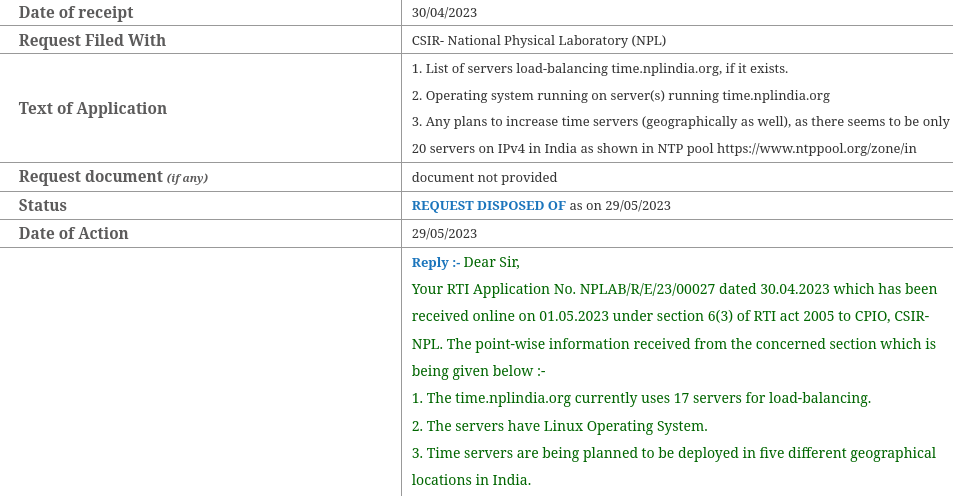
CSIR-National Physical Laboratory (NPL) is the official timekeeper for India and hosts the only public Stratum 1 clock in India, according to NTP pool website. So I was naturally curious to know what kind of infrastructure they re running for NTP. India has a Right to Information (RTI) Act which, like the Freedom of Information Act (FOIA) in the United States, gives citizens rights to request information from governmental entities, to which they have to respond in under 30 days. So last year, I filed two sets of RTI (one after the first reply came) inquiring about NPL s public NTP server setup. The first RTI had some generic questions: RTI 1
First RTI. Click to enlarge
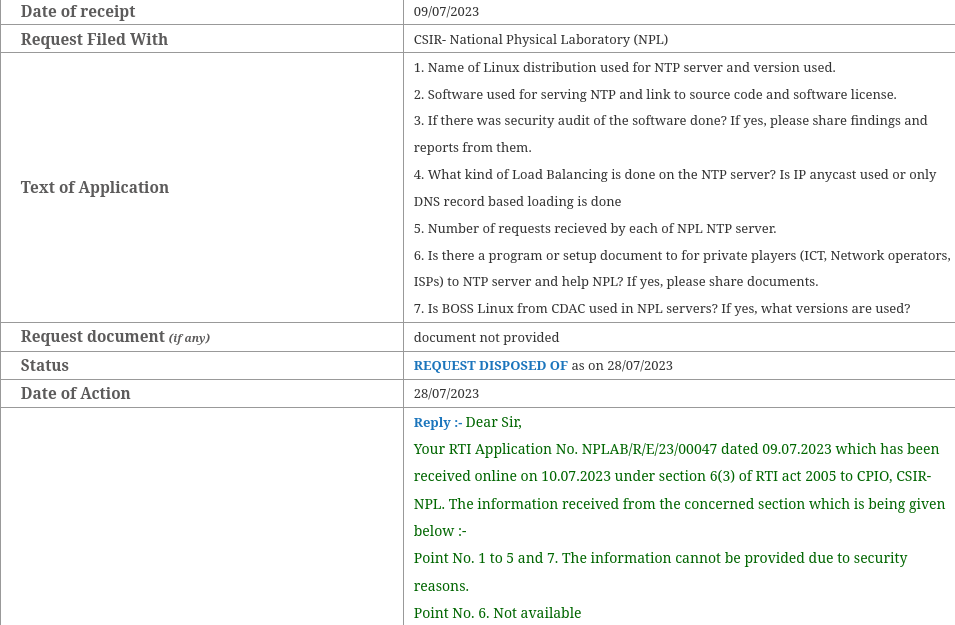
This gave a vague idea about the setup, so I sat down and came with some specific questions in the next RTI. RTI 2
Second RTI. Click to enlarge
Feel free to make your conclusions from it now. Bear in mind these were filled last year so things might have changed. Do let me know if you have more information about it. Update (07/07/2024): Found an article from Medianama about Indian government time servers with information sourced through RTI.

2 July 2024

Bits from Debian: Bits from the DPL

Dear Debian community, Statement on Daniel Pocock The Debian project has successfully taken action to secure its trademarks and interests worldwide, as detailed in our press statement. I would like to personally thank everyone in the community who was involved in this process. I would have loved for you all to have spent your volunteer time on more fruitful things. Debian Boot team might need help I think I've identified the issue that finally motivated me to contact our teams: for a long time, I have had the impression that Debian is driven by several "one-person teams" (to varying extents of individual influence and susceptibility to burnout). As DPL, I see it as my task to find ways to address this issue and provide support. I received private responses from Debian Boot team members, which motivated me to kindly invite volunteers to some prominent and highly visible fields of work that you might find personally challenging. I recommend subscribing to the Debian Boot mailing list to see where you might be able to provide assistance. /usrmerge Helmut Grohne confirmed that the last remaining packages shipping aliased files inside the package set relevant to debootstrap were uploaded. Thanks a lot for Helmut and all contributors that helped to implement DEP17. Contacting more teams I'd like to repeat that I've registered a BoF for DebConf24 in Busan with the following description: This BoF is an attempt to gather as much as possible teams inside Debian to exchange experiences, discuss workflows inside teams, share their ways to attract newcomers etc. Each participant team should prepare a short description of their work and what team roles ( openings ) they have for new contributors. Even for delegated teams (membership is less fluid), it would be good to present the team, explain what it takes to be a team member, and what steps people usually go to end up being invited to participate. Some other teams can easily absorb contributions from salsa MRs, and at some point people get commit access. Anyway, the point is that we work on the idea that the pathway to become a team member becomes more clear from an outsider point-of-view. I'm lagging a bit behind my team contacting schedule and will not manage to contact every team before DebConf. As a (short) summary, I can draw some positive conclusions about my efforts to reach out to teams. I was able to identify some issues that were new to me and which I am now working on. Examples include limitations in Salsa and Salsa CI. I consider both essential parts of our infrastructure and will support both teams in enhancing their services. Some teams confirmed that they are basically using some common infrastructure (Salsa team space, mailing lists, IRC channels) but that the individual members of the team work on their own problems without sharing any common work. I have also not read about convincing strategies to attract newcomers to the team, as we have established, for instance, in the Debian Med team. DebConf attendance The amount of money needed to fly people to South Korea was higher than usual, so the DebConf bursary team had to make some difficult decisions about who could be reimbursed for travel expenses. I extended the budget for diversity and newcomers, which enabled us to invite some additional contributors. We hope that those who were not able to come this year can make it next year to Brest or to MiniDebConf Cambridge or Toulouse tag2upload On June 12, Sean Whitton requested comments on the debian-vote list regarding a General Resolution (GR) about tag2upload. The discussion began with technical details but unfortunately, as often happens in long threads, it drifted into abrasive language, prompting the community team to address the behavior of an opponent of the GR supporters. After 560 emails covering technical details, including a detailed security review by Russ Allbery, Sean finally proposed the GR on June 27, 2024 (two weeks after requesting comments). Firstly, I would like to thank the drivers of this GR and acknowledge the technical work behind it, including the security review. I am positively convinced that Debian can benefit from modernizing its infrastructure, particularly through stronger integration of Git into packaging workflows. Sam Hartman provided some historical context [1], [2], [3], [4], noting that this discussion originally took place five years ago with no results from several similarly lengthy threads. My favorite summary of the entire thread was given by Gregor Herrmann, which reflects the same gut feeling I have and highlights a structural problem within Debian that hinders technical changes. Addressing this issue is definitely a matter for the Debian Project Leader, and I will try to address it during my term. At the time of writing these bits, a proposal from ftpmaster, which is being continuously discussed, might lead to a solution. I was also asked to extend the GR discussion periods which I will do in separate mail. Talk: Debian GNU/Linux for Scientific Research I was invited to have a talk in the Systems-Facing Track of University of British Columbia (who is sponsoring rack space for several Debian servers). I admit it felt a bit strange to me after working more than 20 years for establishing Debian in scientific environments to be invited to such a talk "because I'm DPL". Kind regards Andreas.

Junichi Uekawa: July.

July. My recent coding was around my AC controls at home. That's about it.

1 July 2024

Paul Wise: FLOSS Activities June 2024

Focus This month I didn't have any particular focus. I just worked on issues in my info bubble.

Changes

Issues

Communication
  • Respond to queries from Debian users and contributors on IRC

Sponsors All work was done on a volunteer basis.

Russell Coker: VoLTE in Australia

Introduction In Australia the 3G mobile frequencies are to be reused so they are in the process of shutting down the 3G service. That means that everyone has to use VoLTE (Voice Over LTE) for phone calls (including emergency calls). The shutdown time varies by telco, Kogan Mobile (one of the better services which has good value for money and generally works well) shut down their 3G service in January. Aldi Mobile (another one of the good services which is slightly more expensive but has included free calls to most first-world countries and uses the largest phone network) will shut theirs down at the end of August. For background there s a Fosdem talk about OpenSIPS with VoLTE and VoNR [1], it s more complex than you want to know. Also VoNR (Voice over New Radio) is the standard for 5G voice and it s different from VoLTE and has a fallback to VoLTE. Another good lecture for background information is the Fosdem talk on VoLTE at the handset end [2]. The PinePhonePro In October 2023 I tried using my PinePhonePro as my main phone but that only lasted a few days due to problems with calls and poor battery life [3]. Since then I went back to the Huawei Mate 10 Pro that I bought refurbished in June 2019 for $389. So that has been my main phone for 5 years now, giving a cost of $1.50 per week. I had tried using a Huawei Nova 7i running Android without Google Play as an experiment but that had failed, I do many things that need Android apps [4]. I followed the PinePhone wiki to get my PinePhonePro working with VoLTE [5]. That worked fine for me, the only difference from the instructions is that I had to use device /dev/ttyUSB3 and that the modem kept resetting itself during the process and when that happened I had to kill minicom and start again. After changing the setting and saving it the PinePhonePro seemed to work well with VoLTE on a Kogan Mobile SIM (so definitely not using 3G). One issue I have found is that Plasma Mobile (my preferred FOSS phone GUI) appears to have a library issue that results in polling every 14ms even when the screen is locked [6]. If you have a few processes doing that (which means the most lightly used Plasma system) it really hurts battery use. The maintainer has quite reasonably deferred action on this bug report given the KDE 6 transition. Later on in the Trixie development cycle I hope to get this issue resolved, I don t expect it to suddenly make battery life good. But it might make battery life acceptable. I am now idly considering carrying around my PinePhonePro in a powered off state for situations where I might need to do high security operations (root logins to servers or online banking) but for which carrying a laptop isn t convenient. It will do well for the turn on, do 30 mins of work that needs security, and then turn off scenario. Huawei Mate 10 Pro and Redmi 9A The Huawei Mate 10 Pro has been my main phone for 5 years and it has worked well, so it would be ideal if it could do VoLTE as the PinePhonePro isn t ready yet. All the web pages I ve seen about the Mate 10 Pro say that it will either allow upgrading to a VoLTE configuration if run with the right SIM or only support it with the right SIM. I did a test with a Chinese SIM which gave an option of turning on VoLTE but didn t allow any firmware updates and the VoLTE option went away when I put an Australian SIM in. Some forum comments had led me to believe that it would either permanently enable VoLTE or allow upgrading the firmware to one that enables VoLTE if I used a Chinese SIM but that is not the case. I didn t expect a high probability of success but I had to give it a go as it s a nice phone. I did some tests on a Redmi 9A (a terrible phone that has really bad latency on the UI in spite of having reasonably good hardware). The one I tested on didn t have VoLTE enabled when I got it, to test that I used the code *#*#4636#*#* in the dialler to get the menu of SIM information and it showed that VoLTE was not provisioned. I then had to update to the latest release of Android for that phone and enter *#*#86583#*#* in the dialler to enable VoLTE, the message displayed after entering that magic number must end in DISABLE . I get the impression that the code in question makes the phone not check certain aspects of whether the carrier is good for VoLTE and just do it. So apparently Kogan Mobile somehow gives the Redmi 9A the impression that VoLTE isn t supported but if the phone just goes ahead and connects it will work. I don t plan to use a Redmi 9A myself as it s too slow, but I added it to my collection to offer to anyone else I know who needs a phone with VoLTE and doesn t use the phone seriously or to someone who needs a known good phone for testing things. Samsung Galaxy Note 9 I got some Samsung Galaxy Note 9 phones to run Droidian as an experiment [7]. But Droidian dropped support for the Note 9 and I couldn t figure out how to enable VoLTE via Droidian, which was very annoying after I had spent $109 on a test phone and $215 on a phone for real use (I have no plans to try Droidian again at this time). I tried installing LineageOS on one Note 9 [8] which was much easier than expected (especially after previously installing Droidian). But VoLTE wasn t an option. According to Reddit LineageOS doesn t support VoLTE on Samsung devices and you can use a magisk module or a VoLTE enabler module but those aren t supported by LineageOS either [9]. I downloaded an original image for the Note 9 from SamsMobile.com [10]. That image booted past the orange stage (where if you have problems then your phone is probably permanently useless) but didn t boot into the OS. A friend helped me out with that and it turned out that the Heimdal flash tool on Linux didn t do something it needed to do and that Odin on Windows was required. After using Odin everything was fine and I have a Note 9 with VoLTE running the latest Samsung firmware which is security patch level 1st July 2022!!! So I have a choice between using a Note 9 for data and SMS while running a current version of Lineage OS with all security fixes or running a Samsung image with no security updates for 2 years which supports phone calls. So based on this I have to recommend Pixel as the phone of choice, it has a decent level of support from Google and long term support from LineageOS. According to the LineageOS web site you can run the current version of Lineage on the original Pixel phone from 2016! Of course getting VoLTE to work on it might be another saga, but it would probably be easier to do with LineageOS on a Pixel than on a Samsung phone. Conclusion The operation of the Note 9 for me is decent now apart from the potential security issues. The same goes for selling one of the phones. The PinePhonePro still has potential to become my daily driver at some future time if I and others can optimise power use. Also a complicating factor is that I want to have both Jabber and Matrix be actually instant IM systems not IM with a 5 minute delay, so suspend mode isn t a good option. Pixel phones will be a much higher priority when looking at phones to buy in future. The older Pixel phones go for as little as $100 on eBay and can still run the latest LineageOS. VoLTE seems needlessly complicated.

Niels Thykier: Debian packaging with style black

When I started working on the language server for debputy, one of several reasons was about automatic applying a formatting style. Such that you would not have to remember to manually reformat the file. One of the problems with supporting automatic formatting is that no one agrees on the "one true style". To make this concrete, Johannes Schauer Marin Rodrigues did the numbers of which wrap-and-sort option that are most common in https://bugs.debian.org/895570#46. Unsurprising, we end up with 14-15 different styles with various degrees of popularity. To make matters worse, wrap-and-sort does not provide a way to declare "this package uses options -sat". So that begged the question, how would debputy know which style it should use when it was going to reformat file. After a couple of false-starts, Christian Hofstaedtler mentioned that we could just have a field in debian/control for supporting a "per-package" setting in responds to my concern about adding a new "per-package" config file. At first, I was not happy with it, because how would you specify all of these options in a field (in a decent manner)? But then I realized that one I do not want all these styles and that I could start simpler. The Python code formatter black is quite successful despite not having a lot of personalized style options. In fact, black makes a statement out of not allowing a lot of different styles. Combing that, the result was X-Style: black (to be added to the Source stanza of debian/control), which every possible reference to the black tool for how styling would work. Namely, you outsource the style management to the tool (debputy) and then start using your focus on something else than discussing styles. As with black, this packaging formatting style is going to be opinionated and it will evolve over time. At the starting point, it is similar to wrap-and-sort -sat for the deb822 files (debputy does not reformat other files at the moment). But as mentioned, it will likely evolve and possible diverge from wrap-and-sort over time. The choice of the starting point was based on the numbers posted by Johannes #895570. It was not my personal favorite but it seemed to have a majority and is also close to the one suggested by salsa pipeline maintainers. The delta being -kb which I had originally but removed in 0.1.34 at request of Otto Kek l inen after reviewing the numbers from Johannes one more time. To facilitate this new change, I uploaded debputy/0.1.30 (a while back) to Debian unstable with the following changes:
  • Support for the X-Style: black header.
  • When a style is defined, the debputy lsp server command will now automatically reformat deb822 files on save (if the editor supports it) or on explicit "reformat file" request from the editor (usually indirectly from the user).
  • New subcommand debputy reformat command that will reformat the files, when a style is defined.
  • A new pre-commit hook repo to run debputy lint and debputy reformat. These hooks are available from https://salsa.debian.org/debian/debputy-pre-commit-hooks version v0.1 and can be used with the pre-commit tool (from the package of same name).
The obvious omission is a salsa-pipeline feature for this. Otto has put that on to his personal todo list and I am looking forward to that.
Beyond black Another thing I dislike about our existing style tooling is that if you run wrap-and-sort without any arguments, you have a higher probability of "trashing" the style of the current package than getting the desired result. Part of this is because wrap-and-sort's defaults are out of sync with the usage (which is basically what https://bugs.debian.org/895570 is about). But I see another problem. The wrap-and-sort tool explicitly defined options to tweak the style but provided maintainers no way to record their preference in any machine readable way. The net result is that we have tons of diverging styles and that you (as a user of wrap-and-sort) have to manually tell wrap-and-sort which style you want every time you run the tool. In my opinion that is not playing to the strengths of neither human nor machine. Rather, it is playing to the weaknesses of the human if anything at all. But the salsa-CI pipeline people also ran into this issue and decided to work around this deficiency. To use wrap-and-sort in the salsa-CI pipeline, you have to set a variable to activate the job and another variable with the actual options you want. The salsa-CI pipeline is quite machine readable and wrap-and-sort is widely used. I had debputy reformat also check for the salsa-CI variables as a fallback. This fallback also works for the editor mode (debputy lsp server), so you might not even have to run debputy reformat. :) This was a deliberate trade-off. While I do not want all us to have all these options, I also want Debian packaging to be less painful and have fewer paper cuts. Having debputy go extra lengths to meet wrap-and-sort users where they are came out as the better solution for me. A nice side-effect of this trade-off is that debputy reformat now a good tool for drive-by contributors. You can safely run debputy reformat on any package and either it will apply the styling or it will back out and inform you that no obvious style was detected. In the latter case, you would have to fallback to manually deducing the style and applying it.
Differences to wrap-and-sort The debputy reformat has some limitations or known differences to wrap-and-sort. Notably, debputy reformat (nor debputy lsp server) will not invoke wrap-and-sort. Instead, debputy has its own reformatting engine that provides similar features. One reason for not running wrap-and-sort is that I want debputy reformat to match the style that debputy lsp server will give you. That way, you get consistent style across all debputy commands. Another reason is that it is important to me that reformatting is safe and does not change semantics. This leads to two regrettable known differences to the wrap-and-sort behavior due to safety in addition to one scope limitation in debputy:
  1. debputy will ignore requests to sort the stanzas when the "keep first" option is disabled (-b --no-keep-first). This combination is unsafe reformatting. I feel it was a mistake for wrap-and-sort to ever allow this but at least it is no longer the default (-b is now -bk by default). This will be less of a problem in debhelper-compat 15, since the concept of "main package" will disappear and all multi-binary source packages will be required to use debian/package.install rather than debian/install.
  2. debputy will not reorder the contents of debhelper packaging files such as debian/install. This is also an (theoretical) unsafe thing to do. While the average package will not experience issues with this, there are rare corner cases where the re-ordering can affect the end result. I happen to know this, because I ran into issues when trying to optimize dh_install in a way that assumed the order did not matter. Stuff broke and there is now special-case code in dh_install to back out of that optimization when that happens.
  3. debputy has a limited list of wrap-and-sort options it understands. Some options may cause debputy to back out and disable reformatting entirely with a remark that it cannot apply that style. If you run into a case of this, feel free to file a feature request to support it. I will not promise to support everything, but if it is safe and trivially doable with the engine already, then I probably will.
As stated, where debputy cannot implement the wrap-and-sort styles fully, then it will currently implement a subset that is safe if that can be identified or back out entirely of the formatting when it cannot. In all cases, debputy will not break the formatting if it is correct. It may just fail at correcting one aspect of the wrap-and-sort style if you happen to get it wrong. It is also important to remember that the prerequisite for debputy applying any wrap-and-sort style is that you have set the salsa-CI pipeline variables to trigger wrap-and-sort with the salsa-CI pipeline. So there is still a CI check before the merge that will run the wrap-and-sort in its full glory that provides the final safety net for you.
Just give me a style In conclusion, if you, like me, are more interested in getting a consistent style rather than discussing what that style should be, now you can get that with X-Style: black. You can also have your custom wrap-and-sort style be picked up automatically for drive-by contributors.
$ apt satisfy 'dh-debputy (>= 0.1.30), python3-lsprotocol'
# Add  X-Style: black  to  debian/control  for "just give me a style"
#
# OR, if there is a specific  wrap-and-sort  style for you then set
# SALSA_CI_DISABLE_WRAP_AND_SORT=no plus set relevant options in
# SALSA_CI_WRAP_AND_SORT_ARGS in debian/salsa-ci.yml (or .gitlab-ci.yml)
$ debputy reformat
It is sadly not yet in the salsa-ci pipeline. Otto is looking into that and hopefully we will have it soon. :) And if you find yourself often doing archive-wide contributions and is tired of having to reverse engineer package formatting styles, consider using debputy reformat or debputy lsp server. If you use debputy in this way, please consider providing feedback on what would help you.

Abhijith PA: A lazy local file sharing setup

At home, I have both a laptop and a *desktop PC. Most of my essential things, such as emails, repositories, password managers, contacts, and calendars are synced between the two devices. However, when I need to share some documents and I am lazy enough to go pick a flash drive, my only option is to push them to the Internet and download them on the other system, which is sitting at 20~ meters away. Typically, I do this either through email attachments or a matrix client. Occasionally, I think about setting up a network storage solution at home. But then I ask myself do I really need one. In my home network, I already have a Raspberry Pi running as my Wi-Fi router, doing DNS level ad blocking with Dnsmasq and DNS over TLS with stubby. Rpi has a 16GB memory card. I can mount RPi remote directory to both machines. I use pcmanfm as my file manager. It has the ability (like every other file managers) to mount remote storage over ssh. But one annoying thing is that whenever I open the mount directory, by default it shows the root file system of the remote device even when I explicitly mentioned the path. Then I discovered sshfs. I wrote the following script, which mount remote directory and open that in pcmanfm.
#!/bin/bash
LOCMOUNT="/home/user/Public"
sshfs raspberrypi:Public $LOCMOUNT
pcmanfm $MOUNT
I haven t enabled any encryption for the memory until now since other than some logs RPi wasn t writing anything to it. I set up fscrypt on Rpi storage now. And ta-da, a lazy person s local sharing solution. *Desktop - Well, technically it s an old laptop with a broken keyboard and trackpad, connected to a monitor, keyboard and mouse. I don t feel keeping it on a shelf.

30 June 2024

Joachim Breitner: Do surprises get larger?

The setup Imagine you are living on a riverbank. Every now and then, the river swells and you have high water. The first few times this may come as a surprise, but soon you learn that such floods are a recurring occurrence at that river, and you make suitable preparation. Let s say you feel well-prepared against any flood that is no higher than the highest one observed so far. The more floods you have seen, the higher that mark is, and the better prepared you are. But of course, eventually a higher flood will occur that surprises you. Of course such new record floods are happening rarer and rarer as you have seen more of them. I was wondering though: By how much do the new records exceed the previous high mark? Does this excess decrease or increase over time? A priori both could be. When the high mark is already rather high, maybe new record floods will just barley pass that mark? Or maybe, simply because new records are so rare events, when they do occur, they can be surprisingly bad? This post is a leisurely mathematical investigating of this question, which of course isn t restricted to high waters; it could be anything that produces a measurement repeatedly and (mostly) independently weather events, sport results, dice rolls. The answer of course depends on the distribution of results: How likely is each possible results.

Dice are simple With dice rolls the answer is rather simple. Let our measurement be how often you can roll a die until it shows a 6. This simple game we can repeat many times, and keep track of our record. Let s say the record happens to be 7 rolls. If in the next run we roll the die 7 times, and it still does not show a 6, then we know that we have broken the record, and every further roll increases by how much we beat the old record. But note that how often we will now roll the die is completely independent of what happened before! So for this game the answer is: The excess with which the record is broken is always the same. Mathematically speaking this is because the distribution of rolls until the die shows a 6 is memoryless. Such distributions are rather special, its essentially just the example we gave (a geometric distribution), or its continuous analogue (the exponential distributions, for example the time until a radioactive particle decays).

Mathematical formulation With this out of the way, let us look at some other distributions, and for that, introduce some mathematical notations. Let X be a random variable with probability density function (x) and cumulative distribution function (x), and a be the previous record. We are interested in the behavior of Y(a) = X a X > x i.e. by how much X exceeds a under the condition that it did exceed a. How does Y change as a increases? In particular, how does the expected value of the excess e(a) = E(Y(a)) change?

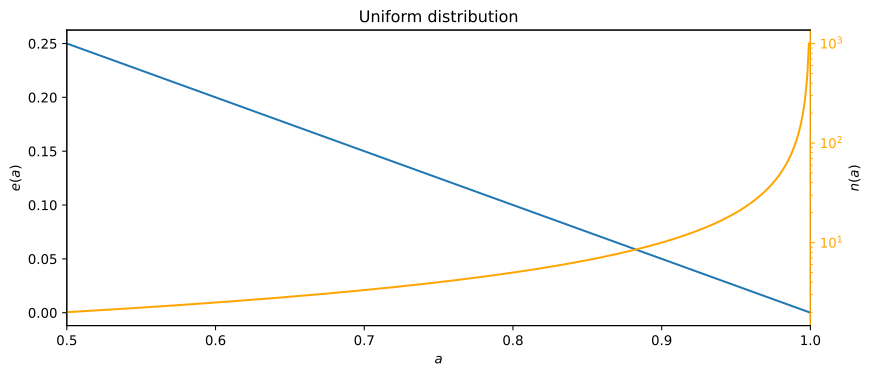
Uniform distribution If X is uniformly distributed between, say, 0 and 1, then a new record will appear uniformly distributed between a and 1, and as that range gets smaller, the excess must get smaller as well. More precisely, e(a) = E(X a X > a) = E(X X > a) a = (1 a)/2 This not very interesting linear line is plotted in blue in this diagram:
The expected record surpass for the uniform distribution The expected record surpass for the uniform distribution
The orange line with the logarithmic scale on the right tries to convey how unlikely it is to surpass the record value a: it shows how many attempts we expect before the record is broken. This can be calculated by n(a) = 1/(1 (a)).

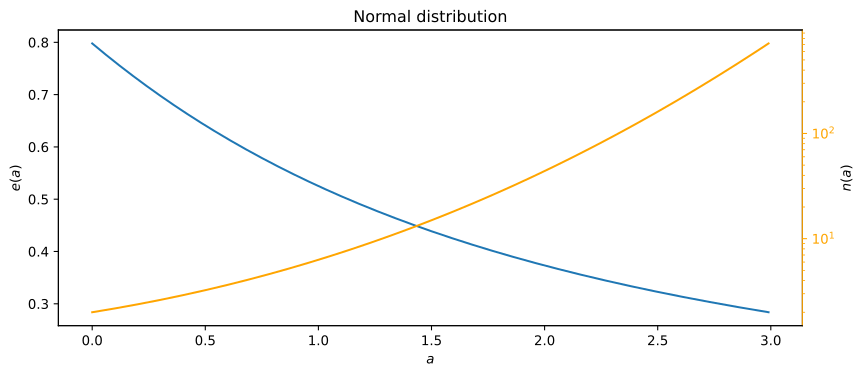
Normal distribution For the normal distribution (with median 0 and standard derivation 1, to keep things simple), we can look up the expected value of the one-sided truncated normal distribution and obtain e(a) = E(X X > a) a = (a)/(1 (a)) a Now is this growing or shrinking? We can plot this an have a quick look:
The expected record surpass for the normal distribution The expected record surpass for the normal distribution
Indeed it is, too, a decreasing function! (As a sanity check we can see that e(0) = (2/ ), which is the expected value of the half-normal distribution, as it should.)

Could it be any different? This settles my question: It seems that each new surprisingly high water will tend to be less surprising than the previously assuming high waters were uniformly or normally distributed, which is unlikely to be helpful. This does raise the question, though, if there are probability distributions for which e(a) is be increasing? I can try to construct one, and because it s a bit easier, I ll consider a discrete distribution on the positive natural numbers, and consider at g(0) = E(X) and g(1) = E(X 1 X > 1). What does it take for g(1) > g(0)? Using E(X) = p + (1 p)E(X X > 1) for p = P(X = 1) we find that in order to have g(1) > g(0), we need E(X) > 1/p. This is plausible because we get equality when E(X) = 1/p, as it precisely the case for the geometric distribution. And it is also plausible that it helps if p is large (so that the next first record is likely just 1) and if, nevertheless, E(X) is large (so that if we do get an outcome other than 1, it s much larger). Starting with the geometric distribution, where P(X > n X n) = pn = p (the probability of again not rolling a six) is constant, it seems that these pn is increasing, we get the desired behavior. So let p1 < p2 < pn < be an increasing sequence of probabilities, and define X so that P(X = n) = p1 pn 1 (1 pn) (imagine the die wears off and the more often you roll it, the less likely it shows a 6). Then for this variation of the game, every new record tends to exceed the previous more than previous records. As the p increase, we get a flatter long end in the probability distribution.

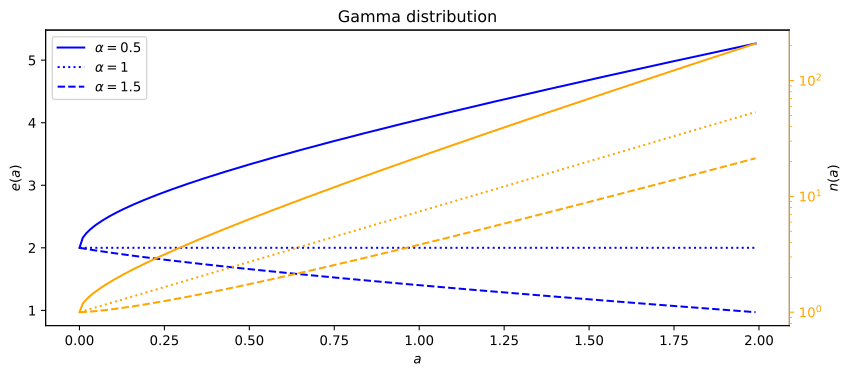
Gamma distribution To get a nice plot, I ll take the intuition from this and turn to continuous distributions. The Wikipedia page for the exponential distribution says it is a special case of the gamma distribution, which has an additional shape parameter , and it seems that it could influence the shape of the distribution to be and make the probability distribution have a longer end. Let s play around with = 2 and = 0.5, 1 and 1.5:
The expected record surpass for the gamma distribution The expected record surpass for the gamma distribution

  • For = 1 (dotted) this should just be the exponential distribution, and we see that e(a) is flat, as predicted earlier.
  • For larger (dashed) the graph does not look much different from the one for the normal distribution not a surprise, as for , the gamma distribution turns into the normal distribution.
  • For smaller (solid) we get the desired effect: e(a) is increasing. This means that new records tend to break records more impressively.
The orange line shows that this comes at a cost: for a given old record a, new records are harder to come by with smaller .

Conclusion As usual, it all depends on the distribution. Otherwise, not much, it s late.

27 June 2024

Jonathan McDowell: Sorting out backup internet #4: IPv6

The final piece of my 5G (well, 4G) based based backup internet connection I needed to sort out was IPv6. While Three do support IPv6 in their network they only seem to enable it for certain devices, and the MC7010 is not one of those devices, even though it also supports IPv6. I use v6 a lot - over 50% of my external traffic, last time I looked. One suggested option was that I could drop the IPv6 Router Advertisements when the main external link went down, but I have a number of internal services that are only presented on v6 addresses so I needed to ensure clients in the house continued to have access to those. As it happens I ve used the Hurricane Electric IPv6 Tunnel Broker in the past, so my pass was re-instating that. The 5G link has a real external IPv4 address, and it s possible to update the endpoint using a simple HTTP GET. I added the following to my /etc/dhcp/dhclient-exit-hooks.d/modem-interface-route where we are dealing with an interface IP change:
# Update IPv6 tunnel with Hurricane Electric
curl --interface $interface 'https://username:password@ipv4.tunnelbroker.net/nic/update?hostname=1234'
I needed some additional configuration to bring things up, so /etc/network/interfaces got the following, configuring the 6in4 tunnel as well as the low preference default route, and source routing via the 5g table, similar to IPv4:
pre-up ip tunnel add he-ipv6 mode sit remote 216.66.80.26
pre-up ip link set he-ipv6 up
pre-up ip addr add 2001:db8:1234::2/64 dev he-ipv6
pre-up ip -6 rule add from 2001:db8:1234::/64 lookup 5g
pre-up ip -6 route add default dev he-ipv6 table 5g
pre-up ip -6 route add default dev he-ipv6 metric 1000
post-down ip tunnel del he-ipv6
We need to deal with IPv4 changes in for the tunnel endpoint, so modem-interface-route also got:
ip tunnel change he-ipv6 local $new_ip_address
/etc/nftables.conf had to be taught to accept the 6in4 packets from the tunnel in the input chain:
# Allow HE tunnel
iifname "sfp.31" ip protocol 41 ip saddr 216.66.80.26 accept
Finally, I had to engage in something I never thought I d deal with; IPv6 NAT. HE provide a /48, and my FTTP ISP provides me with a /56, so this meant I could do a nice stateless 1:1 mapping:
table ip6 nat  
  chain postrouting  
    type nat hook postrouting priority 0
    oifname "he-ipv6" snat ip6 prefix to ip6 saddr map   2001:db8:f00d::/56 : 2001:db8:666::/56  
   
 
This works. Mostly. The problem is that HE, not unreasonably, expect your IPv4 address to be pingable. And it turns out Three have some ranges that this works on, and some that it doesn t. Which means it s a bit hit and miss whether you can setup the tunnel. I spent a while trying to find an alternative free IPv6 tunnel provider with a UK endpoint. There s less call for them these days, so I didn t manage to find any that actually worked (or didn t have a similar pingable requirement). I did consider whether I wanted to end up with routes via a VM, as I described in the failover post, but looking at costings for VMs with providers who could actually give me an IPv6 range I decided the cost didn t make it worthwhile; the VM cost ended up being more than the backup SIM is costing monthly. Finally, it turns out happy eyeballs mostly means that when the 5G ends up on an IP that we can t setup the IPv6 tunnel on, things still mostly work. Browser usage fails over quickly and it s mostly my own SSH use that needs me to force IPv4. Purists will groan, but this turns out to be an acceptable trade-off for me, at present. Perhaps if I was seeing frequent failures the diverse routes approach to a VM would start to make sense, but for now I m pretty happy with the configuration in terms of having a mostly automatic backup link take over when the main link goes down.

23 June 2024

Sahil Dhiman: How I Write Blogs - June 2024 Edition

I wrote about my blog writing methodology back April 2021. My writing method has undergone a significant shift now, so thought about writing this update. New blog topics are added to my note-taking app quite frequently now. Occasionally going through the list, I merge topics, change order to prioritize certain topics or purely drop ideas which seems not worth a write-up. Due to this, I have the liberty to work on blogs according to mood. Writing the last one was tiring, so I chose to work on an easy one, i.e. this blog now. Topic decided, everything starts on etherpad now. Etherpad has this nice font and sync feature, which helps me write from any device of choice. Actual writing usually happens in the morning, right after I wake up. For most topics, I quickly jot down pointers and keep on expanding them over the course of multiple days at a leisurely pace. Though, sometime it adds too many pieces in the puzzle and takes additional time to put everything in flow. New pointer addition keeps on happening along with writing. Nowadays, pictures too dot my blog, which I rarely use to do earlier. I have come to believe on less usage of external links. These breaks the flow of readers. If someone is sufficiently motivated to learn more about something, finding useful sources isn t. As the first draft comes into being, I run it through LanguageTool for spelling corrections (which typically are many) and fixing grammatical issues. Post that, for the first time I read the complete write-up in one go for formation of coherent storyline, moving paragraphs around for form a structure , adding explainers wherever something new or unexplained is introduced, removing elaborate sentences, making amends wherever required and moving paragraphs around for forming structure. Another round of LanguageTool follows. All set now, I try to space out my final read before publishing, which helps find additional mistakes or loopholes. When everything is set, I do hugo to generate the site and rsync everything to the web server. A final git sync closes the publication part. After a day or two, I come back to read the blog on the website. This entails another round finding and fixing trivial mistakes. After this, it s set for good. Nowadays, in addition to being on my blog, everything is syndicated on Planet FSCI and Planet Debian, which has given it more visibility. As someone who s into infrastructure and Internet as a lot, I do pay attention to logs on my server, but as a disconnected exercise to if the blog is being read or not. More hits on the blog doesn t translate to any gratification for me, at least for writers point of view. Occasionally, people do mention my blog, which does flatter me. Four years and nearly a hundred posts later, I still wonder how I kept on writing for this long.

22 June 2024

Russ Allbery: Review: And the Stars Will Sing

Review: And the Stars Will Sing, by Michelle Browne
Series: The Meaning Wars #1
Publisher: Michelle Browne
Copyright: 2012, 2021
Printing: 2021
ASIN: B0075G7GEA
Format: Kindle
Pages: 85
And the Stars Will Sing is a self-published science fiction novella, the first of a (currently) five book series. I believe it may be Browne's first publication, although I don't have a good data source to confirm. Crystal Weiss is a new graduate from Mars, about to leave the solar system to her first job assignment: installation of a permanent wormhole in the vicinity of Messier 14. Her expertise is the placement calculations. The heavy mathematical lifting is of course done by computers, but humans have to do the mapping and some of the guidance. And the Stars Will Sing is an epistolary novel, told in the form of her letters to her friend Sarah. I feel bad when I stumble across a book like this. I want to stick with my habit of writing a review of each book I read, but it's one thing to pan a bad book by a famous author and another thing to pick on a self-published novella that I read due to some recommendation or mention whose details I've forgotten. Worse, I think this wasn't even the recommended book; I looked up the author, saw that the first of a series was on sale, and thought "oh, hey, I like epistolary novels and I'm in the mood for some queer space opera." This book didn't seem that queer (there is a secondary lesbian relationship but the main relationship seemed rather conventional), but I'll get to the romance in a moment. I was not the reader for this book. There's a reason why most of the books I read are from traditional publishers; I'm too critical of a reader for a lot of early self-published work. It's not that I dislike self-publishing as a concept many self-published books are excellent and the large publishers have numerous problems but publishers enforce a quality bar. Inconsistently, unfairly, and by rejecting a lot of good work, but still, they do. I'm fairly sure traditional publishers would have passed on this book; the quality of the writing isn't there yet. (It's certainly a better book than I could have written! But that's why I'm writing my reviews over in my quiet corner of the Internet and not selling fiction to other people.) The early chapters aren't too bad, although they have a choppy, cliched style that more writing experience usually smoothes out. The later chapters have more dialogue, enough that I started wondering how Crystal could remember that much dialogue verbatim to put into a letter, and it's not good. All of the characters talk roughly the same (even the aliens), the dialogue felt even more cliched than the rest of the writing, and I started getting distracted by the speech tags. Crystal comes across as very young, impulsive, and a drama magnet who likes being all up in her coworkers' business. None of these are objective flaws in the book, but I could tell early on that I was going to find her annoying. She has a heavily-foreshadowed enemies-to-lovers thing with one of her male coworkers. Her constant complaining about him at the start of the story was bad enough, but the real problem is that in the very few places where he has more personality than plastic lawn furniture, he's being obnoxious to Crystal. I'm used to being puzzled by a protagonist's choice in love interests, but this one felt less like an odd personality choice and more a lack of writing skill. Even if the relationship is being set up for failure (not true by the end of this book), you've got to help me understand what the protagonist saw in him or was getting out of the relationship. The plot was so predictable that it ironically surprised me. I was sure that some sort of twist or complication was coming, but no. I will give Browne some credit for writing a slightly more realistic character reaction to violence than most SF authors, but there was nothing in the plot to hold my interest. The world-building was generic science fiction with aliens. It had a few glimmers of promise, but there was some sort of psychic hand-waving involved in siting wormholes that didn't work for me and the plot climax made no sense to me whatsoever. This is the kind of bad book that I don't want to hold against the writer. Twelve years later and with numerous other novels and novellas under her belt, her writing is probably much better. I do think this book would have benefited from an editor telling her it wasn't good enough for publication yet, but that's not how the Kindle self-publishing world works. Mostly, this is my fault: I half-followed a recommendation into an area of publishing that I know from past experience I should avoid without a solid review from an equally critical reader. Followed by The Stolen, a two-story collection. Rating: 3 out of 10

19 June 2024

Sahil Dhiman: First Iteration of My Free Software Mirror

As I m gearing towards setting up a Free Software download mirror in India, it occurred to me that I haven t chronicled the work and motivation behind setting up the original mirror in the first place. Also, seems like it would be good to document stuff here for observing the progression, as the mirror is going multi-country now. Right now, my existing mirror i.e., mirrors.de.sahilister.net (was mirrors.sahilister.in), is hosted in Germany and serves traffic for Termux, NomadBSD, Blender, BlendOS and GIMP. For a while in between, it hosted OSMC project mirror as well. To explain what is a Free Software download mirror thing is first, I ll quote myself from work blog -
As most Free Software doesn t have commercial backing and require heavy downloads, the concept of software download mirrors helps take the traffic load off of the primary server, leading to geographical redundancy, higher availability and faster download in general.
So whenever someone wants to download a particular (mirrored) software and click download, upstream redirects the download to one of the mirror server which is geographical (or in other parameters) nearby to the user, leading to faster downloads and load sharing amongst all mirrors. Since the time I got into Linux and servers, I always wanted to help the community somehow, and mirroring seemed to be the most obvious thing. India seems to be a country which has traditionally seen less number of public download mirrors. IITB, TiFR, and some of the public institutions used to host them for popular Linux and Free Softwares, but they seem to be diminishing these days. In the last months of 2021, I started using Termux and saw that it had only a few mirrors (back then). I tried getting a high capacity, high bandwidth node in budget but it was hard in India in 2021-22. So after much deliberation, I decided to go where it s available and chose a German hosting provider with the thought of adding India node when conditions are favorable (thankfully that happened, and India node is live too now.). Termux required only 29 GB of storage, so went ahead and started mirroring it. I raised this issue in Termux s GitHub repository in January 2022. This blog post chronicles the start of the mirror. Termux has high request counts from a mirror point of view. Each Termux client, usually checks every mirror in selected group for availability before randomly selecting one for download (only other case is when client has explicitly selected a single mirror using termux-repo-change). The mirror started getting thousands of requests daily due to this but only a small percentage would actually get my mirror in selection, so download traffic was lower. Similar thing happened with OSMC too (which I started mirroring later). With this start, I started exploring various project that would be benefit from additional mirrors. Public information from Academic Computer Club in Ume s mirror and Freedif s mirror stats helped to figure out storage and bandwidth requirements for potential projects. Fun fact, Academic Computer Club in Ume (which is one of the prominent Debian, Ubuntu etc.) mirror, now has 200 Gbits/s uplink to the internet through SUNET. Later, I migrated to a different provider for better speeds and added LibreSpeed test on the mirror server. Those were fun times. Between OSMC, Termux and LibreSpeed, I was getting almost 1.2 millions hits/day on the server at its peak, crossing for the first time a TB/day traffic number. Next came Blender, which took the longest time to set up of around 9 10 months. Blender had a push-trigger requirement for rsync from upstream that took quite some back and forth. It now contributes the most amount of traffic on the mirror. On release days, mirror does more than 3 TB/day and normal days, it hovers around 2 TB/day. Gimp project is the latest addition. At one time, the mirror traffic touched 4.97 TB/day traffic number. That s when I decided on dropping LibreSpeed server to solely focus on mirroring for now, keeping the bandwidth allotment for serving downloads only. The mirror projects selection grew organically. I used to reach out many projects discussing the need of for additional mirrors. Some projects outright denied mirroring request as Germany already has a good academic mirrors boosting 20-25 Gbits/s speeds from FTP era, which seems fair. Finding the niche was essential to only add softwares, which would truly benefit from additional capacity. There were months when nothing much would happen with the mirror, rsync would continue to update the mirror while nginx would keep on serving the traffic. Nowadays, the mirror pushes around 70 TB/month. I occasionally check logs, vnstat, add new security stuff here and there and pay the bills. It now saturates the Gigabit link sometimes and goes beyond that, peaking around 1.42 Gbits/s (the hosting provider seems to be upping their game). The plan is to upgrade the link to better speeds. vnstat yearly
Yearly traffic stats (through vnstat -y )
On the way, learned quite a few things like - GeoIP Map of Clients from Yesterday Access Logs
GeoIP Map of Clients from Yesterday's Access Logs. Click to enlarge
Generated from IPinfo.io
In hindsight, the statistics look amazing, hundreds of TBs of traffic served from the mirror, month after month. That does show that there s still an appetite for public mirrors in time of commercially donated CDNs and GitHub. The world could have done with one less mirror, but it saved some time, lessened the burden for others, while providing redundancy and traffic localization with one additional mirror. And it s fun for someone like me who s into infrastructure that powers the Internet. Now, I ll try focusing and expanding the India mirror, which in itself started pushing almost half a TB/day. Long live Free Software and public download mirrors.

14 June 2024

Paul Tagliamonte: Reverse Engineering a Restaurant Pager system

It s been a while since I played with something new been stuck in a bit of a rut with radios recently - working on refining and debugging stuff I mostly understand for the time being. The other day, I was out getting some food and I idly wondered how the restaurant pager system worked. Idle curiosity gave way to the realization that I, in fact, likely had the means and ability to answer this question, so I bought the first set of the most popular looking restaurant pagers I could find on eBay, figuring it d be a fun multi-week adventure.

Order up! I wound up buying a Retekess brand TD-158 Restaurant Pager System (they looked like ones I d seen before and seemed to be low-cost and popular), and quickly after, had a pack of 10 pagers and a base station in-hand. The manual stated that the radios operated at 433 MHz (cool! can do! Love a good ISM band device), and after taking an inital read through the manual for tips on the PHY, I picked out a few interesting things. First is that the base station ID was limited to 0-999, which is weird because it means the limiting factor is likely the base-10 display on the base station, not the protocol we need enough bits to store 999 at least 10 bits. Nothing else seemed to catch my eye, so I figured may as well jump right to it. Not being the type to mess with success, I did exactly the same thing as I did in my christmas tree post, and took a capture at 433.92MHz since it was in the middle of the band, and immediately got deja-vu. Not only was the signal at 433.92MHz, but throwing the packet into inspectrum gave me the identical plot of the OOK encoding scheme. Not just similar identical. The only major difference was the baud rate and bit structure of the packets, and the only minor difference was the existence of what I think is a wakeup preamble packet (of all zeros), rather than a preamble symbol that lasted longer than usual PHY symbol (which makes this pager system a bit easier to work with than my tree, IMHO). Getting down to work, I took some measurements to determine what the symbol duration was over the course of a few packets, I was able to determine the symbol rate was somewhere around 858 microseconds (0.000858 seconds per symbol), which is a weird number, but maybe I m slightly off or there s some larger math I m missing that makes this number satisfyingly round (internal low cost crystal clock or something? I assume this is some hardware constrait with the pager?) Anyway, good enough. Moving along, let s try our hand at a demod let s just assume it s all the same as the chrismas tree post and demod ones and zeros the same way here. That gives us 26 bits:

00001101110000001010001000
Now, I know we need at least 10 bits for the base station ID, some number of bits for the pager ID, and some bits for the command. This was a capture of me hitting call from a base station ID of 55 to a pager with the ID of 10, so let s blindly look for 10 bit chunks with the numbers we re looking for:
0000110111 0000001010 001000
Jeez. First try. 10 bits for the base station ID (55 in binary is 0000110111), 10 bits for the pager ID (10 in binary is 0000001010), which leaves us with 6 bits for a command (and maybe something else too?) which is 8 here. Great, cool, let s work off that being the case and revisit it if we hit bugs. Besides our data packet, there s also a preamble packet that I ll add in, in case it s used for signal detection or wakeup or something which is fairly easy to do since it s the same packet structure as the above, just all zeros. Very kind of them to leave it with the same number of bits and encoding scheme it s nice that it can live outside the PHY. Once I got here, I wrote a quick and dirty modulator, and was able to ring up pagers! Unmitigated success and good news only downside was that it took me a single night, and not the multi-week adventure I was looking for. Well, let s finish the job and document what we ve found for the sake of completeness.
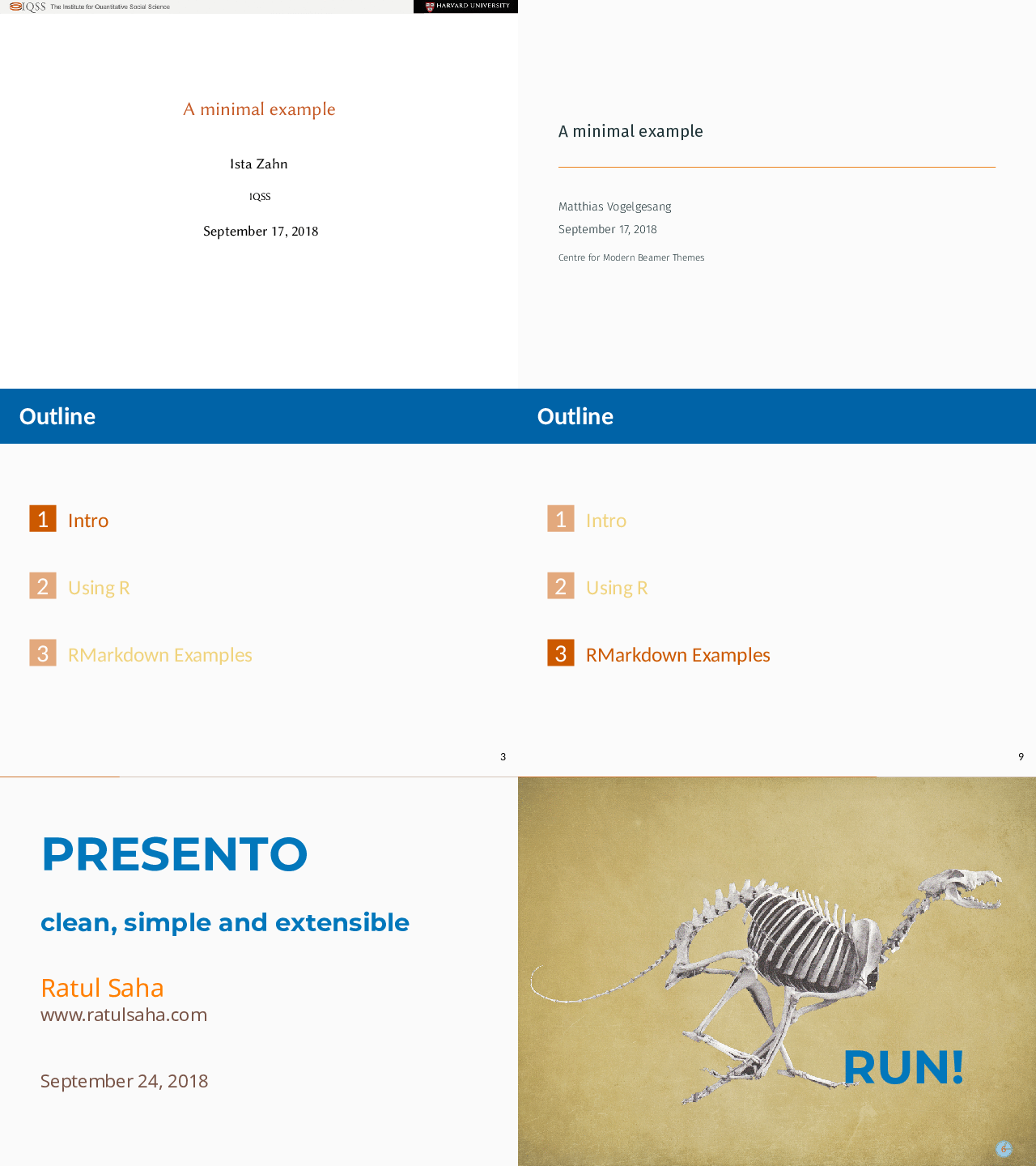
Boxing everything up My best guess on the packet structure is as follows:
base id
argument
command
For a call or F2 operation, the argument is the Pager s ID code, but for other commands it s a value or an enum, depending. Here s a table of my by-hand demodulation of all the packet types the base station produces:
Type Cmd Id Description
Call8Call the pager identified by the id in argument
Off60Request any pagers on the charger power off when power is removed, argument is all zero
F240Program a pager to the specified Pager ID (in argument) and base station
F344Set the reminder duration in seconds specified in argument
F448Set the pager's beep mode to the one in argument (0 is disabled, 1 is slow, 2 is medium, 3 is fast)
F552Set the pager's vibration mode to the one in argument (0 is disabled, 1 is enabled)

Kitchen s closed for the night I m not going to be publishing this code since I can t think of a good use anyone would have for this besides folks using a low cost SDR and annoying local resturants; but there s enough here for folks who find this interesting to try modulating this protocol on their own hardware if they want to buy their own pack of pagers and give it a shot, which I do encourage! It s fun! Radios are great, and this is a good protocol to hack with it s really nice. All in all, this wasn t the multi-week adventure I was looking for, this was still a great exercise and a fun reminder that I ve come a far way from when I ve started. It felt a lot like cheating since I was able to infer a lot about the PHY because I d seen it before, but it was still a great time. I may grab a few more restaurant pagers and see if I can find one with a more exotic PHY to emulate next. I mean why not, I ve already got the thermal printer libraries working

Next.

Previous.