Search Results: "mak"

19 January 2025

Petter Reinholdtsen: 121 packages in Debian mapped to hardware for automatic recommendation

For some years now, I have been working on a automatic hardware based package recommendation system for Debian and other Linux distributions. The isenkram system I started on back in 2013 now consist of two subsystems, one locating firmware files using the information provided by apt-file, and one matching hardware to packages using information provided by AppStream. The former is very similar to the mechanism implemented in debian-installer to pick the right firmware packages to install. This post is about the latter system. Thanks to steady progress and good help from both other Debian and upstream developers, I am happy to report that the Isenkram system now are able to recommend 121 packages using information provided via AppStream. The mapping is done using modalias information provided by the kernel, the same information used by udev when creating device files, and the kernel when deciding which kernel modules to load. To get all the modalias identifiers relevant for your machine, you can run the following command on the command line:
find /sys/devices -name modalias -print0   xargs -0 sort -u
The modalias identifiers can look something like this:
acpi:PNP0000
cpu:type:x86,ven0000fam0006mod003F:feature:,0000,0001,0002,0003,0004,0005,0006,0007,0008,0009,000B,000C,000D,000E,000F,0010,0011,0013,0015,0016,0017,0018,0019,001A,001B,001C,001D,001F,002B,0034,003A,003B,003D,0068,006B,006C,006D,006F,0070,0072,0074,0075,0076,0078,0079,007C,0080,0081,0082,0083,0084,0085,0086,0087,0088,0089,008B,008C,008D,008E,008F,0091,0092,0093,0094,0095,0096,0097,0098,0099,009A,009B,009C,009D,009E,00C0,00C5,00E1,00E3,00EB,00ED,00F0,00F1,00F3,00F5,00F6,00F9,00FA,00FB,00FD,00FF,0100,0101,0102,0103,0111,0120,0121,0123,0125,0127,0128,0129,012A,012C,012D,0140,0160,0161,0165,016C,017B,01C0,01C1,01C2,01C4,01C5,01C6,01F9,024A,025A,025B,025C,025F,0282
dmi:bvnDellInc.:bvr2.18.1:bd08/14/2023:br2.18:svnDellInc.:pnPowerEdgeR730:pvr:rvnDellInc.:rn0H21J3:rvrA09:cvnDellInc.:ct23:cvr:skuSKU=NotProvided
pci:v00008086d00008D3Bsv00001028sd00000600bc07sc80i00
platform:serial8250
scsi:t-0x05
usb:v413CpA001d0000dc09dsc00dp00ic09isc00ip00in00
The entries above are a selection of the complete set available on a Dell PowerEdge R730 machine I have access to, to give an idea about the various styles of hardware identifiers presented in the modalias format. When looking up relevant packages in a Debian Testing installation on the same R730, I get this list of packages proposed:
% sudo isenkram-lookup
firmware-bnx2x
firmware-nvidia-graphics
firmware-qlogic
megactl
wsl
%
The list consist of firmware packages requested by kernel modules, as well packages with program to get the status from the RAID controller and to maintain the LAN console. When the edac-utils package providing tools to check the ECC RAM status will enter testing in a few days, it will also show up as a proposal from isenkram. In addition, once the mfiutil package we uploaded in October get past the NEW processing, it will also propose a tool to configure the RAID controller. Another example is the trusty old Lenovo Thinkpad X230, which have hardware handled by several packages in the archive. This is running on Debian Stable:
% isenkram-lookup 
beignet-opencl-icd
bluez
cheese
ethtool
firmware-iwlwifi
firmware-misc-nonfree
fprintd
fprintd-demo
gkrellm-thinkbat
hdapsd
libpam-fprintd
pidgin-blinklight
thinkfan
tlp
tp-smapi-dkms
tpb
%
Here there proposal consist of software to handle the camera, bluetooth, network card, wifi card, GPU, fan, fingerprint reader and acceleration sensor on the machine. Here is the complete set of packages currently providing hardware mapping via AppStream in Debian Unstable: air-quality-sensor, alsa-firmware-loaders, antpm, array-info, avarice, avrdude, bmusb-v4l2proxy, brltty, calibre, colorhug-client, concordance-common, consolekit, dahdi-firmware-nonfree, dahdi-linux, edac-utils, eegdev-plugins-free, ekeyd, elogind, firmware-amd-graphics, firmware-ath9k-htc, firmware-atheros, firmware-b43-installer, firmware-b43legacy-installer, firmware-bnx2, firmware-bnx2x, firmware-brcm80211, firmware-carl9170, firmware-cavium, firmware-intel-graphics, firmware-intel-misc, firmware-ipw2x00, firmware-ivtv, firmware-iwlwifi, firmware-libertas, firmware-linux-free, firmware-mediatek, firmware-misc-nonfree, firmware-myricom, firmware-netronome, firmware-netxen, firmware-nvidia-graphics, firmware-qcom-soc, firmware-qlogic, firmware-realtek, firmware-ti-connectivity, fpga-icestorm, g810-led, galileo, garmin-forerunner-tools, gkrellm-thinkbat, goldencheetah, gpsman, gpstrans, gqrx-sdr, i8kutils, imsprog, ledger-wallets-udev, libairspy0, libam7xxx0.1, libbladerf2, libgphoto2-6t64, libhamlib-utils, libm2k0.9.0, libmirisdr4, libnxt, libopenxr1-monado, libosmosdr0, librem5-flash-image, librtlsdr0, libticables2-8, libx52pro0, libykpers-1-1, libyubikey-udev, limesuite, linuxcnc-uspace, lomoco, madwimax, media-player-info, megactl, mixxx, mkgmap, msi-keyboard, mu-editor, mustang-plug, nbc, nitrokey-app, nqc, ola, openfpgaloader, openocd, openrazer-driver-dkms, pcmciautils, pcscd, pidgin-blinklight, ponyprog, printer-driver-splix, python-yubico-tools, python3-btchip, qlcplus, rosegarden, scdaemon, sispmctl, solaar, spectools, sunxi-tools, t2n, thinkfan, tlp, tp-smapi-dkms, trezor, tucnak, ubertooth, usbrelay, uuu, viking, w1retap, wsl, xawtv, xinput-calibrator, xserver-xorg-input-wacom and xtrx-dkms. In addition to these, there are several with patches pending in the Debian bug tracking system, and even more where no-one wrote patches yet. Good candiates for the latter are packages with udev rules but no AppStream hardware information. The isenkram system consist of two packages, isenkram-cli with the command line tools, and isenkram with a GUI background process. The latter will listen for dbus events from udev emitted when new hardware become available (like when inserting a USB dongle or discovering a new bluetooth device), look up the modalias entry for this piece of hardware in AppStream (and a hard coded list of mappings from isenkram - currently working hard to move this list to AppStream), and pop up a dialog proposing to install any not already installed packages supporting this hardware. It work very well today when inserting the LEGO Mindstorms RCX, NXT and EV3 controllers. :) If you want to make sure more hardware related packages get recommended, please help out fixing the remaining packages in Debian to provide AppStream metadata with hardware mappings. As usual, if you use Bitcoin and want to show your support of my activities, please send Bitcoin donations to my address 15oWEoG9dUPovwmUL9KWAnYRtNJEkP1u1b.

18 January 2025

Dominique Dumont: How we solved storage API throttling on our Azure Kubernetes clusters

Hi This issue was quite puzzling, so I m sharing how we investigated this issue. I hope it can be useful for you. My client informed me that he was no longer able to install new instances of his application. k9s showed that only some pods could not be created, only the ones that created physical volume (PV). The description of these pods showed a HTTP error 429 when creating pods: New PVC could not be created because we were throttled by Azure storage API. This issue was confirmed by Azure diagnostic console on Kubernetes ( menu Diagnose and solve problems Cluster and Control Plane Availability and Performance Azure Resource Request Throttling ). We had a lot of throttling:
2025-01-18_11-01-k8s-throttles.png
Which were explained by the high call rate:
2025-01-18_11-01-k8s-calls.png
The first clue was found at the bottom of Azure diagnostic page:
2025-01-18_11-27-throttles-by-user-agent.png
According, to this page, throttling is done by services whose user agent is:
Go/go1.23.1 (amd64-linux) go-autorest/v14.2.1 Azure-SDK-For-Go/v68.0.0
storage/2021-09-01microsoft.com/aks-operat azsdk-go-armcompute/v1.0.0 (go1.22.3; linux)
The main information is Azure-SDK-For-Go, which means the program making all these calls to storage API is written in Go. All our services are written in Typescript or Rust, so they are not suspect. That leaves controllers running in kube-systems namespace. I could not find anything suspects in the logs of these services. At that point I was convinced that a component in Kubernetes control plane was making all those calls. Unfortunately, AKS is managed by Microsoft and I don t have access to the control plane logs. However, we re realized that we had quite a lot of volumesnapshots that are created in our clusters using k8s-scheduled-volume-snapshotter: We suspected that kubernetes reconciliation loop is throttled when checking the status of all these snapshots. May be so, but we also had the same issues and throttle rates on preprod and prod were the number of snapshots were quite different. We tried to get more information using Azure console on our snapshot account, but it was also broken by the throttling issue. We were so puzzled that we decided to try L odagan s advice (tout cr mer pour repartir sur des bases saines, loosely translated as burn everything down to start from scratch ) and we destroyed piece by piece our dev cluster while checking if the throttling stopped. First, we removed all our applications, no change. Then, all ancillary components like rabbitmq, cert-manager were removed, no change. Then, we tried remove the namespace containing our applications. But, we faced another issue: Kubernetes was unable to remove the namespace because it could not destroy some PVC and volumesnapshots. That was actually good news, because it meant that we were close to the actual issue. We managed to destroy the PVC and volumesnapshots by removing their finalizers. Finalizers are some kind of markers that tell kubernetes that something needs to be done before actually deleting a resource. The finalizers were removed with a command like:
kubectl patch volumesnapshots $ volumesnapshot  \
  -p ' \"metadata\": \"finalizers\":null '  --type merge
Then, we got the first progress : the throttling and high call rate stopped on our dev cluster. To make sure that the snapshots were the issue, we re-installed the ancillary components and our applications. Everything was copacetic. So, the problem was indeed with PVC and snapshots. Even though we have backups outside of Azure, we weren t really thrilled at trying L odagan s method on our prod cluster So we looked for a better fix to try on our preprod cluster. Poking around in PVC and volumesnapshots, I finally found this error message in the description on a volumesnapshotcontents:
Code="ShareSnapshotCountExceeded" Message="The total number of snapshots
for the share is over the limit."
The number of snapshots found in our cluster was not that high. So I wanted to check the snapshots present in our storage account using Azure console, which was still broken. Fortunately, Azure CLI is able to retry HTTP calls when getting 429 errors. I managed to get a list of snapshots with
az storage share list --account-name [redacted] --include-snapshots \
      tee preprod-list.json
There, I found a lot of snapshots dating back from 2024. These were no longer managed by Kubernetes and should have been cleaned up. That was our smoking gun. I guess that we had a chain of events like: To make things worse, k8s-scheduled-volume-snapshotter creates new snapshots when it cannot list the old ones. So we had 4 new snapshots per day instead of one. Since we had the chain of events, fixing the issue was not too difficult (but quite long ):
  1. stop k8s-scheduled-volume-snapshotter by disabling its cron job
  2. delete all volumesnapshots and volume snapshots contents from k8s.
  3. since Azure API was throttled, we also had to remove their finalizers
  4. delete all snapshots from azure using az command and a Perl script (this step took several hours)
  5. re-enable k8s-scheduled-volume-snapshotter
After these steps, preprod was back to normal. I m now applying the same recipe on prod. We still don t know why we had all these stale snapshots. It may have been a human error or a bug in k8s-scheduled-volume-snapshotter. Anyway, to avoid this problem is the future, we will: My name is Dominique Dumont, I m a devops freelance. You can find the devops and audit services I propose on my website or reach out to me on LinkedIn. All the best

17 January 2025

Russell Coker: Systemd Hardening and Sending Mail

A feature of systemd is the ability to reduce the access that daemons have to the system. The restrictions include access to certain directories, system calls, capabilities, and more. The systemd.exec(5) man page describes them all [1]. To see an overview of the security of daemons run systemd-analyze security and to get details of one particular daemon run a command like systemd-analyze security mon.service . I created a Debian wiki page for a systemd-analyze security goal [2]. At this time release goals aren t a serious thing for Debian so this won t result in release critical bug reports, but it is still something we can aim for. For a simple daemon (EG BIND, dhcpd, and syslogd) this isn t difficult to do. It might be difficult to understand the implications of some changes (especially when restricting system calls) but you can do some quick tests. The functionality of such programs has a limited scope and once you get it basically working it s done. For some daemons it s harder. Network-Manager is one of the well known slightly more difficult cases as it could do things like starting a VPN connection. The larger scope and the use of plugins makes it difficult to test the combinations. The systemd restrictions apply to child processes too unlike restrictions by SE Linux and AppArmor which permit a child process to run in a different security context. The messages when a daemon fails due to systemd restrictions are usually unclear which makes things harder to setup and makes it more important to get it right. My mon package (which I forked upstream as etbe-mon [3] is one of the difficult daemons as local test can involve probing large parts of the system. But I have got that working reasonably well for most cases. I have a bug report about running mon with Exim [4]. The problem with this is that Exim has a single process model which means that the process doing local delivery can be a child of the process that initially received the message. So the main mon process needs all the access for delivering mail (writing to /home etc). This also means that every other child of mon will get such access including programs that receive untrusted data from the Internet. Most of the extra access needed by Exim is not a problem, but /home access is a potential risk. It also means that more effort is needed when reviewing the access control. The problem with this Exim design is that it applies to many daemons. Every daemon that sends email or that potentially could send email in some configuration needs extra access to be granted. Can Exim be configured to have it s sendmail -T type operation just write a file in a spool directory for another program to process? Do we need to grant permissions to most of the system just for Exim?

12 January 2025

Divine Attah-Ohiemi: My 30-Day Outreachy Experience with the Debian Community

Hey everyone! It s Divine Attah-Ohiemi here, and I m excited to share what I ve been up to in my internship with the Debian community. It s been a month since I began this journey, and if you re thinking about applying for Outreachy, let me give you a glimpse into my project and the amazing people I get to work with. So, what s it like in the Debian community? It s a fantastic mix of folks from all walks of life seasoned developers, curious newbies, and everyone in between. What really stands out is how welcoming everyone is. I m especially thankful to my mentors, Thomas Lange, Carsten Schoenert, and Subin Siby, for their guidance and for always clocking in whenever I have questions. It feels like a big family where you can share your ideas and learn from each other. The commitment to diversity and merit is palpable, making it a great place for anyone eager to jump in and contribute. Now, onto the project! We re working on improving the Debian website by switching from WML (Web Meta Language) to Hugo, a modern static site generator. This change doesn t just make the site faster; it significantly reduces the time it takes to build compared to WML. Plus, it makes it way easier for non-developers to contribute and add pages since the content is built from Markdown files. It s all about enhancing the experience for both new and existing users. My role involves developing a proof of concept for this transition. I m migrating existing pages while ensuring that old links still work, so users won t run into dead ends. It s a bit of a juggling act, but knowing that my work is helping to make Debian more accessible is incredibly rewarding. What gets me most excited is the chance to contribute to a project that s been around for over 20 years! It s an honor to be part of something so significant and to help shape its future. How cool is it to know that what I m doing will impact users around the globe? In the past month, I ve learned a bunch of new things. For instance, I ve been diving into Apache's mod_rewrite to automatically map old multilingual URLs to new ones. This is important since Hugo handles localization differently than WML. I ve also been figuring out how to set up 301 redirects to prevent dead links, which is crucial for a smooth user experience. One of the more confusing parts has been using GNU Make to manage Perl scripts for dynamic pages. It s a bit of a learning curve, but I m tackling it head-on. Each challenge is a chance to grow, and I m here for it! If you re considering applying to the Debian community through Outreachy, I say go for it! There s so much to learn and experience, and you ll be welcomed with open arms. Happy coding, everyone!

Dirk Eddelbuettel: Rcpp 1.0.14 on CRAN: Regular Semi-Annual Update

rcpp logo The Rcpp Core Team is once again thrilled, pleased, and chuffed (am I doing this right for LinkedIn?) to announce a new release (now at 1.0.14) of the Rcpp package. It arrived on CRAN earlier today, and has since been uploaded to Debian. Windows and macOS builds should appear at CRAN in the next few days, as will builds in different Linux distribution and of course r2u should catch up tomorrow too. The release was only uploaded yesterday, and as always get flagged because of the grandfathered .Call(symbol) as well as for the url to the Rcpp book (which has remained unchanged for years) failing . My email reply was promptly dealt with under European morning hours and by the time I got up the submission was in state waiting over a single reverse-dependency failure which is also spurious, appears on some systems and not others, and also not new. Imagine that: nearly 3000 reverse dependencies and only one (spurious) change to worse. Solid testing seems to help. My thanks as always to the CRAN for responding promptly. This release continues with the six-months January-July cycle started with release 1.0.5 in July 2020. This time we also need a one-off hotfix release 1.0.13-1: we had (accidentally) conditioned an upcoming R change on 4.5.0, but it already came with 4.4.2 so we needed to adjust our code. As a reminder, we do of course make interim snapshot dev or rc releases available via the Rcpp drat repo as well as the r-universe page and repo and strongly encourage their use and testing I run my systems with these versions which tend to work just as well, and are also fully tested against all reverse-dependencies. Rcpp has long established itself as the most popular way of enhancing R with C or C++ code. Right now, 2977 packages on CRAN depend on Rcpp for making analytical code go faster and further. On CRAN, 13.6% of all packages depend (directly) on Rcpp, and 60.8% of all compiled packages do. From the cloud mirror of CRAN (which is but a subset of all CRAN downloads), Rcpp has been downloaded 93.7 million times. The two published papers (also included in the package as preprint vignettes) have, respectively, 1947 (JSS, 2011) and 354 (TAS, 2018) citations, while the the book (Springer useR!, 2013) has another 676. This release is primarily incremental as usual, generally preserving existing capabilities faithfully while smoothing our corners and / or extending slightly, sometimes in response to changing and tightened demands from CRAN or R standards. The move towards a more standardized approach for the C API of R once again to a few changes; Kevin did once again did most of these PRs. Other contributed PRs include G bor permitting builds on yet another BSD variant, Simon Guest correcting sourceCpp() to work on read-only files, Marco Colombo correcting a (surprisingly large) number of vignette typos, I aki rebuilding some documentation files that tickled (false) alerts, and I took care of a number of other maintenance items along the way. The full list below details all changes, their respective PRs and, if applicable, issue tickets. Big thanks from all of us to all contributors!

Changes in Rcpp release version 1.0.14 (2025-01-11)
  • Changes in Rcpp API:
    • Support for user-defined databases has been removed (Kevin in #1314 fixing #1313)
    • The SET_TYPEOF function and macro is no longer used (Kevin in #1315 fixing #1312)
    • An errorneous cast to int affecting large return object has been removed (Dirk in #1335 fixing #1334)
    • Compilation on DragonFlyBSD is now supported (G bor Cs rdi in #1338)
    • Use read-only VECTOR_PTR and STRING_PTR only with with R 4.5.0 or later (Kevin in #1342 fixing #1341)
  • Changes in Rcpp Attributes:
    • The sourceCpp() function can now handle input files with read-only modes (Simon Guest in #1346 fixing #1345)
  • Changes in Rcpp Deployment:
    • One unit tests for arm64 macOS has been adjusted; a macOS continuous integration runner was added (Dirk in #1324)
    • Authors@R is now used in DESCRIPTION as mandated by CRAN, the Rcpp.package.skeleton() function also creates it (Dirk in #1325 and #1327)
    • A single datetime format test has been adjusted to match a change in R-devel (Dirk in #1348 fixing #1347)
  • Changes in Rcpp Documentation:
    • The Rcpp Modules vignette was extended slightly following #1322 (Dirk)
    • Pdf vignettes have been regenerated under Ghostscript 10.03.1 to avoid a false positive by a Windows virus scanner (I aki in #1331)
    • A (large) number of (old) typos have been corrected in the vignettes (Marco Colombo in #1344)

Thanks to my CRANberries, you can also look at a diff to the previous release Questions, comments etc should go to the rcpp-devel mailing list off the R-Forge page. Bugs reports are welcome at the GitHub issue tracker as well (where one can also search among open or closed issues).

This post by Dirk Eddelbuettel originated on his Thinking inside the box blog. If you like this or other open-source work I do, you can sponsor me at GitHub.

Bastian Venthur: Investigating the popularity of Python build backends over time (II)

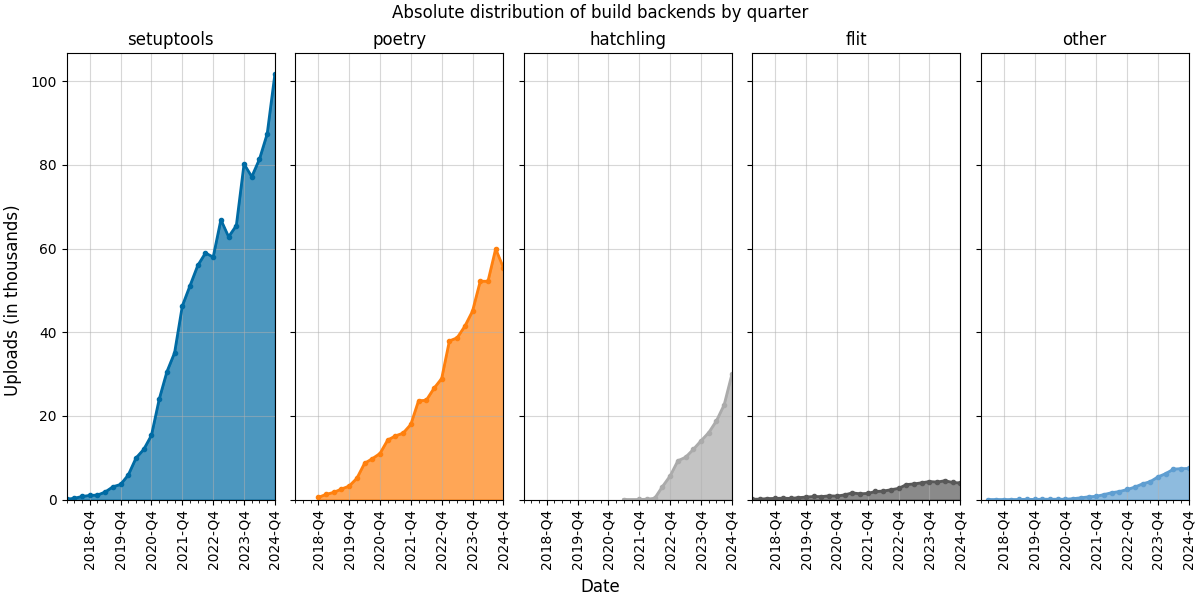
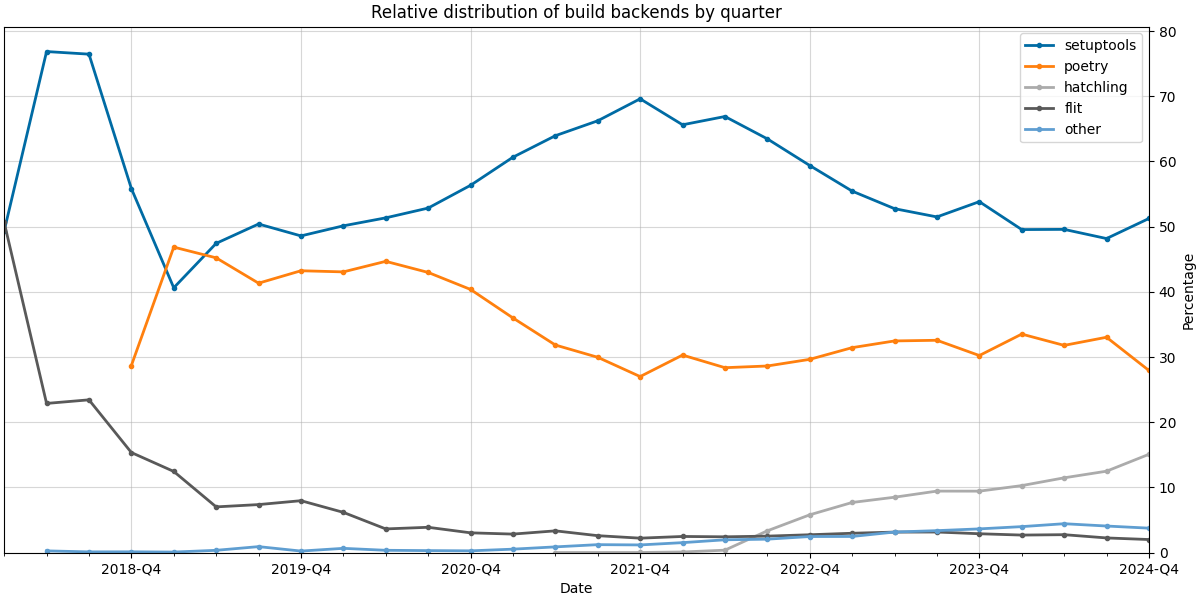
Last year, I analyzed the popularity of build backends used in pyproject.toml files over time. This post is the update for 2024. Analysis Like last year, I m using Tom Forbes fantastic dataset containing information about every file within every release uploaded to PyPI. To get the current dataset, I followed the same process as in last year s analysis, so I won t repeat all the details here. Instead, I ll highlight the main steps: Downloading all the parquet files took roughly a week due to GitHub s rate limiting. Tom suggested leveraging the Git v2 protocol to fetch the data directly. This approach could bypass rate limiting and complete the download of all pyproject.toml files in just 20 minutes(!). However, I couldn t find sufficient documentation that would help me to implement this method, so this will have to wait until next year s analysis. Once all the data is downloaded, I perform some preprocessing: Results I modified the plots a bit from last year to make them easier to read. Most notably, I binned the data into quarters to make the plots less noisy, and secondly, I stopped stacking the relative distribution plots to make the percentages directly readable. The first plot shows the absolute number of uploads (in thousands) by quarter and build backend. Absolute distribution of build backends by quarter The second plot shows the relative distribution of build backends by quarter. Relative distribution of build backends by quarter In 2024, we observe that: The script for downloading and analyzing the data is available in my GitHub repository. If someone has insights or examples on implementing the Git v2 protocol to download the pyproject.toml file given the repository URL and its hash, I d love to hear from you!

10 January 2025

Sergio Talens-Oliag: Testing New User Tools

On recent weeks I ve had some time to scratch my own itch on matters related to tools I use daily on my computer, namely the desktop / window manager and my text editor of choice. This post is a summary of what I tried, how it worked out and my short and medium-term plans related to them.

Desktop / WMOn the desktop / window manager front I ve been using Cinnamon on Debian and Ubuntu systems since Gnome 3 was published (I never liked version 3, so I decided to move to something similar to Gnome 2, including the keyboard shortcuts). In fact I ve never been a fan of Desktop environments, before Gnome I used OpenBox and IceWM because they where a lot faster than desktop systems on my hardware at the time and I was using them only to place one or two windows on multiple workspaces using mainly the keyboard for my interactions (well, except for the web browsers and the image manipulation programs). Although I was comfortable using Cinnamon, some years ago I tried to move to i3, a tilling window manager for X11 that looked like a good choice for me, but I didn t have much time to play with it and never used it enough to make me productive with it (I didn t prepare a complete configuration nor had enough time to learn the new shortcuts, so I went back to Cinnamon and never tried again). Anyway, some weeks ago I updated my work machine OS (it was using Ubuntu 22.04 LTS and I updated it to the 24.04 LTS version) and the Cinnamon systray applet stopped working as it used to do (in fact I still have to restart Cinnamon after starting a session to make it work) and, as I had some time, I decided to try a tilling window manager again, but now I decided to go for SwayWM, as it uses Wayland instead of X11.

Sway configurationOn my ~/.config/sway/config I tuned some things:
  • Set fuzzel as the application launcher.
  • Installed manually the shikane application and created a configuration to be executed always when sway is started / reloaded (I adjusted my configuration with wdisplays and used shikanectl to save it).
  • Added support for running the xdg-desktop-portal-wlr service.
  • Enabled the swayidle command to lock the screen after some time of inactivity.
  • Adjusted the keyboard to use the es key map
  • Added some keybindings to make my life easier, including the use of grimm and swappy to take screenshots
  • Configured waybar as the environment bar.
  • Added a shell script to start applications when sway is started (it uses swaymsg to execute background commands and the i3toolwait script to wait for the
    #!/bin/sh
    # VARIABLES
    CHROMIUM_LOCAL_STATE="$HOME/.config/google-chrome/Local State"
    I3_TOOLWAIT="$HOME/.config/sway/scripts/i3-toolwait"
    # Functions
    chromium_profile_dir()  
      jq -r ".profile.info_cache to_entries map( (.value.name): .key ) add .\"$1\" // \"\"" "$CHROMIUM_LOCAL_STATE"
     
    # MAIN
    IGZ_PROFILE_DIR="$(chromium_profile_dir "sergio.talens@intelygenz.com")"
    OURO_PROFILE_DIR="$(chromium_profile_dir "sergio.talens@nxr.global")"
    PERSONAL_PROFILE_DIR="$(chromium_profile_dir "stalens@gmail.com")"
    # Common programs
    swaymsg "exec nextcloud --background"
    swaymsg "exec nm-applet"
    # Run spotify on the first workspace (it is mapped to the laptop screen)
    swaymsg -q "workspace 1"
    $ I3_TOOLWAIT  "spotify"
    # Run tmux on the
    swaymsg -q "workspace 2"
    $ I3_TOOLWAIT  -- foot tmux a -dt sto
    wp_num="3"
    if [ "$OURO_PROFILE_DIR" ]; then
      swaymsg -q "workspace $wp_num"
      $ I3_TOOLWAIT  -m ouro-browser -- google-chrome --profile-directory="$OURO_PROFILE_DIR"
      wp_num="$((wp_num+1))"
    fi
    if [ "$IGZ_PROFILE_DIR" ]; then
      swaymsg -q "workspace $wp_num"
      $ I3_TOOLWAIT  -m igz-browser -- google-chrome --profile-directory="$IGZ_PROFILE_DIR"
      wp_num="$((wp_num+1))"
    fi
    if [ "$PERSONAL_PROFILE_DIR" ]; then
      swaymsg -q "workspace $wp_num"
      $ I3_TOOLWAIT  -m personal-browser -- google-chrome --profile-directory="$PERSONAL_PROFILE_DIR"
      wp_num="$((wp_num+1))"
    fi
    # Open the browser without setting the profile directory if none was found
    if [ "$wp_num" = "3" ]; then
      swaymsg -q "workspace $wp_num"
      $ I3_TOOLWAIT  google-chrome
      wp_num="$((wp_num+1))"
    fi
    swaymsg -q "workspace $wp_num"
    $ I3_TOOLWAIT  evolution
    wp_num="$((wp_num+1))"
    swaymsg -q "workspace $wp_num"
    $ I3_TOOLWAIT  slack
    wp_num="$((wp_num+1))"
    # Open a private browser and a console in the last workspace
    swaymsg -q "workspace $wp_num"
    $ I3_TOOLWAIT  -- google-chrome --incognito
    $ I3_TOOLWAIT  foot
    # Go back to the second workspace for keepassxc
    swaymsg "workspace 2"
    $ I3_TOOLWAIT  keepassxc

ConclusionAfter using Sway for some days I can confirm that it is a good choice for me, but some of the components needed to make it work as I want are too new and not available on the Ubuntu 24.04 LTS repositories, so I decided to go back to Cinnamon and try Sway again in the future, although I added more workspaces to my setup (now they are only available on the main monitor, the laptop screen is fixed while there is a big monitor connected), added some additional keyboard shortcuts and installed or updated some applets.

Text editorWhen I started using Linux many years ago I used vi/vim and emacs as my text editors (vi for plain text and emacs for programming and editing HTML/XML), but eventually I moved to vim as my main text editor and I ve been using it since (well, I moved to neovim some time ago, although I kept my old vim configuration). To be fair I m not as expert as I could be with vim, but I m productive with it and it has many plugins that make my life easier on my machines, while keeping my ability to edit text and configurations on any system that has a vi compatible editor installed. For work reasons I tried to use Visual Studio Code last year, but I ve never really liked it and almost everything I do with it I can do with neovim (i. e. I even use copilot with it). Besides, I m a heavy terminal user (I use tmux locally and via ssh) and I like to be able to use my text editor on my shell sessions, and code does not work like that. The only annoying thing about vim/neovim is its configuration (well, the problem is that I have a very old one and probably should spend some time fixing and updating it), but, as I said, it s been working well for me for a long time, so I never really had the motivation to do it. Anyway, after finishing my desktop tests I saw that I had the Helix editor installed for some time but I never tried it, so I decided to give it a try and see if it could be a good replacement for neovim on my environments (the only drawback is that as it is not vi compatible, I would need to switch back to vi mode when working on remote systems, but I guess I could live with that). I ran the helix tutorial and I liked it, so I decided to configure and install the Language Servers I can probably take advantage of on my daily work on my personal and work machines and see how it works.

Language server installationsA lot of manual installations are needed to get the language servers working what I did on my machines is more or less the following:
# AWK
sudo npm i -g 'awk-language-server@>=0.5.2'
# BASH
sudo apt-get install shellcheck shfmt
sudo npm i -g bash-language-server
# C/C++
sudo apt-get install clangd
# CSS, HTML, ESLint, JSON, SCS
sudo npm i -g vscode-langservers-extracted
# Docker
sudo npm install -g dockerfile-language-server-nodejs
# Docker compose
sudo npm install -g @microsoft/compose-language-service
# Helm
app="helm_ls_linux_amd64"
url="$(
  curl -s https://api.github.com/repos/mrjosh/helm-ls/releases/latest  
    jq -r ".assets[]   select(.name == \"$app\")   .browser_download_url"
)"
curl -L "$url" --output /tmp/helm_ls
sudo install /tmp/helm_ls /usr/local/bin
rm /tmp/helm_ls
# Markdown
app="marksman-linux-x64"
url="$(
  curl -s https://api.github.com/repos/artempyanykh/marksman/releases/latest  
    jq -r ".assets[]   select(.name == \"$app\")   .browser_download_url"
)"
curl -L "$url" --output /tmp/marksman
sudo install /tmp/marksman /usr/local/bin
rm /tmp/marksman
# Python
sudo npm i -g pyright
# Rust
rustup component add rust-analyzer
# SQL
sudo npm i -g sql-language-server
# Terraform
sudo apt-get install terraform-ls
# TOML
cargo install taplo-cli --locked --features lsp
# YAML
sudo npm install --global yaml-language-server
# JavaScript, TypeScript
sudo npm install -g typescript-language-server typescript
sudo npm install -g --save-dev --save-exact @biomejs/biome

Helix configurationThe helix configuration is done on a couple of toml files that are placed on the ~/.config/helix directory, the config.toml file I used is this one:
theme = "solarized_light"
[editor]
line-number = "relative"
mouse = false
[editor.statusline]
left = ["mode", "spinner"]
center = ["file-name"]
right = ["diagnostics", "selections", "position", "file-encoding", "file-line-ending", "file-type"]
separator = " "
mode.normal = "NORMAL"
mode.insert = "INSERT"
mode.select = "SELECT"
[editor.cursor-shape]
insert = "bar"
normal = "block"
select = "underline"
[editor.file-picker]
hidden = false
[editor.whitespace]
render = "all"
[editor.indent-guides]
render = true
character = " " # Some characters that work well: " ", " ", " ", " "
skip-levels = 1
And to configure the language servers I used the following language-servers.toml file:
[[language]]
name = "go"
auto-format = true
formatter =   command = "goimports"  
[[language]]
name = "javascript"
language-servers = [
  "typescript-language-server", # optional
  "vscode-eslint-language-server",
]
[language-server.rust-analyzer.config.check]
command = "clippy"
[language-server.sql-language-server]
command = "sql-language-server"
args = ["up", "--method", "stdio"]
[[language]]
name = "sql"
language-servers = [ "sql-language-server" ]
[[language]]
name = "hcl"
language-servers = [ "terraform-ls" ]
language-id = "terraform"
[[language]]
name = "tfvars"
language-servers = [ "terraform-ls" ]
language-id = "terraform-vars"
[language-server.terraform-ls]
command = "terraform-ls"
args = ["serve"]
[[language]]
name = "toml"
formatter =   command = "taplo", args = ["fmt", "-"]  
[[language]]
name = "typescript"
language-servers = [
  "typescript-language-server",
  "vscode-eslint-language-server",
]

Neovim configurationAfter a little while I noticed that I was going to need some time to get used to helix and the most interesting thing for me was the easy configuration and the language server integrations, but as I am already comfortable with neovim and just had installed the language server support tools on my machines I just need to configure them for neovim and I can keep using it for a while. As I said my configuration is old, to configure neovim I have the following init.vim file on my ~/.config/nvim folder:
set runtimepath^=~/.vim runtimepath+=~/.vim/after
let &packpath=&runtimepath
source ~/.vim/vimrc
" load lua configuration
lua require('config')
With that configuration I keep my old vimrc (it is a little bit messy, but it works) and I use a lua configuration file for the language servers and some additional neovim plugins on the ~/.config/nvim/lua/config.lua file:
-- -----------------------
-- BEG: LSP Configurations
-- -----------------------
-- AWS (awk_ls)
require'lspconfig'.awk_ls.setup 
-- Bash (bashls)
require'lspconfig'.bashls.setup 
-- C/C++ (clangd)
require'lspconfig'.clangd.setup 
-- CSS (cssls)
require'lspconfig'.cssls.setup 
-- Docker (dockerls)
require'lspconfig'.dockerls.setup 
-- Docker Compose
require'lspconfig'.docker_compose_language_service.setup 
-- Golang (gopls)
require'lspconfig'.gopls.setup 
-- Helm (helm_ls)
require'lspconfig'.helm_ls.setup 
-- Markdown
require'lspconfig'.marksman.setup 
-- Python (pyright)
require'lspconfig'.pyright.setup 
-- Rust (rust-analyzer)
require'lspconfig'.rust_analyzer.setup 
-- SQL (sqlls)
require'lspconfig'.sqlls.setup 
-- Terraform (terraformls)
require'lspconfig'.terraformls.setup 
-- TOML (taplo)
require'lspconfig'.taplo.setup 
-- Typescript (ts_ls)
require'lspconfig'.ts_ls.setup 
-- YAML (yamlls)
require'lspconfig'.yamlls.setup 
  settings =  
    yaml =  
      customTags =   "!reference sequence"  


-- -----------------------
-- END: LSP Configurations
-- -----------------------
-- ---------------------------------
-- BEG: Autocompletion configuration
-- ---------------------------------
-- Ref: https://github.com/neovim/nvim-lspconfig/wiki/Autocompletion
--
-- Pre requisites:
--
--   # Packer
--   git clone --depth 1 https://github.com/wbthomason/packer.nvim \
--      ~/.local/share/nvim/site/pack/packer/start/packer.nvim
--
--   # Start nvim and run :PackerSync or :PackerUpdate
-- ---------------------------------
local use = require('packer').use
require('packer').startup(function()
  use 'wbthomason/packer.nvim' -- Packer, useful to avoid removing it with PackerSync / PackerUpdate
  use 'neovim/nvim-lspconfig' -- Collection of configurations for built-in LSP client
  use 'hrsh7th/nvim-cmp' -- Autocompletion plugin
  use 'hrsh7th/cmp-nvim-lsp' -- LSP source for nvim-cmp
  use 'saadparwaiz1/cmp_luasnip' -- Snippets source for nvim-cmp
  use 'L3MON4D3/LuaSnip' -- Snippets plugin
end)
-- Add additional capabilities supported by nvim-cmp
local capabilities = require("cmp_nvim_lsp").default_capabilities()
local lspconfig = require('lspconfig')
-- Enable some language servers with the additional completion capabilities offered by nvim-cmp
local servers =   'clangd', 'rust_analyzer', 'pyright', 'ts_ls'  
for _, lsp in ipairs(servers) do
  lspconfig[lsp].setup  
    -- on_attach = my_custom_on_attach,
    capabilities = capabilities,
   
end
-- luasnip setup
local luasnip = require 'luasnip'
-- nvim-cmp setup
local cmp = require 'cmp'
cmp.setup  
  snippet =  
    expand = function(args)
      luasnip.lsp_expand(args.body)
    end,
   ,
  mapping = cmp.mapping.preset.insert( 
    ['<C-u>'] = cmp.mapping.scroll_docs(-4), -- Up
    ['<C-d>'] = cmp.mapping.scroll_docs(4), -- Down
    -- C-b (back) C-f (forward) for snippet placeholder navigation.
    ['<C-Space>'] = cmp.mapping.complete(),
    ['<CR>'] = cmp.mapping.confirm  
      behavior = cmp.ConfirmBehavior.Replace,
      select = true,
     ,
    ['<Tab>'] = cmp.mapping(function(fallback)
      if cmp.visible() then
        cmp.select_next_item()
      elseif luasnip.expand_or_jumpable() then
        luasnip.expand_or_jump()
      else
        fallback()
      end
    end,   'i', 's'  ),
    ['<S-Tab>'] = cmp.mapping(function(fallback)
      if cmp.visible() then
        cmp.select_prev_item()
      elseif luasnip.jumpable(-1) then
        luasnip.jump(-1)
      else
        fallback()
      end
    end,   'i', 's'  ),
   ),
  sources =  
      name = 'nvim_lsp'  ,
      name = 'luasnip'  ,
   ,
 
-- ---------------------------------
-- END: Autocompletion configuration
-- ---------------------------------

ConclusionI guess I ll keep helix installed and try it again on some of my personal projects to see if I can get used to it, but for now I ll stay with neovim as my main text editor and learn the shortcuts to use it with the language servers.

9 January 2025

Reproducible Builds: Reproducible Builds in December 2024

Welcome to the December 2024 report from the Reproducible Builds project! Our monthly reports outline what we ve been up to over the past month and highlight items of news from elsewhere in the world of software supply-chain security when relevant. As ever, however, if you are interested in contributing to the Reproducible Builds project, please visit our Contribute page on our website. Table of contents:
  1. reproduce.debian.net
  2. debian-repro-status
  3. On our mailing list
  4. Enhancing the Security of Software Supply Chains
  5. diffoscope
  6. Supply-chain attack in the Solana ecosystem
  7. Website updates
  8. Debian changes
  9. Other development news
  10. Upstream patches
  11. Reproducibility testing framework

reproduce.debian.net Last month saw the introduction of reproduce.debian.net. Announced at the recent Debian MiniDebConf in Toulouse, reproduce.debian.net is an instance of rebuilderd operated by the Reproducible Builds project. rebuilderd is our server designed monitor the official package repositories of Linux distributions and attempts to reproduce the observed results there. This month, however, we are pleased to announce that not only does the service now produce graphs, the reproduce.debian.net homepage itself has become a start page of sorts, and the amd64.reproduce.debian.net and i386.reproduce.debian.net pages have emerged. The first of these rebuilds the amd64 architecture, naturally, but it also is building Debian packages that are marked with the no architecture label, all. The second builder is, however, only rebuilding the i386 architecture. Both of these services were also switched to reproduce the Debian trixie distribution instead of unstable, which started with 43% of the archive rebuild with 79.3% reproduced successfully. This is very much a work in progress, and we ll start reproducing Debian unstable soon. Our i386 hosts are very kindly sponsored by Infomaniak whilst the amd64 node is sponsored by OSUOSL thank you! Indeed, we are looking for more workers for more Debian architectures; please contact us if you are able to help.

debian-repro-status Reproducible builds developer kpcyrd has published a client program for reproduce.debian.net (see above) that queries the status of the locally installed packages and rates the system with a percentage score. This tool works analogously to arch-repro-status for the Arch Linux Reproducible Builds setup. The tool was packaged for Debian and is currently available in Debian trixie: it can be installed with apt install debian-repro-status.

On our mailing list On our mailing list this month:
  • Bernhard M. Wiedemann wrote a detailed post on his long journey towards a bit-reproducible Emacs package. In his interesting message, Bernhard goes into depth about the tools that they used and the lower-level technical details of, for instance, compatibility with the version for glibc within openSUSE.
  • Shivanand Kunijadar posed a question pertaining to the reproducibility issues with encrypted images. Shivanand explains that they must use a random IV for encryption with AES CBC. The resulting artifact is not reproducible due to the random IV used. The message resulted in a handful of replies, hopefully helpful!
  • User Danilo posted an in interesting question related to their attempts in trying to achieve reproducible builds for Threema Desktop 2.0. The question resulted in a number of replies attempting to find the right combination of compiler and linker flags (for example).
  • Longstanding contributor David A. Wheeler wrote to our list announcing the release of the Census III of Free and Open Source Software: Application Libraries report written by Frank Nagle, Kate Powell, Richie Zitomer and David himself. As David writes in his message, the report attempts to answer the question what is the most popular Free and Open Source Software (FOSS)? .
  • Lastly, kpcyrd followed-up to a post from September 2024 which mentioned their desire for someone to implement a hashset of allowed module hashes that is generated during the kernel build and then embedded in the kernel image , thus enabling a deterministic and reproducible build. However, they are now reporting that somebody implemented the hash-based allow list feature and submitted it to the Linux kernel mailing list . Like kpcyrd, we hope it gets merged.

Enhancing the Security of Software Supply Chains: Methods and Practices Mehdi Keshani of the Delft University of Technology in the Netherlands has published their thesis on Enhancing the Security of Software Supply Chains: Methods and Practices . Their introductory summary first begins with an outline of software supply chains and the importance of the Maven ecosystem before outlining the issues that it faces that threaten its security and effectiveness . To address these:
First, we propose an automated approach for library reproducibility to enhance library security during the deployment phase. We then develop a scalable call graph generation technique to support various use cases, such as method-level vulnerability analysis and change impact analysis, which help mitigate security challenges within the ecosystem. Utilizing the generated call graphs, we explore the impact of libraries on their users. Finally, through empirical research and mining techniques, we investigate the current state of the Maven ecosystem, identify harmful practices, and propose recommendations to address them.
A PDF of Mehdi s entire thesis is available to download.

diffoscope diffoscope is our in-depth and content-aware diff utility that can locate and diagnose reproducibility issues. This month, Chris Lamb made the following changes, including preparing and uploading versions 283 and 284 to Debian:
  • Update copyright years. [ ]
  • Update tests to support file 5.46. [ ][ ]
  • Simplify tests_quines.py::test_ differences,differences_deb to simply use assert_diff and not mangle the test fixture. [ ]

Supply-chain attack in the Solana ecosystem A significant supply-chain attack impacted Solana, an ecosystem for decentralised applications running on a blockchain. Hackers targeted the @solana/web3.js JavaScript library and embedded malicious code that extracted private keys and drained funds from cryptocurrency wallets. According to some reports, about $160,000 worth of assets were stolen, not including SOL tokens and other crypto assets.

Website updates Similar to last month, there was a large number of changes made to our website this month, including:
  • Chris Lamb:
    • Make the landing page hero look nicer when the vertical height component of the viewport is restricted, not just the horizontal width.
    • Rename the Buy-in page to Why Reproducible Builds? [ ]
    • Removing the top black border. [ ][ ]
  • Holger Levsen:
  • hulkoba:
    • Remove the sidebar-type layout and move to a static navigation element. [ ][ ][ ][ ]
    • Create and merge a new Success stories page, which highlights the success stories of Reproducible Builds, showcasing real-world examples of projects shipping with verifiable, reproducible builds. These stories aim to enhance the technical resilience of the initiative by encouraging community involvement and inspiring new contributions. . [ ]
    • Further changes to the homepage. [ ]
    • Remove the translation icon from the navigation bar. [ ]
    • Remove unused CSS styles pertaining to the sidebar. [ ]
    • Add sponsors to the global footer. [ ]
    • Add extra space on large screens on the Who page. [ ]
    • Hide the side navigation on small screens on the Documentation pages. [ ]

Debian changes There were a significant number of reproducibility-related changes within Debian this month, including:
  • Santiago Vila uploaded version 0.11+nmu4 of the dh-buildinfo package. In this release, the dh_buildinfo becomes a no-op ie. it no longer does anything beyond warning the developer that the dh-buildinfo package is now obsolete. In his upload, Santiago wrote that We still want packages to drop their [dependency] on dh-buildinfo, but now they will immediately benefit from this change after a simple rebuild.
  • Holger Levsen filed Debian bug #1091550 requesting a rebuild of a number of packages that were built with a very old version of dpkg.
  • Fay Stegerman contributed to an extensive thread on the debian-devel development mailing list on the topic of Supporting alternative zlib implementations . In particular, Fay wrote about her results experimenting whether zlib-ng produces identical results or not.
  • kpcyrd uploaded a new rust-rebuilderd-worker, rust-derp, rust-in-toto and debian-repro-status to Debian, which passed successfully through the so-called NEW queue.
  • Gioele Barabucci filed a number of bugs against the debrebuild component/script of the devscripts package, including:
    • #1089087: Address a spurious extra subdirectory in the build path.
    • #1089201: Extra zero bytes added to .dynstr when rebuilding CMake projects.
    • #1089088: Some binNMUs have a 1-second offset in some timestamps.
  • Gioele Barabucci also filed a bug against the dh-r package to report that the Recommends and Suggests fields are missing from rebuilt R packages. At the time of writing, this bug has no patch and needs some help to make over 350 binary packages reproducible.
  • Lastly, 8 reviews of Debian packages were added, 11 were updated and 11 were removed this month adding to our knowledge about identified issues.

Other development news In other ecosystem and distribution news:
  • Lastly, in openSUSE, Bernhard M. Wiedemann published another report for the distribution. There, Bernhard reports about the success of building R-B-OS , a partial fork of openSUSE with only 100% bit-reproducible packages. This effort was sponsored by the NLNet NGI0 initiative.

Upstream patches The Reproducible Builds project detects, dissects and attempts to fix as many currently-unreproducible packages as possible. We endeavour to send all of our patches upstream where appropriate. This month, we wrote a large number of such patches, including:

Reproducibility testing framework The Reproducible Builds project operates a comprehensive testing framework running primarily at tests.reproducible-builds.org in order to check packages and other artifacts for reproducibility. In November, a number of changes were made by Holger Levsen, including:
  • reproduce.debian.net-related:
    • Add a new i386.reproduce.debian.net rebuilder. [ ][ ][ ][ ][ ][ ]
    • Make a number of updates to the documentation. [ ][ ][ ][ ][ ]
    • Run i386.reproduce.debian.net run on a public port to allow external workers. [ ]
    • Add a link to the /api/v0/pkgs/list endpoint. [ ]
    • Add support for a statistics page. [ ][ ][ ][ ][ ][ ]
    • Limit build logs to 20 MiB and diffoscope output to 10 MiB. [ ]
    • Improve the frontpage. [ ][ ]
    • Explain that we re testing arch:any and arch:all on the amd64 architecture, but only arch:any on i386. [ ]
  • Misc:
    • Remove code for testing Arch Linux, which has moved to reproduce.archlinux.org. [ ][ ]
    • Don t install dstat on Jenkins nodes anymore as its been removed from Debian trixie. [ ]
    • Prepare the infom08-i386 node to become another rebuilder. [ ]
    • Add debug date output for benchmarking the reproducible_pool_buildinfos.sh script. [ ]
    • Install installation-birthday everywhere. [ ]
    • Temporarily disable automatic updates of pool links on buildinfos.debian.net. [ ]
    • Install Recommends by default on Jenkins nodes. [ ]
    • Rename rebuilder_stats.py to rebuilderd_stats.py. [ ]
    • r.d.n/stats: minor formatting changes. [ ]
    • Install files under /etc/cron.d/ with the correct permissions. [ ]
and Jochen Sprickerhof made the following changes: Lastly, Gioele Barabucci also classified packages affected by 1-second offset issue filed as Debian bug #1089088 [ ][ ][ ][ ], Chris Hofstaedtler updated the URL for Grml s dpkg.selections file [ ], Roland Clobus updated the Jenkins log parser to parse warnings from diffoscope [ ] and Mattia Rizzolo banned a number of bots and crawlers from the service [ ][ ].
If you are interested in contributing to the Reproducible Builds project, please visit our Contribute page on our website. However, you can get in touch with us via:

Freexian Collaborators: Debian Contributions: Tracker.debian.org updates, Salsa CI improvements, Coinstallable build-essential, Python 3.13 transition, Ruby 3.3 transition and more! (by Anupa Ann Joseph, Stefano Rivera)

Debian Contributions: 2024-12 Contributing to Debian is part of Freexian s mission. This article covers the latest achievements of Freexian and their collaborators. All of this is made possible by organizations subscribing to our Long Term Support contracts and consulting services.

Tracker.debian.org updates, by Rapha l Hertzog Profiting from end-of-year vacations, Rapha l prepared for tracker.debian.org to be upgraded to Debian 12 bookworm by getting rid of the remnants of python3-django-jsonfield in the code (it was superseded by a Django-native field). Thanks to Philipp Kern from the Debian System Administrators team, the upgrade happened on December 23rd. Rapha l also improved distro-tracker to better deal with invalid Maintainer fields which recently caused multiples issues in the regular data updates (#1089985, MR 105). While working on this, he filed #1089648 asking dpkg tools to error out early when maintainers make such mistakes. Finally he provided feedback to multiple issues and merge requests (MR 106, issues #21, #76, #77), there seems to be a surge of interest in distro-tracker lately. It would be nice if those new contributors could stick around and help out with the significant backlog of issues (in the Debian BTS, in Salsa).

Salsa CI improvements, by Santiago Ruano Rinc n Given that the Debian buildd network now relies on sbuild using the unshare backend, and that Salsa CI s reproducibility testing needs to be reworked (#399), Santiago resumed the work for moving the build job to use sbuild. There was some related work a few months ago that was focused on sbuild with the schroot and the sudo backends, but those attempts were stalled for different reasons, including discussions around the convenience of the move (#296). However, using sbuild and unshare avoids all of the drawbacks that have been identified so far. Santiago is preparing two merge requests: !568 to introduce a new build image, and !569 that moves all the extract-source related tasks to the build job. As mentioned in the previous reports, this change will make it possible for more projects to use the pipeline to build the packages (See #195). Additional advantages of this change include a more optimal way to test if a package builds twice in a row: instead of actually building it twice, the Salsa CI pipeline will configure sbuild to check if the clean target of debian/rules correctly restores the source tree, saving some CPU cycles by avoiding one build. Also, the images related to Ubuntu won t be needed anymore, since the build job will create chroots for different distributions and vendors from a single common build image. This will save space in the container registry. More changes are to come, especially those related to handling projects that customize the pipeline and make use of the extract-source job.

Coinstallable build-essential, by Helmut Grohne Building on the gcc-for-host work of last December, a notable patch turning build-essential Multi-Arch: same became feasible. Whilst the change is small, its implications and foundations are not. We still install crossbuild-essential-$ARCH for cross building and due to a britney2 limitation, we cannot have it depend on the host s C library. As a result, there are workarounds in place for sbuild and pbuilder. In turning build-essential Multi-Arch: same, we may actually express these dependencies directly as we install build-essential:$ARCH instead. The crossbuild-essential-$ARCH packages will continue to be available as transitional dummy packages.

Python 3.13 transition, by Colin Watson and Stefano Rivera Building on last month s work, Colin, Stefano, and other members of the Debian Python team fixed 3.13 compatibility bugs in many more packages, allowing 3.13 to now be a supported but non-default version in testing. The next stage will be to switch to it as the default version, which will start soon. Stefano did some test-rebuilds of packages that only build for the default Python 3 version, to find issues that will block the transition. The default version transition typically shakes out some more issues in applications that (unlike libraries) only test with the default Python version. Colin also fixed Sphinx 8.0 compatibility issues in many packages, which otherwise threatened to get in the way of this transition.

Ruby 3.3 transition, by Lucas Kanashiro The Debian Ruby team decided to ship Ruby 3.3 in the next Debian release, and Lucas took the lead of the interpreter transition with the assistance of the rest of the team. In order to understand the impact of the new interpreter in the ruby ecosystem, ruby-defaults was uploaded to experimental adding ruby3.3 as an alternative interpreter, and a mass rebuild of reverse dependencies was done here. Initially, a couple of hundred packages were failing to build, after many rounds of rebuilds, adjustments, and many uploads we are down to 30 package build failures, of those, 21 packages were asked to be removed from testing and for the other 9, bugs were filled. All the information to track this transition can be found here. Now, we are waiting for PHP 8.4 to finish to avoid any collision. Once it is done the Ruby 3.3 transition will start in unstable.

Miscellaneous contributions
  • Enrico Zini redesigned the way nm.debian.org stores historical audit logs and personal data backups.
  • Carles Pina submitted a new package (python-firebase-messaging) and prepared updates for python3-ring-doorbell.
  • Carles Pina developed further po-debconf-manager: better state transition, fixed bugs, automated assigning translators and reviewers on edit, updating po header files automatically, fixed bugs, etc.
  • Carles Pina reviewed, submitted and followed up the debconf templates translation (more than 20 packages) and translated some packages (about 5).
  • Santiago continued to work on DebConf 25 organization related tasks, including handling the logo survey and results. Stefano spent time on DebConf 25 too.
  • Santiago continued the exploratory work about linux livepatching with Emmanuel Arias. Santiago and Emmanuel found a challenge since kpatch won t fully support linux in trixie and newer, so they are exploring alternatives such as klp-build.
  • Helmut maintained the /usr-move transition filing bugs in e.g. bubblewrap, e2fsprogs, libvpd-2.2-3, and pam-tmpdir and corresponding on related issues such as kexec-tools and live-build. The removal of the usrmerge package unfortunately broke debootstrap and was quickly reverted. Continued fallout is expected and will continue until trixie is released.
  • Helmut sent patches for 10 cross build failures and worked with Sandro Knau on stuck Qt/KDE patches related to cross building.
  • Helmut continued to maintain rebootstrap removing the need to build gnu-efi in the process.
  • Helmut collaborated with Emanuele Rocca and Jochen Sprickerhof on an interesting adventure in diagnosing why gcc would FTBFS in recent sbuild.
  • Helmut proposed supporting build concurrency limits in coreutils s nproc. As it turns out nproc is not a good place for this functionality.
  • Colin worked with Sandro Tosi and Andrej Shadura to finish resolving the multipart vs. python-multipart name conflict, as mentioned last month.
  • Colin upgraded 48 Python packages to new upstream versions, fixing four CVEs and a number of compatibility bugs with recent Python versions.
  • Colin issued an openssh bookworm update with a number of fixes that had accumulated over the last year, especially fixing GSS-API key exchange which had been quite broken in bookworm.
  • Stefano fixed a minor bug in debian-reimbursements that was disallowing combination PDFs containing JAL tickets, encoded in UTF-16.
  • Stefano uploaded a stable update to PyPy3 in bookworm, catching up with security issues resolved in cPython.
  • Stefano fixed a regression in the eventlet from his Python 3.13 porting patch.
  • Stefano continued discussing a forwarded patch (renaming the sysconfigdata module) with cPython upstream, ending in a decision to drop the patch from Debian. This will need some continued work.
  • Anupa participated in the Debian Publicity team meeting in December, which discussed the team activities done in 2024 and projects for 2025.

8 January 2025

John Goerzen: Censorship Is Complicated: What Internet History Says about Meta/Facebook

In light of this week s announcement by Meta (Facebook, Instagram, Threads, etc), I have been pondering this question: Why am I, a person that has long been a staunch advocate of free speech and encryption, leery of sites that talk about being free speech-oriented? And, more to the point, why an I a person that has been censored by Facebook for mentioning the Open Source social network Mastodon not cheering a lighter touch ? The answers are complicated, and take me back to the early days of social networking. Yes, I mean the 1980s and 1990s. Before digital communications, there were barriers to reaching a lot of people. Especially money. This led to a sort of self-censorship: it may be legal to write certain things, but would a newspaper publish a letter to the editor containing expletives? Probably not. As digital communications started to happen, suddenly people could have their own communities. Not just free from the same kinds of monetary pressures, but free from outside oversight (parents, teachers, peers, community, etc.) When you have a community that the majority of people lack the equipment to access and wouldn t understand how to access even if they had the equipment you have a place where self-expression can be unleashed. And, as J. C. Herz covers in what is now an unintentional history (her book Surfing on the Internet was published in 1995), self-expression WAS unleashed. She enjoyed the wit and expression of everything from odd corners of Usenet to the text-based open world of MOOs and MUDs. She even talks about groups dedicated to insults (flaming) in positive terms. But as I ve seen time and again, if there are absolutely no rules, then whenever a group gets big enough more than a few dozen people, say there are troublemakers that ruin it for everyone. Maybe it s trolling, maybe it s vicious attacks, you name it it will arrive and it will be poisonous. I remember the debates within the Debian community about this. Debian is one of the pillars of the Internet today, a nonprofit project with free speech in its DNA. And yet there were inevitably the poisonous people. Debian took too long to learn that allowing those people to run rampant was causing more harm than good, because having a well-worn Delete key and a tolerance for insults became a requirement for being a Debian developer, and that drove away people that had no desire to deal with such things. (I should note that Debian strikes a much better balance today.) But in reality, there were never absolutely no rules. If you joined a BBS, you used it at the whim of the owner (the sysop or system operator). The sysop may be a 16-yr-old running it from their bedroom, or a retired programmer, but in any case they were letting you use their resources for free and they could kick you off for any or no reason at all. So if you caused trouble, or perhaps insulted their cat, you re banned. But, in all but the smallest towns, there were other options you could try. On the other hand, sysops enjoyed having people call their BBSs and didn t want to drive everyone off, so there was a natural balance at play. As networks like Fidonet developed, a sort of uneasy approach kicked in: don t be excessively annoying, and don t be easily annoyed. Like it or not, it seemed to generally work. A BBS that repeatedly failed to deal with troublemakers could risk removal from Fidonet. On the more institutional Usenet, you generally got access through your university (or, in a few cases, employer). Most universities didn t really even know they were running a Usenet server, and you were generally left alone. Until you did something that annoyed somebody enough that they tracked down the phone number for your dean, in which case real-world consequences would kick in. A site may face the Usenet Death Penalty delinking from the network if they repeatedly failed to prevent malicious content from flowing through their site. Some BBSs let people from minority communities such as LGBTQ+ thrive in a place of peace from tormentors. A lot of them let people be themselves in a way they couldn t be in real life . And yes, some harbored trolls and flamers. The point I am trying to make here is that each BBS, or Usenet site, set their own policies about what their own users could do. These had to be harmonized to a certain extent with the global community, but in a certain sense, with BBSs especially, you could just use a different one if you didn t like what the vibe was at a certain place. That this free speech ethos survived was never inevitable. There were many attempts to regulate the Internet, and it was thanks to the advocacy of groups like the EFF that we have things like strong encryption and a degree of freedom online. With the rise of the very large platforms and here I mean CompuServe and AOL at first, and then Facebook, Twitter, and the like later the low-friction option of just choosing a different place started to decline. You could participate on a Fidonet forum from any of thousands of BBSs, but you could only participate in an AOL forum from AOL. The same goes for Facebook, Twitter, and so forth. Not only that, but as social media became conceived of as very large sites, it became impossible for a person with enough skill, funds, and time to just start a site themselves. Instead of neading a few thousand dollars of equipment, you d need tens or hundreds of millions of dollars of equipment and employees. All that means you can t really run Facebook as a nonprofit. It is a business. It should be absolutely clear to everyone that Facebook s mission is not the one they say it is [to] give people the power to build community and bring the world closer together. If that was their goal, they wouldn t be creating AI users and AI spam and all the rest. Zuck isn t showing courage; he s sucking up to Trump and those that will pay the price are those that always do: women and minorities. Really, the point of any large social network isn t to build community. It s to make the owners their next billion. They do that by convincing people to look at ads on their site. Zuck is as much a windsock as anyone else; he will adjust policies in whichever direction he thinks the wind is blowing so as to let him keep putting ads in front of eyeballs, and stomp all over principles even free speech doing it. Don t expect anything different from any large commercial social network either. Bluesky is going to follow the same trajectory as all the others. The problem with a one-size-fits-all content policy is that the world isn t that kind of place. For instance, I am a pacifist. There is a place for a group where pacifists can hang out with each other, free from the noise of the debate about pacifism. And there is a place for the debate. Forcing everyone that signs up for the conversation to sign up for the debate is harmful. Preventing the debate is often also harmful. One company can t square this circle. Beyond that, the fact that we care so much about one company is a problem on two levels. First, it indicates how succeptible people are to misinformation and such. I don t have much to offer on that point. Secondly, it indicates that we are too centralized. We have a solution there: Mastodon. Mastodon is a modern, open source, decentralized social network. You can join any instance, easily migrate your account from one server to another, and so forth. You pick an instance that suits you. There are thousands of others you can choose from. Some aggressively defederate with instances known to harbor poisonous people; some don t. And, to harken back to the BBS era, if you have some time, some skill, and a few bucks, you can run your own Mastodon instance. Personally, I still visit Facebook on occasion because some people I care about are mainly there. But it is such a terrible experience that I rarely do. Meta is becoming irrelevant to me. They are on a path to becoming irrelevant to many more as well. Maybe this is the moment to go shrug, this sucks and try something better. (And when you do, feel free to say hi to me at @jgoerzen@floss.social on Mastodon.)

7 January 2025

Enrico Zini: Debugging printing to a remote printer

I upgraded to Debian testing/trixie, and my network printer stopped appearing in print dialogs. These are notes from the debugging session. Check firewall configuration I tried out kde, which installed plasma-firewall, which installed firewalld, which closed by default the ports used for printing. For extra fun, appindicators are not working in Gnome and so firewall-applet is currently useless, although one can run firewall-config manually, or use the command line that might be more user friendly than the UI. Step 1: change the zone for the home wifi to "Home":
firewall-cmd  --zone home --list-interfaces
firewall-cmd  --zone home --add-interface wlp1s0
Step 2: make sure the home zone can print:
firewall-cmd --zone home --list-services
firewall-cmd --zone home --add-service=ipp
firewall-cmd --zone home --add-service=ipp-client
firewall-cmd --zone home --add-service=mdns
I searched and searched but I could not find out whether ipp is needed, ipp-client is needed, or both are needed. Check if avahi can see the printer Is the printer advertised correctly over mdns? When it didn't work:
$ avahi-browse -avrt
= wlp1s0 IPv6 Brother HL-2030 series @ server                UNIX Printer         local
   hostname = [server.local]
   address = [...ipv6 address...]
   port = [0]
   txt = []
= wlp1s0 IPv4 Brother HL-2030 series @ server                UNIX Printer         local
   hostname = [server.local]
   address = [...ipv4 address...]
   port = [0]
   txt = []
$ avahi-browse -rt _ipp._tcp
[empty]
When it works:
$ avahi-browse -avrt
= wlp1s0 IPv6 Brother HL-2030 series @ server                Secure Internet Printer local
   hostname = [server.local]
   address = [...ipv6 address...]
   port = [631]
   txt = ["printer-type=0x1046" "printer-state=3" "Copies=T" "TLS=1.2" "UUID= " "URF=DM3" "pdl=application/octet-stream,application/pdf,application/postscript,image/jpeg,image/png,image/pwg-raster,image/urf" "product=(HL-2030 series)" "priority=0" "note=" "adminurl=https://server.local.:631/printers/Brother_HL-2030_series" "ty=Brother HL-2030 series, using brlaser v6" "rp=printers/Brother_HL-2030_series" "qtotal=1" "txtvers=1"]
= wlp1s0 IPv6 Brother HL-2030 series @ server                UNIX Printer         local
   hostname = [server.local]
   address = [...ipv6 address...]
   port = [0]
   txt = []
= wlp1s0 IPv4 Brother HL-2030 series @ server                Secure Internet Printer local
   hostname = [server.local]
   address = [...ipv4 address...]
   port = [631]
   txt = ["printer-type=0x1046" "printer-state=3" "Copies=T" "TLS=1.2" "UUID= " "URF=DM3" "pdl=application/octet-stream,application/pdf,application/postscript,image/jpeg,image/png,image/pwg-raster,image/urf" "product=(HL-2030 series)" "priority=0" "note=" "adminurl=https://server.local.:631/printers/Brother_HL-2030_series" "ty=Brother HL-2030 series, using brlaser v6" "rp=printers/Brother_HL-2030_series" "qtotal=1" "txtvers=1"]
= wlp1s0 IPv4 Brother HL-2030 series @ server                UNIX Printer         local
   hostname = [server.local]
   address = [...ipv4 address...]
   port = [0]
   txt = []
$ avahi-browse -rt _ipp._tcp
+ wlp1s0 IPv6 Brother HL-2030 series @ server                Internet Printer     local
+ wlp1s0 IPv4 Brother HL-2030 series @ server                Internet Printer     local
= wlp1s0 IPv4 Brother HL-2030 series @ server                Internet Printer     local
   hostname = [server.local]
   address = [...ipv4 address...]
   port = [631]
   txt = ["printer-type=0x1046" "printer-state=3" "Copies=T" "TLS=1.2" "UUID= " "URF=DM3" "pdl=application/octet-stream,application/pdf,application/postscript,image/jpeg,image/png,image/pwg-raster,image/urf" "product=(HL-2030 series)" "priority=0" "note=" "adminurl=https://server.local.:631/printers/Brother_HL-2030_series" "ty=Brother HL-2030 series, using brlaser v6" "rp=printers/Brother_HL-2030_series" "qtotal=1" "txtvers=1"]
= wlp1s0 IPv6 Brother HL-2030 series @ server                Internet Printer     local
   hostname = [server.local]https://bugs.debian.org/cgi-bin/bugreport.cgi?bug=1092109
   address = [...ipv6 address...]
   port = [631]
   txt = ["printer-type=0x1046" "printer-state=3" "Copies=T" "TLS=1.2" "UUID= " "URF=DM3" "pdl=application/octet-stream,application/pdf,application/postscript,image/jpeg,image/png,image/pwg-raster,image/urf" "product=(HL-2030 series)" "priority=0" "note=" "adminurl=https://server.local.:631/printers/Brother_HL-2030_series" "ty=Brother HL-2030 series, using brlaser v6" "rp=printers/Brother_HL-2030_series" "qtotal=1" "txtvers=1"]
Check if cups can see the printer From CUPS' Using Network Printers:
$ /usr/sbin/lpinfo --include-schemes dnssd -v
network dnssd://Brother%20HL-2030%20series%20%40%20server._ipp._tcp.local/cups?uuid= 
Debugging session interrupted At this point, the printer appeared. It could be that: In the end, debugging failed successfully, and this log now remains as a reference for possible further issues.

5 January 2025

Dominique Dumont: cme: new field in fill.copyright.blanks.yml for Debian copyright file

Hi The file fill.copyright.blanks.yml is used to fill missing copyright information when running cme update dpkg-copyright. This file can contain a comment field that is used for book-keeping. Here s an example from libuv1:
README.md:
comment:  -
  the license from this file is used as a main license and tends to
  apply expat or CC to all files. Which is wrong. Let's skip this file
  and let cme retrieve data from files.
skip: true
You may ask: why no use a YAML comments ? The problem is that YAML comments are dropped by cme edit dpkg. So you should not use them in fill.copyrights.blanks.yml. It occurred to me that it may be interesting to copy the content of this comment in to debian/copyright file entries. But not in all cases, as some comments make sense in fill.copyright.blanks.yml but not in debian/copyright. So I ve added a new forwarded-comment parameter in fill.copyright.blanks.yml. The content of this field is copied verbatim in debian/copyright. This way, you can add comments for book keeping and comments for debian/copyright entries. For instance:
pan/gui/*:
  forwarded-comment: some comment about gui
  comment: this is an example from cme test files
yields:
Files: pan/gui/*
Copyright: 1989, 1991, Free Software Foundation, Inc.
License: GPL-2
Comment: some comment about gui
This new functionality is available in libconfig-model-dpkg-perl >= 3.008. All the best

Jonathan McDowell: Free Software Activities for 2024

I tailed off on blog posts towards the end of the year; I blame a bunch of travel (personal + business), catching the flu, then December being its usual busy self. Anyway, to try and start off the year a bit better I thought I d do my annual recap of my Free Software activities. For previous years see 2019, 2020, 2021, 2022 + 2023.

Conferences In 2024 I managed to make it to FOSDEM again. It s a hectic conference, and I know there are legitimate concerns about it being a super spreader event, but it has the advantage of being relatively close and having a lot of different groups of people I want to talk to / see talk at it. I m already booked to go this year as well. I spoke at All Systems Go in Berlin about Using TPMs at scale for protecting keys. It was nice to actually be able to talk publicly about some of the work stuff my team and I have been working on. I d a talk submission in for FOSDEM about our use of attestation and why it s not necessarily the evil some folk claim, but there were a lot of good talks submitted and I wasn t selected. Maybe I ll find somewhere else suitable to do it. BSides Belfast may or may not count - it s a security conference, but there s a lot of overlap with various bits of Free software, so I feel it deserves a mention. I skipped DebConf for 2024 for a variety of reasons, but I m expecting to make DebConf25 in Brest, France in July.

Debian Most of my contributions to Free software continue to happen within Debian. In 2023 I d done a bunch of work on retrogaming with Kodi on Debian, so I made an effort to try and keep those bits more up to date, even if I m not actually regularly using them at present. RetroArch got 1.18.0+dfsg-1 and 1.19.1+dfsg-1 uploads. libretro-core-info got associated 1.18.0-1 and 1.19.0-1 uploads too. I note 1.20.0 has been released recently, so I ll have to find some time to build the appropriate DFSG tarball and update it. rcheevos saw 11.2.0-1, 11.5.0-1 + 11.6.0-1 uploaded. kodi-game-libretro itself had 20.2.7-1 uploaded, then 21.0.7-1. Latest upstream is 22.1.0, but that s tracking Kodi 22 and we re still on Kodi 21 so I plan to follow the Omega branch for now. Which I ve just noticed had a 21.0.8 release this week. Finally in the games space I uploaded mgba 0.10.3+dfsg-1 and 0.10.3+dfsg-2 for Ryan Tandy, before realising he was already a Debian Maintainer and granting him the appropriate ACL access so he can upload it himself; I ve had zero concerns about any of his packaging. The Debian Electronics Packaging Team continues to be home for a bunch of packages I care about. There was nothing big there, for me, in 2024, but a few bits of cleanup here and there. I seem to have become one of the main uploaders for sdcc - I have some interest in the space, and the sigrok firmware requires it to build, so I at least like to ensure it s in half decent state. I uploaded 4.4.0+dfsg-1, 4.4.0+dfsg-2, and, just in time to count for 2024, 4.4.0+dfsg-3. The sdcc 4.4 upload lead to some compilation issues for sigrok-firmware-fx2laf so I uploaded 0.1.7-2 fixing that, then 0.1.7-3 doing some further cleanups. OpenOCD had 0.12.0-2 uploaded to disable the libgpiod backend thanks to incompatible changes upstream. There were some in-discussion patches with OpenOCD upstream at the time, but they didn t seem to be ready yet so I held off on pulling them in. 0.12.0-3 fixed builds with more recent versions of jimtcl. It looks like the next upstream release is about a year away, so Trixie will in all probability ship with 0.12.0 as well. libjaylink had a new upstream release, so 0.4.0-1 was uploaded. libserialsport also had a new upstream release, leading to 0.1.2-1. I finally cracked and uploaded sg3-utils 1.48-1 into experimental. I m not the primary maintainer, but 1.46 is nearly 4 years old now and I wanted to get it updated in enough time to shake out any problems before we get to a Trixie freeze. Outside of team owned packages, libcli had compilation issues with GCC 14, leading to 1.10.7-2. I also added a new package, sedutil 1.20.0-2 back in April; it looks fairly unmaintained upstream (there s been some recent activity, but it doesn t seem to be release quality), but there was an outstanding ITP and I ve some familiarity with the space as we ve been using it at work as part of investigating TCG OPAL encryption. I continue to keep an eye on Debian New Members, even though I m mostly inactive as an application manager - we generally seem to have enough available recently. Mostly my involvement is via Front Desk activities, helping out with queries to the team alias, and contributing to internal discussions. Finally the 3 month rotation for Debian Keyring continues to operate smoothly. I dealt with 2023.03.24, 2023.06.24, 2023.09.22 + 2023.11.24.

Linux I d a single kernel contribution this year, to Clean up TPM space after command failure. That was based on some issues we saw at work. I ve another fix in progress that I hope to submit in 2025, but it s for an intermittent failure so confirming the fix is necessary + sufficient is taking a little while.

Personal projects I didn t end up doing much in the way of externally published personal project work in 2024. Despite the release of OpenPGP v6 in RFC 9580 I did not manage to really work on onak. I started on the v6 support, but have not had sufficient time to complete anything worth pushing external yet. listadmin3 got some minor updates based on external feedback / MRs. It s nice to know it s useful to other folk even in its basic state. That wraps up 2024. I ve got no particular goals for this year at present. Ideally I d get v6 support into onak, and it would be nice to implement some of the wishlist items people have provided for listadmin3, but I ll settle for making sure all my Debian packages are in reasonable state for Trixie.

4 January 2025

Kentaro Hayashi: Tips when building debian-installer

Recently, I'm trying to fix d-i Han-Unification issue for Japanese. This issue was not fixed for a long time since Debian 9 (stretch). #1037256 - debian-installer: GUI font for Japanese was incorrectly rendered - Debian Bug report logs
To know about how Han-Unification is harmful for Japanese in some cases, See "Your Code Displays Japanese Wrong". heistak.github.io
When building d-i (GUI Installer), you need to build build_netboot-gtk target. But note that you need recent master because it has nitpick issue with GNU Make 4.4.x. bugs.debian.org After that, need to prepare required packages. See README in details.
apt-get update
apt-get install -y myrepos git libgtk2.0-dev fakeroot
apt-get build-dep -y debian-installer
It seems that Bug#1037256 will be fixed with supporting compressed font. I don't know how to do it furthermore , but I'm sure that Mr. Cyril Brulebois will handle this issue better. :-) (I thought that creating fake fontconfig cache when building image, then decompress compressed font dynamically might work as just an idea, but it didn't work.) If you would like to tackle fixing d-i issues as a newbie, it might be better to execute "make reallyclean" before rebuilding image not to fall-in pitfalls.

3 January 2025

Bits from Debian: Bits from the DPL

Dear Debian community, this is bits from DPL for December. Happy New Year 2025! Wishing everyone health, productivity, and a successful Debian release later in this year. Strict ownership of packages I'm glad my last bits sparked discussions about barriers between packages and contributors, summarized temporarily in some post on the debian-devel list. As one participant aptly put it, we need a way to visibly say, "I'll do the job until someone else steps up". Based on my experience with the Bug of the Day initiative, simplifying the process for engaging with packages would significantly help. Currently we have
  1. NMU The Developers Reference outlines several preconditions for NMUs, explicitly stating, "Fixing cosmetic issues or changing the packaging style in NMUs is discouraged." This makes NMUs unsuitable for addressing package smells. However, I've seen NMUs used for tasks like switching to source format 3.0 or bumping the debhelper compat level. While it's technically possible to file a bug and then address it in an NMU, the process inherently limits the NMUer's flexibility to reduce package smells.
  2. Package Salvaging This is another approach for working on someone else's packages, aligning with the process we often follow in the Bug of the Day initiative. The criteria for selecting packages typically indicate that the maintainer either lacks time to address open bugs, has lost interest, or is generally MIA.
Both options have drawbacks, so I'd welcome continued discussion on criteria for lowering the barriers to moving packages to Salsa and modernizing their packaging. These steps could enhance Debian overall and are generally welcomed by active maintainers. The discussion also highlighted that packages on Salsa are often maintained collaboratively, fostering the team-oriented atmosphere already established in several Debian teams. Salsa Continuous Integration As part of the ongoing discussion about package maintenance, I'm considering the suggestion to switch from the current opt-in model for Salsa CI to an opt-out approach. While I fully agree that human verification is necessary when the pipeline is activated, I believe the current option to enable CI is less visible than it should be. I'd welcome a more straightforward approach to improve access to better testing for what we push to Salsa. Number of packages not on Salsa In my campaign, I stated that I aimed to reduce the number of packages maintained outside Salsa to below 2,000. As of March 28, 2024, the count was 2,368. As of this writing, the count stands at 1,928 [1], so I consider this promise fulfilled. My thanks go out to everyone who contributed to this effort. Moving forward, I'd like to set a more ambitious goal for the remainder of my term and hope we can reduce the number to below 1,800. [1] UDD query: SELECT DISTINCT count(*) FROM sources WHERE release = 'sid' and vcs_url not like '%salsa%' ; Past and future events Talk at MRI Together In early December, I gave a short online talk, primarily focusing on my work with the Debian Med team. I also used my position as DPL to advocate for attracting more users and developers from the scientific research community. FOSSASIA I originally planned to attend FOSDEM this year. However, given the strong Debian presence there and the need for better representation at the FOSSASIA Summit, I decided to prioritize the latter. This aligns with my goal of improving geographic diversity. I also look forward to opportunities for inter-distribution discussions. Debian team sprints Debian Ruby Sprint I approved the budget for the Debian Ruby Sprint, scheduled for January 2025 in Paris. If you're interested in contributing to the Ruby team, whether in person or online, consider reaching out to them. I'm sure any helping hand would be appreciated. Debian Med sprint There will also be a Debian Med sprint in Berlin in mid-February. As usual, you don't need to be an expert in biology or medicine basic bug squashing skills are enough to contribute and enjoy the friendly atmosphere the Debian Med team fosters at their sprints. For those working in biology and medicine, we typically offer packaging support. Anyone interested in spending a weekend focused on impactful scientific work with Debian is warmly invited. Again all the best for 2025
Andreas.

Taavi V n nen: Automatically updating reverse DNS entries for my Hetzner servers

Some parts of my infrastructure run on Hetzner dedicated servers. Hetzner's management console has an interface to update reverse DNS entries, and I wanted to automate that. Unfortunately there's no option to just delegate the zones to my own authoritative DNS servers. So I did the next best thing, which is updating the Hetzner-managed records with data from my own authoritative DNS servers.

Generating DNS zones the hard way The first step of automating DNS record provisioning is, well, figuring out which records need to be provisioned. I wanted to re-use my existing automation for generating the record data, instead of coming up with a new system for these records. The basic summary is that there's a Go program creatively named dnsgen that's in charge of generating zone file snippets from various sources (these include Netbox, Kubernetes, PuppetDB and my custom reverse web proxy setup). Those snippets are combined with Jinja templates to generate full zone files to be loaded to a hidden primary running Bind9 (like all other DNS servers I run). The zone files are then transferred to a fleet of internal authoritative servers as well as my public authoritative DNS server, which in turn transfers them to various other authoritative DNS servers (like ns-global and Traficom anycast) for redundancy. There's also a bunch of other smaller features, like using Bind views to server different data to internal and external clients, and resolving external records during record generation time to be used on apex records that would use CNAME records if they could. (The latter is a workaround for Masto.host, the hosting provider we use for Wikis World, not having a stable IPv6 address.) Overall it's a really nice system, and I've spent quite a bit of time on it.

Updating records on Hetzner-managed space As mentioned above, Hetzner unfortunately does not support custom DNS servers for reverse records on IP space rented from them. But I wanted to use my existing, perfectly working DNS record generation setup since that works perfectly fine. So the obvious answer is to (ab)use DNS zone file transfers. I quickly wrote a few hundred lines of Go to request the zone data and then use the Hetzner robot API to ensure the reverse entries are in sync. The main obstacle hit here was the Hetzner API somehow requiring an "update" call (instead of a "create" one) to create a new record, as the create endpoint was returning an HTTP 400 response no matter what. Once I sorted that out, the script started working fine and created the few dozen missing records. Finally I added a CronJob in my Kubernetes cluster to run the script once in a while. Overall this is a big improvement over doing things by hand and didn't require that much effort. The obvious next step would be to expand the script to a tiny DNS server capable of receiving zone update NOTIFYs to make the updates happen real-time. Unfortunately there's now no hiding of the records revealing my ugly hacks clever networking solutions :(

2 January 2025

Martin-&#201;ric Racine: On the future of i386 on Debian

Before we proceed, let's emphasize a few things: This being said, I still think that the current approach of keeping i386 among the supported architectures, all while no longer shipping kernels, is entirely the wrong decision. What should instead be done is to keep on shipping i386 kernels for Trixie, but clearly indicate in the Trixie Release Notes that i386 is supported for the last time and thereafter fully demoted to Ports.

Matthew Garrett: The GPU, not the TPM, is the root of hardware DRM

As part of their "Defective by Design" anti-DRM campaign, the FSF recently made the following claim:
Today, most of the major streaming media platforms utilize the TPM to decrypt media streams, forcefully placing the decryption out of the user's control (from here).
This is part of an overall argument that Microsoft's insistence that only hardware with a TPM can run Windows 11 is with the goal of aiding streaming companies in their attempt to ensure media can only be played in tightly constrained environments.

I'm going to be honest here and say that I don't know what Microsoft's actual motivation for requiring a TPM in Windows 11 is. I've been talking about TPM stuff for a long time. My job involves writing a lot of TPM code. I think having a TPM enables a number of worthwhile security features. Given the choice, I'd certainly pick a computer with a TPM. But in terms of whether it's of sufficient value to lock out Windows 11 on hardware with no TPM that would otherwise be able to run it? I'm not sure that's a worthwhile tradeoff.

What I can say is that the FSF's claim is just 100% wrong, and since this seems to be the sole basis of their overall claim about Microsoft's strategy here, the argument is pretty significantly undermined. I'm not aware of any streaming media platforms making use of TPMs in any way whatsoever. There is hardware DRM that the media companies use to restrict users, but it's not in the TPM - it's in the GPU.

Let's back up for a moment. There's multiple different DRM implementations, but the big three are Widevine (owned by Google, used on Android, Chromebooks, and some other embedded devices), Fairplay (Apple implementation, used for Mac and iOS), and Playready (Microsoft's implementation, used in Windows and some other hardware streaming devices and TVs). These generally implement several levels of functionality, depending on the capabilities of the device they're running on - this will range from all the DRM functionality being implemented in software up to the hardware path that will be discussed shortly. Streaming providers can choose what level of functionality and quality to provide based on the level implemented on the client device, and it's common for 4K and HDR content to be tied to hardware DRM. In any scenario, they stream encrypted content to the client and the DRM stack decrypts it before the compressed data can be decoded and played.

The "problem" with software DRM implementations is that the decrypted material is going to exist somewhere the OS can get at it at some point, making it possible for users to simply grab the decrypted stream, somewhat defeating the entire point. Vendors try to make this difficult by obfuscating their code as much as possible (and in some cases putting some of it in-kernel), but pretty much all software DRM is at least somewhat broken and copies of any new streaming media end up being available via Bittorrent pretty quickly after release. This is why higher quality media tends to be restricted to clients that implement hardware-based DRM.

The implementation of hardware-based DRM varies. On devices in the ARM world this is usually handled by performing the cryptography in a Trusted Execution Environment, or TEE. A TEE is an area where code can be executed without the OS having any insight into it at all, with ARM's TrustZone being an example of this. By putting the DRM code in TrustZone, the cryptography can be performed in RAM that the OS has no access to, making the scraping described earlier impossible. x86 has no well-specified TEE (Intel's SGX is an example, but is no longer implemented in consumer parts), so instead this tends to be handed off to the GPU. The exact details of this implementation are somewhat opaque - of the previously mentioned DRM implementations, only Playready does hardware DRM on x86, and I haven't found any public documentation of what drivers need to expose for this to work.

In any case, as part of the DRM handshake between the client and the streaming platform, encryption keys are negotiated with the key material being stored in the GPU or the TEE, inaccessible from the OS. Once decrypted, the material is decoded (again either on the GPU or in the TEE - even in implementations that use the TEE for the cryptography, the actual media decoding may happen on the GPU) and displayed. One key point is that the decoded video material is still stored in RAM that the OS has no access to, and the GPU composites it onto the outbound video stream (which is why if you take a screenshot of a browser playing a stream using hardware-based DRM you'll just see a black window - as far as the OS can see, there is only a black window there).

Now, TPMs are sometimes referred to as a TEE, and in a way they are. However, they're fixed function - you can't run arbitrary code on the TPM, you only have whatever functionality it provides. But TPMs do have the ability to decrypt data using keys that are tied to the TPM, so isn't this sufficient? Well, no. First, the TPM can't communicate with the GPU. The OS could push encrypted material to it, and it would get plaintext material back. But the entire point of this exercise was to avoid the decrypted version of the stream from ever being visible to the OS, so this would be pointless. And rather more fundamentally, TPMs are slow. I don't think there's a TPM on the market that could decrypt a 1080p stream in realtime, let alone a 4K one.

The FSF's focus on TPMs here is not only technically wrong, it's indicative of a failure to understand what's actually happening in the industry. While the FSF has been focusing on TPMs, GPU vendors have quietly deployed all of this technology without the FSF complaining at all. Microsoft has enthusiastically participated in making hardware DRM on Windows possible, and user freedoms have suffered as a result, but Playready hardware-based DRM works just fine on hardware that doesn't have a TPM and will continue to do so.

comment count unavailable comments

Colin Watson: Free software activity in December 2024

Most of my Debian contributions this month were sponsored by Freexian, as well as one direct donation via Liberapay (thanks!). OpenSSH I issued a bookworm update with a number of fixes that had accumulated over the last year, especially fixing GSS-API key exchange which was quite broken in bookworm. base-passwd A few months ago, the adduser maintainer started a discussion with me (as the base-passwd maintainer) and the shadow maintainer about bringing all three source packages under one team, since they often need to cooperate on things like user and group names. I agreed, but hadn t got round to doing anything about it until recently. I ve now officially moved it under team maintenance. debconf Gioele Barabucci has been working on eliminating duplicated code between debconf and cdebconf, ultimately with the goal of migrating to cdebconf (which I m not sure I m convinced of as a goal, but if we can make improvements to both packages as part of working towards it then there s no harm in that). I finally got round to reviewing and merging confmodule changes in each of debconf and cdebconf. This caused an installer regression due to a weirdness in cdebconf-udeb s packaging, which I fixed - sorry about that! I ve also been dealing with a few patch submissions that had been in my queue for a long time, but more on that next month if all goes well. CI issues I noticed and fixed a problem with Restrictions: needs-sudo in autopkgtest. I fixed broken aptly images in the Salsa CI pipeline. Python team Last month, I mentioned some progress on sorting out the multipart vs. python-multipart name conflict in Debian (#1085728), and said that I thought we d be able to finish it soon. I was right! We got it all done this month: The Python 3.13 transition continues, and last month we were able to add it to the supported Python versions in testing. (The next step will be to make it the default.) I fixed lots of problems in aid of this, including: Sphinx 8.0 removed some old intersphinx_mapping syntax which turned out to still be in use by many packages in Debian. The fixes for this were individually trivial, but there were a lot of them: I found that twisted 24.11.0 broke tests in buildbot and wokkel, and fixed those. I packaged python-flatdict, needed for a new upstream version of python-semantic-release. I tracked down a test failure in vdirsyncer (which I ve been using for some years, but had never previously needed to modify) and contributed a fix upstream. I fixed some packages to tolerate future versions of dh-python that will drop their dependency on python3-setuptools: I fixed django-cte to remove a build-dependency on the obsolete python3-nose package. I added Django 5.1 support to django-polymorphic. (There are a number of other packages that still need work here.) I fixed various other build/test failures: I upgraded these packages to new upstream versions: I updated the team s library style guide to remove material related to Python 2 and early versions of Python 3, which is no longer relevant to any current Python packaging work. Other Python upstream work I happened to notice a Twisted upstream issue requesting the removal of the deprecated twisted.internet.defer.returnValue, realized it was still used in many places in Debian, and went on a PR-filing spree informed by codesearch to try to reduce the future impact of such a change on Debian: Other small fixes Santiago Vila has been building the archive with make --shuffle (also see its author s explanation). I fixed associated bugs in cccc (contributed upstream), groff, and spectemu. I backported an upstream patch to putty to fix undefined behaviour that affected use of the small keypad . I removed groff s Recommends: libpaper1 (#1091375, #1091376), since it isn t currently all that useful and was getting in the way of a transition to libpaper2. I filed an upstream bug suggesting better integration in this area.
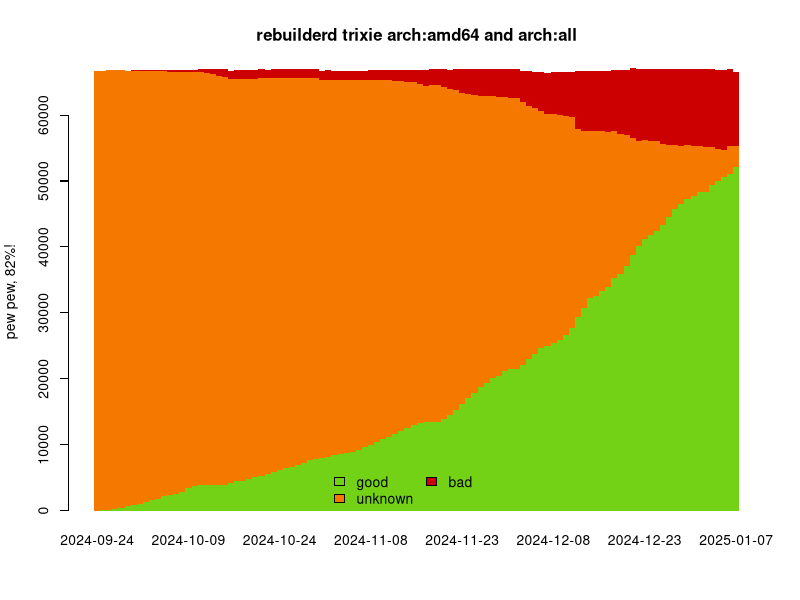
1 January 2025

Russ Allbery: 2024 Book Reading in Review

In 2024, I finished and reviewed 46 books, not counting another three books I've finished but not yet reviewed and which will therefore roll over to 2025. This is slightly fewer books than the last couple of years, but more books than 2021. Reading was particularly spotty this year, with much of the year's reading packed into late November and December. This was a year in which I figured out I was trying to do too much, but did not finish figuring out what to do about it. Reading and particularly reviewing reflected that, with long silent periods and then attempts to catch up. One of the goals for next year is to find a more sustainable balance for the hobbies in my life, including reading. My favorite books I read this year were Ashley Herring Blake's Bright Falls sapphic romance trilogy: Delilah Green Doesn't Care, Astrid Parker Doesn't Fail, and Iris Kelly Doesn't Date. These are not perfect books, but they made me laugh, made me cry, and were impossible to put down. My thanks to a video from BookTuber Georgia Marie for the recommendation. I Shall Wear Midnight was the best of the remaining Pratchett novels. It's the penultimate Tiffany Aching book and, in my opinion, the best. All of the elements of the previous books come together in snarky competence porn that was a delight to read. The best book I read last year was Mark Lawrence's The Book That Wouldn't Burn, which much to my surprise did not make a single award list for its publication year of 2023. It was a tour de force of world-building that surprised me multiple times. Unfortunately, the sequel was not as good and I fear the series may be heading in the wrong direction. I am attempting to stay hopeful about the upcoming third and concluding book. I didn't read much non-fiction this year, but the best of what I did read was Zeke Faux's Number Go Up about the cryptocurrency bubble. This book will not change anyone's mind, but it's a readable and entertaining summary of some of the more obvious cryptocurrency scams. I also had enough quibbles with it to write an extended review, which is a compliment of sorts. The Discworld read-through is done, so I may either start or return to another series re-read in 2025. I have a huge backlog of all sorts of books, though, so we will see how the year goes. As always, I have no specific numeric goals, just a hope that I can make time for regular and varied reading and maintain a rhythm with writing reviews. The full analysis includes some additional personal reading statistics, probably only of interest to me.

Next.

Previous.