Search Results: "evo"

23 February 2015

Simon Josefsson: Laptop Buying Advice?

My current Lenovo X201 laptop has been with me for over four years. I ve been looking at new laptop models over the years thinking that I should upgrade. Every time, after checking performance numbers, I ve always reached the conclusion that it is not worth it. The most performant Intel Broadwell processor is the the Core i7 5600U and it is only about 1.5 times the performance of my current Intel Core i7 620M. Meanwhile disk performance has increased more rapidly, but changing the disk on a laptop is usually simple. Two years ago I upgraded to the Samsung 840 Pro 256GB disk, and this year I swapped that for the Samsung 850 Pro 1TB, and both have been good investments. Recently my laptop usage patterns have changed slightly, and instead of carrying one laptop around, I have decided to aim for multiple semi-permanent laptops at different locations, coupled with a mobile device that right now is just my phone. The X201 will remain one of my normal work machines. What remains is to decide on a new laptop, and there begins the fun. My requirements are relatively easy to summarize. The laptop will run a GNU/Linux distribution like Debian, so it has to work well with it. I ve decided that my preferred CPU is the Intel Core i7 5600U. The screen size, keyboard and mouse is mostly irrelevant as I never work longer periods of time directly on the laptop. Even though the laptop will be semi-permanent, I know there will be times when I take it with me. Thus it has to be as lightweight as possible. If there would be significant advantages in going with a heavier laptop, I might reconsider this, but as far as I can see the only advantage with a heavier machine is bigger/better screen, keyboard (all of which I find irrelevant) and maximum memory capacity (which I would find useful, but not enough of an argument for me). The sub-1.5kg laptops with the 5600U CPU on the market that I have found are:
Lenovo X250 1.42kg 12.5 1366 768
Lenovo X1 Carbon (3rd gen) 1.44kg 14 2560 1440
Dell Latitude E7250 1.25kg 12.5 1366 768
Dell XPS 13 1.26kg 13.3 3200 1800
HP EliteBook Folio 1040 G2 1.49kg 14 1920 1080
HP EliteBook Revolve 810 G3 1.4kg 11.6 1366 768
I find it interesting that Lenovo, Dell and HP each have two models that meets my 5600U/sub-1.5kg criteria. Regarding screen, possibly there exists models with other screen resolutions. The XPS 13, HP 810 and X1 models I looked had touch screens, the others did not. As screen is not important to me, I didn t evaluate this further. I think all of them would suffice, and there are only subtle differences. All except the XPS 13 can be connected to peripherals using one cable, which I find convenient to avoid a cable mess. All of them have DisplayPort, but HP uses DisplayPort Standard and the rest uses miniDP. The E7250 and X1 have HDMI output. The X250 boosts a 15-pin VGA connector, none of the others have it I m not sure if that is a advantage or disadvantage these days. All of them have 2 USB v3.0 ports except the E7250 which has 3 ports. The HP 1040, XPS 13 and X1 Carbon do not have RJ45 Ethernet connectors, which is a significant disadvantage to me. Ironically, only the smallest one of these, the HP 810, can be memory upgraded to 12GB with the others being stuck at 8GB. HP and the E7250 supports NFC, although Debian support is not certain. The E7250 and X250 have a smartcard reader, and again, Debian support is not certain. The X1, X250 and 810 have a 3G/4G card. Right now, I m leaning towards rejecting the XPS 13, X1 and HP 1040 because of lack of RJ45 ethernet port. That leaves me with the E7250, X250 and the 810. Of these, the E7250 seems like the winner: lightest, 1 extra USB port, HDMI, NFC, SmartCard-reader. However, it has no 3G/4G-card and no memory upgrade options. Looking for compatibility problems, it seems you have to be careful to not end up with the Dell Wireless card and the E7250 appears to come in a docking and non-docking variant but I m not sure what that means. Are there other models I should consider? Other thoughts?

17 February 2015

Enrico Zini: akonadi-install

Setting up Akonadi Now that I have a CalDAV server that syncs with my phone I would like to use it from my desktop. It looks like akonadi is able to sync with CalDAV servers, so I'm giving it a try. First thing first is to give a meaning to the arbitrary name of this thing. Wikipedia says it is the oracle goddess of justice in Ghana. That still does not hint at all at personal information servers, but seems quite nice. Ok. I gave up with software having purpose-related names ages ago.
# apt-get install akonadi-server akonadi-backend-postgresql
Akonadi wants a SQL database as a backend. By default it uses MySQL, but I had enough of MySQL ages ago. I tried SQLite but the performance with it is terrible. Terrible as in, it takes 2 minutes between adding a calendar entry and having it show up in the calendar. I'm fascinated by how Akonadi manages to use SQLite so badly, but since I currently just want to get a job done, next in line is PostgreSQL:
# su - postgres
$ createuser enrico
$ psql postgres
postgres=# alter user enrico createdb;
Then as enrico:
$ createdb akonadi-enrico
$ cat <<EOT > ~/.config/akonadi/akonadiserverrc
[%General]
Driver=QPSQL
[QPSQL]
Name=akonadi-enrico
StartServer=false
Host=
Options=
ServerPath=
InitDbPath=
I can now use kontact to connect Akonadi to my CalDAV server and it works nicely, both with calendar and with addressbook entries. KDE has at least two clients for Akonadi: Kontact, which is a kitchen sink application similar to Evolution, and KOrganizer, which is just the calendar and scheduling component of Kontact. Both work decently, and KOrganizer has a pretty decent startup time. I now have a usable desktop PIM application that is synced with my phone. W00T! Next step is to port my swift little calendar display tool to use Akonadi as a back-end.

16 February 2015

Vincent Sanders: To a child, often the box a toy came in is more appealing than the toy itself.

I think Allen Klein might not have been referring to me when he said that but I do seem to like creating boxes for my toys.

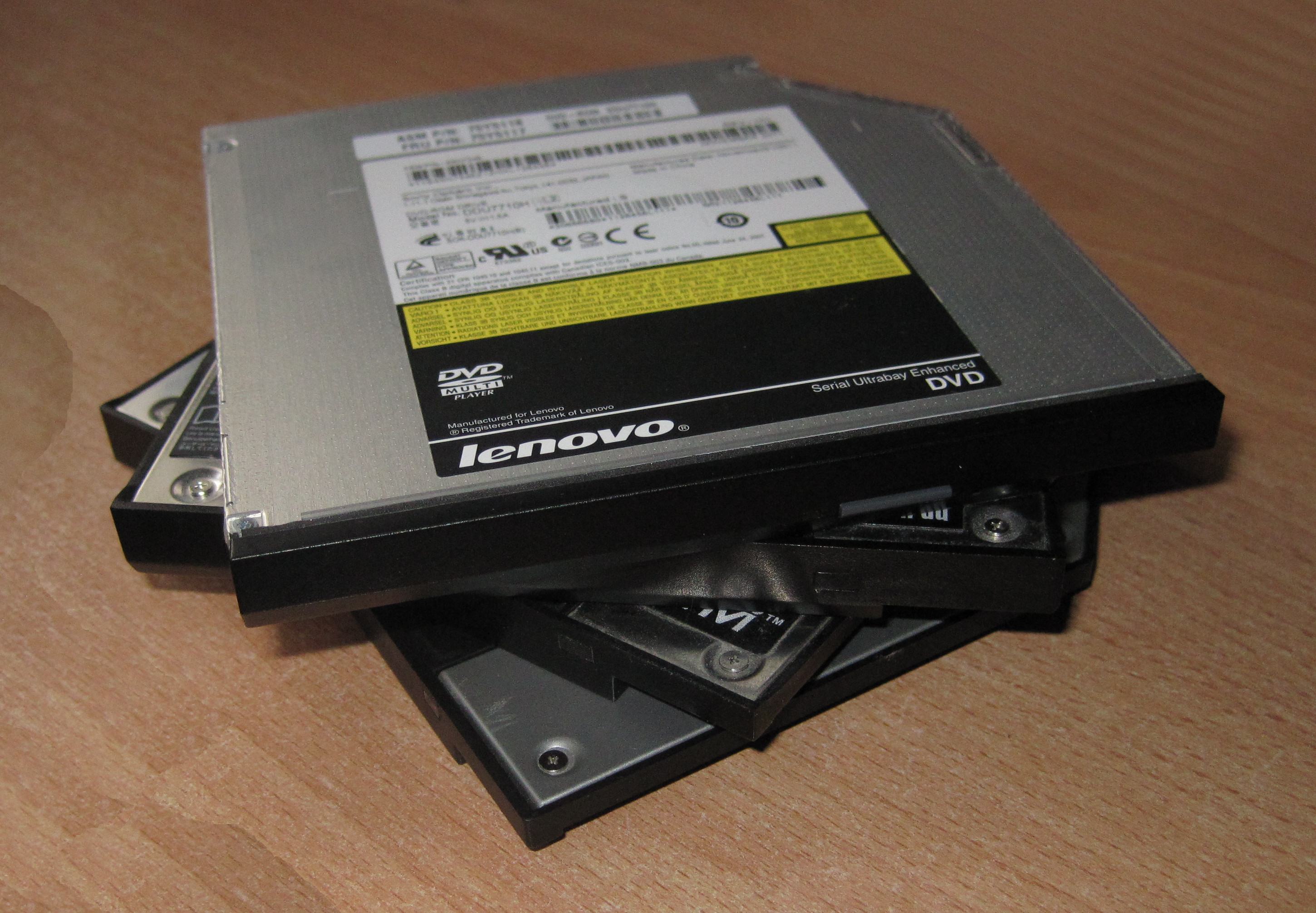
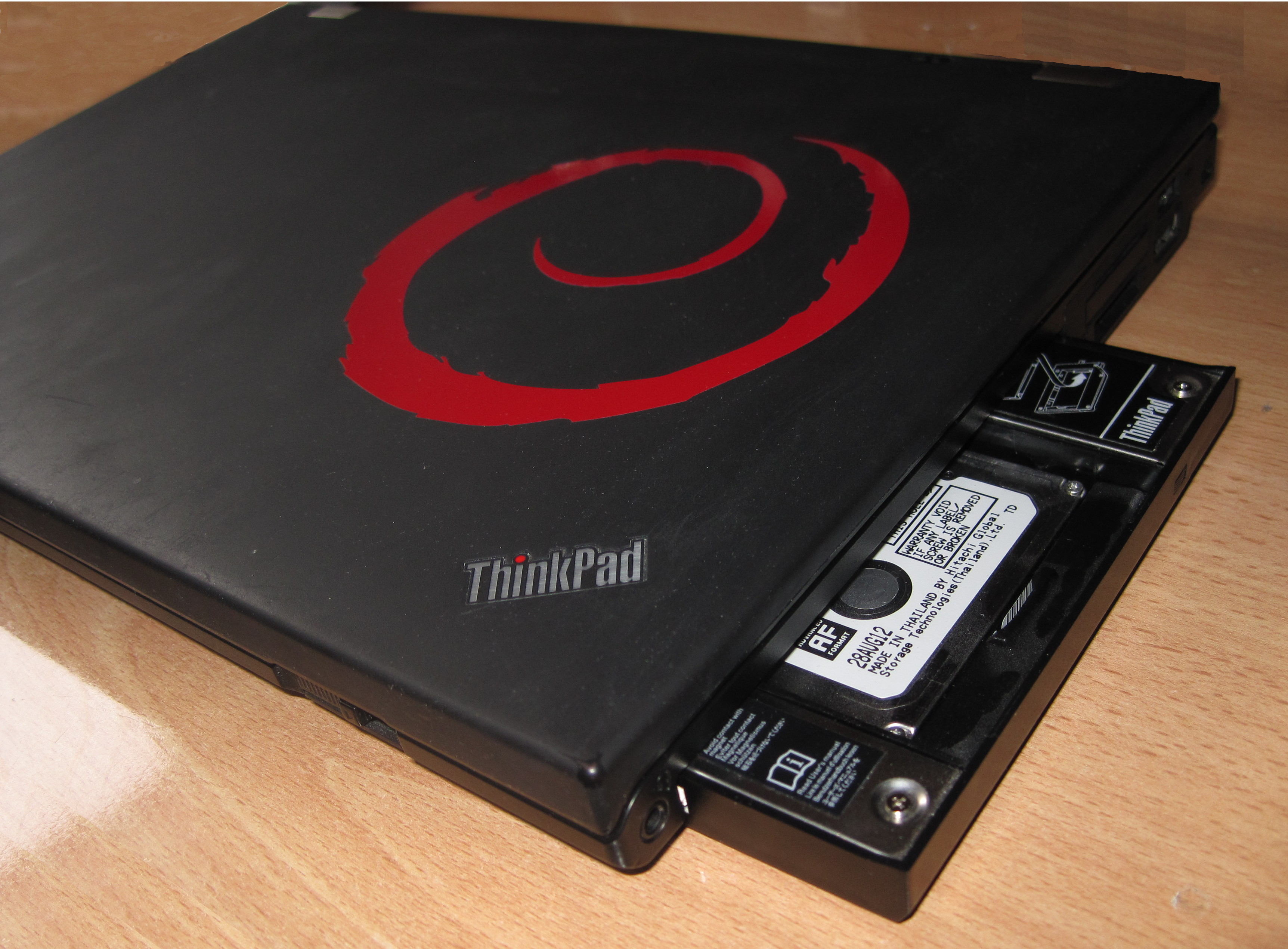
Lenovo laptop with ultrabay ejected
My Lenovo laptop has an Ultrabay, these are a way to easily swap optical and hard drives drives. They allow me to carry around additional storage and, providing I remembered to pack the drive, access optical media.
Over time I have acquired several additional hard drives housed in Ultrabay caddies. Generally I only need to access one at a time but increasingly I want to have more than one available.

Lenovo used to sell docking stations with multiple Ultrabays but since Series 3 was introduced this is no longer the case as the docks have been reduced to port replicators.

One solution is to buy a SATA to USB convertor which lets you use the drive externally. However once you have more than one drive this becomes somewhat untidy, not to mention all those unhoused drives on your desk become something of a hazard.

Recently after another close call I decided what I needed was a proper external enclosure to house all my drives. After some extensive googling I found nothing suitable ready to buy. Most normal people would give up at this point, I appear to be an abnormal person so I got the CAD package out.

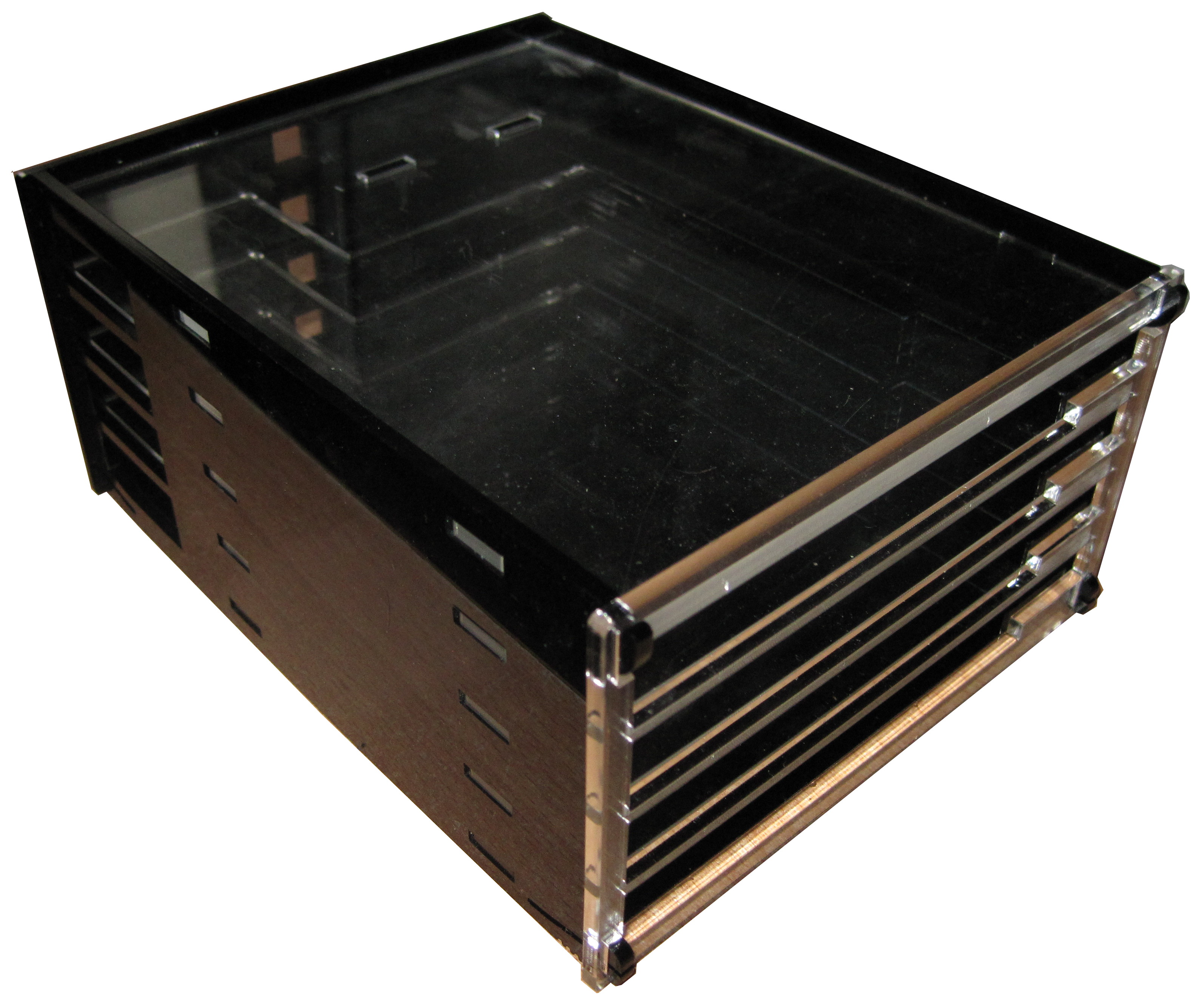
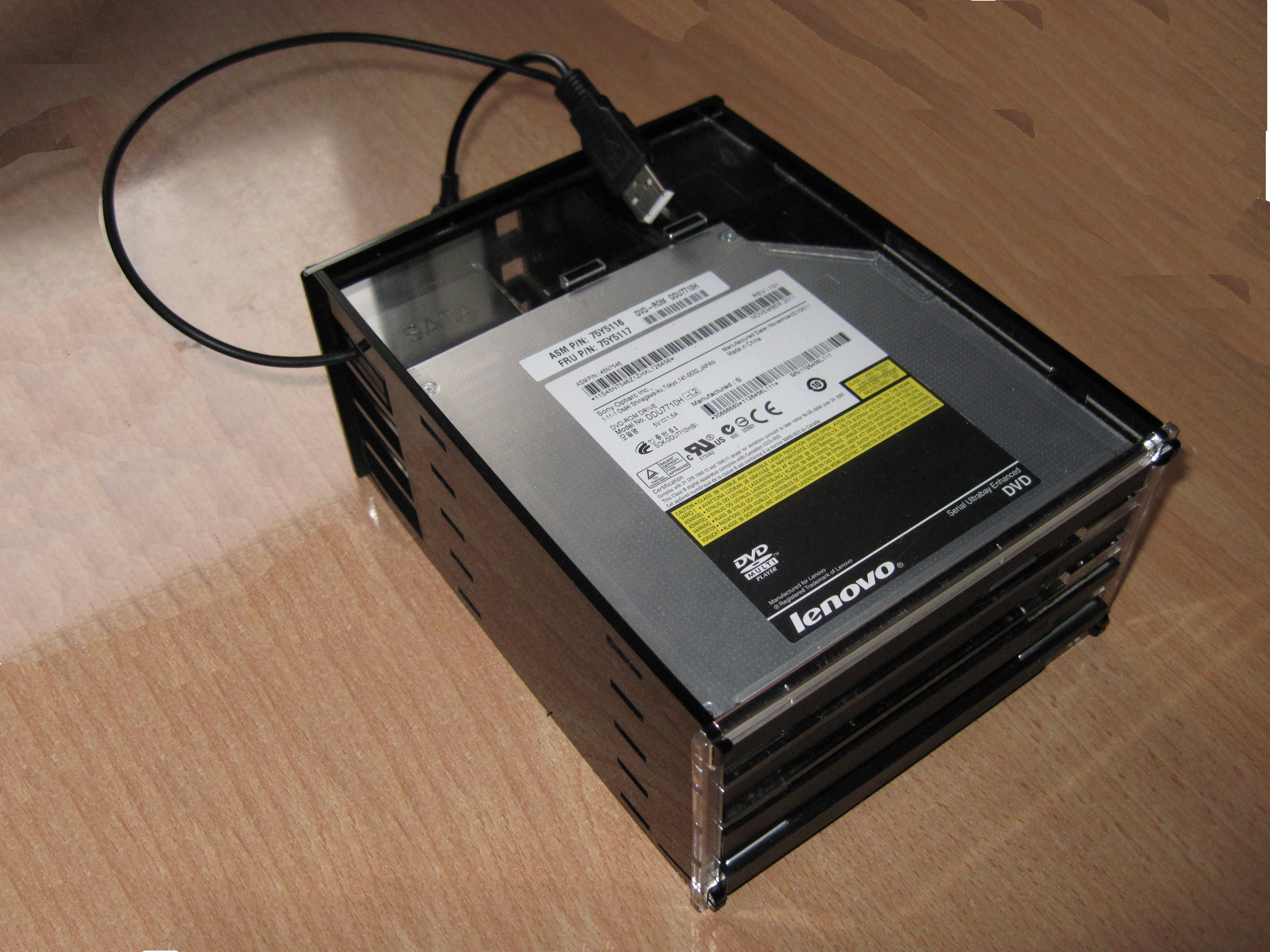
A few hours of design and a load of laser cutting later I came up with a four bay enclosure that now houses all my Ultrabay caddies.

The design was slightly evolved to accommodate the features of some older caddies and allow a pencil to be used to eject the drives (I put a square hole in the back)

The completed unit uses about 10 of plastic and takes 30 minutes to lasercut.

The only issue with the enclosure as manufactured is that Makespace ran out of black plastic stock and I had to use transparent to finish so it is not in classic black as lenovo intended.

As usual all the design files are publicly available from my design repo.

15 February 2015

Antonio Terceiro: rmail: reviving upstream maintaince

It is always fun to write new stuff, and be able to show off that shiny new piece of code that just come out of your brilliance and/or restless effort. But the world does not spin based just on shiny things; for free software to continue making the world work, we also need the dusty, and maybe and little rusty, things that keep our systems together. Someone needs to make sure the rust does not take over, and that these venerable but useful pieces of code keep it together as the ecosystem around them evolves. As you know, Someone is probably the busiest person there is, so often you will have to take Someone s job for yourself. rmail is a Ruby library able to parse, modify, and generate MIME mail messages. While handling transitions of Ruby interpreters in Debian, it was one of the packages we always had to fix for new Ruby versions, to the point where the Debian package has accumulated quite a few patches. The situation became ridiculous. It was considered to maybe drop it from the Debian archive, but dropping it would mean either also dropping feed2imap and sup or porting both to other mail library. Since doing this type of port is always painful, I decided instead to do something about the sorry state in which rmail was on the upstream side. The reasons why it was not properly maintained upstream does not matter: people lose interest, move on to other projects, are not active users anymore; that is normal in free software projects, and instead of blaming upstream maintainers in any way we need to thank them for writing us free software in the first place, and step up to fix the stuff we use. I got in touch with the people listed as owner for the package on rubygems.org, and got owner permission, which means I can now publish new versions myself. With that, I cloned the repository where the original author had imported the latest code uploaded to rubygems and had started to receive contributions, but that repository was inactive for more than one year. It had already got some contributions from the sup developers which never made it in a new rmail release, so the sup people started using their own fork called rmail-sup . Already in my repository, I have imported all the patches that still made sense from the Debian repository, did a bunch of updates, mainly to modernize the build system, and did a 1.1.0 release to rubygems.org. This release is pretty much compatible with 1.0.0, but since I did not test it with Ruby versions older than than one in my work laptop (2.1.5), I bumped the minor version number as warning to prospective users still on older Ruby versions. In this release, the test suite passes 100% clean, what always gives my mind a lot of comfort:

$ rake
/usr/bin/ruby2.1 -I"lib:." -I"/usr/lib/ruby/vendor_ruby" "/usr/lib/ruby/vendor_ruby/rake/rake_test_loader.rb" "test/test*.rb"
Loaded suite /usr/lib/ruby/vendor_ruby/rake/rake_test_loader
Started
...............................................................................
...............................................................................
........
Finished in 2.096916712 seconds.
166 tests, 24213 assertions, 0 failures, 0 errors, 0 pendings, 0 omissions, 0 notifications
100% passed
79.16 tests/s, 11546.95 assertions/s

And in the new release I have just uploaded to the Debian experimental suite (1.1.0-1), I was able to drop all of the patches and just use the upstream source as is. So that s it: if you use rmail for anything, consider testing version 1.1.0-1 from Debian experimental, or 1.1.0 from rubygems.org if you into that, and report any bugs to the [github repository](https://github.com/terceiro/rmail). My only commitment for now is keep it working, but if you want to add new features I will definitively review and merge them.

12 February 2015

Rapha&#235;l Hertzog: Freexian s report about Debian Long Term Support, January 2015

Like each month, here comes a report about the work of paid contributors to Debian LTS. Individual reports In January, 48 work hours have been equally split among 4 paid contributors. Their reports are available: Evolution of the situation During the last month, the number of paid work hours has made a noticeable jump: we re now at 58 hours per month. At this rate, we would need 3 more months to reach our minimal goal of funding the equivalent of a half-time position. Unfortunately, the number of new sponsors actually in the process is not likely to be enough to have a similar raise next month. So, as usual, we are looking for more sponsors. In terms of security updates waiting to be handled, the situation looks a bit worse than last month: the dla-needed.txt file lists 37 packages awaiting an update (7 more than last month), the list of open vulnerabilities in Squeeze shows about 63 affected packages in total (7 more than last month). The increase is not too worrying, but the waiting time before an issue is dealt with is sometimes more problematic. To be able to deal with all incoming issues in a timely manner, the LTS team needs more resources: some months will have more issues than usual, some issues will be longer to handle than others, etc. Thanks to our sponsors The new sponsors of the month are in bold.

No comment Liked this article? Click here. My blog is Flattr-enabled.

6 February 2015

Daniel Pocock: Lumicall's 3rd Birthday

Today, 6 February, is the third birthday of the Lumicall app for secure SIP on Android. Happy birthday Lumicall's 1.0 tag was created in the Git repository on this day in 2012. It was released to the Google Play store, known as the Android Market back then, while I was in Brussels, the day after FOSDEM. Since then, Lumicall has also become available through the F-Droid free software marketplace for Android and this is the recommended way to download it. An international effort Most of the work on Lumicall itself has taken place in Switzerland. Many of the building blocks come from Switzerland's neighbours:
  • The ice4j ICE/STUN/TURN implementation comes from the amazing Jitsi softphone, which is developed in France.
  • The ZORG open source ZRTP stack comes from PrivateWave in Italy
  • Lumicall itself is based on the Sipdroid project that has a German influence, while Sipdroid is based on MjSIP which comes out of Italy.
  • The ENUM dialing logic uses code from ENUMdroid, published by Nominet in the UK. The UK is not exactly a neighbour of Switzerland but there is a tremendous connection between the two countries.
  • Google's libPhoneNumber has been developed by the Google team in Zurich and helps Lumicall format phone numbers for dialing through international VoIP gateways and ENUM.
Lumicall also uses the reSIProcate project for server-side infrastructure. The repro SIP proxy and TURN server run on secure and reliable Debian servers in a leading Swiss data center. An interesting three years for free communications Free communications is not just about avoiding excessive charges for phone calls. Free communications is about freedom. In the three years Lumicall has been promoting freedom, the issue of communications privacy has grabbed more headlines than I could have ever imagined. On 5 June 2013 I published a blog about the Gold Standard in Free Communications Technology. Just hours later a leading British newspaper, The Guardian, published damning revelations about the US Government spying on its own citizens. Within a week, Edward Snowden was a household name. Google's Eric Schmidt had previously told us that "If you have something that you don't want anyone to know, maybe you shouldn't be doing it in the first place.". This statement is easily debunked: as CEO of a corporation listed on a public stock exchange, Schmidt and his senior executives are under an obligation to protect commercially sensitive information that could be used for crimes such as insider trading. There is no guarantee that Lumicall will keep the most determined NSA agent out of your phone but nonetheless using a free and open source application for communications does help to avoid the defacto leakage of your conversations to a plethora of marketing and profiling companies that occurs when using a regular phone service or messaging app. How you can help free communications technology evolve As I mentioned in my previous blog on Lumicall, the best way you can help Lumicall is by helping the F-Droid team. F-Droid provides a wonderful platform for distributing free software for Android and my own life really wouldn't be the same without it. It is a privilege for Lumicall to be featured in the F-Droid eco-system. That said, if you try Lumicall and it doesn't work for you, please feel free to send details from the Android logs through the Lumicall issue tracker on Github and they will be looked at. It is impossible for Lumicall developers to test every possible phone but where errors are obvious in the logs some attempt can be made to fix them. Beyond regular SIP Another thing that has emerged in the three years since Lumicall was launched is WebRTC, browser based real-time communications and VoIP. In its present form, WebRTC provides tremendous opportunities on the desktop but it does not displace the need for dedicated VoIP apps on mobile handsets. WebRTC applications using JavaScript are a demanding solution that don't integrate as seamlessly with the Android UI as a native app and they currently tend to be more intensive users of the battery. Lumicall users can receive calls from desktop users with a WebRTC browser using the free calling from browser to mobile feature on the Lumicall web site. This service is powered by JSCommunicator and DruCall for Drupal.

30 January 2015

Manuel A. Fernandez Montecelo: Hallo, Planet Debian!

Hi! I just created this blog and asked to get it aggregated to the Debian Planet, so first things first -- in the initial post I wanted to say Hallooooo! to the people in the community and to talk about my work and interests in Debian. Probably most of you never interacted with or even heard of me before. I am contributor/Maintainer since ~2010 and Developer only for ~2 years, and most of the things that I worked in or packages that I maintain are "low profile" or unintrusive, except perhaps for work in aptitude and SDL libraries, if you happen to be interested in these packages or others that I [co-]maintain. More recently, during 2014, I was helping to bootstrap and bring to life a new architecture, OpenRISC or1k. Perhaps I should devote a future post to explain a bit more about the history, status and news --or, lately, lack thereof-- about this port. This is one of the main reasons why I thought that it would be useful to have a blog -- to register activities for which it is difficult to get information by other means. Apart from or1k, as it often happens with porting efforts in Debian, the work done also helped indirectly other architectures added last year (mips64el, arm64, ppc64el). Additionally, a few of my NMUs were directly targetted to help ppc64el to get ready in time for the architecture evaluation. None of the porters working in ppc64el were Debian Maintainers/Developers and some of the patches that they created did not benefit directly the other ports, so in the packages without active maintainers, the requests were not getting much attention in the crucial time before the evaluation. In some cases, these packages were in the critical path to build many other packages or support important user-case scenarios. So I was very pleased when I learnt that arm64 and ppc64el will be in the next stable release --Jessie-- as officially supported architectures. They came without much noise or ceremonious celebrations, but I think that this is a great success story for these architectures and for Debian, and even for the computing world in general. Time will tell. In the meantime, congratulations to all people involved! In addition to porting packages within Debian, I also sent some patches upstream to get the packages that I maintain compiling in the new architectures, and sent upstream patches needed to support or1k specifically (jemalloc, nspr, libgc, cmake, components of X.org...). Enough for the first post. Just to finish, let me say that after about a decade without a personal website or blog (the previous ones not about Debian or even computing), here I am again. Let's see how it goes and I hope to have enough interesting things to tell you to keep the blog alive. Or, in other words... To infinity and beyond!

18 January 2015

EvolvisForge blog: Debian/m68k hacking weekend cleanup

OK, time to clean up tarent so people can work again tomorrow. Not much to clean though (the participants were nice and cleaned up after themselves ), so it s mostly putting stuff back to where it belongs. Oh, and drinking more of the cool Belgian beer Geert (Linux upstream) brought We were productive, reporting and fixing kernel bugs, fixing hardware, swapping and partitioning discs, upgrading software, getting buildds (mostly Amiga) back to work, trying X11 (kdrive) on a bare metal Atari Falcon (and finding a window manager that works with it), etc. I hope someone else writes a report; for now we have a photo and a screenshot (made with trusty xwd). Watch the debian-68k mailing list archives for things to come. I think that, issues with electric cars aside, everyone liked the food places too ;-)

16 January 2015

EvolvisForge blog: Debian/m68k hacking weekend commencing soonish

As I said, I did not certain events that begun with lea and end with ing prevent me from organising a Debian/m68k hack weekend. Well, that weekend is now. I m too unorganised, and I spent too much time in the last few evenings to organise things so I built up a sleep deficit already and the feedback was slow. (But so are the computers.) And someone I d have loved to come was hurt and can t come. On the plus side, several people I ve long wanted to meet IRL are coming, either already today or tomorrow. I hope we all will have a lot of fun. Legal disclaimer: Debian/m68k is a port of Debian to m68k. It used to be official, but now isn t. It belongs to debian-ports.org, which may run on DSA hardware, but is not acknowledged by Debian at large, unfortunately. Debian is a registered trademark owned by Software in the Public Interest, Inc.

Rapha&#235;l Hertzog: Freexian s fifth report about Debian Long Term Support

Like each month, here comes a report about the work of paid contributors to Debian LTS. Individual reports In December 46 work hours have been equally split among 4 paid contributors (note that Thorsten and Rapha l have actually spent more hours because they took over some hours that Holger did not do over the former months). Their reports are available: Evolution of the situation Compared to last month, the number of paid work hours has almost not increased (we are at 48 hours per month). We still have a couple of new sponsors in the pipe but with the new year they did not complete the process yet. Hopefully next month will see a noticeable increase. As usual, we are looking for more sponsors to reach our our minimal goal of funding the equivalent of a half-time position. Those of you who are struggling to spend money in the last quarter due to budget overrun, now is a good time to see if you want to include Debian LTS support in your 2015 budget! In terms of security updates waiting to be handled, the situation looks similar to last month: the dla-needed.txt file lists 30 packages awaiting an update (3 more than last month), the list of open vulnerabilities in Squeeze shows about 56 affected packages in total. We do not manage to clear the backlog but it s not getting significantly worse either. Thanks to our sponsors

No comment Liked this article? Click here. My blog is Flattr-enabled.

9 January 2015

Chris Lamb: Uploading a large number of files to Amazon S3

I recently had to upload a large number (~1 million) of files to Amazon S3. My first attempts revolved around s3cmd (and subsequently s4cmd) but both projects seem to based around analysing all the files first rather than blindly uploading them. This not only requires a large amount of memory, non-trivial experimentation, fiddling and patching is also needed to avoid unnecessary stat(2) calls. I even tried a simple find xargs -P 5 s3cmd put [..] but I just didn't trust the error handling correctly. I finally alighted on s3-parallel-put, which worked out well. Here's a brief rundown on how to use it:
  1. First, change to your source directory. This is to ensure that the filenames created in your S3 bucket are not prefixed with the directory structure of your local filesystem whilst s3-parallel-put has a --prefix option, it is ignored if you pass a fully-qualified source, ie. one starting with a /.
  2. Run with --dry-run --limit=1 and check that the resulting filenames will be correct after all:
$ export AWS_ACCESS_KEY_ID=FIXME
$ export AWS_SECRET_ACCESS_KEY=FIXME
$ /path/to/bin/s3-parallel-put \
    --bucket=my-bucket \
    --host=s3.amazonaws.com \
    --put=stupid \
    --insecure \
    --dry-run --limit=1 \
    .
[..]
INFO:s3-parallel-put[putter-21714]:./yadt/profile.Profile/image/circle/807.jpeg -> yadt/profile.Profile/image/circle/807.jpeg
[..]
  1. Remove --dry-run --limit=1, and let it roll.

6 January 2015

Steve McIntyre: Bootstrapping arm64 in Debian

I promised to write about this a long time, ooops... :-) Another ARM port in Debian - yay! arm64 is officially a release architecture for Jessie, aka Debian version 8. That's taken a lot of manual porting and development effort over the last couple of years, and it's also taken a lot of CPU time - there are ~21,000 source packages in Debian Jessie! As is often the case for a brand new architecture like arm64 (or AArch64, to use ARM's own terminology), hardware can be really difficult to get hold of. In time this will cease to be an issue as hardware becomes more commoditised, but in Debian we really struggled to get hold of equipment for a very long time during the early part of the port. First bring-up in Debian Ports To start with, we could use ARM's own AArch64 software models to build the first few packages. This worked, but only very slowly. Then Chen Baozi and the folks running the Tianhe-2 supercomputer project in Guangzhou, China contacted us to offer access to some arm64 hardware, and this is what Wookey used for bootstrapping the new port in the unofficial Debian Ports archive. This has now become the normal way for new architectures to get into Debian. We got most of the archive built in debian-ports this way, and we could then use those results to seed the initial core set of packages in the main Debian archive. Second bring-up - moving into the main Debian archive By the time that first Debian bring-up was done, ARM was starting to produce its own "Juno" development boards, and with the help of my boss^4 James McNiven we managed to acquire a couple of those machines for use as official Debian build machines. The existing machines in China were faster, but for various reasons quite difficult to maintain as official Debian machines. So I set up the Junos as buildds just before going to DebConf in August 2014. They ran very well, and (for dev boards!) were very fast and stable. They built a large chunk of the Debian archive, but as the release freeze for Jessie grew close we weren't quite there. There was a small but persistent backlog of un-built packages that were causing us issues, plus the Juno machines are/were not quite suitable as porter boxes for Debian developers all over the world to use for debugging their packages on the new architecture. More horsepower - Linaro machines This is where Linaro came to our aid. Linaro's goal is to help improve Free and Open Source Software on ARM, and one of the more recent projects in Linaro is a cluster of servers that are made available for software developers to use to get early access to ARMv8 (arm64) hardware. It's a great way for people who are interested in this new architecture to try things out, port their software or indeed just help with the general porting effort. As Debian is seen as such an important part of the FLOSS ecosystem, we managed to negotiate dedicated access to three of the machines in that cluster for Debian's use and we set those up in October, shortly before the freeze for Jessie. Andy Doan spent a lot of his time getting these machines going for us, and then I set up two of them as build machines and one as the porter box we were still needing. With these extra machines available, we quickly caught up with the ever-busy "Needs-Build" queue and we've got sufficient build power now to keep things going for the Jessie release. We were officially added to the list of release architectures at the Cambridge mini-Debconf in November, and all is looking good now! And in the future? I've organised the loan of another arm64 machine from AMD for Debian to use for further porting and/or building. We're also expecting that more and more machines will be coming out soon as vendors move on from prototyping to producing real customer equipment. Once that's happened, more kit will be available and everybody will be able to have arm64-powered computers in the server room, on their desk and even inside their laptop! Mine will be running Debian Jessie... :-) Thanks! There's been a lot of people involved in the Debian arm64 bootstrapping at various stages, so many that I couldn't possibly credit them all! I'll highlight some, though. :-) First of all, Wookey's life has revolved around this port for the last few years, tirelessly porting, fixing and hacking out package builds to get us going. We've had loads of help from other teams in Debian, particularly the massive patience of the DSA folks with getting early machines up and running and the prodding of the ftpmaster, buildd and release teams when we've been grinding our way through ever more package builds and dependency loops. We've also had really good support from toolchain folks in Debian and ARM, fixing bugs as we've found them by stressing new code and new machines. We've had a number of other people helping by filing bugs and posting patches to help us get things built and working. And (last but not least!) thanks to all the folks who've helped us beg and borrow the hardware to make the Debian arm64 port a reality. Rumours of even more ARM ports coming soon are entirely scurrilous... *grin*

5 January 2015

EvolvisForge blog: Tip of the day: prevent iceweasel from mkdir ~/Desktop

If you re a Unix person instead of e.g. a Microsoft Windows person, you ve probably been annoyed by Iceweasel (or Mozilla Firefox ) creating a ~/Desktop directory, among others (things like ~/Downloads). Here s a quick fix I found somewhere in the net:
mkdir -p -m0700 ~/.config
cat >~/.config/user-dirs.dirs <<'EOF'
XDG_DESKTOP_DIR="$HOME/"
XDG_DOCUMENTS_DIR="$HOME/"
XDG_DOWNLOAD_DIR="$HOME/"
XDG_MUSIC_DIR="$HOME/"
XDG_PICTURES_DIR="$HOME/"
XDG_PUBLICSHARE_DIR="$HOME/"
XDG_TEMPLATES_DIR="$HOME/"
XDG_VIDEOS_DIR="$HOME/"
EOF
Upon next start, Iceweasel (and other XDG-compliant applications) will throw stuff into ~/ instead.

1 January 2015

Russ Allbery: Review: Three Parts Dead

Review: Three Parts Dead, by Max Gladstone
Series: Craft #1
Publisher: Tor
Copyright: October 2012
ISBN: 1-4668-0203-0
Format: Kindle
Pages: 336
Tara Abernathy was a student in the Hidden Schools, learning Craft, until she was expelled. Literally expelled: thrown from the floating schools to crash painfully to earth in the Badlands, left to return to her family and village and a life of small workings of Craft and contracts on behalf of local farmers. She had largely resigned herself to that life until raiders started killing people. Tara is not the sort of person who could stand by and watch that, or someone to refrain from using Craft to fix the world. The result was undead guardians for the town, perhaps unwisely formed from the town's risen dead, and only a job offer saves Tara from the ungrateful attention of her neighbors. That's how Tara finds herself employed by the firm of Kelethras, Albrecht, and Ao, in the person of partner Elayne Kevarian. Provisionally, depending on her performance on their job: the investigation of the death of a god. It's possible to call Three Parts Dead urban fantasy if you squint at it the right way. It is fantasy that takes place largely in cities, it features the investigation of a crime (and, before long, several crimes), and Tara's attitude is reminscent of an urban fantasy heroine. But this is considerably different from the normal fare of supernatural creatures. In this world, magic, called Craft, is an occupation that requires a great deal of precision and careful construction. Small workings are described similar to magic, although with an emphasis on metaphor. Larger workings more often come in the form of energy flows, contracts, and careful hedging, and the large Craft firms bear more resemblence to mergers and acquisitions specialists than to schools of wizards. This means that the murder investigation of the god of Alt Coulumb involves a compelling mix of danger, magic, highly unusual library investigations, forensic accounting, hidden Craft machinery, unexpected political alliances, and an inhuman police force. Rather than the typical urban fantasy approach of being beaten up until the resolution of the mystery becomes obvious, Tara and her companions do quite a lot of footwork and uncover a more complex political situation than they were expecting. And, in keeping with this take on magic, the story culminates in a courtroom drama (of a sort). I really enjoyed this. It combines the stylistic elements of urban fantasy that I like with some complex and original world-building and a great take on magical contracts. I prefer worlds like this one, where any source of power people have lived with for a long time is surrounded by the controls, formal analysis, and politics that humans create around anything of value. Tara is also a great protagonist. This is a coming of age story in a sense, and Tara is sometimes unsure of her abilities, but it's refreshingly devoid of worry or angst over new-found abilities. Tara enjoys her work, and approaches it with a well-written mix of uncertainty, impulsiveness, and self-confidence (sometimes warranted, sometimes not). I've read some good stories where the protagonist gets dragged into the story against their will, and some of them are quite good, but it's refreshing to read a book about someone who takes to the story like a duck to water. This is a believable protrayal of a character with a lot of native ability and intelligence, not much wisdom (yet), but a lot of thoughtful enthusiasm. I was disappointed to learn that she isn't the protagonist of the next book in the series. The biggest flaw I found in this book is that Gladstone doesn't stick reliably to his world conception. At times, Craft collapses into something more like typical fantasy magical battles, instead of legal procedure and contract made concrete. I suppose this makes parts of the book more exciting, but I would have preferred a plot resolution that involved less combat and more argument. This isn't helped by the utterly hissable villain. There's a lot of complexity in understanding what happened and who was going to benefit (and how), but there is absolutely no doubt who the enemy is, and he's essentially without redeeming qualities. I would have preferred more nuance, given how satisfyingly complex the rest of the world-building is. Three Parts Dead also occasionally suffers from the typical first novel problem of being a bit overstuffed. The world-building comes fast and thick, and nearly everything Tara does involves introducing new concepts. But the world does have a coherent history, and quite a lot of it. It used to be a more typical fantasy world ruled by gods, each with their own territory and worshippers (and Alt Coulumb is a throwback to this era), but an epic war between gods and Craft is in Tara's past, leading to the defeat or destruction of many of the gods. She lives in a time of uneasy truce between human and inhuman powers, featuring some very complex political and economic alliances. There's a lot of material here for an ongoing series. This is a great first novel. It's not without its flaws, but I enjoyed it from beginning to end, and will definitely keep reading the series. Recommended. Followed by Two Serpents Rise. Rating: 8 out of 10

28 December 2014

Russ Allbery: Review: Some Remarks

Review: Some Remarks, by Neal Stephenson
Publisher: William Morrow
Copyright: June 2013
ISBN: 0-06-202444-2
Format: Trade paperback
Pages: 336
This is going to be another weird review, since I read this essay collection about three months ago, and I borrowed it from a friend. So this is both from fading memory and without a handy reference other than Internet searches. Apologies in advance for any important details that I miss. The advantage is that you'll see what parts of this collection stuck in my memory. Some Remarks is, as you might guess from the title, a rather random collection of material. There's one long essay that for me was the heart of the book (more on that in a moment), two other longer essays, two short stories, and thirteen other bits of miscellaneous writing of varying lengths. I found most of the short essays unremarkable. Stephenson uses a walking desk because sitting is bad for you that sentence contains basically all of the interesting content of one of the essays. I think it takes a large topic and some running room before Stephenson can get up to speed and produce something that's more satisfying than technological boosterism. That means the most interesting parts of this book are the three longer works. "In the Kingdom of Mao Bell" was previously published in Wired and is still available. Some Remarks contains only excerpts; Stephenson says that some of the original essay is no longer that interesting. I had mixed feelings about this one. Some of the sense of place he creates was fun to read, but Stephenson can't seem to quite believe that the Chinese don't care about "freedom" according to his definitions in the same way and therefore don't have the same political reaction to hacker culture that he does. This could have been an opportunity for him to question assumptions, but instead it's mostly an exercise in dubious, sweeping cultural evaluation, such as "the country has a long history of coming up with technologies before anyone else and then not doing a lot with them." A reminder that the detail with which Stephenson crams his writing is not always... true. Stronger is "Atoms of Cognition: Metaphysics in the Royal Society 1715 2010," which covers material familiar to readers of Stephenson's Baroque Cycle. The story of Newton, Leibniz, their rivalry, and the competing approaches to thinking about mathematics and science was my favorite part of that series, and in some ways the non-fiction treatment is better than the fictional one. If you liked the Baroque Cycle, this is worth reading. But the highlight of the book for me was "Mother Earth Mother Board." This is a long essay (50,000 words, practically a small book and the largest part of this collection) about the laying of undersea fiber-optic cables. Those who have read Cryptonomicon will recognize some of the themes here, but there's way more to this essay than there was to the bits about undersea cables in Cryptonomicon. It's mostly about technology, rather than people, which puts Stephenson on firmer ground. The bit about people reads more like a travelogue, full of Stephenson's whole-hearted admiration of people who build things and make things work. There's a bit of politics, a bit of history, a bit of tourism, and a lot of neat trivia about a part of the technological world that I'd not known much about before. I would say this is worth the price of the collection, but it too was previously published in Wired, so you can just read it online. Those reading this review on my web site will notice that I filed it in non-fiction. There are a couple of stories, but they're entirely forgettable (in fact, I had entirely forgotten them, and had to skim them again). But, for the record, here are short reviews of those: "Spew": This originally appeared in Wired and can still be read on-line. The protagonist takes a job as a sort of Internet marketing inspector who looks for deviations from expected profiles. While tracing down an anomaly, though, he finds another use of the Internet that's outside of the marketing framework he's using. It's unlikely that anyone who's been online for long will find much new in this story. Some of that is because it was originally published in 1994, but most of it is just that this isn't a very good story. Stephenson seems to have turned up his normal manic infodump to 11 to satisfy the early Wired aesthetic, and the result is a train wreck of jargon, bad slang, and superficial social observation. (3) "The Great Simoleon Caper": Originally published in TIME, this story too is still available online. It's primarily interesting because it's a story about Bitcoin (basically), written in 1995. And it's irritating for exactly the same reason that Bitcoin enthusiasm often tends to be irritating: the assumption that cryptocurrency is somehow a revolutionary attack on government-run currency systems. I'm not going to get into the ways in which this doesn't make sense given how money is used socially (David Graeber's Debt is the book to read if you want more information); just know that the story follows that path and doesn't engage with any of the social reasons why that outcome is highly unlikely. Indeed, the lengths to which the government tries to go to discredit cryptocurrency in this story are rather silly. Apart from that, this is typical early Stephenson writing. It's very in love with ideas, not as much with characterization, and consists mostly of people explaining things to each other. Sometimes this is fun, but when focused on topics about which considerably more information has become available, it doesn't age very well. (5) Overall, there was one great essay and a few interesting bits, but I wouldn't have felt I was missing much if I'd never read this collection. I borrowed Some Remarks from a friend, and I think that's about the right level of effort. If it falls into your hands, or you see it in a library, some of the essays, particularly "Mother Earth Mother Board," are worth reading, but given that the best parts are available on-line for free, I don't think it's worth a purchase. Rating: 6 out of 10
23 December 2014

Russ Allbery: Review: Wakulla Springs

Review: Wakulla Springs, by Andy Duncan & Ellen Klages
Publisher: Tor
Copyright: October, 2013
ASIN: B00EWZDPH4
Format: Kindle
Pages: 99
This is another nominee for the 2014 Hugo Awards (for works published in 2013), this time in the novella category. In this case, though, I read the free ebook version from Tor (Macmillan) rather than the version from the voter packet, since I usually grab all the free ebooks of Tor.com stories. (Even if I'm quite behind in reading them, since I don't read much short fiction.) As an independently-published novella, it gets its own review in the book category. Wakulla Springs is the story of three generations (and four protagonists) who lived near or visited Wakulla Springs in the Florida panhandle. This is a real place: a huge freshwater springs and underwater cave system, now protected as a national park. Two of the four episodes in this story revolve around the filming of movies: a Tarzan movie and Creature from the Black Lagoon. This actually happened as well, although of course the story takes liberties with the details. This is also the story of race relations in the American deep south: the tense and uncertain interactions between black locals and rich white people, both locals and people from the film industry who came for a brief time and then left again. It's also a story about water, swimming, and the sense of being part of the water and knowing it well. This story doesn't develop any particular point; rather, it's more of a collection of character sketches, grabbing moments in time, glimpsing what it's like to cross racial barriers and to feel at home with one's choices. It's also, in a nicely subtle way, about encountering mythical creatures that are not part of one's world. To the locals, the film stars who visit Wakulla Springs are as wild and strange as the imagined creatures of the swamp, and in their way even more foreign. What this is not, though, is science fiction, or even fantasy. One of the complaints I'd heard about Wakulla Springs in the context of the Hugos was that it didn't qualify as a genre story. I'm usually inclined to dismiss these sorts of complaints, since they're often put forth by people with a far narrower definition of genre than mine. But, having read this story, I have to concur. It's very well-written and engaging, but it's not genre in any sense that I'd define it. There are some rare mentions of mythical creatures, but only in ways that are part of the setting, and which are no more fantastic than I'd expect from many mainstream stories. I'm a bit baffled why an SFF publisher would have bought it for an explicitly SFF forum; I have to assume that it's just because it's well-written and the authors have both written SFF. That said, even though this is not the sort of story I'd normally seek out, I'm still glad I read it. I thought the best part of the story was the first, which follows a black woman who takes a job at the Wakulla Springs resort during the filming of a Tarzan movie. The color lines are simply taken for granted by everyone, but Johnny Weissmuller comes off very well in his fictional representation and adds an enthusiastic energy that plays off well against the thoughtful care of the protagonist. The second part echoes this with a boy as the protagonist, but shifts a generation later. This means the color line is fought instead of simply assumed, although with limited success. I thought this part of the story had the best descriptions of the joy of swimming, and once again the movie folks bring a disruptive and positive change to the tightly-drawn lines of local roles and politics. The third and fourth parts I found slighter, elaborating on the story by showing the reader glimpses of the later life of the first two protagonists, but not, I thought, adding anything fundamental to the story. I'm not sure this would be satisfying if you were looking for a science fiction or fantasy story, but it's a solid mainstream story about race, class, and the joy of knowing and feeling a place. It captures an angle of Hollywood that I've rarely seen in movies: a disruptive and almost subversive playfulness and energy that doesn't fix problems but that does provide moments of escape from the realities of the world, even outside of the film. Worth reading, particularly since it's free. Rating: 7 out of 10

12 December 2014

EvolvisForge blog: Tip of the day: don t use purge when cross-grading

A surprise to see my box booting up with the default GRUB 2.x menu, followed by cannot find a working init . What happened? Well, grub:i386 and grub:x32 are distinct packages, so APT helpfully decided to purge the GRUB config. OK. Manual boot menu entry editing later, re-adding GRUB_DISABLE_SUBMENU=y and GRUB_CMDLINE_LINUX= syscall.x32=y to /etc/default/grub, removing quiet again from GRUB_CMDLINE_LINUX_DEFAULT, and uncommenting GRUB_TERMINAL=console and don t forget to sudo update-grub . There. This should work. On the plus side, nvidia-driver:i386 seems to work but not with boinc-client:x32 (why, again? I swear, its GPU detection has been driving me nuts on > of all systems I installed it on, already!). On the minus side, I now have to figure out why tglase@tglase:~ $ sudo ifup -v tap1
Configuring interface tap1=tap1 (inet)
run-parts exit-on-error verbose /etc/network/if-pre-up.d
run-parts: executing /etc/network/if-pre-up.d/bridge
run-parts: executing /etc/network/if-pre-up.d/ethtool
ip addr add 192.168.0.3/255.255.255.255 broadcast 192.168.0.3 peer 192.168.0.4 dev tap1 label tap1
Cannot find device tap1
Failed to bring up tap1. this happens. This used to work before the cktN kernels.

11 December 2014

Rapha&#235;l Hertzog: Freexian s fourth report about Debian Long Term Support

Like each month, here comes a report about the work of paid contributors to Debian LTS. Individual reports In November 42.5 work hours have been equally split among 3 paid contributors. Their reports are available: New paid contributors Last month we mentioned the possibility to recruit more paid contributors to better share the work load and this has already happened: Ben Hutchings and Mike Gabriel join the list of paid contributors. Ben, as a kernel maintainer, will obviously take care of releasing Linux security updates. We are glad to have him on board because backporting kernel fixes really need some skills that nobody else had within the team of paid contributors. Evolution of the situation Compared to last month, the number of paid work hours has almost not increased (we are at 45.7 hours per month) but we are in the process of adding a few more sponsors: Roche Diagnostics International AG, Misal-System, Bitfolk LTD. And we are still in contact with a couple of other companies which have announced their willingness to contribute but which are waiting the new fiscal year. But even with those new sponsors, we still have some way to go to reach our minimal goal of funding the equivalent of a half-time position. So consider asking your company representative to join this project! In terms of security updates waiting to be handled, the situation looks better than last month: the dla-needed.txt file lists 27 packages awaiting an update (6 less than last month), the list of open vulnerabilities in Squeeze shows about 58 affected packages in total. Like last month, we re a bit behind in terms of CVE triaging and there are still many packages using SSLv3 where we have no clear plan (in response to the POODLE issues). The good side is that even though the kernel update spent a large chunk of time to Holger and Rapha l, we still managed to further reduce the backlog of security issues. Thanks to our sponsors

No comment Liked this article? Click here. My blog is Flattr-enabled.

7 December 2014

Ana Beatriz Guerrero Lopez: Keysigning, it s never too late

I managed to sign all the keys from DebConf14 within a month after the conference ended, but I had still a pile of keys to sign

going back to DebConf11 from several minidebconfs and other small events. Today it was frakking cold and I finally managed to sign something close to 100 keys. I didn t sign any key with less than 2048 bits, expired or revoked. If you got your key signed by me (or get it in the next hours), sorry it took so long!

2 December 2014

Rapha&#235;l Hertzog: My Free Software Activities in November 2014

My monthly report covers a large part of what I have been doing in the free software world. I write it for my donators (thanks to them!) but also for the wider Debian community because it can give ideas to newcomers and it s one of the best ways to find volunteers to work with me on projects that matter to me. Debian LTS This month I have been paid to work 18 hours on Debian LTS (14h allocated by Freexian + 4h I did not spend last month). I did the following tasks: Updating the linux source package took a good half of the allocated time. We opted to update the kernel to the upstream version 2.6.32.64. I integrated the upstream patches and identified about 130 patches that we had to disable (because they were already integrated upstream). Then I updated our openvz flavor patch to apply on top of the new kernel. This required quite a bit of manual conflict resolution and there are even parts where I was not sure that I took the correct decision. I was not able to find an upstream openvz git tree on this kernel version to to double check. Instead I asked Ben Hutchings to review my patch. He told me that he did not volunteer to work on LTS, but that he would be open to contribute to it for money. Following this remark, as the coordinator of Freexian s offer, I offered him to join to the set of paid LTS contributors to take care of the kernel and he accepted. So hopefully we will be able to wrap this linux upload in the first week of december. We had no uploads of the kernel in Squeeze since July so it s good to know that we now have someone who will be able to handle it in priority. Distro Tracker No new developments this month. Instead I spent some time to import old historic news so that when you lookup removed packages you have some actual content instead of a 404 error. For example you can look at python2.1. Another thing that I did is to tag some bugs with the newly-announced tag newcomer . Those are easy bugs that are ideal targets for new contributors who d like to get started: here s the list. It s up to you now! ;-) DEP-14: Recommended layout for Git packaging repositories I have drafted an initial version of a document called Recommended layout for Git packaging repositories and submitted it for discussion on debian-devel. The discussion has been interesting and constructive (yes this is still possible in Debian!). I have a bunch of improvements in my local copy and needs to process a few more feedback before submitting an updated draft. It s not a revolution but it s a good step to try to standardize tags and branches naming conventions. Systemd, the tech-ctte and our mailing lists As an old-timer, I care a lot about the governance of Debian and it s annoying to see how the systemd debate brought back some of our old daemons in terms of hostile atmosphere on our mailing lists. We can disagree on a lot of things, but we must respect each other and we are here to work together on solutions for everybody. As such I wrote to the persons who cross the line to invite them to behave better. And I m glad that our listmasters are backing up our calls with bans when appropriate. I believe we must go further in that direction and I shared an idea (on a debian-private thread that should have never existed, much like most of the traffic on that list) that I shall formalize and share on debian-project@l.d.o at some point. At the same time, we also had another governance-related discussion with the idea to impose some turnover in the technical committee. I m glad to see that we will soon vote on this topic. This is a good thing in general even though we just had 3 tech-ctte members who retired. Misc stuff I sponsored an upload of galette and of 3 of its plugins. I reviewed jitsi-videobridge and jitsi-meet on mentors.debian.net. I filed a few bugs: Thanks See you next month for a new summary of my activities.

No comment Liked this article? Click here. My blog is Flattr-enabled.

Next.

Previous.