Search Results: "edd"

20 March 2021

Dirk Eddelbuettel: An Ode to Stable Interfaces: R and R Core Deserve So Much Praise

A few days ago, a friend and I were riffing about the wonderful stability of R and (subsets of) R packages. The rigorous ASAN/UBSAN/Valgrind/ checks, while at times frustrating for us package maintainers when we do not have easily replicable setups [1], really help in ensuring code quality. As do of course all other layers of quality control at CRAN, and for R. In passing, I mentioned there was an older blog post demonstrating a little power-law-alike behaviour between the most frequent R Core committer and everybody else. So I was intrigued. Could we just pick up a blog post I had written in August of 2007, or almost fourteen years ago, and run it as is? [2] Yes, we can. Which is truly, truly awesome. Back then I must have taken a minor shortcut and analysed just one calendar year of SVN that was pre-extracted (and a few more still exists here if one scrolls down). Maybe then I might not have had the r-devel SVN repo checkout. But these days (and for probably a decade now) I do, and just a few lines of bash get us a full log:
#!/bin/bash

## adjust as needed
svn=$ HOME /svn/r-devel

rev=$(cd $ svn  && svn info --show-item revision)
today=$(date +%Y-%m-%d)

echo -n "Extracting $ rev  revisions at $ today  ... "
(cd $ svn  && svn log --limit $ rev  )   gzip -9 > svn-log-$ today .txt.gz
echo "done"
So that leads to one code adjustments given the different input source. But otherwise the first paragraph runs as is (and now gives us 49.2% for the amazing Prof Ripley):
logfile <- "svn-log-2021-03-20.txt.gz"

## cf http://dirk.eddelbuettel.com/blog/2007/08/11/
x <- readLines(logfile)
rx <- x[grep("^r",x)]
who <- gsub(" ","",sapply(strsplit(rx,"\\ "),"[",2))
twho <- table(who)
twho["ripley"]/sum(twho)
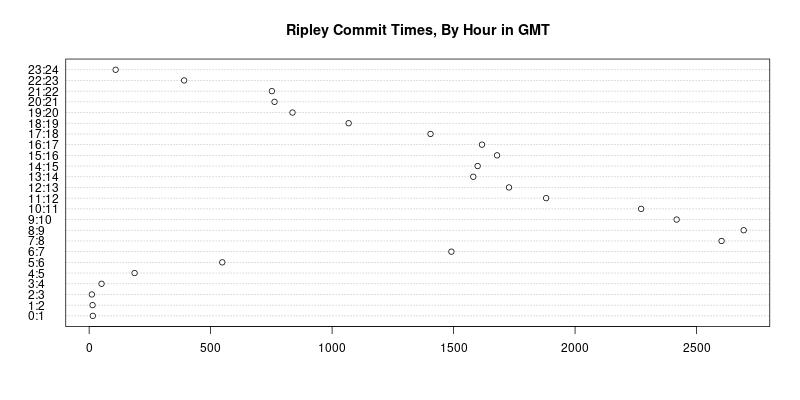
That is what one gets by trusting stable interfaces: code untouched for fourteen years runs unchanged. R itself has had well over sixty releases since then, including two major and eighteen minor releases. Yet the code just runs, including the code for two graphs one can reproduce with the exact same code as we show next.
tod <- unlist(sapply(rx,function(x)strsplit(x,split=" ")[[1]][6]))
tod <- tod[who=="ripley"]

tz <- sub(pattern=".*(-[0-9] 4 ).*",replacement="\\1",x=rx)
tz <- tz[who=="ripley"]
tz <- as.numeric(tz)/100
offset <- 3600*tz

z <- strptime(tod,format="%H:%M:%S")
hist(z,"hours",main="Ripley Commit Times in SVN TZ")

h <- z - offset
h <- format(h,format="%H")
h <- factor(as.numeric(h), levels=0:23)
## added as.vector() here to suppress a warning
dotchart(as.vector(table(h)), main="Ripley Commit Times, By Hour in GMT",
         labels=paste(0:23,1:24,sep=":"))
The code reproduces the chart from 2008, but this time uses the full twenty plus years of SVN history. I added just one as.vector() to suppress one new warning which appears under current R and which was presumably added in the fourteen years since (at the chart is produces without it too). The remainder of the code also runs. I just added one library(zoo) my blog post had omitted. No other changes.
## rather extract both  date and time
dat <- unlist(sapply(rx, function(x)  
  txt <- strsplit(x,split=" ")[[1]]
  paste(txt[5], txt[6])
 ))
## subset on Prof Ripley
dat <- dat[who == "ripley"]
## and convert to POSIXct, correcting by tz as well
datpt <- as.POSIXct(strptime(dat,format="%Y-%m-%d %H:%M:%S")) - offset

## turn into zoo -- we use a constant series of ones as each
## committ is taken as a timestamped event
library(zoo)
datzoo <- zoo(1, order.by=datpt)
## and use zoo to aggregate into commits per date
daily <- aggregate(datzoo, as.Date(index(datzoo)), sum)

## now plot as grey bars
plot(daily, col='darkgrey', type='h', lwd=2,
     ylab="Nb of SVN commits, three-week median",
     xlab="R release dates 2.5.0 and 2.5.1 shown in orange",
     main="The amazing Prof. Ripley")
## mark the two R releases of 2007
abline(v=c(as.Date("2007-04-24"),as.Date("2007-06-28")),col='orange',lwd=1.5)
## and do a quick centered rolling median
lines(rollmedian(daily, 21, align="center"), lwd=3)
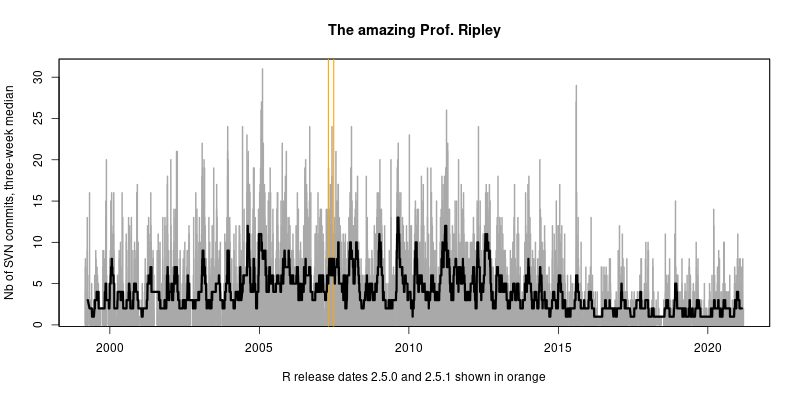
It produces this chart spanning two decades of commits. [3] The subtitle highlighting the then-most-recent releases is a little quaint now given that R has had eighten major.minor releases, and over sixty total releases, since then. Stable and rigourously maintained interfaces are a fantastic resource that is dramatically under-appreciated. Efforts such as the ten-year reproduction challenge demonstrate that this really is not a given. Maybe instead of celebrating band aides ( look, I reproduce via code I have frozen in a virtual environment / container / machine / ) we should celebrate languages, ecosystems, packages, that allow us to rely on just the code itself. Because we can. And we should strengthen and reinforce that ability. And discourage rapid changes just for changes sake. Code running for a decade, or even longer, is a huge boon to everybody relying on it. Three cheers to R Core. [1] Docker containers would be really good, and a step above the specs in the README. Winston s nice r-debug sumo container comes closest and helps a lot, and is updated regularly (which my earlier r-devel-san container is not). [2] The post owes some of its code ideas to Ben Bolker and Simon Jackman, but links to now-stale prior affiliations of theirs. [3] And the singularly impressive contributions charted remain unparalled, but were already the focus of the previous post. Yet over three times as a long period, they remain even more stunning. Edit 2021-03-21: Two minor fixes for grammar and typing.

15 March 2021

Matthew Garrett: Exploring my doorbell

I've talked about my doorbell before, but started looking at it again this week because sometimes it simply doesn't send notifications to my Home Assistant setup - the push notifications appear on my phone, but the doorbell simply doesn't trigger the HTTP callback it's meant to[1]. This is obviously suboptimal, but it's also tricky to debug a device when you have no access to it.

Normally I'd just head straight in with a screwdriver, but the doorbell is shared with the other units in this building and it seemed a little anti-social to interfere with a shared resource. So I bought some broken units from ebay and pulled one of them apart. There's several boards inside, but one of them had a conveniently empty connector at the top with "TX", "RX" and "GND" labelled. Sticking a USB-serial converter on this gave me output from U-Boot, and then kernel output. Confirmation that my doorbell runs Linux, but unfortunately it didn't give me a shell prompt. My next approach would often me to just dump the flash and look for vulnerabilities that way, but this device uses TSOP-48 packaged NAND flash rather than the more convenient SPI NOR flash that I already have adapters to access. Dumping this sort of NAND isn't terribly hard, but the easiest way to do it involves desoldering it from the board and plugging it into something like a Flashcat USB adapter, and my soldering's not good enough to put it back on the board afterwards. So I wanted another approach.

U-Boot gave a short countdown to hit a key before continuing with boot, and for once hitting a key actually did something. Unfortunately it then prompted for a password, and giving the wrong one resulted in boot continuing[2]. In the past I've had good luck forcing U-Boot to drop to a prompt by simply connecting one of the data lines on SPI flash to ground while it's trying to read the kernel - the failed read causes U-Boot to error out. It turns out the same works fine on raw NAND, so I just edited the kernel boot arguments to append "init=/bin/sh" and soon I had a shell.

From here on, things were made easier by virtue of the device using the YAFFS filesystem. Unlike many flash filesystems, it's read/write, so I could make changes that would persist through to the running system. There was a convenient copy of telnetd included, but it segfaulted on startup, which reduced its usefulness. Fortunately there was also a copy of Netcat[3]. If you make a fifo somewhere on the filesystem, you can cat the fifo to a shell, pipe the shell to a netcat listener, and then pipe netcat's output back to the fifo. The shell's output all gets passed to whatever connects to netcat, and whatever's sent to netcat gets passed through the fifo back to the shell. This is, obviously, horribly insecure, but it was enough to get a root shell over the network on the running device.

The doorbell runs various bits of software, one of which is Lighttpd to provide a local API and access to the device. Another component ("nxp-client") connects to the vendor's cloud infrastructure and passes cloud commands back to the local webserver. This is where I found something strange. Lighttpd was refusing to start because its modules wanted library symbols that simply weren't present on the device. My best guess is that a firmware update went wrong and left the device in a partially upgraded state - and without a working local webserver, there was no way to perform any further updates. This may explain why this doorbell was sitting on ebay.

Anyway. Now that I had shell, I could simply dump the flash by copying it directly off the /dev/mtdblock devices - since I had netcat, I could just pipe stuff through that back to my actual computer. Now I had access to the filesystem I could extract that locally and start digging into it more deeply. One incredibly useful tool for this is qemu-user. qemu is a general purpose hardware emulation platform, usually used to emulate entire systems. But in qemu-user mode, it instead only emulates the CPU. When a piece of code tries to make a system call to access the kernel, qemu-user translates that to the appropriate calling convention for the host kernel and makes that call instead. Combined with binfmt_misc, you can configure a Linux system to be able to run Linux binaries from other architectures. One of the best things about this is that, because they're still using the host convention for making syscalls, you can run the host strace on them and see what they're doing.

What I found was that nxp-client was calling back to the cloud platform, setting up an encrypted communication channel (using ChaCha20 and a bunch of key setup stuff I couldn't be bothered picking apart) and then waiting for commands from the cloud. It would then proxy those through to the local webserver. Since I couldn't run the local lighttpd, I just wrote a trivial Python app using http.server and waited to see what requests I got. The first was a GET to a CGI script called editcgi.cgi, along with a path name. I mocked up the GET request to respond with what was on the actual filesystem. The cloud then proceeded to POST to editcgi.cgi, with the same pathname and with new file contents. editcgi.cgi is apparently able to read and write to files on the filesystem.

But this is on the interface that's exposed to the cloud client, so this didn't appear immediately useful - and, indeed, trying to hit the same CGI binary over the local network gave me a 401 unauthorized error. There's a local API spec for these doorbells, but they all refer to scripts in the bha-api namespace, and this script was in the plain cgi-bin namespace. But then I noticed that the bha-api namespace didn't actually exist in the filesystem - instead, lighttpd's mod_alias was configured to rewrite requests to bha-api through to files in cgi-bin. And by using the documented API to get a session token, I could call editcgi.cgi to read and write arbitrary files on the doorbell. Which means I can drop an extra script in /etc/rc.d/rc3.d and get a shell on my doorbell.

This all requires the ability to have local authentication credentials, so it's not a big security deal other than it allowing you to retain access to a monitoring device even after you've moved out and had your credentials revoked. I'm sure it's all fine.

[1] I can ping the doorbell from the Home Assistant machine, so it's not that the network is flaky
[2] The password appears to be hy9$gnhw0z6@ if anyone else ends up in this situation
[3] https://twitter.com/mjg59/status/654578208545751040

comment count unavailable comments

10 March 2021

Dirk Eddelbuettel: RcppArmadillo 0.10.2.2.0 on CRAN: New Upstream Patch Release

armadillo image Armadillo is a powerful and expressive C++ template library for linear algebra aiming towards a good balance between speed and ease of use with a syntax deliberately close to a Matlab. RcppArmadillo integrates this library with the R environment and language and is widely used by (currently) 841 other packages on CRAN. This release brings us a second update within the Armadillo 10.2 series, one month after the initial release. Upstream work has commenced at a 10.3 series with first pre-releases which we are currently testing. If possible, CRAN release will continue to be at least one month apart (such as this time) but we continue to make interim releases available on the Rcpp drat repo repo. The full set of changes follows.

Changes in RcppArmadillo version 0.10.2.2.0 (2021-03-09)
  • Upgraded to Armadillo release 10.2.2 (Cicada Swarm)
    • faster handling of subcubes
    • added tgamma()
    • added .brief_print() for abridged printing of matrices & cubes
    • expanded forms of trimatu() and trimatl() with diagonal specification to handle sparse matrices
    • expanded eigs_sym() and eigs_gen() with optional shift-invert mode
  • Removed debian/ directory from repository as packaging is on salsa.debian.org.
  • Relaxed tolerance on two cube tests on Windows to accomodate new 'gcc10-UCRT' builder.

Courtesy of my CRANberries, there is a diffstat report relative to previous release. More detailed information is on the RcppArmadillo page. Questions, comments etc should go to the rcpp-devel mailing list off the R-Forge page. If you like this or other open-source work I do, you can sponsor me at GitHub.

This post by Dirk Eddelbuettel originated on his Thinking inside the box blog. Please report excessive re-aggregation in third-party for-profit settings.

1 March 2021

Dirk Eddelbuettel: RPushbullet 0.3.4: Small Update, Nicer Docs

RPpushbullet demo Release 0.3.4 of the RPushbullet package arrived on CRAN today. RPushbullet interfaces the neat Pushbullet service for inter-device messaging, communication, and more. It lets you easily send (programmatic) alerts like the one to the left to your browser, phone, tablet, or all at once. This release contains a contributed PR to better reflect an error code, and adds a mkdocs-material-based documentation site (just like a few other packages of mine). See below for more details.

Changes in version 0.3.4 (2021-03-01)
  • Return code checking using error code content if it exists (Thomas Shafer in #64).
  • Enabled GitHub Actions with encrypted JSON file for API access.
  • Added a package documentation website.

Courtesy of my CRANberries, there is also a diffstat report for this release. More details about the package are at the RPushbullet webpage and the RPushbullet GitHub repo. If you like this or other open-source work I do, you can now sponsor me at GitHub.

This post by Dirk Eddelbuettel originated on his Thinking inside the box blog. Please report excessive re-aggregation in third-party for-profit settings.

Utkarsh Gupta: FOSS Activites in February 2021

Here s my (seventeenth) monthly update about the activities I ve done in the F/L/OSS world.

Debian
This was my 26th month of active contributing to Debian. I became a DM in late March 2019 and a DD on Christmas 19! \o/ This month was a nice mix of amusement, excitement, nervousness, and craziness. More on it below.
Anyway, whilst I was super-insanely busy this month, I still did some Debian stuff here and there. Here are the following things I worked on:

Uploads and bug fixes:

Other $things:
  • Attended the Debian LTS team meeting.
  • Mentoring for newcomers.
  • Moderation of -project mailing list.
  • Sponsored ruby-rspec-stubbed-env for C dric Boutillier, heh :P

Interesting Bits!
  • Last month, I wrote:
    Besides, there s something more that is in the pipelines. Can t talk about it now, shh. But hopefully very sooooooon!
    And now I can talk about it! So here it is..
    I ve joined Canonical as a SDE to work on Ubuntu, full time!!! \o/
    Fully remote + dream job/work + most of the work is in the open-source domain + the beessstttt co-workers one could ever ask for! It s been an amazing time so far and I ll talk more about it later this month.
    But for now, here s our team monitor selfie (with Rick missing because of his secret plan ! )

    We ll soon e-meet them in a more detailed manner in the next blog post, that is, later this month!
  • In another exciting news, I got 2 more CVEs assigned!!! \o/
    No, it is not something that I found, it was discovered by Tavis Ormandy. I just assigned them a CVE ID, CVE-2021-26937 for screen and CVE-2021-27135 for xterm.
    This is my 2nd and 3rd, so I am (still) very excited about this! ^_^

Debian (E)LTS
Debian Long Term Support (LTS) is a project to extend the lifetime of all Debian stable releases to (at least) 5 years. Debian LTS is not handled by the Debian security team, but by a separate group of volunteers and companies interested in making it a success. And Debian Extended LTS (ELTS) is its sister project, extending support to the Jessie release (+2 years after LTS support). This was my sixteenth month as a Debian LTS and seventh month as a Debian ELTS paid contributor.
I was assigned 60.00 hours for LTS and 60.00 hours for ELTS and worked on the following things:
(however, I had overworked for 9 hours for both, LTS and ELTS, last month so I had to work for 51 hours for both this month!)

LTS CVE Fixes and Announcements:

ELTS CVE Fixes and Announcements:

Other (E)LTS Work:
  • Front-desk duty from 22-02 until 28-02 for both LTS and ELTS.
  • Triaged privoxy, dnsmasq, openldap, libzstd, ruby-mechanize, firefox-esr, thunderbird, screen, xterm, glibc, isync, rails, openscad, imagemagick, avahi, gdk-pixbuf, python-reportlab, python-aiohttp, spip, gdisk, and jasper.
  • Marked CVE-2021-20214/privoxy as not-affected for stretch.
  • Marked CVE-2021-27645/glibc as no-dsa for stretch.
  • Marked CVE-2021-20247/isync as no-dsa for stretch.
  • Marked CVE-2020-28599/openscad as no-dsa for stretch.
  • Markec CVE-2021-2024 1,4-6 /imagemagick as ignored for stretch.
  • Marked CVE-2021-26720/avahi as postponed for jessie.
  • Marked CVE-2021-20240/gdk-pixbuf as not-affected for jessie.
  • Marked CVE-2021-27645/glibc as no-dsa for jessie.
  • Marked CVE-2020-28463/python-reportlab as postponed for jessie.
  • Document extra CVEs as notes for imagemagick in jessie.
  • Auto EOL ed libupnp, webkit2gtk, libraw, jackson-dataformat-cbor, node-lodash, linux, asterisk, yara, python-django, botan1.10, smarty3, xen, u-boot, steghide, mumble, gsoap, ruby-twitter-stream, isync, nodejs, openscad, mupdf, mongo-java-driver, firefox-esr, thunderbird, and salt for jessie.
  • Sponsored upload for php-horde-text-filter for Sylvain and published its DLA announcement.
  • Got CVE-2021-26937 for screen. Yay, this is the 2nd one I got assigned! \o/
  • Got CVE-2021-27135 for xterm. Woah, this is the 3rd one, am I on a roll or what? \o/
  • Co-ordinated with package maintainer (and upstream) of ca-certificates for backporting patch to stretch.
  • Co-ordinated with package maintainer of ca-certificates for backporting patch to stretch.
  • Co-ordinated with package maintainer of screen for fixing vulnerabilites in stretch.
  • Attended monthly meeting for Debian LTS.
  • Answered questions (& discussions) on IRC (#debian-lts and #debian-elts).
  • Cross-checked LTS survey results, emailed Ola about the problems found.
  • General and other discussions on LTS private and public mailing list.

Until next time.
:wq for today.

28 February 2021

Jamie McClelland: From openbox to sway

I've been running the Openbox window manager since 2005. That's longer then I've lived in any one apartment in my entire life! However, over the years I've been bracing for a change. It seems clear the Wayland is the future, although when that future is supposed to begin is much more hazy. Really, I've felt a bit like a ping pong ball, from panicking over whether Xorg is abandoned (with a follow up from a X server maintainer) to anxiously wondering if literally everything will break the moment I switch to Wayland. In fact, I started this blog post over a year ago when I first decided to switch from the Openbox to Sway. This is my third major attempt to make the change and I think it will finally stick this time. In retrospect, it would have been more sensible to first switch from openbox to i3 (which is a huge transition) and then from i3 to sway, but I decided to dive into the deep end with both changes. So... I'm on debian bullseye so I installed sway and friends (from sid). Then I copied /etc/sway/config to ~/.config/sway/config. I start openbox after logging in with exec startx so after rebooting, I ran exec sway and to my astonishment sway started. Hooray! However, I found that ssh-agent wasn't running so I couldn't ssh into any servers. That's kinda a problem. Launching ssh-agent under openbox was buried deep in /etc/X11/Xsession.d/90x11-common_ssh-agent and clearly was not going to happen via wayland. Since programs using ssh-agent depend on the environment variables SSH_AUTH_SOCK and SSH_AGENT_PID being globally available I thought I could simply run $(eval ssh-agent) via my tty terminal before running exec sway. And, that would have worked. Except... I like to add my keys via ssh-add -c so that everytime my key is being used I get a ssh-askpass prompt to confirm the use. It seems that since ssh-add is started before a window manager is running, it can't run the prompt. Ok, we can fix this. After searching the web, I came upon a solution of running ssh-agent via systemctl --user:
# This service myst be started manually after sway
# starts.
[Unit]
Description=OpenSSH private key agent
IgnoreOnIsolate=true
[Service]
Type=forking
Environment=SSH_AUTH_SOCK=%t/ssh-agent.socket
ExecStart=/usr/bin/ssh-agent -a $SSH_AUTH_SOCK
Then, in my ~/.bashrc file I have:
if [ -n WAYLAND_DISPLAY ]; then
  export SSH_AUTH_SOCK=/run/user/1000/ssh-agent.socket
fi
I think $SSH_AGENT_PID is only used by ssh-agent to kill itself. Now that is running via systemd - killing it should be do-able without a global environment variable. Done? Hardly. I've been using impass (nee assword) happily for years but alas it is tightly integrated with xdo and xclip. So... I've switched to keepassxc which works out of the box with wayland. My next challenge was the status bar. Farewell faithful tint2. One of the reasons I failed on my first two attempts to switch to Sway was the difficulty of getting the swaybar to work how I wanted, particularly with nm-applet. Two things allowed me to move forward: Next up: the waybar clock module doesn't work, but that is easy enough to work around. Replacing my uses of xclip with wl-clipboard was a little tedious but really not that difficult. Getting my screen shot and screen recorder functionality was a bit harder. I did a lot of searching before I finally found and compiled both swappy, screen shot and wf-recorder. In the course of all my adventures, I came across the following helpful tips:
Updates
  1. I've installed libreoffice-gtk3 to ensure libre office runs under wayland
  2. I've installed the latest Gimp via flatpak to get proper wayland support
  3. I've exported MOZ_ENABLE_WAYLAND to ensure firefox works properly.
  4. I've found that passing -c to my ssh-add command to ensure I am prompted for each use of my key seems to cause sway to crash intermittently.
  5. I am working on a questionable work around to get screen sharing to work in zoom. I haven't actually tried it on a real zoom call yet.
  6. Speaking of screen sharing - when using Firefox, I can only share Xwayland screens. Firefox is running under wayland so I can't share it. Chromium is running under xwayland, so I have to use Chromium when screen sharing.
  7. Wait, scratch that about screen sharing in Firefox. I've installed xdg-desktop-portal-wlr, added export XDG_CURRENT_DESKTOP=sway and export XDG_SESSION_TYPE=wayland to my .bashrc, and after hours of frustration, realize that I needed to configured firejail to allow it so that I can share my entire screen in Firefox. It doesn't yet support sharing a specific window, so I still have to keep chromium around for that (and Chromium can only share xwayland windows). Sigh. Oh, one more thing about Firefox: the option to choose what to share doesn't have "Entire Screen" as an option, you are just supposed to know that you should choose "Use operating system settings".
  8. I still am getting weekly crashes. Some of them I've fixed by switching to wayland friendly versions (e.g. Libre Office and Gimp) but others I haven't yet tracked down.
  9. My keyboard does not have an altgr key, so even though I have selected the "English (US) - English (intl., with AltGr dead keys)" I can't get accent marks. I went down a rabbit hole of trying to re-map the Alt key to the right of my space bar but it all seemed too complicated. So - I found a way easier approach. In my ~/.config/sway/config file I have: bindsym Mod4+e exec wtype " ". I have repeated that line for the main accent marks I need.
  10. Due to a Firefox Bug, when I share my desktop or mic or camera, the sharing indicator expands like a normal tiling window instead of remaining a tiny little box on each desktop reminding me that I'm sharing something. I'd prefer to have it be a tiny little box, but since I can't figure that out, I've disabled it by typing about:config in the Firefox location window, searching for privacy.webrtc.legacyGlobalIndicator and setting it to False. The reddit thread also suggested finding privacy.webrtc.hideGlobalIndicator and setting it to True, but that setting doesn't seem to be available and setting the first one alone seems to do the trick.
  11. Oh, one more environment variable to set: GDK_BACKEND=wayland,x11. First I just set it to wayland to get gtk3 apps to use wayland (like gajim). But that broke electron apps (like signal) which notice that variable but don't have a way to display via wayland (at least not yet). Setting it to "wayland,x11" shows the priority. Thank you ubuntu community.
  12. I've also finally consolidated where my environment variables go. I've added them all to ~/.config/sway/env. That seems like an official sway place to put them, but sway doesn't pay any attention to them. So I start sway via my own bash script which sources that file via [ -f "$HOME/.config/sway/env" ] && . "$HOME/.config/sway/env" before exec'ing sway.

26 February 2021

Ritesh Raj Sarraf: Wayland KDE X11

KDE Impressions These days, I often hear a lot about Wayland. And how much of effort is being put into it; not just by the Embedded world but also the usual Desktop systems, namely KDE and GNOME. In recent past, I switched back to KDE and have been (very) happy about the switch. Even though the KDE 4 (and initial KDE 5) debacle had burnt many, coming back to a usable KDE desktop is always a delight. It makes me feel home with the elegance, while at the same time the flexibility, it provides. It feels so nice to draft this blog article from Kwrite + VI Input Mode Thanks to the great work of the Debian KDE Team, but Norbert Preining in particular, who has helped bring very up-to-date KDE packages into Debian. Right now, I m on a Plamsa 5.21.1 desktop, which is recent by all standards.

Wayland Almost all the places in the Linux world these days are busy with integrating Wayland as the primary display service. Not sure what the current status on the GNOME side is but I definitely keep trying KDE + Wayland with every release. I keep trying with every release because it still is not prime for daily use. And it makes me get back to X11, no matter how dated some may call. Fact is, X11 still shines to me as an end-user. Glitches with Wayland still are (Based on this week s test on Plasma 5.21.1):
  • Horrible performance compared to X11
  • Very crashy, especially when hotplugging secondary display. Plasma would just crash. X11 is very resilient to such things, part of the reason I can think is the age of the codebase.
  • Many many applications still need to be fixed for Wayland. Or Wayland needs to accomodate them in some way. XWayland does not really feel like the answer.
And while KDE keeps insisting users to switch to Wayland, as that s where all the new enhancements and fixes are put in, someone like me still needs to stick to X11 for the time being. So to get my shiny new LG 27" 4K Monitor (3840x2160 60.00*+) to work without too much glitch, I had to live with an alias:
$ alias   grep xrandr
alias rrs_xrandr_lg='xrandr --output DP-1 --mode 3840x2160 --scale .75x.75'
18:31                    

Plasma 5.21 On the brighter side, the Plasma 5.21.1 release brings some nice enhancements in other areas.
  • I m now able to make use of tighter integration with systemd/cgroups, with better organization and management of processes overall.
  • The new Plasma theme, Breeze Twilight, is a good blend of Light + Dark.
I also appreciate the work put in by Michail Vourlakos. The KDE project is lucky to have a developer/designer like him. His vision and work into the KDE desktop is well beyond a writing by me.
$ usystemctl status plasma-plasmashell.service 
  plasma-plasmashell.service - KDE Plasma Workspace
     Loaded: loaded (/usr/lib/systemd/user/plasma-plasmashell.service; enabled; vendor preset: enabled)
     Active: active (running) since Fri 2021-02-26 18:34:23 IST; 13s ago
   Main PID: 501806 (plasmashell)
      Tasks: 21 (limit: 18821)
     Memory: 759.8M
        CPU: 13.706s
     CGroup: /user.slice/user-1000.slice/user@1000.service/session.slice/plasma-plasmashell.service
              501806 /usr/bin/plasmashell --no-respawn
             
Feb 26 18:35:00 priyasi plasmashell[501806]: qml: recreating buttons
Feb 26 18:35:21 priyasi plasmashell[501806]: qml: recreating buttons
Feb 26 18:35:49 priyasi plasmashell[501806]: qml: recreating buttons
Feb 26 18:35:57 priyasi plasmashell[501806]: qml: recreating buttons
18:36                  

OBS - Open Build Service I should also thank the OpenSUSE folks for the OBS work. It has enabled the close equivalent (or better, in my experience) of PPAs for Debian. And that is what has enabled developers like Norbert to easily and quickly be able to deliver the entire KDE suite.

OBS - Some detail Christian asked for some more details on the OBS side of things, of my view. I m updating this article with it because the comment system may not always be reliable and I hate losing content. Having been using OBS myself, and also others in the Debian community who are making use of it, I surely think we as project should consider making use of OBS. Given that OBS is Free Software, it is a perfect fit for Debian. Gitlab is another example of what we ve made available in Debian. OBS is divided into multiple parts
  • OBS Server
  • OBS DoD service
  • OBS Publisher
  • OBS Workers
  • OBS Warden
  • OBS Rep Server
For every Debian release I care about, I add an OBS project per release. So I have OBS projects for: Sid, Bullseye, Buster, Jessie. Now, say you have a package, foo . You prep your package and enable all the releases that you want to build the package for. So the same package gets built, in separate clean environments, for every release I mentioned as an example above. You don t have to manually trigger the build for every release/every architcture. You should add the release (as projects) in OBS, set their supported architectures, and then add those enabled release projets as bits to your package. Every build involves:
  • Creating a new chroot for each build
  • Building the package
Builds can be scattered across multiple hosts, known as workers in OBS terminology. Your workers are independent machine entities, supporting different architectures. The machines can be Bare-Metal ones, VMs, even containers. So this allows for very nice scale-in and scale-out. There may be auto-scaling too but that is something worth investigating. Think of things like cross architecture builds. Let s assume the cloud vendors decide to donate resources to the Debian project. We could enable OBS worker instances on the respective clouds (different architectures) and plug them into the master OBS instance that Debian hosts. Fully distributed. Similarly, big hardware vendors willing to donate compute resources could house them in their premises and Debian could just easily establish a connection to them. All of this just a TCP connection away. So when I look at the features of OBS, from the point of view of Debian, I like it more. Extensibility won t be an issue. Supporting a new Debian release would just be a matter of bootstrapping the Debian release as a project in OBS, and then all done. The single effort of setting of the target release project is a one time job, and then all can leverage it. The PPA was a long craved feature missing in Debian, in my opinion. OBS allows to not just fulfil that gap but also extend it in a very easy way. Andrew Lee had put in a nice video presentation about the same @ Debconf 20

24 February 2021

Dirk Eddelbuettel: RcppSimdJson 0.1.4 on CRAN: Small Bugfix

A quick note to say that we finalized a bugfix release 0.1.5 of RcppSimdJson yesterday which got onto CRAN earlier today. RcppSimdJson wraps the fantastic and genuinely impressive simdjson library by Daniel Lemire and collaborators. Via very clever algorithmic engineering to obtain largely branch-free code, coupled with modern C++ and newer compiler instructions, it results in parsing gigabytes of JSON parsed per second which is quite mindboggling. The best-case performance is faster than CPU speed as use of parallel SIMD instructions and careful branch avoidance can lead to less than one cpu cycle per byte parsed; see the video of the talk by Daniel Lemire at QCon (also voted best talk). This version brings a small fix to Windows where temporary filenames constructed from URLs (as for example constructed by our td package) need an extra sanization for a possible ? character. We will be addressing that properly in due course but for now a simple gsub() will do. The NEWS entry follows.

Changes in version 0.1.5 (2021-02-23)
  • Temporary filenames from request URLs need an extra path sanitization on Windows as seen with package td.
  • A few #nocov tags were added to the code.

Courtesy of my CRANberries, there is also a diffstat report for this release. For questions, suggestions, or issues please use the issue tracker at the GitHub repo. If you like this or other open-source work I do, you can now sponsor me at GitHub.

This post by Dirk Eddelbuettel originated on his Thinking inside the box blog. Please report excessive re-aggregation in third-party for-profit settings.

22 February 2021

Dirk Eddelbuettel: pkgKitten 0.2.1: Now with roxygen2 support

kitten A new release 0.2.1 of pkgKitten hit CRAN earlier today, and has been uploaded to Debian as well. pkgKitten makes it simple to create new R packages via a simple function invocation. A wrapper kitten.r exists in the littler package to make it even easier. This release builds on the support for tinytest we added in release 0.2.0 by adding more optional support, this time for roxygen2. It also corrects a minor documentation snafu, and updates the CI use.

Changes in version 0.2.1 (2021-02-22)
  • A small documentation error was corrected (David Dalpiaz in #15).
  • A new option bunny adds support for roxygen2.
  • Continuous integration now use run.sh from r-ci.

More details about the package are at the pkgKitten webpage, the pkgKitten docs site, and the pkgKitten GitHub repo. Courtesy of my CRANberries site, there is also a diffstat report for this release. If you like this or other open-source work I do, you can now sponsor me at GitHub.

This post by Dirk Eddelbuettel originated on his Thinking inside the box blog. Please report excessive re-aggregation in third-party for-profit settings.

21 February 2021

Matthew Garrett: Making hibernation work under Linux Lockdown

Linux draws a distinction between code running in kernel (kernel space) and applications running in userland (user space). This is enforced at the hardware level - in x86-speak[1], kernel space code runs in ring 0 and user space code runs in ring 3[2]. If you're running in ring 3 and you attempt to touch memory that's only accessible in ring 0, the hardware will raise a fault. No matter how privileged your ring 3 code, you don't get to touch ring 0.

Kind of. In theory. Traditionally this wasn't well enforced. At the most basic level, since root can load kernel modules, you could just build a kernel module that performed any kernel modifications you wanted and then have root load it. Technically user space code wasn't modifying kernel space code, but the difference was pretty semantic rather than useful. But it got worse - root could also map memory ranges belonging to PCI devices[3], and if the device could perform DMA you could just ask the device to overwrite bits of the kernel[4]. Or root could modify special CPU registers ("Model Specific Registers", or MSRs) that alter CPU behaviour via the /dev/msr interface, and compromise the kernel boundary that way.

It turns out that there were a number of ways root was effectively equivalent to ring 0, and the boundary was more about reliability (ie, a process running as root that ends up misbehaving should still only be able to crash itself rather than taking down the kernel with it) than security. After all, if you were root you could just replace the on-disk kernel with a backdoored one and reboot. Going deeper, you could replace the bootloader with one that automatically injected backdoors into a legitimate kernel image. We didn't have any way to prevent this sort of thing, so attempting to harden the root/kernel boundary wasn't especially interesting.

In 2012 Microsoft started requiring vendors ship systems with UEFI Secure Boot, a firmware feature that allowed[5] systems to refuse to boot anything without an appropriate signature. This not only enabled the creation of a system that drew a strong boundary between root and kernel, it arguably required one - what's the point of restricting what the firmware will stick in ring 0 if root can just throw more code in there afterwards? What ended up as the Lockdown Linux Security Module provides the tooling for this, blocking userspace interfaces that can be used to modify the kernel and enforcing that any modules have a trusted signature.

But that comes at something of a cost. Most of the features that Lockdown blocks are fairly niche, so the direct impact of having it enabled is small. Except that it also blocks hibernation[6], and it turns out some people were using that. The obvious question is "what does hibernation have to do with keeping root out of kernel space", and the answer is a little convoluted and is tied into how Linux implements hibernation. Basically, Linux saves system state into the swap partition and modifies the header to indicate that there's a hibernation image there instead of swap. On the next boot, the kernel sees the header indicating that it's a hibernation image, copies the contents of the swap partition back into RAM, and then jumps back into the old kernel code. What ensures that the hibernation image was actually written out by the kernel? Absolutely nothing, which means a motivated attacker with root access could turn off swap, write a hibernation image to the swap partition themselves, and then reboot. The kernel would happily resume into the attacker's image, giving the attacker control over what gets copied back into kernel space.

This is annoying, because normally when we think about attacks on swap we mitigate it by requiring an encrypted swap partition. But in this case, our attacker is root, and so already has access to the plaintext version of the swap partition. Disk encryption doesn't save us here. We need some way to verify that the hibernation image was written out by the kernel, not by root. And thankfully we have some tools for that.

Trusted Platform Modules (TPMs) are cryptographic coprocessors[7] capable of doing things like generating encryption keys and then encrypting things with them. You can ask a TPM to encrypt something with a key that's tied to that specific TPM - the OS has no access to the decryption key, and nor does any other TPM. So we can have the kernel generate an encryption key, encrypt part of the hibernation image with it, and then have the TPM encrypt it. We store the encrypted copy of the key in the hibernation image as well. On resume, the kernel reads the encrypted copy of the key, passes it to the TPM, gets the decrypted copy back and is able to verify the hibernation image.

That's great! Except root can do exactly the same thing. This tells us the hibernation image was generated on this machine, but doesn't tell us that it was done by the kernel. We need some way to be able to differentiate between keys that were generated in kernel and ones that were generated in userland. TPMs have the concept of "localities" (effectively privilege levels) that would be perfect for this. Userland is only able to access locality 0, so the kernel could simply use locality 1 to encrypt the key. Unfortunately, despite trying pretty hard, I've been unable to get localities to work. The motherboard chipset on my test machines simply doesn't forward any accesses to the TPM unless they're for locality 0. I needed another approach.

TPMs have a set of Platform Configuration Registers (PCRs), intended for keeping a record of system state. The OS isn't able to modify the PCRs directly. Instead, the OS provides a cryptographic hash of some material to the TPM. The TPM takes the existing PCR value, appends the new hash to that, and then stores the hash of the combination in the PCR - a process called "extension". This means that the new value of the TPM depends not only on the value of the new data, it depends on the previous value of the PCR - and, in turn, that previous value depended on its previous value, and so on. The only way to get to a specific PCR value is to either (a) break the hash algorithm, or (b) perform exactly the same sequence of writes. On system reset the PCRs go back to a known value, and the entire process starts again.

Some PCRs are different. PCR 23, for example, can be reset back to its original value without resetting the system. We can make use of that. The first thing we need to do is to prevent userland from being able to reset or extend PCR 23 itself. All TPM accesses go through the kernel, so this is a simple matter of parsing the write before it's sent to the TPM and returning an error if it's a sensitive command that would touch PCR 23. We now know that any change in PCR 23's state will be restricted to the kernel.

When we encrypt material with the TPM, we can ask it to record the PCR state. This is given back to us as metadata accompanying the encrypted secret. Along with the metadata is an additional signature created by the TPM, which can be used to prove that the metadata is both legitimate and associated with this specific encrypted data. In our case, that means we know what the value of PCR 23 was when we encrypted the key. That means that if we simply extend PCR 23 with a known value in-kernel before encrypting our key, we can look at the value of PCR 23 in the metadata. If it matches, the key was encrypted by the kernel - userland can create its own key, but it has no way to extend PCR 23 to the appropriate value first. We now know that the key was generated by the kernel.

But what if the attacker is able to gain access to the encrypted key? Let's say a kernel bug is hit that prevents hibernation from resuming, and you boot back up without wiping the hibernation image. Root can then read the key from the partition, ask the TPM to decrypt it, and then use that to create a new hibernation image. We probably want to prevent that as well. Fortunately, when you ask the TPM to encrypt something, you can ask that the TPM only decrypt it if the PCRs have specific values. "Sealing" material to the TPM in this way allows you to block decryption if the system isn't in the desired state. So, we define a policy that says that PCR 23 must have the same value at resume as it did on hibernation. On resume, the kernel resets PCR 23, extends it to the same value it did during hibernation, and then attempts to decrypt the key. Afterwards, it resets PCR 23 back to the initial value. Even if an attacker gains access to the encrypted copy of the key, the TPM will refuse to decrypt it.

And that's what this patchset implements. There's one fairly significant flaw at the moment, which is simply that an attacker can just reboot into an older kernel that doesn't implement the PCR 23 blocking and set up state by hand. Fortunately, this can be avoided using another aspect of the boot process. When you boot something via UEFI Secure Boot, the signing key used to verify the booted code is measured into PCR 7 by the system firmware. In the Linux world, the Shim bootloader then measures any additional keys that are used. By either using a new key to tag kernels that have support for the PCR 23 restrictions, or by embedding some additional metadata in the kernel that indicates the presence of this feature and measuring that, we can have a PCR 7 value that verifies that the PCR 23 restrictions are present. We then seal the key to PCR 7 as well as PCR 23, and if an attacker boots into a kernel that doesn't have this feature the PCR 7 value will be different and the TPM will refuse to decrypt the secret.

While there's a whole bunch of complexity here, the process should be entirely transparent to the user. The current implementation requires a TPM 2, and I'm not certain whether TPM 1.2 provides all the features necessary to do this properly - if so, extending it shouldn't be hard, but also all systems shipped in the past few years should have a TPM 2, so that's going to depend on whether there's sufficient interest to justify the work. And we're also at the early days of review, so there's always the risk that I've missed something obvious and there are terrible holes in this. And, well, given that it took almost 8 years to get the Lockdown patchset into mainline, let's not assume that I'm good at landing security code.

[1] Other architectures use different terminology here, such as "supervisor" and "user" mode, but it's broadly equivalent
[2] In theory rings 1 and 2 would allow you to run drivers with privileges somewhere between full kernel access and userland applications, but in reality we just don't talk about them in polite company
[3] This is how graphics worked in Linux before kernel modesetting turned up. XFree86 would just map your GPU's registers into userland and poke them directly. This was not a huge win for stability
[4] IOMMUs can help you here, by restricting the memory PCI devices can DMA to or from. The kernel then gets to allocate ranges for device buffers and configure the IOMMU such that the device can't DMA to anything else. Except that region of memory may still contain sensitive material such as function pointers, and attacks like this can still cause you problems as a result.
[5] This describes why I'm using "allowed" rather than "required" here
[6] Saving the system state to disk and powering down the platform entirely - significantly slower than suspending the system while keeping state in RAM, but also resilient against the system losing power.
[7] With some handwaving around "coprocessor". TPMs can't be part of the OS or the system firmware, but they don't technically need to be an independent component. Intel have a TPM implementation that runs on the Management Engine, a separate processor built into the motherboard chipset. AMD have one that runs on the Platform Security Processor, a small ARM core built into their CPU. Various ARM implementations run a TPM in Trustzone, a special CPU mode that (in theory) is able to access resources that are entirely blocked off from anything running in the OS, kernel or otherwise.

comment count unavailable comments

Russ Allbery: Review: The Fated Sky

Review: The Fated Sky, by Mary Robinette Kowal
Series: Lady Astronaut #2
Publisher: Tor
Copyright: August 2018
ISBN: 0-7653-9893-1
Format: Kindle
Pages: 380
The Fated Sky is a sequel to The Calculating Stars, but you could start with this book if you wanted to. It would be obvious you'd missed a previous book in the series, and some of the relationships would begin in medias res, but the story is sufficiently self-contained that one could puzzle through. Mild spoilers follow for The Calculating Stars, although only to the extent of confirming that book didn't take an unexpected turn, and nothing that wouldn't already be spoiled if you had read the short story "The Lady Astronaut of Mars" that kicked this series off. (The short story takes place well after all of the books.) Also some minor spoilers for the first section of the book, since I have to talk about its outcome in broad strokes in order to describe the primary shape of the novel. In the aftermath of worsening weather conditions caused by the Meteor, humans have established a permanent base on the Moon and are preparing a mission to Mars. Elma is not involved in the latter at the start of the book; she's working as a shuttle pilot on the Moon, rotating periodically back to Earth. But the political situation on Earth is becoming more tense as the refugee crisis escalates and the weather worsens, and the Mars mission is in danger of having its funding pulled in favor of other priorities. Elma's success in public outreach for the space program as the Lady Astronaut, enhanced by her navigation of a hostage situation when an Earth re-entry goes off course and is met by armed terrorists, may be the political edge supporters of the mission need. The first part of this book is the hostage situation and other ground-side politics, but the meat of this story is the tense drama of experimental, pre-computer space flight. For those who aren't familiar with the previous book, this series is an alternate history in which a huge meteorite hit the Atlantic seaboard in 1952, potentially setting off runaway global warming and accelerating the space program by more than a decade. The Calculating Stars was primarily about the politics surrounding the space program. In The Fated Sky, we see far more of the technical details: the triumphs, the planning, and the accidents and other emergencies that each could be fatal in an experimental spaceship headed towards Mars. If what you were missing from the first book was more technological challenge and realistic detail, The Fated Sky delivers. It's edge-of-your-seat suspenseful and almost impossible to put down. I have more complicated feelings about the secondary plot. In The Calculating Stars, the heart of the book was an incredibly well-told story of Elma learning to deal with her social anxiety. That's still a theme here but a lesser one; Elma has better coping mechanisms now. What The Fated Sky tackles instead is pervasive sexism and racism, and how Elma navigates that (not always well) as a white Jewish woman. The centrality of sexism is about the same in both books. Elma's public outreach is tied closely to her gender and starts as a sort of publicity stunt. The space program remains incredibly sexist in The Fated Stars, something that Elma has to cope with but can't truly fix. If you found the sexism in the first book irritating, you're likely to feel the same about this installment. Racism is more central this time, though. In The Calculating Stars, Elma was able to help make things somewhat better for Black colleagues. She has a much different experience in The Fated Stars: she ends up in a privileged position that hurts her non-white colleagues, including one of her best friends. The merits of taking a stand on principle are ambiguous, and she chooses not to. When she later tries to help Black astronauts, she does so in a way that's focused on her perceptions rather than theirs and is therefore more irritating than helpful. The opportunities she gets, in large part because she's seen as white, unfairly hurt other people, and she has to sit with that. It's a thoughtful and uncomfortable look at how difficult it is for a white person to live with discomfort they can't fix and to not make it worse by trying to wave it away or point out their own problems. That was the positive side of this plot, although I'm still a bit wary and would like to read a review by a Black reviewer to see how well this plot works from their perspective. There are some other choices that I thought landed oddly. One is that the most racist crew member, the one who sparks the most direct conflict with the Black members of the international crew, is a white man from South Africa, which I thought let the United States off the hook too much and externalized the racism a bit too neatly. Another is that the three ships of the expedition are the Ni a, the Pinta, and the Santa Maria, and no one in the book comments on this. Given the thoughtful racial themes of the book, I can't imagine this is an accident, and it is in character for United States of this novel to pick those names, but it was an odd intrusion of an unremarked colonial symbol. This may be part of Kowal's attempt to show that Elma is embedded in a racist and sexist world, has limited room to maneuver, and can't solve most of the problems, which is certainly a theme of the series. But it left me unsettled on whether this book was up to fully handling the fraught themes Kowal is invoking. The other part of the book I found a bit frustrating is that it never seriously engaged with the political argument against Mars colonization, instead treating most of the opponents of space travel as either deluded conspiracy believers or cynical villains. Science fiction is still arguing with William Proxmire even though he's been dead for fifteen years and out of office for thirty. The strong argument against a Mars colony in Elma's world is not funding priorities; it's that even if it's successful, only a tiny fraction of well-connected elites will escape the planet to Mars. This argument is made in the book and Elma dismisses it as a risk she's trying to prevent, but it is correct. There is no conceivable technological future that leads to evacuating the Earth to Mars, but The Fated Sky declines to grapple with the implications of that fact. There's more that I haven't remarked on, including an ongoing excellent portrayal of the complicated and loving relationship between Elma and her husband, and a surprising development in her antagonistic semi-friendship with the sexist test pilot who becomes the mission captain. I liked how Kowal balanced technical problems with social problems on the long Mars flight; both are serious concerns and they interact with each other in complicated ways. The details of the perils and joys of manned space flight are excellent, at least so far as I can tell without having done the research that Kowal did. If you want a fictionalized Apollo 13 with higher stakes and less ground support, look no further; this is engrossing stuff. The interpersonal politics and sociology were also fascinating and gripping, but unsettling, in both good ways and bad. I like the challenge that Kowal presents to a white reader, although I'm not sure she was completely in control of it. Cautiously recommended, although be aware that you'll need to grapple with a sexist and racist society while reading it. Also a content note for somewhat graphic gastrointestinal problems. Followed by The Relentless Moon. Rating: 8 out of 10

19 February 2021

Reproducible Builds (diffoscope): diffoscope 167 released

The diffoscope maintainers are pleased to announce the release of diffoscope version 167. This version includes the following changes:
* Temporary directory handling:
  - Ensure we cleanup our temporary directory by avoiding confusion between
    the TemporaryDirectory instance and the underlying directory.
    (Closes: #981123)
  - Use a potentially-useful suffix to our temporary directory based on the
    command-line passed to diffoscope.
  - Fix some tempfile/weakref interaction in Python 3.7 (ie. Debian buster).
    (Closes: reproducible-builds/diffoscope#239)
  - If our temporary directory does not exist anymore (eg. it has been
    cleaned up in tests, signal handling or reference counting),  make sure
    we recreate it.
* Bug fixes:
  - Don't rely on magic.Magic(...) to have an identical API between file's
    magic.py and PyPI's "python-magic" library.
    (Closes: reproducible-builds/diffoscope#238)
  - Don't rely on dumpimage returning an appropriate exit code; check that
    the file actually exists after we call it.
* Codebase changes:
  - Set a default Config.extended_filesystem_attributes.
  - Drop unused Config.acl and Config.xattr attributes.
  - Tidy imports in diffoscope/comparators/fit.py.
* Tests:
  - Add u-boot-tools to test dependencies so that salsa.debian.org pipelines
    actually test the new FIT comparator.
  - Strip newlines when determining Black version to avoid "requires black
    >= 20.8b1 (18.9b0\n detected)" in test output (NB. embedded newline).
  - Gnumeric is back in testing so re-add to test dependencies.
  - Use assert_diff (over get_data, etc.) in the FIT and APK comparators.
  - Mark test_apk.py::test_android_manifest as being allowed to fail for now.
  - Fix the FIT tests in buster and unstable.
You find out more by visiting the project homepage.

18 February 2021

Dirk Eddelbuettel: td 0.0.2 on CRAN: Updated and Expanded

The still very recent td package for accessing the twelvedata API for financial data has been updated and is now at version 0.0.2. The time_series access point is now vectorised: supply a vector of symbols, and you receive list of data.frame (or xts) objects. See this tweet teasing out the earliest support for this new featire, and showing a quick four-securities plot. We also added simpler accessors get_quote() and get_price() rounding out the basic API support. One first bug report alerting us to the fact that our use of RcppSimdJson requires an additional sanitizing of the temporary filename if used on Windows. We will fix that properly soon in new release 0.1.5 of that package; in the meantime you can get hot-fix binary 0.1.4.1 for Windows via install.packages("RcppSimdJson", repos="https://ghrr.github.io/drat") from the ghrr drat. The NEWS entry follows.

Changes in version 0.0.2 (2021-02-18)
  • The time_series is now vectorised and can return a list of return objects when given a vector of symbols
  • The use of tools::R_user_dir() is now conditional on having R 4.0.0 or later, older versions can use env.var for api key
  • New helper function store_key to save api key.
  • New simple accessors get_quote and get_price

Courtesy of my CRANberries, there is a comparison to the previous release. For questions or comments use the issue tracker off the GitHub repo. If you like this or other open-source work I do, you can now sponsor me at GitHub.

This post by Dirk Eddelbuettel originated on his Thinking inside the box blog. Please report excessive re-aggregation in third-party for-profit settings.

Dirk Eddelbuettel: dang 0.0.13: New intradayMarketMonitor

sp500 intraday monitor A new release of the dang package got to CRAN earlier today, a few months since the last relase. The dang package regroups a few functions of mine that had no other home as for example lsos() from a StackOverflow question from 2009 (!!) is one, this overbought/oversold price band plotter from an older blog post is another. This release adds one function I tweeted about one month ago. It takes a function Josh Ulrich originally tweeted about in November with a reference to this gist. I refactored this into a proper functions and polished a few edges: the data now properly rolls off after a fixed delay (of two days), should work with other symbols (though we both focused on ^GSPC as a free (!!) real-time SP500 index (albeit only during trading hours), properly gaps between trading days and more. You can simply invoke it via
dang::intradayMarketMonitor()
and a chart just like the one here will grow (though there is no state : if you stop it, or reboot, or the plot starts from scratch). The short NEWS entry follows.

Changes in version 0.0.13 (2021-02-17)
  • New function intradayMarketMonitor based on an earlier gist-posted snippet by Josh Ulrich.
  • The CI setup was generalized as a test for 'r-ci' and is used essentially unchanged with three different providers.

Courtesy of my CRANberries, there is a comparison to the previous release. For questions or comments use the issue tracker off the GitHub repo. If you like this or other open-source work I do, you can now sponsor me at GitHub.

This post by Dirk Eddelbuettel originated on his Thinking inside the box blog. Please report excessive re-aggregation in third-party for-profit settings.

14 February 2021

Enrico Zini: Mindustry links

Mindustry is really well made computer game that I enjoyed playing a lot. It is Free Software. Here are two guides to get a deeper idea about details of the game: r/Mindustry - How unattended sector defense works (most effective turrets and such) is a useful explanation I found of what happens in Mindustry 6 when I leave a sector to itself. And #959466 is the RFP (wink, wink!)

13 February 2021

Dirk Eddelbuettel: RcppFastFloat 0.0.2: New Function

The second release of RcppFastFloat is now on CRAN. The package wraps fastfloat, another nice library by Daniel Lemire who showed in a recent arXiv paper that one can convert character representations of numbers into floating point at rates at or exceeding one gigabyte per second. Thanks to Brendan, this release adds a helper function as.double2() modeled after the base R function but using, of course, the features from fast_float in RcppFastFloat. Release notes follow.

Changes in version 0.0.2 (2021-02-13)
  • New function as.double2() demonstrating fast_float (Brendan in #1)

Courtesy of my CRANberries, there is also a diffstat report for this release. If you like this or other open-source work I do, you can now sponsor me at GitHub.

This post by Dirk Eddelbuettel originated on his Thinking inside the box blog. Please report excessive re-aggregation in third-party for-profit settings.

12 February 2021

Dirk Eddelbuettel: RcppSimdJson 0.1.4 on CRAN: New Improvements

Brendan and I are happy to share that a new RcppSimdJson release 0.1.4 arrived on CRAN earlier today. RcppSimdJson wraps the fantastic and genuinely impressive simdjson library by Daniel Lemire and collaborators. Via very clever algorithmic engineering to obtain largely branch-free code, coupled with modern C++ and newer compiler instructions, it results in parsing gigabytes of JSON parsed per second which is quite mindboggling. The best-case performance is faster than CPU speed as use of parallel SIMD instructions and careful branch avoidance can lead to less than one cpu cycle per byte parsed; see the video of the talk by Daniel Lemire at QCon (also voted best talk). This version brings a new option to always return list types, tweaks to setting option in the the request and other small improvements. The NEWS entry follows.

Changes in version 0.1.4 (2021-02-12)
  • Support additional headers in fload (Dirk in #60).
  • Enable continuous integration via GitHub Actions using run.sh from r-ci repo (Dirk in #61, #62).
  • Add option to always return list to fparse()/fload() (Brendan in #65 closing #64).

Courtesy of my CRANberries, there is also a diffstat report for this release. For questions, suggestions, or issues please use the issue tracker at the GitHub repo. If you like this or other open-source work I do, you can now sponsor me at GitHub.

This post by Dirk Eddelbuettel originated on his Thinking inside the box blog. Please report excessive re-aggregation in third-party for-profit settings.

11 February 2021

Dirk Eddelbuettel: td 0.0.1 on CRAN: New Finance Data Package

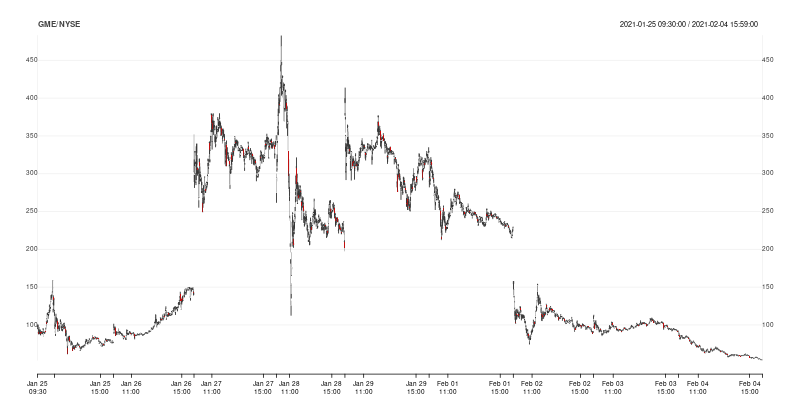
Thrilled to announce that a new package of mine just made it to CRAN: the td package accesses the twelvedata API for financial data. Currently only the time_series REST access point is supported, but it is already supported with all meaningful options (we skipped only JSON or CSV which makes no sense here) so for example any resolution between 1 minute and 1 month can be requested for any stock, etf or currency symbol for a wide array of exchanges. Historical access is available too via (optional) start and end dates. We return either raw JSON or a data.frame or an xts object making it trivial to call high-end plotting functions on the data the project and repo pages show several examples. As just one example, here is GME during the follies. We simply request via
> gme <- time_series("GME", "1min",
+                    start_date="2021-01-25 09:30:00",
+                    end_date="2021-02-04 16:00:00", as="xts")
(where the API key is either in a user-local config file accessed via the new-ish R function tools::R_user_dir("td") pointing at this package s directory, or via an environment variable; either is accessed at package load or attachment) from which we can then plot via quantmod
> quantmod::chart_Series(gme, name=paste0(attr(gme, "symbol"), "/", attr(gme, "exchange")))
which shows how we also helpfully store metadata returned by twelvedata as extra attributes of the object. The chart is You will need an API key to have up to 800 daily accesses for free, higher-performance plans (including websocket access) are available for paying customers too. I have only used the free API so far myself. I plan to add quote and price support this weekend, and generalize the time series access to returning lists of objects as the API does in fact support multi-security access. As always, feedback is welcomed. Please post comments and suggestions at the GitHub repo. If you like this or other open-source work I do, you can now sponsor me at GitHub.

This post by Dirk Eddelbuettel originated on his Thinking inside the box blog. Please report excessive re-aggregation in third-party for-profit settings.

10 February 2021

Dirk Eddelbuettel: RcppSMC 0.2.3 on CRAN: Updated Snapshot

A new release 0.2.3 of the RcppSMC package arrived on CRAN earlier today. Once again it progressed as a very quick pretest-publish within minutes of submission thanks CRAN! RcppSMC provides Rcpp-based bindings to R for the Sequential Monte Carlo Template Classes (SMCTC) by Adam Johansen described in his JSS article. Sequential Monte Carlo is also referred to as Particle Filter in some contexts. This release somewhat belatedly merges a branch Leah had been working on and which we all realized is ready . We now have a good snapshot to base new work on, as maybe with the Google Summer of Code 2021.

Changes in RcppSMC version 0.2.3 (2021-02-10)
  • Addition of a Github Action CI runner (Dirk)
  • Switching to inheritance for the moveset rather than pointers to functions (Leah in #45).

Courtesy of my CRANberries, there is a diffstat report for this release. More information is on the RcppSMC page. Issues and bugreports should go to the GitHub issue tracker. If you like this or other open-source work I do, you can now sponsor me at GitHub.

This post by Dirk Eddelbuettel originated on his Thinking inside the box blog. Please report excessive re-aggregation in third-party for-profit settings.

Dirk Eddelbuettel: RcppArmadillo 0.10.2.1.0: New Upstream Release

armadillo image Armadillo is a powerful and expressive C++ template library for linear algebra aiming towards a good balance between speed and ease of use with a syntax deliberately close to a Matlab. RcppArmadillo integrates this library with the R environment and language and is widely used by (currently) 823 other packages on CRAN. This release brings us Armadillo 10.2 with a few updates as detailed below in the list of changes. Upstream release 10.2 was made a couple of days ago, but we need to balance new upstream updates with a responsible release cadence at CRAN. As we needed a maintenance release in early January, I opted to wait four weeks with this one which hence gets us 10.2.0 and 10.2.1 at once. As tweeted (with a follow-up) it had yet another very smooth passage at CRAN so we again appreciate the excellent work of the CRAN maintainers and say Thank You!. Anybody who desires more frequent updates show look at the RcppCore drat repo which provides more frequent interim updates. Here for example we also had 0.10.2.0.0 available for your testing pleasure. Also of note is that here is now a Python variant pyarma for those who might want enjoy Armadillo with Python. The full set of changes follows.

Changes in RcppArmadillo version 0.10.2.1.0 (2021-02-09)
  • Upgraded to Armadillo release 10.2.1 (Cicada Swarm)
    • faster handling of subcubes
    • added tgamma()
    • added .brief_print() for abridged printing of matrices & cubes
    • expanded forms of trimatu() and trimatl() with diagonal specification to handle sparse matrices
    • expanded eigs_sym() and eigs_gen() with optional shift-invert mode

Courtesy of my CRANberries, there is a diffstat report relative to previous release. More detailed information is on the RcppArmadillo page. Questions, comments etc should go to the rcpp-devel mailing list off the R-Forge page. If you like this or other open-source work I do, you can sponsor me at GitHub.

This post by Dirk Eddelbuettel originated on his Thinking inside the box blog. Please report excessive re-aggregation in third-party for-profit settings.

Next.

Previous.