The libvirt and qemu versions in Debian Bullseye support a new feature that
allows for easier backup and recovery of virtual machines. Instead of using
snapshots for backup operation, its now possible to enable dirty
bitmaps. Other
hypervisors tend to call this changed block tracking .
Using the new backup
begin approach, its not
only possible to create live full backups (without having to create an
snapshot) but also track the changes between so called checkpoints,
which is very useful for incremental backups.
Over the course of the last few months, i have been working on a
simple backup and recovery utility called virtnbdbackup
It uses the pull based approach in the libvirt api set and currently
supports:
Thin provisioned full and incremental backups.
Compression (lz4).
Freezing the virtual machine guest fs via qemu-agent (if installed)
Multithreaded backup, if multiple disks are attached.
Point in time recovery to a given incremental backup.
Includes nbdkit plugin and utility that allows to map the thin provisioned
backup images to a block device, for single file or instant recovery (boot
the virtual machine directly from the backup image)
Preparing the virtual machines
The dirty bitmap feature is not enabled by default, users can enable
it by adding a new capability to a virtual machine configuration:
To finally enable the feature, power cycle virtual machine once.
Creating backups
By default, virtnbdbackup saves the virtual machine config, disks and
its logfiles to a given target directory. Its also possible to stream
the output into a uncompressed zip archive
Taking a backup is as simple as:
# virtnbdbackup -d vm2 -l full -o /tmp/WEEKLY_BACKUP/[..]
[2021-11-08 15:43:46] INFO virtnbdbackup - main [MainThread]: Backup jobs finished, stopping backup task.
[2021-11-08 15:43:46] INFO virtnbdbackup - main [MainThread]: Finished
# tree /tmp/WEEKLY_BACKUP/
/tmp/WEEKLY_BACKUP/
backup.full.11082021154343.log
checkpoints
virtnbdbackup.0.xml
sda.full.data
vm2.cpt
vmconfig.virtnbdbackup.0.xml
From that point on, its now possible to create incremental backups:
Restoring backups
The virtnbdrestore utility can be used to reconstruct the backup sets
into usable qcow images, like so:
# virtnbdrestore -a restore -i /tmp/WEEKLY_BACKUP/ -o /tmp/VM_RESTORE
Using the --until option its also possible to only reconstruct the
images to a certain checkpoint, allowing for point in time recovery.
Restoring single files
Via virtnbdmap you can map full backups back into an usable block device,
without having to reconstruct the complete backup image:
# virtnbdmap -f /tmp/WEEKLY_BACKUP/sda.full.data[..] INFO virtnbdmap - <module> [MainThread]: Done mapping backup image to [/dev/nbd0]
[..] INFO virtnbdmap - <module> [MainThread]: Press CTRL+C to disconnect
# fdisk -l /dev/nbd0
Disk /dev/nbd0: 2 GiB, 2147483648 bytes, 4194304 sectors
From here, you can either mount the disc and recover single files, or boot
from it via:
Arch Linux uses libarchive (bsdtar) in its build environment. The default tar
program installed is GNU tar. It is possible to create a source distribution
which leads to different files seen by the build environment than compared to
a careful reviewer and other Linux distributions.
Samanta notes that addressing the tar utilities themselves will not be a
sufficient fix:
I have submitted bug reports and patches to some projects but eventually I
had to conclude that the problem itself cannot be fixed by these
implementations alone. The best choice for these tools would be to only allow
archives which are fully compatible to standards but this in turn would
render a lot of archives broken.
Reproducible builds, with its twin ideas of reaching consensus on the build outputs as well as precisely recording and describing the build environment, would help address this problem at a higher level.
Codethink announced that they had achieved ISO-26262 ASIL D Tool Certification, a way of determining specific safety standards for software. Codethink used open source tooling to achieve this, but they also leverage:
Reproducibility, repeatability and traceability of builds, drawing heavily on best-practices championed by the Reproducible Builds project.
PackagingCon is a conference for developers of package management software, their communities and other stakeholders. This virtual event, which will take place on the 9th and 10th November 2021, has a mission is to bring different ecosystems together . The schedule for the event is now available to view online.
In addition, Trevor Rosen from SolarWinds presented at the Linux Foundation s Supply Chain Security Con last month on incorporating in-toto into their build system. in-toto a framework to secure the integrity of software supply chains. Trevor also discusses building everything twice to validate the first build la reproducible builds. (PDF slides)
Jeremiah announced the release of version 1.4 of stage0-posix, part of a broader effort to provide an ultra-minimal bootstrap seed to increase trust in our software stack.
Fredrik Str mberg offered an update on the Sigsum project and some specific milestones within transparency logging efforts: after a year of design iterations we have not only designed a transparency log but also decided to turn it into a project of its own .
There were quite a few changes to the Reproducible Builds website and documentation this month as well, including Feng Chai updating some links on our publications page [] and marco updated our project metadata around the Bitcoin Core building guide [].
Lastly, we ran another productive meeting on IRC during October. A full set of notes from the meeting is available to view.
Distribution work
Qubes was heavily featured in the latest edition of Linux Weekly News, and a significant section was dedicated to discussing reproducibility. For example, it was mentioned that the Qubes project has been working on incorporating reproducible builds into its continuous integration (CI) infrastructure . But the LWN article goes on to describe that:
The current goal is to be able to build the Qubes OS Debian templates solely from packages that can be built reproducibly. Templates in Qubes OS are VM images that can be used to start an application qube quickly based on the template. The qube will have read-only access to the root filesystem of the template, so that the same root filesystem can be shared with multiple application qubes. There are official templates for several variants of both Fedora and Debian, as well as community maintained templates for several other distributions.
You can view the whole article on LWN, and Fr d ric also published a lengthy summary about their work on reproducible builds in Qubes as well for those wishing to learn more.
In Debian this month, 133 reviews of Debian packages were added, 81 were updated and 24 were removed this month, adding to Debian s ever-growing knowledge about identified issues. A number of issues were categorised and added by Chris Lamb and Vagrant Cascadian too [][][]. In addition, work on alternative snapshot service has made progress by Fr d ric Pierret and Holger Levsen this month, including moving from the existing host (snapshot.notset.fr) to snapshot.reproducible-builds.org (more info) thanks to OSUOSL for the machine and hosting and Debian for the disks.
Finally, Bernhard M. Wiedemann posted his monthly reproducible builds status report.
diffoscopediffoscope is our in-depth and content-aware diff utility. Not only can it locate and diagnose reproducibility issues, it can provide human-readable diffs from many kinds of binary formats. This month, Chris Lamb made the following changes, including preparing and uploading versions 186, 187, 188 and 189 to Debian
New features:
Add support for Python Sphinx inventory files (usually named objects.inv on-disk). []
Add support for comparing .pyc files. Thanks to Sergei Trofimovich for the inspiration. []
Try some alternative suffixes (e.g. .py) to support distributions that strip or retain them. [][]
Bug fixes:
Fix Python decompilation tests under Python 3.10+ [] and for Python 3.7 [].
Don t raise a traceback if we cannot unmarshal Python bytecode. This is in order to support Python 3.7 failing to load .pyc files generated with newer versions of Python. []
Skip Python bytecode testing where we do not have an expected diff. []
Codebase improvements:
Use our file_version_is_lt utility instead of accepting both versions of uImage expected diff. []
Split out a custom call to assert_diff for a .startswith equivalent. []
Use skipif instead of manual conditionals in some tests. []
In addition, Jelle van der Waa added external tool references for Arch Linux for ocamlobjinfo, openssl and ffmpeg [][][] and added Arch Linux as a Continuous Integration (CI) test target. [] and Vagrant Cascadian updated the testsuite to skip Python bytecode comparisons when file(1) is older than 5.39. [] as well as added external tool references for the Guix distribution for dumppdf and ppudump. [][]. Vagrant Cascadian also updated the diffoscope package in GNU Guix [][].
Lastly, Guangyuan Yang updated the FreeBSD package name on the website [], Mattia Rizzolo made a change to override a new Lintian warning due to the new test files [], Roland Clobus added support to detect and log if the GNU_BUILD_ID field in an ELF binary been modified [], Sandro J ckel updated a number of helpful links on the website [] and Sergei Trofimovich made the uImage test output support file() version 5.41 [].
reprotestreprotest is the Reproducible Build s project end-user tool to build same source code twice in widely differing environments, checking the binaries produced by the builds for any differences.
This month, reprotest version 0.7.18 was uploaded to Debian unstable by Holger Levsen, which also included a change by Holger to clarify that Python 3.9 is used nowadays [], but it also included two changes by Vasyl Gello to implement realistic CPU architecture shuffling [] and to log the selected variations when the verbosity is configured at a sufficiently high level []. Finally, Vagrant Cascadian updated reprotest to version 0.7.18 in GNU Guix.
Upstream patches
The Reproducible Builds project detects, dissects and attempts to fix unreproducible packages. We try to send all of our patches upstream where appropriate. We authored a large number of such patches this month, including:
Testing framework
The Reproducible Builds project runs a testing framework at tests.reproducible-builds.org, to check packages and other artifacts for reproducibility. This month, the following changes were made:
Handle schroot errors when invoking diffoscope instead of masking them. [][]
Declare and define some variables separately to avoid masking the subshell return code. []
Fix variable name. []
Improve log reporting. []
Execute apt-get update with the -q argument to get more decent logs. []
Set the Debian HTTP mirror and proxy for snapshot.reproducible-builds.org. []
Install the libarchive-tools package (instead of bsdtar) when updating Jenkins nodes. []
Be stricter about errors when starting the node agent [] and don t overwrite NODE_NAME so that we can expect Jenkins to properly set for us [].
Explicitly warn if the NODE_NAME is not a fully-qualified domain name (FQDN). []
Document whether a node runs in the future. []
Disable postgresql_autodoc as it not available in bullseye. []
Don t be so eager when deleting schroot internals, call to schroot -e to terminate the schroots instead. []
Only consider schroot underlays for deletion that are over a month old. [][]
Only try to unmount /proc if it s actually mounted. []
Move the db_backup task to its own Jenkins job. []
Lastly, Vasyl Gello added usage information to the reproducible_build.sh script [].
Contributing
If you are interested in contributing to the Reproducible Builds project, please visit our Contribute page on our website. However, you can get in touch with us via:
part = MIMEImage(open('/path/to/image', 'rb').read())
s = smtplib.SMTP('localhost') s.sendmail(from_addr, to_addr, msg.as_string()) s.quit()
will produce an email with empty body and the image as an attachment.The better way, ie to have the image as part of the body of the email, requires to write an HTML body that refers to that image:
import smtplib
from email.mime.multipart import MIMEMultipart from email.mime.text import MIMEText from email.mime.image import MIMEImage
# Define the image's ID as referenced in the HTML body above image.add_header('Content-ID', '<image1>') msg.attach(image)
s = smtplib.SMTP('localhost') s.sendmail(from_addr, to_addr, msg.as_string()) s.quit()
The trick is to define an image with a specific Content-ID and make that the only item in an HTML body: now you have an email with contains that specific image as the only content of the body, embedded in it.
Bonus point: if you want to take a snapshot of a webpage (which is kinda the reason i needed the code above) i found it extremely useful to use the Google PageSpeed Insights API; a good description on how to use that API with Python is available at this StackOverflow answer.
UPDATE (2020-12-26): I was made aware via email that some mail providers may not display images inline when the Content-ID value is too short (say, for example, Content-ID: 1). A solution that seems to work on most of the providers is using a sequence of random chars prefixed with a dot and suffixed with a valid mail domain.
An updated version 0.2.2 of the random-number generator tester RDieHarder (based on the DieHarder suite developed / maintained by Robert Brown with contributions by David Bauer and myself) is now on CRAN.
I should dub this the due to Brian Ripley release. He sent me a detailed five-point email a few days ago which detailed a change I could not have tested ( no access ), a change I would not have known ( somewhat obscure C language bit-level manipulation ), a change I had missed (how my build setup failed for M1mac), another advanced C level fix, and one more simple fix I actually knew. Speechless. The man (I presume) does not sleep and is just so generous with his time and expertise.
So based on the input I rejigged the package over the weekend and made two more (substantial) changes. First, extending on what 0.2.0 brought, I will no longer attempt to use an external libdieharder library (or build one on the fly) that was issue one. Now we just declare all C files as dependents of the package shared library, and things are simpler and more consistent. Sadly, that also implies everything is in the package so I had to edit out a metric ton of stdout or exit() reference with the appropriate R C API hooks to appease the CRAN Policy deities. Win some, loose some. But the package is now simpler, and cleaner, and should be in good standing. (Or so one hopes. Earlier today, and within hours of it hitting CRAN, I got an issue ticket from a motivated user about yet another ( mostly harmless in the Douglas Adams sense) compiler warning Good now too.)
Thanks to CRANberries, you can also look at the most recent diff.
If you like this or other open-source work I do, you can now sponsor me at GitHub.
I think most people and everyone who reads my blog is familiar with the phone support scams that are common nowadays. There s the we are Microsoft support and have found a problem with your PC , the we are from your ISP and want to warn you that your Internet access will be cut off , and the here s the bill for something expensive and we need you to confirm whether you want to pay .
Most people hang up when scammers call them and don t call them back. But I like to talk to them. I review the quality of their criminal enterprise and tell them that I expect better quality criminals to call me. I ask them if they are proud to be criminals and if their parents would be proud of them. I ask them if they are paid well to be a criminal. Usually they just hang up and on one occasion the criminal told me to get lost before hanging up.
Today I got a spam message telling me to phone +61-2-8006-7237 about an invoice for Norton Software Enhancer and Firewall Defender if I wanted to dispute it. It was interesting that they had an invoice number in the email which they asked me for when I called, at the time I didn t think to make up an invoice number with the same format to determine if they were actually looking it up, in retrospect I should have used a random 9 digit number to determine if they had a database for this.
On the first call they just hung up on me. The second call they told me you won t save anyone before hanging up. The third call I got on to a friendly and talkative guy who told me that he was making good money being a criminal. I asked if he was in India or Australia (both guys had accents from the Indian subcontinent), he said he was in Pakistan. He said that he made good money by Pakistani standards as $1 Australian is over 100 Pakistani Rupees. He asked me if I d like to work for him, I said that I make good money doing legal things, he said that if I have so much money I could send him some. ;) He also offered to take me on a tour of Islamabad if I visited, this could have been a genuine offer to have a friendly meeting with someone from the opposite site of computer security or an attempt at kidnap for ransom. He didn t address my question about whether the local authorities would be interested in his work, presumably he thinks that a combination of local authorities not caring much and the difficulty of tracking international crime makes him safe.
It was an interesting conversation, I encourage everyone to chat to such criminals. They are right that you won t save anyone. But you can have some fun and occasionally learn some interesting things.
Related posts:
Talking Fast My previous post about my LCA mini-conf talk received an...
I grew up with the Internet and its ethics and politics have always
been important in my life. But I have also been involved at other
levels, against police brutality, for Food, Not Bombs,
worker autonomy, software freedom, etc. For a long time,
that all seemed coherent.
But the more I look at the modern Internet -- and the
mega-corporations that control it -- and the less confidence I have in
my original political analysis of the liberating potential of
technology. I have come to believe that most of our technological
development is harmful to the large majority of the population of the
planet, and of course the rest of the biosphere. And now I feel this
is not a new problem.
This is because the Internet is a neo-colonial device, and has been
from the start. Let me explain.
What is Neo-Colonialism?
The term "neo-colonialism" was coined by Kwame Nkrumah,
first president of Ghana. In Neo-Colonialism, the Last Stage of
Imperialism (1965), he wrote:
In place of colonialism, as the main instrument of imperialism, we
have today neo-colonialism ... [which] like colonialism, is an
attempt to export the social conflicts of the capitalist
countries. ...
The result of neo-colonialism is that foreign capital is used for
the exploitation rather than for the development of the less
developed parts of the world. Investment, under neo-colonialism,
increases, rather than decreases, the gap between the rich and the
poor countries of the world.
So basically, if colonialism is Europeans bringing genocide, war,
and its religion to the Africa, Asia, and the Americas,
neo-colonialism is the Americans (note the "n") bringing capitalism to
the world.
Before we see how this applies to the Internet, we must therefore make
a detour into US history. This matters, because anyone would be
hard-pressed to decouple neo-colonialism from the empire under which
it evolves, and here we can only name the United States of America.
US Declaration of Independence
Let's start with the United States declaration of independence
(1776). Many Americans may roll their eyes at this, possibly because
that declaration is not actually part of the US constitution and
therefore may have questionable legal standing. Still, it was
obviously a driving philosophical force in the founding of the
nation. As its author, Thomas Jefferson, stated:
it was intended to be an expression of the American mind, and to
give to that expression the proper tone and spirit called for by the
occasion
In that aging document, we find the following pearl:
We hold these truths to be self-evident, that all men are created
equal, that they are endowed by their Creator with certain
unalienable Rights, that among these are Life, Liberty and the
pursuit of Happiness.
As a founding document, the Declaration still has an impact in the
sense that the above quote has been called an:
"immortal declaration", and "perhaps [the] single phrase" of the
American Revolutionary period with the greatest "continuing
importance." (Wikipedia)
Let's read that "immortal declaration" again: "all men are created
equal". "Men", in that context, is limited to a certain number of
people, namely "property-owning or tax-paying white males, or about
6% of the population". Back when this was written, women didn't
have the right to vote, and slavery was legal. Jefferson himself owned
hundreds of slaves.
The declaration was aimed at the King and was a list of
grievances. A concern of the colonists was that the King:
has excited domestic insurrections amongst us, and has endeavoured
to bring on the inhabitants of our frontiers, the merciless Indian
Savages whose known rule of warfare, is an undistinguished
destruction of all ages, sexes and conditions.
This is a clear mark of the frontier myth which paved the way for
the US to exterminate and colonize the territory some now call the
United States of America.
The declaration of independence is obviously a colonial document,
having being written by colonists. None of this is particularly
surprising, historically, but I figured it serves as a good reminder
of where the Internet is coming from, since it was born in the US.
A Declaration of the Independence of Cyberspace
Two hundred and twenty years later, in 1996, John Perry Barlow
wrote a declaration of independence of cyberspace. At this
point, (almost) everyone has a right to vote (including women),
slavery was abolished (although some argue it still exists in the
form of the prison system); the US has made tremendous
progress. Surely this text will have aged better than the previous
declaration it is obviously derived from. Let's see how it reads today
and how it maps to how the Internet is actually built now.
Borders of Independence
One of the key ideas that Barlow brings up is that "cyberspace does
not lie within your borders". In that sense, cyberspace is the final
frontier: having failed to colonize the moon, Americans turn
inwards, deeper into technology, but still in the frontier
ideology. And indeed, Barlow is one of the co-founder of the
Electronic Frontier Foundation (the beloved EFF), founded six
years prior.
But there are other problems with this idea. As Wikipedia quotes:
The declaration has been criticized for internal
inconsistencies.[9] The declaration's assertion that
'cyberspace' is a place removed from the physical world has also
been challenged by people who point to the fact that the Internet is
always linked to its underlying geography.[10]
And indeed, the Internet is definitely a physical object. First
controlled and severely restricted by "telcos" like AT&T, it was
somewhat "liberated" from that monopoly in 1982 when an anti-trust
lawsuitbroke up the monopoly, a key historical event that,
one could argue, made the Internet possible.
(From there on, "backbone" providers could start competing and emerge,
and eventually coalesce into new monopolies: Google has a monopoly on
search and advertisement, Facebook on communications for a few
generations, Amazon on storage and computing, Microsoft on hardware,
etc. Even AT&T is now pretty much as consolidated as it was
before.)
The point is: all those companies have gigantic data centers and
intercontinental cables. And those are definitely prioritizing the
western world, the heart of the empire. Take for example Google's
latest 3,900 mile undersea cable: it does not connect Argentina to
South Africa or New Zealand, it connects the US to UK and
Spain. Hardly a revolutionary prospect.
Private Internet
But back to the Declaration:
Do not think that you can build it, as though it were a public
construction project. You cannot. It is an act of nature and it
grows itself through our collective actions.
In Barlow's mind, the "public" is bad, and private is good,
natural. Or, in other words, a "public construction project" is
unnatural. And indeed, the modern "nature" of development is private:
most of the Internet is now privately owned and operated.
I must admit that, as an anarchist, I loved that sentence when I read
it. I was rooting for "us", the underdogs, the revolutionaries. And,
in a way, I still do: I am on the board of Koumbit and work for a
non-profit that has pivoted towards censorship and surveillance
evasion. Yet I cannot help but think that, as a whole, we have failed
to establish that independence and put too much trust in private
companies. It is obvious in retrospect, but it was not, 30 years
ago.
Now, the infrastructure of the Internet has zero accountability to
traditional political entities supposedly representing the people, or
even its users. The situation is actually worse than when the US was
founded (e.g. "6% of the population can vote"), because the owners of the
tech giants are only a handful of people who can override any
decision. There's only one Amazon CEO, he's called Jeff Bezos, and he
has total control. (Update: Bezos actually ceded the CEO role to Andy
Jassy, AWS and Amazon music founder, while remaining executive
chairman. I would argue that, as the founder and the richest man
on earth, he still has strong control over Amazon.)
Social Contract
Here's another claim of the Declaration:
We are forming our own Social Contract.
I remember the early days, back when "netiquette" was a word, it
did feel we had some sort of a contract. Not written in standards of
course -- or barely (see RFC1855) -- but as a tacit
agreement. How wrong we were. One just needs to look at Facebook to
see how problematic that idea is on a global network.
Facebook is the quintessential "hacker" ideology put in practice. Mark
Zuckerberg explicitly refused to be "arbiter of truth" which
implicitly means he will let lies take over its platforms.
He also sees Facebook as place where everyone is equal, something
that echoes the Declaration:
We are creating a world that all may enter without privilege or
prejudice accorded by race, economic power, military force, or
station of birth.
(We note, in passing, the omission of gender in that list, also
mirroring the infamous "All men are created equal" claim of the US
declaration.)
As the Wall Street Journal's (WSJ) Facebook files later shown,
both of those "contracts" have serious limitations inside Facebook. There are
VIPs who systematically bypass moderation systems including
fascists and rapists. Drug cartels and human traffickers
thrive on the platform. Even when Zuckerberg himself tried to
tame the platform -- to get people vaccinated or to make it
healthier -- he failed: "vaxxer" conspiracies multiplied and
Facebook got angrier.
This is because the "social contract" behind Facebook and those large
companies is a lie: their concern is profit and that means
advertising, "engagement" with the platform, which causes increased
anxiety and depression in teens, for example.
Facebook's response to this is that they are working really hard on
moderation. But the truth is that even that system is severely
skewed. The WSJ showed that Facebook has translators for only 50
languages. It's a surprisingly hard to count human languages but
estimates range the number of distinct languages between 2500
and 7000. So while 50 languages seems big at first, it's actually a
tiny fraction of the human population using Facebook. Taking the first
50 of the Wikipedia list of languages by native speakers we omit
languages like Dutch (52), Greek (74), and Hungarian (78), and that's
just a few random nations picks from Europe.
As an example, Facebook has trouble moderating even a major language
like Arabic. It censored content from legitimate Arab news sources
when they mentioned the word al-Aqsa because Facebook associates
it with the al-Aqsa Martyrs' Brigades when they were talking
about the Al-Aqsa Mosque... This bias against Arabs also shows
how Facebook reproduces the American colonizer politics.
The WSJ also pointed out that Facebook spends only 13% of its
moderation efforts outside of the US, even if that represents 90% of
its users. Facebook spends three more times moderating on "brand
safety", which shows its priority is not the safety of its users, but
of the advertisers.
Military Internet
Sergey Brin and Larry Page are the Lewis and Clark of
our generation. Just like the latter were sent by Jefferson (the same)
to declare sovereignty over the entire US west coast, Google declared
sovereignty over all human knowledge, with its mission statement "to
organize the world's information and make it universally accessible
and useful". (It should be noted that Page somewhat questioned that
mission but only because it was not ambitious enough, Google
having "outgrown" it.)
The Lewis and Clark expedition, just like Google, had a scientific
pretext, because that is what you do to colonize a world,
presumably. Yet both men were military and had to receive scientific
training before they left. The Corps of Discovery was made up of
a few dozen enlisted men and a dozen civilians, including York an
African American slave owned by Clark and sold after the
expedition, with his final fate lost in history.
And just like Lewis and Clark, Google has a strong military
component. For example, Google Earth was not originally built at
Google but is the acquisition of a company called Keyhole which had
ties with the CIA. Those ties were brought inside Google during
the acquisition. Google's increasing investment inside the
military-industrial complex eventually led Google to workers
organizing a revolt although it is currently unclear to me how
much Google is involved in the military apparatus. Other companies,
obviously, do not have such reserve, with Microsoft, Amazon, and
plenty of others happily bidding on military contracts all the time.
Spreading the Internet
I am obviously not the first to identify colonial structures in the
Internet. In an article titled The Internet as an Extension of
Colonialism, Heather McDonald correctly identifies fundamental
problems with the "development" of new "markets" of Internet
"consumers", primarily arguing that it creates a digital divide
which creates a "lack of agency and individual freedom":
Many African people have gained access to these technologies but not
the freedom to develop content such as web pages or social media
platforms in their own way. Digital natives have much more power and
therefore use this to create their own space with their own norms,
shaping their online world according to their own outlook.
But the digital divide is certainly not the worst problem we have to
deal with on the Internet today. Going back to the Declaration, we
originally believed we were creating an entirely new world:
This governance will arise according to the conditions of our
world, not yours. Our world is different.
How I dearly wished that was true. Unfortunately, the Internet is
not that different from the offline world. Or, to be more accurate,
the values we have embedded in the Internet, particularly of free
speech absolutism, sexism, corporatism, and exploitation, are now
exploding outside of the Internet, into the "real" world.
The Internet was built with free software which, fundamentally, was
based on quasi-volunteer labour of an elite force of white men with
obviously too much time on their hands (and also: no children). The
mythical writing of GCC and Emacs by Richard Stallman is a good
example of this, but the entirety of the Internet now seems to be
running on random bits and pieces built by hit-and-run programmers
working on their copious free time. Whenever any of those fails,
it can compromise or bring down entire systems. (Heck, I wrote
this article on my day off...)
This model of what is fundamentally "cheap labour" is spreading out
from the Internet. Delivery workers are being exploited to the bone by
apps like Uber -- although it should be noted that workers organise
and fight back. Amazon workers are similarly exploited beyond
belief, forbidden to take breaks until they pee in bottles, with
ambulances nearby to carry out the bodies. During peak of the
pandemic, workers were being dangerously exposed to the virus in
warehouses. All this while Amazon is basically taking over the entire
economy.
The Declaration culminates with this prophecy:
We will spread ourselves across the Planet so that no one can arrest
our thoughts.
This prediction, which first felt revolutionary, is now chilling.
Colonial Internet
The Internet is, if not neo-colonial, plain colonial. The US colonies
had cotton fields and slaves, we have disposable cell phones and
Foxconn workers. Canada has its cultural genocide, Facebook
has his own genocides in Ethiopia, Myanmar, and mob violence
in India. Apple is at least implicitly accepting the Uyghur
genocide. And just like the slaves of the colony, those atrocities
are what makes the empire run.
The Declaration actually ends like this, a quote which I have in my
fortune cookies file:
We will create a civilization of the Mind in Cyberspace. May it be
more humane and fair than the world your governments have made
before.
That is still inspiring to me. But if we want to make "cyberspace"
more humane, we need to decolonize it. Work on cyberpeace instead of
cyberwar. Establish clear code of conduct, discuss ethics, and
question your own privileges, biases, and culture. For me the first
step in decolonizing my own mind is writing this article. Breaking
uptech monopolies might be an important step, but it won't be
enough: we have to do a culture shift as well, and that's the hard
part.
Appendix: an apology to Barlow
I kind of feel bad going through Barlow's declaration like this, point
by point. It is somewhat unfair, especially since Barlow passed away a
few years ago and cannot mount a response (even humbly assuming that
he might read this). But then again, he himself recognized he was
a bit too "optimistic" in 2009, saying: "we all get older and
smarter":
I'm an optimist. In order to be libertarian, you have to be an
optimist. You have to have a benign view of human nature, to believe
that human beings left to their own devices are basically good. But
I'm not so sure about human institutions, and I think the real point
of argument here is whether or not large corporations are human
institutions or some other entity we need to be thinking about
curtailing. Most libertarians are worried about government but not
worried about business. I think we need to be worrying about
business in exactly the same way we are worrying about government.
And, in a sense, it was a little naive to expect Barlow to not be a
colonist. Barlow is, among many things, a cattle rancher who grew up
on a colonial ranch in Wyoming. The ranch was founded in 1907 by his
great uncle, 17 years after the state joined the Union, and only a
generation or two after the Powder River War (1866-1868) and
Black Hills War (1876-1877) during which the US took over lands
occupied by Lakota, Cheyenne, Arapaho, and other native American
nations, in some of the last major First Nations Wars.
Appendix: further reading
There is another article that almost has the same title as this one:
Facebook and the New Colonialism. (Interestingly, the <title>
tag on the article is actually "Facebook the Colonial Empire" which I
also find appropriate.) The article is worth reading in full, but I
loved this quote so much that I couldn't resist reproducing it here:
Representations of colonialism have long been present in digital
landscapes. ( Even Super Mario Brothers, the video game designer
Steven Fox told me last year. You run through the landscape, stomp
on everything, and raise your flag at the end. ) But web-based
colonialism is not an abstraction. The online forces that shape a
new kind of imperialism go beyond Facebook.
It goes on:
Consider, for example, digitization projects that focus primarily on
English-language literature. If the web is meant to be humanity s new
Library of Alexandria, a living repository for all of humanity s
knowledge, this is a problem. So is the fact that the vast majority of
Wikipedia pages are about a relatively tiny square of the planet. For
instance, 14 percent of the world s population lives in Africa, but
less than 3 percent of the world s geotagged Wikipedia articles
originate there, according to a 2014 Oxford Internet Institute
report.
And they introduce another definition of Neo-colonialism, while
warning about abusing the word like I am sort of doing here:
I m loath to toss around words like colonialism but it s hard to
ignore the family resemblances and recognizable DNA, to wit, said
Deepika Bahri, an English professor at Emory University who focuses
on postcolonial studies. In an email, Bahri summed up those
similarities in list form:
ride in like the savior
bandy about words like equality, democracy, basic rights
mask the long-term profit motive (see 2 above)
justify the logic of partial dissemination as better than nothing
partner with local elites and vested interests
accuse the critics of ingratitude
In the end, she told me, if it isn t a duck, it shouldn t quack
like a duck.
Another good read is the classic Code and other laws of
cyberspace (1999, free PDF) which is also critical of
Barlow's Declaration. In "Code is law", Lawrence Lessig argues that:
computer code (or "West Coast Code", referring to Silicon Valley)
regulates conduct in much the same way that legal code (or "East
Coast Code", referring to Washington, D.C.) does (Wikipedia)
And now it feels like the west coast has won over the east coast, or
maybe it recolonized it. In any case, Internet now christens
emperors.
I recently had to renew the SSL certificate for my web server, nothing exciting about that but Certbot created a new directory for the key because I had removed some domains (moved to a different web server). This normally isn t a big deal, change the Apache configuration to the new file names and run the reload command. My monitoring system initially said that the SSL certificate wasn t going to expire in the near future so it looked fine. Then an hour later my monitoring system told me that the certificate was about to expire, apparently the old certificate came back!
I viewed my site with my web browser and the new certificate was being used, it seemed strange. Then I did more tests with gnutls-cli which revealed that exactly half the connections got the new certificate and half got the old one. Because my web server isn t doing anything particularly demanding the mpm_event configuration only starts 2 servers, and even that may be excessive for what it does. So it seems that the Apache reload command had reloaded the configuration on one mpm_event server but not the other!
Fortunately this was something that was easy to test and was something that was automatically tested. If the change that didn t get accepted was something small it would be a particularly insidious bug.
I haven t yet tried to reproduce this. But if I get the time I ll do so and file a bug report.
Like each month, have a look at the work funded by Freexian s Debian LTS offering.
Debian project funding
Folks from the LTS team, along with members of the Debian Android Tools team and Phil Morrel, have proposed work on the Java build tool, gradle, which is currently blocked due to the need to build with a plugin not available in Debian. The LTS team reviewed the project submission and it has been approved. After approval we ve created a Request for Bids which is active now.
You ll hear more about this through official Debian channels, but in the meantime, if you feel you can help with this project, please submit a bid. Thanks!
This September, Freexian set aside 2550 EUR to fund Debian projects.
We re looking forward to receive more projects from various Debian teams! Learn more about the rationale behind this initiative in this article.
Debian LTS contributors
In September, 15 contributors have been paid to work on Debian LTS, their reports are available:
Abhijith PA has returned hours and marked themselves inactive, at least for the time being. He did 0h out of 14h, carried over 14h and returned 28h.
Adrian Bunk did 19.5h (out of 24.75h assigned and 12.75 from August), carrying over 18h to October.
Emilio Pozuelo Monfort did not report back about their work so we assume they did nothing (out of 5.5h assigned plus 74.5h from August), thus is carrying over 80h for October.
Holger Levsen did 3h (out of 12h assigned) and gave back 9h and carried over 3h.
Jeremiah Foster worked 10 hours (out of 20h assigned) on LTS work, carrying over 10h.
Lee Garrett did not report back about their work so we assume they did nothing (out of 24.75h assigned and 23.75 from August), thus is carrying over 48.50h for October.
Markus Koschany did 43.5h (out of 24.75h assigned and 18.75h from August)
Utkarsh Gupta did 24.75h (out of 24.75h assigned) but did not publish his report yet.
Ola Lundqvist did 2 hours (out of 21h carried over from previous months), and is thus carrying 19h for October.
Evolution of the situation
In September we released 30 DLAs. September was also the second month of Jeremiah coordinating LTS contributors.
Also, we would like say that we are always looking for new contributors to LTS. Please contact Jeremiah if you are interested!
The security tracker currently lists 33 packages with a known CVE and the dla-needed.txt file has 26 packages needing an update.
Thanks to our sponsors
Sponsors that joined recently are in bold.
Let s say you re someone who happens to discover an AWS account number, and would
like to take a stab at guessing what IAM users might be valid in that account.
Tricky problem, right? Not with this One Weird Trick!
In your own AWS account, create a KMS key and try to reference an ARN
representing an IAM user in the other account as the principal. If the policy
is accepted by PutKeyPolicy, then that IAM account exists, and if the error
says Policy contains a statement with one or more invalid principals then the
user doesn t exist.
As an example, say you want to guess at IAM users in AWS account 111111111111.
Then make sure this statement is in your key policy:
  "Sid": "Test existence of user",
  "Effect": "Allow",
  "Principal":
    "AWS": "arn:aws:iam::111111111111:user/bob"
   ,
  "Action": "kms:DescribeKey",
  "Resource": "*"
If that policy is accepted, then the account has an IAM user named bob.
Otherwise, the user doesn t exist. Scripting this is left as an exercise for
the reader.
Sadly, wildcards aren t accepted in the username portion of the ARN, otherwise
you could do some funky searching with ...:user/a*, ...:user/b*, etc. You
can t have everything; where would you put it all?
I did mention this to AWS as an account enumeration risk. They re of the opinion
that it s a good thing you can know what users exist in random other AWS accounts.
I guess that means this is a technique you can put in your toolbox safe in the
knowledge it ll work forever.
Given this is intended behaviour, I assume you don t need to use a key policy
for this, but that s where I stumbled over it. Also, you can probably use it
to enumerate roles and anything else that can be a principal, but since I
don t see as much use for that, I didn t bother exploring it.
There you are, then. If you ever need to guess at IAM users in another AWS account,
now you can!
The goal behind reproducible builds is to ensure that no deliberate flaws have been introduced during compilation processes via promising or mandating that identical results are always generated from a given source. This allowing multiple third-parties to come to an agreement on whether a build was compromised or not by a system of distributed consensus.
In these reports we outline the most important things that have been happening in the world of reproducible builds in the past month:
First mentioned in our March 2021 report, Martin Heinz published two blog posts on sigstore, a project that endeavours to offer software signing as a public good, [the] software-signing equivalent to Let s Encrypt . The two posts, the first entitled Sigstore: A Solution to Software Supply Chain Security outlines more about the project and justifies its existence:
Software signing is not a new problem, so there must be some solution already, right? Yes, but signing software and maintaining keys is very difficult especially for non-security folks and UX of existing tools such as PGP leave much to be desired. That s why we need something like sigstore - an easy to use software/toolset for signing software artifacts.
Some time ago I checked Signal s reproducibility and it failed. I asked others to test in case I did something wrong, but nobody made any reports. Since then I tried to test the Google Play Store version of the apk against one I compiled myself, and that doesn t match either.
BitcoinBinary.org was announced this month, which aims to be a repository of Reproducible Build Proofs for Bitcoin Projects :
Most users are not capable of building from source code themselves, but we can at least get them able enough to check signatures and shasums. When reputable people who can tell everyone they were able to reproduce the project s build, others at least have a secondary source of validation.
Related to this, there was continuing discussion on how to embed/encode the build metadata for the Debian live images which were being worked on by Roland Clobus.
Ariadne Conill published another detailed blog post related to various security initiatives within the Alpine Linux distribution. After summarising some conventional security work being done (eg. with sudo and the release of OpenSSH version 3.0), Ariadne included another section on reproducible builds: The main blocker [was] determining what to do about storing the build metadata so that a build environment can be recreated precisely .
Finally, Bernhard M. Wiedemann posted his monthly reproducible builds status report.
Community news
On our website this month, Bernhard M. Wiedemann fixed some broken links [] and Holger Levsen made a number of changes to the Who is Involved? page [][][]. On our mailing list, Magnus Ihse Bursie started a thread with the subject Reproducible builds on Java, which begins as follows:
I m working for Oracle in the Build Group for OpenJDK which is primary responsible for creating a built artifact of the OpenJDK source code. [ ] For the last few years, we have worked on a low-effort, background-style project to make the build of OpenJDK itself building reproducible. We ve come far, but there are still issues I d like to address. []
diffoscopediffoscope is our in-depth and content-aware diff utility. Not only can it locate and diagnose reproducibility issues, it can provide human-readable diffs from many kinds of binary formats. This month, Chris Lamb prepared and uploaded versions 183, 184 and 185 as well as performed significant triaging of merge requests and other issues in addition to making the following changes:
New features:
Support a newer format version of the R language s .rds files. []
Don t call close_archive when garbage collecting Archive instances, unless open_archive definitely returned successfully. This prevents, for example, an AttributeError where PGPContainer s cleanup routines were rightfully assuming that its temporary directory had actually been created. []
Fix (and test) the comparison of R language s .rdb files after refactoring temporary directory handling. []
Ensure that RPM archives exists in the Debian package description, regardless of whether python3-rpm is installed or not at build time. []
Codebase improvements:
Use our assert_diff routine in tests/comparators/test_rdata.py. []
Move diffoscope.versions to diffoscope.tests.utils.versions. []
Reformat a number of modules with Black. [][]
However, the following changes were also made:
Mattia Rizzolo:
Fix an autopkgtest caused by the androguard module not being in the (expected) python3-androguard Debian package. []
Appease a shellcheck warning in debian/tests/control.sh. []
Ignore a warning from h5py in our tests that doesn t concern us. []
Drop a trailing .1 from the Standards-Version field as it s required. []
Zbigniew J drzejewski-Szmek:
Stop using the deprecated distutils.spawn.find_executable utility. [][][][][]
Adjust an LLVM-related test for LLVM version 13. []
Update invocations of llvm-objdump. []
Adjust a test with a one-byte text file for file version 5.40. []
And, finally, Benjamin Peterson added a --diff-context option to control unified diff context size [] and Jean-Romain Garnier fixed the Macho comparator for architectures other than x86-64 [].
Upstream patches
The Reproducible Builds project detects, dissects and attempts to fix as many currently-unreproducible packages as possible. We endeavour to send all of our patches upstream where appropriate. This month, we wrote a large number of such patches, including:
#990246 filed against vlc (forwarded upstream [][])
Testing framework
The Reproducible Builds project runs a testing framework at tests.reproducible-builds.org, to check packages and other artifacts for reproducibility. This month, the following changes were made:
Holger Levsen:
Drop my package rebuilder prototype as it s not useful anymore. []
Schedule old packages in Debian bookworm. []
Stop scheduling packages for Debian buster. [][]
Don t include PostgreSQL debug output in package lists. []
Detect Python library mismatches during build in the node health check. []
Update a note on updating the FreeBSD system. []
Mattia Rizzolo:
Silence a warning from Git. []
Update a setting to reflect that Debian bookworm is the new testing. []
Upgrade the PostgreSQL database to version 13. []
Roland Clobus (Debian live image generation):
Workaround non-reproducible config files in the libxml-sax-perl package. []
Use the new DNS for the snapshot service. []
Vagrant Cascadian:
Also note that the armhf architecture also systematically varies by the kernel. []
Contributing
If you are interested in contributing to the Reproducible Builds project, please visit our Contribute page on our website. However, you can get in touch with us via:
Like each month, have a look at the work funded by Freexian s Debian LTS offering.
Debian project funding
In August, we put aside 2460 EUR to fund Debian projects. We received a new project proposal that got approved and there s an associated bid request if you feel like proposing yourself to implement this project.
We re looking forward to receive more projects from various Debian teams! Learn more about the rationale behind this initiative in this article.
Debian LTS contributors
In August, 14 contributors have been paid to work on Debian LTS, their reports are available:
Abhijith PA did 4.0h (out of 14h assigned and 5h from August), thus carrying over 15h to September.
Adrian Bunk did 11h (out of 23.75h assigned), thus carrying over 12.75h to September.
Emilio Pozuelo Monfort did not report back about their work so we assume they did nothing (out of 23.75h assigned plus 50.75h from August), thus is carrying over 74.5h for September.
Holger Levsen did 3h (out of 12h assigned) to help coordinate the team, and gave back the remaining hours.
Lee Garrett did nothing (out of 23.75h assigned), thus is carrying over 23.75h for September.
Markus Koschany did 35h (out of 23.75h assigned and 30h from August), thus carrying over 18.75h to September.
Neil Williams did 24h (out of 23.75h assigned), thus anticipating 0.25h of October.
Roberto C. S nchez did 22.25h (out of 23.75h assigned), thus carrying over 1.5h to September.
Sylvain Beucler did 21.5h (out of 23.75h assigned), thus carrying over 2.25h to September.
Evolution of the situation
In August we released 30 DLAs.
This is the first month of Jeremiah coordinating LTS contributors. We would like to thank Holger Levsen for his work on this role up to now.
Also, we would like to remark once again that we are constantly looking for new contributors. Please contact Jeremiah if you are interested!
The security tracker currently lists 73 packages with a known CVE and the dla-needed.txt file has 29 packages needing an update.
Thanks to our sponsors
Sponsors that joined recently are in bold.
Or perhaps this, if you also wanted to send ssh to the background:
ssh -NT -L 3306:db.example.com:3306 example.com &
Both of these use at least one option that is entirely redundant,
and the second can cause ssh to fail to connect if you happen to be
using password authentication.
However, they seem to still persist in various articles about ssh port forwarding.
I myself was using the first variation until just recently, and I figured
I would write this up to inform others who might be still using these
solutions.
The correct option for this situation is not -nNT but simply
-N, as in:
If you want to also send ssh to the background,
then you ll want to add -f instead of using your shell s built-in &
feature, because you can then input passwords into ssh if necessary1
Honestly, that s the point of this article, so you can stop here
if you want. If you re looking for a detailed explaination of what
each of these options actually does, or if you have no idea what
I m talking about, read on!
What is SSH Port Forwarding?
ssh is a powerful tool for remote access to servers,
allowing you to execute commands on a remote machine.
It can also forward ports
through a secure tunnel with the -L and -R options.
Basically, you can forward a connection to a local port to a remote server
like so:
ssh -L 8080:other.example.com:80 ssh.example.com
In this example, you connect to ssh.example.com and then ssh forwards
any traffic on your local machine port 80802
to other.example.com port 80 via ssh.example.com.
This is a really powerful feature, allowing you to jump3 inside your firewall
with just an ssh server exposed to the world.
It can work in reverse as well with the -R option, allowing connections
on a remote host in to a server running on your local machine.
For example, say you were running a website on your local machine on port 8080
but wanted it accessible on example.com port 804.
You could use something like:
ssh -R 8080:example.com:80 example.com
The trouble with ssh port forwarding is that, absent any additional options,
you also open a shell on the remote machine.
If you re planning to both work on a remote machine and use it to forward
some connection, this is fine, but if you just need to forward a port quickly
and don t care about a shell at that moment, it can be annoying, especially since
if the shell closes ssh will close the forwarding port as well.
This is where the -N option comes in.
SSH just forwarding ports
In the ssh manual page5, -N is explained like so:
Do not execute a remote command. This is useful for just forwarding ports.
This is all we need. It instructs ssh to run no commands on the remote server,
just forward the ports specified in the -L or -R options.
But people seem to think that there are a bunch of other necessary options,
so what do those do?
SSH and stdin
-n controls how ssh interacts with standard input,
specifically telling it not to:
Redirects stdin from /dev/null (actually, prevents reading from stdin). This must be used when ssh is run in the
background. A common trick is to use this to run X11 programs on a remote machine. For example, ssh -n
shadows.cs.hut.fi emacs & will start an emacs on shadows.cs.hut.fi, and the X11 connection will be automatically for
warded over an encrypted channel. The ssh program will be put in the background. (This does not work if ssh needs to
ask for a password or passphrase; see also the -f option.)
SSH passwords and backgrounding
-f sends ssh to background, freeing up the terminal in which you ran ssh
to do other things.
Requests ssh to go to background just before command execution. This is useful if ssh is going to ask for passwords
or passphrases, but the user wants it in the background. This implies -n. The recommended way to start X11 programs
at a remote site is with something like ssh -f host xterm.
As indicated in the description of -n, this does the same thing as using
the shell s & feature
with -n, but allows you to put in any necessary passwords first.
SSH and pseudo-terminals
-T is a little more complicated than the others and has a very short
explanation:
Disable pseudo-terminal allocation.
It has a counterpart in -t, which is explained a little better:
Force pseudo-terminal allocation. This can be used to execute arbitrary screen-based programs on a remote machine,
which can be very useful, e.g. when implementing menu services. Multiple -t options force tty allocation, even if ssh
has no local tty.
As the description of -t indicates, ssh is allocating a pseudo-terminal on
the remote machine, not the local one.
However, I have confirmed6 that -N doesn t allocate a pseudo-terminal either,
since it doesn t run any commands.
Thus this option is entirely unnecessary.
What s a pseudo-terminal?
This is a bit complicated, but basically it s an interface used in UNIX-like
systems, like Linux or BSD, that pretends to be a terminal
(thus pseudo-terminal).
Programs like your shell, or any text-based menu system made in libraries
like ncurses, expect to be connected to one (when used interactively at least).
Basically it fakes as if the input it is given
(over the network, in the case of ssh) was typed on a physical terminal
device and do things like raise an interrupt (SIGINT) if Ctrl+C is pressed.
Why?
I don t know why these incorrect uses of ssh got passed around as correct,
but I suspect it s a form of cargo cult,
where we use example commands others provide and don t question what they do.
One stack overflow answer I read that provided these options seemed to think
-T was disabling the local pseudo-terminal, which might go some way towards
explaining why they thought it was necessary.
I guess the moral of this story is to question everything and actually read
the manual, instead of just googling it.
Not that you SHOULD be using ssh with password authentication anyway, but people do.
Only on your loopback address by default, so that you re not allowing random people on your network to use your tunnel.
In fact, ssh even supports Jump Hosts, allowing you to automatically forward an ssh connection through another machine.
I can t say I recommend a setup like this for anything serious, as you d need to ssh as root to forward ports less than 1024. SSH forwarding is not for permanent solutions, just short-lived connections to machines that would be otherwise inaccessible.
Specifically, my source is the ssh(1) manual page in OpenSSH 8.4, shipped as 1:8.4p1-5 in Debian bullseye.
I just forwarded ports with -N and then logged in to that same machine and looked at psuedo-terminal allocations via ps ux. No terminal is associated with ssh connections using just the -N option.
UPDATE: It s not as simple as described below, I m afraid It appears that it s not that easy to obtain new/correct certs from LetsEncrypt that are not cross-signed by DST Root X3 CA. Additionally older OpenSSL version (1.0.x) seems to have problems. So even when you think that your system is now ok, the remote server might refuse to accept your SSL cert. The same is valid for the SSL check on xmpp.net, which seems to be very outdated and beyond repair.
Honestly, I think the solution needs to be provided by LetsEncrypt
I was having some strange issues on my ejabberd XMPP server the other day: some users complained that they couldn t connect anymore to the MUC rooms on my server and in the logfiles I discovered some weird warnings about LetsEncrypt certificates being expired although they were just new and valid until end of December.
It looks like this:
[warning] <0.368.0>@ejabberd_pkix:log_warnings/1:393 Invalid certificate in /etc/letsencrypt.sh/certs/buildd.net/fullchain.pem: at line 37: certificate is no longer valid as its expiration date has passed
and
[warning] <0.18328.2>@ejabberd_s2s_out:process_closed/2:157 Failed to establish outbound s2s connection nerdica.net -> forum.friendi.ca: Stream closed by peer: Your server's certificate is invalid, expired, or not trusted by forum.friendi.ca (not-authorized); bouncing for 237 seconds
When checking out with some online tools like SSLlabs or XMPP.net the result was strange, because SSLlabs reported everything was ok while XMPP.net was showing the chain with X3 and D3 certs as having a short term validity of a few days:
After some days of fiddling around with the issue, trying to find a solution, it appears that there is a problem in Ejabberd when there are some old SSL certifcates being found by Ejabberd that are using the old CA chain. Ejabberd has a really nice feature where you can just configure a SSL cert directory (or a path containing wildcars. Ejabberd then reads all of the SSL certs and compare them to the list of configured domains to see which it will need and which not.
What helped (for me at least) was to delete all expired SSL certs from my directory, downloading the current CA file pems from LetsEncrypt (see their blog post from September 2020), run update-ca-certificates and ejabberdctl restart (instead of just ejabberdctl reload-config). UPDATE: be sure to use dpkg-reconfigure ca-certificates to uncheck the DST Root X3 cert (and others if necessary) before renewing the certs or running update-ca-certificates. Otherwise the update will bring in the expired cert again.
Currently I see at least two other XMPP domains in my server logs having certicate issues and in some MUCs there are reports of other domains as well.
Disclaimer: Again: this helped me in my case. I don t know if this is a bug in Ejabberd or if this procedure will help you in your case nor if this is the proper solution. But maybe my story will help you solving your issue if you experience SSL certs issues in the last few days, especially now that the R3 cert has already expired and the X3 cert following in a few hours.
One of the assumptions baked deeply into US society (and many others) is
that people are largely defined by the work they do, and that work is the
primary focus of life. Even in Marxist analysis, which is otherwise
critical of how work is economically organized, work itself reigns
supreme. This has been part of the feminist critique of both capitalism
and Marxism, namely that both devalue domestic labor that has
traditionally been unpaid, but even that criticism is normally framed as
expanding the definition of work to include more of human activity. A
few exceptions aside, we shy away from
fundamentally rethinking the centrality of work to human experience.
The Problem with Work begins as a critical analysis of that
centrality of work and a history of some less-well-known movements against
it. But, more valuably for me, it becomes a discussion of the types and
merits of utopian thinking, including why convincing other people is not
the only purpose for making a political demand.
The largest problem with this book will be obvious early on: the writing
style ranges from unnecessarily complex to nearly unreadable. Here's an
excerpt from the first chapter:
The lack of interest in representing the daily grind of work routines
in various forms of popular culture is perhaps understandable, as is
the tendency among cultural critics to focus on the animation and
meaningfulness of commodities rather than the eclipse of laboring
activity that Marx identifies as the source of their fetishization
(Marx 1976, 164-65). The preference for a level of abstraction that
tends not to register either the qualitative dimensions or the
hierarchical relations of work can also account for its relative
neglect in the field of mainstream economics. But the lack of
attention to the lived experiences and political textures of work
within political theory would seem to be another matter. Indeed,
political theorists tend to be more interested in our lives as
citizens and noncitizens, legal subjects and bearers of rights,
consumers and spectators, religious devotees and family members, than
in our daily lives as workers.
This is only a quarter of a paragraph, and the entire book is written like
this.
I don't mind the occasional use of longer words for their precise meanings
("qualitative," "hierarchical") and can tolerate the academic habit of
inserting mostly unnecessary citations. I have less patience with the
meandering and complex sentences, excessive hedge words ("perhaps," "seem
to be," "tend to be"), unnecessarily indirect phrasing ("can also account
for" instead of "explains"), or obscure terms that are unnecessary to the
sentence (what is "animation of commodities"?). And please have mercy and
throw a reader some paragraph breaks.
The writing style means substantial unnecessary effort for the reader,
which is why it took me six months to read this book. It stalled all of
my non-work non-fiction reading and I'm not sure it was worth the effort.
That's unfortunate, because there were several important ideas in here
that were new to me.
The first was the overview of the "wages for housework" movement, which I
had not previously heard of. It started from the common feminist position
that traditional "women's work" is undervalued and advocated taking the
next logical step of giving it equality with paid work by making it
paid work. This was not successful, obviously, although the increasing
prevalence of day care and cleaning services has made it partly true
within certain economic classes in an odd and more capitalist way. While
I, like Weeks, am dubious this was the right remedy, the observation
that household work is essential to support capitalist activity but is
unmeasured by GDP and often uncompensated both economically and socially
has only become more accurate since the 1970s.
Weeks argues that the usefulness of this movement should not be judged by
its lack of success in achieving its demands, which leads to the second
interesting point: the role of utopian demands in reframing and expanding
a discussion. I normally judge a political demand on its effectiveness at
convincing others to grant that demand, by which standard many activist
campaigns (such as wages for housework) are unsuccessful. Weeks points
out that making a utopian demand changes the way the person making the
demand perceives the world, and this can have value even if the demand
will never be granted. For example, to demand wages for housework
requires rethinking how work is defined, what activities are compensated
by the economic system, how such wages would be paid, and the implications
for domestic social structures, among other things. That, in turn, helps
in questioning assumptions and understanding more about how existing
society sustains itself.
Similarly, even if a utopian demand is never granted by society at large,
forcing it to be rebutted can produce the same movement in thinking in
others. In order to rebut a demand, one has to take it seriously and
mount a defense of the premises that would allow one to rebut it. That
can open a path to discussing and questioning those premises, which can
have long-term persuasive power apart from the specific utopian demand.
It's a similar concept as the Overton Window, but with more nuance: the
idea isn't solely to move the perceived range of accepted discussion, but
to force society to examine its assumptions and premises well enough to
defend them, or possibly discover they're harder to defend than one might
have thought.
Weeks applies this principle to universal basic income, as a utopian
demand that questions the premise that work should be central to personal
identity. I kept thinking of the Black Lives Matter movement and the
demand to abolish the police, which (at least in popular discussion) is a
more recent example than this book but follows many of the same
principles. The demand itself is unlikely to be met, but to rebut it
requires defending the existence and nature of the police. That in turn
leads to questions about the effectiveness of policing, such as clearance
rates (which are far lower than one might have assumed). Many more
examples came to mind. I've had that experience of discovering problems
with my assumptions I'd never considered when debating others, but had not
previously linked it with the merits of making demands that may be
politically infeasible.
The book closes with an interesting discussion of the types of utopias,
starting from the closed utopia in the style of Thomas More in which the
author sets up an ideal society. Weeks points out that this sort of
utopia tends to collapse with the first impossibility or inconsistency the
reader notices. The next step is utopias that acknowledge their own
limitations and problems, which are more engaging (she cites Le Guin's
The Dispossessed). More conditional
than that is the utopian manifesto, which only addresses part of society.
The least comprehensive and the most open is the utopian demand, such as
wages for housework or universal basic income, which asks for a specific
piece of utopia while intentionally leaving unspecified the rest of the
society that could achieve it. The demand leaves room to maneuver; one
can discuss possible improvements to society that would approach that
utopian goal without committing to a single approach.
I wish this book were better-written and easier to read, since as it
stands I can't recommend it. There were large sections that I read but
didn't have the mental energy to fully decipher or retain, such as the
extended discussion of Ernst Bloch and Friedrich Nietzsche in the context
of utopias. But that way of thinking about utopian demands and their
merits for both the people making them and for those rebutting them, even
if they're not politically feasible, will stick with me.
Rating: 5 out of 10
Nearly 4 weeks after contracting COVID-19 I am finally able to return to work
Yes I have had both Jabs (my 2nd dose was back in June), and this knocked me for six. I spent most of the time in bed, and only started to get up and about 10 days ago.
I passed this on to both my wife and daughter (my wife has also been double jabbed), fortunately they didn t get it as bad as me and have been back at work / school for the last week. I also passed it on to a friend at the UK Debian BBQ, hosted once again by Sledge and Randombird, before I started showing symptoms. Fortunately (after a lot of PCR tests for attendees) it doesn t look like I passed it to anyone else
I wouldn t wish this on anyone.
I went on holiday back in August (still in England) thinking that having both jabs we would be fine. We stayed in self catering accommodation and we spent our time outside, we visited open air museums, walked around gardens etc, however we did eat out in relatively empty pubs and restaurants.
And yes we did all have face masks on when we went indoors (although obviously we removed them whilst eating).
I guess that is when I caught this, but have no idea exactly when or where.
Even after vaccination, it is still possible to both catch and spread this virus. Fortunately having been vaccinated my resulting illness was (statistically) less bad than it would otherwise have been.
I dread to think how bad I would have been if I had not already been vaccinated, I suspect that I would have ended up in ICU. I am still very tired, and have been told it may take many more weeks to get back to my former self. Other than being overweight, prior to this I have been in good health.
If you are reading this and have NOT yet had a vaccine and one is available for you, please, please get it done.
Colson Whitehead's latest novel, Harlem Shuffle, was always going to be widely reviewed, if only because his last two books won Pulitzer prizes. Still, after enjoying both The Underground Railroad and The Nickel Boys, I was certainly going to read his next book, regardless of what the critics were saying indeed, it was actually quite agreeable to float above the manufactured energy of the book's launch.
Saying that, I was encouraged to listen to an interview with the author by Ezra Klein. Now I had heard Whitehead speak once before when he accepted the Orwell Prize in 2020, and once again he came across as a pretty down-to-earth guy. Or if I were to emulate the detached and cynical tone Whitehead embodied in The Nickel Boys, after winning so many literary prizes in the past few years, he has clearly rehearsed how to respond to the cliched questions authors must be asked in every interview. With the obligatory throat-clearing of 'so, how did you get into writing?', for instance, Whitehead replies with his part of the catechism that 'It seemed like being a writer could be a cool job. You could work from home and not talk to people.' The response is the right combination of cute and self-effacing... and with its slight tone-deafness towards enforced isolation, it was no doubt honed before Covid-19.
Harlem Shuffle tells three separate stories about Ray Carney, a furniture salesman and 'fence' for stolen goods in New York in the 1960s. Carney doesn't consider himself a genuine criminal though, and there's a certain logic to his relativistic morality. After all, everyone in New York City is on the take in some way, and if some 'lightly used items' in Carney's shop happened to have had 'previous owners', well, that's not quite his problem. 'Nothing solid in the city but the bedrock,' as one character dryly observes. Yet as Ezra pounces on in his NYT interview mentioned abov, the focus on the Harlem underworld means there are very few women in the book, and Whitehead's circular response ah well, it's a book about the criminals at that time! was a little unsatisfying. Not only did it feel uncharacteristically slippery of someone justly lauded for his unflinching power of observation (after all, it was the author who decided what to write about in the first place), it foreclosed on the opportunity to delve into why the heist and caper genres (from The Killing, The Feather Thief, Ocean's 11, etc.) have historically been a 'male' mode of storytelling.
Perhaps knowing this to be the case, the conversation quickly steered towards Ray Carney's wife, Elizabeth, the only woman in the book who could be said possesses some plausible interiority. The following off-hand remark from Whitehead caught my attention:
My wife is convinced that [Elizabeth] knows everything about Carney's criminal life, and is sort of giving him a pass. And I'm not sure if that's true. I have to have to figure out exactly what she knows and when she knows it and how she feels about it.
I was quite taken by this, although not simply due to its effect on the story it self. As in, it immediately conjured up a charming picture of Whitehead's domestic arrangements: not only does Whitehead's wife feel free to disagree with what one of Whitehead's 'own' characters knows or believes, but that Colson has no problem whatsoever sharing that disagreement with the public at large. (It feels somehow natural that Whitehead's wife believes her counterpart knows more than she lets on, whilst Whitehead himself imbues the protagonist's wife with a kind of neo-Victorian innocence.) I'm minded to agree with Whitehead's partner myself, if only due to the passages where Elizabeth is studiously ignoring Carney's otherwise unexplained freak-outs.
But all of these meta-thoughts simply underline just how emancipatory the Death of the Author can be. This product of academic literary criticism (the term was coined by Roland Barthes' 1967 essay of the same name) holds that the original author's intentions, ideas or biographical background carry no especial weight in determining how others should interpret their work. It is usually understood as meaning that a writer's own views are no more valid or 'correct' than the views held by someone else. (As an aside, I've found that most readers who encounter this concept for the first time have been reading books in this way since they were young. But the opposite is invariably true with cinephiles, who often have a bizarre obsession with researching or deciphering the 'true' interpretation of a film.) And with all that in mind, can you think of a more wry example of how freeing (and fun) nature of the Death of the Author than an author's own partner dissenting with their (Pulitzer Prize-winning) husband on the position of a lynchpin character?
The 1964 Harlem riot began after James Powell, a 15-year-old African American, was shot and killed by Thomas Gilligan, an NYPD police officer in front of 10s of witnesses. Gilligan was subsequently cleared by a grand jury.
As it turns out, the reviews for Harlem Shuffle have been almost universally positive, and after reading it in the two days after its release, I would certainly agree it is an above-average book. But it didn't quite take hold of me in the way that The Underground Railroad or The Nickel Boys did, especially the later chapters of The Nickel Boys that were set in contemporary New York and could thus make some (admittedly fairly explicit) connections from the 1960s to the present day that kind of connection is not there in Harlem Shuffle, or at least I did not pick up on it during my reading.
I can see why one might take exception to that, though. For instance, it is certainly true that the week-long Harlem Riot forms a significant part of the plot, and some events in particular are entirely contingent on the ramifications of this momentous event. But it's difficult to argue the riot's impact are truly integral to the story, so not only is this uprising against police brutality almost regarded as a background event, any contemporary allusion to the murder of George Floyd is subsequently watered down. It's nowhere near the historical rubbernecking of Forrest Gump (1994), of course, but that's not a battle you should ever be fighting.
Indeed, whilst a certain smoothness of affect is to be priced into the Whitehead reading experience, my initial overall reaction to Harlem Shuffle was fairly flat, despite all the action and intrigue on the page. The book perhaps belies its origins as a work conceived during quarantine after all, the book is essentially comprised of three loosely connected novellas, almost as if the unreality and mental turbulence of lockdown prevented the author from performing the psychological 'deep work' of producing a novel-length text with his usual depth of craft. A few other elements chimed with this being a 'lockdown novel' as well, particularly the book's preoccupation with the sheer physicality of the city compared to the usual complex interplay between its architecture and its inhabitants. This felt like it had been directly absorbed into the book from the author walking around his deserted city, and thus being able to take in details for the first time:
The doorways were entrances into different cities no, different entrances into one vast, secret city. Ever close, adjacent to all you know, just underneath. If you know where to look.
And I can't fail to mention that you can almost touch Whitehead's sublimated hunger to eat out again as well:
Stickups were chops they cook fast and hot, you re in and out. A stakeout was ribs fire down low, slow, taking your time.
[ ]
Sometimes when Carney jumped into the Hudson when he was a kid, some of that stuff got into his mouth. The Big Apple Diner served it up and called it coffee.
More seriously, however, the relatively thin personalities of minor characters then reminded me of the simulacrum of Zoom-based relationships, and the essentially unsatisfactory endings to the novellas felt reminiscent of lockdown pseudo-events that simply fizzle out without a bang. One of the stories ties up loose ends with: 'These things were usually enough to terminate a mob war, and they appeared to end the hostilities in this case as well.' They did? Well, okay, I guess.
The corner of 125th Street and Morningside Avenue in 2019, the purported location of Carney's fictional furniture store. Signage plays a prominent role in Harlem Shuffle, possibly due to the author's quarantine walks.
Still, it would be unfair to characterise myself as 'disappointed' with the novel, and none of this piece should be taken as really deep criticism. The book certainly was entertaining enough, and pretty funny in places as well:
Carney didn t have an etiquette book in front of him, but he was sure it was bad manners to sit on a man s safe.
[ ]
The manager of the laundromat was a scrawny man in a saggy undershirt painted with sweat stains. Launderer, heal thyself.
Yet I can't shake the feeling that every book you write is a book that you don't, and so we might need to hold out a little longer for Whitehead's 'George Floyd novel'. (Although it is for others to say how much of this sentiment is the expectations of a White Reader for The Black Author to ventriloquise the pain of 'their' community.)
Some room for personal critique is surely permitted. I dearly missed the junk food energy of the dry and acerbic observations that run through Whitehead's previous work. At one point he had a good line on the model tokenisation that lurks behind 'The First Negro to...' labels, but the callbacks to this idea ceased without any payoff. Similar things happened with the not-so-subtle critiques of the American Dream:
Entrepreneur? Pepper said the last part like manure. That s just a
hustler who pays taxes.
[ ]
One thing I ve learned in my job is that life is cheap, and when things start getting expensive, it gets cheaper still.
Ultimately, though, I think I just wanted more. I wanted a deeper exploration of how the real power in New York is not wielded by individual street hoodlums or even the cops but in the form of real estate, essentially serving as a synecdoche for Capital as a whole. (A recent take of this can be felt in Jed Rothstein's 2021 documentary, WeWork: Or the Making and Breaking of a $47 Billion Unicorn and it is perhaps pertinent to remember that the US President at the time this novel was written was affecting to be a real estate tycoon.). Indeed, just like the concluding scenes of J. J. Connolly's Layer Cake, although you can certainly pull off a cool heist against the Man, power ultimately resides in those who control the means of production... and a homespun furniture salesman on the corner of 125 & Morningside just ain't that. There are some nods to kind of analysis in the conclusion of the final story ('Their heist unwound as if it had never happened, and Van Wyck kept throwing up buildings.'), but, again, I would have simply liked more.
And when I attempted then file this book away into the broader media landscape, given the current cultural visibility of 1960s pop culture (e.g. One Night in Miami (2020), Judas and the Black Messiah (2021), Summer of Soul (2021), etc.), Harlem Shuffle also seemed like a missed opportunity to critically analyse our (highly-qualified) longing for the civil rights era. I can certainly understand why we might look fondly on the cultural products from a period when politics was less alienated, when society was less atomised, and when it was still possible to imagine meaningful change, but in this dimension at least, Harlem Shuffle seems to merely contribute to this nostalgic escapism.
I had this nightmare where I had a very, very important confcall.
I joined with Chrome. Chrome said Failed to access your microphone -
Cannot use microphone for an unknown reason. Could not start audio source.
I joined with Firefox. Firefox chose Monitor of Built-in Audio Analog Stereo
as a microphone, and did not let me change it. Not in the browser, not in
pavucontrol.
I joined with the browser on my phone, and the webpage said This meeting needs
to use your microphone and camera. Select *Allow* when your browser asks for
permissions. But the question never came.
I could hear people talking. I had very important things to say. I tried typing
them in the chat window, but they weren't seeing it. The meeting ended. I was
on the verge of tears.
Tell me, Mr. Anderson, what good is a phone call when you are unable to speak?
Since this nightmare happened for real, including the bit about tears in the
end, let's see that it doesn't happen again. I should now have three working
systems, which hopefully won't all break again all at the same time.
Fixing Chrome
I can reproduce this reliably, on Bullseye's standard Chromium
90.0.4430.212-1, just launched on an empty profile, no extensions.
The webpage has camera and microphone allowed. Chrome doesn't show up in the
recording tab of pulseaudio. Nothing on Chrome's stdout/stderr.
JavaScript console has:
Logger.js:154 2021-09-10Txx:xx:xx.xxxZ [features/base/tracks] Failed to create local tracks
Array(2)
DOMException: Could not start audio source
I had the similar problem once with chromium.
i could solve it by switching in preferences->microphone-> from "default" to "intern analog stereo".
Opening the little popup next to the microphone/mute button allows choosing
other microphones, which work. Only "Same as system (Default)" does not work.
Fixing Firefox
I have firefox-esr 78.13.0esr-1~deb11u1. In Jitsi, microphone selection is
disabled on the toolbar and in the settings menu. In pavucontrol, changing the
recording device for Firefox has no effect. If for some reason the wrong
microphone got chosen, those are not ways of fixing it.
What I found works is to click on the camera permission icon, remove microphone
permission, then reload the page. At that point Firefox will ask for permission
again, and that microphone selection seems to work.
Relevant bugs: on Jitsi and
on Firefox. Since this
is well known (once you find the relevant issues), I'd have appreciated Jitsi
at least showing a link to an explanation of workarounds on Firefox, instead of
just disabling microphone selection.
Fixing Jitsi on the phone side
I really don't want to preemptively give camera and microphone permissions to
my phone browser. I noticed that there's the Jitsi app on F-Droid
and much as I hate to use an app when a website would work, at least in this
case it's a way to keep the permission sets separate, so I installed that.
Fixing pavucontrol?
I tried to find out why I can't change input device for FireFox on pavucontrol.
I only managed to find an Ask Ubuntu question with no answer
and a Unix StackExchange question with no answer.








 An updated version 0.2.2 of the random-number generator tester


 Let s say you re someone who happens to discover an AWS account number, and would
like to take a stab at guessing what IAM users might be valid in that account.
Tricky problem, right? Not with this One Weird Trick!
In your own AWS account, create a KMS key and try to reference an ARN
representing an IAM user in the other account as the principal. If the policy
is accepted by








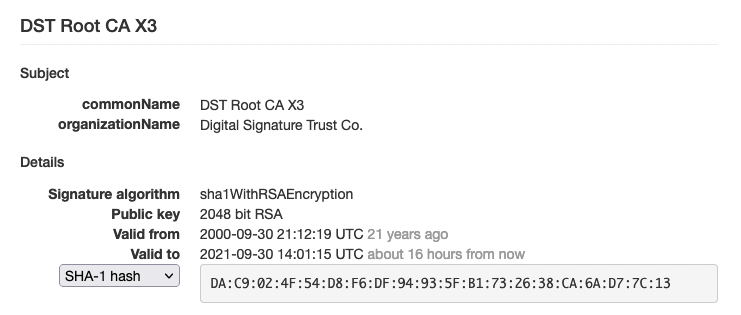
 Nearly 4 weeks after contracting COVID-19 I am finally able to return to work
Yes I have had both Jabs (my 2nd dose was back in June), and this knocked me for six. I spent most of the time in bed, and only started to get up and about 10 days ago.
I passed this on to both my wife and daughter (my wife has also been double jabbed), fortunately they didn t get it as bad as me and have been back at work / school for the last week. I also passed it on to a friend at the UK Debian BBQ, hosted once again by Sledge and Randombird, before I started showing symptoms. Fortunately (after a lot of PCR tests for attendees) it doesn t look like I passed it to anyone else
I wouldn t wish this on anyone.
I went on holiday back in August (still in England) thinking that having both jabs we would be fine. We stayed in self catering accommodation and we spent our time outside, we visited open air museums, walked around gardens etc, however we did eat out in relatively empty pubs and restaurants.
And yes we did all have face masks on when we went indoors (although obviously we removed them whilst eating).
I guess that is when I caught this, but have no idea exactly when or where.
Even after vaccination, it is still possible to both catch and spread this virus. Fortunately having been vaccinated my resulting illness was (statistically) less bad than it would otherwise have been.
I dread to think how bad I would have been if I had not already been vaccinated, I suspect that I would have ended up in ICU. I am still very tired, and have been told it may take many more weeks to get back to my former self. Other than being overweight, prior to this I have been in good health.
If you are reading this and have NOT yet had a vaccine and one is available for you, please, please get it done.
 Colson Whitehead's latest novel,

