Daniel Pocock: The multiple repository conundrum in Linux packaging
I'm involved with a number of free software projects as both a developer and as the maintainer of packages for various distributions such as Debian (which also feeds packages to Ubuntu) and OpenCSW.
I regularly come across the following situations:
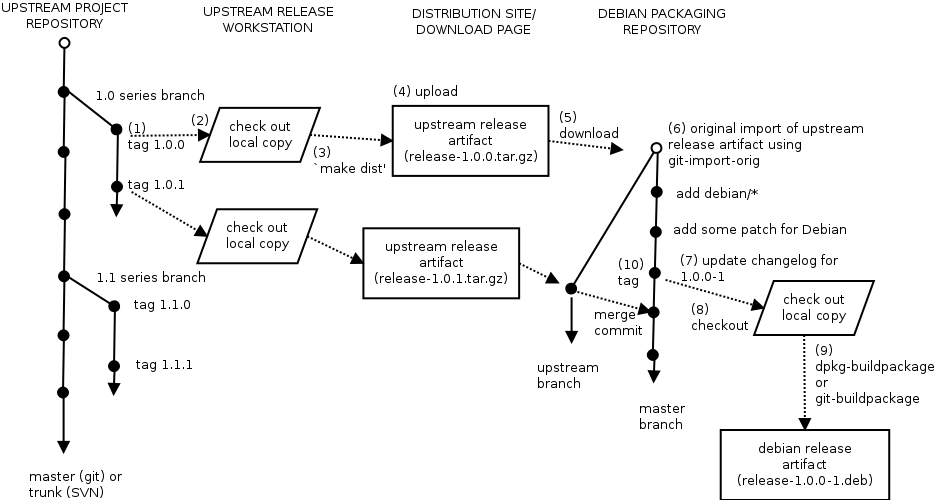 Let's work through each of the steps in the diagram:
The upstream release
onto the next steps himself: Packaging
- Developers of great software who would like to see it packaged, distributed and promoted conveniently through platforms like Debian
- Users of Linux distributions who are keen to use free software if it is presented in a convenient and accessible manner they are familiar with.
Let's work through each of the steps in the diagram:
The upstream release
- The developer/release manager updates the version number in
configure.ac
(sometimes called configure.in) and tags the code. (Usually this tag is on a dedicated release branch.) - The developer checks out a copy of the code from the tag into a fresh working directory
- The developer runs the autoreconf/automake tools, usually from a bootstrap script. These tools create a number of new files that don't exist in the project repository. Finally, the developer runs
make dist
, which puts all the files,
including the generated files, into a distribution tarball. It is worth emphasizing this point: the tarball is not just an archive of the files from the repository/tag, it also contains a number of
files generated by autotools. - The developer uploads the tarball to a web site such as the Sourceforge download page. Usually a release announcement is made now containing checksums for the tarball.
onto the next steps himself: Packaging
- The package is downloaded by the package maintainer
- If it is the first download, the maintainer creates a new git repository. If it has been packaged before, he clones the repository. The important point here is that this is not the upstream repository, it is an independent repository for Debian packaging. The maintainer uses the git-import-orig tool to import the upstream tarball into the packaging repository. The git-import-orig tool captures an exact snapshot of the upstream release tarball contents in a branch called upstream. One point where the Debian repository differs fundamentally from the upstream repository is that all files from the tarball will be tracked in the Debian git repository, even those automatically generated files that were created by autotools and don't exist in the upstream repository.
- The maintainer creates or updates the various artifacts for packaging. These files are kept on the master branch, and the tarball contents from the upstream branch are merged into master to create packages.
- When the maintainer feels the code is ready, he will check out a clean copy of the repository to build the package from.
- The maintainer executes a tool such as git-buildpackage or regular dpkg-buildpackage, which creates the *.deb files.
- The files are checked with a tool like lintian and some manual testing/installation. If all is OK, a tag is made in the packaging repository, with a suffix appended to the upstream version number to indicate which iteration of the package it applies to.
| Attachment | Size |
|---|---|
 release-packaging-workflow.dia | 3.97 KB |
 Also this year the

 On the next two days at the booth we chatted and discussed with visitors and other exhibitors a wide variety of questions, including 'When will be (the next Debian version) released?' and 'Are there installation disks available?'. The answers was as always 'When we are ready and we will have reached the quality-level we defined', 'No we don't have installation medias, as they are always outdated. Do you have an USB-dongle with you?'.
Merchandising was requested by visitors as always, but we just had some leftovers of fosdem, brought by Axel.
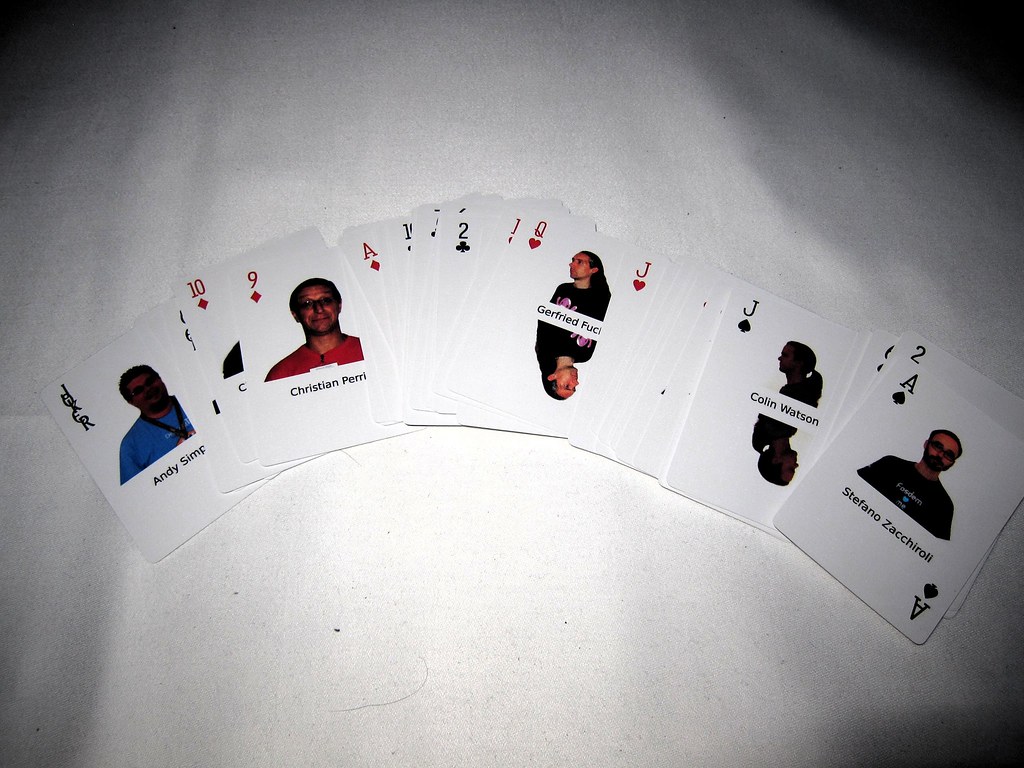
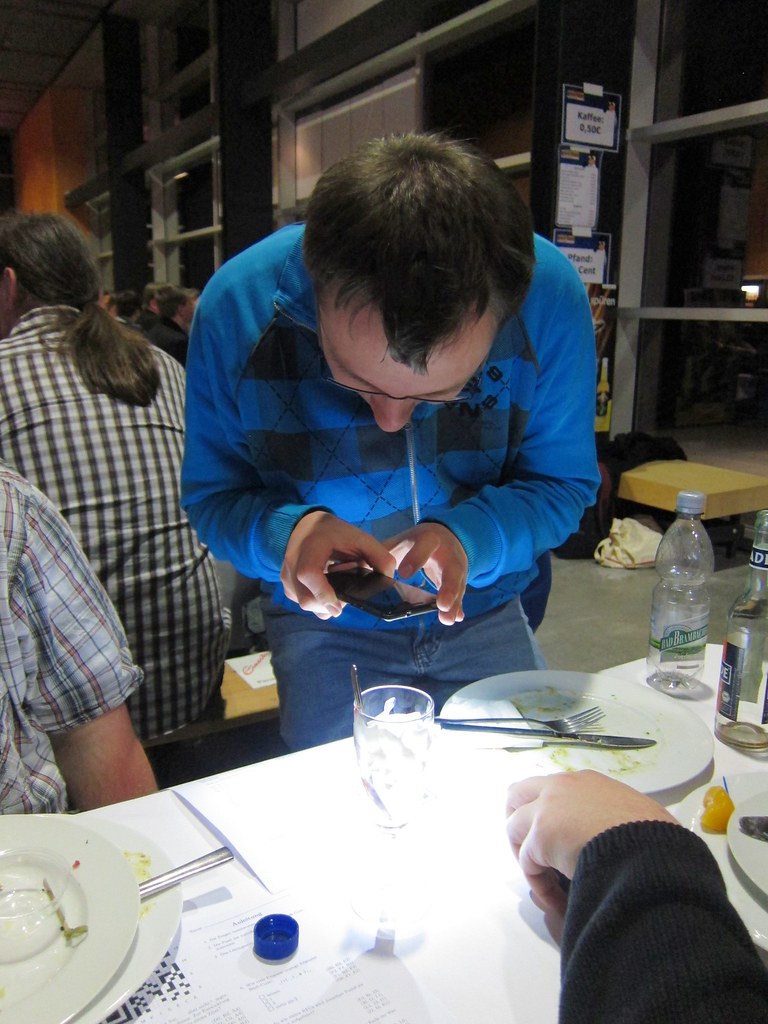
 Many thanks to Florian Baumann, Jan Dittberner, Andreas Tille, Christian Hoffmann, Axel Beckert, Markus Rekkenbeil, Daniel Schier, Jonas Genannt, Jan H rsch and kurio for taking care and running the booth, which worked out this year extreme smoothly from my point of view. Likewise as the last years a special thanks to
 People often ask me why I invest in low-tech, old-school investments like gold and silver bullion.
Surely for somebody working with technology every day, I would have some advantage in the world of investment?
The events of Cyprus this week should provide a clear answer: we've all been told that there is nothing safer than cash in the bank, protected by a Government deposit insurance scheme.
Yet it appears that in a pattern reminiscent of the
 The 2008 British film
 Back to the gold and silver. A recent report in
 You can find a

 With my new ISP providing
 I've provided a new patch

 This is my monthly summary of my free software related activities. If you re among the people who

 I feel like i've done a lot of blogging recently about failing to do things with proprietary software. That's annoying. This post is about something i made successfully with free software (and some non-software crafting): I made a Woolly Mammoth for my nephew!
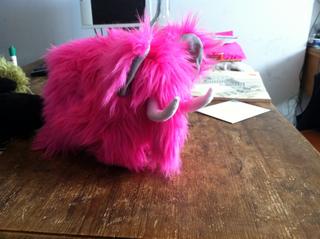 I documented
 Hi planet.ocaml.org.
Just a quick post to thanks Marek Kubica for his help on the planet.ocaml.org spring cleaning.
Here are the feeds that have been removed:
